Get stories like this delivered straight to your inbox. Sign up for The 74 Newsletter
This story was originally reported by Ebony JJ Curry of The 19th. Meet Ebony and read more of their reporting on gender, politics and policy.
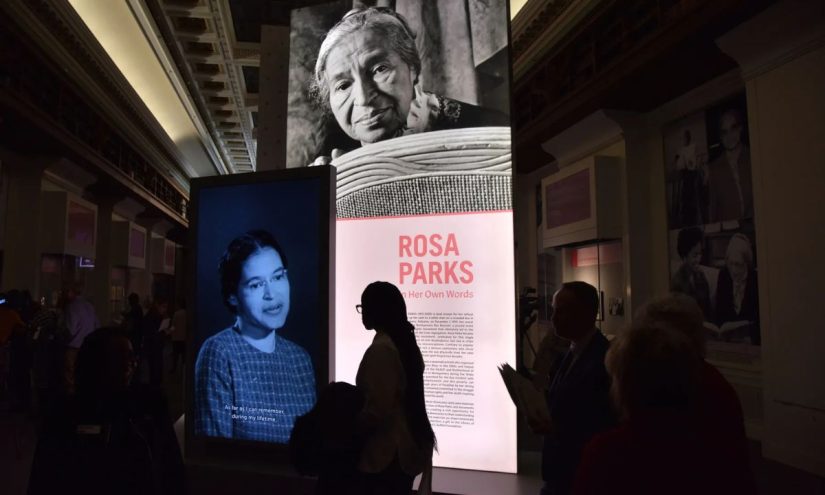
Seventy years have passed since Rosa Parks refused to surrender her seat on a Montgomery bus, and yet the country still tries to shrink her into that single moment — a tired seamstress who’d simply had enough.
Detroit, the city where she chose to continue her life, insists on remembering her differently. Not as an icon frozen in time, but as a Black woman whose lifelong organizing stretched from sexual violence cases in rural Alabama to open housing fights on Detroit’s west side.
That fuller story — truth beyond the myth — is exactly what the Rosa Parks Scholarship Foundation has fought to tell for 45 years.
The Rosa Parks Scholarship Foundation (RPSF) has awarded more than $3 million in scholarships to more than 2,250 high school seniors since its founding by The Detroit News and the Detroit Public Schools (DPS) in 1980.
“Most people actually don’t know the story of Rosa Parks,” said Dr. Danielle McGuire, RPSF board member, historian and author of “At the Dark End of the Street”, whose research permanently shifted how historians write about Parks and the civil rights movement. “She’s so much more interesting, so much more radical, and so much more involved in all kinds of things that we forget about. We keep her stuck on the bus in Montgomery in 1955.”
According to Kim Trent, a Detroit civic leader and former board president, the foundation, created through a racial discrimination lawsuit settlement involving Stroh’s Brewing Company, became one of the rare instances where federal accountability for racism produced long-term investment in Black futures.
A judge, DPS and The Detroit News agreed the money should honor Parks — who was living in Detroit and working for Rep. John Conyers at the time — by funding scholarships for Michigan students devoted to service and social change.
It is a statewide program, reaching students from Detroit to Grand Rapids to rural school districts where scholarship dollars often determine whether higher education is possible at all.
That framing makes her legacy active, not ceremonial.
“As part of her family, I feel grateful to be able to work together with my fellow board members to keep fighting for more opportunities to continue to provide scholarships,” said Erica Thedford, Parks’ great-niece and a foundation trustee. “I think Auntie Rosa would be extremely proud of what the Foundation has been able to achieve.”
The numbers tell one story — more than 1,000 scholars, millions awarded, forty $2,500 scholarships each year — and the essays tell another. Applicants must identify a modern social issue and explain how they would confront it using principles Parks embodied: discipline, non-negotiable dignity, community before self.
“Reading the essays of the students who apply is a great reminder that each person doing one act, no matter how small, creates a stronger network of love and kindness,” Thedford said. “Some of these students come from extreme hardship and still find the time and resources to volunteer at food banks, shelters… Some even take it upon themselves to be the organizer of ways to help the less fortunate at their schools.”
The award is one-time, not renewable, yet its impact stretches across decades.
“Once you become a Rosa Parks Scholarship Foundation recipient, you are a Rosa Parks Scholar for life,” Thedford said. “These students are now part of a network of people who root for each other, and that kind of support system is important.”
Trent knows that firsthand: She was a Parks Scholar herself when she graduated from Cass Tech High School.
“I received the scholarship in 1987,” she said. “Ironically, not only did I get it, but my best friend… also received the same scholarship. And then her son got the scholarship like 30 years later.”
Trent said the scholarship’s origin mirrors Parks’ life — created in response to injustice and sustained through community action.
“It’s one of those rare occasions where something beautiful grew out of an instance of racism and oppression,” Trent said.
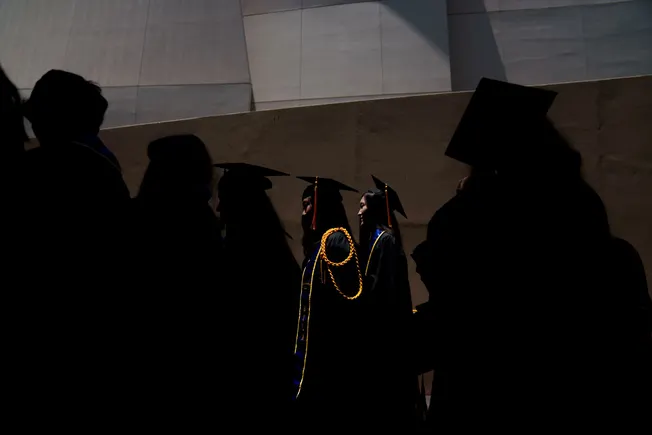
Over the years, some Parks Scholars attended community college. Others enrolled at flagship universities. All had to articulate how their education would serve a community beyond themselves.
Some, like Emmy-winning actor Courtney B. Vance, who’s from Highland Park, Michigan, went on to shape national culture. Others are now attorneys, educators and nonprofit leaders across the state.
“What gets lost in what she did is the reason she did it,” Trent added. “It wasn’t just so she could sit on a bus. It was because she was trying to open up opportunity for people who had been denied opportunity.”
That is the heartbeat of the foundation’s lineage.
Parks was not simply resisting segregation. She was rejecting the entire machinery that kept Black women from safety, education and economic autonomy.
McGuire’s research highlights how Rosa Parks was investigating sexual violence cases long before #MeToo, defending Black girls like Recy Taylor, whose voices were dismissed in courtrooms and newspapers. She worked alongside the NAACP on equity cases. When she left Alabama under threat of death and moved to Detroit, she became the neighbor who knew everyone’s children, the church member who attended every meeting, the woman who collected information and names and needs.
“She was the person in the neighborhood who knew all the kids, who worked in almost every community organization you can imagine, to make life better for her people,” McGuire said. “The scholarship foundation is an example of that — just one of many.”
Every year, nearly 400 applicants encounter that fuller history — the Parks who fought for open housing in Detroit, who believed in Black self-determination, who, as McGuire notes, “never stopped fighting for equality and justice for people who didn’t have a voice that was being heard.”
That is not accidental. It is by design.
“We ask our applicants to become familiar with Rosa Parks and the tactics and strategies she used to make changes in her community and how they will do the same,” McGuire said. “I think it gives them hope. It links them to a tradition and a history of hope and change.”
This anniversary of Parks’ arrest arrives as school boards strip Black history from K-12 classrooms and as scholarship programs for marginalized students come under attack. Thedford sees the foundation’s work as a refusal.
“During this time, when we are hearing of funding being pulled from schools and programs that are needed to serve our youth, the Foundation is able to continue its provision of funds,” she said.
McGuire is blunt about what that represents:
“No matter how hard people try to cancel the past, the past is very much alive,” she said. “Rosa Parks’ history gives us so much honesty about America… and studying her is paramount to getting through any difficult time.”
Seventy years later, the lesson remains unchanged: Rosa Parks did not fight for a place to sit, she fought for the generations who would rise. Today, those students are still applying, still studying her strategies, still refusing to yield.
This story was originally published on The 19th.
Did you use this article in your work?
We’d love to hear how The 74’s reporting is helping educators, researchers, and policymakers. Tell us how