Q: What is the university’s mandate behind this role? How does it help align with and advance the university’s strategic priorities?
A: Excellence in undergraduate education is essential to how Notre Dame envisions itself fulfilling its institutional mission. The digital learning project manager will contribute directly to the educational experience of our undergraduate students, working with faculty, learning designers, a media team and other project management professionals to create cutting-edge digital offerings meant to enhance Notre Dame’s signature residential learning environment.
In addition, the person in this role will manage initiatives that bring elements of Notre Dame’s academic life to learners beyond our campus. These range from online courses open to the general public to online pathway programs for current high school students exploring college opportunities and incoming first-year Notre Dame students prepping for the rigors of a university curriculum.
Q: Where does the role sit within the university structure? How will the person in this role engage with other units and leaders across campus?
A: The digital learning project manager is a member of the Office of Digital Learning, which is part of a larger unit, reporting to the Office of the Provost, called Notre Dame Learning. Housing the ODL and the Kaneb Center for Teaching Excellence, Notre Dame Learning brings together their teaching and learning expertise along with that of the Office of Information Technology’s Teaching and Learning Technologies group to serve as the hub of learning excellence and innovation at Notre Dame.
Working in the ODL will give the person in this position the chance to collaborate directly with instructors, the university’s academic departments and colleges, and colleagues across the Notre Dame Learning organization. They will work closely with the ND Learning leadership team to advance the organization’s strategic priorities.
Q: What would success look like in one year? Three years? Beyond?
A: From day one, building relationships will be paramount in this position. The Notre Dame family embodies a strong sense of community, and successful project managers on our campus are those who embrace the human component of their work, recognizing that shepherding a project from initiation to completion requires personal connection as much as it does the ability to keep a group on task. The importance of being able to understand faculty priorities and concerns, interface with administrators both internal and external to Notre Dame, and partner with colleagues across the ODL and Notre Dame Learning more generally cannot be overstated. As these relationships deepen over time, the digital learning project manager will become a go-to member of the Notre Dame Learning team and assume a larger role in driving its initiatives.
Q: What kinds of future roles would someone who took this position be prepared for?
A: Given all the different skill sets someone in this position will draw on and/or develop—e.g., project management, client/stakeholder relations, written and verbal communication, familiarity with media production and learning design processes, knowledge of higher education and organizational dynamics more broadly—it is a role that can serve as a springboard into opportunities with expanded leadership components. This might be within a unit like the Office of Digital Learning, in other areas of higher ed such as student services or information technology, or in fields outside academia altogether. Named as America’s Best Large Employer by Forbes earlier this year, Notre Dame is a great place both to work and build toward future career success.
Please get in touch if you are conducting a job search at the intersection of learning, technology and organizational change. If your gig is a good fit, featuring your gig on Featured Gigs is free.
Higher education in the UK has a solid background in leveraging scale in purchasing digital content and licenses through Jisc. But when it comes to purchasing specific technology platforms higher education institutions have tended to go their own way, using distinct specifications tailored to their specific needs.
There are some benefits to this individualistic approach, otherwise it would not have become the status quo. But as the Universities UK taskforce on transformation and efficiency proclaims a “new era of collaboration” some of the long standing assumptions about what can work in a sharing economy are being dusted off and held up to the light to see if they still hold. Efficiency – including finding ways to realise new forms of value but with less overall resource input – is no longer a nice to have; it’s essential for the sector to remain sustainable.
At Jisc, licensing manager Hannah Lawrence is thinking about the ways that the sector’s digital services agency can build on existing approaches to collective procurement towards a more systematic collaboration, specifically, in her case, exploring ideas around a collaborative route to procurement for technology that supports assessment and feedback. Digital assessment is a compelling area for possible collaboration, partly because the operational challenges are fairly consistent between institutions – such as exam security, scalability, and accessibility – but also because of the shared pedagogical challenge of designing robust assessments that take account of the opportunities and risks of generative AI technology.
The potential value in collaboration isn’t just in cost savings – it’s also about working together to test and pilot approaches, and share insight and good practice. “Collaboration works best when it’s built on trust, not just transaction,” says Hannah. “We’re aiming to be transparent and open, respecting the diversity of the sector, and making collaboration sustainable by demonstrating real outcomes and upholding data handling standards and ethics.” Hannah predicts that it may take several years to develop an initial iteration of joint procurement mechanism, in collaboration with a selection of vendors, recognising that the approach could evolve over years to offer “best on class” products at a competitive price to institutions who participate in collective procurement approaches.
Reviewing the SIKTuation
One way of learning how to build this new collaborative approach is to look to international examples. In Norway, SIKT is the higher education sector’s shared services agency. SIKT started with developing a national student information system, and has subsequently rolled out, among other initiatives, national scientific and diploma archives, and a national higher education application system – and a national tender for digital assessment.
In its first iteration, when the technology for digital assessment was still evolving, three different vendors were appointed, but in the most recent version, SIKT appointed one single vendor – UNIwise – as the preferred supplier for digital assessment for all of Norwegian higher education. Universities in Norway are not required to follow the SIKT framework, of course, but there are significant advantages to doing so.
“Through collaboration we create a powerful lobby,” says Christian Moen Fjære, service manager at SIKT. “By procuring for 30,000 staff and 300,000 students we can have a stronger voice and influence with vendors on the product development roadmap – much more so than any individual university. We can also be collectively more effective in sharing insight across the network, like sample exam questions, for example.” SIKT does not hold views about how students should be taught, but as pedagogy and technology become increasingly intertwined, SIKT’s discussions with vendors are typically informed by pedagogical developments. Christian explains, “You need to know what you want pedagogically to create the specification for the technical solution – you need to think what is best for teaching and assessment and then we can think how to change software to reflect that.”
For vendors, it’s obviously great to be able to sell your product at scale in this way but there’s more to it than that – serving a critical mass of buyers gives vendors the confidence to invest in developing their product, knowing it will meet the needs of their customers. Products evolve in response to long-term sector need, rather than short-term sales goals.
SIKT can also flex its muscles in negotiating favourable terms with vendors, and use its expertise and experience to avoid pitfalls in negotiating contracts. A particularly pertinent example is on data sharing, both securing assurances of ethical and anonymous sharing of assessment data, and clarity about ultimate ownership of the data. Participants in the network can benefit from a shared data pool, but all need to be confident both that the data will be handled appropriately and that ultimately it belongs to them, not the vendor. “We have baked into the latest requirements the ability to claw back data – we didn’t have this before, stupid, right?” says Christian. “But you learn as the needs arise.”
Difference and competition
In the UK context, the sector needs reassurance that diversity will be accommodated – there’s a wariness of anything that looks like it might be a one-size-fits-all model. While the political culture in Norway is undoubtedly more collectivist than in the UK, Norwegian higher education institutions have distinct missions, and they still compete for prestige and to recruit the best students and staff.
SIKT acknowledges these differences through a detailed consultation process in the creation of national tenders – a “pre-project” on the list of requirements for any technology platform, followed by formal consultation on the final list, overseen by a steering group with diverse sector representation. But at the end of the day to realise the value of joining up, there does need to be some preparedness to compromise, or to put it another way, to find and build on areas of similarity rather than over-refining on what can often be minor differences. Having a coordinating body like SIKT convene the project helps to navigate these issues. And, of course, some institutions simply decide to go another way, and pay more for a more tailored product. There is nothing stopping them from doing so.
As far as SIKT is concerned, competition between institutions is best considered in the academic realm, in subjects and provision, as that is what benefits the student. For operations, collaboration is more likely to deliver the best results for both institutions and students. But SIKT remains agnostic about whether specific institutions have a different view. “We don’t at SIKT decide what counts as competitive or not,” says Christian. “Universities will decide for themselves whether they want to get involved in particular frameworks based on whether they see a competitive advantage or some other advantage from doing so.”
The medium term horizon for the UK sector, based on current discussions, is a much more networked approach to the purchase and utilisation of technology to support learning and teaching – though it’s worth noting that there is nothing stopping consortia of institutions getting together to negotiate a shared set of requirements with a particular vendor pending the development of national frameworks. There’s no reason to think the learning curve even needs to be especially steep – while some of the technical elements could require a bit of thinking through, the sector has a longstanding commitment to sharing and collaboration on high quality teaching and learning, and to some extent what’s being talked about right now is mostly about joining the dots between one domain and another.
This article is published in association with UNIwise. For further information about UNIwise and the opportunity to collaborate contact Tim Peers, Head of Partnerships.
Universities and colleges today face a highly competitive recruitment environment. Declining enrollment trends, shifting demographics, and the rise of alternative education options mean institutions must work harder than ever to connect with prospective students. Traditional outreach methods alone are no longer enough.
That’s where digital marketing for universities comes in. By leveraging the right mix of online strategies, higher education institutions can build brand awareness, generate qualified leads, and foster lasting relationships with students. From content marketing and SEO to social media and data-driven analytics, digital tools give schools the power to meet prospective students where they are: online.
In this blog post, we’ll break down eight proven digital marketing strategies tailored for universities. Along the way, we’ll answer common questions—like what exactly digital marketing in education means and how much universities invest in it—to give you a clear, actionable roadmap for success.
Struggling with enrollment?
Our expert digital marketing services can help you attract and enroll more students!
Understanding Digital Marketing in Higher Education
What is digital marketing in education? Digital marketing in education is the use of online channels—such as websites, SEO, social media, email, and digital ads—to promote programs, connect with prospective students, and engage alumni. Unlike other sectors, the “product” is not just a service but an experience and long-term investment, so messaging must inform, inspire, and build trust.
Why is digital marketing for universities so critical now? The stakes are high. With declining enrollments and growing skepticism about the value of a degree, institutions are investing heavily in outreach. According to SimpsonScarborough’s 2019 State of Higher Ed Marketing report, universities typically allocate between $429 and $623 per enrolled student each year to marketing efforts. The University of Maryland Global Campus, for example, committed $500 million over six years, half dedicated to digital ads.
Digital channels offer clear advantages: precise targeting, interactive storytelling, and measurable results. More importantly, they allow two-way communication—helping schools nurture relationships from first contact through enrollment, turning digital marketing into both a recruitment engine and a trust-building tool.
Below, we outline 8 proven digital marketing strategies for universities and colleges. These strategies have been tested in the education sector and shown to drive results – whether it’s increasing website traffic, applications, or student engagement. Along the way, we’ll highlight real-world examples (with sources) from reputable institutions to illustrate how each strategy can be put into practice.
1. Content Marketing and Search Engine Optimization (SEO)
In higher education, content is king. Universities that create valuable, student-focused content build trust and attract more applicants. Effective content marketing means answering the questions students and parents are already asking—through program pages, blogs, testimonials, videos, guides, and virtual tours.
SEO ensures this content gets discovered. When prospects search “best MBA in Canada” or “colleges with digital marketing programs,” optimized titles, headings, and keywords help your institution appear in results. Consistent updates, quality backlinks, and keyword-rich program pages boost visibility even further.
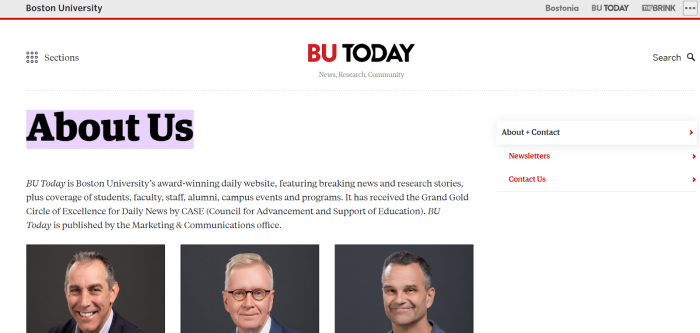
Example: Boston University runs an extensive content hub (“BU Today”) that publishes daily stories about student life, wellness, careers, research and more. This on-site news magazine – featuring contributions from students, faculty, staff, and alumni – builds trust and drives organic traffic by answering the questions prospective students are asking. BU Today’s engaging content strategy not only informs and inspires readers, but also strengthens the university’s visibility in search results through fresh, keyword-rich stories.
Students spend countless hours on social media, making it one of the most powerful tools for higher ed marketing. Platforms like Instagram, TikTok, YouTube, and LinkedIn allow universities to showcase campus life, share authentic stories, and build community long before students arrive on campus.
Tailor content to each platform: Instagram thrives on visual storytelling, TikTok on fun, viral content, YouTube on long-form video, and LinkedIn on alumni success. Meeting students where they are ensures your message resonates.
Authenticity wins: Many schools hand over the reins to students for “takeovers.” For instance, Babson College used Instagram takeovers for Q&As, giving prospects a candid look at campus life. Spelman College maximizes Instagram’s features—Stories, Highlights, and IGTV—to create a polished yet authentic presence that builds trust.
TikTok’s rise: Universities like Oxford and Indiana University leverage TikTok trends to humanize their brand and showcase student enthusiasm, boosting engagement dramatically.
The payoff is real: John Cabot University increased applications by 42% after ramping up its social media presence. Done right, social platforms don’t just market a school—they cultivate belonging and amplify word-of-mouth.
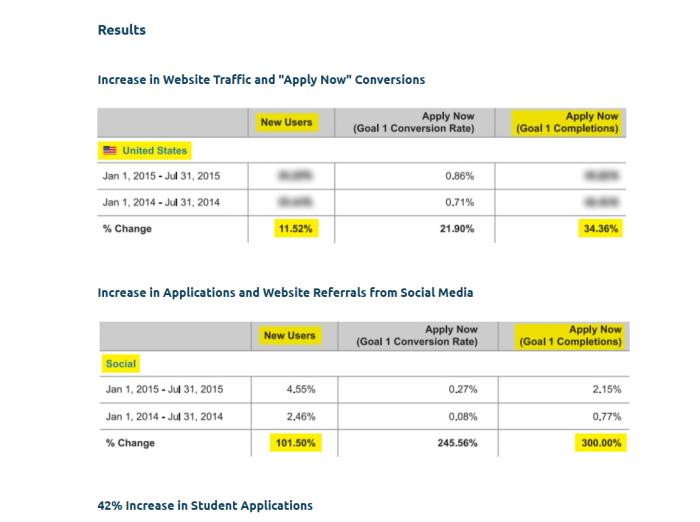
Example: John Cabot University, an American-accredited university in Rome, overhauled its social media strategy to engage prospective students and saw remarkable results. By partnering with Higher Education Marketing and tailoring content to its audience, JCU achieved a 300% increase in applications coming directly from social media and a 42% overall rise in student applications. In practice, this involved creating more audience-targeted posts and campaigns that funneled followers to the admissions site – demonstrating how active social engagement can translate into measurable recruitment gains.
Organic content builds long-term visibility, but paid digital advertising delivers immediate reach. Pay-Per-Click (PPC) ads—on Google, Facebook, Instagram, LinkedIn, or YouTube—allow universities to target demographics, locations, and search intent with precision.
Search ads help institutions appear at the top of results for competitive terms like “MBA program online” or “study in Canada.” Even major universities bid on their own branded keywords to capture applicants searching directly for admissions. These ads often lead to optimized landing pages designed to convert interest into inquiries.
Social ads provide granular targeting. The takeaway? With smart targeting, strong creative, and optimized landing pages, PPC can deliver measurable results in recruitment, even on modest budgets.
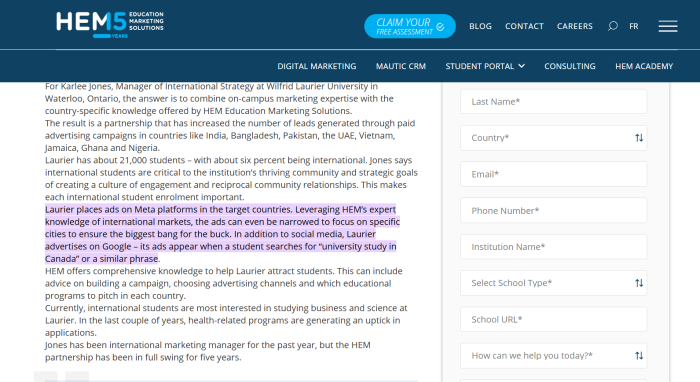
Example: Laurier employs highly targeted PPC advertising to reach international prospects in key markets. In partnership with HEM, Laurier runs country-specific campaigns on Google and Meta (Facebook/Instagram), even narrowing ads to specific cities to maximize relevance. For example, prospective students in India, Nigeria or Vietnam might see ads for Laurier programs, and search ads ensure Laurier appears for queries like “study in Canada university.” This precise targeting has boosted Laurier’s lead generation from countries such as India, Bangladesh, Ghana and more, illustrating how PPC can efficiently capture students in different regions.
Email remains one of the highest-ROI tools for higher ed recruitment. When a prospect shares their email, it creates an opportunity for personalized, direct communication that nurtures them through the enrollment journey.
Lead nurturing works best through sequenced emails—welcoming inquiries, highlighting programs, showcasing campus life, and reminding applicants to complete next steps. Segmentation and personalization make campaigns more effective: tailoring messages by program, audience type, or student behavior ensures relevance and boosts engagement.
Automation tools like HubSpot or Slate allow universities to trigger timely follow-ups—such as reminders for incomplete applications or pre-visit info before a campus tour. Done well, email serves as the connective tissue of digital strategy—tying content, events, and ads into one cohesive student journey.
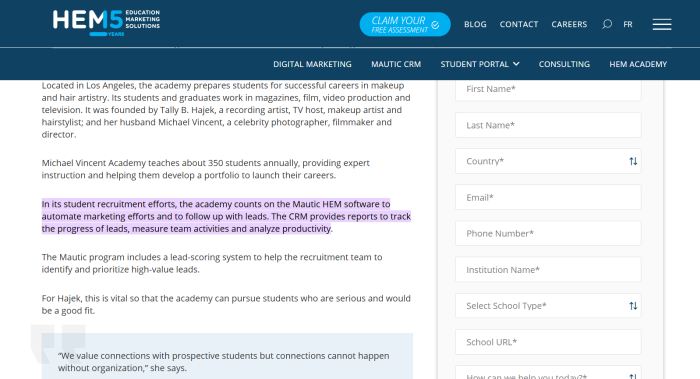
Example: Michael Vincent Academy, a private vocational school in Los Angeles, streamlined its recruitment process by implementing a customized CRM with marketing automation. The academy uses an automated system (HEM’s Mautic CRM) to follow up with every inquiry, score leads, and send sequenced emails. Routine tasks – from welcome emails to application reminders – are now handled automatically, allowing staff to spend more time on personal outreach to high-value prospects. The impact is significant: key elements of the follow-up workflow are now automated, improving efficiency and ensuring no prospective student falls through the cracks.
Pro Tip: Don’t overload inboxes—send 1 email every 7–10 days, keep designs mobile-friendly, and always include a clear call-to-action.
5. Website Optimization and User Experience (UX)
Your website is your digital campus, often the first impression prospective students have. A well-optimized site improves engagement and conversion by guiding visitors smoothly through their journey.
Mobile-first design is non-negotiable. With most students researching on phones, responsive layouts, fast load speeds, and intuitive navigation are critical. Google also rewards mobile-friendly sites in search rankings.
Clear navigation helps diverse audiences—prospective undergrads, grads, parents, international students—find relevant information quickly. Saint Louis University, for example, introduced an interactive admissions page with customizable “pathways,” simplifying content discovery and personalizing the student journey.
Engaging media like photos, videos, and virtual tours immerse visitors in campus life, while CTAs such as “Request Info” or “Apply Now” nudge them toward action.
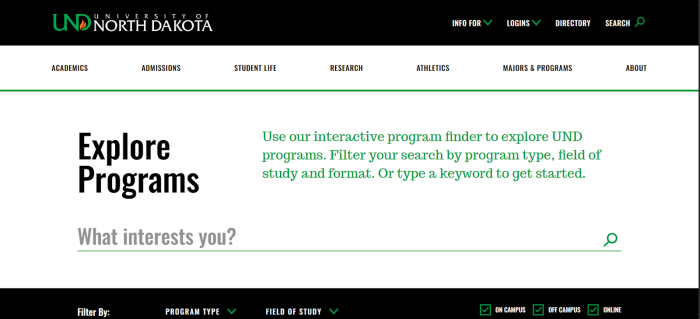
Example: University of North Dakota undertook a comprehensive website refresh that yielded strong results in both engagement and conversions. The new site introduced a powerful “Program Finder” tool giving prospective students one central place to discover academic programs by interest. The homepage and navigation were reorganized around key audiences (prospective undergrads, grad students, parents, etc.), making it easier for each group to find relevant info. UND also weaves in student stories and news in a way that reflects student life and values, rather than just facts. This focus on UX paid off: after launch, UND saw organic traffic climb and a 62% jump in undergraduate inquiries year-over-year, all while many peer institutions saw declines. It underscores that a fast, intuitive, mobile-friendly site can be a university’s best recruitment tool.
Pro Tip: Audit your site regularly—outdated info or broken links can undo even the best design.
6. Search Engine Marketing (SEM) and Local SEO
Search engine marketing ensures your institution is visible when prospective students actively look for programs. Beyond broad SEO, local optimization and targeted campaigns make a significant difference.
Local SEO helps capture location-based searches like “MBA in Toronto” or “universities near me.” Universities should claim and update their Google Business profiles, add campus photos, respond to reviews, and use city/region keywords across their site. For multi-campus schools, create individual location pages optimized with local terms.
Long-tail keywords are equally powerful. Students often search specific queries like “best undergraduate business programs for entrepreneurship.” Creating FAQ pages, blog posts, or landing pages around these terms captures highly motivated prospects. Likewise, many universities now optimize program pages with alumni career outcomes and salary data to rank for career-focused searches.
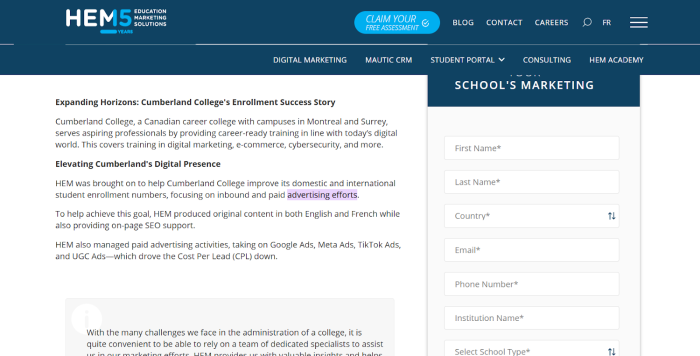
Example: Cumberland College, a career college in Montréal, used SEM and on-page SEO to significantly boost its visibility and inquiries. With expert help, Cumberland optimized its website content (in English and French) and refocused its keyword strategy – plus ran complementary Google Ads – to capture more search traffic. The impact was dramatic over a short period: organic web visitors rose by 27.5%, and overall leads (inquiries) jumped by 95% after the campaign, compared to the previous year. Even more striking, leads coming specifically from organic search increased nearly five-fold (a 386% increase) as Cumberland climbed higher in search results.
Pro Tip: Align SEM campaigns with the admissions cycle—boost spend before deadlines to capture undecided applicants.
7. Video Marketing and Virtual Engagements
In the digital era, video has become an incredibly powerful medium of digital marketing for colleges, and universities are uniquely positioned to leverage it. From campus tour videos and student vlogs to recorded webinars and live-streamed events, video marketing allows prospective students to experience a taste of campus life and academics from anywhere in the world. It’s engaging, shareable, and often more memorable than text.
Campus tours and virtual experiences: When students cannot visit in person (due to distance or as we saw during pandemic lockdowns), a virtual tour is the next best thing. Many universities now feature immersive 360-degree virtual campus tours on their websites. These let users “walk” through the quad, peek into classrooms, dorms, and labs, all from their computer or phone. It’s an interactive way to showcase facilities and atmosphere. Even a simple narrated campus tour video on YouTube can be effective – guiding viewers through major spots on campus while current students or staff explain highlights.
Storytelling through students: Prospective students trust their peers. “Day in the life” vlogs or testimonial clips highlighting internships and career outcomes resonate strongly. Short, authentic videos often outperform highly produced pieces.
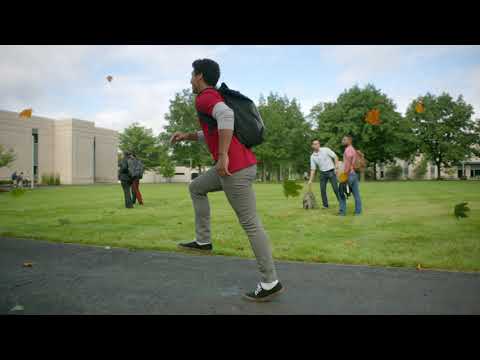
Example: Montgomery County Community College (USA) grabbed attention with an award-winning recruitment video campaign. Their 30-second video spot, “You in Motion,” is a high-energy montage that inspires viewers to envision their success at the college. In that half-minute, the video communicates key value props – an affordable, top-notch education; extensive support resources; and a wide range of programs – all set to uplifting visuals of campus and student achievements. The campaign succeeded in exciting prospective students and driving home the message that at Montco you can “make your own momentum”. It’s a prime example of how concise, well-produced video content can boost a school’s appeal and conversion rates.
Source: YouTube
Takeaway: Video marketing builds trust through storytelling, making your institution both relatable and aspirational.
8. Data Analytics and Continuous Optimization
A major advantage of digital marketing for colleges is the ability to measure performance in real time. Universities that actively track and optimize campaigns consistently outperform those that rely on static strategies.
With tools like Google Analytics, CRMs, and marketing automation, schools can monitor conversions such as info requests, applications, and event signups, while attributing results to specific channels. For example, McGill University’s School of Continuing Studies implemented eCommerce-style tracking with HEM, enabling them to connect digital ad spend directly to applications and enrollment outcomes.
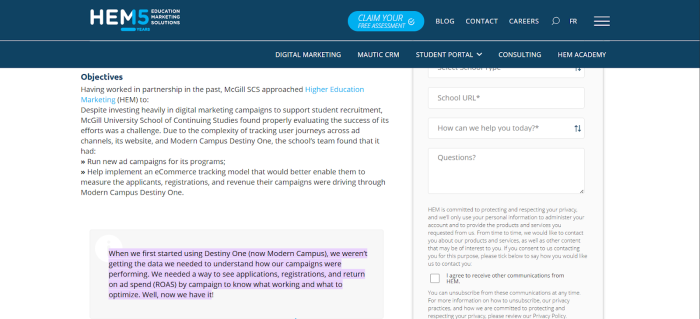
Example: McGill’s School of Continuing Studies struggled to connect its digital ad spend to actual enrollments – until it implemented an advanced analytics solution. Working with HEM, McGill SCS set up eCommerce-style tracking (via its Destiny One online registration system) to measure exactly how ads and web campaigns translated into applications, registrations, and revenue. This involved configuring Google Analytics and tag manager to capture each student touchpoint and conversion. The result was a newfound ability to make data-driven decisions on marketing: McGill can now see ROI by campaign and optimize accordingly, rather than guessing.
Optimization goes beyond tracking. A/B testing landing pages, refining email subject lines, or adjusting ad targeting can deliver significant lifts in conversions. Ultimately, analytics turn insights into action. By continuously refining campaigns based on real results, institutions ensure smarter spending, better engagement, and stronger recruitment outcomes.
Bringing It All Together
Digital marketing is no longer optional for universities—it’s the foundation of how students discover, evaluate, and choose their educational path. From content marketing and social media engagement to PPC, email nurturing, and data-driven optimization, each strategy plays a role in building trust and guiding prospects through the enrollment journey.
The institutions that succeed are those that take an integrated approach: aligning their website, campaigns, and student communications to deliver a consistent, authentic experience. Real-world examples—from Boston University’s content hub to McGill University’s data-driven enrollment gains—show how strategy translates into measurable results.
Ultimately, digital marketing is about connection. By telling authentic stories, engaging students where they are, and continuously refining based on analytics, universities can cut through the noise, reach the right audiences, and build relationships that last well beyond enrollment.
Done right, digital marketing doesn’t just attract students—it creates advocates who carry your institution’s story forward.
Struggling with enrollment?
Our expert digital marketing services can help you attract and enroll more students!
FAQs
Q: What is digital marketing in education?
A: Digital marketing in education is the use of online channels—such as websites, SEO, social media, email, and digital ads—to promote programs, connect with prospective students, and engage alumni. Unlike other sectors, the “product” is not just a service but an experience and long-term investment, so messaging must inform, inspire, and build trust.
Q: Why is digital marketing for universities so critical now?
A: The stakes are high. With declining enrollments and growing skepticism about the value of a degree, institutions are investing heavily in outreach.
Q: How much do universities spend on digital marketing?
A: Universities now spend between $429 and $623 per enrolled student, per year on marketing.
An unexpected group of presenters–11th graders from Whitney M. Young Magnet High School in Chicago–made a splash at this year’s ACM Conference on Fairness, Accountability, and Transparency (FAccT). These students captivated seasoned researchers and professionals with their insights on how school environments shape students’ views of AI. “I wanted our project to serve as a window into the eyes of high school students,” said Autumn Moon, one of the student researchers.
What enabled these students to contribute meaningfully to a conference dominated by PhDs and industry veterans was their critical data literacy–the ability to understand, question, and evaluate the ethics of complex systems like AI using data. They developed these skills through their school’s Data is Powerprogram.
Launched last year, Data is Power is a collaboration among K-12 educators, AI ethics researchers, and the Young Data Scientists League. The program includes four pilot modules that are aligned to K-12 standards and cover underexplored but essential topics in AI ethics, including labor and environmental impacts. The goal is to teach AI ethics by focusing on community-relevant topics chosen by our educators with input from students, all while fostering critical data literacy. For example, Autumn’s class in Chicago used AI ethics as a lens to help students distinguish between evidence-based research and AI propaganda. Students in Phoenix explored how conversational AI affects different neighborhoods in their city.
Why does the Data is Power program focus on critical data literacy? In my former role leading a diverse AI team at Amazon, I saw that technical skills alone weren’t enough. We needed people who could navigate cultural nuance, question assumptions, and collaborate across disciplines. Some of the most technically proficient candidates struggled to apply their knowledge to real-world problems. In contrast, team members trained in critical data literacy–those who understood both the math and the societal context of the models–were better equipped to build responsible, practical tools. They also knew when not to build something.
As AI becomes more embedded in our lives, and many students feel anxious about AI supplanting their job prospects, critical data literacy is a skill that is not just future-proof–it is future-necessary. Students (and all of us) need the ability to grapple with and think critically about AI and data in their lives and careers, no matter what they choose to pursue. As Milton Johnson, a physics and engineering teacher at Bioscience High School in Phoenix, told me: “AI is going to be one of those things where, as a society, we have a responsibility to make sure everyone has access in multiple ways.”
Critical data literacy is as much about the humanities as it is about STEM. “AI is not just for computer scientists,” said Karren Boatner, who taught Autumn in her English literature class at Whitney M. Young Magnet High School. For Karren, who hadn’t considered herself a “math person” previously, one of the most surprising parts of the program was how much she and her students enjoyed a game-based module that used middle school math to explain how AI “learns.” Connecting math and literature to culturally relevant, real-world issues helps students see both subjects in a new light.
As AI continues to reshape our world, schools must rethink how to teach about it. Critical data literacy helps students see the relevance of what they’re learning, empowering them to ask better questions and make more informed decisions. It also helps educators connect classroom content to students’ lived experiences.
If education leaders want to prepare students for the future–not just as workers, but as informed citizens–they must invest in critical data literacy now. As Angela Nguyen, one of our undergraduate scholars from Stanford, said in her Data is Power talk: “Data is power–especially youth and data. All of us, whether qualitative or quantitative, can be great collectors of meaningful data that helps educate our own communities.”
Evan Shieh, Young Data Scientists League
Evan Shieh is the Executive Director of the Young Data Scientists League.
Latest posts by eSchool Media Contributors (see all)
I’ll admit that I use AI. I’ve asked it to help me figure out challenging Excel formulas that otherwise would have taken me 45 minutes and a few tutorials to troubleshoot. I’ve used it to help me analyze or organize massive amounts of information. I’ve even asked it to help me devise a running training program aligning with my goals and fitting within my schedule. AI is a fantastic tool–and that’s the point. It’s a tool, not a replacement for thinking.
As AI tools become more capable, more intuitive, and more integrated into our daily lives, I’ve found myself wondering: Are we growing too dependent on AI to do our thinking for us?
This question isn’t just philosophical. It has real consequences, especially for students and young learners. A recent study published in the journal Societies reports that people who used AI tools consistently showed a decline in critical thinking performance. In fact, “whether someone used AI tools was a bigger predictor of a person’s thinking skills than any other factor, including educational attainment.” That’s a staggering finding because it suggests that using AI might not just be a shortcut. It could be a cognitive detour.
The atrophy of the mind
The term “digital dementia” has been used to describe the deterioration of cognitive abilities as a result of over-reliance on digital devices. It’s a phrase originally associated with excessive screen time and memory decline, but it’s found new relevance in the era of generative AI. When we depend on a machine to generate our thoughts, answer our questions, or write our essays, what happens to the neural pathways that govern our own critical thinking? And will the upcoming era of agentic AI expedite this decline?
Cognitive function, like physical fitness, follows the rule of “use it or lose it.” Just as muscles weaken without regular use, the brain’s ability to evaluate, synthesize, and critique information can atrophy when not exercised. This is especially concerning in the context of education, where young learners are still building those critical neural pathways.
In short: Students need to learn how to think before they delegate that thinking to a machine.
Can you still think critically with AI?
Yes, but only if you’re intentional about it.
AI doesn’t relieve you of the responsibility to think–in many cases, it demands even more critical thinking. AI produces hallucinations, falsifies claims, and can be misleading. If you blindly accept AI’s output, you’re not saving time, you’re surrendering clarity.
Using AI effectively requires discernment. You need to know what you’re asking, evaluate what you’re given, and verify the accuracy of the result. In other words, you need to think before, during, and after using AI.
The “source, please” problem
One of the simplest ways to teach critical thinking is also the most annoying–just ask my teenage daughter. When she presents a fact or claim that she saw online, I respond with some version of: “What’s your source?” It drives her crazy, but it forces her to dig deeper, check assumptions, and distinguish between fact and fiction. It’s an essential habit of mind.
But here’s the thing: AI doesn’t always give you the source. And when it does, sometimes it’s wrong, or the source isn’t reputable. Sometimes it requires a deeper dive (and a few more prompts) to find answers, especially to complicated topics. AI often provides quick, confident answers that fall apart under scrutiny.
So why do we keep relying on it? Why are AI responses allowed to settle arguments, or serve as “truth” for students when the answers may be anything but?
The lure of speed and simplicity
It’s easier. It’s faster. And let’s face it: It feels like thinking. But there’s a difference between getting an answer and understanding it. AI gives us answers. It doesn’t teach us how to ask better questions or how to judge when an answer is incomplete or misleading.
This process of cognitive offloading (where we shift mental effort to a device) can be incredibly efficient. But if we offload too much, too early, we risk weakening the mental muscles needed for sustained critical thinking.
Implications for educators
So, what does this mean for the classroom?
First, educators must be discerning about how they use AI tools. These technologies aren’t going away, and banning them outright is neither realistic nor wise. But they must be introduced with guardrails. Students need explicit instruction on how to think alongside AI, not instead of it.
Second, teachers should emphasize the importance of original thought, iterative questioning, and evidence-based reasoning. Instead of asking students to simply generate answers, ask them to critique AI-generated ones. Challenge them to fact-check, source, revise, and reflect. In doing so, we keep their cognitive skills active and growing.
And finally, for young learners, we may need to draw a harder line. Students who haven’t yet formed the foundational skills of analysis, synthesis, and evaluation shouldn’t be skipping those steps. Just like you wouldn’t hand a calculator to a child who hasn’t yet learned to add, we shouldn’t hand over generative AI tools to students who haven’t learned how to write, question, or reason.
A tool, not a crutch
AI is here to stay. It’s powerful, transformative, and, when used well, can enhance our work and learning. But we must remember that it’s a tool, not a replacement for human thought. The moment we let it think for us is the moment we start to lose the capacity to think for ourselves.
If we want the next generation to be capable, curious, and critically-minded, we must protect and nurture those skills. And that means using AI thoughtfully, sparingly, and always with a healthy dose of skepticism. AI is certainly proving it has staying power, so it’s in all our best interests to learn to adapt. However, let’s adapt with intentionality, and without sacrificing our critical thinking skills or succumbing to any form of digital dementia.
Laura Hakala, Magic EdTech
Laura Hakala is the Director of Online Program Design and Efficacy for Magic EdTech. With nearly two decades of leadership and strategic innovation experience, Laura is a go-to resource for content, problem-solving, and strategic planning. Laura is passionate about DE&I and is a fierce advocate, dedicated to making meaningful changes. When it comes to content management, digital solutions, and forging strategic partnerships, Laura’s expertise shines through. She’s not just shaping the future; she’s paving the way for a more inclusive and impactful tomorrow.
Latest posts by eSchool Media Contributors (see all)
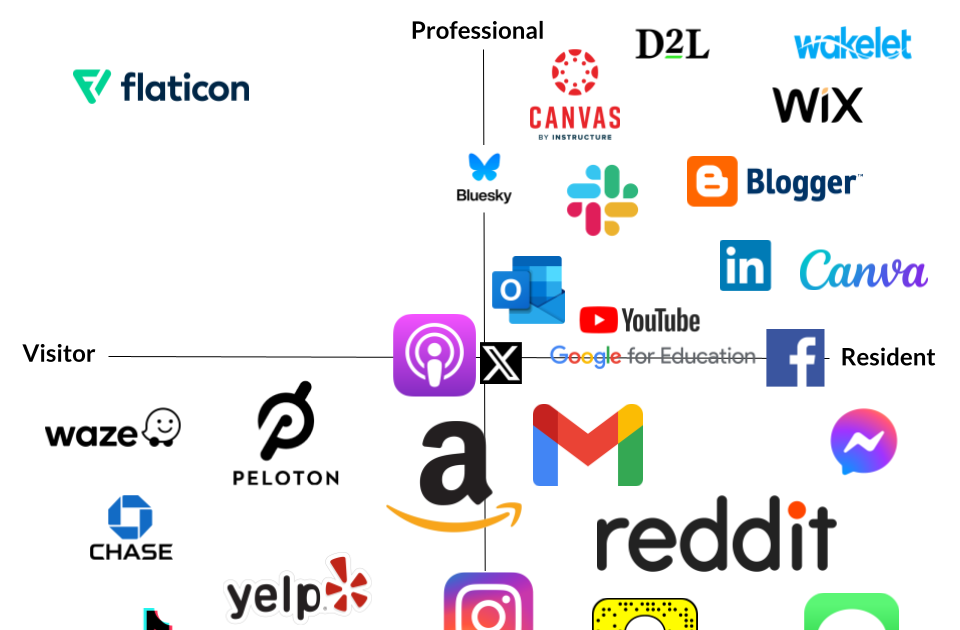
Back in 2017, I wrote a blog post about how I spent my time online. Using David White’s concept of Visitors vs. Residents, I examined the technology tools and sites I frequented most and reflected on whether I used them professionally or personally. I then categorized them according to White’s idea:
Visitors use technology tools to get a job done quickly. They don’t leave a digital trail or engage with others.
Residents regularly interact with others or create with technology while openly sharing parts of themselves, whether names, comments, or resources.
At that time, I was in a different role in education as a school-based instructional technology coach. Now, I am still in the field of education, but as the Director of Distance Learning for a community college. The only role that hasn’t changed in those eight years is my role as an adjunct instructor. The assignment to map digital spaces has always been one of my favorites, so this week I decided to join my students and reflect on what has changed and what has remained the same for me. Below is my current map and some thoughts that stood out to me.
Nicole’s 2025 Digital Map
I overwhelmingly have a digital footprint. The vast majority of my map shows that both personally and professionally, I engage with others and leave a digital trace online.
Larger images, such as Gmail, Amazon, Snapchat, Reddit, and podcasts, are applications that dominate much of my time online.
Applications such as podcasts, “X” (forever Twitter), Google, and Facebook are used for both personal and professional purposes. I love that these are places I can blend my personas.
On the personal visitors’ side, I may have signed up for accounts on these applications, but I do not engage with others or leave a public data trail- I hop on and hop off with a purpose. What may be surprising to some is that TikTok is included in this category. My husband is really the only one who sends me video clips. Otherwise, I don’t use this app much.
I struggled to find applications that I visit professionally as a visitor! This tells me that I am very comfortable leaving a digital presence.
Here is my original map from 2017 and some general observations.
Nicole’s original map from 2017
Things that have changed
New apps! TikTok and Blue Sky are two examples of applications that became available after my original map was created.
RIP old apps! Google+, Wikispaces, and Edmodo played a big role in my professional encounters and are no longer in service.
My old map was very balanced- I spent just as much time as a visitor as I did as a resident.
I have a much greater professional residency than I did in 2017!
Things that have stayed the same
Most of the technology applications I used eight years ago remain the same today. Some, such as Fitbit, have been replaced by applications that perform a similar service (in this case, Peloton).
I am comfortable with using technology to enhance my professional life and comfortable sharing and engaging with others online.
To wrap up, I’d like to revisit my blog post from 2017 by restating something I wrote back then that still holds true today: “My map will evolve as my career evolves and my PLN focus changes. For now, I’m happy with the digital presence that I have and knowing that where I go *is* helping me grow.”
Hushed conversations about the budget, a shrinking applicant pool and that dreaded enrollment cliff are no longer whispers. The numbers are in and they tell a story you know all too well: the old way of doing things isn’t working any more.
The traditional models are failing to keep pace with a new generation of students and a rapidly evolving job market. We’ve moved beyond the “enrollment cliff” as a future threat; it’s a present reality that is forcing institutions to fundamentally rethink their approach to marketing and enrollment.
The old playbook of generic campaigns and static brochures is obsolete. In 2026, the game is no longer about reaching the most students but about connecting with the right students in the most authentic way possible. This new landscape is defined by data, driven by Artificial Intelligence (AI) and built on a foundation of radical transparency. It’s a world where the institutions that survive will be those willing to break away from the establishment and challenge the status quo.
Explore the 2026 trends and predictions that are shaking up digital marketing for education industry, what it means for the next generation of enrollment and how institutions can position themselves to thrive in a new era of higher education.
Shift to GEO/AEO and “Search Everywhere Optimization”
With the rise of social search and AI Overviews, traditional Search Engine Optimization (SEO) is becoming insufficient. The new paradigm is “Search Everywhere Optimization.” This includes GEO (Generative Engine Optimization) to ensure your institution is favorably mentioned in AI-generated answers and AEO (Answer Engine Optimization) to appear in direct answers in AI Overviews as well as on platforms like TikTok, Reddit, Quora and voice assistants. By 2026, success will not be measured by a #1 ranking on a Google page, but by being the embedded answer wherever a student asks a question.
Conversational AI as the 24/7 Admissions Counselor
AI is already strongly embedded in advertising platforms to capture student interest, but the next frontier is how institutions leverage AI in lead nurturing and admissions. As shown in EducationDynamics’ latest Engaging the Modern Learner Report, 60% of students use AI chatbots for college research, a significant jump from 49% just a year ago. This will move beyond simple chatbots into sophisticated conversational AI that manages entire nurturing funnels, providing instant, personalized answers to complex questions about financial aid, credit transfers and program specifics via SMS and web chat. These AI assistants will be able to schedule campus tours, triage inquiries to the correct human counselor and provide 24/7 support, dramatically improving the prospective student experience and freeing up admissions teams to focus on high-intent, high-value interactions.
Authentic Storytelling
Authentic user generated content will be a vital part of a brand’s storytelling as more students turn to social channels and short form video to research and validate individual brands. Brands will increasingly leverage content creators’ sphere of influence, leveraging short-form video to tell showcase their brand story. This creates a massive opportunity for institutions to leverage user-generated content and partner with student-creators who can showcase the real, unpolished and relatable brand story. Think a “Day in the Life” series on TikTok or a student ambassador Q&A on Instagram Live—these genuine interactions build trust and connection in a way a static brochure never could.
AI for Personalization
AI picks up on individual user preferences and can serve ad creative that they are more likely to engage with due to better relevance. AI will use existing ad assets (images, videos, headlines, descriptions, etc.) and landing page experiences to create unique and personalized ads. Landing page personalization will also emerge in 2026 as a way to increase relevance and conversion rate optimization. To be successful, advertisers need to provide a wide variety of existing assets and have a strong landing page experience. For example, if a prospective student has previously browsed your computer science program page, an AI-powered ad could then automatically show them a video testimonial from a current computer science student, rather than a generic campus tour video.
Rise of Social for Search
Over the past couple of years, we’ve seen students turning to social for search, we will continue to see this pattern and expect it to increase. Unlike a traditional search engine that provides a list of links, social platforms offer an immersive experience. Students can search for a university’s name and instantly see “day in the life” videos, unscripted dorm tours and Q&A sessions with real students. This content feels more genuine and trustworthy than a polished university-produced video. For them, a hashtag search is less about finding a fact and more about getting a feel for a school’s culture. Having an organic and paid presence on social channels will be vital for brands to be present where their audience is searching.
More Ads in AIOs/AI Mode
To date, there have been very few instances of EDU ads within AI Overviews or AI Mode, but in 2026, we expect this to change dramatically. Google is actively integrating ads directly into its AI-generated summaries and institutions need to be prepared to take advantage of this new frontier for digital advertising for higher education.
This shift is about more than just a new ad placement; it represents a fundamental change in how advertisers reach prospective students. Instead of relying solely on keywords, digital advertising for universities in AI Overviews are triggered by the full conversational context of a user’s query. This means an ad for your nursing program could appear not just on a search for “nursing school near me,” but also on a more exploratory query like “what are the best career paths in healthcare?” that generates an AI Overview response.
To secure a presence in these valuable new placements, institutions will need to embrace Google’s AI-powered ad solutions. These include:
Broad Match: This uses Google’s AI to match your ads to a much wider range of relevant searches, including long-tail and conversational queries that are common in AI Overviews.
Performance Max: This campaign type leverages automation to find high-value conversions across all of Google’s channels, including Search, Display, YouTube and, increasingly, AI Overviews.
AI Max for Search (Beta): The newest iteration of Google’s AI-powered ad solutions, AI Max for Search is designed specifically to enhance creative relevance and expand reach within AI-driven search experiences.
As AI-generated results take up more screen space, being present in these ad placements is crucial. This is a chance to get your brand in front of students at a new moment of discovery, where they are actively seeking complex, nuanced information. Shifting to these AI-powered tools is the key to ensuring your institution remains visible and competitive.
First-Party Data is the Ultimate KPI
As audience targeting and keywords continue to get broader, across paid search and paid social, properly training AI to find and optimize to the right user will be crucial to a campaign’s success. The best signal institutions can provide is through their own data. Institutions will need to prioritize regularly importing their 1st party data to fuel their audiences and bidding strategies. Bidding to outcomes will drive quality and as a result CPCs as a KPI will decrease in importance, especially as CPCs continue to increase. Instead, the focus should remain on the cost per outcome, such as cost per application and cost per enroll. Focusing on and optimizing to these ultimate KPIs will bypass front-end noise, ensure quality and prioritize outcomes that more closely correlate to business goals.
Ready to Break Free From the Old Playbook in the Higher Education Industry?
The time for waiting is over. The institutions that will survive and thrive in this new era are those that abandon the outdated playbooks of the past and embrace a new, data-driven and authentic approach to enrollment.
This is not a time for incremental change. It’s a time for bold, strategic action. By leveraging AI for personalization and operational efficiency, embracing authentic storytelling and prioritizing first-party data, you can build a recruitment strategy that not only attracts the right students but also proves the enduring value of your institution.
Ready to transform your enrollment strategy and secure your institution’s future? EducationDynamics is the only partner with the expertise, technology and end-to-end solutions to help you not just adapt, but thrive. Contact us today to future-proof your institution.
Back-to-school season arrives every year with a mixed bag of emotions for most educators, including anticipation and excitement, but also anxiety. The opportunity to catch up with friendly colleagues and the reward of helping students connect with material also comes with concern about how best to present and communicate that material in a way that resonates with a new classroom.
An annual challenge for K-12 educators is creating a syllabus that engages students and will be used throughout the year to mutual benefit rather than tucked in a folder and forgotten about. Today’s digital transformation can be a means for educators to create a more dynamic and engaging syllabus that meets students’ and parents’ needs.
While it can be overwhelming to think about learning any new education technology, the good news about a digital syllabi is that anyone who’s sent a digital calendar invite has already done most of the technical-learning legwork. The more prescient task will be learning the best practices that engage students and enable deeper learning throughout the year.
Step one: Ditch the PDFs and print-outs
Creating a syllabus that works begins with educators stepping into the shoes of their students. K-12 classrooms are full of students who are oriented around the digital world. Where textbooks and binders were once the tools of the trade for students, laptops and iPads have largely taken over. This creates an opportunity for teachers to create more dynamic syllabi via digital calendars, rather than printed off or static PDFs with lists of dates, deadlines, and relevant details that will surely change as the year progresses. In fact, many learning management systems (LMS) already have useful calendar features for this reason. Again, teachers need only know the best way to use them. The digital format offers flexibility and connectivity that old-school syllabi simply can’t hold a candle to.
Tips for creating an effective digital syllabus
Classroom settings and imperatives can vary wildly, and so can the preferences of individual educators. Optimization in this case is in the eye of the beholder, but consider a few ideas that may wind up on your personal best practices list for building out your digital syllabus every year around this time:
Make accessing the most up-to-date version of the syllabus as frictionless as possible for students and parents. Don’t attach your syllabus as a static PDF buried in an LMS. Instead, opt-in to the calendar most LMS platforms offer for the mutual benefit of educators, students, and parents. To maximize engagement and efficiency, teachers can create a subscription calendar in addition or as an alternative to the LMS calendar. Subscription calendars create a live link between the course syllabus and students’ and/or parents’ own digital calendar ecosystem, such as Google Calendar or Outlook. Instead of logging into the LMS to check upcoming dates, assignments, or project deadlines, the information becomes more accessible as it integrates into their monthly, weekly, and daily schedules, mitigating the chance of a missed assignment or even parent-teacher conference. Students and parents only have to opt-in to these calendars once at the beginning of the academic year, but any of the inevitable changes and updates to the syllabus throughout the year are reflected immediately in their personal calendar, making it simpler and easier for educators to ensure no important date is ever missed. While few LMS offer this option within the platform, subscription calendar links are like any hyperlink–easy to share in emails, LMS message notifications, and more.
Leverage the calendar description feature. Virtually every digital calendar provides an option to include a description. This is where educators should include assignment details, such as which textbook pages to read, links to videos or course material, grading rubrics, or more.
Color-code calendar invitations for visual information processors. Support different types of information processors in the classroom by taking the time to color-code the syllabus. For example, purple for project deadlines, red for big exams, yellow for homework assignment due dates. Consistency and routine are key, especially for younger students and busy parents. Color-coding, or even the consistent naming and formatting of events and deadlines, can make a large impact on students meeting deadlines.
Encourage further classroom engagement by integrating digital syllabus “Easter eggs.” Analog syllabi often contain Easter eggs that reward students who read it all the way through. Digital syllabi can include similar engaging surprises, but they’re easy to add throughout the year. Hide extra-credit opportunities in the description of an assignment deadline or add an invitation for last-minute office hours ahead of a big quiz or exam. It could be as simple as a prompt for students to draw their favorite animal at the bottom of an assignment for an extra credit point. If students are aware that these opportunities could creep up in the calendar, it keeps them engaged and perhaps strengthens the habit of checking their classroom syllabus.
While the start of the new school year is the perfect time to introduce a digital syllabus into the classroom, it’s important for educators to keep their own bandwidth and comfortability in mind. Commit to one semester with a digital syllabus and spend time learning the basic features and note how the classroom responds. From there, layer in more advanced features or functionality that helps students without being cumbersome to manage. Over time, educators will learn what works best for them, their students and parents, and the digital syllabus will be a classroom tool that simplifies classroom management and drives more engagement year-round.
Joep Leussink, AddEvent
Joep Leussink is the Head of Growth at AddEvent, a San Francisco-based platform that provides event and calendar marketing solutions. With a proven track record in driving growth for B2B SaaS companies from Series B to post-IPO, Joep leverages his expertise in demand generation and growth marketing to make AddEvent known and accessible to everyone.
Latest posts by eSchool Media Contributors (see all)
How Denison Edge partnered with Collegis to clarify brand identity, launch a content strategy, and rebuild its website to drive user growth.
Denison Edge, an initiative by Denison University, equips students, graduates, and professionals with in-demand, industry-relevant skills through stackable micro-credentials. To support ambitious enrollment goals and elevate its brand presence, Denison Edge turned to Collegis Education for strategic marketing support and a digital refresh. With a small internal team and big aspirations, Denison Edge sought to better articulate its value proposition and reach more prospective learners through a high-performing, content-rich website.
The Challenge
Denison Edge needed to amplify registrations for its non-credit programming while refreshing its brand presence to reflect its forward-thinking approach. The organization faced key limitations:
Limited internal marketing capacity
Lack of a cohesive brand voice
Outdated website UX and SEO
Urgent need to launch new high-demand programs in finance, marketing, analytics, and AI
Together, these challenges underscored the need for a strategic partner to help Denison Edge scale effectively and stand out in a competitive market.
The Solution
Collegis delivered a set of tailored services to expand visibility, support program growth, and enhance digital experience:
Brand Voice Workshop Facilitated an on-site session with university stakeholders to define a clear, compelling brand voice, behavior, and tone — establishing the foundation for all future communications.
Content Strategy Developed a comprehensive content roadmap, including a new blog, article templates, writing guide, and SEO-informed article concepts to empower internal marketing teams.
Website Strategy and Optimization Conducted in-depth UX and SEO audits pre- and post-launch, guiding the redevelopment of the Denison Edge website. The rebuilt site now delivers a seamless experience tailored to prospective learners and employers.
The Results: Stronger Presence, Measurable Growth
Within four months of relaunching the website, Denison Edge experienced marked improvements in site traffic and user engagement:
+21% YoY increase in total users
+16% YoY growth in sessions and new users
96% increase in Rental Space page traffic
1,284 sessions on new Registration page
310 sessions on new Business Immersion page
The top-performing pages — including Programs and Homepage — also achieved +16% YoY growth, confirming the success of the site redesign and content strategy.
Ashley Nicklay
Sr. Director – Student Lifecycle, Collegis Education
The Takeaway: Strategy and Storytelling Drive Digital Success
The Denison Edge case study illustrates the impact of aligning brand clarity, content strategy, and digital design. Through partnership with Collegis, Denison Edge built the foundation for ongoing growth — positioning itself as a leader in flexible, career-focused education.
Transform Your Digital Presence with Collegis
Want to grow visibility and enrollment for your programs? Contact Collegis to explore how brand and digital strategy can help you lead with confidence.
Let’s Start Writing Your Success Story
See what’s possible when strategy, creativity, and execution come together. Partner with Collegis to turn your challenges into outcomes worth sharing.
Facing challenges in enrollment, retention, or tech integration? Seeking growth in new markets? Our strategic insights pave a clear path for overcoming obstacles and driving success in higher education.
Unlock the transformative potential within your institution – partner with us to turn today’s roadblocks into tomorrow’s achievements. Let’s chat.
For students with special needs, learning can often resemble a trek through dense woods along a narrow, rigid path–one that leaves little to no room for individual exploration. But the educational landscape is evolving. Picture classrooms as adventurous hunts, where every learner charts their own journey, overcomes unique challenges, and progresses at a pace that matches their strengths. This vision is becoming reality through gamification, a powerful force that is reshaping how students learn and how teachers teach in K–12 special education.
Personalized learning paths: Tailoring the adventure
Traditional classrooms often require students to adapt one method of instruction, which can be limiting–especially for neurodiverse learners. Gamified learning platforms provide an alternative by offering adaptive, personalized learning experiences that honor each student’s profile and pace.
Many of these platforms use real-time data and algorithms to adjust content based on performance. A student with reading difficulties might receive simplified text with audio support, while a math-savvy learner can engage in increasingly complex logic puzzles. This flexibility allows students to move forward without fear of being left behind, or without being bored waiting for others to catch up.
Accessibility features such as customizable avatars, voice commands, and adjustable visual settings also create space for students with ADHD, autism, or sensory sensitivities to learn comfortably. A student sensitive to bright colors can use a softer palette; another who struggles with reading can use text-to-speech features. And when students can replay challenges without stigma, repetition becomes practice, not punishment.
In these environments, progress is measured individually. The ability to choose which goals to tackle and how to approach them gives learners both agency and confidence–two things often missing in traditional special education settings.
Building social and emotional skills: The power of play
Play is a break from traditional learning and a powerful way to build essential social and emotional skills. For students with special needs who may face challenges with communication, emotional regulation, or peer interaction, gamified environments provide a structured yet flexible space to develop these abilities.
In cooperative hunts and team challenges, students practice empathy, communication, and collaboration in ways that feel engaging and low-stakes. A group mission might involve solving a puzzle together, requiring students to share ideas, encourage one another, and work toward a common goal.
Gamified platforms also provide real-time, constructive feedback, transforming setbacks into teachable moments. Instead of pointing out what a student did wrong, a game might offer a helpful hint: “Try checking the clues again!” This kind of support teaches resilience and persistence in a way that lectures or punitive grading rarely do.
As students earn badges or level up, they experience tangible success. These moments highlight the connection between effort and achievement. Over time, these small wins raise a greater willingness to engage with the material and with peers and the classroom community.
Fostering independence and motivation
Students with learning differences often carry the weight of repeated academic failure, which can chip away at their motivation. Gamification helps reverse this by reframing challenges as opportunities and effort as progress.
Badges, points, and levels make achievements visible and meaningful. A student might earn a “Problem Solver” badge after tackling a tricky math puzzle or receive “Teamwork Tokens” for helping a classmate. These systems expand the definition of success and highlight personal strengths.
The focus shifts from comparison to self-improvement. Some platforms even allow for private progress tracking, letting students set and meet personal goals without the anxiety of public rankings. Instead of competing, students build a personal narrative of growth.
Gamification also encourages self-directed learning. As student complete tasks, they develop skills like planning, time management, and self-assessment, skills that extend beyond academics and into real life. The result is a deeper sense of ownership and independence.
Teachers as learning guides
Gamification doesn’t replace teachers, but it can help teach more effectively. With access to real-time analytics, educators can see exactly where a student is excelling or struggling and adjust instruction accordingly.
Dashboards might reveal that a group of students is thriving in reading comprehension but needs help with number sense, prompting immediate, targeted intervention. This data-driven insight allows for proactive, personalized support.
Teachers in gamified classrooms also take on a new role, both of a mentor and facilitator. They curate learning experiences, encourage exploration, and create opportunities for creativity and curiosity to thrive. Instead of managing behavior or delivering lectures, they support students on individualized learning journeys.
Inclusion reimagined
Gamification is not a gimmick; it’s a framework for true inclusion. It aligns with the principles of Universal Design for Learning (UDL), offering multiple ways for students to engage, process information, and show what they know. It recognizes that every learner is different, and builds that into the design.
Of course, not every gamified tool is created equal. Thoughtful implementation, equity in access, and alignment with student goals are essential. But when used intentionally, gamification can turn classrooms into places where students with diverse needs feel seen, supported, and excited to learn.
Are we ready to level up?
Gamification is a step toward classrooms that work for everyone. For students with special needs, it means learning at their own pace, discovering their strengths, and building confidence through meaningful challenges.
For teachers, it’s a shift from directing traffic to guiding adventurers.
If we want education to be truly inclusive, we must go beyond accommodations and build systems where diversity is accepted and celebrated. And maybe, just maybe, that journey begins with a game.
Aditya Prakash, SKIDOS
Aditya Prakash is the founder and CEO of SKIDOS, a Copenhagen-based edtech leader transforming mobile gaming into learning, drawing on two decades of innovation, investment, and mentorship in technology-driven education.
Latest posts by eSchool Media Contributors (see all)