

Tag: Dilemma

  • Walk on by: the dilemma of the blind eye

    Walk on by: the dilemma of the blind eye

    by Dennis Sherwood

    Forty years on…

    I don’t remember much about my experiences at work some forty-odd years ago, but one event I recall vividly is the discussion provoked by a case study at a training event. The case was simple, just a few lines:

    Sam was working late one evening, and happened to walk past Pat’s office. The door was closed, but Sam could hear Pat being very abusive to Alex. Some ten minutes later, Sam saw Alex sobbing.

    What might Sam do?

    What should Sam do?

    Quite a few in the group said “nothing”, on the grounds that whatever was going on was none of Sam’s business. Maybe Pat had good grounds to be angry with Alex and if the local culture was, let’s say, harsh, what’s the problem? Nor was there any evidence that Alex’s sobbing was connected with Pat – perhaps something else had happened in the intervening time.

    Others thought that the least could Sam do was to ask if Alex was OK, and offer some comfort – a suggestion countered by the “it’s a tough world” brigade.

    The central theme of the conversation was then all about culture. Suppose the culture was supportive and caring. Pat’s behaviour would be out of order, even if Pat was angry, and even if Alex had done something Pat had regarded as wrong.

    So what might – and indeed should – Sam do?

    Should Sam should confront Pat? Or inform Pat’s boss?

    What if Sam is Pat’s boss? In that case then, yes, Sam should confront Pat: failure to do so would condone bad behaviour, which in this culture, would be a ‘bad thing’.

    But if Sam is not Pat’s boss, things are much more tricky. If Sam is subordinate to Pat, confrontation is hardly possible. And informing Pat’s boss could be interpreted as snitching or trouble-making. Another possibility is that Sam and Pat are peers, giving Sam ‘the right’ to confront Pat – but only if peer-to-peer honesty and mutual pressure is ‘allowed’. Which it might not be, for many, even benign, cultures are in reality networks of mutual ‘non-aggression treaties’, in which ‘peers’ are monarchs in their own realms – so Sam might deliberately choose to turn a blind eye to whatever Pat might be doing, for fear of setting a precedent that would allow Pat, or indeed Ali or Chris, to poke their noses into Sam’s own domain.

    And if Sam is in a different part of the organisation – or indeed from another organisation altogether – then maybe Sam’s safest action is back where we started. To do nothing. To walk on by.

    Sam is a witness to Pat’s bad behaviour. Does the choice to ‘walk on by’ make Sam complicit too, albeit at arm’s length?

    I’ve always thought that this case study, and its implications, are powerful – which is probably why I’ve remembered it over so long a time.

    The truth about GCSE, AS and A level grades in England

    I mention it here because it is relevant to the main theme of this blog – a theme that, if you read it, makes you a witness too. Not, of course, to ‘Pat’s’ bad behaviour, but to another circumstance which, in my opinion, is a great injustice doing harm to many people – an injustice that ‘Pat’ has got away with for many years now, not only because ‘Pat’s peers’ have turned a blind eye – and a deaf ear too – but also because all others who have known about it have chosen to ‘walk on by’.

    The injustice of which I speak is the fact that about one GCSE, AS and A level grade in every four, as awarded in England, is wrong, and has been wrong for years. Not only that: in addition, the rules for appeals do not allow these wrong grades to be discovered and corrected. So the wrong grades last for ever, as does the damage they do.

    To make that real, in August 2025, some 6.5 million grades were awarded, of which around 1.6 million were wrong, with no appeal. That’s an average of about one wrong grade ‘awarded’ to every candidate in the land.

    Perhaps you already knew all that. But if you didn’t, you do now. As a consequence, like Sam in that case study, you are a witness to wrong-doing.

    It’s important, of course, that you trust the evidence. The prime source is Ofqual’s November 2018 report, Marking Consistency Metrics – An update, which presents the results of an extensive research project in which very large numbers of GCSE, AS and A level scripts were in essence marked twice – once by an ‘assistant’ examiner (as happens in ‘ordinary’ marking each year), and again by a subject senior examiner, whose academic judgement is the ultimate authority, and whose mark, and hence grade, is deemed ‘definitive’, the arbiter of ‘right’.

    Each script therefore had two marks and two grades, enabling those grades to be compared. If they were the same, then the ‘assistant’ examiner’s grade – the grade that is on the candidate’s certificate – corresponds to the senior examiner’s ‘definitive’ grade, and is therefore ‘right’; if the two grades are different, then the assistant examiner’s grade is necessarily ‘non-definitive’, or, in plain English, wrong.

    You might have thought that the number of ‘non-definitive’/wrong grades would be small and randomly distributed across subjects. In fact, the key results are shown on page 21 of Ofqual’s report as Figure 12, reproduced here:

    Figure 1: Reproduction of Ofqual’s evidence concerning the reliability of school exam grades

    To interpret this chart, I refer to this extract from the report’s Executive Summary:

    The probability of receiving the ‘definitive’ qualification grade varies by qualification and subject, from 0.96 (a mathematics qualification) to 0.52 (an English language and literature qualification).

    This states that 96% of Maths grades (all varieties, at all levels), as awarded, are ‘definitive’/right, as are 52% of those for Combined English Language and Literature (a subject available only at A level). Accordingly, by implication, 4% of Maths grades, and 48% of English Language and Literature grades, are ‘non-definitive’/wrong. Maths grades, as awarded, can therefore be regarded as 96% reliable; English Language and Literature grades as 52% reliable.

    Scrutiny of the chart will show that the heavy black line in the upper blue box for Maths maps onto about 0.96 on the horizontal axis; the equivalent line for English Language and Literature maps onto 0.56. The measures of the reliability of the grades for each of the other subjects are designated similarly. Ofqual’s report does not give any further numbers, but Table 1 shows my estimates from Ofqual’s Figure 12:

      Probability of
      ‘Definitive’ grade ‘Non-definitive’ grade
    Maths (all varieties) 96% 4%
    Chemistry 92% 8%
    Physics 88% 12%
    Biology 85% 15%
    Psychology 78% 22%
    Economics 74% 26%
    Religious Studies 66% 34%
    Business Studies 66% 34%
    Geography 65% 35%
    Sociology 63% 37%
    English Language 61% 39%
    English Literature 58% 42%
    History 56% 44%
    Combined English Language and Literature (A level only) 52% 48%

    Table 1: My estimates of the reliability of school exam grades, as inferred from measurements of Ofqual’s Figure 12.

    Ofqual’s report does not present any corresponding information for each of GCSE, AS or A level separately, nor any analysis by exam board. Also absent is a measure of the all-subject overall average. Given, however, the maximum value of 96%, and the minimum of 52%, the average is likely to be somewhere in the middle, say, in the seventies; in fact, if each subject is weighted by its cohort, the resulting average over the 14 subjects shown is about 74%. Furthermore, if other subjects – such as French, Spanish, Computing, Art… – are taken into consideration, the overall average is most unlikely to be greater than 82% or less than 66%, suggesting that an overall average reliability of 75% for all subjects is a reasonable estimate.

    That’s the evidence that, across all subjects and levels, about 75% of grades, as awarded, are ‘definitive’/right and 25% – one in four – are ‘non-definitive’/wrong – evidence that has been in the public domain since 2018. But evidence that has been much disputed by those with vested interests.

    Ofqual’s results are readily explained. We all know that different examiners can, legitimately, give the same answer (slightly) different marks. As a result, the script’s total mark might lie on different sides of a grade boundary, depending on who did the marking. Only one grade, however, is ‘definitive’.

    Importantly, there are no errors in the marking studied by Ofqual – in fact, Ofqual’s report mentions ‘marking error’ just once, and then in a rather different context. All the grading discrepancies measured in Ofqual’s research are therefore attributable solely to legitimate differences in academic opinion. And since the range of legitimate marks is far narrower in subjects such as Maths and Physics, as compared to English Literature and History, then the probability that an ‘assistant’ examiner’s legitimate mark might result in a ‘non-definitive’ grade will be much higher for, say, History as compared to Physics. Hence the sequence of subjects in Ofqual’s Figure 12.

    As regards appeals, in 2016, Ofqual – in full knowledge of the results of this research (see paragraph 28 of this Ofqual Board Paper, dated 18 November 2015) – changed the rules, requiring that a grade can be changed only if a ‘review of marking’ discovers a ‘marking error’. To quote an Ofqual ‘news item’ of 26 May 2016:

    Exam boards must tell examiners who review results that they should not change marks unless there is a clear marking error. …It is not fair to allow some students to have a second bite of the cherry by giving them a higher mark on review, when the first mark was perfectly appropriate. This undermines the hard work and professionalism of markers, most of whom are teachers themselves. These changes will mean a level-playing field for all students and help to improve public confidence in the marking system.

    This assumes that the legitimate marks given by different examiners are all equally “appropriate”, and identical in every way.

    This assumption. however, is false: if one of those marks corresponds to the ‘definitive’ grade, and another to a ‘non-definitive’ grade, they are not identical at all. Furthermore, as already mentioned, there is hardly any mention of marking errors in Ofqual’s November 2018 report. All the grade discrepancies they identified can therefore only be attributable to legitimate differences in academic opinion, and so cannot be discovered and corrected by the rules that have been in place since 2016.

    Over to you…

    So, back to that case study.

    Having read this far, like Sam, you have knowledge of wrong-doing – not Pat tearing a strip off Alex, but Ofqual awarding some 1.5 million wrong grades every year. All with no right of appeal.

    What are you going to do?

    You’re probably thinking something like, “Nothing”, “It’s not my job”, “It’s not my problem”, “I’m in no position to do anything, even if I wanted to”.

    All of which I understand. No, it’s certainly not your job. And it’s not your problem directly, in that it’s not you being awarded the wrong grade. But it might be your problem indirectly – if you are involved with admissions, and if grades play a material role, you may be accepting a student who is not fully qualified (in that the grade on the certificate might be too high), or – perhaps worse – rejecting a student who is (in that the grade on the certificate is too low). Just to make that last point real, about one candidate in every six with a certificate showing AAA for A level Physics, Chemistry and Biology in fact truly merited at least one B. If such a candidate took a place at Med School, for example, not only is that candidate under-qualified, but a place has also been denied to a candidate with a certificate showing AAB but who merited AAA.

    And although you, as an individual, are indeed not is a position to do anything about it, you, collectively, surely are.

    HE is, by far, the largest and most important user of A levels. And relying on a ‘product’ that is only about 75% reliable. HE, collectively, could put significant pressure on Ofqual to fix this, if only by printing “OFQUAL WARNING: THE GRADES ON THIS CERTIFICATE ARE ONLY RELIABLE, AT BEST, TO ONE GRADE EITHER WAY” on every certificate – not my statement, but one made by Ofqual’s then Chief Regulator, Dame Glenys Stacey, in evidence to the 2 September 2020 hearing of the Education Select Committee, and in essence equivalent to the fact that about one grade in four is wrong. That would ensure that everyone is aware of the fact that any decision, based on a grade as shown on a certificate, is intrinsically unsafe.

    But this – or some other solution – can happen only if your institution, along with others, were to act accordingly. And that can happen only if you, and your colleagues, band together to influence your department, your faculty, your institution.

    Yes, that is a bother. Yes, you do have other urgent things to do.

    If you do nothing, nothing will happen.

    But if you take action, you can make a difference.

    Don’t just walk on by.

    Dennis Sherwood is a management consultant with a particular interest in organisational cultures, creativity and systems thinking. Over the last several years, Dennis has also been an active campaigner for the delivery of reliable GCSE, AS and A level grades. If you enjoyed this, you might also like https://srheblog.com/tag/sherwood/.

    Author: SRHE News Blog

    An international learned society, concerned with supporting research and researchers into Higher Education

    Source link

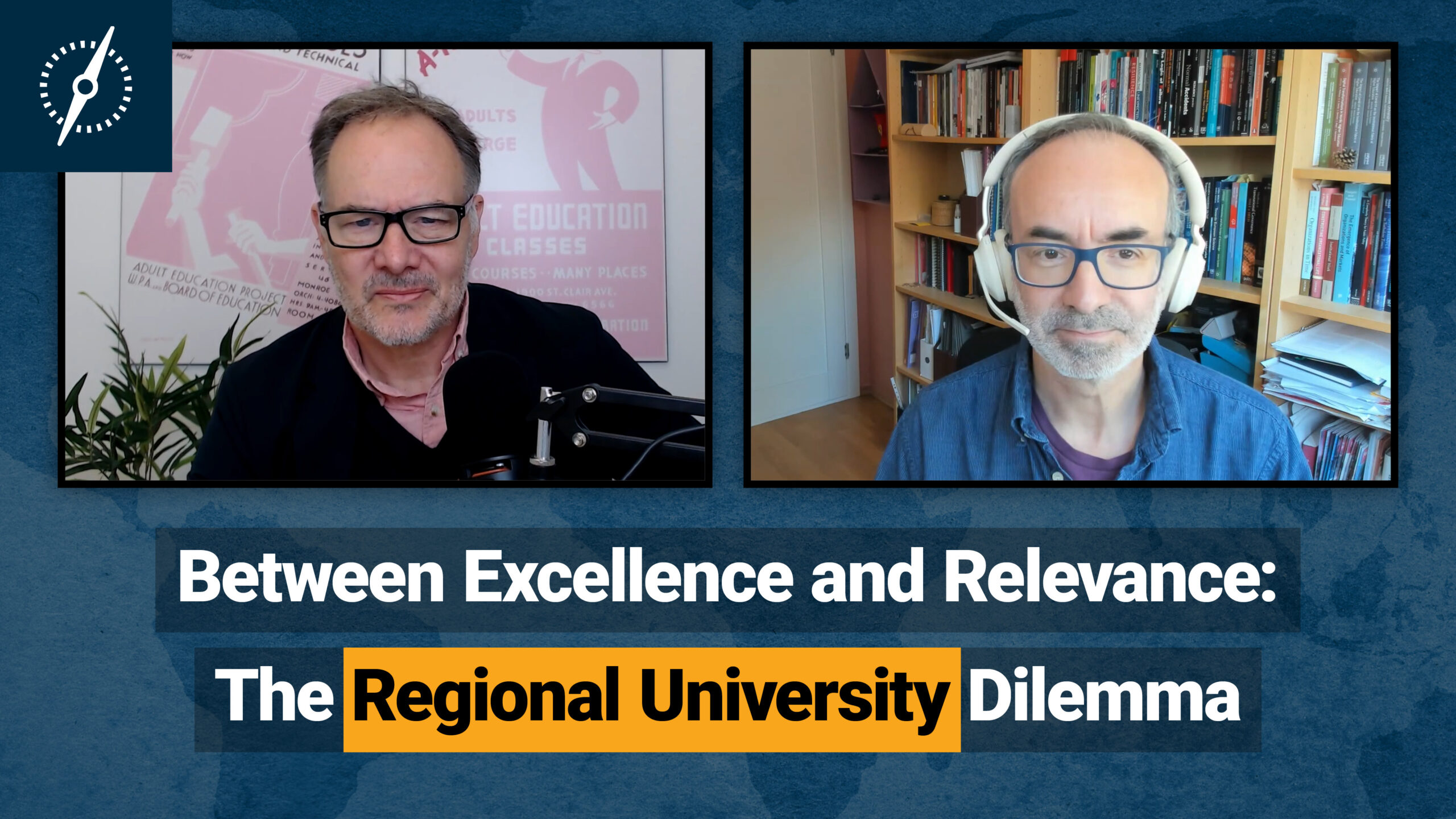
  • Between Excellence and Relevance: The Regional University Dilemma

    Between Excellence and Relevance: The Regional University Dilemma

    Hi everyone.  I’m Alex Usher and this is The World of Higher Education podcast.

    Over the past few decades, Higher Education had taken on a number of new roles.  As we discussed with Ethan Schrum on this podcast over two years, in the years after World War II, universities became obsessed with showing how essential they were with solving society’s problems.  One of these problems – particularly as universities proliferated and started showing up in more and more distant locales – was regional economic development. 

    This was a tough problem to solve.  Universities are about the knowledge economy, and by and large the knowledge economy runs most smoothly in places with significant population density.  By definition, “regional” or “peripheral” institutions are in places that lack this essential quality.  So with whom can universities in this situation partner?  It takes two to tango – a university .  And more generally, what kinds of things can universities in peripheral regions that can do to improve the economic fortunes of the places they serve?

    Today my guest is Dr. Romulo Pinheiro.  He is a professor of public policy and administration at the University of Agder in Norway.  For years now, Romulo has been writing about how universities in different parts of Europe tackle this question.  In our interview today, we go back and forth a bit about how peripheral institutions differ from metropolitan ones, how regional and global ambitions get intertwined at these institutions and how institutional and disciplinary structures do and do not affect how a peripheral universities accomplish their mission.  As a wannabe-geographer, I found this discussion fascinating – pay attention to the bits where Romulo starts diving into the intricacies of how institutions and academics weave their global and local networks together into complicated webs, and – let me underline this bit – how these webs depend crucially on something pretty simple: trust. 

    But enough from me – let’s turn it over to Romulo.


    The World of Higher Education Podcast
    Episode 3.31 | Between Excellence and Relevance: The Regional University Dilemma

    Transcript

    Alex Usher (AU): Romulo, your work often centers around issues of universities and regional development. And I guess it’s been 40 or 50 years now that regional development has been seen as a role that higher education is supposed to play. But how does that development role differ between universities in dense urban areas and, you know, less dense rural areas? What’s the difference in the role they have to play?

    Rómulo Pinheiro (RP): Alex, for universities to be able to engage with different types of regional actors, there have to be competencies on the other side. Universities differ in terms of their competencies and skills—in terms of the depth and breadth of the types of programs they offer, the research groups, as well as the traditions of regional engagement. But they also differ in their localities, right?

    Usually, you have a situation where universities in peripheral regions are thinner institutions, and they’re located in thinner institutional environments. Meaning, they don’t have a lot of interlocutors with the same level of knowledge and skills. That already creates a disadvantage.

    So, should we see the symbiosis between universities and their regional settings? By and large, we see that strong institutions tend to be located in strong regional surroundings as well. Now, that’s not to say there aren’t cases of strong institutions in more peripheral settings. What the literature tells us is that, for the most part, these regions don’t have the absorptive capacity to absorb both the graduates and the knowledge that comes from these “thick” institutions.

    Johns Hopkins is a case in point in Baltimore. And in Europe, we have, for example, the University of Lund. There have been a few studies as well. So the knowledge generated by these institutions tends to go away from the region because there’s no regional capacity to absorb what comes out of the university.

    So, very different roles.

    AU: It seems to me there are two types of rural or peripheral institutions. Let me talk about one of them first, right? So, smaller peripheral institutions—I’m thinking, you know, universities maybe in northern Norway, right? A couple thousand students. They face tight budgets, limited research capacity, and more difficulty, I imagine, in attracting top talent. Maybe not in Norway, but in some countries that would be an issue. And yet, they’re often expected to play an outsized role in regional development. How do they manage that tension?

    RP:  That’s a great question—and indeed, many don’t, right? You’re absolutely right that we should move away from the idea of just “centers” and “periphery,” because there are also centers within the periphery. There are strong institutions in peripheral settings. In northern Norway, for example, we have the University of Tromsø, which is a comprehensive, research-intensive institution. And there are many smaller regional colleges across the Nordic region that don’t have that capacity.

    Traditionally, these institutions have catered more to the applied needs of regional actors. They didn’t have the research infrastructures, so they got involved in what we call “projects,” right? Smaller projects. And that, of course, has limitations.

    Other, bolder institutions try to collaborate—develop networks. What we see, for example, in Northern Europe is a situation where, due to mergers, the smaller institutions are becoming amalgamated into larger institutions. And that, of course, creates new possibilities and new conditions, but also new tensions and dilemmas.

    Because as institutions grow—and as you know, the larger the institution, the more globally oriented scientists you have—the less likely they are to be involved with regional issues, all things being equal, as economists like to say.

    But in the end, it also goes back to the idea of engagement at the academic level—the bottom-up, right? So this combination between… well, you can have all these great strategic plans and funding in place, but if academics themselves—what Burton Clark calls the academic heartland—don’t feel keen to be engaged with regional actors, you can’t pressure them.

    AU: I’m going to come back to that global dimension in a second. But let me counter with something here. I’m not convinced that the larger institutions are necessarily more global, but they are probably more oriented towards basic research, right? As you get bigger and bigger departments, they get deeper into basic research.

    And what’s the uptake of basic research in peripheral areas? I mean, it just seems to me that when you get past a certain institutional size or complexity, it gets very hard to actually even talk with local communities—because the capacity for generating research is much bigger than the receptor capacity for it.

    I remember one example, when we were doing some work in Africa. There was a small private university outside Lagos, and they had sequenced the Ebola virus. I asked, “Can you work with local industries?” And they said, “We can’t work with the local pharmaceutical industry, because in Africa the pharmaceutical industry is packaging and marketing.” Right? Those are the only two functions.

    So what happens when the science at a small regional institution outruns the receptor capacity of the local environment? Are there any good ways to manage that?

    RP: It goes back to the example I gave earlier. For the most part, that knowledge tends to go away—to other regions or other localities. This is the global dimension. But this goes back to the point you raised about the brokering role of universities. Universities—or university actors—have to engage in a process of translating those basic research findings into something that can be applied at the local level.

    So how do they do that? There are different mechanisms. You need professors who are engaged and able to facilitate the translation of more theoretical discussions into something more concrete.

    The role of students is fundamental here—an aspect that has been somewhat neglected in the literature. In the end, the most important boundary spanners are actually students who spend time back and forth between the university and the community. And then there’s the role of graduates—former students. They maintain networks with professors and others, so they play a very important role.

    But in the end, if the companies—public or private—don’t have a need for that knowledge, or if that knowledge is not relevant to them, then they won’t use it. There’s that tendency.

    So it’s also up to the universities to try to make that basic knowledge—if they are so inclined—relevant to local actors. In northern Norway, we have the case of Tromsø, which has been able to do this: bring excellence and relevance together. They focus, for example, on the Sámi dimension, Arctic fauna and flora, or cardiovascular diseases—taking aspects that are relevant to the region and developing excellence around those areas.

    And in the process, they develop institutional capacity, which helps them with strategic profiling in a globally competitive world.

    AU: You’re raising again that issue of global excellence versus regional relevance. I’m interested in that from the perspective of university strategy. What avenues do you have to make sure that your institution is actually balancing those two properly? You used Tromsø as an example—can you think of some others? And are there any commonalities between them?

    RP: Yeah. I mean, university leaders do have some tools at their disposal. As we know, most universities—particularly large ones—are very bottom-heavy institutions. Academics tend to have a lot of autonomy and are relatively independent in what they pursue.

    That being said, they also follow incentives, as rational actors. So there are things that strategic or university leaders can do to align those incentives—whether that’s through PhD student opportunities, sabbaticals, or other types of incentives to collaborate with regional actors.

    Beyond Tromsø, there are other examples I’ve worked on. Oulu is another case in point—in Finland. There’s a very interesting anecdote, going back to the importance of networks. One study asked actors in Oulu, in Northern Finland, “Who are your most important collaborators?” People at the university mentioned individuals from industry and local government.

    Then the same question was asked in another region—northern Sweden, in a place called Luleå—which wasn’t as regionally engaged. They asked, “Who are your most important collaborators?” Regional actors in the private sector mentioned other actors in the private sector. University academics mentioned other academics.

    Those are examples of disconnected networks—networks that are operating within their own silos. So, there has to be a sort of synergy effect, and the most successful regional institutions are able to achieve that.

    One interesting caveat: when you ask these institutions whether they see themselves as regional universities, most of them don’t like that label. They say, “We are, first and foremost, a university in the region—not a regional university.” There are some negative connotations associated with being too closely tied to locality.

    AU: What I’m hearing you say is that we have to pay attention to the incentives for professors within the university to engage locally and form those local partnerships. Are there specific institutional reforms that can achieve that? And presumably, disciplinary mix matters, right? There are different incentives and different possibilities for collaboration across disciplines. So how do you manage that engagement? How do you incentivize it effectively?

    RP: There’s been a long discussion within the field about what types of incentives work. And again, there’s no one-size-fits-all—this has to be tailored. Academics are incentivized in very different ways. But we do know that, for the most part, monetary incentives have a limited effect when compared to other professions.

    So it’s more about things like whether you can gain more autonomy, develop your research group, or set up a center. What we’re seeing now, for example, in the Nordic countries is an orchestrated effort by national and regional funding agencies to ensure that research applications require buy-in from regional actors.

    I can’t submit an application to the Norwegian Research Council or to Business Finland, for example, without having partners from the region or the nation—whether from the public or private sector. Those are structural mechanisms designed to ensure that, if academics want access to significant research funding and to grow their research teams, they need to bring on board those key external actors.

    The second aspect is the very strong emphasis over the past, say, seven to ten years—especially post-COVID—on co-creation and co-production of knowledge. Rather than involving regional actors only at the end of a research project, now there’s an effort to bring them in at the design stage.

    So, researchers will go into a project already with input from those actors, understanding key questions and issues of relevance. And then, throughout the project, they involve these actors through various mechanisms—workshops, feedback exercises, and so on—to ensure there’s a loop of engagement and input.

    It’s a much more egalitarian sort of ecosystem. Whether or not this is working is still an empirical question—we don’t yet know the full results. But at least those are the intentions.

    AU: Romulo, you talked about this interface between the global and the local, right? And the global part of that is usually about relations between academics in one part of the world and academics in another. That helps a local university—a university in a region—act as kind of a window on the world for that region. It brings them into contact with these global networks.

    What’s the right way to think about developing those networks effectively? I mean, I know in Europe right now we’ve got the European Universities Initiative. And I think a number of those alliances are meant to unite institutions with similar missions. A number of them look like alliances of universities and regions. Is this promising? Is this the right way forward? Or are these initiatives missing something?

    RP: Let me touch first on the issue of networks. Most of these networks emerge organically, and they’re very much linked to the relationships that academics have with other academics—or academics have with regional actors. Students can also play a role here—if they get employment locally, and of course, former students may become part of regional government or industry.

    The key element here is trust. This is not new—trust takes time to generate. I think it’s not easy, if you’re sitting in the director’s chair at a university, to articulate a clear strategy for how to develop trust among all these actors. You have to create the conditions.

    That might mean freeing up some resources, or identifying your most engaged academics—those most likely to involve students or work regionally—and then creating a kind of ecosystem to bring these people together. We used to say that the most important thing in regional engagement is having money for lunches and dinners—that’s where people get to know each other.

    When it comes to the second part of your question—strategic alliances—I’m a bit skeptical about the extent to which these will benefit the regional engagement agenda, to be honest. Even those alliances, like the one my own institution is part of—with a regional name and focus—tend to become very inward-oriented.

    I’ve got a number of publications coming out now with a colleague, where we argue that these alliances are primarily collaborative exercises meant to enable institutions to compete globally. And there’s a tendency—despite some efforts, like policy labs for students involving regional actors and regional questions—for other strategic imperatives, outside of the region and locality, to end up dictating institutional priorities.

    That’s my sense. But again, it’s an important empirical question. We’ll have to see in the future what the results actually are.

    AU: So, there’s been a tendency in North America—probably going back to World War II or maybe even a little before—to think about universities as fixers of social or economic problems. And you’ve cautioned against assuming that universities can act as fixers of regional challenges, especially in peripheral contexts in Europe.

    I guess this is a more recent assumption about institutions—maybe 30 or 40 years old instead of 60 or 70. Where do you think that expectation comes from? And what are the risks of leaning too heavily on it?

    RP: That caution also comes from my fieldwork. I remember when I was doing my PhD many years ago, I was in South Africa at Nelson Mandela Metropolitan University, speaking with the vice-chancellor there. And he told me:

    “Look, we are keen to play an active regional role, but we are not going to clean the streets just because the local government is failing to clean the streets. We don’t have the capacity to tackle crime just because the police lack the resources to do so.”

    He was very clear in saying that part of their job was to go into the community and educate people—not just about the possibilities, but also about the limitations that universities and academics face. It is not their role to solve the failures of market forces or government systems.

    There’s a tendency among some local officials to scapegoat the university—to say, “You’re not delivering,” because they’re not helping to tackle poverty or similar issues. That’s not to say universities don’t have an important role. But most of us in the field believe universities have primarily a facilitating role—a generative role—rather than acting as engines of regional development.

    Of course, in those peripheral regions where the university is the largest employer or the only knowledge institution, expectations tend to be that the university must play a disproportionate role. Often, it tries to do so—and in many cases, it succeeds. But in the majority of cases, the university is just one of many knowledge actors in a very complex ecosystem.

    AU: Your work has obvious ramifications for higher education leaders—but also for politicians, right? The ones who are funding these institutions. If there’s one concept or one conceptual insight from your work that you think those groups should take seriously—higher education leaders and politicians—what would it be? It might not be the same for both. They could be different for the different audiences.

    RP: As a traditional academic, let me give you two instead of one.

    The first one—and I’m not the only one saying this, but I think my work reinforces it—is that both universities and regions are complex entities. They are not monolithic, but they tend to be approached by both politicians and university managers as if they are simple, strategic actors. In reality, they have deep histories and institutionalized traditions, which are very difficult to change. So, any attempt to use strategic agency to move universities or regions in a particular direction should take that into account.

    The second aspect links to my recent work on resilience. Over time, we’ve seen that universities have an innate capacity to adapt to social change and play very different roles. The “third mission” of the university—regional development or societal impact—looked very different in the early 20th century than it does today. Yet, universities have managed to withstand and adjust to adversity while retaining a degree of function and identity.

    To do that, they need two important ingredients. One is autonomy—which is currently under threat, both in terms of procedural and substantive autonomy. The second is diversity. From resilience studies, we know that resilient institutions are diverse institutions. So when politicians or managers promote a “lean” approach—saying, “we have two research groups working on similar areas, let’s kill one or merge them”—they’re actually reducing diversity. And reducing diversity reduces an institution’s ability to withstand future adversity—whether it’s a pandemic, geopolitical conflict, or other disruptions. That may seem efficient in the short term, but it’s dangerous in the long term.

    That’s why universities have historically been able to adapt to changing societal conditions—they’ve had those two ingredients, which are now at risk.

    AU: So given that, what’s the future of university–community engagement in peripheral regions? Is there a trend we can expect over the next 10 years? Are institutions going to be able to deliver more fully on the needs of their regions—or will they find it more difficult?

    RP: Well, as you know, Alex, academics are very bad at predicting the future! But we can look to history to see how things have evolved.

    What we’ve seen is that the university’s “third mission”—whether framed as regional development, social impact, or engagement—has increasingly moved closer to the university’s core activities. Today, you could argue that social impact is central to the mission of any university. That might not be new in the U.S., but at least in Europe, it’s a more recent shift over the last 10 to 15 years.

    What I think is important—and colleagues like David Charles in the UK have also emphasized—is that we need to look at the challenges facing our societies: rising polarization, the spread of illiberal democracies, the post-truth society. We should be asking: what role can universities—particularly in peripheral regions—play in helping societies navigate this turbulent environment?

    As the quintessential knowledge institutions, universities have a very important role to play. They should perhaps be more active and assertive in defending the importance of knowledge, of truth. I’m currently involved in projects on regional green transitions, and there’s a broad consensus that universities play a vital role mediating relationships among regional actors with very different agendas.

    They still retain legitimacy. They haven’t been politicized to the extent that other institutions have. So they’re uniquely positioned to bring political and community actors together and help orchestrate collective agendas.

    But that takes time. It doesn’t always yield short-term results. So university leaders need to be willing to take risks. They need to allow academics to play roles that go beyond the traditional functions of teaching and research.

    So I think what we’re seeing is a rediscovery of the civic role of universities—at an important historical moment. A shift from discussions about interests and money to discussions about values and norms.

    AU: Romulo, thank you very much for joining us today.

    RP: Thank you very much, Alex.

    *This podcast transcript was generated using an AI transcription service with limited editing. Please forgive any errors made through this service. Please note, the views and opinions expressed in each episode are those of the individual contributors, and do not necessarily reflect those of the podcast host and team, or our sponsors.

    This episode is sponsored by KnowMeQ. ArchieCPL is the first AI-enabled tool that massively streamlines credit for prior learning evaluation. Toronto based KnowMeQ makes ethical AI tools that boost and bottom line, achieving new efficiencies in higher ed and workforce upskilling. 

    Source link