Tag: Direction

  • NEW HIGH: 3/4 of Americans say free speech is headed in the wrong direction

    NEW HIGH: 3/4 of Americans say free speech is headed in the wrong direction

    PHILADELPHIA, Nov. 13, 2025 — A new poll from the Foundation for Individual Rights and Expression finds that a record number of Americans now believe that freedom of speech in the country is headed in the wrong direction.

    The quarterly National Speech Index tracks changing attitudes toward free speech among the American public over time. Since its inception in January 2024, the NSI has asked respondents, “When it comes to whether people are able to freely express their views do you think things in America are heading in the RIGHT or WRONG direction?”

    A staggering 74% of Americans in the October edition of the NSI responded that things are headed in the wrong direction for free speech, compared to only 26% who believe things are headed in the right direction. This represents a 10-point jump since the previous July survey.

    Notably, drops in confidence across all political parties contributed to the record-levels of pessimism. From July of this year, Democrats who think things are heading in the right direction fell from 17% to 11%, Independents fell from 31% to 19%, and Republicans fell from 69% to 55%.

    “In the last three months, America watched as Charlie Kirk was murdered for simply debating on a college campus, followed immediately by a wave of censorship of those who opposed his views,” said FIRE Research Fellow & Polling Manager Nathan Honeycutt. “It’s no surprise that a record number of Americans of all parties now think that it’s a dire time for free speech in America.”

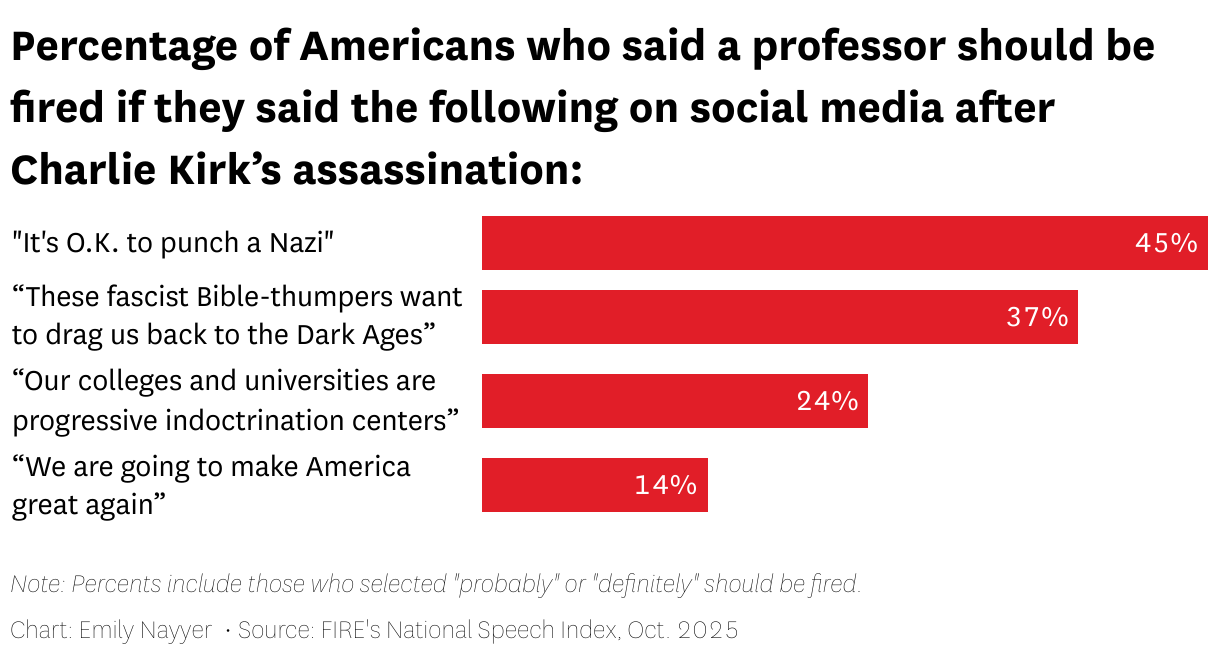
    To test support for academic freedom in the aftermath of the Kirk shooting, the October NSI also asked respondents about four politically charged — but constitutionally protected — remarks made by a professor on social media following the shooting. For each statement, majorities of Americans said the professor should not be fired. But their level of support varied by the statement, and substantial minorities in each case reported that the professor “probably” or “definitely” should be fired.

    • 45% say a professor who posted “It’s O.K. to punch a Nazi” should probably or definitely be fired from their job.
    • 37% say a professor who posted “These fascist Bible-thumpers want to drag us back to the Dark Ages” should probably or definitely be fired from their job.
    • 24% say a professor who posted “Our colleges and universities are progressive indoctrination centers” should probably or definitely be fired from their job.
    • 14% say that a professor who posted “We are going to make America great again” should probably or definitely be fired from their job.
    Percentage of Americans who said a professor should be fired if they said the following on social media after Charlie Kirk’s
assassination: (Bar Chart)

    “Americans were most divided on the statement supporting political violence, but it’s heartening that most Americans correctly backed academic freedom,” said FIRE Chief Research Advisor Sean Stevens. “On the other hand, it’s deeply concerning that we intentionally included some rather tame political statements — including the winning slogan of the last presidential election — and vocal minorities still called for the professor’s firing.”

    Overall, Americans view political violence as a problem across the ideological spectrum, with only modest differences in responses when asked about different ideologies. 57% of respondents said they agreed at least somewhat with the statement “Political violence is a problem among progressives.” But 56% said the same of conservatives, and 58% said they agreed at least somewhat that political violence was a problem across all political groups.

    “Americans seem to recognize that political violence isn’t a partisan problem — it’s a national one,” said Honeycutt. “Our polling suggests that the public is less interested in pointing fingers and more interested in fixing the toxic culture of hostility in our politics.”

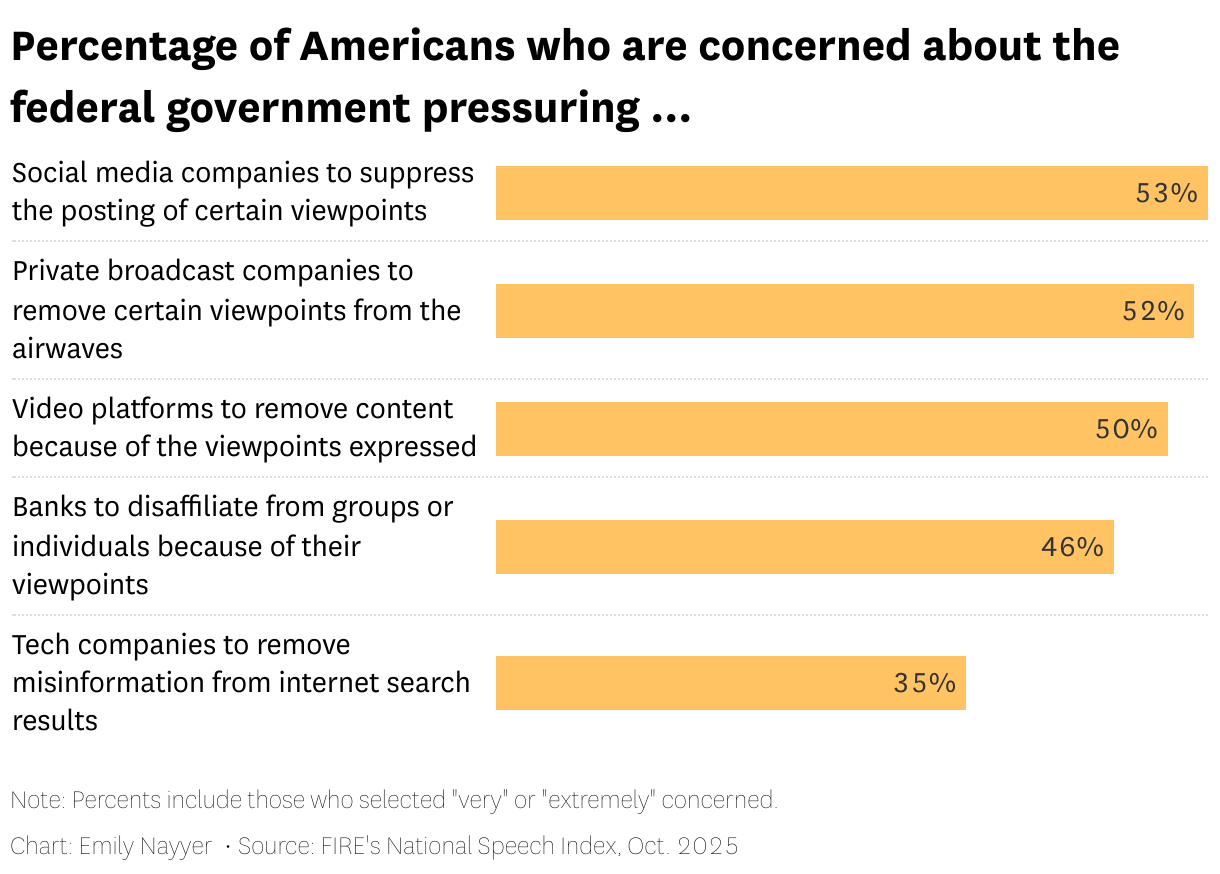
    FIRE also asked for the first time several questions about “jawboning,” the unconstitutional practice in which the government censors by pressuring private actors to silence speech. Around half of Americans said they were “very” or “extremely” concerned about the government pressuring social media companies (53%), video platforms (50%), or private broadcast companies (52%) to remove content based on the ideology expressed.

    Slightly less, 46%, said they were very or extremely concerned about the federal government pressuring banks to disaffiliate with groups or individuals because of their viewpoints, a practice also known as “debanking.” 35% said they were very or extremely concerned about the federal government pressuring tech companies to remove misinformation from internet search results.

    Percentage of Americans who are concerned about the federal government pressuring ... (Bar Chart)

    “Americans are deeply concerned about jawboning — and they’re right to be,” said FIRE Legislative Director Carolyn Iodice. “Both parties have been guilty in recent years of using government pressure to silence speech. This isn’t a partisan issue; it’s a constitutional one.”

    The National Speech Index is a quarterly poll designed by FIRE and conducted by the Dartmouth Polarization Research Lab to capture Americans’ views on freedom of speech and the First Amendment, and to track how Americans’ views change over time. The October 2025 National Speech Index sampled 1,000 Americans and was conducted from October 20 to 28. The survey’s margin of error is +/- 3.0%.


    The Foundation for Individual Rights and Expression (FIRE) is a nonpartisan, nonprofit organization dedicated to defending and sustaining the individual rights of all Americans to free speech and free thought — the most essential qualities of liberty. FIRE educates Americans about the importance of these inalienable rights, promotes a culture of respect for these rights, and provides the means to preserve them.

    The Polarization Research Lab (PRL) is a nonpartisan collaboration between faculty at Dartmouth College, Stanford University and the University of Pennsylvania. Its mission is to monitor and understand the causes and consequences of partisan animosity, support for democratic norm violations, and support for partisan violence in the American Public. With open and transparent data, it provides an objective assessment of the health of American democracy.

    CONTACT:

    Alex Griswold, Communications Campaign Manager, FIRE: 215-717-3473; [email protected]

    Source link

  • A Step in The Wrong Direction in Engaging College Students in our Democracy

    A Step in The Wrong Direction in Engaging College Students in our Democracy

    Amanda Fuchs Miller On this Election Day, it is critical to think about how we as a country want to ensure that more young people vote and get involved in public service.  As a democracy, we should all be striving to make it easier for new voters to register, get to the polls, and have their vote count.  However, what we are seeing instead are efforts to make it harder for college students to be engaged in our electoral process – through restrictions on supports and language designed to have a chilling effect on voting instead of encouraging it. 

    Right before college students returned to campuses, the U.S. Department of Education issued new guidance designed to make it harder for college students to vote.  Every school year, students receive an email with information about how to register to vote.  This is because it is required in law.  The Higher Education Act requires institutions of higher education to “make a good faith effort to distribute a mail voter registration form…to each student enrolled in a degree or certificate program and physically in attendance at the institution, and to make such forms widely available to students at the institution.” 

    Contrary to statute, the Trump Administration is now encouraging schools to limit who they send this information to – saying that if a school doesn’t send it to students who they have “reason to believe” are ineligible to vote, that’s okay.  In addition to this being contrary to law, which requires all students to receive this information, this will increase the likelihood of students who are eligible not receiving information about how to register to vote (thus suppressing their votes) – and is likely to most impact students of color.  The Department is also encouraging the voter registration information to include language reminding students of the list of ways that voting may be fraudulent – another tactic that may have a chilling effect on students going to the polls.

    The same Department guidance prohibits students from being paid with federal work-study funds for any voting-related activities.  A press release from the Department says that they are making a change to this longstanding policy because “Federal Work-Study is meant to provide students opportunities to gain real-world experience that prepares them to succeed in the workforce, not as a way to fund political activism on our college and university campuses.”

    As we prepare our next generation of leaders to play a role in our democracy, in government, and in public service, it is hard to see how allowing students to participate in nonpartisan voting engagement is not aligned with experience they will benefit from in the workplace. By engaging in nonpartisan voter registration efforts using work-study positions, college students are able to increase the number of their peers who are registered to vote while learning and participating fully in our democratic system – all while earning the funds they are entitled to so that they can afford a college degree.  It can’t go without saying that this restriction is also counter to statute and regulations which do not limit the types of on-campus work study positions to those that are in the “public interest,” as the guidance suggests.  That limitation is only linked to off-campus work-study positions.

    In a survey by CIRCLE following the 2024 elections about why young people didn’t register to vote, more than one in 10 – 12 percent – of people aged 18-34 said they did not know how to register or had problems with voter registration forms. Nearly a third of young people – 31 percent – said they were too busy, ran out of time, or missed the registration deadline.  Without receiving voter registration information, in an objective way, from their college or university or their peers on campus, these numbers are likely to go up as more students will lack the information they need about voter registration.

    Ensuring college students are able to vote shouldn’t be a partisan issue.  In 2024, there were disparities by both gender and race in youth voter turnout.  We all benefit from a democracy where everyone’s voice is heard and every vote is counted – for whomever the ballot is cast. 

    _________

    Amanda Fuchs Miller is president of Seventh Street Strategies and former Deputy Assistant Secretary for Higher Education Programs at the U.S. Department of Education in the Biden-Harris Administration.


    Source link

  • Higher Ed Moving in “Wrong Direction”

    Higher Ed Moving in “Wrong Direction”

    The share of Americans who believe higher education has lost its way is on the rise, according to a new survey the Pew Research Center published Wednesday.

    Of the 3,445 people who responded to the survey last month, 70 percent said higher education is generally “going in the wrong direction,” up from 56 percent in 2020. They cited high costs, poor preparation for the job market and lackluster development of students’ critical thinking and problem-solving skills.

    The survey results come amid turmoil for the higher education sector, which was already facing rising public skepticism about the value of a college degree before Donald Trump took office earlier this year. But over the past nine months, the Trump administration has terminated billions in federal research grants and withheld even more money from several selective institutions.

    Another survey published this week found that most Americans oppose the government’s cuts to higher education.

    Earlier this month, Trump asked universities to sign a compact that would give them preference in federal funding decisions if they agree to make sweeping operational changes, including suppressing criticism of conservative views on campus.

    But the state of campus free speech is already one factor driving the public’s overall negative views about higher education, according to the survey.

    Forty-five percent of respondents said colleges and universities are doing a fair or poor job of exposing students to a wide range of opinions and viewpoints; 46 percent said institutions are doing an inadequate job of providing students opportunities to express their own opinions and viewpoints.

    Political leanings also influenced perceptions of higher education, though the gap between Republicans and Democrats has narrowed in recent years.

    According to the survey, 77 percent of Republicans and Republican-leaning respondents said higher education is moving in the wrong direction, compared to 65 percent of Democrats and Democratic-leaning respondents.

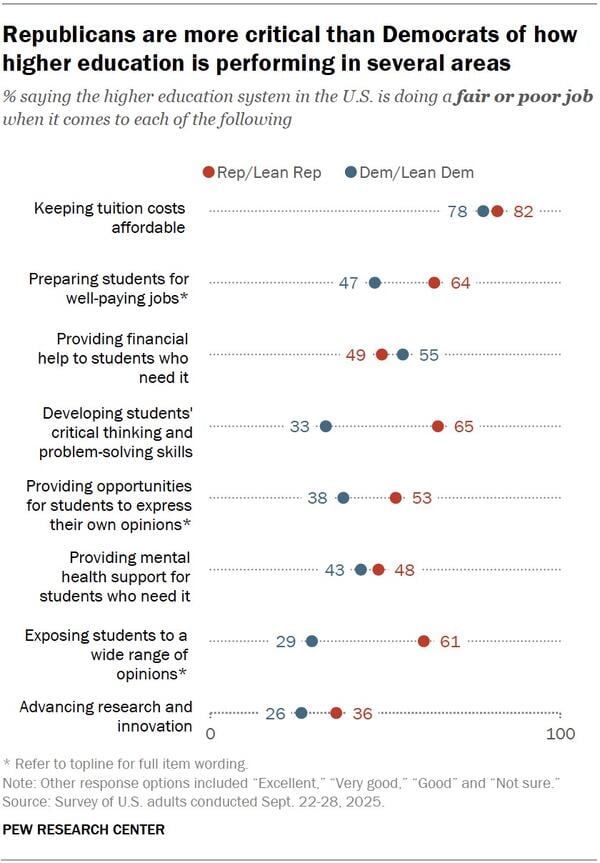
    Republicans were more likely than Democrats to say that universities are doing a poor or fair job of preparing students for well-paying jobs, developing students’ critical thinking and problem-solving skills, exposing students to a wide range of opinions and viewpoints, and providing opportunities for students to express their own opinions and views.

    republican vs democrats on higher ed

    Source link

  • Bank holiday reading: Flying the Nest in the wrong direction – How we can attract our ‘lost boys’ back into HE

    Bank holiday reading: Flying the Nest in the wrong direction – How we can attract our ‘lost boys’ back into HE

    In sociology, the term ‘male flight’ refers to men abandoning fields, activities, or professions when they are perceived as becoming too ‘feminine’ or associated with women. Lisa Wade argues that this is ‘bad long-term strategy for maintaining dominance.’ Education, especially in recent years, has become a battleground for cultural and political struggles, particularly in the wake of growing far-right influence in both Europe and the United States. But is the shift away from higher education by young men simply a cultural power struggle, or are we failing to meet their needs and expectations?

    The Impact of Gender Dynamics on Higher Education Participation

    Men are increasingly opting out of higher education. The widening gender gap in college enrolment reveals a troubling trend: higher education is now facing what can be described as male flight. In the United States, this gap has expanded dramatically. In 1979, only 200,000 more women attended college than men; by 2021, that number had surged to 3.1 million more women than men. While the COVID-19 pandemic significantly impacted enrollment figures in 2021, this shift underscores a broader trend in gender and education that warrants serious consideration.

    A similar pattern is unfolding in the UK. In 2020/21, there were 2.75 million students enrolled in higher education, with women making up 57% of the student body. The undergraduate sector exhibits the largest gender gap. This growth, however, raises critical questions about the future of male participation in higher education.

    The Retreat of Men from Higher Education: A Closer Look

    The trend of male flight from higher education is unlikely to reverse without targeted intervention. A study by King’s College London highlights that young men today are particularly concerned about the challenges they face in society. Unlike their older counterparts, younger men and women hold vastly different views on education, social issues, and political ideologies. According to a survey of over 3,500 young people aged 16+, young men tend to be less supportive of gender equality initiatives and are increasingly aligning with right-wing political views. Within this context, right-wing political groups, such as Reform UK, advocate for a ‘no-nonsense’ approach to education, emphasizing a patriotic curriculum that they argue better addresses concerns about social equality. Their proposals often reflect a growing sentiment among some groups, particularly white men, who feel that their experiences and challenges do not align with current gender equality initiatives.  

    While the political rhetoric surrounding this issue is highly charged, it demands serious attention. The key question now is: How can we rebuild young men’s confidence in higher education? This is particularly pressing when considering young men from low-income or disadvantaged backgrounds. Research shows that white working-class men are disproportionately likely to cite the high cost of higher education as a barrier to entry.

    Fees and student loans are the biggest concern of young people as they look ahead onto the HE landscape, with over 25% of young Britons thinking that university is not worth it. Alongside this sector-wide issue, young men are retreating from HE in much higher numbers than any of their female or BAME counterparts. This is something that should not be ignored if we want truly inclusive HE.  

    What Can We Do? Policies to Address Inclusive Education and Rebuild Trust Among Disadvantaged White Men

    Many of these issues must be addressed by universities themselves. Male students often feel that higher education fails to cater to their unique needs. Young men are less likely to engage in extracurricular activities – such as sports or student unions – that are integral to the student experience. Neil Raven’s contribution to this blog last year highlights young men feeling unsupported and disengaged, and as with everything in this sector, the solution to this question is not straightforward. To truly address the challenges young men face in education, universities must acknowledge that their needs and experiences are distinct and deserve to be supported in meaningful and effective ways.

    When we talk about the financial red flags facing disadvantaged young white men, we’re really addressing the prospect of being burdened with debt—especially when they are just one choice away from avoiding it altogether. Adopting Tim Leunig’s recommendation to shorten the student loan repayment term from 40 years to 20 would give students greater confidence that they can achieve financial freedom by mid-life.  

    Furthermore, research conducted by the Institute for Fiscal Studies commissioned by the Department for Education (DfE) found that only 1 in 5 students would not be financially better off by going to university. This is reason enough to incentivise young white men back into the warm embrace of higher education.

    A shorter repayment term would not only alleviate long-term financial anxiety but also encourage people from all backgrounds to pursue higher education without the fear of being shackled by debt for life. The Higher Education Policy Institute’s own research, despite indicating young women being more debt-averse than men (even with men paying more of the debt due to higher salaries in the longer term), shows that most of our young people are opposed to the Labour government’s tuition fee increase. A shorter repayment term will perhaps not only restore the confidence of our young women – who are already sceptical of the lower salaries they will receive throughout their careers – but reassure all of our young people that student loans are not a lifelong burden, and that we have a system that rewards ambition rather than punishing those who take the leap.

    Moreover, this shift could help restore confidence in the value of a degree, particularly for those who currently see university as a risky financial gamble rather than a stepping stone to social mobility. This is, as Mr Raven identifies, especially important as men doubt and call into question graduate outcomes in the long term.

    Figure 1 New HEPI polling shows Labour’s tuition fee rise made more palatable by maintenance support increase – HEPI

    HEPI’s research also indicates that a tuition fee hike is made more palatable if accompanied by an increase in maintenance support. In a piece I wrote for the Sixteenth Council, I referred to the Institute for Fiscal Studies’s proposals regarding maintenance support. One of these was restoring the generosity of maintenance support to 2020 levels, which represents a 16% increase for the 23/24 intake. Yes, this means issuing £1.5bn in maintenance loans, but repayment levels would mean that the cost to the government and the taxpayer would fall to £0.4bn.

    Therefore, making HE more attractive for young people – especially those white, working-class young men who are lacking that engagement with education – involves reducing the repayment term for tuition fees down to 20 years and restoring maintenance support to pre-COVID levels. Ultimately, this would, as HEPI’s research indicates, make the recent tuition fee rise more palatable and, in turn, set young minds at ease.

    Another way of addressing these practical problems is spearheading a secondary school library-building scheme. The National Literacy Trust identified a strong link between school library use and reading attainment, which is especially important as low reading abilities help to ‘entrench’ education inequality in the UK. The provision and accessibility of school libraries from a young age can help boost attainment in early years and beyond, setting young men on a course that permits more positive thinking about further and then higher education.

    The National Literacy Trust’s report also notes that library users receiving free school meals showed higher reading enjoyment and increased reading and writing for pleasure. They tended to read and write a greater variety of material relative to non-library users. In 2021, the Commons Education Committee found that white working class students were ‘by far the largest group of disadvantaged pupils’ with just under a million eligible for free school meals in 2020. Accessible libraries and reading spaces may be the next big step we can take to help disadvantaged pupils. The National Literacy Trust’s report reveals that white working-class boys receiving free school meals are particularly poised to benefit from a campaign of boosting libraries and reading spaces in educational settings, which may help improve their engagement with education as a whole.

    A few months ago, I attended the Publishers’ Association’s parliamentary drop-in event, where I learnt a lot about the importance of the relationship between school libraries, reading attainment, and the publishing industry as a whole. I enjoyed reading in my primary school’s small library space, and throughout my time at secondary school, I made use of both the school’s reading spaces and our local community library. Unfortunately, I must recognise that this was an enormous privilege for a white working-class student when it should just be a permanent feature of our outstanding education system.

    This is extremely relevant now as I look out on the educational landscape. Young men are falling behind women in education, a significant issue which goes way back to before primary school. According to the Centre for Social Justice (CSJ), ‘From the day they start primary school, to the day they leave higher education, the progress of boys lags behind girls’.

    Ultimately, the success of higher education in the 21st century will depend on how effectively universities can adapt to the evolving needs of all students. In the case of young men, this means recognizing their unique challenges and addressing them with targeted, thoughtful solutions. Only by doing so can we create a higher education system that truly serves everyone, regardless of gender.

    As Mr Raven notes in his blog contribution, it is certainly ‘our problem, not theirs’.

    Source link

  • Ministerial Direction 111: What you need to know

    Ministerial Direction 111: What you need to know

    Jason Clare implemented the direction after his Bill was downvoted by the Coalition and Greens. Picture: Brett Hartwig

    Ministerial Direction 111 (MD111) is the new way of processing international student visa applications and has replaced Ministerial Direction 107. It came into effect on December 19, 2024.

    Please login below to view content or subscribe now.

    Membership Login

    Source link

  • Ministerial Direction 107 to be revamped after caps defeated

    Ministerial Direction 107 to be revamped after caps defeated

    Education Minister Jason Clare has been under pressure from the sector to replace the direction. Picture: NCA NewsWire/Martin Ollman

    The Albanese government is preparing to replace a controversial ministerial direction that has been criticised for favouring sandstone universities over regional and outer-suburban institutions, as providers warn Labor’s “confused and mismanaged” policy approach is damaging the sector and the economy.

    Please login below to view content or subscribe now.

    Membership Login

    Source link