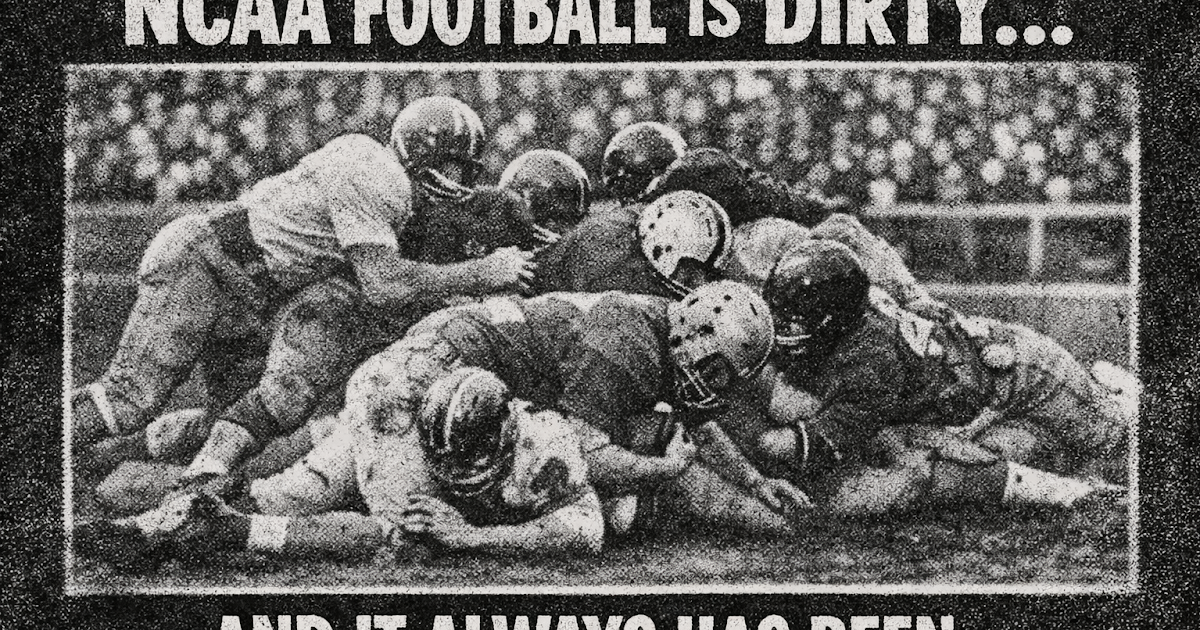
For more than a century, college football has wrapped itself in pageantry, school colors, marching bands, and the language of amateur virtue. It has sold itself as character-building, educational, and fundamentally different from professional sports. Yet from its earliest days to the present NIL era, NCAA football has been marked by exploitation, corruption, racial inequality, physical harm, and institutional hypocrisy. The truth is not that college football has recently become “dirty.” It has always been this way.
College football emerged in the late 19th century as a violent, chaotic game played almost exclusively by elite white men at private Northeastern universities. By the 1890s, dozens of players were dying each season from on-field injuries. In 1905 alone, at least 18 young men were killed. The brutality became so extreme that President Theodore Roosevelt summoned university leaders to the White House, demanding reforms to save the sport—or shut it down entirely. The NCAA’s predecessor organization was born not to protect players, but to protect football itself.
From the beginning, control and image management mattered more than athlete welfare.
As the sport spread nationally in the early 20th century, universities discovered football’s power as a marketing and fundraising engine. Gate receipts financed campuses, built stadiums, and elevated institutional prestige. With that money came cheating. Schools openly paid players under the table, provided fake jobs, and created academic loopholes to keep athletes eligible. The NCAA responded not by ending exploitation, but by codifying “amateurism”—a concept designed to deny players compensation while preserving institutional profit.
That amateur ideal was always selective. Coaches became highly paid public figures, administrators gained power and prestige, and universities used football to attract donors and students. Players, meanwhile, were expected to risk their bodies for scholarships that could be revoked, often steered into academic programs that prioritized eligibility over education. The system worked exactly as intended.
Race made the exploitation even starker. For much of the 20th century, Black athletes were excluded outright or limited by quotas, especially in the South. When integration finally occurred in the 1960s and 1970s, it did not bring equity. Black players disproportionately filled the most physically punishing positions, generated enormous revenue, and remained shut out of coaching, administrative leadership, and long-term financial benefit. The plantation metaphor—uncomfortable as it is—has endured because it fits.
Throughout the postwar era, scandals became routine. Academic fraud at powerhouse programs. Boosters laundering payments. Universities covering up recruiting violations while publicly moralizing about rules and integrity. The NCAA positioned itself as a regulator, but enforcement was inconsistent and often political. Blue-blood programs negotiated slaps on the wrist while smaller schools were hammered to make examples. Justice was never blind; it was strategic.
Meanwhile, the physical toll on players worsened. As athletes grew larger, faster, and stronger, the sport became more dangerous. Concussions were downplayed for decades. Chronic traumatic encephalopathy (CTE) was ignored until it could no longer be denied. Players suffering brain injuries were dismissed as weak, while universities and conferences cashed ever-larger media checks. The NCAA claimed ignorance, even as evidence mounted and lawsuits piled up.
The television era transformed college football into a billion-dollar entertainment industry. Conference realignment chased broadcast revenue, not regional tradition or student well-being. Athletes were asked to travel cross-country on school nights, miss classes, and perform under relentless pressure—all while being told they were “students first.” The hypocrisy became harder to conceal.
By the early 21st century, the contradictions finally cracked. Legal challenges exposed the NCAA’s amateurism rules as a restraint of trade. Courts acknowledged what players had long known: universities were profiting massively from their labor while denying them basic economic rights. Name, Image, and Likeness (NIL) was not a revolution—it was an overdue concession.
Yet even in the NIL era, the dirt remains. The system still lacks transparency. Booster-driven collectives operate in legal gray zones. Players are encouraged to chase short-term deals without long-term protections. There is no guaranteed healthcare beyond enrollment, no pension, no real collective bargaining for most athletes. Coaches can leave at will; players are scrutinized, transferred, or discarded.
The NCAA insists it is reforming. Conferences promise stability. Universities speak the language of athlete empowerment. But the underlying structure remains unchanged: unpaid or under-protected labor generating extraordinary wealth for institutions that claim educational mission while operating like entertainment corporations.
College football’s defenders often say, “It’s always been this way,” as if that excuses the harm. In reality, that phrase is an indictment. From the deadly fields of the 1900s to the concussion-ridden stadiums of today, from Jim Crow exclusion to modern NIL chaos, the sport has been built on control, denial, and profit.
The problem with NCAA football is not that it lost its way. It never had one.
What is new is not the dirt—but the visibility. Players now speak openly. Courts intervene. Fans question the myths. The mask is slipping, and the century-old fiction of purity is harder to maintain. Whether that leads to real change—or merely a cleaner narrative over the same exploitative core—remains to be seen.
But history is clear. College football did not fall from grace.
It was born compromised.
Sources
– National Collegiate Athletic Association, History of the NCAA
– Michael Oriard, Reading Football: How the Popular Press Created an American Spectacle
– Taylor Branch, “The Shame of College Sports,” The Atlantic
– Allen Sack & Ellen Staurowsky, College Athletes for Hire
– ESPN Investigations and NCAA Infractions Reports
– Boston University CTE Center research on football-related brain injury
– U.S. Supreme Court, NCAA v. Alston (2021)