Tag: discount

  • We’re Not Asking for a Discount, We’re Asking for Clarity

    We’re Not Asking for a Discount, We’re Asking for Clarity

    How can you assuage family fears about the cost of college?

    After two years of reading survey responses and digging into the numbers, I have learned something simple and essential about how families and students navigate the college planning journey: most families do not walk away from college because of the price tag itself. They walk away because they do not understand what that number means.

    In the last two years, I have written four major reports: the 2024 High School Student College Planning Report, the 2024 High School Students’ Perceptions of College Financing Report, the 2025 E-Expectations Trend Report, and the 2025 Prospective Family Engagement Study. Together, they draw on responses from nearly 6,000 high school students and almost 10,000 prospective families, giving us a 360-degree view of how people navigate the college planning journey.

    What these studies, and broader research (George-Jackson & Gast, 2015; Marcus, 2016; Rainey & Taylor, 2024; Uperberg, 2023; Gallup & Lumina Foundation, 2025), show us is simple but urgent: cost is not just about dollars. It is about clarity, confidence, and trust.

    Let’s start with what I learned from the broader research.

    What research tells us about cost, aid, and college decisions

    Across the literature, several consistent themes emerge about how families perceive cost, aid, and value in college planning:

    Sticker price stops the conversation

    Families often see the full cost of attendance and assume it is what they will pay. Most are unaware of net price calculators, or if they are aware, they do not know how to interpret the results (George-Jackson & Gast, 2015). This lack of understanding creates a “sticker shock” effect that prevents many students from even considering certain institutions, particularly those with higher published tuition rates. Research shows this disproportionately affects first-generation and lower-income families.

    My takeaway: If sticker price ends the conversation before it begins, institutions must lead with clarity about net price and affordability, not bury those numbers deep on a website.

    Loan fear limits options

    Families are deeply wary of borrowing, shaped by personal experiences, community narratives, and national headlines about student debt. This fear often pushes students toward the cheapest option or away from college altogether, regardless of fit or long-term return (Rainey & Taylor, 2024; Uperberg, 2023). While many students still anticipate borrowing, the emotional weight of debt creates hesitancy, stress, and in some cases, a complete halt in the college search process.

    My takeaway: Colleges need to acknowledge debt anxiety directly, offering tools like loan repayment calculators, loan repayment assistance programs (LRAPs), or transparent messaging that frames borrowing as an investment, not a trap.

    College value is still believed, but proof is demanded

    Despite concerns, most families still believe higher education is a worthwhile investment and a pathway to upward mobility (Gallup & Lumina Foundation, 2025). However, they are increasingly asking colleges to “show the math.” They want to see career placement rates, average earnings by major, and clear evidence that a degree will lead to tangible outcomes (Marcus, 2016). Simply promising that college “pays off” is no longer enough.

    My takeaway: Institutions must highlight outcomes early and often— weaving graduate stories, salary data, and career ROI into recruitment messaging, not waiting until yield season.

    Aid matters, but only if it is understood

    Financial aid has the potential to completely change affordability for students, but too often, the way it is communicated undermines its impact. Many students and families report being unclear on how aid works, what types of aid are available, and how to apply (Rainey & Taylor, 2024). Complex language, late timing, and lack of plain explanations mean that aid packages often add to stress instead of reducing it.

    My takeaway: Aid communication must be simplified, visual, and personal. Families need plain language, early outreach, and real-world examples of how aid changes the bottom line.

    Revolutionize your financial aid offers with video

    What RNL research reveals about cost, clarity, and college decisions

    Sticker shock is real and misleading

    Families often see the full cost of attendance and assume it is what they will pay.

    • 72% of families eliminated a college based on sticker price alone (RNL, Ardeo, & CampusESP, 2025).
    • Only 12% of students used a net price calculator (RNL, Ardeo, & Halda, 2024).
    • More than half of parents still did not know their likely aid after visiting a college website (RNL, Ardeo, & CampusESP, 2025).

    Students say: Sticker price stops the conversation.
    Families say: We are not asking for a discount; we are asking for clarity.

    My takeaway: If families do not know the real price, they walk away before there is even a chance to explain. That is not a money problem; it is a communication problem.

    Clarity is the new currency

    Confusion about aid derails progress toward enrollment.

    • 57% of students started but did not finish at least one application because “it seemed too expensive” (RNL, Ardeo, & Halda, 2024).
    • 65% of prospective families say final cost (after financial aid and scholarships) is the decisive factor to choose a college, and 80% of students agree (RNL, Ardeo, & CampusESP, 2025).
    • 43% of families have trouble finding a financial aid or scholarship calculator, and nearly four out of ten cannot find scholarship info on college websites (RNL, Ardeo, & CampusESP, 2025).

    Students say: Confusion kills momentum.
    Families say: If we do not understand the process, we will not finish it.

    My takeaway: Clarity is not just nice, it is currency. If cost feels hidden or complicated, families spend their trust elsewhere.

    Fear of loans drives the conversation

    Loan fear shapes how families perceive every option.

    • 71% of students said loan concerns shaped their planning negatively; 8 in 10 still plan to borrow (RNL, Ardeo, & Halda, 2025).
    • 72% of students, and 51% of families (69% of first-generation), would be more likely to enroll if the college offered a Loan Repayment Assistance Program (RNL, Ardeo, & CampusESP, 2025).

    Students say: Debt is emotional, not just financial.
    Families say: We fear making a mistake that follows us for years.

    My takeaway: Until you address loan fear head-on, families will see debt as a dealbreaker, not a doorway.

    Families are involved, but often left out

    Parents and caregivers play a central role, but they often lack the tools.

    • 80% of students involve a parent or caregiver in college planning, but first-gen parents are less confident reviewing aid (RNL, Ardeo, & Halda, 2024).
    • Email is the preferred channel for all families (90%), yet awareness of portals and tools is low, especially among low-income and first-gen families (RNL, Ardeo, & CampusESP, 2025).

    Students say: Families want to help but need more than a brochure.
    Families say: Include us; do not just assume we know where to look.

    My takeaway: Families are the co-pilots of this journey. Ignore them, and you risk losing the student, too.

    Technology needs a human touch

    Digital tools can open doors, but students and families still crave connection.

    • 91% of students use college websites; 65% are more likely to apply after a virtual tour (RNL, Halda, & Modern Campus, 2025).
    • 1 in 4 apply after engaging with an AI assistant, but many still follow up with email (RNL, Halda, & Modern Campus, 2025).
    • Only 53% of families know about parent/family portals, with even lower awareness among first-gen families (RNL, Ardeo, & CampusESP, 2025).

    Students say: Yes, we are digital, but we are also human.
    Families say: Technology helps, but we still want a person on the other side.

    My takeaway: Digital opens the door, but human connection makes families walk through it.

    Cost is not just about affordability; it is about perception, trust, and understanding.

    Watch our webinar, The Price Tag Problem, to learn more about communicating with families about college costs.

    Families and students are not asking for a discount; they are asking for clarity. When institutions lead with transparency, plain language, and humanity, they transform the way students and families see higher education.

    This is a topic we’ll explore in our webinar, The Price Tag Problem: How Families Weigh Cost, Stress, and Value and What You Can Do About It. We will look at the latest data on how families feel about college affordability, borrowing, and the value of college.

    References

    Source link

  • Private college discount rates for first-year students, 2021

    Private college discount rates for first-year students, 2021

    Two quick additions/clarifications to this:  The definition of full-pays is those students who receive no institutional funds.  EM people don’t care where the cash comes from, only the discount.  Second, yes, I know some institutions use endowments to pay for institutional aid.  That percentage is likely very small, although concentrated at a few institutions.

    Before we begin, here is what this post does not do:

    • It will generally not tell you where you can get low tuition, with a very few exceptions.  And when it does, it won’t be at one of “those” colleges.
    • It will not tell you which colleges are likely to close soon, although after the fact, you can probably find a closed college and say, “Aha! Right where I expected it would be!”
    • It will not show you net costs to students.
    • It will not adjust for things like church support, enormous endowments, or the cost of living in that high-priced city where Excellence College or Superior University is located.

    Got it?  Good.

    This will show you the discount rate on first-year students at about 1,000 four-year, private, not-for-profit colleges in 2021-22.  Discount as I define it is the total unfunded institutional financial aid divided by the total charged (gross) tuition and fees.  A university that charges (published tuition and fees times the number of students) $10,000,000 and awards $4,000,000 in aid has a discount rate of 40%.  At most colleges, this discount is simply an accounting transaction, much like a coupon to save a dollar on a sandwich at Subway.  That, of course, is a gross over-simplification of the “what” of discounting, and it doesn’t touch the “why” of discounting at all.  But if you want an explanation, I’ll gladly talk to your trustees for a reasonable fee.

    And there is a difference between discount and net revenue, although at any given tuition charge, the two are perfectly related.  Unfortunately, as  you’ll soon, see, colleges all set their own tuition.  To wit:

    • A college charging $50,000 with a 20% discount has net revenue (the cash you can spend) of $40,000 per student.
    • That same college with a 50% discount has just $25,000 per student.
    • A college charging $30,000 with a 10% discount has $27,000 per student.
    • That same college with a 40% discount has $18,000 per student.

    As a college, you don’t care where the cash comes from: Pell grants, state grants, loans, or the student’s family.  This means, hypothetically, a student with low institutional aid might pay less than one with more aid.  Confused?  Good.

    If you use this with your trustees to explain your own college’s market position, consider supporting my costs of time, hosting and software by buying me a coffee.  Just click here to do so.  If you counsel high school students, or your a parent of a prospective college student, must keep reading and don’t feel any obligation at all.

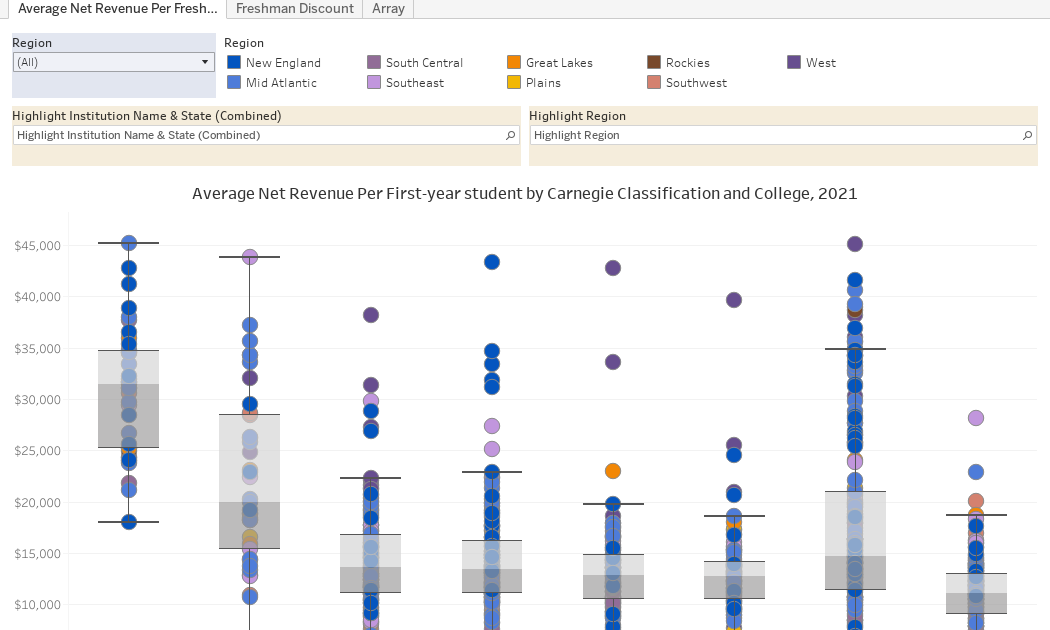
    Here is the data, in three views.  The first two are box and whisker plots, where half of the colleges fall inside the gray box on each column to show you the middle 50%.

    The first view shows net revenue per freshman student, arrayed by the institution’s Carnegie type.  Use the controls to filter region, highlight region, or highlight an individual college.  To do the latter, type any part of the name in the box, hit enter, and select from the options.  Hover over dots for details; each dot is a college.

    The second view is identical, but it shows discount rate, the number people obsess over while missing the more important net revenue figure.

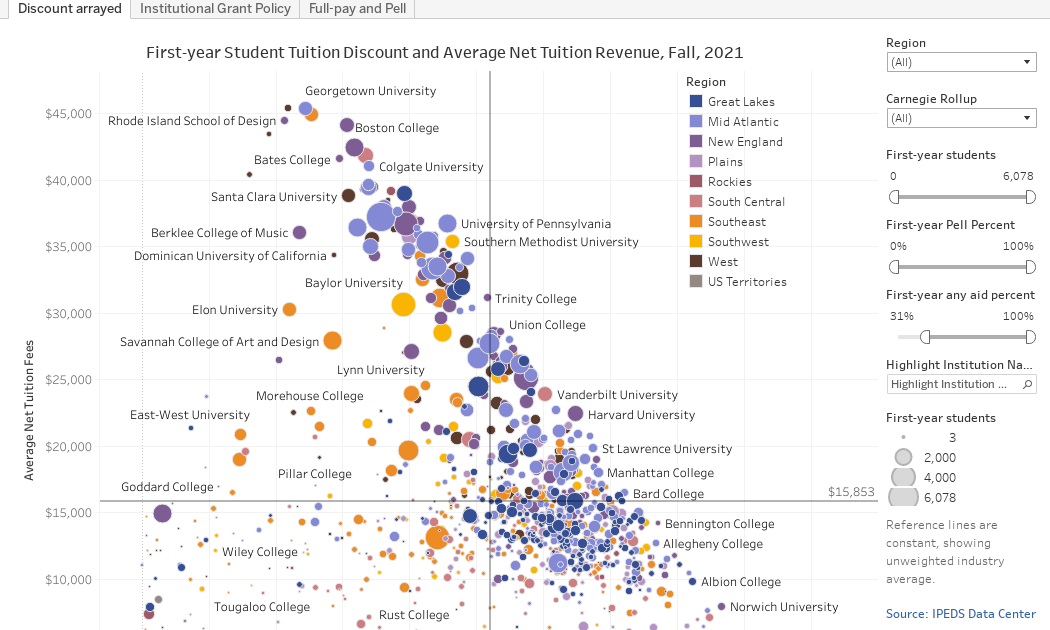
    The third view shows those two values arrayed, with the same highlighters, allowing you to filter on Carnegie type, or even the percentage of the students who are full-pay (that is, they get no institutional aid at all.)

    You’ll soon see that discount and net revenue don’t seem to be big issues at the big name, strongly endowed institutions.  That’s because, at many of these places, undergraduate education is essentially a sideline business, and only a minor source of revenue.  The money they bring in (or don’t) on this presumably core function of the university is managed to best optimize to reputation or selectivity, or other factors (including, sometimes, mission).

    Note that I’ve done my best to remove some outliers with wild data that throw the charts off.  Many of these are colleges I have never heard of, and they’re tiny.  Others are places with strong religious missions (like Yeshivas or Seminaries) that may be externally funded in ways this can’t account for. 

    Enjoy

    Source link

  • First-year Discount rate at private colleges, 2021

    First-year Discount rate at private colleges, 2021

    This is always a popular topic, but the subject is misunderstood.  I want to talk about discount rate at private colleges.  

    IPEDS has the best data on first-year (or freshman) discount, so that’s what I visualize.  And the first part of this is going to get a bit into the weeds; if you work in a private college or university, and you use this in your work, or you send it to trustees, you can support my time, effort, software, and hosting costs by buying me a coffee.  If  you don’t want the details, and you think you understand this concept, feel free to skip down to the section that breaks down the views, below the line of asterisks.

    For those who always ask, no, I don’t do this for public universities.  It may be helpful to compare institutions within a state, but beyond that, state funding models and the mix of resident and nonresident tuition rates make comparisons across borders mostly meaningless.  And for the more knowledgeable who might wonder, I assume that all institutional aid is unfunded; that is, it’s not coming in as a revenue stream from an external source to provide funding.

    Let’s do an exercise to help you understand discount: Suppose you run an ice cream store, and you have more ice cream than you can sell.  You might offer a coupon, let’s say for 50% off a cone.

    The cone you normally sell for $4, you now sell for $2.  You just take less money for it.  There is no one there to hand you two extra dollars to make up for the gap.  The Department Store store down the street sells a very similar cone in its food court for $8, but offers a 75% off coupon.  They decide to take $2 for the cones they sell in order to be competitive with you.  

    The Gourmet Ice Cream Shop around the corner sells cones for $12, because they think their ice cream is much better, their store nicer, and their location more convenient to the subway station.  On occasion, they will tell the kids at the orphanage they’ll give them a free ice cream cone, but everyone else pays.  And finally, Mel’s Fair Deal Ice Cream store sells ice cream cones for $2.50, but never offers coupons.

    If everyone uses your coupon, your store has a discount rate of 50%, and your net revenue per cone is $2.  But of course, some people will pay $4.  If everyone uses the coupon at the Department Store, their net revenue per cone is also $2.  But their discount rate is 75%.  

    The Gourmet Store is more generous with the orphans than people realize; about half of their cones are given away.  So their discount rate is also 50%, but their net revenue per cone is $6.  And finally, Mel’s Fair Deal Ice Cream has a discount rate of 0% and a net revenue of $2.50 per cone.

    It’s important to remember that none of these stores cares where the cash comes from.  It could be from the customer’s pocket, from a parent or aunt, government food stamps, or a loan they take out from the government.  You count the cash, not the source of the cash.

    Now, guess what?  Almost all college aid is discount, much like those coupons the ice cream stores hand out.  It’s simply the college agreeing to take less cash than its published tuition rate.  If tuition is $40,000 and you offer a $20,000 discount or scholarship, you simply take $20,000 to educate the student, and write the rest off as an accounting transaction.

    The need for higher discounts in higher education are driven by tuition prices that are too high for most people to pay.  Colleges have to discount, or they’re going to have costs associated with making too much ice cream to sell that they can’t pay.

    (This is the part where someone will want to comment and extend the analogy ad infinitum: Which ice cream is better? Is one really worth six times more? Why don’t you make more flavors to attract more customers instead of discounting the vanilla to bring people in? Does your cost of ice cream production get lower if you produce a lot more?  Can’t you do research and optimization to figure out who should get the coupons when to maximize profit? And if so, couldn’t you lower price a lot and drive the others out of business?  Couldn’t you offer the coupon to fewer people and hope more pay full price? Please don’t be that person.  I’ll do a workshop for you if the price is right.)

    So, to easily calculate discount, in case it’s not clear, take the amount you have to discount and divide by the published price.  For a college, the discount rate is total institutional (unfunded) grant aid/total gross tuition. For average net revenue, take total gross revenue, subtract institutional (unfunded) grant aid, and divide that number by the number of students.

    For instance, if your sticker tuition is $40,000 and enroll ten students, your total gross tuition is 40,000 x 10, or $400,000.  If you award $100,000 in unfunded aid to make that enrollment happen, your discount rate is 100,000/400,000, or 25%.  After you take the aid away from tuition, your average net revenue is (400,000 – 100,000)/10, or $30,000 per student.  That’s how much cash you have to work with to do things like pay faculty, cut the grass, heat the buildings, and run the administration.

    ***************************

    Now, below, you can dive into college discount rates, net revenue, mixes, and the shape of the industry. This data set is very rich, and I may do another angle on this topic later.  But for now:

    Discount arrayed (the first view using the tabs across the top) arrays about 950 four-year, traditional, private colleges.  I’ve removed lots of religious seminaries, some very small institutions, and, frankly, some suspect data from this for the sake of clarity.  This is IPEDS data so it’s reliable, but never perfect.

    Each college is a dot, colored by region and sized by freshman enrollment relative to the set displayed. The view shows discount rate on the x-axis, and average net revenue on the y-axis.  

    You can use the filters at right to limit the set further.  You can’t break anything, and you can reset the view using the controls at the bottom.  Try this: Use the First-year students filter to look at colleges with at least 2,000 freshmen.  Then look at those colleges with fewer than 250.  Interesting, no?

    The reference lines are the unweighted average of all 950 institutions in the set.

    Institutional grant policy shows how many colleges and how many students fall into institutional grant aid categories.  Some institutions give aid to 100% of all students.  The vast majority give aid to 90% or more.

    And finally, the Full-pay and Pell shows two variables: The percentage of students who get no aid (full-pay students) and those who get Pell grants at the institution shown.  And remember, it doesn’t matter where the cash from full-pay students comes from: That group includes some students whose parents write a check, and some who might get a Pell and whose parents take out an ill-advised PLUS loan for the cost of attendance.

    The point?  Discount rate is important for similar institutions in the same region, but as thing unto itself, it’s kind of meaningless.  Net revenue is more important, for the most part, but at some institutions where undergraduate education can almost be called a sideline business, even net revenue is not important as it might seem.

    Eager to hear your thoughts.

    Source link