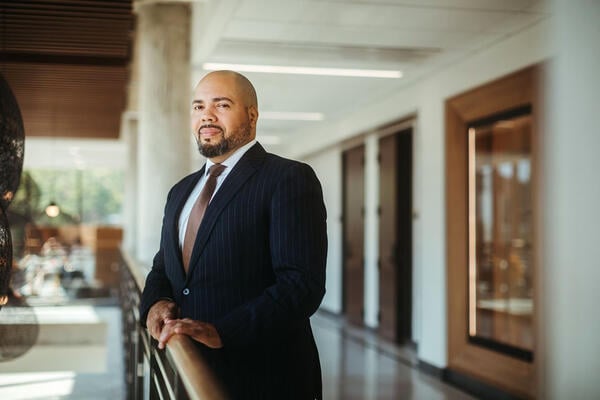
Throughout his 20-year career in higher education, Julian Vasquez Heilig has steadily climbed the career ladder, moving from assistant to associate professor at the University of Texas at Austin; into a full professorship at California State University, Sacramento; and then to a dean position at the University of Kentucky’s College of Education, Human Development and Sport Science. Being dean was rewarding, he said. The wins were visible, the feedback loop was short and he was well supported. Hoping to expand his impact, Heilig stepped onto the next career-ladder rung and became provost at Western Michigan University in Kalamazoo. But as provost, he didn’t feel emboldened to make change, he said; he felt isolated and exposed.
After two years, he stepped down, and he now serves as a professor of educational leadership, research and technology at Western Michigan. His frustrations with the provost role had less to do with Western Michigan and more to do with how the job is designed, he explained. “Each person sees the provost a little differently. The faculty see the provost as administration, although, honestly, around the table at the cabinet, the provost is probably the only faculty member,” Heilig said. “The trustees—they see the provost as a middle manager below the president, and the president sees [the provost] as a buffer from issues that are arising.”
Inside Higher Ed sat down with Heilig to talk about the provost job and all he’s learned about the role through years of education leadership research, conversations with colleagues and his own experience.
The interview has been edited for length and clarity.
Q: You stepped down from the provost role at Western Michigan in January, two years after taking the position. What tipped you off that the position wasn’t for you?
A: In general, provosts are judged on student success, retention, faculty hiring and academic quality, and yet the purse strings of those things often truly sit with the president or the chief financial officer. That split means the provost really answers for outcomes without the levers to fund them. The job really asks you, as a leader, to redesign programs and diversify pipelines while working with multiple stakeholders—trustees, donors and faculty. If you push too hard on innovation, you face backlash. If you move too slowly and the role becomes ceremonial, then that might violate your own personal mission and beliefs. I’m not specifically talking about Western Michigan—all institutions have to decide whether they value transformation or whether they want tranquil optics.
For most provosts, the average tenure is three years, based on the research I’ve seen. But durable change, sustainable change could take five, seven, 10 years. A lot of the things that [provosts] initiate outlive the job—it’s difficult to be around to see your agenda finished.
Q: You’ve described the provost role as being “structurally exposed.” What does that mean, exactly?
A: The relationship between presidents and provosts can be—especially at research universities—really fraught. One of the ways that it can be helped is by, from the outset, sitting down with your president to talk about how you’re going to make decisions, what the expectations are for resource commitments and joint accountability for decisions. A lot of times provosts are enforcing decisions and policies they didn’t make, but they’re held accountable to those policies, and having a compact [with the president] would be a better foundation.
Leaders need to be able to have buffers to take smart risks without constant political whiplash. Those could look like multiyear resource agreements or protocols for handling disputes among vice presidents. That is super important—insulation is not isolation; it’s a structure that enables courage among leaders. Higher education is always the first to call for change and the last to make it because we have to align authority with responsibility. We have to be committed to change. We can’t avoid crises because there are some people that aren’t interested in making change and are completely satisfied with the status quo.
Q: Did pushback to your equity work factor into your decision to ultimately step down?
A: When controversy hits, the easiest release valve is the provost … It’s important for institutions to see the provost role not as disposable if they expect the provost to be bold stewards of academic affairs.
Someone told me on LinkedIn that the provost role is not actually the chief officer of academic affairs; they’re actually the associate dean of academic affairs. Because pressure comes at the provost from the side from other vice presidents, from above you from the president and from below you from the deans, without the opportunity to respond to all those stakeholders in all the ways you would like. If you reallocate resources and challenge the institution’s sacred cows, then you’re going to take immediate fire. A lot of provosts will last many, many years in the job because caretaking is much safer than transforming under the current norms of higher education. So we need to think about how you reward measured disruption in the provost role and protect those who are doing the hard work of solving problems.
There’s a high burnout cost to this job because you have nonstop negotiation between all these different stakeholder groups and competing demands. Each of these stakeholder groups want something different. Emotional labor mounts for you as a provost because the wins are very diffused … and if something goes wrong with accreditation or something else, the blame is very concentrated. So without structural support from each of those stakeholder groups, even the best leaders get drained.
A lot of people go right from dean to president nowadays; they don’t want to get sidelined by the provost role. They just decide that this type of leadership is not worth it. That means that institutions are losing people who would build in this role, who would innovate in this role, and are rewarding people who just simply want to manage and caretake. Instead of hiring leaders, they’re just going to hire a manager.
Q: You’ve written that provosts are almost always destined for a falling-out with their president. How do you think those roles are pitted against each other?
A: If you’re thinking about becoming a provost, you have to take the measure of the person you’re working for. You’ve got to figure out: How is this hard decision going to be made? How are resources going to be committed? How is there going to be joint accountability for decisions that the president wants you to make? Will there be shared goals and shared power, rather than performative communications and performative statements? A real relationship and a real compact is the foundation for success for a partnership like this.
Deans operate in a bounded area of things with very visible outcomes and very tight feedback loops, but the provost has a very diffuse set of responsibilities and is responsible for not just one but [many] colleges. The clarity that deans have really fuels that work. Vice president of academic affairs is a title that suggests influence, but its insulation and authority are very thin. Visibility is high, but when things go wrong, they go very wrong. We’ve got to pair the prestige of that position with clear powers and clear protections, because, again, each of the stakeholder groups has different interests, and so they see you either as their friend or their enemy.
Q: Is there anything in particular that you would like to see from presidents in general to better support their provosts?
A: [Provosts] can’t be seen as expendable by design. So when a controversy hits—and you have controversies day after day after day—the main job of the provost is to fix things, hard problems that weren’t fixed before they got to your desk. And so when things go really wrong, from what I hear from my colleagues, the easiest release valve is the provost.
As you look across campuses, people are saying provost is the hardest job. And there’s a reason why they say that.
Q: Inside Higher Ed with Hanover Research is releasing its annual survey of provosts tomorrow, and one of the things we found is that 86 percent of respondents said they enjoyed being provost, but only 29 percent of them felt that they consistently have the resources they need to implement initiatives. Do you feel like your experience aligned with that?
A: Yeah, I think it’s particularly difficult when you come in as a vice president rather than as an executive vice president. When you’re on the same level with other VPs, it creates a Game of Thrones in terms of resources. The finance people want money for building, and the VP of research wants money for research, and so one of the challenges when you come into the provost role is you need to have more flexibility, especially around equity. When equity moves from emails and speeches to actual budget shifts, you get resistance. Leaders who are expected to redirect resources to close gaps, they become targets.
Q: Also in our survey, more than half of provosts said their job was more about fixing problems than planning ahead. Would you agree that the role is like playing crisis manager?
A: Part of the challenge is that provosts are having to deal with decisions that other people made. And so you have to deal with decisions that faculty made that may be problematic. You’ve got to implement decisions that the president made. You have a cabinet wanting to implement their decisions for academic affairs, and some of those things go wrong. So you’ve got to work with your team to fix all the different things, and sometimes you can’t fix it fast enough.