
Tag: Displays

  • Can the government ban controversial public holiday displays?

    Can the government ban controversial public holiday displays?

    Last year, the Satanic Temple of New Hampshire put up a Baphomet statue (a part-human, part-goat satanic deity) in front of the State House in Concord. People vandalized it and knocked off its head. Concord vowed to review its policies after its mayor described the statue as “deliberately provocative and disturbing.” That raised major constitutional concerns. 

    FIRE wrote to Concord, arguing that the government could not discriminate against disfavored displays. In a victory for free speech, Concord kept the statue and arrested the perpetrators. This year, despite questions from public officials, Baphomet is back up in front of the State House.

    New Hampshire’s backing of the Satanic Temple’s right to display its religious symbol illustrates a core First Amendment principle: When the government invites private holiday displays, the First Amendment bars viewpoint discrimination. 

    What the Free Speech Clause requires

    The threshold question: who is speaking?

    When the government — such as a town council or a public school — puts up holiday displays, it’s subject to the First Amendment’s Establishment Clause. When the government opens up a public place to private groups or individuals to display their own religious symbols, it is subject to the Free Speech Clause.

    Understanding public forum doctrine

    If the government allows private groups or individuals to display their own symbols, the question is then one of forum. Public forum doctrine is a First Amendment framework that determines the level of constitutional protection afforded to speech on government property. Some forum types allow for more restrictions, but viewpoint discrimination is always constitutionally forbidden. 

    The Supreme Court identifies three types of public forums: traditional, limited, and designated. Traditional public forums are those historically used for public assembly, such as streets and parks, where regulatory ability is most limited. In these spaces, restrictions based on the content (not just viewpoint) of speech are almost always unconstitutional.

    Designated public forums arise when the government intentionally opens public properties for expression. Once the government opens up a designated public forum, the same rules that apply to traditional public forums apply as long as the government keeps the forum open. 

    Finally, limited public forums are places the government opens for expression by limited groups or specific topics. The government can be slightly more restrictive here, with the ability to impose restrictions that are viewpoint neutral and reasonable in light of the purpose served by the forum. For example, a city council might establish a public comment period at its meetings but require that comments be related to city business.

    No matter which type of forum exists, viewpoint discrimination is prohibited

    Courts have reached different conclusions on whether government properties (other than parks, sidewalks, or other traditional forums) opened up for holiday displays constitute limited or designated public forums depending on the circumstances. Regardless, even when the government can set subject matter limits, it can’t discriminate by viewpoint within those categories. The Supreme Court has long barred censorship merely “because public officials oppose the speaker’s view.” Perry Education Association v. Perry Local Educators’ Association (1983).

    Last year in Gallatin, Tennessee, a library allowed 20 different organizations to decorate Christmas trees to display on its premises. The mayor directed the library to remove one of the trees with a gay pride message, citing a policy against “political” decorations. That type of policy is constitutionally suspect in a limited public forum like the library tree exhibition and the tree should not have been removed.

    Just as constitutionally suspect are government attempts to limit religious displays in public forums for fear of endorsing religion. In Shurtleff v. Boston (2022), Boston allowed different groups to fly flags of their choice over Boston’s city hall. Some included foreign countries’ flags or the pride flag. When the city denied a request to fly a “Christian flag,” the Supreme Court treated that as unconstitutional viewpoint discrimination. Put simply, religion is a viewpoint too. Boston could not approve a pride flag and deny a Christian one. 

    VICTORY! Charges dropped against Tenn. woman cited for using skeletons in Christmas decorations

    Less than a month after FIRE filed a First Amendment lawsuit against Germantown, Tennessee, the city has dismissed charges against a resident for keeping skeletons in her yard after Halloween.


    Read More

    Attempts to classify certain messages as offensive, disturbing, or otherwise not in the holiday spirit count as viewpoint discrimination. In other words, under the First Amendment, if the government allows people to publicly celebrate Christmas, it cannot dictate how they do so just because officials dislike a particular perspective. 

    Common neutral rules

    That begs the question: what can the government do once it opens up a forum for holiday displays?

    Usually OK — time, place, and manner rules

    The government can usually impose what are known as “time, place, and manner” restrictions on speech in public forums. In the holiday display context, this could mean limiting the size, height, and distance between displays — all without regard to the display’s content. In other words, cities can reasonably regulate logistics as long as they don’t police viewpoints. 

    Red flags — often viewpoint discrimination in disguise

    Some rules masquerade as viewpoint neutral time, place, and manner restrictions, but are actually viewpoint discriminatory. Look no further than the New Hampshire Baphomet statue, where the mayor argued that the display was too provocative. On the surface, it might seem that the mayor advocated for a neutral “provocation” principle where any display that causes a reaction could be taken down. But that’s not a neutral principle at all — it means enabling a heckler’s veto over unpopular speech. Restricting speech because members of the public, rather than government officials, dislike its viewpoint is still viewpoint discrimination.

    Perhaps the most common problem with holiday display policies are rules that feign neutrality by requiring “good taste” or “respect.” But what’s respectful to one religious group might be offensive to another. These rules invite subjective message policing by the government, which does not and should not have a dog in the fight when it comes to the tone of expression. 

    The bottom line

    In the end, the government can choose whether to open up non-traditional public forums for public holiday displays or not. If it doesn’t, there is no free-floating constitutional right to put up a Satanic display or a Christmas tree as one pleases. For example, the government has not opened up court rooms for holiday displays, so one could not just walk up to the bench and place a giant menorah on it. But when the government solicits holiday decorations, it can’t discriminate between a menorah, a Christmas tree, or even a Satanic statue. 
    Source link

  • Arkansas Judge Orders Removal of Ten Commandments Displays from Lakeside School District – The 74

    Arkansas Judge Orders Removal of Ten Commandments Displays from Lakeside School District – The 74


    Get stories like this delivered straight to your inbox. Sign up for The 74 Newsletter

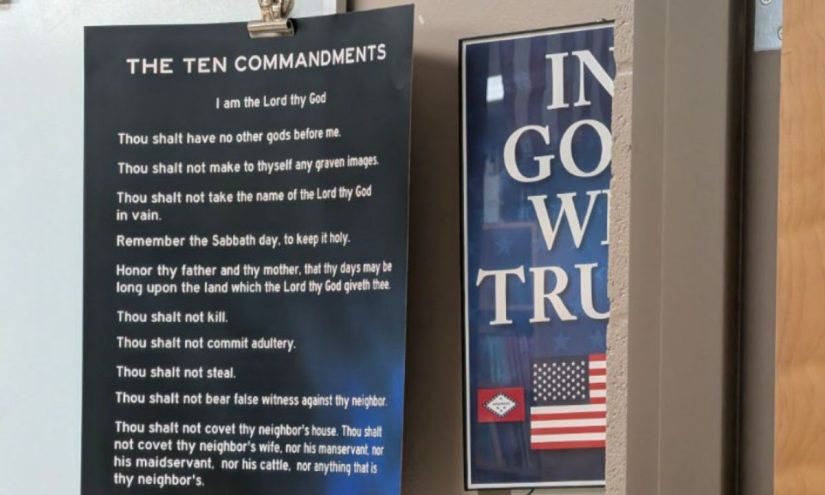
    A federal judge on Friday ordered Ten Commandments posters be removed from Lakeside School District, two days after he permitted the Garland County district to be added to a lawsuit challenging a new state law requiring the displays.

    Following passage of Act 573 of 2025 this spring, public schools are now required to “prominently” display a “historical representation” of the Ten Commandments in classrooms and libraries. The posters must be donated or bought with funds from voluntary contributions. The law also requires them to be displayed in public colleges and universities and other public buildings maintained by taxpayer funds.

    Seven Northwest Arkansas families of various religious and nonreligious backgrounds filed a lawsuit in June challenging the constitutionality of the statute. The families allege the state law violates the First Amendment’s Establishment Clause, which guarantees that “Congress shall make no law respecting an establishment of religion,” and its Free Exercise Clause, which guarantees that “Congress shall make no law … prohibiting the free exercise [of religion].”

    Supporters of the law have argued the tenets have historical significance because they influenced the country’s founders in creating the nation’s laws and legal system.

    U.S. District Judge Timothy Brooks granted a preliminary injunction in August that blocked implementation of the statute in four districts — Bentonville, Fayetteville, Siloam Springs and Springdale.

    Brooks later allowed the Conway School District to be added to the suit as a defendant and district families as plaintiffs. He also ordered Ten Commandments posters be removed from the district’s schools and converted a temporary restraining order against the district into a preliminary injunction.

    A temporary restraining order temporarily halts an action and may be issued immediately, without informing all parties and without holding a hearing. It’s intended to last until a court holds a hearing on whether to grant a preliminary injunction, according to Cornell Law School.

    After Brooks granted permission Wednesday to add Lakeside School District as a defendant and Christine Benson and her minor child as plaintiffs in the case, attorneys for the plaintiffs filed a motion for a temporary restraining order and/or preliminary injunction on Thursday.

    Brooks granted the temporary restraining order Friday and held the preliminary injunction in abeyance. He also temporarily blocked Lakeside from complying with the law and ordered the district to remove Ten Commandments displays from its schools by 5 p.m. Monday.

    “A temporary restraining order should issue as to Lakeside School District No. 9,” Brooks wrote in Friday’s order. “Lakeside Plaintiffs are identically situated to the original Plaintiffs: They advance the same legal arguments, assert the same constitutional injuries, and request the same relief.”

    Defendants and the attorney general’s office, which intervened in the case, have until Nov. 3 to submit briefs to address why the existing preliminary injunction should not be modified to include Lakeside School District as a defendant, according to Friday’s order.

    Arkansas Advocate is part of States Newsroom, a nonprofit news network supported by grants and a coalition of donors as a 501c(3) public charity. Arkansas Advocate maintains editorial independence. Contact Editor Sonny Albarado for questions: [email protected].


    Did you use this article in your work?

    We’d love to hear how The 74’s reporting is helping educators, researchers, and policymakers. Tell us how

    Source link

  • Optoma Announces Launch of the New 3-Series Interactive Displays with Google Certification and AI-Enabled Tools

    Optoma Announces Launch of the New 3-Series Interactive Displays with Google Certification and AI-Enabled Tools

    FREMONT, CA – Optoma, a world-leading provider of visual solutions, today announced its latest Creative Touch 3-Series Interactive Displays designed to empower educators and business professionals with new tools and features to enhance learning, make presentations more effective, and increase collaboration in classrooms, lecture halls, boardrooms, remote working and other business environments.

    With Google’s Enterprise Device Licensing Agreement (EDLA) Certification and added functionality, the new 3-Series empowers professionals and educators to deliver dynamic and impactful content by providing cutting-edge tools that streamline management and elevate engagement. The advanced capabilities of the new 3-Series simplify planning and workflow through wireless collaboration, screen sharing, and innovative meeting solutions in both corporate and educational environments alike, all packed into a robust yet user-friendly platform.

    The 3-Series: Purpose-Built for Corporate and Education Environments

    New features and key highlights include:

    Google EDLA Certification: Ensures compatibility and optimized performance with thousands of educational applications and services available directly from the pre-installed Google Play Store allowing users to experience the full Google Suite for real-time collaboration from practically anywhere in the world.  Without compatibility issues or the hassle of connecting an external PC, users can easily access the entire suite of Google-based applications they are accustomed to – including Google Drive, Google Docs, YouTube, and more!

    The Optoma Solution Suite (OSS®): User-friendly software featuring Artificial Intelligence (AI) enabled tools, such as Sticky Notes* and AI Handwriting Recognition, the OSS package also includes:

    • Whiteboard: Unleash creativity through a digital whiteboard packed with tools that make learning and sharing ideas engaging – facilitating collaboration in real-time from anywhere.
      • Smart Sketch tool is ideal for drawing diagrams as it recognizes shapes and drawings and converts them into clipart images.
      • Floating Toolbar and Infinity Canvas allow you to seamlessly switch between tools to suit your tasks with a virtually limitless writing space.
      • Innovative Annotation and Highlighter Tools make underlining key points or annotating complex diagrams a breeze.
    • File Manager: Easily save, organize, or move files from local storage to networkable storage or to popular cloud services in seconds.
    • Display Share: Connect any device to wirelessly broadcast, share, or stream your content to the big screen. Bringing your own device has never been easier.

    Exceptional Performance: Seamless performance with an 8-core processor, Android 14 OS, and Zero Bonding screen for that natural writing experience.

    “We are excited to announce our new 3-Series and partnership with Raptor Technologies which truly embodies our commitment to supporting education through cutting-edge visual solutions, enhanced software packages and safety and security,” said Maria Repole, Head of Marketing at Optoma.

    A value-added solution, Optoma Management Suite (OMS®) is available out of the box on the 3-Series Interactive Displays, with a free trial available.** OMS offers IT administrators and technicians a real time remote platform to monitor, manage, diagnose, and update multiple or entire fleets of displays simultaneously that are either on the same network or connected through the cloud. OMS makes it easy to broadcast emergency messages, alerts, or announcements across displays worldwide.

    Optoma is thrilled to partner with Raptor® Technologies, the leading innovator in school safety solutions, redefining the landscape of school security with its Raptor School Safety Software Suite. By integrating Raptor’s software with Optoma’s interactive displays, school administrators and students can receive real-time alerts and emergency notifications using CAP protocols to improve the overall safety of the school.

    To experience a demonstration and learn more about Optoma’s new Creative Touch 3-Series Interactive Displays, please schedule a demo or visit: https://www.optomausa.com/products/interactive-flat-panel-displays-3-series/education https://www.optomausa.com/products/interactive-flat-panel-displays-3-series/corporate

    *Some AI features may require the use of an Optoma (OSS) account.

    **Free trial licenses are available for a limited time. Please register your OMS® Cloud account at https://oms.optoma.com or speak with your local representative.

    OMS and OSS are registered trademarks of Optoma Corporation

    DLP is a registered trademark of Texas Instruments

    About Optoma Technology, Inc.  

    Optoma combines cutting-edge technology and innovation to deliver remarkable visual display products designed to connect audiences with engaging video experiences. From the company’s ProScene projectors to its Creative Touch interactive, Professional LCD and LED displays, Optoma’s suite of products can meet the demands of nearly any professional environment, including conference rooms and classrooms, digital signage, corporate, houses of worship, retail, simulation environments and control rooms. Optoma Technology is the U.S. headquarters for The Optoma Group, with continental headquarters also in Europe and Asia. For more information, visit optomausa.com.   

    eSchool News Staff
    Latest posts by eSchool News Staff (see all)

    Source link