Tag: Disruption

  • AI In Academic Publishing: Disruption or Evolution? – Faculty Focus

    AI In Academic Publishing: Disruption or Evolution? – Faculty Focus

    Source link

  • How colleges can help students affected by SNAP disruption

    How colleges can help students affected by SNAP disruption

    This audio is auto-generated. Please let us know if you have feedback.

    As the longest federal government shutdown in U.S. history drags on, student advocates are urging colleges to step up and support those affected by a loss of food benefits.

    The Supplemental Nutrition Assistance Program, the government’s largest anti-hunger program, supports about 1 in 8 Americans in an average month. And its funding has never before lapsed during a government shutdown.

    However, the Trump administration refused to use emergency funds to sustain SNAP this time, with the U.S. Department of Agriculture in October claiming that “the well has run dry.”

    Last week, two federal judges ordered the federal government to fund SNAP, at least in part, via emergency reserves during the shutdown. Then on Thursday, one of those judges issued another ruling requiring the administration to fully fund the program by Friday.

    But when SNAP recipients will actually receive their benefits is unclear.

    The Hope Center for Student Basic Needs, a resource and policy center at Temple University, estimated that 1.1 million college students are affected by the lapse in SNAP, citing 2024 data from the U.S. Government Accountability Office.

    Colleges seeking to support affected students should expand their services and regularly communicate updates to their campuses, according to a toolkit published by the center.

    Where colleges can make a difference

    The Hope Center warned that the recent court rulings ordering the Trump administration to keep SNAP running with contingency funds will not immediately solve the hunger crisis for recipients, who receive their benefits once a month. 

    “It may take weeks for November benefits to arrive in SNAP recipients’ accounts,” the center’s toolkit said.

    The document, which the center is regularly updating, outlines some programmatic changes colleges can undertake to help mitigate the “damaging effects on student basic needs security during this delay and period of uncertainty.”

    Colleges that have campus food pantries should extend those services’ hours and work to increase the food available, the center said. They should also host donation drives on campus and expand support for emergency aid programs.

    To aid these efforts, the center recommended tapping into alumni networks and advancement campaigns.

    Institutions can offer direct financial assistance to students, such as through grocery gift cards. And campus dining services can provide discounted or free meals for SNAP recipients, the toolkit said. They can also establish or expand programs that allow students to donate unused meal plan dollars.

    At the administrative level, bursars can offer relief by pausing collections on institutional debts or offering waivers to affected students, The Hope Center said. 

    College leaders can also partner with local businesses, asking that the establishments provide discounts or free meals to affected students and their children, the center said.

    While the Trump administration has continued to fund WIC — a federal hunger program specifically for children under age five and women who are pregnant, breastfeeding and recently postpartum — college fathers and students parenting older children are not eligible. 

    However, it may be difficult for colleges to partner with grocery stores to offer affected students a break on their bill.

    The USDA last week warned grocery stores against offering discounts to SNAP recipients amid the lapse in benefits. Doing so without a waiver from the agency could result in the stores losing their ability to accept SNAP funds — a crucial source of income for small grocers and those in low-earning areas.

    Communication confusion

    Throughout the shutdown, the executive branch’s chaotic messaging about SNAP funds has added confusion for students and colleges.

    On Tuesday, after the initial court orders, USDA told state and regional leaders overseeing SNAP said it would fund the program with recipients getting at most 50% of their benefits. The agency then said the following day that they would receive up to 65% of their benefits. Neither update gave a timeline for distribution.

    But President Donald Trump broke from his administration’s message via social media.

    Source link

  • Embracing Disruption: Reflections from DisruptED 2025 

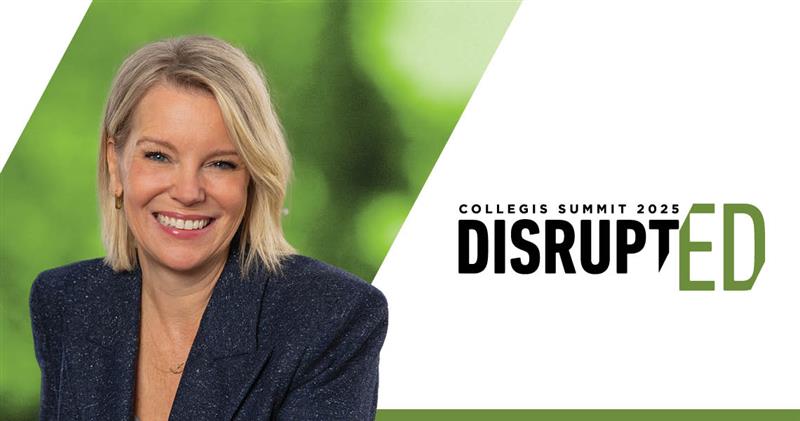
    Embracing Disruption: Reflections from DisruptED 2025 

    Two weeks ago, I had the privilege of gathering with higher ed leaders from across the country for our annual Collegis conference, designed to spark candid dialogue about the future of higher education. We were fortunate to bring together leaders from institutions of all types and sizes, recognizing that while their contexts differ, the profound disruption reshaping higher education is affecting them all.  As we heard from industry experts and schools “winning” during these unprecedented times, it was so rewarding to see excitement build around how to not just navigating this disruption but embrace and drive it.   

    We’ve hosted several conferences over the years, but this one felt different. Maybe it was the collective honesty in the room or the mix of optimism and unease we all carried about the future of higher education. Whatever it was, the conversations reminded me how critical it is for our industry to embrace discomfort as a catalyst for progress. 

    In higher education, disruption is often seen as something that happens to us, driven by external forces we have to react to. But our focus this year was on flipping that script. Instead of responding to disruption, we talked about creating it by becoming the catalysts who challenge long-held models and reimagine how to meet the needs of today’s and tomorrow’s students. 

    These conversations also reinforced the value of stepping out of the day-to-day to connect with peers and have the kind of honest, intentional conversations that spark real change.  I felt honored to be amongst a group of leaders so passionate about the need to evolve for one main reason — the student. 

    Rethinking what “ready” really means 

    One thought-provoking statement that stood out to me came from presenter Casey Evans, Chief Operating Officer at ASU EdPlus. She posed: Institutions focus too much on students being college-ready. We need to flip that and ask ourselves, are WE, the college, ready for the students? 

    It’s a simple reframing, but it changes everything. Too often, we measure readiness as a student’s ability to fit into the systems we’ve built. But what if readiness meant our ability to adapt those systems to meet students where they are? 

    I spoke with leaders who are looking to do exactly that — using data, technology, and empathy to design experiences that are more flexible, inclusive, and human. These institutions aren’t lowering standards, they’re reimagining them. They’re asking what it means to be student-ready, not system-bound. 

    The power of deconstruction 

    Another theme that emerged was around innovation. Fixing broken processes isn’t innovation. Reimagining them is. 

    I heard from presidents, provosts, and enrollment leaders who are bravely seeking to dismantle long-standing workflows and rebuild them one step at a time. Not because it’s easy or efficient, but because it’s necessary. 

    That kind of deconstruction takes courage. It means letting go of what feels comfortable and, at times, rebuilding from the ground up with the student experience leading the way. It’s a daunting idea, but real innovation happens when we move past fixing what’s broken and start imagining what’s possible. 

    Leading through ambiguity 

    We also explored what it means to lead in an era that’s unpredictable and accelerating. Technology, policy shifts, and political forces are reshaping higher ed faster than ever, often in ways we can’t control. 

    Change once seemed to follow a pattern. Now it’s fluid — much like unstructured data: constant, complex, and always evolving. Uncertainty isn’t the exception anymore; it’s the environment we operate in. 

    That’s why intuition alone isn’t enough. Leaders need data to anticipate, adapt, and make confident decisions in real time. True leadership today means creating space for curiosity and collaboration, moving forward even when the path isn’t clear, and trusting that progress is built on motion, not perfection. 

    Creating space for humanity 

    Throughout the event, we discussed how technology could better support human connection across the student experience. There’s a real desire to reduce friction in the journey, make data work harder, and give faculty and staff more time to focus on what they do best: connecting, mentoring, and inspiring. 

    That vision resonates deeply with me because it’s exactly what I believe is possible. Technology isn’t a replacement for  human interaction, but it can absolutely enhance it. When designed intentionally and used strategically, it creates space for humanity. It creates space for students to feel seen, for advisors to act sooner, and for institutions to operate with both empathy and precision. 

    This is the kind of transformation higher ed leaders are striving toward, and it’s one we’re excited to help bring to life. 

    Looking ahead 

    As I left DisruptED, I felt both challenged and inspired. Change in higher ed isn’t slowing down. Technology, regulation, and politics are reshaping our world in ways we can’t always control — but how we respond is up to us. 

    There is no new normal. Continuous, unpredictable change is the norm, and with it comes opportunity. With the right data, strategy, and partners, institutions can move from reacting to leading — anticipating what’s next instead of catching up. 

    Change isn’t optional, but progress is. And as this community of leaders continues to show, disruption doesn’t divide us. It pushes us forward when we’re bold enough to lead together. 

    Innovation Starts Here

    Higher ed is evolving — don’t get left behind. Explore how Collegis can help your institution thrive.

    Source link

  • Leading Your Institution in Times of Disruption and Uncertainty

    Leading Your Institution in Times of Disruption and Uncertainty

    Blog on higher education navigating turbulent waters: Image of a lighthouse in rough seass
    How can you illuminate a path to success in a turbulent environment?

    This last half decade has delivered unprecedented disruption for university leaders. The pandemic, economic uncertainty, greater need among students and families, and sweeping governmental changes have buffeted campuses of every size, type, and mission. As we move through 2025 and look at the landscape beyond, it’s clear that adaptability, resilience, and innovative thinking are crucial for successful university management.

    As my colleagues and I partner with university leaders on key areas such as strategic enrollment planning and working with university boards, we help leaders assess and address five key challenges that impact institutional sustainability. Addressing these areas strengthens fiscal health, campus alignment and collaboration, efficiency, and other challenges that are roadblocks to a campus achieving its full potential.

    Embracing Enterprise Risk Management

    There is one preliminary key strategy that has become especially vital for navigating uncertain times: Enterprise Risk Management (ERM). This approach replaces siloed risk management that dilutes campus resources and responses with a stronger, integrated perspective—allowing senior leaders and boards of trustees to gain a comprehensive view of potential threats and their interconnections. By implementing ERM, universities can develop more effective strategies for identifying, mitigating, and managing risks across all aspects of their operations.

    Addressing five key challenges

    Once you have embraced ERM, that can help guide your strategies and tactics in addressing these five key university challenges.

    1. Financial stability and funding

    With potential changes in federal funding and financial aid structures, universities must diversify their revenue streams and explore new partnerships. This may include collaborations with private industry, international organizations, and philanthropic entities to sustain critical academic research and support student access to education.

    Additionally and perhaps more urgently, leaders need to dive deep into financial aid budgets, leveraging strategies, funding sources, and how they tie to recruitment and admissions strategies. RNL is working closely with our partners to redesign models if/when funding sources disappear, ensuring that you can meet your enrollment goals and serve your mission amidst tremendous uncertainly regarding government sources of funding.

    2. Technological integration

    The rapid advancement of technology, particularly artificial intelligence, is disrupting traditional teaching and learning methods. University leaders must navigate this transformation by:

    • Investing in faculty training for AI integration
    • Updating curricula to reflect emerging technologies
    • Developing ethical guidelines for AI use in academia

    Along those lines, it is critical that institutions have an AI governance framework in place. However, few universities do. In our recent survey of marketing and recruitment practices for undergraduate students, only one out of 10 four-year institutions reported having an AI governance plan. With AI revolutionizing the college journey for students and families, you need to ensure you have a sound AI governance framework.

    3. Crisis preparedness

    From pandemics to natural disasters disrupting higher education, having a comprehensive crisis management plan is essential. This should include:

    • Regular scenario planning and contingency exercises
    • Clear communication protocols for all stakeholders
    • Ongoing training for staff and administrators

    Most institutions have the logistics of crisis management figured out: crisis captains, protocols, policies, and procedures. What they have not accommodated for in the midst of myriad external forces is the long-term impact of these singular events and ongoing circumstances on their communities—students, families, faculty, and staff. The mental health crisis in education is on the rise and now, more than ever, campuses need to lead with compassion and understanding to bring communities together. Ultimately, your institution needs to be able to anticipate potential crisis and be ready to adapt rapidly to ensure that students are cared for and their college experience can continue.

    4. Fostering a culture of innovation and adaptability

    Taking the optimal approach to technological changes and crisis preparedness requires cultivating a culture of continuous innovation. This involves:

    • Creating dedicated teams to explore new areas of innovation
    • Encouraging interdisciplinary collaboration
    • Promoting flexibility in learning paths and program offerings

    The higher education marketplace does not stand still, and universities therefore cannot afford to be set in their ways and be slow to adapt.

    5. Prioritizing stakeholder trust and communication

    Addressing these challenges and achieving goals in a period of disruption requires unity, transparency, and communication among key stakeholders. University leaders should:

    • Maintain open lines of communication with all stakeholders
    • Build trust through consistent and honest messaging
    • Engage in active listening to address concerns and gather feedback

    Difficult messages can be difficult to deliver, but more transparency and dialogue with stakeholders will increase collaboration and focus that will produce transformative results.

    Great university leadership is needed more than ever

    Managing a university during times of great disruption and uncertainty requires a delicate balance of strategic foresight, agile decision-making, and compassionate leadership. By embracing risk management, fostering innovation, and prioritizing clear communication, university leaders can navigate these challenging waters and emerge stronger, more resilient, and better equipped to fulfill their educational missions in an ever-changing world.

    As we face the future, it’s clear that the most successful universities will be those that can adapt quickly, leverage new technologies thoughtfully, and maintain an unwavering commitment to their core values and the communities they serve. My colleagues and I stand ready to help you face this future and achieve immediate and long-term success. Please reach out and we can arrange a convenient time to share our insights and what’s working for institution’s like yours.

    Source link