Safety response protocols are foundational to creating a culture of safety in schools. District leaders should adopt and implement response protocols that cover all types of emergencies. Schools should have building-level response protocols and protocols for incidents when first responders are needed. These practices are critical to keeping the community safe during emergencies.
When staff members are empowered to participate in emergency planning and response, their sense of safety is improved. Unfortunately, many staff members do not feel safe at school.
Thirty percent of K-12 staff think about their physical safety when at work every day, and 74 percent of K-12 staff said they do not feel supported by their employer to handle emergency situations at work.
Staff disempowerment is a “central problem” when it comes to district emergency planning, said Dr. Gabriella Durán Blakey, superintendent of Albuquerque Public Schools: “What does safety mean for educators to really be able to feel safe in their classroom, to impact student achievement, the well-being of students? And how does that anxiety play with how the students feel in the classroom?”
School leaders should implement response protocols that empower staff to understand and participate in emergency response using a two-tiered system of emergency response:
A building-level emergency planning and response team should develop an Emergency Operations Plan, which includes an emergency response protocol
Administrators should adopt protocols to follow when they need first responders to intervene
For guidance on crafting emergency response protocols and plans, click here.
Laura Ascione is the Editorial Director at eSchool Media. She is a graduate of the University of Maryland’s prestigious Philip Merrill College of Journalism.
Across the country, education is on the brink of significant change. As schools, districts, and policymakers grapple with the realities of a rapidly evolving workforce that requires discipline-specific knowledge, high-tech know-how, and hands-on skills, there is a growing recognition that the traditional approaches to preparing students for the real world no longer suffice.
This shift brings uncertainty and anxiety for district leaders here in Indiana. Change can be intimidating, especially when the stakes are as high as the future success of our students. Yet, this moment also holds immense potential to redefine what it means to truly ready them for a workplace that is continually reinventing itself.
To confront the challenges future-focused schools face, we’re sharing our approach from two distinct, but complementary, perspectives. One, from the superintendent of Eastern Hancock Schools, a small, rural district in Indiana that is deeply rooted in its community and focused on creating opportunities for students through strong local partnerships. The other, from the president and CEO of Project Lead The Way (PLTW), a national nonprofit organization that provides schools with innovative, hands-on, project-based STEM curriculum designed to develop critical skills and knowledge, while preparing students for careers beyond the classroom.
While we work in different contexts, our shared mission of preparing students and educators for an ever-changing world unites us. Together, we aim to highlight the excitement and possibility that change can bring when approached with readiness and purpose.
Redefining what it means to be ready
The jobs of tomorrow will demand far more than technical knowledge. As industries transform at warp speed, accelerated by AI, automation, and other technological advancements, many of today’s students will enter careers that don’t yet exist.
Preparing them for this reality requires educators to focus on more than just meeting academic benchmarks or prepping for the next standardized test. It demands fostering critical thinking, collaboration, communication skills, and, perhaps most importantly, confidence–characteristics many employers say are lacking among today’s graduates.
At Eastern Hancock, this preparation begins by creating opportunities for students to connect their learning to real-world applications. The district’s robust work-based learning program allows juniors and seniors to spend part of their day in professional placements across industries, such as construction, healthcare, engineering, and education, where they receive hands-on training. These experiences not only provide exposure to potential careers but also help students develop soft skills, including teamwork and problem-solving, that are critical for success in any field.
We also know that when students have earlier access to STEM learning and concepts, they are more inclined to pursue a STEM-driven career, such as computer science and engineering. Students in PLTW programs tackle meaningful problems as capable contributors, such as designing prototypes to address environmental issues, exploring biomedical innovations, and solving arising problems like cybersecurity and information safety.
Preparation, however, is about more than providing opportunities. Many students dismiss career paths because they lack the self-assurance to see themselves thriving in those roles. Both Eastern Hancock and PLTW work to break down these barriers–helping students build self-esteem, explore new possibilities, and develop confidence in chosen fields they may have once considered out of reach.
Empowering educators to lead with confidence
While students are at the heart of these changes, educators are the driving force behind them. For many teachers, however, change can feel overwhelming, even threatening. Resistance to new approaches often stems from a fear of irrelevance or a lack of preparation. To truly transform education, it is essential to support teachers with the resources, tools, and confidence they need to thrive in evolving classrooms.
PLTW’s professional development programs equip educators with training that builds their capacity to lead transformative learning experiences. Teachers leave PLTW sessions with practical strategies, a renewed sense of purpose, and the self-assurance to inspire their students through immersive classroom experiences.
At Eastern Hancock, the promise of growth drives efforts to support educators through professional development that aligns with their goals and the district’s vision. Teachers collaborate to set meaningful objectives, fostering a culture of innovation and shared purpose. This approach ensures that educators feel prepared not only to guide students but also to grow alongside them.
Blending a local approach and national reach illustrates how schools and organizations at every level can work together to address the shared challenge of preparing and supporting educators for the future. By empowering teachers with the tools and confidence they need, both Eastern Hancock and PLTW demonstrate how readiness can ripple outward to transform entire communities.
Delivering on the promises of education
Indiana’s reimagined graduation requirements offer schools the chance to redefine what it means to be truly prepared for the future. At Eastern Hancock, we’ve seen how aligned values–like those we share with PLTW–can inspire new ways of thinking about career readiness. We’re both deeply committed to ensuring students are equipped with the skills, experiences, and confidence they need to thrive in an unpredictable world.
Change may cause anxiety, but it also creates opportunities for innovation, growth, and excitement. When educators, students, and communities embrace readiness, the future of education becomes a source of hope and possibility-for Indiana and for the nation.
George Philhower, Ed.D., Eastern Hancock Schools & David L. Dimmett, Ed. D., MBOE, Project Lead The Way
George Philhower, Ed.D., is superintendent of Eastern Hancock Schools, a rural district just east of Indianapolis.
David L. Dimmett, Ed. D., MBOE, is president and CEO of Project Lead The Way, a national non-profit organization providing hands-on learning experiences to PreK-12 students across the U.S.
Latest posts by eSchool Media Contributors (see all)
This audio is auto-generated. Please let us know if you have feedback.
Tahira DuPree Chase is superintendent of Westbury Union Free School District In New York and a member of the Institute for Education Innovation.
Rising through the ranks to a school leadership role can be an arduous journey for even the most qualified female educators. And once we reach our final destination, we’re not always welcomed. We often face challenges our male counterparts never experience.
Only 30% of superintendents in the U.S. are female, and less than 1.5% are Black women. Across the country, female school leaders are targeted by unwarranted criticism, experience significant gender pay gaps, and receive less coaching and support than their male colleagues. We’re also a powerful force to be reckoned with — fierce, committed and experienced — and when united, we are reshaping education to better fit our students’ diverse needs.
Tahira DuPree Chase
Permission granted by Tahira DuPree Chase
To break down barriers, female leaders must find their own tribe of like-minded women who sit in a similar seat, both in the education field and outside of it. There are formal and informal, national, regional, and local support systems composed of incredible individuals who understand one another’s struggles. In these groups, we talk about our experiences, share ideas and uplift our fellow women.
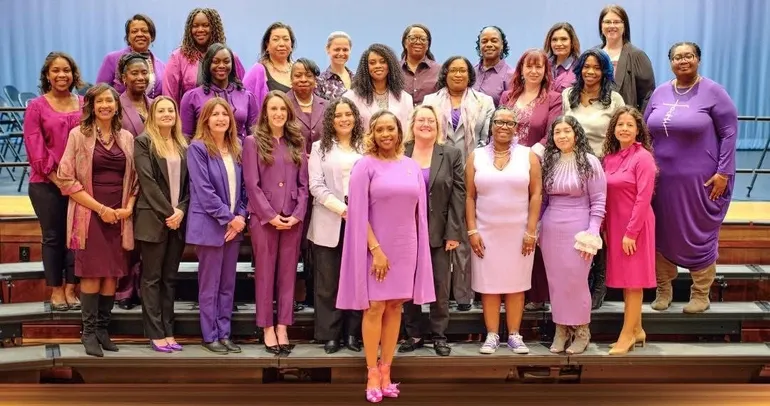
Westbury is an anomaly in K-12 education, with women in 93% of administrative roles. Under the leadership of “The Women of Westbury,” otherwise known as “WOW,” the district’s graduation rate has skyrocketed to 90% in a district where nearly 70% of children qualify for free or reduced-price lunch. We have implemented top-tier security measures to better protect our students, improved facilities and operations, and done it all while successfully managing our schools’ finances.
Building this team of professionals and helping them thrive hasn’t been without its challenges, but by aligning our recruitment and retention strategies with three critical guidelines, we’ve reached this incredible time in Westbury’s history.
Hire with an open mind
At Westbury, we knew we needed to diversify our leadership, but the goal did not dictate our hiring process. We followed a traditional interview path, and it just so happened that female applicants rose to the top. The individuals we’ve hired are credentialed, well-versed and highly qualified. These aren’t so-called “DEI hires”; they are common-sense hires.
As a Black female leader in education, I’ve had my credentials questioned due to unconscious — and sometimes blatant — bias. I’m required to hold multiple advanced degrees and jump through endless hoops to be on the same playing field as many of my male counterparts in the hiring process. Based on my own experiences, I find it no surprise that female candidates often self-select from applying for management roles, because they believe men have an advantage or assume they lack the experience to meet every vague qualification listed in the job announcement.
It has been disheartening to watch other women struggle with similar challenges and become disenchanted with the entire education system. That’s why Westbury has strived to create a more equitable space where all individuals are encouraged to take the next step in their careers.
Encourage leaders to embrace their vulnerability
Superintendents are expected to shoulder a heavy load in their role, but for female leaders, the stress can feel overwhelming. Ninety-five percent of female administrators said they struggled to find a healthy work-life balance and were forced to make personal and professional sacrifices their male colleagues did not.
At Westbury, we stress the importance of self-care for all educators and administrators in the district by hosting wellness fairs and offering a mental health day focused solely on our team’s well-being. A board-certified psychotherapist is on staff to provide social-emotional support on both a group and individual level. In addition, we help school leaders develop their own professional support system that includes not just their fellow women, but male allies who have their best interests at heart.
We have found that when we provide educators the space to find that self-care sweet spot, they better maintain their focus, think more clearly, and allow ideas to flow. In turn, our schools become centers of innovation where we are improving our students’ academic experience.
Help lift up the women behind you
As female school leaders, we have an obligation to empower the next generation of women. Becoming a mentor to future leaders and watching them thrive is one of the greatest honors we can experience in our leadership roles. When someone trusts me to be their sounding board and values my insights, it fuels me to keep moving forward.
All leaders in the district are automatically assigned a mentor to help guide them in their administrative path. I’ve also extended myself to be a secondary mentor if a leader requests extra support. Furthermore, Westbury encourages our leaders to consider roles with professional organizations, like the Institute for Education Innovation and AASA, to offer their expertise to female colleagues nationwide.
This professional community is incredibly powerful. Research has found that women who have a close inner circle of female colleagues are more likely to secure leadership positions, have higher pay and greater authority. In comparison, there is no link for men’s success in terms of the gender composition of their networks.
Over the years, the “Women of Westbury” have encountered their fair share of detours, roadblocks and bumps to get to a place where their talents and expertise are celebrated. Today, we’re not just a support system for each other, we are paving the way for the women coming up behind us to receive the roles they rightly deserve.
We recognized that diversifying our administration is one of the best things we can do for students, ensuring they see themselves reflected in their leaders and understand there is no limit to what they can achieve in their future careers.
NEW ORLEANS — Between 2020 and 2024, student attendance in Missouri’s Springfield Public Schools dipped from 94.73% to 90.63%.
Like many other school districts nationwide, Springfield’s attendance rates took a hit from the COVID-19 pandemic.
Data from the American Institutes for Research shows fall 2020 attendance rates nationwide for elementary school at 92%, middle school at 90%, and high school at 89% — down from pre-pandemic averages of 95% for elementary and 92% for middle and high school.
And because of the global health crisis, the state kept Springfield at its 2019-20 attendance numbers for funding purposes, Superintendent Grenita Lathan told attendees in March at the annual conference of AASA, The School Superintendents Association, in New Orleans.
But with the state’s hold harmless order on attendance about to sunset, Lathan said, officials in the 24,500-student district knew that they needed to boost attendance during the 2023-24 school year. So they set a goal: By the end of that school year, they would raise attendance to 92%.
“When it comes to school attendance, 90% is not an A.”
Springfield Public Schools’ messaging on attendance
Announcing that charge during her annual state of the schools address in August 2023, Lathan said chamber of commerce members and the community at large needed to understand the impact that a 2 percentage-point attendance increase would have.
“That would bring in anywhere from $3 [million] to $4 million in funding that would help us with different programs,” Lathan said.
Lathan and other district officials laid out a districtwide strategic plan that included a communication timeline, monthly updates to 300 local business leaders, and a promise that Lathan would let herself be publicly doused in Powerade if the district reached its goal. Here are the keys to how officials rallied the community to work toward the attendance goal.
Keep it simple and be bold
“It was important that we had buy-in from everyone in the district so that the messaging would resonate with everyone in the community,” said Stephen Hall, the district’s chief communications officer.
To that end, the district prioritized making its messaging simple, direct and bold in presentation. This was reflected not only in the attendance campaign’s slogan — “Attend today, succeed forever” — but also in messaging on social media and on signage around the city.
In their car pickup lines, each of Springfield Public Schools’ 50 elementary, middle and high school buildings displayed five 18-inch by 24-inch yard signs heralding the directive “Attend daily. On time. All day.”
Additionally, the district used digital billboards at three major intersections to get its message out. For only $500, Hall said, the district was able to get more than 250,000 ad placements on the billboards over 20 days.
The attendance initiative became an easy, noncontroversial message for media and business partners to get behind. District leaders asked businesses to be creative in incorporating the campaign into their own messaging and also to sponsor PSAs on local TV stations.
Furthermore, the district sent monthly news releases to local media showing the district’s progress. One local reporter even made it his mission to try to calculate the progress on his own, because he wanted to beat the competition on getting the story out once the district hit its goal, Hall said.
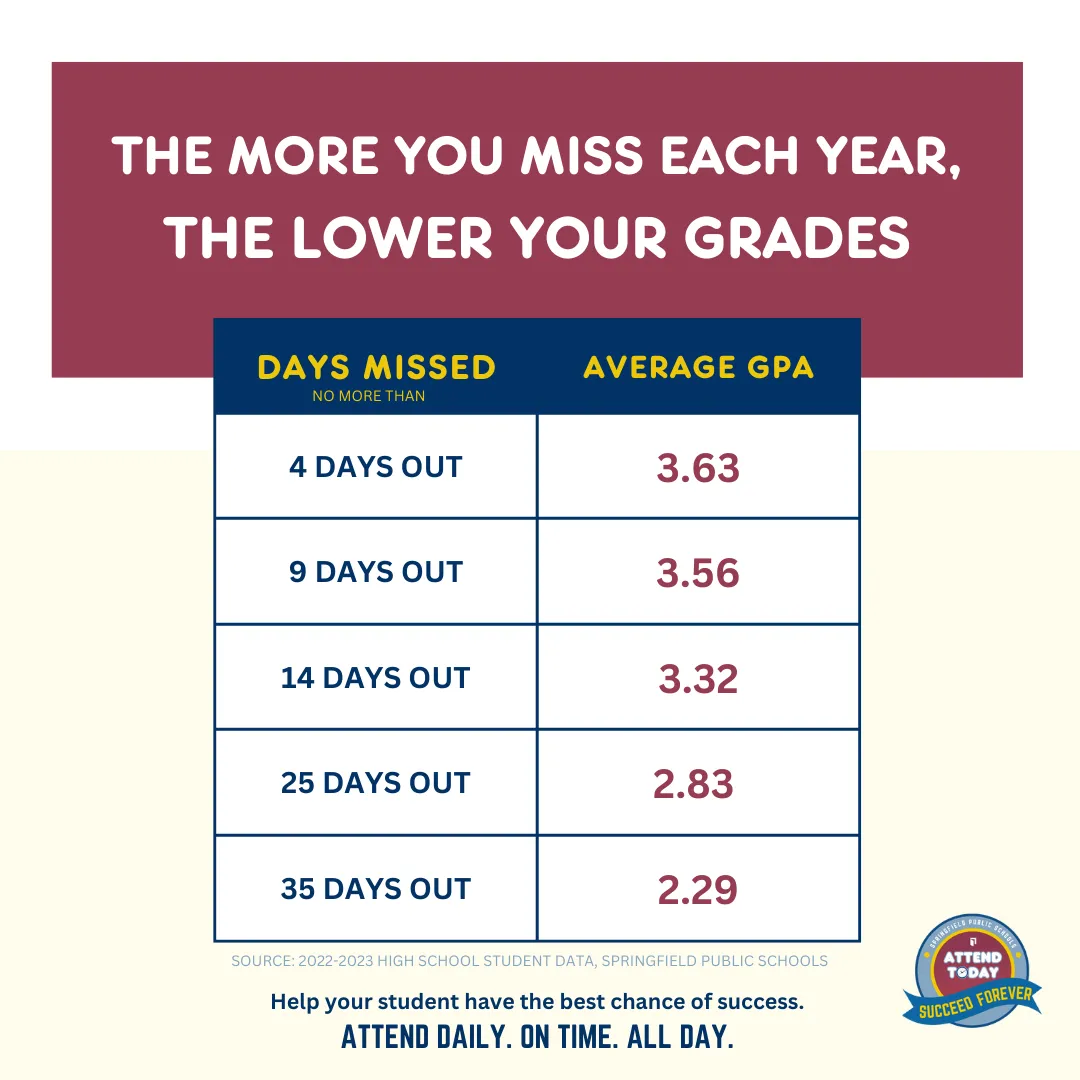
On social media, the district boldly declared, “When it comes to school attendance, 90% is not an A.” The school system supplemented these posts with graphics that simplified attendance data. Visuals, for instance, demonstrated how much of an impact each successive absence could have on a student’s performance, as defined using their GPA: Where a student with four absences might average a 3.63 GPA, a student with 35 absences might have a 2.29.
A social media graphic from Springfield Public Schools shows how prolonged absences correlate to potential impacts on student GPAs.
Permission granted by Springfield Public Schools
Don’t sweat the pushback
Shifting a community’s mindset isn’t without its hiccups, however. If your messaging is working, you should expect to receive pushback, the Springfield officials told AASA conference attendees.
“Because it was consistent, because it was bold, and because we were holding people accountable, we heard quite a bit of feedback,” Hall said.
One negative Facebook comment shared with attendees, for instance, read in part: “The SPS attendance obsession is why everyone in our house has been sick the last month. Our kids report they have been surrounded by sick kids at school who have been bullied by administrators into thinking they cannot miss any school. The result? Our kids are getting sick because sick kids are at school.”
When concerns like this arose, Hall said the district made a point of reminding parents that it’s still important to keep their kids at home when they are ill, and that punishing sick children wasn’t the purpose of the attendance campaign.
The district used the pushback as an opportunity to have school attendance officers and liaisons talk with families to identify barriers to attendance and offer solutions and resources to help address the issue. These included six attendance advisors who provided supports for transportation and health needs, counseling referrals, home visits, phone calls and address checks.
But pushback didn’t just come from parents: Students also leveled criticism against the district using social media comment sections, the district website’s feedback platform, and even a cover story in Kickapoo High School’s quarterly KHQ Today Magazine. Among their complaints: participation in school activities like dances, art shows, and public-facing performances such as band or choir relied upon attendance staying above a certain level.
“The only way to move metrics by 2 percentage points is for people to understand that there’s accountability, that there is consistency. And so it does ruffle some feathers sometimes, because they’re hearing it from multiple levels of the organization,” Hall said.
Yard signs promoting school attendance are pictured on the cover of the Fall 2024 issue of KHQ Today Magazine, a quarterly publication produced by students at Kickapoo High School in Springfield Public Schools in Missouri.
Permission granted by Springfield Public Schools
Leverage virtual learning
Not only is Springfield Public Schools the largest school system in Missouri, but it has the state’s largest virtual learning program, which serves around 400 school districts statewide.
“We have, in-house, a really robust virtual learning program,” said Ben Hackenwerth, the district’s chief strategy and innovation officer. “In Missouri, the way we’re funded, if a student is a virtual student, they automatically receive 100% attendance as long as they are participating.”
While there are specifics on how that participation has to be monitored and reported, Hackenwerth said, this situation provided an opportunity to meet with parents of students who were struggling in the regular school environment and offer them an option that might suit their child better.
The virtual learning program also gave Springfield a pathway to rethink suspensions.
For students on long-term suspensions, “we would give them the option of becoming a virtual student with the expectation that they could not be on campus,” Hackenwerth said. “So instead of taking that attendance hit, they could continue learning in a virtual setting, and it didn’t impact our attendance in a negative way.”
At the high school level, leveraging virtual learning options raised attendance by 1.5 percentage points.
It’s a small percentage of students in the grand scheme of things, “but it’s still good for kids,” Hackenwerth said.
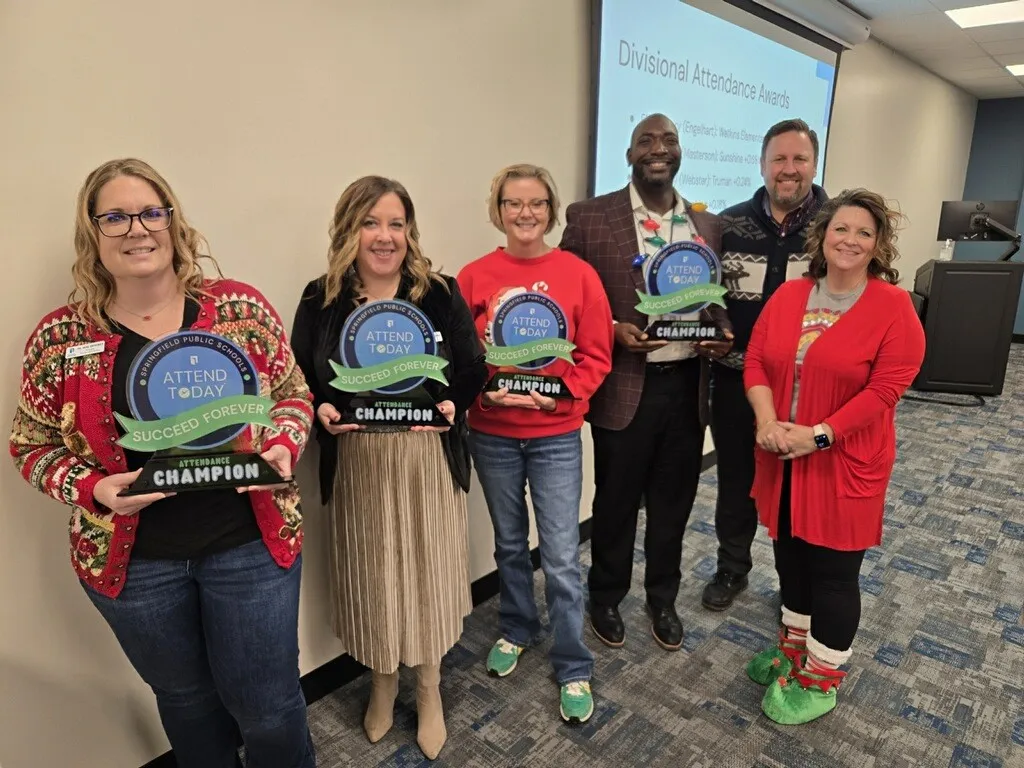
Springfield Public Schools principals pose with their attendance trophies. (L-R) Truman Elementary Principal Sara Shevchuk, Watkins Elementary Principal Joanna Brockwell, Sunshine Elementary Principal Tracy Daniels, Pershing K-8 Principal Tommy Wells, Middle School and K-8 Campuses Director Andre Illig, and Elementary Schools Director Mykie Nash.
Permission granted by Springfield Public Schools
Reward progress
Of course, recognition for successes achieved is crucial to keeping morale up during an effort like Springfield’s attendance campaign. So, the district each month awarded trophies to principals in categories such as largest attendance gain year over year, most improved over the past month, and 95% attendance or better.But what about Lathan’s Powerade promise? Did Springfield hit its goal?
The short answer is “yes.” At her 2024 State of the Schools address in August, Lathan announced the district’s attendance had reached 91.78%, which was rounded up to 92%.
Lathan noted that one school in particular stood out throughout the campaign: McGregor Elementary School. The 281-student, 90%-free-lunch campus led by Principal Rebekah Kirby— then a first-year principal — raised its attendance by 3.56 percentage points.
“Her children were outperforming our higher-performing campuses where attendance is not an issue,” Lathan said.
With that in mind, at Lathan’s August 2024 state of the schools address, Kirby, along with some of her building’s teachers and students, got to do the honors of dumping a bucket of Powerade over Lathan’s head.
“It truly was worth it to be able to hit that goal and for them to be able to celebrate,” Lathan said.
Streamlining school communication empowers all district stakeholders
The dos and don’ts of parent-educator communication
Female district leaders target back-to-school priorities
For more on school communication, visit eSN’s Educational Leadership hub
As technology trainers, we support teachers’ and administrators’ technology platform needs, training, and support in our district. We do in-class demos and share as much as we can with them, and we also send out a weekly newsletter. We coordinate a lot of different training sessions across our many different platforms, and support principals during staff meetings and on professional development days.
More News from eSchool News
Many math tasks involve reading, writing, speaking, and listening. These language demands can be particularly challenging for students whose primary language is not English.
As a career and technical education (CTE) instructor, I see firsthand how career-focused education provides students with the tools to transition smoothly from high school to college and careers.
In recent years, the rise of AI technologies and the increasing pressures placed on students have made academic dishonesty a growing concern. Students, especially in the middle and high school years, have more opportunities than ever to cheat using AI tools.
Math is a fundamental part of K-12 education, but students often face significant challenges in mastering increasingly challenging math concepts.
Throughout my education, I have always been frustrated by busy work–the kind of homework that felt like an obligatory exercise rather than a meaningful learning experience.
During the pandemic, thousands of school systems used emergency relief aid to buy laptops, Chromebooks, and other digital devices for students to use in remote learning.
Education today looks dramatically different from classrooms of just a decade ago. Interactive technologies and multimedia tools now replace traditional textbooks and lectures, creating more dynamic and engaging learning environments.
There is significant evidence of the connection between physical movement and learning. Some colleges and universities encourage using standing or treadmill desks while studying, as well as taking breaks to exercise.
This story was originally published by Chalkbeat. Sign up for their newsletters at ckbe.at/newsletters. In recent weeks, we’ve seen federal and state governments issue stop-work orders, withdraw contracts, and terminate…
English/language arts and science teachers were almost twice as likely to say they use AI tools compared to math teachers or elementary teachers of all subjects, according to a February 2025 survey from the RAND Corporation.
As Chief Dan George of the Tsleil-Waututh Nation aptly noted, “What you do not know, you will fear. What one fears, one destroys.” Unfortunately, the Los Rios Community College District of greater Sacramento, California, has an overly restrictive policy that risks making this a grim reality.
In an effort to respect Native American remains, the district enacted a broad “moratorium” — essentially a complete ban — on faculty and students displaying “images and reproductions of Native American human remains.” Even if well-intentioned, this policy creates some predictably absurd results that severely limit educational opportunities and make professors think twice before signing up to teach Native American history.
Sure, professors could dryly describe the objects in question rather than show their students images and replicas. But that approach is about as effective — and as likely to capture students’ attention — as merely describing the roundness of a globe or the wryness of Mona Lisa’s smile.
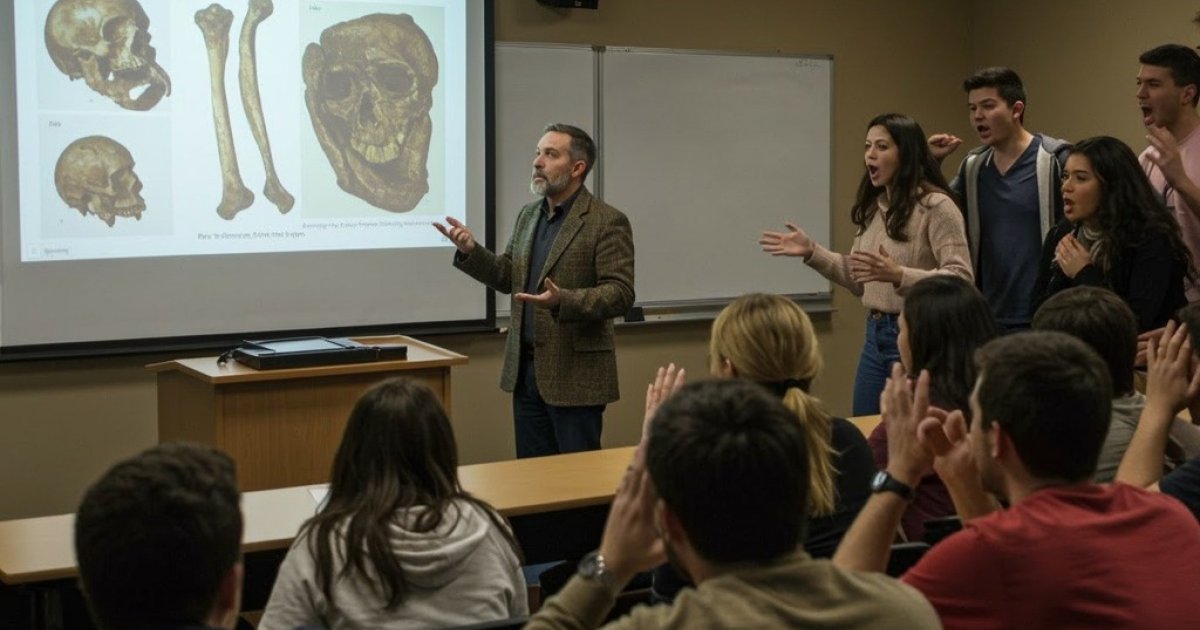
Take, for instance, the near-complete skeleton of a teenage girl who researchers named Naia, and who died while cave diving for water about 13,000 years ago. Naia’s skeleton has much to teach students, but thanks to the district’s ban, educators are now prohibited from using similar images of incredible archeological finds.
The First Amendment — which binds public colleges and districts like Los Rios — forbids such broad, content-based restraints on teachers instructing their students.
Courts have repeatedlyheld that the First Amendment protects faculty expression that is “related to scholarship or teaching” or “germane to the classroom subject matter,” including showing photographs that are relevant to the course material. Even more fundamentally, the First Amendment protects the display and communication of photos, videos, and recordings, provided there is no issue with intellectual property rights. But in LRCCD’s blatant overreach, the district doesn’t even try to make an argument about copyright protections.
What is left is an unconstitutional policy that drastically dulls the learning process. Sure, professors could dryly describe the objects in question rather than show their students images and replicas. But that approach is about as effective — and as likely to capture students’ attention — as merely describing the roundness of a globe or the wryness of Mona Lisa’s smile. Visuals are a vital learning aid, and a blanket ban on educational images is a disaster for academic freedom and student learning.
While it’s tempting to justify a ban as showing respect for Native American tribes, shunning these images is a funny way to show respect. Universities can best show respect by teaching about Native American cultural heritage using images and replicas. In any case, the government’s desire to show respect to a minority group doesn’t allow it to ban speech about that group.
Nor can the district justify the policy by appealing to the federal Native American Graves Protection and Repatriation Act or its California counterpart, which deal with the identification and repatriation of Native American remains or cultural items — not images or replicas. To its credit, Los Rios admits as much, even if it confusingly claims that the moratorium is “part of the District’s compliance” with NAGPRA.
Fortunately, there have been calls for reform. After we wrote to the district about this issue in August and yet again in October, the district Academic Senate released the draft of a new policy that leaves replicas and images out of any bureaucratic review process. FIRE attorney Daniel Ortner helped along this process by testifying in favor of the draft before the DAS.
But there’s a major roadblock holding up this promising new policy: FIRE was recently informed by Cosumnes River College Academic Senate President Jacob Velasquez that the district won’t change its existing policy until it gets the go-ahead from the district’s tribal partners. In other words, the ban on images and replicas is here to stay unless the district and its partners change their minds.
FIRE recently wrote to the district a third time, calling for an end to this speech-stifling policy. Until it listens, it’s lights out for free speech and academic freedom at the Los Rios Community College District.
Professional growth is often at the top of New Year’s Resolution lists. As educators and education leaders plan for the year ahead, we asked some of the nation’s top female school district leaders to give fellow women educators the do’s and don’ts of climbing the professional ladder. Here’s what they said.
Do:Believe in yourself.
Though women make up 76 percent of teachers in K-12 school settings, just a small percentage of women hold the most senior role in a district. But the climb to leadership isn’t an easy one; women in educational leadership report a range of biases–from interpersonal slights to structural inequities–that make it difficult to attain and persist in top positions.
Professional groups like Women Leading Ed are working to change that by highlighting long standing gender gaps and calling for policies and practices to improve conditions at all levels. Female education leaders are also working to rewrite the narrative around what’s possible for women educators and encouraging their peers.
Among those education leaders is Shanie Keelean, deputy superintendent of Rush-Henrietta Central School District in New York. When asked to share advice to her peers, she said, “You just have to continually push yourself forward and believe in yourself. So very often women, if they don’t check all the boxes, they decide not to go for something. And you don’t have to check all the boxes. Nobody knows everything in every job. You learn things as you go. Passion and energy go a long way in being really committed.”
Nerlande Anselme, superintendent of Rome City School District in New York, agreed: “We have directors in this field, we have coordinators in this field, we have psychologists who are doing amazing work, but they will dim themselves and figure that they cannot get to the top. Don’t dim your light.”
Don’t: Keep your career goals a secret.
When you decide to pursue a leadership position, don’t keep it a secret. While it may feel “taboo” to announce your intentions or desires, it’s actually an important first step to achieving a leadership role, said Kathleen Skeals, superintendent of North Colonie Central School District in New York.
“Once people know you’re interested, then people start to mentor you and help you grow into the next step in your career,” Skeals said.
Kyla Johnson-Trammell, superintendent of Oakland Unified School District in California, echoed: “Make your curiosity and your ambition known. You’ll be pleasantly surprised how that will be received by many of the folks that you work for.”
Do: Find a strong mentor.
A strong mentor can make all the difference in the climb to the top, leaders agreed.
“Seek out a leader you respect and ask for a time where you could have a conversation about exploring some possibilities and what the future might bring to you,” said Mary-Anne Sheppard, executive director of leadership development for Norwalk Public Schools in Connecticut.
It’s especially helpful to connect with someone in a position that you want to be in, said Melanie Kay-Wyatt, superintendent of Alexandria City Public Schools in Virginia. “Find someone who’s in the role you want to be in, who has a similar work ethic and a life that you have, so they can help you,” she said.
Don’t: Be afraid to ask questions.
“Start asking a lot of questions,” said Keelean. She suggested shadowing a mentor for a day or asking for their help in creating a career map or plan.
And don’t be afraid to take risks, added Johnson-Trammell. “Could you get me 15 minutes with the superintendent or the chief academic officer?”
Do: Build your skill set and network.
“Increase your impact by developing relational skills and leadership skills,” said Rachel Alex, executive director of leadership development of Aldine Independent School District in Texas.
And cultivate a network, said Heather Sanchez, chief of schools for Bellevue School District in Washington. “We can’t do it alone. Find that network, cultivate that network.”
Don’t: Give up.
“People are always going to tell you no, but that does not stop you,” said Kimberley James. “Continue to live beyond the noise and the distractions and stay focused on what it is that you want to accomplish for our students.”
“I would say to any woman aspiring to any level of leadership that first of all, never sell yourself short,” said Sanchez. “You have it in you.”
Interviews were conducted as part of the Visionary Voices video series. Responses have been edited for clarity and brevity.
Megan Scavuzzo, Presence
Megan Scavuzzo is the Vice President of Communications, Policy and Advocacy for Presence, a leading provider of PreK–12 remote special education-related and mental health evaluation and teletherapy services. With a diverse background in strategic communication and advocacy, Megan specializes in crafting compelling narratives that amplify voices across industries. By harnessing the power of storytelling, she aims to inspire action, provoke thought, and spark meaningful dialogue that leads to tangible change and impact.
Latest posts by eSchool Media Contributors (see all)
There have been two cycles so far for which students have received the gift cards and, in addition to the 4,936 students who had perfect attendance in at least one of two-week periods, 2,028 have had perfect attendance in both cycles, according to data Superintendent Nikolai Vitti shared with Chalkbeat this week.
The attendance incentive is aimed at improving attendance in the district, where two-thirds of nearly 49,999 students were considered chronically absent during the 2023-24 school year. The incentive is among a number of efforts the district has employed over the years to create an attendance-going culture among students. The district has invested heavily into attendance agents to improve attendance and this school year announced that students with extremely high rates of chronic absenteeism will be held back a grade at the K-8 level and required to repeat classes at the high school level.
The number of students earning the perfect attendance incentive is a fraction of the nearly 15,000 high school students in the district, leading one school board member to question last week whether the incentive is working. But Vitti said he is encouraged that the program is getting more high school students to class and resulting in a small decrease in the chronic absenteeism rate for high school students. He said the district and board will have to evaluate the program’s success at the end of the school year.
Chronic absenteeism has been one of the district’s biggest challenges for years. The chronic absenteeism rate has declined, from a high of nearly 80% at the height of the pandemic, when quarantining rules meant many students missed school because of COVID exposure. But last school year’s much lower chronic absenteeism rate of 66% still means it is difficult to have consistency in the classroom and improve academic achievement.
Students in Michigan are chronically absent when they miss 10%, or 18 days in a 180-day school year. Statewide, 30% of students are considered chronically absent, compared to 23% nationally. A recent education scorecard cited the state’s rate as being a factor in students’ slow academic recovery from the pandemic.
Here are some of the highlights of the students who’ve received the incentive so far::
3,473 students had perfect attendance during the first cycle.
3,492 students had perfect attendance during the second cycle.
About 10% already had perfect attendance.
About 4% were considered chronically absent at the time the incentive began.
About 16% had missed 10% of the school year at the time the incentive began.
About 25% had missed 5-10% of the school year.
About 44% had missed 5% or fewer days in the school year.
At a Detroit school board meeting last week, Vitti said the statistic showing that just 10% of the students who earned the incentive already had perfect attendance is an indication that “this is not just rewarding those that have already been going to school.”
Board member Monique Bryant questioned what school leaders are doing to promote the incentive to students who haven’t earned it.
Bryant suggested that data Vitti shared at the meeting showing that chronic absenteeism is down by 5 percentage points for high school students since the incentive began is an illustration that most students aren’t rising to the goal of the incentive.
Vitti responded that it depends on how you look at the data.
“Right now, chronic absenteeism at the high school levels improved by five percentage points,” Vitti said. “That means that 700 high school students are not chronically absent where they were last year. I’d also say that at least on the 97th day, our chronic absenteeism at the high school levels is the lowest it’s been since the pandemic.”
The question for board members to decide at the end of the school year is whether the incentive “is the right investment with other challenges that we have districtwide,” Vitti said. “But I think the data is suggesting it’s working for many students … but not all.”
Board member Ida Simmons Short urged the district to survey students to learn more about what is preventing them from coming to school.
The causes of chronic absenteeism are numerous and include physical and mental health reasons, lack of transportation,and lack of affordable housing. Most of them tie back to poverty. Vitti specifically cited transportation, because half of the students in the district don’t attend their neighborhood school and the district doesn’t provide school bus transportation for high school students, who must take city buses to get to school.
“Sometimes they’re unreliable, they’re late, they’re too far away from where the child lives,” Vitti said.
Vitti said traditional school bus transportation for high school students “was decimated” under emergency management and it could cost between $50 million and $100 million to bring that level of transportation back.
Another factor, Vitti said, is that for some students, school isn’t relevant. Middle and high school students, in particular, “struggle to understand, ‘why am I going to school every day? How is this connected to what I’m going to I need to know for life.’”
Mi’Kah West, a Cass Technical High School student who serves as a student representative on the board, said that when talking to other members of the District Executive Youth Council last week, many said students overall are excited about the incentive.
One thing that stuck out, she said, was council members saying they heard students in the hallways or on social media saying they were coming to school because they want the money.
“And, while we don’t want to just say we want to come to school for the money,” West said, “I think it’s important to see that students … may have stayed home because they don’t want to come to school, but they’re willing to come to school now.”
Lori Higgins is the bureau chief for Chalkbeat Detroit. You can reach her at [email protected].
Chalkbeat is a nonprofit news site covering educational change in public schools.
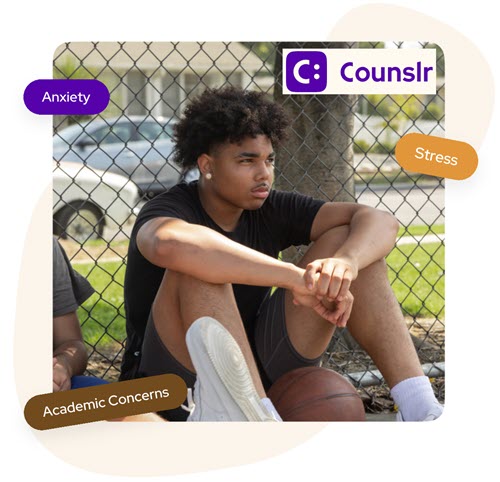
NEW YORK, NY –Counslr, a leading B2B mental health and wellness platform, announced today that it has expanded its footprint into the State of New Mexico starting with a partnership with Vista Nueva High School, Aztec, NM; and into the State of Illinois starting with a partnership with Big Hollow School District, Ingleside, IL. These initial partnerships will empower students and staff to prioritize their mental health by enabling them to access unlimited wellness resources and live texting sessions with Counslr’s licensed and vetted mental health support professionals, who are available on-demand, 24/7/365. By increasing accessibility to Counslr’s round-the-clock support, Vista Nueva and Big Hollow aim to bridge gaps in mental health support for students and staff, enabling those who previously did not or could not access care, whether due to cost, inconvenience, or stigma, to receive the support they desire.
1 in 6 youth suffer from a mental illness, but the majority do not receive mental health support due to substantial obstacles to care. Additionally, mental health is even a bigger challenge in rural America due to unique barriers, including fewer providers resulting in longer wait times or insufficient access to crucial mental health services. This resource scarcity underscores the urgency for additional resources and innovative solutions to bridge this critical gap in mental health care for school communities.
“We are happy to be able to offer students another tool that they can use to support their mental well-being. Knowing that students have been able to speak with a professional outside of school hours helps us know this app was needed and is useful,” states Rebekah Deane, Professional School Counselor, Vista Nueva High School. “We hope this tool also assists students in learning how to navigate systems so that when they graduate high school they know these options exist and they can continue to seek out support when necessary.”
As factors such as academic pressures, social media influence, burnout and world events contribute to heightened stress levels and mental health challenges, schools throughout the country are recognizing the growing need to offer more accessible resources and preventative mental health services to both students and staff.
“Counslr provides an extremely easy-to-access platform for those who otherwise may not seek the help they need, and we are very excited to join Counslr in this partnership. We are all very well aware of the impact that technology has had on the mental health of our students and we feel that Counslr can meet our students in a setting they are comfortable with,” states Bob Gold, Big Hollow School District Superintendent. “Outside of our students, we are thrilled to be able to offer this service to the amazing adults who work with our students every day. There are so many families dealing with some sort of trauma, and the life of an educator is no different. These adults tend to give so much of themselves to their students, so we strongly feel that our efforts here to join with Counslr is our way of providing an opportunity for our educators to focus on their own mental health.”
In addition to the geographic expansion,Counslr has also expanded its existing footprint in states like New York, most recently partnering with the Silver Creek Central School District to support its students and staff.
“We know mental health needs are on the rise, for students and adults. To me, Counslr is a resource our students and staff both deserve,” states Dr. Katie Ralston, Superintendent, Silver Creek Central. “In the beginning stages at Silver Creek Central, it has proven to be an asset, as it offers access to everyone on the spot, any day, for any situation.”
“Supporting diverse populations of students and faculty across the country clearly illustrates that mental health knows no boundaries,” said Josh Liss, Counslr CEO. Adding that, “With 86% of Counslr’s users being first-time care seekers, we strive to reach these silent sufferers who need help, but do not or cannot access it, no matter where they are located.”
ABOUT COUNSLR
Counslr is a text-based mental health support application that provides unlimited access to robust wellness resources and live texting sessions with licensed professionals, 24/7/365. Users can access support on-demand within two minutes of opening the app, or by scheduled appointment. Through real-time texting, users enjoy one-on-one, private communication with a licensed counselor that can be conducted anytime, anywhere. Counslr was designed to help individuals deal with life’s day-to-day issues, empowering individuals to address concerns while they are “small” to help ensure that they stay “small”. Counslr partners with organizations of all shapes and sizes (companies, unions, nonprofits, universities/colleges, high schools, etc) so that these entities can provide Counslr’s services to their employees/members/students at no direct cost. For more information, please visit www.counslr.com.
eSchool Media staff cover education technology in all its aspects–from legislation and litigation, to best practices, to lessons learned and new products. First published in March of 1998 as a monthly print and digital newspaper, eSchool Media provides the news and information necessary to help K-20 decision-makers successfully use technology and innovation to transform schools and colleges and achieve their educational goals.
AUSTIN, Texas, Feb. 7, 2025 — After a lawsuit from the Foundation for Individual Rights and Expression and Davis Wright Tremaine, a district court today stopped enforcement of a Texas law that would have blocked access to broad categories of protected speech for minors and forced websites to collect adults’ IDs or biometric data before they can access social media sites.
Northern District of Texas Judge Robert Pitman granted FIRE’s motion for a preliminary injunction against provisions of the Securing Children Online through Parental Empowerment Act (SCOPE Act) requiring content monitoring and filtering, targeted advertising bans, and age-verification requirements, ruling that these measures were unconstitutionally overbroad, vague, and not narrowly tailored to serve a compelling state interest.
“The court determined that Texas’s law was likely unconstitutional because its provisions restricted protected speech and were so vague that it made it hard to know what was prohibited,” said FIRE Chief Counsel Bob Corn-Revere. “States can’t block adults from engaging with legal speech in the name of protecting children, nor can they keep minors from ideas that the government deems unsuitable.”
The SCOPE Act would have required social media platforms to register the age of every new user. Platforms would have been forced to track how much of their content is “harmful” to minors and, once a certain percentage is reached, force users to prove that they are 18 or older. In other words, the law would have burdened adults who wanted to view content that is fully legal for adults, serving as an effective ban for those who understandably don’t trust a third-party website with their driver’s license or fingerprints.
The law also required websites to prevent minors from being exposed to “harmful material” that “promotes, glorifies, or facilitates” behaviors like drug use, suicide, or bullying. That definition was far too vague to pass constitutional muster: whether speech “promotes” or “glorifies” an activity is inherently subjective, and platforms had testified that they would be forced to react by censoring all discussions of those topics.
Today’s ruling should serve as yet another warning to states tempted to jump on the unconstitutional bandwagon of social media age verification bills.
“At what point… does alcohol use become ‘substance abuse?’” asked Judge Pitman in his ruling. “When does an extreme diet cross the line into an ‘eating disorder?’ What defines ‘grooming’ and ‘harassment?’ Under these indefinite meanings, it is easy to see how an attorney general could arbitrarily discriminate in his enforcement of the law.”
FIRE sued on August 16 on behalf of three plaintiffs who use the Internet to communicate with young Texans and keep them informed on issues that affect them. A fourth plaintiff, M.F., is a 16-year-old rising high school junior from El Paso who is concerned that Texas is blocking his access to important content.
Lead plaintiff Students Engaged in Advancing Texas represents a coalition of Texas students who seek to increase youth visibility and participation in policymaking.
Nope to SCOPE: FIRE sues to block Texas’ unconstitutional internet age verification law
Press Release
Texans browsing your favorite websites, beware. If the state has its way, starting next month, the eyes of Texas may be upon you.
“Young people have free speech rights, too,” said SEAT Executive Director Cameron Samuels. “They’re also the future voters and leaders of Texas and America. The SCOPE Act would make youth less informed, less active, and less engaged on some of the most important issues facing the nation.”
Earlier, Judge Pitman enjoined the content moderation requirements while ruling on a separate lawsuit from the Computer & Communications Industry Association and Netchoice. Judge Pitman ruled in August that Texas “cannot pick and choose which categories of protected speech it wishes to block teenagers from discussing online.”
“This is a tremendous victory against government censorship, especially for our clients—ordinary citizens—who stood up to the State of Texas,” said Adam Sieff, partner at Davis Wright Tremaine. “The Court enjoined every substantive provision of the SCOPE Act we challenged, granting even broader relief than its first preliminary injunction. We hope this decision will give other states pause before broadly restricting free expression online.”
Texas lawmakers perhaps could have predicted today’s ruling. Age verification laws have been enjoined by courts across the country in states like California, Arkansas, Mississippi, Ohio, and even initially in Texas, in another law currently before the Supreme Court for review.
“Today’s ruling should serve as yet another warning to states tempted to jump on the unconstitutional bandwagon of social media age verification bills,” said Corn-Revere. “What these laws have in common is that they seek to impose simplistic one-size-fits-all solutions to address complicated problems.”
The Foundation for Individual Rights and Expression (FIRE) is a nonpartisan, nonprofit organization dedicated to defending and sustaining the individual rights of all Americans to free speech and free thought — the most essential qualities of liberty. FIRE educates Americans about the importance of these inalienable rights, promotes a culture of respect for these rights, and provides the means to preserve them.
CONTACT:
Alex Griswold, Communications Campaign Manager, FIRE: 215-717-3473; [email protected]