

Get stories like this delivered straight to your inbox. Sign up for The 74 Newsletter
California sends mixed messages when it comes to serving dyslexic students.
California Gov. Gavin Newsom is the most famous dyslexic political official in the country, even authoring a children’s book to raise awareness about the learning disability. And yet, California is one of 10 states that doesn’t require dyslexia screening for all children.
Education experts agree that early screening and intervention is critical for making sure students can read at grade level. But so far, state officials have done almost everything to combat dyslexia except mandate assessments for all students.
“It needs to happen,” said Lillian Duran, an education professor at the University of Oregon who has helped develop screening tools for dyslexia. “It seems so basic to me.”
Since 2015, legislators have funded dyslexia research, teacher training and the hiring of literacy coaches across California. But lawmakers failed to mandate universal dyslexia screening, running smack into opposition from the California Teachers Association.
The union argued that since teachers would do the screening, a universal mandate would take time away from the classroom. It also said universal screening may overly identify English learners, mistakenly placing them in special education.
The California Teachers Association did not respond to requests for comment for this story. In a letter of opposition to a bill in 2021, the union wrote that the bill “is unnecessary, leads to over identifying dyslexia in young students, mandates more testing, and jeopardizes the limited instructional time for students.”
In response, dyslexia experts double down on well-established research. Early detection actually prevents English learners — and really, all students — from ending up in special education when they don’t belong there.
While California lawmakers didn’t vote to buck the teachers union, they haven’t been afraid to spend taxpayer money on dyslexia screening. In the past two years, the state budget allocated $30 million to UC San Francisco’s Dyslexia Center, largely for the development of a new screening tool. Newsom began championing the center and served as its honorary chair in 2016 when he was still lieutenant governor.
“There’s an inadequate involvement of the health system in the way we support children with learning disabilities,” said Maria Luisa Gorno-Tempini, co-director of UCSF’s Dyslexia Center. “This is one of the first attempts at bridging science and education in a way that’s open sourced and open to all fields.”
Parents and advocates say funding dyslexia research and developing a new screener can all be good things, but without mandated universal screening more students will fall through the cracks and need more help with reading as they get older.
Omar Rodriguez, a spokesperson for the governor did not respond to questions about whether Newsom would support a mandate for universal screening. Instead, he listed more than $300 million in state investments made in the past two years to fund more reading coaches, new teacher credentialing requirements and teacher training.
Rachel Levy, a Bay Area parent, fought for three years to get her son Dominic screened for dyslexia. He finally got the screening in third grade, which experts say could be too late to prevent long-term struggles with reading.
“We know how to screen students. We know how to get early intervention,” Levy said. “This to me is a solvable issue.”
Levy’s son Dominic, 16, still remembers what it felt like trying to read in first grade.
“It was like I was trying to memorize the shape of the word,” he said. “Even if I could read all the words, I just wouldn’t understand them.”
Dyslexia is a neurological condition that can make it hard for students to read and process information. But teachers can mitigate and even prevent the illiteracy stemming from dyslexia if they catch the signs early.
Levy, who also has dyslexia, said there’s much more research today on dyslexia than there was 30 years ago when she was first diagnosed. She said she was disappointed to find that California’s policies don’t align with the research around early screening.
“Unfortunately, most kids who are dyslexic end up in the special education system,” Levy said. “It’s because of a lack of screening.”
Soon after his screening in third grade, Dominic started receiving extra help for his dyslexia. He still works with an educational therapist on his reading, and he’s just about caught up to grade level in math. The biggest misconception about dyslexia, Dominic said, is that it makes you less intelligent or capable.
“Dyslexics are just as smart as other people,” he said. “They just learn in different ways.”
The first step to helping them learn is screening them in kindergarten or first grade.
“The goal is to find risk factors early,” said Elsa Cárdenas-Hagan, a speech-language pathologist and a professor at the University of Houston. “When you find them, the data you collect can really inform instruction.”
Cárdenas-Hagan’s home state of Texas passed a law in 1995 requiring universal screening. But she said it took several more years for teachers to be trained to use the tool. Her word of caution to California: Make sure teachers are not only comfortable with the tool but know how to use the results of the assessment to shape the way they teach individual students.
UC San Francisco’s screener, called Multitudes, will be available in English, Spanish and Mandarin. It’ll be free for all school districts.
Multitudes won’t be released to all districts at once. UCSF scientists launched a pilot at a dozen school districts last year, and they plan to expand to more districts this fall.
But experts and advocates say there’s no need to wait for it to mandate universal screenings. Educators can use a variety of already available screening tools in California, like they do in 40 other states. Texas and other states that have high percentages of English learners have Spanish screeners for dyslexia.
For English learners, the need for screening is especially urgent. Maria Ortiz is a Los Angeles parent of a dyslexic teenager who was also an English learner. She said she had to sue the Los Angeles Unified School District twice: once in 2016 to get extra help for her dyslexic daughter when she was in fourth grade and again in 2018 when those services were taken away. Ortiz said the district stopped giving her daughter additional help because her reading started improving.
“In the beginning they told me that my daughter was exaggerating,” Ortiz said.
“They said everything would be normal later.”
California currently serves about 1.1 million English learners, just under a fifth of all public school students. For English learners, dyslexia can be confused with a lack of English proficiency. Opponents of universal screening, including the teachers association, argue that English learners will be misidentified as dyslexic simply because they can’t understand the language.
“Even the specialists were afraid that the problem might be because of the language barrier,” Ortiz said about her daughter’s case.
But experts say dyslexia presents a double threat to English learners: It stalls them from reading in their native language and impedes their ability to learn English. And while there are some Spanish-language screeners, experts from Texas and California say there’s room for improvement. Current Spanish screeners penalize students who mix Spanish and English, they say.
Duran, who helped develop the Spanish version of Multitudes, said the new screener will be a better fit for how young bilingual students actually talk.
“Spanglish becomes its own communication that’s just as legitimate as Spanish on its own or English on its own,” Duran said. “It’s about the totality of languages a child might bring.”
Providing Multitudes free of cost is important to schools with large numbers of low-income students. Dyslexia screeners cost about $10 per student, so $30 million might actually be cost-effective considering California currently serves 1.3 million students in kindergarten through second grade. The tool could pay for itself in a few years. Although there are plenty of screeners already available, they can stretch the budgets of high-poverty schools and districts.
“The least funded schools can’t access them because of the cost,” Duran said.
In addition to the governor, another powerful state lawmaker, Glendale Democratic state Sen. Anthony Portantino, is dyslexic. While chair of the Senate Appropriations Committee, he has repeatedly, and unsuccessfully, authored legislation to require public schools to screen all students between kindergarten and second grade.
Portantino’s 2021 bill received unanimous support in the Senate Education and Appropriations committees, but the bill died in the Assembly Education Committee. Portantino authored the same bill in 2020, but it never made it out of the state Senate.
“We should be leading the nation and not lagging behind,” Portantino said.
Portantino blamed the failure of his most recent bill on former Democratic Assemblymember Patrick O’Donnell, who chaired the Assembly Education Committee, for refusing to hear the bill.
“It’s no secret, Patrick O’Donnell was against teacher training,” Portantino said. “He thought our school districts and our educators didn’t have the capacity.”
O’Donnell did not respond to requests for comment. Since O’Donnell didn’t schedule a hearing on the bill, there is no record of him commenting about it at the time.
Portantino plans to author a nearly identical bill this year. He said he’s more hopeful because the Assembly Education Committee is now under the leadership of Assemblymember Al Muratsuchi, a Democrat from Torrance. Muratsuchi would not comment on the potential fate of a dyslexia screening bill this year.
Levy now works as a professional advocate for parents of students with disabilities. She said without mandatory dyslexia screening, only parents who can afford to hire someone like her will be able to get the services they need for their children.
“A lot of high school kids are reading below third-grade level,” she said. “To me, that’s just heartbreaking.”
This was originally published on CalMatters.
Get stories like these delivered straight to your inbox. Sign up for The 74 Newsletter

If we think about research as a means of driving innovation and by extension economic growth, there is a need to consider the lives of the people who are doing the research.
The UK has a significant strength in the quality and diversity of its higher education system – which trains a large proportion of the staff who end up working in universities (and elsewhere) performing research. We should, in other words, be better than we are at sustaining and shaping research capacity through supporting the people who contribute research throughout their careers.
Certainly, that’s the case that the University and College Union makes in last week’s research staff manifesto – noting that nearly two thirds of research staff are on fixed term contracts, following research funding and strategic decisions around the country at a significant detriment to their personal lives and professional development.
Precarity is not an accident of the system – it is the entire design of the system. Becoming a postdoc is not the final stage of the undergraduate to postgraduate to researcher pipeline: it is a step into a new system where the trial of job-hopping, house moving, city shifting work, may one day lead to a full time post.
The first step after undertaking a doctorate is, unsurprisingly post-doctoral work – the postdoc. The term is confusing as it implies simply the job someone does after being awarded a PhD. Over time the taxonomy has changed to take on a specific meaning. It has become synonymous with precarious employment tied to grant funding. As an example, Imperial College London describes their postdocs as follows
Crucially, in the section which describes what a postdoc is not, it includes being “a permanent member of academic staff.”
This is often the case because postdocs are tied to grant funding and grant funding is limited to a certain period of time to cover a specific project. UKRI, for example, does not fund postdocs directly but funds research organisations directly through a mix of focused studentships and capacity funding. Research organisations then fund postdocs.
This means that the flexible deployment of resources is the very start of the system. It’s not an accident or a quirk, it is that the UK’s research system is built around incentivising human capital to move to the organisations and places that most closely aligns to their research skills. The upside of this is that, in theory, it should mean resources are efficiently deployed to the people and places that can use them most productively. In reality, it means that instability and structural barriers to progressing to full research contracts are the norm.
It’s not that UKRI are not aware of this problem. In a 2023 blog on team research Nik Ogryzko, Talent Programme Manager at UKRI, wrote that
We’ve built a system where research groups sometimes act as their own small business inside an institution. And this leads to a very particular set of weaknesses.
Employment contracts have become linked to individual research grants, with research staff often highly dependent on their principal investigator for career progression, or even their continued employment.
Group leaders are often not equipped to support their staff into anything other than an academic career, and we know most research staff do not end up there.
We also know such precarious employment and power imbalances can in some cases lead to bullying, harassment and discrimination. Such structural factors further compromise the integrity of our research, despite the strong intrinsic motivation of our researchers and innovators.“
A number of institutions are signatories to The Concordat to Support the Career Development of Researchers. When it comes to the use of fixed-term contracts the concordat states that
[…]some of the areas of most concern to researchers, such as the prevalence of fixed-term contracts and enforced mobility, will require long term systemic changes, which can only be realised through collective action across stakeholders.
Again, should a researcher be lucky enough to pass through their postdoc a permanent role is not guaranteed or even the norm. In reading through the websites of universities the reasons for fixed term contracts are various including; to align with grant-funding, to cover peak demand, to meet uncertain demand, to cover staff absence, to cover time-limited projects, secondments, training, and to bring in specialist skills.
It is not that universities don’t recognise the issue of fixed term contracts, institutions like the University of Exeter has a whole framework on the appropriate use of these contacts, it’s that in a funding system which places a premium on project working it is necessary to have a highly flexible staff force.
However, this does not mean that this system is inevitable or that the number of fixed term contracts is desirable.
According to HESA data, that number is slowly falling – both numerically and proportionally – for research only academic staff. As of the 2023-24 academic year, 63.9 per cent of “research only” academic staff (64,265) are on a fixed term contract. This sounds like a lot, but it is down slightly from a peak of 68 per cent (70,050) in 2019-20.
The proportion of fixed term contracts for teaching only academics (another prominent early career route, often coupled with weekends at the kitchen table writing literature reviews for publication in an attempt to bolster credentials for a research job in an underfunded field) is also on a downward trajectory. Some 44.3 per cent of teaching only contracts (equating to 64,300 people) were fixed term in 2019-20 – by 2023-24 the numbers were 35.7 per cent and 63,425.
If we take this to provider level we can see that a significant research focus is no predictor of a reliance on fixed term contracts. This chart shows the proportion of all academic staff on research only contracts on the y axis, with the proportion of all academic staff on fixed term contracts on the x axis.
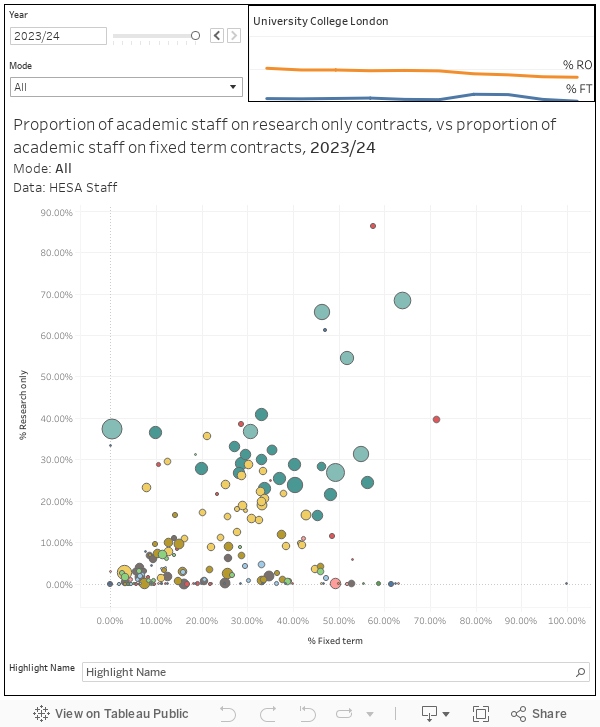
What this chart shows is that a strong focus on research (with many research only academic contracts) does not predict a reliance on fixed term contracts – indeed, there are many providers with a significant proportion of fixed term contracts that have no research only academic staff at all. While a fixed term contract is a poor basis on which to plan long term as an individual, for many higher education institutions it is a useful answer to wildly varying income and recruitment. Whereas for more traditional institutions it makes sense to maintain capacity even as prevailing conditions worsen, in smaller and more precarious providers unutilised capacity is a luxury that is no longer as affordable.
If you look back to the first chart, you may notice a “salary source” filter. One of the prevailing narratives around fixed term contracts is that these necessarily link to the “fixed term” nature of funded research projects – the argument being that once the money is finished, the staff need to find new jobs. In fact, this is less of a factor than you might imagine: the proportions of research only academic staff on fixed term contracts is higher for externally funded than those funded internally, but the difference isn’t huge.
Plotting the same data another way shows us that around a quarter of research only salaries are funded entirely by the higher education provider, with a further five per cent or so partially supported by the host institution – these figures are slightly lower for fixed-term research only staff, but only very slightly.
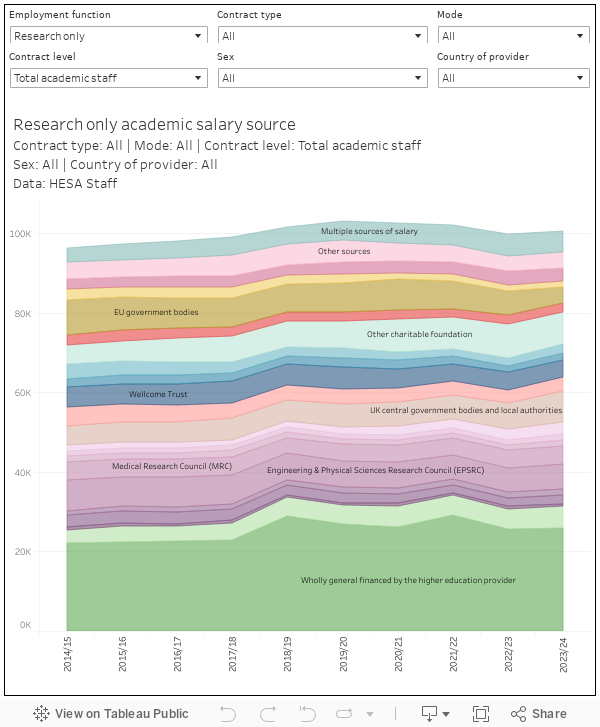
So we can be clear that fixed term salaries are (broadly) a research thing, but there’s not really evidence to suggest that short term external funding is the whole reason for this.
As a quick reminder, the research councils represent about a quarter of all external research funding, with the UK government (in various forms) and the NHS representing about another (swiftly growing)fifth. That’s a hefty chunk of research income that comes from sources that the government has some degree of control over – and some of the language used by Labour before the election about making this more reliable (the ten year settlements of legend) was seen as a recognition of the way funding could be reprofiled to allow for more “livable” research careers and an expansion of research capacity.
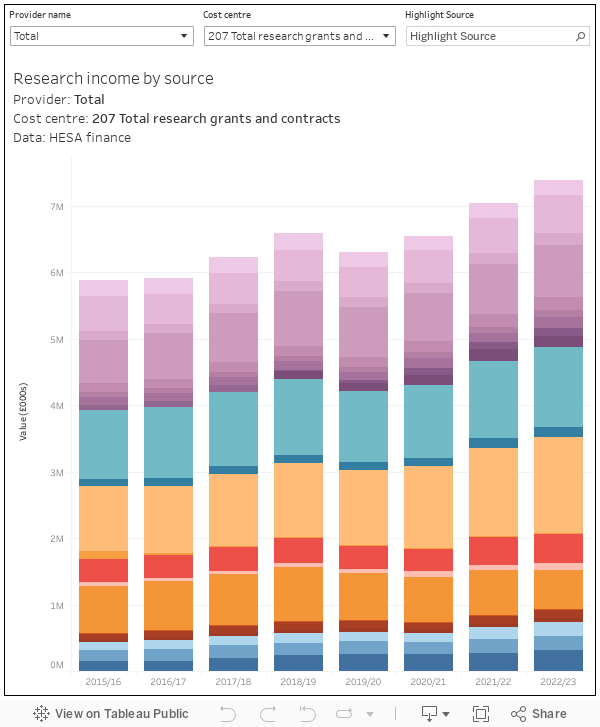
This chart also allows you to examine the way these proportions land differently by provider and subject area (expressed here as HESA cost code). The volatility is higher at smaller providers, as you might expect – while research in the arts and humanities is more likely to be funded by research councils than in STEM or social sciences. But it is really the volume, rather than the source, of research funding that determines how researcher salaries are paid.
Although the established pathway from research postgraduate to research is by no means the only one available (many postgraduate research students do not become academics) it is an established maxim – dating back to the post-war Percy and Barlow reviews – that to produce the researchers we need requires training in the form of postgraduate research provision.
Although it’s not really the purpose of this article, it is worth considering the subject and provider level distribution of postgraduate research students in the light of how funding and capacity for research is distributed. As the early research career is often dominated by the need to move to take on a fixed term contract, one way to address this might be to have research career opportunities and research students in the same place from the start.
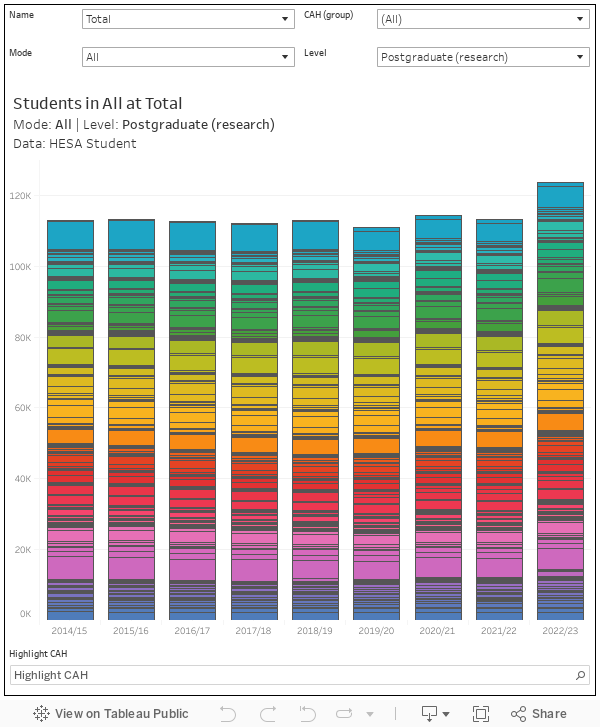
Research capacity, and – for that matter – research training capacity, can’t be turned off and on at a whim. Departments and research centres need more than one short-term funded project to begin delivering for the UK at their full potential, because developing capacity and expertise takes time and experience. That’s a part of the reason why we have non-ringfenced funding: streams like those associated with QR in England – to keep research viable between projects, and to nurture developing expertise so it can contribute meaningfully to national, regional, and industrial research priorities. It’s funds like these that support researcher training and supervision, and the infrastructure and support staff and components that make research possible.
But what the data suggests is that while the short-term nature of project funding does have an impact, especially at smaller providers and emerging research centres, there are many universities that are able to sustain research employment between projects. A part of this is bound to be sheer scale, but it doesn’t happen at all large research performing organisations by any stretch of the imagination. A part of the answer then, must be the strategic decisions and staffing priorities that makes sustaining researcher employment possible.
That’s not to let the funding side of the equation off the hook either. There is a sense that the Labour party was moving in the right direction in considering longer term research funding settlements – but we have yet to learn how this will work in practice. By its very nature, research is discovery and opportunity led: a few years ago artificial intelligence research was a minor academic curiosity, currently it is big money – but will it be a priority in 2035? Could there be some areas – medical and healthcare research, large scale physics, engineering – where we can be more sure than others?
You’ll note we didn’t mention the arts, humanities, and social sciences in that list – but these may be some of the most valuable areas of human activity, and government-supported research plays a more prominent role in sustaining not just discovery and innovation but the actual practice of such activity. Such is the paucity of money available in the arts that many practitioners subsidise their practice with research and teaching – and it feels like arts funding more generally needs consideration.
Sure, the UK punches above its weight in the sciences and in health care – but in arts, heritage, and social policy the work of the UK is genuinely world leading. It has a significant economic impact (second only to financial services) too. Research funding is a part of the picture here, but a long term commitment to these industries would be one of the most valuable decisions a government can make.
The fundamental challenge is maintaining a system which is dynamic, where the dynamism is not solely reliant on a highly transient workforce. A simple, albeit extremely limited, conclusion from the data would be that there is too great a supply of researchers to meet the demand for their skills.
The more important question is what is the value of such a highly educated workforce and how can society make the most of their talents. This is not to say the UK should operate a supply led model. A world where funding is allocated based purely on the academic interests of researchers might be good for placing emphasis on intellectual curiosity but it would not allow funders to match social and economic priorities with researcher’s work. Put another way, it isn’t sufficient to tackle climate change by hoping enough researchers are interested in doing so. It would also not necessarily create more permanent jobs – just different ones.
Conversely, a system which is largely demand led loses talent in other ways. The sheer exhaustion of moving between jobs and tacking research skills to different projects in the same field means stamina, not just research ability, is a key criterion for success. This means researchers whose abilities are needed are not deployed because their personal incentive for a more stable life trumps their career aspirations.
The current system does penalise those who cannot work flexibly for extended periods of time, but more fundamentally the incentives in the system are misaligned to what it hopes to achieve. There can be no dynamism without some flexibility, but flexibility should be demonstrable not permanently designed. Flexibility of employment should be used to achieve a research benefit not only an administrative one.
This is not wholly in the gift of universities. A careful consideration by government, funders, institutions, and researchers, of how flexibility should be used is the key to balance in the system. There are times where the research system requires stability. For example, the repeated use of fixed term contracts on the same topic is a clear market signal for more stable employment. Furthermore, it is undesirable to have a forever changing workforce in areas governments have singularly failed to make progress on for decades. Nobody is arguing that if only research into productivity was a bit more transient the UK’s economies woes could be fixed.
The need is coordinated action. And unlike in Australia there is no single review of what the research ecosystem is for. Until then as priorities change, funders work on short time horizons, and institutions respond to ever changing incentives, the downstream effect is a workforce that will be treated as entirely changeable too.

Amid public campaigns urging universities to commit to “institutional neutrality,” the American Association of University Professors released a lengthy statement Wednesday saying that the term “conceals more than it reveals.”
The statement, approved by the AAUP’s elected national council last month, says it continues the national scholarly group’s long commitment to emphasizing “the complexity of the issues involved” in the neutrality debate. “Institutional neutrality is neither a necessary condition for academic freedom nor categorically incompatible with it,” it says.
The push for universities to adopt institutional neutrality policies ramped up as administrators struggled over what, if anything, to say about Hamas’s Oct. 7, 2023, attack on Israelis and Israel’s swift retaliation in the Gaza Strip.
The AAUP statement notes that “institutional neutrality” has varied meanings and that actions—not just words—convey a point of view. For instance, some argue that to be neutral, institutions shouldn’t adjust their financial investments for anything other than maximizing returns. But the AAUP says that “no decision concerning a university’s investment strategy counts as neutral.”
The AAUP asserts that by taking any position on divestment—which many campus protesters have asked for—a university “makes a substantive decision little different from its decision to issue a statement that reflects its values.”
“A university’s decision to speak, or not; to limit its departments or other units from speaking; to divest from investments that conflict with its mission; or to limit protest in order to promote other forms of speech are all choices that might either promote or inhibit academic freedom and thus must be made with an eye to those practical results, not to some empty conception of neutrality,” the AAUP statement says. “The defense of academic freedom has never been a neutral act.”
Steven McGuire, Paul and Karen Levy Fellow in Campus Freedom at the conservative American Council of Trustees and Alumni, called the statement “another unhelpful document from the AAUP.”
“Institutional neutrality is a long-standing principle that can both protect academic freedom and help colleges and universities to stick to their academic missions,” McGuire told Inside Higher Ed. “It’s critical that institutional neutrality be enforced not only to protect individual faculty members on campus, but also to help to depoliticize American colleges and universities at a time when they have become overpoliticized” and are viewed as biased.

During the Covid pandemic, nations realized they needed to work together to keep their people safe. That’s where the World Health Organization comes in.
Source link