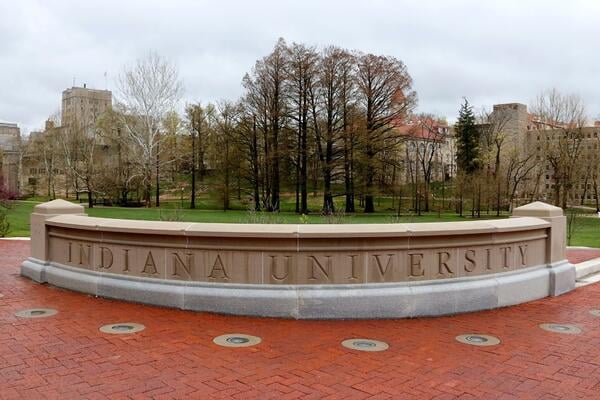
Indiana University’s decision to suspend the print publication of its student newspaper is costing the institution: Alumni are pulling donations in protest. The university ended the Indiana Daily Student’s print edition after firing the paper’s adviser, who refused to comply with administrators’ request to remove news coverage from a homecoming edition of the paper.
University leaders insist they’re not censoring the student paper but moving it to a digital platform in line with a business plan adopted last year to address the paper’s deficits. But alumni aren’t buying it, IndyStarreported. Some are asking what came of donations they made to a fund dedicated to the student publication after the newspaper reported students faced hurdles to spending the money. Other alumni are pulling their donations altogether.
Former journalism student Patricia Esgate canceled $1.5 million in bequests she planned to leave to the university. Alum Ryan Gunterman, executive director of the Indiana High School Press Association and the faculty adviser of Franklin College’s student newspaper, posted on Facebook that he and his wife were ceasing all future donations after giving money to the university and newsroom for over two decades. Toby Cole, a fourth-generation alum of the institution, told IndyStar in an email that his family was ending its monthly contributions and a $300,000 planned gift for scholarships.
“If IU can pay our [football] coach almost $100mm we can fund our IDS,” Cole said in the email. “Problem is ‘they’ don’t want an independent free speaking print newspaper because students actually wield power with it.”
Hillsdale College—a small, private Christian liberal arts institution in Michigan—has increasingly turned to digital advertising, including Microsoft’s MSN platform, to extend its reach and solicit donations. Known for its conservative ideology and its refusal to accept any federal or state funding, Hillsdale is relying more than ever on mass digital engagement to sustain its growing national influence.
Hillsdale sponsors content across digital news aggregators like MSN using native advertising platforms such as Taboola. These sponsored links promote Hillsdale’s free online courses in subjects like the U.S. Constitution and Western political philosophy. Readers who click are typically prompted to provide an email address, after which they are placed into a recurring stream of newsletters and donation appeals. Hillsdale’s marketing strategy combines educational branding with ideological and political themes designed to deepen audience loyalty and increase donor conversion.
The school’s strategy is informed by its unique financial model. Unlike most colleges, Hillsdale accepts no Title IV federal funds and avoids other forms of government support. While this independence allows Hillsdale to circumvent Department of Education oversight, it also necessitates a highly developed fundraising operation. Hillsdale reportedly raises between $100 million and $200 million annually through private donations, which support its growing campus, online educational infrastructure, Imprimis publication, and a national network of affiliated classical charter schools.
Hillsdale’s digital fundraising and brand-building efforts align closely with its broader ideological mission. On February 19, 2025, Turning Point USA founder Charlie Kirk delivered a keynote lecture at Hillsdale’s National Leadership Seminar in Phoenix. Titled “Hitting the Ground Running: The Trump Transition and Early Priorities,” the event illustrated how Hillsdale fuses academic outreach with conservative political messaging. The speech was promoted on Hillsdale’s social media platforms and streamed via its Freedom Library website.
[Charlie Kirk speaks at Hillsdale College in February 2025.]
Hillsdale’s collaboration with platforms like MSN reflects a wider shift in how politically-aligned institutions use digital media ecosystems to bypass traditional gatekeepers. Because MSN blends sponsored content into its main news feed using algorithmic curation, promotional material from ideological institutions can appear alongside conventional journalism—without the benefit of editorial transparency or disclaimers. For Hillsdale, this means access to millions of readers, many of whom may not realize they’re engaging with sponsored political content masked as civic education.
This convergence of ideology, education, and marketing raises critical questions about the future of higher education outreach and the role of big tech platforms in shaping political narratives. Hillsdale’s success in these spaces underscores how easily lines between education, influence, and revenue can blur in the digital age.
The value of college endowments collectively grew 4% in fiscal 2024 thanks to a combination of strong investment returns and a rise in donations, according to the latest data from the National Association of College and University Business Officers and asset management firm Commonfund.
The total value of the endowments of the 658 institutions that participated in the study reached $873.7 billion for the year, with a median endowment value of $243 million. Of the survey respondents, 144 had endowments of $1 billion or more,comprising roughly 86% of the total value reported.
Gifts to endowments rose to $15.2 billion from $12.7 billion last year, according to the study. Draws on funds rose as well, by 6.4% year over year to $30.1 billion in spending at institutions.
Dive Insight:
Investment returns remained strong through 2024, supporting institutions’ spending from their endowments. Ten-year average annual returns stood at 6.8% for fiscal 2024,down slightly from last year but still robust enough to make spending with endowment money “possible and prudent,” NACUBO and Commonfund said in a press release. The average one-year return hit 11.2%, a 3.5 percentage point increase over 2023.
On average, endowments funded 14% of institutions’ operating budget, up from 10.9% in fiscal 2023, according to the NACUBO-Commonfund study.
Student aid represented the largest share by far of endowment spending, at 48.1%, followed by academic programs and research at 17.7%.
Colleges spend the largest share of endowment funds on student financial aid
Endowment spending distribution by function in fiscal 2024
“Faculty and staff certainly benefit from this philanthropy, but students remain the primary beneficiaries, as the bulk of these resources is used to maintain student aid and affordability,” NACUBO President and CEO Kara Freeman said in a statement.
The list of the largest endowments looks very similar to that of years past. In the No. 1 spot, once again, is Harvard University, with a value of about $52 billion, up 5% from last year. Harvard is followed by the University of Texas System ($47.5 billion) and Yale University ($41.4 billion).
Harvard University has the largest endowment — again
Endowment sizes in fiscal 2024 by total market value and value per student
Those wealthy endowments are once again in the spotlight as President Donald Trump and Republicans eye higher tax rates on colleges’ investment funds.
During Trump’s first term, he signed a tax bill containing a 1.4% levy against the investment income of private colleges whose endowments are valued at $500,000 or more per student. House Republicansthis year floated a plan to jack that rate up to 14%. Others have proposed yet higher rates, including 21%, to be in line with the same rates paid by for-profit corporations.
NACUBO addressed the politics around endowments in its release of the latest data.
Pointing to how institutions use their endowments on student aid and other core functions, Freeman said, “This is incredibly important work and demonstrates how short-sighted it would be to further tax these funds and divert them from their true purpose.”
Mark Anson, Commonfund CEO and chief investment officer, said at a Tuesday media briefing that institutions would have to take a close look at post-tax investment returns should higher rates become law. That could in turn push many to look at more aggressive investing strategies, while others would likely see the share of their operations financed by endowments fall, Anson added.
In 2023, Korean video game company WeMade pledged to donate the equivalent of one billion Korean won ($695,988) in Wemix tokens—a cryptocurrency linked to the blockchain platform of the same name—to Seoul National University.
What seemed like a moment for celebration quickly descended into controversy, with the university eventually ceasing to accept cryptocurrency donations altogether.
So, what happened? Shortly after the donation was made, WeMade reportedly liquidated a large share of its coins, causing a significant currency devaluation and meaning SNU’s donation was no longer worth so much—a problem given that the funds had been earmarked for a specific project.
That wasn’t the only barrier. Under South Korean financial regulations, the university was also unable to open a corporate account for virtual asset exchange. With calls to change the law unanswered, the university was left holding a volatile currency it was unable to convert to cash.
Now Korean regulators are reportedly considering allowing the country’s universities to convert cryptocurrency for the first time—potentially opening a significant new fundraising stream for the country’s financially ailing sector.
Elsewhere, universities are already cashing in on the crypto craze, most notably in the U.S. In 2021, the University of Pennsylvania received $5 million in Bitcoin from an unnamed donor. A year later, Vitalik Buterin, co-founder of Ethereum, a leading blockchain, donated the equivalent of $9.4 million in USDC coin to the University of Maryland to fund public health research in the wake of the pandemic.
The Giving Block, a U.S.-based platform that facilitates cryptocurrency donations to nonprofit organizations, said that the higher education sector has been one of its “biggest growth areas” over the past two years, with Washington State University and Northeastern University among the company’s clients.
“There are several things driving this, like the booming crypto market and broader mainstream adoption, but the biggest driver for schools is simply following the money,” said Pat Duffy, its co-founder.
With analysts suggesting popular currencies like Bitcoin will continue to grow in value this year, spurred on by newly inaugurated Donald Trump’s crypto-friendly rhetoric, universities could be set to benefit—if they are prepared to manage the risks that come with the volatile landscape.
“For donors in the U.S., the biggest driver is the tax incentive,” said Duffy. “You can skip capital gains taxes on appreciated assets and still get a deduction for the full market value.
“The donor pays no taxes on their appreciated crypto, and neither does the school. Donors across the country are eliminating tens of millions of dollars in tax liability by choosing to give with crypto, and giving larger gifts … as a result.”
For universities, accepting cryptocurrency may also allow them to target their fundraising at a younger, tech-savvy market. “They can attract more people if they accept crypto payments,” said Nir Kshetri, professor of management at the University of North Carolina at Greensboro.
It’s not just donations where universities are capitalizing. Some, like Bentley University, have begun accepting tuition fees in cryptocurrency, with significant implications for international students.
In Nigeria, for example, converting the naira to the U.S. dollar to make fee payments can be a complicated process. For some, paying in decentralized cryptocurrency is simpler and faster, according to Kshetri.
However, a key risk for universities is the unpredictability of cryptocurrency markets, with fears compounded by the volatility of Bitcoin in recent years. While the market is recovering, crashes such as the one experienced in 2022 have left a lasting impact and made some universities wary.
“Right now it’s at a peak, but who’s to say we won’t see a return to what we saw two years ago when the bottom fell out?” cautioned Bill Stanczykiewicz, director of the Fund Raising School at Indiana University Indianapolis’s Lilly Family School of Philanthropy.
According to Stanczykiewicz, best practice is to avoid holding on to cryptocurrency, even if it is predicted to increase in value. “What we say to fundraisers is if you get crypto, turn it into your national currency as quickly as you can,” he said, or use a platform like the Giving Block, which does this for you.
However, this approach isn’t universal. In Paraguay, Universidad Americana is less risk-averse than some, evaluating the market before converting any cryptocurrency payments.
Universities considering going down this avenue also need to consider the ethical aspects, said Stanczykiewicz, and whether such donations adhere to their institution’s values.
Specifically, the environmental impact of currencies like Bitcoin is a concern for some. However, Kshetri argued, the coin has already been mined prior to the donation—that is, the damage has already been done. “Just to transfer that Bitcoin from you to me consumes very little … electricity,” he said.
Whatever your ethical view, those interviewed for this article agreed on this: Cryptocurrency is here to stay and, for universities, it’s simply a question of how quickly they embrace it.
“Historically, it was regulatory uncertainty that made universities nervous about crypto acceptance and investing,” said Duffy. Today, he continued, in the U.S., “regulatory clarity and the political support we see on both sides of the aisle have cleared up those concerns.”
With countries like South Korea set to provide a regulatory green light, too, it may not be long before institutions around the globe follow in the footsteps of their U.S. counterparts.