This blog was kindly authored by Vikki Welch, Associate Director Student Living, University of Nottingham.
It is the second blog in HEPI’s series with The Unite Foundation on how to best support care experienced and estranged students. You can find the first blog here.
When the University of Nottingham (UoN) launched its Care Leaver and Estranged Student support package in 2022, the ambition was clear: to remove financial barriers and create a genuine sense of belonging for students who often arrive without the safety net of family support. Today, it provides a comprehensive wraparound system, anchored by a one-year accommodation bursary that has changed lives.
Why accommodation matters
For care-experienced and estranged students, the cost of living on campus can be a major obstacle. UoN’s analysis revealed that these students were disproportionately opting for cheaper, off-campus housing – often in poorer conditions and far from academic spaces. This not only isolated them from student life but also correlated with lower degree outcomes compared to peers who lived on campus.
The solution was bold: cover 365 days of accommodation costs for the first year of study, whether in catered halls or self-catered options. By partnering with third-party providers and embedding strong support mechanisms, we were able to develop a comprehensive package of support for care experienced and estranged students. Critical to this was ensuring that the bursary was non-competitive and universally available to eligible students – we wanted to create the opportunity to welcome all care experienced and estranged students who met our eligibility criteria and wanted to study at the University of Nottingham. The goal was not just financial relief but a holistic transition into university life – setting our students up for success.
Beyond the bursary
The scheme goes far beyond paying rent. From pre-entry needs assessments and liaising with local authorities to welcome events and starter packs, we designed a programme that recognises the emotional and practical challenges care experienced and estranged students face. Initiatives like “NottingHome for the Holidays” during winter vacation and solidarity events during Estranged Student Week foster community and belonging.
Support continues throughout the year: exam preparation, wellbeing interventions, and help with second-year housing – including covering costs for guarantor services. The summer BBQ for care experienced and estranged students is a joyful and emotionally rewarding event to see a cohort come together to celebrate their first year.
This is underpinned by staff who really care and want the best for these students. None of this would be possible without such incredible people. The UoN models puts our people in theposition to make a difference.
Impact on recruitment and retention
The results speak volumes. Applications from care-experienced students have risen since the bursary’s introduction, and enrolment rates have improved significantly. Living on campus has been shown, through regression analysis by UoN’s Digital Research Service, to increase the likelihood of degree completion among bursary recipients. With a 92% increase in care experienced and estranged students choosing on campus accommodation we are confident in the success outcomes of these students once they graduate. This mirrors findings from the Unite Foundation scholarship programme, reinforcing the transformative power of secure, inclusive accommodation.
Financial stress remains a critical issue for care experienced and estranged students nationally – this was something we heard consistently in focus groups with this group of students. The recent analysis of HEPI’s Student Academic Experience Survey shows that this group of students work at least 2+hours more in paid work than their peers. At Nottingham, 98% of respondents said the bursary was essential to continuing their studies.
One first-year student summed it up:
I don’t have to worry about getting a job on top of my studies this year because of my accommodation bursary.
Wellbeing and belonging
The impact goes beyond numbers. Students report feeling part of campus life, joining societies, using sports facilities and building friendships. Reduced working hours mean more time for study and social engagement, which in turn supports mental health and academic success. UoN’s commitment was recognised with the NNECL Quality Mark, awarded “Exceptional” for both pre-enrolment support and student wellbeing.
Lessons for the sector
What can other universities learn from Nottingham’s approach? First, that accommodation is not a luxury – it’s a foundation for success. Second, that financial support must be paired with pastoral care and community-building. Finally, that schemes should be flexible, extending help to students who become estranged after enrolment.
As higher education grapples with cost-of-living pressures, Nottingham’s model offers a template and example for meaningful change. By investing in accommodation and wraparound support, universities can turn access into success for some of the most vulnerable students in our system.
You can find out more about accommodation scholarships and wider support for care experienced and estranged students through the Unite Foundation’s Blueprint framework – supporting your institution to in building a safe and stable home for care experienced and estranged students, improving retention and attainment outcomes.
After almost 20 years in business, Milestones Preschool in Inglewood closed its doors this month.
It was a decision that preschool director Milena Bice had been putting off for years. She’d turned her family home into a small business, transforming the house on a quiet tree-lined street into a playground of childish delights, complete with a sand pit, fruit trees and even a brood of chicks waddling around a small pen.
Bice loved her preschool. She loved the way it allowed her to care for her own kids when they were little, and how she could continue to apply therapeutic approaches to her work long after they’d outgrown preschool. Over the years, she developed a reputation for her care for children with neurological differences.
But child care is no easy business. Margins were about as slim as can be. When parents couldn’t afford to pay full tuition, Bice felt it was her duty to keep caring for their kids anyway. The question of closing loomed over her as her business survived the ups and downs of the global economy: first, the 2008 recession, and the COVID-19 pandemic more than a decade later.
But this month, Bice finally called it quits. She was sick of charging families high fees and still struggling to pay herself at the end of the month. And for the first time this year, she said her preschool didn’t have anyone on her waitlist. One reason is universal transitional kindergarten — or TK — no-cost public kindergarten that becomes an option for all California 4-year-olds this fall.
“ I can’t compete with free,” she told LAist in a recent interview. “And in this economy, I think a lot of families are hurting.”
Bice’s predicament mirrors a statewide challenge. As families sign their 4-year-olds up for TK, some childcare and preschool providers say they’re losing enrollment and it’s threatening their businesses. While teachers struggle to adjust, childcare remains an unaffordable and unmet need for many families across California, especially with very young children.
Child care is still a major need for CA families
Even as transitional kindergarten expands, there’s no shortage of need for child care. The California Budget & Policy Center estimates that just 19% of infants, toddlers and preschool-aged children who are eligible for state subsidized care are enrolled. The need is especially great for children age 2 or younger — the most expensive age group to care for.
A recent report from the Center for the Study of Child Care Employment found that most early education programs will need to pivot to younger kids to meet the need and stay in business, and that centers and home-based childcares are hurting from declined enrollment since the pandemic.
Anna Powell, the lead author of that report, said early educators struggling to adapt to the changing landscape of their industry are a byproduct of the state’s massive investment in universal TK, but lack of similar investment in others.
“ If one area, for example TK, receives a lot of resources to scale up to reach demand, in theory, that is positive,” she said. “What happens when you don’t invest in all the quadrants at the same time is that there can be these unintended consequences.”
Transitioning to younger kids is a challenge
Powell said that caring for younger kids requires a number of shifts in how child care programs operate. Teaching expertise is different for younger children, and staffing ratios are smaller. The time a provider might expect to have a child enrolled is also shorter, since kids are heading to the public school system earlier. This means early educators could face more turnover.
There’s also the matter of teaching preferences. Caring for a 3- or 4-year-old is very different from taking care of a 1-year-old. In a survey of nearly 1,000 early educators, just 20% said they’d be interested in teaching infants and toddlers.
David Frank, who runs a preschool in Culver City, told LAist in April that he’s also closing his doors this year. He said that 4-year-olds used to make up a third of the school’s students, and his enrollment was down from 34 to 13. His preschool already took 2 -year-olds, but he didn’t want to go any younger. One reason is it would require him to reconfigure the school to create a separate space for the youngest children.
Frank said he’s not against TK, but he couldn’t keep making it work.
“ I’m happy that children will have good, free education,” he said. “But as a person trying to run a business … it’s just no longer a viable plan to stay open anymore.”
Advocates say even more investment is needed
California’s transitional kindergarten is a plan years in the making, and, despite kinks, it has achieved a big goal: offering a free option for every family with a 4-year-old in the state.
That program runs through the public school system, but child care and early education offerings for the state’s youngest children continue to be a patchwork of different types of care with no similar central system. The state funds a public preschool program for 2- to 5-year-olds for low-income families, which has received more money in recent years. Many private programs receive state subsidies for serving low-income families, and the state has increased the number of seats it funds in recent years.
It also bumped up reimbursement rates for 3-year-olds to entice more providers to take younger kids.
Gov. Gavin Newsom’s office pointed to these changes, telling LAist that it has invested heavily in a universal Pre-K program that extends beyond transitional kindergarten.
Some advocates and childcare providers say still more game-changing investment is needed. The state has promised the childcare providers that receive its subsidies to overhaul its payment system to reflect the “true cost” of care, but this year deferred offering them pay bumps. The union representing those workers is currently bargaining with the state, saying providers can’t wait for a raise.
Patricia Lozano, the executive director of advocacy organization Early Edge California, said TK’s ripple effect on early education programs shows that the state needs to do more to provide for its youngest children.
“ TK was one of the key things we’ve been advocating since it was passed,” she said. “But that’s just one piece. I think the whole system itself is problematic. It’s underfunded.”
Lozano pointed to New Mexico as a potential model for California. The state has boosted teacher pay and expanded eligibility for free care by directing gas and oil revenue to state childcare programs. She said this type of consistent source of money is especially important amid threats to federal funding and state budget cuts.
“The bottom line is we need to have that source of funding protected,” she said.
In the meantime, Milena Bice’s preschool in Inglewood is closed. She’s not sure exactly what happens next. She can’t go work at a public school. Despite decades in the business, she doesn’t have a bachelor’s degree or teaching credential.
While she debates the future, Bice is holding onto her childcare license. Who knows? Maybe she’ll want to reopen someday.
CLEVELAND — In a public school cafeteria here, 6- and 7-year olds were taking turns sketching their ideas for a building made of toothpicks and gummy bears. Their task: to design a structure strong enough to support a single subject notebook.
It was a challenge meant to test their abilities to plan ahead, work as a team and overcome setbacks. But first, they had to resist the urge to eat the building materials.
Zayden Barnes, a first grader at Clara E. Westropp School of the Arts, picked up a blue gummy bear and sniffed it. “That smells good,” he said, licking his lips.
Mia Navarro, another first grader, held a green gummy bear to her nose and inhaled deeply. “I can’t stop smelling them!” she exclaimed. “I just want to eat it, but I can’t!”
The lesson in engineering and self-control was part of an after-school program run by the nonprofit Horizon Education Centers. It’s one of a dwindling number of after-school options in a city with one of the highest child poverty rates of any large urban area in the country.
Last year, Horizon and other nonprofit after-school providers reached more than 7,000 students in Cleveland public schools, buoyed by $17 million in pandemic recovery aid. But when the money ran out at the end of that school year, nonprofits here had to drop sites, shed staff and shrink enrollment. Horizon, which was in five public schools last year, is now in just one.
Similar setbacks can be seen across the country, as after-school programs struggle to replace billions in federal relief money. While a few states are helping to fill the gap, Ohio isn’t among them. And many providers fear more cuts are coming, as the Trump administration continues its campaign to slash government spending and end “equity-related” grants and contracts.
The after-school sector plays a critical role in the nation’s economy, providing close to 8 million students, or nearly 14 percent of all school-aged children, with a safe place to go while their parents work. It offers homework help, enriching activities, healthy snacks and physical exercise — often for a fee, but sometimes for free.
Done well, after-school programs can strengthen students’ social and emotional skills, increase their engagement with and attendance in school, and reduce their risk of substance abuse or criminal activity. In some cases, they can help improve grades and test scores, too.
Yet the sector, which has existed for more than 100 years, has long been hobbled by inadequate funding, staffing shortages and uneven quality. There are long waitlists for many programs, and low-income families often struggle to find affordable options.
In a recent survey by the nonprofit Afterschool Alliance, more than 80 percent of program leaders said they were concerned about their program’s future, and more than 40 percent said they worried they’d have to close permanently.
“The state of afterschool in America feels very grim,” said Alison Black, executive director of the Cleveland affiliate of America Scores, a nonprofit that teaches soccer and poetry to students in 13 cities across North America.
Students build a gummy bear structure in an after-school program run by Horizon Education Centers, in Cleveland. Credit: Grace McConnell for The Hechinger Report
After-school programs emerged in the second half of the 19th century, in philanthropic settlement houses that provided English courses and health care to the children of immigrants, according to a Rand Corporation report. They multiplied after Congress passed child labor laws in the 1930s, and again during World War II, when women entered the workforce in large numbers.
In those early days, the programs functioned mostly as child care, offering a solution to the problem of the “latchkey kid.” But they began to take on a broader role in the 1960s, when the programs started to be seen as a way to both reduce youth crime and provide kids with positive role models, according to Rand.
In the 1980s and 1990s, policymakers and funders began demanding that after-school programs play a part in closing the academic gaps between wealthier and poorer kids. High-poverty schools began setting aside some of their Title I funds to provide after-school programs.
But it wasn’t until 1998 that the federal government offered targeted support to after-school programs, in the form of competitive grants awarded by the states through the newly created 21st Century Community Learning Centers Program. The first year, Congress appropriated $40 million for the program; by 2002, that number had swelled to $1 billion.
Today, the after-school sector is made up of a mix of programs providing academic support, enrichment (sports, theater and the like) or some combination. Their goals and funding streams vary, from public dollars to philanthropic and corporate gifts. Many survive by stitching together multiple sources of funding.
The 21st Century program remains the only dedicated federal funding stream for after-school and summer learning, providing $1.3 billion in support to 10,000 centers serving close to a fifth of students in 2023.
After-school programs are popular among parents, and demand for slots far exceeds the supply. For every child in an after-school program, there are three more who would participate if an affordable, accessible option was available to their families, according to surveys by the Afterschool Alliance.
Gina Warner, CEO of the National Afterschool Association, says afterschool is a space where kids can try new things and take risks they wouldn’t take at school, where the stakes are higher. “Afterschool is still a place where kids can fail” without consequence, she said.
The programs also connect students with positive adult role models who aren’t their teachers or caregivers, said Jodi Grant, executive director of the Afterschool Alliance. “Our biggest strength, when it gets down to it, is relationships,” Grant said.
But sustaining those connections can be difficult in a sector with low pay and limited opportunities for advancement. Turnover rates are high, and when staff don’t stick around, “You’re missing one of the best benefits of afterschool,” said Warner.
Students practice a dance routine at the Downtown Boxing Gym, in Detroit. Credit: Kelly Field for The Hechinger Report
For a sector accustomed to scraping by, the American Rescue Plan Act of 2021 was like a winning lottery ticket.
Over three years, after-school programs received roughly $10 billion in ARPA aid — money they used to add staff, improve pay and benefits and expand enrollment, according to the Afterschool Alliance. It estimates that programs were able to serve 5 million more kids as a result.
But the money has mostly been spent, and late last month, Education Secretary Linda McMahon told districts that their time to use any remaining funds was over. In Cleveland, which spent almost $28 million on out-of-school time programs between fiscal 2022 and 2024, Horizon and other nonprofits formed a coalition to try to convince the district to continue at least a portion of the aid. They held rallies, secured media coverage and brought parents to testify before the school board. But the district wouldn’t budge, said David Smith, Horizon’s executive director.
“There’s no opportunity to go back to the scale we were at during the pandemic, and we still have the same problems,” said Smith. “Kids are getting in trouble after school, and they still need the extra academic help.”
The Cleveland Metropolitan School District made significant gains under its last CEO, Eric Gordon, whose Cleveland Plan was credited with improved student outcomes, including a 25 percentage point increase in the high school graduation rate. But the pandemic erased some of those gains and Cleveland, like many districts, is still recovering.
The district’s new CEO, Warren Morgan, has defended his decision not to fund the nonprofit providers, noting that the district offers after-school sports and an arts program. But those extracurriculars vary by day and by school, and after-school advocates say many schools have been left without the consistent, comprehensive care working parents depend on.
“Our city is focused on workforce development without thinking about who cutting this care hurts,” said Black, of America Scores Cleveland.
Without continued support from the district, Black’s organization has had to dip into its rainy-day fund and drop fall soccer for middle schoolers. Serving elementary students feels more essential, she explained, since younger kids can’t stay home alone.
Other nonprofits have been harder hit. The Greater Cleveland Neighborhood Centers Association, or NCA, has closed half of its locations in the district, leaving programs in seven schools. The Boys and Girls Clubs of Northeast Ohio, which lost $3 million in pandemic relief dollars and other federal support this academic year, has shuttered 17 sites.
Dorothy Moulthrop, chief executive officer of Open Doors Academy, another nonprofit, thinks the losses might have been less severe if the after-school coalition had been able to show strong results for the federal money. Though individual programs handed over reams of data to the district, Moulthrop wasn’t able to get its leaders to share the data in a form that would allow providers to study their collective impact.
“We needed to be able to demonstrate our return on investment and we were not able to,” she said.
Students in a poetry class run by America Scores Cleveland. Credit: Grace McConnell for The Hechinger Report
Questions about whether after-school programs are a good investment of public dollars have dogged the sector since the early 2000s, when Mathematica Policy Research began publishing the results of an evaluation that found the 21st Century program had little impact on student outcomes.
The study, which is often cited by politicians seeking to gut after-school spending, was controversial at the time, and remains so. Defenders of afterschool argue the evaluation was methodologically flawed and point to other research that found that students who regularly attended high-quality programs saw significant gains. But one of the study’s two authors, Susanne James-Burdumy, said in an interview that it was the most rigorous of its time.
In the 20 years since the Mathematica reports were published, hundreds of dissertations and program evaluations have added to the evidence base for both sides of the debate. But large-scale, rigorous evaluations of after-school programs remain rare, and their findings are mixed, James-Burdumy and other researchers say.
Though some analyses have found after-school programs can boost reading and math achievement, promote positive social behaviors and reduce negative ones, other studies have shown little growth in those and other areas.
Some of that inconsistency likely stems from differences in the quality of programs, researchers and advocates say. When funding is tight, after-school programs tend to focus their dollars on services, rather than professional development or program evaluation.
“Quality often feels like an extra,” said Jessie Kerr-Vanderslice, a consultant at the American Institutes for Research who focuses on out-of-school time programs.
Advocates also note a misalignment between program goals and outcome measures: While after-school programs often prioritize relationships and social and emotional skill-building, their funders frequently focus on academic gains.
One variable that seems to matter in student outcomes is attendance: Studies have found that students who attend regularly reap greater benefits than those who show up sporadically.
Yet more than half of students who participated in programs paid for with 21st Century grants in 2022-23 attended for less than 90 hours, a program evaluation shows. That works out to just 30 days for a three-hour program.
At Clara E. Westropp Elementary in Cleveland, where Horizon Education Centers has been able to continue its after-school program with a 21st Century grant, 73 students are enrolled, but average daily attendance is less than half that.
Students descend the stairs during an after-school program run by America Scores Cleveland. Credit: Grace McConnell for The Hechinger Report
On the other side of Lake Erie, at Detroit’s Downtown Boxing Gym, students are required to attend at least three days a week. To keep them coming, the program offers a huge range of activities, from cooking to coding (but ironically, not boxing).
Inside the large building that houses the program, there’s a lab with a flight simulator and 3D printer, and a music studio paid for and built by one of Eminem’s former producers.
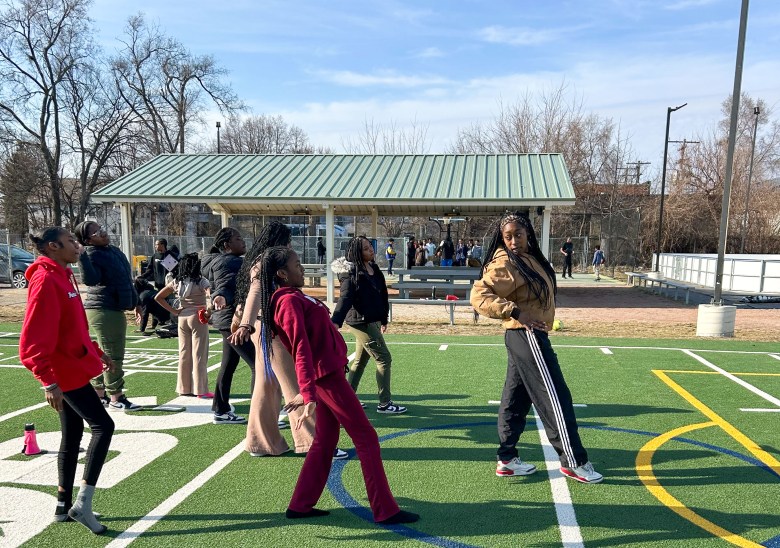
Outside, on a turf field where the program plans to build an addition that will enable it to double enrollment, a group of middle school majorettes was preparing for an upcoming dance performance.
Debra Beal, who became the caregiver to her niece’s two young sons when she was in her 50s, says the program saved her life — and theirs. It kept the boys, now 19 and 20, off the streets while she worked, provided them with exercise and tutoring, and even served them dinner. The staff became like family, supporting her when she struggled as a parent and offering to pay for counseling when one son lost his father and uncle from fentanyl overdoses on the same day.
“What they’re doing is life-changing,” said Beal, whose long denim coat had the word “Blessed” written in sequins on the back.
Financially, the Downtown Boxing Gym is on surer footing than its counterparts in Cleveland. The Michigan Legislature has provided $50 million in funding for after-school programs in each of the last two years, and the program recently received $3 million in funds from the state.
That doesn’t mean the program isn’t being pinched by the Trump administration’s cost-cutting campaign and purge of diversity, equity and inclusion programs, said Jessica Hauser, its executive director. Corporations the program was counting on for seven-figure gifts for the addition and program expansion are reconsidering their pledges, and a promised federal earmark now seems unlikely.
Hauser is also worried about potential cuts to federal child nutrition programs and student aid, which the program depends on for meals and college student tutors.
Back in Cleveland, the coalition Smith formed to fight for after-school funding has expanded to include the city, the county and a local foundation, which hired a consultant to come up with the cost to deliver quality after-school programming. To longtime advocates like Smith and Allison Wallace, executive director of the NCA, it feels like the sector is having to prove itself, yet again.
“They’re revisiting conversations we had 15 years ago, around best practices and identifying quality,” Wallace said. “We keep going over the same things, and we’re not getting any traction.”
Things could get even tougher in the next couple years, as the district shifts the costs of providing security and custodial services for after-school programs onto the nonprofit providers. Wallace estimates that the change will cost providers tens of thousands per site.
And future federal funding is far from guaranteed. Though the 21st Century program enjoys bipartisan support in Congress, Trump sought to eliminate it in every budget proposal he issued in his first term and is expected to do so again.
For now, though, after-school programs are still providing kids in Cleveland with caring staff, a safe place to spend the hours after school, and engaging activities like gummy bear construction.
The teams had 10 minutes to build structures that could support a notebook. When the timer went off, the structure built by Zayden and Mia’s group resembled a two-story house with a caved-in roof. Zayden wasn’t feeling optimistic.
“I think it’s going to fall,” he said.
“Think positive,” said Kathy Thome, a program administrator who is helping the group.
Ian Welch, the program’s site coordinator for Clara E. Westropp, picked up a notebook and approached the table. He reminded the teams that failure is part of the scientific method. If their structures collapse, they can try again, he said.
“It’s going to squish down,” Mia predicted.
She was right. But the flattened structure still held the notebook aloft. The kids jumped up and down, and Zayden did a little boogie.
“We’re so happy — we did it!” he said.
Welch rewarded their effort with some fresh gummy bears, and the kids, proud and hopped up on sugar, waited for their parents to pick them up.
Contact editor Caroline Preston at 212-870-8965, on Signal at CarolineP.83 or via email at [email protected].
This story was produced with support from the Education Writers Association Reporting Fellowship program.
The Hechinger Report provides in-depth, fact-based, unbiased reporting on education that is free to all readers. But that doesn’t mean it’s free to produce. Our work keeps educators and the public informed about pressing issues at schools and on campuses throughout the country. We tell the whole story, even when the details are inconvenient. Help us keep doing that.
This audio is auto-generated. Please let us know if you have feedback.
WASHINGTON — Democratic members of the House were blocked from entering the U.S. Department of Education’s headquarters in Washington, D.C., Friday after requesting a meeting with Acting Education Secretary Denise Carter to discuss their opposition to the Trump administration’s efforts to limit department programming.
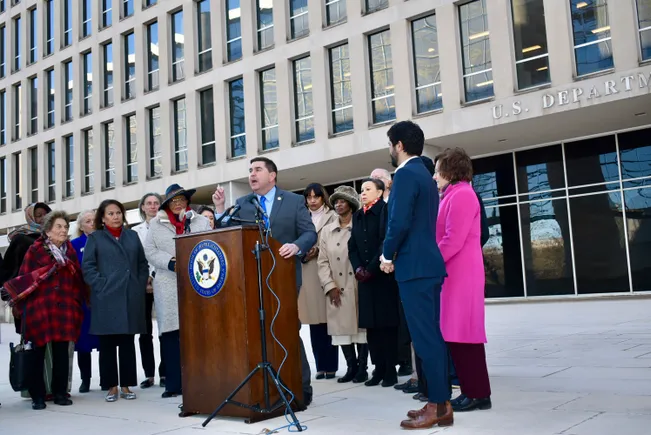
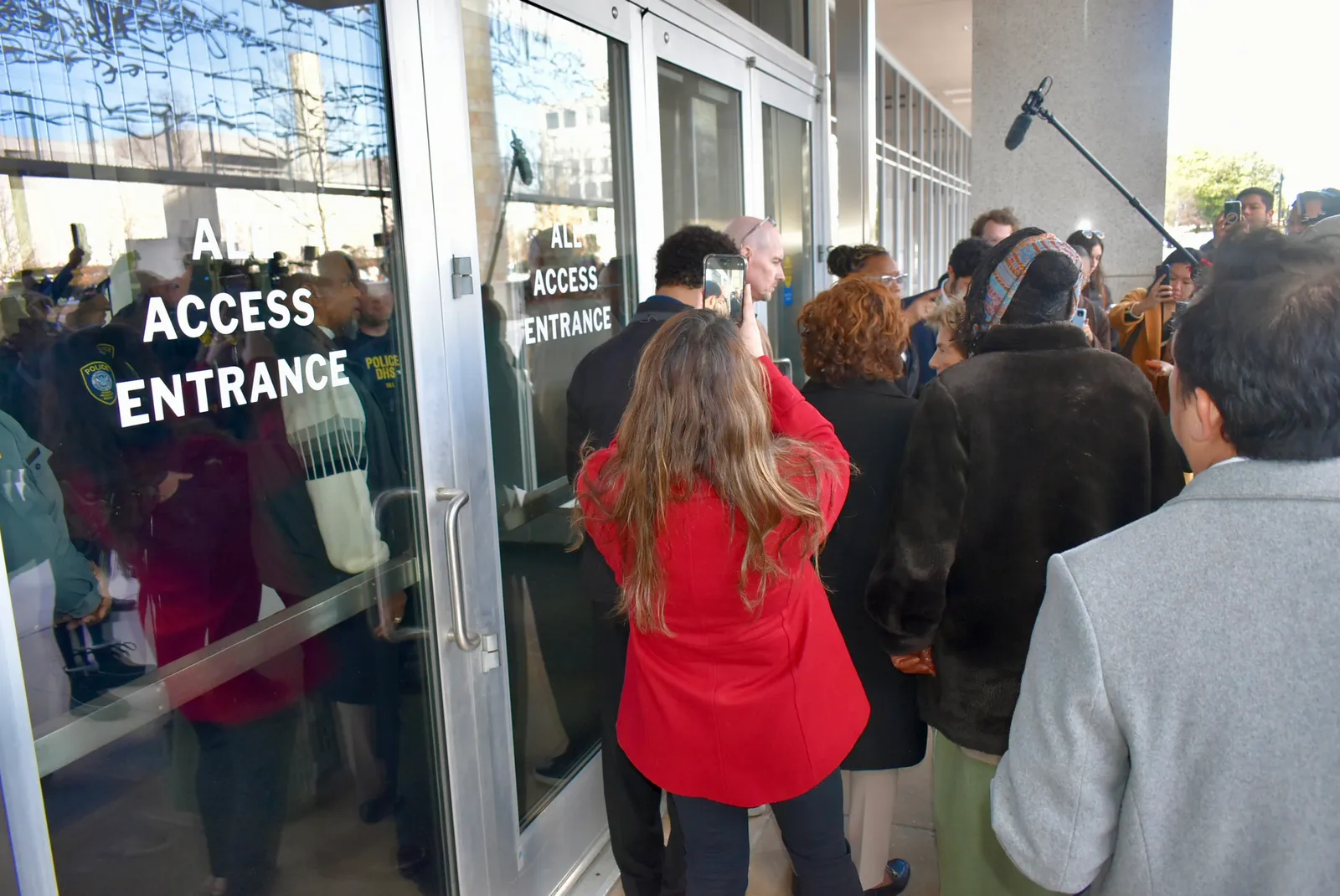
About 18 members of Congress walked up to the visitor’s entrance asking to enter after holding a press conference about their concerns. A person who was not wearing a security uniform came outside and told the group they were not allowed to enter. For the next 30 minutes, lawmakers pleaded to be let in the building, with some holding up their congressional business cards and arguing they had a right to enter the federal building as legislators who oversee federal agencies.
U.S. Department of Homeland Security uniformed officers could be seen inside the glass doors.
“Each and everyone one of us have been through these doors,” said Rep. Greg Casar, D-Texas, standing near a sign reading “All Access Entrance.” “But, of course, as soon as we get word that Elon Musk and Donald Trump want to shut down the Department of Education, suddenly, they don’t want to let members of Congress in that ask questions.”
On Wednesday, 96 Democratic members of Congress sent a letter to Carter requesting an “urgent” meeting to discuss the Trump administration’s plans for what they say is to “illegally dismantle or drastically reduce” the Education Department. The department has received the letter, but no meeting has been scheduled as of Friday afternoon, according to the office of Rep. Mark Takano, D-Calif.
An Education Department spokesperson said in an email after the lawmakers’ visit that “The protest was organized by members of Congress who were exercising their First Amendment rights, which they are at liberty to do. They did not have any scheduled appointments, and the protest has since ended.”
Democratic members of the U.S. House are denied entry to the U.S. Department of Education’s headquarters in Washington, D.C. on Feb. 7, 2025. They were there to voice concerns about attempts to reduce or eliminate department programs.
Kara Arundel/K-12 Dive
Carter, who is an Education Department senior official overseeing federal student aid, is in the acting role as education secretary pending Senate approval of Trump’s choice for education secretary — Linda McMahon. McMahon’s confirmation hearing is scheduled for Feb. 13.
Trump is expected to issue an executive order limiting the Education Department’s activities, although the timing of that order is unknown. Since being inaugurated Jan. 20, Trump has issued a series of executive orders geared toward education. They include restrictions on diversity, equity and inclusion programs, an expansion of school choice, and halting federal support for “gender ideology and discriminatory equity ideology.”
Most recently, he ordered K-12 schools and colleges to prevent transgender girls and women from participating on sports teams that align with their gender identity. Those that don’t comply could lose their federal funding.
Trump has said his goal is to close the Education Department. However, that would require approval from at least 60 members of the Senate. Supporters of shrinking or eliminating the Education Department say there is too much federal bureaucracy. They also say states and districts should have more control over how to spend federal funds for schools.
During the Friday press conference in front of the Education Department, Rep. Jahana Hayes, D-Conn., a former national teacher of the year, asked what would happen to the civil rights of 49 million students, including 7 million students with disabilities, if the Education Department shuts down. She also asked about the $1.6 trillion in student financial aid the department manages.
“If you want to have some true oversight of the department, I’m here for it, but what you will not do is shut down this department and deny access to all of those children who need it while we’re in Congress,” Hayes said.
Another former educator turned lawmaker, Rep. John Mannion, D-N.Y., said, “When we’re talking about dismantling the Department of Education, what we’re talking about is larger class sizes, those kids not getting those individualized services, the removal of athletics, art, science, music.”
“These people and I will not stand here silently as they steal taxpayer dollars from special education students,” Mannion said.
Democratic lawmakers this week have also tried to enter the Washington, D.C., offices of the Environmental Protection Agency and the U.S. Agency for International Development without success, according to statements from lawmakers and news reports.
Also on Thursday, Rep. Bobby Scott, D-Va., ranking member of the House Education and Workforce Committee, asked the Government Accountability Office to immediately assess the security of IT systems at the Education Department, the U.S. Department of Labor, and the U.S. Department of Health and Human Services following reports that the temporary Department of Government Efficiency, which is headed by billionaire Elon Musk, has accessed data from various government agencies.
Democratic leaders in Congress sent Carter a letter Wednesday asking about DOGE’s involvement in Education Department’s internal systems that contain personally identifiable information.
This audio is auto-generated. Please let us know if you have feedback.
WASHINGTON — Democratic members of the House were blocked from entering the U.S. Department of Education’s headquarters in Washington, D.C., Friday after requesting a meeting with Acting Education Secretary Denise Carter to discuss their opposition to the Trump administration’s efforts to limit department programming.
About 18 members of Congress walked up to the visitor’s entrance asking to enter after holding a press conference about their concerns. A person who was not wearing a security uniform came outside and told the group they were not allowed to enter. For the next 30 minutes, lawmakers pleaded to be let in the building, with some holding up their congressional business cards and arguing they had a right to enter the federal building as legislators who oversee federal agencies.
U.S. Department of Homeland Security uniformed officers could be seen inside the glass doors.
“Each and everyone one of us have been through these doors,” said Rep. Greg Casar, D-Texas, standing near a sign reading “All Access Entrance.” “But, of course, as soon as we get word that Elon Musk and Donald Trump want to shut down the Department of Education, suddenly, they don’t want to let members of Congress in that ask questions.”
On Wednesday, 96 Democratic members of Congress sent a letter to Carter requesting an “urgent” meeting to discuss the Trump administration’s plans for what they say is to “illegally dismantle or drastically reduce” the Education Department. The department has received the letter, but no meeting has been scheduled as of Friday afternoon, according to the office of Rep. Mark Takano, D-Calif.
An Education Department spokesperson said in an email after the lawmakers’ visit that “The protest was organized by members of Congress who were exercising their First Amendment rights, which they are at liberty to do. They did not have any scheduled appointments, and the protest has since ended.”
Democratic members of the U.S. House are denied entry to the Education Department’s headquarters in Washington, D.C., on Feb. 7, 2025. They were there to voice concerns about attempts to reduce or eliminate department programs.
Kara Arundel/K-12 Dive
Carter, who is an Education Department senior official overseeing federal student aid, is in the acting role as education secretary pending Senate approval of Trump’s choice for education secretary — Linda McMahon. McMahon’s confirmation hearing is scheduled for Feb. 13.
Trump is expected to issue an executive order limiting the Education Department’s activities, although the timing of that order is unknown. Since being inaugurated Jan. 20, Trump has issued a series of executive orders geared toward education. They include restrictions on diversity, equity and inclusion programs, an expansion of school choice, and halting federal support for “gender ideology and discriminatory equity ideology.”
Most recently, he ordered K-12 schools and colleges to prevent transgender girls and women from participating on sports teams that align with their gender identity. Those that don’t comply could lose their federal funding.
Trump has said his goal is to close the Education Department. However, that would require approval from at least 60 members of the Senate. Supporters of shrinking or eliminating the Education Department say there is too much federal bureaucracy. They also say states and districts should have more control over how to spend federal funds for schools.
During the Friday press conference in front of the Education Department, Rep. Jahana Hayes, D-Conn., a former national teacher of the year, asked what would happen to the civil rights of 49 million students, including 7 million students with disabilities, if the Education Department shuts down. She also asked about the $1.6 trillion in student financial aid the department manages.
“If you want to have some true oversight of the department, I’m here for it, but what you will not do is shut down this department and deny access to all of those children who need it while we’re in Congress,” Hayes said.
Another former educator turned lawmaker, Rep. John Mannion, D-N.Y., said, “When we’re talking about dismantling the Department of Education, what we’re talking about is larger class sizes, those kids not getting those individualized services, the removal of athletics, art, science, music.”
“These people and I will not stand here silently as they steal taxpayer dollars from special education students,” Mannion said.
Democratic lawmakers this week have also tried to enter the Washington, D.C., offices of the Environmental Protection Agency and the U.S. Agency for International Development without success, according to statements from lawmakers and news reports.
Also on Thursday, Rep. Bobby Scott, D-Va., ranking member of the House Education and Workforce Committee, asked the Government Accountability Office to immediately assess the security of IT systems at the Education Department, the U.S. Department of Labor, and the U.S. Department of Health and Human Services following reports that the temporary Department of Government Efficiency, which is headed by billionaire Elon Musk, has accessed data from various government agencies.
Democratic leaders in Congress sent Carter a letter Wednesday asking about DOGE’s involvement in Education Department’s internal systems that contain personally identifiable information.
Bryce Loo, Associate Director of Higher Education Research
International students navigate a landscape of uncertainty and opportunity, as the 2024 IIE Open Doors Report highlights shifting trends in U.S. enrollment and global migration.
The Institute of International Education’s (IIE) annual Open Doors Report on International Education Exchange (Open Doors, for short),[1] along with its companion Fall Enrollment Snapshot Survey (Fall Snapshot Survey, for short),[2] was released only a few weeks after a consequential presidential election in which former president Donald Trump defeated Vice President Kamala Harris. Trump’s win will significantly shift the landscape around international students in the U.S.
Open Doors is a retrospective report on international enrollment and other student data in the U.S., focused on the previous full academic year—in this case 2023-24.[3] The Fall Snapshot Survey provides insights into the current fall term. But uncertainty abounds in this new environment with the return of Trump, known for his tough stances on immigration, which may affect non-immigrant residents such as international students and temporary workers. This is happening against a backdrop of global uncertainty, in a year with a tremendous number of important elections around the world, many armed conflicts, and growing climate change. At the same time, there are bright spots for the U.S. as a host of international students and for global student migration in general.
In this article, I also compare results from Open Doors and the Fall Snapshot Survey against recently released data from SEVIS (the Student Exchange and Visitor Information System), maintained by the Department of Homeland Security (DHS), for Fall 2024.[4] This dataset captures all students with a record in SEVIS, the U.S. government database in which all international students are required to be registered by their hosting U.S. institution. Data are organized monthly, with the most recently released is for November 2024, and they vary little month-to-month within a given term, such as a fall semester. For consistency, I compare November 2024 with November 2023. Such data help us to gain a fuller picture of current international enrollment trends this fall.
What the data tell us: Continued but leveling growth
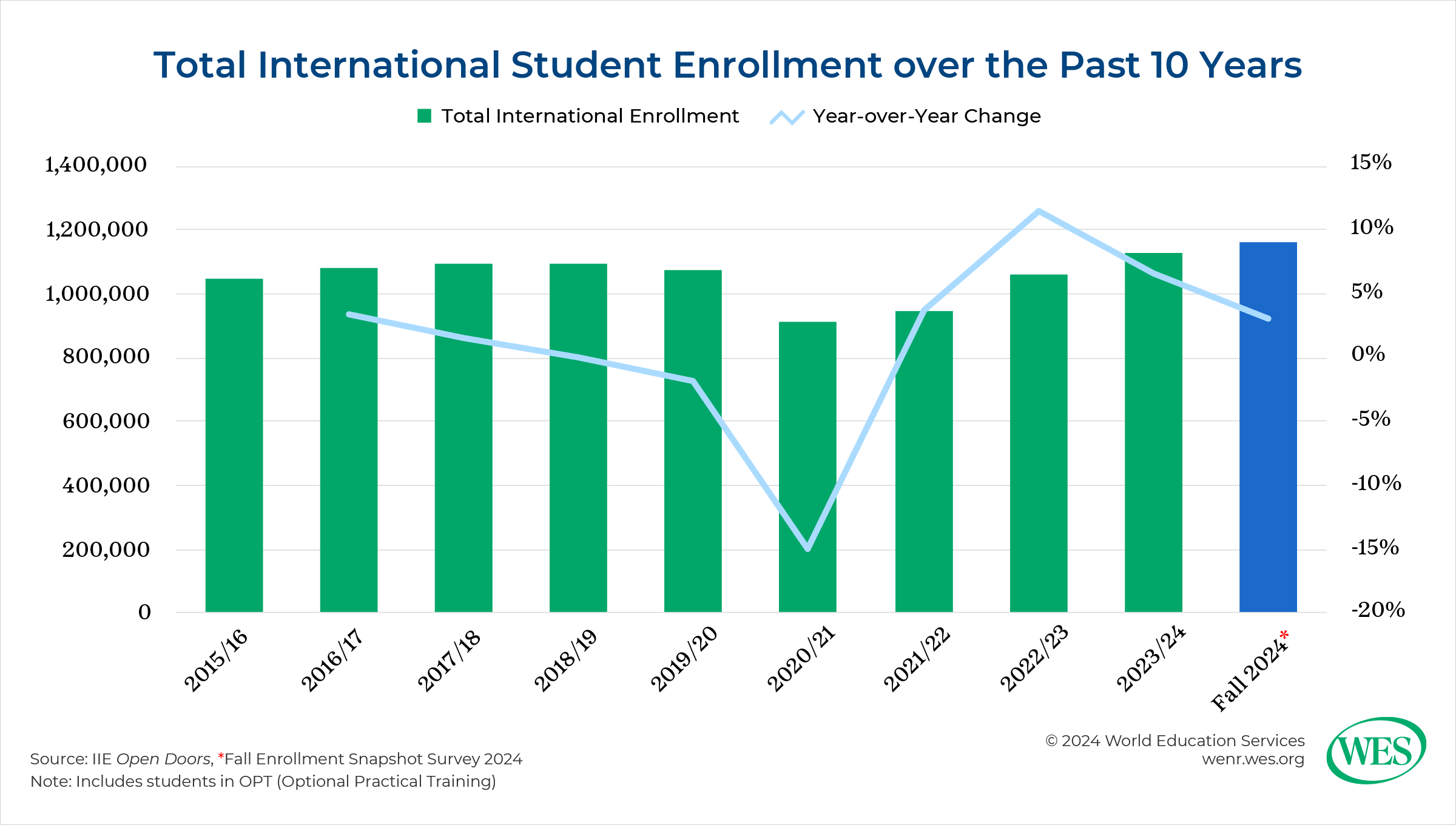
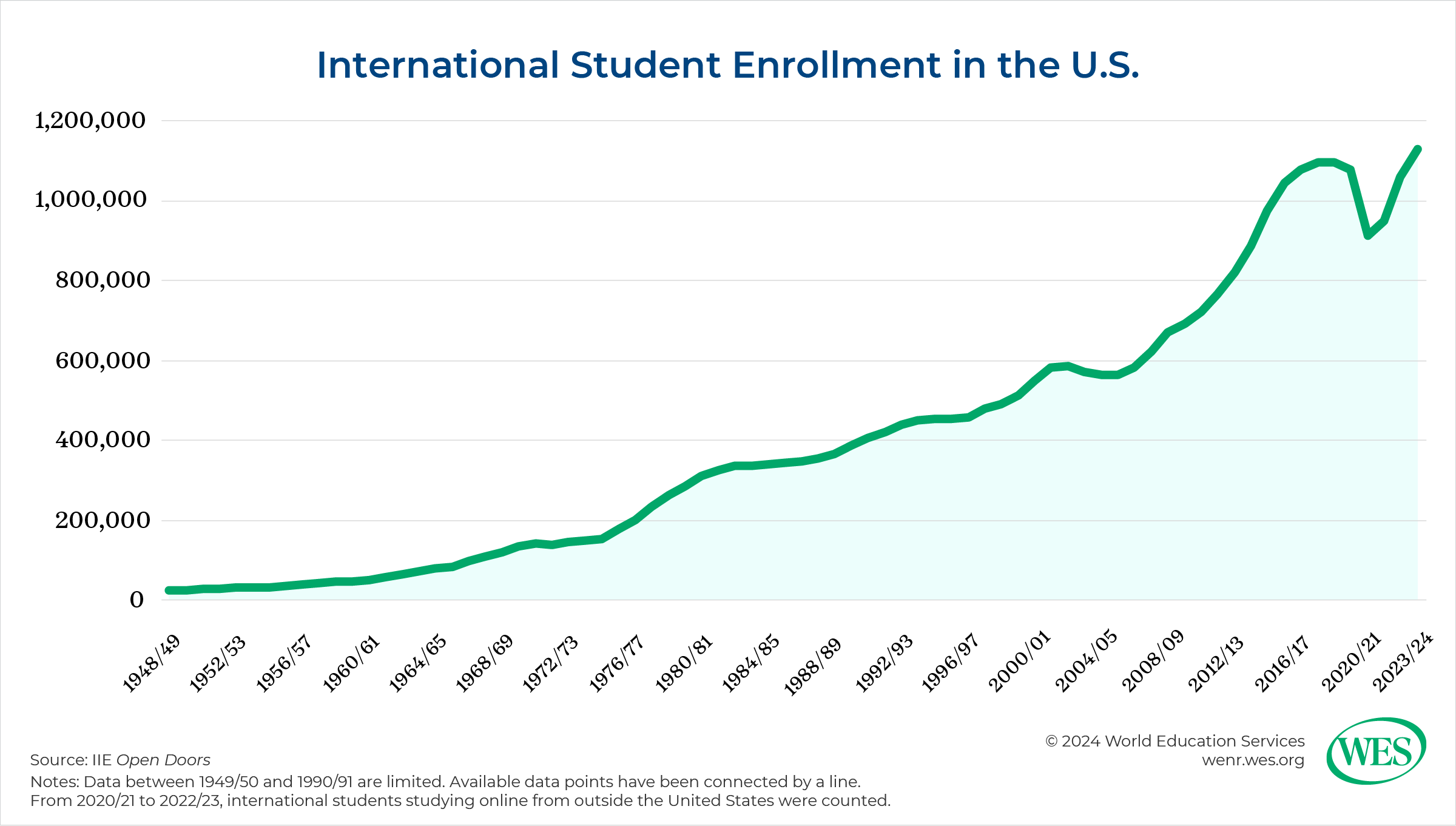
Total international student enrollment in the U.S. hit an all-time high of 1,126,690 in 2023–24, a growth rate of 6.6 percent from the previous year. This has followed a few years of recovery following the dramatic enrollment decrease during the COVID-19 pandemic. The post-pandemic growth rate peaked in 2022-23 at 11.5 percent.
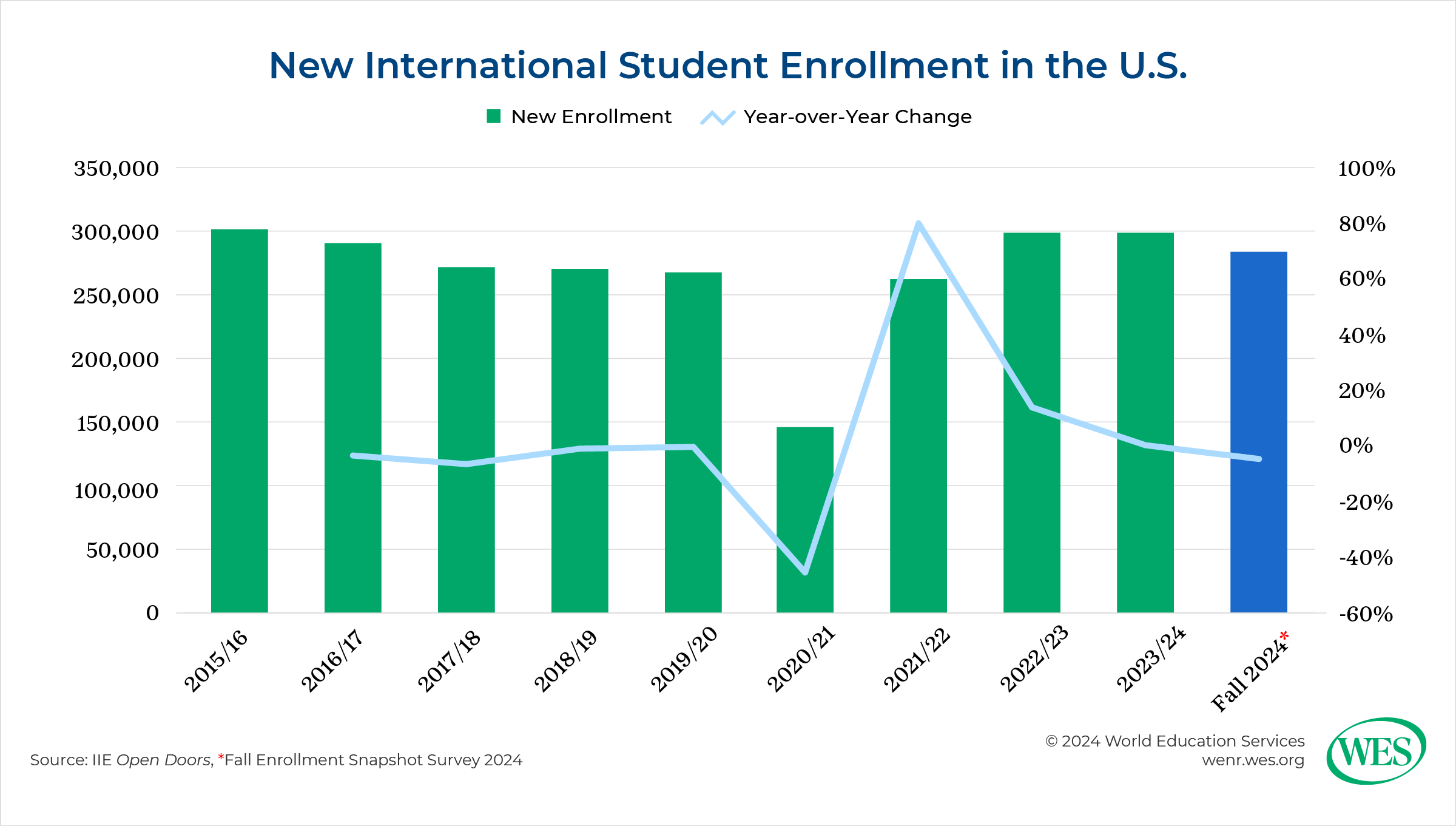
However, growth is slowing. While this year’s Fall Snapshot Survey indicates a 3 percent growth rate in fall 2024, analysis of the SEVIS data indicates a drop in overall enrollment. International enrollment is down to 1,091,190 students in November 2024, a 10 percent decrease from the previous November, according to SEVIS records.[5] IIE’s data confirms slowing growth, too. New international student enrollment slowed to only 0.1 percent in 2023-24. Additionally, the Fall Snapshot Survey indicates a 5 percent decrease in new students this fall.
This recent slowdown, which happened prior to the presidential election results, is tricky to diagnose. One likely culprit, though certainly not the only one, is economics: An education in the U.S. has become particularly expensive, due largely to a combination of inflation and a strong U.S. dollar. A more expensive U.S. education particularly impacts many students from South Asia and sub-Saharan Africa, the two regions showing the strongest rise in U.S. international enrollment in recent years, who are particularly price sensitive.
Changing trends in South Asia and East Asia
International enrollments in the U.S. from South Asia, driven dominantly by India, continued growing at a rapid rate in 2023–24. In 2023–24, India became the top country of origin among international students in the U.S. and by a substantial margin, at 331, 602 students. There was about a 23 percent increase in Indian students from the previous year, accounting for almost 30 percent of all international students in the U.S.
In 2023-24, South Asia firmly dominated among regions of origin for U.S. international students and its numbers continue to rise. South and Central Asia (which IIE groups together as one[6]) account for one-third (34.3 percent) of all U.S. international students, just ahead of East Asia. South and Central Asia’s sending numbers grew 22 percent over the last year, more than those of any other region. Beyond India, there continues to be robust enrollment growth from Bangladesh (26 percent), Nepal (11 percent), Sri Lanka (10 percent), and Pakistan (8 percent). Bangladesh and Nepal broke into the top 10 countries of origin in 2023-24.
By contrast, the number of Chinese students in the U.S. declined more than 4 percent to 277,398 during the same period and accounted for less than 25 percent of all U.S. international students. Overall, numbers from East Asia are declining steadily (by nearly 4 percent last academic year). Numbers from South Korea (-2 percent) and Japan (-13 percent) continued to drop. The one bright spot among major East Asian nations was Taiwan, which saw a 6 percent rise from the previous year and was the fifth largest sending country. Students from East Asia have been decreasing in the last few years, and forecasts suggest further steady decline.
For many East Asian students, the calculus about studying in the U.S. and in Western countries has changed in recent years. Holding a degree from a highly ranked U.S. or Western institution holds less cachet than it once did. In both China and South Korea, local universities have become more prestigious and offer students the opportunity to connect directly with the local job market, putting those studying far afield at a disadvantage. For Chinese students, geopolitical tensions and strict policies against Chinese students and scholars largely enacted by the first Trump Administration, many of which were continued by the Biden Administration, may make studying in the U.S. feel riskier. There has also been growing intra-regional mobility, with many East Asian students choosing to go to another country in the region. According to the British Council, for example, there are more Japanese students in China than in any anglophone country.
Despite the recent increases in enrollment from South Asia, the SEVIS data show a rapid reversal of trends heading in Fall 2024. Indian enrollment in the U.S. this fall has declined by 24 percent, and overall South Asian enrollment has fallen at a similar rate. Meanwhile, Chinese and overall East Asian enrollment has flatlined, each with a barely perceptible decrease. As a result, however, China has become the top country of origin once again, with 263,523 students in the U.S., followed by India (25,5443), in Fall 2024. Likewise, East Asia has returned to the top spot among region of origin, with modest enrollment increases from Japan and South Korea.
A slowdown of enrollment growth from South Asia likely is attributable to rising costs in the U.S., particularly given currency exchange rates, as noted earlier. Safety, a frequent concern for Indian students and their families, could also be a factor. Many Indian media outlets, such as The Economic Times and The Indian Express, have recently reported on increasing safety issues for Indian students in the U.S.
That said, these declines from India and South Asia do not necessarily foretell a long-term trend. Many prominent models, notably that of HolonIQ, predict growth from India into 2030.
Graduate students continue to dominate. For now.
International student growth in the U.S. continues to be driven at the graduate level, particularly among master’s degree students. Graduate students made up almost 45 percent of all U.S. international enrollment in 2023-24. Total international student graduate enrollment increased by 7.6 percent in 2023-24, while undergraduate enrollment fell by 1.4 percent and non-degree enrollment fell by 11.5 percent. These trends are somewhat parallel with new international student enrollment. India has driven much of this growth in grad students, as have South and Central Asian students in general. More Chinese students came to study at the graduate level that year, too.
This growth of international graduate students does not appear to be holding into 2024-25, however. The Fall Snapshot Survey indicates a slight decrease of about 2 percent in international grad students this fall and an increase (6 percent) in international undergrad students. The SEVIS numbers show decreases for both, including a significant decrease of 15 percent among international grad students. (International undergrad enrollment declined by 3 percent.) However, international graduate enrollment is still greater than undergraduate enrollment currently.
The decrease in international graduate students appears to be driven by Indian students and South Asian students overall. Indian students account for about 40 percent of all U.S. international student graduate students, and 60 percent of Indian students in the U.S. are studying at the graduate level, according to Open Doors. Per the SEVIS data, Indian graduate enrollment in the U.S. declined by almost 26 percent in Fall 2024. Additionally, South and Central Asian and East Asian student together account for nearly three-quarters of all international graduate students. Chinese graduate enrollment in the U.S. decreased about 4 percent this fall, according to the data from SEVIS.
U.S. universities and colleges continue to focus heavily on India and to a lesser extent China for their international student recruitment, according to the Fall Snapshot Survey. India is the top country of focus for both graduate students (81 percent of respondents) and undergrads (65 percent). China was second top country of focus for grad students and third for undergrads (just after Vietnam). Given the volatility of enrollment from India and steady declines from China, U.S. institutions may wish to ensure diversity of countries from which they recruit.
What could impact international enrollment in the near future?
The Trump Administration
When it comes to potential impacts on international student enrollment in the U.S., a primary factor will be the incoming Trump administration. Donald Trump will take office with a decisive agenda, having campaigned and won with a tough-on-immigration stance. This stance seemed to resonate with many voters, along with concerns about the economy and inflation.
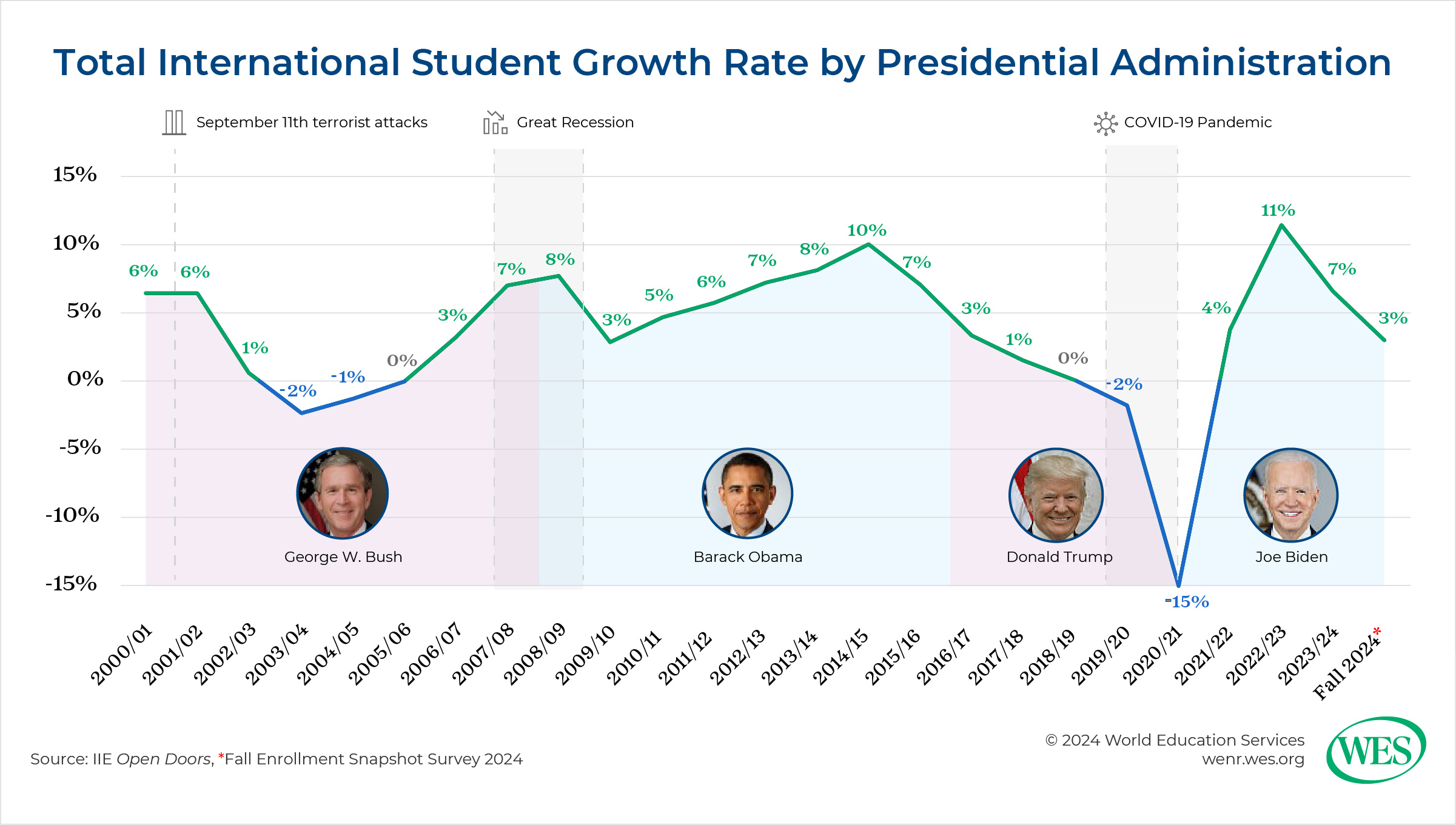
The first Trump administration may provide a useful look at what could happen in the second one. Trump’s first term brought a decline in international student enrollment, due in part to policies like the 2017 travel ban and a slowdown in visa processing. This trend reversed somewhat during the Biden administration but could resume under the policies of a second Trump term.
Going forward, much will depend on the incoming administration’s policies as well as rhetoric. Trump’s immigration agenda is mostly focused on asylum, primarily at the U.S.-Mexico border, and on undocumented immigrants, whom he has pledged to deport at unprecedented rates. The extent that he will focus on international students and immigrants with specialty occupations, notably the H1-B visa program under which some international students seek to remain in the U.S., is unclear. In June 2024, Trump, known for making offhand comments, proposed on a podcast hosted by Silicon Valley investors that international students who graduate from U.S. institutions, including community colleges, should receive a green card (permanent residency). He and his team later walked back that remark, and many commentators see such policy as highly unlikely given Trump’s overall immigration stance. In fact, reports suggest the administration is likely to limit pathways to H1-B visas, international students’ primary means of staying in the U.S. beyond Optional Practical Training (OPT), effectively making such visas virtually inaccessible.
Policy changes under Trump’s second administration could also affect OPT and “duration of status,” the length of time students with visas have been allowed to stay in the U.S. without needing to renew. Such changes were attempted in the first Trump administration but did not succeed. His first administration also tried to eliminate STEM OPT, the 24-month extension of OPT for those graduating with a degree in fields related to science, technology, engineering, or mathematics. Indian students in particular may be concerned about such changes if they are proposed again, as they are often drawn to the U.S. by opportunities to gain work experience. Toward the end of that term the administration also put forward a rule to limit duration of status to a finite period of two or four years, rather than allow the time needed to finish earning a degree, after which a student would be required to pay a fee and renew.
Still, it is possible to overestimate the attitudinal impact of a presidential administration, and recent survey research by Intead and Studyportals found a majority of prospective international students this fall were “indifferent” to the election outcome and how it might affect their plans to study in the U.S., according to The PIE News. There is certainly no monolithic view of President-elect Trump or U.S. politics among international students. If any declines in numbers happen again under Trump, it will likely be in response to policies that specifically impact international students or rhetoric aimed at individuals from their home country or region of origin. It may also be driven in part by visa delays and denials caused by administration policies.
Policies and politics in other major host countries
One other major factor is current policy changes in other major host countries, driven largely by politics and public opinion, which might actually boost the attractiveness of the U.S. The other three Big Four predominantly anglophone destinations—Australia, Canada, and the United Kingdom—have had massive international student enrollment in recent years, particularly as a percentage of total higher education enrollment. According to IIE’s Project Atlas, Canada’s international enrollment rate in 2023 was 30 percent, Australia’s was 24 percent, and the U.K.’s was 22 percent. (By contrast, only 6 percent of U.S. higher education students were international, although overall size of its system makes the U.S. numerically the top enroller of international students.) Canada’s enrollment in particular has seen explosive growth, a rise of nearly 70 percent from 2019 to 2023. Many Canadian locales have struggled to accommodate such an influx, often viewed as a way to fill provincial funding gaps yet sometimes lacking steps to ensure students’ well-being.
Additionally, international students have been ensnared in broader immigration debates within these three countries, often being unfairly blamed for systemic housing and employment challenges, among other issues. As in the U.S., immigration has been a major political topic in many Western countries and in recent elections in France and the U.K.
As a result, the other three Big Four countries have begun implementing policies designed to rein in international enrollment growth and limit access to opportunities to work and stay after graduation. Canada, which according to IIE’s recent Open Doors briefing just overtook the U.K. to become the second most popular international student destination, adopted new policies in rapid-fire succession from late 2023 to fall 2024. The most consequential is a cap on the number of study permits (required in Canada for international students) granted per province, particularly meant to limit growth in higher-enrollment provinces, in 2024 and 2025. Other new policies include a significant hike in the financial resources international students are required to demonstrate, restrictions on work permits for spouses, limits on permission to work during study, and stricter requirements for obtaining the popular post-graduation work permit (PGWP), which allows graduated students to work in Canada and often transition to permanent residency.
The Australian government is strongly considering similar caps on international student enrollment in an attempt to reduce overall migration to the country. Already it has stricter visa regulations for international students, including stronger “tests” to ensure that prospective students are coming with the intention of studying, not working, as well as a significant increase in the visa fee. In the U.K. a new regulation enacted by the Conservative Party prohibits international students at all levels except postgraduate from bringing family members starting in 2024, in order to “slash migration and curb abuse of the immigration system,” according to the U.K, government. The new Labour government has opted not to reverse the policy.
The effects of these changes are already evident. The three other Big Four countries are all seeing declining applications for relevant visas and permits. Preliminary analysis of Canadian study permit application data shows the number of approved study permits will likely come in below the actual caps for 2024. The U.K. reported a 16 percent drop in student visa applications in summer 2024 compared to the same time period in 2023, and in Australia, the decrease in such applications has been particularly steep, nearly 40 percent from October 2023 to August 2024.
So far, the prospective beneficiary of these changes has been the U.S., according to both prospective student surveys and media reports. For example, in IDP Education’s Emerging Futures Report for 2024, a prominent series based on prospective student survey data, the U.S. came in second place (at 23 percent) as destination of choice for survey takers, just behind Australia (24 percent). Interest in the U.S. increased four percentage points; Australia’s percentage point declined by one. By contrast, interest in the U.K. and Canada decreased 1 percent and 9 percent respectively, dropping them to third and fourth places. In media coverage of the restrictions, Indian outlets such as Business Standard and The Indian Express note that many Indian students are switching focus to the U.S, although some, including the Express, also report students are looking beyond the Big Four to other study destinations entirely.
Still, President-elect Trump may introduce cuts or caps of his own, which, depending on their scope, may cause the U.S. to lose its developing enrollment edge. If all Big Four destinations have policies significantly cutting student influx, that could alter the student mobility landscape, shifting enrollments to other countries—notably, smaller anglophone destinations such as Ireland, New Zealand, and Singapore and non-predominantly anglophone countries in continental Europe and Asia—where English-taught programs have increased greatly in recent years.
Student mobility in an uncertain world
The incoming Trump administration and policy changes in other countries are only two factors apt to impact movement to the U.S.; internal issues in other countries and regions also come into play. For example, while U.S. policies and tensions with China have affected the number of Chinese students coming to the U.S., factors within China also played a role, as we examined in a recent series in WENR.
Worldwide, uncertainty and systemic challenges lie ahead. Several major conflicts, notably Russia’s war in Ukraine and escalated fighting in the Middle East, threaten to spiral into bigger geopolitical crises. Authoritarianism is rising around the globe, creating more potential crises, as is the threat of climate change, with 2024 recently declared the hottest year on record. Among its many effects, climate change will likely continue spurring global migration, including, increasingly, the forcibly displaced. In fact, all these factors will likely increase global migration. Luckily, U.S. institutions are well-placed to take in students from affected regions and offer them pathways for academic and professional growth.
In general terms, there is reason for optimism. Global student migration will continue and most likely rise, increasing economic and social opportunities for many globally mobile young people. International students also benefit their host societies, communities, and institutions, including domestic students, by bringing diverse international perspectives as well as economic benefits. By some estimates, international students will increase worldwide from about 6 million in 2023 to 10 million in 2030. The U.S. could host as many as 2 million, a still significant capacity compared to other destinations.
Despite domestic and international pressures, U.S. institutions can continue to demonstrate the value of a U.S. education and what unique value they in particular offer. They can continue to make clear, through channels like the #youarewelcomehere campaign, that international students are both accepted and embraced. Institutions can continue to show that international education benefits not only students and institutions but communities and the nation. For example, huge numbers of U.S.-based entrepreneurs and STEM professionals came to the U.S. as international students and have been an asset for U.S. business and research and development. And international educators can advocate for policies at local, state, and federal levels (for example, via NAFSA: Association of International Educators) that continue to make the U.S. a hospitable place for students from abroad.
Most important, U.S. institutions can and should take proactive steps to ensure inclusion and integration of their international students. This means initial support in everything from securing good housing to culturally sensitive mental health resources to campus career services that recognize international students’ unique needs. It may mean assisting students with financing in any way possible. It also means more efforts toward academic and social integration, which involves educating faculty, staff, and domestic students as well.
Looking to the future, U.S. policymakers, educators, and institutions must work together to create an environment that remains welcoming, inclusive, and responsive to the needs of international students. By doing so, the U.S. can maintain its position as a global leader in higher education and continue to benefit from the diverse perspectives and talents that international students bring.
[1] Open Doors is an annual census of international students (those on a nonimmigrant student visa) enrollment in U.S. higher education institutions, as well as U.S. students who studied abroad two academic years prior.
[2] The Fall Snapshot Survey is sent to all institutions that report data to IIE for Open Doors. This year, IIE collected 693 valid responses.
[3]Open Doors always tracks data from the previous full academic year.
[4] The SEVIS data released by DHS is usually the most up-to-date data available. Open Doors, however, provides more analysis and a greater breakdown of data compared with what is provided by SEVIS.
[5] Usually, IIE’s Fall Snapshot Survey aligns with current data trends from SEVIS and is a strong predictor of numbers that appear in the following year’s Open Doors Report. This year, however, the data between the Fall Snapshot Survey and SEVIS are quite different, though both indicate slowing growth in international enrollment in the U.S.
[6] Central Asia, which includes mostly former Soviet republics in Asia (such as Kazakhstan and Uzbekistan), only accounts for about 1 percent of total enrollment from the overall South and Central Asia region, according to my analysis of IIE Open Doors data.