

Tag: drama

  • Top Challenges Inside the Classroom for Drama Teachers

    Top Challenges Inside the Classroom for Drama Teachers

    Investing in Arts Education

    Often a department of one, drama teachers must work proactively to find support networks and community resources that enable them to provide the best education possible.

    In late spring, 2006, I was faced with a quandary: How do you teach drama? I had just been assigned my first drama classes at North Hollywood High School, where I’d been teaching for two years, and although I had many thoughts about shows I might direct that would be a good fit for our student population, I had no idea what to include in day-to-day classroom curriculum. 

    This conundrum was unfortunately not new to me. I had just earned my teacher certification in the state of California as an English teacher through LAUSD’s District Intern Program. Never mind that I had never taken an English class in college — I passed the state exam for English language arts and that was sufficient for entry to the program. As a result, I leaned heavily on the expertise of teachers in the English department at North Hollywood for guidance on what to teach. I asked those colleagues what they were teaching to get insight into what materials and activities were successful with our students. However, when it came to drama, I’d be on my own. Although elements of drama pedagogy were incorporated into various graduate courses I’d taken while a student in NYU Steinhardt’s Program in Educational Theatre, I lacked a scaffolded approach to learning how to create a curriculum and no set community of drama teachers to turn to for support. 

    Just as I had experienced in the English department at North Hollywood, most teachers have the luxury of working with colleagues who teach the same content. Consider the math department, the social studies department, or the science department. But how many schools have a drama department? Some lucky few might find themselves within an arts department, but how similar are visual art teaching, music teaching, dance teaching, and drama teaching? Consequently, it is incumbent upon drama teachers to get out of the isolation of being a department-of-one and find a support network of trusted peers to whom they can turn when faced with the all-too-common question: “What now?” 

    Community support for drama and theater teachers

    Professional organizations like the American Alliance for Theatre and Education (AATE) and the Educational Theatre Association (EDTA) host annual conferences that provide theater educators with needed professional development and networking which are necessary resources for supporting classroom teachers. However, membership in these organizations is not free, and registration and travel to attend these annual conferences requires investment from school and district leadership to support teachers in their professional development.  

    The support drama teachers get from these organizations is essential at this political moment. In the press, a lot of attention is given to book banning across the country, but less so to censorship and restrictions in the arts. For the last five years, Qui Nguyen’s play “She Kills Monsters” regularly appears in EDTA’s annual survey of the top ten plays performed in schools, and yet the work has been met with calls for censorship and cancellation due to the play’s content. Other popular plays have faced a similar fate — be it Lorraine Hansberry’s “A Raisin in the Sun,” Moisés Kaufman and members of Tectonic Theatre Project’s “The Laramie Project,” Bert V. Royal’s “Dog Sees God: Confessions of a Teenage Blockhead,” or even works by William Shakespeare. 

    Through partnership with organizations like AATE and EDTA, teachers learn about initiatives to actively oppose efforts to restrict the arts, such as the No Book Bans Coalition, which advocates against theater bans; Dramatists Guild Legal Defense Fund, which has published “Dramatic Changes: A Toolkit for Producing Stage Works on College Campuses in Turbulent Times,” and provide legal support for producing scripted plays; and the National Coalition Against Censorship, who have published “The Show Must Go On: A Toolkit for Organizing Against Theatre Censorship in Public Schools.”

    Through participation in national organizations like AATE and EDTA, drama teachers are able to develop support networks across the country. In community and solidarity, drama teachers are able to develop skills to meet the needs of an ever-diversifying student population, improve classroom instruction, promote deeper arts learning, and respond to classroom and community challenges in turbulent times.

    Source link

  • This LSU law professor’s job has become a legal drama

    This LSU law professor’s job has become a legal drama

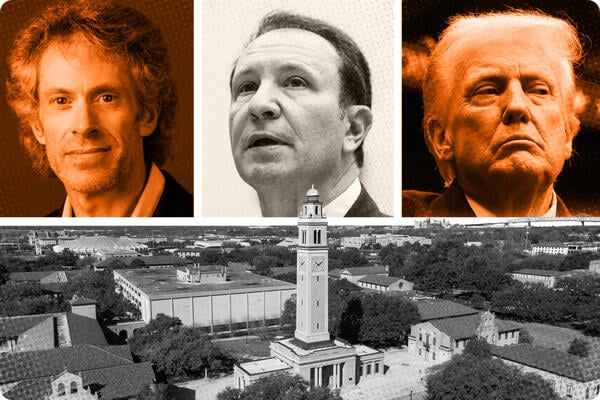
    In a Jan. 14 lecture, Ken Levy, Holt B. Harrison Distinguished Professor of Law at Louisiana State University, dropped f-bombs against then–president-elect Donald Trump and Louisiana governor Jeff Landry and told students who like Trump that they need his “political commentary.”

    Some students found the apparent attempt at political humor funny, according to an audio recording of the class obtained by Inside Higher Ed from a student who supports Levy.

    But at least one student in the administration of criminal justice class who subsequently complained, according to LSU, wasn’t amused—and neither were the university and the governor. An LSU spokesperson said the institution “took immediate action to remove Professor Levy from the classroom after complaints about the professor’s remarks.”

    Levy got a lawyer and took immediate action himself, pulling LSU into court instead of waiting for the university to take further steps internally regarding his job.

    In the month since that lecture, state district court judges have twice ruled that Levy should return to the classroom, only for a state appeals court to twice overrule that. The back-and-forth nature of the case has attracted attention in Louisiana and in law circles, including via headlines such as “The LSU Law School Professor Free Speech Hot Potato Saga Continues.”

    Landry also continues to discuss the case. A Republican governor who’s repeatedly inserted himself in LSU affairs, Landry used social media in the fall to call on the university to punish one of Levy’s law school colleagues for alleged in-class comments about Trump-supporting students. Landry has now repeatedly posted about Levy, recently saying an alleged exam he gave was incendiary and suggesting that “maybe it’s time to abolish tenure.”

    In and Out

    In the lecture in question, Levy referenced Landry’s previous criticism of his LSU colleague Nick Bryner, adding that he “would love to become a national celebrity [student laughter drowns out a moment of the recording] based on what I said in this class, like, ‘Fuck the governor!’”

    Levy also referenced Trump. “You probably heard I’m a big lefty, I’m a big Democrat, I was devastated by— I couldn’t believe that fucker won, and those of you who like him, I don’t give a shit, you’re already getting ready to say in your evaluations, ‘I don’t need his political commentary,’” Levy told students. “No, you need my political commentary, you above all others.”

    A few days after that lecture, LSU notified Levy he was suspended from teaching pending an investigation into student complaints, according to a letter from the university provided by Levy’s attorney, Jill Craft.

    On Jan. 28, Craft filed a request for a temporary restraining order against LSU to get Levy back in the classroom. The filing alleged that a student complained to the governor, not LSU, and calls were then made to LSU. A state district court judge granted the restraining order Jan. 30 without a hearing.

    In the first reversal, a panel of appellate judges wrote Feb. 4 that the lower court shouldn’t have approved the return-to-teaching part of the temporary restraining order without a full evidentiary hearing. But after the lower court held a two-day hearing last week, a different group of appellate judges overruled Levy’s return to teaching again—without explaining why.

    Local journalists who covered last week’s hearing reported that district court judge Tarvald Anthony Smith kicked an LSU deputy general counsel out of the courtroom because the lawyer told the law school dean, who was a scheduled and sequestered witness, about a student witness’s earlier testimony. The testimony was reportedly that the student had recorded a conversation with the dean.

    Smith ruled Feb. 11 that LSU policy required the university to keep Levy in class during the investigation of his comments, WBRZ reported. But a Feb. 4 statement from university spokesman Todd Woodward to Inside Higher Ed suggested the investigation was already over: “Our investigation found that Professor Levy created a classroom environment that was demeaning to students who do not hold his political view, threatening in terms of their grades and profane.” The university didn’t make anyone available for an interview about the case.

    Amid this legal back-and-forth, Landry continues to denounce Levy on social media. Last week, Landry posted on X an alleged exam from Levy that included potential sexual and other crimes committed by various fictitious individuals and asked students at the end to “discuss all potential crimes and defenses.” The narrative included a teen who put his penis into pumpkins on Halloween and was seen by trick-or-treating children, and a powerful Republican and suspected pedophile who invited the children inside to dance for him.

    “Disgusting and inexcusable behavior from Ken Levy,” Landry wrote on X regarding what he claimed was Levy’s test. “Deranged behavior like this has no place in our classrooms! If tenure protects a professor from this type of conduct, then maybe it’s time to abolish tenure.” Asked about this document, Craft said she believes the assignment was part of the sex crimes portion of Levy’s criminal law exam years ago, but she did not confirm it.

    After the latest appellate ruling in LSU’s favor, Landry wrote on X that “Levy should stay far, far away from any classroom in Louisiana!”

    Craft said Levy has received death threats on X due to Landry’s comments there. “This seems to be a situation entirely of the governor’s making,” she said. “He has been active on social media, trying to accuse my client of all kinds of bad things. He’s a lawyer himself. He attacked the courts and the judge.”

    Landry’s office didn’t respond to requests for comment.

    Craft also said Levy’s roughly 80 students remain with another 80 in another professor’s classroom.

    “I’m not sure how he can handle office hours for 160 law students,” Craft said of that second professor. The university says it’s doubled the number of student tutors for the course.

    No Longer the U.S.?

    Craft said Levy was set to return to the classroom Feb. 13, but Louisiana’s First Circuit Court of Appeal issued its two-sentence order around 9:30 a.m. that appeared to stay the part of the lower court’s order that returned Levy to teaching.

    LSU again kept Levy out of the classroom Tuesday, Craft said. But she said the rest of the lower court order remains in place, at least for now, and that prevents LSU from taking further employment action against Levy due to his expression.

    “This is a critical issue, and I feel like we have got to, as a nation, understand that there has to be academic freedom, there has to be free speech in this country, and there have to be protections against governmental intrusions without due process,” she said. “We take all that away and we are no longer the United States of America.”

    Source link

  • Curtain call on traditional time-intensive drama training

    Curtain call on traditional time-intensive drama training

    Recent closures of renowned actor training courses, including the Bristol Old Vic Theatre School’s undergraduate provision and the abrupt collapse of the Academy of Live and Recorded Arts, have laid bare a crisis in drama training. This isn’t only about funding shortfalls; it’s about the very structures and traditions of training, which risk shutting out those able to succeed.

    The financial strain on institutions is undeniable. The historical freeze in undergraduate tuition fees and the high-intensity delivery required in drama and other forms of intensive arts training like dance and music education have made traditional models almost unsustainable. Specialist institutions, unable to cross-subsidise, have stretched themselves to the limit – expanding course offerings, increasing intakes, internationalisation and growing postgraduate provision, where costs can be better covered. Meanwhile, government support through welcome specialist funding streams such as Institution Specific Funding have proven insufficient to address the root challenges.

    These efforts, while necessary, have unintended consequences. Over-speedy expansion creates great challenges for the quality of the learning experience, while institutional survival strategies rarely address the deeper, systemic issues at play. The question is not just how to survive in this increasingly precarious environment, but how to rethink the system entirely.

    The hidden barrier of time poverty

    The financial barriers to entering drama training are well-documented, but there is a more insidious form of exclusion that demands urgent attention: time-poverty.

    As highlighted in a recent Unipol and HEPI report, the average cost of student rent in London now exceeds the maximum maintenance loan, leaving students struggling to make ends meet. This financial reality forces many to take on part-time work, but the intensive nature of traditional actor training – 30-40 hours a week, often with irregular schedules – leaves little room for paid employment. The result? Only those who can afford not to work can afford to train.

    Traditional training models require high levels of physical presence and stamina. While these methods have been celebrated for their rigour, they exclude those with caring responsibilities, disabilities requiring time flexibility, or the need to support themselves financially. This isn’t just a financial issue – it’s a fundamental inequity in how time is valued in training.

    Addressing time-poverty isn’t about making marginal adjustments; it requires a paradigm shift. Drama schools must reimagine training models to prioritise accessibility and sustainability without compromising quality. Flexible delivery methods, guaranteed non-contact periods for work or rest, and rethinking the necessity of long, traditional schedules are all potential starting points. If we are to be equitable in the way almost all drama schools claim as a value, we must redesign what “intensity” in training means for excellent students who do not arrive with the economic means required. The current system is exclusionary.

    Some institutions are already leading the way. Identity School and Access All Areas have successfully adapted their training processes to accommodate a broader range of students. The Collective Acting Studio excels at balancing time pressures with rigorous training, redefining how intensity can be delivered. These organisations boast impressive alumni who are actively working successfully in the industry. Notably, Sally Ann Gritton, Principal of Mountview, emphasises in her book, The Independent Actor, that long, gruelling days are neither effective nor beneficial for students. These examples prove that change isn’t just possible – it’s essential if we want the arts to become more inclusive.

    Why it matters

    The stakes couldn’t be higher. The creative industries contribute over £100 billion to the UK economy annually, with drama training forming the backbone of the talent pipeline. Rose Bruford College alumna like Jessica Gunning, who recently won Emmy and Golden Globe awards, or Sara Huxley, whose work on Mr. Bates vs. the Post Office catalysed governmental action, exemplify the global impact of British arts education.

    However, the arts are more than an economic driver – they shape how we see ourselves, societal narratives, build empathy, and are key in defining our cultural identity. If access to training is restricted to the privileged, the stories we tell become narrower and less representative. Equity in the arts is not just an educational issue; it is a societal imperative.

    Nearly a decade ago, calls for greater class diversity in the arts sparked important conversations. In 2016, a report from the London School of Economics revealed that only 27 per cent of actors came from working-class backgrounds. While this discussion was absorbed into the broader issue of societal inequality, solutions remained vague and largely limited to the idea of increased funding. Today, with budgets tighter than ever, this approach feels increasingly out of reach.

    In recent years, established actors, including household names like Julie Walters and Christopher Eccleston have voiced concerns that they would no longer be able to afford the cost of training. Their warnings highlight a system where financial barriers stifle talent, despite the well-meaning calls for bursaries and other competitive financial support. The result? A cycle where potential is lost, and the arts grow less accessible.

    We need bold leadership across the sector. Institutions must collaborate to share best practice, experiment with alternative training models, and advocate for systemic support. There are innovative models, and we must deal with the friction preventing them from spreading. Policymakers and trainers must recognise that funding is only one part of the equation; addressing time-poverty is critical to ensuring a truly inclusive arts education.

    The arts are at their best when they reflect the richness of society. It’s time to move beyond tradition and reimagine drama training for a new generation—one where potential, not privilege, determines success.

    Anyone interested in being part of this conversation is welcome to contact the authors directly.

    Source link