

Tag: Dramatic

  • Houston, We Have A Problem* (Actually, no, Houston is one of a few places at least trying dramatic reform). – Eduwonk

    Houston, We Have A Problem* (Actually, no, Houston is one of a few places at least trying dramatic reform). – Eduwonk

    ICYMI – I wrote about Virginia ed politics here. About this week’s interagency agreements here. Nat Malkus, Rick Hess, and I discuss the goings on here on The Report Card.

    I was at a gathering recently, and a Silicon Valley person who had transitioned into education was talking about how he approaches personnel decisions—basically using data: replacing lowest-performers each year. Essentially, the idea is that it’s a coin flip, but if your selection process is genuinely reliable, the odds will be in your favor.

    A more traditional education person in the conversation had a host of questions—about support, counseling, and various other things.

    The exchange was fascinating to watch because they were talking past each other and quite literally didn’t understand one another or what was being said. It was a real Mars–Venus culture clash.

    We have to figure out how to talk the same language because we’re staring down a serious problem. The past few days have seen a flurry of articles from writers who are not traditional characters on the education beat. And they point up a culture clash that isn’t R and D, left or right—it’s more about who thinks we have a serious problem and who thinks the erosion of standards isn’t a big deal, or is acceptable in service of other goals.

    What these three recent stories have in common is stark takes calling attention to an issue that doesn’t get enough attention: it’s not only poor, Black, or Hispanic students struggling in schools. Subpar learning is widespread.

    Andrew Rice wrote about the situation in tony Montclair, New Jersey, for New York Magazine.

    Via New York Magazine

    At The Argument Kelsey Piper dug into the UCSD math issue, which is hardly only a problem at UCSD or in California.

    Via The Argument

    She followed it up with a look at what this is actually about and why, despite howls of protest from people who are OK with the status quo, no one is saying everyone will be an engineer, we’re talking about pretty low-level skills that can be universal. And what no one seems to be talking about is the skilled part of skilled trades, you have to be able to do math to be successful if you chose to do something besides college. Actually more. Technical jobs require more math than sociology.

    Want Eduwonk.com in your inbox via Substack?   Sign up for free here.

    This is the kind of math we’re talking about at the 8th-grade level. If you’re not able to do this you’re going to struggle in the skilled trades or higher education.

    Via NAGB

    Where does it all lead? Rose Horowitch dug into that for The Atlantic.

    All three articles are worth reading, and all three point up a real problem whether you approach it from the vantage point of personal agency, freedom, and choice—or American competitiveness.

    The only thing missing? Political traction to address it in too many places. As Tom Kane notes in the New York Magazine article:

    What’s stunning is just how much professionals tolerate—and, in some cases, contribute to—obfuscation as a matter of course. We’ve discredited measurement, transparency, and the idea that performance matters, and we’ve baked it into the political price.

    Perhaps that’s why political traction for such an obvious, and real, problem is so elusive?

    *That’s a misquote. The actual statement from the damaged Apollo 13 was, “we’ve had a problem.” You can listen here.

    Friday Fish Porn

    Here’s Bellwether’s managing partner Rebecca Goldberg with a nice one in the Roaring Fork Valley of Colorado (from a few weeks ago when it was warmer, if you missed the context clues). Good time to point you toward Bellwether’s new strategic plan for the next several years, learn more here.

    This picture is part of this one of a kind archive with hundreds of pictures of education types and their relatives with fish from rivers, lakes, and streams all over the world. Send me yours.

    Want Eduwonk.com in your inbox via Substack?   Sign up for free here.
    Source link

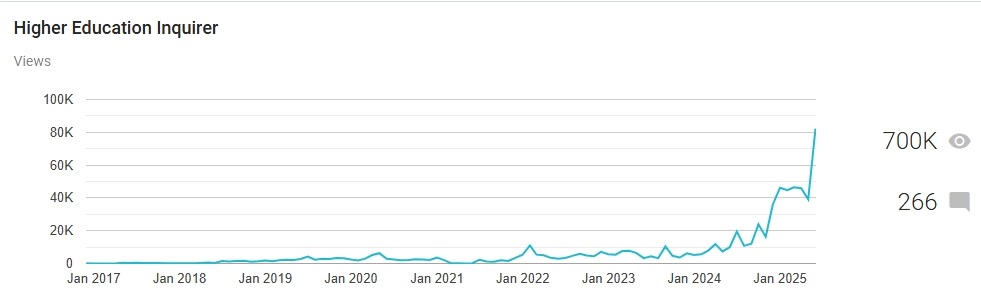
  • The Higher Education Inquirer’s Dramatic Rise in Viewership

    The Higher Education Inquirer’s Dramatic Rise in Viewership

    The Higher Education Inquirer has experienced a dramatic surge in readership in recent months, defying the odds in a media ecosystem dominated by corporate influence, algorithmic manipulation, and declining public trust. Without the benefit of advertising dollars, search engine optimization tactics, or institutional backing, the Inquirer has built an expanding audience on the strength of its investigative rigor, academic credibility, and fearless confrontation of power in higher education.

    The Inquirer’s success lies in its refusal to chase headlines or appease stakeholders. Instead, it examines the underlying systems that have shaped the American higher education crisis—escalating student debt, the exploitation of adjunct faculty, administrative overreach, the encroachment of private equity, and the weakening of regulatory oversight. Its reporting draws directly from primary source documents: internal university records, SEC filings, FOIA requests, and government data from the U.S. Department of Education, Department of Veterans Affairs, and other public institutions. Readers trust the Higher Education Inquirer not simply because it is independent, but because it is evidence-based and relentlessly honest.

    This journalistic integrity has attracted a diverse and influential group of contributors whose work amplifies the publication’s reach and credibility. Among them is David Halperin, an attorney, journalist, and watchdog who has long held the for-profit college industry accountable. Halperin’s sharp investigative writing has helped shape federal policy, inform regulatory action, and expose the inner workings of a powerful, often unregulated sector of higher education.

    Other essential contributors include Henry Giroux, whose writing connects neoliberalism, authoritarianism, and education policy; Bryan Alexander, who offers foresight into technological and demographic changes shaping the future of academia; and Michael Hainline, who combines investigative rigor with grassroots activism. Together, these voices reflect a commitment to intellectual diversity grounded in a shared mission: to make sense of a higher education system in crisis, and to imagine alternatives.

    HEI’s timing could not be more significant. As student loan debt hits historic levels, public confidence in higher education erodes, and international students reassess their futures in the United States, people are seeking answers—and not from the usual pundits or PR firms. They’re turning to sources like the Inquirer that offer clarity, accountability, and a refusal to look away from injustice.

    With more than 700 articles and videos in its growing archive, the Inquirer has become a vital resource for researchers, journalists, educators, and activists alike. And unlike many mainstream outlets, it remains open-access, free of paywalls and advertising clutter. It encourages participation from readers through anonymous tips, public commentary, and shared research, building a collaborative community that extends beyond the screen.

    Last week, more than 30,000 readers visited the site—a significant number for an independent, ad-free platform. But more than numbers, this growth signals a shift in how people consume and value journalism. It shows that there is a real appetite for media that holds power accountable, that prioritizes substance over spectacle, and that dares to tell the truth even when it’s inconvenient.

    The Higher Education Inquirer is not chasing influence—it’s earning it. Through fearless reporting, scholarly insight, and a commitment to justice, it has become a trusted voice in the fight to reclaim higher education as a public good. And with its core group of contributors continuing to inform and inspire, the Inquirer is poised to grow even further, serving as a beacon for those who believe that education—and journalism—should serve the people, not the powerful.

    Source link