The coalition of states, led by California’s attorney general Rob Bonta, has argued Trump’s September proclamation bypasses required rulemaking procedures and exceeds the authority of the President’s executive branch.
They said the fee violates federal law which allows immigration authorities to collect only necessary fees to cover the cost of administering visa processes.
“The Trump administration thinks it can raise costs on a whim, but the law says otherwise,” declared Bonta on December 12.
“We are going to court to defend California’s residents and their access to the world-class universities, schools, and hospitals that make Californians proud to call this state home,” he said.
The plaintiffs argued the $100,000 fee required for certain H-1B petitions would put “unnecessary” and “illegal” financial burdens on public employers and providers of vital services, exacerbating labour shortages in key sectors.
The lawsuit filed last week in a federal court in Boston is the third to challenge Trump’s September 19 proclamation raising the cost of an H-1B visa petition to $100,000 – over 20 times the current cost which ranges between $2,000 and $5,000.
The H-1B visa enables US employers to temporarily hire international workers in “specialty occupations” from healthcare to computer science and financial analysis. California’s tech industry is particularly reliant on the visa stream.
A month after the initial proclamation, the administration clarified the controversial fee would not apply to international students and other visa holders changing status in the country – an update that commentators say will cause US companies to lean heavily into hiring US trained international students.
The White House previously said the fee would combat the “large-scale abuse” of the program which was replacing American workers and undermining the country’s economic and national security.
The Trump Administration thinks it can raise costs on a whim, but the law says otherwise
Rob Bonta, California Attorney General
The states bringing the lawsuit are Arizona, California, Colorado, Connecticut, Delaware, Hawaii, Illinois, Maryland, Massachusetts, Michigan, Minnesota, Nevada, New Jersey, New York, North Carolina, Oregon, Rhode Island, Vermont, Washington, and Wisconsin.
Their legal action follows the US Chamber of Commerce bringing a case against the Department of Homeland Security (DHS), and an earlier case, Global Nurse Force v. Trump, challenging the policy on similar grounds to the most recent suit.
Plaintiffs in the Chamber of Commerce lawsuit are seeking a preliminary injunction that would temporarily ban the fee being imposed while the legality of the proclamation is litigated. A district court hearing is due to be held today (December 19) on the injunction.
In addition to the fee hike, businesses and prospective employers are keeping a close eye on government plans to overhaul the H-1B system in favour of higher wage earners.
A change of this sort is likely to have wide-reaching implications for global talent flows to the US, with over half of postgraduate students indicating in a recent survey that they wouldn’t have enrolled at US institutions if access to H-1B was determined by wage levels.
This audio is auto-generated. Please let us know if you have feedback.
Faculty groups and employee unions are urging universities to reject a proposed compact from the Trump administration that would trade control over their policies for preferential access to federal research funding.
Of the nine colleges that received the offer, at least two faculty senates — the University of Virginia and the University of Arizona — voted to oppose the deal and pushed their institution’s leadership to reject it. Other instructors and employee groups have also decried the compact.
Leaders at the colleges have thus far issued mostly noncommittal responses, with none publicly announcing they would decline the deal as of Wednesday afternoon.
Along with UVA and the University of Arizona, the Trump administration sent the compact to Brown University, Dartmouth College, the Massachusetts Institute of Technology, the University of Texas at Austin, the University of Pennsylvania, the University of Southern California and Vanderbilt University.It gave the institutions until Oct. 20 to respond with feedback and up to Nov. 21 to sign.
Faculty groups weigh in
At a Monday meeting, the University of Arizona’s faculty senate approved a resolution opposing the compact in a 40-8 vote, with one member abstaining.
The resolution called the compact a danger to “the independence, excellence, and integrity” of the institution and the constitutional rights of the campus community.
“Others wiser than I have called it recently a trap, a poisoned apple,” Faculty Chair Leila Hudson said before the vote. “Federal funds are not a drug that we need a quick fix of to be forever extortable.”
Hundreds of miles east, faculty at the University of Virginia similarly rebuked the Trump administration’s proposal.
The UVA faculty senate on Friday, in a 60-2 vote with 4 abstentions, approved a resolution whose preamble called the compact a danger to the university that runs antithetical to its mission and traditions. It also said the deal “likely violates state and federal law.”
At least one law firm, Ropes & Gray, has said the compact raises legal questions, adding that it “does not explain the statutory or other basis that authorizes the Administration to give preferential access to federal programs.”
The law firm also said the compact used vague and broad language and doesn’t explain key elements of the proposal. For instance, it threatens to strip federal funding from institutions that sign and then violate its terms — but it doesn’t explain which dollars could be revoked.
“Would all federal benefits — research dollars and beyond — be affected by an instance of non-compliance, or would only those additional or new federal benefits that have accrued as a result of the institution having signed onto this Compact (the scope of which is unclear as well) be affected?” it posited in a Wednesday analysis.
A second round of deals?
Two of the institutions that received the offer — Penn and Brown — have previously struck deals with the Trump administration.
Penn President J. Larry Jameson said Sunday that he would seek input on the compact from the campus community, including Penn’s trustees and faculty senate.
“The long-standing partnership with the federal government in both education and research has yielded tremendous benefits for our nation. Penn seeks no special consideration,” he said in a statement.
Jameson added that he would keep five factors front of mind: “freedom of inquiry and thought, free expression, non-discrimination, adherence to American laws and the Constitution of the United States, and our own governance.”
In March, the Trump administration suspended $175 million of Penn’s research funding over its prior policy permitting transgender women to compete in women’s sports.The U.S. Department of Education formally alleged in April that the university’s policies had violated Title IX, a law banning sex-based discrimination at federally funded institutions.
In July, Penn struck a deal with the Trump administration. The university agreed to follow the administration’s new interpretation of Title IX, revoke swimming titles and awards that had previously been won by transgender women, and write personalized apology letters to impacted cisgender athletes who were on the women’s swimming team.
Among other things, agreeing to this compact would restrict university employees from speaking out on political issues, limit the enrollment of foreign students, and once again require the university to essentially deny the existence of transgender students.
Steven Brown
Executive Director, American Civil Liberties Union of Rhode Island
Following Jameson’s response this week, a petition opposing the compact organized by two Penn employee unions garnered some 1,300 signatures as of Wednesday afternoon. The university’s American Association of University Professors chapter is also promoting an Oct. 17 campus rally to protest the compact.
Brown has thus far not issued a public statement on the proposed deal and did not respond to a request for comment Wednesday. But the American Civil Liberties Union of Rhode Island urged Brown President Christine Paxson to stand against the Trump administration.
“Among other things, agreeing to this compact would restrict university employees from speaking out on political issues, limit the enrollment of foreign students, and once again require the university to essentially deny the existence of transgender students,” Steven Brown, executive director of the group,said in an Oct. 3 letter. “The compact makes no serious attempt to hide its real intent.”
The civil rights organization drew parallels between the Trump administration’s latest proposal and Brown University’s settlement with the federal government in July. The university agreed to pay $50 million to state workforce development organizations and give the White House oversight of its admissionsin exchange for a restoration of federal funding frozen over claims related to antisemitism and other civil rights violations.
“We believe that your university’s previous capitulation has simply empowered and emboldened the Trump administration to demand more,” it said. “It is only by sending a clear, strong, and visible message that these attacks on the mission of higher education will not be tolerated that one can ever hope to stop them.”
‘A devil’s bargain’
Dartmouth President Sian Beilock issued a short statement about the compact on Oct. 3.
“I am deeply committed to Dartmouth’s academic mission and values and will always defend our fierce independence,” she said. “You have often heard me say that higher education is not perfect and that we can do better. At the same time, we will never compromise our academic freedom and our ability to govern ourselves.”
In a joint op-ed, two faculty members from Dartmouth and Vanderbilt called the compact “a devil’s bargain.”
“Any institution that yields to these broad and intrusive demands would give up its legal rights and would forever be subservient to the whims of the government,” wrote Vanderbilt professor Lisa Fazio and Dartmouth professor Brendan Nyhan. “If the Justice Department decides that a signatory violated the vague terms of the agreement, that university would be forced to return all federal money it received in that year — along with any private donations at donor request.”
Vanderbilt has not commented on the compact publicly, but President Daniel Diermeier told the student newspaper that the university is reviewing the offer.Diermeier has also previously aligned with some of the Trump administration’s higher education positions, such as supporting institutional neutrality.
An anti-compact petition organized by Vanderbilt Graduate Workers United had over 920 signatures, including from students, active and former employees, alumni and community members, as of Wednesday afternoon.
“This compact represents nothing other than a fascist takeover of higher education in the United States,” the petition said. “And we will not allow it to happen.”
The graduate workers union said it intends to deliver the petition in-person to the administration.
Nick Hillman, HEPI Director, bottles his thoughts about this year’s Labour Party Conference.
As multiple fringe events showed, when it comes to higher education the Labour Conference was very busy, with notably more vice-chancellors in attendance than in days of yore.
My Conference sojourn started on Saturday with a trip to Liverpool’s famous Cavern Club to watch the brilliant in-house Beatles tribute band. At the time, I mused about which fab-four song might best sum up the next few days. ‘Taxman’ perhaps?
(If you drive a car) I’ll tax the street
(If you try to sit) I’ll tax your seat
(If you get too cold) I’ll tax the heat
(If you take a walk) I’ll tax your feet
In fact, when it came to higher education, the big news was a giveaway rather than a new tax. I’ll always remember where I was when Margaret Thatcher resigned as Prime Minister (in the Manchester University Students’ Union shop). Perhaps education policy wonks will similarly always remember where they were when they heard maintenance grants were on their way back (albeit for a second time – they were last reintroduced in the mid-2000s before being abolished a decade later).
In my case, I was with dozens of others in a fascinating HEPI fringe event on students’ cost of living, chaired by my colleague Rose Stephenson and featuring Alex Stanley (NUS), Gavan Conlon (London Economics) and Nic Beech (University of Salford). This came hot on the heels of two other HEPI fringe events – one on public opinion and higher education featuring a bevy of vice-chancellors and another with Cambridge University Press and Assessment on ‘Quality Matters’.
It was no surprise the news about maintenance grants won a spontaneous round of applause. It reminded me of the cheer I got during a speech to the University of Derby in 2016, when I read out the breaking news that UKIP’s Leader had just stood down (‘Nigel Farage resigns’, the Guardian reported, ‘after “achieving political ambition”’).
In both instances, the initial reaction was premature. Brexit was not the end of Faragism and it quickly became clear in Liverpool that the return of maintenance grants is not quite what it first seemed either.
Access to our colleges and universities shouldn’t just be for a wealthy few.
That’s why I’m bringing back maintenance grants for those who need them most.
Labour is ambitious for all our young people, no matter their background. I’m putting our values into action.
Most people who have calculated the cost of reintroducing grants have assumed it would cost something in the region of £2 billion a year. However, Ministers plan to fund the new grants via the proposed levy on international students’ fees, which is expected to raise around £600 million. So entitlement to the new means-tested grants will, it turns out, be limited by students’ course choice. You will be quids in only if you are studying what the politicians want you to study.
As I noted at the King’s College London Policy Institute fringe meeting on Wednesday afternoon, funding the new grants from the new levy may seem like clever politics, at least inside Number 10 and the Treasury and also perhaps by anyone seeking election as the Labour Party’s Deputy Leader.
Students and vice-chancellors have been desperate for grants to return and rightly so – for the reasons why, see our recent report on a Minimum Income Standard for Students with TechnologyOne and Loughborough University. But the levy / tariff / tax on international students is hated by those same students and vice-chancellors, putting them in something of a bind when it comes to responding to the Government’s announcement.
Not only do international students typically come from countries that are poorer than the UK, but they are already subsidising UK research and the teaching of domestic students. Now they are expected to contribute towards the day-to-day living costs of poorer home students too (just so long as those UK students are studying courses deemed to be of most economic value). Just how broad do Ministers think international students’ shoulders are?
Many of them come from wealthy backgrounds but some do not have very deep pockets and none is obliged to study in the UK rather than elsewhere. So our higher education institutions are unlikely to be able to pass on the full 6% without seeing a drop in demand.
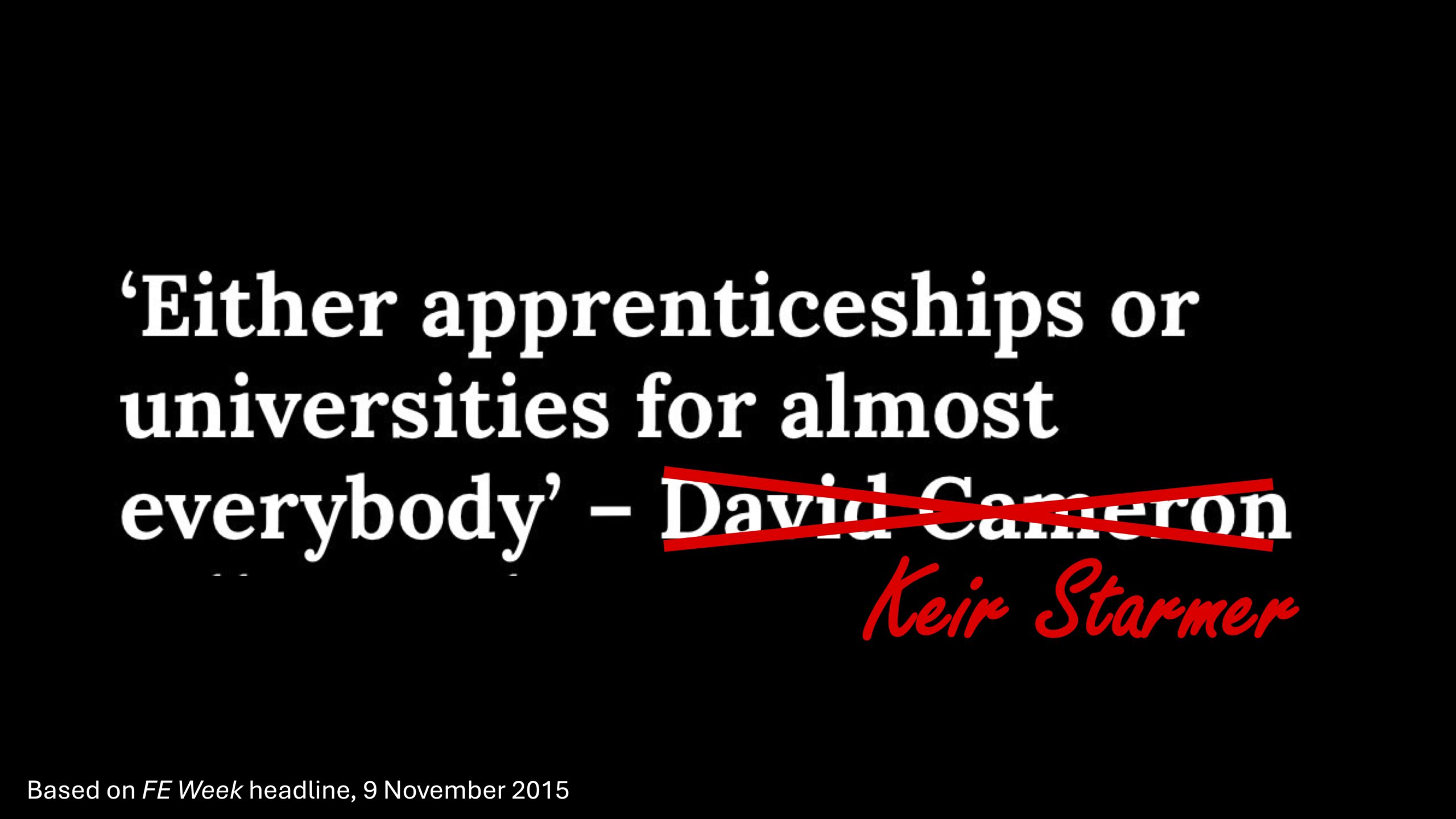
It was great to witness so many backbench Labour MPs, like Alex Sobel, Daniel Zeichner, Abtisam Mohamed and Dr Lauren Sullivan, advocating for UK universities across the conference fringe programme. But more generally, there were parts of the Conference that felt flat as well as parts that were presumably in line with what the organisers wanted – including the Leader’s big set-piece speech. Starmer’s big reveal was the rejection of the ancient 50% target for young people’s participation in higher education in preference for a new target ‘That two-thirds of our children should go either to university… Or take a gold standard apprenticeship.’
The Prime Minister would be unlikely to welcome the comparison but this reminded me of nothing so much as David Cameron’s pledges as Prime Minister. In 2013, for example, Cameron said: ‘I want us to have as a new norm the idea that in school, everybody, everyone who can, either takes that path on to university, or takes that path on to an apprenticeship. You should be doing one or the other.’
The challenge is not coming up with such commitments; it is delivering them. Fewer adults are doing apprenticeships now than when David Cameron spoke, despite the introduction of an Apprenticeship Levy. Perhaps Starmer can succeed where Cameron and his successors failed…
At the end of the Conference, I was left feeling the biggest omission compared to past Labour Conferences was a clear and broad narrative about His Majesty’s Official Opposition: the Conservative Party. If the choice facing the country really is between ‘division’ and ‘decency’, as Keir Starmer says, then might not the best way to defeat division be, as with Le Pen in France or the AfD in Germany, for centre-right and centre-left parties to act together?
If Tony Blair and William Hague can work together, surely this is not impossible? But – and this is a personal opinion only – I left Liverpool wondering if the main problem for today’s Labour leadership is that they have spent the last 15 years making such strong criticisms of their bedfellows in the mainstream centre of British politics that they are unable to admit they may now need to work with the centre-right to stave off their worst fears.
Then again, perhaps today’s Tory Party also cannot see that the opposite of division is not so much ‘decency’ (however much we might want that) as collaboration. We’ll find out for certain next week as the policy caravan moves across the north-west to Manchester for the Conservative Party Conference. Do come to HEPI’s event there if you can – it is outside the secure zone so no expensive pass is needed.
Carole Cox, HEPI’s Events and Communications Administrator (and HEPI’s biggest Beatles’s fan) explains why Liverpool is the perfect place for day-trippers and long-stayers.
The City of Liverpool has the biggest single collection of Grade One listed buildings than any other English city outside London and it was named the European Capital of Culture in 2008. A football mecca, it also boasts a plethora of museums, including the World Museum, the International Slavery Museum, the Museum of Liverpool, Tate Liverpool and the Merseyside Maritime Museum.
It is also an interestingly quirky place, which harbours some amazing public toilets (you read that right). For example, if you ever happen to drop into the Philharmonic Dining Rooms in the Georgian Quarter, feel free to admire the famous Grade I-listed urinals in their pink marble splendour.
And then, there is the deservedly famous Mersey Beat. Liverpool and The Beatles, these are words that go together well.* The Liverpudlian group are considered the best-selling band in music history, hailed as pioneers who revolutionised the music industry and popular culture.
In summary, Liverpool is a ‘blast’ in more ways than one: a city which does not shy away from its heritage, a city with so much to offer culturally, but also a windy city open to the strong maritime winds gusting from the docks. Which may be why the French translation of the 1964 Beatles film A Hard Day’s Night is Les Quatre Garçons Dans Le Vent, a French colloquial idiom for their growing popularity – which, when translated word-for-word, awkwardly reads as ‘the four boys in the wind’.
* ‘these are words that go together well’ are lyrics from the 1965 Beatles song Michelle (Lennon/McCartney).