Tag: Drops

  • Penny Schwinn Drops Out of the Running for Ed Department’s Deputy Role – The 74

    Penny Schwinn Drops Out of the Running for Ed Department’s Deputy Role – The 74

    Updated

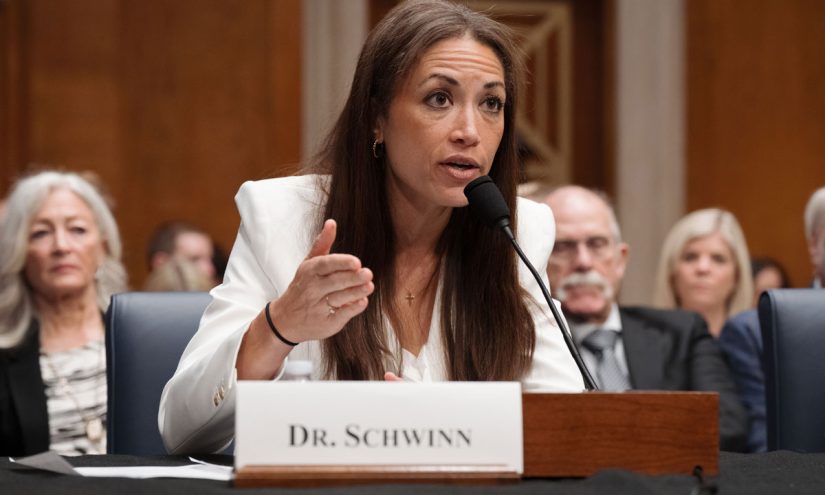
    Penny Schwinn, in line to serve as second in command of the U.S. Department of Education, has withdrawn from the nomination, Education Secretary Linda McMahon announced Thursday.

    Instead, the former Tennessee education commissioner will take on a different role for the department.

    “I am grateful to Dr. Schwinn for her commitment to serving students, families, and educators across the nation,” McMahon said in a statement. “Penny is a brilliant education mind and I look forward to continuing working with her as my chief strategist to make education great again.”

    Schwinn, in a statement, said she gave the decision “thoughtful consideration” and said she will  “remain committed to protecting kids, raising achievement and expanding opportunity  —  my lifelong mission and north star.”

    Considered a champion for improving reading outcomes and high-dosage tutoring, Schwinn was among President Donald Trump’s early picks for department posts. Many perceived her as a more bipartisan choice than others joining the administration, but among Tennessee conservatives, many who felt she was too liberal, opposition to her nomination was strong.

    The timing of Schwinn’s withdrawal couldn’t be worse, according to some conservatives. 

    “Her decision to remove herself from consideration to become deputy secretary hurts students, educators, and the Trump administration,” said Jim Blew, co-founder of the Defense of Freedom Institute, a think tank. “Secretary McMahon has been charged by Congress and the president with huge tasks under the One Big Beautiful Bill and several urgent executive orders.”

    As head of the Education Department, McMahon is striving to turn more authority over education to the states. It’s now unclear who will step into the deputy position and take the lead on the state’s requests for more flexibility over education funding. At least two states, Iowa and Oklahoma, have already submitted requests for block grants, and Indiana is currently gathering comments from the public in preparation for a similar proposal. Kirsten Baesler, North Dakota’s long-time education chief, is currently awaiting confirmation to be assistant secretary for elementary and secondary education at the department. In February, she joined 11 other GOP chiefs in asking McMahon for greater freedom to direct education funds toward state-level needs.

    Controversies and questions over Schwinn’s conservative qualifications have followed her for years. Far-right groups, including Moms for Liberty, said her past support for equity initiatives, like hiring more teachers of color, was evidence that she was not a good fit for an administration determined to eliminate such programs. Others remained angry over Schwinn’s pandemic-era plan to conduct “well-being” home visits. Even though she scrapped the plan, parents and members of the legislature considered it an example of government overreach.

    More recently, Steve Gill, a conservative commentator in Tennessee, reported that while she was deputy superintendent of the Texas Education Agency, Schwinn recommended individuals who advocate for comprehensive sex education, including abortion rights, to advise the state on health curriculum. 

    Gill told The 74 he shared his TriStar Daily article about her stance on these issues with Tennessee Sens. Marsha Blackburn and Bill Hagerty, as well as the state’s congressional delegation. Blackburn, who is expected to run for governor next year, was considered a possible no vote for Schwinn.

    According to Gill, Blackburn’s office “has been working tirelessly behind the scenes with the White House, Secretary Linda McMahon and Majority Leader [John] Thune to block the confirmation.”

    But Madi Biedermann, spokeswoman for the department, said the agency “strongly disagrees with that characterization.”

    Republican Sen. Marsha Blackburn from Tennessee was expected to vote no on Penny Schwinn’s confirmation. (Anna Moneymaker/Getty Images)

    Blew said it’s unfortunate that politics got in the way, noting that Schwinn’s experience in both blue and red states would have brought valuable expertise to the Ed Department role. In addition to her jobs in Tennessee and Texas, Schwinn founded a charter school in Sacramento and also served in the Delaware Department of Education.

    “It’s sad that a handful of demagogues are standing in the way of giving Secretary McMahon the team she needs to succeed,” he said.

    Others praised Schwinn’s record of prioritizing the science of reading in Tennessee schools and directing COVID relief funds toward tutoring.

    “This is a setback for all who want to see Washington slashing red tape, advancing literacy and fighting for common sense values,” said Rick Hess, director of education policy studies at the conservative American Enterprise Institute.

    For some critics, Schwinn’s business ventures since leaving the top spot in Tennessee two years ago raised questions as she waited to appear before the Senate education committee. 

    In June, a day ahead of her joint hearing with three other nominees, The 74 reported that shortly after Trump tapped her for the job, she registered a new education consulting business in Florida, New Horizon BluePrint Group, with a longtime colleague. Before Schwinn filed ethics paperwork with the federal government, her sister replaced her as a manager on the business. 

    When a reporter from The 74 asked questions about the new project, Donald Fennoy, her colleague and a former superintendent of the Palm Beach County School District, dissolved the business.

    Ethics experts say candidates for an administration post often distance themselves from new business entanglements to avoid any appearance of a conflict, but Schwinn has faced accusations of poor judgment before.

    While she was in Texas, the state agency signed a $4.4 million no-bid contract in 2017 with a software company where she had a “professional relationship” with a subcontractor, according to a state audit. And in Tennessee, the education agency made an $8 million deal in 2021 with TNTP, a teacher training organization where her husband Paul Schwinn was employed at the time. Lawmakers considered the deal a “huge conflict.

    “Ethics was a crucial concern,” said J.C. Bowman, executive director and CEO of Professional Educators of Tennessee, a non-union organization. He was among those who sent letters to the Senate, asking them to remove her from consideration. “Her personal business interests and possible conflicts could potentially influence educational decisions in ways that many found difficult to overlook.”

    Clarification: An earlier version of this story mischaracterized the role Penny Schwinn will take on in lieu of serving as the deputy education secretary. Schwinn will be taking on an advisory role at the Education Department.


    Get stories like these delivered straight to your inbox. Sign up for The 74 Newsletter

    Source link

  • Indiana’s College-Going Rate Drops Again, Dipping to 51.7% – The 74

    Indiana’s College-Going Rate Drops Again, Dipping to 51.7% – The 74


    Get stories like this delivered straight to your inbox. Sign up for The 74 Newsletter

    Fewer than 52% of Indiana high school graduates from the Class of 2023 went directly to college, according to the latest data quietly released by the Indiana Commission for Higher Education.

    That’s the state’s lowest rate in recent history and a continued decline from its previous plateau.

    Just 51.7% of 2023 graduates, about 39,000 students, enrolled in college within a year of finishing high school, data showed. That’s down from a steady 53% between 2020 and 2022, and far below the state’s peak of 65% a decade ago.

    Around 36% of all graduating seniors enrolled in one of Indiana’s public four-year institutions, followed by 8% who chose a private college or university.

    Another 7.6% went to a school outside of Indiana, according to the data.

    The figures, posted to the agency’s website earlier this month, reflect concerns state leaders have long expressed about Indiana’s declining college-going culture, especially as the state shifts focus toward career credentials and work-based learning.

    “The startling drop in our college-going rate yet again can be credited to the lack of two things: money and morale,” said Rep. Ed DeLaney, D-Indianapolis, in a statement released Wednesday.

    “While our governor has been taking a victory lap for getting our state universities to freeze tuition, he has failed to guarantee that his move will not decrease financial aid and scholarship opportunities,” DeLaney continued. “Any lack of opportunity for tuition support will lead to more Hoosiers not being able to afford college and being forced to choose a different path.”

    The 2023 numbers come just six months after the higher education commission approved sweeping changes to Indiana’s high school diploma, set to take effect statewide in 2029, that emphasize work-based learning and career readiness over traditional college preparation.

    High schoolers will be required to earn at least one “diploma seal” to graduate, including options for employment or postsecondary readiness. While some seal options are specifically geared toward college-bound students, graduates will no longer be required to complete all the coursework or meet other criteria typically expected for college admission.

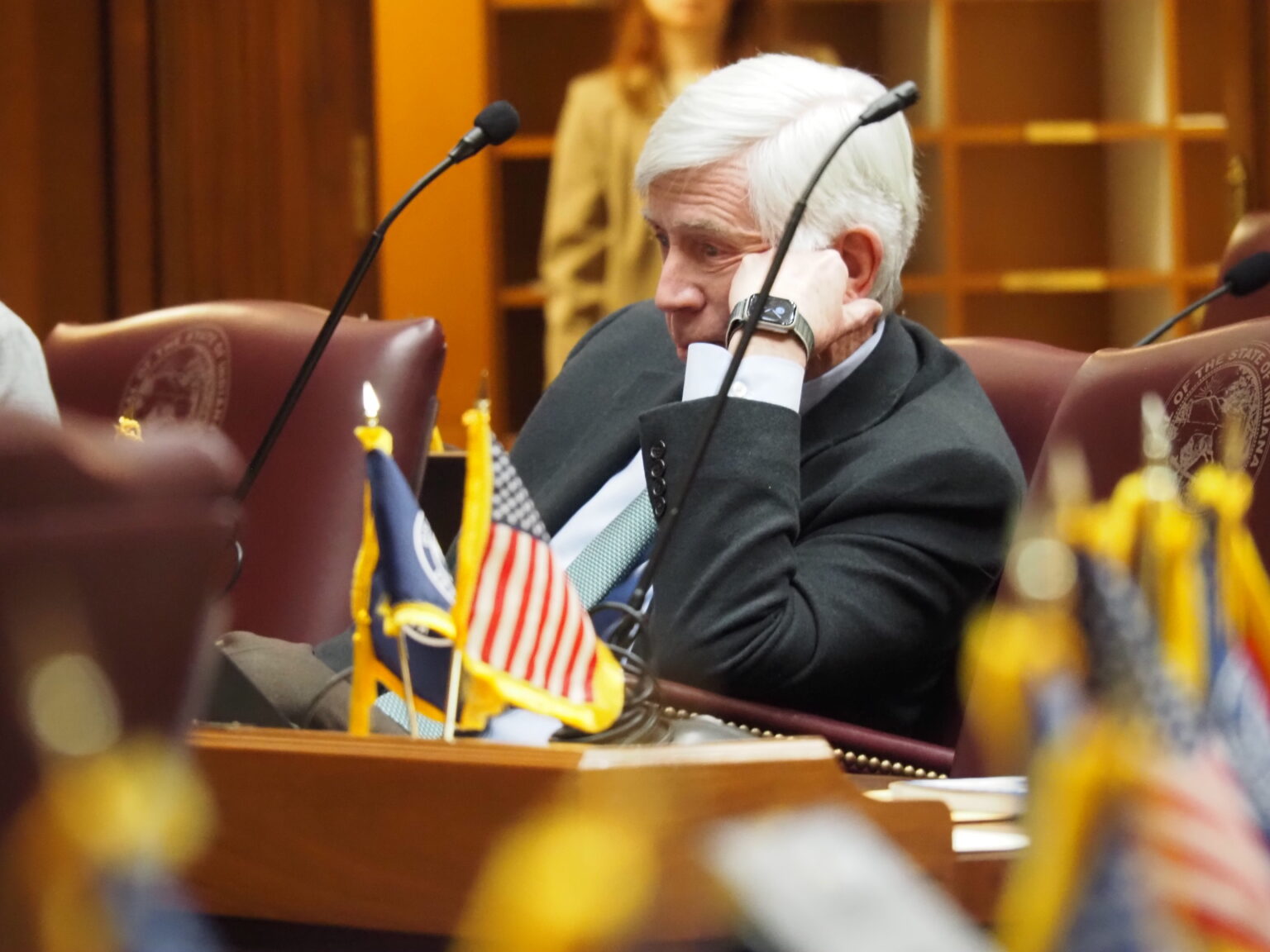
    Rep. Ed DeLaney, D-Indianapolis, sits in the House Education Committee on Wednesday, Feb. 12. (Casey Smith/Indiana Capital Chronicle)

    DeLaney maintained that Republican leaders “have been devaluing the opportunities that our colleges and universities can offer students.”

    “At the same time, the supermajority has made attacking colleges and universities the centerpiece of their culture war agenda — from policing what can be taught in the classroom, to forcing institutions to eliminate hundreds of degree options, to creating an entirely new high school diploma that emphasizes the path directly into the workforce,” the lawmaker said.

    “Trying to bury this report in a website and not send a press release is a telling sign that the Commission on Higher Education knows this does not look good, and does not act to fix it,” DeLaney added. “It simply isn’t important enough to them. They are busy eliminating college courses and creating new tests. This is what the legislature has asked them to do.”

    CHE has not issued a press release on the latest data and did not immediately respond to a request for comment Wednesday.

    Indiana’s college-going rate has dropped more than any other state tracked by the National Center for Education Statistics over the past 15 years.

    Previously, Indiana reached a college-going rate of 65%.

    “We set a goal to get it back when it slumped,” DeLaney recalled. “Now, it doesn’t seem like we care to address the issue. That is a shame for our students, a shame for our economy, and a shame for our state.”

    Earlier this year, Republican lawmakers passed additional legislation requiring public colleges to eliminate low-enrollment degree programs. So far, Indiana’s public colleges and universities have collectively cut or consolidated more than 400 academic degree programs.

    “The supermajority has been in power for 20 years and this is their achievement,” DeLaney said. “At some point we have to ask ourselves: is a declining college-going rate not the result they want?”

    By the numbers

    According to the numbers published on CHE’s online college-going dashboard, the vast majority of 2023 grads who continued their education earned some form of college credit while still in high school: 85.6% of college-goers took and passed an Advanced Placement exam; 64.6% earned dual credit; 90.7% earned the Indiana College Core diploma, which comes with a block of 30 general education credits that can be transferred to and accepted at colleges across the state; 86.3% earned as associate’s degree; and 63.6% earned another type of credential.

    A quarter of postsecondary enrollees, 25%, are seeking STEM-related degrees, while:

    • 17.8% enrolled in business and communications programs
    • 16% enrolled in health programs
    • 11% enrolled in social and behavioral sciences and human services programs
    • 9.9% enrolled in arts and humanities programs
    • 7.4% enrolled in trades programs
    • 5.8% enrolled in education programs
    • 7% were undecided

    College-going among male students dropped to 45%, compared to 59% for female students — widening an existing gender gap.

    Among racial groups, Asian and white students had the highest college-going rates, at 70.7% and 54%, respectively. The college-going rates among other racial groups lagged, though, at 45.5% for Black students, and 41.7% for Hispanic students.

    The rate for students from low-income backgrounds — as measured by eligibility for free or reduced lunch — was 38.7%, compared to about 60% for their higher-income peers.

    More than 78% of college-bound graduates from the 2023 cohort were part of Indiana’s 21st Century Scholars program, according the the new data. The scholarship fund covers full tuition and fees at Indiana colleges and universities for low-income students, who enroll in the 8th grade.

    Also previewed in the data was an update on the Class of 2022.

    The CHE dashboard showed 53% of the 2022 cohort that enrolled in a postsecondary program within a year after high school graduation met all three early college success benchmarks: ​​they did not need remediation; they completed all courses they attempted during their first year of enrollment; and they persisted to their second year of schooling.

    According to the latest numbers, 77.5% of the 2022 cohort that enrolled in a postsecondary program persisted to the second year.

    Indiana Capital Chronicle is part of States Newsroom, a nonprofit news network supported by grants and a coalition of donors as a 501c(3) public charity. Indiana Capital Chronicle maintains editorial independence. Contact Editor Niki Kelly for questions: [email protected].


    Get stories like these delivered straight to your inbox. Sign up for The 74 Newsletter

    Source link

  • Drops in International Student Tuition Could Pose Credit Risk

    Drops in International Student Tuition Could Pose Credit Risk

    Photo illustration by Justin Morrison/Inside Higher Ed | skynesher/E+/Getty Images

    Colleges and universities with a high percentage of international students face a credit risk as the federal government continues to target international students, according to a new report from Moody’s Ratings.

    Those most at risk include the 11 percent of American institutions where international students make up more than 20 percent of the student body, the ratings agency said, as well as institutions that are already struggling financially. (In total, 6 percent of students at U.S. institutions come from other countries.)

    “The reduction in international students presents a credit risk for universities heavily reliant on this demographic because of potential declines in tuition income, as international students typically pay full tuition fees,” the report states. “Additionally, with declining numbers of high school students over the next several years in the U.S. leading to fewer domestic students, universities intending to fill the gap with more international students may fall short.”

    The report follows the Trump administration’s months-long attack on immigrants and international students specifically, which began with the sudden removal of thousands of students from the Student Exchange and Visitor Information System, putting their legal status at risk. Since then, the administration has implemented a travel ban that includes 12 countries, prohibiting students from those countries from studying in the United States, and has targeted international students at Harvard University specifically, attempting to end the university’s ability to host international students. The State Department has also increased scrutiny into student visa applicants’ social media presences.

    It’s unclear as of yet how those factors will impact international enrollment in the fall. According to a recent report by the Institute of International Education, an approximately equal number of colleges and universities said they expected their international enrollment in the 2025–26 academic year to increase (32 percent), decrease (35 percent) and stay the same (32 percent) from this year’s numbers. But the percentage who expect a decrease was much higher than last year, when only 17 percent of institutions thought they might lose international students.

    The hit to the sector may not be as significant as it would be in countries like the United Kingdom and Australia, where about 25 percent of all students are international, Moody’s reported. Still, if the U.S. lost 15 percent of its international student population, a substantial number of colleges could experience at least moderate financial repercussions, according to one projection.

    About one in five colleges’ and universities’ EBIDA (earnings before interest, depreciation and amortization) margins would shrink by 0.5 to two percentage points, according to the ratings agency’s calculations.

    “For entities that already are under fiscal stress and have low EBIDA margins (the median EBIDA for private nonprofit colleges and universities was 11.7 percent in fiscal 2024 and 10.7 percent for publics), a change of one or two percentage points could push them into negative territory, especially if they are heavily discounting domestic tuition or losing enrollment because of demographic shifts,” according to the report. “Also, many small private schools may need to contend with federal changes to student loan and aid programs, further depressing domestic enrollment prospects and stressing budgets, especially for those with low liquidity.”

    The report stresses that this model does not account for any steps the institutions might take to mitigate those losses—especially at wealthier institutions. (Fifty-four percent of institutions with at least 15 percent international students are highly selective, while 25 percent are nonselective.)

    “Institutions that are highly selective, or those with considerable reserves, may better absorb the impacts by adjusting operations or increasing domestic enrollment,” it states. “Some elite institutions are less reliant on tuition, deriving income from endowments, fundraising or research, thereby mitigating the financial impact.”

    Source link

  • Stanford drops plan to buy Bay Area campus

    Stanford drops plan to buy Bay Area campus

    Stanford University backed off a plan, almost four years in the making, to buy the Notre Dame de Namur University campus in nearby Belmont, Calif., the San Francisco Chronicle reported.

    “The university arrived at this decision after evaluating many factors, some of which could not be anticipated when Stanford first entered into an option purchase agreement with NDNU almost four years ago,” Stanford officials wrote in a Tuesday statement announcing the decision.

    Officials added that as the university was “exploring possible academic uses for a Stanford Belmont campus,” it became clear “that identifying and establishing those uses for a potential Belmont campus will take significantly longer than we initially planned.”

    Administrators also seemed to hint at potential financial concerns, as President Donald Trump has sought—unsuccessfully, so far—to cap reimbursements for indirect research costs funded by the National Institutes of Health, which experts have warned will harm research universities. 

    “The landscape for research universities has changed considerably since Stanford entered into the option purchase agreement with NDNU,” Stanford officials wrote. “These changes are resulting in greater uncertainties and a different set of institutional and financial challenges for Stanford.”

    In their own statement, NDNU officials noted the university would continue to seek a buyer and expressed disappointment that the sale had fallen through.

    Notre Dame de Namur has sought to sell the Belmont campus near Palo Alto since it shrank its offerings and moved a number of its programs online in 2021 amid financial challenges that pushed it to the brink of closure. Now the private Roman Catholic institution is focused on graduate education and offers a mix of in-person, hybrid and online programs.

    Officials had expected the sale of the Belmont campus to provide a financial boon.

    “Our focus remains on finding a buyer who will preserve and honor the historical significance of this beautiful campus and continue to serve the community-oriented mission that has long been a cornerstone of Notre Dame de Namur University,” NDNU president Beth Martin wrote.

    Source link

  • STEM accreditor drops DEIA from its standards

    STEM accreditor drops DEIA from its standards

    The Accreditation Board for Engineering and Technology has dropped diversity, equity, inclusion and accessibility from its accreditation criteria and supporting documents, a move made in response to federal pushback on DEIA, according to an email obtained by Inside Higher Ed.

    “Recognizing the heightened scrutiny of higher education and accreditation—including recent directives and legislation in the United States—the ABET Board of Directors recently approved the removal of all references to diversity, equity, inclusion and accessibility (DEIA) from our accreditation criteria and supporting documents,” officials wrote in the email.

    ABET did not respond to a request for comment from Inside Higher Ed.

    The move comes as President Donald Trump has turned campaign trail rhetoric against DEI into policy, issuing an executive order early in his term that took aim at what the administration called “illegal” DEI initiatives without specifying what would violate federal civil rights laws.

    “These changes were made in response to the significant challenges many institutions, academic programs, and industry partners face in implementing and sustaining DEIA initiatives,” ABET officials wrote in the email announcing changes to their accreditation criteria.

    The accrediting body also appeared to delete the DEIA page on its website that was active until at least last week, according to an archived copy that is accessible via the Wayback Machine.

    ABET currently accredits programs at 930 colleges, according to its website.

    Source link

  • Dartmouth Men’s Basketball Team Drops Union Bid

    Dartmouth Men’s Basketball Team Drops Union Bid

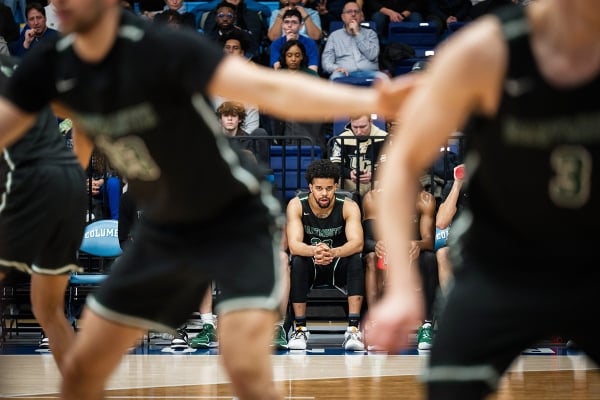
    The Dartmouth College men’s basketball team is dropping its historic bid to form a union, months after voting to do so. 

    The decision, announced Tuesday, comes as Republicans are poised to take control of the National Labor Relations Board, which could affect who is allowed to unionize on college campuses. A regional office of the board cleared the way earlier this year for the players to vote on the petition, ruling that the student-athletes were employees and thus allowed to unionize.

    Dartmouth disagreed with that opinion and refused to bargain with the team until the five-member NLRB ruled on the issue. Currently, the five-member panel has two vacancies, so incoming President Donald Trump could quickly reshape the board. In withdrawing the petition, the Service Employees International Union, Local 560, which represents the players, decided not to gamble with the new board and potentially risk a negative opinion.

    “By filing a request to withdraw our petition today, we seek to preserve the precedent set by this exceptional group of young people on the men’s varsity basketball team,” local president Chris Peck said in a statement to the Associated Press. “They have pushed the conversation on employment and collective bargaining in college sports forward and made history by being classified as employees, winning their union election 13-2, and becoming the first certified bargaining unit of college athletes in the country.”

    The Dartmouth team union threatened to upend college sports and added more urgency to the National Collegiate Athletic Association’s efforts to settle the question of whether student athletes are employees who can collectively bargain. The NCAA has lobbied Congress to pass a law affirming that college athletes aren’t employees. The incoming Congress seems likely to grant that request.

    Source link