Join our zero2eight Substack community for more discussion about the latest news in early care and education. Sign up now.
For months now, Shannon Hampson has had August 1 etched in her mind.
That day marks an important shift for her and other early care and education providers in Nebraska who serve low-income families. On that date, the state intended to begin paying providers a consistent rate for families who use government subsidies to pay for child care.
Instead of reimbursing providers based on children’s attendance — which can vary wildly, especially this time of year, based on factors like illness and family travel — Nebraska would pay providers the same amount each month based on enrollment.
Last year, because of the change expected to come in summer 2026, Hampson, who owns a home-based child care program in Lincoln, Nebraska, felt comfortable filling more of her program slots with children whose families pay with subsidies. Today, she does not have one private-paying family. She made the shift assuming the enrollment-based pay would insulate her from the instability that often accompanies subsidy slots.
“I was super excited to know more of these families were going to get that quality, consistent care,” Hampson said, adding that reaching more low-income families is important in the field. “It’s not that providers don’t want to.”
Now, though, that could all be about to change.
Nebraska’s transition to enrollment-based pay was part of an effort to get in compliance with a rule established by the Biden administration in 2024. Enrollment-based payments, that administration believed, would create greater predictability for providers, allowing them to serve more low-income families who need child care and, eventually, could entice more providers to participate in the subsidy program.
The rule was one of a handful of changes made by the prior administration related to the Child Care and Development Fund (CCDF), the primary federal program that states use to provide financial assistance to low-income families in need of child care. Other shifts include paying providers up front for child care, rather than reimbursing them the following month, and encouraging the use of grants and contracts with providers. State timelines for implementing these changes have varied. As of September 2025, 24 states were paying based on enrollment, according to an analysis by New America. For the others, the latest deadline granted was Aug. 1, 2026.
Just this week, however, the U.S. Department of Health and Human Services, through the Administration for Children and Families (ACF), announced that it would seek to rescind many of the 2024 rules, returning these issues to states.
The proposed changes cannot be enforced right away. Under federal law, the agency is required to take public comments, review them, and use that input to make final decisions, noted Alex Adams, who leads ACF. He declined to give a timeline for any changes to take effect.
If approved, the changes would not “make any net new policy decisions,” he added. “It simply goes back to where we were prior to 2024 regulations.”
The administration wants to rescind the 2024 rules, he said, because all 50 states had requested waivers related to some or all of these rules due to budget constraints and other implementation challenges.
“Any time 50 states are asking for a waiver from something,” Adams said, “it suggests to me that maybe the rule isn’t working as intended.”
He also noted that “attendance-verified payment,” rather than enrollment-based, “is more of a deterrent to fraud.” Leaders in the Trump administration are concerned about programs with “phantom attendance” — suggesting they receive government payments but don’t actually serve the children they say they do — Adams said, but he declined to share specifics of ongoing investigations.
Many early care and education advocates and policy experts have expressedskepticism that rampant fraud and abuse is going unchecked.
Casey Peeks, senior director of early childhood policy at the Center for American Progress, a left-leaning think tank, called the allegations “unfounded” and worried that they would undo real progress made in the field in recent years.
“It is very unhelpful and destabilizing to the sector, in the immediate- and long-term, to take some of these most foundational levers we have to stabilize the sector and claim that they result in fraud,” Peeks said.
Upon hearing the news this week, Hampson said she’s had to remind herself to “just breathe.” She knew she was taking a risk by enrolling 100% of families on subsidies.
Now, she said, she will have to rearrange her budget to continue to serve all of those families. Under an attendance-based pay structure, her income is just that much more volatile.
In December, for example, between holidays, vacation time and children’s absences, Hampson was only able to bill the state for 18 child care days. If the children in her program were from private-paying families, she would have been paid for 23 days, she said.
But Hampson’s operational costs didn’t see a material decrease in December.
“Without a provider being at fault at all, they could be at 50% attendance one day just because the flu is going around. That shouldn’t harm their bottom line,” Peeks said.
“It’s really unpredictable and unfair for the provider,” she added. “Just because attendance is down doesn’t mean operation costs go down.”
In West Virginia, where providers have been paid based on enrollment since 2020, Katelyn Vandal emphasized how critical the change has been to keeping her rural, center-based program open.
“Our mortgage payment doesn’t cost less because two kids in the classroom have the flu,” noted Vandal, director of A Place to Grow, a child care center in Oak Hill, West Virginia. Nor does her electricity bill and a host of other overhead costs.
If her state returns to attendance-based pay, she’s not sure A Place to Grow would be able to continue operating. The center serves about 100 kids, with 60% from families that pay with subsidies.
“We run such a fine budget line anyway that if, six months from now, we were going back to attendance, we would be looking at closing,” she said. “We would not survive transitioning back to that.”
Sheryl Hutzenbiler, owner of Munchkin Land Daycare in Billings, Montana, said she suspects that, under attendance-based pay, providers will either raise tuition rates on families — many of whom are already paying the maximum they can afford without one parent leaving the workforce — or, like Vandal, be forced to close their doors.
But that is not a decision Hutzenbiler will have to face, should the Trump administration successfully restore attendance-based pay. Since she lives in Montana, where enrollment-based pay became law in 2023, she and other providers in the state are protected from policy fluctuations at the federal level.
That’s true for a handful of states, which have either passed laws protecting enrollment-based pay or have continued paying based on enrollment, on a temporary basis, since the pandemic. (West Virginia is in the latter category.)
Enrollment-based pay has been pivotal for Hutzenbiler, whose home-based program consists of about 60% of families who pay with subsidies. Back when she was paid based on attendance, she said her first sacrifice during low-attendance months would be her own wages. She would pay her full-time teacher first and make sure program costs were covered, often leaving nothing for herself and relying on her husband’s income instead. With the consistent subsidy income each month, though, she’s not only been able to avoid missed paychecks for herself, she’s been able to add two part-time workers to the payroll.
Hampson, in Nebraska, said she was part of a group last year advocating for the state to pass legislation around enrollment-based pay. It was ultimately unsuccessful.
“We wanted to know our state had already said yes, so we wouldn’t go backwards,” she said. “And here we are going backwards.”
In an industry where profit margins are estimated at less than 1%, these changes will inevitably leave providers who participate in the subsidy program with less revenue to survive on. The shifts will likely also deter providers who participate in the subsidy program, or who might have considered participating, from doing so in the future, said Peeks. This will likely, in effect, leave low-income families with fewer choices about where to go for child care.
“When you’re stabilizing providers overall, you’re often creating more options for families overall,” said Peeks. “I think it could definitely have a chilling effect.”
Did you use this article in your work?
We’d love to hear how The 74’s reporting is helping educators, researchers, and policymakers. Tell us how
Join our zero2eight Substack community for more discussion about the latest news in early care and education. Sign up now.
The early care and education field has experienced an eventful — sometimes tumultuous — year, placing it repeatedly in the spotlight. While some states such as New Mexico forged bold solutions to child care’s rising unaffordability, others responded to federal budget pressures by cutting or freezing their child care programs, or walking back the very regulations meant to keep kids safe. When Head Start’s federal grant disbursements were slowed or frozen, the 60-year-old early education program for low-income families suffered a severe, existential threat. Meanwhile, as the sector continues to reel from the staffing shortages and high turnover rates that have haunted child care since the pandemic, heightened immigration enforcement activity is sending chills through the field’s workforce, which is nearly 20% foreign born. Through these challenges, some child care providers have found themselves becoming involved with advocacy efforts to bring about change, with some even running for office.
Amid these developments — some amazing research and resources have emerged for the field. As the year comes to a close, zero2eight asked early care and education experts to share what they consider to be the sector’s must-read research of 2025. What emerged from their responses were a collection of reports, studies and data tools relevant to a number of urgent themes. These include the sector’s ability to respond to current events, new ways of thinking about preschool gains and economic analysis of some of the ongoing challenges facing the early care and education workforce.
Here are some of the themes, studies and resources identified by the field’s insiders as essential to moving the sector forward.
1. Timely Research and Resources for Challenging Times
Authors: Thomas S. Dee, economist and the Barnett Family Professor at Stanford University’s Graduate School of Education
Key Takeaway: Immigration raids coincided with a 22% increase in daily student absences, with especially large increases among the youngest students.
This study highlights the field’s “ability to innovate and be nimble to understand impacts of policy and policy enforcement,” said nominator Cristi Carman, director of the RAPID Survey Project at Stanford Center on Early Childhood who studies family well-being. It examines the collateral damage of unexpected immigration raids in California’s Central Valley, documenting a clear pattern in children’s school attendance, said second nominator Philip Fisher, director of the Stanford Center on Early Childhood, adding that “ICE raids are associated with increased school absenteeism.” According to the working paper, young children are expected to be the most likely to miss school, with students in kindergarten through fifth grade estimated to be far more likely to miss school as a result of immigration raids than high school students.
Authors: Children’s Funding Project staff, including Bruno Showers, state policy manager; Lisa Christensen Gee, director of tax policy; Olivia Allen, vice president of strategy and advocacy; Josh Weinstock, policy analyst (former); and Marina Mendoza, senior manager of early childhood impact
Key Takeaway: Facing dwindling federal funds, several states have innovated ways to provide dedicated funding for early care and education and youth programs.
With pandemic-era relief funds running out, states are in desperate need of models for how to continue supporting early care and education, said Erica Phillips, executive director of the National Association for Family Child Care (NAFCC), who nominated this recent report. The report — from Children’s Funding Project, a nonprofit that helps secure sustainable public funding for children’s services — offers exactly that by providing a crucial, “very comprehensive overview” of how some states are building long-term, dedicated revenue streams for child care, early education and youth programs as federal money runs dry. As the report’s authors explain, stable, dedicated funding is critical to thriving programs, letting states and providers to “budget more than one year at a time, allowing them to make longer-term investments in quality improvement, facilities, staff education, and other key elements of evidence-based programs and services.”
Authors: The diaper need mapping tool was published as part of a research collaboration between the Urban Institute and the National Diaper Bank Network. The affordability tracker was published by the Urban Institute.
Key takeaway: Families are facing mounting economic insecurity
The Urban Institute recently released two innovative data tools for policymakers, advocates and researchersthat illuminate the increasing economic precariousness facing too many families, said Carman of the RAPID Survey Project. The interactive tool Mapping Diaper Need in the U.S., produced in partnership with the National Diaper Bank Initiative, shows how many diapers each county across the nation needs to address diaper shortages facing homes with young children that are below 300% of the federal poverty level. The American Affordability Tracker illustrates the rising cost pressures facing families across various indicators, including how the price of groceries has changed in counties and congressional districts in recent years. “Being able to see and understand scale and drivers of economic insecurity nationally is very powerful,” wrote Carman.
2. New Research Reveals Preschool’s Overlooked Impacts
The body of early education research about how preschool affects children often measures child outcomes such as kindergarten readiness, standardized test scores or later graduation rates. While those are all important, Christina Weiland, professor at the Marsal School of Education at the University of Michigan and the Ford School of Public Policy, wrote in an email, “we’ve long suspected they aren’t the full picture of preschool’s effects.” Weiland nominated the following working paper as part of what she considers to be a new wave of research that explores a broader set of outcomes than the field has typically examined, such as parent earnings, accelerated coursework and subsequent schooling environments. “Together, these studies suggest benefits of preschool programs that have been largely overlooked,” but that are key to fully understanding the potential benefits of early learning investments for children and families, noted Weiland.
Authors: John Eric Humphries, faculty research fellow at Yale University’s Department of Economics; Christopher Neilson, research associate at Yale University; Xiaoyang Ye, Brown University; and Seth D. Zimmerman, research associate at Yale School of Management
Key Takeaway: New Haven’s universal pre-K (UPK) program raised parents’ earnings by nearly 22% during pre-kindergarten, with gains persisting for at least six years.
Weiland said that this notable study, published in 2024 and updated in 2025, expands the preschool picture by looking at how UPK might impact parents’ earnings,” and uses that to estimate the program’s returns on investment. It found that New Haven’s UPK program raised parents’ earnings by nearly 22% during pre-kindergarten, with gains persisting for at least six years, concluding that the returns to UPK investment are “high.” As one of the first studies looking at “earnings data in modern-day pre-K studies,” noted Weiland, it offers more evidence that the field is “likely underestimating the return on investment early education programs have.”
3. Spotlight on the Early Child Care Workforce
Back in the spring,child care economist Chris Herbst spoke with zero2eight about how the COVID pandemic demonstrated how the child care workforce is “like a leaf blowing in the wind” — “sensitive to all kinds of changes in the policy and economic environment because it is is inextricably linked to the larger labor market.” Because of this, a new surge of recent research by economists has focused on the workforce, with researchers seeking to understand how early care providers respond to policy and market changes. Nominators pointed toward two such studies.
Authors: Katharine C. Sadowski, assistant professor at Stanford’s Graduate School of Education
Key Takeaway: An increase in minimum wage changes who provides child care
Combining “rich data with sensible research designs,” this study examines how an increase in the minimum wage could impact child care quality and access, noted nominator Aaron Sojourner, senior economist at W.E. Upjohn Institute for Employment Research.
Author Katharine C. Sadowski’s findings suggest that an increase to the minimum wage doesn’t lead to a decrease in the number of child care programs or the number of people working in the sector. However, minimum wage policies can influence who provides child care: larger enterprises, such as child care centers, are more likely to open and remain in operation, while smaller, self-employed providers, such as home-based child care programs, are less likely to open or remain in business. Among the smaller establishments that do stay open, the owners are less likely to have advanced degrees, the study found, potentially impacting the quality of child care provided, according to the author. “Unfortunately, minimum wage policy is binding and too important for a lot of child care employers and employees due to chronic underinvestment in the sector,” wrote Sojourner, adding that this is the first paper he’s seen to leverage “restricted-use data available through the U.S. Census Research Data Center system to generate insights on the sector.”
Authors: Chris M. Herbst, foundation professor in Arizona State University’s School of Public Affairs
Key Takeaway: The education of the early education workforce has dropped over time, possibly due to the sector’s low wages
This study found that the education levels and cognitive test scores of the early education workforce have been declining over time, suggesting lower teacher quality, which could have implications for children’s development. The study links this dip in teacher skills to the proliferation of early education programs which might divert future child care workers away from four-year colleges. It also looks at how low wages — which have remained low even as wages for other jobs for similarly-skilled workers have increased — might lead highly qualified individuals to choose other occupations.
“This is analogous to what previous research has found in the K-12 workforce,” wrote Jessica Brown, assistant professor of economics at University of South Carolina, who nominated the study. It “underscores the importance of the discussion of compensation in early childhood education.” Brown notes that it’s a difficult topic for the field to discuss, because “no one wants to imply that the current workforce is not high quality. But the reality is that compensation challenges mean that child care is not a very attractive job, and that has implications for the quality of the workforce.”
Did you use this article in your work?
We’d love to hear how The 74’s reporting is helping educators, researchers, and policymakers. Tell us how
Join our zero2eight Substack community for more discussion about the latest news in early care and education. Sign up now.
Hunger is on the rise for the early care and education workforce, according to recent research from the Stanford Center on Early Childhood, and signs suggest the challenge is unlikely to improve in the short term.
In June, 58% of early care and education providers surveyed by the RAPID Survey Project at Stanford said they were experiencing hunger, which researchers measured using six questions about food insecurity developed by the U.S. Department of Agriculture. These providers, who span a variety of roles and settings, are not just dealing with sticker shock at the grocery store; they are skipping meals, eating smaller portions to stretch food supplies further, and going hungry because they’ve run out of money to purchase food.
The RAPID Survey Project measured hunger using six food security criteria developed by the U.S. Department of Agriculture:
The food that we bought just didn’t last, and we didn’t have money to get more.
We couldn’t afford to eat balanced meals.
Did you or other adults in your household ever cut the size of your meal or skip meals because there wasn’t enough money for food?
If yes, how often did this happen?
Did you ever eat less than you felt you should because there wasn’t enough money for food?
Were you ever hungry but didn’t eat because there wasn’t enough money for food?
RAPID has charted provider food insecurity for the past four years. Rates of hunger held steady between 20% and 30% from summer 2021 until early 2024, then began rising precipitously.
Phil Fisher, director of the Stanford Center on Early Childhood, said the status quo rates of provider hunger were “unacceptable to begin with,” but that this recent spike is both “alarming” and “concerning.”
“The early care and education workforce is incredibly vulnerable to economic trends,” Fisher said, explaining the rise. “Part of it is just how close to abject poverty many [educators] are.”
Indeed, early educators earn a median wage of $13.07per hour, making it one of the lowest-paid professions in the United States. An estimated 43% of the workforce relies on public benefits, such as Medicaid and food stamps, to get by.
So when prices go up, early educators are among the first to feel the effects, and lately, food prices have done nothing but climb. The cost of groceries has increased almost 30% since February 2020.
“Food is very expensive,” said Isabel Blair, a home-based child care provider of almost 20 years who recently decided to close her program in Michigan. “It’s hard for families earning minimum wage to cover their basic needs — housing, child care and food.”
Blair has noticed price inflation among eggs and produce, in particular. Both are staples in an early education program.
“You go to the grocery store, and the fresh vegetables are very expensive. For a tomato, you pay like three bucks. Or a dozen eggs, you play close to $4 now,” she said. “Feeding the children, you have to provide breakfast, a snack and lunch. Some programs offer dinner. Add those up, and it’s very costly.”
In the RAPID survey, providers shared written responses to open-ended questions, and some highlighted how high grocery prices are affecting their own families.
“We’re skipping meals so the kids can eat,” a teacher in Colorado said. “Grocery prices are through the roof.”
“Grocery bills continue to rise and we are having to cut back on what we buy and redo our menu at home to be able to afford the same amount of food we were buying just months ago…” wrote a center director in Washington.
“[My biggest concern right now is that] we don’t go hungry in the street someday,” a teacher at a center-based program in Georgia wrote.
A center director in Indiana said the “cost of groceries is going up and I can’t afford enough food … to last the entire month. We have to skimp on meals or bring leftovers from work home for the kids to eat.”
“Keeping food in the house and meeting our nutritional needs as a family [are my biggest concerns],” wrote a home-based provider in Ohio.
Cristi Carman, director of the RAPID Survey Project, said the difficult choices providers must make, between buying more groceries or paying off a bill, is “really, really devastating.” Carman and Fisher separately noted that it becomes harder for caregivers to provide a nurturing, high-quality environment for kids when their stomachs are growling and they’re worried about how to put food on the tables for their own families before their next paycheck hits.
“That’s not humane circumstances for individuals in any role, especially when they’re caring for the youngest children,” Carman said. “They’re not operating under the best set of circumstances. They’re operating at reduced need.”
What’s more, Fisher said, is that early care and education providers often aren’t just buying groceries for themselves, but for the kids in their programs as well. (Rising costs have hit unlicensed family, friend and neighbor providers who care for millions of children from birth to age 5 in the U.S. especially hard, because while they are technically eligible, many remain excluded from the federal food program for child care providers.) So when providers are going hungry, it usually means the kids they’re serving are affected too. Maybe fresh fruits and vegetables are replaced with canned items, or proteins are replaced with carbs. Corner-cutting becomes unavoidable.
Despite the severity of food insecurity among providers, grocery prices are not expected to stabilize anytime soon, with the Trump administration’s tariffs forcing up the cost of imported foods. Meanwhile, the Supplemental Nutrition Assistance Program, which helps low-income households offset the cost of food, was disrupted during the government shutdown this fall, leaving many recipients without benefits for weeks. RAPID researchers have not yet finished analyzing survey data from that period, but Fisher acknowledged it may only show a worsening situation.
“We’re not expecting these things to get better in the short term,” Fisher said. “If anything it will either reach a ceiling or continue to spiral.”
Did you use this article in your work?
We’d love to hear how The 74’s reporting is helping educators, researchers, and policymakers. Tell us how
A few factors have made selecting an elementary school particularly challenging in recent years. For one, there are simply more schools for parents to pick from over the past few decades, ranging from traditional public and private to a growing number of magnet and charter programs. There are also new policies in some places, such as New York City, that allow parents to select not just their closest neighborhood public school but schools across and outside of the districts where they live.
Some parents experience this pressure a bit more acutely than others.
Women often see their choice of school as a reflection of whether they are good moms, my interviews show. Parents of color feel pressure to find a racially inclusive school. Other parents worry about finding niche schools that offer dual-language programs, for example, or other specialties.
Navigating schools in New York City
Every year, about 65,000 New York City kindergartners are matched to more than 700 public schools.
New York City kindergartners typically attend their nearest public school in the neighborhood and get a priority place at this school. This school is often called someone’s zoned school.
Even so, a spot at your local school isn’t guaranteed – students get priority if they apply on time.
While most kindergartners still attend their zoned schools, their attendance rate is decreasing. While 72% of kindergartners in the city attended their zoned school in the 2007-08 school year, 60% did so in the 2016-17 school year.
One reason is that since 2003, New York City parents have been able to apply to out-of-zone schools when seats were available. And in 2020, when the COVID-19 pandemic began, all public school applications moved entirely online. This shift allowed parents to easily rank 12 different school options they liked, in and outside of their zones.
Many of the mothers I interviewed from 2015 through 2019 said that getting their child into what they considered a “good” school reflected good mothering.
Mothers took the primary responsibility for their school search, whether they had partners or not, and regardless of their social class, as well as racial and ethnic background.
In 2017, I spoke with Janet, a white, married mother who at the time was 41 years old and had an infant and a 3-year-old. Janet worked as a web designer and lived in Queens. She explained that she started a group in 2016 to connect with other mothers, in part to discuss schools.
Though Janet’s children were a few years away from kindergarten, she believed that she had started her research for public schools too late. She spent multiple hours each week looking up information during her limited spare time. She learned that other moms were talking to other parents, researching test results, analyzing school reviews and visiting schools in person.
Janet said she wished she had started looking for schools when her son was was 1 or 2 years old, like other mothers she knew. She expressed fear that she was failing as a mother. Eventually, Janet enrolled her son in a nonzoned public school in another Queens neighborhood.
Pressure to find an inclusive school
Regardless of their incomes, Black, Latino and immigrant families I interviewed also felt pressure to evaluate whether the public schools they considered were racially and ethnically inclusive.
Parents worried that racially insensitive policies related to bullying, curriculum and discipline would negatively affect their children.
In 2015, I spoke with Fumi, a Black, immigrant mother of two young children. At the time, Fumi was 37 years old and living in Washington Heights in north Manhattan. She described her uncertain search for a public school.
Fumi thought that New York City’s gifted and talented programs at public schools might be a better option academically than other public schools that don’t offer an advanced track for some students. But the gifted and talented programs often lacked racial diversity, and Fumi did not want her son to be the only Black student in his class.
Still, Fumi had her son tested for the 2015 gifted and talented exam and enrolled him in one of these programs for kindergarten.
Once Fumi’s son began attending the gifted and talented school, Fumi worried that the constant bullying he experienced was racially motivated.
Though Fumi remained uneasy about the bullying and lack of diversity, she decided to keep him at the school because of the school’s strong academic quality.
Pressure to find a niche school
Many of the parents I interviewed who earned more than US$50,000 a year wanted to find specialty schools that offered advanced courses, dual-language programs and progressive-oriented curriculum.
Parents like Renata, a 44-year-old Asian mother of four, and Stella, a 39-year-old Black mother of one, sent their kids to out-of-neighborhood public schools.
In 2016, Renata described visiting multiple schools and researching options so she could potentially enroll her four children in different schools that met each of their particular needs.
Stella, meanwhile, searched for schools that would de-emphasize testing, nurture her son’s creativity and provide flexible learning options.
In contrast, the working-class parents I interviewed who made less than $50,000 annually often sought schools that mirrored their own school experiences.
Few working-class parents I spoke with selected out-of-neighborhood and high academically performing schools.
For instance, Black working-class parents like 47-year-old Risha, a mother of four, and 53-year-old Jeffery, a father of three, who attended New York City neighborhood public schools themselves as children told me in 2016 that they decided to send their children to local public schools.
Based on state performance indicators, students at these particular schools performed lower on standard assessments than schools on average.
Cracks in the system
The parents I spoke with all live in New York City, which has a uniquely complicated education system. Yet the pressures they face are reflective of the evolving public school choice landscape for parents across the country.
Parents nationwide are searching for schools with vastly different resources and concerns about their children’s future well-being and success.
When parents panic about kindergarten, they reveal cracks in the foundation of American schooling. In my view, parental anxiety about kindergarten is a response to an unequal, high-stakes education system.
Nearly 9,000 children across 16 states and Puerto Rico remained locked out of Head Start programming as of Friday evening, according to the National Head Start Association, despite the federal government’s reopening on Wednesday night.
For some programs, the promise of incoming funding will be enough to restart operations. But many won’t be able to open their doors until they receive their federal dollars, which could take up to two weeks, said Tommy Sheridan, deputy director at the NHSA.
Sheridan said the Trump administration understands the urgency and is “moving as fast as they possibly can.”
That said, this interruption had an opportunity cost, and it’s led to instability for families and providers, he said, adding that the shutdown caused staff to focus on issues they “should not be worried about,” such as fundraising and contingency planning.
“They’re going to be working as hard as they can, but they’re going to be doing it with half the capacity,” said Katie Hamm, former deputy assistant secretary for early childhood development under President Joe Biden.
And even once the funding comes through, closed centers will need to go through a series of logistical hurdles, including reaching out to families who may have found alternative child care arrangements and calling back furloughed staff, some of whom have found employment elsewhere.
“Head Start is not a light switch,” Hamm said. “You can’t just turn it back on.”
This interruption has also further eroded trust between grantees and the federal government that was already shaky, she added.
The Administration for Children and Families did not respond to a request for comment on when programs can anticipate communication from the office or their funding.
Since Nov. 1, approximately 65,000 kids and their families — close to 10% of all of those served by Head Start — have been at risk of losing their seats because their programs had not received their awarded funding during the longest government shutdown in history. The early care and education program delivers a range of resources to low-income families including medical screenings, parenting courses and connections to community resources for job, food and housing assistance.
At the peak of the Head Start closures, roughly 10,000 kids across 22 programs lost access to services, according to Sheridan. A number of the remaining programs were able to stay open through private donations, loans, alternative funding streams and staff’s willingness to go without pay.
Valerie Williams, who runs a Head Start program with two facilities in Appalachian Ohio, was excited to tell parents that classrooms would be reopening soon. Her centers have been closed since Nov. 3, impacting 177 kids and 45 staff, many of whom already live paycheck to paycheck, she said.
Valerie Williams runs two Head Start centers in Appalachian Ohio, serving 177 kids. (Valerie Williams)
A number of families were doubly impacted, losing access to Head Start’s resources as well as the Supplemental Nutrition Assistance Program, also known as SNAP, simultaneously. In the days leading up to the closure, Williams and her staff prepared families as best they could, sharing information about resources for food, assistance for utilities and heating and guidance on child care options.
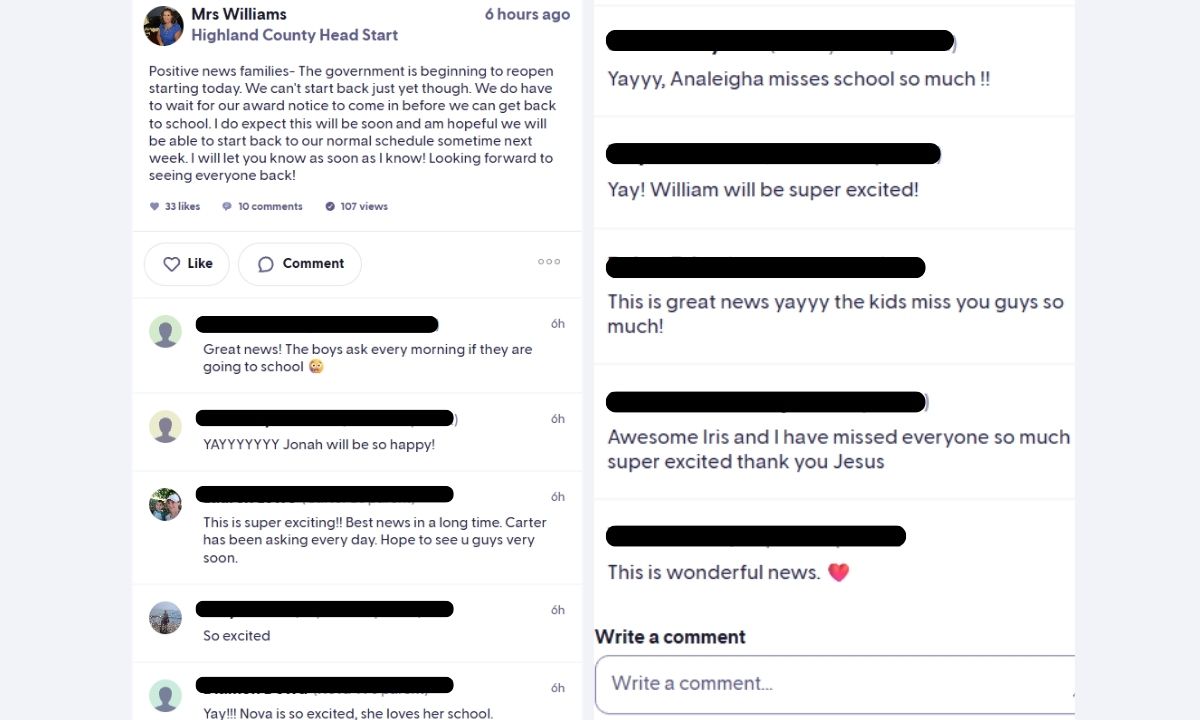
On Thursday, Williams wrote to parents via an online portal that she hopes to restart the normal school schedule sometime next week. The post was quickly flooded with comments.
“This is super exciting!!” wrote one parent. “Best news in a long time. Carter has been asking every day. Hope to see u guys very soon.”
“Yayyy,” wrote another. “The kids miss you guys so much!”
Valerie Williams, who runs a Head Start program in Appalachian Ohio, was excited to tell parents that classrooms would be reopening soon. (Valerie Williams)
Still, Williams knows reopening won’t be seamless. Along with program leaders across the country, she’ll need to call back furloughed staff, place food orders and handle a number of other operational challenges.
And despite the excitement, the transition back may also prove tricky for some kids.
“I do think that it will feel like starting school again for a lot of our classrooms,” Williams said. “They’ve been out for two weeks … You’re going to work on separation anxiety issues, you’re going to have to get into that routine again and the structure of a classroom environment. So I think that will be a big issue for a lot of our teachers.”
As of Friday afternoon, Williams was still awaiting communication from the federal Office of Head Start with information about the anticipated timeline for next steps.
“As soon as we get that notice of award, [I want to] start our staff and kids back immediately,” she said. “The very next day.”
Now that the shutdown has ended, what’s next for Head Start?
Funding for Head Start is complex. Some 80% comes from federal grants that are released to local providers on a staggered schedule throughout the year. This year, grant recipients with funding deadlines on the first of October and November were left scrambling, as the federal shutdown dragged on.
The government began to resume operations late Wednesday night after President Donald Trump signed a bill, funding most federal agencies through Jan. 30 and allowing programs that didn’t receive their funding on time, including Head Start, to use forthcoming dollars to backpay expenses incurred over the past month and a half.
Here’s what Hamm predicts will happen next: The Office of Head Start will recall all staffto resume, including those who were furloughed during the shutdown. The employees will review grant applications, a process which now requires them to flag any language that might be reflective of diversity, equity and inclusion practices. Next, money will be sent along to the remaining regional offices, and eventually dispersed to individual grantees. The NHSA is hopeful that this process will be completed by Thanksgiving for all grantees.
There are two things the federal government can do to help centers open faster, according to Hamm. First, they could waive a typical protocol that leads to a period of seven days between when a member of Congress is notified that their state will be receiving funding and when the funding actually goes out, Hamm explained.
Officials could also notify grantees, in writing, about how much money they’ll get and when it’s expected to come through, so they can begin planning.
Unlike SNAP, which received guaranteed funding through the budget year, money for Head Start remains uncertain beyond Jan. 30. While the fear of another shutdown has caused “quite a bit of worry” among the Head Start community, Sheridan said it would likely lead to fewer program disruptions, since it wouldn’t fall at the start of the fiscal year.
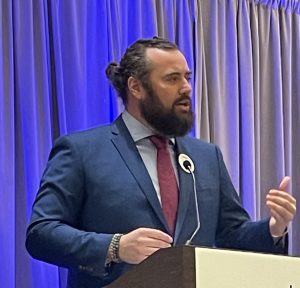
Tommy Sheridan, deputy director of the National Head Start Association. (Tommy Sheridan)
To prevent similar chaos moving forward, Democratic Sen. Tammy Baldwin of Wisconsin introduced a bill in the final days of the shutdown that would guarantee uninterrupted service for fiscal year 2026.
“The 750,000 children and their families who use Head Start shouldn’t pay the price for Washington dysfunction,” Baldwin, the ranking member of the Senate Appropriations Subcommittee for Labor, Health and Human Services, Education, and Related Agencies, wrote in a statement to The 74.
Multiple funding threats and deep staffing cuts by the Trump administration over the past year have plunged programs across the country into uncertainty. In the wake of that recent upheaval, a leadership change is also underway. The acting director of the Office of Head Start, Tala Hooban, accepted a new role within the Office of Administration for Children and Families and will be replaced by political appointee Laurie Todd-Smith, according to an email statement from ACF. Todd-Smith currently leads the Office of Early Childhood Development, which oversees the Office of Head Start.
Sheridan described this move as anticipated and not particularly concerning, though others were less sure. Joel Ryan, the executive director of the Washington State Association of Head Start, noted that Hooban was a longtime civil servant and strong supporter of the Head Start program. Without her, he fears “there’s nobody internally with any kind of power that will push back,” on future threats to the program.
Another worry plaguing providers: current funding for Head Start has remained stagnant since the end of 2024, meaning that through at least Jan. 30, programs will be operating under the same budget amid rising costs across the board.
In previous years, the program’s grant recipients typically got a cost-of-living adjustment, such as the 2.35% bump ($275 million) for fiscal year 2024. In May, a group of almost 200 members of Congress signed a letter to a House Appropriations subcommittee, requesting an adjustment of 3.2% for 2026. A recent statement from NHSA suggested that instead, the proposed Senate bill for next year includes a jump of just 0.6%, or $77 million.
“If we don’t see a funding increase in line with inflation, that means that Head Start will be facing a cut of that degree,” said Sheridan. “It’s just kind of a quiet cut, or a silent cut.”
“I think what will end up happening,” said Ryan, “is you’ll end up seeing a massive reduction in the number of kids being served.”
Did you use this article in your work?
We’d love to hear how The 74’s reporting is helping educators, researchers, and policymakers. Tell us how
Politicians love to say, “We must protect our children. They are our future.” But looking at what’s happening in Congress right now, children are not being protected. Families are not being prioritized. Instead, lawmakers are locked in a standoff, waiting to see who blinks first as they fight over who gets the last word and how big of a tax break they can give the wealthiest Americans.
Meanwhile, families — especially families of color and low-income families — are left to hold their breath and wonder what this shutdown means for them. As members of Congress keep making their rounds on television, babies still need formula, toddlers still need health screenings, children still need breakfast and lunch at school and in their child care programs, and parents still need child care so they can work. Amid extreme stress, families are left, wondering how they will be able to take care of their children.
The demands of children and their families do not stop just because Congress is at a standstill.
According to Kids’ Share 2024, an annual report published by the Urban Institute about federal expenditures, children received only about 9% of all federal spending in 2023, while about 43% of federal spending went toward health and retirement benefits for adults 18 years and older. That’s a very small percentage for a nation in which politicians on both sides of the aisle have expressed interest in increased government investment in children. These numbers contradict the narrative that claims children matter because they are our future.
That 9% starts to feel even smaller during a government shutdown. Some programs, like Social Security, Medicaid and Medicare, are mandatory, meaning they don’t require annual congressional approval. But others, including a number of crucial children’s programs, such as the Special Supplemental Nutrition Assistance Program for Women, Infants, and Children (WIC), are funded through the annual appropriations process, which Congress must approve. This means when lawmakers can’t agree on a budget, these critical programs are left in limbo.
The fallout on the horizon from this needless dysfunction is becoming clearer.
In September, the National WIC Association reminded the public that WIC only had enough funds to temporarily remain open during a government shutdown. Now, according to Reuters, at least two dozen state websites warn there could be an unprecedented benefit gap for more than 41 million people in America who get aid from the Supplemental Nutrition Assistance Program (SNAP) and the nearly 7 million people who rely on WIC.
Georgia Machell, president and chief executive officer of the National WIC Association, delivered this sobering news last week.
“Without additional support, State WIC Agencies face another looming crisis,” she said. “Several are set to run out of funds to pay for WIC benefits on November 1 and may need to start making contingency plans.”
Many families in historically marginalized communities, who already face greater barriers to health care, housing and early education, will feel this impact even more sharply. For example, we know that tens of thousands of young children and families rely on vital support received through Head Start, a service that promotes early learning and development, health and well-being. The shutdown is already in its fourth week, and, according to a statement issued on Oct. 16 from the National Head Start Association, if the government shutdown doesn’t end by Nov. 1, more than 65,000 children and families will be at risk of losing critical services.
A missed doctor’s appointment, a delay in SNAP benefits or a gap in child care isn’t just inconvenient. It can destabilize a family and hinder a child’s development, especially in the classroom.
A research brief published by The Food Research & Action Center highlighted the links between hunger and learning, stating that “behavioral, emotional, mental health, and academic problems are more prevalent among children and adolescents struggling with hunger” and that young people experiencing hunger have lower math scores and poorer grades. The shutdown will have real and lasting consequences on the learning, development and well-being of America’s children because these programs are being impacted.
It’s frustrating to watch lawmakers stand at podiums and declare how much they care about children while their actions — or inaction — puts children at risk.
Words don’t put food on the table. Words don’t pay rent. But actions do.
And right now, the actions coming out of Congress are sending an unfortunate message to families: protecting children is not the priority.
If children truly are our future, then they cannot be treated as bargaining chips. Children deserve more than 9% of America’s federal spending budget. We needfederal budgets that reflect children’s needs and protection for essential services. Critical programs that protect child health and well-being should never be disrupted by a government shutdown.
Finally, Americans deserve government accountability. Policymakers should be held responsible for their words and actions, especially when they fail to deliver on the promises they make about protecting children.
Children cannot wait. They are growing, learning and developing right now. The choices we make as a country today will shape their tomorrow.
Did you use this article in your work?
We’d love to hear how The 74’s reporting is helping educators, researchers, and policymakers. Tell us how
Join our zero2eight Substack community for more discussion about the latest news in early care and education. Sign up now.
The U.S. military faced a new threat to national security toward the end of the 20th century. This threat affected the recruitment and retention of our nation’s armed forces, reducing their capacity to defend the denizens of the United States and our interests overseas.
The threat wasn’t the Cold War; it wasn’t tension in the Middle East; and it wasn’t international or domestic terrorism.
The threat was a lack of affordable, accessible, high-quality child care.
The makeup of the armed forces changed following the shift from a national draft to an all-volunteer military after the war in Vietnam. More service members had families in the late 1970s and 1980s — many of them with young children. And many more of those families included two working parents than in previous decades.
The child care crisis faced by the military 40 to 50 years ago was similar to the one civilians face today. More families with working parents increased the demand for child care. Thousands of children languished on waitlists, forcing families to consider forms of supervision that lacked consistent standards for safety, teacher training, student/teacher ratios, and curricula. Teachers were poorly compensated, and turnover was high.
Back then, as now, parents couldn’t afford the fees necessary to cover the costs of addressing these challenges, and limited public investment wasn’t enough to fill the gap.
Graphic by Lanie Sorrow
Because the child care crisis was seen as a threat to the collective future of Americans, elected officials took action. Congress passed the Military Child Care Act of 1989, which put a priority on affordability, accessibility, and quality in child care for service members.
With the end of child care stabilization efforts that were undertaken during the pandemic, North Carolinians now face a similar threat to our own collective future. The military’s approach offers lessons for where we can go from here, in our communities and across our state.
An experiment in universal child care
The Military Child Care Act wasn’t the first time the military had taken the lead on child care. During World War II, women entered the workforce in massive numbers, filling the roles of men who were drafted to serve in the military. This raised the question of who would care for children when both parents were working outside the home to defend American interests.
Congress responded with the Lanham Act of 1940, creating a nationwide, universal child care system to support working families with children through age 12. Federal grants were issued to communities that demonstrated their need for child care related to parents working in the defense industry.
The program distributed $1.4 billion (in 2025 dollars) between 1943 and 1946 to more than 600 communities in 47 states. The grants could be used to build and maintain child care facilities, train and compensate teachers, and provide meals to students.
In his 2017 analysis of the Lanham Act’s outcomes for mothers and children, Chris M. Herbst, of Arizona State University’s School of Public Affairs, found that “the Lanham Act increased maternal employment several years after the program was dismantled.”
An image of Rosie the Riveter from a 1943 issue of the magazine Hygeia (published by the American Medical Association) demonstrating the need for child care.
Herbst also found that “children exposed to the program were more likely to be employed, to have higher earnings, and to be less likely to receive cash assistance as adults.”
One lesson Herbst took from his research was that the Lanham Act was successful because of the broad support it received from parents, advocates for education and women, and employers. He noted: “Each group was committed to its success because something larger was at stake.”
Today’s military-operated child care model
While the Lanham Act was a short-lived national experiment that hasn’t received much study, the military’s child care program since adoption of the Military Child Care Act of 1989 has become a widely acclaimed model for publicly subsidized early care and learning, serving about 200,000 children each year.
Four categories of child care are available through military-operated child care programs: Child Development Centers (CDCs), Family Child Care (FCC), 24/7 Centers, and School Aged Care (SAC). The official military child care website describes each program type:
Child Development Centers (CDCs) — CDCs provide child care services for infants, pretoddlers, toddlers, and preschoolers. They operate Monday through Friday during standard work hours, and depending on the location offer full-day, part-day, and hourly care.
Family Child Care (FCC) — Family child care is provided by qualified child care professionals in their homes. Designed for infants through school agers, each FCC provider determines what care they offer, which may include full-day, part-day, school year, summer camp, 24/7, and extended care.
24/7 Centers — 24/7 Centers provide child care for infants through school age children in a home-like setting during both traditional and non-traditional hours on a regular basis. The program is designed to support watch standers or shift workers who work rotating or non-traditional schedules (i.e., evenings, overnights, and weekends).
School Aged Care (SAC) — School age care is facility-based care for children from the start of kindergarten through the end of the summer after seventh grade. This program type operates Monday through Friday during standard work hours. SAC programs provide both School Year Care and Summer Camp.
Requirements for military-operated child care programs are typically more stringent than state requirements. For one thing, they must be accredited by one of the following: National Association for the Education of Young Children (NAEYC), National Early Childhood Program Accreditation (NECPA), the Council on Accreditation (COA), or the National Accreditation Commission (NAC).
For context, the requirements for licensed child care in North Carolina are relatively stringent compared with other states, but still fall below the requirements for NAEYC accreditation, which is widely recognized as the national standard. Only 110 programs in our state are NAEYC-accredited — many of which are Head Start or military-operated programs — out of about 5,300 total state-licensed programs.
Military-operated child care programs offer families hourly, part-day, full-day, extended, or overnight care, plus afterschool and summer programs.
The maximum rate is on par with the national average for civilian child care in 2023, meaning that almost every family using military-operated child care programs is paying less than the national average for typically higher-quality early care and learning.
The Department of Defense budgeted about $1.8 billion for child care in 2024 — about 0.2% of its $841.4 billion total budget.
Military child care in North Carolina
In addition to military-operated child care programs, service members may be eligible for Military Child Care in Your Neighborhood (MCCYN), a fee assistance program for families who can’t access military-operated child care. MCCYN pays a portion of the cost of enrolling children in early care and learning programs that meet the military’s high-quality standards in their community.
North Carolina is one of 19 locations where military families may be eligible for MCCYN-PLUS, which expands the MCCYN program to child care programs that participate in state or local Quality Rating and Improvement Systems (QRIS) in places where nationally accredited care is not available.
Both programs rely on the availability of high-quality child care in civilian communities. That’s a challenge in North Carolina, which was already facing a child care shortage before the pandemic. Our state has lost almost 6% of licensed child care programs since February 2020, with more expected to close because stabilization grants have ended.
According to the NC Military Affairs Commission, there are 12 military bases and more than 130,000 active-duty military members in North Carolina, giving us the fourth-largest active-duty military population in the nation.
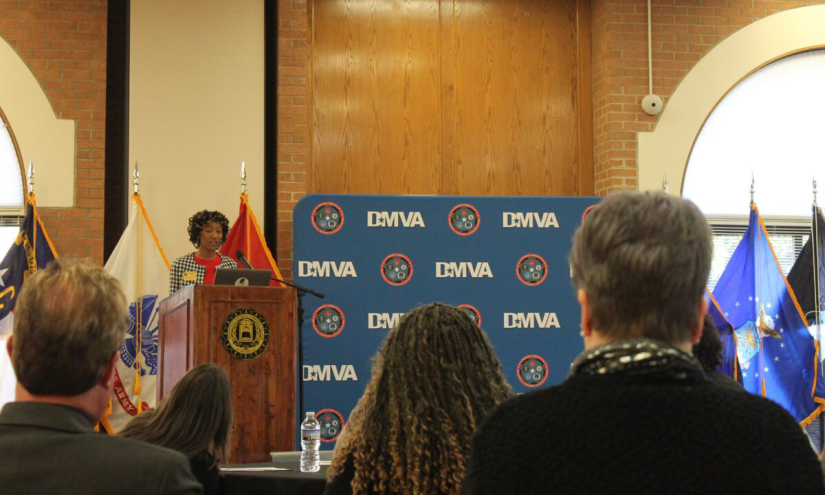
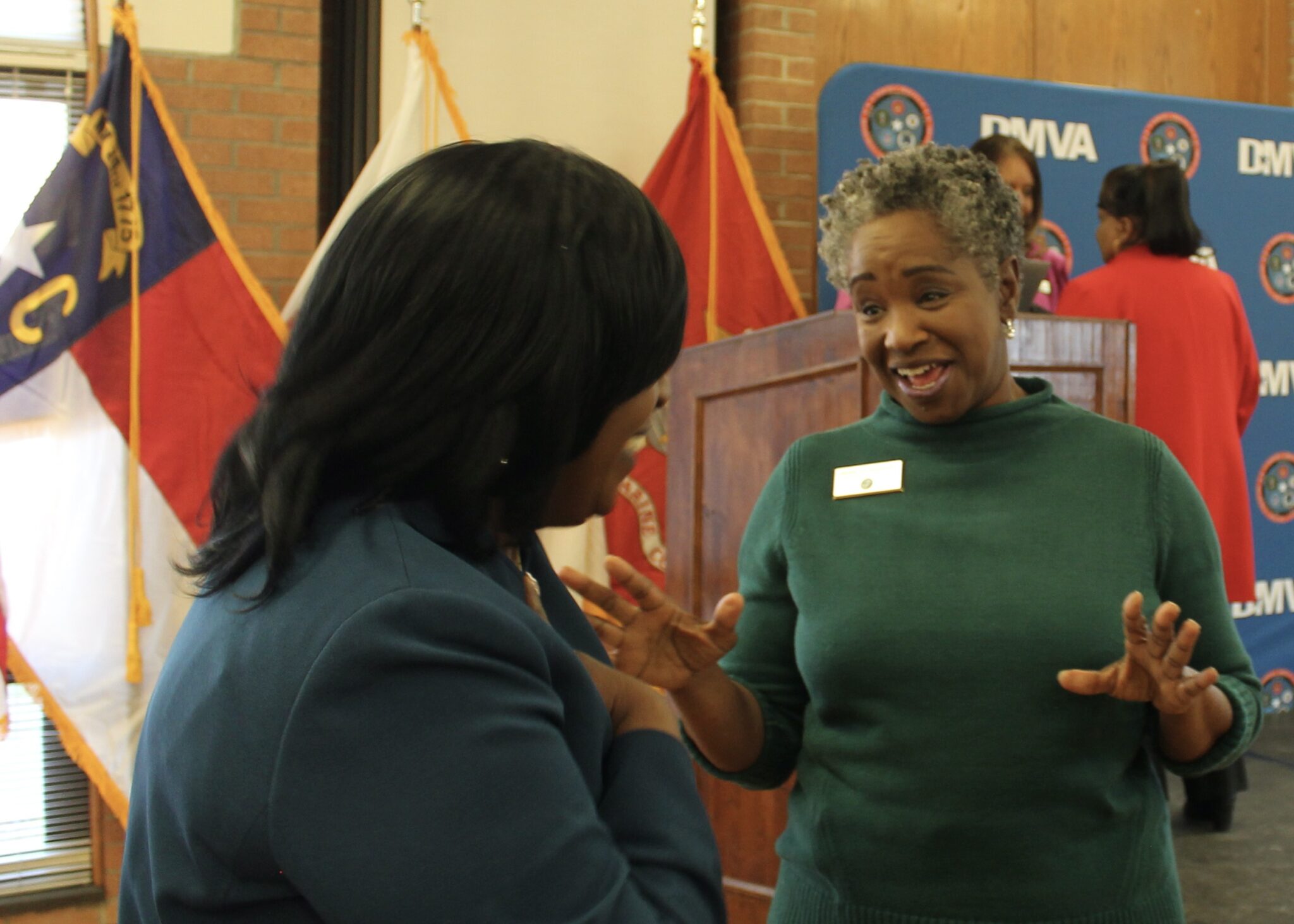
In January 2025, Fayetteville Technical Community College hosted the state’s first N.C. Military Community Childcare Summit, organized by the North Carolina Department of Military and Veteran Affairs (NCDMVA) to discuss the problem that military communities are having with access to community-based child care.
The first N.C. Military Community Childcare Summit in January 2025.( Katie Dukes/EdNC)
The summit culminated in a screening of Take Care, a documentary about North Carolina’s child care crisis produced by the state Department of Health and Human Services and featuring EdNC’s early childhood reporter, Liz Bell.
The issues of spouse resilience and child care are inextricably linked for Angie Mullennix, who works for The Honor Foundation at Fort Bragg, helping members of the U.S. Special Operations Forces (SOF) transition to careers in the private sector after their military service.
Mullennix served in the U.S. Army for four years after high school and has previously worked for the Department of Public Instruction as the state military liaison. Her husband recently retired from the SOF himself. They have two teenage children.
“If you look at the number of military spouses in North Carolina who have degrees and credentials and could be in the workforce, from nurses to lawyers, lots of them are staying at home,” Mullennix said.
“A big reason why about 40% of (military) spouses do not work is because of child care not being available to them,” Mullennix said, noting that lack of child care is also a barrier to workforce participation among the civilian population.
When Mullennix’s children were under the age of 5, she used hourly child care on base, which was available at no cost when her husband was away on assignment.
“You ask any parent in the world, I don’t care who they are, there’s nothing more important than their child’s safety — then their education,” Mullennix said. “And yet, the two things we think are the most important, we put (their providers) at the lowest pay and ask them to do quality care.”
That’s what sets military child care apart from civilian early care and learning for Mullennix: high quality standards and higher pay for early childhood educators, including benefits. She sees lessons in this for North Carolina.
“You gotta pay them to keep them, there’s no secret behind that,” Mullennix said. “If you pay them high, you can also set the standards really high.”
And because workforce participation — and military readiness — is directly tied to the accessibility and affordability of high-quality child care, not investing in it threatens our collective future.
“North Carolina, or any state that doesn’t offer child care, is shooting itself in the foot,” Mullennix said.
Lessons from military child care
Policymakers at every level who are seeking to end the child care crisis can learn much from the military child care model. One report on the topic offers these lessons:
Do not be daunted by the task. It is possible to take a woefully inadequate child care system and dramatically improve it.
Recognize and acknowledge the seriousness of the child care problem and the consequences of inaction.
Improve quality by establishing and enforcing comprehensive standards, assisting providers in becoming accredited, and enhancing provider compensation and training.
Keep parent fees affordable through subsidies.
Expand the availability of all kinds of care by continually assessing unmet need and taking concrete action steps to address it.
Commit the resources necessary to get the job done.
Both agreed these are the right takeaways for policymakers across North Carolina to consider.
Lesson 1: Do not be daunted by the task
Gale Perry said the top lesson for her is: “Start where you are, know that change is possible, and have a goal post in mind.”
She pointed out that the military’s goal wasn’t a fully publicly funded child care system. It was a system that acknowledged Americans’ values around the role of parents in raising young children — and paying for their care and education. But also that their employers and the government “have a role in offsetting that cost, so that we can ensure that child care is quality, and it is stable, and that the families can actually afford it.”
Smith said there was no “silver bullet” when she and her colleagues were tasked with solving the military’s child care crisis in the 1990s — and there isn’t one for the civilian child care crisis today.
We had to redo the standards, we had to look at the workforce, we had to look at the health and safety issues, we had to look at the fees and how we could bring those fees down. We had to look at the infrastructure of all of it. We’ve got to start thinking about the interconnectedness of all of these things if we’re going to be successful in this country.
Smith said people think that because she worked for the secretary of defense, “I could just tell all the bases what to do, and that would magically happen, which is so not true. It wasn’t just like we could give an order and everybody jumped.”
She said you just have to start where you are, and move up.
Lesson 2: Acknowledge the seriousness of the problem and the consequences of inaction
“The military understood very early the link between people getting to work and child care,” Smith said.
As the military shifted away from relying on conscription and became a more welcoming workplace for women, the need for child care became evident. Smith described working on a base where children were routinely left in cars when their parents were unexpectedly called into work.
“So (military leaders) really got the connection to their guys going to work very quickly, and I think that we still haven’t all understood that in this country,” Smith said, though she notes businesses have started making that connection since the pandemic.
“The other thing the military understood was that a pilot is every bit as important as the mechanic who works on the plane, and so they invest in all of their people,” Smith said.
She and her team had to design a program that worked for everyone, or it wouldn’t work for anyone.
Lesson 3: Improve quality
Smith said quality was of critical importance when she was designing the military’s child care system in the 1990s, especially after child abuse and neglect scandals that came to light in the 1980s.
She and her team studied the child care standards of all 50 states and created a set of military standards that fell squarely in the middle. Then they set about training the 22,000 early childhood educators they already had — most of whom were military spouses — to meet those standards.
That was a six-month training program. Then there was an 18-month training to get them to move beyond those standards toward national accreditation. They hired highly qualified trainers to work with educators at each site.
“And if you didn’t do it, guess what? You’re fired!” Smith said.
There was an incentive to participate in the training, beyond keeping their jobs — higher compensation.
“Maybe some were grumpy about it, but we didn’t have to fire people,” Smith said.
North Carolina already has some tools in place to help educators advance their education and improve their compensation, specifically through the WAGE$ and TEACH programs — both of which were highlighted in the report that identified these lessons.
“(The military) realized they had to get serious about quality and quality standards. And I would say that’s a lesson for us now, particularly in a climate that is deregulatory,” Gale Perry said. “And while I’m for sensible regulatory reform, I think we have to be really thoughtful about not wanting stacks of child deaths in child care sitting on a desk waiting to be investigated.”
Lesson 4: Keep parent fees affordable through subsidies
Smith said that while designing the military’s child care program, she and her team figured out that there was no way parents could afford the actual cost of high-quality child care. So they set up a subsidized system that would provide a 50% match — on average — to parents’ fees, paid directly to child care programs.
“We had to, on average, match parent fees dollar-for-dollar, with the higher-income people paying more and the lower-income paying less,” Smith said. “So a major, for example, would pay two-thirds of the cost, and a private would pay one-third, but the average was 50/50.”
Smith pointed out that we’re already subsidizing child care in ways that are hidden — through the public benefits and social programs that early childhood educators often rely on because of low compensation, and through lack of workforce participation.
Lesson 5: Expand the availability of all kinds of care
Gale Perry said the military’s model really stands out to her for its ability to assess unmet needs and take action to improve.
“In the early 2000s when there were the wars in Iraq and Afghanistan, there were a lot of deployments of National Guard and Reserve who did not live on post and did not have access to on-post child care,” Gale Perry said. “That is really when the military got in the business of thinking about, how do we help build capacity and make child care accessible for military families off post?”
That’s when the MCCYN came about, subsidizing high-quality early care and learning in a broader array of settings in the communities where service members live.
Smith said that the Military Child Care Act was originally targeted toward child care centers, but she recalls briefing the assistant secretary of defense on the potential effects of that strategy when they were designing the system:
I remember saying we need to apply all of this to family child care, to school-aged care, to part-day preschools, because if we don’t, all the parents are going to have a demand on these centers that we can’t meet, right? Because if you lower the cost in the centers and you improve the quality, why would somebody go to another place when they get it cheaper and better over here?
She made the case for educators in every setting getting the same access to training and the same level of compensation, because that’s what would work best for everyone.
“Everything applies to everybody,” Smith said. “And I think that was one of the smartest policy decisions we made.”
Lesson 6: Commit the resources necessary to get the job done
“There was this perception that we just had a lot of money and we threw it at” child care, Smith said. But that wasn’t the case.
“When they passed the Military Child Care Act, it didn’t come with an appropriation,” Gale Perry said. “So they had to fight equally hard for the funding, and a lot of the funding actually ended up coming from local base commanders making the decision to invest in child care.”
Now the military submits a budget request to Congress each year, and depends on those appropriations.
For state and local policymakers seeking to solve the civilian child care crisis without public investment, the woman credited with solving the military’s own child care crisis 35 years ago has a message.
“It’s gonna cost. There’s no way it doesn’t cost,” Smith said.
Join our zero2eight Substack community for more discussion about the latest news in early care and education. Sign up now.
Content warning: This story includes details of an infant’s death.
After Democrats passed the American Rescue Plan in 2021, states were flush with federal funding to help prop the child care sector up. But that money is now all gone, and as Republicans in Congress threaten to pass spending cuts that could further shrink state budgets, lawmakers are trying to find solutions to the child care crisis that don’t cost money.
Many have proposed changing the mandated ratios that require a certain number of early educators to care for young kids. Nearly a dozen states have considered rolling back child care regulations, including those governing staff-to-child ratios.
But while these deregulatory bills are common, it’s not a foregone conclusion that they will pass. Advocates in three states have been able to beat back these efforts in the legislative sessions that just wrapped up by mobilizing a wide variety of people to speak up against these proposals and deploying research-backed arguments about child safety and child care supply.
Eliminating Ratios Entirely
Idaho advocates faced down the most extreme bill. In its original form, HB243 would have eliminated all requirements that limit the number of young children an early educator can care for, leaving it up to individual providers. It would have been the first state in the country to take such a step.
Advocates had very little time to fight back. The bill got fast tracked; there was less than 24 hours’ notice before the first public hearing on it in the House. “You can’t get child care providers and parents there in that amount of time,” said Christine Tiddens, executive director of Idaho Voices for Children, a nonprofit that advocates for child-focused policies, noting that it requires moving work schedules and getting people to cover shifts. The bill sailed through the House.
Eventually, Tiddens said, they were able to put parents and providers in front of lawmakers to warn of the negative consequences. One of those parents was Idaho resident Kelly Emry. On June 10, 2024, she got a panicked call from the home-based child care provider where she had just started sending her 11-week-old son Logan. She dashed to the provider’s home and was told he was dead. The coroner’s report later confirmed he died from asphyxiation. According to Emry, the coroner said the provider put him down for a nap between a rolled up blanket and a pillow and left him there for hours. The provider was caring for 11 kids by herself that day, putting her out of compliance with state regulations that, at the time, required at least two staff members.
“It was completely preventable, and that’s what’s so hard for me to come to terms with,” Emry said in a podcast interview in January.
Emry wasn’t the only one who spoke up. Once the bill got to the Senate, advocates packed the hearing and overflow rooms with several hundred people. Among the 40 people who signed up to testify, 38 opposed the bill. Baby Logan’s uncle spoke, as did pediatricians, fire marshals, nurses, the state police, child welfare experts, child care providers and parents. Lawmakers were flooded with thousands of calls and emails from the opposition. Tiddens made sure every senator was sent the podcast interview with Emry.
The bill passed the Senate committee by a single vote. Advocates decided to try to stop the worst elements, knowing that the bill was likely to pass in some form. They asked a senator who opposed it to “throw a Hail Mary,” Tiddens said. When the bill came to the Senate floor, he asked for unanimous support to pull it and move it into the amending process. He got it. The original elimination of staff-to-child ratios was stripped out; instead, the bill preserved ratios, albeit higher ones than before. Under previous law, Idaho ranked at No. 41 among all states for how high its ratios were; now it has dropped even further to No. 45.
The victory is “bittersweet,” Tiddens said. She attributes it almost solely to one thing: putting parents, not just businesses and child care providers, in front of lawmakers, which led to the moving account of Logan’s family, still in the midst of raw grief. “How could you listen and not have your heart changed?” Tiddens asked.
Doubling Family Child Care Ratios
Advocates in Maryland have fought back against legislation to loosen staff-to-child ratios twice now. Last year, lawmakers introduced a bill to raise the ratios in family child care settings, but it died thanks to “a lot of advocacy,” said Beth Morrow, director of public policy at the Maryland Family Network, a nonprofit focused on child care. As in Idaho, the American Academy of Pediatrics and fire marshals warned about what would happen in the case of emergencies. Children under 2 years old are “not capable of self-preservation,” Morrow pointed out; they might hide when a fire alarm goes off and can’t evacuate on their own. “If there is an emergency you have to be able to get these kids out,” she said.
The idea returned this year in House Bill 477, this time coupled with looser ratios for center-based care. Family providers are currently allowed to care for eight children but no more than two under the age of 2; the legislation would have doubled that, allowing providers to watch as many as four children under the age of 1. That was a “nonstarter,” Morrow said. It would also have been the first time that these rules were dictated by lawmakers rather than by the Maryland State Department of Education, which would have been barred from changing them in the future.
So advocates marshalled research, with the help of national groups including the National Association for the Education of Young Children and Center for Law and Social Policy. They highlighted that there has been no evidence that stricter child care regulations lead to reduced supply. Lawmakers seemed moved by the argument that lower ratios support better health and safety for children.
During the markup session, the chief sponsor amended the bill by striking the language about higher ratios; instead, the version that passed requires the Department of Education to study child care regulations with an eye toward alleviating barriers for providers.
Ratio Increases by Another Name
In Minnesota, lawmakers took a different approach to proposing changes to the number of staff required to care for young children this session. Their legislation avoided mentioning the term “ratios” at all. Instead, the issue was presented as an exemption for in-home child care providers caring for their own children as well. The legislation originally would have exempted as many as three of the providers’ own children from the number they are licensed to watch. “That’s a direct ratio increase, no way around that,” said Clare Sanford, vice president of government and community relations at New Horizon Academy, a child care and preschool provider. “You still have the same number of adults but you’re increasing the number of children that adult is responsible for.”
In later drafts, the number of children who could be exempted kept being reduced. In the end the legislation didn’t get a standalone vote and the language was left out of the final state budget. The argument that Sanford thinks worked the best was that increasing ratios wouldn’t actually increase child care supply. That’s because, as a brief by NAEYC argues, they will lead to more burnout among providers, which will push them to leave and, in the end, reduce available child care spots.
The fight is far from over. Advocates in all three states expect lawmakers to try to loosen staff-to-child ratios again next session. Tiddens fears that, although Idaho didn’t eliminate ratios, the idea could spread. “Idaho has often been a frontrunner for harmful legislation,” she said. On the whole, more of these laws have been signed than stopped, said Diane Girouard, state policy senior analyst at ChildCare Aware of America. Ratio deregulation bills pop up “in some states every single year,” she said. “This isn’t just unique to red, conservative states. It has happened in blue states, it has happened in purple states.”
Advocates who oppose raising these ratios are formulating responses to the child care crisis that preserve safety standards without requiring state funding. In Maryland, for example, Morrow’s organization helped pass a bill that removes legal barriers to opening and operating family child care programs. The hope is that with more solutions on the table to increase child care supply, states won’t look to options that erode safety standards, such as increasing ratios.
Tiddens has vowed to fight back. “We’re not going away, and we’re going to show up next session with our own proposal,” she said. Her coalition plans to formulate a bill for next year that “prioritizes child safety at the same time as dealing with the child care shortage,” she said.