
Tag: early literacy

  • Why rigor and efficiency matter in early reading

    Why rigor and efficiency matter in early reading

    Key points:

    In early literacy, the goal is simple but urgent: Help students become independent readers and writers. Every instructional decision we make either moves them closer to that goal or keeps them circling the mountain instead of climbing it. As literacy researcher Timothy Shanahan reminds us, “If a mountain is high, we should help children to climb that mountain. With appropriate supports and scaffolds it can be done.”

    As an early literacy coach specializing in pre-K to grade five, I work with teachers and districts to accelerate access so all students can become independent, empowered readers. I focus on the most efficient, research-supported strategies to help children learn to read with confidence.

    Unfortunately, many traditional literacy approaches treat third grade as the finish line for learning to read, leaving too many students stranded on the mountainside.

    The phonics code introduced in K-2 doesn’t disappear as texts become more complex. In fact, upper grade reading places even greater demands on decoding as vocabulary grows longer and more morphologically complex. While many teachers want to support students through this shift, they often lack the training, tools, and time needed to continue explicit instruction in word recognition.

    The danger of a slow rollout

    Time is of the essence. One longitudinal study found that first graders who are behind in reading have an 88 percent chance of still being behind in fourth grade. This pattern reflects what researchers call the Matthew Effect: Students who fall behind early tend to fall further behind over time unless instruction accelerates their progress.

    This is why students who are catching up still need regular opportunities to engage with grade-level text. Students need rigor paired with intentional scaffolding–not simplified reading assignments that limit access to the language, ideas, and vocabulary found in complex texts.

    There is a common belief that, after enough reading lessons, a switch will flip and reading will simply click. But learning to read is far more nuanced. While phonics instruction is typically organized across a K-2 scope and sequence, students who miss or only partially master early skills often carry those gaps forward. By third or fourth grade, these unresolved gaps can block access to grade-level text.

    A brain-based, research-aligned approach

    At any age, when students understand the logic behind the code, reading stops feeling random. They begin noticing patterns, decoding unfamiliar words, and approaching text with genuine confidence.

    English is a morphophonemic language, which means our spelling system represents both morphology (meaning) and phonology (sound). When instruction reflects this, everything changes for students. That’s why I advocate for teaching how sounds, spelling patterns, and meaning work together, rather than relying on rote memorization or delaying access to key phonics patterns. It’s also important to introduce morphology and etymology early, giving students access to the meaningful building blocks of complex words.

    Here’s what this brain-based approach looks like in practice. While working in a district implementing a systematic, research-aligned literacy framework, I began tutoring a student at the very end of second grade. He had little confidence in his reading ability and regularly said things like, “I’m a terrible reader.”

    To accelerate his literacy development, I focused on three priorities: identifying his precise gaps, closing them efficiently, and ensuring he could access grade-level text with support.

    To understand where he was struggling, the first step was administering a universal literacy screener, Acadience Reading. His results showed he was well below benchmark in oral reading fluency for his grade. 

    From there, I administered a phonics diagnostic to pinpoint his specific needs. I used the Intervention Placement Test from UFLI Foundations, which placed him at a lesson within the program’s scope and sequence and clarified exactly which skills still required explicit instruction. I then began targeted, systematic phonics instruction using UFLI Foundations.

    But assessment and phonics instruction alone weren’t enough. Decodable texts are essential, but they must be paired with supported access to grade-level text. Because this student was moving into third grade, I selected grade-level texts from ReadWorks around a topic he was interested in.

    To accelerate his progress beyond the limits of a traditional scope and sequence, I integrated Secret Stories–an ESSA Tier 1 supplemental phonics resource with an average effect size of 1.62 that helps students quickly learn and apply complex phonics patterns through brief, brain-based stories.

    I used Secret Stories within UFLI phonics lessons to teach tricky patterns, and outside of phonics instruction to unlock words in grade-level texts he was not “supposed” to be able to read yet. Because most Secret Stories take under 30 seconds to teach, they can be embedded anywhere in the day. For example, when the calendar shows the month of August, teachers might pause to review why AU makes the “aww” sound. Once learned, those explanations become tools kids can immediately apply during reading, writing, and content instruction. 

    To further prepare him for these grade-level texts, I pre-taught key vocabulary and explicitly introduced relevant morphemes–prefixes, suffixes and root words. I also used The Writing Revolution, a book with resources for teaching writing and sentence syntax, and Brainspring, a morphology resource my district had just started using for third grade and up to teach new prefixes, suffixes, and roots.

    Putting this set of literacy “mountain-climbing gear” in place took intentional effort, and I worried it might be too much. Instead, he leaned in. With the right supports and someone beside him, he embraced the challenge and began to see himself as a capable reader. The rigor didn’t overwhelm him. It gave him confidence.

    Achieving the peak of independence

    Many older students face the same struggles as the second-grader I supported. They never fully mastered the early phonics sequence, and those gaps accumulate over time. By the time they encounter texts filled with multisyllabic words, unfamiliar morphemes, dense syntax, and academic vocabulary, reading can feel overwhelming.

    But when those patterns are reintroduced through clear, brain-based explanations, older learners often catch on quickly. Words that once felt confusing begin to make sense. They experience the same “aha” moments as younger learners with an even deeper sense of relief and empowerment–and without feeling remediated. For students who felt stuck below grade level for years, this shift is transformative.

    Today, that same student, now halfway through third grade, is confidently reading grade-level text, with a renewed sense of competence and joy. In just eight months, his oral reading fluency moved from ‘well below benchmark’ to ‘at benchmark.’

    Each successful mountain climber is a reminder that the end goal of literacy instruction isn’t mastery of isolated skills like phonemic awareness or sight words. In isolation, these skills move students sideways or, as Shanahan describes, “walk students around the mountain rather than up it.” Instead, the goal is upward progress, toward independent reading and writing. Every instructional decision, assessment, program and resource we choose should point students efficiently up the mountain, helping them reach the peak with confidence and purpose.

    Latest posts by eSchool Media Contributors (see all)

    Source link

  • 5 high-frequency and irregular word teaching strategies rooted in the Science of Reading

    5 high-frequency and irregular word teaching strategies rooted in the Science of Reading

    Key points:

    When students learn to read in the early elementary years, developing phonemic awareness, decoding skills, and blending typically take priority. Another essential component of fluent reading, however, is learning to read high-frequency and irregular words. While most phonics programs do address these words, instruction often stops at introduction or, at best, includes a single exposure activity embedded within a larger lesson.

    As the Science of Reading continues to gain traction, educators must look beyond repetition and memorization and adopt strategies that help students understand why words sound the way they do.

    Before outlining five such strategies, it is important to distinguish among the various labels ascribed to the words in question, the most common of which are listed below:

    • high-frequency words
    • trick words
    • sight words
    • heart words
    • irregular words
    • Fry words
    • Dolch words

    The term high-frequency words refers to words that appear frequently in books, especially those in decodable texts used by emerging readers. These words may or may not be decodable, but they account for a large percentage of the words students encounter in early reading. Edward Fry (Fry words) and E. W. Dolch (Dolch words) developed lists of the top 1000 and 220 words, respectively, found in printed English material (University of Florida Literacy Institute, 2025). These lists include words like it, like, and did, which, though decodable, are not necessarily accessible to beginning readers who have not secured all letter sounds and phonics rules yet.

    These words are known as “temporarily irregular” words because they will eventually be decodable once a student learns the necessary phonics pattern (University of Florida Literacy Institute, 2025). However, learning these words allows readers to begin reading richer texts and developing fluency while simultaneously working on these skills.

    Permanently irregular words, in contrast, contain letters that do not make their expected sounds and, consequently, are never fully decodable. These words may “trick” students or require them to learn the words by “sight” or by “heart,” which is where these labels originate.

    Parsing out the nuances of these labels proves to be important because it emphasizes that many of these words, regardless of what category they belong, can actually be taught phonetically, with the exception of one or two phoneme-grapheme correspondences. Finding strategies to do so not only eliminates the need to memorize the words in their entirety but also sets students up for greater success in developing greater automaticity for reading these words.

    Here are five strategies for teaching temporarily and permanently irregular words in the early elementary years:

    Orthographic mapping: Orthographic mapping requires students to physically break words down by sound, not letter. Manipulatives such as connecting cubes or chips may be used or students may simply write them in different colored boxes or using different colored ink. For example, ship contains three sounds because sh represents one phoneme. Similarly, like has three sounds, with -ke representing a single sound due to the silent e. This process helps students attend to phoneme-grapheme relationships rather than memorizing words visually.

    Hunt for the words in a meaningful context: After introducing one or two target words, provide students with a decodable text or familiar reading material and ask them to locate the words. This encourages students to recognize words in authentic contexts rather than in isolation and supports comprehension as students see how the words function within a story.

    Add a kinesthetic component: Strategies such as tapping out phonemes on the arm, tracing letters while saying corresponding sounds, or using hand motions to represent each sound in a word help students physically experience the structure of words. These movements reinforce phonemic awareness and support orthographic mapping by linking motor memory with auditory and visual input.

    Marking: Word marking is a powerful, research-aligned strategy that helps students attend to the internal structure of irregular words rather than relying on visual memory alone. Teachers guide students through each letter in a word and mark it according to the sound it makes (i.e. long or short vowel), as well as indicate whether or not it is the expected sound with a symbol such as a heart or X over the letters that diverge from the standard pattern. This activity lends itself well to reviewing skills over time as students learn new skills. For example, the word the is fully irregular until students learn the th digraph, at which point only the e remains irregular.

    Use the words in writing: Writing plays a critical role in solidifying irregular word learning. When students use target words in sentence construction, journals, or shared writing, they must retrieve and apply their knowledge independently. Doing so reinforces grapheme-sound connections and ensures that irregular words are not only recognized during reading but also produced accurately in writing. Having students write pattern books with these words is particularly helpful because they provide students with meaningful repetition. An example may include writing books that include sentence starters such as, “I like,” “You can,” “The dog and cat are,” etc.

    When high-frequency words are taught through explicit instruction, aligned phonics, and meaningful practice, they become a natural extension of early literacy development. By grounding instruction in the science of reading, educators can move beyond rote memorization and equip young learners with the tools they need for fluent, confident reading.

    Latest posts by eSchool Media Contributors (see all)

    Source link

  • Ignite Reading Again Approved as 1:1 High-Dosage Early Literacy Tutoring Provider in Massachusetts

    Ignite Reading Again Approved as 1:1 High-Dosage Early Literacy Tutoring Provider in Massachusetts

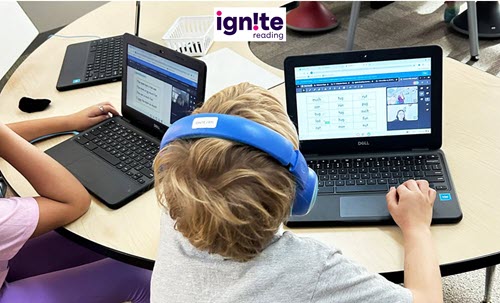
    BOSTON — Ignite Reading — a Science of Reading-based virtual tutoring program serving students in 18 states nationwide — today announced its approval by the Massachusetts Department of Elementary and Secondary Education (DESE) to continue providing 1:1 high-dosage evidence-based literacy tutoring to K-3 students across the commonwealth.

    Massachusetts Governor Maura Healey’s administration called on her state to invest heavily in high-dosage tutoring (HDT) earlier this year, earmarking $25 million in her state budget proposal to help accelerate literacy growth, “complementing the more systemic, long-term improvement work” being supported under the administration’s five-year literacy improvement campaign, Literacy Launch.

    In its approval process, DESE evaluated Ignite Reading’s services to Massachusetts districts over the past three school years and approved the literacy company to again provide school districts and charter schools with tutoring that is focused on building foundational skills — including phonological awareness, phonics knowledge and decoding skills — to help students become independent fluent readers in the early grades.

    Since Ignite Reading first gained DESE approval during the 2022-23 school year:

    • 30 Massachusetts schools and districts have partnered with Ignite Reading to provide students with 15 minutes of daily, 1:1 virtual tutoring.
    • Ignite Reading’s tutor educators have delivered differentiated, evidence-based early literacy instruction to more than 7,800 Massachusetts students.
    • Researchers at Johns Hopkins University’s Center for Research and Reform in Education have followed approximately 2,000 Massachusetts 1st graders enrolled in the program. The quasi-experimental study found the number of students reading on benchmark increased 213% after a year of Ignite Reading tutoring. At the same time, the percentage of students who required intensive reading intervention decreased 55%. All student groups — including Black and Hispanic students, those with IEPs and Multilingual Learners — had equitable skills growth, and those meeting end-of-year reading benchmarks grew more than 125%.

    The Healey-Driscoll Administration recently announced that schools and districts in Massachusetts are invited to apply for high-dosage early literacy tutoring for K-3 students with 1st grade as the state’s top priority.

    “When we get kids reading proficiently by the end of 1st grade, we set them up for a lifetime of academic success,” said Ignite Reading CEO Jessica Sliwerski. “Our continued approval by DESE means we can keep delivering the intensive, personalized support that Massachusetts 1st graders need to learn to read on grade level and on time. We are honored to be able to continue to partner with Massachusetts districts to ensure all students can access the tools they need to succeed as readers.”

    For more information about Ignite Reading’s Massachusetts partnerships, visit https://info.ignite-reading.com/massachusetts.

    About Ignite Reading

    Ignite Reading is on a mission to ensure every student can access the tools they need to be a confident, fluent reader by the end of 1st grade. School districts nationwide depend on Ignite Reading’s virtual tutoring program to deliver literacy support at scale for students who need help learning to read. Our highly trained tutors provide students with 1:1 tutoring in foundational literacy skills each school day, helping them go from learning to read to reading to learn.

    A recent study by the Center for Research and Reform in Education at Johns Hopkins University found that Ignite Reading students across demographics — including students who are English Learners, Black, Hispanic, and those with Individualized Education Programs (IEPs) — achieve the same outstanding gains of more than 5 months of additional learning during a single school year.  For more information about Ignite Reading, visit www.ignite-reading.com.

    eSchool News Staff
    Latest posts by eSchool News Staff (see all)

    Source link