Tag: Eating

  • Colleges Teach Students Healthy Eating, Cooking Habits

    Colleges Teach Students Healthy Eating, Cooking Habits

    A 2025 survey of 5,000 undergraduates by Inside Higher Ed, supported by Generation Lab, found that the greatest share of students rated their nutrition at college as average (44 percent), with an additional 30 percent describing their nutrition as below average or poor.

    A number of colleges and universities are working to teach students proper nutrition habits and equip them to lead healthy lives in and beyond college.

    The research: A 2023 literature review found that college students experience a variety of risk factors that make them uniquely positioned to experience food insecurity, including busy schedules and a lack of access to nutritious food.

    Several studies found that students who had cooking experience were less likely to face food insecurity, implying that those without cooking or food-preparation skills may be at higher risk for food insecurity, according to the report.

    The report suggests colleges can provide cooking and meal-preparation demonstrations to help students gain skills, as well as learn how to prepare low-budget, nutritious meals. One study cited in the literature review suggested adding nutrition education—including food budgeting and recipes—as a feature of first-year seminars.

    Inside Higher Ed compiled five examples of nutrition education designed to address student health, food insecurity and malnutrition.

    1. University of Memphis: Grilling Classes

    To help teach students how to cook using relevant tools and resources, the University of Memphis staff hosts a lunchtime nutrition class, teaching students how to prepare and grill a personal pizza.

    The university charges students $15 to participate in the class, which covers ingredients and lunch foods, providing a low-cost and casual introduction to basic cooking principles.

    1. University of North Dakota: Culinary Corner

    At UND, students get the chance to lead their peers in cooking classes. Events are open to all campus members, including faculty and staff, and the hourlong sessions in the wellness center teach students how to prepare simple meals.

    In addition, UND has a virtual demonstration library so students can teach themselves how to cook a range of healthful recipes from wherever they are, including honey-glazed salmon, chana masala or acai bowls. Each demonstration video features a student instructor and a recipe card for viewers to follow along.

    1. Lewis College, University of Georgia Cooperative Extension: Fulton Fresh University

    This fall Georgia State University students benefited from a free cooking demonstration and nutrition course pilot hosted by two local institutions.

    Fulton Fresh University, a partnership between Lewis College and the University of Georgia Cooperative Extension, typically educates seniors or those in low-income communities. But in 2024, the partners tested a new offering for college students who don’t necessarily know how to cook and are more inclined to eat quick meals or takeout, according to a university press release.

    The four-week, no-cost course provided students with 10 pounds of produce at each session, in addition to spices and a variety of kitchen tools to keep.

    1. Iowa State University: Culinary Boot Camp

    Iowa State University students can participate in a two-credit course, Culinary Boot Camp, which provides nutrition education and culinary skills to promote healthy living.

    The course, which has been offered since 2016, covers topics including storing food safely, reducing food waste, converting recipes and shopping efficiently for groceries, among others.

    1. Cornell University: Get Cooking With Cornell Dining

    Cornell offers students a chance to learn from the professionals: the campus dining team. Members host events in the Discovery Kitchen in a residence hall on campus, where students can practice preparing plant-based dishes, which they then enjoy.

    The goal is to help students learn to make healthy dishes that are both tasty and environmentally friendly.

    Do you have a wellness intervention that might help others promote student success? Tell us about it.

    Source link

  • Eating Well in College: What Students and Families Need to Know

    Eating Well in College: What Students and Families Need to Know

    Food is more than just a necessity in college — it fuels academic success, well-being, and connection, making informed dining choices essential for thriving on campus.

    Robert Nelson

    President and CEO, The National Association of College & University Food Services

    Preparing for college means choosing classes, housing, and campus activities — but what about food? While dining may not always be top of mind, what students eat has a profound impact on their academic performance, health, and overall well-being. Here’s what families should consider when planning for a successful — and well-fed — college experience.

    Food and academic success

    Skipping meals may seem like a small sacrifice when juggling a packed schedule, but the effects on academic performance are significant. Studies show that students who eat regular, balanced meals — especially breakfast — perform better on tests, have stronger focus, and experience lower stress and anxiety.

    Meal plans exist for a reason: They provide consistency, affordability, and easy access to nourishing meals that support learning, brain function, and students’ mental and physical health. Students should aim to create a meal schedule that aligns with their class and study habits, ensuring they have time to eat before long lectures or exams.

    Know your options 

    Many students arrive on campus with food allergies, religious or cultural dietary preferences, or health-related nutrition needs, yet they may not realize that college dining services can accommodate them. Parents and students should take the time to explore:

    • Allergen-friendly options: Many dining halls have designated stations or innovative programs for accommodating top allergens like nuts, dairy, gluten, and more.
    • Registered dietitians: Some schools offer access to nutrition experts who can help students make informed choices.
    • Cultural and religious meals: If students keep kosher, halal, or vegetarian diets, understanding what’s available ahead of time can make the transition smoother.

    Before move-in, students should visit the campus dining website, contact the dining team, and ask about meal options that fit their needs.

    Making the most of your plan

    A meal plan isn’t just about convenience — it’s also one of the most cost-effective ways to eat in college. Because of economies of scale, campus dining can offer a wide variety of meals at a lower cost than students would typically spend cooking for themselves or eating off-campus.

    Students should consider:

    • Understanding their chosen meal plan: Are there unlimited swipes? A set number per week? Can unused meals roll over? What is the deadline to adjust plans if needed? 
    • Knowing about alternative dining locations: In addition to dining halls, many campuses offer grab-and-go options, food trucks, or mobile ordering for busy days, included as part of the meal plan.
    • Making the most of cooking and nutrition programs: Some schools offer cooking classes, workshops, or healthy eating initiatives to help students develop lifelong food skills.

    Food as connection

    Beyond nutrition, food plays a vital role in helping students build relationships and feel a sense of belonging. Sitting down for a meal is one of the easiest ways for new students to make friends, unwind, and stay connected to campus life.

    While technology has changed how students engage with their world, dining halls remain one of the most valued spaces for face-to-face interaction — not just with peers, but also with staff who become familiar, welcoming faces in a student’s daily routine.

    A strong foundation 

    Students and families invest a great deal in higher education, and making informed choices about nutrition is part of that investment. Food is more than fuel; it’s a foundation for academic success, personal well-being, and lifelong habits. As students embark on this next chapter, taking the time to understand and prioritize their dining options can make all the difference.

    Source link

  • More Eating the Future | HESA

    More Eating the Future | HESA

    Morning everyone. Welcome back. Some statistical wonkery today, with respect to the analysis of government expenditures on postsecondary education.

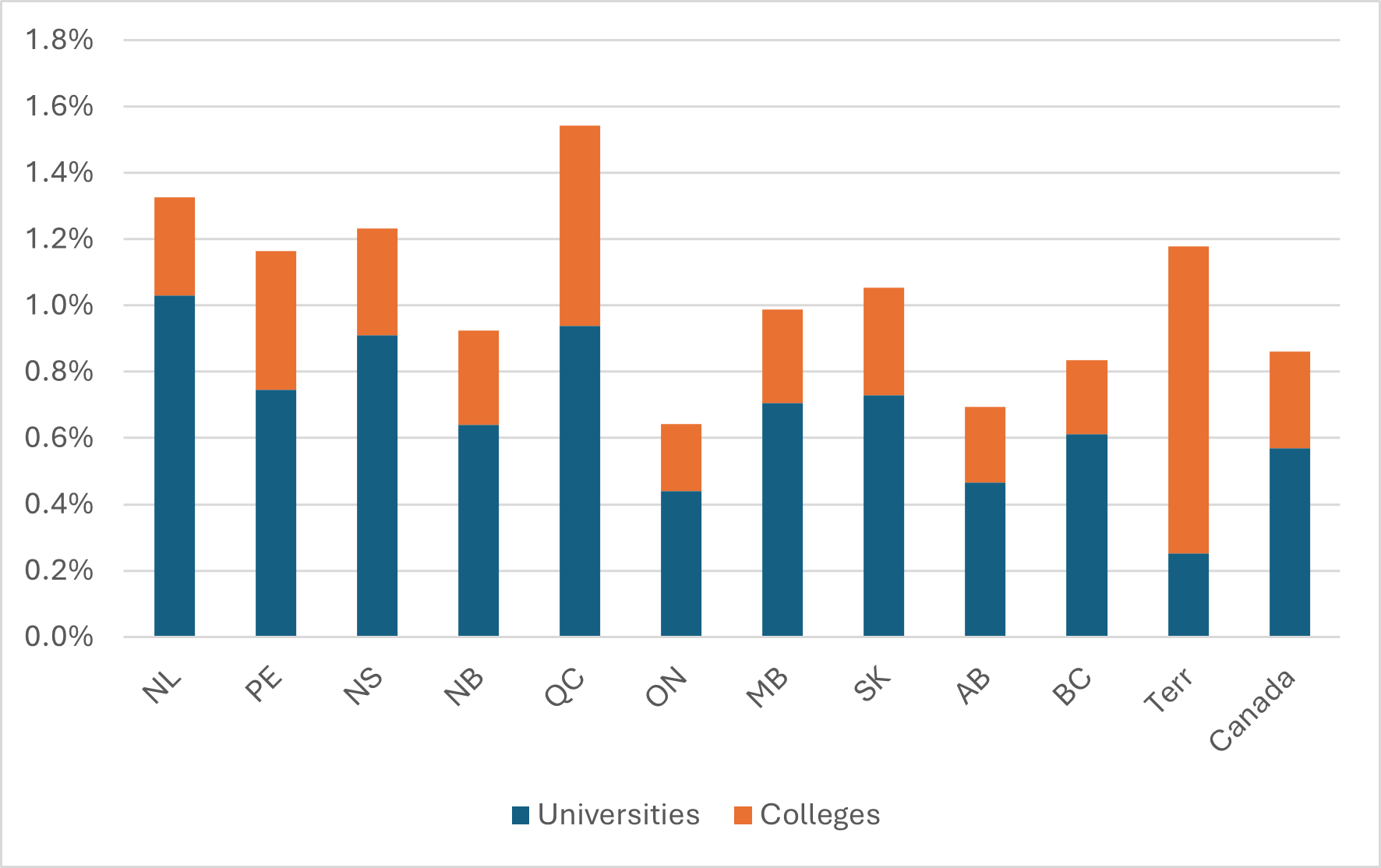
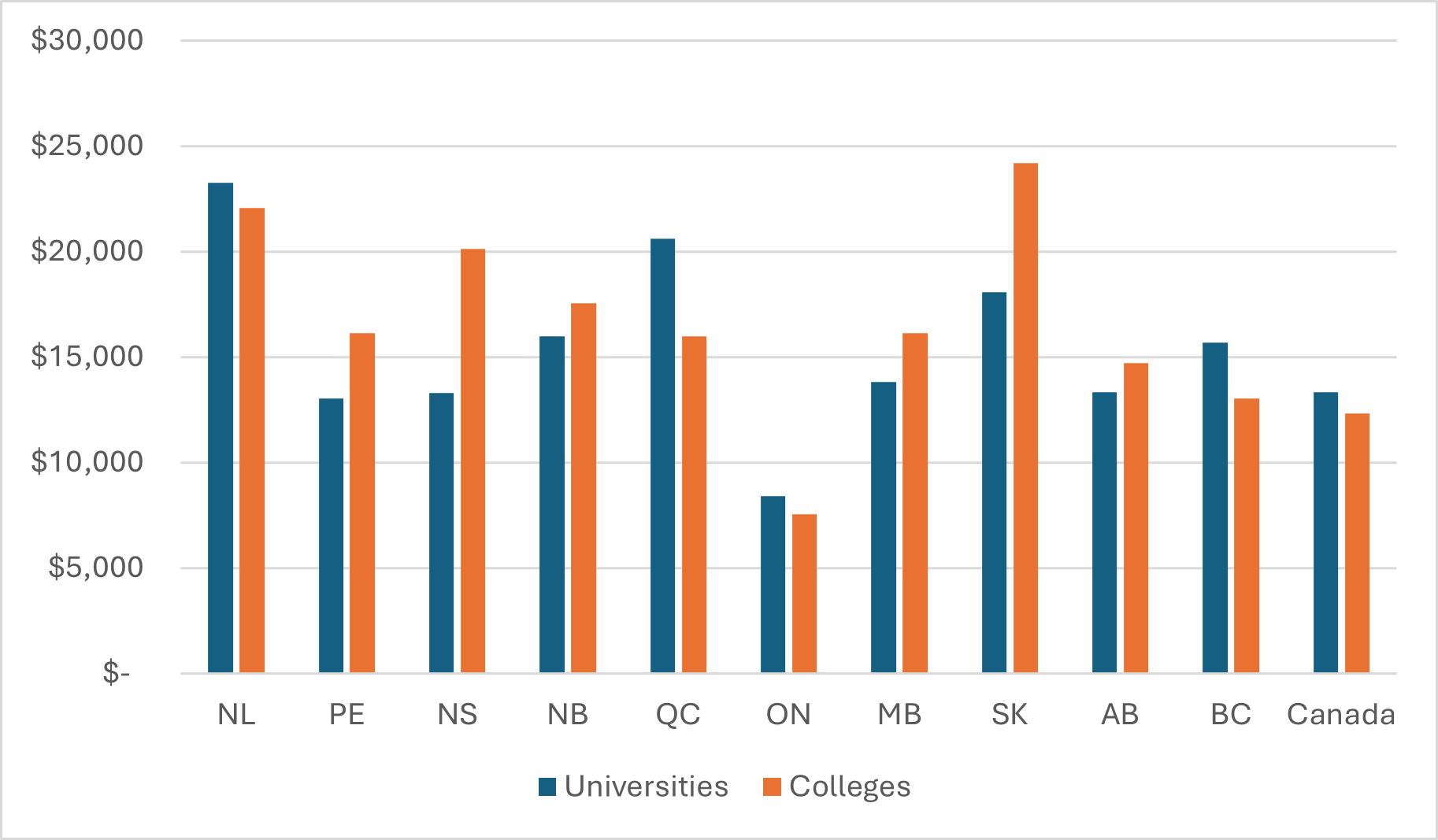
    Many of you will recognize Figures 1 and 2 from earlier blogs or the State of Postsecondary Education 2024. They represent the two most-common ways to look at commitments to postsecondary education: the first in per-student terms, and the second in per-GDP terms.

    Figure 1: Provincial Expenditures per FTE Student by Sector, 2022-23

    Figure 2: Provincial PSE Expenditures, by Sector, as a Percentage of Provincial GDP, 2022-23

    These two approaches have their respective strengths and weaknesses, and not surprisingly they generate slightly different conclusions about how strong each jurisdiction’s efforts are writ to postsecondary education, one focused on the “recipients” of funding (students) and the other focused on the source of the funding (the local economy). Neither is definitive, both are useful.

    But there is another way to look at this funding, and that is not to look at how much institutions receive as a proportion of local jurisdictional output, but to look at what percentage of government spending is devoted to educational institutions. Examined over time, this figure tells you the changing status of postsecondary education compared to other policy priorities; examined across provinces, it can tell you which provinces put more emphasis on postsecondary education. Of course, no one tracks this in Canada, because it involves a lot of tedious mucking around in government documents, but what is this blog for if not precisely that? I wasn’t doing anything on my holidays anyways.

    So I decided to pair my long-term data series on provincial budgets (the most recent one posted back in April), with a new data series on total provincial spending which I derived simply by looking at consolidated expenditures in each province since 2006 and expressed in these same budgets. Usual disclaimers apply: provincial spending definitions aren’t entirely parallel (or at least they use different words to describe what they are doing) particularly with respect to capital, so inter-provincial comparisons are probably a tiny bit apples-to-oranges even if each province’s data is consistent over time. Take the exact numbers with a grain of salt but I think they will mostly stand up to scrutiny.

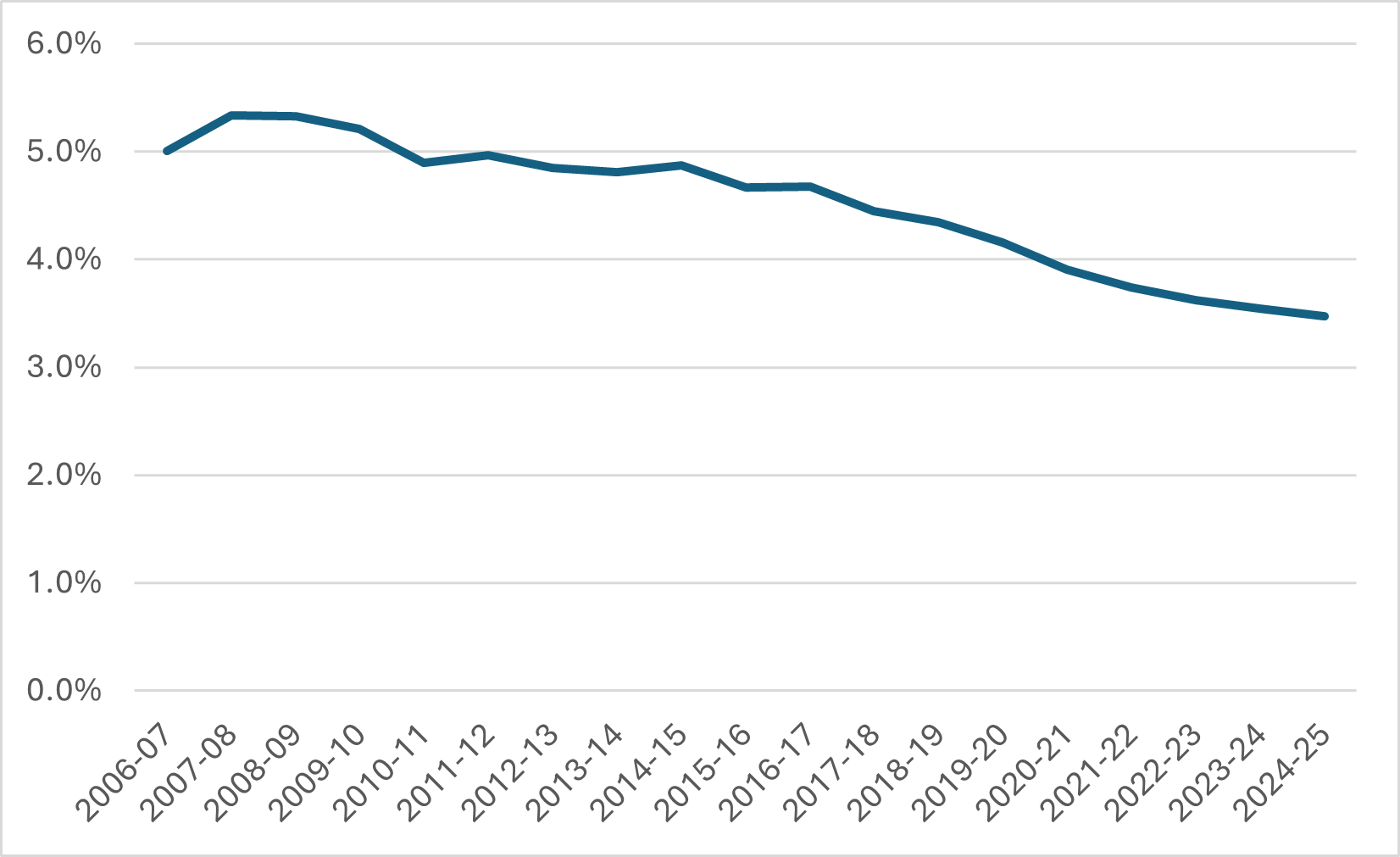
    Figure 3 shows provincial transfers on postsecondary institutions across all ten provinces as a percentage of total provincial spending. And it’s…well, it’s not good. As recently as 2011-12, provinces spent five percent of their budgets on postsecondary education. Now it’s three and a half percent. Or to put it another way, as a proportion of total spending, it’s down by about thirty percent.

    Figure 3: Provincial Spending on PSE as a Percentage of Total Provincial Spending, Canada, 2006-07 to 2024-25

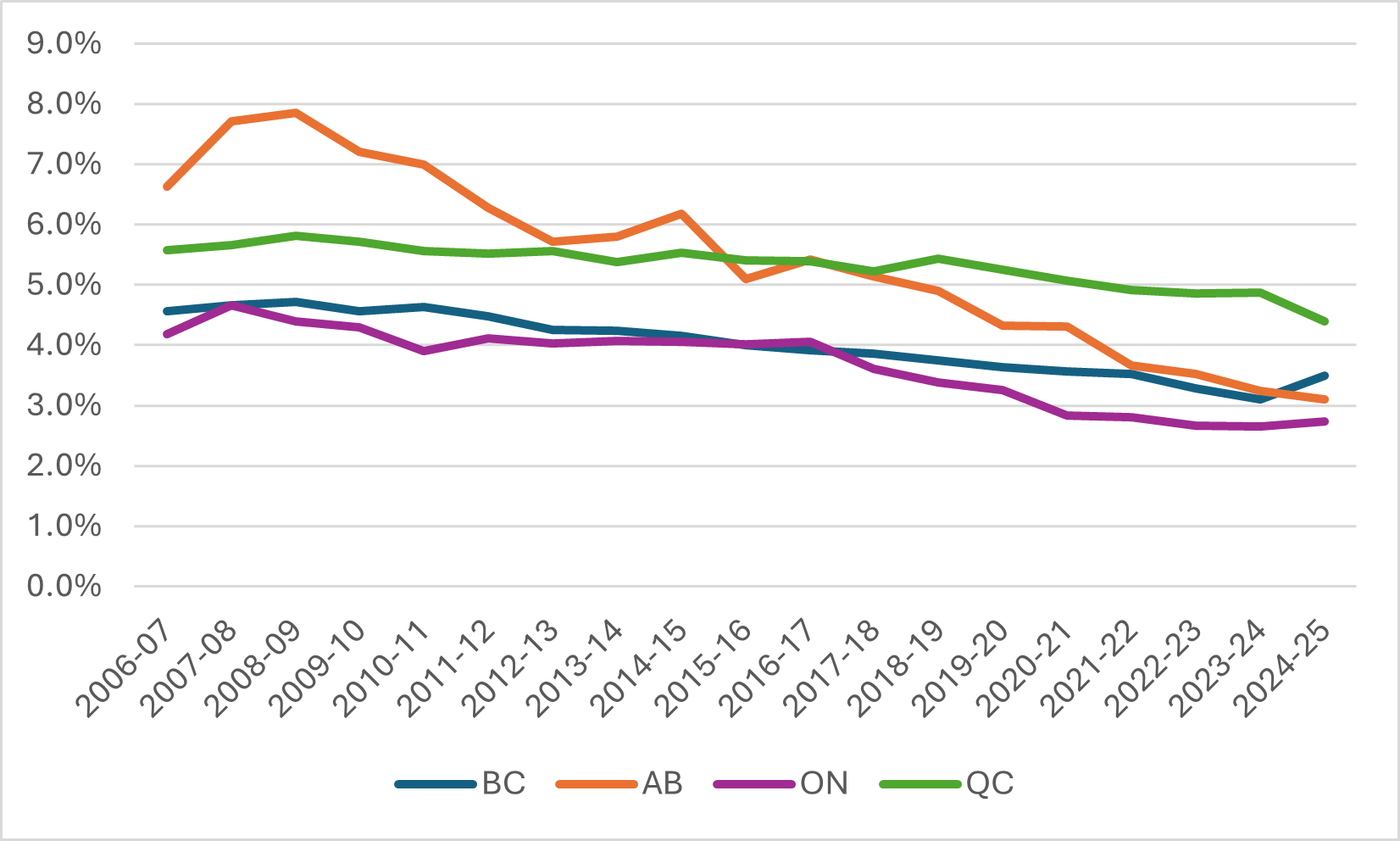
    Is this due to particular events in particular provinces? Not really. Let’s just take a look at the four big provinces (which make up 85% of the postsecondary system. The provinces all started in different places (Alberta, famously, spent a heck of a lot more than other provinces back in the day) and the slope of decline is gentler in Quebec than elsewhere, but the basic path of decline and the eventual destination is similar everywhere. Notable by its absence in any of the four provinces are any clear break-lines which coincide with a change in administration—these declines are pretty consistent regardless of whether governments are left, right, or centre. It’s not a partisan thing.

    Figure 4: Provincial Spending on PSE as a Percentage of Total Provincial Spending, Selected Provinces, 2006-07 to 2024-25

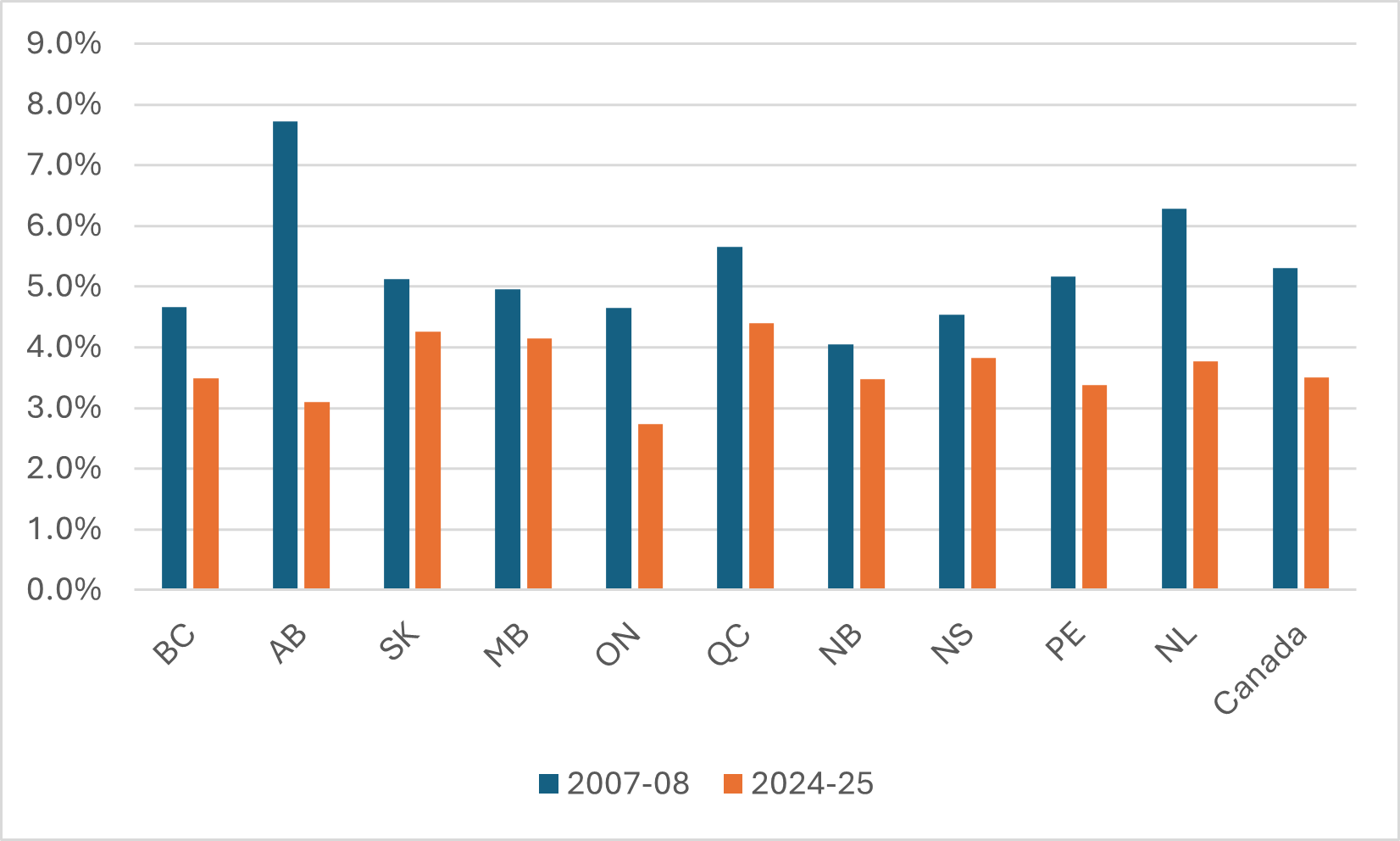
    Figure 5 shows each province’s performance both in 2006-07 and 2024-25. As can clearly be seen, every province saw a decline over the 18-year period. This was not especially driven by one or two provinces: all provinces seem to have come to an identical conclusion that postsecondary institutions are not worth investing in. The size of whatever drop was in most cases inversely proportionate to how high spending was back in the initial period. The biggest drops were in Alberta and Newfoundland, which back in the day were the two highest spenders, riding high as they were on oil revenues. The smallest drop was New Brunswick, which was the weakest performer back in 2006-07. Ontario…is Ontario. But basically, the entire country is converging on the idea that investments in postsecondary need to be in the 2.5%-4.5% range rather than in the 4-7.5% range as they did 20 years ago.

    Figure 5: Provincial Spending on PSE as a Percentage of Total Provincial Spending, by Province, 2006-07 vs 2024-25

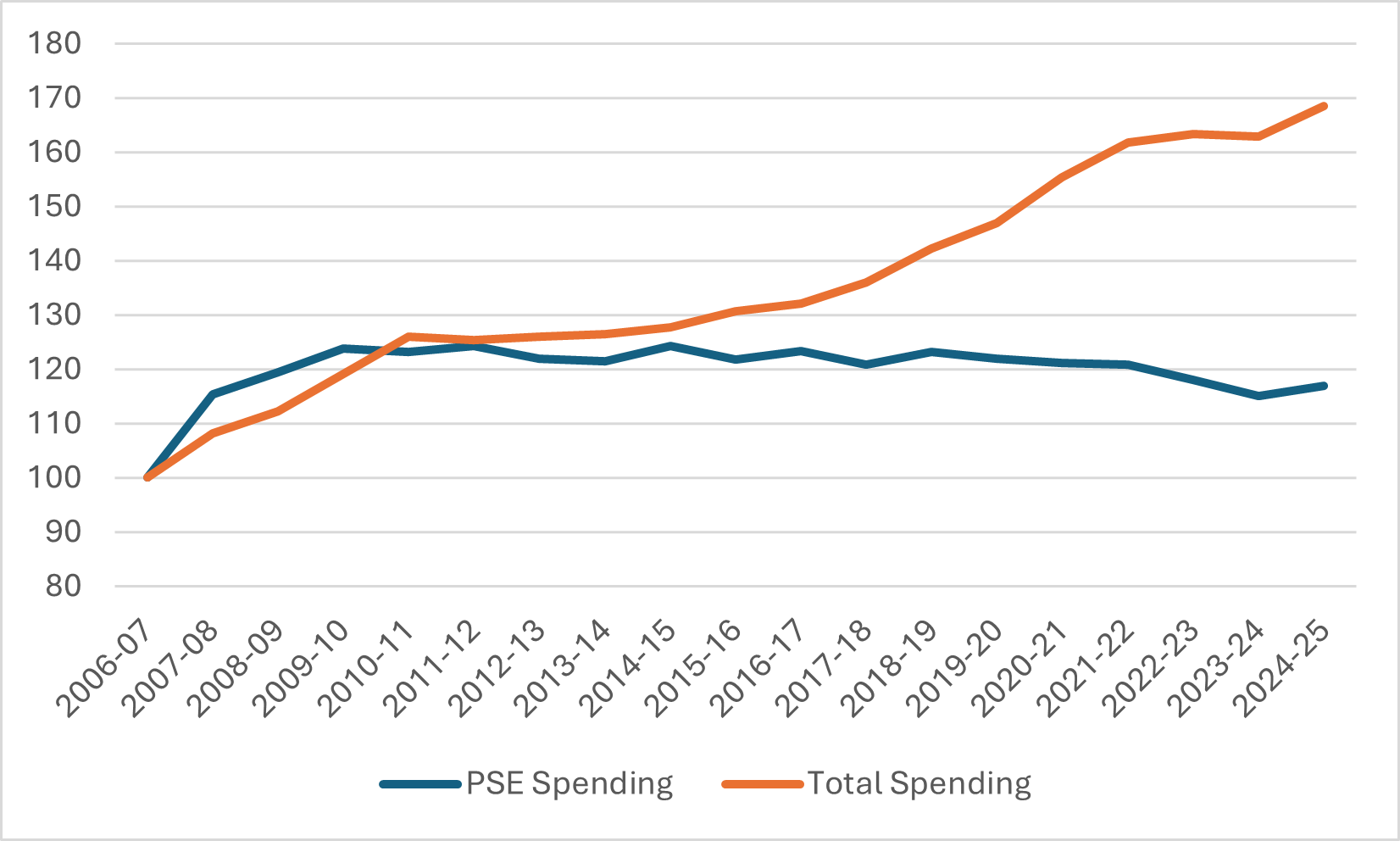
    Now, the obvious conclusion you might draw from this is “hey! Huge declines in public support for public postsecondary education!” But this is not quite correct. Remember: these are ratios we are looking at. Some of the delta will be due to changes in the numerator, some will be due to changes in the denominator. Figure 6 shows changes in both postsecondary spending and total provincial spending. And what’s clear is that the changes we have been examining in Figures 3 and 6 have more to do with the expansion of total spending rather than a decline in PSE spending.

    Figure 6: Real Change Provincial Spending on PSE Institutions vs Real Change Total Provincial Spending, Canada, 2006-07 to 2024-25 (2006-07 = 100)

    That increase in provincial spending in the last decade—30% over and above inflation—is wild. And deeply inconvenient for anyone who wants to build a narrative around generalized “austerity.” But what is clear here is:

    1. transfers to universities and colleges have trailed provincial spending everywhere and without reference to ideology of the governments in question, and
    2. ii) if transfers had not trailed general spending, they would be roughly $9.5 billion better off than they are today.

    And by a simply *amazing* coincidence, $9.5 billion–in real dollars—is almost identical to the increase in income  postsecondary institutions have seen in revenue from international students over the same period (it’s about a $9.2 increase from 2007-08 to 2022-23, the last year for which we have useful data—the 2024-25 is likely somewhat higher but we don’t know by how much).

    There a number of conclusions one could draw from this, but the ones I draw are:

    • Governments are spending more. A lot more. They just aren’t spending on PSE. Instead, they are spending it on an ageing population and other things that juice consumption. Eating the future, basically.
    • The drop in government support for PSE relative to overall spending increases is universal. No government provides any evidence of contrarian thinking. None of them think PSE is worth greater investment.
    • Changes of government are also almost irrelevant. They may change the “vibe” around postsecondary education, but they don’t change financial facts on the ground.
    • There is a really basic argument about the value of postsecondary education which somehow, postsecondary institutions are losing with governments and, I think by implication, the public. That, and nothing else, needs to be the focus of institutional efforts on external relations.

    Provincial governments are eating the future. But the data above, showing that the trend transcends geography and political ideology suggests that at base, the problem is that the Canadian public does not think postsecondary education is worth investing in. Working out how to reverse this view really needs to be job one for the whole sector.

    (Or, to be a bit cuter: the sector needs to do a lot less Government Relations and a lot more Community Relations.)

    Source link