Tag: Edition

  • Collective Punishment, Early Decision Edition (opinion)

    Collective Punishment, Early Decision Edition (opinion)

    Tulane University’s admissions office has banned students from four high schools from applying to Tulane through early decision this fall, according to reporting from The New York Times. Though three of the schools have not been publicly identified, the one-year ban (or “suspension”) for Colorado Academy comes after a student from that school backed out of the early-decision agreement they signed when they applied to Tulane last year.

    For those who aren’t card-carrying college admission geeks like I am, early decision is an application option and enrollment management strategy in which students apply earlier and promise to enroll if admitted, in exchange for receiving an earlier decision offer. The binding nature of early decision means that a student can apply to only one college through early decision.

    In most cases students applying through early decision are asked, along with a parent and their school counselor, to sign an early-decision agreement attesting to their understanding of the commitment to enroll if admitted. Early decision is in no way legally binding, but colleges take the early-decision commitment seriously and are appalled and disgusted when students back out of the commitment. The one agreed-upon reason for backing out of an early-decision commitment is when an institution can’t meet a student’s financial need (as determined by the college’s financial aid formula, not what a family thinks it can pay).

    I have had admission deans tell me that they would hold it against a school whose students did not follow through on the early-decision commitment, but Tulane is the first college I’ve seen publicly penalize schools. The Tulane ban raises some interesting and thorny ethical questions.

    The most obvious is whether it is permissible to punish students in the Class of 2026 for offenses committed by students in the Class of 2025. Retribution may be fashionable these days, but punishing the innocent because you have no way to punish the guilty is not retribution, just wrong.

    But that may be just me. The National Association for College Admission Counseling has an “Ethical Dilemmas in College Admission” page on its website that includes a hypothetical case study in which a student wants to back out of an early-decision commitment. Among the suggested advice for counselors is to caution the student and parents that withdrawing could have negative consequences for future applicants from the school. Even if that might be the case, that’s terrible advice from NACAC, making it seem like colleges punishing future applicants is acceptable and normal.

    At least Tulane is being transparent with its early-decision ban for the schools. As bad as that is, there is a scenario that would be worse, if Tulane ostensibly welcomed early-decision applications from the four schools when it had no intention of admitting any of them.

    The Times article didn’t provide any details about the circumstances leading up to the ban for the four schools, but Tulane’s position seems to be, as the Times paraphrased it, that the schools “failed to uphold the expectations of the early decision agreement.” Let’s examine that claim a little more closely.

    What is a school’s responsibility in advising students wanting to apply early decision? As a counselor, I always advised students and parents that it was a binding commitment, not to be taken lightly. I don’t remember any of my students backing out of an early-decision commitment, but on several occasions I had students who told me on Friday they planned to apply early decision to one college and then a different college on Monday. My response was that they were not ready to apply early decision at all if their thinking was that fluid.

    It’s hard for me to imagine how the schools would have failed in their responsibilities. The counselor part of the early-decision agreement states, “I have advised the student to abide by the early decision commitment outlined above.” As long as they have done that, are they responsible for policing the student’s actions? The school could withhold sending transcripts to other colleges, but in today’s litigious environment, it could face legal action from parents for doing so. I have learned that parents who are lawyers are especially skeptical of the early-decision commitment. If the student wanted to renege on early decision, I would require the student to inform the college. An applicant owes the college that courtesy. Beyond that, schools can’t be expected to enforce early decision.

    There are several other issues that deserve scrutiny. One is Tulane’s claim in a statement to the Times that “A last-minute withdrawal without explanation unfairly impacts other applicants who may have missed opportunities due to the limited number of early-decision offers a university can make.” Excuse me, my BS detector is going off. Tulane has no restriction that I am aware of in the number of students it can admit through early decision, as suggested by the fact that, in recent years, it’s admitted more than 60 percent of its freshman class using early decision, and it has other opportunities to make up for any loss through early decision 2, early action and regular decision.

    There is also an interesting philosophical question about the nature of the early-decision binding commitment. At what point does the binding commitment kick in? Or, more to the point, when does Tulane believe that the commitment is binding?

    The common understanding across the world of college admission is that students take on the binding commitment either as soon as they sign the early-decision agreement, or at least as soon as they are accepted. Tulane’s application instructions state that early decision is binding and that students are expected to withdraw all other applications once accepted and issued a financial aid offer, but there are two other points in the same instructions that bring into question whether Tulane really believes that students are committed as soon as accepted.

    The first bullet point in Tulane’s instructions for early decision defines it as an “application timeline for students whose first choice is Tulane and who are prepared to enroll soon after (italics mine) being admitted and receiving a financial aid offer.” The use of the phrase “soon after” suggests that there is a period of time after acceptance when the student is not yet committed.

    In addition, Tulane expects accepted early-decision applicants to submit a $1,000 enrollment deposit by Jan. 15. Asking for a deposit is not unique to Tulane, but if the student is committed to attend Tulane as soon as they sign the early-decision agreement or upon acceptance, why require an enrollment deposit? If a student is accepted early decision but doesn’t then make the deposit, have they broken the commitment or does that commitment only kick in with the deposit? Am I the only one who sees a contradiction here? (The answer may well be yes, and it wouldn’t be the first time.)

    The broader issue here has to do with early decision itself. Early decision has been around since the 1950s, and it’s controversial. The early-decision “bargain” can be argued to benefit both colleges and students, but it is far more beneficial to institutions as a way to manage enrollment. It doesn’t work well for students for whom financial aid is essential or those who come from schools without savvy college counselors who understand the early-decision game.

    Tulane is the poster child for how colleges and universities use early decision to manage both enrollment and prestige. Its admit rate has declined precipitously in recent years largely through strategic use of early decision. According to its most recent Common Data Set, about 63 percent of the freshman class was admitted through early decision (that’s assuming a 100 percent yield rate for early-decision admits).

    That may actually understate the impact of early decision. Another 20 percent of the class was admitted off the wait list (the CDS shows the number of students admitted off the wait list but does not break it down in terms of enrollments, but there are universities that only admit students off the wait list if they know they will enroll, almost a form of “early decision 3”).

    The heavy use of early decision means that there is a huge variance in the admit rates for early decision and other admissions plans at Tulane (it also has nonbinding early action). According to the Common Data Set, the admit rate for early decision was 59 percent, compared with 11 percent for all other options. That’s not new. A 2022 Inside Higher Ed article reported that Tulane had admitted only 106 students in regular admission. In any case, the numbers suggest that not applying early decision is hugely disadvantageous at Tulane, which makes the ban even more punitive.

    I am trying to be sympathetic to Tulane’s hurt feelings over being dissed by students they admitted in early decision, but I would hope the university’s admissions office will take to heart the wisdom of Gilbert and Sullivan, as well as the Ramones, and let the punishment fit the crime.

    Jim Jump recently retired after 33 years as the academic dean and director of college counseling at St. Christopher’s School in Richmond, Va. He previously served as an admissions officer, philosophy instructor and women’s basketball coach at the college level and is a past president of the National Association for College Admission Counseling. He is the 2024 recipient of NACAC’s John B. Muir Excellence in Media Award.


    Source link

  • Life vs. Education: The Empath Edition – Faculty Focus

    Life vs. Education: The Empath Edition – Faculty Focus

    Source link

  • Life vs. Education: The Empath Edition – Faculty Focus

    Life vs. Education: The Empath Edition – Faculty Focus

    Source link

  • The Professor is In, 2nd Edition (Karen Kelsky)

    The Professor is In, 2nd Edition (Karen Kelsky)

    PLEASE READ: 2nd Edition Book News and Promotion

    I just got word that the second edition of The Professor Is In book – orig. planned for September – might be *delayed*!

    It can’t ship out until we sell the extra inventory of the 1st edition that is still on hand at Amazon, Random House, and other sellers (about 2000 copies).

    I REALLY want the second edition to come out Fall 2025 in time for its 10th anniversary, so I’m running a special promotion!

    If you buy 100 (new) copies of the first edition (ie, the one that’s on sale now at Amazon, Random House, etc.) I will do a FREE 1 hour virtual talk for your department or program on any aspect of the academic or post-academic job search, grant writing, book proposals, or any other topic in my repertoire.

    If you buy 200 new copies, I’ll do a full 1.5 hour virtual talk!

    //Rest assured, the actual job search advice content is virtually unchanged between the two editions! So the first edition remains 100% effective for anyone seeking an academic job in 2025. (For reference, the big difference in the second ed., is in the wider contextualization of this advice – deteriorating conditions of academic labor, attacks on tenure and DEI, considerations for marginalized job seekers around issues of disability, gay and trans identity, BIPOC identity, and mental illness and neurodivergency, making the decision to leave, and above all, prioritizing your personal health and well-being). The one chapter of advice that has been entirely rewritten is the one on “What to Wear”, and I’m happy to send along pdfs of that chapter to anyone who participates in this promotion and wants the updated fashion advice!//

    But wait, there’s more! 🙂

    If you buy 50 books, I will do a 30 minute Q & A with your class or program.

    If you buy 25, I’ll give you a discounted rate for a virtual or in person talk.

    And if you buy 1 to 10 copies, send me the receipt (at [email protected]) and I’ll put you in a drawing for a free suite of services – editing your job or grant documents, doing a zoom consultation with me, etc. – worth $500! You will get as many entries as copies you buy, up to 10.

    Of course, if you’re a Dean or Provost and want to buy 1000+ copies for all the grad students in your college … well, DM me and let’s talk! I’d be glad to reciprocate in some big way that benefits your program.

    Thanks, and please share widely! I hope together we can get this done!

    Source link

  • Check-in on Administrative Bloat, 2025 Edition

    Check-in on Administrative Bloat, 2025 Edition

    Check-in on Administrative Bloat, 2025 Edition

    It’s been a little over five years since I took a serious dive into the question of “administrative bloat,” which apparently exists everywhere but in the statistics. Still, always good to check assumptions every once in a while, and I thought five years was long enough to make a new look at the data worthwhile. So here goes:

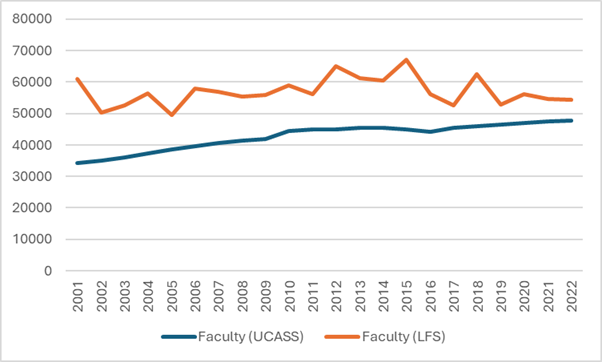
    Let’s start by reviewing what we can and cannot know about staffing at Canadian universities. StatsCan tracks the number of permanent ranked faculty pretty accurately through its University and College Academic Staff Survey (UCASS), and in a loosey-goosier fashion through the Labour Force Survey. The latter gives much higher numbers than the former, as shown below in Figure 1, which compares the number of “ranked” academics from UCASS with the number of permanent, full-time academics from the LFS.

    Figure 1 – Full-time Academic Staff Numbers According to LFS and UCASS

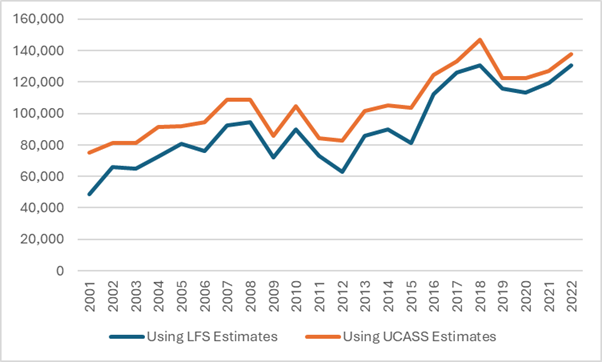
    StatsCan also tracks the total number of employees—both salaried and hourly—in the university sector using the Survey of Employment, Payroll and Hours (SEPH). However, in theory, if you subtract the number of FT academic staff from the number of total staff, you should be able to get the total number of non-academic staff, right? Well, unfortunately, this is where the discrepancy between UCASS and LFS runs into some problems. In Figure 2, I show the implied number of non-academics using both methods. The growth rates are different because of the difference in observations in the early period, but the two estimates do both converge on the observation that there are about 130,000 non-academic staff at Canadian universities, or about two and a half times the complement of academic staff.

    Figure 2 – Implied Non-Academic Staff Numbers using SEPH, LFS and UCASS

    So, that’s evidence of bloat, right? Well, maybe. Personally, what I take from Figure 2 is that either (or both) the LFS numbers and the SEPH numbers are probably flaming hot garbage. There’s simply no way that the number of non-academic staff has increased by 170% in the past twenty years, as a combination of the SEPH and LFS data suggests. For reasons that will become apparent shortly, I also have serious doubts that it’s increased by 85% either, as the combination of SPEH and UCASS suggests. Because there is a second set of data available to look at this question, one that shows expenditure on salaries, and it shows a much different picture.

    The annual FIUC survey shows how much money is spent on wages for ranked academics as well as how much is spent on non-academics (it also shows wages for instructional staff without academic rank,” but I exclude this here for ease of analysis). Over the past three years, it is true that non-academic salary mass has risen, and academic ones have not (score for the bloat theory!), but looked at with a 25-year lens, Figure 3 shows that the rate of increase is about the same (score one against).

    Figure 3 – Total Expenditures on Salaries by Employee Group, in millions of $2023

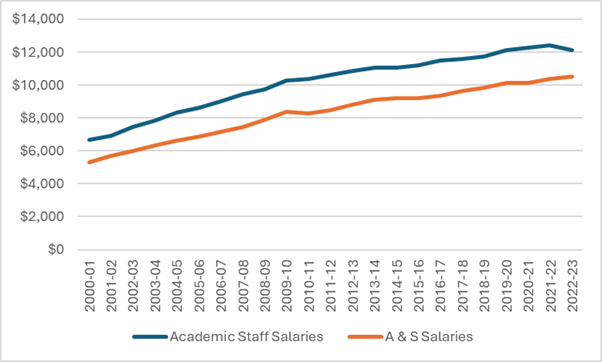
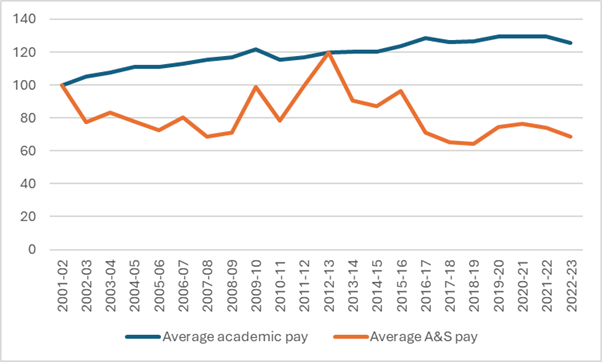
    Basically, the salary data in Figure 3 tells a completely different story than the SEPH/LFS/UCASS data in Figure 2. All you do is divide the spending data by the implied headcounts to see what I mean (which I do below). Figure 4 shows the implied change in average academic pay and average A&S pay, dividing total FIUC pay by the UCASS academic staff numbers and the A&S staff numbers implied by subtracting the UCASS numbers from the SEPH numbers, i.e., the orange line from Figure 2. To believe both sets of data, you have to believe that average academic salaries have increased substantially while average salaries for non-academics have declined substantially.

    Figure 4 – Change in Implied Average Pay, Academic Staff vs. A&S Staff, 2001-02 = 100

    In Figure 4, the blue line representing academic salaries is more or less consistent with the long-term trend in salaries we have seen by looking at salary survey data (which I last did back here): significant growth in the 00s and much slower growth thereafter. There are no staff salary surveys to use for comparison, but let’s put it this way: when people talk about “bloat” in non-academic staff positions, they normally mean it in the sense that the bloat is coming from expensive A&S staff, overpaid A&S staff, etc. For Figure 4 to be true, the growth in staff numbers would need to come almost entirely from more junior, less well-paid staff. It’s not impossible that this is true, but it’s not consistent with the general vibe about bloat, either

    So who knows, really? There’s a lot of contradictory data here, some of which argues strongly in favour of the bloat argument, but quite a bit of which points in the other direction. Better data is needed to answer this question probably isn’t forthcoming.

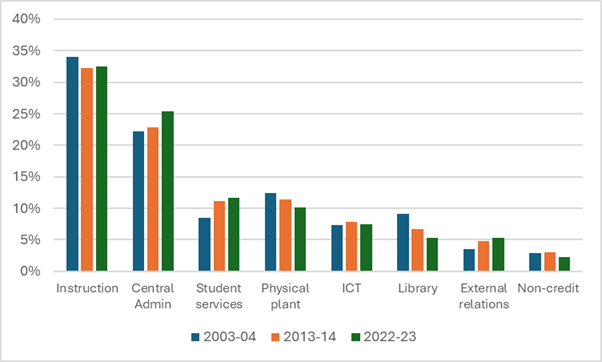
    Meanwhile, we can take one last look at A&S expenditure data. We can check to see if the pattern of A&S salary expenditures across university operating functions has changed over time. As Figure 5 shows, the answer is “a little bit.” Central Administration now takes up 25% of total A&S salary expenditures, up from 22% 20 years ago. Student services and external relations are up much more sharply in proportional terms, but since they were both starting from a low base, they don’t impact the overall numbers that much. Libraries, physical plant, and non-credit instruction are the categories losing share.

    Figure 5: Share of Total A&S Salary Mass by Function, Canadian University Operating Grants, Select Years

    And there you have it: more data than you probably needed on administrative bloat. See you back here again in 2030.

    Source link

  • Q&A With Authors of Chemistry First Edition for GOB Courses

    Q&A With Authors of Chemistry First Edition for GOB Courses

    Reading Time: 6 minutes

    Tell us a little bit about yourself and your background (current title, professional milestones, professional history, education, research works, hobbies, etc.)

    Tiffiny D. Rye-McCurdy: I am a lecturer in chemistry and the Administrative Manager of the Academic Success Center at The Ohio State University at Marion, where I assist students in learning concepts of chemistry and biology both inside and outside the classroom. I currently teach GOB chemistry, general chemistry, organic chemistry and biochemistry. Prior to this position, I taught general chemistry as well as introductory biology courses. I received a B.A. in biochemistry from Ohio Wesleyan University and received my Ph.D. from The Ohio State University Biochemistry program. I am involved in community outreach as the co-coordinator of Ohio State Marion’s science and engineering camps for high school and middle school students. I enjoy visiting local parks with my family and gardening in my free time.

    Ryan J. Yoder: I am an Associate Professor at The Ohio State University, serving the regional campus in Marion, OH. I previously taught GOB chemistry at Marion before joining the full-time faculty in 2013. I currently teach organic chemistry lecture and laboratory courses in addition to serving the campus and university community. I received my B.A. in chemistry from Ohio Wesleyan University and received my Ph.D. from The Ohio State University. I mentor undergraduate research students at Marion and Columbus. I am also currently pursuing chemical education research. I live in central Ohio with my wife and two children where I enjoy family time, travel, cooking, golfing and following sports from around the world.

    Tell us about the GOB course at OSU Marion. What are the most rewarding aspects of teaching the class and the biggest challenges?

    Tiffiny: The most rewarding aspect of teaching the GOB course is getting to show brand-new college students how basic chemistry relates to their health and physiology. In other general chemistry courses, we never get to emphasize the connection between chemicals and their extensive roles in the human body, and I think that delays student interest in chemistry until much later in their academic careers.

    The biggest challenge is that, in covering general chemistry, organic chemistry and biochemistry in one semester, the breadth of knowledge you must communicate is vast. To complicate things, the majority of my class consists of first-year students who may not have developed college-level study habits yet.

    How has the GOB course changed over the past few years? How have you adapted your teaching to reflect those changes?

    Tiffiny: When I taught this course in 2015, it was a scaled down general chemistry course with an introduction to functional groups and a side of biochemistry at the very end. Now the course gives students a foundation in the core concepts of general chemistry, an extensive dive into not only functional groups, but their physical properties and chemical reactions, as well as an extensive coverage of biomolecules and how they all tie into human nutrition and metabolism. It’s very different from the course it used to be!

    Ryan: These developments are influential to the way we wrote the book itself. Since it’s an integrated text, students learn about concepts early on that show up again and again in different contexts in later chapters, which helps reinforce core concepts. For example, the textbook teaches students about molecular shapes, polarity and intermolecular forces in the first third of the book. Then we talk about those intermolecular forces and how they affect the physical properties of organic molecules, learning about them again when we discuss how attractive forces are responsible for the 3-D structures of biomolecules like DNA and proteins.  We believe this approach is the most appropriate to balance the tremendous breadth of the course while going into enough depth for faculty to be able to teach students these fundamentals of chemistry properly.

    How has your work at OSU Marion influenced your work on Fundamentals of Chemistry for Today: General, Organic, Biological Chemistry? What is distinctive about the text? Do you have any suggestions for instructors getting started with the text?

     Tiffiny: Despite our differences, Ryan and I are both very methodical in our teaching approaches. We incorporated our teaching pedagogy into this text by presenting a cluster of related concepts, followed by an example problem which is solved step-by-step to show students a logical way to break down more complex problems, and show them the thought process. We follow these in-chapter worked examples immediately with a Learning Check to reinforce what the students learned, allowing them the opportunity to build those critical problem-solving skills.

    Ryan: This text not only breaks down complex problems with a step-by-step approach, but the importance of the chemistry is constantly being shown with real-life examples of how it relates to the world around us. Not only is this evident in the way we introduce the concepts themselves, but we also provide extra features throughout each chapter to highlight connections between the chemistry we’re learning and the larger world. We begin each chapter with a Career Focus feature, to show our students that not everyone in health care is a doctor or nurse.  And, in fact, many of the topics we cover in each chapter are directly related to a variety of careers in health-related fields. Also, throughout each chapter, we have several Health Connections and Environmental Connections to make the material come even more to life.

     How does WebAssign connect to your text? How do you use it in your course? Do you have any suggestions for professors getting started with WebAssign?

     Tiffiny: WebAssign for Chemistry, Cengage’s online learning platform, serves as an excellent tool for instructors to create graded assignments using a mixture of end-of-chapter and learning check exercises. I currently use it to assign homework to help students understand the concepts taught during lecture, and next semester I will use it to create extra review assignments (outside the hard-copy review packets I provide now).

    Students love the Practice Another feature, which allows them to do a similar problem to those assigned. In fact, sometimes my students do those first to ensure they understand the concept before getting graded on their assignment. They also like the Ask Your Teacher feature, which allows them to ask me a question on specific problems and helps me see where students are struggling to understand when they are on their own. Lastly, WebAssign will soon include videos of Ryan and I working through specific exercises, showing how to approach each problem in a stepwise manner. These will be a great resource that students can watch in addition to the lecture with their own instructor.

    How do you see this text deepening students’ engagement with chemistry and fostering more active engagement with core concepts? What is the most significant takeaway students will carry with them after using this textbook?

    Tiffiny: I think tying general chemistry to our physiology really helps students connect to the material, when they might otherwise “zone out.” I really think students will have a basic, introductory understanding of chemistry in the body that they can build on when going into a science education or health and medicine field.  Examples include conversion in the context of medical dosages, pH in the context of blood buffers, dilutions in the context of medication, REDOX reactions and the role of electron carriers in cellular respiration, how glycolipid antigens determine our blood types, the central dogma and chemicals that serve as micro and macronutrients.

    Ryan: I think, in general, students who use this text will see how all of chemistry is connected to itself and how chemistry is connected to their broader world. On that latter point, I believe it’s critical that we included such cutting-edge technologies as COVID vaccines and CRISPR, which are sure to be a part of the health care landscape well into the future. Seeing chemistry in action through such relevant advancements and challenges will allow for more active engagement with the rest of the material. I think the way we scaffold the later organic and biochemistry material also gives students the best opportunity to carry that relevant knowledge further into their academic and professional journey.


    Tiffiny D. Rye-McCurdy is the Administrative Manager of the Academic Success Center and a lecturer in chemistry at The Ohio State University at Marion. Dr. Rye-McCurdy currently has a rotational schedule teaching GOB chemistry, general chemistry and organic chemistry. Prior to this position, she taught biochemistry and introductory biology and physiology courses. She received her B.A. in ACS-certified biochemistry from Ohio Wesleyan University and her Ph.D. from The Ohio State University Biochemistry program.

    Ryan YoderRyan J. Yoder is an Associate Professor at The Ohio State University, serving the regional campus in Marion, OH. Dr. Yoder previously taught GOB chemistry at Marion before joining the full-time faculty in 2013. He currently teaches organic chemistry lecture and laboratory courses in addition to serving the campus and university community. He received his B.A. in chemistry from Ohio Wesleyan University and his Ph.D. from The Ohio State University. Dr. Yoder mentors undergraduate research students at Marion and Columbus, examining protein-ligand interactions toward therapeutics against threats from chemical weapons and cancer.
     

    Interested in “Fundamentals of Chemistry for Today: General, Organic, and Biochemistry,” 1e by Tiffiny D. Rye-McCurdy and Ryan J. Yoder for your chemistry course? Check out this title now.

    Source link

  • Call for Submissions for Special Edition – “Trends in the Use of Generative Artificial Intelligence for Digital Learning.” (Anthony Picciano)

    Call for Submissions for Special Edition – “Trends in the Use of Generative Artificial Intelligence for Digital Learning.” (Anthony Picciano)


    Dear Commons Community,

    Patsy Moskal and I have decided to be guest editors for Education Sciences for a special edition entitled,

    “Trends in the Use of Generative Artificial Intelligence for Digital Learning.” (See below for a longer description.)

    It is a most timely topic of deep interest to many in the academy. We would love to have you contribute an article for it. Your submission can be research, practitioner, or thought-based. It also does not have to be a long article (4,000-word minimum). Final articles will be due no later than July 1, 2025.

    You can find more details at: https://www.mdpi.com/journal/education/special_issues/6UHTBIOT14#info

    Thank you for your consideration!

    Tony


    Source link