Tag: eds

  • ED’s Problematic “Professional Degree” Definition (opinion)

    ED’s Problematic “Professional Degree” Definition (opinion)

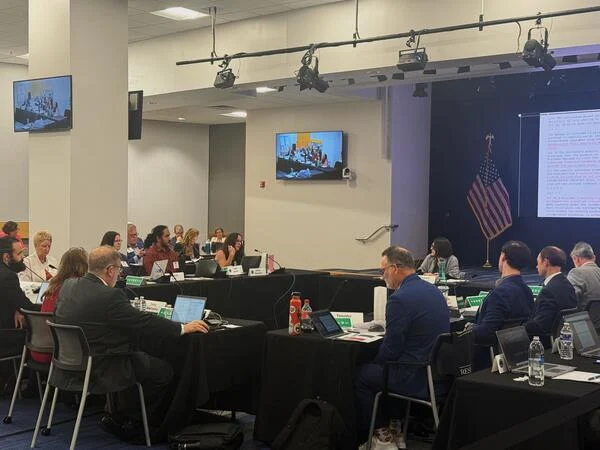
    In early November, following extensive debate by the RISE negotiated rule-making committee, the U.S. Department of Education proposed a definition of “professional degree” for federal student aid that could deter talented students from pursuing health-care careers. The proposed rule, stemming from the One Big Beautiful Bill Act, would leave students in many fields critical for our future health-care workforce subject to a $20,500-per-year federal student loan cap.

    Physician assistant/associate programs stand to be strongly affected. These programs are intensive, highly structured and clinically immersive. Students complete rigorous professional-level coursework while rotating through multiple clinical sites to gain hands-on experience. Unlike in many graduate programs, PA students cannot work during their studies, as clinical rotations are full-time and often require travel across multiple locations. Within this context, federal student aid is not optional; it is the lifeline that allows students to stay in their programs and complete the training they have worked for years to achieve. Without it, some students will have no choice but to abandon the profession entirely.

    The financial gap under the department’s proposal is striking. Tuition alone —not including expenses like housing, food and other needs—for PA programs often exceeds $90,000 for the duration of the program due to the unique costs associated with health professional education, such as simulation technology and clinical placement expenses. Under the department’s proposal, federal student aid would only cover a fraction of this amount. For students without access to private resources, the gap will likely be insurmountable.

    These challenges are not hypothetical. A student accepted into a PA program may face a choice to take on crippling private debt or leave the career track entirely. Students in nurse practitioner, physical therapy and occupational therapy programs face the same reality. Each of these programs combines intense academic and clinical requirements, preparing graduates for immediate entry into practice. Federal policy must recognize this reality if it hopes to support the next generation of health-care professionals.

    The consequences extend far beyond individual students. PA students, along with other health professions students, are essential to addressing workforce shortages, especially in rural and underserved areas. Every student forced to forgo pursuing a PA program due to financial barriers represents a future provider absent from the health-care system. At a time when demand for care is rising, federal policy that fails to recognize these students risks worsening shortages and limiting access to care for patients who need it most.

    The Department of Education has the opportunity to correct this in the final rule. Explicitly including PA students, along with nurse practitioners, physical therapists, occupational therapists and other professions that meet the statutory criteria for professional degrees would ensure that aid reaches students fully committed to intensive, licensure-preparing programs. Recognition will reduce financial stress, allow students to focus on becoming high-quality health-care providers and maintain the pipeline of skilled professionals critical to patient care.

    Including PA and other health professions students in the department’s final rule is both necessary and prudent. It allows students to complete programs they cannot otherwise afford, protects the future health-care workforce and ensures that communities continue to have access to vital services. The Department of Education can achieve clarity, fairness and meaningful impact by explicitly recognizing these professional students.

    Sara Fletcher is chief executive officer of the PA Education Association.

    Source link

  • Why PR May Be One of Higher Ed’s Most Urgent Strategies Right Now 

    Why PR May Be One of Higher Ed’s Most Urgent Strategies Right Now 

    Trust in colleges and universities is slipping. Public narratives about higher education are being shaped without institutional input. At the same time, search behaviors that marketing teams have spent years refining are being rapidly overtaken by artificial intelligence and that shift is fundamentally altering how visibility is earned and maintained. If institutions do not begin treating public relations as a strategic imperative they risk being left out of the conversations that define relevance. 

    The urgency becomes clearer when we look at the data. According to our 2026 Landscape of Higher Education Report, 74% of Americans in 2010 believed college was “very important” to success. By 2025, that number has dropped to just 35%, as shown in Gallup’s latest trend data. Meanwhile, the percentage of people saying college is “not too important” has increased fivefold. These are not isolated shifts in public opinion. They are broad signals that confidence in higher education is diminishing and with it, the sector’s influence in shaping the future workforce and civic landscape. The reality that this is not business as usual, but what comes next, is becoming harder for leadership teams to ignore. 

    Despite this, many institutions continue to rely on messaging frameworks and digital strategies that were designed for a web environment that no longer exists. 

    AI Is Rewriting the Rules Quietly and Quickly 

    Search behavior is evolving at a pace that is difficult to match and artificial intelligence is now redefining what visibility looks like. EducationDynamics’ Q3 2025 data shows that nearly 43% of all Google searches end without a click. In other words, users are getting their answers directly from AI-generated summaries, often without ever reaching an institution’s website. 

    That change does not diminish the importance of websites or blog content, but it does alter how they function. Pages that were once primary destinations are now source material feeding large language models and search algorithms. The value of that content is not in clicks alone, but in its ability to influence what AI tools surface in response to user questions. 

    The AI Visibility Pyramid featured in our 2026 Landscape of Higher Education Report illustrates how visibility is earned in this new environment. At its foundation is owned content, which includes blogs, faculty profiles, explainer articles and program pages. These assets contribute essential signals that shape how AI systems understand and rank institutional authority. However, they are not sufficient on their own. They must be elevated and validated through external sources to carry meaningful weight in this ecosystem. 

    Owned content becomes most effective when it is distributed and linked through credible channels. Media coverage, thought leadership placements and backlinks from high-authority outlets all play a critical role in reinforcing an institution’s visibility and shaping its reputation in the broader information landscape. What matters most is not just what institutions say about themselves, but where and how those messages are repeated, cited and trusted. 

    For leaders building their broader growth roadmap, the dynamics of AI, trust and visibility align directly with the strategies outlined in The 2026 Growth Strategy Higher Ed Needs Right Now and in the 2026 Higher Education Digital Marketing Trends and Predictions

    We Cannot Let the Work Go Unseen 

    The transformational work happening within higher education is substantial, but it is often not reaching the audiences who need to see it most. Whether it is a first-generation student securing a high-impact internship, a research partnership influencing policy or faculty-led innovation with industry implications, these stories are powerful proof points of institutional value. Yet too often, they remain confined within internal channels or are overlooked altogether. 

    Public relations plays an essential role in ensuring this work does not go unseen. Visibility must be actively cultivated, not assumed. Trust is built not only through consistent messaging, but through third-party validation that reinforces an institution’s credibility and relevance. As AI becomes the first layer of search for many users, the presence of credible, external proof will determine whether institutions are even included in the digital conversation. 

    The absence of that visibility has consequences. When institutions are not showing up in external media, not being cited in trusted sources and not contributing to narratives beyond their own platforms, they become harder to discover and easier to overlook. That decline in visibility often coincides with declines in public trust, prospective student interest and donor engagement. Reversing those trends begins with being present and recognized in the places that matter most. 

    For many colleges and universities, that also means grounding PR strategy in data from resources like the EducationDynamics’ Marketing and Enrollment Management Benchmarks, which tracks how visibility, demand and student behavior are shifting across the sector. 

    Public Relations Is Not a Press Release Function 

    In many institutions, public relations remains anchored to a traditional calendar of announcements tied to internal milestones. Press releases about new buildings, faculty honors, strategic plans and major gifts continue to dominate the output. While these updates have their place, they rarely break through the broader noise or shift the public narrative in a meaningful way. The same structural constraints that can keep marketing from leading, as we describe in Marketing Can’t Lead If Shackled by Structure, often limit what PR is allowed to be. 

    Today, public relations must function as a core strategic asset, not a service center. Its value lies in its ability to translate institutional mission and outcomes into public narratives that are credible, compelling and consistent with the institution’s brand. These stories should not be reactive, nor should they be generic. They should be aligned with the brand pillars that define what the institution stands for and where it is headed. 

    Institutions that claim leadership in areas like social mobility, research innovation or workforce readiness must make those claims evident through the stories they place and the voices they elevate. It is not enough to state the promise. It must be demonstrated through ongoing, credible engagement that reflects those themes in national and regional conversations. 

    This is where owned content and earned media intersect. Blogs, faculty profiles and campus features continue to matter, but they must be intentionally positioned and supported through media outreach and content distribution that expand their reach. 

    According to Muck Rack’s 2025 Generative Pulse report, more than 95% of the sources cited by generative AI tools are unpaid. Of those, 27% are journalistic, with the most frequently cited outlets including Reuters, NPR, the Associated Press, The New York Times and Bloomberg. These platforms are not pulling directly from institutional press centers. They are reflecting content that has been validated, shared and linked widely across trusted networks. 

    For institutions that want to shape public perception, these are the environments where visibility must be earned. That means placing stories where they will be seen, cited and shared. It also means ensuring that those stories reflect the strategic priorities and differentiators that define the institution’s place in a competitive market. 

    Leaders do not have to guess where to begin. EducationDynamics’ market research solutions and consulting services are built to help institutions translate insight into narrative strategy, then connect that strategy to measurable revenue and reputation outcomes. 

    Public relations is no longer optional. It is an infrastructure investment in how institutions are discovered, described and believed. It builds the signals that matter most to both human audiences and machine-driven systems. It is not enough to have a good story. It must be findable, credible and aligned with the identity the institution wants to project. 

    What Leadership Should Do Now 

    For presidents, CMOs and enrollment leaders, treating PR as infrastructure starts with a few concrete moves: 

    • Audit your external visibility 
      Compare how you are described on your own channels with how you show up in search results, media coverage and AI summaries. Identify the gaps between the story you tell and the story the market sees. 
    • Align PR with brand and enrollment goals 
      Build PR around a small set of institutional themes, such as social mobility, research impact or workforce readiness, that reinforce your brand and support priority programs. Measure success in terms of visibility, inquiry growth and reputation, not just clips. 
    • Prioritize a short list of voices and proof points 
      Elevate a consistent bench of leaders, faculty and partners who can speak to your themes with credibility. Match their stories to concrete outcomes, such as student trajectories, employer partnerships or policy influence. 
    • Resource PR to lead, not just respond 
      Shift PR from a press release calendar to a proactive pipeline of narratives aimed at the outlets, conversations and audiences that matter most. Integrate that work with marketing, enrollment and crisis leadership, as we emphasize in Leadership Matters During Crisis. 

    These steps move PR from a communications activity to a strategic system that shapes how your institution is discovered and believed. 

    Leadership Cannot Afford to Miss This Moment 

    The question is no longer whether an institution is doing meaningful work. It is whether that work is being seen, cited and valued in the right places. Institutions that fail to show up in earned media, in search results and in national conversations are not simply underexposed. They are at risk of becoming irrelevant, not because they have failed to deliver, but because they have failed to be discovered. 

    The stakes of that visibility gap increase during times of disruption. The same is true for the sector’s own story. EducationDynamics’ In the News presence and Insights hub illustrate how consistent, strategic visibility can reinforce a clear point of view and a challenger mindset in the market.  

    This is not a short-term communications problem. It is a long-term visibility challenge. For colleges and universities that want to remain vital to the communities they serve, public relations may be one of the most urgent and strategic tools available right now. When PR is aligned with full-funnel marketing services, enrollment strategy and market intelligence, it becomes a force multiplier for both revenue and reputation. 

    Discover how we help institutions proactively shape their narrative in an AI-driven world. Contact the PR experts at EducationDynamics for a personalized discussion. 

    Source link

  • Trump Gutted ED’s Civil Rights Office. Could States Step Up?

    Trump Gutted ED’s Civil Rights Office. Could States Step Up?

    The Education Department’s Office for Civil Rights, which is supposed to protect students from discrimination based on race, ethnicity, sex, age and disability status, isn’t what it once was.

    The Trump administration laid off nearly half the staff in March, shuttered seven of its 12 regional offices, shifted the hollowed-out agency’s focus to new priorities (including keeping transgender women out of women’s sports) and then reportedly terminated more employees amid the ongoing shutdown.

    Philadelphia was among the cities that lost its OCR regional office in the first round of layoffs. Lindsey Williams, a Pennsylvania state senator who serves as minority chair of the Senate Education Committee, said the region’s cases now go to Atlanta, “where they may or may not be heard.”

    To fill this void, Williams, a Democrat, announced she will file legislation to establish an Office of Civil Rights within the Pennsylvania Department of Education. The bill has yet to be written, but Williams said she wants to “create new authorities for the Pennsylvania Department of Education to investigate and enforce federal civil rights violations.” She noted, “There may be opportunity as well to strengthen our state laws in this regard.”

    “We’re looking at all of it to see what we can do,” she said, “because we haven’t been here before.”

    Students facing discrimination across the country now have far fewer staff in the federal Education Department OCR who can respond to their complaints. The agency had a large backlog of cases even before President Trump retook office, and then it dismissed thousands of complaints in the spring. Some advocates have expressed particular concern about OCR’s current capacity to process complaints of disability discrimination.

    And those left at OCR appear to be applying a conservative interpretation of civil rights law that doesn’t recognize transgender students’ gender identity. The Trump-era OCR has actively targeted institutions for allowing trans women in women’s sports. It’s also focused on ending programs and practices that specifically benefit minorities, to the exclusion of whites.

    Civil rights advocates are calling for states to step up.

    “We cannot stop what is happening at the federal level,” Williams said. “There’s plenty of lawsuits that are trying … but, in the meantime, what do we as a state do?”

    One of those ongoing suits, filed by the Victim Rights Law Center and two parents in April, alleges that shrinking OCR harms students from protected classes. It argues that the federal OCR cuts left “a hollowed-out organization incapable of performing its statutorily mandated functions,” adding that “without judicial intervention, the system will exist in name only.” But that intervention may not work in students’ favor—judges have issued preliminary injunctions, but the Supreme Court has, so far, allowed the Education Department layoffs to continue.

    Shelby Chestnut, executive director of the Transgender Law Center and a Pennsylvania resident, said, “States need to be picking up some of the slack.”

    “If more states with Democratic leaders started to propose such offices or legislation or money, it would likely create a bigger conversation,” Chestnut said.

    He noted that during the Obama administration, the federal government sued North Carolina over its controversial law banning trans people from using bathrooms matching their gender identity. But that’s not something the Trump administration would do. Chestnut said some states are now saying—and more should be saying—“OK, you won’t do your job, so we’ll do your job for you.”

    Beth Gellman-Beer, who was director of the Philadelphia regional office of the federal OCR before the Trump administration laid her off, said she doesn’t know of other states creating a new state-level agency like the one that’s been proposed in Pennsylvania. Even there, Republicans control the state Senate, and the legislation isn’t certain to pass. She said other state legislatures “should be really thinking about this and taking immediate steps to build out some kind of civil rights unit to help students in their state.”

    Some states already have their own agencies that protect civil rights in higher ed, Gellman-Beer said, including the existing Pennsylvania Human Relations Commission. But she said these entities “are traditionally severely understaffed and don’t have the resources and relied heavily on OCR.”

    Chad Dion Lassiter, executive director of the Pennsylvania Human Relations Commission, agreed with Gellman-Beer’s assessment of commissions like his. Lassiter said he feels “sheer exuberance” over the proposed legislation—which he said would be even greater if the new Office of Civil Rights were created in his agency.

    “Give us 20 additional staff and we’ll do the work,” Lassiter said. Ideally, 15 would be investigators in his agency’s education division and five would be attorneys, he said.

    “Each state that has a human relations commission should have an educational component,” he said. “Fund these commissions.”

    Gellman-Beer said the only true fix is to restore a federal OCR—because even if some states do step up, students’ rights will be contingent on where they live.

    “It used to be, under the model prior to this administration, that the promise for equal educational opportunity was across the board,” she said.

    Unequal Rights Across States

    For a student going before a state-level OCR in a state that doesn’t recognize their identity, the process could be as fruitless as seeking help from the Trump-era federal OCR. The Movement Advancement Project, which advocates for LGBTQ+ rights, says 27 states have laws banning trans students from participating in sports matching their gender identity. Such laws don’t all affect postsecondary students, but they often do, the organization said.

    Nicholas Hite, a senior attorney at Lambda Legal, which advocates for LGBTQ+ people in court, said the federal OCR was supposed to provide a single, consistent application of federal legal protections. Now, he said, “that just isn’t happening—they’re just refusing to do it.”

    “If we’re relying on states to be the enforcement mechanism, we’ve created this patchwork where each state is going to take their own approach,” Hite said.

    Universities in states with laws recognizing trans students’ rights have to decide whether to comply with those laws or with the Trump administration’s approach. The administration, using massive cuts to federal research funding, forced concessions from the University of Pennsylvania for allowing a trans woman to compete in women’s sports. But Scott Lewis—a co-founder of the Association of Title IX Administrators and managing partner of TNG Consulting, which advises higher ed institutions on civil rights issues—said so far he’s seen blue-state universities handling discrimination complaints like they did before Trump retook office.

    Lassiter, of the Pennsylvania Human Relations Commission, said, “It’s important for people to know you still have protections under the state.” But protections for trans students can be unclear.

    His agency enforces state laws protecting students against discrimination based on gender identity, but wouldn’t directly answer whether that means it would order a university to allow a trans woman to play on a woman’s sports team. Lassiter said his agency avoids “cultural wars.”

    Students facing discrimination of all sorts can still sue under federal civil rights law in lieu of seeking help from the federal OCR or any state version of that agency. But personal lawsuits can be expensive.

    Williams, the Pennsylvania state senator, noted that lawsuits may also not wrap up by the time a student graduates. Gellman-Beer, the former federal OCR employee, said they also often lead to individual remedies for a victim, rather than “systemic interventions to make sure that the problem doesn’t occur again for other students.” That was the kind of broad solution the federal OCR could achieve, she said.

    Hite welcomed people whose rights are being infringed, or who are concerned about others’ rights, to reach out to Lambda Legal. He noted the federal OCR did much of its work through negotiating with universities to fix issues, rather than pursuing litigation. If the federal OCR is no longer doing these negotiations, the burden is placed on students and parents to sue to uphold their own rights—while an added cost of litigation is also placed on universities, he said.

    Lewis said that if the Trump administration continues its trajectory, people who don’t feel they’re being served at the federal level will go to the state level.

    “If the federal government won’t do it,” he said, “the states are going to be left to do it.”

    Source link

  • Charlie Kirk Killing Feeds Fears for Higher Ed’s Future

    Charlie Kirk Killing Feeds Fears for Higher Ed’s Future

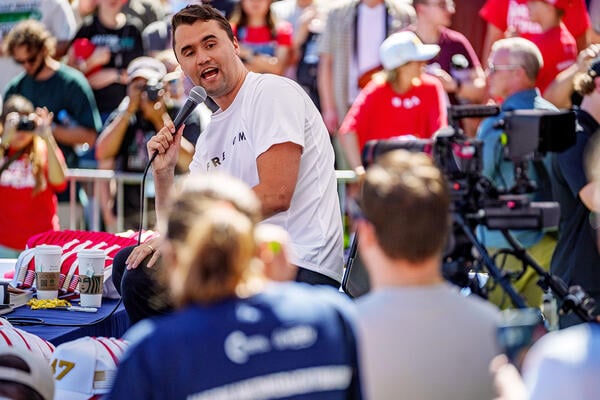
    Wednesday saw a moment without precedent in recent history: A college speaker shot to death on a campus during an event. That fact alone would’ve escalated growing concerns about the future of free speech and civil discourse at colleges and universities.

    But this speaker was Charlie Kirk, a prominent ally of a U.S. president who was already crusading against higher ed. Kirk, a national political figure in his own right, was one of the foremost conservative critics of intolerance for right-wing views in higher ed and the founder and leader of Turning Point USA, a nationwide organization of conservative campus groups that aided the president’s re-election. Kirk even spoke at Trump’s January inauguration.

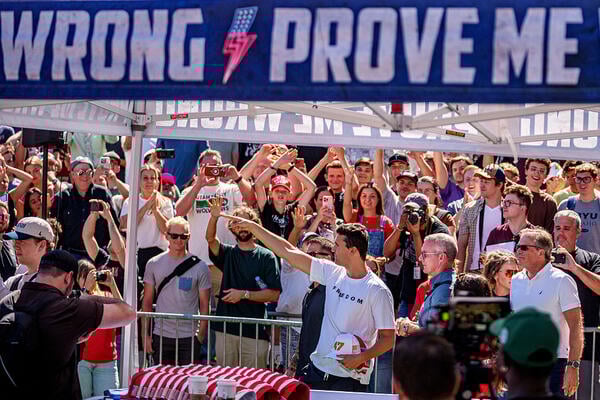
    He was known for goading students on campuses to “prove me wrong,” posting the resulting clips online, appearing in conservative media to denounce higher ed, spreading his views further on his own podcast and using his organization’s online presence and on-the-ground staff to target left-leaning faculty.

    “College is a scam,” Kirk, who dropped out of Harper College in Illinois, wrote in a 2022 Fox News op-ed, in which he urged most students not to go.

    “Universities are indoctrination zones where free speech is crushed,” he wrote. “Radical students and faculty coerce and persecute their nonconforming peers through ‘cancel culture’ and threats … I firmly believe that most—if not all—the destructive ideas that are now eating away at the foundation of American society originated on college campuses.”

    His death at Utah Valley University could put more pressure on higher ed at a time when colleges and universities have already been excoriated and targeted by the right. Faculty and those who criticize higher ed as being insufficiently open to civil debate between different viewpoints are worried that free expression will further erode.

    “This is an epic moment for the future of higher ed,” said John Tomasi, president of Heterodox Academy. “For the issue of free speech, there’s been nothing quite like this ever before.”

    Tomasi, whose organization promotes “viewpoint diversity” and “constructive disagreement” on campuses, noted both Kirk’s national stature and his association with campus free expression. He was the kind of person that conservatives had long argued wasn’t welcome on campuses.

    “This is an attack on a magnitude that we have not previously seen,” he said. He said national attention on campus cultures intensified when Congress in late 2023 started calling university presidents into televised hearings regarding alleged campus antisemitism. Now, that “white-hot spotlight” is even hotter.

    “This is a killing of a person who exemplifies the struggles of viewpoint diversity on college campuses … in the act of speaking on a college campus,” Tomasi said.

    Multiple college presidents have issued statements condemning the shooting. Michael Roth of Wesleyan University, a vocal critic of Trump’s targeting of higher ed, wrote that “those who choose violence destroy the possibility of learning and meaning. Mr. Kirk’s murder on a college campus is an assault on all of us in education.” University of California system president James B. Milliken wrote, “This wasn’t just an attack on an individual; it was an attack on the very freedoms we as a nation hold dear.”

    Some universities have also acted swiftly to punish employees who appeared to celebrate or make light of Kirk’s death in online comments.

    I think it marks a breakdown of the culture of free speech.”

    —Lindsie Rank, director of campus rights advocacy at FIRE

    The killer has yet to be apprehended, their motive is unknown and the FBI is offering up to $100,000 for information. But in a video from the Oval Office Wednesday evening, President Trump called Kirk’s killing a “heinous assassination” of a “martyr for truth and freedom” and a “dark moment for America.” He said, “There’s never been anyone who was so respected by youth,” whom Kirk brought into the political process “better than anybody ever.”

    “Charlie was a patriot, who devoted his life to the cause of open debate and the country that he loved so much,” Trump said, adding that Kirk “traveled the nation, joyfully engaging with everyone interested in good-faith debate.”

    Kirk in the Oval Office

    Andrew Harnik/Getty Images

    But the president—who has demanded an undefined viewpoint diversity from universities while threatening them with sweeping federal funding cuts—didn’t go on to defend all free speech, which includes even hate speech. He denounced the “radical left,” saying that “violence and murder are the tragic consequence of demonizing those with whom you disagree day after day, year after year.”

    “Those on the radical left have compared wonderful Americans like Charlie to Nazis and the world’s worst mass murderers and criminals,” Trump said. “This kind of rhetoric is directly responsible for the terrorism that we’re seeing in our country today, and it must stop right now.” (His speech didn’t mention the 2022 attack on former House speaker Nancy Pelosi’s husband, Paul, or the killings earlier this year of Democratic former Minnesota House speaker Melissa Hortman and her husband, Mark.)

    Trump isn’t the only person calling it an assassination. Free speech advocates have called past shoutdowns of campus speakers the “heckler’s veto.” Lindsie Rank, director of campus rights advocacy at the Foundation for Individual Rights and Expression, called this an “assassin’s veto.”

    “Regardless of how one feels about Charlie Kirk’s viewpoints, his tactics, his background, assassination cannot be a response to disagreement in a civilized society,” Rank said. “That’s the whole purpose of free speech: that we have a better way to engage in discourse across differences to settle disagreements.”

    “I think there’s a lot of faculty thinking, ‘Is it going to be me, and maybe instead of a video, it’s a rifle?’”

    —Isaac Kamola, director of the AAUP Center for the Defense of Academic Freedom

    Rank said free speech allows people “to exchange words instead of bullets.” She said what happens on campus is never isolated to campus and raised concern about a feedback loop.

    “Our society has started to accept violence as an appropriate response to viewpoints that folks disagree with,” Rank said. “I think it marks a breakdown of the culture of free speech.”

    Isaac Kamola, director of the American Association of University Professors’ Center for the Defense of Academic Freedom and an associate political science professor at Trinity College in Connecticut, is among the fierce critics of Kirk’s tactics. While Trump called the “radical left’s” rhetoric dangerous, Kamola said Kirk’s was.

    “He literally wrote the book titled Campus Battlefield,” Kamola noted. “He built a career out of treating higher education as a war zone … and treating professors and students that he disagreed with as enemies that posed an existential threat to America … That being said, when actual violence—physical violence and murder—come to college campuses, that ratchets things up to an even more dangerous degree.”

    Kamola added that, “without knowing who the gunman is,” Trump is already saying “he’s going to use this as an opportunity to punish the left, and I think that’s really scary.” (Kirk’s final post on X to his over 5.4 million followers said it was “100% necessary to politicize the senseless murder” of a Ukrainian woman in Charlotte, N.C., last month.)

    Kamola pointed to Turning Point USA’s own Professor Watchlist and Texas A&M University’s firing of a professor earlier this week after a student filmed herself challenging the legality of teaching about gender identity in a children’s literature class. He said the killing could now leave faculty to think, “Is there going to be retaliation for this assassination?”

    “I think there’s a lot of faculty thinking, ‘Is it going to be me, and maybe instead of a video, it’s a rifle?’” he said.

    Another Turning Point

    Trump redefined conservatism, attracting new adherents. Kirk appeared to do the same for conservative students across the nation, adding them to the MAGA movement.

    Amy Binder, SNF Agora Professor of Sociology at Johns Hopkins University, said she’s studied conservative campus activism for decades. She said Kirk “kind of burst on the scene right around the time” Trump won his first term in office.

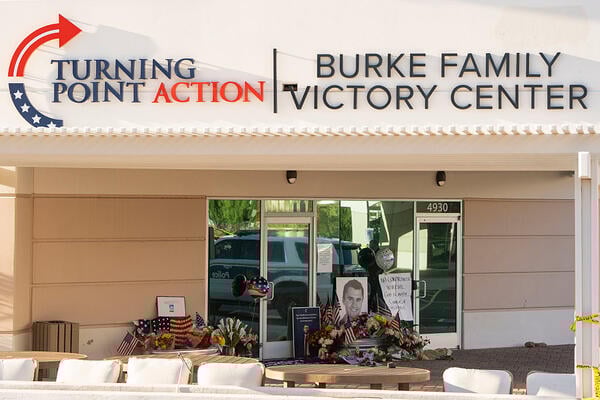
    Photos of Charlie Kirk and flowers sit in front of the Turning Point USA headquarters

    Vigils to remember Kirk have popped up at college campuses and at the Turning Point USA headquarters in Arizona.

    Rebecca Noble/Getty Images

    Binder, co-author of Becoming Right: How Campuses Shape Young Conservatives and The Channels of Student Activism, said Kirk’s Turning Point group attracted students who initially weren’t sure they were Republicans and weren’t attracted to the College Republicans chapters that traditionally mobilized students.

    “Their complaint about College Republicans was that it was too establishment, it was kind of fusty, stale, too focused on getting people elected,” Binder said of these students. She said Turning Point told them that “you are part of a liberal, left campus and you are mistreated here and you need to come out of the closet and declare that you’re conservative in a big, broad way—and we’ll help you do that with really splashy events and really splashy speakers.”

    “All of the incentive structure there was to go big, go confrontational,” she said. Kirk exemplified that in his sparring matches with left-leaning students on campuses.

    Binder said, “Kirk was really excellent at cross-branding,” frequently appearing on Fox News, recording videos for the conservative education video website PragerU and more.

    “Over time, Kirk was really involved with the Trump family, and with MAGA under Trump,” Binder said. “And he really became an ambassador for that—not only to young people, but to others as well … He was really crossing over into other age brackets and he just kind of became a face—or the face—of energized, youthful conservatism.”

    Turning Point sought to elect conservatives to student governments by providing funding. It broadcast online the names of faculty it considered too left-leaning or intolerant of conservative views and marshaled voters for Trump during his re-election campaigns.

    “He became the face of young Republicans and probably helped Trump win Arizona, maybe Wisconsin, maybe Michigan, with his get-out-the-vote” in 2024, Binder said. She said he “might have been predicted to have a political career in the future. He’s charismatic, he’s good-looking, he has a perfect family, he’s obviously had success.”

    Charlie Kirk, in a white shirt, points to the crowd while holding some hats in his hand

    Charlie Kirk was speaking at Utah Valley University on Sept. 10 to kick off his American Comeback Tour when he was shot and killed.

    Trent Nelson/The Salt Lake Tribune/Getty Images

    But now, Kirk is dead. While Binder said there will continue to be a “very robust right ecosystem of organizations that seek mobilized students on campus,” it’s unclear what Turning Point’s future will be.

    “Is there a power vacuum, is there a succession plan, what does that look like? I certainly don’t know,” she said. Turning Point didn’t respond to Inside Higher Ed’s request for an interview Thursday.

    As for how his death could impact campus free expression, Binder said, “It’s really, really horrible on just all of the fronts, and in the wrong hands, something like this could shut down speech.”

    Rank, from FIRE, said that while the shooter’s motive is unknown, the effect that violence can have on free expression isn’t. She said it can not only create a chilling effect within people, but it also can cause higher ed institutions to clamp down on speech to prevent violence.

    “If an administration comes in and prevents controversial speaking engagements, then you’re creating a situation where the violence wins and that just causes free speech to deteriorate even further,” Rank said. She said that would not only be wrong, but “it would be a strange way to honor his legacy.”

    Source link

  • Later Wake-Up Call for Inside Higher Ed’s Daily News Update

    Later Wake-Up Call for Inside Higher Ed’s Daily News Update

    Loyal Inside Higher Ed readers who wake up to our daily newsletter will soon have an easier time finding each day’s edition in their crowded inboxes. 

    Starting Tuesday, Sept. 2, the Daily News Update will arrive between 5:30 and 6:00 a.m. Eastern, several hours later than the current 3:15 a.m. This may upset the morning routines of the handful of souls on the East Coast who rise before the sun, but for most readers, we hope this change means our newsletter is there at the top of your inbox when you log in, ready to inform your day.  

    Thank you for waking up with Inside Higher Ed

    Source link

  • The End of the Traditional Student Era: Higher Ed’s New Enrollment Reality

    The End of the Traditional Student Era: Higher Ed’s New Enrollment Reality

    For decades, the term “traditional student” referred to an 18–22-year-old, full-time student living on campus and largely unencumbered by adult responsibilities. That definition may have been true in the past, but today, it’s holding institutions back. 

    Across the country, Gen Z students increasingly look like their older counterparts in how they approach higher education. They’re working while enrolled, choosing flexible learning formats, weighing cost against career ROI, and demanding that programs fit into — not disrupt — their lives. At the same time, adult learners remain a vital audience, and their motivations often mirror those of younger students. 

    For enrollment and marketing leaders, the takeaway is clear: Stop relying on outdated labels and start building strategies for the actual students you serve. 

    The blurred lines between traditional and adult learners 

    Recent Gallup-Lumina research shows that 57% of U.S. adults without a degree have considered enrolling in the past two years, and more than 8 in 10 say they’re likely to do so within the next five years. While adult learners have long valued affordability, flexibility, and career outcomes, these same factors now dominate Gen Z’s expectations. 

    Cost concerns are particularly telling, as highlighted by The CIRP Freshman Survey 2024. The study found that 56.4% of incoming first-year students reported some or major concern about paying for college, with even higher rates among Hispanic or Latino (81.4%) and Black or African American (69.6%) students. 

    Work and life responsibilities are also playing a growing role. Georgetown University’s Center on Education and the Workforce (CEW) reports that between 70-80% of undergraduate students are employed while enrolled, with about 40% working full-time.  

    For many, this isn’t a nice-to-have — it’s the only way they can afford school. 

    Why this matters for enrollment strategy 

    If your enrollment marketing still segments audiences primarily by age, you’re likely missing the mark. Here’s the reality: 

    • An 18-year-old commuter working 30 hours a week and taking hybrid classes might have more in common with a 35-year-old career changer than with a residential peer. 
    • Transfer and degree completer students (36.8 million Americans with some college but no credential) are often juggling similar priorities. 
    • Both groups respond to messaging that clearly connects program design to life balance, affordability, and employment outcomes. 

    The “traditional vs. adult” distinction no longer works for understanding motivations, predicting behaviors, or designing student experiences. 

    Ready for a Smarter Way Forward?

    Higher ed is hard — but you don’t have to figure it out alone. We can help you transform challenges into opportunities.

    4 Priorities that span generations 

    Regardless of age, today’s students share a core set of expectations that shape their enrollment decisions. These priorities now cut across the full spectrum of higher education audiences. 

    1. Affordability 

      The Gallup-Lumina report states that finances are among the most influential factors in enrollment decisions for unenrolled adults. Cost is also the top reason adults have stopped out of higher education and a leading reason current students consider doing so.  

      Gen Z mirrors this cost-conscious mindset, with many forgoing the traditional four-year route and embracing community colleges or transfer pathways as a lower-cost way to begin their degree journey.

      2. Flexible learning programs 

        Hybrid, online, and asynchronous options are no longer “adult learner perks” — they’re mainstream expectations. Traditional-aged students now seek flexible schedules to balance work, internships, and other commitments, mirroring adult learners. The pandemic accelerated digital comfort across age groups, making flexibility table stakes for recruitment. 

        3. Career outcomes 

          The Gallup-Lumina report shows that 60% of currently enrolled students cite expected future job opportunities as a “very important” factor in choosing to enroll. For stopped-out adult students, career prospects were also the top motivator. 

          Knowing this, institutions should ensure career outcomes are central to program design, marketing, and student advising. Those that clearly articulate skill alignment, employment pathways, and alumni success stories will attract and retain students. 

          4. Work-life balance 

            More students than ever are balancing jobs, caregiving, and other priorities with their academic responsibilities. For adult learners, this has always been true, but for traditional-aged students it’s increasingly the norm.  

            Institutions should respond by offering flexible schedules, targeted support, and streamlined services that help students balance academics with work and family demands. 

            Moving from segmentation to personalization 

            The solution isn’t to erase audience differences but to recognize that motivations and needs cut across age lines. Institutions should: 

            • Use behavioral and attitudinal data (not just demographics) to inform personas. 
            • Map programs to shared priorities, ensuring flexible formats and clear ROI messaging. 
            • Equip enrollment teams to surface emerging trends from student conversations. 
            • Invest in CRM and marketing automation to deliver personalized, timely outreach. 

            The opportunity for forward-thinking institutions 

            Institutions that adapt now can capture a larger share of a changing student market. Meeting the needs of today’s learners, who span generations, life stages, and responsibilities, requires more than minor adjustments. It calls for rethinking how programs are designed, marketed, and delivered to address shared priorities and remove persistent barriers. 

            Consider the following tactics: 

            • Retooling marketing messages to emphasize affordability, flexibility, and career outcomes. 
            • Rethinking program delivery models for a mixed audience. 
            • Breaking down internal silos between “traditional” and “adult learner” recruitment. 

            From outdated labels to modern enrollment strategies 

            The traditional student still exists, but they’re no longer the majority. Today’s demand for higher education comes from learners of all ages and circumstances. 

            The lines are blurred, and the labels are outdated. It’s time to create enrollment strategies that reflect today’s student realities and anticipate tomorrow’s opportunities. 

            Innovation Starts Here

            Higher ed is evolving — don’t get left behind. Explore how Collegis can help your institution thrive.

    Source link

  • Faculty Are Latest Targets of Higher Ed’s AI-ification

    Faculty Are Latest Targets of Higher Ed’s AI-ification

    Photo illustration by Justin Morrison/Inside Higher Ed | Dougall_Photography and gazanfer/iStock/Getty Images

    Last week, Instructure, which owns the widely used learning management system Canvas, announced a partnership with OpenAI to integrate into the platform native AI tools and agents, including those that help with grading, scheduling, generating rubrics and summarizing discussion posts.

    The two companies, which have not disclosed the value of the deal, are also working together to embed large language models into Canvas through a feature called IgniteAI. It will work with an institution’s existing enterprise subscription to LLMs such as Anthropic’s Claude or OpenAI’s ChatGPT, allowing instructors to create custom LLM-enabled assignments. They’ll be able to tell the model how to interact with students—and even evaluate those interactions—and what it should look for to assess student learning. According to Instructure, any student information submitted through Canvas will remain private and won’t be shared with OpenAI.

    Steve Daly, CEO of Instructure, touted Canvas’s AI push as “a significant step forward for the education community as we continuously amplify the learning experience and improve student outcomes.” But many faculty aren’t convinced that integrating AI into every facet of teaching and learning is the answer to improving the function and value of higher education.

    “Our first job is to help faculty understand how students are using AI and how it’s changing the nature of thinking and work. The tools will be secondary,” said José Antonio Bowen, senior fellow at the American Association of Colleges and Universities and co-author of the book Teaching With AI: A Practical Guide to a New Era of Human Learning. “The LMS might make it easier, but giving people a couple of extra buttons isn’t going to substitute for training faculty to build AI into their assignments in the right way—where students use AI but are still learning.”

    The AI-ification of Canvas is just one of the latest examples of the technology’s infiltration of higher education amid predictions that the technology will reshape and shrink the job market for new college graduates.

    Earlier this year, the California State University system announced a partnership with a slate of tech companies—including Microsoft, OpenAI and Google—to give all students and faculty access to AI-powered tools, in part to equip students with the AI skills employers say they want. In April, Anthropic unveiled Claude for Education, which it designed specifically for college students. One day later, OpenAI gave college students free access to ChatGPT Plus through finals. Soon after, Ohio State University launched an initiative aimed at making every graduate AI “fluent” by 2029. And this week, OpenAI released Study Mode, a version of ChatGPT designed for college students that acts as a tutor rather than an answer generator.

    Faculty Unsurprised, Skeptical

    Few faculty were surprised by the Canvas-OpenAI partnership announcement, though many are reserving judgment until they see how the first year of using it works in practice.

    “It was only a matter of time before something like this happened with one of the major learning management systems,” said Derek Bruff, associate director of the Center for Teaching Excellence at the University of Virginia. “Some of the use cases they’ve talked about make sense to me and others make less sense.”

    Having Canvas provide a summary of students’ discussion posts could be a helpful time saver, especially for a larger class, though it doesn’t seem like “a game-changer,” he said. But he’s less sure that using the chat bot to evaluate student interactions, as Instructure suggests, could provide faculty with useful learning metrics.

    “If students know that their interactions with the chat bot are going to be evaluated by the chat bot and then perhaps scored and graded by the instructor, now you’re in a testing environment and student behavior is going to change,” Bruff said. “You’re not going to get the same kind of insight into student questions or perspective, because they’re going to self-censor.”

    Faculty, including the thousands who work for the more than 40 percent of higher ed institutions across North America that use Canvas, will have the option to use some or all of these new tools, which Instructure says it won’t charge extra for.

    Those who choose to use it run the risk of “digital reification,” or “locking faculty and students into particular tools and systems that may not be the best fit for their educational goals,” Kathryn Conrad, an English professor at the University of Kansas who researches culture and technology, said in an email. “What works best for student learning is challenge, care and attention from human teachers. Drivers from outside of education are pushing yet another technological solution. We need investment in people.”

    But as higher education budgets keep shrinking, faculty workloads are growing—and so is the temptation to use AI to help alleviate it.

    “I worry about the people who are living out of their car, teaching at three institutions, trying to make ends meet. Why wouldn’t they take advantage of a system like Canvas to help with their grading?” said Lew Ludwig, a math professor and former director of the Center for Learning and Teaching at Denison University. “All of a sudden AI is going to be grading the work if we’re not careful.”

    But that realization could push students to rely more and more on generative AI to complete their coursework without fully grasping the material—and give cash-strapped administrators another justification to increase faculty workloads. Such scenarios run the risk of further devaluing a higher education system that’s already facing scrutiny from lawmakers and consumers.

    “Students are starting to graduate into a new economy, where just having a piece of paper hanging on their wall isn’t going to mean as much anymore, especially if they leaned heavily on AI to achieve that piece of paper,” Ludwig said. “We have to make sure our assignments are impactful and meaningful and that our students understand why in some instances we may not want them to use AI.”

    Despite Instructure’s claims that this new version of Canvas will enhance the learning process in the age of AI, a recent survey by the American Association of University Professors shows that most faculty don’t believe AI tools are making their jobs easier; 69 percent said it hurts student success.

    Britt Paris, co-author of the report and associate professor of library and information science at Rutgers University, said she doesn’t expect that to change with the introduction of an AI-powered LMS.

    “In the history of educational technology there has never been an instance of large-scale … data-intensive corporate learning infrastructure that has met the needs of learners,” she said. “This is because people are nuanced in how they learn. The goal with these technologies is to make money, not [to] support people’s unique learning, teaching and working styles.”

    Source link

  • Higher Ed’s Broken Promises and the American Student

    Higher Ed’s Broken Promises and the American Student

    “I’m hung up on dreams I’ll never see.”

    That Southern rock refrain from Molly Hatchet captures the bitter reality faced by millions of Americans who invested in higher education only to be left with debt, shattered hopes, and uncertain futures.

    Educator Gary Roth’s The Educated Underclass points to a growing class of credentialed individuals caught in precarious economic and social positions—overqualified yet underpaid, burdened by debt without the stability education promised. Yet it is the borrowers’ own stories that reveal the human toll behind the numbers.

    Over the past month, The Higher Education Inquirer has chronicled the experiences of borrowers misled by predatory institutions—mainly for-profit colleges—through its Borrower Defense Story Series. These narratives shed light on the deeply personal consequences of institutional deception and a federal loan forgiveness process that is often slow, bureaucratic, and uneven.

    In one story, a single mother describes her experience at Chamberlain University School of Nursing. She followed every instruction, met every deadline, and committed herself fully to a career in health care. Yet she never earned her degree. Despite this, she remains burdened with thousands of dollars in student loan debt. Her borrower defense application has yet to yield relief.

    Another borrower shares her journey with Kaplan University Online, where promises of flexible learning and job placement proved empty. After transferring and completing her degree elsewhere, she still faces uncertainty as her borrower defense claim drags on, highlighting the emotional toll of navigating a broken loan forgiveness system.

    A third story critiques the broader system of higher education finance, describing how students—especially those without family wealth or institutional support—become trapped in debt relationships that limit their autonomy and economic mobility. Rather than offering a pathway to security, college becomes a mechanism of financial entrapment.

    Most recently, a former fashion student recounts how private loans—unlike federal loans—offered no path for borrower defense relief after she attended a program marketed with glowing career outcomes that never materialized. The result was devastating financial consequences with little recourse.

    These individual stories are not exceptions. As of April 30, 2024, over 974,000 borrowers had received more than $17 billion in loan discharges under borrower defense rules, mostly through group claims tied to scandals involving Corinthian Colleges, ITT Tech, and DeVry. Yet hundreds of thousands still await decisions, and many are excluded entirely due to private loans, school exclusions, or bureaucratic delays.

    The borrower defense rule was meant to shield students from fraud, but political interference, legal challenges, and an overwhelmed bureaucracy have marred its implementation. Behind the statistics are people deceived, indebted, and left behind.

    Meanwhile, elite institutions hoard resources, adjunct faculty struggle to survive, and the promise of higher education rings hollow for many.

    “I’m hung up on dreams I’ll never see.” This lyric is not just poetry but the lived reality for millions. Unless there is radical change—debt cancellation, labor protections, honest admissions, and accountability—the cycle of exploitation will only grow louder.

    Some were sold dreams they could never afford. Many of those dreams are now lost.


    Sources

    Roth, Gary. The Educated Underclass. Pluto Press, 2022

    National Center for Education Statistics. “Debt After College”

    The Institute for College Access and Success (TICAS). “Student Debt and the Class of 2023”

    American Psychological Association. “Mental Health Impacts of Student Debt”

    Bousquet, Marc. How the University Works. NYU Press, 2008

    McMillan Cottom, Tressie. Lower Ed. The New Press, 2017

    https://www.highereducationinquirer.org/2025/07/i-did-everything-right-and-im-still.html

    https://www.highereducationinquirer.org/2025/07/fashion-gone-bad-for-private-student.html

    https://www.gao.gov/products/gao-24-106530

    https://standup4borrowerdefense.com

    https://www.insidehighered.com/news/government/student-aid-policy/2023/10/24/colleges-concerned-about-rise-borrower-defense-claims

    Source link

  • Americans Recognize Nuances of Higher Ed’s Value

    Americans Recognize Nuances of Higher Ed’s Value

    While the Trump administration has painted a bleak picture of the higher education sector as a costly enterprise that burdens taxpayers and pushes leftist ideologies, new survey data shows that most Americans—regardless of their political leanings—still value it.

    “Increasingly, higher ed is being cast as elite, expensive and not connected with everyday Americans,” said Sophie Nguyen, senior policy manager with the higher education team at New America, the left-leaning think tank that published its annual Varying Degrees survey on Wednesday. “There’s a significant disconnect in the narrative about what higher ed is” and how it’s perceived.

    Capturing the American public’s views on the purpose of higher education drove many of the questions Nguyen and her colleagues asked 1,631 respondents in March for the ninth iteration of the survey.

    After reaching a low point last year, the data shows that satisfaction with higher education is on the rise: 40 percent of respondents—including 42 percent of both Republicans and Democrats—reported that higher education is “fine as it is,” compared to 36 percent who said the same last year.

    “We see a lot of alignment between Democrats and Republicans, something we haven’t heard a lot about,” Nguyen said, describing such data points as “the common ground” colleges can tap into when defending their worth to both consumers and lawmakers.

    New America’s findings are in line with a poll Gallup also released Wednesday in partnership with the Lumina Foundation, which shows that 42 percent of Americans surveyed said they have a “great deal” or “quite a lot” of confidence in higher education, compared to a low of 36 percent in 2024 and 2023—though it’s still far from the nearly 60 percent confidence peak in 2015. The share of people who reported “very little” or no confidence is also on the decline, falling from 32 percent last year to 23 percent this year. Although Democrats reported much higher confidence in higher education institutions, Republican confidence in both four- and two-year colleges rose by 11 and 12 percentage points, respectively, compared to last year.

    Data visualization of change in confidence in four- and two-year colleges, by political party.

    Respondents cited the economic and social benefits of higher education, its standing at the forefront of innovation, the quality of education and training—both for jobs and exposure to different viewpoints—as drivers of the uptick in their confidence.

    The Trump administration’s war on higher ed may have played a role, said Courtney Brown, Lumina’s vice president of impact and planning.

    “It is possible that we are seeing people in support of the sector because they see so many attacks,” she said. Whatever the reason, she said the new data is positive, and if institutions want to restore confidence to 2015 levels they should consider “how they can build on this moment and show up for students and ensure they’re getting value.”

    Like Gallup’s report, New America’s survey revealed partisan divides as well as agreements. Sixty percent of Republicans said colleges are having a negative impact on the country, while 75 percent of Democrats said they’re having a positive impact. But respondents from both parties were much more aligned on questions about specific aspects of higher ed’s value and purpose.

    While Republican lawmakers pressure universities into proving their return on investment, the vast majority of Americans, including both Republicans and Democrats, believe higher education should function as more than a transaction. They say it should not only equip students with the skills and knowledge to succeed in their chosen fields (97 percent of Democrats; 98 percent of Republicans), but also help students become informed citizens (97 percent of Democrats; 89 percent of Republicans) and critical thinkers (97 percent of Democrats; 92 percent of Republicans).

    “The rhetoric coming from Washington tends to be a caricature of what are some real issues facing college campuses and the sector in general,” Beth Akers, a senior fellow at the right-leaning American Enterprise Institute who focuses on the economics of higher education, said at a media briefing about New America’s survey. While “there’s room for improvement … it’s unfortunate that the rhetoric is empowering misinformation about what institutions are doing.”

    Bar chart of responses to the question "How important do you think it is for colleges and universities to do the following?" Responses are detailed earlier in thes tory.

    Even as Trump and his political allies move to dramatically cut federal funding for university research—which advocates say will devastate university budgets, local economies and progress toward lifesaving research—88 percent of Republicans and 97 percent of Democrats believe it’s important to some degree that colleges and universities conduct research to expand understanding in various subjects.

    Despite political rhetoric that suggests otherwise, American higher education has delivered an array of personal and societal benefits for decades, Lynn Pasquerella, president of the American Association of Colleges and Universities, said during a news briefing on the report.

    “Higher ed continues to be the single most powerful socioeconomic catalyst in America, which is associated not only with higher earnings, but longer productive lives, better physical and mental health, resilience, adaptability, and personal development and fulfillment,” she said. “At the societal level, education drives long-term economic growth for local communities and the nation.”

    More broadly, it “strengthens our democracy,” because it “tends to mitigate or tame authoritarian tendencies” and “reduces individuals’ sensitivities to potential triggers by providing them with psychological protection in the form of self-esteem, personal security and autonomy,” she said. “It fosters a moral imagination—imagining what it’s like to be in the shoes of another, different from oneself—and interpersonal trust.”

    Despite the Trump administration and its allies’ attacks on diversity, equity and inclusion initiatives, the survey data shows that an overwhelming majority of Republicans and Democrats agree that higher education should create an environment where students of all backgrounds feel supported, provide a platform for exploration of diverse ideas and foster cross-cultural understanding.

    Bar chart showing responses to the question "How important do you think it is for colleges and universities to do the following" including "create an environment where students of all backgrounds feel supported" and "provide a platform for exploration of diverse ideas."

    Although New America’s survey suggests that most Americans recognize the layered value of higher education, Republican lawmakers have increasingly focused on both controlling the subjects colleges can teach and research and making it harder for students and colleges to access federal funding.

    The sweeping policy bill Trump signed into law earlier this month requires colleges to show that their graduates earn more than an adult with only a high school diploma or risk losing access to federal loans. Trump has also proposed billions of dollars in cuts to education funding, including eliminating all federal support for college-access programs that have long helped low-income, first-generation and students with disabilities navigate higher education.

    While Republicans and Democrats are divided on who they think should be primarily responsible for paying for college—76 percent of Democrats believe the government should; 67 percent of Republicans believe students should—respondents from both parties cited cost as the single biggest barrier to enrolling in or finishing college.

    At the same time, 75 percent of respondents over all (91 percent of Democrats and 58 percent of Republicans) said the federal government should spend more on making college more affordable.

    Hironao Okahana, vice president and executive director of the Education Futures Lab at the American Council on Education, said this data offers a ray of optimism for the higher education sector navigating an onslaught of partisan attacks from Republican policymakers.

    “The public is seeing higher education as a sector beyond some of the sound bites we’re hearing,” he said. “They’re seeing that it has more nuance and texture, and that there’s not just one way higher education can contribute to society.”

    Source link

  • U.S. Higher Ed’s Investment in Sustainable Development Lags

    U.S. Higher Ed’s Investment in Sustainable Development Lags

    Colleges and universities in the United States lag behind their peers around the globe in working toward the United Nations’ 17 Sustainable Development Goals—including ending poverty and hunger, climate action, and expanding access to education—according to the Times Higher Education Impact Rankings 2025, published today.

    The Trump administration’s financial and political attacks on higher education, as well as more pressing problems across the sector, mean it’s unlikely U.S. colleges will prioritize sustainability work in the near future.

    While seven Canadian universities—including Queen’s University, McMaster University and the University of Alberta—ranked in the global top 50, Arizona State University, ranked joint sixth, is the only U.S.-based institution to crack the top 50. Three highly ranked U.S. colleges fell out of the global top 50 this year: Michigan State University is now at joint 61st, Penn State at joint 64th and Florida International University at joint 71st.

    Western Sydney University in Australia topped the global ranking for the fourth year in a row.

    THEInside Higher Ed’s parent company—ranked the sustainability efforts of 2,526 universities from 130 countries; 52 institutions from across the U.S. participated in the 2025 ranking, down from 58 in 2024.

    Since 2019, THE has evaluated the performance of thousands of higher education institutions across the globe on the U.N.’s 17 Sustainable Development Goals. Universities that want to participate in the rankings are required to submit information for SDG 17, Partnerships and Goals, and at least three other SDGs. How well an institution meets those goals is then evaluated across four broad categories: research, stewardship, outreach and teaching.

    Phil Baty, chief global affairs officer for THE, described American universities’ “general lack of direct engagement with the SDGs” as “disappointing,” especially because the U.S. has some of the world’s strongest research universities. “I’d hope they can turn their greatest minds more overtly towards tackling the world’s most pressing and urgent challenges.”

    Under Trump, SDGs May Be ‘More Risky’

    Although the nation’s lackluster showing in the 2025 Impact Rankings is based on university data that predates the start of President Donald Trump’s second term, the administration’s attacks on the sector and political stances suggest the country’s higher education institutions may only face more barriers to becoming global sustainability leaders.

    In March, the Trump administration denounced the SDGs, which the U.N. created in 2015 during President Barack Obama’s administration with the aim of reaching them by 2030. The second Trump administration has also pulled out of other international sustainability initiatives, including the Paris Agreement on climate change, and moved to cut billions in funding for scientific research and social programs—including many focused on reducing social inequities, addressing climate change and advancing diversity, equity and inclusion efforts.

    Bryan Alexander, a scholar who studies the future of higher education and author of 2023’s Universities on Fire: Higher Education in the Age of Climate Crisis, wrote in an email to Inside Higher Ed that even before the Trump administration’s denouncement of the SDGs, they’d failed to gain much traction among U.S. universities.

    “When I mention SDGs in academic settings, I usually see blank faces and have to explain what they are,” he wrote, attributing the indifference to a stronger focus on other, seemingly more pressing matters plaguing higher education, such as financial instability. “That sense of institutional urgency, heightened by a steady stream of campuses closing, merging, or cutting programs and staff, looms large. In that context, the SDG goals look like noble but not essential, nice-to-haves rather than imperatives.”

    According to Alexander, other deterrents to the sector launching a widespread commitment to sustainable development include faculty burnout, scarce resources, anti-expert animus, doubts from faculty and administrators that their efforts will make a difference, and anxiety about associated political risks.

    And he expects all those problems to persist, if not worsen, in the coming years as Trump continues his assault on universities and pro-sustainability initiatives. “The anti-DEI campaign strikes directly at several SDGs,” Alexander wrote. “It will be harder for academics to win external support for any such work, from doing research to offering new academic programs, overhauling a campus power system to replacing vehicles with electric vehicles. It will appear to be politically even more risky.”

    However, he said there are some less risky actions U.S. institutions can take to be more sustainable.

    “First, renewable energy, especially solar, is simply cheaper than fossil fuels. Switching a campus’ power supply just makes financial sense,” he said. “Second, traditional-age undergraduates are much more interested in climate change and sustainable development than their elders, which means they will tend to be eager to take classes and study in programs along those lines.”

    Walking a Fine Line

    ASU also tops the global ranking for SDG 14: Life Below Water, which means it’s at the forefront of developing strategies that support the health and sustainability of aquatic ecosystems.

    It launched one of the nation’s first schools of sustainability nearly 20 years ago, and although its main campus is located in the Arizona desert, ASU launched the School of Ocean Futures in 2024. The school connects research and teaching facilities in the Pacific and Atlantic Oceans with research happening on its main campus in Tempe.

    The school is one example of how universities can help to “restore balance within the global environment,” said Marc Campbell, ASU’s assistant vice president of sustainability and deputy chief sustainability officer.

    “Fundamentally, the work of sustainability is about trying to be more efficient in the use of our resources and trying to protect what’s out there,” Campbell said. “A lot of people can support the foundational work of sustainability, but we need to unload some of the baggage that’s associated with the word and the discipline.”

    Doing that, he said, will come from making a case for the economic and social value of investing in sustainable development initiatives.

    “In any organization there are supporters and detractors. You have to figure out how to walk that fine line to get people supporting the greater good and recognizing what that is,” Campbell said.

    “When we can do that more effectively across the board and build broader collaborative partnerships with other organizations that are focused on the same goals, then I think we can get past some of the [political] baggage.”

    Source link