Tag: Education

  • Censorship at Northwestern Worse After Dreger’s Resignation

    Censorship at Northwestern Worse After Dreger’s Resignation

    Ten years ago, on Aug. 24, 2015, Alice Dreger submitted her resignation as a tenured professor at Northwestern University’s Feinberg School of Medicine. Dreger was protesting the censorship of an academic journal at Northwestern called Atrium, for which she had served as guest editor of the 2014 issue with the theme “Bad Girls.” That edition included a controversial essay by disability rights advocate William Peace, who wrote about receiving oral sex from a nurse in the 1970s. Northwestern officials removed Atrium’s online issues for 14 months, restoring access to it only after Dreger announced she was going public about the censorship.

    Dreger wasn’t even the first professor to quit in protest over the censorship of Atrium. Kristi Kirschner, a clinical professor of medical humanities and bioethics, resigned in December 2014 because of the repression.

    But Northwestern demanded a new editorial board (including a public relations official) to oversee the journal in the future, which Dreger called a “censorship committee.” The faculty editors of Atrium refused to accept administrative control over its content, and it has never published another issue.

    Dreger recently wrote about her “disappointment (and that tablespoon of regret) at having accidentally caused the end of Atrium. For the magazine was such a gem.” But, of course, she didn’t cause the end of the journal—Northwestern administrators did by making unacceptable demands for control. The blame for censorship always must belong to the censor for suppressing controversy, and not the censored for causing controversy.

    Dreger’s resignation, and the censorship that prompted it, received much less attention than it deserved. This year is also the 10th anniversary of another case at Northwestern that was far more publicized: The Title IX investigation of Laura Kipnis over her essay “Sexual Paranoia Strikes Academe” that examined the case of a Northwestern professor accused of sexually assaulting a graduate student. Two students filed a complaint of retaliation against Kipnis over her writing, and the university cleared her after a lengthy investigation. While Kipnis obviously should never have been investigated for expressing her opinions on a case of campus sexual misconduct, she never suffered any official penalty or censorship.

    By contrast, the censorship of Atrium actually did lead to the demise of a respected academic journal (and the loss of the two professors who protested it). But while the Kipnis case fit a very popular narrative of politically correct leftists demanding suppression, the Atrium case exposed the reality on campus: Conservative censorship was more repressive but much less publicized than the trendy complaints about the PC police.

    Another example of this at Northwestern occurred in 2016, when political science professor Jackie Stevens was suspended and banned from campus after she complained that an administrator had yelled at her and slammed a door. Without any evidence and in violation of its due process policies, Northwestern officials contended that Stevens posed an immediate violent threat to the campus and forced her to undergo a psychological evaluation (which found no danger) before lifting the suspension and banishment. Stevens had been a harsh critic of the administration and was a leader of the successful faculty effort to prevent a retired general without a Ph.D. from being appointed head of an international studies program.

    Looking back at the Dreger resignation a decade ago, it’s hard to feel optimistic, because censorship on campus is even worse today. In the past year, Northwestern University’s actions have been some of the most repressive in the entire history of the institution. In February, Northwestern’s administration adopted the International Holocaust Remembrance Alliance definition of antisemitism, which the Foundation for Individual Rights and Expression has condemned because it “will chill campus speech.”

    One little-known example of Northwestern’s censorship is shockingly reminiscent of what happened to Atrium, except that it’s much worse. In February, Northwestern officials took down the entire website of the Gender and Sexuality Resource Center in response to President Donald Trump’s executive order “Ending Illegal Discrimination and Restoring Merit-Based Opportunity.” GSRC director Matt Abtahi didn’t go public about the censorship, but wrote an April 14 email to his staff to explain the removal of the website: “This last month working with the lawyers and senior leadership at NU has been particularly gutting.”

    He added, “The use of civil rights law and discrimination policy to advance these kinds of changes is alarming.” When Northwestern officials learned about the email, they immediately suspended Abtahi on April 18 and then fired him on April 29 and banned him from campus. Northwestern finally restored the GSRC website in May but censored all of the LGBTQ+ content. The censorship today is far worse than what happened to Atrium, which was finally restored online without censorship and no one was fired for questioning the repression.

    But even more appalling has been Northwestern’s violation of the rights of journalism professor Steven Thrasher. After Thrasher defended a student encampment in spring 2024 to prevent police from arresting protesters, Northwestern’s administration retaliated several months later in the wake of Northwestern president Michael Schill’s testimony before members of Congress who called Thrasher a “goon” and demanded his firing.

    Northwestern used its police powers to order Thrasher’s arrest, although the charges were immediately dismissed. In the fall of 2024, Northwestern suspended Thrasher from teaching for two quarters in violation of campus rules and claimed that he had violated professional norms by questioning the concept of “objectivity” in journalism. After a faculty committee cleared Thrasher of any wrongdoing, Northwestern was forced to reinstate him.

    However, Thrasher was up for tenure in 2025, and Northwestern denied him tenure. When Thrasher publicly criticized that decision and blamed it on retaliation for his criticism of Israel, Northwestern’s administration promptly banned Thrasher from teaching in the spring quarter and the entire 2025–26 academic year, declaring, “Your public lobbying, mischaracterizations and efforts to encourage pressure from groups complicate and compromise the process of tenure review, decision making, and appeal. Therefore, we are concerned about your presence with students in our community.”

    Obviously, criticizing the administration can never be grounds for banning a professor from the classroom for years without due process. Because tenure decisions are secretive, we don’t know if illegitimate, nonacademic judgments affected Thrasher’s case. But we do know that Northwestern’s excuses for twice suspending Thrasher are entirely illegitimate and violate basic norms of academic freedom.

    (Full disclosure: I’m a member of the Illinois AAUP’s Committee A on Academic Freedom and Tenure, and we wrote two letters to Northwestern, condemning its initial suspension of Thrasher and its second suspension of Thrasher that denied him the right to teach during his terminal year after being denied tenure.)

    Despite the extraordinary repression at Northwestern, where merely speaking out against the administration’s censorship can get you immediately banished, faculty and students are resisting efforts to silence dissent. On April 21, 2025, the entire faculty assembly at Northwestern voted 338 to 83 to support a resolution sponsored by the Northwestern AAUP (led by Jackie Stevens) that called upon the university to defend academic freedom, protect free speech and follow due process. But so far Northwestern refuses to back down from its embrace of censorship.

    As Dreger wrote 10 years ago, “An institution in which the faculty are afraid to offend the dean is not an institution where I can in good conscience do my work. Such an institution is not a ‘university,’ in the truest sense of that word.”

    Sadly, Dreger’s warning is going unheeded by Northwestern (and many other “universities”) that are part of a growing wave of repression on campus.
    John K. Wilson was a 2019–20 fellow with the University of California National Center for Free Speech and Civic Engagement and is the author of eight books, including Patriotic Correctness: Academic Freedom and Its Enemies (Routledge, 2008), and his forthcoming book The Attack on Academia. He can be reached at [email protected], or letters to the editor can be sent to [email protected].

    Source link

  • The Gray Zone

    The Gray Zone

    This academic year marks year seven—our last, if all goes well—of paying college tuition for our kids. (TB’s senior year and TG’s first year were the same year.) My brother has just joined the ranks of tuition payers, with his oldest arriving at college a few days ago. We’ve both found ourselves in the increasingly common spot of making too much to get much aid, but too little to reasonably afford tuition without significant aid.

    We’re not alone. That gray zone of “theoretically affordable, but not really” has become normal.

    If anything, it seems to be expanding. We’re lucky enough that for us, it’s annoying rather than prohibitive. That’s not true for everybody.

    People land in the gray zone in any number of ways. Sometimes the FAFSA calculation is simply unrealistic, whether because of fluctuating income, multiple siblings, divorce or the actual cost of living. Need-based aid is usually based on the FAFSA (or the CSS) or income tax return data, each of which is based on formulas that reflect political compromises rather than the cost of living. “Need” is a judgment, and judgments at scale tend to be blunt instruments at best. In practical terms, they pretty much have to be. Sometimes, though, the issue is even worse than the quirks of the FAFSA calculation. To save money, many colleges engage in “gapping,” or offering less aid than even the FAFSA recommends. That makes the gray zone even bigger.

    And that’s under the relatively rosy scenario of having two-parent families in which both are citizens, both are employed and nobody has a disability requiring massive economic support. People with disabilities are often subject to unrealistically low savings thresholds before they lose Medicaid coverage; ABLE accounts help, but they go only so far, and relatively few eligible people know that they exist. Undocumented parents may be increasingly unwilling or unable to submit financial information, even if their children are citizens. And divorced and/or mixed families introduce variables that no algorithm will anticipate. (I had personal experience of that in my student days. It wasn’t pretty.) Include any of those in the picture, and the shortfalls of the current system become more dramatic.

    I had hoped that the free community college movement would make many of these issues moot. But it fizzled at the federal level, as did most student loan forgiveness. Some states adopted versions of free community college, which is great, but states don’t have the fiscal flexibility that the federal government does. Most states aren’t allowed to run deficits, and public college enrollments are usually countercyclical to the economy, which means demand for college goes up at the same time that state tax revenues go down. Without a mechanism to offset the imbalance, public scholarship programs tend to get shorted when they’re most needed. Worse, even when they’re funded, state programs often include means-testing phase-outs that create gray zones of their own.

    With all of those ways into the gray zone, it’s unsurprising that so many people are there. But as an industry, I don’t think we’ve paid enough attention to how people on the ground experience it.

    It comes across as insulting. Being told that aid is for other people, but you have to pay what seems like an unreasonable amount, leaves a bad taste.

    I’ve had conversations with parents who can’t believe that they’re judged too rich to help. They aren’t happy, and there isn’t much to say to make them happy. I can’t help but think that part of the reason the public hasn’t rallied to our side in response to recent political attacks is that after years of being directly and personally insulted, as they see it, they don’t mind seeing some payback. We can offer structural explanations, but structural explanations don’t help when you’re facing a tuition bill higher than you expected and the institution essentially tells you to suck it up. Heck, when UVA had the gall to raise TB’s tuition for a fully remote year, I was personally offended. Years later, I still grumble at the memory. The causes may be long-term and structural, but the offense is direct and personal.

    Answers to the gray zone exist, in big and small ways.

    The best big answer, of course, is recognizing the social benefit of education generally and supporting it with enough public funding that tuition becomes an afterthought. Public libraries don’t have the gray zone because they don’t charge for access to books. That’s an excellent model, and it has ample precedent. The challenge there is political.

    A small but institutionally actionable answer involves strategic philanthropy. We recently had a donor who specifically wanted to aim scholarship money at students in the gray zone, to ensure that they can finish their programs and get started in their careers. It struck me as a fantastic idea. Yes, it’s hard to scale, and yes, it leaves existing systems intact. But until we can get to a saner political moment, it can make a genuinely positive difference for untold numbers of students. It may even serve as a proof of concept for a larger change.

    The main challenge now is to acknowledge the existence of the gray zone and to incorporate that knowledge into policy. The gray zone isn’t just a regrettable imperfection; it’s a direct threat to higher education’s continued existence. It corrodes public support and plays into narratives that make us the bad guys. Every single time a policy includes means-testing, sliding scales, income cutoffs or gapping, we create enemies. We’ve focused so much on immediate economic cost that we’ve lost sight of long-term political cost. I’m much less worried about some scion of the upper middle class getting a free education than I am about folks in the vast middle deciding they’ve had enough and voting for people who will channel their anger at the wrong targets. The cost of that is much higher than simply getting it right in the first place.

    Source link

  • Racial Discrimination on Campus Where 4 of 5 Students Are White?

    Racial Discrimination on Campus Where 4 of 5 Students Are White?

    Administrators at the University of Missouri told a student organization that it could not proceed with a “Black 2 Class Block Party” because the event qualified as “unlawful discrimination.” Is it possible that students who are not Black complained of being denied access to the annual event in prior years? Probably not. This cancellation is one of numerous examples of how institutions are attempting to comply with the Trump administration’s anti-DEI agenda, as Inside Higher Ed reporter Jessica Blake noted in an article last Friday.

    U.S. Department of Education data shows that during the 2023–24 school year, 79 percent of undergraduates on the University of Missouri’s flagship campus were white. Black students were just 5 percent of the undergraduate student body. Put differently, nearly 19,000 students were white and fewer than 1,200 were Black. Numerically, there are not and have never been enough Black students there to create a climate of exclusion for their white counterparts. The same is true among professors—last school year, only 33 of 1,027 tenure-track faculty members at Mizzou were Black, according to statistics published online by the university’s Office of Institutional Research.

    Given these demographics, it seems implausible that collegians in the minority have enough power to routinely and unlawfully discriminate against their peers who comprise the majority. This could be confirmed via systematic analyses of discrimination complaints submitted to the university in recent years. When disaggregated by race, the data is unlikely to show that it is overwhelmingly white students who most often experience racism. Surely few, if any, complaints are about encounters with discrimination at Black student organization events.

    Activities like Mizzou’s annual welcome-week block party are important for Black students, as most will be expected to successfully navigate spaces where they are the only or one of just a few persons from their racial group in every course they take, sometimes in their entire academic majors. Some will be the lone Black students who live on their residence hall floors. In these and other spaces, too many will be met with racial stereotypes, microaggressions and, at times, explicit racial violence. Black student organization events afford them opportunities to meet others who can affirm their sense of belonging at the institution. They may also meet other Black students who can teach them how to navigate campus environments that are anti-Black and otherwise racist.

    The inclusion of “Black” in its title is what made this year’s block party suddenly and presumably discriminatory. Like historically Black colleges and universities, Black culture centers, and African American studies courses, Black student organization events have neither historically nor contemporarily been proven to be spaces that exclude people from other races. Mizzou and universities like it are considerably more likely to find evidence of racial discrimination in predominantly white sorority and fraternity recruitment and member-selection activities, as well as at parties on frat row, than at a student organization event that amplifies black culture.

    As previously noted, 5 percent of Mizzou undergraduates are Black. Noteworthy is that Black men are 2 percent of the student body, yet NCAA data shows that they comprised 62 percent of the football team and 56 percent of the men’s basketball team there last academic school year. Despite generating millions of dollars in revenue for the university, these student athletes and their same-race peers are not allowed to have events that have “Black” in the title.

    “Black college football and basketball players are the most powerful people of color on campus,” I wrote in a Washington Post article 10 years ago. At that time, Black student athletes at Mizzou threatened to skip a football game that would have resulted in a loss of more than $1 million in revenue. This threat was in response to institutional inaction on racism that Black collegians had long experienced there. Within days, the system president and the chancellor of the Columbia campus both resigned.

    Football and basketball players are as powerful there today as they were a decade ago. They can indeed resist anti-DEI efforts that disadvantage them and other students of color. But should they do so in response to a canceled welcome-week block party? Yes, because that one seemingly insignificant event is emblematic of a more expansive demonstration of anti-Blackness on their and other campuses at this time.

    The elimination of culturally resonant programs, centers and institutes, and offices denies Black students access to valuable relationships and resources that bolster their first-year transition experiences, sense of belonging, classroom and out-of-class engagement, academic performance, and retention. Some of the most enduring and transformative advancements for Black collegians in U.S. higher education emerged from student activism. Student athletes, student organization leaders and everyday students who are Black, along with allies and supporters from other racial groups, ought to refuse to allow anyone to mischaracterize activities and spaces as discriminatory just because “Black” is in the title.

    Source link

  • Letter From a Region of My Mind

    Letter From a Region of My Mind

    Working in journalism left Inside Higher Ed’s co-founder Doug Lederman little time to read for anything but information, so last summer, when he stepped away from 90-hour workweeks, he told me he wanted to watch less Netflix. I said, “Friend, you came to the right place.” Recommending reading is pretty much the only area where I can make solid contributions these days.

    I started Doug out with things I knew he’d like. Chad Harbach’s The Art of Fielding was an early favorite. I moved him along to Jess Walter’s Beautiful Ruins, The Friend by Sigrid Nunez, James (Percival Everett, not Henry), Meg Wolitzer’s The Interestings and loaded him onto the Louise Penny train.

    But just before I headed to D.C. last March for his official farewell party, I assigned him a novel I’d been wanting to reread and liked the idea of book-clubbing with him: John Williams’s beautiful and heartbreaking Stoner. I’ve often given Doug a hard time about—well, everything—but especially the fact that he’s never actually been in higher ed. He’s only peered in from outside with a reporter’s magnifying glass, exposing our flaws and fault lines, doing his essential duty as a journalist.

    When Doug asked me to work with him as a thought partner to create a newsletter for upper-level administrators, he wanted to bring tough love to leaders. He confessed to having a case of the fuck-its, disappointed that higher ed has been so slow to change and unwilling to take responsibility for some missteps. As we know, disappointment can only come from love, and is much harder for recipients to bear.

    I responded in my typically tactful fashion, asking him, “Who the fuck are you to have a case of the fuck-its? Do not speak to me of the fuck-its! Have you had to read millions of pages of academic monographs? Have you heard academics complain that their names were too small on book covers? Have you denied thousands of qualified applicants admission to their dream college, or sat through interminable Faculty Senate meetings group-copyediting policies? Have you taught classes that flop or graduate students who just can’t?”

    In other words, I told the co-founder of IHE he had little idea what it was like to be in higher ed, especially from the perspective of a faculty or staff member. Given his role and prominence in the industry, Doug’s attention is always sought after, a high-value treat. In our world, he is beef jerky, not a Milk-Bone.

    I thought it time for him to use his leisure reading to get a deeper understanding of what it’s like to be a regular professor. Not an oversize character like Morris Zapp (my old boss, Stanley) or even Lucky Hank Devereaux (or Lucky Jim).

    Stoner follows the fictional life and career of an English professor at the University of Missouri in the early part of the last century. Early in the novel, and just before the sinking of the Lusitania, the sharpest of a group of three young academics asks his fellows, “Have you gentlemen ever considered the question of the true nature of the University?”

    Mr. Stoner “sees it as a great repository, like a library or a whorehouse, where men come of their free will and select that which will complete them, where all work together like little bees in a common hive.” Mr. Finch, with his “simple mind,” sees it as “a kind of spiritual sulphur-and-molasses that you administer every fall to get the little bastards through another winter.” Finch goes on, naturally, to become a dean.

    But they are both wrong, claims the character named Masters. The university ”is an asylum …. a rest home, for the infirm, the aged, the discontent, the otherwise incompetent.” His self-diagnosis: ”I’m too bright for the world, and I won’t keep my mouth shut about it.” He concludes, ”But bad as we are, we’re better than those on the outside, in the muck, the poor bastards of the world. We do no harm, we say what we want, and we get paid for it.”

    The book, published in 1965, presents characters that feel so current and vibrant you can imagine having a cocktail with them. In the times we now find ourselves, Stoner may become popular again—but not for all the right reasons.

    I have friends who have long said they’re done reading things by dead white men. When Doug and I were in college, that was pretty much the entire curriculum, with the exception of the 19th century gals, an Emily Dickinson here, a Frederick Douglass there. This reluctance is understandable, given how long the canon excluded previously silenced voices. Yet, I don’t discriminate. Stoner offers profound insights into institutional structures that persist today.

    These thoughts were on my mind as I finished my reread just before our flight to D.C. to celebrate Doug’s retirement next chapter, where institutional structures of a different kind awaited us in marble and glass.

    We had half a day before the event and my husband, Toby, and I wanted to be tourists. It had not been my intention to speed-walk through four museums in five hours. (Toby could spend hours in front of one painting, but he loves me and is a good sport.)

    My childhood consisted of trips downstate to see grandparents in New York City, which often involved visits to museums. A favorite was the one that hosted the squid and the whale. Unconsciously, I bought into the primate visions described by Donna Haraway about hierarchies—her critique of how science museums construct narratives of power and evolution that shape our understanding.

    Fifty years later, I was eager to see what had changed. We started at Natural History, moved on to American History, then African American, and ended up at the Holocaust. In March 2025, this journey was not, it won’t surprise you to learn, an uplifting experience. The museums, like higher education itself, told a complex story of American identity that is now under dire threat.

    I sped through to parse the presentation. How did the curators choose to tell the stories, some of which I know well, and which, as an adult, I would always prefer to read? Since I began my career publishing books in American history at Oxford University Press, I’ve imbibed a decent amount of quality scholarship.

    When I became an acquisitions editor at Duke University Press in 1991, I was intrigued by the work of scholars like Kimberlé Crenshaw, Patricia Williams, Mari Matsuda, Derrick Bell and other theorists who used narrative to examine how our legal system perpetuated structural inequalities. Most people weren’t reading law journals back then, and it took a while for those ideas to make it into the mainstream

    Academe cranked open the curriculum to face historical truths not always self-evident: We are a country built on a commitment to diversity, equity and inclusion. At times we fell short of the mark, but the arc of the universe is long, and we were taught the direction in which it bends.

    Except. The rise to power documented in that last somber building we visited reads to me like a blueprint for what’s happening today. Before I could remember not knowing it, my father drilled into me that what it means to be a Jew is there’s always someone who wants to put you in an oven. That was made tangible by the numbers I saw tattooed on the arm of Great-Grandpa Max.

    How much longer will busloads of boisterous students milling around these repositories of culture be able to learn our history? When will the whitewashing take hold so that the ideas contained in the curators’ vision—in the works we’ve published since the latter part of the last century—are mummified?

    One of many chilling moments: coming on a small story I knew from the film Who Will Write Our History? Historian Emanuel Ringelblum organized Jews in the Warsaw Ghetto in 1939 to document unprecedented actions. He collected materials, placed them in milk cans and buried them throughout the city. The archive known as the Oneg Shabbat is housed in Jerusalem at Yad Vashem.

    It was impossible in March not to feel that my colleagues at IHE and other media outlets are busting their butts at a similar task: chronicling the last days of an era of inclusion.

    How long before these exhibits come down, replaced by gold toilets in buildings repurposed for hotels and casinos?

    Just as the bright shining moment of Camelot disappeared for a previous generation, many of us already look back on Hamilton with nostalgia. A too-quick tour of museums in our nation’s capital filled me with love for America and the things that made us great. When I left, all I felt was grief. What happens if we don’t rise to today’s challenge?

    This sobering experience in D.C. brought me back to my conversation with Doug about higher education’s resistance to change. A reading of Stoner should not feel as resonant and familiar as it does. Little about faculty structure and the ethos of academe has evolved in the last century.

    Walking through those endangered halls of American memory, what Doug has long been saying to leaders is urgent: We need more than just better storytelling about higher education—we need to fundamentally reimagine it. And we need to do it now.

    The buried milk cans of our moment will someday be unearthed. The articles, reports and assessments documenting higher education’s struggles will serve as testimony to what we did—or failed to do—in this critical period. My only hope is that they’ll reveal how colleges and universities finally broke free from institutional inertia to continue to do the work of educating our citizenry toward truth and justice for all.

    Note: This reflection was published March 22, 2025, as an issue of The Sandbox. I wanted to share it as part of my new column here for two reasons (and with apologies to subscribers). First, if you’ve been reading the news, you’ll see that I wish I’d been wrong. Just a week after this first came out, the dismantling began. And now we’re seeing a scrubbing of our nation’s history in essential cultural institutions and not just in D.C.

    Also, I got a ton of responses from readers thanking me for putting them onto Stoner. So now, you’re welcome, friends.

    Rachel Toor is a contributing editor at Inside Higher Ed and the co-founder of The Sandbox, a weekly newsletter that allows presidents and chancellors to write anonymously. She is also a professor of creative writing and the author of books on weirdly diverse subjects. Reach her here with questions, comments and complaints compliments.

    Source link

  • Howard President Steps Down, Former President Appointed Interim

    Howard President Steps Down, Former President Appointed Interim

    Cheriss May/NurPhoto via Getty Images

    Howard University president Ben Vinson III will step down Aug. 31, two years after assuming the role and two weeks after the start of fall classes, university officials announced Friday. Former Howard president Wayne A. I. Frederick will serve as interim president. 

    “It has been an honor to serve Howard,” Vinson said in a statement. “At this point, I will be taking some time to be with my family and continue my research activities. I look forward to using my experiences as president to continue to serve higher education in the future.” 

    University officials declined to comment about why Vinson is leaving only two years after he took up the helm. During his tenure, the Washington, D.C.–based HBCU became an R-1 research institution and brought on several high-profile faculty, including journalist Nikole Hannah-Jones, author Ta-Nehisi Coates and historian Ibram X. Kendi. The university also hosted Kamala Harris’s election night watch party.

    But the past year has also brought its share of challenges. In May, the Trump administration proposed cutting Howard’s federal funding by $64 million in fiscal year 2026, bringing it back to its 2021 funding level. Over the summer, the administration took heat from students over surprise bills that appeared on their accounts when the university transitioned to a new student financial platform, and some students turned to crowdfunding to pay those bills. 

    “On behalf of the Howard University Board of Trustees, we extend our sincere gratitude to Dr. Vinson for his service and leadership as president,” board chair Leslie Hale said in a statement. “We extend our very best wishes to him in his future endeavors.”

    Frederick, who served as president of Howard from 2014 to 2023, will remain interim president while the board conducts a nationwide search for a permanent replacement.

    Source link

  • How modern HR tools are helping higher education adapt – Campus Review

    How modern HR tools are helping higher education adapt – Campus Review

    As budget cuts continue to ripple across the education sector, many institutions are being forced to reassess how they manage their workforce. From widespread restructures to heavier workloads, staff are feeling the strain.

    Some academics are now working the equivalent of nine-hour days, 365 days a year. At the same time, some institutions are making difficult staffing decisions in response to multi-million dollar funding gaps.

    These pressures are compounding existing workforce challenges. Human resource (HR) and payroll teams are navigating complex employment arrangements, evolving compliance requirements, and increasing scrutiny around underpayment.

    Without the right systems in place, even minor errors can have significant consequences.

    The limitations of outdated systems

    For many universities and TAFEs, HR and payroll systems haven’t kept pace with the realities of modern education. What may have once worked for a more stable, less fragmented workforce is now creating unnecessary complexity.

    When systems aren’t integrated, data is difficult to reconcile and even harder to act on. Payroll teams are left cross-checking spreadsheets, while HR teams struggle to track performance, training, and entitlements across multiple roles and contracts.

    Manual processes create more room for error, and a lack of visibility makes it harder to ensure compliance. According to McKinsey, automating finance processes can free up 30 to 40 per cent of a team’s capacity.

    Disparate platforms also limit the experience for staff. Employees struggle to access their information, update details, or understand how their workload impacts their pay and entitlements. In a climate where staff are already stretched, that lack of clarity can further impact morale and retention.

    A smarter approach to HR and payroll

    Education providers are turning to integrated enterprise resource planning (ERP) software to automate tasks like timesheet management, onboarding, and performance tracking, thereby freeing up teams to focus on more strategic work.

    We have identified eight benefits of an integrated HR and payroll solution. Payroll becomes more accurate, compliance becomes easier to manage, and leaders gain clearer insights into workforce trends.

    How institutions are making it work

    While workforce challenges persist across the sector, some institutions are proving that the right technology can deliver meaningful change.

    Instead of relying on fragmented systems, organisations like GOTAFE and Victoria University have shown how ERP software, like TechnologyOne’s, can play a critical role in improving payroll accuracy, streamlining HR tasks, and boosting overall efficiency and decision-making.

    These are just two recent TechnologyOne success stories among many, but their experiences reflect a broader shift happening across the sector. More institutions are recognising the value of embracing ERP software that can grow with them.

    How GOTAFE transformed payroll and people management

    We recently saw this shift in action at GOTAFE, which replaced its ageing payroll system with TechnologyOne’s modern enterprise software.

    By moving to our Human Resources & Payroll product, GOTAFE was able to unify its systems and reduce its reliance on manual processes. Staff could manage leave and payslips through self-service tools, while HR teams gained real-time insights into workforce activity and performance.

    The improvements were significant. Contract generation dropped from four days to five minutes. Workforce reports that once took weeks could now be produced in two days. These changes helped the organisation make faster, more informed decisions and improve the employee experience.

    Importantly, the shift was also cultural. GOTAFE moved away from customising the platform to match legacy processes, instead adopting standard functionality to unlock ongoing improvements.

    The result is a more agile, data-driven workforce environment that supports both staff needs and strategic planning.

    Read more about the GOTAFE story here.

    Victoria University improves student experience

    Victoria University recently completed a major digital transformation, replacing legacy platforms with a single enterprise solution with TechnologyOne’s OneEducation. While the project was initially focused on improving the student experience, the impact on staff productivity, reporting, and decision-making has been just as significant.

    Before the shift, the university was operating across a patchwork of disconnected systems. Frequent outages and manual workarounds meant that staff were spending more time managing technology than using it effectively. Reporting was cumbersome, making it difficult to generate insights or respond to changes with confidence.

    By unifying core systems across student management, finance, and scheduling, Victoria University has created a more connected environment for both staff and students. Manual tasks have been replaced with automated workflows. Reporting is no longer a reactive process but an embedded part of everyday decision-making.

    Overall, the university fixed nearly 180 pain points. The result is a more agile workforce environment where time is spent on higher-value work and institutional knowledge is easier to share and act on.

    You can find out more about Victoria University’s transformation here.

    Embrace the future of education software

    From shifting compliance requirements to the increasing complexity of workforce management, legacy systems are no longer equipped to support long-term success.

    Modern enterprise platforms are changing that. In an environment where every hour counts, the ability to streamline tasks and remove administrative roadblocks makes a real difference.

    The next generation of education software is already here. Institutions that embrace it will be better positioned to support their people, respond to challenges, and plan with confidence.

    Invest in TechnologyOne’s Human Resources & Payroll today

    TechnologyOne Human Resources & Payroll (HRP), part of our OneEducation solution, provides universities with real-time workforce insights, automated payroll processing, and self-service HR tools.

    Designed for the unique needs of higher education, it streamlines recruitment, onboarding, and workforce planning, helping institutions manage staff efficiently while ensuring compliance.

    Adapt, evolve, and stay ahead with a solution built for the future of education.

    Do you have an idea for a story?
    Email [email protected]

    Source link

  • DOJ Deems Definition of HSIs Unconstitutional, Won’t Defend

    DOJ Deems Definition of HSIs Unconstitutional, Won’t Defend

    Photo illustration by Justin Morrison/Inside Higher Ed | InnaPoka and yongyuan/iStock/Getty Images

    The country’s roughly 600 Hispanic-serving institutions are in peril of losing hundreds of millions of dollars annually from the federal government, after the Department of Justice said it won’t defend the program against a lawsuit alleging the way HSIs are currently defined is unconstitutional. The suit challenges the requirement that a college or university’s undergraduate population must be at least a quarter Hispanic to receive HSI funding.

    U.S. solicitor general D. John Sauer wrote to House Speaker Mike Johnson July 25 that the DOJ “has determined that those provisions violate the equal-protection component of the Fifth Amendment’s Due Process Clause.” Federal law requires DOJ officers to notify Congress when they decide to refrain from defending a law on the grounds that it’s unconstitutional.

    Citing the 2023 U.S. Supreme Court ruling that banned affirmative action in student admissions, Sauer wrote that “the Supreme Court has explained that ‘[o]utright racial balancing’ is ‘patently unconstitutional’” and said “its precedents make clear that the government lacks any legitimate interest in differentiating among universities based on whether ‘a specified number of seats in each class’ are occupied by ‘individuals from the preferred ethnic groups.’” 

    The Washington Free Beacon, a conservative outlet, first reported on the letter Friday. The DOJ subsequently provided Inside Higher Ed with the letter but gave no further comment or interviews.

    The Free Beacon wrote that “the letter likely spells the end for the HSI grants, which the Trump administration is now taking steps to wind down.” The Education Department wrote in an email, “We can confirm the Free Beacon’s reporting,” but didn’t provide Inside Higher Ed an interview or answer further written questions. 

    Just because the executive branch has given up defending the program doesn’t necessarily mean it’s over—or that the group Students for Fair Admissions and the state of Tennessee have won the lawsuit they filed in June. The Hispanic Association of Colleges and Universities moved to intervene in the case late last month, asking U.S. District Court judge Katherine A. Crytzer to add the group as a defendant. She has yet to rule, but the Education Department and education secretary Linda McMahon, the current defendants, didn’t oppose this intervention. 

    The legal complaint from Students for Fair Admissions and Tennessee  asks Crytzer to declare the program’s ethnicity-based requirements unconstitutional, but not necessarily to end the program altogether. Students for Fair Admissions is the group whose suits against Harvard University and the University of North Carolina at Chapel Hill yielded the 2023 Supreme Court decision banning affirmative action in admissions. In the suit over the HSI program, that group and Tennessee’s attorney general, Jonathan Skrmetti, now argue that the admissions ruling means Tennessee colleges and universities can’t use affirmative action to increase Hispanic student enrollments in order to qualify for HSI funding. 

    Deborah Santiago, co-founder and chief executive officer of Excelencia in Education, which promotes Latino student success, said Friday that the Education Department in June “opened a competition to award grants for this fiscal year for HSIs.”

    “There are proposals to the Department of Education right now that they said they were going to allocate,” Santiago said, noting that the program was set to dole out more than $350 million this fiscal year—money that institutions use for faculty development, facilities and other purposes. 

    “The program doesn’t require that any of the money go to Hispanics at all,” she said. For a college or university to qualify for the program, at least half of the student body must be low-income, in addition to the requirement that a quarter be Hispanic. 

    “The value of a program like this has really been investing in institutions that have a high concentration of low-income, first generation students,” Santiago said. 

    Source link

  • George Mason University violated civil rights law, Education Department alleges

    George Mason University violated civil rights law, Education Department alleges

    This audio is auto-generated. Please let us know if you have feedback.

    Dive Brief: 

    • The U.S. Department of Education’s Office for Civil Rights alleged Friday that Virginia’s George Mason University has violated civil rights law by illegally using race and other protected characteristics in its hiring and promotion practices. 
    • Craig Trainor, the office’s acting assistant secretary for civil rights, accused George Mason President Gregory Washington of waging a “university-wide campaign to implement unlawful DEI policies that intentionally discriminate on the basis of race.”
    • Under the Trump administration, Trainor and other officials have set their sights on diversity, equity and inclusion programs and other policies that were designed to help historically disadvantaged groups. 

    Dive Insight: 

    George Mason has faced a torrent of investigations in recent weeks from the Trump administration, including probes into whether the university is practicing discriminatory hiring and admissions and adequately responding to antisemitism on campus. 

    The most recent allegations from the Education Department, announced just six weeks after it opened the probe, said the agency determined that the university violated Title VI. The civil rights law bars federally funded institutions from discriminating based on race, color or national origin. 

    The agency gave George Mason, which is located near Washington, D.C., 10 days to agree with the Trump administration’s proposal to voluntarily resolve the alleged violations. 

    Under the proposed agreement, Washington would have to release a statement saying the university’s hiring and promotion practices will comply with Title VI and explaining the steps for submitting a discrimination complaint. 

    The university would also have to review its employment policies, conduct annual training for all employees involved in hiring and promotion decisions, and maintain and share records with the federal government upon request to prove compliance. 

    The agreement would also require Washington to apologize to the university community “for promoting unlawful discriminatory practices in hiring, promotion, and tenure processes,” the Education Department said. 

    In a Friday statement, George Mason’s governing board said the Education Department notified it of the violation, and it will review the proposed resolution and fully respond to government inquiries.

    “Our sole focus is our fiduciary duty to serve the best interests of the University and the people of the Commonwealth of Virginia,” the board said. 

    The Education Department said it opened the investigation following a complaint from multiple George Mason professors who alleged that university leadership has implemented policies that give preferential treatment to underrepresented groups since 2020. 

    The agency pointed to a 2021 statement from Washington as evidence of “support for racial preferencing.”

    In it, Washington said that leaders wanted staff and faculty to reflect the diversity of the student population. “This is not code for establishing a quota system,” he added. “It is a recognition of the reality that our society’s future lies in multicultural inclusion.” 

    He noted that a majority of George Mason’s students weren’t White, yet only 30% of the university’s faculty were part of a ethnic minority group, were multi-ethnic or came from international communities. To achieve the university’s vision, officials should focus on both professional credentials and lived experiences when recruiting employees, he said. 

    “If you have two candidates who are both ‘above the bar’ in terms of requirements for a position, but one adds to your diversity and the other does not, then why couldn’t that candidate be better, even if that candidate may not have better credentials than the other candidate?” Washington said at the time. 

    On Friday, the Education Department also cited several George Mason policies it said violated Title VI, including one it said appeared on the university’s website in 2024. The policy said officials could forgo a competitive search process for faculty members when “there is an opportunity to hire a candidate who strategically advances the institutional commitment to diversity and inclusion,” the agency said.

    Washington, George Mason’s first Black president, pushed back on the Education Department’s allegations when it first opened the investigation. In a July 16 statement, he said that the university’s promotion and tenure policies don’t give preferential treatment based on race or other protected characteristics. 

    He also pointed to a “profound shift in how Title VI is being applied.” 

    “Longstanding efforts to address inequality — such as mentoring programs, inclusive hiring practices, and support for historically underrepresented groups — are in many cases being reinterpreted as presumptively unlawful,” he said. 

    The U.S. Department of Justice has also opened several investigations into George Mason, including one over its hiring and promotion practices

    Another DOJ probe is looking into the university’s Faculty Senate after its members approved a resolution supporting Washington and the diversity initiatives following the federal investigations, according to The New York Times. The agency has demanded internal communications from the Faculty Senate as part of its investigation.

    Todd Wolfson, president of the American Association of University Professors slammed the probe shortly after it was announced. 

    “Let’s call this what it is: a gross misuse of federal power to chill speech, silence faculty members, and undermine shared governance,” he said in a July statement. “It is an attack on academic freedom, plain and simple.”

    Source link

  • Ed Dept. Says George Mason Violated Civil Rights Law

    Ed Dept. Says George Mason Violated Civil Rights Law

    John M. Chase/iStock Unreleased/Getty Images

    Gregory Washington, president of Virginia’s George Mason University, must apologize to the university community for “promoting unlawful discriminatory practices” in order to resolve allegations that the institution violated civil rights law, the Department of Education announced Friday.

    The department claims that the university has illegally factored race and “other immutable characteristics” into hiring, promotion and tenure practices since at least 2020.

    Acting Assistant Secretary for Civil Rights Craig Trainor said the unlawful practices began shortly after the murder of George Floyd, when Washington called on faculty and administrators to expunge campus of “racist vestiges” by “intentionally discriminat[ing] on the basis of race.” 

    “You can’t make this up,” Trainor said in the statement. “Despite this unfortunate chapter in Mason’s history, the university now has the opportunity to come into compliance with federal civil rights laws by entering into a Resolution Agreement with the Office for Civil Rights.”

    The Education Department first announced in early July that it would investigate GMU for potentially violating Title VI of the Civil Rights Act, which bars discrimination based on race and national origin. Later that month, the Department of Justice announced it would investigate the institution’s Faculty Senate after the panel passed a resolution in support of Washington, who had been quick to push back on the Trump administration and defend the university’s commitment to addressing social injustice. Many conservatives called for Washington—the institution’s first Black president—to be fired. But the university’s Board of Visitors spared him at a meeting Aug. 1, at least for now, and gave him a raise.

    Trainor said in the statement that “the Trump-McMahon Department of Education will not allow racially exclusionary practices—which violate the Civil Rights Act, the Equal Protection Clause, and Supreme Court precedent—to continue corrupting our nation’s educational institutions.”

    In addition to an apology, the Education Department is demanding that GMU post that statement “prominently” to the university’s website, remove any contrary statements from the past and revise campus policies to prevent future race-based programming. It also wants the institution to begin an annual training session for all individuals involved in recruitment, hiring, promotion or tenure decisions to emphasize the ban on racial consideration and provide records documenting compliance whenever they are requested moving forward.

    George Mason officials have 10 days to respond to the department’s proposed resolution agreement.

    Source link

  • How are education leaders combating chronic absenteeism?

    How are education leaders combating chronic absenteeism?

    WASHINGTON, D.C. — In Maryland’s Baltimore City Public Schools, educators are making home visits to determine families’ barriers to school attendance.

    In Virginia, a state-level task force is helping pediatricians and school nurses educate parents on the importance of school attendance and when to keep students home if they are truly too sick to attend school.

    And several states are prioritizing attendance campaigns through accountability measures, additional funding, data-informed decision-making and elevated attention within governors’ offices.

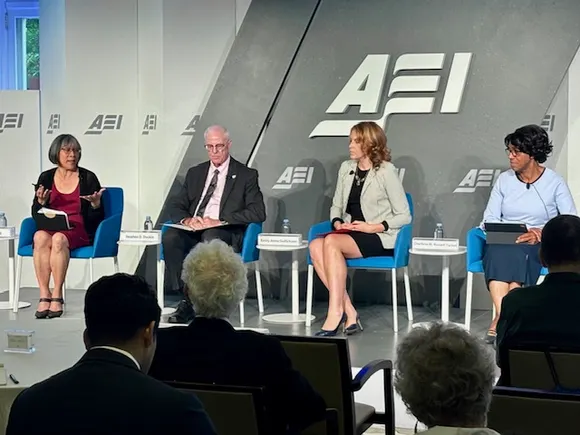
    These are some of the school attendance approaches school system leaders shared during a Thursday event focused on combating chronic absenteeism. The event was hosted by Attendance Works, EdTrust and American Enterprise Institute.

    “If we don’t have our students there, we will not see the outcomes that we’re looking for,” said Charlene Russell-Tucker, commissioner of the Connecticut State Department of Education.  

    Nat Malkus, a senior fellow and deputy director of education policy studies at AEI, said that while data shows the national chronic absenteeism rate is improving, there’s much more work to do to get school attendance back to pre-COVID-19 levels.

    In 2024, the national chronic absenteeism rate was 23.5%. That’s an improvement from a high of 28.5% in 2022, but still higher than the 13.4% recorded in 2017 and 15.2% in 2018, Malkus said. Chronic absenteeism is measured as missing 10% or more days in a school year — or about 18 days — for any reason. 

    In 2022, “almost every district in the nation saw [chronic absenteeism] increases, most of them sizable,” Malkus said. Although overall attendance improved in 2023 and 2024, the increases weren’t as high as the education field had hoped, he said.

    “This is a long-haul game” to get schools operating with consistent attendance “for our educational and economic future,” Malkus said.

    He commended 16 states and Washington, D.C., for committing to reduce chronic absenteeism by 50% over five years. At an event last year, the three organizations called on all states to make this commitment. 

    “States and districts have made progress, and we should be happy for that,” said Malkus, adding that improvements in attendance show “progress on this front is doable, and that the goals are achievable.”

    Trying different solutions

    Stephen Dackin, director of the Ohio Department of Education and Workforce, said that his state has committed to the 50% reduction in chronic absenteeism. Ohio hit a high of 30% in 2021-22 but is now down to 25.6%.

    Dackin said what has helped improve attendance is the use of a multi-tiered system of supports that provides increased levels of interventions where needed and an integrated review of students’ academic and behavioral data in developing interventions.

    “That is a game-changer, if we do it well in Ohio,” Dackin said.

    Emily Anne Gullickson, superintendent of public instruction in Virginia, said the state had a peak chronic absenteeism rate of 20.1%, which a case study by Attendance Works shows occurred in 2021-22. As of spring 2024, the rate was 15.7%. More recent attendance data is expected to be released soon, Gullickson said.

    A state-level task force launched the ALL (Attendance, Literacy and Learning) Initiative in September 2023. The state board of education incorporated chronic absenteeism into its accountability system and included it as part of a readiness indicator for elementary, middle and high schools, Gullickson said. Additionally, Virginia is studying model programs and looking at how to scale those practices.

    In Connecticut, Russell-Tucker said the chronic absenteeism rate was at a high of 23%, which state data shows occurred in 2021-22. Now, it’s at 17.2%. The state board of education set a goal of 6% by 2028.

    To help better understand the problem and to implement solutions, the attendance data is collected at the state level monthly. That data is then disaggregated by student subgroups. That data helps the state work with the districts so they can intervene immediately, Russell-Tucker said. Additionally, the state has a line item in its budget addressing student attendance.

    She called the need to improve school attendance an “all hands on deck” moment.

    The state’s Learner, Engagement and Attendance Program — or LEAP — supports home visits to strengthen school-family relationships and to reduce school attendance barriers for students, Russell-Tucker said.

    Evaluation studies of LEAP show that six months after the first LEAP visit, student attendance rates improved by about 10 percentage points for students in K-8, and nearly 16 percentage points for students in grades 9-12, she said.

    Source link