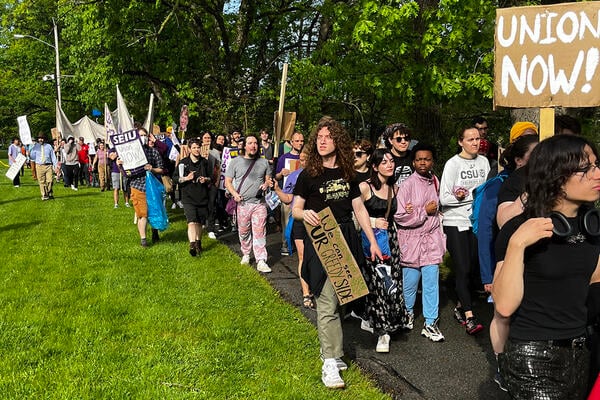
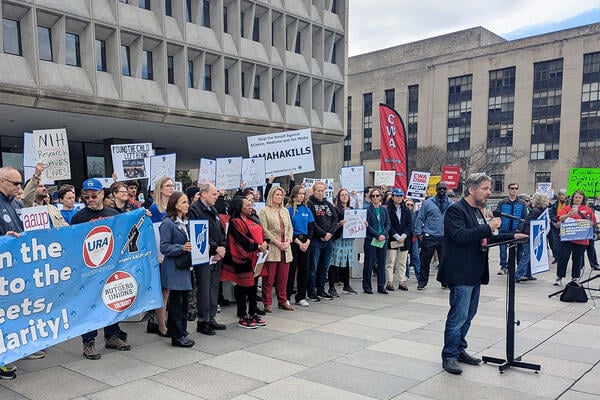
For a month this spring, the University of Rochester Graduate Labor Union, a group of Ph.D. student workers, staged a strike. Workers walked off the job, demanding that the university host a private unionization election so they could vote and win recognition of the union—all without having to go through the Trump-era National Labor Relations Board.
But after workers protested during the May 16 commencement ceremony, GLU representatives told them that organizing committee members had voted unanimously to “pause” the strike. And, with fall semester classes starting Monday, the organizers say they have no plans to rekindle it.
“We didn’t achieve what we wanted, which was them giving us a fair process for an election,” said Katie Gregory, a seventh-year environmental sciences Ph.D. worker. But, she said, “none of us consider the fight here to be over in terms of support for a union.”
George Elkind, a fourth-year visual and cultural studies Ph.D. worker, said, “We intend to continue fighting for a fair election process.”
The strike was both a carryover from an intense period of grad student union activity during the Biden administration—roughly 38 percent of grad student workers are unionized, according to a report from last August—and an indication of how President Trump’s return to the White House has raised concerns that the NLRB has become less favorable to unions.
Last year, during Biden’s presidency, University of Rochester officials and GLU organizers discussed plans for a private election, which both parties were amenable to. If they had reached an agreement, the NLRB—which usually handles unionization votes at private nonprofit institutions such as Rochester—wouldn’t have been involved.
But after Trump retook the White House in January—and fired a Democratic NLRB member and the agency’s general counsel—the university changed its tune. In February, a university lawyer told student organizers the institution no longer wanted a private election, citing multiple reasons, according to a document that Ph.D. student workers provided to Inside Higher Ed. Instead, the lawyer wrote, they could pursue an election with the Trump-era NLRB.
Taking that route would be risky—not just for their own prospective union’s chances of winning recognition, but also for the continued rights of grad workers across the country to unionize. Some union supporters worry an NLRB dominated by Trump appointees might use a grad student unionization case such as Rochester’s to overturn the 2016 Columbia University precedent establishing that private nonprofit university grad workers can unionize through the NLRB.
If that precedent were overturned, student workers could continue to unionize at public universities in the states that allow such action, but those at private institutions would have no other path than to seek voluntary recognition from their universities.
So far, GLU hasn’t succeeded in pressuring the University of Rochester once again to back a private union vote that would circumvent the NLRB. Gregory and Elkind both said the outcome of the strike might have been different if more Ph.D. workers had withheld their labor.
The union would have represented more than 1,400 students, Elkind said. About 300 withheld at least a day of work, Gregory said, but having 1,000 strike on day one would’ve sent a very different message.
Elkind said a “more sweeping strike with bigger numbers … would have had [university leaders] at the table within days.”
Both said the Trump administration’s attempts to remove international students from the U.S. had a “chilling effect” on strike participation. Elkind, who said about half of grad students at the university are international, called it “a horror show of a national environment.”
They also pointed to the university’s announcement of “attestation” forms that asked workers to indicate how much they were working—allowing the university to cut off pay for strikers if it wished.
“Clearly, a tactic to impact the strike participation,” Gregory said. The university didn’t move forward with requiring the forms; in an email, Sara Miller, a university spokesperson, said it “never implemented an attestation form and denies any allegation of ‘scare tactics.’”
University representatives also “refused to acknowledge the union as an entity,” Gregorysaid. For instance, they responded to organizing committee members’ communications as if they were merely students, offering them help with issues such as registration.
“It was a real slap in the face,” she said.
In their May 18 email calling off the strike, GLU members noted the semester was ending, writing that “many grads only have 9-month stipends and do not have labor to withhold during the summer.”
But Elkind and Gregory both said organizing is continuing. And the provost, in a Friday memo, announced new, universitywide minimum stipends for “full-time, full tuition remission PhD students”: $25,000 for nine-month stipends and $34,000 for yearlong stipends.
“I think they’re trying to curb labor organizing and unrest,” Elkind said.
Miller, the university spokesperson, wrote in an email that “the recent stipend update marks another step in implementing the University’s long-standing plans to enhance our graduate programs and was not related, in any way, to students’ prior organizing and/or protest activity.”
In recent years, Miller said, Rochester has expanded support for full-time Ph.D. students to include “subsidized health, dental and vision insurance; childcare benefits; raising stipends, and enhanced access to mental wellbeing and counseling services.”
And again, she said, “the students continue to have and have always had access to the National Labor Relations Board (NLRB).”
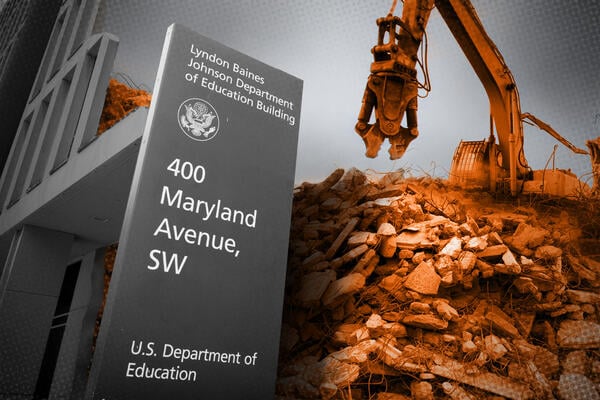
The administration has been revoking visas for months as part of a broader crackdown on international students.
Photo illustration by Justin Morrison/Inside Higher Ed | gradisca and Uladzimir Zuyeu/iStock/Getty Images
The State Department has revoked 6,000 student visas so far this year, Fox News reported along with The Washington Post.
Of that group, 4,000 were revoked due to crimes, including assault, driving under the influence and burglary. However, a department spokesperson told the Post that the students whose visas had been revoked “either faced arrest or charges,” but the spokesperson didn’t specify whether they were convicted.
The spokesperson also said that between 200 and 300 visas were revoked due to “support for terrorism.” President Donald Trump has previously labeled pro-Palestinian student protesters as terrorist sympathizers and has targeted international students over their pro-Palestinian activism.
The Post article does not address whether these students will have to stop their studies and leave the U.S. A visa—the stamp that permits an individual to enter the U.S.—is different from one’s nonimmigrant status, which refers to whether they are lawfully in the country, something immigration experts stressed amid a slew of student visa revocations in March and April.
The latest NASFAA survey shows financial aid services moving in the wrong direction.
Photo illustration by Justin Morrison/Inside Higher Ed | Marvin Joseph/The Washington Post/Getty Images | MauMyHaT/iStock/Getty Images | subtik/E+/Getty Images
Complaints about the Office of Federal Student Aid’s operations have increased significantly over the past few months, according to the latest edition of a survey from the National Association of Student Financial Aid Administrators. Challenges that were once just kinks behind the scenes are evolving to become student-facing issues on the front line, the association says.
The share of institutions reporting disruptions to communication, responsiveness or processing timelines rose from 59 percent in May to 72 percent in July. Meanwhile, the share of aid offices reporting student confusion about the process increased from 32 percent to 51 percent.
“I wasn’t overly surprised” by the data, said NASFAA president Melanie Storey. “But it was largely a disappointment that the trajectory is moving in the wrong direction.”
She added that the new loan caps and repayment plan changes detailed in President Trump’s One Big Beautiful Bill Act could compound the damage, creating long-term consequences for college attainment rates.
Given the “fissures and cracks around trust in higher education, we need to eliminate barriers and support students clearly and consistently—and that includes helping them figure out how they’re going to finance their higher education,” Storey said. “If this trajectory continues, I’m really concerned about the decisions that students and families are going to be able to make to enroll in postsecondary education.”
An Education Department official called the NASFAA report inaccurate and accused the organization of “peddling a false narrative to preserve the status quo.”
“It is an embarrassment for NASFAA to release a ‘survey’ that blatantly parrots falsehoods and is not representative of the higher education community nor the American people’s overwhelming charge for change,” deputy press secretary Ellen Keast said in an email to Inside Higher Ed. “While NASFAA stands idly by ready to see us fail, the Trump Administration has just launched the earliest FAFSA form ever, which they are well aware of and decided to ignore.”
Storey responded that NASFAA has tried repeatedly to partner with the administration in their “shared goal of serving students,” applauding efforts such as FAFSA beta testing.
But to dismiss the survey results as “fabricated or political undermines the expertise of those working directly with students every day, eager to deliver on the promise of postsecondary education, and shows that the administration is not interested in working with experts in the field to achieve the best results for students; instead, it is focused on advancing its own agenda,” she said.
Worsening Outcomes
It’s been an eventful few months for the FSA. Mass layoffs throughout the department, first announced in March, quickly faced legal challenges; in May, a district court temporarily blocked the executive action. But any hopes that the staffing shortage would be resolved were squashed when the Supreme Court overturned the lower court’s ruling in July. And while the justices have yet to hear the full case or issue a final ruling, the order allows Education Secretary Linda McMahon to proceed with the pink slips.
Storey said that some of the increased frustration and concern higher ed officials expressed in the survey may be related to timing; the district court ruling spurred cautious optimism in May, which had largely tanked by July. Similarly, the repercussions of staffing shortages were not necessarily evident in May but are now becoming clear. She also noted that the mounting discontent could simply be a reflection of the cyclical nature of student aid and the imminent start of the new academic year.
Either way, the survey suggests that FSA operations are flagging, and many NASFAA members say it’s preventing them from properly processing aid. For example, 63 percent of institutions that have submitted their E-App—a form that must be completed and approved in order to receive federal aid—said their submission had yet to be processed in July.
Department officials argue that this data is biased due to NASFAA’s survey method. They point specifically to the sample size, saying that the 500 institutions represented are predominantly nonprofit or public institutions, reflecting only a sliver of the more than 5,000 that FSA works with—and are the ones most likely to harbor anti-Trump sentiments.
The department also described the survey’s questions as biased toward the negative and said it was conducted just as the department finished updating its Partner Connect Portal to address various complaints, meaning the results don’t accurately reflect the new changes.
But Storey stood by her view that most of the challenges financial aid offices face today are the same as those they reported in May, only worse, and with longer delays in response time.
For example, previous Inside Higher Ed reporting shows that when students hit a wall and cannot log in to the FAFSA application portal, college advisers struggle to reach the central processing system that manages user IDs. While a department spokesperson said all help lines remain fully open, multiple college and NASFAA representatives say they have been unable to get through at certain times.
The latest survey shows this is still a major problem. More than half of institutions reported issues with federal call centers, and more than 40 percent cited problems with the National Student Loan Data System. In addition, over a third flagged disruptions with student loan servicing. Collectively, the NASFAA report said, these failures affect colleges’ ability to resolve aid issues for students in real time.
Once the delays start to hit students—which is happening more and more often, according to NASFAA’s report—it could leave them without access to loans and therefore unable to pay their bills and stay enrolled. Although colleges can grant students extensions for tuition payments or on-campus housing fees, they can’t change when off-campus rent or childcare payments are due. Situations like these often force students to take a job and attempt to pay off their debt with some college but no degree.
So unless FSA addresses its shortcomings, Storey said, the impact could be far-reaching.
“It’s a compounding of issues and uncertainties that I think could have a long-lasting and significant impact on postsecondary enrollment and financing,” she said.
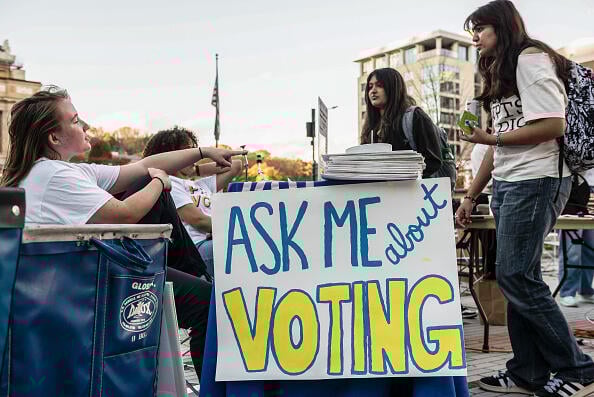
Students at the University of Pittsburgh participated in 2024 election activities.
Aaron Jackendoff/SOPA Images/LightRocket via Getty Images
The Department of Education released guidance Tuesday discouraging colleges from using Federal Work-Study funds to pay students to work on voter registration efforts and other activities it deems political.
The department announced the change to work study provisions in a Dear Colleague letter signed by acting assistant ED secretary Christopher McCaghren.
“Jobs involving partisan or nonpartisan voter registration, voter assistance at a polling place or through a voter hotline, or serving as a poll worker—whether this takes place on or off campus—involve political activity because these activities support the process of voting which is a quintessential political activity whereby voters formally support partisan or nonpartisan political candidates by casting ballots,” McCaghren wrote.
He emphasized in the letter that ED “encourages institutions to employ students in jobs that align with real-world work experience related to a student’s course of study whenever possible.”
Education Secretary Linda McMahon echoed that sentiment in a Tuesday social media post, writing that the department is “done funding political activism on college campuses!” She added, “Under the Trump Administration, taxpayer dollars will be used to prepare students for the workforce.”
McCaghren’s letter also warned colleges about “aiding and abetting voter fraud.”
While institutions are required to make a “good faith effort to distribute voter registration forms to students,” they should refrain from distributing such materials to students they believe are ineligible to vote in state or federal elections, according to the letter.
The move comes as President Donald Trump has announced plans to overhaul how elections are conducted before the upcoming midterms next year, including barring certain voting machines and mail-in voting, though he does not have the authority to make such changes.
As generative AI continues to gain momentum in education each year, both its adoption and the attitudes toward its use have steadily grown more positive, according to a new report from Quizlet.
The How America Learns report explores U.S. student, teacher, and parent perspectives on AI implementation, digital learning and engagement, and success beyond the classroom.
“At Quizlet, we’ve spent nearly two decades putting students at the center of everything we do,” said Quizlet CEO Kurt Beidler. “We fielded this research to better understand the evolving study habits of today’s students and ensure we’re building tools that not only help our tens of millions of monthly learners succeed, but also reflect what they truly need from their learning experience.”
AI becomes ubiquitous in education As generative AI solutions gain traction in education year over year, adoption and attitudes towards the technology have increased and improved. Quizlet’s survey found that 85 percent of respondents–including high school and college teachers, as well as students aged 14-22–said they used AI technology, a significant increase from 66 percent in 2024. Of those respondents using AI, teachers now outpace students in AI adoption (87 percent vs 84 percent), compared to 2024 findings when students slightly outpaced teachers.
Among the 89 percent of all students who say they use AI technology for school (up from 77 percent in 2024), the top three use cases are summarizing or synthesizing information (56%), research (46 percent), and generating study guides or materials (45 percent). The top uses of AI technology among teachers remained the same but saw significant growth YoY: research (54 percent vs. 33 percent), summarizing or synthesizing information (48 percent vs. 30 percent), and generating classroom materials like tests and assignments (45 percent vs. 31 percent).
While the emergence of AI has presented new challenges related to academic integrity, 40 percent of respondents believe that AI is used ethically and effectively in the classroom. However, students are significantly less likely to feel this way (29 percent) compared to parents (46 percent) and teachers (57 percent), signaling a continued need for education and guidelines on responsible use of AI technology for learning.
“Like any new technology, AI brings incredible opportunities, but also a responsibility to use it thoughtfully,” said Maureen Lamb, AI Task Force Chair and Language Department Chair at Miss Porter’s School. “As adoption in education grows, we need clear guidelines that help mitigate risk and unlock the full potential of AI. Everyone–students, educators, and parents–has a role to play in understanding not just how to use AI, but when and why it should be used.”
Digital learning demands growth while equity gap persists Just as AI is becoming a staple in education, survey results also found that digital learning is growing in popularity, with 64 percent of respondents expressing that digital learning methods should be equal or greater than traditional education methods, especially teachers (71 percent).
Respondents indicated that flexibility (56 percent), personalized learning (53 percent), and accessibility (49 percent) were the most beneficial aspects of digital learning. And with 77 percent of students making sacrifices, including loss of sleep, personal time, and missed extracurriculars due to homework, digital learning offers a promising path toward a more accommodating approach.
While the majority of respondents agreed on the importance and benefits of digital learning, results also pointed to a disparity in access to these tools. Despite nearly half (49 percent) of respondents agreeing that all students in their community have equal access to learning materials, technology, and support to succeed academically, that percentage drops to 43 percent for respondents with diagnosed or self-identified learning differences, neurodivergent traits, or accessibility needs.
Maximizing success for academic and real-world learning While discussion around AI and education has largely focused on use cases for academic learning, the report also uncovered an opportunity for greater support to help drive success beyond the classroom and provide needed resources for real-world learning.
Nearly 60 percent of respondents believe a four-year college degree is of high importance for achieving professional success (58 percent). However, more than one-third of students, teachers, and parents surveyed believe schools are not adequately preparing students for success beyond the classroom.
“As we drive the next era of AI-powered learning, it’s our mission to give every student and lifelong learner the tools and confidence to succeed, no matter their motivation or what they’re striving to achieve,” said Beidler. “As we’ve seen in the data, there’s immense opportunity when it comes to career-connected learning, from life skills development to improving job readiness, that goes well beyond the classroom and addresses what we’re hearing from students and teachers alike.”
The top five skills respondents indicated should be prioritized more in schools are critical thinking and problem solving (66 percent), financial literacy (64 percent), mental health management (58 percent), leadership skills (52 percent), and creativity and innovation (50 percent).
eSchool Media staff cover education technology in all its aspects–from legislation and litigation, to best practices, to lessons learned and new products. First published in March of 1998 as a monthly print and digital newspaper, eSchool Media provides the news and information necessary to help K-20 decision-makers successfully use technology and innovation to transform schools and colleges and achieve their educational goals.
The Oregon Health & Science University will receive a $2 billion gift from Nike co-founder Phil Knight and his wife, Penny, to support the eponymous Knight Cancer Institute, OHSU announced last week.
It is the largest single donation ever made to a U.S. university-affiliated health center and is intended to promote the integration of cancer diagnostics, treatment and patient care.
The gift will allow the cancer institute to become self-governed within OHSU. It will have its own board of directors under the leadership of Brian Druker, a leukemia researcher who has worked closely with the Knights and who helped develop a drug that vastly improved the life span of patients with chronic myeloid leukemia.
“This gift is an unprecedented investment in the millions of lives burdened with cancer, especially patients and families here in Oregon,” said OHSU president Shereef Elnahal. “It is also a signal of trust in the superlative work that our clinicians, researchers and teammates at the Knight Cancer Institute do every day. Dr. Druker’s vision around a multidisciplinary system of care—focused squarely on making the patient’s experience seamless from the moment they receive a diagnosis—will now become reality. And thanks to the extraordinary generosity of Mr. and Mrs. Knight, Oregon will be the place to do it.”
The Knights have been key benefactors of the cancer institute. In 2013 they vowed to donate $500 million if the university could match the funds within two years—which it did, thanks to $200 million in bonds from the Oregon Legislature, $100 million from Columbia Sportswear chair Gert Boyle and assorted donations from some 10,000 individuals from all 50 states and 15 countries.
Over the past seven months, members of the American Association of University Professors, a 110-year-old organization that is fundamental in defining and protecting academic freedom, have found themselves, their disciplines and their universities on the receiving end of the Trump administration’s unrelenting attack on higher ed.
As Republicans in some states diminish the influence of faculty senates, AAUP state- and campus-level chapters, which often also represent faculty as official unions, have led the criticism of the federal government’s actions. But how is the AAUP planning to fight now—more than half a year into Trump’s return to power, as Washington continues to pressure some of the country’s most powerful universities into making concessions?
Late last week, Inside Higher Ed interviewed Todd Wolfson, whom AAUP members elected as their president in June 2024. A former union leader at Rutgers University, Wolfson denounced the Trump-Vance ticket well before the GOP victory in November. Now, he’s leading the AAUP as it protests, sues and otherwise tussles with Trump.
The following transcript of the interview has been edited for clarity and concision.
Q: We’re now more than six months into Trump’s second administration. What is the current state of academic freedom?
A: It’s being washed over by an administration that has no respect, or even probably understanding, of the concept. We’re seeing massive infringement of academic freedom at the individual level. But then, it’s also the academic freedom of institutions.
In the McCarthy era, the attacks on academic freedom were attacks on individual faculty and demands for loyalty oaths and those sorts of attacks on individuals, not on institutions. So I’d say that, in the current moment, academic freedom is under its most fundamental attack we’ve ever seen, both in its attack on individual academics, but also on institutional autonomy from the federal government, ideological control.
Q: Did you expect the Trump administration to target higher ed this much, or in these ways? What has and hasn’t surprised you?
A: We were raising the alarm about this from before the election. We were very concerned about statements coming out of … the Trump campaign and then JD Vance’s mouth. So we recognized a threat. I mean, if you go back and look at Trump’s campaign video about higher ed, it’s like pure lunacy, right?
And it’s not that this was new—because [of Florida governor] Ron DeSantis—but it was alarming. Even with that, though, I would say that, clearly, we underestimated how dangerous it was. I did not expect a wholesale assault on the sector, squeezing it from every direction. And so, yes, I’m surprised. We were not prepared for how they’ve approached dismantling higher education.
I never expected the Trump administration to take a democracy, or the health of American society, to heart, because they’re grifters and they’re in it for their own personal power and their own personal wealth. But I did not expect that they would be so outlandishly intent on destroying a sector that’s so important to the fundamental values and power of American society.
Q: Yeah, you called then–vice presidential candidate JD Vance a fascist last August. Has he turned out to be one?
A: I would say so.
Vance and Trump and [Christopher] Rufo and Stephen Miller and the ilk that run our government are fascist in a 21st-century variant—not operating within the constructs of our society, [but] trying to rip those constructs down. I think the last six months have borne out my position pretty well.
The ilk that run our government are fascist in a 21st-century variant—not operating within the constructs of our society, [but] trying to rip those constructs down.”
Q: How has the AAUP resisted the Trump administration’s actions, and universities’ apparent responses to those actions?
A: The first and most important is we’re organizing our members, we’re doing a lot of political education with them, we’re thinking together about the problems at the campus level and then the problems at the state and national level, and we’re talking about how we approach it. We’ve grown more than this organization has ever grown in the last six months.
We built out coalition[s]. And so I think the most important [coalition]—but not the only one—is that we have established and coordinated a space called Labor for Higher Ed where all the international unions sit together and work together to come up with a coordinated plan to respond to the Trump administration. That’s never happened before. We have every major union that has higher ed workers sitting at that table.
[Secondly,] we sued the Trump administration on our own six times. With our AFT [American Federation of Teachers] as our [union] affiliate … probably another three or four times.
They’re doing so many things that are so obviously unconstitutional and illegal, and so we’re trying to use the courts to slow them down.
The third [tactic]—and you’ll see more of this, but you’ve probably been watching and seen it throughout the spring of last year—is getting our people into the streets, fighting back, offering a different vision. This has primarily happened in response to the NIH, NSF cuts.
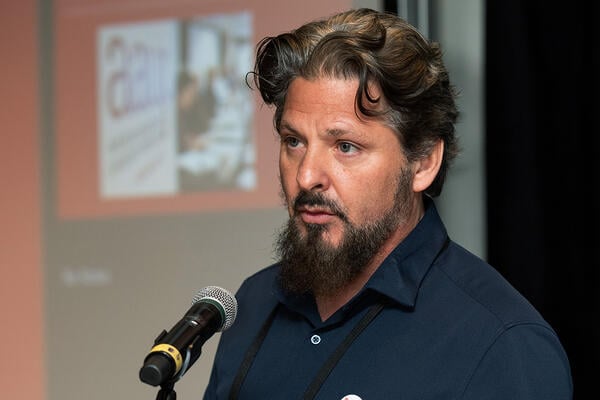
Wolfson (at podium) at a news conference at AAUP headquarters in Washington, D.C.
Ryan Quinn/Inside Higher Ed
The fourth area is that we need to offer … a countervision of higher education to the Trump vision, which is higher education ideologically controlled by the federal government, in its most extreme form, as well as the complete destruction of our biomedical research infrastructure and our research over all.
We’re working on a policy vision that will move us into the midterms … a counterimaginary of higher ed to the imaginary that’s been developed by the Trump administration, by Chris Rufo, one where we’re all Marxist ideologues indoctrinating our students.
The last area is that we’re supporting the development of organizing at the campus level to challenge and hold our administrations accountable, whether supporting the mutual aid defense compact projects that [have] mushroomed across higher ed, or supporting the fights at campus levels around academic freedom and freedom of speech, or any other number of things that we’re doing to support faculty at the campus level, to get their administrations to hold firm and not to bow to the Trump administration’s demands before they even make them.
We had 40,000 members, now we have something like 50,000 members [since Wolfson was elected president last year]. By the end of the calendar year, I’d like to see [60,000]. And that’s dues-paying members.
Q: Has there been an increase in the number of campus chapters or state conferences?
A: Since Trump was elected, I think we’ve grown by at least 40 chapters. Some of those chapters had gone dormant and then renewed and came back to life.
So if we had, when [current AAUP leaders] took office, something like 500 chapters, now there’s something like 550.
Q: Do you have any regrets about tactics or actions your organization has taken so far during the second Trump administration?
A: Certainly, I have regrets. Everyone makes mistakes. I don’t know if this is a regret, [but] I think that our sector is not fully ready to respond to the real threats. Our sector needs to be able to take militant job actions and other sorts of actions as this issue continues to ramp up.
We won’t do that if we don’t have the ability to do it at a scale that makes it powerful and meaningful and effective. And so I think that’s the thing we are working on, and anything we do—and I want to underscore this—would be nonviolent and peaceful.
But, nonetheless, we need to be able to militantly show how concerned we are—not only over our own institutions and our own jobs and our students, but also around higher education and the future of our democracy.
Q: Is what you’re saying is needed is a simultaneous general strike across higher education institutions across the country?
A: If we continue to have a federal government that takes over our cities and puts our cities under martial law and abuses the institutional autonomy of our higher education institutions and does all sorts of things that we all see are undemocratic and dangerous, we need to be prepared not only for a general strike in higher education, but a general strike over all.
I don’t think a higher education general strike is an action that will be effective, because I don’t think that higher education alone has this sort of industrial power to hurt the economy in a way that could force us to try to move through this moment.
If the Trump administration continues on its course … the only force that could respond to that effectively is a labor movement that is willing to withhold its labor, and in a general way.”
But I’m saying if the Trump administration continues on its course—which is a course that’s antidemocratic, that could undermine elections, that could take over cities, that could endanger citizens in the way it did in L.A. and now is doing in D.C., and that is destroying our democracy one piece at a time—that the only force that could respond to that effectively is a labor movement that is willing to withhold its labor, and in a general way.
Q: I was wondering whether you felt that your organization relied a little too much on litigation, or whether protest fell flat.
A: Maybe society writ large in the U.S. is depending too much on courts. I wish we were prepared, as workers in the sector, to take approaches that were more direct than just the courts. But, obviously, we can only be a reflection of the workers in the sector. We cannot, as an institution, push ourselves well beyond where our workers are at.
Q: I think many people would agree that things have gotten worse and worse as the Trump administration has progressed … What does AAUP plan to do differently going forward?
A: There can’t be an expectation that the moment that the Trump administration took office, that … all of the higher ed workers and our students would have been ready and prepared to respond. There is often a lag time between a crisis and the public’s response to that crisis.
We should be critical of ourselves and critical of our tactics and think about how to respond better and move forward better. We see the next 16 months as really important, and that rolls us through the midterms of 2026.
We don’t plan to do this alone. We plan to do this with every higher ed worker, and so that’s why Labor for Higher Ed—this table that represents millions of higher ed workers coming together and working together and coming up with this plan together—is so important. We’re also building an aligned table with our students and student organizations, and also with alumni and alumni organizations. And so we think that if those three forces can come together and fight specifically over higher ed, we can make a real fight.
Wolfson at a rally outside the Health and Human Services Department headquarters.
Ryan Quinn/Inside Higher Ed
But I’ll say this … higher ed workers alone cannot beat back the Trump administration. It needs to be a multisector fight. Federal workers—who are also under attack—we need to build alliance with them. K–12 teachers, health-care workers, immigrant workers, progressive community organizations all need to build an aligned front that is ready to take risks, because if we don’t take those risks, we may look at what we have in 2026 and we might not have clean, fair elections.
I think we have to take that very seriously, and we have to build our power to respond.
[Currently, we need] a real fight around the budget, from now through October, a fight around the budget that demands a fully funded NIH, NSF, NASA, [that] pushes around the destruction of the student loan program [and] fights over the TRIO program … which is a program for first-generation college kids.
From there, we are going to be really working on our campuses, building campus-level campaigns and state-level campaigns around higher education.
The things we want to have in [the national] vision are things like a demand for free public higher education, college for all and an end to adjunctification, an end to student debt, more research funding … and then use that vision to really fight for candidates that lift up our imagination of higher education as we move into the midterms.
We are going to fight in the streets and we’re going to fight politically. This is a political battle, and we need to respond politically in this battle.
Q: How do you fight an enemy that seems to thrive on conflict and to derive strength partly by othering certain groups of people—and, among those groups of people … faculty?
A: Faculty and the press and people of color and women and gay people and trans people and anybody that’s not white, Christian nationalist, in the end, is othered. And then even within the white Christian nationalist community, if you’re not MAGA, or you care about a free press, or care about free inquiry, you’re othered.
That first six months was a freaking whirlwind, and so we were really reactive, we were reacting. The Trump administration set the tone—not just for us, to be clear, obviously [for] the Democratic Party, but the progressive community more generally or any sector under attack.
We have been too reactive to the political environment, and so I think the biggest thing that we need to do is stay on our message and vision.
Now there seems to be some fracturing, maybe over Palestine, in the right-wing echo chamber. But, in general, that echo chamber has operated in lockstep and it’s huge, and we don’t have anything like that. Whatever we do, we’re never going to have the megaphone that they have. But, what I do believe is that we must put out our own proactive vision. It can no longer be “Ron DeSantis is mean, and he’s saying bad things about DEI and we need to stop him,” or “Donald Trump is saying bad things about Harvard,” or “Chris Rufo, can you believe how ridiculous the things he puts out are?”
We can’t be constantly responding to them. We can’t have kids going into hundreds of thousands of dollars of debt to get a college degree, and we need to make sure that we have work with dignity and free inquiry and we need to make sure we have the best research infrastructure in the world.
Q: You mentioned Palestine. What position, what action, if any, does national AAUP need to take on Israel and Palestine at this moment? … I know that you guys already dropped your categorical opposition to academic boycotts before Trump’s election.
A: We believe strongly that no weapons should be sent to Israel, at all. Not defensive or offensive, nothing.
What do we do in the U.S., where antisemitism has been used as a weapon, in many ways, by the Trump administration to bring universities to heel—and many times stripping out, or threatening to strip out, hundreds of millions of research dollars that often affect Jewish faculty members? Versus what our position should be on the conflict in the Middle East?
First and foremost, our job is to safeguard ourselves at home and to set a vision that aligns with what we’re trying to do in the United States. We need to stand up for academic freedom, for freedom of speech, for freedom of assembly for our students so they can protest the war—the genocide, excuse me—that’s taking place in Gaza.
We need to stand up to the weaponization of antisemitism in the Title VI process. And we need to make sure that we defend our members.
We think the Jerusalem Declaration on Antisemitism, which does not get involved with questions of the Israeli state at all, is a much more apt way of defining antisemitism.
The numbers of universities and faculty and university presidents [in Gaza] that have been killed and universities that have been destroyed in this war is mammoth. We are certainly educating our members on this concept of scholasticide.
It seems pretty obvious that they are—but if, in fact, Israel is purposefully destroying the educational infrastructure, both K–12 and higher ed, of Palestine, and of Gaza, that stands against our values of academic freedom. And if that’s the case, and we can unify around that, then we will take a stand and call for an end to the scholasticide.
Q: What will it take, ultimately, to get the Trump administration to relent in its attacks on higher ed?
A: Ultimately, we need a massive movement of higher ed workers and students. But, again, I don’t think that’s enough.
I believe as higher ed goes, so goes democracy. But the converse isn’t absolutely true. Higher ed alone cannot save democracy, but we’re a critical part.
It needs to be a broader societal movement to save our country.
For many decades, the National Collegiate Athletic Association preserved student athletes’ amateur status by prohibiting their ability to profit off their name, image or likeness (NIL). As a former Division I compliance coordinator, I often felt the NCAA’s amateurism policies went too far—denying student athletes the right to earn money like other college students, such as by running their own sports camps.
But now the courts have turned the NCAA’s concept of amateurism on its head with the approval in June of a $2.8 billion athlete compensation settlement, which will be shared by student athletes who previously missed out on the opportunity to make money from their NIL. This historic deal between Division I athletes, the NCAA and the Division I Power 5 conferences—the SEC, Big Ten, Big 12, Pac-12 and ACC—has also made revenue sharing with current student athletes a reality.
Athletes at top football and basketball programs may be celebrating this financial victory, which allows institutions to share up to $20.5 million each year with student athletes—money generated from media, tickets, concessions and donations.
But many coaches who recruit them—along with professors like me, who teach them—believe that paying college athletes for their athletic ability will hurt college sports. That’s because doing so professionalizes college athletes in a way that hurts other students and sports over all and compromises the institution’s academic mission.
And while some student athletes stand to benefit from the new system, most won’t. Many universities will use the 75-15-5-5 model, meaning that 75 percent of the revenue would be distributed to football, 15 percent to men’s basketball, 5 percent to women’s basketball and 5 percent to all other sports.
Paying players will also change the spirit of college sports. Although the concept of amateurism has been a joke in college athletics for a long time—particularly in revenue-generating sports—a pay-for-play system would further move the emphasis away from educational goals and toward commercial ones. As one big-time head football coach described it to me, “As soon as you start paying a player, they become in some ways their [university’s] employees. It’s not amateurism anymore.”
On many campuses, a separation already exists between student athletes and nonathletes, which some believe is due to student athletes’ perceived privilege. According to one Division I women’s basketball coach I spoke to, implementing revenue sharing will only increase that divide. Student athletes receiving five- or six-figure salaries to play for their institutions will be incentivized to devote more time to their sport, leaving less time to engage in the campus community and further diluting the purpose of college as an incubator for personal and intellectual growth.
There’s also a possibility, one coach told me, that colleges will shrink staff and “avoid facility upgrades in order to fund revenue share,” putting off improvements to gyms or playing fields, for instance. At some institutions, funding the revenue-sharing plan will undoubtedly lead to cuts in Olympic and nonrevenue sports like swimming and track.
What’s more, it remains unclear how revenue-sharing plans will impact gender equity, because revenue distribution may not count as financial aid for Title IX purposes. Since 1972, Title IX has ensured equal opportunities for female student athletes that includes proportionate funding for their college athletic programs. If NIL payments from colleges are not subject to Title IX scrutiny, athletic departments will be allowed to direct all revenue generated from media rights, tickets and donations to their football and men’s basketball programs. As one Division I women’s basketball coach put it to me, “We are widening the gap between men and women athletes.”
To be sure, the college sports system is problematic; as scholars have pointed out, it exploits student athletes for their athletic talent while coaches and athletic leaders reap the benefits. But creating professional athletes within educational institutions is not the answer.
Instead, I propose that all student athletes participate in collective bargaining before being required to sign employment-type contracts that waive their NIL rights in exchange for a share of the revenue.
Collective bargaining would ensure that student athletes are guaranteed specific commitments by their institutions to safeguard their academic success, holistic development and well-being. These could include approved time off from their sport to participate in beneficial, high-impact practices like internships and undergraduate research, and academic support to help them excel in a program of their choosing—not one effectively chosen for them to accommodate their athletic schedule.
The graduation rates of student athletes—particularly Black male football and basketball players at the top Power 5 institutions—are dismal. A 2018 study by Shaun R. Harper found that, across the 65 institutions that then comprised the Power 5 conferences, only 55.2 percent of Black male athletes graduated in six years, a figure that was lower than for all student athletes (69.3 percent), all Black undergraduate men (60.1 percent) and all undergraduates (76.3 percent). Under collective bargaining, student athletes could retain their scholarships, regardless of injury or exhausted eligibility, to help finish their degrees. Such financial support would encourage athletes to stay in college after their athletic careers end.
They could also negotiate better mental health support consistent with the NCAA’s best practices, including annual mental health screenings and access to culturally inclusive mental health providers trained to work with athletes. Coaches would learn to recognize mental health symptoms, which is crucial; as one former women’s basketball coach told me, she didn’t “have the right language” to help her athletes.
Presently, the NCAA’s posteligibility injury insurance provides student athletes only two years of health care following injury. Collective bargaining could provide long-term health care and disability insurance for those sustaining injuries during college. This matters because football players risk their lives every day to make money for their institutions—doubling their chances to develop chronic traumatic encephalopathy with each 2.6 years they play and likely significantly increasing their chances of developing Parkinson’s disease relative to other nonfootball athletes.
As one football coach mentioned to me, it may be too late to put the proverbial genie back in the bottle when it comes to pay for play, but it’s not too late for colleges to prioritize their academic mission in their athletic programs, care for students’ well-being and restore the spirit of college sports.
Debbie Hogan works and teaches at Boston College. Her research focuses on holistic coaching, student athlete development and sense of belonging of Black student athletes.
Job shadows are one way to give students a behind-the-scenes look at the daily operations and undertakings of a particular role or industry, giving them a deeper perspective than an informational interview or job description may provide. However, opportunities to engage in career exploration experiences can be limited, particularly for lower-level students.
A winter 2023 survey found 22 percent of respondents had never had experiential learning or an internship while in college. Among first-year respondents, that number grew to 28 percent.
To increase access to career exploration for first-generation students early in their college experience, Harvey Mudd College in California partnered with alumni around the country to offer short-term job shadows in students’ hometowns. The experiences offered students a chance to define their STEM career goals and establish a professional network.
Survey Says
Students say giving them access to and preparation for career-building spaces is critical for their success. A May 2024 Student Voice survey by Inside Higher Ed and Generation Lab found 38 percent of students believe helping them prepare for internships and career success should be a top priority for career centers.
The background: Harvey Mudd is a liberal arts college that provides exclusively STEM degrees. Its current strategic plan focuses on expanding students’ career navigation experiences, particularly helping them connect their major program with life after college, said Shannon Braun, director of career services.
“A lot of time they really know what they want to study because it’s interesting to them, but not how that applies to life after Mudd or during Mudd,” Braun said. “It can be a little difficult.”
Staff elected to focus first on students who could most benefit from a job-shadow experience and exposure to a professional work setting.
“We landed on our first-gen, who may not have had some of the opportunities that other students might have, like a take-your-kid-to-work day,” Braun said.
How it works: The pilot program focused on students enrolled in Mudd’s Summer Institute, a precollege program for incoming students from underresourced high schools and those who are first-generation or from groups historically underrepresented in STEM.
Summer Institute participants indicated if they would be interested in a summer job-shadow opportunity, as well as some information about their hometown, program of study and career goals. From there, the career services office partnered with the alumni and family engagement office to identify hosts that matched students’ location and interests.
The focus on a student’s hometown was in part tied to logistics—most first-year students go home during the summer before their second year, and it was more cost-effective to provide job shadows where they were residing, Braun said. But staff also hoped it would expose students to career opportunities locally and near family, which can be a strong pull for first-generation students in particular, and help them affirm their major decision.
“Another benefit of this program is, let me shadow an engineer and see if I’m into that, or let me shadow a programmer to see if I’m into that,” Braun said.
After the alumni and students were matched up, both groups completed orientations prior to the job shadow addressing what makes a good job-shadow experience, questions to ask of the student or host, and transportation to and from the host site. All job shadows happened in the metropolitan area of the student’s hometown, so most participants commuted at least some distance.
The college also reimbursed students for their travel and lunch for the day, about $150 on average.
The impact: Ten students participated in cities ranging from neighboring Los Angeles and Altadena to farther away in Redmond, Wash., and Denver. Over all, student and alumni feedback indicated all parties were pleased with the experience.
“Students said this was something that they felt was informative for them, either picking a different major or thinking about an industry that they wanted to go into,” Braun said. Alumni said it was a feel-good experience and an opportunity for them to give back, as well.
One change staff are considering is to rebrand the program. The pilot was titled “Muddship,” a play on internship, which was confusing for both groups, so staff are brainstorming a new title that clarifies this isn’t work-based learning but a low-stakes career-exploration experience.
For next year, Braun and her team are hoping to offer job shadows over winter, spring and summer breaks, allowing more students to participate.
The program has limited funds, but Braun would like to see additional dollars invested for stipends on the front end so the students don’t have to pay out of pocket to participate. Braun also sees value in offering students the opportunity to travel to job shadows or providing students with professional dress to enter job-shadow spaces, which would require more financial resources, as well.
If you have the opportunity to apply for a job at the University of Michigan’s Center for Academic Innovation, do so. If they offer you the gig, accept.
The two roles that CAI is recruiting for that I want to highlight are:
I asked Suzanne Dove, CAI’s chief education solutions officer, to answer four questions about the roles.
Q: What is the university’s mandate behind these roles? How do they help align with and advance the university’s strategic priorities?
A: Education Solutions is a new team within the University of Michigan’s Center for Academic Innovation, charged with bringing strategic focus and forward momentum to our partnerships with external organizations, both private and public, seeking an innovative educational provider for workforce development.
A growing and robust set of high-value strategic partnerships is an essential component of CAI’s growth strategy in the decade ahead. We are responsible for engaging prospective partners, identifying opportunities and crafting relevant educational solutions in collaboration with other CAI teams and U-M faculty and ensuring a high-quality partner experience. We also provide thought leadership around the shifting workforce-development landscape.
Q: Where do the roles sit within the university structure? How will the hires in these roles engage with other units and leaders across campus?
A: The Center for Academic Innovation is a strategically focused central campus unit at the University of Michigan. We aim to shape the future of learning by unlocking new opportunities for the University of Michigan community and learners, as well as organizations around the world. Our vision is a future in which education connects and empowers learners everywhere to reach their full potential throughout their lives.
The people who join our team in these two new business development roles will play a vital role in connecting CAI to organizations outside the university, understanding and supporting solutions that fulfill these organizations’ evolving workforce and talent development needs, and helping us scale these partnerships in alignment with CAI’s mission. Successful candidates will bring expertise in developing and nurturing strong partnerships with external organizations at regional, national and international levels, as well as the ability to adopt an industry perspective.
Q: What would success look like in one year? Three years? Beyond?
A: Year one is about building the foundations for successful partnerships, both by experimenting with different ways we can serve organizational partners and by taking a systematic approach to deliver, evaluate and learn as we go. We will work together to establish a robust and vibrant pipeline of strategic partner organizations, evaluate their organizational learning needs and determine ways in which our current and future catalog of offerings can serve those needs.
At three years, I expect we will be engaging with a set of strategic external partnerships and have built our understanding of the educational solutions that we’re best positioned to provide. Beyond that, we want to scale these solutions to match the vast needs of workforce trends and transitions around the world.
Q: What kinds of future roles would someone who took either of these positions be prepared for?
A: I am excited for the people we hire as business development specialists because their work will position them at the intersection of building relationships, understanding the dynamic world of workforce learning and building internal processes to allow effective delivery of educational solutions for organizations. The result will be a tangible impact not only on people’s lives but also on the organization’s performance.
I can envision plenty of doors that would open as a result of success in one of these positions, depending on the individual’s interests: HR or talent development leadership; a workforce or economic development agency at the local, state, federal or even global level; or a larger or more complex business development portfolio.
One thing I have noticed about CAI since I joined a few months ago is that there are plenty of opportunities for team members to grow and stretch. If you are an intellectually curious, creative problem solver who leads by listening and collaborating, if you love to take an initial concept and help a team and organization bring it to life, I hope you’ll apply!
Please get in touch if you are conducting a job search at the intersection of learning, technology and organizational change. If your gig is a good fit, featuring your gig on Featured Gigs is free.