The loan program would need $30 million for its first year, based on calculations of how much Connecticut students take out in Grad PLUS loans.
Photo illustration by Justin Morrison/Inside Higher Ed | Getty Images | Rawpixel
After President Donald Trump’s One Big Beautiful Bill Act (OBBBA) overhauled federal student loans, college affordability advocates worried that those changes would severely restrict who has access to higher education—especially graduate programs. Now, lawmakers in Connecticut are taking steps to ensure students in the state can continue to afford those degrees.
Rep. Gregg Haddad, a Democrat who co-chairs the Connecticut legislature’s Higher Education Committee, announced a plan last week to create a new state-level student loan program to fill in the gap left by the elimination of Grad PLUS loans, a 20-year-old loan program that helped expand graduate education for middle- and low-income students. The program will be open to any student studying at a graduate program in the state.
Josh Hurlock, deputy director of the Connecticut Higher Education Supplemental Loan Authority (CHESLA), a quasi-public body that administers Connecticut’s state-level student loans, said the organization is hoping to launch the new program in time for students to take out loans for the 2026–2027 academic year.
“The Grad PLUS program historically has had very little credit check, so it’s been accessible to students of all credit qualities,” Hurlock said. “So, with the program going away … we want to make sure that students and schools have financing options available for their graduate students, and students and schools need to know what’s available sooner rather than later as we approach the fall semester.”
The program would require $30 million in funding for its first year, based on calculations that students in Connecticut take out between $90 million and $100 million in Grad PLUS loans annually. (Those already receiving the loans will be grandfathered in.) Two-thirds of that would come from a bond that CHESLA will issue, while the remaining $10 million would have to come from state allocations. Haddad said he is hoping the funds can be drawn from a $500 million emergency reserve the state created in November specifically to offset federal cuts.
Interest rates and borrower fees have not yet been determined, “but we think we can come up with an attractive product and solve this problem for Connecticut students,” Haddad said.
Eliminating Grad PLUS loans is just one of the restrictions on federal student loans included in the OBBBA. The legislation also placed caps on how much borrowers can take out in federal loans for graduate programs and on Parent PLUS loans for dependent undergraduates. Proponents of the limits argued that uncapped federal loans encouraged universities to increase their tuition fees, creating the student debt crisis. But supporters of federal student loan programs argue they opened the door to graduate education and careers in fields like medicine for students who previously would not have had those opportunities.
Grad PLUS loans will officially end and the caps for other federal loans will go into effect in July. Administrators at several institutions with a large number of graduate students told Inside Higher Edthat they’re still working to figure out how to close funding gaps for their students.
Filling in the gap left behind by Grad PLUS loans is especially important because Connecticut, like most U.S. states, struggles with a shortage of workers in certain professions, like nurses and teachers, Haddad said.
“We have a keen interest in making sure that we have a robust pipeline of people who want to enter those professions,” he said. “And we’d like to remove any roadblocks to having them achieve and complete their degrees so that they can get to work providing the services that people need in Connecticut.”
Peter Granville, a fellow at the Century Foundation who researches college affordability, said that it’s wise for states to consider how they can support students in the absence of Grad PLUS funding.
“State leaders know that their economies depend on these students being able to attain degrees in fields like education and nursing,” he said. “States will be worse off if [they] completely depend on private lenders filling gaps that they may or may not be inclined to fill.”
Haddad said that the proposed loan program has been received extremely well by both the public and his fellow lawmakers, whom he is hopeful will support the proposal once their legislative session begins in February.
“I was struck when we had our press conference the other day—the room was filled with nurses and social workers, physical therapists and educators from across the state,” he said. “I think it’s an indication that there’s a real problem we need to fix.”
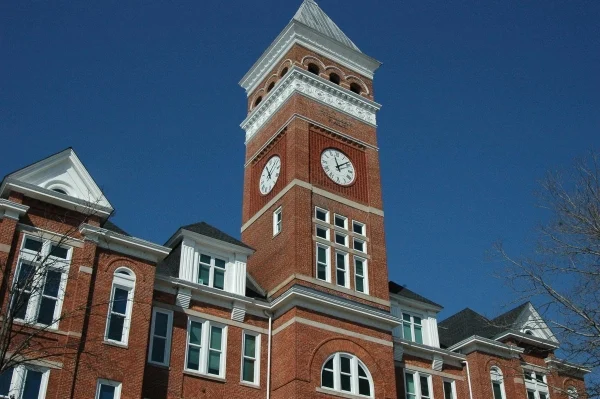
Bregy will resign from his position at Clemson on May 15, 2026, according to the settlement agreement.
sbrogan/E+/Getty Images
Clemson University has agreed to rescind the termination of Joshua Bregy, an assistant professor in the department of environmental engineering and earth sciences, nearly four months after dismissing him for resharing a post on his personal Facebook page that criticized the late conservative commentator Charlie Kirk.
Bregy sued after he was terminated on Sept. 26, claiming that his firing violated his First Amendment rights. As part of the settlement, Bregy will receive pay and benefits “throughout the original term of his employment,” the ACLU of South Carolina, which represented Bregy, said in a news release. In addition, Clemson provost Robert Jones agreed to “provide positive letters of recommendation to potential employers based on Dr. Bregy’s classroom teaching.” For Bregy’s part, he agreed to drop his lawsuit and resign from his position at Clemson effective May 15, 2026. He will not have any teaching, research or other faculty obligations through the spring semester, according to the release.
Bregy was among the dozens of faculty members targeted by right-wing politicians and online commentators for making or sharing critical posts about Kirk after his death. The post Bregy shared said, in part: “I’ll never advocate for violence in any form, but it sounds to me like karma is sometimes swift and ironic. As Kirk said, ‘play certain games, win certain prizes.’”
“We were honored to represent Dr. Bregy and to reach an agreement that restores his employment, allows him to continue to pursue research funding, and deters the university from violating the First Amendment rights of its faculty in the future,” Allen Chaney, legal director at the ACLU of South Carolina, said in a statement. “Politicians and university administrators come and go, but years from now we will still be here. So will the U.S. Constitution.”
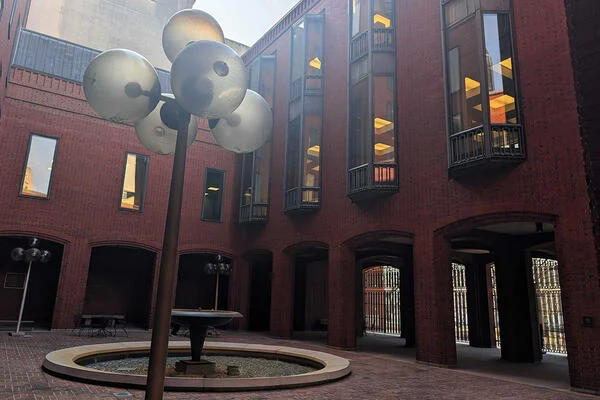
Several hundred feet from the White House, down a concrete path and across a quiet brick courtyard adorned with historical markers lie the doors to a small courthouse.
Inside, etched into the stone wall, is a quote from Abraham Lincoln: “It is as much the duty of government to render prompt justice against itself, in favor of citizens, as it is to administer the same, between private individuals.”
It’s apt for what’s in this building: the Court of Federal Claims, a legal venue where the U.S. government is always the one being sued. The building is now poised to be the site of fights over droves of terminated research grants.
Although it’s the latest iteration of a court that’s existed since 1855, predating Lincoln’s election, it’s not a well-known institution. It’s not the subject of on-screen, steamy legal dramas. But the U.S. Supreme Court’s preliminary rulings last year have elevated its importance for higher ed.
A majority of justices say this 16-judge court likely has jurisdiction over lawsuits regarding thousands of National Institutes of Health federal research grants that the Trump administration has tried to terminate, as well as other fights concerning canceled grants. If the Supreme Court sticks by its current thinking in final rulings, the Court of Federal Claims could be handling fights over countless grants that the Trump administration and future higher ed-targeting presidencies may try to cancel in the future.
One catch: This court doesn’t have the authority to actually restore the grants. It can award money for canceled ones, but experienced lawyers who practice before it disagree on whether it will provide compensation even approaching what the grants were worth—they can be for millions of dollars apiece.
Attorneys also say that researchers likely won’t have the right in this court to challenge their grant terminations; they’ll have to rely on their universities to sue on their behalf because the institutions are the legal parties to research grants. Overall, it’s generally unclear how a research grant-related case would turn out in this court.
“This is—I think esoteric is probably an understatement,” said Bob Wagman, president of the Court of Federal Claims Bar Association and a lawyer before the court for 25 years.
Lobby of the United States Court of Federal Claims building.
Ryan Quinn/Inside Higher Ed
‘A Mess’
As far as Wagman knows, the court has yet to say what level of monetary damages plaintiffs could win from the court over research grant terminations. He said that’s just one of a number of “threshold” issues judges will have to decide on regarding how these cases will work.
“It’s just been sort of an avalanche and people are trying to figure out what makes the most sense,” Wagman said.
Ted Waters, the managing partner at Feldesman LLP and a George Washington University Law School adjunct professor, said “it’s all a mess because nobody knows what the rules are.”
He contends that plaintiffs before this court couldn’t win back the full value of their grants but instead only “out-of-pocket termination costs,” such as the expense of giving two weeks’ severance pay to employees a university hired in expectation of receiving the grant. He said Congress didn’t create the Court of Federal Claims and the special appeals court that’s over it to deal with federal grants; it’s meant for contracts, such as when the government purchases items from companies.
“This is all new stuff, and none of the kinks have been worked out,” said Waters, who’s been working in the federal grants field since 1992.
Heather Pierce, senior director of science policy for the Association of American Medical Colleges, said thousands of terminated NIH grant cases going to the Court of Federal Claims “would clog the court immediately.” Elizabeth Hecker, a senior counsel with specialty in higher ed for Crowell & Moring LLP, echoed that.
“There’s gonna be a tremendous backup … and these are gonna take years and years and years to decide,” Hecker said. “Whereas, if you go to federal district court, you can get a preliminary injunction.”
But Waters doubts there will be a flood of cases. He said there’s little to fight over because researchers can’t get the relief they want from the court.
The [Supreme] Court grapples with none of these complexities before sending plaintiffs through the labyrinth it has created.”
Justice Ketanji Brown Jackson
Anuj Vohra, a partner at Crowell & Moring LLP, who began his career in Washington working for the Justice Department before the court, said “the court does not have equitable powers to reinstate grants, and I think that is, in large part, why the government is trying to move much of this litigation to the court.”
He said plaintiffs will have to expend resources to win in this court and, while “we don’t know exactly how the Department of Justice is going to defend these grant terminations, … I assume they’re going to argue that the researchers are entitled to something less than the entire amount of the grant.”
Still, Vohra said he doesn’t think going to the court would be pointless.
“Grant terminations have not historically been litigated in the Court of Federal Claims, and so the challenges we’re seeing now are kind of charting a new course in terms of damages, theories and entitlement,” he said. “But I certainly don’t think it’s a fool’s errand to come to the court, and I think we’re going to see a lot more litigation over grant terminations this year.”
Courtyard of the U.S. Court of Federal Claims building. Lincoln’s secretary of state lived and was almost assassinated at this site.
Ryan Quinn/Inside Higher Ed
‘The Labyrinth’
Not all the Supreme Court justices thought this was a good idea.
The conservative majority, absent Chief Justice John Roberts, first mentioned the Court of Federal Claims last year in one line in a roughly two-page preliminary ruling in April.
“The Tucker Act grants the Court of Federal Claims jurisdiction over suits based on ‘any express or implied contract with the United States,’” the majority wrote, reasoning that canceled Education Department K-12 teacher training grants in that case were contracts.
There was only one justice, and that’s Amy Coney Barrett, who thought that that was the right outcome.”
Elizabeth Hecker, senior counsel with Crowell & Moring LLP
Then, in August, in ongoing litigation over the Trump administration’s termination of thousands of NIH research grants, Justice Amy Coney Barrett was the deciding vote. In a five-page preliminary opinion, she said a regular federal district court “likely lacked jurisdiction to hear challenges to the grant terminations, which belong in the Court of Federal Claims.” In a partial concurrence with Barrett, Justice Neil Gorsuch criticized the lower court judge—who had ruled the grants should be reinstated while the case continued—for not following the conservative majority’s earlier (also preliminary) ruling in the Education Department lawsuit.
“Lower court judges may sometimes disagree with this Court’s decisions, but they are never free to defy them,” Gorsuch wrote. He said that, even though the decision in the Education Department case wasn’t a final judgment, “when this Court issues a decision, it constitutes a precedent that commands respect in lower courts.”
Justice Ketanji Brown Jackson countered in a 20-page dissent that “the Court of Federal Claims is authorized to award only money damages for contract breaches, not reinstatement of grant funding improperly terminated in violation of federal law.” She defended the district court’s decision.
“Having struck down unlawful agency action, the District Court ‘also had the authority to grant the complete relief’ that followed,” Jackson wrote, quoting precedent. “Under the rule the Court announces today, however, no court can reinstate the plaintiffs’ grants.” In a footnote, she added that “the Court grapples with none of these complexities before sending plaintiffs through the labyrinth it has created.”
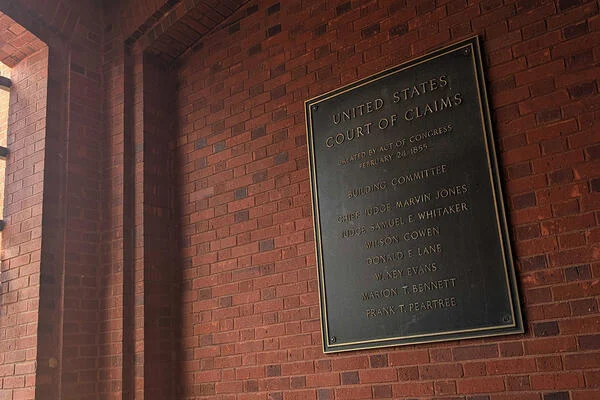
A plaque outside the United States Court of Federal Claims building.
Ryan Quinn/Inside Higher Ed
Barrett concluded in her August decision that the district court did likely have the right to void the NIH guidance upon which the agency based its terminations, even though it likely didn’t have the right to restore the grants. But four of Barrett’s colleagues said the district court was likely wrong on both issues, while the other four said the district court was likely right on both.
That meant Barrett was the deciding vote on a split order that allowed universities, researchers and other organizations to challenge the guidance in district court, but said they had to challenge the actual grant terminations in the Court of Federal Claims.
“There was only one justice, and that’s Amy Coney Barrett, who thought that that was the right outcome,” said Hecker, of Crowell & Moring LLP. She said “it’s a very unusual and seemingly inefficient way to go about doing things.”
Hecker said one way to avoid this dual-track litigation would be for plaintiffs challenging grant terminations to use constitutional arguments—such as claiming that grant cancellations violate the First Amendment—rather than the Administrative Procedure Act, a law cited in the NIH grants case that invited the counter-argument from the government that the cases belonged in the Court of Federal Claims.
Waters, of Feldesman LLP, said the ramifications of sending grant cases to the Court of Federal Claims extend far beyond higher ed, to highways, green technology and more.
“The importance of grant programs—I don’t think people realized until now,” he said, adding that they “touch the whole fabric of American society.”
Wagman, the president for the court’s bar association, said he thinks that, given the uncertainty of how claims for money before the court will turn out, most people would just prefer their grants be reinstated.
“But if that’s all you got,” he said, “that’s all you got.”
The Carnegie Foundation announced on Monday that more than 230 colleges and universities received its Community Engagement classification.
The designation from the American Council on Education and the Carnegie Foundation for the Advancement of Teaching highlights institutions that have formed and sustained successful community partnerships. Of the 237 institutions recognized in 2026, 48 received the classification for the first time. The group includes157 public colleges and universities, 80 private institutions and 81 minority-serving institutions.
“We celebrate each of these institutions, particularly their dedication to partnering with their neighbors—fostering civic engagement, building useable knowledge, and catalyzing real world learning experiences for students,” Timothy F.C. Knowles, president of the Carnegie Foundation, said in a news release.
Some colleges and universities celebrated making it to the list.
“This recognition means a great deal to the University of Houston, because it reflects who we are, and how we prepare educated, engaged citizens, while showing up for our community every day,” Diane Z. Chase, the university’s senior vice president for academic affairs and provost, said in a statement.
ACE and Carnegie also shared the news that the University of San Diego, a Catholic institution in California, will house the Community Engagement classification for the next two cycles.
I have spent 12 of my 28 years in higher education working in top business schools—three in graduate admissions and nine as a tenured professor. I especially love teaching and mentoring MBA students, in part because I know that most of them are going to ascend to leadership in corporations, government agencies and other organizations in the future. I want them to leave my classrooms with the practical skills required to solve complex contemporary business problems.
Importantly, I also want students to enter leadership roles with the right values. Prioritizing profits over everything at all costs is not one of them. I do not teach students to misuse their power to take things that do not belong to them. To be absolutely sure, I have never instructed them to hate or in any way despise America. But I also have not taught them that America is so exceptional that it can, should and must snatch other people’s land and oil just because our elected officials feel entitled to or desire ownership of those things.
Students in K-12 schools and on college campuses are receiving a different lesson right now from our federal government. Specifically, it is an instructive lesson on imperialism—the act of a powerful nation exerting control over less powerful countries, often leading to the violent seizure of land and other valuable material resources.
After capturing and arresting Venezuela president Nicolás Maduro and his wife Cilia Flores, U.S. president Donald Trump declared that the U.S. would be “running” the country. In business, a CEO of one company kidnapping and imprisoning the top executive of another, then grabbing that company’s assets and proclaiming oneself the new leader “for years” (as Trump said of the “only time will tell” period of self-appointed U.S. leadership in Venezuela) would be gangster. It seems like a dramatized fictitious saga that students would see in a movie. They are now witnessing it in real life. And they are learning from it.
Beyond Venezuela, the Trump administration shamelessly has its sights on Greenland. President Trump seems determined to take it. The imperialist lesson for students is that people’s homelands can be bought or forcibly conquered by a greedy superpower. In history courses, many students have learned about this occurring in various parts of the world centuries ago. Others have seen and engaged in critical analyses of it happening more recently in other geographic regions outside of North America, which has resulted in devastating wars and tremendous losses of life. But they have not seen firsthand or read in their courses about the U.S. recently engaging in such selfish demonstrations of imperialism—until now.
Between them, my two younger brothers have nine children. At this point, all the kids have been two-year-olds. Uncle Shaun would teach his beautiful nieces and nephews the same lesson that Professor Harper would impart to his impressively smart graduate students: You cannot just snatch other people’s stuff because you want it. An adorable two-year-old may not understand or comply with this lesson, but business and government leaders most certainly should. I am not suggesting that educators treat collegians like toddlers. But perhaps we should not take for granted that they understand what imperialism is, how it harms people and why they must resist it when they amass power and someday ascend to leadership.
Shaun Harper is University Professor and Provost Professor of Education, Business and Public Policy at the University of Southern California, where he holds the Clifford and Betty Allen Chair in Urban Leadership. His most recent book is titled, Let’s Talk About DEI: Productive Disagreements About America’s Most Polarizing Topics.
Nearly half of higher ed workers feel a mix of caution and enthusiasm about AI.
Photo illustration by Justin Morrison/Inside Higher Ed | hoozone and PhonlamaiPhoto/iStock/Getty Images | skynesher/E+/Getty Images
New data shows that while 94 percent of higher education workers use AI tools, only 54 percent are aware of their institution’s AI use policies and guidelines. And even when colleges and universities have transparent policies in place, only about half of employees feel confident about using AI tools for work.
“[That disconnect] could have implications for things like data privacy and security and other data governance issues that protect the institution and [its] data users,” Jenay Robert, senior researcher at Educause and author of “The Impact of AI on Work in Higher Education,” said on a recorded video message about the report. Educause published the findings Monday in partnership with the National Association of College and University Business Officers, the College and University Professional Association for Human Resources and the Association for Institutional Research.
In the fall, roughly three years after generative artificial intelligence tools went mainstream and some higher education institutions began partnering with tech companies, researchers surveyed 1,960 staff, administrators and faculty across more than 1,800 public and private institutions about AI’s relationship to their work. Ninety-two percent of respondents said their institution has a work-related AI strategy—which includes piloting AI tools, evaluating both opportunities and risks and encouraging use of AI tools. And while the vast majority of respondents (89 percent) said they aren’t required to use AI tools for work, 86 percent said they want to or will continue to use AI tools in the future.
But the report also reveals concerns about AI’s integration into the campus workplace, and shows that not every worker is on the same page regarding which tools to implement and how.
For example, 56 percent of respondents reported using AI tools that are not provided by their institutions for work-related tasks. Additionally, 38 percent of executive leaders, 43 percent of managers and directors, 35 percent of technology professionals and 30 percent of cybersecurity and privacy professionals reported that they are not aware of policies designed to guide their work-related use of AI tools.
“Given that institutional leaders and IT professionals are the two groups of stakeholders most likely to have decision-making authority for work-related AI policies/guidelines, the data suggest that many institutions may simply lack formal policies/guidelines, rather than indicating insufficient communication about policies,” Robert wrote in an email to Inside Higher Ed.
And even if they are aware of AI use policies, most workers still don’t know whether to fear or embrace AI.
The majority of respondents (81 percent) expressed at least some enthusiasm about AI, with 33 percent reporting that they were “very enthusiastic/enthusiastic” and 48 percent reporting a mix of “caution and enthusiasm.” Meanwhile, 17 percent said they were “very cautious/cautious” about it.
The survey yielded a similar breakdown of responses to questions about impressions of institutional leaders’ attitudes toward AI: 38 percent said they thought their leaders were “very enthusiastic/enthusiastic”; 15 percent said they were “very cautious/cautious” about it, and 36 percent said their leaders express a mix of “caution and enthusiasm.”
But Kevin McClure, chair of the department of educational leadership at the University of North Carolina at Wilmington, told Inside Higher Ed that embrace of AI may be skewed. That’s because only 12 percent of the survey’s respondents were faculty, whereas the rest held staff, management or executive roles.
“This survey was also sent to institutional researchers and people affiliated with human resources,” he said. “Those people are working in the realm of technology, processing forms, paperwork data analysis and filing reports.”
And the framing of the report’s questions about workers’ levels of caution and enthusiasm may have contributed to the elevated excitement about AI captured in the report, McClure added.
So many people said they share a mix of caution and enthusiasm “because that was one of the choices,” he said. “To me, it reads like people are feeling it out—they can see the use cases for AI but also have concerns. That gets washed out by combining it with enthusiasm.”
Risks and Rewards
Nonetheless, that mix of caution and enthusiasm stems from the risks and benefits higher education workers associate with AI.
Sixty-seven percent of respondents identified six or more “urgent” AI-related risks, including an increase in misinformation, the use of data without consent, loss of fundamental skills requiring independent thought, student AI use outpacing faculty and staff AI skills, and job loss. Some of those concerns align with the findings of Inside Higher Ed’s own surveys of provosts and chief technology officers, which found that the majority of both groups believe AI is a moderate or serious risk to academic integrity.
“Almost more important than the specific risks that people are pointing out is the number of risks that people are pointing out,” Robert, the report’s author, said. “This really validates the feeling that we’re all having about AI when it comes to this feeling of overwhelm that there really are a lot of things to pay attention to.”
At the same time, 67 percent of respondents to the Educause survey identified five or more AI-related opportunities as “most promising,” including automating repetitive processes, offloading administrative burdens and mundane tasks, and analyzing large datasets.
“A lot of people want tools that will simplify the [administrative burden] of higher ed. Not a lot of that is going to save a ton of time or money. It’s just going to be less of an annoyance for the average worker,” McClure said. “That suggests that people aren’t looking for something that’s going to transform the workplace; they just want some assistance with the more annoying tasks.”
And according to the report, most colleges don’t know how efficient those tools are: Just 13 percent of respondents said their institution is measuring the return on investment (ROI) for work-related AI tools.
“Measuring the ROI of specific technologies is challenging, and this is likely one of the biggest reasons we see this gap between adoption and measurement,” Robert said. “As higher education technology leaders consider longer term investments, ROI is becoming a more pressing issue.”
Schools, colleges, and universities face growing challenges in keeping their communities informed, connected, and engaged. From classroom collaboration to campus-wide alerts, reliable communication is critical to creating positive learning environments and student experiences.
Currently, many educational institutions are weighed down by outdated and disjointed communication systems that hinder learning, experience, and even safety. Educators need technology that is both flexible and responsive, and these systems are falling short.
The campus communication disconnect
Many schools find themselves in a fragmented communication trap, juggling a complex tech stack with outdated systems. On its own, each tool might work well, but when different applications are used for texts, emails, virtual classrooms, and emergency alerts, each with separate logins and interface, communication can become disjointed.
School district IT teams are notoriously spread thin, and having fragmented communication tools that requires their own training, trouble shooting, and management is burdensome. This also adds unnecessary complexity for the wider faculty that can easily lead to missed messages or alerts. When taking safety into account, hampered communications in times like severe weather or lockdown can have serious repercussions.
Outside of safety and complexity, patchworked communication systems can weigh schools down financially. Many platforms come with their own hidden fees or inconsistent licensing costs across departments. Those seeking to upgrade might face a block if budgets don’t have room for the initial investment, even though it could lead to long-term savings. This has left many schools in the position of maintaining a web of outdated tools like on-site servers or phone lines where potential benefits are overshadowed by price and complications.
Key benefits of unified communications
Faculty, students, families, and communities must be connected for impactful learning. Effective connection requires simplified and streamlined information sharing, which can be achieved through unifying communications. Modern, unified communication systems bring together channels like alerts, email, phone, messaging, and virtual learning into one platform, making it easier for schools to stay informed and engaged.
Driven by a need for reliability, security, and budget predictability, 62.5% of educational institutions are now moving to UCaaS platforms, according to a 2025 Metrigy study. In practice, these platforms can enable teachers to reach the school nurse, contact a parent, or join a virtual classroom–all without switching platforms. For administrators, these tools can provide ecosystem management through one simple dashboard, reaching from individual campuses to entire school districts.
Today’s learning environment requires flexibility. Whether class is fully remote or in person, modernized communication ensures both staff and students maintain consistent access to learning. Modern tools are also simplified–they can exist on the cloud in one platform, decreasing the need for separate servers, phone systems, or emergency alert tools.
Modernized communication isn’t just convenient, but functions to bolster safety and responsiveness. For example, if a safety threat is reported, in real time, a unified system can automatically alert first responders, prompt crisis notifications, and confirm message distribution. Outside of emergencies, in a more day-to-day function, administrators can benefit from smoother operations like automated attendance alerts and streamlined family communications.
Uplevel with AI
AI has emerged as a valuable partner for school administrators who perpetually need to do more with less. Within unified communications systems, AI can identify overlooked patterns and inefficiencies, such as if parent engagement rates climbed when sending a text as opposed to a phone call.
Faculty can use AI to automate more administrative tasks like summarizing meeting notes, routing calls, or translating messages for multilingual families. These tools can help staff focus more on hands-on teaching and human interactions. Collated over time, these learnings can aid in decision making around staffing, communication approach, and resource allocation.
Where to start
Modernizing communication requires alignment between faculty, IT departments, and leadership. Before selecting a solution, school leaders should work to identify pain points and align goals across departments to ensure any updates serve both operational and academic priorities.
When evaluating a consolidated communication solution, it’s important to consider tools that fit the specific needs of your institution, offering both flexibility and scalability. These solutions should work to unify legacy systems where needed, instead of completely gutting them. For example, an effective solution for your school might have the ability to work with bell or hardware phone systems while modernizing the rest of your communication tools into a single platform to minimize disruption and protect previous investments.
A complete overnight rework of current communication systems is intimidating, and frankly, unrealistic. Instead, start by evaluating where a few systems can be consolidated and then gradually expand. This could look like first integrating messaging and emergency alerts before looking to incorporate analytics and collaboration tools.
A more connected future
The current education landscape is intrinsically dynamic, hybrid, and interconnected. Learning now takes place across both physical and digital spaces, requiring students and educators to collaborate seamlessly across locations and time zones.
As advanced technology like AI continues to integrate into schools and universities, those that modernize their communications now will ensure they are ready to meet current and future educational needs for more effective, seamless, and safe learning environments.
Damon Covey, GoTo
Damon Covey is General Manager, UCC at GoTo. As General Manager of UCC, Damon is responsible for the continued growth and strengthening of GoTo’s business communications product portfolio.
Latest posts by eSchool Media Contributors (see all)
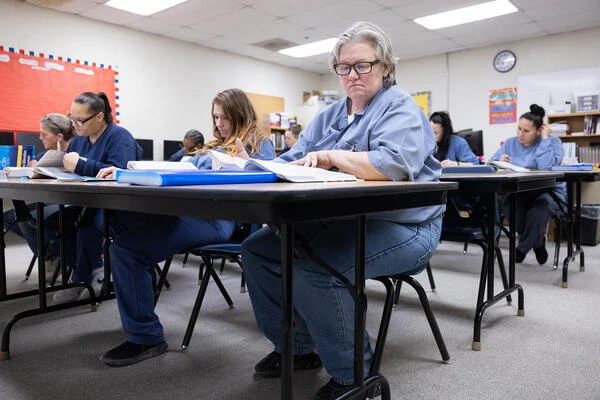
Prison education programs are designed to help people succeed after release, but new research suggests they may actually increase participants’ chances of reincarceration.
An analysis from Grinnell College found that participation in prison education increases an individual’s likelihood of returning to prison within three years of release by 3.4 percentage points—a roughly 10 percent increase compared to those who did not participate. That increase is driven largely by revocations, such as technical violations of release conditions, rather than by new crimes.
“The takeaway from this should not be that prison education is bad,” said Logan Lee, an associate professor of economics at Grinnell and the study’s author. “Instead, what seems to be happening is that there are these unintended consequences.”
The analysis examined more than 22,000 prisoner stints in Iowa, drawing on data from the Iowa Department of Corrections, the Iowa Department of Education, Iowa Workforce Development and Grinnell College to create a comprehensive, individual-level dataset of people released from Iowa prisons between 2014 and 2018.
The research found that participation in prison education programs affects how individuals are released. Those who enroll in college courses are less likely to be released free and clear and more likely to be assigned to work release, which allows eligible inmates to leave prison during the day to work in the community and return at night.
In Iowa, work release often takes place in a halfway house, a structured living environment intended to support people as they transition back into the community. But work release also exposes individuals to more intensive postrelease supervision, which dramatically increases the likelihood of revocation, or being reincarcerated for violating supervision terms, Lee said.
“Work release programs are quite ineffective at achieving their goals, [and] they’re driving a significant increase in people returning to prison,” Lee said. “It’s being assigned far too often at the margins, and some [incarcerated individuals] would be better off on parole or even released free and clear.”
Lee said anecdotal evidence suggests that some correctional officers may resent the idea of “free” education for incarcerated people, pointing out that the requirements for their job are a high school diploma and a clean criminal record. As a result, he said, there is “the potential for some animosity,” with research finding “an increase in misconduct for people who are participating in education programs.”
“Correctional officers are very difficult, high-stress, low-pay jobs,” Lee said. “So you can imagine that that sort of person might go, ‘Look, I kept my nose clean and I didn’t commit any crimes, so why are these people given opportunities that I wasn’t given?’”
However, Lee said case managers, who often recommend how incarcerated individuals are released, don’t share the same resentment. He noted they are “much more likely to have college degrees and interact with prisoners in a different way.”
The background: The U.S. has one of the world’s largest incarcerated populations, with nearly two million people in prison in 2024. This population recidivates at high rates: 46 percent of released prisoners are rearrested within five years, research shows.
U.S. prisons disproportionately house economically vulnerable individuals, many of whom have limited education. Despite historically limited access, prison education programs consistently draw strong interest from incarcerated people. A survey from the National Center for Education Statistics found that 70 percent of incarcerated individuals wanted to enroll in educational programs, and that a majority were academically eligible for college-level courses.
In Iowa, all prison education is offered through local colleges, primarily community colleges. The state funds all GED preparation courses and some postsecondary and vocational programs. Lee said programs offered through some institutions, including Grinnell College and the University of Iowa, are funded by donations.
Across the country, nearly all state and federal prisons provide some form of educational programming. The expectation in both Iowa and nationally is that courses offered inside prisons resemble, as closely as prison guidelines allow, their nonprison counterparts.
“The reality on the ground in most [prisons] is that [incarcerated individuals] only take a couple of courses and then they get released and move on,” Lee said. “You can certainly look at national statistics and see that most people who participate in education in prison are not earning any sort of degree.”
The implications: In addition to his work at Grinnell College, Lee said he previously taught at a women’s prison in Mitchellville, Iowa. He led a “how-to-do-college course,” where he taught writing, critical reading and academic honesty.
Lee described the experience as “eye-opening,” adding that the incarcerated women he taught were highly engaged and deeply interested in the material.
“I saw a real hunger for education, and I do think they got a lot out of the class,” Lee said, noting that he taught 16 students, six of whom were released from prison during the course and 10 of whom eventually completed it.
Providing education in prisons, however, can be challenging. Limited access to technology and learning materials, restrictions on participation times, and situations like lockdowns can interrupt learning opportunities.
“There are just some real challenges with balancing the educational mission with the security demands of the setting,” Lee said. “It’s much more difficult to write a research paper if you can’t get on the internet and start googling stuff.”
Ultimately, Lee emphasized that policymakers, prison administrators and educators need to think “holistically” about the entire system for incarcerated individuals.
“I thought [prison education] might be positive, I thought it might have no effect, but I really did not expect it to increase reincarceration,” Lee said. “If you’re thinking about offering prison education or expanding it, you need to be really aware of the whole system that’s in place and the implications it’s going to have for the people who are participating.”
Get more content like this directly to your inbox. Subscribe here.
A UK professor will not get to return to teaching while the university continues investigating him.
Gwengoat/iStock/Getty Images Plus
A federal judge is, for now, declining to return to the classroom a professor whom the University of Kentucky removed from teaching amid his calls for a global war to end Israel’s existence as a country.
On his website, antizionist.net, law professor Ramsi Woodcock asks fellow legal scholars to sign a “Petition for Military Action Against Israel.” He says Israel is a colony and war is needed to decolonize, and he calls for the war to continue until “Israel has submitted permanently and unconditionally to the government of Palestine.”
The university removed him from teaching in July. In a message to campus that month, UK president Eli Capilouto wrote, “We have been made aware of allegations of disturbing conduct, including an online petition calling for the destruction of a people based on national origin.” (Woodcock says he’s calling for the end of the state of Israel, not the destruction of Jews.)
In November, Woodcock sued UK in U.S. District Court for the Eastern District of Kentucky, asking for restoration of his normal teaching duties and other relief. On Thursday, Judge Danny C. Reeves paused the case while the university’s investigation proceeds.
“As is customary for the University investigating claims that potentially impact the educational environment, Woodcock was removed from teaching and the law building as an interim measure during the investigation,” Reeves said. “Abstention is appropriate because those removals cannot be separated from the investigation and interference clearly would result if the Court were to enjoin any aspect of the investigation.”
Reeves added that “once the investigation is completed or any subsequent disciplinary procedures have concluded and claims have been exhausted, the stay will be lifted.”
In a statement, a UK spokesperson said the university “appreciates the Court’s thoughtful and clear ruling.” Woodcock, in his own statement, suggested he may appeal, saying UK officials were “torching the First Amendment and the university’s own regulations in an effort to protect a colonization project that practices apartheid and commits genocide.”
“There is very strong precedent stretching back to the Civil War that federal courts must intervene when rogue state actors, like university officials in my case, abuse their authority to try to silence speech that they happen to dislike,“ he wrote.
For the first time in 43 years, lawyers who want to practice in Texas will no longer be required to hold a degree from a law school accredited by the American Bar Association, the Texas Supreme Court decided last week.
While the ABA is “continuing to work with the Texas Supreme Court—and all other state supreme courts and bar admitting authorities—to help preserve the portability of law school degrees throughout the country,” the policy “reinforces the authority that the Supreme Court of Texas has always had over the licensure of JD graduates,” Jenn Rosato Perea, managing director of the ABA’s accrediting arm, wrote in an email to Inside Higher Ed.
Since 1983, Texas has ceded some of that authority to the ABA, whose Section of Legal Education and Admissions to the Bar accredits the majority of law schools in the United States. Most other states have similar ABA oversight in place; it became a popular move in the 1980s because law was becoming increasingly national business. Widespread adoption of ABA accreditation as a licensure standard offered more uniformity and has made it easier for lawyers to practice in multiple states.
The new Texas policy comes amid the broader crackdown on higher education accreditors by the Trump administration and its allies, and specifically on the ABA, which has become a target of the Republican-led anti-DEI crusade in recent years. Indeed, the ABA suspended its diversity, equity and inclusion standards last year. Now Texas has become the first state to say it will no longer rely on the accreditor to help to set law licensure standards.
“[The Court] intends to provide stability, certainty, and flexibility to currently approved law schools by guaranteeing ongoing approval to schools that satisfy a set of simple, objective, and ideologically neutral criteria (such as bar exam passage rate) using metrics no more onerous than those currently required by the ABA,” read a Jan. 6 order signed by all nine justices of the Texas Supreme Court. “[It] does not intend to impose additional accreditation, compliance, or administrative burdens on currently approved law schools.”
While the policy likely won’t change much in the short term, critics say it invites the creation of alternative law school accreditors, which could make it harder for lawyers to move their practice across state lines.
Republican-controlled Florida, Ohio and Tennessee are weighing similar measures.
“This could be the beginning of the end of the ABA as the accreditor of choice for law schools nationally,” Peter Lake, a law professor at Stetson College of Law’s Center for Excellence in Higher Education Law and Policy, told Inside Higher Ed. “It’s a little too early to call the game, but this is a significant step toward a goal the Trump administration and many states want to see happen.”
Part of that goal involves asserting more control over higher education accreditors.
In April, Trump issued an executive order directing the Department of Education to suspend or terminate the federal recognition of accreditors found “to engage in unlawful discrimination in accreditation-related activity under the guise of ‘diversity, equity, and inclusion’ initiatives.” It specifically called for an investigation of the ABA and the Liaison Committee on Medical Education, which accredits medical schools. In June, six states—Florida, Georgia, North Carolina, South Carolina, Tennessee and Texas—announced the launch of a new regional accreditor, the Commission for Public Higher Education; at the time, Florida governor Ron DeSantis described it as part of an effort to root out “woke ideology” in higher education and break up the “accreditation cartel.”
The federal government made adjacent arguments in supporting the Texas Supreme Court’s plan to minimize the ABA’s oversight of legal education, also announced last April. In December, the Federal Trade Commission submitted a public comment letter in support of the policy, accusing the ABA of having a “monopoly on the accreditation of American law schools” and of imposing “rigid and costly requirements” mandating “every law school follow an expensive, elitist model of legal education.”
Texas Open to ABA Alternative
While the Texas court stopped short of establishing a new law school accreditor, it acknowledged that it might in the future consider “returning to greater reliance on a multistate accrediting entity other than the ABA should a suitable entity become available,” according to the final version of the policy.
Lake said that could happen eventually, especially if other states decide to follow Texas and ditch the ABA’s oversight. “This is an open invitation to form a [new law school–accrediting] organization,” he said. “And I suspect that whatever group forms will probably be a little more aligned with the Trump administration’s goals and ideas.”
Educators and experts believe such a move will only impede the goals of legal education and practice.
“ABA accreditation provides a nationally recognized framework for quality assurance and transparency; portability of licensure through recognition of ABA accreditation by all 50 states, which is critical for graduates’ career flexibility; consumer protections and public accountability through disclosure standards; and a baseline of educational quality that correlates with higher bar passage rates and better employment outcomes,” the deans of eight of the state’s 10 ABA-accredited law schools wrote in a letter to the Texas Supreme Court in June.
The dean of South Texas College of Law Houston was among those that objected to minimizing the ABA’s oversight of law licenses in the state.
JHVEPhoto/iStock/Getty Images
A degree from an ABA-accredited law school is generally required to pursue a career as a lawyer, said Oren R. Griffin, a law professor at the University of Tulsa College of Law.
“ABA accreditation is a national stamp of approval,” he said. “Law schools may differ on what they prioritize, such as curriculum or clinics they offer, but the standards have identified some basic requirements that allow all law schools to operate at an efficient, effective level.”
And even if a state says it will license lawyers who didn’t graduate from an ABA-accredited law school, graduates from such institutions may still face limited opportunities.
“Law schools have been very well served by these standards,“ Griffin said. “If other states were to follow suit and begin to not require ABA accreditation as a national standard, you could end up with some real disparities or differences among the 50 states, which could increase the complexities for students who are graduating and want to be able to practice in multiple states.”
Regardless of the Texas Supreme Court’s new policy, law schools won’t likely abandon ABA accreditation anytime soon, said Austen L. Parrish, dean of the University of California, Irvine, School of Law and president of the Association of American Law Schools.
“For example, a school like the University of Texas—where about 40 percent of students come from out of state and some 30 percent of graduates are placed out of state—cannot afford to not be ABA accredited. And I suspect that’s true for all of the ABA-accredited schools,” he said, adding that any school that eventually gives up ABA accreditation would be charting “a very dangerous path.”
Students who are not held to the ABA’s national accreditation standards are less likely to receive a quality legal education, Parrish said—a result long demonstrated by the poor outcomes at California’s handful of non-ABA-accredited law schools, which have high attrition and low bar-passage rates, he added.
“The unraveling of the national accreditation system would be really harmful to students and law schools,” Parrish said. “We’re in a world where schools need to recruit from all over and students end up practicing all over. To have a school that doesn’t do that makes them less attractive to students and more likely to create some of the problems at some of the unaccredited schools in California.”
And even if Texas and other states do band together to form their own law school accreditor, rivaling the ABA’s influence would be a challenge.
First, “it’s very difficult to set up an accrediting body and takes quite a bit of money,” Parrish said. “They could set up a regional accreditor, but it’s not necessarily clear who will see that as sufficient for licensing eligibility, which means the schools in those states will still have to go with ABA accreditation … I’m skeptical that more progressive states are going to buy into something that’s blatantly political.”
For now, he interprets the Texas order as a placeholder.
“There probably won’t be many changes right now,” he said, “other than keeping the pressure on the ABA, because [Texas] has signaled a willingness to move to a different approach, though it’s not clear what that is right now.”