The Key Podcast: Colleges Are Planning for the Unknown
sara.custer@in…
Thu, 08/14/2025 – 03:00 AM


The Key Podcast: Colleges Are Planning for the Unknown
sara.custer@in…
Thu, 08/14/2025 – 03:00 AM
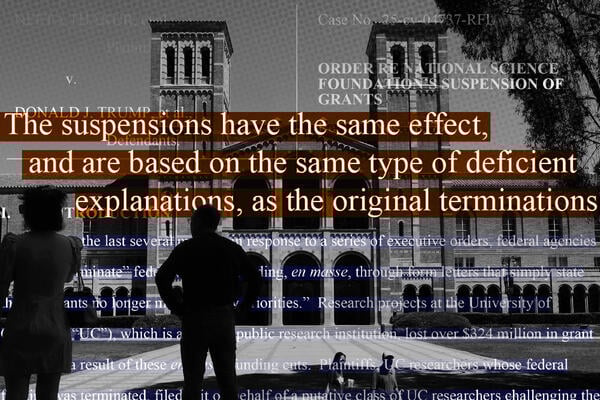
A class action suit led by researchers in the University of California system spurred the ruling.
Photo illustration by Justin Morrison/Inside Higher Ed | Genaro Molina/Los Angeles Times/Getty Images | US District Court for the Northern District of California
The National Science Foundation restored grants it recently suspended for researchers at the University of California, Los Angeles, following a court order late Tuesday, a spokesperson for the agency said.
The NSF and UCLA didn’t tell Inside Higher Ed how much funding had been restored, but the Los Angeles Times reported it’s roughly $81 million.
It’s a blow to the Trump administration, which had multiple agencies cut off more than $500 million in research funds to UCLA earlier this month and, according to the UC system, demanded a $1 billion settlement payment.
UCLA is the latest target of the Trump administration’s use of mass federal research grant suspensions to pressure prominent universities to change policies and pay restitution, ranging from tens of millions of dollars for Brown University to the billion-dollar demand of UCLA. Federal agencies justify cutting off grants by accusing targeted institutions of failing to address pro-Palestine protesters’ alleged antisemitism, and accusing universities of other transgressions, such as letting transgender women compete in women’s sports or promoting racial preferences.
But this is the first known court order blocking one of those blanket funding freezes. Harvard University also challenged the administration’s decision to suspend more than $2.7 billion in funds, but a judge has a yet to rule in that case.
UCLA didn’t sue, though.
Instead, the ruling came from a lawsuit that UC researchers filed in early June against President Trump, the NSF and other federal agencies and officials that challenged previous NSF grant terminations.
On June 23, U.S. District Court judge Rita F. Lin, of the Northern District of California, issued a preliminary injunction restoring grants that the administration terminated en masse via form letters that didn’t provide grant-specific explanations for the terminations. When the NSF recently cut off grants again, specifically to UCLA, the researchers’ attorneys alleged the agency violated the preliminary injunction.
Lin agreed, writing in an opinion Tuesday that the new “suspensions have the same effect, and are based on the same type of deficient explanations, as the original terminations.”
The NSF wrote in a July 30 letter justifying the new suspensions that “NSF understands that [UCLA] continues to engage in race discrimination including in its admissions process, and in other areas of student life, as well as failing to promote a research environment free of antisemitism and bias.” Two days later, the NSF sent a second letter, alleging that UCLA furthermore “engages in racism” and “endangers women by allowing men in women’s sports and private women-only spaces.”
According to Lin, the NSF argued that its recent funding cuts “are not within the scope of the preliminary injunction because it suspended, rather than terminated, the grants.” She said the agency argued that suspensions, unlike terminations, “can be lifted once the grantee takes certain corrective actions.”
However, Lin said the NSF had labeled these “suspensions” as “final agency decision[s] not subject to appeal.”
“There is no listed end date for the suspensions, nor is there any path for researchers to restore funding for their project. If any curative action is actually feasible, it would need to be undertaken by UCLA,” the judge wrote. “In other words, researchers have no guarantee that funding will ever be restored and no way to take action to increase the likelihood of restoration.”
She added that “NSF claims that it could simply turn around the day after the preliminary injunction issued, and halt funding on every grant that had been ordered reinstated, so long as that action was labeled as a ‘suspension’ rather than a ‘termination.’ This is not a reasonable interpretation of the scope of the preliminary injunction.”
Researchers told the court that as a result of the latest suspensions, “projects are already losing talented graduate students, staff will soon be laid off, and years of federally funded work will go to waste,” Lin wrote. Researchers also said the defunded projects include “multi-year research into global heat extremes, a project to address environmental challenges in the Southwestern United States, and another to enhance veteran participation and leadership in STEM fields,” the judge added.
A UC system spokesperson said in an email Wednesday that, “while we have not had an opportunity to review the court’s order and were not party to the suit, restoration of National Science Foundation funds is critical to research the University of California performs on behalf of California and the nation.”

At first glance, Southeastern Michigan University’s website looks like it represents a real institution.
Smiling students in graduation regalia embrace, diplomas in hand, in the video on the front page. A chat bot pops up to ask, “How can I help you?” Southeastern Michigan’s website touts the university’s scholarships, array of accredited academic programs, award-winning faculty, 75 percent graduation rate and “vibrant campus life.”
But littered throughout the website are signs that something is off about Southeastern Michigan.
Blurry backgrounds and distorted limbs hint at the use of generative artificial intelligence. Some images seem likely to fool the untrained eye, while others—like a basketball player with veins bulging from his angular arms—could have been ripped from a poorly illustrated comic book. Meanwhile, paragraphs of text contain repetitive, grandiose and nonspecific language, characteristic of a chat bot’s writing.
In reality, the university is as fake as some of the content on its website. And it’s part of a much larger scam fueled in part by the rise of generative AI.
Some of the images on Southeastern Michigan University website appeared to be AI-generated.
“It took me a while to realize it wasn’t an actual institution,” said Aaron Ament, president of the National Student Legal Defense Network and a lawyer who has investigated for-profit colleges that have defrauded students. “For the average person who’s looking for a program, you could easily see how people would think it’s a real institution.”
Michigan attorney general Dana Nessel warned consumers about Southeastern Michigan University in an alert last week, following a complaint from Eastern Michigan University to her office about the fraudulent website using deceptive practices in an effort to scam students.
Southeastern Michigan is one of nearly 40 fake university sites that Inside Higher Ed recently uncovered, which appear to have been developed with or supplemented by AI. The sites seem to be part of a network, based on the use of identical language, the repetition of images and other design similarities. And many of these fake colleges also have a presence on social media sites, including LinkedIn, Instagram and Facebook.
An Inside Higher Ed analysis also turned up dozens of websites for nonexistent accreditors and a fake U.S. Department of Education website. They all contain at least some AI-generated images and design templates similar to the college websites’, including many that list those fake accreditors—and link to their websites—to give an air of legitimacy. The Education Department is also investigating the scam.
Fake colleges aren’t new. North Carolina’s attorney general warned about a nonexistent King’s College in North Carolina in 2023, and U.S. Immigration and Customs Enforcement set up the fictional University of Farmington several years ago as a sting operation to crack down on student visa fraud. Last year, websites popped up advertising colleges that had been closed for years.
But the network uncovered by Inside Higher Ed reveals how the rise of generative AI is making it faster and easier for scammers to repackage an old ruse and deploy it on a much larger scale.
“This lowers the transaction costs for making a scam site,” said Jose Marichal, a professor of political science at California Lutheran University who studies how algorithms and AI are restructuring social and political institutions. “If I wanted to do this [before generative AI], it would have taken me a week, maybe a month, to put all this together. Now, it would take me a matter of hours.”
The technology is also making it harder for consumers to immediately recognize fraudulent websites like Southeastern Michigan’s and dozens of other similar scam college websites Inside Higher Ed identified.
Large language models—which can immediately generate text and images like those populating the scam college websites—are becoming more sophisticated at mimicking human-created content by the day. For example, last week OpenAI released GPT-5, the latest version of ChatGPT, advertising it as its “smartest, fastest, most useful model yet,” capable of putting “expert-level intelligence in everyone’s hands.”
While suspicious, Marichal couldn’t say for certain if the fraudulent college websites were created using generative AI. But Junfeng Yang, a computer science professor at Columbia University who helped develop a novel tool that can discern whether text was generated by an LLM, had one of his graduate students peruse Southeastern Michigan’s website. “It appears that the [university’s] engineering page is AI generated,” he said in an email.
“A year ago, if you tried to do this, you may have had some bugs to work out,” Marichal said of the scam college websites. “Now, we’re getting to a place where you could keep spitting these out and it doesn’t cost much to host it. If you make 100 of them, you increase your yield. Instead of casting one fishing line, you cast 20, upping your chances of catching fish.”
One prospective student who was looking for a business degree program almost got hooked by Southeastern Michigan’s con, according to Walter Kraft, a spokesperson for Eastern Michigan University, which is a real, accredited institution in Ypsilanti.
“He came across an institution named Southeastern Michigan University, and it looked legit to him,” Kraft said. “So he contacted them and received a phone call telling him that his total tuition would be, like, $31,000, but he would receive a 90 percent scholarship and would only have to pay $3,100.”
The fake university asked the would-be student to provide documents for his scholarship application, but he never followed up. Two days later, he got a call from a number spoofing Eastern Michigan’s admissions office number, and the person on the other line told him he got the scholarship, despite never receiving any of his documentation.
After that, he received an admissions offer on letterhead that looked similar to Eastern Michigan’s, which raised his suspicions.
“He could sense that it didn’t seem legit, didn’t seem right, and questioned it,” recalled Kraft, who said two or three other people have reported similar concerns about Southeastern Michigan’s website, though he’s not aware of anyone who has fallen for the scam.
A spokesperson with the Michigan attorney general’s office said the office had “not received complaints from any potential students losing money in connection to these websites” but had contacted officials in two other states about similar schemes and referred concerns to the Federal Trade Commission.
But that doesn’t mean other people haven’t been scammed—or won’t in the future. As of Wednesday, the website was still live.
“That’s problematic, because until somebody finds out who’s responsible and takes that site down, other prospective students could be victimized,” Kraft said. “We certainly don’t want that to happen.”
While Eastern Michigan went to the state attorney general, other universities that have encountered similar websites have sought recourse with the World Intellectual Property Organization, a group that mediates domain disputes.
George Washington and New York Universities, as well as the University of Houston system, have all filed successful complaints to challenge websites using their trademarks or a similar name and URL. Those complaints shed more light on the scheme, which appears to date to at least 2021, per archived copies of the websites that were taken down. In its filing, GWU pointed to Kenneth Stone, a person the university believed to be connected to the scheme through a company called Domain Lance, a forwarding service that allows users to redirect URLs.
(NYU did not name a specific individual in its WIPO complaint, which noted that “little is known of the respondent” and indicated the domain owner provided a contact address in Panama. However, another version of that website—New York University of Business and Technology—with a slightly different URL has already emerged.)
The University of Houston system also named Stone in a complaint filed in December, along with William Morocco and Cole Brad as the people believed to be behind the website. The filing suggests that Stone is in Panama, while the other two are in the U.S. In its second complaint, filed in May, Houston pointed to websites in Panama. Despite winning the domain dispute, another version of the contested website has since emerged.
Houston’s complaints indicated that multiple fake college websites were created last year. Three of the websites flagged by Houston were registered between July and October of 2024, and another followed early this year. The fake accreditor websites mentioned in Houston’s complaint were all registered on May 10 of last year, according to the WIPO filing.
Inside Higher Ed contacted two of the individuals it believed to be the persons referenced in the complaint based on a review of public records and LinkedIn profiles, but neither responded. A review of public records, including website registration information, suggests all three individuals are in the U.S., though the fake university websites are hosted on servers located overseas.
An Inside Higher Ed reporter also had conversations with individuals operating the chat service on three different websites connected to the network. After a reporter requested admissions info through Southeastern Michigan’s chat service, a woman called to talk him through the process.
Over a nearly half-hour conversation, the operator—a woman with a heavy accent—explained the tuition and fees, gave the reporter a password to a demo version of its student portal, and pressed hard for a $300 “registration fee.” When the reporter pushed back on the cost, she offered to lower it to $199 and stressed the importance of signing up while seats were available.
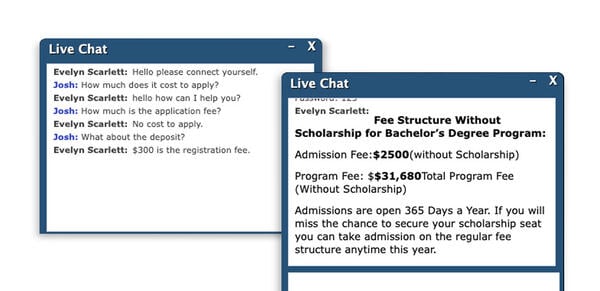
A chat operator at Southeastern Michigan University offered insights into the scheme.
Justin Morrison/Josh Moody
But when the reporter questioned the legitimacy of the operation, telling her it appeared to be a scam, she said, “I will suggest you contact the Department of Education, not me” and hung up.
Contacted by Inside Higher Ed, a Department of Education spokesperson wrote by email that “the department is currently investigating these malign activities and will work with the appropriate authorities to prevent predatory action toward our nation’s students.”
Universities with similar names to fake college websites encouraged consumers to take steps to protect themselves from scams.
“Students have many affordable, high-quality education options among North Carolina’s public universities. It’s a shame that bad actors are creating fake university websites to prey on students who want to pursue their dreams of a college degree,” Andy Wallace, a spokesperson for the University of North Carolina system, wrote while encouraging people to report the sites.
University of Houston spokesperson Shawn Lindsey wrote by email that UH “continuously monitor[s] for threats, including false or misleading websites and domain names, and use[s] a variety of tools to support this vigilance” and noted UH’s legal team has acted on offending sites.
The Council for Higher Education Accreditation also condemned the rise of fraudulent college and accreditor websites designed to mimic legitimate institutions in an emailed statement.
“Accreditation is meant to assure quality and integrity in higher education—not to be misused as a tool for fraud,” CHEA president Nasser H. Paydar wrote. “These fake accreditors prey on the trust of students and the public, and we are committed to exposing and stopping them.”
But experts warn if these websites aren’t shut down—or similar ones continue to crop up—it could further weaken the public’s trust in higher education in an era marked by politicized attempts to discredit legitimate universities as overpriced and biased.
“People may not know what’s a real university and what isn’t, so they just throw their hands up and say, ‘Universities are too expensive anyway,’” said Marichal, the algorithm expert. “When people don’t know what’s true or false anymore, they’re less inclined to trust any of it.”

Key points:
In education, we often talk about “meeting the moment.” Our current moment presents us with both a challenge and an opportunity: How can we best prepare and support our teachers as they navigate increasingly complex classrooms while also dealing with unprecedented burnout and shortages within the profession?
One answer could lie in the thoughtful integration of artificial intelligence to help share feedback with educators during training. Timely, actionable feedback can support teacher development and self-efficacy, which is an educator’s belief that they will make a positive impact on student learning. Research shows that self-efficacy, in turn, reduces burnout, increases job satisfaction, and supports student achievement.
As someone who has spent nearly two decades supporting new teachers, I’ve witnessed firsthand how practical feedback delivered quickly and efficiently can transform teaching practice, improve self-efficacy, and support teacher retention and student learning.
AI gives us the chance to deliver this feedback faster and at scale.
A crisis demanding new solutions
Teacher shortages continue to reach critical levels across the country, with burnout cited as a primary factor. A recent University of Missouri study found that 78 percent of public school teachers have considered quitting their profession since the pandemic.
Many educators feel overwhelmed and under-supported, particularly in their formative years. This crisis demands innovative solutions that address both the quality and sustainability of teaching careers.
What’s often missing in teacher development and training programs is the same element that drives improvement in other high-performance fields: immediate, data-driven feedback. While surgeons review recordings of procedures and athletes get to analyze game footage, teachers often receive subjective observations weeks after teaching a lesson, if they receive feedback at all. Giving teachers the ability to efficiently reflect on AI-generated feedback–instead of examining hours of footage–will save time and potentially help reduce burnout.
The transformative potential of AI-enhanced feedback
Recently, Relay Graduate School of Education completed a pilot program with TeachFX using AI-powered feedback tools that showed remarkable promise for our teacher prep work. Our cohort of first- and second-year teachers more than doubled student response opportunities, improved their use of wait time, and asked more open-ended questions. Relay also gained access to objective data on student and teacher talk time, which enhanced our faculty’s coaching sessions.
Program participants described the experience as “transformative,” and most importantly, they found the tools both accessible and effective.
Here are four ways AI can support teacher preparation through effective feedback:
1. Improving student engagement through real-time feedback
Research reveals that teachers typically dominate classroom discourse, speaking for 70-80 percent of class time. This imbalance leaves little room for student voices and engagement. AI tools can track metrics such as student-versus-teacher talk time in real time, helping educators identify patterns and adjust their instruction to create more interactive, student-centered classrooms.
One participant in the TeachFX pilot said, “I was surprised to learn that I engage my students more than I thought. The data helped me build on what was working and identify opportunities for deeper student discourse.”
2. Freeing up faculty to focus on high-impact coaching
AI can generate detailed transcripts and visualize classroom interactions, allowing teachers to reflect independently on their practice. This continuous feedback loop accelerates growth without adding to workloads.
For faculty, the impact is equally powerful. In our recent pilot with TeachFX, grading time on formative observation assignments dropped by 60 percent, saving up to 30 hours per term. This reclaimed time was redirected to what matters most: meaningful mentoring and modeling of best practices with aspiring teachers.
With AI handling routine analysis, faculty could consider full class sessions rather than brief segments, identifying strategic moments throughout lessons for targeted coaching.
The human touch remains essential, but AI amplifies its reach and impact.
3. Scaling high-quality feedback across programs
What began as a small experiment has grown to include nearly 800 aspiring teachers. This scalability can more quickly reduce equity issues in teacher preparation.
Whether a teaching candidate is placed in a rural school or urban district, AI can ensure consistent access to meaningful, personalized feedback. This scalable approach helps reduce the geographic disparities that often plague teacher development programs.
Although AI output must be checked so that any potential biases that come through from the underlying datasets can be removed, AI tools also show promise for reducing bias when used thoughtfully. For example, AI can provide concrete analysis of classroom dynamics based on observable actions such as talk time, wait time, and types of questions asked. While human review and interpretation remains essential–to spot check for AI hallucinations or other inaccuracies and interpret patterns in context–purpose-built tools with appropriate guardrails can help deliver more equitable support.
4. Helping teachers recognize and build on their strengths
Harvard researchers found that while AI tools excel at using supportive language to appreciate classroom projects–and recognize the work that goes into each project–students who self-reported high levels of stress or low levels of enjoyment said the feedback was often unhelpful or insensitive. We must be thoughtful and intentional about the AI-powered feedback we share with students.
AI can also help teachers see what they themselves are doing well, which is something many educators struggle with. This strength-based approach builds confidence and resilience. As one TeachFX pilot participant noted, “I was surprised at the focus on my strengths as well and how to improve on them. I think it did a good job of getting good details on my conversation and the intent behind it. ”
I often tell new teachers: “You’ll never see me teach a perfect lesson because perfect lessons don’t exist. I strive to improve each time I teach, and those incremental gains add up for students.” AI helps teachers embrace this growth mindset by making improvement tangible and achievable.
The moment is now
The current teacher shortage is a crisis, but it’s also an opportunity to reimagine how we support teachers.
Every student deserves a teacher who knows how to meaningfully engage them. And every teacher deserves timely, actionable feedback. The moment to shape AI’s role in teacher preparation is now. Let’s leverage these tools to help develop confident, effective teachers who will inspire the next generation of learners.

Arizona State University ranks fourth among four-year colleges and universities in terms of total international students enrolled.
yongyuan/iStock/Getty Images Plus
Arizona State University typically welcomes over 17,900 international students to its four campuses each year, but this fall, due to a variety of complications, the university expects only 14,600 international students will attend this fall—an 18 percent drop.
If the projection holds, international students will account for 7.5 percent of ASU’s 194,000 students this fall, according to an Aug. 11 news release. In comparison, during the 2023–24 academic year, ASU hosted 18,400 international students, with a total enrollment of 183,000, or more than 10 percent.
The change is in part due a drop in master’s applications from international students, but primarily driven by challenges to visa appointments, according to a university spokesperson.
ASU’s president, Michael Crow, told Bloomberg that as of early August, 1,000 of the university’s incoming international students (a third of the new cohort of 3,313 students) were still waiting on their visas. The university is providing several pathways for students unable to make it to campus, including online programs, study abroad, starting later in the semester or enrolling in a partner institution overseas, the spokesperson said.
“We anticipate that our enrollment of international students will continue to grow throughout the year,” said Matt López, deputy vice president of academic enterprise enrollment, said in the university news release. “When students have their visa in hand, we will welcome them with open arms and the classes they need to continue their degree without delay.”
ASU has the largest share of international students in Arizona, providing $545.1 million in revenue to the state and supporting 5,279 jobs, according to data from NAFSA, the association of international educators.
ASU also ranks fourth among four-year colleges and universities in terms of total international students enrolled, according to 2023–24 OpenDoors data, behind New York University, Northeastern University and Columbia University.
Nationally, international student enrollment is projected to decline by about 15 percent this fall due to federal changes to visa issuance and other actions against international students.

In Jarek Janio’s Inside Higher Ed opinion column, “Beyond ‘Grit’ and ‘Growth Mindsets,’” Janio argues that, to promote better student learning, college instructors should ignore questions about student motivation and focus solely on changing student behavior. He focuses on two ideas from the motivation field—grit and growth mindset—as examples of “traits” that have weak associations with student learning. Instead of focusing on what goes on “inside the student’s head,” he argues we should instead focus on “what’s happening in the environment and change that instead.”
As educational psychology researchers, we are also interested in how to get students to engage in effective learning behaviors. We fully agree with—and our research supports—the idea that it is important for instructors to structure learning environments to support student learning, such as by offering opportunities for students to revise their work and providing clear, well-defined feedback. However, it is a mistake to ignore what is going on inside students’ heads. In doing so, we miss a very crucial piece of the puzzle.
As anyone who has taught a college class knows, students are not robots. There are vast differences between them. Take the example of offering your students an opportunity to revise and resubmit their work, after receiving feedback, for a higher grade. Just because you provide this opportunity does not mean that all your students will take it. Some students will enthusiastically revisit their work, dig into the feedback provided, seek additional feedback and deepen their learning. Others will half-heartedly look over the feedback and make shallow attempts to revise. Still others will not glance at the feedback at all and will not turn in a revision.
These differences are, in part, due to more stable traits that students may have, such as their conscientiousness, their perfectionism and—yes—their grit. However, these differences may also be a function of other individual differences that are less stable. Take growth mindset, for example. Those of us who study growth mindset tend to think about it as a belief rather than a trait. It is something that can change based on the context.
Imagine a student who has been told by their statistics instructor that statistics is something that anyone can learn—you just need the right strategies. Their art professor, on the other hand, has told them that you need a special, innate talent to be good at art—you either have it or you don’t. These factors can shape students’ beliefs, and in turn, their behaviors. For example, this student may be much more likely to engage in revising and resubmitting their work in their statistics class (where they have stronger growth-mindset beliefs) than their art class (where they have stronger fixed-mindset beliefs). This pattern is also true for when students feel confident about their abilities or have a desire for learning. Such students seek out help more proactively, and they engage with feedback more constructively.
Although grit and growth mindset are perhaps the most well-known (and have some legitimate weaknesses), researchers in the educational psychology and motivation fields study many other factors that impact student engagement and learning. These include students’ interests, values, goals, needs, emotions, beliefs and perceptions of the instructor and their classroom—all things that are going on inside the student’s head but that are critically important to understanding their behavior.
Theories of motivation articulate the processes through which students’ beliefs, values, needs and goals shape their engagement, behaviors and choices. Researchers have created and tested effective tools to observe, measure and assess these different factors. Decades of research have given us robust understandings of how these factors are both shaped by and interact with the environment to predict students’ behavior and learning. These aspects of the individual student matter.
It is important to focus both on what is going on in students’ heads and what is going on in the environment. Instructors have the power to shape their classroom environment in different ways that can influence student behavior.
We do not disagree with the strategies Janio proposed instructors should focus on. Instead, we want to emphasize that these strategies are effective because of how they are motivationally supportive. For instance, incorporating a revision process into course assignments is based on mastery goal structures, or the environments instructors can nurture so that students focus on their improvement and growth. Normalizing failure is a growth mindset–teaching practice that helps students see the effort they put into the learning process as being something of value. Providing feedback is an important way to inform a student’s self-confidence and show them how they can be more competent in the future.
Motivation is the central mechanism through which these strategies can help students persist through learning challenges. By understanding student motivation, these teaching strategies and approaches can be fine-tuned and adapted to differently motivated students to maximize student learning. That is exactly what motivation scientists in education have been investigating for decades. Simply discarding learner motivation is dismantling the science that undergirds motivationally supportive teaching.
A return to behaviorism essentially disregards the last 50 years of psychological research emphasizing the important role students’ cognition, emotion and motivation plays in the classroom. It is critical to understand these psychological processes that have been rigorously tested across many studies. Students are also agentic and complex in their thinking and motivations, so a one-size-fits-all approach rarely works. By harnessing students’ motivation, instructors can better adapt their teaching approaches to match students’ interests and goals in addition to creating motivationally supportive environments that promote persistence and deeper learning. When instructors understand their students’ motivation, it can unlock the type of engagement and behaviors meaningful for learning.
Arizona State University ranks fourth among four-year colleges and universities in terms of total international students enrolled.
yongyuan/iStock/Getty Images Plus
This article has been revised to reflect more enrollment data provided by Arizona State University after publication to correct Inside Higher Ed’s previous analysis.
Arizona State University welcomed over 15,100 international students to its four campuses in fall 2024, but this fall, due to a variety of complications, the university expects only 14,600 international students will attend.
If the projection holds, international students will account for 7.5 percent of ASU’s 194,000 students this fall, according to an Aug. 11 news release. In comparison, during the 2023–24 academic year, ASU hosted 18,400 international students, with a total enrollment of 183,000, or more than 10 percent.
The change is in part due a drop in master’s applications from international students, but primarily driven by challenges to visa appointments, according to a university spokesperson.
“We anticipate that our enrollment of international students will continue to grow throughout the year,” said Matt López, deputy vice president of academic enterprise enrollment, said in the university news release. “When students have their visa in hand, we will welcome them with open arms and the classes they need to continue their degree without delay.”
ASU’s president, Michael Crow, told Bloomberg that as of early August, 1,000 of the university’s incoming international students (a third of the new cohort of 3,313 students) were still waiting on their visas. The university is providing several pathways for students unable to make it to campus, including online programs, study abroad, starting later in the semester or enrolling in a partner institution overseas, the spokesperson said.
ASU has the largest share of international students in Arizona, providing $545.1 million in revenue to the state and supporting 5,279 jobs, according to data from NAFSA, the association of international educators.
ASU also ranks fourth among four-year colleges and universities in terms of total international students enrolled, according to 2023–24 OpenDoors data, behind New York University, Northeastern University and Columbia University.
Nationally, international student enrollment is projected to decline by about 15 percent this fall due to federal changes to visa issuance and other actions against international students.

As generative artificial intelligence skills have become more in demand among employers, colleges and universities have expanded opportunities for students to engage with the tools.
Indiana University is no exception. It’s developed a free, online course for campus community members to gain a basic understanding of generative AI and how the tools could fit into their daily lives and work. GenAI 101 is available to anyone with a campus login and comes with a certificate of in-demand skills for people who complete it.
Survey says: Artificial intelligence tools have gained a significant foothold on college campuses, especially in teaching and learning.
A 2023 study by Wiley found over half (58 percent) of instructors say they or their students are using generative AI in their classrooms, and a similar number believe AI-based tools, virtual reality or coursework with flexible assignment types will be important in delivering their courses in three years.
Even before entering college, learners have said they’re familiar with generative AI and expect their institutions to help them develop their skills in using it. A 2024 survey found 69 percent of high school seniors planning to attend college have used generative AI tools, and 54 percent anticipate their college will engage in AI usage and education in some way. But exposure to AI is not ubiquitous; a different 2024 study of young people (ages 14 to 22) found nearly half of respondents had never used AI tools or didn’t know what the AI tools were.
AI literacy and safety concerns have presented a growing challenge as well. A February 2025 survey from Microsoft found 73 percent of individuals say spotting AI-generated images is difficult.
How it works: GenAI 101 at Indiana is free to anyone in the university community, including students, instructors and staff members at all campuses. The course is optional and has no academic credits attached, which allowed faculty designers to be flexible and creative with how content is presented.
Brian Williams, faculty chair of the Kelley School of Business’s Virtual Advanced Business Technologies Department, serves as the lead course instructor and he, alongside a team of other faculty members, identified key topics to know about generative AI. The goal is to prepare participants to engage in an AI-influenced world with practical takeaways and insights, Williams said.
The self-paced course has eight modules and 16 lessons that include short, YouTube-style video lectures. Students learn practical examples of how to use generative AI tools, including managing their schedule or planning an event, and content areas range from prompt engineering, data storytelling and fact-checking content to how to use AI ethically. In total, GenAI 101 takes approximately four to five hours to finish.
The course features an AI character, Crimson, that teaches content, and an embedded AI tutor, Crimson Jr., that can address participants’ questions as they come up.
After completing the course, participants earn a certificate they can display on their LinkedIn profile or résumé.
What’s next: The course launches Monday, Aug. 25, and the first person to take it will be IU president Pamela Whitten, according to a university press release. She’ll gain early access to the course on Friday, Aug. 15, Williams said.
Students will be auto-enrolled in GenAI 101, making it easy to access. Some faculty instructors have also said they’ll embed the content into their syllabus or curriculum, according to Williams, in part to reduce gaps in who’s engaging with generative AI resources and education.
How is your college teaching students how to use generative AI? Tell us more.
This article has been updated to correct the date in which the course will launch to the IU community, August 25.
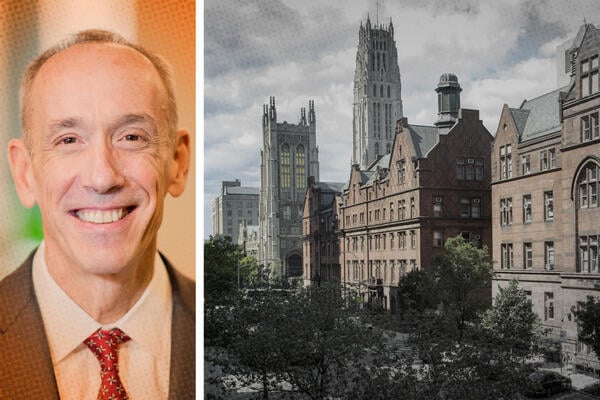
Research on community colleges has taken a hit amid the Trump administration’s ongoing war against the Ivy League.
The Community College Research Center, an independent organization based at Columbia University’s Teachers College, found out in March that four of its grants totaling at about $12 million were immediately cancelled, despite being multiple years into their grant cycles. The remaining grant money expected from the Institute of Education Sciences amounted to at least $3.5 million. Four half-completed research projects relied on the funding. Now CCRC leaders are scrambling to find ways to continue the work.
The grants were swept up in the Trump administration’s slashing of $400 million in grants to Columbia University to cow the institution into agreeing to a set of demands. Columbia has since reached an agreement with the administration to restore its federal funding, but the deal only restored grants administered by the U.S. Department of Health and Human Services and the National Institutes of Health. Education Department grants, like the CCRC’s, didn’t return.
The center, now almost 30 years old, conducts rigorous research into community college programs and practices, like guided pathways and dual enrollment, to help institutions improve the student experience and student outcomes.
The canceled grants funded two efforts focused on pandemic recovery, including a study into a program at Virginia community colleges to support adults earning short-term credentials in high-demand fields. CCRC researchers were also using IES money to evaluate the Federal Work-Study program and for a fellowship that placed doctoral students in apprenticeships at education agencies and nonprofits. Teachers College has agreed to take over funding for the fellowship program for at least the upcoming academic year.
Thomas Brock, CCRC’s director, worries the field of community college research—and its benefits for students—are at risk at a time when federal funding has grown more tenuous. He spoke with Inside Higher Ed about how the center is moving forward in the absence of these funds. The conversation has been edited for length and clarity.
Q: How did you react when you first heard from the Education Department about the nixed IES grants?
A: It got us completely by surprise. We did not see that coming. The notification came on a Friday morning. We had to be finished with our work by the end of the day that Friday—we could have no further charges beyond that point. So, there was just no time to prepare. And all of our communications with IES until that point had been very positive. We were on track to complete the goals of our grants. We had been in frequent conversation with our program officers. So, there was simply no inkling that this would be coming.
Q: What was the extent of the funding loss for you?
A: The overall funding loss amounted to about $3.5 million. Most of the grants that we were working on were pretty far along. The total berth of the grants was well above $3.5 million, but that was about the amount we had remaining. Most of the work that was canceled was in the last year or two. It was all the more disappointing then, because we were so close to having results that we could share with the field. And that is important, of course, not just to CCRC but to the states and colleges that we partner with more broadly to accomplish our mission of informing community colleges, policymakers, practitioners about strategies that work to improve student outcomes.
Q: Going forward, what’s going to happen to projects funded by the canceled grants?
A: So, everything had to be put on hold. I will say we’ve been in discussion with some foundations about what they are calling last-mile funding to complete some of the IES-funded work. We don’t have the grants in hand just yet but invited proposals and ones we think have a good chance of funding.
We should hear news this fall about some of those. With the last-mile funding, we had to narrow the scope. Generally speaking, foundations don’t have the kinds of resources that the federal government does. So, most of these grants are just to really get out the final results and not putting as much emphasis on dissemination as we would have done with the federal funding. But nonetheless, we’re very grateful to have those opportunities.
We were lucky at CCRC. We’ve been around for a while. So, over many years, we’ve built up a reserve fund for rainy days, and we decided if this wasn’t a rainy day, we didn’t know what was. So, we have dipped into those reserves to keep many of our staff fully employed while they work on these proposals and to continue to have the ability to do the work if we get refunded. Those funds won’t last forever. We will have to make some tough decisions later this year about just what size of organization we can continue to support with foundation funds. And, I should note, we have already made a few layoffs and have had a couple of voluntary departures. So we are already smaller than we were, but we hope to maintain a critical core.
Q: Columbia recently reached an agreement with the Trump administration to have some of its research funds restored. Were you hopeful that your funds would be restored as well in that agreement?
A: We were, yes. We were not part of the negotiations. That was handled by Columbia University. And one of the complications here—really, going all the way back to the initial cancellation of our grants—was a misunderstanding, honestly, by the current administration of Teachers College’s relationship to Columbia. We are an affiliated institution, but we are independent—legally, financially, administratively. We have our own president, our own Board of Directors. We are a separate nonprofit organization, a separate 501(c)(3), so the affiliation we have is a loose one. It allows our students to cross-register and take courses at Columbia. But we do not benefit in any way from Columbia’s endowment or its wealth as an institution. Teachers College is a relatively poor stepchild within the Columbia University constellation.
So, when we first lost our grants, we appealed as we were instructed to do if we had an issue with the cancellation. The beginning of our appeal was just that we are a separate institution. Whatever complaints the administration may have about Columbia University and how it handled the student protests last year, that had no bearing on what happened at Teachers College. And indeed, we had no student protests. We had no actions that were of concern to the administration or to anyone. So, we hope, just on that basis, we might win on appeal.
Our appeals were acknowledged, but they have not ever been acted upon as the university went forward with its negotiations. We were hopeful that perhaps [the agreement] would benefit us as well. And when the settlement was reached, I had maybe 24 hours when I was I was really holding my breath. But unfortunately, as we looked at the details of the settlement, it only applied to grants made to the U.S. Department of Health and Human Services and the National Institutes of Health. Department of Education grants were not included.
Q: You touched on this, but what comes next for the CCRC? How are you thinking about moving forward and how you might have to pivot?
A: In the near term, we will have to depend on foundation funding exclusively or primarily. We are fortunate in that we have a long history of foundation funding, so that’s not new, but our model has always involved a blending of federal and foundation resources. And that’s just very important to an organization like ours, because foundations and the federal government have typically funded different kinds of things. They both are really critical to advancing a research agenda.
What is the most important about the federal funding is, No. 1, the strong emphasis on scientific rigor. So, things like the randomized controlled trials that we’re doing on Federal Work-Study, it’s possible you could get a foundation to pick up a project like that, but that is much more in the bailiwick, or at least traditionally has been in the bailiwick of the U.S. Department of Education and its Institute of Education Sciences—not just randomized controlled trials but rigor in all ways, the emphasis on nationally representative samples on longitudinal research. IES funding has been really important for that.
A second way IES has been so critical is this emphasis on dissemination. IES has been criticized, and justifiably so, for the What Works Clearinghouse, for instance, being a bit indecipherable at first and having too much in it that really wasn’t showing effectiveness. But it’s come a long way in improving that resource and also really in encouraging grantees to get their findings out into the field. We depended heavily on federal funding for our website, for our social media efforts, for attending practitioner conferences. It was really vital support for those purposes. So, that is largely what concerns us. Perhaps some new foundation supporters will be interested in that kind of work. [It’s] not likely we will find the level of funding that was available through the federal government, but we hope at least enough to keep our essential communications and outreach efforts intact.
Our agenda will probably have to shift a little bit. This is also what’s disappointing about the Department of Education and IES stepping back—we could count on them to really help set the national agenda and things that were of importance to all 50 states and students in all parts of the country. It’s not to say foundations don’t have that interest, but it is much more typical with foundations to find that they are investing in particular places. There simply are not that many foundations with the resources to kind of take the national view, and that is a concern moving forward. So, it’s something that we’re addressing or trying to think about strategically, but it will be a challenge.
Q: How does the uncertainty with federal funding affect the broader field of community college research?
A: Well, obviously I am biased here. I think research matters, or I would not have entered this profession.
There have been major advances in how community colleges think about developmental education, for example. The models that were in place 20 years ago just turned out to be fundamentally wrong. Most community college students coming in were assessed and placed into developmental education courses that actually did them more harm than good. It was years of careful research that documented that fact and that then supported partnerships with community colleges interested in trying different strategies.
And thanks to all of that work, we now have multiple-measures assessment, where students’ high school grades and other indicators are used. It’s resulting in far fewer students being placed in developmental courses. We also have corequisite remediation, where students are placed in college-level work right away with extra support, as opposed to requiring them to do what was known as prerequisite remediation before starting college-level work. So, those are strategies that we would not have known about, but for this kind of investment, and strategies that have been widely picked up now by the field that are demonstrably leading to improve student outcomes.
So, I guess what I worry about is the cessation, or near cessation, of those kinds of research and development efforts that lead to new insights, that lead to new ways of doing business that really could be transformative for students. And if you think about today’s challenges, they are no different or less concerning.
Artificial intelligence is transforming education. What will it mean for community college students? How could institutions best harness those tools to really ensure students are learning and moving forward? That’s a big, big area that I think cries out for deeper investigation. Another big area of interest is short-term training. Congress is prepared to make Pell Grants available for short-term training. Past evidence has shown not much effectiveness there. But what are the program areas that do lend themselves to short-term training? How might community colleges focus these efforts so that they really do lead to a payoff for students and for taxpayers?
These are big questions that, if we don’t have some of the foundational work in place, we’re not going to have answers five or 10 years from now. And the field as a whole, students specifically, will suffer as a result.
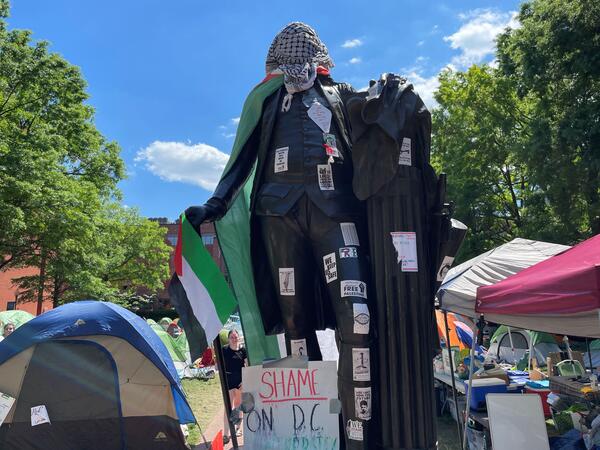
The Department of Justice said Tuesday that George Washington University was “deliberately indifferent” toward Jewish students and faculty who said they faced antisemitic harassment and had violated federal civil rights law that bars discrimination based on race and national origin.
The four-page letter signals that George Washington could be the next university in the Trump administration’s crosshairs. The DOJ sent a similar letter to the University of California, Los Angeles, late last month, and then various federal agencies froze more than $500 million in federal grants at the university. Since then, the Trump administration has demanded $1 billion from the UC system to resolve the dispute—a move the state’s governor called “extortion.”
GW was one of 10 universities that a federal task force to combat antisemitism had planned to visit and investigate. That list included UCLA and Harvard and Columbia Universities, which also have been targeted by the Trump administration.
Harmeet Dhillon, the assistant attorney general for the civil rights division, wrote in the letter that the department plans to enforce its findings unless the university agrees to a voluntary resolution agreement to address the agency’s concerns. She didn’t detail what such an agreement would entail or what enforcement might look like.
The department’s allegations largely center on how the university responded—or didn’t—to a spring 2024 encampment established to protest the war in Gaza. The university ultimately called in D.C. police to clear the demonstration after it persisted for nearly two weeks.
“The purpose of the agitators’ efforts was to frighten, intimidate, and deny Jewish, Israeli, and American-Israeli students free and unfettered access to GWU’s educational environment,” Dhillon wrote. “This is the definition of hostility and a ‘hostile environment.’”
She also wrote that university officials “took no meaningful action” in the face of at least eight complaints alleging that demonstrators at the encampment were discriminating against students because they were Jewish or Israeli.
George Washington spokesperson Shannon McClendon said in a statement that university officials were reviewing the letter.
“GW condemns antisemitism, which has absolutely no place on our campuses or in a civil and humane society,” McClendon said. “Moreover, our actions clearly demonstrate our commitment to addressing antisemitic actions and promoting an inclusive campus environment by upholding a safe, respectful, and accountable environment. We have taken appropriate action under university policy and the law to hold individuals or organizations accountable, including during the encampment, and we do not tolerate behavior that threatens our community or undermines meaningful dialogue.”