BOSTON — Ignite Reading — a Science of Reading-based virtual tutoring program serving students in 18 states nationwide — today announced its approval by the Massachusetts Department of Elementary and Secondary Education (DESE) to continue providing 1:1 high-dosage evidence-based literacy tutoring to K-3 students across the commonwealth.
Massachusetts Governor Maura Healey’s administration called on her state to invest heavily in high-dosage tutoring (HDT) earlier this year, earmarking $25 million in her state budget proposal to help accelerate literacy growth, “complementing the more systemic, long-term improvement work” being supported under the administration’s five-year literacy improvement campaign, Literacy Launch.
In its approval process, DESE evaluated Ignite Reading’s services to Massachusetts districts over the past three school years and approved the literacy company to again provide school districts and charter schools with tutoring that is focused on building foundational skills — including phonological awareness, phonics knowledge and decoding skills — to help students become independent fluent readers in the early grades.
Since Ignite Reading first gained DESE approval during the 2022-23 school year:
30 Massachusetts schools and districts have partnered with Ignite Reading to provide students with 15 minutes of daily, 1:1 virtual tutoring.
Ignite Reading’s tutor educators have delivered differentiated, evidence-based early literacy instruction to more than 7,800 Massachusetts students.
Researchers at Johns Hopkins University’s Center for Research and Reform in Education have followed approximately 2,000 Massachusetts 1st graders enrolled in the program. The quasi-experimental study found the number of students reading on benchmark increased 213% after a year of Ignite Reading tutoring. At the same time, the percentage of students who required intensive reading intervention decreased 55%. All student groups — including Black and Hispanic students, those with IEPs and Multilingual Learners — had equitable skills growth, and those meeting end-of-year reading benchmarks grew more than 125%.
The Healey-Driscoll Administration recently announced that schools and districts in Massachusetts are invited to apply for high-dosage early literacy tutoring for K-3 students with 1st grade as the state’s top priority.
“When we get kids reading proficiently by the end of 1st grade, we set them up for a lifetime of academic success,” said Ignite Reading CEO Jessica Sliwerski. “Our continued approval by DESE means we can keep delivering the intensive, personalized support that Massachusetts 1st graders need to learn to read on grade level and on time. We are honored to be able to continue to partner with Massachusetts districts to ensure all students can access the tools they need to succeed as readers.”
Ignite Reading is on a mission to ensure every student can access the tools they need to be a confident, fluent reader by the end of 1st grade. School districts nationwide depend on Ignite Reading’s virtual tutoring program to deliver literacy support at scale for students who need help learning to read. Our highly trained tutors provide students with 1:1 tutoring in foundational literacy skills each school day, helping them go from learning to read to reading to learn.
A recent study by the Center for Research and Reform in Education at Johns Hopkins University found that Ignite Reading students across demographics — including students who are English Learners, Black, Hispanic, and those with Individualized Education Programs (IEPs) — achieve the same outstanding gains of more than 5 months of additional learning during a single school year. For more information about Ignite Reading, visit www.ignite-reading.com.
eSchool Media staff cover education technology in all its aspects–from legislation and litigation, to best practices, to lessons learned and new products. First published in March of 1998 as a monthly print and digital newspaper, eSchool Media provides the news and information necessary to help K-20 decision-makers successfully use technology and innovation to transform schools and colleges and achieve their educational goals.
RAJ AGNIHOTRI has been named the next Raisbeck Endowed Dean of Iowa State University’s Debbie and Jerry Ivy College of Business. He will begin his service July 1, 2025. Agnihotri currently serves in the college as Mary Warner Professor and Morrill Professor of marketing and assistant dean for industry engagement at Iowa State. He has served at Iowa State since 2018, and in his current role as assistant dean since 2024. Prior positions include appointments at the University of Texas-Arlington and Ohio University. Agnihotri earned a bachelor’s degree in engineering from the University of Pune in India, an MBA in management from Oklahoma City University, and a Ph.D. in marketing from Kent State University.
Prior research shows attendance is one of the best predictors of class grades and student outcomes, creating a strong argument for faculty to incentivize or require attendance.
Attaching grades to attendance, however, can create its own challenges, because many students generally want more flexibility in their schedules and think they should be assessed on what they learn—not how often they show up. A student columnist at the University of Washington expressed frustration at receiving a 20 percent weighted participation grade, which the professor graded based on exit tickets students submitted at the end of class.
“Our grades should be based on our understanding of the material, not whether or not we were in the room,” Sophie Sanjani wrote in The Daily, UW’s student paper.
Keenan Hartert, a biology professor at Minnesota State University, Mankato, set out to understand the factors affecting students’ performance in his own course and found that attendance was one of the strongest predictors of their success.
His finding wasn’t an aha moment, but reaffirmed his position that attendance is an early indicator of GPA and class community building. The challenge, he said, is how to apply such principles to an increasingly diverse student body, many of whom juggle work, caregiving responsibilities and their own personal struggles.
“We definitely have different students than the ones I went to school with,” Hartert said. “We do try to be the most flexible, because we have a lot of students that have a lot of other things going on that they can’t tell us. We want to be there for them.”
Who’s missing class? It’s not uncommon for a student to miss class for illness or an outside conflict, but higher rates of absence among college students in recent years are giving professors pause.
An analysis of 1.1 million students across 22 major research institutions found that the number of hours students have spent attending class, discussion sections and labs declined dramatically from the 2018–19 academic year to 2022–23, according to the Student Experience in the Research University (SERU) Consortium.
More than 30 percent of students who attended community college in person skipped class sometimes in the past year, a 2023 study found; 4 percent said they skipped class often or very often.
Students say they opt out of class for a variety of reasons, including lack of motivation, competing priorities and external challenges. A professor at Colorado State University surveyed 175 of his students in 2023 and found that 37 percent said they regularly did not attend class because of physical illness, mental health concerns, a lack of interest or engagement, or simply because it wasn’t a requirement.
A 2024 survey from Trellis Strategies found that 15 percent of students missed class sometimes due to a lack of reliable transportation. Among working students, one in four said they regularly missed class due to conflicts with their work schedule.
High rates of anxiety and depression among college students may also impact their attendance. More than half of 817 students surveyed by Harmony Healthcare IT in 2024 said they’d skipped class due to mental health struggles; one-third of respondents indicated they’d failed a test because of negative mental health.
A case study: MSU Mankato’s Hartert collected data on about 250 students who enrolled in his 200-level genetics course over several semesters.
Using an end-of-term survey, class activities and his own grade book information, Hartert collected data measuring student stress, hours slept, hours worked, number of office hours attended, class attendance and quiz grades, among other metrics.
Mapping out the various factors, Hartert’s case study modeled other findings in student success literature: a high number of hours worked correlated negatively with the student’s course grade, while attendance in class and at review sessions correlated positively with academic outcomes.
Data analysis by Keenan Hartert, a biology professor at Minnesota State University, Mankato, found student employment negatively correlated with their overall class grade.
Keenan Hartert
The data also revealed to Hartert some of the challenges students face while enrolled. “It was brutal to see how many students [were working full-time]. Just seeing how many were [working] over 20 [hours] and how many were over 30 or 40, it was different.”
Nationally, two-thirds of college students work for pay while enrolled, and 43 percent of employed students work full-time, according to fall 2024 data from Trellis Strategies.
Hartert also asked students if they had any financial resources to support them in case of emergency; 28 percent said they had no fallback. Of those students, 90 percent were working more than 20 hours per week.
Data analysis of student surveys show students who are working are less likely to have financial resources to support them in an emergency.
The findings illustrated to him the challenges many students face in managing their job shifts while trying to meet attendance requirements.
A Faculty Aside
While some faculty may be less interested in using predictive analytics for their own classes, Hartert found tracking factors like how often a student attends office hours was beneficial to helping him achieve his own career goals, because he could include those measurements in his tenure review.
An interpersonal dynamic: A less measured factor in the attendance debate is not a student’s own learning, but the classroom environment they contribute to. Hartert framed it as students motivating their peers unknowingly. “The people that you may not know that sit around you and see you, if you’re gone, they may think, ‘Well, they gave up, why should I keep trying?’ Even if they’ve never spoken to you.”
One professor at the University of Oregon found that peer engagement positively correlated with academic outcomes. Raghuveer Parthasarathy restructured his general education physics course to promote engagement by creating an “active zone,” or a designated seating area in the classroom where students sat if they wanted to participate in class discussions and other active learning conversations.
Compared to other sections of the course, the class was more engaged across the board, even among those who didn’t opt to sit in the participation zone. Additionally, students who sat in the active zone were more likely to earn higher grades on exams and in the course over all.
Attending class can also create connections between students and professors, something students say they want and expect.
A May 2024 student survey by Inside Higher Ed and Generation Lab found that 35 percent of respondents think their academic success would be most improved by professors getting to know them better. In a separate question, 55 percent of respondents said they think professors are at least partly responsible for becoming a mentor.
The SERU Consortium found student respondents in 2023 were less likely to say a professor knew or had learned their name compared to their peers in 2013. Students were also less confident that they knew a professor well enough to ask for a letter of recommendation for a job or graduate school.
“You have to show up to class then, so I know who you are,” Hartert said.
Meeting in the middle: To encourage attendance, Hartert employs active learning methods such as creative writing or case studies, which help demonstrate the value of class participation. His favorite is a jury scenario, in which students put their medical expertise into practice with criminal cases. “I really try and get them in some gray-area stuff and remind them, just because it’s a big textbook doesn’t mean that you can’t have some creative, fun ideas,” Hartert said.
For those who can’t make it, all of Hartert’s lectures are recorded and available online to watch later. Recording lectures, he said, “was a really hard bridge to cross, post-COVID. I was like, ‘Nobody’s going to show up.’ But every time I looked at the data [for] who was looking at the recording, it’s all my top students.” That was reason enough for him to leave the recordings available as additional practice and resources.
Students who can’t make an in-person class session can receive attendance credit by sending Hartert their notes and answers to any questions asked live during the class, proving they watched the recording.
Hartert has also made adjustments to how he uses class time to create more avenues for working students to engage. His genetics course includes a three-hour lab section, which rarely lasts the full time, Hartert said. Now, the final hour of the lab is a dedicated review session facilitated by peer leaders, who use practice questions Hartert designed. Initial data shows working students who stayed for the review section of labs were more likely to perform better on their exams.
“The good news is when it works out, like when we can make some adjustments, then we can figure our way through,” Hartert said. “But the reality of life is that time marches on and things happen, and you gotta choose a couple priorities.”
Do you have an academic intervention that might help others improve student success? Tell us about it.
University governing boards are the black boxes of higher ed. As with marriages, the only people who know what they’re really like are the ones in the relationship. Sometimes not even them.
Like most faculty members, I knew almost nothing about the Board of Trustees at my regional public university, other than hearing my colleagues rail against their hiring decisions. In my nearly two decades on the faculty, we’ve had six presidents. That should tell you something.
After a no-confidence vote in a previous president, the board held a public Zoom session where faculty, students and community members gave them hell. I watched, embarrassed. At the board’s request for further comment, I wrote a letter explaining from my limited perspective how things had gotten so bad.
The next day, a trustee emailed to thank me and asked if I’d be willing to talk. I was. I knew some of my colleagues had go-out-drinking relationships with board members. I have never been cool, so I was, of course, flattered. (Frailty, thy name is Rachel.)
The trustee asked if there were other faculty members they could contact. I gave names. We kept in touch. Eventually, the board fired the president and hired someone new. The trustee would occasionally reach out. We’d talk about campus issues—but also books and dogs. Our conversations made me feel seen and valued—a rarity for me.
Only when I began writing a weekly newsletter for Inside Higher Ed, having confidential and off-the-record conversations with sitting presidents, did I realize that my friendly back channel might not have been entirely kosher. Recently, I finally looked at our board’s bylaws. They said, essentially, that trustees aren’t supposed to go around the president to make requests of university employees.
Oops.
That rule is there for a good reason. While it is theoretically great for trustees to be more knowledgeable about the institutions on whose boards they serve, their main functions are fiduciary and to hire and (increasingly often) fire the president, who is responsible in turn for educating them. Most faculty and staff will have plenty to say if asked (I sure did) but will have only a limited perspective on the administrative realities (which never stops us from opining). And some board members, like some of us faculty, just like to stir up shit.
That was not the case with the trustee at my university, who loved the institution, was smart and caring, and wanted only to understand and help make things better. But the reason for bylaws is because not everyone acts honorably. Or is even informed. One thing I’ve learned: Many board members (and some presidents) don’t pay much attention to those pesky board documents. And they’re rarely updated. I just heard from a current president that when he came into the job, the bylaws stated that documents were to be sent electronically. By telegram!
In the last two years, I’ve heard plenty of stories about good relationships between presidents and helpful boards working together to lead all sorts of different types of institutions. Those tales are happily dull.
Frequently, though, I’ve heard horror stories about board behavior. Trustees reliving their frat years, getting hammered and passing out on the president’s couch. Grabbing butts and commenting on legs. Weighing in on clothing and jewelry choices. But not all offenses are so blatant. More often, presidents tell me about covert alliances between trustees and executive team members who want to undermine the president—and get away with it because of personal relationships. Or the board members who go around the president to talk to faculty (um, right).
I have come to believe that many of the problems in higher ed are a result of the fact that there’s no real oversight of trustees, and often not even a shared understanding of what they’re supposed to be doing. There are associations and consultants, but the institutions that seek them out are the ones who already know they need help, and only because things are seriously messed up. Most “training” happens after everything goes pear-shaped and someone with a title and willingness to spend some coin brings in the consultants.
You’d think leaders would recognize a dysfunctional board. But as one of those consultants likes to say, when you’ve seen one board, you’ve seen one board. Many presidents don’t realize they are in an abusive relationship until they move on (by their own choice, or not) and realize that the next board isn’t like the last. That’s when it hits: Oh. That wasn’t normal.
Boards sometimes bring in a president to shake things up or solve a big problem (there’s no money in the budget). But when a place is used to doing things a certain way—especially if there’s been a long-serving president—the new person often ends up being blamed for making everyone feel uncomfortable. When trustees start hearing complaints from their golf buddies about how their alma mater is “changing too much” or faculty vote no confidence, guess who takes the hit?
Some say big boards are better—fewer people means fewer checks on the loudest voices. Most trustees are used to being in charge and seeing quick results. Higher ed doesn’t work that way. And we haven’t even started talking about shared governance. (That’s a whole other can of night crawlers.)
Presidents have to walk a fine line: Give the board enough information to fulfill their duties without overwhelming them. Some create board books of many hundreds of pages and hope no one reads too closely. Others spoon-feed just what’s needed so they can take advantage of the real expertise and wisdom of the board members. Good trustees are curious and thoughtful. But not all of them got the memo that this is a governing role, not a management one. (Same is true for shared governance.)
As with faculty development, those who are eager to get better at their jobs attend learning sessions and those who most need training rarely show up. The bullies call themselves “critical thinkers.” A former president–turned–consultant told me that in the old days, other board members would call out bad behavior. Now, she says, when the flamethrowers show up, everyone else suddenly finds their phones fascinating.
Good trustees know their role. One I’ve spoken to told his president, “If I ever feel like I’m running the place, I know it’s time to find a new president.” That’s what a good marriage sounds like—mutual trust, healthy boundaries, a sense of being on the same team without Monday-morning quarterbacking.
But like all relationships, presidencies can sour. Many presidents have had great relationships with strong, supportive board chairs. But then the chair rotates. Or a new crop of trustees arrives. Suddenly, everything changes. And there’s no way to explain what happened—only that it did.
That’s when we see the press release that says the president “resigned abruptly.” The board thanks them for their service, announces an interim and closes the door behind them. In a few recent cases, the interim is the board chair, who then takes over as president.
Which is why seasoned presidents negotiate their contracts like they’re signing a prenup. Because as with any marriage, you want to believe it’s forever—but you’d be wise to plan for the day one of you decides to walk away.
Rachel Toor is a contributing editor at Inside Higher Ed, where she writes and edits the Insider membership newsletter The Sandbox.
Shalini Randeria, president and rector of the Central European University, has warned that the Trump administration is working from the “playbook” of Hungarian prime minister Viktor Orbán, describing the legal uncertainty faced by U.S. universities as the government’s “intended outcome.”
Now based in Vienna, CEU was forced out of Budapest after Orbán’s Fidesz government implemented a series of legal measures in 2017, which the European Court of Justice later ruled were “incompatible with E.U. law.”
The 2020 ruling came too late for CEU, however, which had relocated to Austria the previous year. “That’s one of the problems of using law courts to stop the machinations of soft authoritarian regimes,” Randeria told Times Higher Education. “Courts are slow and unpredictable, even though we had a very strong case.”
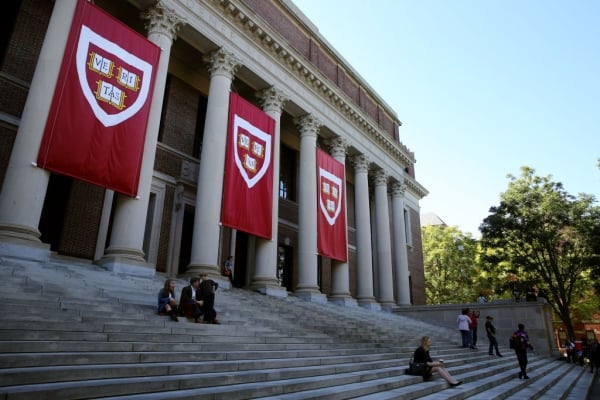
“There was a lot of legal uncertainty created by Orbán, and this is exactly the same playbook which is being used by the Trump administration,” she said, pointing to the court battle between Harvard University and the government as an example.
“They introduce a flurry of laws and administrative measures that universities can then go to court against. It’s unclear what will happen at the end, and this chaos and unpredictability is really the intended outcome.”
Randeria described legal uncertainty as particularly problematic for organizations that work on “long-term cycles,” such as universities. “It makes any rational decision-making, any financial planning or academic planning, impossible,” she said.
“When we admit students now, we admit them to complete a four-year degree, or a two-year master’s, or a doctoral degree in five or six years. We are thinking and planning way ahead,” she said. “If you don’t know what the legal status of your institution will be in two years, you cannot in good faith advertise to and recruit students.”
Attracting faculty, too, requires long-term certainty, Randeria continued: “When you have this sword of Damocles hanging over your head, not knowing whether you’ll be able to run the university efficiently and fairly on a consistent basis, it’s very, very difficult to recruit faculty.”
After the “traumatic period” of forced relocation, CEU has “performed really well academically,” Randeria said, securing “competitive research funding both within Austria and, as usual, within Europe.”
Obtaining consortium grants, such as those awarded by the Austrian Science Fund, has “allowed us to anchor ourselves in Austria, not in competition with the very vibrant academic scene here and its research institutions and universities, but in partnership with them.” The university did not lose any faculty in the move, she noted, and “recruitment and admission numbers didn’t fall.”
Nevertheless, Orbán’s pursuit of the CEU—part of a larger campaign against its philanthropist founder, George Soros—has yet to run its course, Randeria said. Fidesz’s proposed “national sovereignty” law, which would allow the government to penalize or shut down organizations receiving “foreign funding,” “could be used against CEU’s continuing activities” in Budapest, she warned, namely, research conducted at the CEU Democracy Institute.
U.S. vice president JD Vance has expressed explicit admiration for Orbán’s higher education policy, calling his approach, which has also seen control of state universities transferred to government-aligned foundations, “the closest that conservatives have ever gotten to successfully dealing with left-wing domination of universities.”
“What right-wing populists all over have done is stamp universities as ivory towers of elite privilege, and this is not true,” Randeria said. In response, “we need to mobilize public support on a very large scale.”
“As institutions, we need to put a lot more focus on outreach and communication,” she told THE, with the goal of ensuring the public “really understand what universities do, and why they are the backbone of a functioning liberal democracy.”
U.S. universities must “not let themselves be divided one against the other,” Randeria advised. “I don’t think you can protect yourself as an institution on your own. It has to be a collective resistance against this kind of intervention into university autonomy and academic freedom.”
“One should be prepared for some very, very strong institutional solidarity of universities across the board.”
Before a federal judge blocked its plans, the Education Department reached a deal with the Department of Labor to hand over some of its career, technical and adult education grants, according to court records.
Under the agreement, reached May 21, the Labor Department would administer about $2.7 billion in grants, including the Perkins Grant program, which funds career and technical education at K–12 schools and community colleges, Politicofirst reported. But that plan is now on hold, as is an agreement with the Treasury Department regarding student loan collections, according to a status update in New York’s lawsuit challenging mass layoffs at the agency and President Donald Trump’s executive order to dismantle the department.
The Trump administration has asked the Supreme Court to overturn the lower court’s injunction so officials can proceed with the layoffs and other plans.
The department didn’t publicly announce the handover, which appears to be a first step toward Trump’s endgame of shutting down the agency. Education Secretary Linda McMahon has acknowledgedrepeatedly that only Congress can legally shutter the department, but she’s also made clear that she can transfer some responsibilities to other agencies. In addition to administering the funds, Labor officials agreed to oversee the implementation of career education programs and to monitor grant recipients for compliance.
Advance CTE and the Association for Career and Technical Education criticized the plan, saying the agreement “directly circumvents existing statutory requirements” related to the Perkins program and would cause confusion.
“We strongly oppose any efforts to move CTE administration away from the U.S. Department of Education given the disruption this would cause to the legislation’s implementation and services to students in schools across the country,” they said in a statement released Wednesday evening.
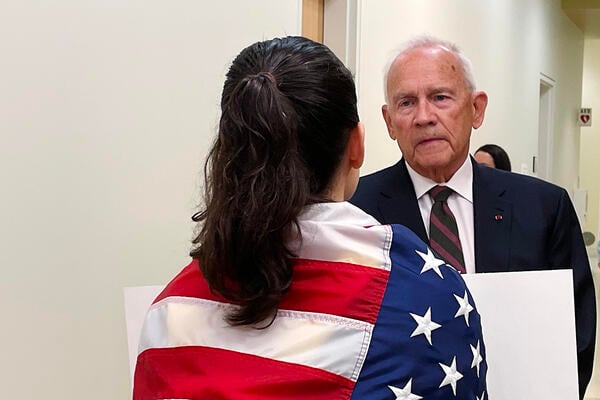
A judge released a Harvard Medical School research associate and Russian native Thursday. She had been held in federal detention for nearly four months after she tried to re-enter the U.S.
Kseniia Petrova still faces a criminal charge for allegedly trying to smuggle frog embryos into the country through Boston’s Logan International Airport, where Customs and Border Protection detained her, but she’s been freed for now.
“I hear it’s sunny. Goodbye,” U.S. magistrate judge Judith G. Dein said after approving Petrova’s release, the Associated Press reported.
The AP wrote that Petrova, standing outside the John Joseph Moakley U.S. Courthouse in Boston, thanked her supporters, saying, “I never really felt alone any minute when I was in custody, and it’s really helped me very much.”
The court set a probable cause hearing in the case for next Wednesday.
Despite being detained Feb. 16 and transferred to Immigration and Customs Enforcement custody in Louisiana, it wasn’t until mid-May that prosecutors announced the smuggling charge. One of her lawyers, Gregory Romanovsky, has said that Petrova “was suddenly transferred from ICE to criminal custody” less than two hours after a judge set a hearing on her release.
On May 28, a U.S. District Court of Vermont judge said that Petrova’s immigration detention was unjustified and granted bail, but that didn’t immediately lead to her release, NBC News reported.
“It’s difficult to understand why someone like Kseniia needed to be jailed for four months,” Romanovsky said. “She poses no danger and has deep ties to her community. Her case is a reminder that immigration enforcement should be guided by law and common sense—and not deportation quotas.”
President Trump said that Chinese international students would be welcome in the U.S. in a post on Truth Social on Wednesday announcing the terms of a pending trade agreement with China.
In exchange for shipments of rare earth metals, the U.S. “WILL PROVIDE TO CHINA WHAT WAS AGREED TO, INCLUDING CHINESE STUDENTS USING OUR COLLEGES AND UNIVERSITIES (WHICH HAS ALWAYS BEEN GOOD WITH ME!),” Trump posted (capital letters his).
The about-face comes less than two weeks after Secretary of State Marco Rubio promised to “aggressively revoke” Chinese students’ visas and implement a much stricter review process for nonimmigrant visa applications from the country.
That announcement, an escalation of the Trump administration’s campaign to decrease the number of foreign students at American universities, threw higher education into a panic. International enrollment has become a financial lifeline for many institutions, and Chinese students make up nearly a quarter of all international students in the U.S.—around 280,000 in 2023–24, according to the Institute of International Education, more than students from any other country. They make up 16 percent of graduate STEM programs and 2 percent of undergraduate programs.
Rubio’s visa-revocation announcement also led to distress among Chinese families, whose hopes of sending their children to a prestigious American university seemed to be fading. In May, the Chinese foreign minister called the policy “politically discriminatory” and “irrational.”
Students will soon have to show a government-approved ID either in person or online in order to receive federal aid.
Photo illustration by Justin Morrison/Inside Higher Ed | michaeljung and robas/iStock/Getty Images
College financial aid offices and students’ advocates say that a Trump administration plan to crack down on fraud in the federal aid system could burden university staff and hinder access to college programs.
Although they support fighting fraud as a concept, they particularly worry that real, eligible Pell Grant recipients will get caught up in the detection system and won’t be able to jump through the extra hoops to verify their identity.
“In general, verification is a little bit of threading the needle between making sure that the right dollars are going to the right students, but also not putting up an inordinate number of barriers, particularly to low-income students, that are insurmountable,” said Karen McCarthy, vice president of public policy and federal relations at the National Association of Student Financial Aid Administrators. “You have to walk a fine line between those two things.”
Department of Education officials, however, say their plan, announced June 9, is necessary to protect American taxpayers from theft and won’t become a burden for colleges. They aren’t worried about students losing access, either.
Ultimately, the Trump administration plans to verify the identity of each financial aid applicant with the help of a new system that should be up and running “this fall,” according to the department’s announcement. Before then, the department is planning to screen more first-time applicants for verification—a process that could affect 125,000 students this summer and will be handled by financial aid offices. (About 40,000 students were checked last year, according to a department spokesperson.)
McCarthy, however, is concerned that if the new system isn’t ready by the fall, “institutions will be assuming this larger burden for a longer, indeterminate amount of time.” The department’s botched launch of the 2024–25 Free Application for Federal Student Aid showed the challenges of standing up new systems quickly, she noted.
A senior official at the Department of Education told Inside Higher Ed that the Office of Federal Student Aid and the department procurement team are in the process of purchasing an identity-validation product similar to the ones used by financial services companies like banks. The product would be incorporated into the online FAFSA portal.
If an individual is flagged for potential fraud at any point while filling out the form, a pop-up box would appear with a live staff member on the other side, the official explained. The applicant would then be asked to display a government-issued ID. If that ID is deemed valid, the person could then continue.
“Once that’s done, the process is over,” the official said. “That’s really as simple as that effort is. I believe rental car companies are using it, too.”
The official was optimistic that the department could have the system up and running by early September, though that won’t be soon enough to get aid disbursed in time for the fall semester. The official also acknowledged that the timeline means that colleges may have to do some verification in person even in the fall, but that process should not be too much of a burden for the college or the student. Similar to the online process, a student would just need to show a valid ID to a college financial aid administrator, either in person or over a video call. Previously, when identity verifications were conducted, students had to present a Statement of Educational Purpose and submit a notarized copy of their identification document.
But advocacy groups that work with low-income students worry that even requiring a government-issued ID could give some students a leg up over others when it comes to accessing financial aid and affording to enroll in college.
“We want to see fraud eliminated as much as anyone else … We just need to make sure that gets balanced with a reasonable process for students,” said MorraLee Keller, a senior consultant for the National College Attainment Network. “A lot of low-economic kids may not have secured, for example, a driver’s license. If they don’t drive, they may not have a driver’s license, and that is probably the primary form of a government-issued valid ID that most people would be able to present.”
Keller noted that some states may have alternate IDs available for those who do not drive, but even that may take time to obtain if a student doesn’t already possess it.
“We want to make sure that timing doesn’t interrupt the aid getting credited to their account to pay their bills on time so that they could start classes, get refunds to go get their books and all those kinds of things,” she said. “So one of the questions that we still need answered is, what else would be considered a valid ID?”
The California Community College system, which has grappled with increasing financial aid fraud, recently considered an application fee to help screen legitimate students from fraudsters. A spokesperson for the system said they are waiting on additional guidance from the department before they can know how big a deal this shift will be.
“We wouldn’t be able to speculate on the level of concern among students and institutions until the federal guidance is known,” she wrote. But “financial aid fraud is a nationwide trend and additional identification verification processes will help in the fight against it.”
An environmental researcher at Tulane University resigned Wednesday after accusing campus officials, reportedly under pressure from Gov. Jeff Landry, of issuing a “gag order” that prevented her from publicly discussing her work, which focused on racial disparities in the petrochemical workforce.
“Scholarly publications, not gag orders, are the currency of academia,” Kimberly Terrell, the now-former director of community engagement at Tulane’s Environmental Law Clinic, wrote in her resignation letter. “There is always room for informed debate. But Tulane leaders have chosen to abandon the principles of knowledge, education, and the greater good in pursuit of their own narrow agenda.”
Terrell’s resignation comes amid wider efforts by the Trump administration and its allies to control the types of research—including projects related to environmental justice—academics are permitted to pursue and punish campus protesters for espousing messages the president and other public officials disagree with.
“It started with the pro-Palestinian activism on our campus and others across the country. It’s emboldened a lot of political leaders to feel they can make inroads by silencing faculty in other areas,” Michelle Lacey, a math professor and president of Tulane’s chapter of the American Association of University Professors, told Inside Higher Ed. “That was the catalyst for creating a climate where university administrators are very nervous, especially now as we see the government pulling funding for areas of research they don’t like.”
Last spring, Landry praised Tulane president Michael Fitts and university police for removing students who were protesting Israel’s attacks on Gaza. Soon after, the Legislature passed a provision creating harsher punishments for protesters who disrupt traffic, which Landry later signed into law.
Landry, a Republican aligned with Trump, has a history of trying to exert control over the state’s public higher education institutions.
Last summer, he enacted a law that allows him to directly appoint board chairs at the state’s public colleges and universities. And in November, following Trump’s election, Landry publicly called on officials at Louisiana State University to punish a law professor who allegedly made brief comments in class about students who voted for the president.
Landry’s office denied to the Associated Press (which first reported on Terrell’s resignation) that it pressured Tulane to silence research from the law clinic. Michael Strecker, a Tulane spokesperson, also told the outlet that the university “is fully committed to academic freedom and the strong pedagogical value of law clinics” and declined to comment on “personnel matters.”
Strecker added in a statement that Tulane administrators have been working with the law school’s leadership on how the law clinics could better support the university’s education mission.
“Debates about how best to operate law clinics’ teaching mission have occurred nationally and at Tulane for years—this is nothing new,” Strecker said. “This effort includes most recently input from an independent, third-party review.”
But Terrell’s account of the events that led to her resignation call the universities’ academic freedom commitments into question, while also implying that Landry—and powerful industry groups—wield some influence over private higher education institutions in the state.
And it’s not something Tulane, a private university in New Orleans, should tolerate, Lacey said.
Kimberly Terrell
“The academic freedom of all university researchers must be unequivocally defended at both public and private institutions,” Lacey wrote in a statement. “This includes the right to conduct and disseminate research that may be unfavorably viewed by government officials or corporate entities. Political demands to stifle controversial research are an affront to the advancement of knowledge and open exchange of ideas, as is the voluntary compliance with such requests by university leadership.”
The latest controversy at Tulane stems from a paper Terrell published April 9 in the peer-reviewed journal Ecological Economics. Her research found that while Black people in Louisiana are underrepresented in the state’s petrochemical workforce, they are overexposed to toxic pollutants the industry releases into an area of the state between New Orleans and Baton Rouge known as “Cancer Alley.”
But according to emails obtained by Inside Higher Ed and other outlets, Fitts worried that publicizing Terrell’s research and the clinic’s other work, which includes legal advocacy, could jeopardize funding for the university’s $600 million plan to redevelop New Orleans’ historic Charity Hospital into residential and commercial spaces as part of a broader downtown expansion plan.
As Terrell explained in her resignation letter, Fitts and other top Tulane executives were at Louisiana’s state capitol on April 16 lobbying for the project when “someone accused the university of being anti–chemical industry” and cited her study, which was receiving media attention after it was published the week prior. According to Terrell, “the story that came down to me through the chain of command was that Governor Landry threatened to veto any bill with funding for Tulane’s Charity project unless Fitts did something about the Environmental Law Clinic.”
‘Complete Gag Order’
After that, Terrell says, she was “placed under a complete gag order,” which the emails appear to confirm.
“Effective immediately all external communications that are not client-based—that is, directly related to representation—must be pre-approved by me,” Marcilynn Burke, dean of Tulane’s law school, wrote in an April 25 email to law clinic staff. “Such communications include press releases, interviews, videos, social media postings, etc. Please err on the side of over-inclusion as we work to define the boundaries through experience.”
A week later, on May 4, Burke wrote another email to clinic staff explaining that “elected officials and major donors have cited the clinic as an impediment to them lending their support to the university generally and this project specifically,” referring to Fitts’s plans to redevelop the old hospital. Terrell wrote that when she pleaded her case to Provost Robin Forman, “he refused to acknowledge my right to freely conduct and disseminate research” and also “let slip that my job description was likely going to be rewritten.”
Terrell described the entire law clinic as being “under siege” and said she would rather leave her position “than have my work used as an excuse for President Fitts to dismantle the Tulane Environmental Law Clinic.”
Other academics, free speech experts and environmental justice advocates also believe Tulane’s moves to silence Terrell’s work amounts to an attack on academic freedom with implications beyond the campus.
“The administration of Tulane University, far from standing up for academic freedom, is participating in the effort to suppress free inquiry and the pursuit of knowledge by scientific methods,” Michael Ash, an economics and public policy professor at the University of Massachusetts, said in a statement. “Any effort to reduce academic freedom for Dr. Terrell either by changing her job classification or by redefining whether the protection applies is a blatant and un-American attempt to suppress the type of free inquiry that has made this country great.”
Joy Banner, co-founder and co-director of the Descendants Project, a community organization that works in Cancer Alley, added that the Tulane Environmental Law Clinic is a vital public health resource.
Without the clinic, “it would be far more difficult to show the racially discriminatory practices of the industry, from preferential hiring practices to a pattern of concentrating pollution in majority Black neighborhoods,” she said in a statement. “President Fitts must commit to protecting it at all costs.”