Tag: Education

  • Higher Education Inquirer : IMPORTANT INFO for Sweet v Cardona (now Sweet v McMahon) CLASS

    Higher Education Inquirer : IMPORTANT INFO for Sweet v Cardona (now Sweet v McMahon) CLASS

    Just dropping this IMPORTANT INFO from the DOE for Sweet v Cardona (now Sweet v McMahon) peeps who are CLASS – DECISION GROUPS and POST-CLASS.

    Edited To Add

    Decisions Class are streamlined R and R submissions.

    Post-class denials MUST ask the DOE for a reconsideration, which allows you to add additional evidence.

    Orginial Post:

    For REVISE and RESUBMITS (R and R) notices, the DOE is now saying that they WILL “disregard R and R*”* submissions if you EMAIL additional supporting documents or material. You CANNOT email the R and R back.

    You MUST submit a NEW BDTR APPLICATION and INCLUDE your previous BDTR application number which can be fund on the Denial letter.

    YOU HAVE 6 MONTHS TO RE-SUBMIT FROM THE RECEIPT OF THE R AND NOTICE (Here: https://studentaid.gov/borrower-defense**/

    **)

    The DOE states, “If you email supplemental information to the DOE or attempt to update your existing application, you will be treated as having failed to Revise and Resubmit”.

    ALSO, If you are still trying to add more evidence to your BDTR application this late in the game, you may want to wait for the decision letter to come out. We are reaching Group 5 Decision deadline, and Post-Class is 6 months after that. If you feel uneasy about your evidence, START collecting it now!

    Follow all DIRECTIONS on anything you get from the DOE relating to BDTR (except demanding payment, they can pound sand LOL).

    In Solidarity!!!

    Source link

  • IPEDS Data Collection Schedule (US Department of Education)

    IPEDS Data Collection Schedule (US Department of Education)

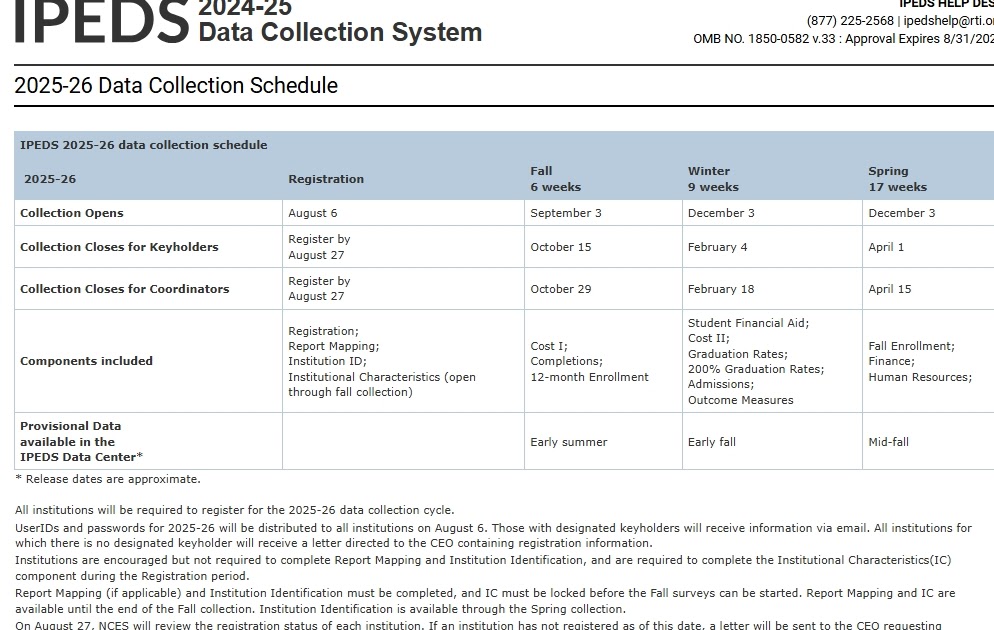
    The IPEDS data collection calendar for 2025-26 has now been posted and is available within the Data Collection System’s (DCS) Help menu, and on the DCS login page at: https://surveys.nces.ed.gov/ipeds/public/data-collection-schedule

    What is IPEDS?

    IPEDS is the Integrated Postsecondary Education Data System. It is a system of interrelated surveys conducted annually by the U.S. Department of Education’s National Center for Education Statistics (NCES). IPEDS gathers information from every college, university, and technical and vocational institution that participates in the federal student financial aid programs. The Higher Education Act of 1965, as amended, requires that institutions that participate in federal student aid programs report data on enrollments, program completions, graduation rates, faculty and staff, finances, institutional prices, and student financial aid. These data are made available to students and parents through the College Navigator college search Web site and to researchers and others through the IPEDS Data Center. To learn more about IPEDS Survey components, visit https://nces.ed.gov/Ipeds/use-the-data/survey-components.

    How is IPEDS Used?

    IPEDS provides basic data needed to describe — and analyze trends in — postsecondary education in the United States, in terms of the numbers of students enrolled, staff employed, dollars expended, and degrees earned. Congress, federal agencies, state governments, education providers, professional associations, private businesses, media, students and parents, and others rely on IPEDS data for this basic information on postsecondary institutions.

    IPEDS forms the institutional sampling frame for other NCES postsecondary surveys, such as the National Postsecondary Student Aid Study.

    Which Institutions Report to IPEDS?

    The completion of all IPEDS surveys is mandatory for institutions that participate in or are applicants for participation in any federal student financial aid program (such as Pell grants and federal student loans) authorized by Title IV of the Higher Education Act of 1965, as amended (20 USC 1094, Section 487(a)(17) and 34 CFR 668.14(b)(19)).

    Institutions that complete IPEDS surveys each year include research universities, state colleges and universities, private religious and liberal arts colleges, for-profit institutions, community and technical colleges, non-degree-granting institutions such as beauty colleges, and others.

    To find out if a particular institution reports to IPEDS, go to College Navigator and search by the institution name.

    What Data are Collected in IPEDS?

    IPEDS collects data on postsecondary education in the United States in eight areas: institutional characteristics; institutional prices; admissions; enrollment; student financial aid; degrees and certificates conferred; student persistence and success; and institutional resources including human, resources, finance, and academic libraries.

    Source link

  • How the 2025 U.S. Department of Education Reorganization Fulfills Grover Norquist’s Dream (Glen McGhee)

    How the 2025 U.S. Department of Education Reorganization Fulfills Grover Norquist’s Dream (Glen McGhee)

    In 2001, conservative activist Grover Norquist declared that his goal was to shrink government “to the size where I can drag it into the bathroom and drown it in the bathtub.” More than two decades later, under the leadership of Secretary Linda McMahon, the U.S. Department of Education’s March 2025 reorganization delivers on that radical vision—not with fire and fury, but with vacancies, ambiguity, and quiet institutional collapse.

    Vacant Seats, Hollow Power

    With dozens of senior leadership roles left vacant, enforcement functions gutted, and policymaking handed over to political allies and industry insiders, the Department no longer resembles a federal agency tasked with protecting students and public investment. Instead, it has become a hollowed-out vessel primed for deregulation, privatization, and corporate exploitation.

    The new organizational chart is littered with the word “VACANT.” From Chiefs of Staff and Deputy Assistant Secretaries to senior advisors in enforcement, civil rights, and postsecondary education, entire divisions have been effectively immobilized. The Office of Civil Rights is barely staffed at the top. The Rehabilitation Services Administration is leaderless. The General Counsel’s office lacks oversight in key regulatory areas. This is not streamlining—it is strategic self-sabotage.

    Federal Student Aid (FSA), overseeing over $1.5 trillion in loans, is run by an acting chief. Critical offices such as the Office of Postsecondary Education (OPE) are fragmented, missing key leadership across multiple branches—especially those charged with accreditation, innovation, and borrower protections.

    The Kent Controversy: A Symptom of Systemic Rot

    The collapse of federal oversight is not only evident in the vacancies—it is also embodied in controversial political appointments. As education policy watchdog David Halperin has reported, the Trump administration’s nominee for Under Secretary of Education, Nicholas Kent, epitomizes the revolving door between the Department of Education and the for-profit college industry.

    Kent’s career includes roles at Education Affiliates, which in 2015 paid $13 million to settle a Department of Justice case involving false claims for federal student aid, and later at Career Education Colleges and Universities (CECU), the lobbying group for the for-profit college sector. Under Kent’s policy leadership at CECU, the organization actively fought against borrower defense rules, gainful employment regulations, and other safeguards meant to protect students from exploitative educational institutions.

    Despite this record, the Senate Health, Education, Labor and Pensions (HELP) Committee advanced Kent’s nomination on May 22, 2025, in a party-line 12–11 vote—without a hearing. HELP Ranking Member Bernie Sanders objected, saying, “In my view, we should not be confirming the former lobbyist that represented for-profit colleges.” Advocates, including Halperin and six education justice organizations, sent a letter to Chairman Bill Cassidy calling for public scrutiny of Kent’s background and the Trump administration’s destructive higher education agenda.

    Among their concerns are the elimination of key enforcement staff and research arms at the Department, the cancellation of ongoing research contracts, the rollback of borrower defense and gainful employment protections, the $37 million fine reversal against Grand Canyon University for deceptive practices, and the Department’s silence on accreditation reform and oversight of predatory schools. These developments, the letter argued, mark a decisive return to the era of unchecked corporate education—where taxpayer dollars are funneled to dubious institutions and students are left with mountains of debt and worthless credentials.

    “Mission Accomplished” for the Privatization Movement

    This version of the Department of Education, stripped of its regulatory muscle and stocked with industry sympathizers, is not an accident. It’s the culmination of decades of libertarian, neoliberal, and religious-right agitation to disempower public education. The policy pipeline now flows directly from organizations like the Heritage Foundation and ALEC to appointed officials with deep ties to the industries they were once charged with policing.

    Rather than serving the public, the department’s primary role now appears to be facilitating the private sector’s conquest of higher education—through deregulation, outsourcing, and the erosion of civil rights protections.

    A Shrinking Federal Presence, an Expanding Crisis

    The consequences are far-reaching. Marginalized students—Black, brown, low-income, first-generation, disabled—depend disproportionately on federal guarantees, oversight, and funding. As these protections recede, so too does their access to meaningful educational opportunity. Instead, they are increasingly funneled into high-debt, low-return programs or shut out entirely.

    Meanwhile, the political vacuum left by this strategic dismantling is being filled by corporate actors, right-wing religious institutions, and profit-seeking “ed-tech” startups. The dream of public education as a democratic equalizer is being replaced by a market of extraction and exploitation.

    The Dream Realized

    Grover Norquist’s fantasy of drowning the government has now been partially fulfilled in the U.S. Department of Education. What remains is an agency in name only—a shell that no longer enforces its core mission. In the name of efficiency and deregulation, the department has abandoned millions of students and ceded its authority to those who view education as a commodity rather than a public right.

    The danger now is not only what’s been lost, but what is being built in its place. The Higher Education Inquirer will continue to monitor the ongoing capture of education policy and fight for a system that serves students, not shareholders.

    Sources:

    U.S. Department of Education, Organizational Chart, March 17, 2025

    David Halperin, Republic Report, “The Senate Shouldn’t Vote on Trump Higher Education Pick without a Hearing”

    U.S. Department of Justice press releases on Education Affiliates

    Politico Pro Education updates, May 2025

    Senate HELP Committee voting record, May 22, 2025

    Heritage Foundation and CECU policy recommendations

    Source link

  • Higher Education Inquirer : College Financial Aid: How It Really Works

    Higher Education Inquirer : College Financial Aid: How It Really Works

    Crucial Insights: Understanding College Financial Aid Dynamics

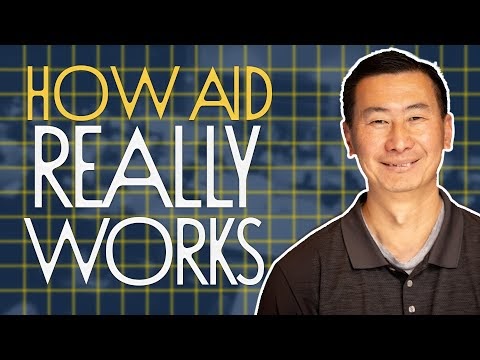
    (00:02:56) Variety of College Financial Assistance Options
    (
    00:05:18) Scholarships: Balancing Merit and Financial Need
    (
    00:10:00) Student Selection Strategies in College Admissions
    (
    00:21:40) Financial Aid Strategy at Competitive vs. Smaller Schools
    (
    00:26:29) Major-based Financial Aid Allocation in Colleges

    Source link

  • The Quick Convo All Writing Teams Should Have (opinion)

    The Quick Convo All Writing Teams Should Have (opinion)

    Scenario 1: You’re part of a cross-disciplinary group of faculty members working on the new general education requirement. By the end of the semester, your group has to produce a report for your institution’s administration. As you start to generate content, one member’s primary contributions focus on editing for style and mechanics, while the other members are focused on coming to an agreement on the content and recommendations.

    Scenario 2: When you’re at the stage of drafting content for a grant, one member of a writing team uses strikethrough to delete a large chunk of text, with no annotation or explanation for the decision. The writing stops as individual participants angrily back channel.

    Scenario 3: A team of colleagues decides to draft a vision statement for their unit on campus. They come to the process assuming that everyone has a shared idea about the vision and mission of their department. But when they each contribute a section to the draft, it becomes clear that they are not, in fact, on the same page about how they imagine the future of their unit’s work.

    In the best case scenarios, we choose people to write with. People whom we trust, who we know will pull their weight and might even be fun to work with. However, many situations are thrust upon us rather than carefully selected. We have to complete a report, write an important email, articulate a new policy, compose and submit a grant proposal, author a shared memo, etc., with a bunch of folks we would likely not have chosen on our own.

    Further, teams of employees tasked with writing are rarely selected because of their ability to write well with others, and many don’t have the language to talk through their preferred composing practices. Across professional writing and within higher education, the inability to work collaboratively on a writing product is the cause of endless strife and inefficiency. How can we learn how to collaborate with people we don’t choose to write with?

    Instead of just jumping into the writing task, we argue for a quick conversation about writing before any team authorship even starts. If time is limited, this conversation doesn’t necessarily need to be more than 15 minutes (though devoting 30 minutes might be more effective) depending on the size of the writing team, but it will save you time—and, likely, frustration—in the long run.

    Drawing from knowledge in our discipline—writing studies—we offer the following strategies for a guided conversation before starting any joint writing project. The quick convo should serve to surface assumptions about each member’s beliefs about writing, articulate the project’s goal and genre, align expectations, and plan the logistics.

    Shouldn’t We Just Use AI for This Kind of Writing?

    As generative AI tools increasingly become integrated into the writing process, or even supplant parts of it, why should people write at all? Especially, why should we write together when people can be so troublesome?

    Because writing is thinking. Certainly, the final writing product matters—a lot—but the reason getting to the product can be so hard is that writing requires critical thinking around project alignment. Asking AI to do the writing skips the hard planning, thinking and drafting work that will make the action/project/product that the writing addresses more successful.

    Further, we do more than just complete a product/document when we write (either alone or together)—we surface shared assumptions, we come together through conversation and we build relationships. A final written product that has a real audience and purpose can be a powerful way to build community, and not just in the sense that it might make writers feel good. An engaged community is important, not just for faculty and staff happiness, but for productivity, for effective project completion and for long-term institutional stability.

    Set the Relational Vibe

    To get the conversation started, talk to each other: Do real introductions in which participants talk about how they write and what works for them. Talk to yourself: Do a personal gut check, acknowledging any feelings/biases about group members, and commit to being aware of how these personal relationships/feelings might influence how you perceive and accept their contributions. Ideas about authorship, ownership and credit, including emotional investments in one’s own words, are all factors in how people approach writing with others.

    Articulate the Project Purpose and Genre

    Get on the same page about what the writing should do (purpose) and what form it should take (genre). Often the initial purpose of a writing project is that you’ve been assigned to a task—students may find it funny that so much faculty and staff writing at the university is essentially homework! Just like our students, we have to go beyond the bare minimum of meeting a requirement to find out why that writing product matters, what it responds to and what we want it to accomplish. To help the group come to agreement about form and writing conventions, find some effective examples of the type of project you’re trying to write and talk through what you like about each one.

    Align Your Approach

    Work to establish a sense of shared authorship—a “we” approach to the work. This is not easy, but it’s important to the success of the product and for the sake of your sanity. Confront style differences and try to come to agreement about not making changes to each other’s writing that don’t necessarily improve the content. There’s always that one person who wants to add “nevertheless” for every transition or write “next” instead of “then”—make peace with not being too picky. Or, agree to let AI come in at the end and talk about the proofreading recommendations from the nonperson writer.

    This raises another question: With people increasingly integrating ChatGPT and its ilk into their processes (and Word/Google documents offering AI-assisted authorship tools), how comfortable is each member of the writing team with integrating AI-generated text into a final product?

    Where will collaboration occur? In person, online? Synchronously or asynchronously? In a Google doc, on Zoom, in the office, in a coffee shop? Technologies and timing both influence process, and writers might have different ideas about how and when to write (ideas that might vary based on the tools that your team is going to use).

    When will collaboration occur? Set deadlines and agree to stick with them. Be transparent about expectations from and for each member.

    How will collaboration occur? In smaller groups/pairs, all together, or completely individually? How will issues be discussed and resolved?

    Finally, Some Recommendations on What Not to Do

    Don’t:

    • Just divvy up the jobs and call it a day. This will often result in a disconnected, confusing and lower-quality final product.
    • Take on everything because you’re the only one who can do it. This is almost never true and is a missed opportunity to build capacity among colleagues. Developing new skills is an investment.
    • Overextend yourself and then resent your colleagues. This is a surefire path to burnout.
    • Sit back and let other folks take over. Don’t be that person.

    Source link

  • AI, Irreality and the Liberal Educational Project (opinion)

    AI, Irreality and the Liberal Educational Project (opinion)

    I work at Marquette University. As a Roman Catholic, Jesuit university, we’re called to be an academic community that, as Pope John Paul II wrote, “scrutinize[s] reality with the methods proper to each academic discipline.” That’s a tall order, and I remain in the academy, for all its problems, because I find that job description to be the best one on offer, particularly as we have the honor of practicing this scrutinizing along with ever-renewing groups of students.

    This bedrock assumption of what a university is continues to give me hope for the liberal educational project despite the ongoing neoliberalization of higher education and some administrators’ and educators’ willingness to either look the other way regarding or uncritically celebrate the generative software (commonly referred to as “generative artificial intelligence”) explosion over the last two years.

    In the time since my last essay in Inside Higher Ed, and as Marquette’s director of academic integrity, I’ve had plenty of time to think about this and to observe praxis. In contrast to the earlier essay, which was more philosophical, let’s get more practical here about how access to generative software is impacting higher education and our students and what we might do differently.

    At the academic integrity office, we recently had a case in which a student “found an academic article” by prompting ChatGPT to find one for them. The chat bot obeyed, as mechanisms do, and generated a couple pages of text with a title. This was not from any actual example of academic writing but instead was a statistically probable string of text having no basis in the real world of knowledge and experience. The student made a short summary of that text and submitted it. They were, in the end, not found in violation of Marquette’s honor code, since what they submitted was not plagiarized. It was a complex situation to analyze and interpret, done by thoughtful people who care about the integrity of our academic community: The system works.

    In some ways, though, such activity is more concerning than plagiarism, for, at least when students plagiarize, they tend to know the ways they are contravening social and professional codes of conduct—the formalizations of our principles of working together honestly. In this case, the student didn’t see the difference between a peer-reviewed essay published by an academic journal and a string of probabilistically generated text in a chat bot’s dialogue box. To not see the difference between these two things—or to not care about that difference—is more disconcerting and concerning to me than straightforward breaches of an honor code, however harmful and sad such breaches are.

    I already hear folks saying: “That’s why we need AI literacy!” We do need to educate our students (and our colleagues) on what generative software is and is not. But that’s not enough. Because one also needs to want to understand and, as is central to the Ignatian Pedagogical Paradigm that we draw upon at Marquette, one must understand in context.

    Another case this spring term involved a student whom I had spent several months last fall teaching in a writing course that took “critical AI” as its subject matter. Yet this spring term the student still used a chat bot to “find a quote in a YouTube video” for an assignment and then commented briefly on that quote. The problem was that the quote used in the assignment does not appear in the selected video. It was a simulacrum of a quote; it was a string of probabilistically generated text, which is all generative software can produce. It did not accurately reflect reality, and the student did not cite the chat bot they’d copied and pasted from, so they were found in violation of the honor code.

    Another student last term in the Critical AI class prompted Microsoft Copilot to give them quotations from an essay, which it mechanically and probabilistically did. They proceeded to base their three-page argument on these quotations, none of which said anything like what the author in question actually said (not even the same topic); their argument was based in irreality. We cannot scrutinize reality together if we cannot see reality. And many of our students (and colleagues) are, at least at times, not seeing reality right now. They’re seeing probabilistic text as “good enough” as, or conflated with, reality.

    Let me point more precisely to the problem I’m trying to put my finger on. The student who had a chat bot “find” a quote from a video sent an email to me, which I take to be completely in earnest and much of which I appreciated. They ended the email by letting me know that they still think that “AI” is a really powerful and helpful tool, especially as it “continues to improve.” The cognitive dissonance between the situation and the student’s assertion took me aback.

    Again: the problem with the “We just need AI literacy” argument. People tend not to learn what they do not want to learn. If our students (and people generally) do not particularly want to do work, and they have been conditioned by the use of computing and their society’s habits to see computing as an intrinsic good, “AI” must be a powerful and helpful tool. It must be able to do all the things that all the rich and powerful people say it does. It must not need discipline or critical acumen to employ, because it will “supercharge” your productivity or give you “10x efficiency” (whatever that actually means). And if that’s the case, all these educators telling you not to offload your cognition must be behind the curve, or reactionaries. At the moment, we can teach at least some people all about “AI literacy” and it will not matter, because such knowledge refuses to jibe with the mythology concerning digital technology so pervasive in our society right now.

    If we still believe in the value of humanistic, liberal education, we cannot be quiet about these larger social systems and problems that shape our pupils, our selves and our institutions. We cannot be quiet about these limits of vision and questioning. Because not only do universities exist for the scrutinizing of reality with the various methods of the disciplines as noted at the outset of this essay, but liberal education also assumes a view of the human person that does not see education as instrumental but as formative.

    The long tradition of liberal education, for all its complicity in social stratification down the centuries, assumes that our highest calling is not to make money, to live in comfort, to be entertained. (All three are all right in their place, though we must be aware of how our moneymaking, comfort and entertainment derive from the exploitation of the most vulnerable humans and the other creatures with whom we share the earth, and how they impact our own spiritual health.)

    We are called to growth and wisdom, to caring for the common good of the societies in which we live—which at this juncture certainly involves caring for our common home, the Earth, and the other creatures living with us on it. As Antiqua et nova, the note released from the Vatican’s Dicastery for Culture and Education earlier this year (cited commendingly by secular ed-tech critics like Audrey Watters) reiterates, education plays its role in this by contributing “to the person’s holistic formation in its various aspects (intellectual, cultural, spiritual, etc.) … in keeping with the nature and dignity of the human person.”

    These objectives of education are not being served by students using generative software to satisfy their instructors’ prompts. And no amount of “literacy” is going to ameliorate the situation on its own. People have to want to change, or to see through the neoliberal, machine-obsessed myth, for literacy to matter.

    I do believe that the students I’ve referred to are generally striving for the good as they know how. On a practical level, I am confident they’ll go on to lead modestly successful lives as our society defines that term with regard to material well-being. I assume their motivation is not to cause harm or dupe their instructors; they’re taking part in “hustle” culture, “doing school” and possibly overwhelmed by all their commitments. Even if all this is indeed the case, liberal education calls us to more, and it’s the role of instructors and administrators to invite our students into that larger vision again and again.

    If we refuse to give up on humanistic, liberal education, then what do we do? The answer is becoming clearer by the day, with plenty of folks all over the internet weighing in, though it is one many of us do not really want to hear. Because at least one major part of the answer is that we need to make an education genuinely oriented toward our students. A human-scale education, not an industrial-scale education (let’s recall over and over that computers are industrial technology). The grand irony of the generative software moment for education in neoliberal, late-capitalist society is that it is revealing so many of the limits we’ve been putting on education in the first place.

    If we can’t “AI literacy” our educational problems away, we have to change our pedagogy. We have to change the ways we interact with our students inside the classroom and out: to cultivate personal relationships with them whenever possible, to model the intellectual life as something that is indeed lived out with the whole person in a many-partied dialogue stretching over millennia, decidedly not as the mere ability to move information around. This is not a time for dismay or defeat but an incitement to do the experimenting, questioning, joyful intellectual work many of us have likely wanted to do all along but have not had a reason to go off script for.

    This probably means getting creative. Part of getting creative in our day probably means de-computing (as Dan McQuillan at the University of London labels it). To de-compute is to ask ourselves—given our ambient maximalist computing habits of the last couple decades—what is of value in this situation? What is important here? And then: Does a computer add value to this that it is not detracting from in some other way? Computers may help educators collect assignments neatly and read them clearly, but if that convenience is outweighed by constantly having to wonder if a student has simply copied and pasted or patch-written text with generative software, is the value of the convenience worth the problems?

    Likewise, getting creative in our day probably means looking at the forms of our assessments. If the highly structured student essay makes it easier for instructors to assess because of its regularity and predictability, yet that very regularity and predictability make it a form that chat bots can produce fairly readily, well: 1) the value for assessing may not be worth the problems of teeing up chat bot–ifiable assignments and 2) maybe that wasn’t the best form for inviting genuinely insightful and exciting intellectual engagement with our disciplines’ materials in the first place.

    I’ve experimented with research journals rather than papers, with oral exams as structured conversations, with essays that focus intently on one detail of a text and do not need introductions and conclusions and that privilege the student’s own voice, and other in-person, handmade, leaving-the-classroom kinds of assessments over the last academic year. Not everything succeeded the way I wanted, but it was a lively, interactive year. A convivial year. A year in which mostly I did not have to worry about whether students were automating their educations.

    We have a chance as educators to rethink everything in light of what we want for our societies and for our students; let’s not miss it because it’s hard to redesign assignments and courses. (And it is hard.) Let’s experiment, for our own sakes and for our students’ sakes. Let’s experiment for the sakes of our institutions that, though they are often scoffed at in our popular discourse, I hope we believe in as vibrant communities in which we have the immense privilege of scrutinizing reality together.

    Jacob Riyeff is a teaching associate professor and director of academic integrity at Marquette University.

    Source link

  • The state of the UK higher education sector’s finances

    The state of the UK higher education sector’s finances

    • Jack Booth and Maike Halterbeck at London Economics take a closer look at the recently published HESA Finance data to investigate the financial state of UK higher education.
    • At 11am today, we will host a webinar to mark the launch of the Unite Students Applicant Index. You can register for a free place here.

    In recent years, financial pressures have mounted across the entirety of the UK higher education (HE) sector, and have left many institutions in an exceptionally vulnerable position. In England alone, 43% of institutions are expected to face a financial deficit for 2024-25, prompting the House of Commons Education Select Committee to announce an inquiry into university finances and insolvency plans. Wide-ranging cost-cutting measures and redundancies are taking place across the sector, and the first institution (to our knowledge) has recently received emergency (bailout) funding from its regulator.

    With the recent release of the full HESA Finance data for 2023-24, we now have an updated picture of the scale of the financial challenges facing higher education providers (HEPs). London Economics analysed HEPs’ financial data between 2018-19 and 2023-24 to better understand the current financial circumstances of the sector.
     
    While other recent analyses focused on England only or covered other types of financial variables, here, we include providers across all of the UK and focus on three core financial indicators. 

    What does the analysis cover?

    Our analysis focuses on four broad clusters of HEPs, following the approach originally developed by Boliver (2015), which categorises a total of 126 providers according to differences in their research activity, teaching quality, economic resources, and other characteristics. Cluster 1 includes just two institutions: the University of Oxford and the University of Cambridge. Cluster 2 is composed mainly of other Russell Group universities and the majority of other pre-1992 institutions (totalling 39 institutions). Cluster 3 includes the remaining pre-1992 universities and most post-1992 institutions (67 institutions), and Cluster 4 consists of around a quarter of post-1992 universities (totalling 18 institutions). The latest HESA Finance data were, unfortunately, not available for 8 of these clustered institutions, meaning that our analysis covers 118 institutions in total.

    We focus on three key financial indicators (KFIs):

    1. Net cash inflow from operating activities after finance costs (NCIF). This measure provides a key indication of an institution’s financial health in relation to its day-to-day operations. Unlike the more common ‘surplus’/‘deficit’ measure, NCIF excludes non-cash items as well as financing-related income or expenditure.
    2. Net current assets (NCA), that is, ‘real’ reserves. This measure captures the value of current assets that can be turned into cash relatively quickly (i.e. in the short term, within 12 months), minus short-term liabilities.
    3. Liquidity days. This is based on the sum of NCA and NCIF, to evaluate whether institutions can cover operational shortfalls using their short-term resources. We then estimate the number of liquidity days each institution holds, defined as the number of days of average cash expenditure (excluding depreciation) that can be covered by cash and equivalents. The Office for Students requires providers to maintain enough liquid funds to cover at least 30 days’ worth of expenditures (excluding depreciation).

    What are the key findings?

    The key findings from the analysis are as follows:

    • In terms of financial deficits (NCIF), 40% of HEPs included in the analysis (47) posted a negative NCIF in 2023-24.
    • The average surplus across the institutions analysed (in terms of NCIF as a percentage of income) declined from 6.1% in 2018-19 to just 0.5% in 2023-24.
    • In terms of financial assets/resilience (NCA), 55% of HEPs analysed (65) saw a reduction in their NCA (as a proportion of their income) in 2023-24 as compared to 2018-19.
    • The decline in NCA has been particularly large in recent years, with average NCA declining from 27.4% of income in 2021-22 to 20.0% in 2023-24.
    • In terms of liquidity days, 20% of HEPs (24) had less than 30 days of liquidity in 2023-24, including 17 providers that posted zero liquidity days.

    A challenging time for the sector

    The analysis shows that the financial position of UK higher education institutions is worsening, with all three indicators analysed (i.e. NCIF, NCA, and liquidity days) showing a decline in providers’ financial stability. Major challenges to the sector’s finances are set to continue, especially as the UK government is looking to further curb net migration through potential additional restrictions on international student visas. Therefore, the financial pressures on UK HE providers are expected to remain significant.

    Want to know more?

    Our more detailed analysis, including a number of charts and additional findings on each indicator by university ‘cluster’, can be found on our website.

    Source link

  • REF panels must reflect the diversity of the UK higher education sector

    REF panels must reflect the diversity of the UK higher education sector

    As the sector begins to prepare for REF 2029, with a greater emphasis on people, culture and environment and the breadth of forms of research and inclusive production, one critical issue demands renewed attention: the composition of the REF panels themselves. While much of the focus rightly centres on shaping fairer metrics and redefining engagement and impact, we should not overlook who is sitting at the table making the judgments.

    If the Research Excellence Framework is to command the trust of the full spectrum of UK higher education institutions, then its panels must reflect the diversity of that spectrum. That means ensuring meaningful representation from a wide range of universities, including Russell Group institutions, pre- and post-92s, specialist colleges, teaching-led universities, and those with strong regional or civic missions.

    Without diverse panel representation, there is a real risk that excellence will be defined too narrowly, inadvertently privileging certain types of research and institutional profiles over others.

    Broadening the lens

    Research excellence looks different in different contexts. A university with a strong regional engagement strategy might produce research that is deeply embedded in local communities, with impacts that are tangible but not easily measured by traditional academic metrics, but with clear international excellence. A specialist arts institution may demonstrate world-leading innovation through creative practice that doesn’t align neatly with standard research output categories.

    The RAND report looking at the impact of research through the lens of the REF 2021 impact cases rightly recognised the importance of “hyperlocality” – and we need to ensure that research and impact is equally recognised in the forthcoming REF exercise.

    UK higher education institutions are incredibly diverse, with different institutions having distinct missions, research priorities, and challenges. REF panels that lack representation from the full spectrum of institutions risks bias toward certain types of research outputs or methodologies, particularly those dominant in elite institutions.

    Dominance of one type of institution on the panels could lead to an underappreciation of applied, practice-based, or interdisciplinary research, which is often produced by newer or specialist institutions.

    Fairness, credibility, and innovation

    Fair assessment depends not only on the criteria applied but also on the perspectives and experiences of those applying them. Including assessors from a wide range of institutional backgrounds helps surface blind spots and reduce unconscious bias. It also allows the panels to better understand and account for contextual factors, such as variations in institutional resources, missions, and community roles, when evaluating submissions.

    Diverse panels also enhance the credibility of the process. The REF is not just a technical exercise; it shapes funding, reputations, and careers. A panel that visibly includes internationally recognised experts from across the breadth of the sector helps ensure that all institutions – and their staff – feel seen, heard, and fairly treated, and that a rigorous assessment of UK’s research prowess is made across the diversity of research outputs whatever their form.

    Academic prestige and structural advantages (such as funding, legacy reputations, or networks) can skew assessment outcomes if not checked. Diversity helps counter bias that may favour research norms associated with more research established institutions. Panel diversity encourages broader thinking about what constitutes excellence, helping to recognize high-quality work regardless of institutional setting.

    Plus there is the question of innovation. Fresh thinking often comes from the edges. A wider variety of voices on REF panels can challenge groupthink and encourage more inclusive and creative understandings of impact, quality, and engagement.

    A test of the sector’s commitment

    This isn’t about ticking boxes. True diversity means valuing the insights and expertise of panel members from all corners of the sector and ensuring they have the opportunity to shape outcomes, not just observe them. It also means recognising that institutional diversity intersects with other forms of diversity, including protected characteristics, professions and career stage, which must also be addressed.

    The REF is one of the most powerful instruments shaping UK research culture. Who gets to define excellence in the international context has a profound impact on what research is done, how it is valued, and who is supported to succeed. REF panels should reflect the diversity of UK HEIs to ensure fairness, credibility, and a comprehensive understanding of research excellence across all contexts.

    If REF 2029 is to live up to the sector’s ambitions for equity, inclusion, and innovation, then we must start with its panels. Without diverse panels, the REF risks perpetuating inequality and undervaluing the full range of scholarly contributions made across the sector, even as it evaluates universities on their own people, culture, and environment. The composition of those panels will be a litmus test for how seriously we take those commitments.

    Source link

  • N.C. Gov. Vetoes Bills Targeting ‘DEI,’ ‘Divisive Concepts’

    N.C. Gov. Vetoes Bills Targeting ‘DEI,’ ‘Divisive Concepts’

    North Carolina’s Democratic governor has vetoed two bills the Republican-led General Assembly passed targeting what lawmakers dubbed “diversity, equity and inclusion”; “discriminatory practices”; and “divisive concepts” in public higher education.

    Senate Bill 558 would have banned institutions from having offices “promoting discriminatory practices or divisive concepts” or focused on DEI. The bill defined “discriminatory practices” as “treating an individual differently [based on their protected federal law classification] solely to advantage or disadvantage that individual as compared to other individuals or groups.”

    SB 558’s list of restricted divisive concepts mirrored the lists that Republicans have inserted into laws in other states, including the idea that “a meritocracy is inherently racist or sexist” or that “the rule of law does not exist.” The legislation would have prohibited colleges and universities from endorsing these concepts.

    The bill would have also banned institutions from establishing processes “for reporting or investigating offensive or unwanted speech that is protected by the First Amendment, including satire or speech labeled as microaggression.”

    In his veto message Thursday, Gov. Josh Stein wrote, “Diversity is our strength. We should not whitewash history, police dorm room conversations, or ban books. Rather than fearing differing viewpoints and cracking down on free speech, we should ensure our students learn from diverse perspectives and form their own opinions.”

    Stein also vetoed House Bill 171, which would have broadly banned DEI from state government. It defined DEI in multiple ways, including the promotion of “differential treatment of or providing special benefits to individuals on the basis of race, sex, color, ethnicity, nationality, country of origin, or sexual orientation.”

    “House Bill 171 is riddled with vague definitions yet imposes extreme penalties for unknowable violations,” Stein wrote in his HB 171 veto message. NC Newsline reported that lawmakers might still override the vetoes.

    Source link

  • The ART of Professionalism (opinion)

    The ART of Professionalism (opinion)

    A career is much like a work of art: We select an area to study—a medium, of sorts—in which to pursue an interest or a desire. We start by obtaining foundational knowledge before creating something that contributes to the greater society. Some may benefit from what is produced; others may not. Some will appreciate the output; others will not gain much, if anything, from what is constructed. At the center of the result is the artist themselves. Others along the way lend their own expertise, time and insights toward the outcome. However, it is the unique skills, perspectives, knowledge, choices and behaviors of the artist that determine what is created.

    We are all artists in the making. We have a profession in which we have chosen to engage. As graduate students or postdoctoral scholars, we gain the foundations needed for our chosen discipline. During our time training in higher education, we focus on acquiring technical skills and techniques to contribute to sustaining and expanding our fields of study. We set upon the path to becoming experts through trial and error, discovery and disappointments, gains and losses.

    Like with a work of art, we may start from a place of uncertainty: What can appear to be confounding fragments of a greater idea can coalesce in ways that surprise and satisfy us. We pull together parts and pieces to make something whole or even construct something unique. Yet while we are engaged in this creative and intellectual process, we must also work within defined boundaries. Expectations and ethical standards guide our professional conduct. Understanding these nuances is essential to forming a professional identity.

    Each profession carries its own expectations for behavior, decision-making and accountability. Cambridge defines “professionalism” as “the qualities connected with trained and skilled people.” We can have strong technical skills and deep knowledge in our particular disciplines; however, these alone do not guarantee our level of professionalism when we are actually in the workforce interfacing with supervisors, colleagues, team members and clients.

    While having the foundational skills and understanding may guarantee some success within a career, it is actually the capacity for acquiring and applying what I’ve termed “human-centered competencies” that ensures a greater degree of career fulfillment. Human-centered competencies consist of behaviors that involve a deeper sense of self-awareness. Recognizing and managing our behaviors, and understanding how they may impact those interacting with us, helps us relate to others in ways that forge effective communication, efficacious decision-making, constructive conflict resolution and fruitful work endeavors.

    With this in mind, let’s explore the ART of professionalism through some simple reflective exercises. Think about the questions presented here as intended to encourage an honest reflection on the art we are creating within our own spheres of influence.

    Attitude

    Our attitude is an outward reflection of what we are thinking and how we are feeling. Our attitude toward an assignment, toward a co-worker, toward ourselves or toward life itself is exemplified through our behaviors. Are we respectful and kind to others? Do we smile at who we see in the mirror or constantly chastise ourselves for what we have done (or not done)? Do we tend to jump to negative conclusions regarding those with whom we interact? Do we shake hands, look people in the eye and smile? Or are we downcast, avoidant and possibly even surly? How do we appear? Are we dressed for the part—one in which we want to be respected and taken seriously—or do we look like we would rather be on the couch bingeing on Netflix and eating potato chips?

    Our attitude says a lot about ourselves, and sometimes we do not even have to open our mouths to reveal it. Our internal dialogue can have an impact on our external behaviors, so we need to be aware of our attitude. We can improve it, if needed. We can start by examining how we carry ourselves, as our posture and physical appearance convey nonverbal messages. How we show up is also important to consider. Are we prepared for meetings? Do we speak up with confidence? Do we actively listen to others and appreciate their contributions?

    Our attitude reflects our frame of mind, and we illustrate who we are through our attitude. We also should keep in mind that each of us represents more than ourselves; we reflect the values and credibility of our professional communities.

    Responsibility

    Within the work environment we all have duties, projects or assignments that we manage. Responsibility involves taking ownership of our decisions, our actions and our outcomes. Work involves interdependence; it is rare that we can achieve a goal all on our own. Even artists need people who help them develop their skills, manufacture their tools, market their work and provide venues to exhibit their talent. Within the workplace, we will need others and others will need us.

    Responsibility, therefore, is a crucial competency to have as a professional. Exhibiting responsibility involves both dependability and accountability. Being dependable is a choice, and this can involve time management, setting boundaries and fulfilling obligations; we show up on time and we follow through with what we say we are going to do. Accountability means that we acknowledge when things have not worked out as planned, we recognize our contributions to successes and we face the consequences of our decisions and actions, whether positive or negative. Instead of evaluating situations as win or lose, we can choose to look at outcomes as win or learn. Whether we experience a victory or suffer a defeat, we can always learn from the process. In essence, responsibility is about us doing our part so that we contribute, in a mindful way, to the success and well-being of our colleagues and co-workers.

    Trust

    Trust is by far the most important component of professionalism. Trust looks different in a professional atmosphere than it does in personal life. Trust involves being genuine with others. We want to be able to count on others and to believe that they are being honest with us. The same expectations for honesty should hold when it comes to our own behavior.

    Trust involves being reliable, striving to meet expectations, fulfilling obligations, avoiding gossip and feeling secure in the knowledge that harm will not be done or betrayal will not occur. As professionals, it is imperative that we are trustworthy, as this is a fundamental component of human interactions. Being competent at trust involves building goodwill, being cooperative, displaying integrity, adhering to our values, engaging in sincere interactions and forming strong alliances. Without trust, bonds are broken, relationships are destroyed and organizations fail. We need to examine our words and our actions to evaluate how trustworthy we may seem to others. Being empathetic, reliable and ethical will serve us well as we pursue our passion and contribute our talents to the well-being of those with whom we work, as well as those who benefit from what our teams and organizations produce.

    Conclusion: Building a Body of Work

    As professionals, we are not just building careers; we are creating something much more enduring: a body of work, a reputation, a legacy. The skills we acquire in our chosen disciplines are only part of the equation. Equally important are the attitudes we embody, the responsibilities we accept and the trust we build. It takes time, reflection and endurance to create a great work of art; the same is true for our careers. The process may be unpredictable, but the core elements—our values, our character and our professionalism—will determine how our work is received and remembered.

    So ask yourself: What kind of professional artist do you want to be? What are you creating through your everyday choices? How will your ART— attitude, responsibility and trust—shape your path forward?

    Rhonda Sutton is dean of professional development at North Carolina State University’s Graduate School. She oversees a team that provides programming focused on career readiness, communication skills and teaching for graduate students and postdoctoral scholars. She also facilitates professional development initiatives on leadership, mentoring and wellness. Rhonda is a member of the Graduate Career Consortium, an organization providing an international voice for graduate-level career and professional development leaders.

    Source link