Tag: Education

  • The state of the UK higher education sector’s finances

    The state of the UK higher education sector’s finances

    • Jack Booth and Maike Halterbeck at London Economics take a closer look at the recently published HESA Finance data to investigate the financial state of UK higher education.
    • At 11am today, we will host a webinar to mark the launch of the Unite Students Applicant Index. You can register for a free place here.

    In recent years, financial pressures have mounted across the entirety of the UK higher education (HE) sector, and have left many institutions in an exceptionally vulnerable position. In England alone, 43% of institutions are expected to face a financial deficit for 2024-25, prompting the House of Commons Education Select Committee to announce an inquiry into university finances and insolvency plans. Wide-ranging cost-cutting measures and redundancies are taking place across the sector, and the first institution (to our knowledge) has recently received emergency (bailout) funding from its regulator.

    With the recent release of the full HESA Finance data for 2023-24, we now have an updated picture of the scale of the financial challenges facing higher education providers (HEPs). London Economics analysed HEPs’ financial data between 2018-19 and 2023-24 to better understand the current financial circumstances of the sector.
     
    While other recent analyses focused on England only or covered other types of financial variables, here, we include providers across all of the UK and focus on three core financial indicators. 

    What does the analysis cover?

    Our analysis focuses on four broad clusters of HEPs, following the approach originally developed by Boliver (2015), which categorises a total of 126 providers according to differences in their research activity, teaching quality, economic resources, and other characteristics. Cluster 1 includes just two institutions: the University of Oxford and the University of Cambridge. Cluster 2 is composed mainly of other Russell Group universities and the majority of other pre-1992 institutions (totalling 39 institutions). Cluster 3 includes the remaining pre-1992 universities and most post-1992 institutions (67 institutions), and Cluster 4 consists of around a quarter of post-1992 universities (totalling 18 institutions). The latest HESA Finance data were, unfortunately, not available for 8 of these clustered institutions, meaning that our analysis covers 118 institutions in total.

    We focus on three key financial indicators (KFIs):

    1. Net cash inflow from operating activities after finance costs (NCIF). This measure provides a key indication of an institution’s financial health in relation to its day-to-day operations. Unlike the more common ‘surplus’/‘deficit’ measure, NCIF excludes non-cash items as well as financing-related income or expenditure.
    2. Net current assets (NCA), that is, ‘real’ reserves. This measure captures the value of current assets that can be turned into cash relatively quickly (i.e. in the short term, within 12 months), minus short-term liabilities.
    3. Liquidity days. This is based on the sum of NCA and NCIF, to evaluate whether institutions can cover operational shortfalls using their short-term resources. We then estimate the number of liquidity days each institution holds, defined as the number of days of average cash expenditure (excluding depreciation) that can be covered by cash and equivalents. The Office for Students requires providers to maintain enough liquid funds to cover at least 30 days’ worth of expenditures (excluding depreciation).

    What are the key findings?

    The key findings from the analysis are as follows:

    • In terms of financial deficits (NCIF), 40% of HEPs included in the analysis (47) posted a negative NCIF in 2023-24.
    • The average surplus across the institutions analysed (in terms of NCIF as a percentage of income) declined from 6.1% in 2018-19 to just 0.5% in 2023-24.
    • In terms of financial assets/resilience (NCA), 55% of HEPs analysed (65) saw a reduction in their NCA (as a proportion of their income) in 2023-24 as compared to 2018-19.
    • The decline in NCA has been particularly large in recent years, with average NCA declining from 27.4% of income in 2021-22 to 20.0% in 2023-24.
    • In terms of liquidity days, 20% of HEPs (24) had less than 30 days of liquidity in 2023-24, including 17 providers that posted zero liquidity days.

    A challenging time for the sector

    The analysis shows that the financial position of UK higher education institutions is worsening, with all three indicators analysed (i.e. NCIF, NCA, and liquidity days) showing a decline in providers’ financial stability. Major challenges to the sector’s finances are set to continue, especially as the UK government is looking to further curb net migration through potential additional restrictions on international student visas. Therefore, the financial pressures on UK HE providers are expected to remain significant.

    Want to know more?

    Our more detailed analysis, including a number of charts and additional findings on each indicator by university ‘cluster’, can be found on our website.

    Source link

  • REF panels must reflect the diversity of the UK higher education sector

    REF panels must reflect the diversity of the UK higher education sector

    As the sector begins to prepare for REF 2029, with a greater emphasis on people, culture and environment and the breadth of forms of research and inclusive production, one critical issue demands renewed attention: the composition of the REF panels themselves. While much of the focus rightly centres on shaping fairer metrics and redefining engagement and impact, we should not overlook who is sitting at the table making the judgments.

    If the Research Excellence Framework is to command the trust of the full spectrum of UK higher education institutions, then its panels must reflect the diversity of that spectrum. That means ensuring meaningful representation from a wide range of universities, including Russell Group institutions, pre- and post-92s, specialist colleges, teaching-led universities, and those with strong regional or civic missions.

    Without diverse panel representation, there is a real risk that excellence will be defined too narrowly, inadvertently privileging certain types of research and institutional profiles over others.

    Broadening the lens

    Research excellence looks different in different contexts. A university with a strong regional engagement strategy might produce research that is deeply embedded in local communities, with impacts that are tangible but not easily measured by traditional academic metrics, but with clear international excellence. A specialist arts institution may demonstrate world-leading innovation through creative practice that doesn’t align neatly with standard research output categories.

    The RAND report looking at the impact of research through the lens of the REF 2021 impact cases rightly recognised the importance of “hyperlocality” – and we need to ensure that research and impact is equally recognised in the forthcoming REF exercise.

    UK higher education institutions are incredibly diverse, with different institutions having distinct missions, research priorities, and challenges. REF panels that lack representation from the full spectrum of institutions risks bias toward certain types of research outputs or methodologies, particularly those dominant in elite institutions.

    Dominance of one type of institution on the panels could lead to an underappreciation of applied, practice-based, or interdisciplinary research, which is often produced by newer or specialist institutions.

    Fairness, credibility, and innovation

    Fair assessment depends not only on the criteria applied but also on the perspectives and experiences of those applying them. Including assessors from a wide range of institutional backgrounds helps surface blind spots and reduce unconscious bias. It also allows the panels to better understand and account for contextual factors, such as variations in institutional resources, missions, and community roles, when evaluating submissions.

    Diverse panels also enhance the credibility of the process. The REF is not just a technical exercise; it shapes funding, reputations, and careers. A panel that visibly includes internationally recognised experts from across the breadth of the sector helps ensure that all institutions – and their staff – feel seen, heard, and fairly treated, and that a rigorous assessment of UK’s research prowess is made across the diversity of research outputs whatever their form.

    Academic prestige and structural advantages (such as funding, legacy reputations, or networks) can skew assessment outcomes if not checked. Diversity helps counter bias that may favour research norms associated with more research established institutions. Panel diversity encourages broader thinking about what constitutes excellence, helping to recognize high-quality work regardless of institutional setting.

    Plus there is the question of innovation. Fresh thinking often comes from the edges. A wider variety of voices on REF panels can challenge groupthink and encourage more inclusive and creative understandings of impact, quality, and engagement.

    A test of the sector’s commitment

    This isn’t about ticking boxes. True diversity means valuing the insights and expertise of panel members from all corners of the sector and ensuring they have the opportunity to shape outcomes, not just observe them. It also means recognising that institutional diversity intersects with other forms of diversity, including protected characteristics, professions and career stage, which must also be addressed.

    The REF is one of the most powerful instruments shaping UK research culture. Who gets to define excellence in the international context has a profound impact on what research is done, how it is valued, and who is supported to succeed. REF panels should reflect the diversity of UK HEIs to ensure fairness, credibility, and a comprehensive understanding of research excellence across all contexts.

    If REF 2029 is to live up to the sector’s ambitions for equity, inclusion, and innovation, then we must start with its panels. Without diverse panels, the REF risks perpetuating inequality and undervaluing the full range of scholarly contributions made across the sector, even as it evaluates universities on their own people, culture, and environment. The composition of those panels will be a litmus test for how seriously we take those commitments.

    Source link

  • N.C. Gov. Vetoes Bills Targeting ‘DEI,’ ‘Divisive Concepts’

    N.C. Gov. Vetoes Bills Targeting ‘DEI,’ ‘Divisive Concepts’

    North Carolina’s Democratic governor has vetoed two bills the Republican-led General Assembly passed targeting what lawmakers dubbed “diversity, equity and inclusion”; “discriminatory practices”; and “divisive concepts” in public higher education.

    Senate Bill 558 would have banned institutions from having offices “promoting discriminatory practices or divisive concepts” or focused on DEI. The bill defined “discriminatory practices” as “treating an individual differently [based on their protected federal law classification] solely to advantage or disadvantage that individual as compared to other individuals or groups.”

    SB 558’s list of restricted divisive concepts mirrored the lists that Republicans have inserted into laws in other states, including the idea that “a meritocracy is inherently racist or sexist” or that “the rule of law does not exist.” The legislation would have prohibited colleges and universities from endorsing these concepts.

    The bill would have also banned institutions from establishing processes “for reporting or investigating offensive or unwanted speech that is protected by the First Amendment, including satire or speech labeled as microaggression.”

    In his veto message Thursday, Gov. Josh Stein wrote, “Diversity is our strength. We should not whitewash history, police dorm room conversations, or ban books. Rather than fearing differing viewpoints and cracking down on free speech, we should ensure our students learn from diverse perspectives and form their own opinions.”

    Stein also vetoed House Bill 171, which would have broadly banned DEI from state government. It defined DEI in multiple ways, including the promotion of “differential treatment of or providing special benefits to individuals on the basis of race, sex, color, ethnicity, nationality, country of origin, or sexual orientation.”

    “House Bill 171 is riddled with vague definitions yet imposes extreme penalties for unknowable violations,” Stein wrote in his HB 171 veto message. NC Newsline reported that lawmakers might still override the vetoes.

    Source link

  • The ART of Professionalism (opinion)

    The ART of Professionalism (opinion)

    A career is much like a work of art: We select an area to study—a medium, of sorts—in which to pursue an interest or a desire. We start by obtaining foundational knowledge before creating something that contributes to the greater society. Some may benefit from what is produced; others may not. Some will appreciate the output; others will not gain much, if anything, from what is constructed. At the center of the result is the artist themselves. Others along the way lend their own expertise, time and insights toward the outcome. However, it is the unique skills, perspectives, knowledge, choices and behaviors of the artist that determine what is created.

    We are all artists in the making. We have a profession in which we have chosen to engage. As graduate students or postdoctoral scholars, we gain the foundations needed for our chosen discipline. During our time training in higher education, we focus on acquiring technical skills and techniques to contribute to sustaining and expanding our fields of study. We set upon the path to becoming experts through trial and error, discovery and disappointments, gains and losses.

    Like with a work of art, we may start from a place of uncertainty: What can appear to be confounding fragments of a greater idea can coalesce in ways that surprise and satisfy us. We pull together parts and pieces to make something whole or even construct something unique. Yet while we are engaged in this creative and intellectual process, we must also work within defined boundaries. Expectations and ethical standards guide our professional conduct. Understanding these nuances is essential to forming a professional identity.

    Each profession carries its own expectations for behavior, decision-making and accountability. Cambridge defines “professionalism” as “the qualities connected with trained and skilled people.” We can have strong technical skills and deep knowledge in our particular disciplines; however, these alone do not guarantee our level of professionalism when we are actually in the workforce interfacing with supervisors, colleagues, team members and clients.

    While having the foundational skills and understanding may guarantee some success within a career, it is actually the capacity for acquiring and applying what I’ve termed “human-centered competencies” that ensures a greater degree of career fulfillment. Human-centered competencies consist of behaviors that involve a deeper sense of self-awareness. Recognizing and managing our behaviors, and understanding how they may impact those interacting with us, helps us relate to others in ways that forge effective communication, efficacious decision-making, constructive conflict resolution and fruitful work endeavors.

    With this in mind, let’s explore the ART of professionalism through some simple reflective exercises. Think about the questions presented here as intended to encourage an honest reflection on the art we are creating within our own spheres of influence.

    Attitude

    Our attitude is an outward reflection of what we are thinking and how we are feeling. Our attitude toward an assignment, toward a co-worker, toward ourselves or toward life itself is exemplified through our behaviors. Are we respectful and kind to others? Do we smile at who we see in the mirror or constantly chastise ourselves for what we have done (or not done)? Do we tend to jump to negative conclusions regarding those with whom we interact? Do we shake hands, look people in the eye and smile? Or are we downcast, avoidant and possibly even surly? How do we appear? Are we dressed for the part—one in which we want to be respected and taken seriously—or do we look like we would rather be on the couch bingeing on Netflix and eating potato chips?

    Our attitude says a lot about ourselves, and sometimes we do not even have to open our mouths to reveal it. Our internal dialogue can have an impact on our external behaviors, so we need to be aware of our attitude. We can improve it, if needed. We can start by examining how we carry ourselves, as our posture and physical appearance convey nonverbal messages. How we show up is also important to consider. Are we prepared for meetings? Do we speak up with confidence? Do we actively listen to others and appreciate their contributions?

    Our attitude reflects our frame of mind, and we illustrate who we are through our attitude. We also should keep in mind that each of us represents more than ourselves; we reflect the values and credibility of our professional communities.

    Responsibility

    Within the work environment we all have duties, projects or assignments that we manage. Responsibility involves taking ownership of our decisions, our actions and our outcomes. Work involves interdependence; it is rare that we can achieve a goal all on our own. Even artists need people who help them develop their skills, manufacture their tools, market their work and provide venues to exhibit their talent. Within the workplace, we will need others and others will need us.

    Responsibility, therefore, is a crucial competency to have as a professional. Exhibiting responsibility involves both dependability and accountability. Being dependable is a choice, and this can involve time management, setting boundaries and fulfilling obligations; we show up on time and we follow through with what we say we are going to do. Accountability means that we acknowledge when things have not worked out as planned, we recognize our contributions to successes and we face the consequences of our decisions and actions, whether positive or negative. Instead of evaluating situations as win or lose, we can choose to look at outcomes as win or learn. Whether we experience a victory or suffer a defeat, we can always learn from the process. In essence, responsibility is about us doing our part so that we contribute, in a mindful way, to the success and well-being of our colleagues and co-workers.

    Trust

    Trust is by far the most important component of professionalism. Trust looks different in a professional atmosphere than it does in personal life. Trust involves being genuine with others. We want to be able to count on others and to believe that they are being honest with us. The same expectations for honesty should hold when it comes to our own behavior.

    Trust involves being reliable, striving to meet expectations, fulfilling obligations, avoiding gossip and feeling secure in the knowledge that harm will not be done or betrayal will not occur. As professionals, it is imperative that we are trustworthy, as this is a fundamental component of human interactions. Being competent at trust involves building goodwill, being cooperative, displaying integrity, adhering to our values, engaging in sincere interactions and forming strong alliances. Without trust, bonds are broken, relationships are destroyed and organizations fail. We need to examine our words and our actions to evaluate how trustworthy we may seem to others. Being empathetic, reliable and ethical will serve us well as we pursue our passion and contribute our talents to the well-being of those with whom we work, as well as those who benefit from what our teams and organizations produce.

    Conclusion: Building a Body of Work

    As professionals, we are not just building careers; we are creating something much more enduring: a body of work, a reputation, a legacy. The skills we acquire in our chosen disciplines are only part of the equation. Equally important are the attitudes we embody, the responsibilities we accept and the trust we build. It takes time, reflection and endurance to create a great work of art; the same is true for our careers. The process may be unpredictable, but the core elements—our values, our character and our professionalism—will determine how our work is received and remembered.

    So ask yourself: What kind of professional artist do you want to be? What are you creating through your everyday choices? How will your ART— attitude, responsibility and trust—shape your path forward?

    Rhonda Sutton is dean of professional development at North Carolina State University’s Graduate School. She oversees a team that provides programming focused on career readiness, communication skills and teaching for graduate students and postdoctoral scholars. She also facilitates professional development initiatives on leadership, mentoring and wellness. Rhonda is a member of the Graduate Career Consortium, an organization providing an international voice for graduate-level career and professional development leaders.

    Source link

  • On the Sensibility of Cognitive Outsourcing (opinion)

    On the Sensibility of Cognitive Outsourcing (opinion)

    I am deeply worried about my vacuuming skills. I’ve always enjoyed vacuuming, especially with the vacuum cleaner I use. It has a clear dustbin, and there’s something cathartic about running it over the carpet in the upstairs hallway and seeing all the dust and debris it collects. I’m worried, however, because I keep outsourcing my downstairs vacuuming to the robot vacuum cleaner my wife and I bought a while back. With three kids and three dogs in the house, our family room sees a lot of foot traffic, and I save a lot of time by letting the robot clean up. What am I losing by relying on my robot vacuum to keep my house clean?

    Not much, of course, and I’m not actually worried about losing my vacuuming skills. Vacuuming the family room isn’t a task that means much to me, and I’m happy to let the robot handle it. Doing so frees up my time for other tasks, preferably bird-watching out the kitchen window, but more often doing the dishes, a chore for which I don’t have a robot to help me. It’s entirely reasonable for me to offload a task I don’t care much about to the machines when the machines are right there waiting to do the work for me.

    That was my response to a new high-profile study from a MIT Media Lab team led by Nataliya Kosmyna. Their preprint, “Your Brain on ChatGPT: Accumulation of Cognitive Debt When Using an AI Assistant for Essay Writing Task,” details their experiment. The team enlisted 54 adult participants to write short essays using SAT prompts over multiple sessions. A third of the participants were given access to ChatGPT to help with their essay writing, a third had access to any website they could reach through a Google search engine but were prohibited from using ChatGPT or other large language models and a third had no outside aids (the “brain-only” group). The researchers not only scored the quality of the participants’ essays, but they also used electroencephalography to record participants’ brain activity during these writing tasks.

    The MIT team found that “brain connectivity systematically scaled down with the amount of external support.” While the brain-only group “exhibited the strongest, widest‑ranging [neural] networks,” AI assistance in the experiment “elicited the weakest overall coupling.” Moreover, the ChatGPT users were increasingly less engaged in the writing process over the multiple sessions, often just copying and pasting from the AI chat bot by the end of the experiment. They also had a harder time quoting anything from the essay they had just submitted compared to the brain-only group.

    This study has inspired some dramatic headlines: “ChatGPT May Be Eroding Critical Thinking Skills” and “Study: Using AI Could Cost You Brainpower” and “Your Reliance on ChatGPT Might Be Really Bad for Your Brain.” Savvy news readers will key into the qualifiers in those headlines (“may,” “could,” “might”) instead of the scarier words, and the authors of the study have made an effort to prevent journalists and commentators from overplaying their results. From the study’s FAQ: “Is it safe to say that LLMs are, in essence, making us ‘dumber’? No!” As is usually the case in the AI-and-learning discourse, we need to slow our roll and look beyond the hyperbole to see what this new study does and doesn’t actually say.

    I should state now for the record that I am not a neuroscientist. I can’t weigh in with any authority on the EEG analysis in this study, although others with expertise in this area have done so and have expressed concerns about the authors’ interpretation of EEG data. I do, however, know a thing or two about teaching and learning in higher education, having spent my career at university centers for teaching and learning helping faculty and other instructors across the disciplines explore and adopt evidence-based teaching practices. And it’s the teaching-and-learning context in the MIT study that caught my eye.

    Consider the task that participants in this study, all students or staff at Boston-area universities, were given. They were presented with three SAT essay prompts and asked to select one. They were then given 20 minutes to write an essay in response to their chosen prompt, while wearing an EEG helmet of some kind. Each subject participated in a session like this three times over the course of a few months. Should we be surprised that the participants who had access to ChatGPT increasingly outsourced their writing to the AI chat bot? And that, in doing so, they were less and less engaged in the writing process?

    I think the takeaway from this study is that if you give adults an entirely inauthentic task and access to ChatGPT, they’ll let the robot do the work and save their energy for something else. It’s a reasonable and perhaps cognitively efficient thing to do. Just like I let my robot vacuum cleaner tidy up my family room while I do the dishes or look for an eastern wood pewee in my backyard.

    Sure, writing an SAT essay is a cognitively complex task, and it is perhaps an important skill for a certain cohort of high school students. But what this study shows is what generative AI has been showing higher ed since ChatGPT launched in 2022: When we ask students to do things that are neither interesting nor relevant to their personal or professional lives, they look for shortcuts.

    John Warner, an Inside Higher Ed contributor and author of More Than Words: How to Think About Writing in the Age of AI (Basic Books), wrote about this notion in his very first post about ChatGPT in December 2022. He noted concerns that ChatGPT would lead to the end of high school English, and then asked, “What does it say about what we ask students to do in school that we assume they will do whatever they can to avoid it?”

    What’s surprising to me about the new MIT study is that we are more than two years into the ChatGPT era and we’re still trying to assess the impact of generative AI on learning by studying how people respond to boring essay assignments. Why not explore how students use AI during more authentic learning tasks? Like law students drafting contracts and client memos or composition students designing multimodal projects or communications students attempting impossible persuasive tasks? We know that more authentic assignments motivate deeper engagement and learning, so why not turn students loose on those assignments and then see what impact AI use might have?

    There’s another, more subtle issue with the discourse around generative AI in learning that we can see in this study. In the “Limitations and Future Work” section of the preprint, the authors write, “We did not divide our essay writing task into subtasks like idea generation, writing, and so on.” Writing an essay is a more complicated cognitive process than vacuuming my family room, but critiques of the use of AI in writing are often focused on outsourcing the entire writing process to a chat bot. That seems to be what the participants did in this study, and it is perhaps a natural use of AI when given an uninteresting task.

    However, when a task is interesting and relevant, we’re not likely to hand it off entirely to ChatGPT. Savvy AI users might get a little AI help with parts of the task, like generating examples or imagining different audiences or tightening our prose. AI can’t do all the things that a trained human editor can, but, as writing instructor (and human editor) Heidi Nobles has argued, AI can be a useful substitute when a human editor isn’t readily available. It’s a stretch to say that my robot vacuum cleaner and I collaborate to keep the house tidy, but it’s reasonable to think that someone invested in a complex activity like writing might use generative AI as what Ethan Mollick calls a “co-intelligence.”

    If we’re going to better understand generative AI’s impact on learning, something that will be critical for higher education to do to keep its teaching mission relevant, we have to look at the best uses of AI and the best kinds of learning activities. That research is happening, thankfully, but we shouldn’t expect simple answers. After all, learning is more complicated than vacuuming.

    Derek Bruff is associate director of the Center for Teaching Excellence at the University of Virginia.

    Source link

  • To make real progress on widening participation in higher education, we need a new mission

    To make real progress on widening participation in higher education, we need a new mission

    The promise of higher education as a pathway to opportunity has never been more important, or more precarious.

    While overall university participation has reached record levels, this headline figure masks a troubling reality: where you’re born in England increasingly determines whether you’ll ever set foot on a university campus. And even once students do get their foot in the door, they might not have the support system in place – financially as well as academically – to succeed and thrive.

    It is in this context that the UPP Foundation has today published the concluding paper in its widening participation inquiry. Mission Critical: six recommendations for the widening participation agenda is our attempt to fill in the gaps that the government left in its opportunity mission around widening participation, and to provide targets and mechanisms by which it can achieve success in this area.

    Doing “getting in” right

    For years, the biggest single aim of widening participation work has been “getting in” – ensuring that young people from disadvantaged backgrounds are supported to attend university, most often by undertaking a bachelor’s degree as a residential student. The aim of growing participation has come under political scrutiny in recent years and is no longer an accepted mission across the political spectrum.

    But as our inquiry’s earlier papers highlight, there remains significant gaps in participation. Although more young people are going to university than ever before, there are stark disparities in the rates at which young people from different parts of the country attend university. If we believe, as I do, that talent is not simply concentrated in London and the South East, then by implication if opportunity is spread out more evenly, participation in higher education needs to grow.

    That’s why our first recommendation is a “triple lock” widening participation target. This includes a gap of no more than ten percentage points between the highest and lowest regional HE participation rates; plus a 50 per cent floor for progression to HE at 18-19 across all regions; and a target for 70 per cent of the whole English population to have studied at level 4 or above by the age of 25, as advocated by Universities UK. Meeting these targets will ensure that “getting in” really is for everyone.

    Onwards and upwards

    But this is not enough in isolation. The people we spoke to in Doncaster and Nottingham made it clear that “getting on” and “getting out” are equally important parts of the widening participation struggle – with the cost of learning a major barrier to full participation in university life.

    With that in mind, we’re calling for the restoration of maintenance loans to 2021 real-terms levels by the end of the decade, as well as additional maintenance grants for those eligible for free school meals in the last six years.

    We also want universities that are currently spending millions of pounds on bursaries and hardship funds to put that money towards outreach in the most challenging cold spots, as well as ensuring that the wider student experiences that undergrads cherish are available to all. That’s why it makes sense for a proportion of the proceeds from the proposed international student fee levy, if introduced, to be ring fenced to support an expanded access and participation plan regime, prioritising disadvantaged students from cold spot backgrounds.

    Revitalisation

    Finally, widening participation needs to address the short-term mindset that grips young people both before and during their time at university.

    Young people are more mindful of their finances than ever before, with many opting out of university in favour of a job in places where graduate careers are scarce and those who do choose to attend keeping one eye on their present and future earnings even before they’ve graduated.

    If we are to revitalise the widening participation agenda, we have to bring employability to the fore, both by reconfiguring the Office for Students’ B3 metric on positive student outcomes and by bringing employers into the design and outputs of university study. There are already fantastic examples of this working in practice across the sector, such as at London South Bank’s energy advice centre and Bristol University’s career- and community-oriented dental school. It’s time for the sector to pick up these ideas and run with them.

    The young person in Doncaster with the same grades and aspirations as their counterpart in Surrey faces not just different odds of getting to university, but different expectations about what’s possible. When we fail to address these disparities, we’re not just perpetuating inequality, we’re actively weakening the economic foundations that the whole country depends on.

    What our new report offers is a chance to refocus the widening participation agenda around a series of ambitious but achievable targets. Getting in, getting on and getting out are all crucial parts of the higher education cycle, especially for those who otherwise wouldn’t attend. If the government want to take their widening participation priorities seriously, all three aspects need to take their place in the sun.

    Source link

  • Trump Education Department Delays Return of Laid-Off Workers Over Logistics – The 74

    Trump Education Department Delays Return of Laid-Off Workers Over Logistics – The 74


    Get stories like this delivered straight to your inbox. Sign up for The 74 Newsletter

    Parking permits. Desk space. Access cards.

    Ordered to bring back roughly 1,300 laid-off workers, the U.S. Department of Education instead has spent weeks ostensibly working on the logistics. Meanwhile, the Trump administration wants the U.S. Supreme Court to decide they don’t have to restore those jobs after all.

    The legal argument over the job status of Education Department workers is testing the extent to which President Donald Trump and Education Secretary Linda McMahon can reshape the federal bureaucracy without congressional approval.

    The employees, meanwhile, remain in limbo, getting paid for jobs they aren’t allowed to perform.

    An analysis done by the union representing Education Department employees estimates the government is spending about $7 million a month for workers not to work. That figure does not include supervisors who are not part of the American Federation of Government Employee Local 252.

    “It is terribly inefficient,” said Brittany Coleman, chief steward for AFGE Local 252 and an attorney in the Office for Civil Rights. “The American people are not getting what they need because we can’t do our jobs.”

    McMahon announced the layoffs in March, a week after she was confirmed by the Senate, and described them as a first step toward dismantling the Education Department. A few days later, Trump signed an executive order directing McMahon to do everything in her legal authority to shut down the department.

    The Somerville and Easthampton school districts in Massachusetts, along with the American Federation of Teachers, other education groups, and 21 Democratic attorneys general sued McMahon over the cuts. They argued the layoffs were so extensive that the Education Department would not be able to perform its duties under the law.

    The layoffs hit the Office for Civil Rights, Federal Student Aid, and the Institute of Education Sciences particularly hard. These agencies are responsible for federally mandated work within the Education Department. By law, only Congress can get rid of the Education Department.

    U.S. District Court Judge Myong Joun agreed, issuing a sweeping preliminary injunction in May that ordered the Education Department to bring laid off employees back to work and blocked any further effort to dismantle or substantively restructure the department.

    The Trump administration sought a stay of that order, and the case is on the emergency docket of the Supreme Court, where a decision could come any day.

    In the administration’s request to the Supreme Court, Solicitor General John Sauer argued that the harms the various plaintiffs had described were largely hypothetical, that they had not shown the department wasn’t fulfilling its duties, and that they didn’t have standing to sue because layoffs primarily affect department employees, not states, school districts, and education organizations.

    Sauer further argued that the injunction violates the separation of powers, putting the judicial branch in charge of employment decisions that are the purview of the executive branch.

    “The injunction rests on the untenable assumption that every terminated employee is necessary to perform the Department of Education’s statutory functions,” Sauer wrote in a court filing. “That injunction effectively appoints the district court to a Cabinet role and bars the Executive Branch from terminating anyone.”

    The Supreme Court, with a conservative 6-3 majority, has been friendlier to the administration’s arguments than lower court judges. Already the court has allowed cuts to teacher training grants to go through while a lawsuit works its way through the courts. And it has halted the reinstatement of fired probationary workers.

    The Education Department did not immediately respond to a request for comment.

    Last week, Joun issued a separate order telling the Education Department that it must reinstate employees in the Office for Civil Rights. The Victims Rights Law Center and other groups had described thousands of cases left in limbo, with children suffering severe bullying or unable to safely return to school.

    Meanwhile, the Education Department continues to file weekly updates with Joun about the complexities of reinstating the laid-off employees. In these court filings, Chief of Staff Rachel Oglesby said an “ad hoc committee of senior leadership” is meeting weekly to figure out where employees might park and where they should report to work.

    Since the layoffs, the department has closed regional offices, consolidated offices in three Washington, D.C. buildings into one, reduced its contracts for parking space, and discontinued an interoffice shuttle.

    In the most recent filing, Oglesby said the department is working on a “reintegration plan.”

    Coleman said she finds these updates “laughable.”

    “If you are really willing to do what the court is telling you to do, then your working group would have figured out a way to get us our laptops,” she said.

    This story was originally published by Chalkbeat. Chalkbeat is a nonprofit news site covering educational change in public schools. Sign up for their newsletters at ckbe.at/newsletters.


    Get stories like these delivered straight to your inbox. Sign up for The 74 Newsletter

    Source link

  • Higher Education Inquirer : Fiction: The Pines Still Whisper

    Higher Education Inquirer : Fiction: The Pines Still Whisper

    Cass McBride pulled into the parking lot of Atlantic Cape Community College just as the morning fog was lifting. The campus was quieter than she remembered—fewer cars, fewer conversations, fewer reasons to linger. The culinary arts building stood at the edge, windows clouded with dust, the café shuttered and dark.

    Javi Sandoval sat beside her, scrolling through an email on his cracked phone screen. The college had just announced what everyone already knew: Atlantic Cape’s culinary program would be consolidated with Rowan College at Burlington County by the fall. The words were clean and administrative—“efficiency,” “realignment,” “cost savings”—but everyone understood the message. This place was being downsized, absorbed, and eventually erased.

    “They’re moving all the classes to Mt. Holly,” Javi said. “That’s over an hour away. No shuttle, no support. Just go if you can. Or don’t.”

    Cass nodded, her hands resting on a worn-out canvas bag filled with cookbooks and a half-used chef’s coat. “They say it’s about opportunity. But it feels like they’re just trimming away everything that made this place ours.”

    Inside the student center, the old café was locked, its chalkboard menu still faintly showing specials from months ago—creamy risotto, grilled seasonal vegetables, apple tart. Meals once made by students, for staff and faculty, as part of their hands-on learning.

    They walked around to the back hallway near the faculty offices, hoping to find someone who could give them real answers. That’s where they found Professor Reilly, sitting on a bench with a cardboard box beside him—books, a stained apron, and a union button that read: EDUCATION IS NOT A BUSINESS.

    Reilly had taught part-time in the culinary program for over a decade—early morning sections, night classes, summer workshops. He was known for lecturing about labor history in the middle of baking demonstrations, quoting Eugene V. Debs while folding dough.

    “They gave me fifteen minutes,” he said when Cass asked what had happened. “No severance. Just a letter. Said my ‘contract wasn’t renewed due to program restructuring.’ They didn’t even spell my name right.”

    Javi sat down next to him. “I thought you were protected. Weren’t you in the union?”

    Reilly chuckled. “We tried. We organized. But it’s hard when most of us are part-time and disposable. Admin smiles during bargaining, then turns around and guts your job through ‘curricular updates.’ They always find a way.”

    Cass asked him if he’d stay in the area.

    “I’ll stay,” he said. “Because this is where the students are. Because someone needs to remind them they’re not crazy for wanting more than just job training and debt. They deserve an education that feeds the soul, not just the economy.”

    That night, Cass and Javi drove out past Pleasantville, where empty storefronts now stood beside a few remaining restaurants, barbershops, and bodegas. They passed through Margate and Ventnor, where beach homes glowed in early evening light, and the golf courses were still lush and quiet. In Somers Point, they saw the “Help Wanted” signs outside the waterfront restaurants—jobs with no benefits and long hours, perfect for students who no longer had classes to attend.

    The casinos in Atlantic City still blinked and buzzed, but the crowds were thinner, and most of the profits came from online betting now—clicks from phones, not chips on tables.

    They camped that evening just off Route 542, in a small clearing where the Pines bent gently in the wind. The stars came out slowly.

    “I miss the kitchen,” Javi said. “The way Reilly used to talk about food—like it was a kind of justice.”

    Cass pulled out her copy of The Grapes of Wrath, the one Reilly had recommended. She turned to a page he had dog-eared for her. “‘And the little screaming fact that sounds through all history: repression works only to strengthen and knit the repressed.’”

    Javi looked up at the trees. “I keep thinking about people like Bernie Sanders and AOC. The way they talk about socialism, unions, public schools—for them, it’s not just politics. It’s survival. Dignity. Like what Reilly was trying to teach.”

    Cass smiled, the firelight flickering on her face. “Yeah. It makes you think maybe this isn’t the end. Maybe it’s the start of something different.”

    The wind moved through the Pines, steady and low, like an old voice telling stories to those who still cared to listen.

    And for now, that was enough.

    Source link

  • Higher Education Inquirer : Labor Notes

    Higher Education Inquirer : Labor Notes

    IN THIS ISSUE:

    • Philadelphia Municipal Workers Strike Before July 4 Celebrations
    • LISTEN: Labor Notes Podcast—How to Win a Strong Contract
    • Social Justice Artists: Apply for an Anne Feeney Hellraiser Grant
    • Reactions to the GOP Budget Legislation

    UPCOMING EVENTS

    • Workshop: Winning a Strong Contract Parts I & II: July 7 & 14
    • Who Has the Power? A Mapping Tool to Build our Movement: July 16
    • Webinar: Building Power Through Coordinated Bargaining and Contract Alignment: July 21
    • Stewards’ Workshop: Build a Steward Network: July 23
    • Secrets of a Successful Organizer: Sept. 8, 15, 22
    • North Carolina Troublemakers School: Sept. 20
    • Milwaukee Troublemakers School: Oct. 4

    by Paul Prescod

    Nine thousand blue-collar workers who make Philadelphia run went on strike July 1.

    After sacrificing through the pandemic and years of bruising inflation, they say they’re on strike so they can afford to live in the city they serve.

    Already, uncollected garbage is piling up as the workers, members of AFSCME District Council 33, defend their strike lines.

    SHOW FULL ARTICLE

    A graphic with a white and blue background image of people demonstrating outside what appears to be the steps and pillars of a courthouse. They are holding up large white signs on wooden posts. The Labor Notes slingshot logo is on the top left hand corner of the image, and the cutout photos of our cohosts Natascha Elena Uhlmann and Danielle Smith are on either side of the image. Between them is the text, "How to win a strong contract," the title of this podcast episode.

    by Labor Notes Staff

    What’s the secret of winning a strong contract? Hint: You won’t find it at the negotiations table!

    In our “Winning a Strong Contract” workshop series, we talk about how we can build power away from the table to win our demands in bargaining.  

    Labor Notes Organizer Lisa Xu joins pod co-hosts Danielle Smith and Natascha Elena Ulhmann for an overview of the workshop, including concepts like the campaign mountain and campaign power spiral.

    SHOW EPISODE

    You can also listen to The Labor Notes Podcast on SpotifyApple Podcasts and on our YouTube channel. Please rate and review our podcast wherever you listen!

    “Winning a Strong Contract Parts I & II” will be running the next two Mondays (July 7 and July 14th), and you can sign up at labornotes.org/events.

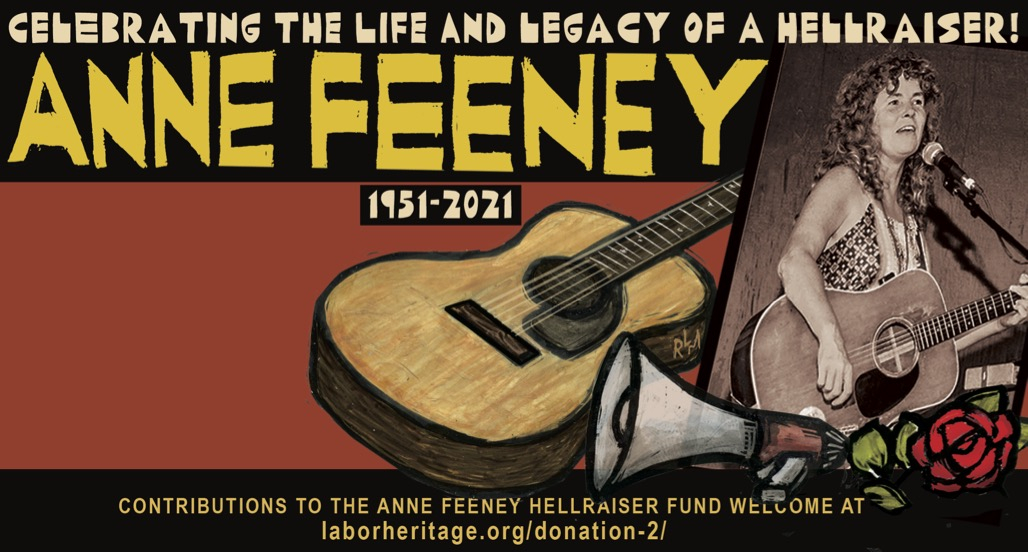
    Graphic shows woman with guitar and says Anne Feeney, 1951-2021.

    by Natascha Elena Uhlmann

    Friends and family of legendary folk musician and “hellraiser” Anne Feeney have come together to announce a new round of grants for artists “on the frontlines of the fight against fascism.”

    The Anne Feeney Hellraiser Memorial Fund will provide three grants of up to $1,000 for emerging artists of any discipline who create art in support of social movements for justice.

    LEARN MORE AND APPLY

    Economic Policy Institute president Heidi Shierholz denounces passage of GOP budget bill: 

    The Republican budget will gut Medicaid, slash food aid for families, and shutter rural hospitals—just to give tax breaks that will go overwhelmingly to the wealthy. It is a staggering upward redistribution of income.

    The bill also turbocharges an authoritarian-style immigration regime—funding internment camps, mass surveillance, and waves of deportations that will kill millions of jobs.

    SHOW FULL EPI STATEMENT

    North America’s Building Trades Unions (NABTU) President Sean McGarvey issued the following statement on the Senate Republican Proposed Budget Bill: 

    If enacted, this stands to be the biggest job-killing bill in the history of this country. Simply put, it is the equivalent of terminating more than 1,000 Keystone XL pipeline projects.

    In some cases, it worsens the already harmful trajectory of the House-passed language, threatening an estimated 1.75 million construction jobs and over 3 billion work hours, which translates to $148 billion in lost annual wages and benefits.

    SHOW FULL NABTU STATEMENT

    Visit labornotes.org/events for updates. Nobody will be turned away from a Labor Notes event, virtual or in-person, for lack of funds—if the registration fee is a barrier, email us.

    We will cover the basics of building a Contract Action Team (CAT), putting together an escalating campaign (potentially culminating in a strike), and dynamics between the bargaining committee, CAT, and the membership.

    When: Mondays, July 7 & 14
    Time: 7 p.m. – 8:30 p.m. ET / 4 p.m. – 5:30 p.m. PT
    Where: This is an online workshop and will be held via Zoom.

    Registration fee
    $15 – Regular Registration

    REGISTER HERE

    Prerequisites for this workshop: We strongly encourage workshop participants to also first attend our upcoming “Secrets of a Successful Organizer” workshop series in June. 

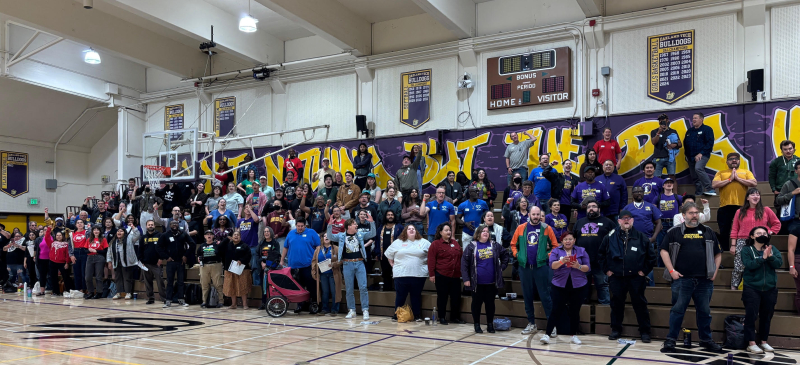
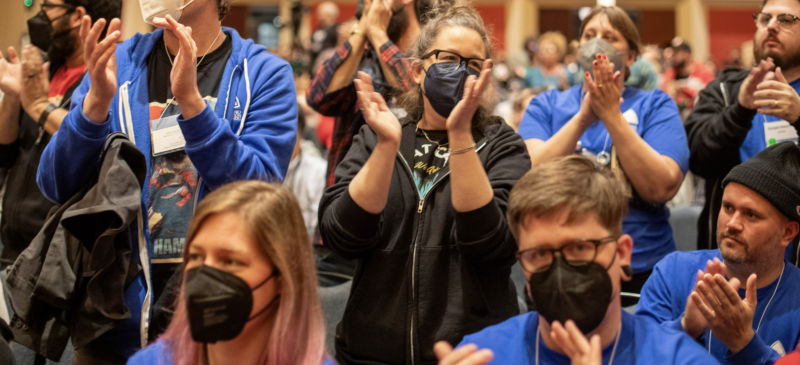
    A large gathering of workers in purple, black, blue and other dark colored shirts. They're standing on the bleachers at a gymnasium.

    This workshop will teach skills to analyze power in the present moment to strategically build the workers movement we need. We’ll be joined by labor educator Stephanie Luce.

    This is an advanced workshop for those organizers who are already part of a union or other worker organizations.

    When: Wednesday, July 16
    Time: 7:30 p.m. to 9:00 p.m. Eastern (4:30 p.m. to 6:00 p.m. Pacific)
    Where: This is an online workshop and will be held via Zoom.

    Registration fee
    $10 – Regular Registration

    REGISTER HERE

    Join us for a discussion about how unions are coordinating bargaining and even aligning their contracts to maximize leverage in negotiations.

    We’ll also discuss takeaways for workers seeking to align contracts leading up to the UAW’s call for unified action on May Day 2028.

    When: Monday July 21
    Time: 7 p.m. to 8:30 pm ET
    Registration: $10

    This panel will feature:
    – Francisco Ortiz, the president of United Teachers Richmond in California

    – Jane Fox, a unit chair in UAW Local 2325, the Association of Legal Aid Attorneys

    – Chris Spurlock, a steward in Teamsters Local 135 at Zenith Logistics, a third-party operator for Kroger

    REGISTER HERE

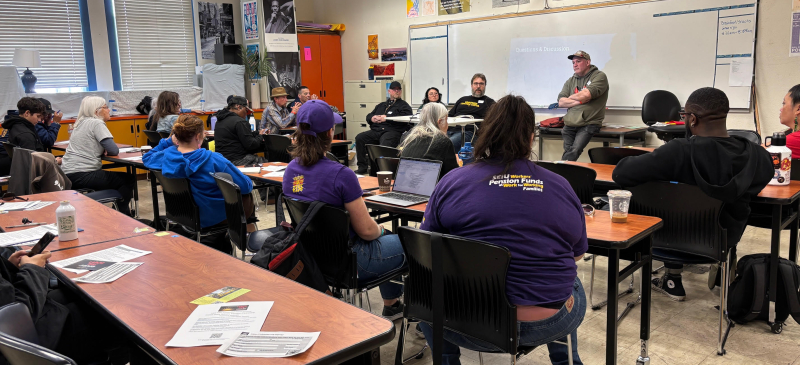
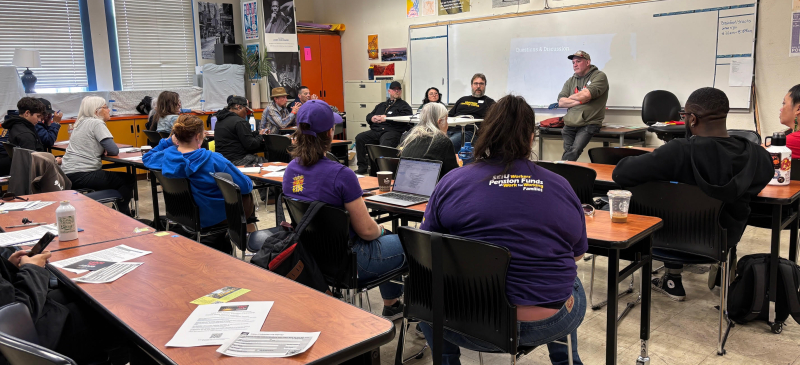
    Workers gathered in a classroom.

    Stewards are the backbone of the union! Learn how to build a strong stewards structure that helps workers use their power in the workplace to effectively fight the boss.

    When: Wednesday, July 23
    Time: 7:30 p.m. to 9:00 p.m. Eastern (4:30 p.m. to 6:00 p.m. Pacific)
    Where: This is an online workshop and will be held via Zoom.

    Registration fee
    $10 – Regular registration

    REGISTER HERE

    Secrets of a Successful Organizer is Labor Notes’ core organizing training, in three sessions full of lively participatory exercises. We welcome first-timers and repeat attendees looking to sharpen their skills.

    These workshops are based on our widely acclaimed book Secrets of a Successful Organizer. These trainings will be held via Zoom.

    When: Mondays, September 8, 15 and 22
    Time: 7:30 p.m. to 9:30 p.m. Eastern / 4:30 p.m. to 6:30 p.m. Pacific
    Cost: $15 for the whole series. Includes access to all three sessions.

    REGISTER HERE

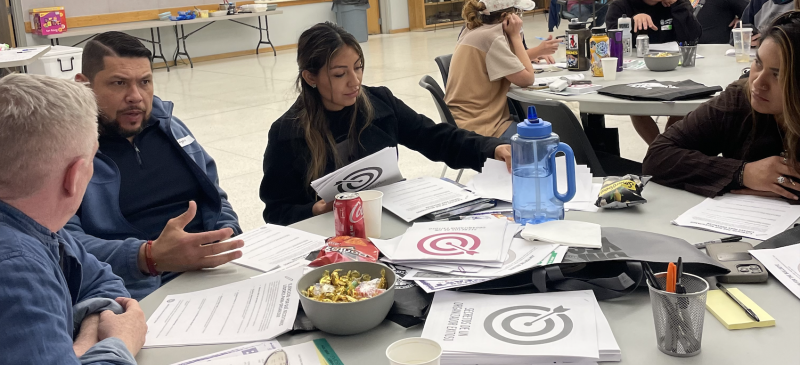
    Workers sit at a table in a lunch discussion. There are "Secrets of a Successful Organizer" handouts with the bulleye logo on the cover, interspersed between a bowl of food, drinks and snacks.

    Join labor activists from around North Carolina—and the whole region—to strategize, share skills, and learn how to organize to win.

    Whether you’re new to unions or are an experienced union activist, there’s something there for you. We encourage local unions to send a group of members.

    Date: September 20
    Time: 10 am – 5 pm
    Location: Jordan High School, 6806 Garrett Rd., Durham, NC

    Registration fee
    $35 – Regular registration
    $15 – Low-income registration 

    REGISTER HERE
     

    Bringing together union members, labor activists, and local officers, a Labor Notes Troublemakers School is a space for building solidarity, and sharing successes, strategy, and inspiration.

    It’s a real shot in the arm for newbies and seasoned activists alike.

    When: 9:30 a.m. – 4 p.m. on Saturday, October 4, 2025
    Where: Steamfitters Local 601
    3300 S 103rd Street
    Milwaukee, WI 53227

    Registration fee
    $30 – Regular registration
    $15 – Low-income registration 

    REGISTER HERE

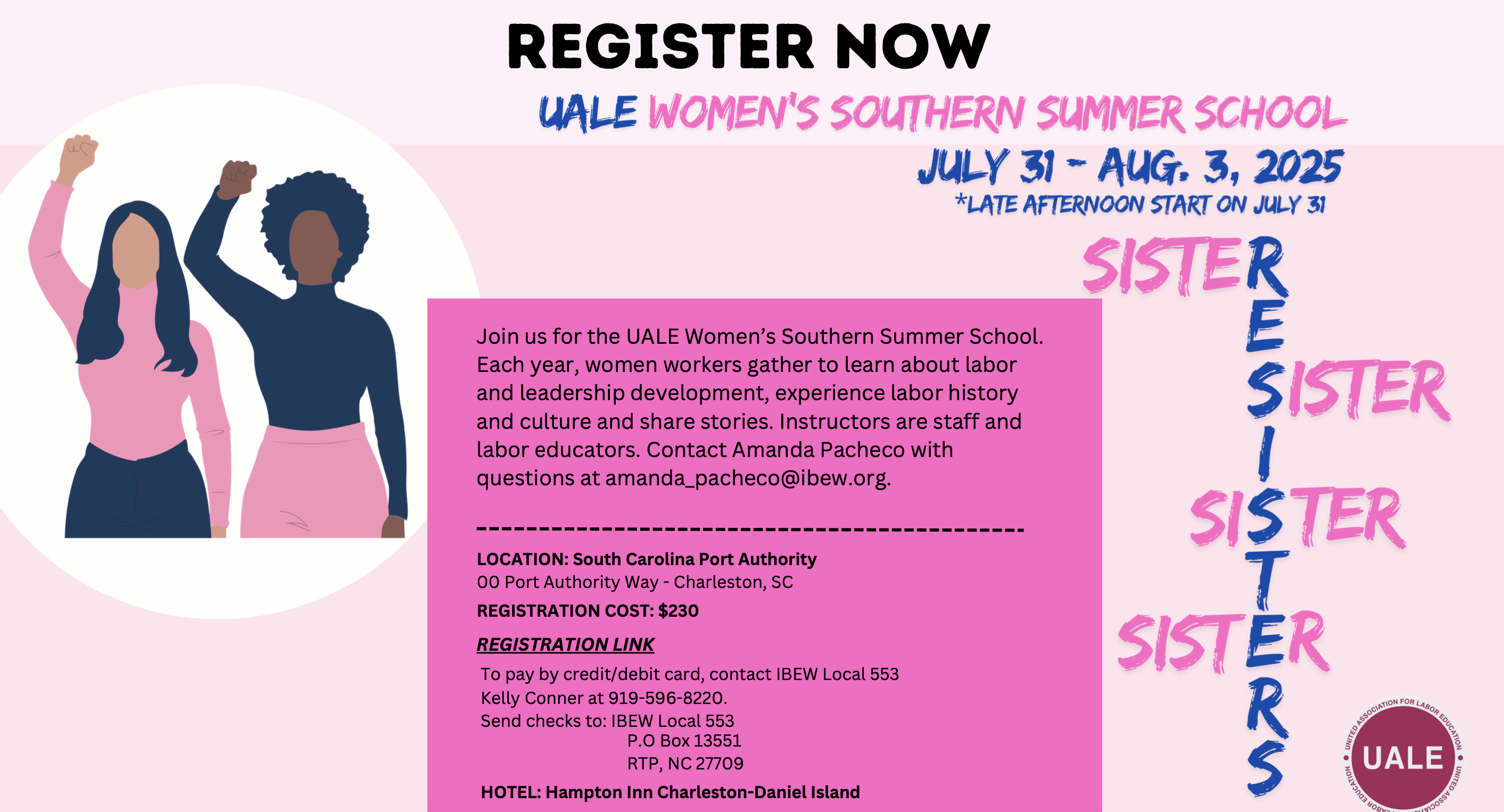
    At the Southern Summer School, women workers come together to learn about labor and leadership development, experience labor history and culture, and share stories.

    Contact Amanda Pacheco with questions at [email protected].

    When: Thursday, July 31 to Sunday, Aug. 3
    Where: Port Authority
    200 Port Authority Way, Charleston, SC
    Registration Price: $230

    REGISTER HERE

    A massive gathering of workers with their fists up and chanting energetically.
    Write for Labor Notes. When you discover a good tactic, share the news! Thousands of readers in other workplaces can put the information to use. Email [email protected].
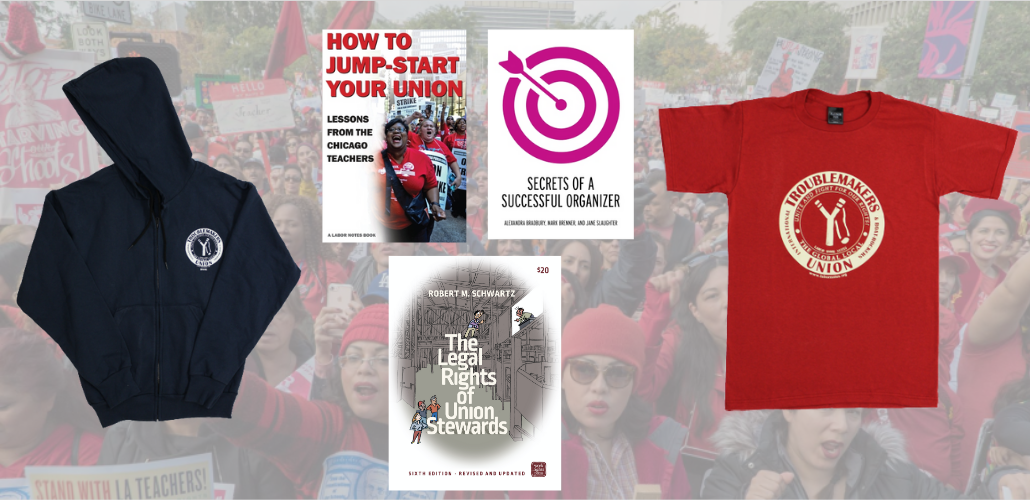
    A composite image of labor notes merch including a black hoodie and red T-shirt with the Labor Notes slingshot logo, and the covers of three Labor Notes books, namely, "How to Jump-Start Your Union," "Secrets of a Successful Organizer," and "The Legal Rights of Union Stewards."
    Visit the Labor Notes Store for books, knit caps, hoodies, T-shirts and more! Check it out at labornotes.org/store.

    Source link

  • Higher Education Inquirer : Caring for the Planet: Walk More, Buy Less

    Higher Education Inquirer : Caring for the Planet: Walk More, Buy Less

    In a world of climate crisis, student debt, and endless consumption, there’s a quiet revolution available to young people: walk more, buy less. It sounds simple—because it is—but the impact can be profound.

    Most college students and recent grads don’t need to be reminded about environmental collapse. You’ve grown up amid wildfires, extreme weather, and warnings about rising seas. But while corporations and billionaires pump out pollution and plastic, you’re often told that the burden to fix things falls on your shoulders. You recycle. You switch off lights. You carry a tote bag. Still, it doesn’t feel like enough.

    That’s because systemic change is slow and hard. But two actions—walking and not shopping—have the power to disrupt entire systems of waste and exploitation.


    Walking Is a Radical Act

    In car-dominated societies like the U.S., walking is often dismissed as inconvenient or inefficient. But for those who can safely walk, it is an act of environmental resistance. Cars consume fossil fuels, require destructive mining for materials, and spew emissions into the air. Even electric vehicles rely on rare earth metals, large batteries, and energy grids that still burn coal and gas.

    Every mile you walk instead of drive avoids carbon pollution. Every pair of shoes worn out instead of tires is a win. Walking also builds local awareness. You notice what’s happening on your streets—who’s struggling, who’s thriving, which spaces are neglected, and where nature is still hanging on. You become part of your community rather than just passing through it.

    Walking saves money, improves health, and takes power away from oil companies and car-dependent infrastructure. That’s not just healthy—it’s revolutionary.


    Buying Less: Anti-Consumerism as Climate Action

    You’ve probably heard the phrase “vote with your wallet.” But what if not spending is the more powerful vote?

    Our entire economy is built around constant consumption. Fast fashion, tech upgrades, cheap furniture, endless online shopping—this isn’t just bad for your bank account. It’s bad for the planet. Every product you buy took raw materials, labor (often exploited), and energy to produce, ship, and store. The less we consume, the less destruction we support.

    Here’s the thing: corporations want you to feel like you’re missing out if you don’t buy the newest thing. Social media and marketing are built to trigger that FOMO. But refusing to participate—living simply, creatively, and consciously—is one of the boldest stands you can take.

    You don’t have to live like a monk. But delaying gratification, fixing what you already own, swapping clothes with friends, using the library, and just sitting with your discomfort instead of numbing it with shopping—these are environmental acts. They’re also acts of freedom.


    Why This Matters for Students and Grads

    As a young person, you’re probably juggling rent, school loans, gig jobs, and anxiety about the future. You may feel powerless. But walking and cutting back on shopping are low-cost, high-impact moves. They don’t require wealth. They don’t require perfection. They’re daily choices that build awareness and build community.

    By walking and refusing overconsumption, you model an alternative future—one not built on endless growth, but on balance, care, and intentional living.

    These small acts won’t fix everything. But they will help you live in closer alignment with your values. And they send a clear message: We’re not buying the lies anymore.


    Final Thought

    Caring for the environment isn’t about being perfect. It’s about shifting culture. It’s about resisting a system that treats the Earth—and our lives—as disposable.

    So walk when you can. Buy less than you think you need. Look around. Notice what matters. And know that in these small acts, you’re part of something bigger.

    Your steps count. Your refusal counts. Your care counts.


    Higher Education Inquirer is committed to radical truth-telling and student advocacy in an era of climate chaos and corporate capture.

    Source link