Tag: Education

  • McMahon Says She Wants to Shift Away From Higher Ed

    McMahon Says She Wants to Shift Away From Higher Ed

    Education Secretary Linda McMahon told a conservative news outlet she wants to focus less on higher ed this year. The comment comes after the Trump administration’s yearlong use of multiple federal departments to pressure universities and their employees and students to conform to the White House’s desires.

    McMahon discussed her 2026 priorities in an interview with Breitbart before Christmas. As the outlet put it, “McMahon said the new year is a chance to shift a little bit away from higher education and focus on elementary and secondary.” (Education Department spokespeople didn’t respond Monday to Inside Higher Ed’s requests for further information on what she meant.)

    On social media, McMahon posted, “In 2026 we will empower parents, strengthen families, and end Washington’s grip on education by returning it to the states.” She also shared a video touting what she sees as the administration’s many wins. Those included cutting deals with several universities to restore funding the administration froze, changes to the federal student aid application and steps toward dismantling the Education Department.

    She told Breitbart her top three priorities will be literacy, noting poor scores on a national K–12 test; school choice, which usually refers to providing public money for parents to send their children to K–12 charter or private schools or to homeschool them; and “returning education to the states.”

    Regarding that last priority, McMahon told the outlet, “That’s what we’re really going to be working on, and that falls in line with the president’s directive to eventually totally move education to the states and to make sure that the bureaucracy of the Department of Education doesn’t exist in Washington anymore.”

    It remains unclear what “returning education to the states” would look like, even if Congress agrees to sign off on the Trump administration’s push to close the Education Department. Other laws Congress has passed over the decades would still continue to require a significant federal role in education.

    McMahon also touted what Breitbart called her “victories,” with the outlet writing that “one of her favorite accomplishments is the department’s Title IX work protecting women’s sports.” It wrote that McMahon “specifically pointed to an agreement reached with the University of Pennsylvania ordering awards to be taken” from transgender former swimmer Lia Thomas “and given to the [cisgender] female athletes who really deserved them.”

    In April, the department’s Office for Civil Rights found that Penn violated Title IX by allowing a trans woman to compete on a women’s sports team—presumably referring to Thomas, who last competed on the swim team in 2022, in accord with NCAA policies at that time.

    Source link

  • College Costs, Accreditation Likely Top Focus for Congress

    College Costs, Accreditation Likely Top Focus for Congress

    Lowering college costs, boosting accountability and reforming accreditation will likely be at the top of congressional Republicans’ to-do list for 2026. But as public approval ratings for President Trump continue to decline and midterm elections loom, higher education policy experts across the political spectrum say congressional conservatives could be running out of time.

    The push for more affordable higher education has been gaining momentum for years, and while it was a common refrain at the committee level in 2025, complex and sweeping debates over tax dollars soaked up much of lawmakers’ attention.

    First, the Republicans passed their signature piece of legislation, the One Big Beautiful Bill Act, which cut taxes for wealthy individuals, increased them for elite universities and overhauled the student loan system. Then, they turned their attention to disagreements on the federal budget—an impasse that led to the record 43-day government shutdown.

    But in the few cases where members of the GOP did get to home in on college cost issues, whether via legislation or hearings, an underlying theme emerged—holding colleges accountable for their students’ return on investment.

    Higher education experts have no doubt that concern will continue in 2026, but Congress won’t have the time or the oxygen needed to nail down real changes unless they figure out how to fund the government, which runs out of money again Jan. 31.

    “The Republican majority is very conscious that it may be on the clock, and this would argue for trying to move rapidly and get things done,” said Rick Hess, a senior fellow and director of education policy studies at the American Enterprise Institute, a right-leaning think tank. “But with the narrow and fractious House majority, the way the budget is going to chew up time going into January and the pressure on the Senate to get judges confirmed, it’s just going to be a challenge for them to find much time to move further higher ed–related legislation.”

    Legislative Actions

    Republicans spent much of 2025 using their control of Congress and the White House to pass what many industry leaders have described as the largest overhaul to higher education policy in more than a decade—the One Big Beautiful Bill Act. And while policy experts were initially skeptical that this multi-issue package could pass given the complex, restrictive nature of a legislative process called reconciliation, the GOP found a way.

    The final bill, signed into law July 4, served as a major win for the GOP, expanding federal aid for low-income students to include nontraditional short-term training programs, limiting loans for graduate students, consolidating the number of repayment plans and increasing taxes on wealthy colleges, among other provisions.

    Conservative policy experts like Hess praised the overhaul as “a much-needed and positive set of changes.”

    “There’s certainly more that can be done, but I think it moved us in a substantially better direction than we’ve been,” he added.

    But aside from OBBBA, little legislation concerning colleges and universities advanced. Only one bill tracked by Inside Higher Ed, the Laken Riley Act, reached the president’s desk. That law gave state attorneys general increased power over visas that could affect some international students and scholars. Others, including the Protection of Women and Girls in Sports Act, a bill that forbids trans women from participating in women’s sports, and the DETERRENT Act, a bill designed to restrict foreign academic partnerships, made it out of the House in a matter of weeks but then got stuck in the Senate.

    The story of 2025 in higher ed is a big, dramatic one, but it’s almost entirely one of executive branch activity.”

    —Rick Hess, AEI

    So when asked what congressional accomplishments stood out from 2025, progressive policy experts told Inside Higher Ed they didn’t see much. The things that did happen, they added, hurt students and institutions more than they helped.

    “‘Accomplishments’ is not really the word I would use considering the challenges that higher education faced this year,” said Jared Bass, senior vice president of education at the Center for American Progress. “I don’t think that Congress actually met the moment for affordability or defending and preserving higher education.”

    Instead, he said, legislators placed the burden of cost on the backs of students.

    “The Republican argument is by cutting access to these loans they’ll actually drive down costs. But we’ll have to wait and see if that happens,” he explained. “But I would say it didn’t actually make college more affordable. It just made resources less available.”

    Hearings Highlight Priorities

    Congress did, however, hold a number of higher ed–related hearings to dive into their priorities, which included improving the transparency of financial aid offers, establishing stronger records of the skills students gain and elevating ideological concerns like allegedly illegal use of diversity, equity and inclusion practices and liberal biases in the Truman Scholarship program.

    Although the House Committee on Education and Workforce hosted a greater number of higher ed hearings, some of the more notable panels came from the Senate Health, Education, Labor and Pensions Committee.

    “They actually wanted to put the ‘E’ back in HELP and focus on education issues,” said Emmanual Guillory, senior director of government relations at the American Council on Education, a leading higher ed lobbying group. “That wasn’t really the case under prior leadership. So that was good.”

    Chairman Bill Cassidy, a Republican from Louisiana, right, and ranking member Sen. Bernie Sanders, Independent of Vermont, lead the Senate Health, Education, Labor and Pensions Committee.

    Tom Williams/CQ–Roll Call Inc./Getty Images

    Much of the shift in interest, Guillory added, was likely tied to new leadership. This was the first year that Sen. Bill Cassidy, a Louisiana Republican, held the gavel. In the last Congress, Cassidy had served as ranking member.

    The House Committee on Education and Workforce also had new leadership, as Rep. Virginia Foxx of North Carolina handed the baton to Rep. Tim Walberg from Michigan. But it was the Senate’s tactics that led to more meaningful legislative progress in ACE’s view.

    “Mr. Walberg may have pushed a slightly more aggressive agenda. The House definitely had more hearings in the higher ed space and tackled more hard-punching issues, but in the Senate they took a different approach,” Guillory said. “When it came to those difficult issues and conversations, the Senate chose to discuss those a bit more quietly and really work on solutions with stakeholder groups and ask, ‘How can we be influential with actual legislation?’”

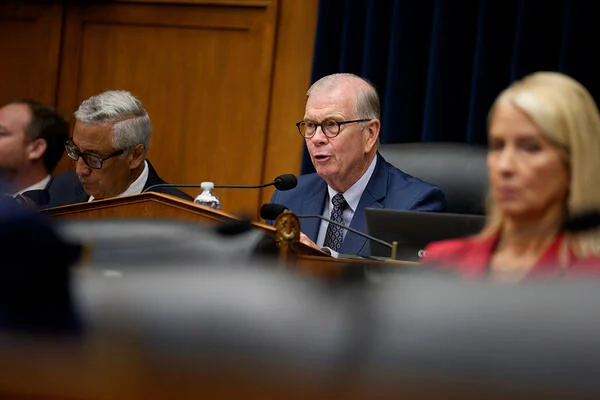
    Tim Walberg is in focus at the center of the frame, sitting next to Rep. Bobby Scott of Virginia, the ranking member. Walberg is a white man with thinning gray hair and glasses, and Scott is an older Black man with white hair and square-framed glasses.

    Chairman Tim Walberg took over the House Education and Workforce Committee in 2025.

    Andrew Harnik/Getty Images

    When asked for their reflections on the year, Cassidy and Walberg pointed to OBBBA, which they touted as a historic reform to drive down college costs and limit students from taking on insurmountable debt. But while Walberg then looked back to the ongoing antisemitism discussions and concerns about “hostile learning environments,” Cassidy touted his legislation aimed at helping students better understand the cost of college.

    “College is one of the largest financial investments many Americans make, but there is little information to ensure students make the right decision,” he said. “That is why I introduced the College Transparency Act to empower families with better information so they can decide which schools and programs of study are best suited to fit their unique needs and desired outcomes.”

    Democrats Fight Back

    Meanwhile, Democrats in both chambers said they were forced to spend much of their time and attention maintaining the Department of Education, an agency they say is needed to do much of the work to fulfill Republicans’ priorities, be it addressing antisemitism and other civil rights issues or driving down college costs.

    From his early days on the campaign trail in 2024, Trump has promised to dismantle the department, and starting in March of 2025, he began doing so—all without congressional approval.

    First, the president laid off nearly half of the agency’s staff. Then, just a week later, he signed an executive order directing Education Secretary Linda McMahon to close down the department “to the maximum extent appropriate and permitted by law.”

    Later, he tried to slash federal spending, redistribute grant dollars and use the government shutdown to lay off even more employees. Most recently, Trump approved a series of six interagency agreements that reallocate many of ED’s responsibilities to other agencies.

    Through it all, the Democrats repeatedly decried his “attack” on higher ed. They used statements, town halls and demonstrations outside the department to draw attention to decisions they said would be “detrimental” to “students, teachers and educators.”

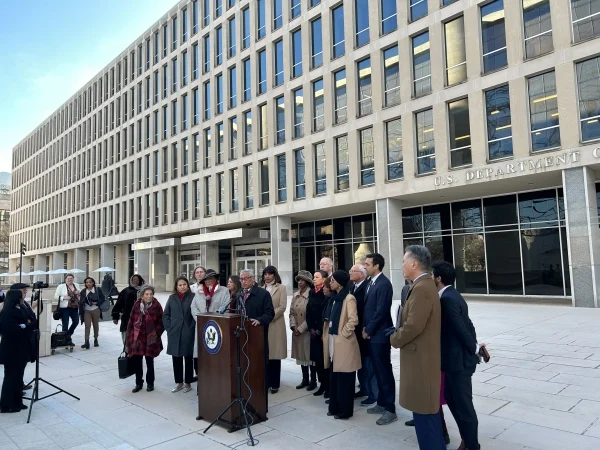
    Lawmakers stand at a podium outside the Education Department building, dressed for winter.

    Lawmakers tried to access the Education Department in February but were denied entry.

    Katherine Knott/Inside Higher Ed

    Rep. Bobby Scott, a Virginia Democrat and ranking member of the House education committee, said he has spent much of his year in defense mode, pushing back against each of these actions.

    “The administration has been dismantling the Department of Education, making access to education much less available,” he said. “And we’ve been trying to keep it together.”

    But both Scott and Sen. Patty Murray, a Washington Democrat and former educator, acknowledged that as members of the minority, they can only do so much. A few Republicans have joined them in voicing concern about specific issues, but not enough, they say.

    “We’ve had some successes—forcing some funding to be restored and rejecting, for example, President Trump’s push to slash Pell Grants by half in our draft funding bill for the coming year—but ultimately, we need a whole lot more bipartisan outrage and pushback from Republicans to truly start to undo the sweeping damage Trump has already caused,” Murray said.

    And it wasn’t just Democrats who raised concerns.

    “Congress has done very little to ask important questions, to ask the executive branch to justify some of the actions it is taking,” said Hess from AEI. “Hill Republicans are very much marching in lockstep to what the White House asks. The story of 2025 in higher ed is a big, dramatic one, but it’s almost entirely one of executive branch activity.”

    What’s Ahead in 2026?

    Now that congressional Republicans have completed a number of the tasks they set for themselves back in January 2025, most experts say two remaining items—college cost and accreditation reform—will be top priorities in 2026.

    Most sources Inside Higher Ed spoke with anticipated that college cost reduction and transparency would be addressed first, largely because related bills made it out of a House committee in December and senators held a hearing on the topic. The bills, which would standardize financial aid offers and create a universal net price calculator, have already gained some significant bipartisan support.

    Meanwhile, many remain skeptical of Republicans’ proposals for accreditation. Although no exact legislative language has been released, GOP lawmakers and Trump officials at the Department of Education have called for a major overhaul to not only ensure better student outcomes but also to deconstruct a what they see as a systemic liberal bias.

    “I would hope to see a focus on accreditors taking an active role and not just sort of a check-the-box approach to quality assurance,” said Carolyn Fast, director of higher education policy at the Century Foundation, a left-leaning think tank. “What I’m concerned about is some of the efforts to reform accreditation don’t seem necessarily as concerned about making sure that the system is working in terms of their role as gatekeepers of federal funds … but more about political and cultural war issues.”

    Bass from CAP said that he will be keeping a close eye on the midterm election campaign trail for a pulse on higher ed policy in general this year, as it gives the public a chance to speak up and direct change.

    “I’m curious to see how conversations about affordability play out, not just for higher education or education over all, but just for the country,” he said. “There are going to be over 30 gubernatorial races next year, and the debate gets shaped over key issues like higher education, like college costs, like affordability. So it will be very interesting to see how both parties are going to show up.”

    Source link

  • SAT Requirements Should Be Aligned With Mission (opinion)

    SAT Requirements Should Be Aligned With Mission (opinion)

    The autonomy of states in setting their own higher education policies creates a series of natural experiments across the United States, offering insights into what approaches work best in particular contexts. Given the importance of local considerations, there are few universal policy prescriptions that can be recommended with confidence. Sadly, this complexity was overlooked in Saul Geiser’s recent Inside Higher Ed essay entitled “Why the SAT Is a Poor Fit for Public Universities.”

    My position is not that all, or even any, public universities should require standardized test scores. In fact, I share Geiser’s view that a university’s “mission shapes admission policy.” However, it is because of this principle that I contend that the SAT cannot be dismissed as a poor fit for public universities without considering how institutions operationalize their missions and define their institutional priorities.

    Vertical Stratification Within a Public University System

    In my view, Geiser’s argument is fundamentally flawed in his comparison of elite private institutions to public university systems, which often include an elite flagship campus alongside a broader range of institutions. Geiser’s comparison is particularly surprising given his long-standing association with the University of California system.

    The California Master Plan for Higher Education has long been studied and celebrated for establishing a public postsecondary education system consisting of institutions with differentiated missions and admission processes. Under its original design, the community colleges provided open access to all high school graduates and adult learners, offering a stepping-stone to the four-year institutions. The California State University institutions admitted the top third of high school graduates, focusing on undergraduate education and teacher preparation. The University of California institutions were reserved for the top eighth of high school graduates and emphasized research and doctoral education.

    By using high school class rank to sort students into the different tiers of the system, the Master Plan established a baseline for admissions to both UC and CSU institutions. This framework enabled the emergence of two elite public flagship campuses in Berkeley and Los Angeles that prioritized academic excellence alongside accessible undergraduate institutions in the CSU system that served as drivers of economic development and social mobility.

    Reorienting the analysis to a comparison between elite public and private institutions would have provided a stronger basis for discussing selective admissions, as both of these institutional types receive far more applications than available spaces in their first-year cohorts. In these circumstances, institutions must make choices about how to differentiate among a pool of qualified applicants.

    It is common to start with assessing an applicant’s academic achievement. In a competitive pool, this assessment is less about whether the applicant meets minimum academic standards of the university and more about how the applicant has achieved above and beyond other applicants to the same program or institution. In a competitive admission pool, academic excellence is often an important distinction, but it can be defined in different ways.

    Assessing Academic Excellence

    Many researchers agree that the use of both high school GPA and standardized test scores yields the most accurate assessment of academic potential, rather than relying on either measure alone. Geiser’s own research from 2002 shows that combining both high school GPA and test scores better predicted UC students’ first-year grades than just high school GPA alone. Therefore, I was surprised that he presented the use of GPAs and test scores in admission policies as mutually exclusive alternatives.

    Although somewhat dated, a compelling finding from his 2002 analysis was that the combination of SAT Subject Test scores (discontinued in 2021) and high school GPA accounted for a greater proportion of variance in UC students’ first-year GPA than the combination of GPA and SAT scores. This finding suggests that precollege, discipline-specific achievement is important.

    This should come as no surprise, as college curricula for artists, anthropologists and aeronautical engineers differ substantially. It is reasonable to expect that the predictors of success in these programs would also differ. As such, academic programs within universities may be well served by setting admission standards calibrated to the specific competencies of their respective disciplines—a portfolio for the artist, an academic paper for the anthropologist and a math exam for the engineer.

    Although Geiser maintains that “academic standards haven’t slipped” at the UCs since they went test-free four years ago, a recent Academic Senate report from the University of California, San Diego, revealed that about one in eight first-year students this fall did not meet high school math standards on placement exams despite having strong high school math grades—a nearly 30-fold increase since 2020—and about one in 12 did not even meet middle school standards. This mismatch between GPAs and scores on course placement exams underscores critics’ concerns about inflation of high school GPAs and undermines the reliability of GPAs as a sole marker of academic achievement. The authors of the report called for an investigation of grading standards across California high schools and recommended the UC system re-examine its standardized testing requirements.

    It is understandable that faculty in quantitative disciplines, such as engineering and finance, would want to better gauge the readiness of applicants for their programs by considering test scores, if only the results from the SAT or ACT math sections, in light of these findings. However, if one in 12 students are not meeting middle school math standards, then the greater concern is that these students, regardless of major, will require remediation, creating longer, more expensive and more difficult paths to graduation.

    Variation in Standardized Testing Requirements Across States

    I was surprised Geiser did not acknowledge this report, instead arguing that the reinstatement of standardized test requirements at Ivy League institutions “provided intellectual cover for the SAT’s possible revival” nationwide. This characterization overlooks the fact that some public institutions in at least 11 states—Alabama, Arkansas, Florida, Georgia, Indiana, Louisiana, Mississippi, Ohio, Tennessee, Texas and West Virginia —already require standardized test scores in admission, according to the College Board. Notably, Florida public universities never suspended their test requirements during the COVID pandemic when all of the Ivies did.

    In Georgia and Tennessee, public universities waived test requirements during the COVID pandemic but subsequently moved to reinstate the requirements for the University of Tennessee system and for at least seven of the 26 institutions in the University System of Georgia, including the Georgia Institute of Technology and the University of Georgia.

    Among public universities in Texas and Ohio, only the states’ flagships, the University of Texas at Austin and the Ohio State University, reinstated standardized test requirements for all students. While the flagship in Indiana remains test optional, the state’s premier land-grant institution requires test scores—Purdue University reinstated the requirement in 2024. And in Alabama, both the land-grant, Auburn University, and the flagship, the University of Alabama at Tuscaloosa, have announced plans to reinstate required test scores for all first-year applicants.

    In some states, public institutions, including Southern Arkansas University, Fairmont State University in West Virginia and Alcorn State University, a historically Black institution in Mississippi, waive test requirements for students with higher GPAs. In practice, this approach prioritizes performance in the classroom but offers low-performing high school students a second chance to demonstrate their proficiency and potential.

    These examples show how variations in admission practices across institutions enable public systems to pursue their missions and diverse sets of state goals that may not be possible for any single institution within their system. These systems can offer broad access to four-year programs while also upholding academic standards and pursuing academic excellence. Whether that means all, some or none of the institutions in a public system require the SAT or ACT depends on the goals and strategies of each of the states.

    While most public institutions adopted test-optional admissions during the pandemic, California implemented a test-blind policy that prohibited the consideration of test scores. Based on my experience as an admission officer, I applaud this decision. Test-optional admission is an easy policy decision, but I have seen how test-optional policies can create two different admission processes, where test scores are essentially required for some groups of students and not for others. Test-optional policies muddy the waters, offering less transparency in an already complicated process. The UC and CSU systems avoided this mistake by establishing equal grounds for evaluating applicants, but this does not mean that other public institutions need to do the same.

    Aligning Admissions With Mission

    Public universities are facing numerous enrollment pressures. Shifting state and regional demographics continue to force admission leaders to adjust their recruitment strategies and admission policies. The growing prominence of artificial intelligence appears apt to redefine the academic experience and admission processes, but exactly when and how are unknown. Meanwhile, the expected increase in states’ financial obligations in relation to Medicaid is likely to increase reliance on tuition revenue, which will ultimately shape the budgets and enrollments of higher education institutions.

    A uniform, one-size-fits-all approach to admissions policy, such as test-blind admissions for all public universities, does not respect the autonomy of states and institutions and does not serve the diversity of institutional contexts. Public universities should continue to tailor admissions policies to their specific needs, which may include variation across campuses within a public system or even among programs within the same institution. What matters most is that admission policies remain transparent, are applied consistently to all applicants within a program and closely align with the institution’s mission and public purpose.

    Ryan Creps is an assistant professor in the Graduate School of Education at the State University of New York at Buffalo and was previously an admission officer at Brown University. His research focuses on college admission practices and postsecondary enrollment trends.

    Source link

  • College Food Pantry Helps Students Combat Food Insecurity

    College Food Pantry Helps Students Combat Food Insecurity

    With rising food costs and uncertain federal food-assistance benefits wreaking havoc on families nationwide, Alicia Wright has found relief in an unlikely place: her community college’s food pantry.

    Wright, a student at Roxbury Community College, said her campus food pantry has been lifesaving, especially as she juggles classes while raising her 6-year-old daughter, Olivia.

    “I was like, ‘Oh snap—I don’t have to trek around Boston to find food from other local pantries,’” said Wright, a theater major who is scheduled to graduate in 2027. “Having it right there really changed the game for me.”

    Wright is one of more than 1,500 students who have relied on the pantry, better known as the Rox Box, since its launch in October 2023, according to Nancy Santos, RCC’s Project Access director.

    Roxbury Community College students shop for food and personal care essentials at the Rox Box.

    Roxbury Community College

    Designed to mirror a neighborhood grocery store, the pantry carries items such as food, diapers and personal care essentials and is funded entirely by the community.

    “If I find myself going to class thinking about how I didn’t go grocery shopping this weekend, I know I can pick up something from the Rox Box,” Wright said, adding that students receive 30 points each month to redeem for items they need.

    “That lets me be more present in class … [and] really does allow peace of mind,” Wright said.

    Like Wright, nearly 60 percent of college students nationwide have experienced at least one form of basic needs insecurity in the past year, according to a recent Hope Center survey.

    According to Swipe Out Hunger, a nonprofit dedicated to ending college student hunger, student visits to campus food pantries have increased by 30 to 50 percent over the past year across its more than 900 campus partners nationwide.

    Origin story: The Rox Box started as an extension of Project Access, an initiative designed to address the nonacademic issues that can prevent degree completion at the Boston-area college.

    Santos said the Rox Box has met a strong need, serving more than 300 students each month.

    “It’s really taken off,” Santos said. “We see the athletes and everyone walking around with their little bags that say ‘Rox Box,’ and they’re proud that they’re going.”

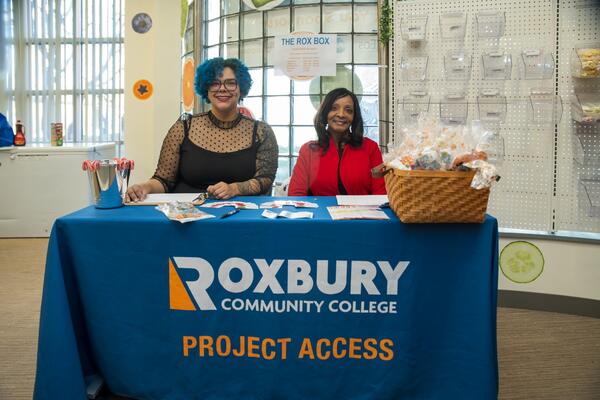
    Two women, one with blue hair wearing a black dress with a sheer overlay, and one with shoulder-length dark hair wearing a red top, sit behind a table with a blue tablecloth that says "Roxbury Community College Project Access."

    Roxbury Community College Project Access director Nancy Santos (right) sitting with a student worker at the Rox Box.

    Roxbury Community College

    She noted that demand continues to rise, with more than 1,700 visits from over 1,500 students between September and December 2025.

    “We know the need is out there, because 1,700 visits on our campus is a large number when we only have 2,400 students enrolled,” Santos said, noting that RCC’s student body is predominantly Black, Latino and Pell Grant eligible.

    Santos said she regularly surveys students who rely on the Rox Box and has found that nearly 40 percent worry their food won’t stretch until the next time they can afford to buy more, while nearly 30 percent have changed their eating habits to make the provisions last longer.

    She underscored how the federal government shutdown last fall contributed to growing “uneasiness” and “insecurity” around RCC students’ food needs.

    This comes as nearly 40 percent of public college students in Massachusetts experienced food insecurity last year.

    “The numbers are alarming to us,” Santos said. “Our faculty have even shared that they can sometimes see students are distracted or they don’t come to school if they’re hungry … [and] it really does affect their grades.”

    To ensure the Rox Box runs smoothly, Santos said, they hired a coordinator who is an RCC alum and had previously relied on the pantry.

    “She started as a work-study, so she worked in the pantry with us, and when she graduated we hired her back,” Santos said. “In doing so, the students identify with her and they see there’s a path. They see where they are isn’t where they’ll always be.”

    Santos said the pantry helps students feel supported and actively works to reduce the shame around needing help.

    “I often say that the shame is not that you are food insecure, the shame is that [food insecurity] exists,” Santos said. “Don’t pretend it isn’t happening. Address it and embrace it and let’s figure out a way to wipe it out.”

    What’s next: Santos said starting a campus food pantry is a “big undertaking” but worthwhile for other institutions looking to create their own.

    “We are a small college, but we care for our students,” Santos said. “When students are fed and when they’re able to concentrate and really study, it helps them go across the finish line.”

    Wright agreed, adding that actively listening to students’ needs and implementing those changes really fosters a sense of trust and community.

    “We tell them our views and what we need and everything, and then we see things being done about it,” Wright said. “It really allows us to feel seen, heard and supported.”

    Ultimately, Wright said, RCC really gets it right about seeing students “holistically.”

    “We’re not just students—we’re entrepreneurs, we’re parents, we’re our parents’ caregivers,” Wright said. “A lot of us are already full-grown people who have lived life and know how to survive, [but] we just need a bit more support that shows [the college is] here for your success.”

    Want to help students battling food insecurity? You can support The Rox Box here.

    Get more content like this directly to your inbox. Subscribe here.

    Source link

  • New Year’s Resolutions for Higher Ed

    New Year’s Resolutions for Higher Ed

    As we enter the new year, I want to share some thoughts about what higher education needs to accomplish as a sector in 2026. I view these as resolutions: tough challenges we need to tackle with courage and determination. Are you ready?

    Fix Accreditation

    I have participated in accreditation as a college president, a law school faculty member and as a board member of the NWCCU, the Northwest’s regional accreditor, and so I say this from experience: Our accreditation system is horrible. It wastes massive amounts of time and accomplishes almost nothing to guarantee students a good education. We need to scrap it and start over. Instead of multiyear cycles, we should review schools every five years, in a process that takes no more than six months. It should focus on just three things: student outcomes, responsible financial management and academic freedom. Schools that do not meet strong, clear, objective standards in these areas should be placed on probation and, ultimately, decertified if they fail to improve. We have to stop rubber-stamping failure.

    Discuss Creating a True National Higher Ed System

    If I use the phrase “American higher education system” with colleagues from Europe and Asia, they laugh. “System? You don’t have a system! You have a giant collection of unregulated institutions that perform very inconsistently, many of them for-profit scams.”

    There is so much truth in this reaction. The venerable Higher Education Act of 1965 no long meets our national needs. We need to start a rational discussion about reform of the higher education regulatory landscape. We need a smaller number of higher-performing universities, we need to eliminate institutions with poor outcomes that provide limited or no real return on investment, we need to provide truly affordable undergraduate programs in every state, we need to cut regulations and legal rules that drive up the cost of compliance, and we need to limit student debt. This is not the year for reform—Congress is a divided mess. But we need to start discussing the future.

    Focus on Community Colleges

    The foundation of American higher education is the part of the sector we talk about least: our community colleges. Community college is the best place to provide four vital services our students and our country desperately need: remedial education to make up for poor K–12 schools, valuable job training in skills and trades to help students prepare for the workplace, ESL classes to help nonnative English speakers thrive, and low-cost general education to help students determine whether they want to proceed to a four year degree.

    Community college quality is inconsistent across the United States: excellent in some states, poor in others. As a result, there is no one-size-fits-all set of reforms we need to enact. Every state government needs to have a serious, honest conversation led by the governor on how to strengthen and improve this vital sector.

    Start Low-Cost, High-Quality Undergraduate Experiments

    College costs too much. Instead of pretending this is not true, we need to develop new low-cost, high-quality models. We cannot rely on new institutions to do this: The entry costs and accreditation barriers are too high.

    Here’s a place to start.

    The eight (relatively wealthy) Ivy League universities should jointly create Ivy College, a low-cost undergraduate lab school in a place they currently don’t serve, like Los Angeles. They should cut everything ancillary to great undergraduate education that drives up costs. That means no research, no sports and recreation, no subsidized activities, no alumni association, no communications department, no health and counseling, no permanent campus (just rented office space). They should reduce the number of majors and the number of electives. Simplify admission, with a lottery for every student scoring 1100 or above on the SAT. Get federal regulatory waivers for compliance cost drivers.

    If we tried this for four years, we would learn so much! Then, the Big Ten schools should follow suit.

    Advertise on Television

    A recent Pew poll found that 70 percent of Americans think higher education is headed in the wrong direction. How do we improve public trust in higher education? Reform will help, yes, but we also need a more effective approach to public relations. When other industries run into trouble, they don’t rely on heartfelt op-eds and books published by university presses to make their case. They launch proactive television and a social media ad campaigns.

    ACE should enlist the top 100 universities to bankroll ads that explain the ROI of higher education and the value of university research to national security, health and the economy. Trusted figures should explain why college matters. Celebrities should explain why they benefited from college. And we should remind people that American research universities helped win the Second World War.

    John Kroger served as president of Reed College, attorney general of Oregon, chief learning officer of the U.S. Navy and a visiting faculty member at Harvard and Yale Universities and Lewis and Clark College.

    Source link

  • Higher Education Inquirer : $8 Billion in Liberty University Debt: Engaging a Faith-Driven Constituency

    Higher Education Inquirer : $8 Billion in Liberty University Debt: Engaging a Faith-Driven Constituency

    More than 290,000 Liberty University borrowers owe over $8 billion in federal student loans, yet most remain politically disengaged. Many are veterans or enrolled in accelerated master’s programs often criticized as “robocolleges.” What sets this population apart is not just the size of their debt, but their faith and social conservatism—a demographic frequently overlooked by traditional student debt advocacy.

    For unions and nonprofit organizations committed to civic engagement and economic justice, this represents a unique opportunity: mobilize borrowers in ways that align with their values, rather than against them. Messaging that highlights fairness, personal responsibility, and stewardship—core Christian principles—can resonate deeply while framing student debt as a challenge to both economic and moral accountability.

    These borrowers are approaching peak voting age, meaning that engagement now could influence local and national politics in the coming election cycles. Institutions like the University of Phoenix show the scale of the opportunity: over one million borrowers owe more than $21 billion nationwide, suggesting that faith-aligned organizing strategies could have broad impact.

    The strategy is clear: educate borrowers about their rights, expose predatory practices, and organize them into civic action, all while respecting their values and beliefs. Done thoughtfully, this approach can build trust and spur meaningful participation in democracy, turning a population long overlooked into an informed, motivated constituency.

    The coming years will test whether unions and nonprofits seize this moment. Hundreds of thousands of conservative, Christian borrowers could become a powerful force for accountability and change—but only if engagement is value-driven, strategic, and timely.


    Sources:

    Source link

  • As Job Market Tightens, More Californians Are Heading Back to College – The 74

    As Job Market Tightens, More Californians Are Heading Back to College – The 74

    “When the economy is doing well, our enrollments are down, and when the economy is in a tough stretch or in a recession, we see our enrollments go up,” said Chris Ferguson, an executive vice chancellor with the California Community Colleges Chancellor’s Office, which oversees all of the state’s 116 community colleges. 

    Ferguson said the state has yet to release authoritative data on fall enrollment, but early data shows upward trends. In interviews with CalMatters, some college presidents said they’re seeing over 10% more students compared to last fall. But they say the state hasn’t provided enough funding to keep up with their growth. 

    California is not in a recession, but some economic indicators are grim. Unemployment is rising, and it’s getting harder to find a job. The cost of consumer goods, such as toilet paper and cosmetics, is going up, and economists say tariffs and President Donald Trump’s increased deportations could lead to further economic declines in the state

    “Typically when the economy gets a little crazy, like it is right now, people need to upskill or find new work,” and workers look to colleges for help, said Nicole Albo-Lopez, deputy chancellor for the Los Angeles Community College District. In the Los Angeles district, students between the ages of 35 and 54 are coming back to school in droves — up 28% compared to last year, she said. 

    Other factors may also be bringing students back to school. The COVID-19 pandemic created a sudden and historic drop in college enrollment, and some schools say the influx of students this year is just a return to pre-pandemic levels. A large portion of recent enrollment growth comes from high school students taking college courses, which has exploded in popularity in the past few years. 

    But most college officials agree that uncertainty about the economy is at least one of the driving forces for new students this semester. 

    At the Los Rios Community College District, which represents four campuses in the Sacramento metro area, enrollment is up by more than 5% compared to last fall. Part of that is due to “the gap between Wall Street and Main Street,” said Mario Rodriguez, an executive vice chancellor for the system: The stock market has performed well in the past few years, even as job seekers see fewer opportunities and families struggle with inflation. Enrollments in career technical classes are up 10% this semester at the district, the equivalent of almost 4,000 new students. 

    These job-ready programs, such as medical assisting, welding, and automotive, have always been popular, and some cap enrollment. School officials say waitlists are growing.

    Quitting a job, starting school

    Carla Gruhn, 29, has worked as a medical assistant in San Jose for 10 years. At one point she was making roughly $50,000 a year, but it wasn’t enough.

    “In the last year, eggs started becoming super expensive,” she said. “That’s when I started paying more attention to gas and groceries.” Together with her husband, she started planning ways to scale back — fewer coffee runs, less travel with their truck, cheaper gifts this Christmas. But they needed a long-term solution, too.

    In July, she quit her job and enrolled in a two-year radiologic technology program at Foothill College, in the south Bay Area, which will teach her how to read X-rays, CT scans, and MRIs. Her salary will double, maybe even triple, once she graduates with the new credential. 

    The pay raise could be “life-changing,” she said. At the moment, Gruhn said her family is small, just her husband and her dog, so their costs are lower, but they know it’s going to get more expensive, since they want to buy a house and have kids. “We’re trying to plan for the future too.”

    At Foothill College, enrollment is up, especially in science and technology classes, said Simon Pennington, the school’s associate vice president of community relations. Many of these students are looking to fulfill prerequisites to enter careers in the health care sector, he added. Health care is one of the largest and fastest-growing job sectors in the state, according to a recent report from the Public Policy Institute of California. 

    In Merced, hours away from major urban centers like the Bay Area, Sacramento, or Los Angeles, students are clamoring for classes in electronics, where the fall waitlist numbers have nearly doubled compared to three years ago. Demand is also up for classes in criminal justice and mechanized agriculture, according to James Leonard, a spokesperson for the school. 

    “When the economy goes bad, enrollment skyrockets,” said Dee Sigismond, Merced College’s vice president of instruction, though she wasn’t certain that a recession would have the same impact it did 15 years ago. Staring during the pandemic, Merced College, like most community colleges, now offers many of its classes online, which can make it easier for students to juggle school with a full- or part-time job. She added that Merced is also experimenting with new, more flexible kinds of instruction, such as competency-based education, which allows students to pass a class by showing they already have the requisite skills.

    Colleges call for more funding

    California’s community colleges receive most of their funding based on the number of students they serve. When enrollment declined during the pandemic, colleges were set to lose funding, but the governor and the Legislature granted the community college system a special exemption, delaying many funding cuts. 

    Now that enrollment is ticking up, many colleges say they have the opposite problem — they aren’t getting enough money to serve the influx of new students. That’s largely because the state’s funding formula is based on the college’s average enrollment over the past three years, so sudden changes this year are slow to have an effect. Rodriguez said his Sacramento area district is serving about 5,000 more students than the system is funded to support, representing about $20 million in lost revenue. 

    This summer, the state agreed to send more money to California’s community colleges to account for recent enrollment growth, but Ferguson said it isn’t enough to fully fund all the new students. 

    Last month, presidents and chancellors from 10 different community colleges or community college districts, including representatives from Los Angeles and Sacramento, sent a letter to the governor, asking him to change state policy and allow colleges to get more funding in next year’s budget. Though he did not sign the letter, Ferguson said the state chancellor’s office is asking the governor for similar changes. 

    In 2008, colleges had to cut back on services or classes, even as new students poured in because the state didn’t provide proportionate funding for each new enrollment. 

    Next year, California is expected to face an $18 billion budget deficit, according to a November analysis by the Legislative Analyst’s Office. For comparison, the state had a deficit of about $24 billion in 2008, worth about $36 billion in today’s dollars. 

    In Chula Vista, Southwestern College President Mark Sanchez said his district is already saying no to potential college classes in high schools and prisons because of a lack of state funding. 

    His district had over 32,000 students in the last academic year — the highest enrollment rate since the Great Recession.


    Did you use this article in your work?

    We’d love to hear how The 74’s reporting is helping educators, researchers, and policymakers. Tell us how

    Source link

  • Higher Education Inquirer Resources, Spring 2026

    Higher Education Inquirer Resources, Spring 2026

    [Editor’s note: Please let us know of any corrections, additions, or broken links.  We always welcome your feedback.]  

    This list traces how U.S. higher education has been reshaped by neoliberal policies, privatization, and data-driven management, producing deepening inequalities across race and class. The works examine the rise of academic capitalism, growing student debt, corporatization, and the influence of private interests—from for-profit colleges to rankings and surveillance systems. Together, they depict a sector drifting away from its public mission and democratic ideals, while highlighting the structural forces that created today’s crises and the reforms needed to reverse them.

    Ahn, Ilsup (2023). The Ethics of Educational Healthcare: Student Debt, Neoliberalism, and Justice. Palgrave Macmillan.
    Alexander, Bryan (2020). Academia Next: The Futures of Higher Education. Johns Hopkins Press.
    Alexander, Bryan (2023). Universities on Fire. Johns Hopkins Press.

    Alexander, Bryan (2026). Peak Higher Ed. Johns Hopkins Press.

    Angulo, A. (2016). Diploma Mills: How For-profit Colleges Stiffed Students, Taxpayers, and the American Dream. Johns Hopkins University Press.

    Apthekar, Bettina (1966). Big Business and the American University. New Outlook Publishers.

    Apthekar, Bettina (1969). Higher Education and the Student Rebellion in the United States, 1960–1969: A Bibliography.

    Archibald, R. & Feldman, D. (2017). The Road Ahead for America’s Colleges & Universities. Oxford University Press.

    Armstrong, E. & Hamilton, L. (2015). Paying for the Party: How College Maintains Inequality. Harvard University Press.

    Arum, R. & Roksa, J. (2011). Academically Adrift: Limited Learning on College Campuses. University of Chicago Press.

    Baldwin, Davarian (2021). In the Shadow of the Ivory Tower: How Universities Are Plundering Our Cities. Bold Type Books.

    Barr, Andrew & Turner, Sarah (2023). The Labor Market Returns to Higher Education. Oxford University Press.

    Bennett, W. & Wilezol, D. (2013). Is College Worth It? Thomas Nelson.

    Berg, I. (1970). The Great Training Robbery: Education and Jobs. Praeger.

    Berman, Elizabeth P. (2012). Creating the Market University. Princeton University Press.

    Berman, Elizabeth Popp & Stevens, Mitchell (eds.) (2019). The University Under Pressure. Emerald Publishing.

    Berry, J. (2005). Reclaiming the Ivory Tower: Organizing Adjuncts to Change Higher Education. Monthly Review Press.

    Berry, J. and Worthen, H. (2021). Power Despite Precarity: Strategies for the Contingent Faculty Movement in Higher Education. Pluto Books.

    Best, J. & Best, E. (2014). The Student Loan Mess. Atkinson Family Foundation.

    Bledstein, Burton J. (1976). The Culture of Professionalism. Norton.

    Bogue, E. Grady & Aper, Jeffrey (2000). Exploring the Heritage of American Higher Education.

    Bok, D. (2003). Universities in the Marketplace. Princeton University Press.

    Bousquet, M. (2008). How the University Works. NYU Press.

    Brennan, J. & Magness, P. (2019). Cracks in the Ivory Tower. Oxford University Press.

    Brint, S. & Karabel, J. (1989). The Diverted Dream. Oxford University Press.

    Burawoy, Michael & Mitchell, Katharyne (eds.) (2020). The University, Neoliberalism, and the Politics of Inequality. Routledge.

    Burd, Stephen (2024). Lifting the Veil on Enrollment Management: How a Powerful Industry is Limiting Social Mobility in American Higher Education. Harvard Education Press

    Cabrera, Nolan L. (2018). White Guys on Campus. Rutgers University Press.

    Cabrera, Nolan L. (2024). Whiteness in the Ivory Tower. Teachers College Press.

    Cantwell, Brendan & Robertson, Susan (eds.) (2021). Research Handbook on the Politics of Higher Education. Edward Elgar.

    Caplan, B. (2018). The Case Against Education. Princeton University Press.

    Cappelli, P. (2015). Will College Pay Off? Public Affairs.

    Carney, Cary Michael (1999). Native American Higher Education in the United States. Transaction.

    Cassuto, Leonard (2015). The Graduate School Mess. Harvard University Press.

    Caterine, Christopher (2020). Leaving Academia. Princeton Press.

    Childress, H. (2019). The Adjunct Underclass. University of Chicago Press.

    Chomsky, Noam (2014). Masters of Mankind. Haymarket Books.

    Choudaha, Rahul & de Wit, Hans (eds.) (2019). International Student Recruitment and Mobility. Routledge.

    Cohen, Arthur M. (1998). The Shaping of American Higher Education. Jossey-Bass.

    Collins, Randall (1979/2019). The Credential Society. Columbia University Press.

    Cottom, Tressie McMillan (2016). Lower Ed.

    Cottom, Tressie McMillan & Darity, William A. Jr. (eds.) (2018). For-Profit Universities. Routledge.

    Domhoff, G. William (2021). Who Rules America? Routledge.

    Donoghue, F. (2008). The Last Professors.

    Dorn, Charles (2017). For the Common Good. Cornell University Press.

    Eaton, Charlie (2022). Bankers in the Ivory Tower. University of Chicago Press.

    Eisenmann, Linda (2006). Higher Education for Women in Postwar America. Johns Hopkins Press.

    Espenshade, T. & Walton Radford, A. (2009). No Longer Separate, Not Yet Equal. Princeton University Press.

    Faragher, John Mack & Howe, Florence (eds.) (1988). Women and Higher Education in American History. Norton.

    Farber, Jerry (1972). The University of Tomorrowland. Pocket Books.

    Freeman, Richard B. (1976). The Overeducated American. Academic Press.

    Gaston, P. (2014). Higher Education Accreditation. Stylus.

    Gildersleeve, Ryan Evely & Tierney, William (2017). The Contemporary Landscape of Higher Education. Routledge.

    Ginsberg, B. (2013). The Fall of the Faculty. Oxford University Press.

    Giroux, Henry (1983). Theory and Resistance in Education. Bergin and Garvey Press.

    Giroux, Henry (2014). Neoliberalism’s War on Higher Education. Haymarket Books.

    Giroux, Henry (2022). Pedagogy of Resistance. Bloomsbury Academic.

    Gleason, Philip (1995). Contending with Modernity. Oxford University Press.

    Golden, D. (2006). The Price of Admission.

    Goldrick-Rab, S. (2016). Paying the Price.

    Graeber, David (2018). Bullshit Jobs. Simon and Schuster.

    Groeger, Cristina Viviana (2021). The Education Trap. Harvard Press.

    Hamilton, Laura T. & Kelly Nielson (2021). Broke.

    Hampel, Robert L. (2017). Fast and Curious. Rowman & Littlefield.

    Hirschman, Daniel & Berman, Elizabeth Popp (eds.) (2021). The Sociology of Higher Education.

    Johnson, B. et al. (2003). Steal This University.

    Kamenetz, Anya (2006). Generation Debt. Riverhead.

    Keats, John (1965). The Sheepskin Psychosis. Lippincott.

    Kelchen, Robert (2018). Higher Education Accountability. Johns Hopkins University Press.

    Kezar, A., DePaola, T., & Scott, D. (2019). The Gig Academy. Johns Hopkins Press.

    Kinser, K. (2006). From Main Street to Wall Street.

    Kozol, Jonathan (1992). Savage Inequalities. Harper Perennial.

    Kozol, Jonathan (2006). The Shame of the Nation. Crown.

    Kraus, Neil (2023). The Fantasy Economy: Neoliberalism, Inequality, and the Education Reform Movement. Temple University Press, 2023.

    Labaree, David (1997). How to Succeed in School Without Really Learning. Yale University Press.

    Labaree, David F. (2017). A Perfect Mess. University of Chicago Press.

    Lafer, Gordon (2004). The Job Training Charade. Cornell University Press.

    Loehen, James (1995). Lies My Teacher Told Me. The New Press.

    Lohse, Andrew (2014). Confessions of an Ivy League Frat Boy. Thomas Dunne Books.

    Lucas, C.J. (1994). American Higher Education: A History.

    Lukianoff, Greg & Haidt, Jonathan (2018). The Coddling of the American Mind. Penguin Press.

    Maire, Quentin (2021). Credential Market. Springer.

    Mandery, Evan (2022). Poison Ivy. New Press.

    Marginson, Simon (2016). The Dream Is Over. University of California Press.

    Marti, Eduardo (2016). America’s Broken Promise. Excelsior College Press.

    Mettler, Suzanne (2014). Degrees of Inequality. Basic Books.

    Morris, Dan & Targ, Harry (2023). From Upton Sinclair’s ‘Goose Step’ to the Neoliberal University.

    Newfeld, C. (2011). Unmaking the Public University.

    Newfeld, C. (2016). The Great Mistake.

    Newfield, Christopher (2023). Metrics-Driven. Johns Hopkins Press.

    O’Neil, Cathy (2016). Weapons of Math Destruction. Crown.

    Palfrey, John (2020). Safe Spaces, Brave Spaces. MIT Press.

    Paulsen, M. & Smart, J.C. (2001). The Finance of Higher Education. Agathon Press.

    Piketty, Thomas (2020). Capital and Ideology. Harvard University Press.

    Reynolds, G. (2012). The Higher Education Bubble. Encounter Books.

    Rojstaczer, Stuart (1999). Gone for Good. Oxford University Press.

    Rosen, A.S. (2011). Change.edu. Kaplan Publishing.

    Roth, G. (2019). The Educated Underclass. Pluto Press.

    Ruben, Julie (1996). The Making of the Modern University. University of Chicago Press.

    Rudolph, F. (1991). The American College and University.

    Rushdoony, R. (1972). The Messianic Character of American Education. The Craig Press.

    Schrecker, Ellen (2010). The Lost Soul of Higher Education: New Press.

    Selingo, J. (2013). College Unbound.

    Shelton, Jon (2023). The Education Myth. Cornell University Press.

    Simpson, Christopher (1999). Universities and Empire. New Press.

    Sinclair, U. (1923). The Goose-Step.

    Slaughter, Sheila & Rhoades, Gary (2004). Academic Capitalism and the New Economy. Johns Hopkins University Press.

    Smyth, John (2017). The Toxic University. Palgrave Macmillan.

    Sperber, Murray (2000). Beer and Circus. Holt.

    Stein, Sharon (2022). Unsettling the University. Johns Hopkins Press.

    Stevens, Mitchell L. (2009). Creating a Class. Harvard University Press.

    Stodghill, R. (2015). Where Everybody Looks Like Me.

    Tamanaha, B. (2012). Failing Law Schools. University of Chicago Press.

    Tatum, Beverly (1997). Why Are All the Black Kids Sitting Together in the Cafeteria? Basic Books.

    Taylor, Barret J. & Cantwell, Brendan (2019). Unequal Higher Education. Rutgers University Press.

    Thelin, John R. (2019). A History of American Higher Education. Johns Hopkins Press.

    Tolley, K. (2018). Professors in the Gig Economy. Johns Hopkins University Press.

    Trow, Martin (1973). Problems in the Transition from Elite to Mass Higher Education. Carnegie Commission on Higher Education. 

    Twitchell, James B. (2005). Branded Nation. Simon and Schuster.

    Vedder, R. (2004). Going Broke By Degree.

    Veysey, Lawrence R. (1965). The Emergence of the American University.

    Washburn, J. (2006). University Inc.

    Washington, Harriet A. (2008). Medical Apartheid. Anchor.

    Whitman, David (2021). The Profits of Failure. Cypress House.

    Wilder, C.D. (2013). Ebony and Ivy.

    Winks, Robin (1996). Cloak and Gown. Yale University Press.

    Woodson, Carter D. (1933). The Mis-Education of the Negro.

    Zaloom, Caitlin (2019). Indebted. Princeton University Press.

    Zemsky, Robert, Shaman, Susan & Baldridge, Susan Campbell (2020). The College Stress Test. Johns Hopkins University Press.

    Zuboff, Shoshana (2019). The Age of Surveillance Capitalism. PublicAffairs. 

    Activists, Coalitions, Innovators, and Alternative Voices

     College Choice and Career Planning Tools

    Innovation and Reform

    Higher Education Policy

    Data Sources

    Trade publications

    Source link

  • Artificial Intelligence, Mass Surveillance, and the Quiet Reengineering of Higher Education

    Artificial Intelligence, Mass Surveillance, and the Quiet Reengineering of Higher Education

    The Higher Education Inquirer has approached artificial intelligence not as a speculative future but as a present reality already reshaping higher education. Long before university leaders and consultants embraced Artificial Intelligence (AI) as an abstract promise, HEI was using these tools directly while documenting how they were being embedded into academic institutions. What has become increasingly clear is that AI is not merely an educational technology. It is a structural force accelerating corporatization, automation, and mass surveillance within higher education.

    Artificial intelligence enters the university through the language of efficiency and personalization. Administrators speak of innovation, student success, and institutional competitiveness. Yet beneath this language lies a deeper transformation. Teaching, advising, grading, counseling, and evaluation are increasingly reduced to measurable functions rather than human relationships. Once learning is fragmented into functions, it becomes easily automated, monitored, outsourced, and scaled.

    This shift has long been visible in for-profit and online institutions, where scripted instruction, learning management systems, predictive analytics, and automated advising have replaced meaningful faculty engagement. What is new is that nonprofit and elite universities are now adopting similar systems, enhanced by powerful AI tools and vast data collection infrastructures. The result is the emergence of the robocollege, an institution optimized for credential production, labor reduction, and data extraction rather than intellectual growth.

    Students are told that AI-driven education will prepare them for the future economy. In reality, many are being trained for an economy defined by automation, precarity, and diminished human agency. Rather than empowering students to challenge technological power, institutions increasingly socialize them to adapt to it. Compliance, constant assessment, and algorithmic feedback replace intellectual risk-taking and critical inquiry.

    These developments reinforce and intensify inequality. Working-class students, student loan debtors, and marginalized populations are disproportionately enrolled in institutions where AI-mediated education and automated oversight are most aggressively deployed. Meanwhile, elite students continue to receive human mentorship, small seminars, and insulation from constant monitoring. Artificial intelligence thus deepens a two-tier system of higher education, one human and one surveilled.

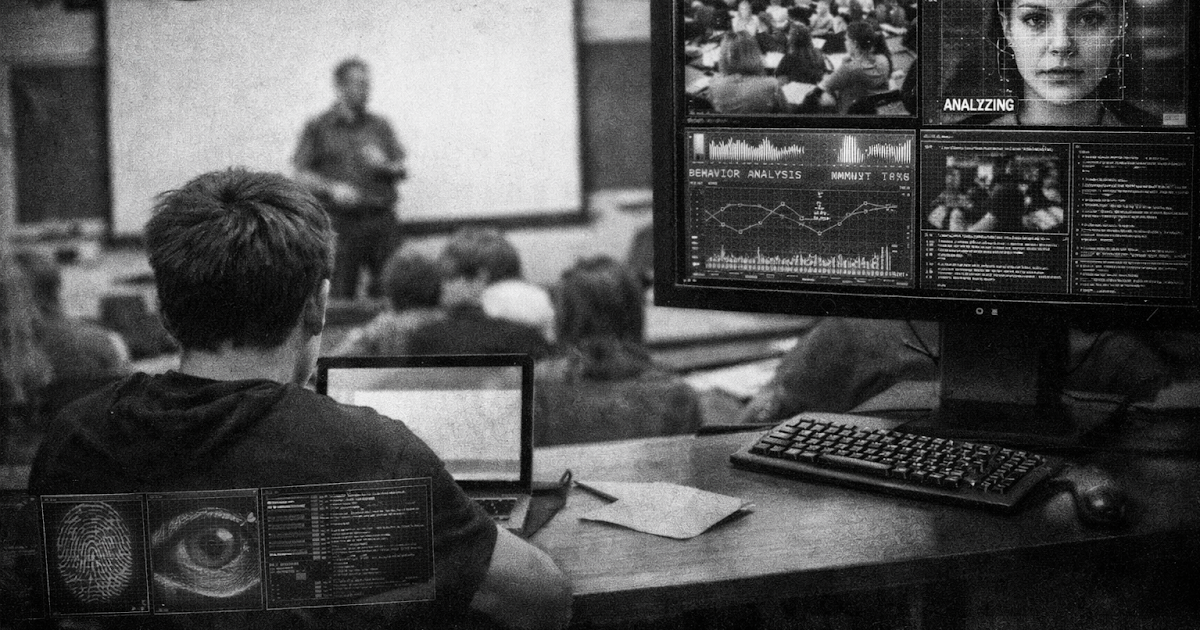
    Mass surveillance is no longer peripheral to higher education. It is central to how AI operates on campus. Predictive analytics flag students as “at risk” before they fail, often without transparency or consent. Proctoring software monitors faces, eye movements, living spaces, and biometric data. Engagement dashboards track clicks, keystrokes, time spent on screens, and behavioral patterns. These systems claim to support learning while normalizing constant observation.

    Students are increasingly treated as data subjects rather than citizens in a learning community. Faculty are pressured to comply with opaque systems they did not design and cannot audit. The data harvested through these platforms flows upward to administrators, vendors, private equity-backed education companies, and, in some cases, government and security-linked entities. Higher education becomes a testing ground for surveillance technologies later deployed across workplaces and society at large.

    At the top of the academic hierarchy, a small group of elite universities dominates global AI research. These institutions maintain close relationships with Big Tech firms, defense contractors, and venture capital interests. They shape not only innovation but ideology, presenting AI development as inevitable and benevolent while supplying talent and legitimacy to systems of automation, surveillance, and control. Ethics initiatives and AI principles proliferate even as accountability remains elusive.

    Cultural warnings about technological obsolescence no longer feel theoretical. Faculty are told to adapt or be replaced by automated systems. Students are told to compete with algorithms while being monitored by them. Administrators frame automation and surveillance as unavoidable. What is absent from these conversations is moral courage. Higher education rarely asks whether it should participate in building systems that render human judgment, privacy, and dignity increasingly expendable.

    Artificial intelligence does not have to dehumanize higher education, but resisting that outcome requires choices institutions have largely avoided. It requires valuing human labor over scalability, privacy over control, and education as a public good rather than a data pipeline. It requires democratic governance instead of technocratic management and surveillance by default.

    For years, the Higher Education Inquirer has examined artificial intelligence not as a neutral tool or a distant threat, but as a technology shaped by power, profit, and institutional priorities. The future of higher education is not being determined by machines alone. It is being determined by decisions made by university leaders, technology firms, and policymakers who choose surveillance and efficiency over humanity.

    The question is no longer whether AI will reshape higher education.

    The question is whether higher education will resist becoming a fully surveilled system that trains students to accept a monitored, automated, and diminished future.


    Sources

    Higher Education Inquirer, Robocolleges, Artificial Intelligence, and the Dehumanization of Higher Education


    Higher Education Inquirer, AI-Robot Capitalists Will Destroy the Human Economy (Randall Collins)


    Higher Education Inquirer, University of Phoenix: Training Folks for Robowork


    Higher Education Inquirer, “The Obsolete Man”: A Twilight Zone Warning for the Trump Era and the Age of AI


    Higher Education Inquirer, Stanford, Princeton, and MIT Among Top U.S. Universities Driving Global AI Research (Studocu)


    Higher Education Inquirer, Tech Titans, Ideologues, and the Future of American Higher Education — 2026 Update

    Source link

  • Virginia Agrees to Scrap In-State Tuition for Undocumented Students

    Virginia Agrees to Scrap In-State Tuition for Undocumented Students

    Andrew Harnik/Getty Images News/Getty Images

    With just over two weeks left in office, Republican Virginia attorney general Jason Miyares agreed with the federal Justice Department that a 2020 law granting in-state tuition to undocumented students is unconstitutional.

    In a joint court filing, Miyares and lawyers for the Justice Department asked a federal judge to declare the Virginia Dream Act invalid and bar state authorities from enforcing it. If approved, the joint consent decree order would make Virginia the fourth state to scrap its policies that allow eligible undocumented students to pay the lower in-state tuition rate. The joint agreement came just one day after the Trump administration sued Virginia over its in-state tuition policies—the seventh such lawsuit.

    In response to these challenges, some states have fought the Justice Department, while several Republican-led states quickly agreed to stop offering undocumented students in-state tuition. The rapid change in policies spurred confusion and chaos for students as they scrambled to find ways to pay for their education. Some advocacy groups have sought to join the lawsuits to challenge the Justice Department.

    Miyares, who lost his re-election bid to Democrat Jay Jones in November, wrote on social media that it’s clear that the 2020 statute “is preempted by federal law.”

    “Illegal immigrants cannot be given benefits that are not available to American citizens,” he wrote. “Rewarding noncitizens with the privilege of in-state tuition is wrong and only further incentivizes illegal immigration. I have always said I will call balls and strikes, and I am proud to play a part in ending this unlawful program.”

    Trump lawyers argued in the Virginia lawsuit and elsewhere that such policies discriminate against U.S. citizens because out-of-state students aren’t eligible for in-state tuition. In Virginia, undocumented students can qualify for the reduced rate if they graduated from a state high school and if they or their parents filed Virginia income tax returns for at least two years before they enroll at a postsecondary institution.

    Jones, the incoming Democratic attorney general, criticized the administration’s lawsuit as “an attack on our students and a deliberate attempt to beat the clock to prevent a new administration from defending them.” He added that his team is reviewing their legal options.

    In the meantime, the Dream Project, a Virginia nonprofit that supports undocumented students, is seeking to intervene in the lawsuit and has asked the court to delay its consideration of the proposed order. An estimated 13,000 undocumented students were enrolled in Virginia colleges and universities in 2018, according to the filing.

    The Dream Project argued in its filing that it and the students it serves would be harmed if the Virginia Dream Act is overturned and that the court should hear a defense of the law.

    “The motion by the Trump administration was deliberately filed over a holiday in the dead of night without briefing, without public scrutiny, and without hearing from our scholars and families who would be impacted by this judgment,” Dream Project executive director Zuraya Tapia-Hadley said in a news release. “The state and federal administrations are attempting to re-legislate and set aside the will of the people. If we don’t intervene, that essentially opens the door for settled law to be thrown out with the wave of a pen via a judgment.”

    Carl Tobias, a law professor at the University of Richmond, said he’s hopeful that the judge, Robert Payne, will grant the motion for intervention, noting that he “is a stickler for proper procedures.”

    “There’s a basic premise that there should be two sides to every litigation, and there aren’t two sides in this litigation,” he said, adding that if the judge does approve the consent decree, the General Assembly could always put a law similar to the Virginia Dream Act back in place.

    To Tobias, the legislation is constitutional and should withstand a legal challenge.

    “This administration has a very different view of what the Constitution requires, so they can make their arguments,” he said. “But they shouldn’t be making them in a vacuum without hearing the other side.”

    Source link