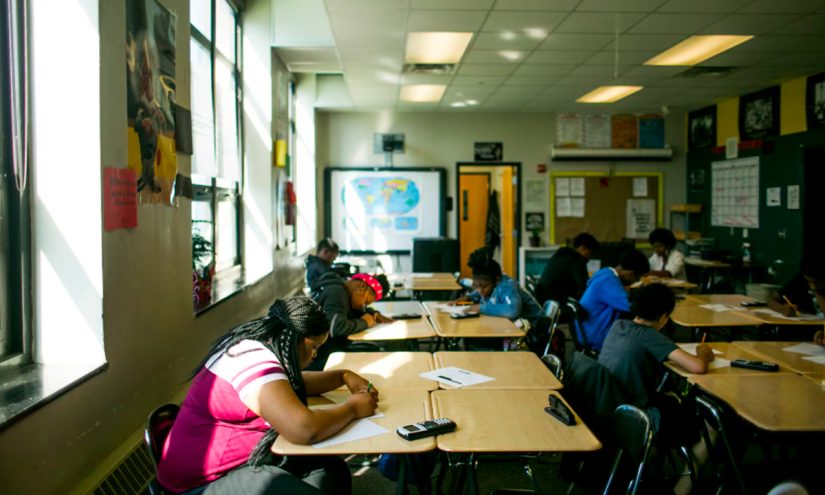
There have been two cycles so far for which students have received the gift cards and, in addition to the 4,936 students who had perfect attendance in at least one of two-week periods, 2,028 have had perfect attendance in both cycles, according to data Superintendent Nikolai Vitti shared with Chalkbeat this week.
The attendance incentive is aimed at improving attendance in the district, where two-thirds of nearly 49,999 students were considered chronically absent during the 2023-24 school year. The incentive is among a number of efforts the district has employed over the years to create an attendance-going culture among students. The district has invested heavily into attendance agents to improve attendance and this school year announced that students with extremely high rates of chronic absenteeism will be held back a grade at the K-8 level and required to repeat classes at the high school level.
The number of students earning the perfect attendance incentive is a fraction of the nearly 15,000 high school students in the district, leading one school board member to question last week whether the incentive is working. But Vitti said he is encouraged that the program is getting more high school students to class and resulting in a small decrease in the chronic absenteeism rate for high school students. He said the district and board will have to evaluate the program’s success at the end of the school year.
Chronic absenteeism has been one of the district’s biggest challenges for years. The chronic absenteeism rate has declined, from a high of nearly 80% at the height of the pandemic, when quarantining rules meant many students missed school because of COVID exposure. But last school year’s much lower chronic absenteeism rate of 66% still means it is difficult to have consistency in the classroom and improve academic achievement.
Students in Michigan are chronically absent when they miss 10%, or 18 days in a 180-day school year. Statewide, 30% of students are considered chronically absent, compared to 23% nationally. A recent education scorecard cited the state’s rate as being a factor in students’ slow academic recovery from the pandemic.
Here are some of the highlights of the students who’ve received the incentive so far::
3,473 students had perfect attendance during the first cycle.
3,492 students had perfect attendance during the second cycle.
About 10% already had perfect attendance.
About 4% were considered chronically absent at the time the incentive began.
About 16% had missed 10% of the school year at the time the incentive began.
About 25% had missed 5-10% of the school year.
About 44% had missed 5% or fewer days in the school year.
At a Detroit school board meeting last week, Vitti said the statistic showing that just 10% of the students who earned the incentive already had perfect attendance is an indication that “this is not just rewarding those that have already been going to school.”
Board member Monique Bryant questioned what school leaders are doing to promote the incentive to students who haven’t earned it.
Bryant suggested that data Vitti shared at the meeting showing that chronic absenteeism is down by 5 percentage points for high school students since the incentive began is an illustration that most students aren’t rising to the goal of the incentive.
Vitti responded that it depends on how you look at the data.
“Right now, chronic absenteeism at the high school levels improved by five percentage points,” Vitti said. “That means that 700 high school students are not chronically absent where they were last year. I’d also say that at least on the 97th day, our chronic absenteeism at the high school levels is the lowest it’s been since the pandemic.”
The question for board members to decide at the end of the school year is whether the incentive “is the right investment with other challenges that we have districtwide,” Vitti said. “But I think the data is suggesting it’s working for many students … but not all.”
Board member Ida Simmons Short urged the district to survey students to learn more about what is preventing them from coming to school.
The causes of chronic absenteeism are numerous and include physical and mental health reasons, lack of transportation,and lack of affordable housing. Most of them tie back to poverty. Vitti specifically cited transportation, because half of the students in the district don’t attend their neighborhood school and the district doesn’t provide school bus transportation for high school students, who must take city buses to get to school.
“Sometimes they’re unreliable, they’re late, they’re too far away from where the child lives,” Vitti said.
Vitti said traditional school bus transportation for high school students “was decimated” under emergency management and it could cost between $50 million and $100 million to bring that level of transportation back.
Another factor, Vitti said, is that for some students, school isn’t relevant. Middle and high school students, in particular, “struggle to understand, ‘why am I going to school every day? How is this connected to what I’m going to I need to know for life.’”
Mi’Kah West, a Cass Technical High School student who serves as a student representative on the board, said that when talking to other members of the District Executive Youth Council last week, many said students overall are excited about the incentive.
One thing that stuck out, she said, was council members saying they heard students in the hallways or on social media saying they were coming to school because they want the money.
“And, while we don’t want to just say we want to come to school for the money,” West said, “I think it’s important to see that students … may have stayed home because they don’t want to come to school, but they’re willing to come to school now.”
Lori Higgins is the bureau chief for Chalkbeat Detroit. You can reach her at [email protected].
Chalkbeat is a nonprofit news site covering educational change in public schools.
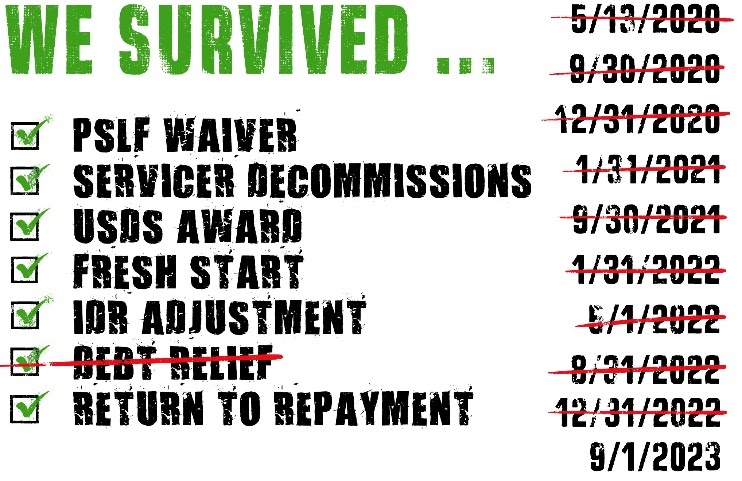
This graphic is part of an email from a US Department of Education official who was recently fired without good cause. Our experiences with this dedicated public servant were always excellent, something we cannot say about others in the DC crowd. The graphic displays a number of important measures that have been enacted by ED-FSA (Federal Student Aid) over the last six years–and one giant failure, general debt relief for more than 30 million citizens. We wish the best for those Department of Education workers who remain, and who may see their jobs made more difficult, privatized, or moved to other agencies. The work cannot be easy for anyone–especially those who care about the folks they serve–the consumers and their families who are less likely to receive justice in the coming months and years.
SUPAI, Ariz. — Kambria Siyuja always felt like the smartest kid in Supai.
Raised by educators in this tribal village at the base of the Grand Canyon, she started kindergarten a little ahead of her peers. Her teachers at Havasupai Elementary School often asked Siyuja to tutor younger students and sometimes even let her run their classrooms. She graduated valedictorian of her class.
But once she left the K-8 school at the top of her grade, Siyuja stopped feeling so smart.
“I didn’t know math or basic formulas,” she said. “Typing and tech? Nonexistent.”
Siyuja, now 22, wiped tears from her face as she sat alongside her mother and grandmother — the educators of the family — one afternoon last year in the Havasupai Tribal Council chambers. The trio wept as they recalled Siyuja’s move as a teenager to a private boarding school 150 miles away in Sedona, Arizona, which she’d chosen to attend because the federal agency that runs Havasupai Elementary, the only school in her village, provides no options for high school.
Kambria Siyuja, right, plans to teach in Supai, like her mother, Jackie Siyuja, middle, who teaches at the tribe’s preschool program. Grandmother and Havasupai Tribal Council chair Bernadine Jones, left, previously taught at the elementary school. Their tribe’s seal is reflected from a window onto a wall in the council chambers. Credit: Matt Stensland for The Hechinger Report
Once there, however, Siyuja discovered how little she’d learned at the Supai school. She had only superficial familiarity with state and U.S. history, and knew none of the literature her peers had read years earlier. She was the only freshman who’d never taken pre-algebra.
Last year, eight years after Siyuja graduated, the K-8 school still did not offer pre-algebra, a course that most U.S. public school students take in seventh or eighth grade, if not earlier. It had no textbooks for math, science or social studies. The school’s remoteness — on a 518-acre reservation the government forcibly relocated the Havasupai people to more than 150 years ago — makes it a challenge to staff, and chronic turnover required the few educators who remained to teach multiple grades at once. Only 3 percent of students test proficiently in either English language arts or math.
“I know they struggle a lot because of how few resources we have down here,” said Siyuja of Supai, which visitors must reach either by an 8-mile hike or helicopter. “But what are they teaching here?”
In 2017, six Havasupai families sued the federal government, alleging that the Bureau of Indian Education, which operates Havasupai Elementary and is housed within the Interior Department, deprived their children of their federal right to an education. The tribe, in a brief supporting the lawsuit, argued that the bureau had allowed Havasupai Elementary to become “the worst school in a deplorable BIE system” and that court intervention was required to protect students from the agency.
The families eventually secured two historic settlements that fueled hopes across Indian Country that true reform might finally improve outcomes both in Supai and perhaps also at BIE schools throughout the U.S.
Related: Become a lifelong learner. Subscribe to our free weekly newsletter featuring the most important stories in education.
So far, the settlements have brought new staff to Supai, and the BIE had to reconstitute the school board. Teachers now must use lesson plans, and they finally have a curriculum to use in English, science and math classes. A new principal pledged to stay longer than a school year.
“We now have some teachers and some repairs to the building that are being done,” said Dinolene Kaska, a mother to three former students and a new school board member. “It has been a long time just to get to this point.”
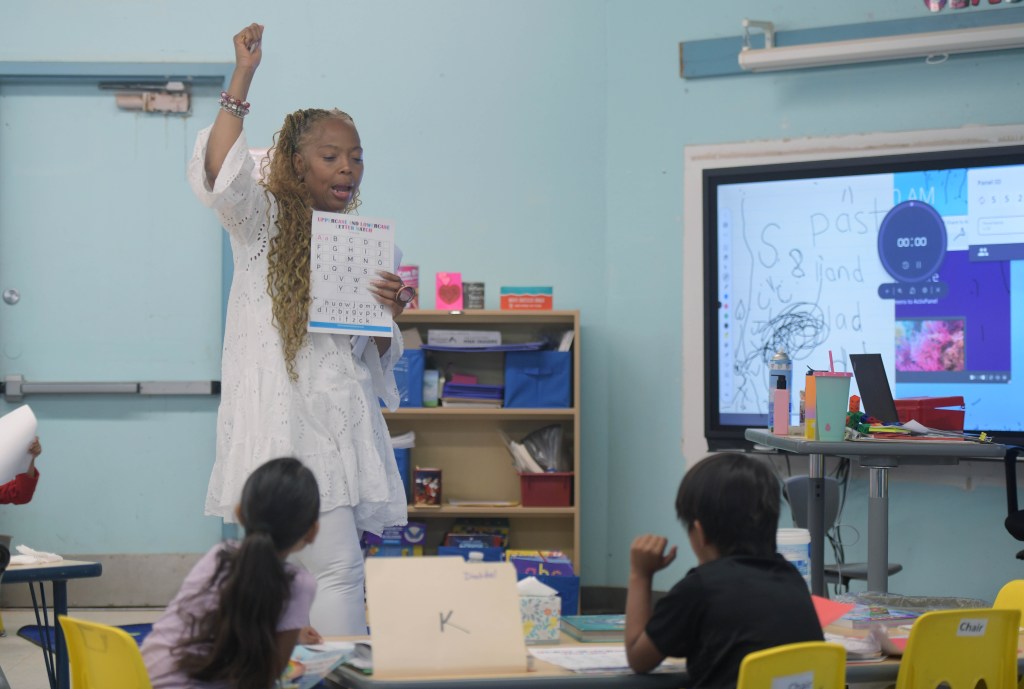
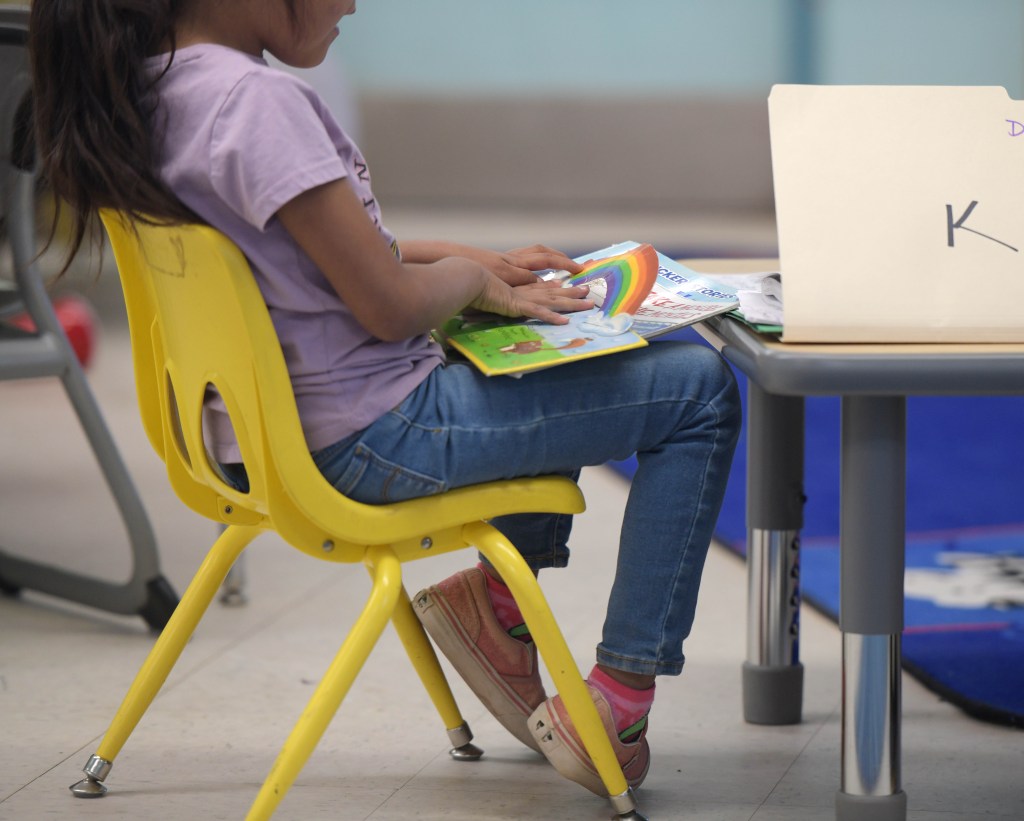
Valencia Stinson leads a kindergarten class through a lesson matching lowercase letters with their corresponding uppercase letters. Credit: Matt Stensland for The Hechinger Report
The legal wins followed an effort to reform the BIE as a whole. In 2014, federal officials unveiled a sweeping plan to overhaul the beleaguered bureau, which had long struggled to deliver better student outcomes with anemic funding. If the BIE were a state, the schools it operates would rank at or very near the bottom of any list for academic achievement.
But in the past decade, and after a nearly doubling of its budget, the BIE has finally started to make some progress. Graduation rates have improved, staff vacancies are down and the bureau built its own data system to track and support student achievement across its 183 campuses in 23 different states. Now, those milestones could be at risk.
President Donald Trump, in his seismic restructuring of the federal government, laid off thousands of workers that will trigger deep cuts to the BIE, among other agencies that work directly on Indian Country. The White House in January also issued an executive order to turn the BIE into a school choice program, draining the bureau of funding and, according to some advocates in Washington, D.C., threatening the government’s long-established trust responsibility to tribal nations. It also remains unclear how the policy would benefit families in isolated communities like Supai where other schooling options are scant or nonexistent.
“Tribes in rural areas don’t have a lot of school choice,” said Quinton Roman Nose, executive director of the Tribal Education Departments National Assembly, a nonprofit that works with tribal education agencies. “For Native students, that’s not a good model. I don’t think it’s going to work for so many.”
Brian Schatz, a Hawaii Democrat and vice chairman of the Senate Committee on Indian Affairs, said the Trump administration’s actions are devastating. “What Trump is doing to the federal government isn’t just reckless — it’s arson,” he said in a statement to The Hechinger Report. “We will do everything we can to ensure that this manufactured chaos does not have lasting impacts on our trust and treaty responsibilities to Native communities.”
Last fall, as conservative critics called for dismantling the BIE and converting its funding into vouchers, longtime director Tony Dearman defended the bureau. He also pitched a new, five-year strategic direction that will emphasize tribal sovereignty and cultural education — both promises the bureau made in its reform agenda more than a decade ago.
“We have really built the capacity of the BIE,” Dearman said. “It’s just taken a while. Anything in the government does.”
Still, he insisted that the BIE could fulfill the government’s obligation to deliver a quality education to tribal nations. “I truly believe that we can handle the trust responsibility with the support from Congress through appropriations,” Dearman said.
For decades, the Department of the Interior, which manages natural resources and wildlife, placed control of schools on tribal reservations within its Bureau of Indian Affairs. The agency oversees law and justice across Indian Country, as well as agriculture, infrastructure, economic development and tribal governance. The agency’s poor management of schools, meanwhile, had been well documented, and in 2006, an internal shakeup resulted in the creation of the BIE.
Almost from the start, the new bureau faced criticism.
In 2008, the Government Accountability Office dinged the BIE for stumbling in its early implementation of the No Child Left Behind education law. A year later, the Nation’s Report Card found Native students in traditional public schools performed much better than those in BIE schools. (About 92 percent of Native students attend traditional public schools and 8 percent attend BIE schools.) Senators scolded the bureau after only 1 in 4 of its schools could meet the new federal education standards. A 2011 report, “Broken Promises, Broken Schools,” cataloged the deterioration of BIE schools, estimating it would cost $1.3 billion to bring every educational facility to an “acceptable” condition.
In 2013, then-Interior Secretary Sally Jewell assembled a study group to diagnose the root causes of academic failures in BIE schools. A year later, the group released the Blueprint for Reform. At its unveiling, Arne Duncan, then the federal education secretary, had damning words for why the BIE needed to change, calling it “the epitome of broken” and “utterly bankrupt.”
The blueprint, issued through a formal secretarial order, called for dramatically restructuring the BIE over two years, starting with its management of tribally controlled schools. In 1988, as part of a renewed focus on tribal sovereignty, Congress had created a grant program to help tribes take control of their respective BIE schools, and as of 2014, a full two-thirds of campuses had already converted.
The 70-page blueprint proposed transforming the agency from a top-down operator of schools into more of an educational services and support center. It would create a division within the BIE to focus on assisting principals with the day-to-day operation of schools. New regional directors and offices would oversee tribally controlled schools, BIE-operated campuses and schools on the sprawling Navajo Nation.
The plan also pitched the addition of “school support solutions teams” at each regional office that would assist with teacher and principal recruitment, school facilities, financial management and technology. A new Office of Sovereignty and Indian Education would help tribes convert their schools to local control and encourage them to shape culture and language classes. Other proposed changes included allowing tribes to tie staff pay to student performance and creating incentives to replicate successful tribally controlled schools.
The study group, however, did not address whether the bureau needed additional funding to pull off the reforms. And without additional funding, the BIE faced deep cuts as budget negotiations pressured then-President Barack Obama to require all federal agencies to reduce their spending by 20 percent.
That essentially tasked the BIE with achieving a turnaround of its failing schools with a fifth less funding. By the time of the blueprint, those cuts were already phasing in: Between 2011 and 2014, for example, the number of full-time administrators located on or near Indian reservations to oversee school spending fell from 22 to 13, leaving the remaining staff to still split 64 reservations among them.
“It was a terrible set up,” said one former top agency official who worked at the BIE during the blueprint’s release. The official, like many of the more than 75 interviewed by The Hechinger Report for this story, spoke on the condition of anonymity because of the DOI’s large role in tribal communities and worries that criticizing the agency could cost them jobs or contracts.
Famous for its turquoise waterfalls — Havasupai means “people of the blue-green water” — Supai village greets visitors at the banks of Havasu Creek.
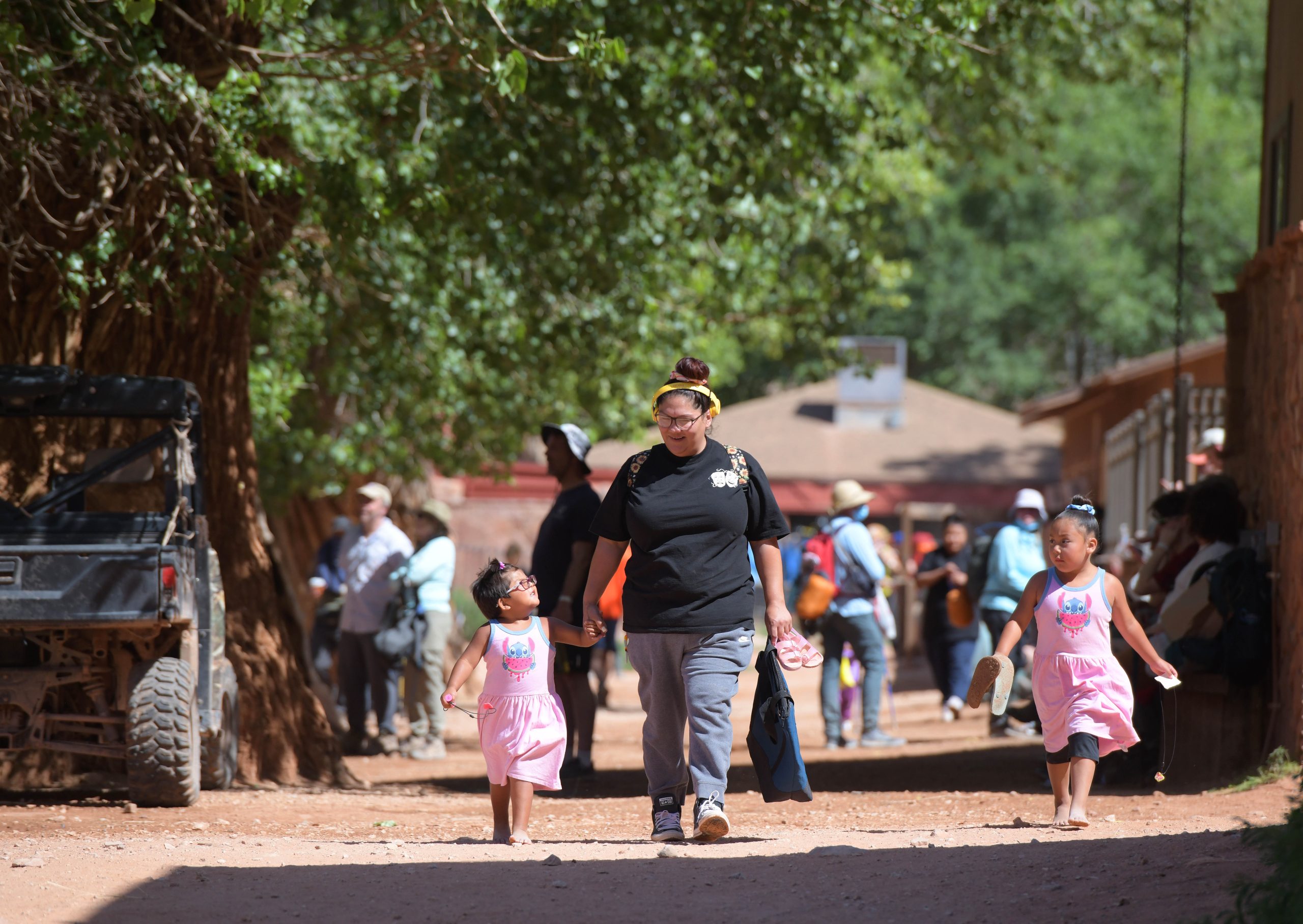
The creek and waterfalls feed a hidden canyon oasis here. Trees bursting with blooms of apricot and pomegranate offer much-welcome shade for backpacking tourists and the mules carrying their gear. Tribal elders wind their way through Supai’s unmarked dusty roads as children on the preschool playground shield their eyes from sand swirling around the adjacent helipad. Benches, some made from milk crates, ring the town square at the front gate of Havasupai Elementary.
Eight years ago, lawyer Alexis DeLaCruz sat on one of those benches in Supai town square. She had recently started working at the Native American Disability Law Center, a firm based in Farmington, New Mexico, that represents Native Americans with disabilities. The firm had recently hosted a training on special education law for parents, and several from Supai, incensed about their kids’ education, traveled out of the canyon to attend. They convinced DeLaCruz and two colleagues to book a helicopter ride into the village to hear directly from parents about their experiences with the BIE.
Parents described how their children couldn’t tell the difference between North and South America and, despite BIE regulations requiring Native culture in all curriculum areas, the students never had a class in Havasupai culture, history or language. Because of a teacher shortage, children learned in classes that combined students from three or even four grades. The school had 10 principals in as many years. The BIE closed Havasupai Elementary for nearly a month in 2015 because of insufficient staffing.
About 100 students each year enroll in Havasupai Elementary School, one of 183 schools that the Bureau of Indian Education manages on 64 tribal reservations across the U.S. Credit: Matt Stensland for The Hechinger Report
Siyuja, who graduated from the school in 2016, remembered cooks and janitors stepping in as teachers — and then having to leave class midday to check on school lunch or plumbing problems.
Until Siyuja reached the fourth grade, Havasupai Elementary, which serves about 80 students, had two tribal members on staff. They led culture and language classes, and Siyuja still owns a copy of the Havasupai dictionary they gifted her as a child. But then they left, and most of the other teachers soon followed, during the 2011-12 school year, she recalled.
That’s when Obama tasked federal agencies with cutting a fifth of their administrative budgets, hollowing out the BIE’s ability to support its schools. In Supai, the already revolving door of educators suddenly started spinning much faster, Siyuja said.
“We were just in this constant loop of relearning the same thing over and over,” she said.
It wasn’t until college, at Fort Lewis College in Colorado, where Siyuja chose to study education, that she learned it was not normal for a school to lump so many grades together in one classroom. “That’s one of the major big no-nos,” she said. (In an email, a BIE spokesperson said, “Many schools implement implement multi-grade instruction as an intentional and effective educational model,” particularly in rural and remote locations, “to enhance individualized learning, maximize resources and promote peer collaboration.”)
In January 2017, nine students from six families sued the BIE and the Interior Department, naming as defendants Dearman, Jewell — who did not respond to interview requests — her deputy assistant secretary and the Havasupai Elementary School principal. The lawsuit listed all plaintiffs under pseudonyms to protect their identity, and the two families involved in the lawsuit who spoke with The Hechinger Report for this story asked to remain anonymous even after the settlements were signed. Some of the students still attend BIE schools, and parents remain worried about exposing any of their children’s privacy, even as adults.
The families hinged their case on a well-established federal right to education for Native American children.
There is no federal right to education in the Constitution, according to a landmark 1973 Supreme Court decision. But for Native Americans, congressional statutes, executive orders, treaties and other Supreme Court opinions dating back virtually to this nation’s founding have cemented education as a major component of the government’s trust responsibility — a set of legal and moral obligations to protect tribal sovereignty and generally look out for the welfare of tribal members. In 1972, lawmakers made it even more clear with the Indian Education Act, which says that the “federal government has the sole responsibility for the operation and financial support” of tribal schools. They also required the BIA — the BIE had not yet been established — to work with tribes to create a system of schools of “the highest quality.” To this day, the BIE pitches itself as a provider of a “world class education.”
DeLaCruz, not long after filing the Havasupai case, started imagining what impact it could have beyond that tiny community.
“Most cases in our legal system end in money,” she said. “This isn’t the same calculus. We’re weighing what we think we can get in place that won’t just make a difference for students now but frankly for generations to come.”
The lead plaintiff in the case was a sixth grader described in the lawsuit as Stephen C. Diagnosed with ADHD, he had never received counseling as mandated in his Individualized Education Program, or IEP, a legal document detailing the interventions and supports that a student with a disability will get from their school. None of the fifth grade teachers the school hired stayed more than two weeks, the lawsuit said, and Stephen C. was taught in a combined sixth, seventh and eighth grade class.
His teacher’s attention split among kids across three grades, Stephen C. started to act out. The school sent him home three to four times a week for behavior issues related to his disability, the lawsuit alleged. Even as an eighth grader, he could barely read or write.
In its friend-of-the-court brief, the Havasupai Tribe said its “people have been isolated at the bottom of one of the world’s most rugged canyons and for more than a century have been forced to depend on the federal government to educate their children.
“Although the days of forced removal and assimilation are over,” the brief continued, “the BIE is still failing its students.”
The federal government didn’t entirely dispute the claims of Stephen C. and his co-plaintiffs.
The BIE and DOI, in June 2017, formally petitioned the U.S. District Court of Arizona to dismiss the case, arguing that the students couldn’t prove the BIE failed or refused to comply with its regulations for what counts as a “basic” education. Also, by that point Stephen C. and four other plaintiffs all had graduated or transferred from Havasupai Elementary, making them ineligible to pursue compensatory educational services, according to the government.
But Lisa Olson, an attorney for the U.S. Department of Justice, also acknowledged the BIE’s shortcomings.
“We are not saying there’s no accountability here. We are just saying that it’s for Congress and the executive to resolve these problems,” Olson said during a November 2019 hearing before U.S. District Judge Steven Logan. “The agency doesn’t dispute that its efforts have been unsatisfactory and they have fallen short.”
Olson asked Logan to consider the many challenges of providing instruction in Supai: There was no funding for an agency helicopter to transport teachers in and out, for example, and new hires often failed their background checks or took other positions before the FBI checks were completed.
“There’s nothing we can do to change that,” she said.
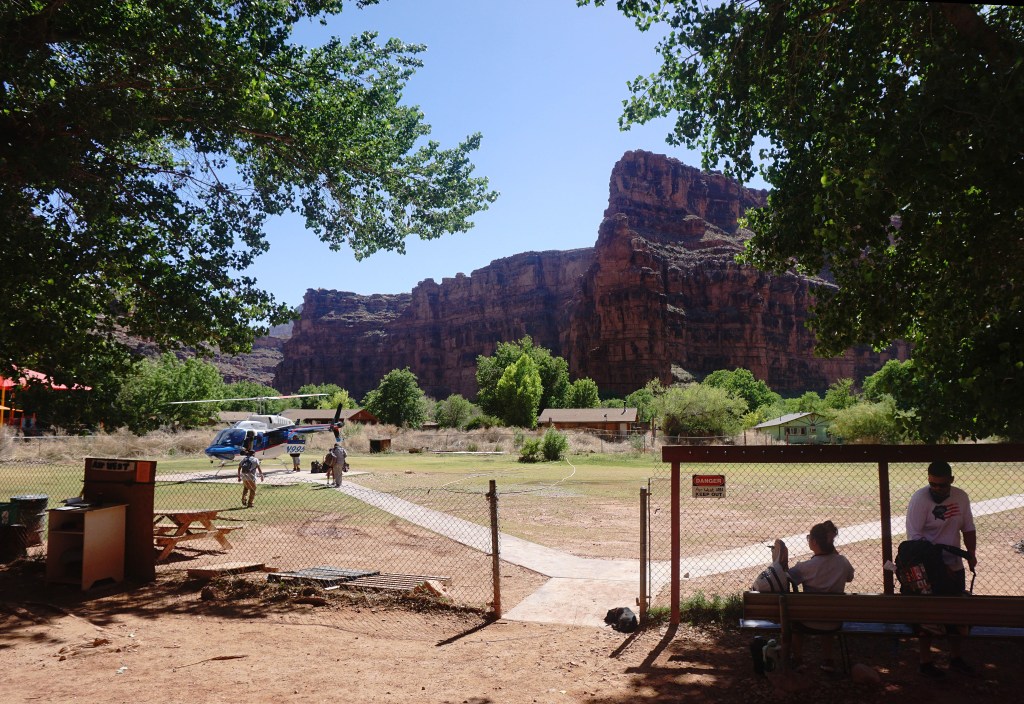
Passengers load into a helicopter at a landing zone next to the preschool’s playground in a central part of Supai village. Credit: Matt Stensland for The Hechinger Report
Logan seemed unmoved. “So what you are basically saying, counsel, is it is the problem of the parents, and they need to make better decisions about where they have children so they can be properly educated?” he said. Olson responded, saying, “It is not the parents’ fault, but we need the cooperation of the parents and the community.” She continued, “I’m saying that BIE is doing its best and tries to enlist the support of parents and the tribe.”
The families also presented a secondary argument — that the complex trauma of Native American children qualifies them for services and protections of the sort that are guaranteed for students with disabilities. They argued that exposure to adversity — specifically, the long-lasting trauma from this nation’s official policy to separate Native children from their families in order to eradicate their cultures and seize tribal land — limited their ability to access the benefits of a public education. To this day, Havasupai families must ship their children away to attend high school, often in other states, and the BIE has no plans to open one in the canyon.
The government warned Logan against following that line of logic, cautioning that it would set a dangerous precedent linking childhood adversity to a student’s ability to learn. The families filed their lawsuit under the Rehabilitation Act of 1973, which prevents discrimination against people with disabilities in federal programs. It does not include adversity or trauma on its list of qualifying conditions, and its applicable regulations expressly note that social disadvantage, such as homelessness or family violence, do not count as impairments, the government noted.
Expanding that definition would threaten to impose “unwieldy” obligations on high-poverty schools across the U.S., the government’s attorneys argued.
“The alleged ‘forced relocation, loss of homes, families and culture,’ and poverty within the Havasupai community … do not constitute a physical or mental impairment,” the motion to dismiss reads.
In August 2020, the federal court issued a mixed decision. Logan allowed the case to continue for students with disabilities. The families also persuaded the court that complex trauma — including interaction with juvenile justice systems, extreme poverty and a denial of access to education — qualifies as a protected disability in the rehabilitation law. But he dismissed the general education claims, deciding that the older students, including Stephen C., had aged out of the school and no potential remedy would be precise enough for a court to enforce.
The Havasupai families cheered Logan’s ruling, but only in part. As they continued to pursue the special education claims, the Havasupai families challenged his decision to dismiss the rest of the case. A three-judge panel of the U.S. Court of Appeals for the 9th Circuit, which includes Arizona, heard their arguments in February 2022.
“The agency is attempting to comply,” Laura Myron, a Justice Department attorney, told the judges. There are, she added, “numerous, practical obstacles to operating a school at the bottom of the Grand Canyon.”
Kathryn Eidmann, president and CEO of Public Counsel, a pro bono public interest law firm, represented the Havasupai families and argued that their ancestors never chose to permanently live in such an isolated location. The government restricted the tribe to the reservation to make way for Grand Canyon National Park.
Hoai-My Winder, new principal at Havasupai Elementary Schools, holds a student’s hand while walking with him during recess. Credit: Matt Stensland for The Hechinger Report
“The obstacles that the government is pointing to that make compliance hard are entirely problems of the government’s own making,” Eidmann said.
In a short five-page decision, the 9th Circuit panel allowed the older students to continue their lawsuit against the BIE. They clarified that judges — namely, Logan — could indeed compel an agency to comply with its own regulations.
The three judges also ruled that the students could seek monetary compensation for the educational services they never received.
Tara Ford, also a pro bono attorney on the Stephen C. case, said at the time that the ruling would reverberate across Indian Country: “Students who have been harmed by the Bureau of Indian Education’s broken promises now have a path to hold the federal government accountable for its failures.”
By then, the students and government had settled the special education claims. Their deal provided each student with $20,000 for compensatory services and required the BIE to follow anti-discrimination provisions of the Rehabilitation Act while creating its first-ever complaint process for parents to challenge suspected discrimination. After the 9th Circuit ruling, however, negotiations to settle the rest of the Stephen C. case stretched beyond a year.
The eventual deal, signed in May 2023, established an $850,000 compensatory education fund for any student who attended Havasupai Elementary since 2011. The BIE estimates about 215 kids could qualify to use that money, meaning each child would receive roughly $4,000, less than some families had hoped for. It also agreed to pay stipends to help recruit and retain teachers in Supai, build additional housing for staff and hire a cultural instructor from the community. The BIE also had to form a new school board.
A year after the case closed, Breanna Bollig, a fellow at the California Tribal Families Coalition, wrote in a legal publication that it could change Native education far beyond Supai.
“The BIE could be held accountable at every other BIE school through similar lawsuits,” Bollig wrote. “Perhaps the federal right to education for Indian children can even be used to improve inadequate and inequitable state public schools that Indian children attend.”
Billy Vides stopped counting at 19.
That’s how many principals he worked with in his first three years as a teacher at Havasupai Elementary. He stayed two more years, submitting his resignation in June.
A longtime educator in Phoenix public schools, Vides first heard of Supai from a pair of grandmothers at an early learning conference. He had considered retiring, but knew he would miss working with kids. Vides searched online for Havasupai, bookmarked an article calling it “America’s Worst Tribal School” and sent in his application.
“I wanted to make a difference,” he said.
The BIE hired Vides in 2019 as a kindergarten and first grade teacher. On his first day, the interim principal assigned him to a combined kindergarten, first, third and fourth grade class. The ages didn’t mix well, he said, and the older kids bullied and sometimes assaulted the younger children.
Joy Van Est, a special education teacher who quit in June, said many of her students’ IEPs had not been updated for several years. It took her four months, the entirety of her tenure there, to update every child’s support plan.
As part of the settlement, an independent monitor every six months must visit Supai and inspect whether the BIE has complied with its own regulations at the school. The monitor must review 104 specific requirements covering student-to-teacher ratios, curriculum taught in each subject, textbooks, grading rules and more. In its first report following a January 2024 visit, the monitor found the bureau in violation of 72 of those requirements.
The school had a curriculum for just one subject — English language arts — and no textbooks for math, science and social studies, the compliance report reads. Teachers used no lesson plans, in any subject, and the school had no librarian. Only one tribal member taught at the school, leading culture and language classes once a week for 45 minutes.
The compliance officer granted the BIE some credit for hiring a school counselor and physical education teacher. However, once-a-week P.E. classes only happened if the part-time teacher could catch a helicopter flight. The counselor started in November 2023, but staff shortages required her to cover teachers’ classrooms too often for her to do any counseling work, the compliance officer found.
The compliance report seemed to have some impact: In the spring, the BIE went on a hiring spree to replenish the beleaguered staff in Supai. A second counselor and special education teacher — Van Est — plus a few additional teachers meant Havasupai Elementary was fully staffed for the first time in years.
A more recent work plan for the school, updated in December, documented further changes: The bureau hired enough staff to meet class size caps. Teachers now submit weekly lesson plans, and the school selected a curriculum and purchased computers for all grades.
The recent recruits include Hoai-My Winder, the school’s new principal. Winder had been working for the Department of Defense, as an administrator at an elementary school in Japan. She previously taught and worked as an assistant principal in Las Vegas, where her family settled after fleeing Vietnam during the fall of Saigon.
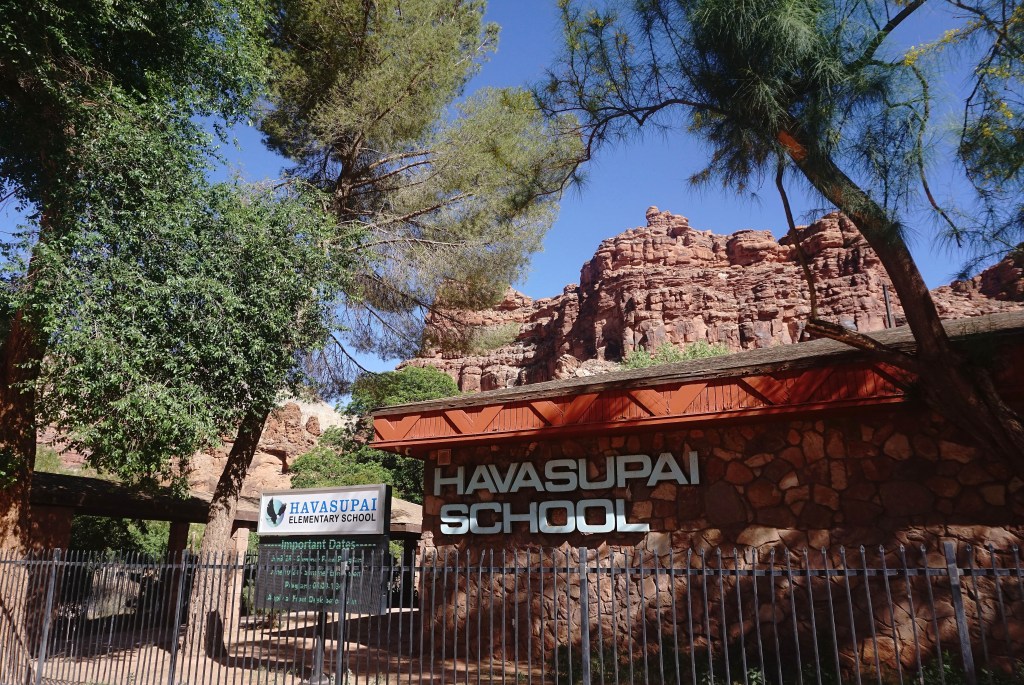
Havasupai Elementary School enrolls students from kindergarten through eighth grade. The Bureau of Indian Education directly operates the campus in Supai village, which visitors must reach via an 8-mile hike or helicopter ride. Credit: Matt Stensland for The Hechinger Report
“Day Six!” Winder hollered one afternoon this past May as she entered the spiked gates that separate Havasupai Elementary from the rest of the village. It was her tally of the number of days she’d been principal — both at Havasupai Elementary and ever.
While her husband unpacked boxes in their new home, Winder took inventory at her new school. She discovered 40-year-old math textbooks on classroom shelves. Havasupai teachers at some point had created a Supai dictionary and draft curriculum for language instruction; Winder found it collecting dust in a box.
As she met with parents and tribal members during her first week, ahead of the eighth grade graduation ceremony that afternoon, Winder repeated a pledge to stay at Havasupai Elementary for at least five years, maybe 10.
Felicia Siyuja, the longtime school secretary, stood next to Winder as families packed into the cafeteria for the ceremony. As the aroma of frybread wafted from the kitchen, Siyuja tapped the mic before addressing the 13 students sitting in the front row.
“I also want to apologize,” she told the soon-to-be freshmen. “All the teachers and principals rotating for all these years. It was hard for me as a grown-up. I can’t imagine how it was for you.”
Eighth graders wearing turquoise-and-gold colored gowns prepare for their graduation ceremony at Havasupai Elementary School. The tribal village, at the base of the Grand Canyon, is famous for its turquoise waterfalls. Credit: Matt Stensland for The Hechinger Report
Aside from Winder and her supervisor, the BIE would not allow The Hechinger Report to interview school staff on the record. But six current or former Havasupai teachers, most of whom spoke on the condition of anonymity, placed blame on the bureau for Havasupai Elementary’s dysfunction.
“The BIE is the problem,” said one teacher. “The BIE lacks humility.”
The educator, who now works at another BIE school, said he never received cultural training to prepare him for working with Native children and families. Several colleagues resigned before winter break his first year in Supai, making him the most veteran teacher on staff.
“I had no curriculum. No student names, no mentor, no oversight or guidance,” he said. “You don’t want to be yet another teacher who comes and goes. After three years, it gets old. It’s just exhausting.”
In a February 10 email, a BIE spokesperson wrote that cultural training, including language preservation, had been scheduled for later that month.
Van Est, who joined the bureau specifically to support its mission of uplifting tribal communities, said last summer that she no longer believed it was capable of doing that job. “The entity that has most recently oppressed the Havasupai people is making absolutely no effort to use education as a tool for repair, as a gold mine for building their future,” she said.
The BIE blames Havasupai Elementary School’s isolation and lack of housing for its troubles.
Even before the Stephen C. lawsuit, the BIE offered lucrative stipends to lure educators to Supai. It also guarantees housing, in theory, but in a pinch has forced teachers to room together. And a recent hiring spree, to satisfy the settlement, has made housing even tighter.
Dearman said a recent housing needs analysis determined the BIE now needs 30 beds in Supai, but has only 12. One teacher simply didn’t return to their position this fall when the bureau couldn’t secure housing for more than a few weeks.
“That puts a major strain on us being able to keep staff there,” Dearman said about the housing shortage. “We have housing needs at other locations as well. However, Havasupai is so isolated that if you’re not able to stay in our quarters there, there’s no other options.”
He said that it’s hard for some educators to uproot their lives to live in Supai. “It’s a difficult place to come in and out of. It really is,” Dearman said.
Poverty surrounds many BIE schools on tribal reservations, largely as a result of former government policies to eradicate Native peoples. In Supai, nearly 40 percent of the tribe lives in poverty, almost four times the national average. Tourism provides an economic bedrock for the Havasupai economy, though many families rely on government assistance.
Vides, the teacher, struggled with his decision to quit. His wife had remained 300 miles away in Phoenix, raising their 3-year-old daughter without him. He missed a lot of her firsts, and felt torn between her and the Havasupai children.
“It was difficult. I was grieving for the future of these students,” Vides said.
“Either the system is continually broken,” he added, “or the system is working successfully to slowly eradicate this tribe.”
Long before Trump’s executive order in January, some conservatives had pushed school choice as a solution to the BIE’s troubles. In 2016, the right-wing Heritage Foundation proposed turning the BIE into an education savings account, or ESA, which would grant families a portion of their child’s per-pupil funding to spend on private school tuition, home-school supplies and other educational expenses. That same year, the late Arizona Sen. John McCain introduced legislation offering ESAs equal to 90 percent of what the BIE spends on each student.
The bill didn’t advance, but Heritage resurrected the idea last year in its Project 2025 transition plan for the next president. Notably, the conservative think tank — despite citing the BIE’s poor track record as justification for converting much of its funding into vouchers — also proposed granting it even more authority over the education of all Native American students, in all U.S. public schools.
In his January order, Trump required the BIE to identify “any available mechanisms” for families to tap federal funding for private and faith-based schools, as well as to report on the performance of its schools and identify alternatives for families to consider. The agency has until April to submit its plan, for implementation this fall. The White House did not respond to several requests for comment.
In certain tribal communities across Arizona, some parents have started to consider opting out of the BIE system. The state passed a universal school voucher program in 2022, giving any family who wants roughly $7,400 to spend on private or parochial schools or other options. Christian academies on the Gila River Indian Community, a reservation near Phoenix, have already used the program to recruit students.
The walls of Havasu Canyon surround the village of Supai, where water from Havasu Creek later connects to the Colorado River at the Grand Canyon. Credit: Matt Stensland for The Hechinger Report
But in Supai, some residents worry the ESA option is meaningless. The closest private schools, in Kingman, are more than two hours away. Internet access in the village is virtually nonexistent, a hurdle for any parents trying to teach their kids at home.
The National Indian Education Association, an advocacy group, has yet to issue a position on Trump’s order but said in a statement that it’s “closely monitoring” potential impact on cultural preservation and access to education for Native students. In the past, the group has said BIE is the best option to fulfill the federal government’s responsibility to educate Native students. It blames its poor results on Congress — the branch of government holding the purse strings.
“The BIE in general, they just have a difficult time,” said Roman Nose, with the national group for tribal education departments. He noted that Department of Defense schools — the only other K-12 system run by the federal government — receive more funding. And Roman Nose worried how the recent federal layoffs and school choice proposal could further erode BIE’s ability to fulfill the trust responsibility.
The BIE lost dozens of employees in the recent layoffs, sources told ICT. Among those laid off were approximately 30 from non-school positions in the BIE agency offices, excluding kindergarten through 12th grade schools.
“There won’t be any progress made during this administration,” Roman Nose said. “It’s a difficult job, but these are treaty obligations.”
Dearman, the bureau’s longtime director, insisted that the BIE could fulfill the government’s obligation to deliver a quality education to tribal nations.
Under his leadership, the BIE has secured some financial wins for its schools. Lawmakers now funnel about $235 million into the bureau for school construction – it has asked for more than $400 million – and $150 million for replacing older campuses, according to the agency. Counselors and teachers now make the same amount as their counterparts in Department of Defense schools. And Dearman, a longtime champion of early childhood education, has expanded the bureau’s popular preschool program into more schools.
Traditional beadwork decorates an eighth grader’s graduation cap at a Havasupai Elementary School ceremony. The school’s mascot is the eagle. Credit: Matt Stensland for The Hechinger Report
Graduation rates have also climbed. Last year, according to the bureau, 75 percent of its high schoolers earned a diploma on time — a 31 percentage point jump since 2014 and slightly above the national average for Native American students. As of 2021, the last time the BIE reported achievement data, 17 percent of students tested on grade level in English language arts, and 11 percent in math. For three states where the BIE runs two-thirds of its schools, students have posted 8 percentage point increases on English exams and 13-point increases on math exams since 2016, according to the bureau.
The U.S. Government Accountability Office, which has tracked the BIE’s “systemic management weaknesses” since 2013, recently reported that it had achieved substantial progress on school construction and safety. The bureau’s oversight of special education, distance learning and school spending remain open problems, the GAO found, while also noting in its report — released just days before Trump’s recent layoffs — that meager staffing “has been a challenge for BIE for over a decade.”
DeLaCruz left the Native American Disability Law Center in October to work on education litigation for the Tulalip Tribe in northern Washington state. A little more than a year after closing the Havasupai case, she hesitated to call either settlement a win.
Still, she noted in an email that the creation of a school board at Havasupai Elementary had been a big step forward: “The fact there is a community-led School Board to ask questions and voice concerns to the BIE is vital to improving education at Havasupai Elementary School.”
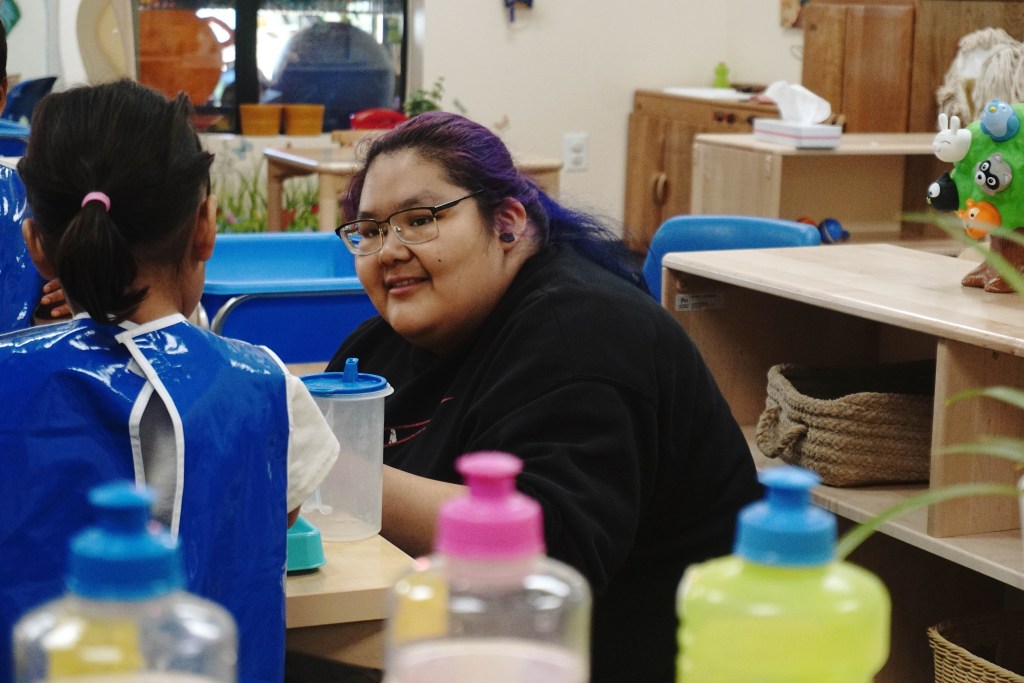
Kambria Siyuja works during her summer break at Supai’s preschool program. Siyuja graduated from Havasupai Elementary School down the road and plans to teach there after graduating from Fort Lewis College next year. Credit: Matt Stensland for The Hechinger Report
The morning after the eighth grade graduation ceremony, Kambria Siyuja walked past her old elementary school as the sun crawled over the rust-red walls of Supai Canyon.
She greeted parents dropping off their sleepy toddlers at the federal Head Start preschool. Siyuja has worked there every summer break in college, hoping to decide whether to pursue a job in early learning or teaching down the road, at Havasupai Elementary.
Her grandmother, Bernadine Jones, attended Havasupai Day School in the 1960s, when it only offered K-2 classes, before attending and graduating from a Phoenix high school. She eventually returned to Supai and taught at her old school and the village preschool for 20 years. Siyuja’s mother teaches at the tribal Head Start program.
Academically, Siyuja finally feels prepared to be a teacher.
“It’s really weird taking a class in college and learning stuff they should have taught me at that elementary school,” she said. “Now I’m really able to understand math, and also teach math.”
This winter, Siyuja returned home for break with big news. Not only had she finally finished remedial math and qualified for a math class this past semester that would earn her full college credit, she’d passed it, receiving a B.
Siyuja also recently learned she qualified for about $3,500 from the Stephen C. settlement. She said she had planned to use the money to pay for her spring semester of college, but as of February, had not heard back from a BIE representative about the payment.
She graduates from Fort Lewis College, the former site of a notorious Indian boarding school, in 2026.
Despite her misgivings about the BIE, she said she views becoming an educator at the school as the best way possible to help her community. “I just want the younger kids to have a much better education than we got.”
Contact staff writer Neal Morton at 212-678-8247 or [email protected].
This story about the Bureau of Indian Education was produced by The Hechinger Report, a nonprofit, independent news organization focused on inequality and innovation in education, in collaboration with ICT (formerly Indian Country Today). Sign up for the Hechinger newsletter. Sign up for the ICT newsletter.
The Hechinger Report provides in-depth, fact-based, unbiased reporting on education that is free to all readers. But that doesn’t mean it’s free to produce. Our work keeps educators and the public informed about pressing issues at schools and on campuses throughout the country. We tell the whole story, even when the details are inconvenient. Help us keep doing that.
A federal judge Friday extended a temporary block on the National Institutes of Health’s plan to slash funding for universities’ indirect research costs amid a legal battle over the policy change.
The nationwide block, which U.S. District Judge Angel Kelley put in place Feb. 10 soon after a coalition of state attorneys general, research advocates and individual universities sued the agency, was set to expire Monday. But it will now remain in place until Kelley has time to consider the arguments the plaintiffs and NIH presented at a hearing Friday morning.
It’s unclear when Kelley will rule. But after the two-hour hearing, she said she certainly “has a lot of work to do” to before making a decision.
“This case is not about whether as a policy matter the administration can target waste, fraud and abuse,” Katherine Dirks, an attorney for the Massachusetts attorney general’s office, told the judge during the hearing. “It’s contrary to the regulations which govern how these costs are determined and how these payments are disbursed. If there were an intention on the administration’s part to change the mechanism by which those occur, there’s a process for it—a statutory process and a regulatory process. Neither of those were followed here.”
But the NIH’s legal team said the agency has the right to unilaterally cap reimbursements for costs related to research—such as hazardous waste removal, facilities costs and patient safety—at 15 percent.
“This is not cutting down on grant funding,” said Brian Lea, a lawyer for the NIH, said at Friday’s hearing. “This is about changing the slices of the pie, which falls squarely within the executive’s discretion.”
Counsel for the plaintiffs, however, argued that the policy is unlawful and, if it’s allowed to move forward during a protracted litigation process, will cause “irreparable harm” to university budgets, medical breakthroughs and the patients who may not be able to enroll in clinical trials as a result.
“A clinical trial is for a lot of people a last hope when there’s not an FDA–approved medicine that will treat their condition. Any minute that they’re not enrolled in that trial brings the risk of irreparable harm,” said Adam Unikowsky, an attorney for the plaintiffs. “Part of these institutions’ mission is serving these patients, and this cut will irreparably harm their ability to fulfill that mission.”
Since 1965, institutions have been able to periodically negotiate their reimbursement rates directly with the federal government; university rates average about 28 percent. However, rates can vary widely depending on factors such as geographic cost differences and the type of research, and some institutions receive indirect reimbursement rates of more than 50 percent of their direct grants.
Although the NIH argued in court that indirect costs are “difficult to oversee” as a justification for cutting them, the plaintiffs refuted that claim, pointing to a complex negotiation process and regular audit schedule that’s long been in place to ensure the funds are being used to support NIH research.
In fiscal year 2024, the NIH sent about $26 billion to more than 500 grant recipients connected to colleges—$7 billion of which went to indirect costs.
Saving or Reallocating $4B?
This isn’t Trump’s first attempt to cap indirect costs, which Elon Musk—the unelected billionaire bureaucrat overseeing the newly created Department of Government Efficiency—recently characterized as a “rip-off” on X, the social media site he owns.
In 2017, Congress rebuked President Trump’s attempt to cap indirect costs, and it has written language into every appropriations bill since specifically prohibiting “deviations” from negotiated rates. Given that, Kelley asked the Trump Administration’s legal team, how in his second term, Trump “can unilaterally slash these previously negotiated indirect cost rates which Congress prevented him from doing previously?”
“The money that is saved—it’s not being saved, it’s being reallocated—will be taken from indirect costs and filed into new grants that will be using the same funding formula,” said Lea, who told the judge he was using air quotes around the word saved. “The money is not being pocketed or being shipped somewhere else. It’s being applied back into other research in a way that best fits NIH and what will best serve the public’s health.”
But Lea’s claims that the money will simply be reallocated contradicted the NIH’s own social media post from Feb. 7, which said the plan “will save more than $4B a year effective immediately,” and Kelley asked for an explanation.
In response, Lea said the NIH’s “tweet was at best sort of a misunderstanding of what the guidance does.”
The Department of Health and Human Services, which oversees the NIH, did not immediately respond to Inside Higher Ed’s request for comment on whether it plans to issue a widespread public correction on social media and its other platforms to clarify its policy and inform taxpayers that their plan to cap indirect costs is not intended to save them any money. As of Friday afternoon, the post was still up on X.
Layoffs, Canceled Clinical Trials
But Unikowsky, an attorney for the plaintiffs, said that funneling money away from indirect costs would still harm the nation’s esteemed scientific enterprise, which is grounded in university research.
“Indirect costs are real costs associated with doing research,” said Unikowsky, pointing to the California Institute of Technology as an example. The institute spent $200 million to build a state-of-the-art laboratory and is counting on indirect cost reimbursements from the NIH to help pay off the debt it incurred to construct it.
“There’s going to be a hole in Cal Tech’s research budget” and the “money is going to have to come from somewhere else,” Unikowsky added.
Unikowsky also listed nine different institutions, including the Universities of Florida, Kansas and Oregon, that have said they will have to lay off skilled workers who support medical research, including nurses and technicians, if the cap goes into effect.
Lea, the lawyer for the Trump Administration, countered that destabilizing university budgets doesn’t amount to immediate and permanent harm warranting injunctive relief on the rate caps.
“That’s not an irreparable thing, or else every business that’s in a money pinch could just come in and get an injunction,” he said. “I understand that many institutions would prefer to use endowments and tuition for other purposes, but unless they’re barred from doing so—and the inability to do so would cause some non-monetary harm—that’s not irreparable harm.”
Although Kelley gave no indication on when or how she plans to rule, some university leaders who listened to the hearing came away optimistic that she’ll favor the plaintiff’s arguments.
“We look forward to the judge’s ruling,” said Katherine Newman, provost at the University of California which is one of the universities suing the NIH. “[We] maintain our position that the Administration’s misguided attempt to cut vital NIH funding is not only arbitrary and capricious but will stifle lifesaving biomedical research, hobble U.S. economic competitiveness and ultimately jeopardize the health of Americans who depend on cutting-edge medical science and innovation.”
The U.S. Department of Education’s Acting Assistant Secretary for Civil Rights issued a “Dear Colleague” letter last week that overflowed with misrepresentations of diversity, equity, and inclusion initiatives in our nation’s educational institutions. The threat of losing federal funding has understandably spooked many of you. It is clear to others and me that inciting such fear, as opposed to actually holding institutions accountable for doing right by students and employees whom racial discrimination most persistently harm, was the aim of the Department’s letter.
I am writing to publicly furnish guidance that I have privately offered to principals, superintendents, college and university presidents, education governing board members, and journalists over the past seven days. But before doing so, I start with a question that I posed in this Forbes article more than a year ago: “What sense does it make to know something is a lie and to have examples of what’s actually true, yet deliberately hide those truths for fear of what liars might do?” Much of what was conveyed in the Department’s letter was largely untrue—at best based on anecdotes, not on credible evidence systematically collected from surveys of students and employees, or from rigorous analyses of discrimination reports disaggregated by race.
To be sure, persons (no matter how small in number) who experience discrimination, harassment, abuse, and other forms of injustice deserve protections and remedies from their educational institutions and the federal government. But the Department’s letter insists that it is white and Asian students who are most on the receiving end of these experiences. A corpus of evidence published over five decades makes irrefutably clear that Asian American, Black, Indigenous, Latino, and multiracial students and employees most often experience racism on campuses. Paradoxically, the Department’s letter calls for the elimination of policies, offices, programs, and activities that aim to address those historical and contemporary norms. This is guaranteed to result in more discrimination, harassment and abuse. In addition, racialized opportunity and outcomes disparities that disadvantage people of color will widen and new racial inequities will emerge.
Here are 11 actions I recommend for higher education institutions that are truly committed to anti-discrimination and anti-racism:
Maintain mission fidelity: Many college and university mission statements have long included language about fostering inclusive learning environments, preparing students for citizenship and work in a diverse democracy, and other values that qualify as DEI. If and when the Department probes an institution, you must be prepared to show how and why various DEI efforts are essential for mission actualization.
Show your work: The Department’s letter will compel many of you to hide, rename, or altogether discontinue DEI initiatives. I insist on doing the opposite. Now is the time to showcase DEI activities to confirm that they are not the racist, divisive, discriminatory, and anti-American activities that obstructionists erroneously claim.
Show your racial equity data: Transparency about racial disparities in student outcomes and various employee trends should be used to justify the existence of DEI policies and programs. Black undergraduate men, for instance, are often at the bottom of most statistical measures of educational progress and performance; my and other scholars’ research confirms that it is not because those students were undeserving of admission or are academically less capable. Data like these could help justify the need for Black male student success initiatives.
Show racial discrimination data trends: Educational institutions are required to have reporting and investigation processes for claims of racial discrimination. As previously noted, the Department’s letter makes is seem as if white and Asian students are being most routinely discriminated against. It might just be that your campus data shows something different. It is important to present year-over-year trends, as opposed to a one-time snapshot. These data could be used to justify the existence of various DEI policies and programs.
Assess the campus racial climate: The National Assessment of Collegiate Campus Climates (NACCC) is a suite of peer-reviewed, expert-validated quantitative surveys that are administered to every student or employee at a participating institution, including white people. Whether you use the NACCC or some other data tool, now is the time to formally assess the climate to determine if and how persons from different racial groups are experiencing the institution. The NACCC has been administered on hundreds of campuses over the past six years—very few white respondents have reported what the Department’s letter alleges. It is important for institutions to provide climate survey data about which groups most frequently encounter discrimination, harassment, abuse, and exclusion.
Rely on evidence: A dozen highly respected researchers contributed to Truths About DEI on College Campuses: Evidence-Based Expert Responses to Politicized Misinformation, a report published last March. This document is just one of several hundred research-based resources (including peer-reviewed studies published in top academic journals) that confirm the educational and democratic value of DEI in higher education. You should use these evidence-based resources to justify the continuation of your institution’s policies and programs.
Insist on evidence: DEI attackers make numerous untrue and exaggerated claims about what is occurring on campuses. Educational leaders have the right to insist that outside accusers furnish evidence of widespread discrimination, harassment, and abuse. Data sources must be rigorous, trustworthy, and verifiable. One-off examples and small numbers of anecdotes ought not be accepted as evidence of pervasive wrongdoing. Imagine if someone told lies about you as an individual person—you would demand proof. Institutions that have committed themselves to DEI deserve this, too.
Articulate consequences: As the federal government, state legislators, and others scrutinize campus DEI efforts, it behooves leaders and employees not only to amplify the value of these policies and programs, but also to forecast what would occur in their absence. For example, how the discontinuation of a first-year transition program for Indigenous students would widen first-to-second-year persistence rate disparities between them and peers from other racial groups. Or how financially devastating lawsuits would be to institutions if less attention was paid to improving the workplace climate for the groups of employees whom years of investigations data confirms experience the highest levels of discrimination and harassment on campus.
Ensure reporting equity: The Department’s letter includes a link to this webpage where “anyone who believes that a covered entity has unlawfully discriminated may file a complaint with OCR.” It is important for white and Asian American, as well as for Black, Indigenous, Latino, and multiracial people to know this reporting site exists. If it is distributed through only a limited number of cable news and social media channels, then there is a chance that those who experience discrimination most often will not be aware of its existence. It is similarly important to remind students and employees of how to access campus-level reporting resources.
Humanize DEI professionals: As many DEI professionals were being fired from their federal jobs last month, I recognized their humanity in this TIME article. I specifically noted the following consequences for them: “Some of these workers now won’t be able to afford daycare for their kids or elder care for their aging parents. Others have children in college whose tuition payments are suddenly in limbo because of politics. Some will lose their healthcare benefits. Too many of these workers will struggle to find other jobs because of the false narratives that are being told about DEI.” Professionals who do DEI work everywhere, including in higher education, deserve greater protections from their employers. These innocent people deserve colleagues like you who use your platforms to communicate threats to their lives and careers.
Form coalitions: The tone of the Department’s letter is serious. It has many people scrambling on their individual campuses. We need institutions to come together to collectively strategize, defend their DEI commitments, push back and sue. Attempting to do this in isolation will not yield the macro-level outcomes that our democracy and its educational institutions deserve. Last fall, I launched the National DEI Defense Coalition. So far, hundreds of scholars, leaders, and DEI professionals have contributed. In the next few weeks, I will publicly announce ways for others to participate. But meanwhile, please leverage existing networks (professional associations, athletic conference memberships, and so on).
These are not the only ways institutions can defend DEI policies and programs, but my hope is that they provide some helpful guidance in response to the Department’s letter as well as to other politicized misinformation, disinformation and anecdotal exaggerations about who is being most frequently discriminated against on campuses.
For Democracy,
Shaun Harper
Shaun Harper is university professor and provost professor of Education, Business and Public Policy at the University of Southern California, where he holds the Clifford and Betty Allen Chair in Urban Leadership.
We’re rounding up recent stories, from a letter attempting to prohibit colleges’ diversity initiatives to an analysis of graduates’ earnings over time.
The value of internships for students’ career navigation and future employment opportunities is clear for colleges and many employers. But what do students think of internship experiences, and how do they benefit them in their future planning?
A new report from Handshake, published Feb. 20, highlights trends across students who have and have not participated in internships, the impact on their goals beyond college, and the barriers that hinder engagement.
Among the trends present: More interns are participating in paid internships and earning above minimum wage while doing so, and company culture can influence students’ willingness to return for a full-time position.
Methodology
Handshake’s Internship Index was assembled with data from a November 2024 survey of more than 5,605 students and 834 recent graduates, as well as job posting and application data from the platform. Recent graduates are those who completed their degree in 2022, 2023 or 2024.
Why intern? A majority of students said they pursue internships to build valuable skills (87 percent), to identify possible career opportunities (72 percent), to make professional connections (70 percent) or to get a leg up in their future job hunt (70 percent). About 59 percent say participating in an internship is an essential step toward clarifying their career goals.
Only one-third of students identified fulfilling a degree requirement as a primary factor for pursuing an internship, and just over half indicated financial motivation for interning.
Among students who have completed an internship, more than 80 percent say the experience shaped their preferences for industries and job roles. Around 54 percent of students said their internship made them more confident in their career goals, and 56 percent said it was essential for making progress toward career goals. One-quarter said it inspired them to set new career goals, which can be similarly valuable.
A winter 2023 Student Voice survey by Inside Higher Ed and College Pulse found 10 percent of students identified an internship as a top influence on their career decisions for after college.
What hinders internships: Around 12 percent of students in the Handshake study have not participated in an internship and do not expect to do so prior to finishing their degree. The greatest share of these students say they’re limited by time (33 percent)—overwhelmed by coursework and other commitments—or they’ve applied for roles and haven’t been selected (33 percent).
“Students may feel shut out of internships for a variety of reasons, ranging from packed schedules to financial and geographic constraints,” the report says. “Even for students who have ample time and resources, landing an opportunity has become more difficult as hiring contracts and competition increases, and the application process may feel overwhelming given the variation in hiring timelines across employers and industries.”
Internal data shows demand for opportunities among students that is outpacing the supply. The number of internship postings on Handshake declined 15 percent from January 2023 to January 2025, but applications surged, with 41 percent of the Class of 2025 having applied to at least one internship through Handshake, compared to 34 percent of the Class of 2023.
Only half of recent college graduates participated in an internship while enrolled in an undergraduate program. Even among students who do land an internship, time continues to be limited, with 56 percent of interns simultaneously taking classes and 36 percent working a part-time job. Around one in eight students said that their internship required them to work 40 hours a week or more.
First-generation students were more likely to say they completed an internship while taking classes or working (80 percent) compared to their continuing-generation peers (70 percent).
Almost all internships (95 percent) posted on Handshake in the past year were paid, which students say is important to them in selecting an internship role.
A majority of students who participated in an internship had an hourly wage (57 percent) or a fixed salary or stipend (24 percent). The highest average rate was for student interns working in professional services ($35 an hour) or financial services ($31 per hour). Students working in hospitality or education received the lowest average rate of $17.50 an hour.
A talent pipeline: Internships can be a great way for a student to get a foot in the door of a company and for the employer to offer training and a career pathway for early talent. Handshake’s data shows that the interpersonal experiences students have while in their internships can influence their desire to hold a full-time role in that company.
Three in five interns said the mentorship they received or didn’t receive had a major impact on their level of interest in working full-time for their internship employer.About 89 percent of students said team culture at least somewhat impacted on their interest in working full-time for their internship employer, and 90 percent said the same of their interactions with colleagues.
Similarly, pay was a factor that impacted students’ consideration of a full-time role at their employer. Eighty-two percent of interns who had a fairly compensated role would likely accept a full-time offer from their internship employer, compared to 63 percent of those who didn’t feel their pay was fair.
After finishing their internship, 59 percent of students said their experience impacted their interest in working for their employer at least moderately, but only 30 percent said they would definitely accept a full-time offer from their employer.
Get more content like this directly to your inbox every weekday morning. Subscribe here.
In a minorly famous letter to the duchess of Sutherland, Henry James advises that The Ambassadors should be read “very easily and gently,” specifying that his correspondent should ideally “read five pages a day.” At this pace, the duchess would have taken almost exactly 13 weeks to finish the book if she read every day of the week. One imagines that the novel would be tucked into otherwise inaccessibly glamorous, luxurious days for the duchess, days filled with, among other comforts, corresponding with James about how to read his latest novel.
Five pages a day is very slow reading, but most of us would love to approach our reading at a more leisurely pace, if not a pace determined so prescriptively. On the other side of the spectrum of reading experiences, one finds the average student in college English classes—both undergraduate and graduate. To use my experience as an example, I was at the nadir of my reading life as an undergraduate English major; as someone who naturally reads quite slowly, I spent many nights of my undergraduate career standing at my dresser so I wouldn’t fall asleep while reading. (I couldn’t afford, and doubt I had ever heard of, a standing desk at that point in my life, and my dresser was the tallest piece of furniture in my room.)
While doing this, I often took notes blindly in a notebook with my right hand while I held whatever book I was reading in my left. I would reread my notes the next morning to help me remember what I had read the night before. I loved the books I was reading, and I wanted to succeed in the classes I took, but I was also, by trying to read upward of 500 pages a week, making myself miserable.
I don’t blame the professors who assigned the reading—all of them were gifted pedagogues, and not all of them assigned too much reading. They, too, inhabited a culture in which they were expected to work quickly and fulfill numerous demanding institutional roles (years later, I still remember one of my undergraduate professors saying she worked around 70 hours a week).
Now that I’m on the other side of the academic experience, however, I’ve come to realize that each of us is responsible for resisting a culture that is, by all accounts, making students anxious, depressed and—dare I say it—unproductive at unprecedented rates. Students in undergraduate classes are primed to work quickly. Almost every part of their life—their experience on social media, their online shopping, their use of ChatGPT to complete assignments and their selection of a route on Apple Maps—is designed to help them reach tangible and intangible destinations as quickly as possible. Most students, meanwhile, are terrible at working slowly.
As academicians, we’re constricted, of course, by all the reasonable and unreasonable demands placed on us by work, family and the other important parts of life, and when we read—especially when we read for professional, critical purposes—we read and work as quickly as possible, that “possible” being an ever-nebulous boundary toward which we strain and suffer while still trying to produce quality work. As professors, if we read books like The Ambassadors, we’re likely to read them in bursts and chunks—butcherly words that sound as unappealing as the process of reading a dense, beautiful novel in such a manner actually is.
While we cannot, in the immediate future, totally alter the institutional structures of postsecondary liberal arts education, there are still things that English professors can do to resist the pressure for speed. Chief among them is to design a classroom that encourages our students to go slow.
In their 2016 book, The Slow Professor, Maggie Berg and Barbara K. Seeber challenged the culture of speed in academia by advising faculty to work more slowly, a laudable goal, but one that critics pointed out was a luxury that untenured faculty simply couldn’t enjoy. The problem, of course, is that the people who design a job decide how much work ought to be accomplished in a given time frame, and untenured faculty have little control over the amount of work they are expected to produce to attain job security. However, what almost all professors, regardless of contract status, do have control over is how much work we require within a given time frame from the students we teach. In other words, we should design classes that treat our students in a way that we’d like our institutions to treat us.
As English professors, our job is not to encourage quick thinking but to foster thorough, imaginative and critical thinking. To do this, we must design our courses to foster and prompt slow work that breaks students out of the habits of expediency they have developed throughout their time in school. Designing classes that foster intentional slowness takes effort, but it also means that we can craft the kinds of spaces that make literature enjoyable and show students the value and beauty of literary texts when they are encountered in an environment suitable for literary consumption.
A slow classroom can take several forms. In the slow classes I’ve taught, it means requiring students to purchase paper copies of the texts we read and to keep a real, physical journal in which they respond to prompts weekly outside of class. I also do something in these classes that I wish someone had done for me when I was a student: I make it clear that they should spend a certain amount of time on work for my class outside the classroom but that they should also give themselves a cutoff time, especially when it comes to reading for class. I tell them that I take around two or three minutes to read a page of a novel well, sometimes more if the prose is dense, and that they should plan for each page of reading to take three to four minutes. I also tell them that if they make time to read and don’t finish, they shouldn’t panic; they should move on with their day and enjoy the nonacademic parts of their life.
Most importantly, I assign less reading. Of course, I’d love to live in a world where my students have thoroughly read the English literary canon (whatever that means), but more than anything, I want them to have read something and to have read it well. To this end, I try to assign between 20 and 30 pages of reading per class meeting, which amounts to around 10 to 15 pages per day, not too far from James’s edict. Rather than just assigning this reading and hoping for the best, I explain to my students about why I assign this number of pages, talk to them about creating and choosing a time and space to read in their daily lives, and describe the process of reading in my class as one they should understand as a reprieve from the time-pressured demands of other courses.
In class, I designate much of our time together as technology-free in order to make space for the rich and meaningful conversations that occur most fruitfully when we aren’t distracted by notifications from our phones and laptops. Students engage in small group and classwide discussions, and I challenge them with daily questions that push them out of their comfort zones. I task them with coming up with steel man arguments in support of cultural and fictional villains, I ask them to articulate what makes a good life by finding evidence for and theories of good lives in their reading, and I frequently make them dwell with a given scene until we’ve extracted every last bit of sense (and often a bit of senselessness) from it.
We tackle around one question a day, if we’re lucky. But the answers and questions we walk away with are finer and fuller than the formulaic answers that students give when they’re in a hurry. In return for designing my class in a way that allows students to work slowly, I expect around the same amount of essayistic output in terms of page numbers, but I design essays to be completed slowly, too, by scaffolding the work and requiring creative responses to prompts to encourage the slow, critical thinking and writing that English professors long to read and rarely encounter. I’ve received work that was thoughtful and occasionally even beautiful, work that couldn’t have been written by AI.
In many ways, my experience of earnestly trying to read around 500 pages of fiction a week as an undergraduate might seem anachronistic. Professors across disciplines have noted the apparent inability of students to engage with any extended reading, whether this means they’re not reading at all or that they just ask ChatGPT to do the “reading” for them. The irony of worrying—as many academics seem to be doing these days—that students will use artificial intelligence to read or write for them is that many undergraduate classes require students to work like machines, to read and write at a breakneck pace, a demand that prompts the ridiculous phenomenon of classes on speed reading, which many universities advertise and which are also available online (the one I’ve linked here is accompanied by the terrifying motto “Reading at the Speed of Thought™”).
In a discipline for which the core method is close reading, the idea of students reading a novel as quickly as possible ought to make English professors shudder, and while it’s not necessary to dedicate an entire semester to a single novel, we ought to see course design as part of the solution to students rushing through their work. In an age that privileges fast work, near-constant availability and answers on demand, the slow English classroom is a reprieve, a space where deep, creative and inspired thought is given the time it needs to blossom.
While our students will likely never occupy the rarefied spaces that the duchess of Sutherland enjoyed when James wrote to her in 1903, with our guidance and course design, they can experience the joy, power and, yes, the luxury of reading and writing slowly. We just have to give them the time.
Luke Vines is a sixth-year Ph.D. candidate in the Department of English at Vanderbilt University. He recently began serving as the assistant director for academic support at Berry College.
More Republican politicians are calling for colleges to end their partnerships with Chinese universities.
U.S. representatives John Moolenar and Tim Walberg wrote letters to the presidents of Eastern Michigan University, Oakland University and the University of Detroit Mercy demanding that they cancel their partnerships with institutions in China, expressing concerns that sensitive research could help the Chinese military advance its technological capabilities.
“The university’s [People’s Republic of China] collaborations jeopardize the integrity of U.S. research, risk the exploitation of sensitive technologies, and undermine taxpayer investments intended to strengthen America’s technological and defense capabilities,” Moolenar and Walberg wrote in all three letters. “You must immediately terminate these collaborations.”
Moolenar and Walberg’s letters come a few weeks after the University of Michigan ended a 20-year partnership with Shanghai Jiao Tong University. In September, Moolenar wrote a similar letter to Michigan president Santa Ono demanding an end to that collaboration after five Chinese international students were caught taking photos of training exercises at nearby Camp Grayling, where the state National Guard trains.
EMU has partnerships with Beibu Gulf University and Guangxi University; Oakland partners with Changchun University of Science and Technology, Zhengzhou University of Light Industry, and Beijing Information Science and Technology University; and Detroit Mercy offers dual-degree programs with Beijing University of Chemical Technology, Yancheng Institute of Technology and Anhui Polytechnic University.