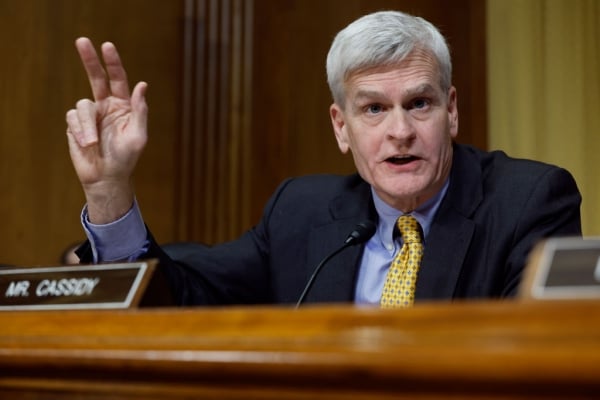
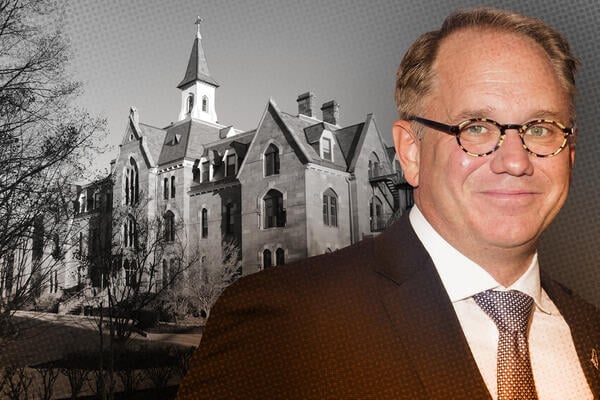
Dr. Bill Cassidy, a Republican from Louisiana and chair of the Senate HELP Committee, led the hearing and voted to advance McMahon’s nomination to the Senate floor.
Chip Somodevilla/Getty Images
Linda McMahon’s bid to become the next education secretary moved forward Thursday after a Senate committee voted 12–11 along party lines to advance her nomination.
At the preceding committee hearing on Feb. 13, Republicans of the Health, Education, Labor and Pensions Committee largely praised McMahon, saying they couldn’t think of a better person to lead the nation’s education system.
They used their questions to ensure the nominee recognized that only Congress has the statutory power to carry out Trump’s plan to abolish the Education Department—to which she said, “Well, certainly President Trump understands that we will be working with Congress.” In addition to shutting down or reducing the size of the department, McMahon made clear at the hearing that she supports combating campus antisemitism, prohibiting trans women from participating in sports and eliminating diversity, equity and inclusion programs.
Since the hearing, the Education Department released a sweeping Dear Colleague letter that directs colleges to end any race-based policies or programming in K-12 schools and colleges by Feb. 28. The letter, which targeted “every facet of academia,” has received significant pushback from the public but likely won’t affect McMahon’s confirmation.
The committee’s vote advances McMahon’s confirmation to the Senate. The full Senate will now vote on McMahon’s nomination, likely in the next two weeks.
Once formally recognized as secretary, McMahon will be an important arrow in Trump’s quiver, as she’s seen as dedicated to carrying out the president’s agenda, from abolishing the agency to stripping certain institutions of access to federal student aid when they do not align with his ideals.
A lawsuit filed in July against the Columbia University chapter of the American Association of University Professors, along with 20 other organizations and individuals, alleged that our public statements in support of antiwar and pro-Palestinian student protests last spring harmed other students by contributing to the campus shutdown that followed. Unraveling the cynical logic of this claim is for the courts. But what is clear from this lawsuit is that the purpose of such recourse to legal theater is not to ameliorate harm. It is to silence public and academic speech.
The tactic used against us is what is known as a strategic lawsuit against public participation (SLAPP). These suits are brought principally not to win in court but to harass and intimidate individuals or groups into curtailing speech. By entangling defendants in costly and invasive litigation—or even just threatening to do so—plaintiffs can frighten those with whom they disagree into silence. In the context of higher education, this comes at an incalculable cost.
On its own, this lawsuit certainly threatens the speech of Columbia-AAUP. But in the current climate, it also opens a front in the widespread attack on universities as sanctuaries of critical inquiry and reasoned debate. In their mere filing, lawsuits like this one aim especially to chill dissenting speech, including speech that takes place at the intersection of the classroom and the public square. Such legal instruments are a dangerous cudgel that could be used to threaten broad swaths of political and academic speech on American campuses.
Our chapter has precisely sought to combat this hostile environment in the speech over which we are being sued. In multiple public statements made during the height of the campus protests last spring, we condemned partisan congressional meddling in Columbia’s affairs, arguing that this “undermine[s] the traditions of shared governance and academic freedom.” We called for a vote of no confidence in university leadership, who we believe “failed utterly to defend faculty and students” and “colluded in political interference.” And we affirmed the Columbia Faculty of Arts and Sciences’ subsequent vote of no confidence in our then-president for her “failure to resist politically motivated attacks on higher education,” whereby she endangered students and undermined our rights as faculty.
In challenging our statements in support of faculty and students, this particular SLAPP targets both our constitutionally protected public speech and our academic freedom. We are fortunate enough to be represented by the American Civil Liberties Union and civil rights firm Wang Hecker LLP, who have filed a motion to dismiss on our behalf that utilizes New York State’s anti-SLAPP law, one of the 35 state-level anti-SLAPP laws on the books across the United States. But the outcome of a SLAPP shouldn’t depend on your counsel, or the state in which you live. Unfortunately, for many faculty and students faced with a SLAPP, the only available option may well be to self-censor.
Interests committed to the mainstream political consensus have found pro-Palestinian political advocacy on American campuses to be unacceptable. To silence dissent, they have shown themselves willing to use every instrument at their disposal in a manner that recalls the red scares of the early and mid-20th century, when character assassination and blacklists were employed in industry and civil society, including academia. This SLAPP revives such measures, as do the theatrical congressional grillings of college presidents, including our own, and the wave of censorship that has swept over higher education during the course of the past year. In this context, attacks on public speech are also attacks on academic freedom.
Academic freedom depends essentially upon a social contract that remains under perpetual debate both inside and outside the academy. SLAPPs like this one aim at the very heart of that contract, which accords to academics relative autonomy to explore difficult and often uncomfortable truths on the assumption that those truths will ultimately benefit society. Although the classroom, the laboratory and the library are classic sites for the practice and protection of this freedom, the truths pursued there translate to worlds outside the campus gates. Bullying faculty and students into self-censorship in the public square, SLAPPs seek to further silence and constrain the pursuit of uncomfortable truths in the classroom.
Scholarly knowledge consists of truth claims, not dicta. Whether exercised in the classroom or in the public square, academic freedom is therefore the freedom to make and to contest such claims. This goes for all sides in a debate, including the debates still quietly raging on our campuses. However, a stark reality disclosed by SLAPPs is that political force is now poised to govern the contest over truth in place of enlightened reason and democratic deliberation.
If such high-minded concepts as truth claims, enlightened reason and democratic debate seem too lofty for the dirty realism of the day, it is important to remember that these still lie at the core of any academic freedom worthy of the name. Academic freedom is not a narrowly academic matter; it is a matter of determining whether something is or is not true. SLAPPs are designed to decide such questions in advance, in favor of those who can afford the attorneys, or on whose behalf politically motivated law firms work. It is time for us to exercise our freedoms and responsibilities as academics, in defense of our right and that of our students to speak.
Reinhold Martin is president of the American Association of University Professorschapter at Columbia University, on whose behalf he wrote this piece, and a professor of architecture.
At more than a dozen events across the country Wednesday, workers and faculty at colleges and universities gathered to speak out against what they see as an attack on federal research funding, lifesaving medical research and education.
In Washington, D.C., hundreds rallied in the front of the Department of Health and Human Services, while in Philadelphia, hundreds gathered at the office of Senator Dave McCormick, a Pennsylvania Republican. Other protests were planned at colleges in Seattle and St. Louis, among others.
The rallies were part of a national day of action organized by a coalition of unions representing higher ed workers, students and their allies. The coalition includes the American Association of University Professors, the American Federation of Teachers, Higher Ed Labor United and United Auto Workers, among others.
Hundreds in Philly braved the freezing temps to rally for our healthcare, research, and jobs! ❄️💪Workers & students from CCP, Drexel, UPenn, Rutgers, Temple, Jefferson, Arcadia, Rowan, Moore—alongside elected leaders & union presidents—made it clear: We won’t back down. #LaborForHigherEd
In recent weeks, the Trump administration has proposed capping reimbursements for indirect research costs, laid off hundreds of federal employees and cracked down on diversity, equity and inclusion. Most recently, the Education Department gave colleges and K-12 schools until Feb. 28 to end all race-conscious student programming, resources and financial aid. Higher education advocates have called that directive “dystopian” and “very much outside of the law.”
Colleges and universities sued to block the rate cut for indirect costs, warning it would mean billions in financial losses and an end to some research. Some colleges have already frozen hiring in response, even though the cut is temporarily on hold.
“If politics decides what I can and cannot study, I’m afraid I will fail the very people who need this research and inspire me to do it,” said Lindsay Guare, a doctoral student at the University of Pennsylvania, in a news release about the Philadelphia event. “In an ideal world, I would be fighting to expand support for my science instead of fighting to keep it afloat … The work done in Philadelphia’s institutions doesn’t just lead the world in innovation—it saves lives.”
Together, we should be clear on what President Donald Trump is trying to do to higher education.
Destroy it. Whatever public rationales he or his administration release, the intent of his actions is clear, so if we’re going to discuss responses to those actions, we must remember, always, that Donald Trump is trying to destroy higher education.
Michelle Goldberg at The New York Times gets it; the rest of us should, too.
This goal is not new. In 2021 in a speech at the National Conservatism Conference, future vice president JD Vance declared, “We have to honestly and aggressively attack the universities in this country.” Vance (and Trump) are open admirers of Hungarian authoritarian leader Viktor Orbán, who has subjugated the once-free higher education institutions of his country to his own needs.
This is the Trump/Vance playbook. The unannounced, unilateral (now paused thanks to court intervention) cuts to NIH grants, and the Dear Colleague letter that goes well beyond, and even actively distorts current law to threaten institutions with punishment for failing to obey, are just the latest attacks in a war that has been going on for quite some time, and not just at the federal level, but in the states as well, as exemplified by Ron DeSantis’s wanton destruction of Florida’s New College.
Sadly, as callous, counterproductive and wasteful of taxpayer money as it was, DeSantis taking a wrecking ball to New College in order to install his cronies while recruiting enough athletes for three baseball teams—despite New College not being in an athletic conference—was within the power of the state’s chief executive.
What Trump is doing to higher education institutions is not. It should be unthinkable for institutions to obey diktats that are not only unlawful, but in direct conflict with the purported mission of the institution.
If any institutional leaders are thinking that if they do just enough compliance with Trump’s demands, he will stop the war, they are kidding themselves.
How is the rush to declare institutional neutrality to not just words but actions, as enacted by Vanderbilt chancellor Daniel Diermeier last year, working out? Surely they are feeling secure knowing that they got ahead of the abuse.
I used Vanderbilt only because it was a recent, handy example, not the only one. The silence from major, well-resourced higher education institutions is truly deafening.
Writing at her personal website, Jackie Gharapour Wernz, an education and civil rights attorney, calls the Dear Colleague letter “regulation by intimidation,” which is exactly right. Bending the knee at this moment only demonstrates the effectiveness of intimidation.
Wernz walks through a number of ways the advisories in the letter go well beyond well-established law, while also making an additional important point: Trump is busy gutting the very agencies that would be able to do the investigation and enforcement of institutions they believe are in violation of legal regulations. This reality, plus the various procedural steps involved in these investigations, suggests that it may be far more advantageous to dig in and run out the clock of this initial flurry, particularly when existing law is clearly on your side.
But this doesn’t seem to be the strategy for most institutions. They are going to hope this goes away. Trying to make yourself a smaller target doesn’t mean the people intent on destroying you are going to stop attacking.
Interestingly, the group of higher ed leaders who are … uh … leading belong to the Education for All coalition, primarily consisting of community college administrators. Under the “freedom’s just another world for nothing left to lose” theory, this should not be surprising. Giving in to the Trump administration’s demands to give up on providing educational opportunities to diverse cohorts of students with different desires and needs would be to abandon their work entirely. Their defiance is both principled and practical.
To me, this suggests that the more prestigious institutions that are cowering in the face of the intimidation perhaps do not see their mission in terms of providing access to all. In a lot of ways, the present situation is primarily revealing that which we already knew—that the interests in diversity, equity and inclusion in elite spaces were a virtue-signaling scrim over the much less savory reality of wealth and exclusion.
Look, I’m getting worked up here. The truth is, I don’t wish any harm on any higher education institution, but the institutions with the most resources, most power and most influence must step up.
The present threat goes well beyond an attack on the institutional coffers. These attacks on higher education are part of a much broader push toward authoritarianism as a federal executive (and his minions) direct the actions of formerly free institutions and people.
The good news is that should institutions stand up for themselves, I think they will find many people standing up with them, including, most importantly, the students. Unfortunately, the longer institutions hesitate to stand for the values they claim to hold, the more distrust they’re sowing with the very constituencies who could save them, who do not want to destroy them, but the opposite, who want to see them thrive.
The stakes are almost impossibly high. Shouldn’t we act like it?
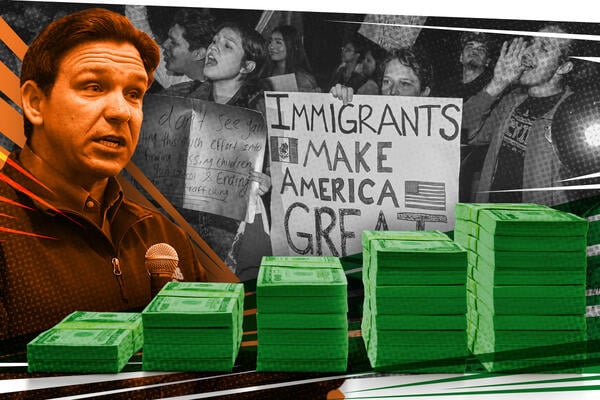
Florida state lawmakers have eliminated in-state tuition for undocumented students, reversing a decade-old law that once enjoyed bipartisan support.
Previously, undocumented students in Florida could apply for waivers to pay in-state tuition rates, if they went to high school in the state for at least three consecutive years and enrolled in college within two years of graduating.
Under the new policy, included in a sweeping immigration bill signed by Governor Ron DeSantis last week, only “citizens of the United States” or those “lawfully present in the United States” qualify. Students receiving the waivers need to be “reevaluated for eligibility” by July 1.
“I don’t think you should be admitted to college in Florida if you’re here illegally,” DeSantis said in a press conference Friday, “but to give in-state tuition was just a slap in the face to taxpayers.”
Florida was one of 25 states that offered in-state tuition to undocumented students at public colleges and universities, according to the Higher Ed Immigration Portal, a data hub run by the Presidents’ Alliance on Higher Education and Immigration. These reduced tuition prices came as a relief to undocumented students, who can’t access federal financial aid like their peers and often lack work authorization unless they’re part of the Deferred Action for Childhood Arrivals, or DACA, program. (Of the approximately 400,000 undocumented students enrolled in U.S. colleges and universities, most don’t hold DACA status.)
Policymakers in other states are considering taking similar steps to curb in-state tuition for these students as they embrace President Donald Trump’s national push against undocumented immigration. Since the presidential election in November, state lawmakers in Massachusetts, Minnesota and Texas have introduced legislation to remove in-state tuition for undocumented students. As the issue becomes a political lightning rod, politicians in other states are doubling down on financial supports for these students, introducing bills that would expand in-state tuition eligibility, including in Indiana, New Mexico, Oregon and Pennsylvania.
Miriam Feldblum, president and CEO of the Presidents’ Alliance, said advocates “should be prepared and ready” to come out against similar legislation elsewhere in the country.
A Game of ‘Political Football’
In-state tuition for undocumented students has become a “political football” in Florida, said Jared Nordlund, Florida state director at UnidosUS, a Latino civil rights organization. But that wasn’t always the case.
Republican lieutenant governor Jeanette Nuñez—who resigned last week to become interim president of Florida International University—originally advocated for extending in-state tuition to undocumented students, and former Republican governor Rick Scott, now Florida’s senior U.S. senator, signed the bill into law. Nuñez has since pulled back her support for the policy, posting on X in January that the law had “run its course” and needed to be repealed.
The political winds have shifted on what was once a fairly bipartisan issue, Nordlund said. “Ten years ago, the Republican Party wasn’t the party of Trump.”
Ira Mehlman, media director at the Federation for American Immigration Reform, an organization that promotes more restrictive immigration policies, applauded Republican state lawmakers for “not rewarding people who are in the country illegally.”
“The more you reward people for breaking the laws, even if it’s through their kids, the more likely people are to disobey the laws,” Mehlman said. And “you are filling seats that might otherwise have gone to kids who are equally deserving and whose parents have not violated any laws.”
Now undocumented students are left to pay out-of-state tuition prices, a significant cost difference. During the 2023–24 academic year, average tuition and fees at Florida colleges and universities for out-of-state students was more than triple the cost state residents paid, according to the Florida Policy Institute, an organization that promotes economic mobility in Florida. The state’s in-state tuition waivers benefited an estimated 6,500 undocumented students that year.
The Ripple Effects
An undocumented student at University of Central Florida, who requested anonymity, told Inside Higher Ed that she couldn’t have pursued a bachelor’s degree as a full-time student without in-state tuition. She would’ve gone for an associate degree instead, taking one or two classes at a time, to keep costs down.
Without in-state tuition, “who knows if I’d be graduating right now,” she said.
The student, who was brought to Florida from Mexico at age 4, is graduating this spring, before the policy change takes effect. But she worries about her peers who won’t have the same resources she did. She previously helped and encouraged other undocumented students to apply for the in-state tuition waiver because of how much it helped her.
“I gave them that hope,” she said, “and now it’s being snatched away from them.”
The student argued she and other undocumented students would use their degrees to contribute to the local labor market, a point they’ve made to state lawmakers in the past; her long-term goal is to open a marketing agency and work with small business owners in the state.
“We studied here our whole life, and our goal is to get our degree and be able to contribute to the economy,” she said.
Diego Sánchez, director of policy and strategy at the Presidents’ Alliance, said he scrambled to pay for college in Florida before in-state tuition became available to undocumented students like him.
In 2008, he enrolled at St. Thomas University, a private institution, and joined as many activities as he could that came with university scholarships—student government, choir and cross country, even though he wasn’t a singer or a runner. He couldn’t have afforded college otherwise, which is why he and other activists advocated for in-state tuition for Florida’s undocumented population. He’s “very disappointed” to see that win reversed.
“It’s about scoring political points,” Sánchez said. “And unfortunately, these students who grew up in Florida, went to our public schools, are going to suffer the consequences … The state has already invested in them, and they’re working their way up to contribute to the community, [to] pay taxes.”
Undocumented students and their supporters argue Florida is going to lose out on these students as future skilled workers at a time when the state is challenged by workforce shortages and an aging population.
Feldblum said these students tend to be “tremendously determined” and will likely attend college in other states, taking their talents with them. She also expects some will stop out of higher ed altogether because they can’t afford it or because they don’t know about other resources available to them, like privately funded scholarships.
“When there are obstacles put in front of students, when students are told, ‘You’re not welcome here’ in different ways, that’s really discouraging,” she said. “That’s disincentivizing,” when Florida has a “need for talent, the need for workforce development.”
What’s Next
The fight for in-state tuition in Florida isn’t over, some advocates say.
“Hopefully we can eventually undo the repeal [of in-state tuition] when the time is right,” Nordlund said. For now, he’s focused on educating state lawmakers and the public about the economic benefits of the repealed policy.
Sánchez plans to lobby state lawmakers to at least let undocumented students already in college finish their degrees at in-state tuition prices, a proposed amendment to the law that previously failed. He hopes colleges and universities push state lawmakers on the issue as well.
He continues to worry, however, that these kinds of attacks on students’ in-state tuition “could spread to other parts of the country.”
Mehlman would like to see other states, and even Congress, look to Florida’s example and work to end in-state tuition for noncitizens nationwide.
“Florida and Texas have sort of been leaders in this area,” he said, “and they certainly can show the way for other states that might be considering this as well.”
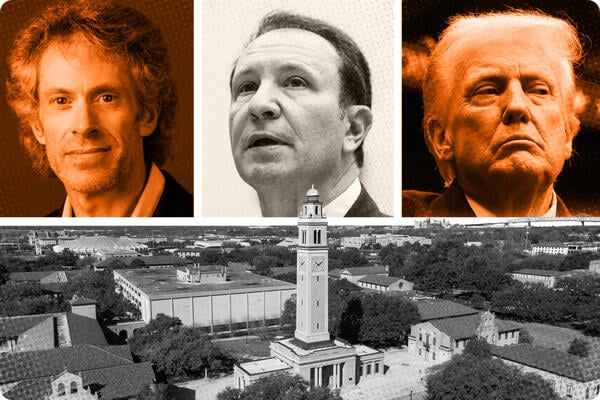
In a Jan. 14 lecture, Ken Levy, Holt B. Harrison Distinguished Professor of Law at Louisiana State University, dropped f-bombs against then–president-elect Donald Trump and Louisiana governor Jeff Landry and told students who like Trump that they need his “political commentary.”
Some students found the apparent attempt at political humor funny, according to an audio recording of the class obtained by Inside Higher Ed from a student who supports Levy.
But at least one student in the administration of criminal justice class who subsequently complained, according to LSU, wasn’t amused—and neither were the university and the governor. An LSU spokesperson said the institution “took immediate action to remove Professor Levy from the classroom after complaints about the professor’s remarks.”
Levy got a lawyer and took immediate action himself, pulling LSU into court instead of waiting for the university to take further steps internally regarding his job.
In the month since that lecture, state district court judges have twice ruled that Levy should return to the classroom, only for a state appeals court to twice overrule that. The back-and-forth nature of the case has attracted attention in Louisiana and in law circles, including via headlines such as “The LSU Law School Professor Free Speech Hot Potato Saga Continues.”
Landry also continues to discuss the case. A Republican governor who’s repeatedly insertedhimself in LSU affairs, Landry used social media in the fall to call on the university to punish one of Levy’s law school colleagues for alleged in-class comments about Trump-supporting students. Landry has now repeatedly posted about Levy, recently saying an alleged exam he gave was incendiary and suggesting that “maybe it’s time to abolish tenure.”
In and Out
In the lecture in question, Levy referenced Landry’s previous criticism of his LSU colleague Nick Bryner, adding that he “would love to become a national celebrity [student laughter drowns out a moment of the recording] based on what I said in this class, like, ‘Fuck the governor!’”
Levy also referenced Trump. “You probably heard I’m a big lefty, I’m a big Democrat, I was devastated by— I couldn’t believe that fucker won, and those of you who like him, I don’t give a shit, you’re already getting ready to say in your evaluations, ‘I don’t need his political commentary,’” Levy told students. “No, you need my political commentary, you above all others.”
A few days after that lecture, LSU notified Levy he was suspended from teaching pending an investigation into student complaints, according to a letter from the university provided by Levy’s attorney, Jill Craft.
On Jan. 28, Craft filed a request for a temporary restraining order against LSU to get Levy back in the classroom. The filing alleged that a student complained to the governor, not LSU, and calls were then made to LSU. A state district court judge granted the restraining order Jan. 30 without a hearing.
In the first reversal, a panel of appellate judges wrote Feb. 4 that the lower court shouldn’t have approved the return-to-teaching part of the temporary restraining order without a full evidentiary hearing. But after the lower court held a two-day hearing last week, a different group of appellate judges overruled Levy’s return to teaching again—without explaining why.
Local journalists who covered last week’s hearing reported that district court judge Tarvald Anthony Smith kicked an LSU deputy general counsel out of the courtroom because the lawyer told the law school dean, who was a scheduled and sequestered witness, about a student witness’s earlier testimony. The testimony was reportedly that the student had recorded a conversation with the dean.
Smith ruled Feb. 11 that LSU policy required the university to keep Levy in class during the investigation of his comments, WBRZ reported. But a Feb. 4 statement from university spokesman Todd Woodward to Inside Higher Ed suggested the investigation was already over: “Our investigation found that Professor Levy created a classroom environment that was demeaning to students who do not hold his political view, threatening in terms of their grades and profane.” The university didn’t make anyone available for an interview about the case.
Amid this legal back-and-forth, Landry continues to denounce Levy on social media. Last week, Landry posted on X an alleged exam from Levy that included potential sexual and other crimes committed by various fictitious individuals and asked students at the end to “discuss all potential crimes and defenses.” The narrative included a teen who put his penis into pumpkins on Halloween and was seen by trick-or-treating children, and a powerful Republican and suspected pedophile who invited the children inside to dance for him.
“Disgusting and inexcusable behavior from Ken Levy,” Landry wrote on X regarding what he claimed was Levy’s test. “Deranged behavior like this has no place in our classrooms! If tenure protects a professor from this type of conduct, then maybe it’s time to abolish tenure.” Asked about this document, Craft said she believes the assignment was part of the sex crimes portion of Levy’s criminal law exam years ago, but she did not confirm it.
After the latest appellate ruling in LSU’s favor, Landry wrote on X that “Levy should stay far, far away from any classroom in Louisiana!”
Craft said Levy has received death threats on X due to Landry’s comments there. “This seems to be a situation entirely of the governor’s making,” she said. “He has been active on social media, trying to accuse my client of all kinds of bad things. He’s a lawyer himself. He attacked the courts and the judge.”
Landry’s office didn’t respond to requests for comment.
Craft also said Levy’s roughly 80 students remain with another 80 in another professor’s classroom.
“I’m not sure how he can handle office hours for 160 law students,” Craft said of that second professor. The university says it’s doubled the number of student tutors for the course.
No Longer the U.S.?
Craft said Levy was set to return to the classroom Feb. 13, but Louisiana’s First Circuit Court of Appeal issued its two-sentence order around 9:30 a.m. that appeared to stay the part of the lower court’s order that returned Levy to teaching.
LSU again kept Levy out of the classroom Tuesday, Craft said. But she said the rest of the lower court order remains in place, at least for now, and that prevents LSU from taking further employment action against Levy due to his expression.
“This is a critical issue, and I feel like we have got to, as a nation, understand that there has to be academic freedom, there has to be free speech in this country, and there have to be protections against governmental intrusions without due process,” she said. “We take all that away and we are no longer the United States of America.”
A year after being sued by ex-president Joseph Nyre for alleged breach of contract and retaliation, among other claims, Seton Hall University has hit back with its own legal action against the former leader.
In a lawsuit filed Wednesday in the Superior Court of New Jersey, the university accused Nyre of “illicitly accessing, downloading, maintaining, and later disseminating confidential and proprietary documents, as well as documents protected by the attorney-client and work product privileges, and information after his departure as President of the University.” Those documents led to critical reports about the university’s current president, Monsignor Joseph Reilly.
Alongside Nyre, the lawsuit also names John Does 1–10, referring to them as “persons who are in possession of documents unlawfully maintained, retrieved, accessed, and/or downloaded.”
In a statement to Inside Higher Ed, a Seton Hall spokesperson wrote that Wednesday’s filing “makes clear that confidential documents were utilized with sections selectively released, causing damage to the University and its leadership and painting a false narrative about Monsignor Reilly.” Reilly has been accused of failing to report allegations of sexual misconduct and thus violating the university’s Title IX policies.
An attorney for Nyre blasted the lawsuit as a “cover-up” by Seton Hall.
The former president later sued Seton Hall, alleging he was pushed out by the Board of Regents amid conflict with then-chair Kevin Marino, whom Nyre accused of micromanagement, improperly involving himself in an embezzlement investigation at the law school and sexually harassing the president’s wife, Kelli Nyre, among other claims. Marino, who is no longer a board member, was not named as a defendant in Nyre’s lawsuit, and an investigation found no evidence of sexual harassment.
While Seton Hall is defending itself against Nyre’s lawsuit, it also threw a legal counterpunch in suing the ex-president. The university alleges that its information technology team confirmed that Nyre had improperly accessed materials after his departure, and in doing so, he violated confidentiality provisions in his employment and separation agreement.
Specifically, Nyre is accused of improperly downloading confidential documents that were later provided to Politico. Those files—some of which were also obtained by Inside Higher Ed—seemed to indicate Reilly, the current president, overlooked instances of sexual harassment while rector and dean of the university’s graduate seminary from 2012 to 2022.
However, one of the leaked documents in question—a letter from a Board of Regents member to Reilly in February 2020 that said he had violated university Title IX policies through his inaction—was an unsent draft, university officials previously told Inside Higher Ed.
Seton Hall officials said in the lawsuit that though the Politico reporter never disclosed who provided him with the documents, “it was clear that [Nyre], directly or indirectly, was responsible” for the leak of confidential information to the news outlet between December and February. Seton Hall accused Nyre of trying to “create a false impression about” Reilly, arguing he acted in “bad faith and malicious intent” by not disclosing that the February 2020 letter was never sent.
The allegations against Reilly have prompted calls for transparency from state lawmakers and Democratic governor Phil Murphy, who called on the university to release an investigative report that allegedly cleared Reilly. Seton Hall has thus far declined to do so, citing the need to protect the confidentiality of participants who voluntarily cooperated with the investigation.
The allegations against Reilly come as the university is only a few years removed from the sprawling sexual abuse scandal involving former cardinal Theodore McCarrick, who sat on both of Seton Hall’s governing boards. Investigators determined in a 2019 university report that McCarrick “created a culture of fear and intimidation” and “used his position of power as then–Archbishop of Newark”—which sponsors Seton Hall—“to sexually harass seminarians” for decades. (McCarrick was defrocked but avoided criminal charges due to a dementia diagnosis.)
As part of the lawsuit, Seton Hall is seeking a temporary restraining order to stop Nyre from allegedly sharing more documents. University officials argued in court filings that Seton Hall stands to “suffer irreparable harm” from further leaks, which “cannot be adequately compensated” monetarily.
“The nature of the harm is such that it affects the university’s ability to maintain the confidentiality of sensitive information, which is crucial for its operations and reputation,” filings read. “Moreover, to the extent that documents to which defendant has access are protected under [the Family Educational Rights and Privacy Act] or Title IX, the disclosure of such documents would directly implicate the right of students and their parents to control the disclose [sic] of such confidential educational records as well as the confidentiality rights of university employees.”
Pushback
In a statement to Inside Higher Ed, Nyre attorney Matthew Luber called the lawsuit “a desperate, retaliatory ploy designed to silence a whistleblower and distract from the university’s own corruption and misconduct.”
Luber did not specifically address the allegations that Nyre had inappropriately leaked confidential documents but accused Seton Hall of ignoring red flags in hiring Reilly and overlooking Title IX infractions.
“Let’s be clear: Dr. Nyre was not at Seton Hall when Monsignor Reilly engaged in misconduct, nor when the board knowingly violated its own policies and Title IX to install him as President,” Luber wrote. “But he was the one who warned university officials about Reilly’s disqualifying history during his presidential search—warnings that were deliberately ignored by board leadership. Instead of addressing their own failures, Seton Hall is now attempting to smear and intimidate Dr. Nyre.”
As of publication, a judge has not set to a hearing to consider the request for a restraining order.
Did
you know that Truthout is a nonprofit and independently funded by
readers like you? If you value what we do, please support our work with a donation.
Trump appears bent on ridding schools of dangerous practices like critical thinking and an unsanitized study of history.
In the initial days of his second term, President Donald Trump issued several executive orders “seeking
to control how schools teach about race and gender, direct more tax
dollars to private schools, and deport pro-Palestinian protesters.” On January 29, 2025, he signed the “Ending Radical Indoctrination in K-12 Schooling”
executive order, which mandates the elimination of curricula that the
administration deems as promoting “radical, anti-American ideologies.”
This executive order is not just an attack on critical race theory or
teachings about systemic racism — it is a cornerstone of an
authoritarian ideology designed to eliminate critical thought, suppress
historical truth and strip educators of their autonomy. Under the guise
of combating “divisiveness,” it advances a broader war on education as a
democratizing force, turning schools into dead zones of the
imagination. By threatening to strip federal funding from institutions
that refuse to conform, this policy functions as an instrument of
ideological indoctrination, enforcing a sanitized, nationalistic
narrative that erases histories of oppression and resistance while
deepening a culture of ignorance and compliance.
Concurrently, President Trump issued the “Expanding Educational Freedom and Opportunity for Families”
executive order, aiming to enhance school choice by redirecting federal
funds to support charter schools and voucher programs. This policy
enables parents to use public funds for private and religious school
tuition. While proponents claim that this legislation empowers parents
and fosters competition, in reality, it is a calculated effort to defund
and privatize public education, undermining it as a democratizing
public good. As part of a broader far right assault on education, this
policy redirects essential resources away from public schools, deepening
educational inequality and advancing an agenda that seeks to erode
public investment in a just and equitable society.
In the name of eliminating radical indoctrination in schools, a third executive order,
which purportedly aims at ending antisemitism, threatens to deport
pro-Palestinian student protesters by revoking their visas, warning that even those legally in the country could be targeted
for their political views. In a stark display of authoritarianism,
Trump’s executive order unapologetically stated that free speech would
not be tolerated. Reuters
made this clear in reporting that one fact sheet ominously declared: “I
will … quickly cancel the student visas of all Hamas sympathizers on
college campuses, which have been infested with radicalism like never
before. To all the resident aliens who joined in the pro-jihadist
protests, we put you on notice: come 2025, we will find you, and we will
deport you.”
By gutting federal oversight, he is handing the fate of education to
reactionary state legislatures and corporate interests, ensuring that
knowledge is shaped by a state held captive by billionaires and far
right extremists. This is the logic of authoritarianism: to hollow out
democratic institutions and replace education with white Christian
propaganda and a pedagogy of repression. At issue here is an attempt to
render an entire generation defenseless against the very forces seeking
to dominate them.
What we are witnessing is not just an educational crisis but a
full-scale war on institutions that not only defend democracy but enable
it. What is under siege in this attack is not only the critical
function of education but the very notion that it should be defined
through its vision of creating a central feature of democracy, educating
informed and critically engaged citizens.
These executive actions represent an upgraded and broader version of
McCarthyite and apartheid-era education that seeks to dictate how
schools teach about race and gender, funnel more taxpayer dollars into
private institutions, and deport Palestinian protesters. The irony is
striking: The White House defends these regressive measures of
sanitizing history, stripping away the rights of transgender students
and erasing critical race theory as efforts to “end indoctrination in
American education.” In truth, this is not about the pursuit of freedom
or open inquiry, nor is it about fostering an education that cultivates
informed, critically engaged citizens. At its core, this agenda is a
deliberate attack on education as a public good — one that threatens to
dismantle not only public institutions, but the very essence of public
and higher education and its culture of criticism and democracy. The
urgency of this moment cannot be overstated: The future of education
itself is at stake.
In the raging currents of contemporary political and cultural life,
where fascist ideologies are rising, one of the most insidious and
all-encompassing forces at play is the violence of forgetting — a plague
of historical amnesia. This phenomenon, which I have referred to as “organized forgetting,”
describes the systemic erasure of history and its violent consequences,
particularly in the public sphere. This is especially evident in the
current historical moment, when books are banned in
libraries, public schools and higher education across countries, such
as the United States, Hungary, India, China and Russia. Ignoring past
atrocities, historical injustices and uncomfortable truths about a
society’s foundation is not merely an oversight — it constitutes an
active form of violence that shapes both our collective consciousness
and political realities. What we are witnessing here is an assault by
the far right on memory that is inseparable from what Maximillian
Alvarez describes as a battle over power — over who is remembered, who
is erased, who is cast aside and who is forcibly reduced to something
less than human. This struggle is not just about history; it is about
whose stories are allowed to shape the present and the future. Alvarez captures this reality with striking clarity and is worth quoting at length:
Among the prizes at stake in the endless war of politics is history
itself. The battle for power is always a battle to determine who gets
remembered, how they will be recalled, where and in what forms their
memories will be preserved. In this battle, there is no room for neutral
parties: every history and counter-history must fight and scrap and
claw and spread and lodge itself in the world, lest it be forgotten or
forcibly erased. All history, in this sense, is the history of empire — a
bid for control of that greatest expanse of territory, the past.
Organized forgetting also helped fuel the resurgence of Donald Trump,
as truth and reason are being systematically replaced by lies,
corruption, denial and the weaponization of memory itself. A culture of
questioning, critique and vision is not simply disappearing in the
United States — it is actively maligned, disparaged and replaced by a
darkness that, as Ezra Klein
observes, is “stupefyingly vast, stretching from self-destructive
incompetence to muddling incoherence to authoritarian consolidation.”
This erosion affects institutions of law, civil society and education
— pillars that rely on memory, informed judgment and evidence to foster
historical understanding and civic responsibility. The attack on the
common good goes beyond the distractions of an “attention economy”designed
to distort reality; it reflects a deliberate effort to sever the ties
between history and meaning. Time is reduced to fragmented episodes,
stripped of the shared narratives that connect the past, present and
future.
This crisis embodies a profound collapse of memory, history,
education and democracy itself. A culture of manufactured ignorance —
rooted in the rejection of history, facts and critical thought — erases
accountability for electing a leader who incited insurrection and
branded his opponents as “enemies from within.” Such authoritarian
politics thrive on historical amnesia, lulling society into passivity,
eroding collective memory and subverting civic agency. This is
epitomized by Trump’s declaration
on “Fox & Friends” that he would punish schools that teach students
accurate U.S. history, including about slavery and racism in the
country. The call to silence dangerous memories is inseparable from the
violence of state terrorism — a force that censors and dehumanizes
dissent, escalating to the punishment, torture and imprisonment of
truth-tellers and critics who dare to hold oppressive power accountable.
At its core, the violence of forgetting operates through the denial
and distortion of historical events, particularly those that challenge
the dominant narratives of power. From the colonial atrocities and the
struggles for civil rights to the history of Palestine-Israel relations,
many of the most significant chapters of history are either glossed
over or erased altogether. This strategic omission serves the interests
of those in power, enabling them to maintain control by silencing
inconvenient truths. As the historian Timothy Snyder
reminds us, by refusing to acknowledge the violence of the past,
society makes it far easier to perpetuate injustices in the present. The
politics of organized forgetting, the censoring of history and the
attack on historical consciousness are fundamental to the rise of far
right voices in the U.S. and across the world.
With the rise of regressive memory laws, designed to repress what
authoritarian governments consider dangerous and radical interpretations
of a country’s past, historical consciousness is transformed into a
form of historical amnesia. One vivid example of a regressive memory law
was enacted by Trump during his first term. The 1776 Report,
which right-wingers defended as a “restoration of American education,”
was in fact an attempt to eliminate from the teaching of history any
reference to a legacy of colonialism, slavery and movements which
highlighted elements of American history that were unconscionable,
anti-democratic and morally repugnant. Snyder highlights the emergence
of memory laws in a number of states. He writes in a 2021 New York Times article:
As of this writing, five states (Idaho, Iowa, Tennessee, Texas and
Oklahoma) have passed laws that direct and restrict discussions of
history in classrooms. The Department of Education of a sixth (Florida)
has passed guidelines with the same effect. Another 12 state
legislatures are still considering memory laws. The particulars of these
laws vary. The Idaho law is the most Kafkaesque in its censorship: It
affirms freedom of speech and then bans divisive speech. The Iowa law
executes the same totalitarian pirouette. The Tennessee and Texas laws
go furthest in specifying what teachers may and may not say. In
Tennessee teachers must not teach that the rule of law is “a series of
power relationships and struggles among racial or other groups.”… The
Idaho law mentions Critical Race Theory; the directive from the Florida
school board bans it in classrooms. The Texas law forbids teachers from
requiring students to understand the 1619 Project. It is a perverse
goal: Teachers succeed if students do not understand something.
A major aspect of this forgetting and erasure of historical memory is the role of ignorance,
which has become not just widespread but weaponized in modern times.
Ignorance, particularly in U.S. society, has shifted from being a
passive lack of knowledge to an active refusal to engage with critical
issues. This is amplified by the spectacle-driven nature of contemporary
media and the increasing normalization of a culture of lies and the
embrace of a language of violence, which not only thrives on distraction
rather than reflection, but has become a powerful force for spreading
bigotry, racial hatred and right-wing lies. In addition, the mainstream
media’s obsession with spectacle — be it political drama, celebrity
culture or sensationalist stories — often overshadows the more
important, yet less glamorous, discussions about historical violence and
systemic injustice.
This intellectual neglect allows for a dangerous cycle to persist,
where the erasure of history enables the continuation of violence and
oppression. Systems of power benefit from this amnesia, as it allows
them to maintain the status quo without having to answer for past
wrongs. When society refuses to remember or address past injustices —
whether it’s slavery, imperialism or economic exploitation — those in
power can continue to exploit the present without fear of historical
accountability.
To strip education of its critical power is to rob democracy of its transformative potential.
The cultural impact of this organized forgetting is profound. Not
only does it create a void in public memory, but it also stunts
collective growth. Without the lessons of the past, it becomes nearly
impossible to learn from mistakes and address the root causes of social
inequalities. The failure to remember makes it harder to demand
meaningful change, while reproducing and legitimating ongoing far right
assaults on democracy.
The violence of organized forgetting is not a mere act of neglect; it
is a deliberate cultural and intellectual assault that undercuts the
foundations of any meaningful democracy. By erasing the past, society
implicitly condones the ongoing oppression of marginalized groups and
perpetuates harmful ideologies that thrive in ignorance. This erasure
silences the voices of those who have suffered — denying them the space
to speak their truth and demand justice. It is not limited to historical
injustices alone; it extends to the present, silencing those who
courageously criticize contemporary violence, such as Israel’s
U.S.-backed genocidal war on Gaza, and those brave enough to hold power
accountable.
The act of forgetting is not passive; it actively supports systems of
oppression and censorship, muffling dissent and debate, both of which
are essential for a healthy democracy.
Equally dangerous is the form of historical amnesia that has come to
dominate our contemporary political and cultural landscape. This
organized forgetting feeds into a pedagogy of manufactured ignorance
that prioritizes emotion over reason and spectacle over truth. In this
process, history is fragmented and distorted, making it nearly
impossible to construct a coherent understanding of the past. As a
result, public institutions — particularly education — are undermined,
as critical thinking and social responsibility give way to shallow,
sensationalized narratives. Higher education, once a bastion for the
development of civic literacy and the moral imperative of understanding
our role as both individuals and social agents, is now attacked by
forces seeking to cleanse public memory of past social and political
progress. Figures like Trump embody this threat, working to erase the
memory of strides made in the name of equality, justice and human
decency. This organized assault on historical memory and intellectual
rigor strikes at the heart of democracy itself. When we allow the
erasure of history and the undermining of critical thought, we risk
suffocating the ideals that democracy promises: justice, equality and
accountability.
A democracy cannot thrive in the absence of informed and engaged
agents that are capable of questioning, challenging and reimagining a
future different from the present. Without such citizens, the very
notion of democracy becomes a hollow, disembodied ideal — an illusion of
freedom without the substance of truth or responsibility. Education, in
this context, is not merely a tool for transmitting knowledge; it is
the foundation and bedrock of political consciousness. To be educated,
to be a citizen, is not a neutral or passive state — it is a vital,
active political and moral engagement with the world, grounded in
critical thinking and democratic possibility. It is a recognition that
the act of learning and the act of being a citizen are inextricable from
each other. To strip education of its critical power is to rob
democracy of its transformative potential.
Confronting the violence of forgetting requires a shift in how we
engage with history. Intellectuals, educators and activists must take up
the responsibility of reintroducing the painful truths of the past into
public discourse. This is not about dwelling in the past for its own
sake, but about understanding its relevance to the present and future.
To break the cycles of violence, society must commit to remembering, not
just for the sake of memory, but as a critical tool for progress.
Moreover, engaging with history honestly requires recognizing that
the violence of forgetting is not a one-time event but a continual
process. Systems of power don’t simply forget; they actively work to
erase, rewrite and sanitize historical narratives. This means that the
fight to remember is ongoing and requires constant vigilance. It’s not
enough to simply uncover historical truths; society must work to ensure
that these truths are not forgotten again, buried under the weight of
media spectacles, ideological repression and political theater.
Ultimately, the violence of forgetting is an obstacle to genuine
social change. Without confronting the past — acknowledging the violence
and injustices that have shaped our world — we cannot hope to build a
more just and informed future. To move forward, any viable democratic
social order must reckon with its past, break free from the bonds of
ignorance, and commit to creating a future based on knowledge, justice
and accountability.
The task of confronting and dismantling the violent structures shaped
by the power of forgetting is immense, yet the urgency has never been
more pronounced. In an era where the scope and power of new pedagogical
apparatuses such as social media and AI dominate our cultural and
intellectual landscapes, the challenge becomes even more complex. While
they hold potential for education and connection, these technologies are
controlled by a reactionary ruling class of financial elite and
billionaires, and they are increasingly wielded to perpetuate
disinformation, fragment history and manipulate public discourse. The
authoritarian algorithms that drive these platforms increasingly
prioritize sensationalism over substance, lies over truth, the
appropriation of power over social responsibility, and in doing so,
reinforce modes of civic illiteracy, while attacking those fundamental
institutions which enable critical perspectives and a culture of
questioning.
The vital need for collective action and intellectual engagement to
reclaim and restore historical truth, critical thinking and social
responsibility is urgent. The present historical moment, both
unprecedented and alarming, resonates with Antonio Gramsci’s reflection
on an earlier era marked by the rise of fascism: “The old world is
dying, and the new world struggles to be born; now is the time of
monsters.”
In the face of a deepening crisis of history, memory and agency, any
meaningful resistance must be collective, disruptive and
unapologetically unsettling — challenging entrenched orthodoxies and
dismantling the forces that perpetuate ignorance and injustice. This
struggle needs to be both radical in its essence and uncompromising in
its demands for social change, recognizing education as inseparable from
politics and the tangible challenges people face in their everyday
lives. In this collective effort lies the power to dismantle the
barriers to truth, rebuild the foundations of critical thought, and
shape a future rooted in knowledge, justice and a profound commitment to
make power accountable. Central to this vision is the capacity to learn
from history, to nurture a historical consciousness that informs our
present and to reimagine agency as an essential force in the enduring
struggle for democracy. This call for a radical imagination cannot be
confined to classrooms but must emerge as a transformative force
embedded in a united, multiracial, working-class movement. Only then can
we confront the urgent crises of our time.
We’re resisting Trump’s authoritarian pressure.
As
the Trump administration moves a mile-a-minute to implement right-wing
policies and sow confusion, reliable news is an absolute must.
Truthout
is working diligently to combat the fear and chaos that pervades the
political moment. We’re requesting your support at this moment because
we need it – your monthly gift allows us to publish uncensored,
nonprofit news that speaks with clarity and truth in a moment when
confusion and misinformation are rampant. As well, we’re looking with
hope at the material action community activists are taking. We’re
uplifting mutual aid projects, the life-sustaining work of immigrant and
labor organizers, and other shows of solidarity that resist the
authoritarian pressure of the Trump administration.
As we work to dispel the atmosphere of political despair, we ask that you contribute to our journalism. Over 80 percent of Truthout’s
funding comes from small individual donations from our community of
readers, and over a third of our total budget is supported by recurring
monthly donors.
8
days remain in our fundraiser, and you can help by giving today.
Whether you can make a small monthly donation or a larger gift, Truthout only works with your support.
This article is licensed under Creative Commons (CC BY-NC-ND 4.0), and you are free to share and republish under the terms of the license.
Founded in 1957, Cabrini University, a small, tuition-driven Roman Catholic liberal arts institution located outside of Philadelphia, closed last June after providing a year’s notice of its impending closure. One of at least 14 nonprofit four-year colleges that announced closures in 2023, Cabrini announced a memorandum of understanding with Villanova University in June 2023, signed a definitive agreement in November 2023 and closed the transaction in June 2024.
Through this transaction, Cabrini was afforded a final year of operation prior to closure. Villanova acquired Cabrini’s assets, including a 112-acre property, and committed to preserving the legacy of Cabrini through commitments like naming its new campus Villanova University Cabrini Campus, providing Cabrini representatives two seats on the Villanova board for up to two successive five-year terms, stewarding the Mother Cabrini special collections and planning events for Cabrini alumni.
In this three-part essay, we—Cabrini’s former interim president, Helen Drinan, and former members of the academic leadership team—describe our decision to seek a strategic partner, the planning that went into a dignified closure and the ways we supported employees and students through a mission-driven plan to help them transition in terms of their careers and academic studies.
High acceptance rate: It increased from 72 percent in 2018 to 79 percent in 2022.
Low yield on offers of admission: It declined from 17 percent in 2018 to 11 percent in 2022.
Falling enrollment: 29.3 percent decline between 2018 (2,283) and 2022 (1,613).
Rising institutional aid: Institutional aid awards increased by about 38 percent from 2018 to 2022 ($10,595 per student in 2018 to $14,638 per student in 2022), outpacing small increases in tuition. In 2022–23, 39 percent of Cabrini’s undergraduate students were receiving Pell Grants and 99 percent received institutional grant or scholarship aid.
Persistent operating losses: Eight years of operating losses from 2015 to 2022, ranging between $1.9 million and $10 million, topped off by a fiscal year 2023 budget awaiting approval that included its highest-ever multimillion-dollar operating loss.
Enrollment and financial operating data of course tell only part of the story of a troubled institution. Many leadership decisions made over time cumulatively result in these kinds of outcomes. At least three common practices have emerged as critical leadership traps in higher education: nonstrategic launches of initiatives intended to increase revenues or decrease costs, consistent drawdowns of the endowment to cover annual losses and accumulation of deferred maintenance. All three of these institution-threatening practices were occurring at Cabrini over the eight years leading to the summer of 2022, when we realized time was running out.
The Road to Closure
Sound strategic planning for a tuition-dependent, modestly endowed, indebted institution like Cabrini depends on choosing opportunities that expand on existing expertise, require minimal capital outlays and are tested for success within a three-year time frame. At Cabrini, too many new initiatives, well beyond historic areas of expertise, were launched in the eight years prior to closure, resulting in a laundry list of only loosely related activities: a targeted international student recruitment program, graduate online education, revived adult degree completion offerings, new doctoral programs, a new residence hall and parking garage, efforts to qualify as a Hispanic-serving institution, and the start-up of a new undergraduate nursing program. All this occurred while the university took on additional debt for construction activity and used federal pandemic relief funding to fill revenue gaps, pushing the institution to the point where it faced its largest-ever annual deficit and rapidly declining cash on hand going into fiscal year 2023.
In summer 2022, Cabrini’s Board of Trustees approved a four-month budget delay, and the senior leadership team sought to identify $10 million in revenue and expense improvements. In September, the senior leadership team presented the board with two alternative paths: 1) a plan to operate for three-plus years to assess the financial feasibility of staying independent or 2) a plan to find the best possible partner to help support the institution financially. Past strategies such as voluntary separation programs, involuntary separations and the hiring of external consultants all yielded unsuccessful results and negatively impacted employee morale. The best opportunities for maintaining independence involved growing revenues, reducing costs (with the understanding that previous attempts to do so were insufficient), capitalizing on real estate and seeking nontraditional revenue streams.
The Penultimate Year
Prior to the decision to close, while institutional leaders remained focused on staying viable, senior leadership offered an exclusive interview to ThePhiladelphia Inquirer in the spirit of transparency, announcing very aggressive organizational changes and plans for new programs and publicly expressing an interest in partnerships. Such an approach, we realized, would raise further questions about the future of the institution: The truth is that once an institution acknowledges difficulties, questions will proliferate, and it is best to be transparent and open when responding.
As fall 2022 moved into winter, our leadership team became aware of three negative trends: 1) efforts to recruit the new first-year class were falling short of enrollment targets, 2) new program launches took longer than expected, creating a lag in new revenue, attributable in large part to reduced marketing resources, and 3) partnership conversations yielded few opportunities serious enough to pursue. Two institutions were seriously considering partnering with us, allowing for academic and possibly athletic continuity. However, in both cases, potential partner boards determined they were “unable to buy Cabrini’s problems” because of its declining cash and indebtedness.
Given the direction of these conversations, we concluded that the institution was not financially viable. We determined that the best opportunity to preserve Cabrini’s legacy and ensure students, faculty and staff would experience a full academic year prior to closure was to readily agree to the MOU with Villanova, the initial step toward an asset purchase agreement and a graceful closure.
Villanova’s strategic direction proved key to the partnership decision. Villanova’s strength as an Augustinian institution in the Catholic tradition aligned beautifully with Cabrini’s heritage, and the missions of both institutions made for wonderful integration opportunities in such areas as immigration, leadership and services for marginalized populations. Cabrini’s real estate offered the expansion opportunities Villanova desired in close proximity to its beautifully built-out campus. And Villanova’s financial resources enabled Cabrini to deliver a robust final year to all its students, faculty and staff, the value of which is beyond measure.
The university graduated a senior class in May 2024, offered placements to every student interested in continuing their education and supported its workforce with a combination of job-seeking resources, retention payments and severance, none of which would have been possible without Villanova’s remarkable engagement. (Part 2 of this series provides further detail about Cabrini’s final year and transition planning.)
Part of why we think the partnership worked was because we, as the institutional leadership team, effectively checked our egos at the door. We knew our focus had to be on what was best for the institution, not our own personal outcomes, to credibly lead the university through closure. A key lesson for other institutions exploring acquisitions or mergers is that the future expectations of the sitting president as well as of board members in a new organization should be clarified early in partner conversations; otherwise, personal expectations could present an obstacle to the transaction’s success.
Another lesson for any struggling institution is to think critically about the kinds of partner institutions that would find you attractive, how much leverage you might have and how much you can do to minimize your downsides. This is not typically work you can do as you face the threat of immediate closure. For institutions that may be financially stable but are experiencing some of the indicators of risk and stress mentioned at the start of this essay, the task of thoughtfully identifying potential partners could be an important activity for trustees and senior leadership teams to pursue.
Editor’s note: The second and third installments of the series will be published on the next two Wednesdays.
Helen Drinan served as interim president of Cabrini University. Previously, she served as president of Simmons University.
Michelle Filling-Brown is associate vice provost for integrated student experience and a teaching professor in the Department of English at Villanova University. She formerly served as chief academic officer/dean for academic affairs at Cabrini University, where she also served as a faculty member for 16 years.
Richie Gebauer is dean of student success at Bryn Mawr College. He formerly served as assistant dean of retention and student success at Cabrini University.
Erin McLaughlin is the interim dean of the College of Arts, Education and Humanities at DeSales University. She formerly served as associate dean for the School of Business, Education and Professional Studies at Cabrini University, where she also served as a faculty member for 16 years.
Kimberly Boyd is assistant professor of biology and anatomy and physiology at Delaware County Community College. She formerly served as dean of retention and student success at Cabrini University, where she also served as a faculty member for 25 years.
Missy Terlecki is dean of the School of Professional and Applied Psychology at Philadelphia College of Osteopathic Medicine. She formerly served as associate dean for the School of Arts and Sciences at Cabrini University, where she also served as a faculty member for 19 years.
Lynda Buzzard is associate vice president and controller at Villanova University. Previously, she served as the vice president of finance and administration at Cabrini University in its final year.
I had the pleasure recently to participate in a lifelong learning session with a group of mostly current or retired educators at my nearby Lincoln Land Community College. The topic was AI in education. It became clear to me that many in our field are challenged to keep up with the rapidly emerging developments in AI.
The audience was eager to learn, however, many were unaware of the current models and capabilities of AI available to them. I had mentioned in the previous edition of “Online: Trending Now” that we are now in the third of a five-step development of AI as envisioned by the CEO of OpenAI, Sam Altman:
Level 1: Chat bots, AI with conversational language
Level 2: Reasoners, human-level problem solving
Level 3: Agents, systems that can take actions
Level 4: Innovators, AI that can aid in invention
Level 5: Organizations, AI that can do the work of an organization
Most Popular
Level 1, chat bots, are the question (prompt) and answer version that many users still think of as generative AI. Famously, on Nov. 30, 2022, OpenAI released GPT-3.5 featuring ChatGPT, an interactive, conversational AI trained with Reinforcement Learning from Human Feedback (RLHF) and fine-tuned safety measures, derived from the GPT-3.5 model. That became the inflection point for this technology that has rapidly spread around the world:
“ChatGPT stands out as the undisputed leader of this boom, capturing over 82.5% of the total traffic, with over two billion global visits and 500 million users each month. The pace of adoption is particularly noteworthy. ChatGPT set a record as the fastest-growing consumer software in history, reaching 100 million users just 64 days after the release of the updated ChatGPT3.5 in May 2023. It’s not alone in this surge; Baidu’s AI chatbot, ‘Ernie Bot,’ surpassed 200 million users within just eight months of its launch.”
Yet, this technology has, importantly, developed beyond earlier versions to stage 2, which Sam Altman called “reasoners,” such as the more recently released OpenAI o1 and OpenAI o3-mini. Every version of GPT engages in some form of text-based pattern recognition that can look like reasoning. The newer versions exhibit markedly stronger logical consistency, better multistep problem-solving and better handling of extended context. This is why Altman calls the latest iterations “reasoner” models: They integrate more advanced techniques, larger context windows and improved training methods to produce answers that seem more logically sound. Ultimately, these “reasoner” capabilities reflect the evolution of large language models toward more complex forms of textual analysis and response.
The newer model OpenAI o3-mini is available to all users (paid and unpaid). I encourage you test out this reasoner model. You are welcome to use the GPT I trained for higher education emphasis, Ray’s eduAI Advisor, or the general ChatGPT site. In either case, try running a deep, questioning prompt that requires interpretation and significant research in its response. You will be able to briefly view the thought process that o3 is taking flash onto the top of your screen. The model shares this thought process with you as it assesses your question and context, then gathers data and ultimately responds to your question. What is unique about this level of AI is that you can see how the application is thinking about your inquiry. This will give you hints as to how you might craft follow-up prompts to add insights and perspectives to your inquiry.
On Feb. 2, 2025, OpenAI announced a highly advanced application built upon 03-mini named “Deep Research,” saying:
“Today we are launching our next agent capable of doing work for you independently—deep research. Give it a prompt and ChatGPT will find, analyze & synthesize hundreds of online sources to create a comprehensive report in tens of minutes vs what would take a human many hours … Powered by a version of OpenAI o3 optimized for web browsing and python analysis, deep research uses reasoning to intelligently and extensively browse text, images, and PDFs across the internet. Deep Research is built for people who do intensive knowledge work in areas like finance, science, policy & engineering and need thorough & reliable research.”
While Deep Research is not available to the general public at this time, online demonstrations show that this very powerful tool conducts both reasoning and far-reaching analysis. In her podcast of Feb. 9, AI expert Julia McCoy reports that the release of Deep Research puts us on the cusp of artificial general intelligence (summarized by Gemini 2.0 Flash):
“The podcast talks about OpenAI’s new deep learning models, 03 mini and Deep Research. 03 mini is a groundbreaking reasoning Powerhouse that fundamentally changes how AI approaches problems. Unlike previous models, 03 mini actually thinks before it speaks, methodically working through complex tasks with unprecedented precision. Deep Research is an autonomous research assistant that can spend up to 30 minutes deeply analyzing information, something previously unheard of in AI systems. What makes Deep Research truly special is its ability to dynamically adapt its research path, combining multiple sources and presenting its findings in fully cited comprehensive reports in seconds. The podcast discusses how Deep Research can be used to provide medical diagnoses and treatment recommendations. It can also be used for other knowledge work, such as market research and product development. The podcast concludes by discussing the implications of these new models for the future of AI. The host believes that we will see AGI [Artificial General Intelligence] this year and ASI [Artificial Super Intelligence] possibly as soon as 2027.”
“We will next ship GPT-4.5, the model we called Orion internally, as our last non-chain-of-thought model. After that, a top goal for us is to unify o-series models and GPT-series models by creating systems that can use all our tools, know when to think for a long time or not, and generally be useful for a very wide range of tasks. In both ChatGPT and our API, we will release GPT-5 as a system that integrates a lot of our technology, including o3. We will no longer ship o3 as a standalone model. The free tier of ChatGPT will get unlimited chat access to GPT-5 at the standard intelligence setting (!!), subject to abuse thresholds. Plus subscribers will be able to run GPT-5 at a higher level of intelligence, and Pro subscribers will be able to run GPT-5 at an even higher level of intelligence. These models will incorporate voice, canvas, search, deep research, and more.”
The funneling of all of the capabilities of OpenAI technologies into the GPT-5 track shows a maturing of the technology. The three levels of intelligence most likely point to true AGI in the higher levels that will be released with GPT-5 later this year! Clearly, advancements are taking place very rapidly.
In addition, with the advent of new competitors both here and abroad, we are seeing new options for open-source models and alternative approaches. As these become more efficient and reliable, prices are headed lower while features continue to expand. McCoy’s vision of AGI seems only months, not years, away.
How are these highly advanced tools being used by your university to enhance teaching, learning, research and other mission-centric tasks? Are most of your faculty, staff and administrators well versed on the recent developments and potential of AI? Are they prepared for the full release of GPT-5? What can you do to help your institution remain efficient, effective and competitive?