Tag: Education

  • Ed Department investigates SJSU, UPenn over trans athletes

    Ed Department investigates SJSU, UPenn over trans athletes

    The Trump administration launched its first Title IX investigations into transgender athletes participating in college sports on Thursday, targeting San José State University and the University of Pennsylvania, according to a press release. The investigations came a day after President Trump signed an executive order banning transgender athletes from women’s sports and single-sex facilities.

    San José State and Penn are pointed choices for the first investigations by the Office for Civil Rights: Both were at the center of high-profile controversies over their acceptance of trans athletes on women’s teams. At SJSU, reports that one member of the women’s volleyball team was transgender spurred a months-long conflict in the NCAA last year, prompting a slew of teams to forfeit their games against the university in protest. And Penn swimmer Lia Thomas’s performance in 2022 led to an explosion of conservative backlash against trans athletes.

    “The previous administration trampled the rights of American women and girls—and ignored the indignities to which they were subjected in bathrooms and locker rooms—to promote a radical transgender ideology,” Craig Trainer, the department’s acting assistant secretary for civil rights, wrote in a statement. “That regime ended on January 20, 2025.”

    The press release also said that the Office for Civil Rights is “actively reviewing athletic participation policies” at other institutions.

    Source link

  • Higher Education Inquirer Investigating White House, DOGE Communications

    Higher Education Inquirer Investigating White House, DOGE Communications

     
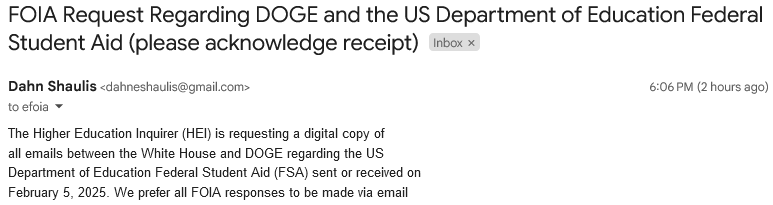
    The Higher Education Inquirer (HEI) is investigating email communications between the White House and DOGE regarding the US Department of Education Federal Student Aid (FSA).  HEI has been using FOIA responses for a number of years to expose corruption in the US higher education business. The White House has 20 days to acknowledge receipt. We will let you know if and when we get any responses from the White House.  

    Source link

  • Higher education postcard: Taxila | Wonkhe

    Higher education postcard: Taxila | Wonkhe

    We’re doing anther historical incursion today – looking at what was an internationally renowned centre of higher learning in the Indus valley.

    We have to wind the clock back a long way. In 535 BCE Persian emperor Cyrus the Great invaded the lands to the east, and by 540 BCE had taken all of the lands to the west of the Indus. A regional capital was established at Taxila, which by then had probably already been a city for about 500 years. It was the obvious choice, having been capital of the ancient kingdom of Gandhāra. We also need to note that in 326 BCE Taxila surrendered to Alexander the Great’s army; that a few years later it became part of the Mauryan empire for over 100 years; then part of the Yavana empire for another hundred years or so; then occupied by Indo-Scythians between 80-ish BCE and 30 CE; and the Kushan empire until about 375 CE.

    The following account draws strongly on Roy Lowe and Yoshihito Yasuhara’s 2016 work, The origins of higher learning. After the Persian conquest, Taxila became a centre for Vedic learning. By the time of Alexander and the early Mauryan emperors, there was a demand for scholars who could speak Greek.

    As well as the Vedic scriptures, medicine was taught at Taxila. Two eminent healers – Charaka and Jivaka – both studied at Taxila, perhaps under the teacher Disapamok Achariya. Other notable people associated with Taxila included Panini (who was neither the inventor of the sandwich nor the inventor of sticker albums, but was in fact a Sanskrit grammarian) and Chanakya, an early political economist.

    Lowe and Yasuhara tell us something about academic life at Taxila. Individual teachers shared a building with their students, and would enrol up to five hundred students. Senior students were used as assistant teachers, as clearly 500 is too many for one person (it’s easy to recognise the doctoral-students-as-teaching-assistants model here).

    The curriculum comprised “the three Vedas and the eighteen accomplishments”. The three Vedas – books of verses – were the Rigveda (knowledge of the verses), the Yajurveda (knowledge of the sacrifice) and the Samaveda (knowledge of the chants). The eighteen accomplishments are not so clearly specified. On the evidence seen by Lowe and Yasuhara they may have included “elephant lore, magic charms, spells for reincarnating the dead, hunting, the study of animals’ cries, archery, the art of prognostication, charms, divining from bodily symptoms, and medicine”; to which was later added “logic, the atomic theory of creation, arithmetic, law, accountancy, agriculture and astronomy.”

    This looks like a cracking degree programme to me. Particularly once I’d realised it was prognostication not procrastination, for which I’d want to submit a claim for accreditation of prior experiential learning. And, if you’re tempted to get sniffy about seriousness, it probably represented a good stab at the frontiers of knowledge at that time. Which is what first and second cycle qualifications of the UK higher education qualifications frameworks are about nowadays. So not so daft really.

    The Kusham empire, in the first century CE, destroyed the city of Taxila to make way for their own city, rebuilt a little to the north. And in the fifth century the Hunas destroyed the rebuilt city. (It is not clear if these Hunas were connected to the Huns who were busy invading Europe at about this time.

    And so there we have it; a very early institution of higher education. It is now a world heritage site, as suggested by the postcard, and a very popular tourist destination in Pakistan.

    A final cultural connection. A favourite of mine from the 1970s TV schedules was Monkey! This was a TV adaptation of an early Chinese novel, the Voyage to the West.

    The song played over the closing credits includes the lines “In Gandhāra, Gandhāra, they say it was in India…” – our heroes were escorting a Buddhist monk, Tripitaka, to being back some holy scrolls to help the emperor restore morality and order to China. It seems likely, I would suggest, that they were heading to Taxila.

    And really finally, here’s a jigsaw of the card, in case you feel the need of some pleasant distraction.

    Source link

  • Cancel culture, legal education, and the Supreme Court with Ilya Shapiro

    Cancel culture, legal education, and the Supreme Court with Ilya Shapiro

    Over the years, elite institutions shifted from
    fostering open debate to enforcing ideological conformity. But as
    guest Ilya Shapiro puts it, “the pendulum is swinging back.” He
    shares his firsthand experience with cancel culture and how the
    American Bar Association’s policies influence legal education.
    Shapiro also opines on major free speech cases before the Supreme
    Court, including the TikTok ownership battle and Texas’ age
    verification law for adult content.

    Shapiro is a senior fellow and director of
    constitutional studies at the Manhattan Institute. He previously
    (and briefly) served as executive director and senior lecturer at
    the Georgetown Center for the Constitution and as a vice president
    at the Cato Institute. His latest book, “Lawless:
    The Miseducation of America’s Elites
    ,” is out now.

    Enjoy listening to our podcast? Donate to FIRE today and
    get exclusive content like member webinars, special episodes, and
    more. If you became a FIRE Member
    through a donation to FIRE at thefire.org and would like access to
    Substack’s paid subscriber podcast feed, please email
    [email protected].


    Read the transcript.

    Timestamps:

    00:00 Intro

    02:58 Shapiro’s Georgetown controversy

    15:07 Free speech on campus

    26:51 Law schools’ decline

    40:47 Legal profession challenges

    42:33 The “vibe shift” away from cancel culture

    56:02 TikTok and age verification at the Supreme
    Court

    01:03:37 Anti-Semitism on campus

    01:09:36 Outro

    Show notes:

    – “The
    illiberal takeover of law schools
    ” City Journal (2022)

    – “Poll
    finds sharp partisan divisions on the impact of a Black woman
    justice.
    ” ABC News (2022)

    – “Why
    I quit Georgetown.
    ” Ilya Shapiro, The Wall Street Journal
    (2022)

    – “Georgetown’s
    investigation of a single tweet taking longer than 12 round-trips
    to the moon.
    ” FIRE (2022)


    Students for Fair Admissions v. Harvard
    (2023)


    Lamont v. Postmaster General
    (1965)

    TikTok Inc
    v. Garland
    (2025)


    Free Speech Coalition v. Paxton
    (2024)

    Ginsberg
    v. New York
    (1968)


    International Holocaust Remembrance Alliance (IHRA) working
    definition of antisemitism
    (last updated 2025)

    Source link

  • The left should reclaim free speech mantle (opinion)

    The left should reclaim free speech mantle (opinion)

    If progressive or even not-so-progressive Jewish students invited comedian Sacha Baron Cohen to their university to perform his riotous parody “In My Country There Is Problem,” with its call-and-pogrom chorus “throw the Jew down the well / so my country can be free,” would Cohen be allowed on campus? If the song were indeed sung, and a few humorless, unthinking listeners were distressed by the lyrics, or at least claimed to be, would the Jewish students face discrimination and harassment charges under the university’s disciplinary code?

    Today, probably. Would they be found responsible for discrimination and harassment based on national origin? Again, probably. And what if a student band wished to parody the parody with a song titled something like, “Throw Chris Rufo Down the Well So My University Can Be Free”? Could the song be sung against the backdrop of students’ sensitivities and the reciprocated rage of today’s young conservative white men?

    In her recently published opinion essay for Inside Higher Ed, Joan W. Scott skewered the Foundation for Individual Rights and Expression and its vice president for campus advocacy, Alex Morey, for condemning the American Association of University Professors. Scott’s criticism of Morey’s criticism goes like this: Morey lambasted AAUP president Todd Wolfson’s expression of “disappointment” over Donald Trump’s re-election, arguing that Wolfson’s explicit partisanship betrays the AAUP’s purported commitment to academic freedom. Scott countered that FIRE is a libertarian wolf donning academic freedom drag. FIRE, explains Scott, is “dedicated to the absolutist principle of individual free speech,” a principle that is “not,” Scott italicizes, synonymous with academic freedom. In turn, Scott elaborates on academic freedom as “individual and collective rights of faculty as they pursue the mission of higher education in a democracy.”

    We agree with Scott that FIRE—with its many right-wing funding sources as Scott lists them—is unlikely to have our backs if and when the federal government comes to shut down diversity, equity and inclusion programs and cultural studies departments on campus (i.e., queer and Black studies). We respect, too, that Scott knows more about the history and purpose of academic freedom than we do.

    And yet, we worry that the line she draws between free speech and academic freedom—the former ideological and libertarian, the latter true and good—cedes too much. Indeed, her distinction hands “free speech” over to the conservative groups championing their anti-educational causes under its banner, and her dismissal of free speech defenses as apologia for racism lets stand, unnuanced, the left-originating but now right-appropriated proposition that combative, controversial speech is necessarily harmful in an egalitarian university environment. It is the quick conversion of (at times highly provocative) political speech into hate speech that allows “from the river to the sea” to be branded as categorically harassing antisemitism—a conversion that would so quickly ban Jews from sending up antisemitism (“throw the Jew down the well”), ban musicians from joking about drowning Rufo or prohibit, for that matter, marginalized groups from reappropriating slurs to divest them of their injurious force.

    In short, we think there is still good reason—several good reasons—for the academic left to defend speech, both as elemental to academic freedom and as a democratic value unto itself.

    We and nearly every colleague we know have stories of students hastily claiming talk—talk of sex, Israel, Palestine and criticism of affirmative action—as intimidating, harassing or discriminating. It seems to us that a robust defense of academic freedom must include healthy skepticism, but not outright cynicism, of the proposition that words injure. Skepticism, not cynicism, because words may hurt people, further subordinate marginalized groups and erode democratic ideals. David Beaver’s and Jason Stanley’s recently published The Politics of Language draws on critical race and feminist theory to show how some speech acts—affective, nondeliberative and/or racist dog whistles—function to polarize and degrade.

    But we also know, especially in the wake of spurious discrimination claims against campus activists and academics protesting Israel’s military campaigns, that conservative stakeholders are weaponizing the idea of words as weapons, alleging atmospheres of harassment to chill political speech—a project, we must concede, that the left paved the way for.

    Indeed, around 2013, as trigger warnings gained traction on college campuses, the right repackaged “free speech” as the inalienable freedom of anyone to speak on any topic without consequence, especially if that consequence is the loss of a platform. Instead of drawing on the left’s history of free speech advocacy, scholars of “identity knowledges” centered attention on the moral wrongness of offensive speech and the intolerability of feeling unsafe. This shift left progressives defending feelings rather than ideas, collapsing political discord with dehumanization—or, as Sarah Schulman argues, conflict with abuse. Now, with free speech reduced to melodrama, even the Christian right claims to protect its constituents against “harm”—whether from critical race theory or drag shows—rendering the issue a conceit of the culture wars.

    In his much-ridiculed op-ed for The New York Times published last year, linguist John McWhorter lamented that he and his students were unable to listen to John Cage’s silent “4:33” during class, as the silence would have been interrupted by the sound of student protests. The irony that McWhorter chided the protesters for impeding his students from appreciating Cage’s invitation to listen to “the surrounding noise” of the environs was not lost on McWhorter’s critics.

    What was not commented on, though, was McWhorter’s contention that if a group of students had been shouting “DEI has got to die” with the same fervor with which they were shouting for Palestine’s self-determination, then the protests “would have lasted roughly five minutes before masses of students shouted them down and drove them off the campus. Chants like that would have been condemned as a grave rupture of civilized exchange, heralded as threatening resegregation and branded as a form of violence.”

    Whether correct or not, McWhorter’s speculation is not baseless. We want to insist, though, that there are left, not just libertarian, grounds to defend, for example, a student protest against DEI initiatives. They include: respecting and celebrating the university as a space of open dialogue and debate; the possibility that you might learn something from someone with whom you disagree; the opportunity to lampoon, parody or otherwise countermand whatever worse-than-foolish statement the opposition is making; the opportunity, as John Stuart Mill taught us, to strengthen your own ideas and arguments alongside and against the ideas of others; and finally, avoiding the inevitable backlash of “the cancel,” whereby censored conservatives rebrand themselves as truth-telling victims of the “woke.”

    Granted, some of these grounds for defending speech tilt more liberal or libertarian than pure left, whatever that means, but we nonetheless maintain that it is self-defeating for us to carry the banner for “academic freedom” while consigning “free speech” to the province of white grievance. This is especially true for those of us teaching queer and critical sexuality studies, where classrooms and related spaces of activism and dialogue are increasingly circumscribed, the harm principle ever more unprincipled. Consider the case of Aneil Rallin, who in 2022 was accused by Soka University of America of teaching “triggering” sexual materials to his students in a course called Writing the Body, and whose case—while taken up by FIRE—was met with little alarm from the academic left.

    It also applies to those of us who still recognize satire, irony and social commentary in an age of breathtaking literalism. In 2011, the Dire Straits song “Money for Nothing” (1985) was temporarily banned from Canadian radio for its use of the f-slur, even though the term was intended as a commentary on working-class homophobia. The drive to censor and demonize without regard for social context has arguably gotten stronger in the years since.

    From the recent historical record, it seems to us that the enforcement of bureaucratic speech restrictions often damages campus culture and democratic norms more than the speech acts themselves. Indeed, the better question than is X speech act harmful is, to crib from Wendy Brown, when—if ever and at what costs—are speech restrictions the remedy for injury?

    Debating DEI programs, myths of meritocracy and so on is the stuff of academic freedom. A speech act like “DEI must die” is provocative, abrasive and worth publicly disparaging, but it is not the same as hate speech. Song parodies will not save us from the dark years ahead for public education, academic freedom and egalitarian pedagogies of all kinds. But our battle preparations demand standing up for, not surrendering, free speech.

    Joseph J. Fischel is an associate professor of women’s, gender and sexuality studies at Yale University.

    Kyler Chittick is a Ph.D. candidate in the Department of Political Science at the University of Alberta.

    Source link

  • West Point disbands student groups for women and minorities

    West Point disbands student groups for women and minorities

    The United States Military Academy in West Point, N.Y., has shut down a dozen student affinity clubs to comply with President Donald Trump’s executive orders to eliminate federal funding for diversity, equity and inclusion initiatives and ensure that no member of the military “be preferred or disadvantaged on the basis of sex, race, ethnicity, color, or creed,” The Washington Post reported.

    The Asian-Pacific Forum Club, the National Society of Black Engineers Club and the Latin Cultural Club are among the campus groups ordered to shut down, according to a memo sent Tuesday from Chad Foster, deputy commandant at West Point, to the Directorate of Cadet Activities.

    The memo orders all the identified clubs to “permanently cease all activities” and “unpublish, deactivate, archive or otherwise remove all public facing content.” It also orders the dozens of other clubs at West Point to “cease all activity” until they have been reviewed to ensure compliance with Trump’s executive orders and guidance from the Army and the Department of Defense. 

    Below is the full list of disbanded clubs, including some with decades-long histories at West Point, according to the Post:

    • The Asian-Pacific Forum Club
    • The Contemporary Cultural Affairs Seminar Club
    • The Corbin Forum
    • The Japanese Forum Club
    • The Korean-American Relations Seminar
    • The Latin Cultural Club
    • The Native American Heritage Forum
    • The National Society of Black Engineers (West Point chapter)
    • The Society for Hispanic Professional Engineers (West Point chapter)
    • The Society of Women Engineers (West Point chapter)
    • Spectrum
    • The Vietnamese-American Cadet Association

    Source link

  • College presidents’ survey finds alarm over Trump

    College presidents’ survey finds alarm over Trump

    Even before President Donald Trump unleashed a flurry of executive orders involving higher education, college and university presidents expressed serious concerns about his possible impact on the sector and on their own institutions. That’s according to findings released today from Inside Higher Ed’s forthcoming 2025 Survey of College and University Presidents with Hanover Research.

    More than half of presidents surveyed in December and early January—51 percent—at that point believed Trump’s second administration would have a somewhat or significant negative impact on the regulatory environment for higher education. Some 38 percent of respondents said they believed Trump would have a somewhat or significant positive impact on the regulatory environment, while the remainder expected his administration to have no impact. Male presidents were more likely than their female counterparts to express confidence in the Trump administration, with 42 percent of men responding that they expected an at least somewhat positive regulatory environment for the sector compared to 30 percent of women.

    Drilling down into specific concerns, the vast majority of presidents—80 percent—indicated Trump would have a negative impact on DEI across higher education. On an institutional level, 60 percent said he would negatively impact DEI efforts at their own colleges and universities.

    Presidents also expressed concerns about what Trump 2.0 would mean for public perceptions of higher education’s value, the climate for campus speech and the financial outlook for colleges and universities.

    The latest edition of the annual survey of presidents, now in its 15th year, includes responses from 298 leaders from a mix of two- and four-year institutions, public and private nonprofit. It was administered after Trump was elected but before he took office. The findings below are focused exclusively on his new administration and the broader political environment. The full survey, covering a broad range of issues relevant to college leaders, is forthcoming.

    Unpacking the Findings

    Given the timing of the survey and the rapid-fire executive orders and other actions that have followed, which included a temporary freeze on federal funding that created uncertainty and alarm across the sector, some experts believe presidents would respond even more negatively now.

    “I don’t think there’s any question that had this survey been done after Jan. 20, the numbers would be more negative than they were, with what we have seen since: the executive orders flowing out of the White House and funding freezes and just the chaos and uncertainty,” Michael Harris, a professor of higher education at Southern Methodist University, told Inside Higher Ed.

    “The survey indicates that presidents had some sense of what was coming,” Harris said. But he noted their “failure of imagination” to realize how quickly Trump would act.

    Already higher education is feeling the pressure on DEI, an area presidents anticipated would come under fire by the new administration.

    One of Trump’s first executive orders, issued on Jan. 21, called on federal agencies “to enforce our longstanding civil-rights laws and to combat illegal private-sector DEI preferences, mandates, policies, programs, and activities.” It also tasked Trump’s attorney general and the education secretary with crafting guidance for universities on how to comply with the 2023 Supreme Court ruling that banned the consideration of race in admissions policies.

    Universities have reacted in myriad ways to Trump’s attack on DEI. Last month the Rutgers University Center for Minority Serving Institutions canceled a virtual conference on apprenticeships at historically Black colleges and universities, and Michigan State University called off a lunch to celebrate Lunar New Year (but allowed other related events to go on).

    According to the survey, 71 percent of respondents believe that Trump will have a negative impact on the climate for free inquiry and civil dialogue across higher education. But only 52 percent said their own institution would suffer those negative effects.

    The majority of respondents—71 percent—also said Trump would have a negative financial impact on the sector. But at the institutional level, only 45 percent believe the same is true at their institution. And nearly a quarter of respondents believe he’ll positively affect their finances.

    Harris views with skepticism the belief among many presidents that their institutions will fare better than the rest of the sector. He argues that presidents can be “blinded” by proximity to their institution, which makes them overconfident in its strength.

    “I tend to believe the response around the industry more than the individual institution,” he said.

    But Anne Harris, president of Grinnell College—and no relation to Michael—believes that presidents have a firm grasp on their community “and all of its complexity,” which helps them better understand how a situation may play out on campus. She said that the “direct impact of a federal policy is always going to be negotiated, diffused and maybe absorbed by the multiplicity of constituencies on a campus.”

    While the new Republican president was the cause of concern for many respondents, presidents also expressed dissatisfaction with his Democratic predecessor, Joe Biden, last year.

    In Inside Higher Ed’s 2024 survey of College and University Presidents, only 33 percent of respondents indicated satisfaction with the Biden administration’s record on higher education. Last year’s survey found that 41 percent of respondents were completely or somewhat dissatisfied with Biden, who left behind a mixed legacy on higher education. He was accused of leaving some promises unfulfilled while overreaching in other areas, such as student loan forgiveness.

    Killing the Education Department

    One of Trump’s campaign promises was to dismantle the U.S. Department of Education, a process that he has already taken steps toward but that will likely face an uphill battle given that he would need congressional approval to shut it down, which Democrats have made clear they are unwilling to provide. Even with a Republican majority in the Senate, the move faces highly unlikely odds.

    The majority of presidents surveyed disapprove of shutting down the department: 72 percent opposed the idea and 21 percent indicated uncertainty, while 8 percent voiced support for the effort. Presidents of private, nonprofit institutions were most likely to support the move.

    Harris, the Grinnell College president, questions what role last year’s botched launch of the new Free Application for Federal Student Aid played in draining support from the Department of Education, given the financial pressures felt by countless students, families and institutions.

    “There are going to be very few presidents who are going to cheer what happened with FAFSA,” she said. “So maybe this is some FAFSA lack of confidence saying the Department of Education did not serve higher ed well with the FAFSA debacle last year. So why not try something else?”

    Brad Mortensen, president of Weber State University, offered a similar perspective.

    “It wouldn’t have surprised me if [that number] was higher, just given how rough of a time the Department of Education had in rolling out the new FAFSA,” Mortensen told Inside Higher Ed. “That had real impacts on all types of institutions across the country.”

    Both presidents indicated that the programs housed in ED are more important than the department itself. They are more concerned about the continued flow of federal financial aid, for example, than where it comes from—whether that’s ED or the U.S. Department of the Treasury.

    Ongoing Optimism

    Concerns about Trump notwithstanding, other findings in the forthcoming full survey were positive—including the financial outlook at the institutional level, despite clear signs of strain across the sector. (Financial findings will be covered in depth as part of the full survey release.)

    Some presidents believe that optimism comes with the job.

    “College and university presidents are a funny lot. As I was applying for this job, I had a past president tell me, ‘Brad, you have to be smart enough to get the job and dumb enough to take it.’ I think by nature, we tend to be naïve optimists because it’s a job with a lot of challenges,” Mortensen said.

    Source link

  • Abrupt presidential exits at Oklahoma State, CSU Pueblo

    Abrupt presidential exits at Oklahoma State, CSU Pueblo

    Two presidents resigned abruptly with few details in recent days: Kayse Shrum stepped down at Oklahoma State University, and Armando Valdez resigned the presidency of Colorado State University, Pueblo.

    For Shrum, the move comes less than four years into her job and with no public explanation.

    Local news outlet NonDoc reported that her resignation—which blindsided many at the university—coincides with an opaque review of improper transfers of “legislatively appropriated funds.” NonDoc also noted recent tensions over the contract of football coach Mike Gundy, who signed a restructured deal that gave him an extension but also a $1 million–a–year pay cut. 

    One anonymous source told the news outlet that the situation escalated quickly as Shrum “went from being on solid footing last Thursday to essentially not being president on Monday night.”

    Though the resignation was official Monday, the Board of Regents did not announce the move until Wednesday.

    Valdez resigned as president of CSU Pueblo one day shy of hitting a year on the job. The move follows an independent investigation that found he had violated university policy, according to a Colorado State University System news release. System officials did not indicate what policy Valdez allegedly violated, noting in the news release that Valdez disagreed with the findings but recognized he had lost “the confidence of the Board of Governors and CSU System leadership. As a result, to allow the university to move forward, he resigned his role.”

    System officials told The Pueblo Chieftain that his resignation and the alleged policy violation were a personnel matter and therefore “not something the CSU system will be commenting on.”

    Source link

  • Abolishing the Department of Education is unpopular

    Abolishing the Department of Education is unpopular

    The majority of likely voters oppose abolishing the U.S. Department of Education by executive order, according to a new poll conducted by the progressive think tank Data for Progress, on behalf of the Student Borrower Protection Center and Groundwork Collaborative, a left-wing advocacy group.

    The poll found 61 percent of all survey respondents “somewhat” or “strongly” opposed the idea of eliminating the department, compared to 64 percent of likely voters under the age of 45 and 59 percent above age 45. Among likely voters who attended college, 70 percent opposed the plan, compared to 57 percent who didn’t attend college.

    The results are based on a survey of 1,294 likely voters between Jan. 31 and Feb. 2.

    The poll, released Tuesday, comes amid news report that President Donald Trump is planning to sign an executive order to dismantle the Department of Education or direct “the agency to begin to diminish itself,” The Washington Post reported, citing three people briefed on the order.

    In a press release, Mike Pierce, executive director of the Student Borrower Protection Center, called “the rumored plan” to eliminate the department “wildly unpopular.”

    Source link

  • Interest in QuestBridge students on the rise

    Interest in QuestBridge students on the rise

    As colleges and universities look for new ways to diversify their student bodies and increase access to low-income students, one national program is emerging as an increasingly popular tool in those efforts.

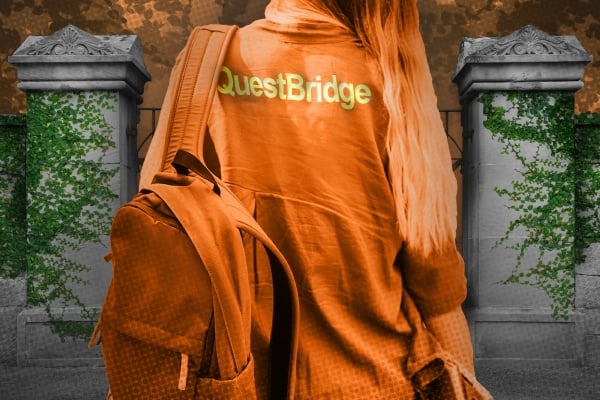
    QuestBridge, a national match program that places high-achieving low-income students at selective partner colleges, saw early-admission rates for its applicants rise by 17 percent this year, according to data released in December. A total of 2,627 students from QuestBridge’s program were accepted early to the Class of 2029, and that number will likely grow as regular-decision acceptance letters roll in.

    And that growth will likely continue into the future after the 21-year-old organization recently added three new university partners to its roster: Bates College, the University of Richmond and, most notably, Harvard University—the last Ivy League institution to join forces with the organization.

    QuestBridge students go through a competitive application process to become finalists: Only 7,288 were selected this cycle out of more than 25,000 applicants. The finalists rank their top choices out of the organization’s 55 partner colleges, and QuestBridge matches them with a full scholarship at the highest-ranking institution on their list that accepts them.

    A spokesperson for QuestBridge chalked up this cycle’s record-breaking early acceptances to typical growth. But the numbers are hard to ignore: QuestBridge went from having 1,755 early admits in 2023 to 2,627 in 2025, during which time it only added two partner universities.

    Institutions say that QuestBridge helps deliver talented students from diverse backgrounds, filling in where their resources fall short. That’s become especially important since the Supreme Court’s decision in June 2023 banning affirmative action. In fact, universities’ interest in QuestBridge scholars surged last year, too, right after the ruling, when admit rates went up by a whopping 28 percent and the program added Cornell University and Skidmore College as partners.

    The vast majority of QuestBridge’s partner schools practiced affirmative action before the court decision. After a slew of selective colleges reported declines in Black and Hispanic enrollment this fall, they have been looking for race-neutral recruitment and admissions tools to enhance incoming classes’ diversity, including expanded financial aid programs and a commitment to first-generation students.

    Bryan Cook, director of higher education policy at the Urban Institute and the author of an ongoing study on the wide-reaching effects of the Supreme Court decision, said that whether colleges were looking to boost racial diversity or expand on efforts to admit more low-income students post–affirmative action, QuestBridge fits the bill.

    “My sense from talking to admissions professionals across the country is that they’re utilizing every tool available to them to identify diverse students,” Cook said. “Before [the Supreme Court decision], QuestBridge was a good resource but maybe not necessary,” so “it’s not surprising to see an uptick after the fact.”

    Some of the colleges with the steepest declines in underrepresented student enrollment are doubling down on QuestBridge during this early admissions cycle. Brown University, which saw a 10 percent decline in Black, Hispanic and Indigenous students, admitted 90 QuestBridge finalists early, up from 64 the prior year. Tufts University had a six-percentage-point drop in underrepresented students this fall and admitted 42 QuestBridge applicants early, up from 30 in 2023–24. The Massachusetts Institute of Technology, which reported a nine-point drop in minority students, admitted 100 QuestBridge students early, nearly double the 56 it accepted last year and comprising more than 10 percent of its early-action cohort this cycle. Black, Hispanic and Indigenous enrollment also fell by 10 percentage points this fall at Cornell, which is welcoming its first class of QuestBridge scholars this cycle.

    QuestBridge, crucially, is not a race-based program—if it were, it might earn the scrutiny being given other race-conscious scholarships and admission-adjacent initiatives. Instead, its criteria are income-based; this past year, 90 percent of applicants came from families who earn less than $65,000. While the organization’s website breaks down data on certain applicant characteristics—81 percent first-generation, 37 percent Southerners, 5 percent noncitizens—it offers no information on racial demographics. As recently as 2020, the organization did publish those breakdowns; that year, about 41 percent of finalists were white, 24 percent were Asian American, 14 percent Latino and 9 percent Black.

    “As an organization focused on socioeconomic status, we do not currently publish race data, although there have not been significant shifts in our demographics by race pre and post the [Supreme Court] decision,” a QuestBridge spokesperson wrote in an email.

    Chazz Robinson, education policy adviser at the left-of-center think tank Third Way, said the affirmative action ban isn’t the only important context for the rise in QuestBridge admits. Heightening scrutiny of wealthy colleges has increased pressure to boost financial aid programs and increase socioeconomic diversity—both problems that QuestBridge can be part of addressing.

    “There’s growing concern from students about costs. There’s growing questions for administrators about value, about the students they’re serving,” Robinson said. QuestBridge “can be part of building the case that they’re helping students from struggling backgrounds achieve socioeconomic mobility.”

    In a statement, Harvard admissions director William Fitzsimmons said the partnership reflected the university’s commitment to “bringing the most promising students to Harvard from all socioeconomic backgrounds.”

    Leigh Weisenburger, dean of admission and vice president for enrollment at Bates, said the new partnership isn’t specifically aimed at increasing racial diversity, but it is part of the university’s commitment to increasing “all kinds of diversity.”

    “Given the law, I don’t want to misconstrue [the QuestBridge partnership] as an attempt to racially diversify our class,” she said. “While we can’t consider race any longer, we obviously are continuing to do everything in our power to feed our prospect applicant pools in access-oriented ways.”

    Extending Recruiters’ Reach

    Stephanie Dupaul, vice president for enrollment management at the University of Richmond, wrote in an email to Inside Higher Ed that the university had been entertaining a partnership with QuestBridge for “many years.” She emphasized the program’s potential to amplify the university’s recruitment range geographically and reach high schools outside its normal recruitment zone.

    “We were particularly interested in their connections with rural students who might not have exposure to schools like Richmond,” she wrote.

    Weisenburger also stressed the benefits of QuestBridge’s broad geographic reach.

    “Bates is on the smaller scale of many of the institutions with whom QuestBridge partners and so for us to be present in Oklahoma as much as we’re present in California, as much as we’re present in rural Vermont, just isn’t feasible,” she said. “This allows us to be in those students’ conversations.”

    Geographic gaps aren’t the only recruitment concern for selective private colleges. Bates, like many small New England liberal arts colleges, has historically struggled to diversify its student body, which is currently about 72 percent white; its most diverse cohort yet, admitted last year, was made up of 32 percent domestic students of color. Bates’s student body is also disproportionately wealthy. Fewer than half of students receive any kind of need-based aid, and a 2023 New York Times report ranked Bates as tied for last in socioeconomic diversity out of a pool of 283 colleges. The Times report also found that only 8 percent of Bates students receive Pell Grants, and the share of Pell recipients in the student body fell by five percentage points from 2011 to 2023.

    Weisenburger said that while Bates has always striven to welcome a wide variety of students to its Lewiston, Me., campus, finding the resources to not only recruit those students but support them once they arrive on campus can be a challenge. And though she maintains Bates has a better history of diversity than many of its peers, Weisenburger acknowledged the college has a reputation for being “undiverse and privileged.”

    “We do have limited resources, looking at the college’s overall operating budget and our financial aid budget, and so we have to think really strategically and critically about how we’re going to best use those funds,” Weisenburger said. “That’s where QuestBridge for us just seems obvious.”

    Cook said that QuestBridge, with only a few thousand finalists a year, is not a cure for colleges’ diversity woes. But as admissions offices scramble to plug the hole left by the affirmative action ban, he said, partnering with outside organizations like QuestBridge can be a good short-term solution—and based on growing interest in the program, colleges may be thinking the same thing.

    “A lot of admissions professionals are still trying to figure out what are the best tools and options available to achieve the type of diverse student bodies they want. And most of them, to my knowledge, have not found a magic bullet,” he said. “I wouldn’t say that QuestBridge is a replacement for doing the hard work of figuring out other strategies. But understanding that’s not going to happen overnight, why not use it to help in the interim?”


    Source link