Two presidents resigned abruptly with few details in recent days: Kayse Shrum stepped down at Oklahoma State University, and Armando Valdez resigned the presidency of Colorado State University, Pueblo.
For Shrum, the move comes less than four years into her job and with no public explanation.
Local news outlet NonDoc reported that her resignation—which blindsided many at the university—coincides with an opaque review of improper transfers of “legislatively appropriated funds.” NonDoc also noted recent tensions over the contract of football coach Mike Gundy, who signed a restructured deal that gave him an extension but also a $1 million–a–year pay cut.
One anonymous source told the news outlet that the situation escalated quickly as Shrum “went from being on solid footing last Thursday to essentially not being president on Monday night.”
Though the resignation was official Monday, the Board of Regents did not announce the move until Wednesday.
Valdez resigned as president of CSU Pueblo one day shy of hitting a year on the job. The move follows an independent investigation that found he had violated university policy, according to a Colorado State University System news release. System officials did not indicate what policy Valdez allegedly violated, noting in the news release that Valdez disagreed with the findings but recognized he had lost “the confidence of the Board of Governors and CSU System leadership. As a result, to allow the university to move forward, he resigned his role.”
System officials told The Pueblo Chieftain that his resignation and the alleged policy violation were a personnel matter and therefore “not something the CSU system will be commenting on.”
The majority of likely voters oppose abolishing the U.S. Department of Education by executive order, according to a new poll conducted by the progressive think tank Data for Progress, on behalf of the Student Borrower Protection Center and Groundwork Collaborative, a left-wing advocacy group.
The poll found 61 percent of all survey respondents “somewhat” or “strongly” opposed the idea of eliminating the department, compared to 64 percent of likely voters under the age of 45 and 59 percent above age 45. Among likely voters who attended college, 70 percent opposed the plan, compared to 57 percent who didn’t attend college.
The results are based on a survey of 1,294 likely voters between Jan. 31 and Feb. 2.
The poll, released Tuesday, comes amid news report that President Donald Trump is planning to sign an executive order to dismantle the Department of Education or direct “the agency to begin to diminish itself,” The Washington Post reported, citing three people briefed on the order.
In a press release, Mike Pierce, executive director of the Student Borrower Protection Center, called “the rumored plan” to eliminate the department “wildly unpopular.”
As colleges and universities look for new ways to diversify their student bodies and increase access to low-income students, one national program is emerging as an increasingly popular tool in those efforts.
QuestBridge, a national match program that places high-achieving low-income students at selective partner colleges, saw early-admission rates for its applicants rise by 17 percent this year, according to data released in December. A total of 2,627 students from QuestBridge’s program were accepted early to the Class of 2029, and that number will likely grow as regular-decision acceptance letters roll in.
And that growth will likely continue into the future after the 21-year-old organization recently added three new university partners to its roster: Bates College, the University of Richmond and, most notably, Harvard University—the last Ivy League institution to join forces with the organization.
QuestBridge students go through a competitive application process to become finalists: Only 7,288 were selected this cycle out of more than 25,000 applicants. The finalists rank their top choices out of the organization’s 55 partner colleges, and QuestBridge matches them with a full scholarship at the highest-ranking institution on their list that accepts them.
A spokesperson for QuestBridge chalked up this cycle’s record-breaking early acceptances to typical growth. But the numbers are hard to ignore: QuestBridge went from having 1,755 early admits in 2023 to 2,627 in 2025, during which time it only added two partner universities.
Institutions say that QuestBridge helps deliver talented students from diverse backgrounds, filling in where their resources fall short. That’s become especially important since the Supreme Court’s decision in June 2023 banning affirmative action. In fact, universities’ interest in QuestBridge scholars surged last year, too, right after the ruling, when admit rates went up by a whopping 28 percent and the program added Cornell University and Skidmore College as partners.
The vast majority of QuestBridge’s partner schools practiced affirmative action before the court decision. After a slew of selective colleges reported declines in Black and Hispanic enrollment this fall, they have been looking for race-neutral recruitment and admissions tools to enhance incoming classes’ diversity, including expanded financial aid programs and a commitment to first-generation students.
Bryan Cook, director of higher education policy at the Urban Institute and the author of an ongoing study on the wide-reaching effects of the Supreme Court decision, said that whether colleges were looking to boost racial diversity or expand on efforts to admit more low-income students post–affirmative action, QuestBridge fits the bill.
“My sense from talking to admissions professionals across the country is that they’re utilizing every tool available to them to identify diverse students,” Cook said. “Before [the Supreme Court decision], QuestBridge was a good resource but maybe not necessary,” so “it’s not surprising to see an uptick after the fact.”
Some of the colleges with the steepest declines in underrepresented student enrollment are doubling down on QuestBridge during this early admissions cycle. Brown University, which saw a 10 percent decline in Black, Hispanic and Indigenous students, admitted 90 QuestBridge finalists early, up from 64 the prior year. Tufts University had a six-percentage-point drop in underrepresented students this fall and admitted 42 QuestBridge applicants early, up from 30 in 2023–24. The Massachusetts Institute of Technology, which reported a nine-point drop in minority students, admitted 100 QuestBridge students early, nearly double the 56 it accepted last year and comprising more than 10 percent of its early-action cohort this cycle. Black, Hispanic and Indigenous enrollment also fell by 10 percentage points this fall at Cornell, which is welcoming its first class of QuestBridge scholars this cycle.
QuestBridge, crucially, is not a race-based program—if it were, it might earn the scrutiny being given other race-conscious scholarships and admission-adjacent initiatives. Instead, its criteria are income-based; this past year, 90 percent of applicants came from families who earn less than $65,000. While the organization’s website breaks down data on certain applicant characteristics—81 percent first-generation, 37 percent Southerners, 5 percent noncitizens—it offers no information on racial demographics. As recently as 2020, the organization did publish those breakdowns; that year, about 41 percent of finalists were white, 24 percent were Asian American, 14 percent Latino and 9 percent Black.
“As an organization focused on socioeconomic status, we do not currently publish race data, although there have not been significant shifts in our demographics by race pre and post the [Supreme Court] decision,” a QuestBridge spokesperson wrote in an email.
Chazz Robinson, education policy adviser at the left-of-center think tank Third Way, said the affirmative action ban isn’t the only important context for the rise in QuestBridge admits. Heightening scrutiny of wealthy colleges has increased pressure to boost financial aid programs and increase socioeconomic diversity—both problems that QuestBridge can be part of addressing.
“There’s growing concern from students about costs. There’s growing questions for administrators about value, about the students they’re serving,” Robinson said. QuestBridge “can be part of building the case that they’re helping students from struggling backgrounds achieve socioeconomic mobility.”
In a statement, Harvard admissions director William Fitzsimmons said the partnership reflected the university’s commitment to “bringing the most promising students to Harvard from all socioeconomic backgrounds.”
Leigh Weisenburger, dean of admission and vice president for enrollment at Bates, said the new partnership isn’t specifically aimed at increasing racial diversity, but it is part of the university’s commitment to increasing “all kinds of diversity.”
“Given the law, I don’t want to misconstrue [the QuestBridge partnership] as an attempt to racially diversify our class,” she said. “While we can’t consider race any longer, we obviously are continuing to do everything in our power to feed our prospect applicant pools in access-oriented ways.”
Extending Recruiters’ Reach
Stephanie Dupaul, vice president for enrollment management at the University of Richmond, wrote in an email to Inside Higher Ed that the university had been entertaining a partnership with QuestBridge for “many years.” She emphasized the program’s potential to amplify the university’s recruitment range geographically and reach high schools outside its normal recruitment zone.
“We were particularly interested in their connections with rural students who might not have exposure to schools like Richmond,” she wrote.
Weisenburger also stressed the benefits of QuestBridge’s broad geographic reach.
“Bates is on the smaller scale of many of the institutions with whom QuestBridge partners and so for us to be present in Oklahoma as much as we’re present in California, as much as we’re present in rural Vermont, just isn’t feasible,” she said. “This allows us to be in those students’ conversations.”
Geographic gaps aren’t the only recruitment concern for selective private colleges. Bates, like many small New England liberal arts colleges, has historically struggled to diversify its student body, which is currently about 72 percent white; its most diverse cohort yet, admitted last year, was made up of 32 percent domestic students of color. Bates’s student body is also disproportionately wealthy. Fewer than half of students receive any kind of need-based aid, and a 2023 New York Times report ranked Bates as tied for last in socioeconomic diversity out of a pool of 283 colleges. The Times report also found that only 8 percent of Bates students receive Pell Grants, and the share of Pell recipients in the student body fell by five percentage points from 2011 to 2023.
Weisenburger said that while Bates has always striven to welcome a wide variety of students to its Lewiston, Me., campus, finding the resources to not only recruit those students but support them once they arrive on campus can be a challenge. And though she maintains Bates has a better history of diversity than many of its peers, Weisenburger acknowledged the college has a reputation for being “undiverse and privileged.”
“We do have limited resources, looking at the college’s overall operating budget and our financial aid budget, and so we have to think really strategically and critically about how we’re going to best use those funds,” Weisenburger said. “That’s where QuestBridge for us just seems obvious.”
Cook said that QuestBridge, with only a few thousand finalists a year, is not a cure for colleges’ diversity woes. But as admissions offices scramble to plug the hole left by the affirmative action ban, he said, partnering with outside organizations like QuestBridge can be a good short-term solution—and based on growing interest in the program, colleges may be thinking the same thing.
“A lot of admissions professionals are still trying to figure out what are the best tools and options available to achieve the type of diverse student bodies they want. And most of them, to my knowledge, have not found a magic bullet,” he said. “I wouldn’t say that QuestBridge is a replacement for doing the hard work of figuring out other strategies. But understanding that’s not going to happen overnight, why not use it to help in the interim?”
The North Carolina Community College System is launching NC Community Colleges Boost, a new program to move students into high-demand careers in the state. The program is modeled after the City University of New York’s Accelerated Study in Associate Programs, or CUNY ASAP, known for offering extensive wraparound supports for low-income students to increase their completion rates, including personalized academic advising and covering various college costs.
The program will launch at eight community colleges across the state in 2025 and at seven more colleges the following year, with the help of the CUNY ASAP National Replication Collaborative, which has helped other institutions create their own versions of the heavily studied and rapidly spreading program. Participating North Carolina students will have to be in fields of study that lead to high-demand careers in the state, among other eligibility criteria.
The CUNY ASAP model is “the gold standard for increasing completion in higher education,” North Carolina Community College System president Jeff Cox said in an announcement Wednesday. “In the NC Community Colleges Boost implementation, we have taken that model and aligned it with North Carolina’s workforce development goals as specified in the PropelNC initiative,” the system’s new funding model intended to better align funding with workforce needs.
The effort is supported by a grant of about $35.6 million from the philanthropy Arnold Ventures, the largest private grant ever received by the North Carolina Community College System.
“This program has increased graduation rates, reduced time to graduation, and lowered the cost per graduate across many individual colleges in several states,” Cox said of CUNY ASAP. “Here in North Carolina, we have every reason to expect similar results.”
President Donald Trump signed an executive order Wednesday banning transgender women from participating in women’s sports.
“The war on women’s sports is over,” he said. “With my action this afternoon, we are putting every school receiving taxpayer dollars on notice that if you let men take over women’s sports teams or invade your locker rooms, you will be investigated for violations of Title IX and risk your federal funding.”
The executive order, signed on National Girls and Women in Sports Day, declares that it’s “the policy of the United States to oppose male competitive participation in women’s sports more broadly, as a matter of safety, fairness, dignity, and truth.” Under the order, the assistant to the president for domestic policy will bring together representatives of “major athletic organizations and governing bodies, and female athletes harmed by such policies, to promote policies that are fair and safe, in the best interests of female athletes.”
The president’s latest action builds on the GOP’s broader campaign to remove all recognition of transgender individuals from state and federal programs. On his first day in office, Trump signed a separate executive action declaring that there are only two sexes and banning federal funding for any program related to “gender ideology.” And House Republicans have passed a bill that would unilaterally ban trans women from competing in women’s sports. In nearly half of the country, trans women are banned from playing women’s sports at the K-12 or higher education level, but the order would take those bans nationwide.
Additionally, the order calls on the education secretary to prioritize “Title IX enforcement actions against educational institutions (including athletic associations composed of or governed by such institutions) that deny female students an equal opportunity to participate in sports and athletic events by requiring them, in the women’s category, to compete with or against or to appear unclothed before males.” (Federally funded K-12 public schools and colleges are required to comply with Title IX, which bars discrimination based on sex in educational settings.)
Charlie Baker, president of the National Collegiate Athletic Association, told Congress recently that out of the more than 500,000 college athletes, fewer than 10 were transgender. The NCAA released a statement Wednesday that said, “The NCAA Board of Governors is reviewing the executive order and will take necessary steps to align NCAA policy in the coming days, subject to further guidance from the administration.”
As Trump spoke Wednesday, girls and women—including former University of Kentucky swimmer and anti-trans advocate Riley Gaines—stood behind him, often clapping in support.
After thanking them, the president turned back to face the rest of the East Room audience. He acknowledged the federal lawmakers, state attorneys general and governors in attendance, describing them as “friends of women’s sports.”
“My administration will not stand by and watch men beat and batter women,” he said. “It’s going to end and nobody’s gonna be able to do a damn thing about it because when I speak [I] speak with authority.” (Trump was referring to an Olympic gold medal–winning Algerian boxer whom some accused of being transgender; the boxer has publicly said she was born a woman.)
Fatima Goss Graves, president of the National Women’s Law Center, said in a statement that trans students do not pose a threat in sports and deserve the same opportunities as their peers.
“The far-right’s disturbing obsession with controlling the bodies, hearts, and minds of our country’s youth harms all students,” Graves said.
Education secretary nominee Linda McMahon attended the ceremony, though her confirmation hearing for the office has yet to be scheduled. In the meantime, the department is being led by a collection of acting officials and appointees, including Deputy General Counsel Candice Jackson, who described the president’s order as “a demonstration of common sense.”
“The President affirmed that this administration will protect female athletes from the danger of competing against and the indignity of sharing private spaces with someone of the opposite sex,” Jackson said in a news release. “The Department of Education stands proudly with President Trump’s action as we prioritize Title IX enforcement against educational institutions that refuse to give female athletes the Title IX protections they deserve.”
Other Republican lawmakers praised the order Wednesday, arguing it would ensure women and girls won’t be pushed to the sidelines.
But Representative Bobby Scott, a Democrat from Virginia and ranking member on the House education committee, was quick to oppose the order, calling it “yet another overreach by this administration” and saying its lack of clarity will further complicate what should be addressed by sports associations.
“Rather than address the real, urgent issues that students and families are facing every day, this administration continues to target vulnerable students—specifically transgender girls and women—with a shameless attempt to bully them,” he said in a statement. “They are willing to use the most vulnerable Americans as pawns in a political game.”
In “The Doctoral Dilemma” (Feb. 3, 2025), Inside Higher Ed reporter Johanna Alonso describes career coaching as a “cottage industry” of “gurus” that emerged to fill critical gaps in graduate training. As a career coach cited in the article, I was disappointed to see such an inaccurate and biased portrayal of my work.
Coaching is a professional industry with proven methods, tools, and credentialing provided by the International Coaching Federation (ICF). Coaching is distinct from “consulting,” and it’s an intentional, strategic step for anyone seeking to change careers. This is why Johns Hopkins University employs coaches as part of its Doctoral Life Design Studio. Yet, the article portrays these university-led coaching initiatives as legitimate, structured and holistic, while describing coaching outside of the university as an opportunistic “cottage industry.” Why frame the same service in two very different ways?
From our wide-ranging, 20-minute interview, Alonso only highlighted my hourly rate—$250/hour for a single one-to-one meeting—without any context. There is no mention of the benefits of career coaching, or whether universities like Johns Hopkins pay their coaches a similar rate. The monetary cost, presented in isolation, suggests exploitation. The reality? As a neurodivergent person, I find one-to-one meetings draining, so I’ve priced them to limit bookings. Instead, I direct Ph.D.s toward my free library of online content, my lower-cost group programs and my discounted coaching packages, all of which have helped Ph.D.s secure industry roles that double or triple their academic salaries. The article doesn’t include these details.
The most telling sign of the article’s bias is the use of the word “guru.” Why use a loaded term like “guru” instead of “expert” to describe career coaches? As I frequently remind my clients, language shapes perception. Ph.D.s are more likely to be seen as industry-ready professionals if they use terms like “multi-year research project” instead of “dissertation” or “stakeholders” instead of “academic advisers.” The same logic applies here—calling career coaches “gurus” trivializes our work, implying we are self-appointed influencers rather than qualified professionals. I’ll never forget the professor who once tweeted, “If life outside of academia is so great, why do alt-ac gurus spend so much time talking about it? Don’t they have better things to do?”
My response? “I wouldn’t have to do this if professors provided ANY professional development for non-academic careers.”
Because contrary to what the article claims, I didn’t start my coaching business because I wished there were more resources available to me. I started it because, after I quit my postdoctoral fellowship for an industry career, I spent untold hours providing uncompensated career support to Ph.D.s. For nearly two years, I responded to thousands of messages, created online resources, reviewed résumés and met one-to-one with hundreds of Ph.D. students, postdocs and even tenured professors—all for free, in my leisure time. Eventually, I burned out from the incessant demand. I realized that, if I was going to continue pouring my time into helping Ph.D.s, I needed to be compensated. That’s when I started my business.
Academia conditions us to see for-profit businesses as unethical, while “nonprofit” universities push students into a lifetime of high-interest debt. It convinces us that charging for expertise is predatory, while asking Ph.D.s to work for poverty wages is somehow noble. It forces us to internalize the idea that, if you truly care about something, you should sacrifice your well-being and life for it. But our time is valuable. Our skills are valuable. We deserve to be fairly compensated for our labor, inside and outside of academia.
Career coaching isn’t the problem. The real problem is that academia still refuses to take a critical look in the mirror.
On February 4, the Department of Education’s Office for Civil Rights (OCR) issued a “Dear Colleague” letter to institutions of higher education regarding enforcement of Title IX regulations. Specifically, the letter reaffirms that OCR will enforce the first Trump administration’s Title IX rule instead of the Biden administration’s Title IX rule.
As a reminder, in early January of this year, a judge from the Eastern District of Kentucky Court struck down the Biden administration’s rule nationwide, reverting enforcement back to the 2020 Title IX regulations for all institutions. In the Dear Colleague letter, OCR states that the Department of Justice is responsible for determining whether to appeal the district court’s decision, but they confirm that the decision was effective immediately and that the Biden administration’s rule is no longer in effect in any jurisdiction.
In addition to the court decision, the letter also points to Trump’s executive order, “Defending Women from Gender Ideology Extremism and Restoring Biological Truth to the Federal Government.” The letter restates from the executive order that all federal agencies are directed to “‘enforce all sex-protective laws to promote [the] reality’ that there are ‘two sexes, male and female,’ and that ‘[t]hese sexes are not changeable and are grounded in fundamental and incontrovertible reality.’” As such, the letter states that OCR must enforce Title IX consistent with the executive order.
Finally, the letter orders all open Title IX investigations initiated under the Biden administration’s Title IX rule to “be immediately reoriented to comport fully with the requirements of the 2020 Title IX rule.” It also directs institutions to a Title IX resource page on the Department of Education’s website, which includes resources that provide an overview of the changing Title IX landscape over the past couple of years.
CUPA-HR is hosting a webinar on Title IX and Title IV enforcement at OCR on February 25 at 1 p.m. ET. The webinar is free to attend but registration is limited. A recording of the webinar will be available after the live event. CUPA-HR will continue to monitor for new developments related to Title IX enforcement under the new Trump administration.
Data analytics has become the cornerstone of effective decision-making across industries, including higher education marketing. As a school administrator or marketer, you’re likely aware that competition for student enrollment is fiercer than ever.
To stand out, leveraging data analytics can transform your marketing strategy, enabling you to make informed decisions, optimize resources, and maximize ROI. But what does data analytics mean in the context of higher education marketing, and how can you apply it to achieve tangible results? Keep reading to understand the impact of data analytics on your school’s marketing campaigns, some benefits you can expect, and how to implement them.
Struggling with enrollment?
Our expert digital marketing services can help you attract and enroll more students!
The Significance of Data Analytics in Education Marketing
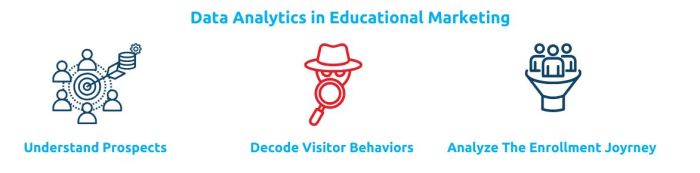
What is the role of data analysis in education marketing? Data analytics involves collecting, processing, and interpreting data to uncover patterns, trends, and actionable insights. In higher education marketing, data analytics enables you to understand your target audience—prospective students, parents, alumni, and other stakeholders—better and craft strategies that resonate with them.
Data analytics goes beyond tracking website visits or social media likes. It involves deep-diving into metrics such as application trends, conversion rates, engagement levels, and even predictive modelling to anticipate future behaviour. For example, analyzing prospective students’ journey from initial interaction with your website to applying can reveal opportunities to refine your marketing campaigns. Data analytics equips you to attract and retain the right students by more effectively addressing their needs.
Source: HEM
Do you need support as you create a more data-driven higher education marketing campaign? Reach out to learn more about our specialized digital marketing services.
Benefits of a Data-Driven Marketing Campaign
What are the benefits of big data analytics in higher education marketing? A data-driven approach to marketing offers several advantages that can elevate your institution’s performance and visibility. First, it enhances decision-making. With access to real-time and historical data, you can base your decisions on evidence rather than assumptions. For example, if you notice that email campaigns targeting a particular geographic region yield a higher application rate, you can allocate more resources to similar efforts.
Second, data analytics in higher education enables personalization. Prospective students now expect tailored experiences that speak to their unique aspirations and challenges. By leveraging data, you can segment your audience and deliver content that resonates deeply with each group. This level of personalization increases engagement and fosters trust and loyalty.
Additionally, data analytics optimizes your budget. In the past, marketing efforts often involved a degree of guesswork, leading to wasted resources. With data, you can pinpoint what works and what doesn’t, ensuring every dollar you spend contributes to your goals. For instance, if a social media ad targeting international students outperforms others, you can reallocate funds to expand that campaign.
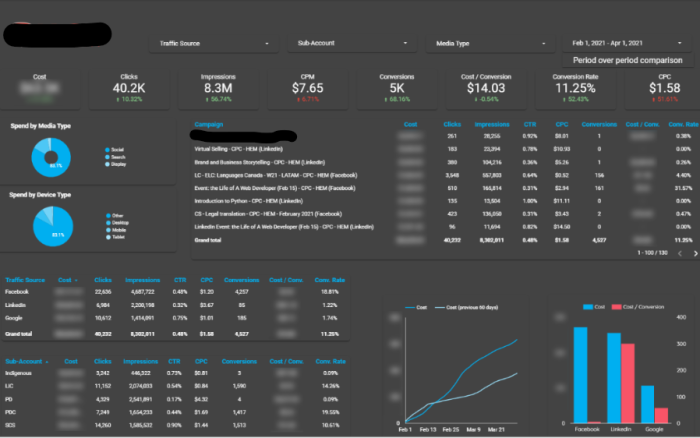
Finally, data analytics offers the ability to measure success with precision. By setting key performance indicators (KPIs) and tracking them over time, you clearly understand what’s driving results. Whether the number of inquiries generated by a digital ad or the completion rate of an online application form, data analytics provides you with the tools to evaluate and refine your strategies continuously.
Source: HEM
Example: Our clients have access to our specialized performance-tracking services. The information in the image above, coupled with the school’s specific objectives, allows us to assess what is working and what needs changing. It informs our strategy, provides valuable insights into how new strategies are performing, and offers detailed insights into the changes that can be made for optimal results.
Types of Data Analytics Tools for Higher Education Marketers
The many data analytics tools available can seem overwhelming, but selecting the right ones can significantly improve your marketing efforts. These tools generally fall into a few key categories.
Web analytics platforms, such as Google Analytics, allow you to track user behaviour on your website. From page views to time spent on specific pages, these tools help you understand how prospective students interact with your digital presence. For instance, if many visitors drop off on your application page, it may indicate a need to simplify the process.
Customer relationship management (CRM) systems, like our system, Mautic, help you manage and analyze interactions with prospective and current students. CRMs help you organize your outreach efforts, track the progress of leads through the enrollment funnel, and identify trends in student engagement.
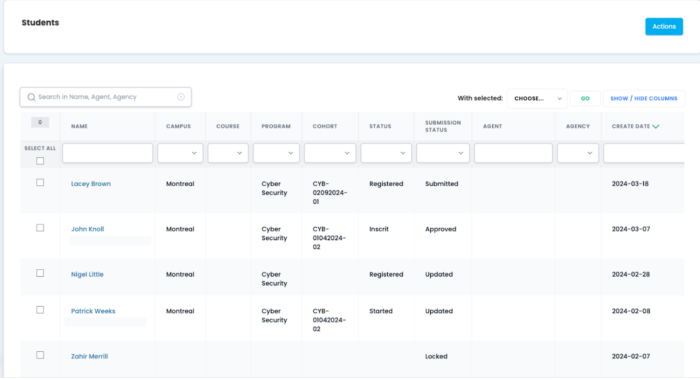
As a higher education institution, a system like our Student Portal will guide your prospects down the enrollment funnel. The Student Portal keeps track of vital student information such as their names, contact information, and relationship with your school. You need these data points to retarget students effectively through ads and email campaigns.
Source: HEM | Student Portal
Example: Here, you see how our SIS (Student Information System) tracks the progress of school applications, complete with insights like each prospect’s program of interest and location. This data is vital for creating and timing marketing materials, such as email campaigns based on each contact’s current needs, guiding them to the next phase of the enrollment funnel.
Social media analytics tools, including platforms like Hootsuite or Sprout Social, provide insights into your social media performance. These tools can reveal which types of content resonate most with your audience, enabling you to fine-tune your messaging.
Source: Sprout Social
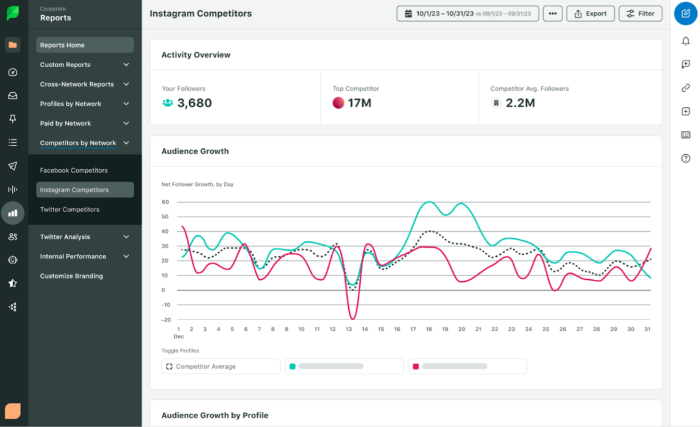
Example: Social media is a powerful tool for a higher education institution, particularly when targeting Gen-Z prospects. Like any marketing tactic, optimizing social media platforms requires measuring post-performance. A tool like Sprout Social, pictured above, tracks paid and organic performance, streamlining reports and even offering insights into competitor data.
Predictive analytics platforms, such as Tableau or SAS, take your efforts further by using historical data to forecast future outcomes. These tools can help you identify at-risk students who may not complete the enrollment process or predict which programs are likely to see increased interest based on current trends.
Use These Actionable Tips for Optimizing ROI Using Data Analytics
Clearly define your goals to maximize the impact of data analytics in education marketing campaigns. Whether you aim to increase enrollment in a specific program, boost alumni engagement, or expand your reach internationally, having a clear objective will guide your efforts and help you measure success effectively.
Next, ensure that you’re collecting the right data. Too often, institutions fall into the trap of gathering vast amounts of data without a clear plan for its use. Focus on metrics that align with your goals, such as lead generation, conversion rates, and engagement levels. Regularly audit your data collection processes to ensure they remain relevant and efficient.
Once you’ve gathered your data, prioritize analysis. This step involves identifying patterns and trends that can inform your strategy. For instance, if your data shows that most applications come from mobile devices, optimizing your website for mobile users becomes a top priority. Similarly, if you notice that email open rates are highest on Tuesdays, you can adjust your sending schedule accordingly.
Another key aspect of optimizing ROI is experimentation. Use your data to test different strategies, such as varying your ad copy, targeting different demographics, or experimenting with new platforms. Over time, you’ll better understand what resonates with your audience.
Don’t overlook the importance of collaboration. Data analytics should be integrated across departments. By sharing insights with admissions, student services, and academic departments, you can create a more cohesive and impactful strategy and carve an efficient path toward the desired results. For example, if your analytics reveal a growing interest in STEM programs, your academic team can develop targeted resources to meet that demand.
Finally, invest in ongoing education and training. Data analytics constantly evolves, and staying up-to-date on the latest tools and techniques is essential. Encourage your team to participate in workshops, webinars, and courses to enhance their skills and bring fresh insights to your campaigns.
How We Help Clients to Leverage Data Analytics Solutions: A Case Study with Western University
The transformative potential of data analytics is best illustrated through real-world examples. Western University of Health Sciences, a leading graduate school for health professionals in California, partnered with us to optimize its data analytics strategy. The collaboration highlights how implementing tailored data solutions can drive meaningful results.
HEM began by conducting program—and service-specific interviews with Western University staff to identify the analytics needs of managers across the institution. These discussions revealed unique departmental needs, prompting the creation of tailored analytics profiles and corresponding website objectives. Subsequently, data was segmented and collected in alignment with these tailored profiles, ensuring actionable insights for each group.
A comprehensive technical audit of Western’s web ecosystem revealed several challenges in implementing analytics tools. HEM recommended and implemented a series of changes through a custom analytics implementation guide. These changes included the university’s web team developing and installing cross- and subdomain tracking codes and creating data filters, such as internal traffic exclusion.
One of the highest priorities was tracking student registration behaviour. HEM developed a custom “apply now” registration funnel that integrated seamlessly with Western’s SunGard Banner registration pages to address this. This funnel provided a clear view of prospect and registrant behaviour across the main website and its subdomains, offering valuable insights into the user journey.
Over three months, HEM implemented these solutions and provided custom monthly reports to program managers. These reports verified the successful integration of changes, including the application of filters and cross-domain tracking. As a result, Western’s managers gained the ability to fully track student registrations, monitor library download behaviour, and make data-informed decisions to enhance student services.
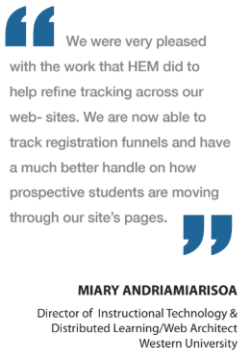
Western University’s Director of Instructional Technology praised HEM’s efforts, noting that the refined tracking capabilities clarified how prospective students navigated the site. The successful collaboration demonstrates the significant impact of data analytics solutions on improving user experience and institutional efficiency.
Source: HEM
HEM continues to build data-driven marketing campaigns for clients, streamlining their workflows, providing deep insights, increasing engagement, and boosting enrollment.
Higher ed data analytics is necessary for building effective marketing campaigns. By understanding its role and potential, you can craft data-driven strategies that elevate your institution’s visibility, improve engagement, and optimize ROI. As you embrace data analytics, remember that its true power lies in its ability to guide informed decision-making and foster continuous improvement. Whether you aim to attract more students, enhance retention, or build stronger alumni relationships, data analytics provides the roadmap to success. Start leveraging its insights today and position your institution as a leader in an increasingly competitive landscape.
Struggling with enrollment?
Our expert digital marketing services can help you attract and enroll more students!
Frequently Asked Questions
What is the role of data analysis in education marketing?
Data analytics involves collecting, processing, and interpreting data to uncover patterns, trends, and actionable insights. In higher education marketing, data analytics enables you to better understand your target audience—prospective students, parents, alumni, and other stakeholders—and craft strategies that resonate with them.
What are the benefits of big data analytics in higher education marketing?
A data-driven approach to marketing offers several advantages that can elevate your institution’s performance and visibility, including:
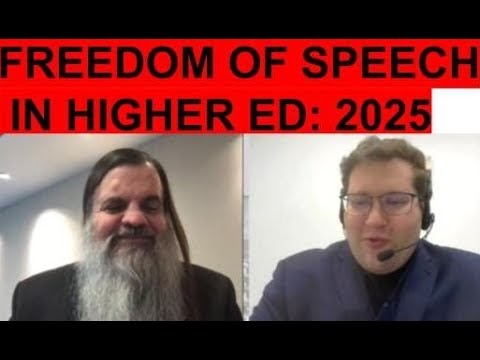
We will explore this vital question with the help of Jeremy C. Young, the Freedom to Learn program director at PEN America (and excellent 2023 Forum guest).
Newly confirmed U.S. secretary of defense Pete Hegseth issued a memo Jan. 29 ordering the Department of Defense to eliminate diversity, equity and inclusion initiatives and offices—including race-conscious admissions at military academies.
The memo establishes a task force “charged with overseeing the department’s efforts to abolish DEI offices” and specifically prohibits “sex-based, race-based or ethnicity-based goals for academic admission” within the department, which oversees military academies. Hegseth wrote that he’s enforcing an executive order issued by President Trump instructing military academy leaders to eliminate DEI initiatives.
When the Supreme Court struck down affirmative action in 2023’s Students for Fair Admissions v. Harvard and UNC Chapel Hill, the justices explicitly made an exception for the military academies. In his majority opinion, Chief Justice John Roberts argued that the institutions, which train the military officer corps, may have “potentially distinct interests” when it comes to admissions and that diversity in the armed forces may be a national security prerogative.
Three of those academies—the Military Academy at West Point, the Naval Academy and the Air Force Academy—have since been sued by anti–affirmative action groups seeking to eliminate the exemption. Last February the Supreme Court declined to hear the case against West Point, and in December a federal judge ruled that the Naval Academy can continue to consider race in admissions; the case against the Air Force Academy is ongoing.
It is unclear if Hegseth’s order to eliminate race-based “quotas” in admissions would prohibit military academies from considering race at all when reviewing applications.