Tag: Education

  • Human predictions for AI in higher education in 2025

    Human predictions for AI in higher education in 2025

    The year 2023 was a watershed moment for artificial intelligence. ChatGPT made its way into classrooms, prompting educators to grapple with AI’s potential and pitfalls. Industry leaders like Sundar Pichai declared AI as transformative as fire or electricity, while others voiced caution, warning of ethical dilemmas and societal upheaval.

    Two years later, amid the headlines and hype, the deeper question remains: What will AI actually look like in our day-to-day lives in higher ed? Understanding how AI will shape learning, recruitment and operations by 2025 is no longer optional—it’s essential.

    Below are five key ways AI is poised to transform higher education in 2025. These predictions aren’t abstract theories; they’re practical insights to guide your strategic planning, help you stay competitive and ensure your institution thrives in an AI-driven era.

    1. AI Agents Will Revolutionize Learning and Administration

    AI-powered agents are on the cusp of becoming indispensable tools in higher education. These intelligent systems are already taking on roles as digital mentors, capable of guiding students through complex material with tailored feedback. You may be familiar, for example, with Georgia State University’s AI chat-bot pilot program that answered student questions about financial aid and registration, reducing summer melt by 21 percent. In 2025, such agents will act as personalized tutors, adapting to individual learning styles and offering real-time academic support.

    Beyond learning, AI will also streamline administrative operations. Routine tasks like course scheduling, admissions processing and answering common student inquiries will increasingly fall to these systems, freeing human staff to focus on strategic initiatives.

    Imagine admissions officers who no longer spend hours manually reviewing applications but instead analyze data-driven insights provided by AI agents to make quicker, more informed decisions.

    This year will also bring us a new generation of AI that doesn’t just respond but takes action. For example, with agentic AI, a text might automatically go out to an applicant who needs a nudge to submit remaining documents—without a staff member lifting a finger.

    The future of higher education will be defined by AI systems that seamlessly blend proactive support with human expertise, transforming both student success and institutional efficiency.

    1. Generative AI Search Will Reshape Digital Engagement

    Generative AI is changing how prospective students discover and interact with institutions online. Platforms like ChatGPT are making it easier for users to ask complex questions and receive synthesized, conversational answers. Instead of clicking through multiple webpages, users increasingly expect clear and direct responses. In 2025, this shift will make traditional SEO strategies less effective, forcing institutions to reimagine their digital presence.

    One way they might do that is to incorporate generative AI search into their websites. You’ve likely used generative AI search yourself in Google—it’s the AI overview at the top of the page when you do a search that shows a summary answer of your query drawn from the sites that would traditionally appear in a list of search results.

    To prepare for students using AI tools outside of your site (e.g., ChatGPT, Perplexity) to learn about your school or incorporate generative AI search into your own site, there are critical to-dos for your website content teams to make your content as relevant, up-to-date and engaging as possible.

    The stakes are high: AI often relies on the most visible or credible content to provide answers. Universities with fragmented or outdated digital strategies risk being left behind, while those with robust, high-quality content will find themselves highlighted in AI-driven searches.

    Institutions that prioritize creating unique, authoritative content—such as faculty research profiles or interactive student success stories—will gain an edge in this new search landscape.

    1. Hyperpersonalization Will Redefine Student Engagement

    The days of one-size-fits-all communication and student services have ended. In 2025, institutions will rely on AI to create hyperpersonalized experiences that resonate with each student’s unique needs and goals. Drawing inspiration from industries like retail and entertainment, universities will use AI to craft individualized learning paths, anticipate challenges and deliver targeted interventions before students even ask for help.

    For example, Purdue University’s Course Signals initiative uses data analytics to identify students who may be at risk of falling behind and sends personalized alerts encouraging them to seek support. This type of proactive engagement not only improves retention rates but also fosters a sense of belonging. As McKinsey aptly describes it, the future of student engagement hinges on embracing the “care of one.”

    However, this approach raises ethical concerns. Institutions must carefully manage data privacy and ensure that algorithms do not inadvertently disadvantage certain groups. Transparency about how student data is collected and used will be crucial in maintaining trust.

    1. Faculty and Staff Roles Will Evolve Alongside AI

    The integration of AI will not replace faculty and staff but will redefine their roles. In 2025, educators will focus less on rote instruction and more on mentorship, critical thinking and creativity. This shift is already evident in programs like Northeastern University’s Experiential AI initiative, which trains faculty to incorporate AI tools into their teaching to enrich the student experience.

    Marketing and admissions teams will also need to adapt. AI insights can reveal patterns in prospective student behavior, allowing teams to craft campaigns that resonate on a deeper level. However, this will require staff to develop new skills in data interpretation and digital strategy.

    The transition won’t be without challenges. Institutions must invest in professional development to help their teams thrive in an AI-enhanced environment. Collaborative efforts between IT, academic affairs and marketing will ensure the successful adoption of these technologies.

    1. Ethical Challenges Will Take Center Stage

    The adoption of AI presents significant ethical considerations that will shape its implementation in higher education. From ensuring unbiased algorithms to safeguarding student data, institutions will need to tread carefully. Recent incidents, such as the use of biased AI tools in hiring processes, highlight the risks of unchecked AI deployment.

    Higher education can lead the way by modeling responsible AI practices. For example, Stanford University has established an Institute for Human-Centered Artificial Intelligence, emphasizing the ethical use of AI technologies across disciplines. By prioritizing fairness, transparency and accountability, institutions can harness AI’s potential without compromising their values.

    Preparing for 2025 and Beyond

    AI will ultimately elevate higher ed. Institutions that embrace AI’s changes with foresight and care will enhance their competitiveness, improve operational efficiency and create more meaningful experiences for students and staff alike. Success will depend on a willingness to adapt, invest in ethical practices and put students at the center of every decision.

    Mallory Willsea is chief strategist and producer at Enrollify.

    Source link

  • The value of having a National Learning Framework incorporating school, college and higher education

    The value of having a National Learning Framework incorporating school, college and higher education

    By Michelle Morgan, Dean of Students at the University of East London.

    In the UK, we have a well-established education system across different levels of learning including primary, secondary, further and higher education. For each level, there is a comprehensive structure that is regulated and monitored alongside extensive information. However, at present, they generally function in isolation. 

    The Government’s recent Curriculum and Assessment Review has asked for suggestions to improve the curriculum and assessment system for the 16-19 year study group. This group includes a range of qualifications including GCSEs, A-levels, BTECs, T Levels and apprenticeships. The main purpose of the Review is to

    ensure that the curriculum balances ambition, relevance, flexibility and inclusivity for all children and young people.

    However, as part of this review, could it also look at how the different levels of study build on one another? Could the sectors come together and use their extensive knowledge for their level and type of study, to create an integrated road map across secondary, further and higher education where skills, knowledge, competencies and attributes (and how they translate into employability skills) are clearly articulated? We could call this a National Learning Framework. It could align with the learning gain programme led by the Office for Students (OfS).

    The benefits of a National Learning Framework

    There would be a number of benefits to adopting this approach:

    • It would provide a clear resource for all stakeholders, including students and staff in educational organisations, policymakers, Government bodies, Regulators and Quality Standard bodies (such as Ofsted, the Office for Students and QAA) and business and industry. It would also help manage the general public perception of higher education. 
    • This approach would join up the regulatory bodies responsible for the different sectors. It would help create a collaborative, consistent learning and teaching approach, by setting and explaining the aims and objectives of the various types of education providers.
    • It would explain and articulate the differences in learning, teaching and assessment approaches across the array of secondary and further education qualifications that are available and used as progression qualifications into higher education.  For example, A-Levels are mainly taught in schools and assessed by end-of-year exams. ‘Other’ qualifications such as BTEC, Access and Other Level 3 qualifications taught in college have more diverse assessments.
    • It would help universities more effectively bridge the learning and experience transition into higher education across all entry qualifications.  We know students from the ‘Other’ qualification groups are often from disadvantaged backgrounds, which can affect retention, progression and success at university as research highlights (see also this NEON report).  Students with other qualifications are more likely to withdraw than those with A-Levels. However, as this recent report Prior learning experience, study expectations of A-Level and BTEC students on entry to university highlights, it is not the BTEC qualification per se that is the problem but the transition support into university study that needs improvement.
    • It would also address assumptions about how learning occurs at each level of study. For example, because young people use media technology to live and socialise, it is assumed the same is the case with learning. Accessing teaching and learning material, especially in schools, remains largely traditional: the main sources of information are course textbooks and handwritten notes, although since the Covid-19 Pandemic, the use of coursework submission and basic virtual learning environments (VLEs) is on the increase.
    • If we clearly communicate to students the learning that occurs throughout each level of their study, and what skills, knowledge, competencies and attributes they should obtain as a result, this can help with their confidence levels and their employability opportunities as they can better articulate what they have achieved.

    What could an integrated learning approach across all levels of study via a National Learning  Framework look like?

    The  Employability Skills Pyramid created for levels 4 to 7 in higher education with colleagues in a previous university where I worked could be extended to include Levels 2/3 and apprenticeships to create a National Learning Framework. The language used to construct the knowledge, skills and attribute grids used by course leaders purposely integrated the QAA statements for degrees (see accompanying document Appendix 1) .

    By adding Levels 2 and 3, including apprenticeship qualifications and articulating the differences between each qualification, the education sector could understand what is achieved within and between different levels of study and qualifications (see Figure 1).

    Key stakeholders could come together from across all levels of study to map out and agree on the language to adopt for consistency across the various levels and qualifications.

    Integrated National Learning Framework across Secondary, Further and Higher Education

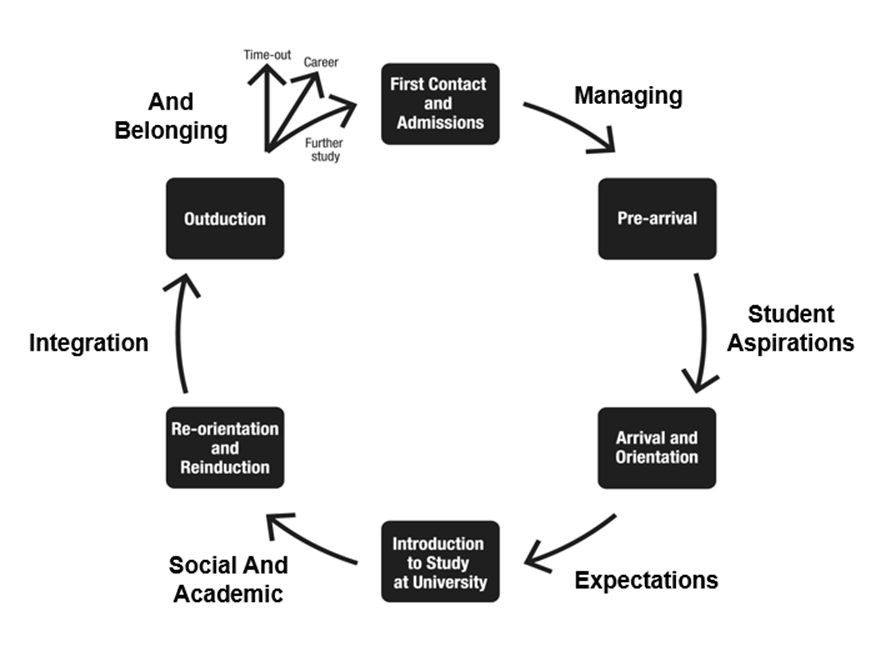
    Alongside the National Learning Framework, a common transition approach drawing on the same definitions across all levels of study would be valuable. Students and staff could gain the understanding required to foster successful transitions between phases.  An example is provided below.

    Supporting transitions across the National Learning Framework using similar terminology

    The Student Experience Transitions (SET) Model was designed to support courses of various lengths and make the different stages of a course clearer. It was originally designed for higher education but the principles are the same across all levels of study (see Figure 2). Students need to progress through each stage which has general rules of engagement. The definitions of each stage and the mapping of each stage by length of course are in the accompanying document in Appendix 2.

    Figure 2: The Student Experience Transitions Model. Source: Morgan 2012

    The benefits for students are consistency and understanding what is expected for their course. At each key transition stage, students would understand what is expected by reflecting on what they have previously learnt, how the coming year builds on what they already know and what they will achieve at the end.

    Taking the opportunity to integrate

    The Curriculum Review provides a real opportunity to join up each level of study and provide clarity for all stakeholders. Importantly, a National Learning Framework could provide and help with the Government’s aims of balancing ambition, relevance, flexibility and inclusivity for all learners regardless of level of study.

    Appendices

    Source link

  • Dear President-elect Trump: Higher Education Builds America

    Dear President-elect Trump: Higher Education Builds America

    As you prepare to take office for a second time, we know you have ambitious plans to address the nation’s challenges and build a more secure and prosperous America. Achieving those goals will require contributions from many areas of society, and we urge you to see the value in partnering with our nation’s colleges and universities.

    Campuses across the country are deeply embedded in local communities and work every day to build their communities while meeting national needs. Let me share just three of many examples:

    Many, including you, have criticized higher education in recent years. We know that we always have room to innovate and improve. But we also know a basic truth: higher education builds America. This has been understood by American presidents since the nation’s founding. That conviction inspired landmark legislation such as the land-grant acts of the 19th century and the GI Bills of the 20th and 21st centuries—measures that contributed to unprecedented economic and technological growth.

    Study after study has documented the benefits colleges and universities provide to the workforce and the economy. For example, Georgetown University’s Center on Education and the Workforce found that less than a decade from now 72 percent of jobs in the American economy will require some level of postsecondary education or workforce training. Simply put, every pathway to expanding our economy and filling employers’ needs runs through colleges and universities.

    The American Council on Education (ACE), which I lead, is the major coordinating body for the nation’s colleges and universities. Our members include community colleges, liberal arts colleges, regional universities, and research universities. They are public and private, large and small, urban and rural. Many have religious affiliations.

    We have common-sense recommendations to help your administration and the new Congress deliver on the goals of all Americans: a safe and secure country, a prosperous economy with good jobs, and uncontested global leadership in developing new technologies. You can do that by extending Pell Grant eligibility to those who enroll in high-quality, short-term programs. You can do that by helping military service members and veterans further their careers through higher education. And you can do that by advancing research that saves lives and bolsters national security.

    Our colleges and universities work on behalf of all Americans, from every walk of life and every political perspective. While you may not always agree with us on every issue, ACE and our members are committed to fighting for the policies, principles, and values that ensure our students, their families, and our nation will flourish. So while we may differ in some areas, we also know there is much common ground.

    We are deeply concerned about the impact of proposed immigration changes on students, staff, and families, and appreciate your concern for those known as “Dreamers,” who came to the United States as children. As you stressed in a recent interview, these outstanding young people have made numerous contributions to America, and we must safeguard their futures in the only country they have ever known as home. Likewise, we fully agree that America benefits immensely by continuing to attract the brightest and most talented students from around the world to study, work, and innovate here.

    We pledge to be accountable to your administration, Congress, and the public. If you, Secretary of Education-designate Linda McMahon, and others in your administration see areas where we can do better, we are eager to sit down and discuss them. We hope, in turn, to have the opportunity to demonstrate how the know-how and creativity that runs deep through our campuses can help you accomplish your most important objectives.

    Our overriding goal is to provide more opportunity for all Americans. Like you, we are ready to get to work to deliver results. Together, we can build a better America.


    If you have any questions or comments about this blog post, please contact us.

    Source link

  • Higher Education Inquirer : HEI Resources 2025

    Higher Education Inquirer : HEI Resources 2025

    [Editor’s Note: Please let us know of any additions or corrections.]

    Books

    • Alexander, Bryan (2020). Academia Next: The Futures of Higher Education. Johns Hopkins Press.  
    • Alexander, Bryan (2023).  Universities on Fire. Johns Hopkins Press.  
    • Angulo,
      A. (2016). Diploma Mills: How For-profit Colleges Stiffed Students,
      Taxpayers, and the American Dream. Johns Hopkins University Press.
    • Archibald, R. and Feldman, D. (2017). The Road Ahead for America’s Colleges & Universities. Oxford University Press.
    • Armstrong, E. and Hamilton, L. (2015). Paying for the Party: How College Maintains Inequality. Harvard University Press.
    • Arum, R. and Roksa, J. (2011). Academically Adrift: Limited Learning on College Campuses. University of Chicago Press. 
    • Baldwin, Davarian (2021). In the Shadow of the Ivory Tower: How Universities Are Plundering Our Cities. Bold Type Books.  
    • Bennett, W. and Wilezol, D. (2013). Is
      College Worth It?: A Former United States Secretary of Education and a
      Liberal Arts Graduate Expose the Broken Promise of Higher Education.
      Thomas Nelson.
    • Berg, I. (1970). “The Great Training Robbery: Education and Jobs.” Praeger.
    • Berman, Elizabeth P. (2012). Creating the Market University.  Princeton University Press. 
    • Berry, J. (2005). Reclaiming the Ivory Tower: Organizing Adjuncts to Change Higher Education. Monthly Review Press.
    • Best, J. and Best, E. (2014) The Student Loan Mess: How Good
      Intentions Created a Trillion-Dollar Problem. Atkinson Family
      Foundation.
    • Bledstein, Burton J. (1976). The Culture of Professionalism: The Middle Class and the Development of Higher Education in America. Norton.

    • Bogue, E. Grady and Aper, Jeffrey.  (2000). Exploring the Heritage
      of American Higher Education: The Evolution of Philosophy and Policy. 
    • Bok, D. (2003). Universities in the Marketplace : The Commercialization of Higher Education.  Princeton University Press. 
    • Bousquet, M. (2008). How the University Works: Higher Education and the Low Wage Nation. NYU Press.
    • Brennan, J & Magness, P. (2019). Cracks in the Ivory Tower. Oxford University Press. 
    • Brint, S., & Karabel, J. The Diverted Dream: Community colleges
      and the promise of educational opportunity in America, 1900–1985. Oxford
      University Press. (1989).
    • Cabrera, Nolan L. (2024) Whiteness in the Ivory Tower: Why Don’t We Notice the White Students Sitting Together in the Quad? Teachers College Press.
    • Cabrera, Nolan L. (2018). White Guys on Campus: Racism, White Immunity, and the Myth of “Post-Racial” Higher Education. Rutgers University Press.
    • Caplan, B. (2018). The Case Against Education: Why the Education
      System Is a Waste of Time and Money. Princeton University Press.
    • Cappelli, P. (2015). Will College Pay Off?: A Guide to the Most Important Financial Decision You’ll Ever Make. Public Affairs.
    • Carney, Cary Michael (1999). Native American Higher Education in the United States. Transaction.
    • Childress, H. (2019). The Adjunct Underclass: How America’s Colleges
      Betrayed Their Faculty, Their Students, and Their Mission University of
      Chicago Press.
    • Cohen, Arthur M. (1998). The Shaping of American Higher Education:
      Emergence and Growth of the Contemporary System. San Francisco:
      Jossey-Bass.
    • Collins, Randall. (1979/2019) The Credential Society. Academic Press. Columbia University Press. 
    • Cottom, T. (2016). Lower Ed: How For-profit Colleges Deepen Inequality in America
    • Domhoff, G. William (2021). Who Rules America? 8th Edition. Routledge.
    • Donoghue, F. (2008). The Last Professors: The Corporate University and the Fate of the Humanities.
    • Dorn, Charles. (2017) For the Common Good: A New History of Higher Education in America Cornell University Press.
    • Eaton,
      Charlie.  (2022) Bankers in the Ivory Tower: The Troubling Rise of
      Financiers in US Higher Education. University of Chicago Press.
    • Eisenmann, Linda. (2006) Higher Education for Women in Postwar America, 1945–1965. Johns Hopkins U. Press.
    • Espenshade, T., Walton Radford, A.(2009). No Longer Separate, Not
      Yet Equal: Race and Class in Elite College Admission and Campus Life.
      Princeton University Press.
    • Faragher, John Mack and Howe, Florence, ed. (1988). Women and Higher Education in American History. Norton.
    • Farber, Jerry (1972).  The University of Tomorrowland.  Pocket Books. 
    • Freeman, Richard B. (1976). The Overeducated American. Academic Press.
    • Gaston, P. (2014). Higher Education Accreditation. Stylus.
    • Ginsberg, B. (2013). The Fall of the Faculty: The Rise of the All Administrative University and Why It Matters
    • Gleason, Philip. Contending with Modernity: Catholic Higher Education in the Twentieth Century. Oxford U. Press, 1995.
    • Golden, D. (2006). The Price of Admission: How America’s Ruling
      Class Buys its Way into Elite Colleges — and Who Gets Left Outside the
      Gates.
    • Goldrick-Rab, S. (2016). Paying the Price: College Costs, Financial Aid, and the Betrayal of the American Dream.
    • Graeber, David (2018) Bullshit Jobs: A Theory. Simon and Schuster. 
    • Groeger, Cristina Viviana (2021). The Education Trap: Schools and the Remaking of Inequality in Boston. Harvard Press.

    • Hamilton, Laura T. and Kelly Nielson (2021) Broke: The Racial Consequences of Underfunding Public Universities
    • Hampel, Robert L. (2017). Fast and Curious: A History of Shortcuts in American Education. Rowman & Littlefield.

    • Johnson, B. et al. (2003). Steal This University: The Rise of the Corporate University and the Academic Labor Movement
    • Keats, John (1965) The Sheepskin Psychosis. Lippincott.
    • Kelchen, R. (2018). Higher Education Accountability. Johns Hopkins University Press.
    • Kezar, A., DePaola, T, and Scott, D. The Gig Academy: Mapping Labor in the Neoliberal University. Johns Hopkins Press. 
    • Kinser, K. (2006). From Main Street to Wall Street: The Transformation of For-profit Higher Education
    • Kozol, Jonathan (2006). The Shame of the Nation: The Restoration of Apartheid Schooling in America. Crown. 
    • Kozol, Jonathan (1992). Savage Inequalities: Children in America’s Schools. Harper Perennial.
    • Labaree,
      David F. (2017). A Perfect Mess: The Unlikely Ascendancy of American Higher
      Education. Chicago: University of Chicago Press.
    • Labaree,
      David (1997) How to Succeed in School without Really Learning: The
      Credentials Race in American Education, Yale University Press.
    • Lafer, Gordon (2004). The Job Training Charade. Cornell University Press.  
    • Loehen, James (1995). Lies My Teacher Told Me. The New Press. 
    • Lohse, Andrew (2014).  Confessions of an Ivy League Frat Boy: A Memoir.  Thomas Dunne Books. 
    • Lucas, C.J. American higher education: A history. (1994).
    • Lukianoff,
      Greg and Jonathan Haidt (2018). The Coddling of the American Mind: How
      Good Intentions and Bad Ideas Are Setting Up a Generation for Failure.
      Penguin Press.
    • Maire, Quentin (2021). Credential Market. Springer.
    • Mandery, Evan (2022) . Poison Ivy: How Elite Colleges Divide Us. New Press. 
    • Marti, Eduardo (2016). America’s Broken Promise: Bridging the Community College Achievement Gap. Excelsior College Press. 
    • Mettler, Suzanne ‘Degrees of Inequality: How the Politics of Higher Education Sabotaged the American Dream. Basic Books. (2014)
    • Newfeld, C. (2011). Unmaking the Public University.
    • Newfeld, C. (2016). The Great Mistake: How We Wrecked Public Universities and How We Can Fix Them.
    • Paulsen, M. and J.C. Smart (2001). The Finance of Higher Education: Theory, Research, Policy & Practice.  Agathon Press. 
    • Rosen, A.S. (2011). Change.edu. Kaplan Publishing. 
    • Reynolds, G. (2012). The Higher Education Bubble. Encounter Books.
    • Roth, G. (2019) The Educated Underclass: Students and the Promise of Social Mobility. Pluto Press
    • Ruben,
      Julie. The Making of the Modern University: Intellectual Transformation
      and the Marginalization of Morality. University Of Chicago Press.
      (1996).
    • Rudolph, F. (1991) The American College and University: A History.
    • Rushdoony, R. (1972). The Messianic Character of American Education. The Craig Press.
    • Selingo, J. (2013). College Unbound: The Future of Higher Education and What It Means for Students.
    • Shelton, Jon (2023). The Education Myth: How Human Capital Trumped Social Democracy. Cornell University Press.
    • Sinclair, U. (1923). The Goose-Step: A Study of American Education.
    • Stevens, Mitchell L. (2009). Creating a Class: College Admissions and the Education of Elites. Harvard University Press. 
    • Stodghill, R. (2015). Where Everybody Looks Like Me: At the Crossroads of America’s Black Colleges and Culture. 
    • Tamanaha, B. (2012). Failing Law Schools. The University of Chicago Press. 
    • Tatum, Beverly (1997). Why Are All the Black Kids Sitting Together in the Cafeteria. Basic Books
    • Taylor,
      Barret J. and Brendan Cantwell (2019). Unequal Higher Education:
      Wealth, Status and Student Opportunity. Rutgers University Press.
    • Thelin, John R. (2019) A History of American Higher Education. Johns Hopkins U. Press.
    • Tolley, K. (2018). Professors in the Gig Economy: Unionizing Adjunct Faculty in America. Johns Hopkins University Press.
    • Twitchell, James B. (2005). Branded Nation: The Marketing of Megachurch, College Inc., and Museumworld. Simon and Schuster.
    • Vedder, R. (2004). Going Broke By Degree: Why College Costs Too Much.
    • Veysey Lawrence R. (1965).The emergence of the American university.
    • Washburn, J. (2006). University Inc.: The Corporate Corruption of Higher Education
    • Washington,
      Harriet A. (2008). Medical Apartheid: The Dark History of Medical
      Experimentation on Black Americans from Colonial Times to the Present.
      Anchor. 
    • Whitman, David (2021). The Profits of Failure: For-Profit Colleges and the Closing of the Conservative Mind. Cypress House.
    • Wilder, C.D. (2013). Ebony and Ivy: Race, Slavery, and the Troubled History of America’s Universities. 
    • Woodson, Carter D. (1933). The Mis-Education of the Negro.  
    • Zemsky,
      Robert, Susan Shaman, and Susan Campbell Baldridge (2020). The College
      Stress Test:Tracking Institutional Futures across a Crowded Market.
      Johns Hopkins University Press. 


    Activists, Coalitions, Innovators, and Alternative Voices

     College Choice and Career Planning Tools

    Innovation and Reform

    Higher Education Policy

    Data Sources

    Trade publications


    Source link

  • New book envisions colleges dedicated to Earth’s well-being

    New book envisions colleges dedicated to Earth’s well-being

    What is a climate justice university, and how can our universities transform into institutions that truly promote the well-being of the earth and humanity? Jennie C. Stephens’s new book, Climate Justice and the University: Shaping a Hopeful Future for All (Johns Hopkins University Press, 2024), sets out to answer that question. It outlines where today’s universities fall short in their handling not only of the climate crisis but also a wealth of other modern social issues.

    The book lays out broad ideas for transforming how universities function in society, such as shifting research practices to collaborate with people and communities affected by the issues, like the climate crisis, at the center of that research. Stephens, who is a professor at both the National University of Ireland Maynoonth and Northeastern University, acknowledges in the introduction that such a transformation would be a major undertaking, and one that many universities would be disinclined to tackle. “Because of the internal pressure within higher education to maintain institutional norms, this book and its proposal for climate justice universities are, in some ways, radical acts of resistance,” she writes.

    In a phone interview, Stephens spoke with Inside Higher Ed about her vision for climate justice universities—and how modern institutions fail to meet it. The conversation has been edited for length and clarity.

    Q: It was interesting reading that your perspective on these issues comes both from your scholarly work and from a time that you worked on the administrative side of academia. Could you describe how those experiences came together to inspire this book?

    A: I’ve been working in academia my whole career—more than 30 years—and during that time, I’ve been focused on climate and energy issues and sustainability from a very social justice perspective. What has happened through my experiences over time is that I see part of society’s inadequate response to the climate crisis mirrored in academia.

    I think higher education has a really big role in society—in what we are doing and what we’re not doing, in how we’re teaching and learning, in what we’re doing research on and what we’re not doing research on—and I think that our collective insufficient response to the climate crisis is related to what’s been happening in our higher education institutions, which are increasingly very financialized. They’re driven by profit-seeking priorities and new tech and start-ups and focused on job training. We’ve drifted away from a public-good mission of higher education: What does society need in this very disruptive time, and how can our higher education institutions better respond to the needs of society, particularly of vulnerable and marginalized communities and people and households who are increasingly struggling with all kinds of precarity and vulnerabilities?

    Q: How would you define the term “climate justice university”?

    A: The idea of a climate justice university is a university with a mission and a purpose to create more healthy, equitable, sustainable futures for everyone. So, that is a very public-good mission. The idea is to connect the climate crisis with all the other injustices and the … multiple different crises that are happening right now; the climate crisis is just one among many. We also have a cost of living crisis; we have a mental health crisis, we have financial crises; we have a plastic pollution crisis and a biodiversity crisis; we have a crisis in international law and a militarization crisis. We have all of these crises, and yet what we’re doing in our universities tends to continue to be quite siloed and trying to address parts of specific problems, rather than acknowledging that these crises are symptoms of larger systemic challenges.

    For me, climate justice is a paradigm shift toward a transformative lens, acknowledging that things are getting worse and worse in so many dimensions, and that if we want a better future for humanity and for societies around the world, we actually need big, transformative change. A lot of things we do in our universities are reinforcing the status quo and not promoting or endorsing transformative change. So, climate justice is a paradigm shift with a transformative lens that focuses less on individual behavior, more on collective action, less on technological change, more on social change, and less on profit-seeking priorities, more on well-being priorities. What do human beings need to live meaningful, healthy lives, and how can society be more oriented toward that?

    Q: Can you talk a bit more about how the current structure of the university maintains the status quo with regard to climate?

    A: One of the ways that I think universities kind of perpetuate the status quo is by not acknowledging what a disruptive time we’re in with regard to climate crisis, but other crises as well. There’s an encouragement on many campuses for kind of being complacent, like, “Oh, this is the way the world is.” Not necessarily encouraging students and researchers to imagine alternative futures.

    There’s also a focus on doing research that billionaires or corporate interests want us to do, and—in particular, in the climate space—what this has led to is a lot of climate and energy research that is funded by big companies and other wealthy donors who actually don’t want change. We have more and more research to show who has been obstructing climate action and transformative change for a more stable climate future. We know many of those same companies and same fossil fuel interests have also been very strategically investing in our universities. What that does is constrain the research and also the public discourse about climate and energy futures toward very fossil fuel–friendly futures.

    Early on in my own career, I worked on projects that were funded by the fossil fuel industry on carbon capture and storage, and a lot of the climate and energy research in our universities is focused on carbon capture and storage, carbon dioxide removal technology, geoengineering—all these technical fixes that assume we’re just going to keep using fossil fuels. What we really need, if we had more climate justice universities that were focused on the public good and what the climate science has been telling us for decades, is to phase out fossil fuels. We need a global initiative to phase out fossil fuels. But we don’t have in our universities much research on how to phase out fossil fuels.

    Q: In your book, you discuss the concept of exnovation—the process of phasing out inefficient or harmful technologies. Why is research into exnovation not already more common in higher education, and what are the main barriers for researchers who want to take this approach?

    A: I do think funding has a lot to do with it. There’s a whole chapter in the book about the financialization of higher education institutions, which has resulted from kind of a decline in public support toward more private sector support, which means that universities are beholden to private sector interests, increasingly, and they’re encouraged and incentivized to cater to and partner with … private sector interests. I think that has really changed the kinds of impact that higher education institutions and research has had.

    Of course, there are a lot of people within universities who are interested in the public good and doing research on exnovation. But the incentive structure, even among those of us who would want to contribute in those ways, is such that we are increasingly incentivized and promoted based on how much money we can bring in, how many papers can we get published and the scale of resources available to do research. So, there’s a larger, long-term strategy to orient research toward the technical fixes, particularly when it comes to climate and energy, and a lot less funding available for social change or governance research on how to bring back the public-good priorities in our policies, our funding, in our universities. It’s really a longer-term trend that has led to this financialization.

    Q: You lay out a lot of alternative ideas for financing universities, which is important given that anxiety over funding is at an all-time high at some institutions. Walk me through some of your ideas and talk about the feasibility of restructuring how universities are funded.

    A: One idea in the chapter on new ways of engaging and being more relevant is what if we imagine higher education institutions more like public libraries? Public libraries, we all kind of recognize as valuable resources for everyone; every community should have some access to a public library. What if higher education could be [better] invested in that sense of being a resource and not being an ivory tower that is really hard to get into and only some privileged people get access to? What if our higher education institutions were designed and funded to provide more accessible and relevant resources, co-created with communities? That’s kind of one of the big ideas of imagining what this really valuable resource could be more relevant and more connected to the needs of society and of communities.

    You also asked about feasibility, and one of the things that I want to point out is that this book is not a how-to; every context and region and different place in the world has different things going on with their higher education institutions. The idea with this book is to invite us all to kind of think about, what is the purpose of higher education institutions? And how can we better leverage all the public investment that is already spent on higher education institutions? How can that be oriented toward better futures for everyone?

    At higher education institutions that are feeling very vulnerable, having a lot of anxiety about funding levels—the ideas in this book don’t provide a prescription on how to fix that in the near term. But the ideas in the book are really to encourage us all—and especially those involved in higher education policy and higher education funding—to re-evaluate and reclaim the public-good mission of higher education and reconsider how to restructure higher education so that the value and the resources are more accessible, more relevant and more transformative, in terms of fitting the needs of a very disruptive time for humanity and for societies and communities around the country and around the world.

    Source link

  • Your 2025 higher education policy almanac

    Your 2025 higher education policy almanac

    Well, it’s January again.

    The early months of last year were dominated by the Conservatives’ slow swan dive into electoral oblivion, and then we got a general election that saw little serious discussion of the sector’s future, aside from the trotting out of a few old canards.

    And since Labour took power in July, there have been two broad phases: an initial “these things take time” framing in which universities – as well as many other groups and industries – were asked to be patient. In November we got the tuition fee uplift in England (in cash terms, for one year) and news of a bigger reform plan due next summer. A little movement, but in grand terms it was still can-kicking. Even the concrete announcements we’ve had, such as on level 7 apprenticeships, have not been accompanied by detailed policy papers or formal consultations.

    There’s reason to think that 2025 will have more for wonks to get their teeth into. There’s plenty pending, promised, or otherwise pretty damn urgent. So the below is an attempt to reckon with absolutely everything we know is on its way that matters for HE. Please charitably ascribe any oversights to a post-holidays sugar crash on my part rather than wilfully turning a blind eye, and let me know what I’ve missed in the comments.

    Big ticket items

    In Westminster politics, the first half of next year is going to be completely dominated by the spending review, which will set departmental budgets for three financial years (2026–29) as well as lay out a five-year programme of capital spending. It has always been described as being “in the spring”, but recent reports suggest that Labour will fly as close to the summer solstice as they can with this definition, so make sure you’ve got some free time in June to deal with the fallout.

    If what we read in the papers is to be believed, what is – counterintuitively – the default policy of inflation-linked tuition fees will be confirmed for England at this point, taking us up over £10,000 a year by the end of the Parliament.

    This is also when we’ll hear more about the government’s plans for ten-year R&D budgets. Attendees of the 2023 Labour conference may recall science secretary Peter Kyle promising a decade of confirmed funding for UKRI and ARIA – this commitment has been repeatedly qualified since then, partly due to issues of practicality (given that it’s not a ten-year spending review) and partly due to a question mark over whether fixing research spending in this way is really a good idea. It’s likely to be restricted now to “specific R&D activities” – the (much) bigger question will be around levels of investment in R&D. Plus we’ll see to what extent the government really wants to commit to linking research and its missions – last autumn brought only a small pot of cash for this in 2025–26.

    Also due alongside the spending review is “further detail and plans for delivery” for the Lifelong Learning Entitlement – so don’t expect to hear much more before then, though the delayed commencement in 2027 makes the need for information marginally less pressing. And the finalised industrial strategy will also arrive, “aligned with” (and likely published together with) the spending review, laying out specific sector plans for areas like the creative industries, the life sciences, and professional services. Once complete, the idea is that these plans can then inform Skills England’s work, and potentially migration policy – it’s all very ambitious.

    The HE reform announcement in England that we’ve been promised for “the summer” will land – it appears – fairly hot on the heels of the spending review settlements, and any money needed for it will need to have been allocated already, or at least tucked in to Office for Budgetary Responsibility (OBR) projections in some way. On the topic of the OBR, its spring forecast is due on 26 March – there are rumblings that its revised projections could spell fiscal trouble for the government.

    There are also clear indications that the HE reform statement will be preceded, or possibly accompanied, by a review of some kind. There have been rumours of a panel in place, and the indications are that this will fly under the radar somewhat and happen quickly – think Becky Francis’ curriculum review or Lord Darzi’s NHS audit, rather than a grand commission in the traditional “major review” style we have become used to.

    Around the sector

    Part of the Westminster government’s reform agenda is predicated on the sector coming up with ideas itself, which may end up drawing quite a lot on Universities UK’s blueprint from back in September. UUK’s own “efficiency and transformation taskforce” will be busy putting out recommendations on business models and collaboration, with the endorsement of education secretary Bridget Phillipson – “all options are on the table,” we are told, with plenty of policy debate likely to ensue once publications begin to appear.

    With many universities in poor financial shape, the search for longer-term sustainability will likely be derailed at regular intervals by news of redundancies and course closures. National industrial action is a possibility, though there are real questions around the willingness of struggling union members to take action on pay at this point. Local disputes will continue to flare up. Alongside this we have a renewed push for newer English universities to be exempted from the Teachers’ Pension Scheme due to the massively increased costs it is now carrying, a move which would substantially inflame industrial relations if it came to pass.

    And looming over all of this is the possibility of a disorderly market exit, and the question of whether the government has a viable plan in place to step in if a large institution were to hit the wall. All the other policy developments we are highlighting here could be hugely complicated by a sudden shock to the system and what is likely to be a political rather than a strategic response.

    The world of regulation

    There’s a lot to look out for from the Office for Students, from the appointment of a new permanent chair down (interviews are being held this month).

    There’s the ongoing consultation on a new strategy, the continuing fallout from the temporary closure of the register (this should supposedly also bring new proposals on improvements to the registration process), whispers of a more “integrated approach” to quality and whatever that means for the TEF, and a greater regional focus to access and participation.

    We should start getting assessment reports for the second round of quality investigations (where franchising and foundation years will be a focus) as well as the belated release of those grade inflation investigations that were announced on 2 September 2022. We’re waiting for consultation responses on a new approach to public grant funding and even on LLE regulation, though you can’t blame them for waiting to see what exactly the government is planning with this one.

    According to last summer’s business plan, there should also be consultations of potential new initial conditions of registration on both management and governance, and consumer protection. And this year’s National Student Survey will have a sexual misconduct questionnaire appended – though it’s not clear at time of writing to what extent the results will be made public.

    Over in Wales, Medr is taking shape, with a finalised strategic plan due to have been submitted to the Welsh government for approval just before the Christmas break – we should hear more of this soon, along with the consultation response.

    And if all that sounds like a lot, in Scotland we are due a Post-School Education Reform Bill at some point in the 2024–25 parliamentary session, which will make big changes to how the Scottish Funding Council (SFC) and Student Awards Agency Scotland operate. A consultation which closed in September asked stakeholders for thoughts on what the funding agency landscape should look like – we haven’t heard much since then. The sector is keen to stress the importance of universities retaining their autonomy, whatever happens – legislative passage could see MSPs push for new duties on the SFC.

    We’ve been aware for a long time that the Office for National Statistics is undertaking a review into whether higher education should be seen as “public sector” in the national accounts – it’s now been slightly rejigged into a review of the statistical classification of “the transactions in which UK universities engage.” For what is a very technical definition, an eye over the recent travails of the FE sector suggest that there are potential implications for everything from procurement to senior staff pay. The long delayed work will kick off early in 2025.

    The research agenda

    What little research policy we’ve seen come out of the new government so far has been limited to haggling over budgets and science minister Patrick Vallance stressing that ministers should not meddle in university research. There’s no reason to think we will get big policy pronouncements out of the Department for Science, Innovation and Technology, which feels more interested in the tech and digital side of its remit, both legislatively and aesthetically. But there’s lots going on around the margins that could end up being quite consequential.

    First up we have the appointment of a new UKRI chief executive, where there’s already evidence the new minister has been having a think about longer term strategic direction. While the new roleholder won’t take up office until June, we should get news of the appointment fairly soon.

    In the Research Excellence Framework world, the “modular” approach to releasing different policies on a staggered timetable will see the release of the volume measure policy (imminently) and the contribution to knowledge and understanding policy (scheduled for the summer). The more contentious people, culture and environment pilot will continue throughout the year, with criteria and definitions due for the winter – any slippage on this will likely provoke controversy.

    At UKRI, January will bring an update on its work reviewing how PGR stipends are set (as well as the stipend level for 2025–26). Elsewhere, the ongoing National Audit Office work looking at UKRI grants and loans could be a wildcard – it’s due to report in spring 2025 – and at the very least is a moment where the government will need to comment on how the research funding system is operating. Research England is also thinking about the current state of research infrastructure, via its condition of the estate survey, and how the sector’s financial challenges are affecting research – for both of these pieces of ongoing work, it’s doubtful that much will be shared publicly.

    Further afield, a European Commission proposal for the successor to Horizon Europe is due midway through the year, preceded by an interim evaluation of the current funding programme which will likely give an indication of its plans. We will also get regulations for the Foreign Influence Registration Scheme in the new year – the measures, which will speak to research security, are now expected to come into effect in the summer. It’s been reported that the government is resisting calls to put China on the “enhanced tier” of the scheme, a move that would have greatly complicated UK-China academic partnerships. On a related note, the government has quietly been conducting a “China audit” – this will be released in the coming months, and in theory will spell out the policy areas where closer ties will be permitted.

    Finally, the House of Commons Science, Innovation and Technology Committee will be conducting a timely inquiry into regional R&D, which should be a good opportunity for some more insight into how the government’s English devolution-related plans for more mayoral involvement in the research system will come together.

    International

    If you had to pick a policy area that will have the biggest macro impacts on the sector in 2025, you could do a lot worse than opt for international recruitment (you would arguably have been proved right if you’d chosen it in any of the last few years).

    Two big policy items are on their way here: a legal migration white paper, spelling out how the government will fulfil its electoral promise to bring net migration down. And a revised international education strategy (IES), which we’re told is coming “early spring” – whether it will appear before, after, or alongside the white paper remains to be seen, but could be significant.

    The big questions here are whether the government will put a recruitment target on the face of the strategy – the aspiration for 600,000 students in the last one ended up coming back to haunt the Conservatives among their own base – and what the plan for education exports targets might be. But there are other areas we could see movement, such as on post-study work, where some in the sector seem hopeful that a little improvement could be on offer, despite the enormous political pushback the Graduate route has faced over the last couple of years. It feels like an outside bet.

    More important to keep an eye on will be whether some kind of arrangement is arrived at with net migration statistics – we know that the Office for National Statistics is looking at how estimates excluding students could be arrived at, and it’s been on the higher education sector’s wishlist for years.

    If it did come to pass, the devil would very much be in the detail – the Migration Advisory Committee annual report has already been noting the contribution that students make to long-term net migration, and Starmerite think tank Labour Together’s recent proposal is for visa routes such as Skilled Worker and Graduate to have multi-year targets, even if the Student visa does not. Put like that, it sounds like a recipe for universities to recruit pretty freely but for students’ post-study options to remain a political football – the seeming lack of student involvement in the IES review would appear all the more glaring in this case. The Universities UK blueprint did promise a kind of quid pro quo on responsible international recruitment, and it has been notable that government ministers have stressed the importance of housing availability when the question has come up in Parliament recently.

    Whatever comes out of it, it looks clear that the Home Office will continue to toe a careful line on student visas, and continue to implement the last government’s Graduate route review response. The use of “action plans” by UKVI for certain providers will continue, even if there is no substantive public comment from the Home Office about what these are and why they are being imposed. And there will also be a review of English language self-assessment policies over the next few months, “driven by growing concern around underlying reasons for reports of students being picked up at the border or entering UKHE with low levels of English” (in UUKi’s words). It’s unlikely much will be shared publicly about these, but they are items to watch, especially in the event that there is further negative publicity about international students in the media.

    It’s worth stressing that developments in migration and visa policy do not only affect students – the House of Lords Science and Technology Committee is next week highlighting the interplay between visas and international researchers, and there are ongoing issues such as the future of the family visa income threshold where the government will eventually need to take a position.

    And despite all this policy in play, the three most significant factors for future international recruitment with likely be the Australian federal election – where the incumbent government’s attempts to impose number caps have been thwarted by an opposition that wants bigger caps – the Canadian election – which could happen at any minute if Justin Trudeau is forced out, and where the Conservatives are strongly favoured to take power – and the impact of Donald Trump on the USA, where universities are already reportedly asking international students to return before he takes office. All these things have the potential to greatly benefit the UK “market”.

    Skills, skills, skills

    Before we get any HE reform news out of Westminster, there’s going to be policy elsewhere in the post-compulsory system, with Skills England gearing up for action – we’ll learn the appointments of chief executive and permanent chair pretty soon – and various policy pronouncements at this end of the tertiary sector are overdue.

    Probably the most impactful for higher education is confirmation about exactly what is happening with the apprenticeship levy, both in wider terms of the planned additional flexibility for non-apprentice courses (this will be less than the 50 per cent originally proposed… at least probably), and for the “defunding” of level 7 apprenticeships.

    Many universities are big operators in this space, and it appears that most if not all of these programmes will be removed from the levy’s scope (“a significant number” is the most recent framing from the government). Over Christmas the Telegraph reported that the much-feted doctor apprenticeship is now “paused in perpetuity”. We should get the full picture very soon, as well as the much-awaited post-16 strategy, which you would hope would give a decent insight into the government’s wider vision for tertiary education. Though it may not.

    The defunding of level 7 apprenticeships is also relevant for those higher education institutions that have been spending their levy contributions on such courses for their staff as part of their professional development offer. DfE assures us all that employers are more than welcome to pay for them using different funds, “where they feel they provide a good return on their investment.”

    Our world in data

    We’re getting the outcome of the Data Futures review soon! There may be some lessons to learn about programme management and platform delivery, which could play out as a shared commitment to improving processes or as an unedifying multi-agency row. Whatever the case, this year’s HESA Student data will arrive later than usual – “in the spring, earlier than last year’s August publication but later than the January release date achieved in previous years.” Whether this is spring as in daffodils, or spring as in spending review, remains to be seen – but the delay (and issues with data quality as we saw last year) will have a knock on effect on data releases elsewhere, once again.

    At the end of this month we are getting HESA Staff data for 2023–24. The headline figures from last year’s release did get quoted the odd time by the previous government – in answer to questions about the impact of redundancies and cuts, it would occasionally be pointed out by ministers that (academic) staff numbers were still rising when you look at the sector as a whole. These figures won’t show the impact of this academic year’s cuts, however.

    Of course, elsewhere we have the usual releases which make up the HE wonk’s annual working rhythm. UCAS end-of-cycle numbers, at provider level, are due out at the end of January, and further down the line (probably around spending review time!) we have HESA Finance data and the Office for Students’ accompanying financial sustainability report, which will likely once again be a moment of maximum attention for higher education’s bottom line.

    One other piece of data we are getting this spring is a new ONS release on student suicides. This will come alongside the independent review commissioned by the last government, and whatever the findings is likely to generate a lot of press coverage and renewed pushes from campaign groups and opposition parties for a statutory duty of care. Early indications from the current government is that they are happy with the voluntary, sector-led approach to mental health – but things can change.

    Elsewhere in government

    It’s amazing it’s taken us this long to get to it, but probably the biggest, most controversial item on DfE’s to-do list is a decision on the fate of the free speech act and its associated provisions and complaints scheme. The Free Speech Union has its day in court on 23 January as part of a legal challenge over the pausing of the bill’s commencement – it’s just possible that the government will try to get a decision out before then. Or it could all drag on intractably for several more months, very much in keeping with the legislation’s passage through Parliament.

    Another hugely consequential move which we may see from DfE this month is the launch of a consultation on proposals to “strengthen oversight of partnership delivery in higher education” in conjunction with OfS. The department “will be developing options for legislative change, if required,” the Public Accounts Committee was told back in September, with a target date of January 2025 for an update.

    We’re due impact assessments and regulations for the tuition fee and maintenance “increases”, which should also involve a government pronouncement on how much the national insurance increase will cost the sector. And while it’s not higher education business, the soon-to-appear curriculum review (covering the curriculum in England from key stage 1 to key stage 5) will have long-term consequences for the wider education system – as well as likely sparking further backlash among those worried about it recklessly promoting diversity and risking PISA scores.

    Elsewhere in Westminster, the ongoing parliamentary passage of massive pieces of legislation will have big consequences for universities and students. The Employment Rights Bill and the Renters’ Rights Bill will both likely see some amendments, and we’re still awaiting the text of the English Devolution Bill and the promised “Hillsborough” bill. The government’s NHS plan for change – again, due at some point in the spring – and proposed updates to the NHS Long-Term Workforce Plan are important to keep an eye on as well.

    Up in Scotland, one day we may see the fruits of the ongoing review of student maintenance for part-time students. Negotiations over the 2025–26 budget will dominate the parliamentary agenda in the early part of the year, with ministers appearing in front of committees to get into the details of what exactly will be funded and what will not – and then the countdown to 2026 elections begins (all of this sentence is also true in Wales).

    It’s dangerous to go alone – take this

    If you’ve made it this far, congratulations. It feels like there is currently a huge number of moving parts in play in policy-land, all of which will contribute to the future shape and operations of the UK higher education sector in various, often hard-to-predict ways. Some are pretty immediate, others are issues that should have been tackled long ago, and then there are long-term policy changes that will be massive news in the 2030s.

    Here at Wonkhe we try to cover every single policy development that affects the sector, especially in our Daily Briefings (which restart on Tuesday 7 January – my alarm is already set).

    So if you’re interested in following even a fraction of the stuff that’s set out above, do join us for the ride this year. And fair warning, it’s likely that a good number of the most important developments that 2025 has in store for us are not even on this list. We’ll cover those as well, the moment they arrive.


    Source link

  • Challenging climate hypocrisy in higher education learning and teaching 

    Challenging climate hypocrisy in higher education learning and teaching 

    By Dr Adrian Gonzalez (@AGonzalez05) Senior Lecturer in Sustainability and Director of Learning and Teaching, Department of Environment and Geography at the University of York.

    Climate hypocrisy in Higher Education

    The climate crisis and global attempts at strengthening the sustainable and low-carbon transition is arguably the most critical issue we face and there is clear evidence to show strong Higher Education (HE) support for this twin approach. However, HE, particularly in the Global North, faces increasing scrutiny and critique over its implementation of the sustainability agenda. This has led to accusations of greenwashing, in which universities (willingly or perhaps erroneously) overmarket and/or underdeliver their sustainability policies, and climate hypocrisy, where an internationalist agenda frames student recruitment (the drive towards overseas markets), research activities and partnerships. For example, in UK tertiary education (further education and higher education), the largest sources of travel emissions are student flights, but there has been limited focus on the emissions stemming from learning and teaching, particularly fieldtrips, which this post is keen to reflect on.

    Destination long haul; Higher Education residential undergraduate student fieldtrips

    Outdoor education, particularly fieldtrips, offer a wide array of learner benefits and can be integral to different undergraduate programmes such as Geography, Earth and Environmental Sciences (GEES), archaeology, history and classics. However, the competitive UK higher education market has helped generate an internationalisation of undergraduate fieldtrips which are now used as a critical marketing tool to attract prospective students, who as ‘consumers’, are increasingly keen on knowing where these trips go to inform applications. For example, a brief internet search of UK GEES departments shows undergraduate trips heading to exotic locations such as the Amazonia region, Colombia (BSc Environmental Science), Bahamas (BSc Ocean Science and Marine Conservation) and Malawi (BA Human Geography). 

    Climate hypocrisy is evident here; students are studying programmes that acknowledge and grapple with the climate crisis and the need for transformational structural changes, yet at the same time will be enrolled on degrees that facilitate long-haul international learning opportunities without significant acknowledgement or reflection of the environmental impacts. Whilst there is no reliable publicly available data on the level of carbon emissions generated by GEES and other subject fieldtrips in UK higher education, I can give an indication by drawing on a case study of the department I work in.

    Department of Environment and Geography, University of York

    The department runs a wide variety of one-day and residential fieldtrips across its undergraduate and postgraduate programmes. It is the undergraduate residential trips that, owing to their design, have particularly significant carbon emissions and were made the focus of the subsequent investigation. Until 2022-2023, the department ran several residential fieldtrips that encompassed both UK and overseas destinations for its four undergraduate programmes (BSc Environmental Science; BSc Physical Geography and Environment; BSc Environment, Economics and Ecology; BA Human Geography and Environment). 

    I used the University of York’s carbon calculator, which draws upon the UK government’s Department for Environment, Food and Rural Affairs greenhouse conversion factors to calculate the carbon emissions stemming from travel and accommodation and the offsetting requirements. The table below shows the residential fieldtrips and carbon emissions from travel (including coach and flights where relevant) and accommodation on a per-person and 50-person basis. For four 50-person trips, this generated 108,521.85 kg CO2e (or 109 metric tonnes rounded up), equating to a carbon offsetting cost of £3,437.97 for the Department on an annual basis.

    Table 1: Department of Environment and Geography, University of York fieldtrips up to 2022-2023

    What does this total figure equate to? A good comparison is the Stockholm Environment Institute (SEI), an international non-profit that focuses on environment and development challenges and employs 170 staff working across several international regional centres. At the time of these fieldtrips operating, SEI’s 2020 annual report indicated that its air travel emissions were almost 550 metric tonnes CO2e (in 2019). So these department fieldtrips made up the equivalent of almost 20% of the total air travel emissions of a major international research organisation.

    Conclusion: a call to action

    These figures indicate the scale of the socio-environmental impacts caused and the urgent need for UK higher education learning and teaching operations, particularly in GEES given the subject areas, to be seen as ‘walking the talk.’ There have been recent efforts to address this issue through the work of the RGS-IBG who have developed a list of voluntary principles to guide geography fieldwork, including the adoption of ‘sustainable fieldtrips’ which acknowledge the need to recognise and justify the resulting carbon impacts. Whilst it is positive to see 31 institutions signed up, this is less than half of the UK GEES departments and does not incorporate any wider disciplinary commitments. 

    This article raises a call to action for all learned institutions and UK HE departments operating residential fieldtrips to adopt sustainable fieldtrip principles and operations. Without system-wide change, climate hypocrisy remains unchallenged in UK higher education learning and teaching. 

    To support academic staff and departments, several steps towards sustainable fieldtrips can be taken:

    • Conduct a carbon audit of fieldtrips to ascertain the impacts as undertaken at the Department of Environment of Environment and Geography, University of York
    • Using this data, consider revising long-haul fieldtrip locations to relevant localised destinations that can be reached through low carbon (i.e. no flights) transport; 
    • Publish the carbon costs on the department or university website to support wider debate and discussion of sustainable fieldtrips;
    • Implementing sustainable fieldtrips can lead to multiple Equity, Diversity and Inclusion (EDI) benefits, particularly around accessibility and inclusivity. Use this opportunity to review and seek to strengthen the EDI agenda. 
    • Disseminate best practice guidance through research and conference outputs;
    • Lobby learned institutions to adopt sustainable fieldtrip principles that align with those adopted by the RGS-IBG;

    Through these steps, UK higher education can begin to create a more holistic, robust and transparent sustainability and decarbonisation agenda. 

    However, these actions cannot happen in isolation or nullify wider critical discussions around the UK HE sustainability agenda. One of the most significant discussion points is the impact of international students studying in the UK, a country which is the second most popular study destination in the world. Whilst these students provide significant economic benefits to the UK economy (£41.9 billion between 2021/22) and are vital to the UK higher education business model (one in six universities get over a third of their total income from overseas students), the carbon footprint far surpasses the UK higher education fieldtrip contribution. A 2023 report from 21 UK further education and higher education providers concluded that student flights accounted for 2.2 metric tonnes of CO2e or 12% of total emissions, whilst globally, student mobility is estimated to generate at least 14 megatones of Co2e per year (14 million metric tonnes). It is clear therefore that in the UK context, there is an urgent need for a robust policy debate on UK higher education funding and student mobility, otherwise the sector’s decarbonisation agenda will remain only partially addressed through sustainable fieldtrips. 

    Source link

  • Top 5 Strategies to Enhance Cloud Security in Higher Education

    Top 5 Strategies to Enhance Cloud Security in Higher Education

    The transition to cloud computing has revolutionized higher education by enabling enhanced collaboration, scalability, and flexibility. On the other hand, the cloud’s ability to improve data security is a substantial advantage that is often overlooked. Securing a cloud environment necessitates a proactive approach, rather than solely implementing cloud-based technologies. Here We have collated the top are five strategies to optimize cloud security in higher education:


    Cloud security in higher education: Importance of data protection for HEIs

    Higher education institutions have a great deal of sensitive student and institutional data to handle, hence data security and cloud security in higher education is a top issue. Safeguarding sensitive data depends on strong adherence to laws including FERPA and GDPR, therefore guaranteeing ethical usage, limited access, and safe storage. According to surveys, giving transparency and strong data protection a top priority and opting for solutions to protecting student data in the cloud not only helps to prevent breaches but also fosters staff and student confidence, hence improving engagement and institutional reputation.


    5 Clever Strategies for Secure Cloud Adoption in Universities


    1. Emphasize control rather than location

    The belief that on-premises data storage is intrinsically more secure may be deceptive. Although server rooms appear concrete, they remain susceptible to breaches, natural calamities, and maintenance issues. Cloud solutions offer superior security features, like powerful firewalls, automatic backups across many sites, and multi-site processing to reduce risks and enhance recovery efficiency. Institutions may be confident that their data is secured by superior infrastructure.


    2. Adopt the paradigm of shared responsibility.

    Cloud security is not the responsibility of a single individual; it requires collaboration. The vendor is able to manage hardware maintenance, patching, and enhancements in physical infrastructure security by collaborating with a reliable cloud provider. This enables your internal IT staff to concentrate on strategic data governance, institutional policies, and user access control. By coordinating activities, academic institutions can enhance their security and facilitate more effective departmental decision-making.


    3. Employ sophisticated security features

    Cloud platforms offer a diverse array of integrated security features, including identity management systems, multifactor authentication (MFA), and advanced encryption. These features guarantee that only authorized individuals can access sensitive information. Moreover, cloud providers consistently enhance their security protocols to address emerging attacks, enabling your organization to remain proactive against potential hazards.


    4. Make scaling easier without putting security at risk

    Higher education needs are changing quickly, and old IT systems often can’t keep up. But the cloud lets you grow without sacrificing protection. Institutions can increase or decrease storage space, processing power, and entry controls without affecting the security of academic institutions and their data. For instance, access can be tailored to each role, so administrators, faculty, and students will only see data that is important to them.


    5. Invite everyone to be conscious of cloud security in higher education

    Usually, people are the weakest component in data security. As you migrate to the cloud, for instance, teach your employees and children about best practices include using secure passwords, turning on multifactor authentication, and identifying phishing efforts. Successful usage of the security features of the cloud reduces user error-related risks by means of informed communities.


    Cloud technology in campus management – Creatrix Campus higher education cloud suite

    The move to cloud technology in higher education is more than just a trend; it’s a huge chance to make data safer. Despite early concerns, institutions that follow these criteria can fully utilize the cloud’s data protection capabilities.

    Higher education institutions can adapt to this new reality with Creatrix Campus’s robust, secure cloud-based technologies. Can you commit to data security? Secure cloud solutions for academic institutions may help your institution.Get in touch for details.


    Source link

  • Dartmouth Men’s Basketball Team Drops Union Bid

    Dartmouth Men’s Basketball Team Drops Union Bid

    The Dartmouth College men’s basketball team is dropping its historic bid to form a union, months after voting to do so. 

    The decision, announced Tuesday, comes as Republicans are poised to take control of the National Labor Relations Board, which could affect who is allowed to unionize on college campuses. A regional office of the board cleared the way earlier this year for the players to vote on the petition, ruling that the student-athletes were employees and thus allowed to unionize.

    Dartmouth disagreed with that opinion and refused to bargain with the team until the five-member NLRB ruled on the issue. Currently, the five-member panel has two vacancies, so incoming President Donald Trump could quickly reshape the board. In withdrawing the petition, the Service Employees International Union, Local 560, which represents the players, decided not to gamble with the new board and potentially risk a negative opinion.

    “By filing a request to withdraw our petition today, we seek to preserve the precedent set by this exceptional group of young people on the men’s varsity basketball team,” local president Chris Peck said in a statement to the Associated Press. “They have pushed the conversation on employment and collective bargaining in college sports forward and made history by being classified as employees, winning their union election 13-2, and becoming the first certified bargaining unit of college athletes in the country.”

    The Dartmouth team union threatened to upend college sports and added more urgency to the National Collegiate Athletic Association’s efforts to settle the question of whether student athletes are employees who can collectively bargain. The NCAA has lobbied Congress to pass a law affirming that college athletes aren’t employees. The incoming Congress seems likely to grant that request.

    Source link

  • How to Create an Education Marketing Plan for 2025

    How to Create an Education Marketing Plan for 2025

    Reading Time: 9 minutes

    It’s 2025! Now is the perfect time to reevaluate your strategies and set a fresh, bold new vision for your institution’s success. This year, education marketing will continue to evolve rapidly, and staying ahead means adapting to the latest trends, technologies, and audience expectations. Keeping this in mind as you follow the 4 stages of the marketing planning process will help you boost your school’s digital marketing campaign results. 

    What are the 4 stages of the marketing planning process? Follow these steps: Analyze, plan, implement, and control. The advice we’re sharing today is applicable during each of these phases.

    As a school marketer or administrator, you have the opportunity to refresh your education marketing plan, making it more dynamic, personalized, and impactful. This guide will walk you through actionable steps to rethink your approach and leverage the tools that will define success in 2025. Let’s get started!

    Struggling with enrollment?

    Our expert digital marketing services can help you attract and enroll more students!

    Evaluating 2024’s Performance to Shape 2025 Goals

    How do you create a marketing plan for education? Any successful education marketing plan involves a data-driven evaluation of the previous year’s performance, an analysis of current digital marketing trends, and a targeted investigation into what your particular audience needs.

    To start your school’s reimagined marketing plan, conduct an honest evaluation of the previous year’s performance. Begin by reviewing their analytics from 2024, identifying what strategies brought the most engagement, where the most valuable leads originated, and what channels seemed underutilized. Metrics such as lead-to-enrollment conversion rates, social media engagement trends, and website traffic sources can illuminate what strategies resonated most effectively with prospective students and parents.

    To make this evaluation productive, a methodical approach should be applied. Your team can organize findings by categorizing successful campaigns, unexpected successes, and areas where they fell short. This allows you to use data to guide your decisions. This data-driven assessment will form a solid foundation for crafting strategies that are both visionary and practical in 2025.

    HEM Image 6HEM Image 6

    HEM Image 8HEM Image 8

    Source: HEM

    Example: Digital marketing audits such as the one we completed for one of our clients are an excellent way to reflect on last year’s performance and enter the new year with a data-informed plan. Our digital marketing audits include traffic insights, keyword rankings, and personalized suggestions for optimizing your school site. This provides a solid starting point to creating a marketing plan that drives results.

    Do you need support as you create a new digital marketing plan for your school? Reach out to see how our digital marketing services can help

    Reimagine How You Engage with Prospective Students

    In 2025, your audience expects you to meet them where they are. To stay relevant, you need to embrace a digital-first strategy that prioritizes engagement over promotion. Emerging technologies like augmented reality (AR) and virtual reality (VR) can bring your campus to life for prospective students, offering immersive experiences that go beyond static images or videos.

    HEM Image 5HEM Image 5

    Source: University of Western University

    Example: This AR campus tour, complete with 360º images, audio guidance, and detailed written descriptions of your campus as Western has done is a convenient, immersive way to share your school with prospects. Take full advantage of new technology when creating an education marketing plan. Though not as revolutionary as AR and VR, social media is another tool you should never neglect when creating a school marketing campaign.

    Social media is where the most authentic connections happen, especially on platforms like TikTok and Instagram. But the key to standing out in 2025 will be authenticity. Think about how you can use short-form videos to showcase real student experiences, faculty achievements, or day-in-the-life snapshots. Consider hosting live Q&A sessions or interactive events to foster direct engagement. The more you humanize your institution, the stronger the connection you’ll create with your audience.

    Leverage Artificial Intelligence for Smarter Marketing

    Artificial intelligence (AI) has moved beyond being a buzzword—it’s now a vital part of successful marketing. This year, take advantage of AI to transform how you interact with prospective students. Predictive analytics, powered by AI, can help you understand student behavior and target your campaigns with unprecedented precision. You can predict the types of students most likely to enroll, what they care about, and how they prefer to engage with your school.

    Chatbots are another way AI can streamline your communication. Today’s chatbots don’t just answer basic questions—they guide prospective students through complex processes like application submission or program selection. You can also use AI to personalize your outreach efforts, crafting content tailored to each prospect’s unique interests and behaviors. AI provides efficiency and more; it helps you create an experience that feels relevant and meaningful.

    Make Accessibility and Inclusivity a Priority

    Your prospective students come from diverse backgrounds and circumstances, and they expect your marketing to reflect that. In 2025, it’s more important than ever to create campaigns that are accessible to everyone. Take a close look at your website and digital content. Is it optimized for screen readers? Does it work seamlessly on mobile devices? These small adjustments can make a big difference in how inclusive your institution feels to prospective students.

    Inclusivity also means speaking to the values your audience cares about. Highlighting diversity, equity, and inclusion initiatives on your campus can help students see themselves as part of your community. International students, in particular, will appreciate content that acknowledges their unique needs, whether it’s visa support, language resources, or cultural events. By showing that you’re committed to creating an inclusive environment, you’ll build trust and strengthen your brand.

    HEM Image 4HEM Image 4

    Source: Syracuse University |  Instagram

    Example: Here, Syracuse University demonstrates its commitment to diversity and inclusion with a dedicated office for championing these principles. On its Instagram page dedicated to its Office of Diversity and Inclusion, Syracuse University provides updates on how it fosters acceptance and respect in meaningful, action-oriented ways. 

    Adapt Your SEO Strategy for the Future of Search

    Search engine optimization (SEO) is evolving, and your strategy needs to keep pace. In 2025, the way people search for information is increasingly conversational. With voice search growing in popularity, you need to focus on optimizing for natural language queries. Prospective students are asking questions like, “What’s the best school for me in New York?” or “How can I study abroad in Italy?” Tailoring your content to match these queries will make it easier for them to find you.

    Video SEO is also a critical area to watch. Platforms like YouTube and TikTok are now major search engines for younger audiences. By creating engaging video content and optimizing it with descriptive titles, tags, and captions, you can expand your reach significantly. Don’t forget to prioritize user experience—your website should load quickly, look great on mobile, and provide intuitive navigation.

    HEM Image 3HEM Image 3

    Source: TikTok

    Example: As you create your 2025 SEO strategy, don’t underestimate the importance of video SEO on platforms such as TikTok and YouTube. Your young prospects are searching for information about schools in an easy-to-digest, engaging format. This means that video platforms the perfect place for you to make your first impression on them. 

    Stay Ahead with Innovative Advertising Strategies

    If paid advertising is part of your student recruitment strategy, now is the time to rethink how you’re using it. Interactive ads—featuring live polls, quizzes, or even augmented reality filters—can capture attention and drive engagement. Streaming platforms and connected TV are also gaining traction as advertising spaces, giving you new ways to reach prospective students and their families.

    Retargeting campaigns will be even smarter in 2025, thanks to AI. Imagine delivering ads that dynamically adjust based on a prospective student’s previous interactions with your website or social media. These personalized ads feel more relevant, increasing the chances of conversion. At the same time, new privacy regulations mean you’ll need to adopt ethical, transparent practices when handling user data. Building trust with your audience will be just as important as getting their attention.

    Use Data to Continuously Improve

    Marketing isn’t static—it’s an ongoing process of learning and refining. This year, make data-driven decision-making the backbone of your strategy. Use your analytics tools to track key metrics like website traffic, social media engagement, and lead conversions. What’s working? What’s falling flat? By identifying education marketing trends and adjusting your approach in real time, you can ensure that your efforts are always aligned with your goals.

    Predictive analytics can help you go even further by forecasting future trends and identifying areas for growth. For example, if your data shows that a specific program is generating high interest but low conversions, you can adjust your messaging to address potential concerns. The more you rely on insights, the more effective your campaigns will be.

    HEM image 2HEM image 2

    Source: Google Analytics

    Example: In 2025, analytics tools will continue to be essential for making informed decisions about your school’s digital marketing strategy. As you can see in the example above, Google Analytics provides information about traffic volume and sources, audience demographics, and user behavior for your site. 

    Showcase Your Brand’s Values Through Partnerships

    Students in 2025 want more than just a degree—they want to join a community that aligns with their values. Highlighting your partnerships with industry leaders, alumni, and global institutions can help reinforce your school’s credibility and reach. Think about how you can collaborate with partners to launch new initiatives, co-host events, or create content that appeals to your target audience.

    For international students, partnerships with schools abroad or study-abroad programs can be particularly compelling. Promoting these opportunities shows that you’re forward-thinking and globally minded, which can resonate with students looking for diverse and enriching experiences.

    HEM Image 1HEM Image 1

    Source: Instagram | Ivy Campus USA

    Example: Partnerships are a highly effective way to demonstrate your institution’s commitment to continuous academic enrichment for students. Here, Ivy Campus USA announces a partnership with Artal International Preparatory School that offers young students unique skills. Try forging partnerships that can provide valuable and unique learning opportunities for your prospects. 

    Anticipate What Students Will Want in 2025

    The next generation of students expects your institution to care about issues that affect them directly such as mental health, career development, and sustainability. Incorporating these priorities into your marketing campaigns can help you stand out. Highlight your mental health resources, career placement rates, and green initiatives. Transparency is key—students and their families want clear, honest information about tuition costs, scholarships, and program outcomes.

    By anticipating their needs and addressing them upfront, you can create a marketing plan that not only attracts attention but builds trust.

    Create a Seamless Multi-Channel Experience

    Your audience moves seamlessly between platforms, and they expect your marketing to do the same. Whether someone is exploring your website, scrolling through Instagram, or attending a virtual open house, they should encounter consistent messaging and visuals that reinforce your brand. In 2025, it’s critical to ensure that all your channels work together to provide a unified experience.

    Real-time engagement will also be a game-changer. Live events—like virtual Q&A sessions or webinars—offer opportunities to connect directly with prospective students and answer their questions. By creating these interactive moments, you can leave a lasting impression and strengthen their connection to your school.

    By embracing new technologies, prioritizing inclusivity, and building campaigns that reflect the values of modern students, you can create a strategy that resonates deeply and drives real results. The new year is your opportunity to reimagine what’s possible, and with the right approach, you’ll not only meet your goals but exceed them.

    We’re here to help!

    Struggling with enrollment?

    Our expert digital marketing services can help you attract and enroll more students!

    FAQ

    What are the 4 stages of the marketing planning process?

    Follow these steps: Analyze, plan, implement, and control.

    How do you create a marketing plan for education?

    Any successful education marketing plan involves a data-driven evaluation of the previous year’s performance, an analysis of current digital marketing trends, and a targeted investigation into what your particular audience needs.

    Source link