Tag: Education

  • for Generative AI Integration into Education – Sovorel

    for Generative AI Integration into Education – Sovorel

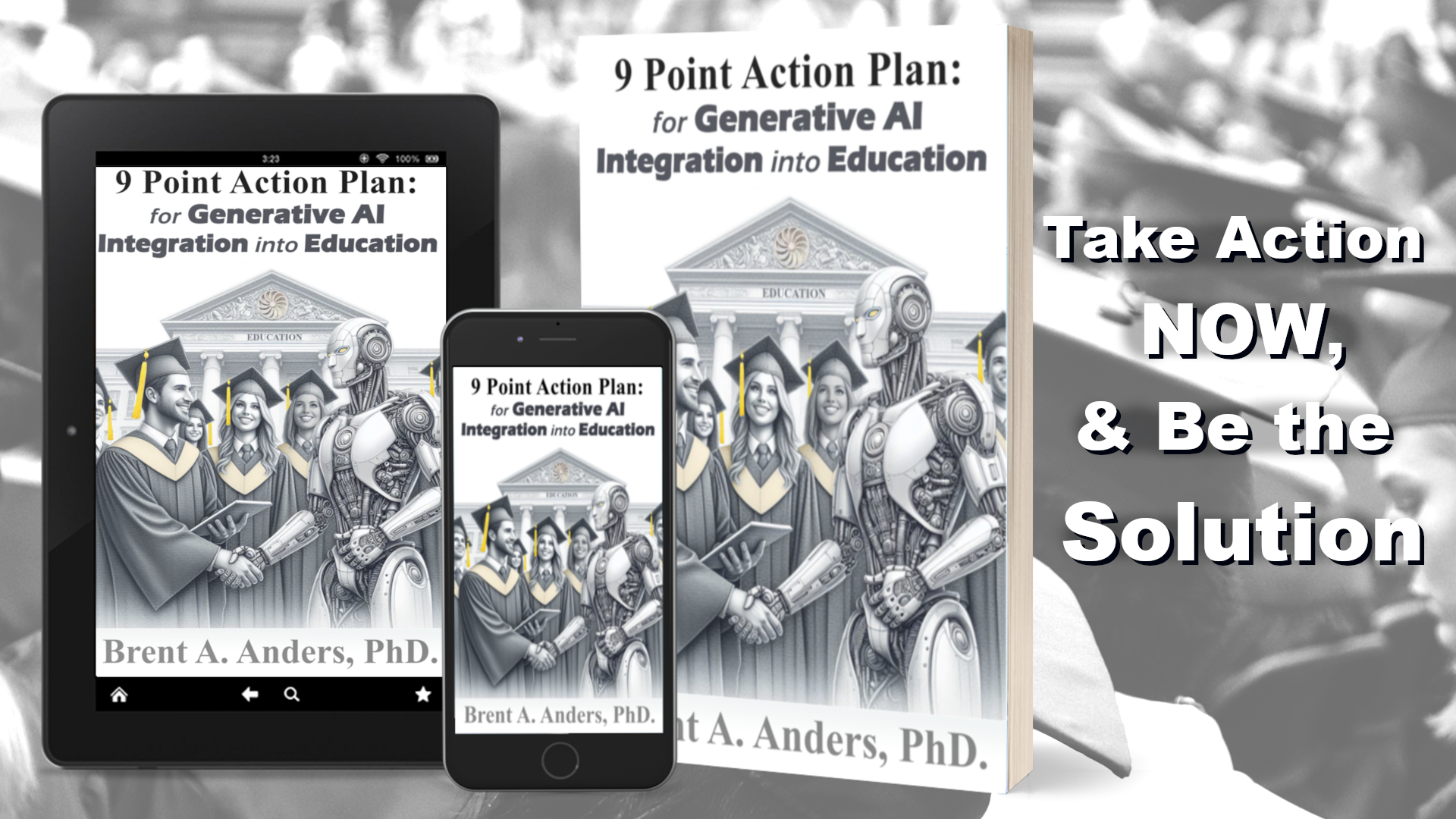
    I’m very happy and excited to share that I have released a new book that is geared specifically to helping universities, as well as all educational institutions, with the very important topic of generative AI integration into education. This is a vital process that higher education and all places of learning need to address in order to become and stay relevant in a world that so filled with AI. All of us in academia must develop AI Literacy skills in order to fully develop these skills within our students. If educational institutions do not integrate this important process now, then they will not be properly setting up their students for success. This book specifically provides an action plan to help educational institutions be part of the solution and to better ensure success.

    Here is a video trailer for the 9 Point Action Plan: for Generative AI Integration into Education book:

    Table of contents for the 9 Point Action Plan: for Generative AI Integration into Education book that is now available as an ebook or printed book at Amazon: https://www.amazon.com/Point-Action-Plan-Generative-Integration/dp/B0D172TMMB

    TABLE OF CONTENTS

    1. Chapter 1: Institutional Policies
      • Examples
      • Policy Examples
      • Implementation
    2. Chapter 2: Leadership Guidance on Utilization of Generative AI
      • Examples
      • Michigan State University Example
      • Yale University Example
      • Template Example: Leadership Guidance on Generative AI in Education
      • Implementation
    3. Chapter 3: Training
      • Faculty Training
      • Staff Training
      • Student Training
      • Examples
      • American University of Armenia Example
      • Arizona State University Example
      • Other Examples
      • Implementation
    4. Chapter 4: Generative AI Teaching & Learning Resources
      • Examples
      • University of Arizona
      • American University of Armenia
      • The University of California Los Angeles (UCLA)
      • Implementation
    5. Chapter 5: Outside Information/Confirmation
      • Bring in an Outside Speaker, Presenter, Facilitator
      • Examples
      • Obtain Employers’/Organizations’ Views & Ideas on Needed AI Skills
      • Implementation
    6. Chapter 6: Syllabus AI Use Statement
      • Examples
      • Tuffs University Example
      • Vanderbilt College of Arts and Science
      • American University of Armenia Example
      • Implementation
    7. Chapter 7: Strategic Plan Integration
      • Components of a Good Strategic Plan and AI Considerations
      • Environmental Analysis
      • Review of Organizational Vision/Mission
      • Identification of Strategic Goals and Objectives
      • Key Performance Indicators
      • Integration of AI Literacy into the Curriculum
      • Example: White Paper: Integration of AI Literacy into Our Curriculum
    8. Chapter 8: Integration Observation and Evaluation
    9. Chapter 9: Community Outreach
      • Example Benefits of Community Outreach
      • Implementation
    10. Chapter 10: Conclusion and Call to Action
    11. Glossary
    12. References
    13. Additional Resources

    As with all of my books, please reach out if you have any questions. I can be found on LinkedIn and Twitter. I also respond to all comments placed this blog or through YouTube. Please also join the Sovorel Center for Teaching and Learning Facebook page where I post a lot of updates.

    Source link

  • Using AI in Education is NOT an All or Nothing Endeavor – Sovorel

    Using AI in Education is NOT an All or Nothing Endeavor – Sovorel

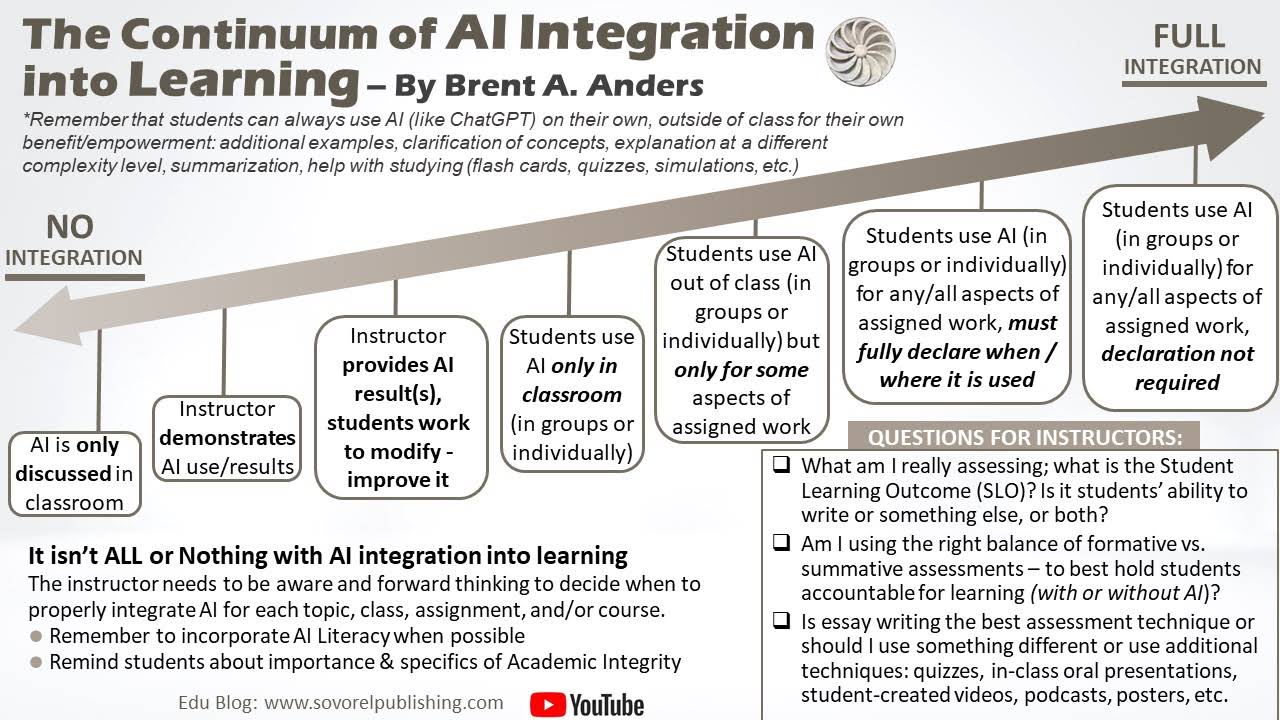
    In working with many different instructors around the world, I still run into a lot of teachers and professors that think that using AI and teaching about AI Literacy in the classroom is an all or nothing endeavor. They have the false belief that you either have use AI in every part of your teaching, for every assignments, or you can’t use AI at all. The reality is that there is a full continuum of how an instructor can use and implement generative AI within their classroom.

    The infographic provided in this post is an example of the many different ways that an instructor could use generative AI within their teaching and learning process. To begin with an instructor could simply just talk about generative AI. This is beneficial on a multiple of levels in that for one it helps student understand that the instructor is at least aware of generative AI. Additionally, talking about AI helps students develop their AI Literacy skills which is something that all of us in academia must continually develop within ourselves so that we can can properly develop it within all of our students.

    The continuum of AI integration into learning that proceeds with different levels of use of AI in the classroom. This could be done in a way so that the instructor uses generative AI, such as ChatGPT, in front of the students so that then everyone can then discuss and answer questions about the interaction and the created results. Another way to implement could be that students use the AI in class for different activities. A more advanced way would be for students to have homework assignments where they would have to us the AI in some way to complete a task or as part of a group project.

    A key consideration with AI integration is that every instructor must be knowledgeable about the topic to be taught and their students needs. Instructors need to make purposeful choices as to when to us AI and in what ways. A great tool to help with the creating or redesigning assessments and assignments given that we know have generative AI is the following infographic titled “Redesigning Assignments & Assessment in Age of AI.”

    The SHARE Technique to Assist in Redesigning Assignments and Assessments in the Age of AI

    This infographic is very benifitial in that in addition to helping all with the creation of assignments/assessments in the age of AI, it helps instructors to create good and effective assignments/assessment in general. Faculty need to be purposful and really think about assignments and learning activeities in order to help students learn the material and also develop appropriate AI Literacy skills.

    View this following video for additional information on integrating AI in the classroom:

    What are your thoughts? Please add to the comments so that we can all learn from one another.

    Source link

  • Higher Education Pay Increases in 2023 Exceeded Inflation for the First Time Since the Pandemic – CUPA-HR

    Higher Education Pay Increases in 2023 Exceeded Inflation for the First Time Since the Pandemic – CUPA-HR

    by CUPA-HR | March 27, 2024

    New research from CUPA-HR has found that median pay increases for most higher education employees in 2023-24 continued the upward trend seen last year (and exceeded the inflation rate for the first time since 2019-20). However, the findings also show that most higher ed employees are still being paid less than they were in 2019-20 in inflation-adjusted dollars.

    The largest gap between pre-pandemic inflation-adjusted salaries and current salaries is for tenure-track faculty (earning 9.7% less), followed by non-tenure-track teaching faculty (earning 8.2% less). The smallest gap is for staff (earning only 0.3% less).

    Other key findings from an analysis of CUPA-HR’s higher ed workforce salary survey data from 2016-17 to 2023-24 include:

    • Non-tenure-track teaching faculty received their highest raise in the past eight years.
    • Staff (generally non-exempt employees) received the highest increase in pay in comparison to other employee types. This was true last year as well.
    • Tenure-track faculty continued to receive the lowest pay increases (and were the only group of employees whose raise did not surpass inflation).

    Across higher ed, employees are still being paid less than they were in 2019-20 (pre-pandemic) in inflation-adjusted dollars. Tenure-track faculty are the group with the largest gap between median salaries in 2019-20 adjusted to 2023-24 dollars and actual median salaries in 2023-24, earning 9.7% less. This is followed by non-tenure-track teaching faculty (earning 8.2% less). The smallest gap is for staff (earning only 0.3% less).

    High inflation has only exacerbated the gaps in pay increases faculty (particularly tenure-track faculty) experience in relation to other higher ed employees. Further, even though most higher ed employee groups received raises that beat inflation in 2023-24, these raises did not reverse the erosion of higher ed employee purchasing power that has been occurring since 2019-20.

    Explore this data and more in CUPA-HR’s newest interactive graphic.

    CUPA-HR Research

    CUPA-HR is the recognized authority on compensation surveys for higher education, with its workforce surveys designed by higher ed HR professionals for higher ed HR professionals and other campus leaders.


    Source link

  • CUPA-HR’s Equal Pay Day Data for Higher Education: Women in Higher Ed Are Paid Just 82 Cents on the Dollar, Most Women of Color Are Paid Even Less – CUPA-HR

    CUPA-HR’s Equal Pay Day Data for Higher Education: Women in Higher Ed Are Paid Just 82 Cents on the Dollar, Most Women of Color Are Paid Even Less – CUPA-HR

    by Julie Burrell | March 12, 2024

    Since 1996, the National Committee on Pay Equity has acknowledged Equal Pay Day to bring awareness to the gap between men’s and women’s wages. This year, Equal Pay Day is March 12 — symbolizing how far into the year women must work to be paid what men were paid in the previous year.

    To help higher ed leaders understand, communicate and address gender pay equity in higher education, CUPA-HR has analyzed its annual workforce data to establish Higher Education Equal Pay Days for 2024. Tailored to the higher ed workforce, these dates observe the gender pay gap by marking how long into 2024 women in higher ed must work to make what White men earned the previous year.

    Higher Education Equal Pay Day fell on March 5, 2024, for women overall, which means that women employees in higher education worked for more than two months into this year to gain parity with their White male colleagues. Women in the higher ed workforce make on average just 82 cents for every dollar a White male employed in higher ed makes.

    Highlighting some positive momentum during this Women’s History Month, some groups of women are closer to gaining pay equity. Asian American women in higher ed worked two weeks into this year to achieve parity on January 14 — not ideal, but by no means insignificant. In fact, during the academic year 2022-23, Asian American women administrators in particular saw better pay equity than most other groups, according to CUPA-HR’s analysis.

    But the gender pay gap remains for most women, and particularly for women of color. Here’s the breakdown of the gender pay gap in the higher ed workforce, and the Higher Education Equal Pay Day for each group.* These dates remind us of the work we have ahead.

    • March 5 — Women in Higher Education Equal Pay Day. On average, women employees in higher education are paid 82 cents on the dollar.
    • January 14 — Asian Women in Higher Education Equal Pay Day. Asian women in higher ed are paid 96 cents on the dollar.
    • March 1 — White Women in Higher Education Equal Pay Day. White women in higher ed are paid 83 cents on the dollar.
    • March 12 — Native Hawaiian/Pacific Islander Women in Higher Education Equal Pay Day. Native of Hawaii or Pacific Islander women in higher ed are paid 80 cents on the dollar.
    • March 28 — Black Women in Higher Education Equal Pay Day. Black women in higher ed are paid 76 cents on the dollar.
    • April 12 — Hispanic/Latina Women in Higher Education Equal Pay Day. Hispanic/Latina women in higher ed are paid 72 cents on the dollar.
    • April 22 — Native American/Alaska Native Women in Higher Education Equal Pay Day. Native American/Alaska Native women are paid just 69 cents on the dollar.

    CUPA-HR research shows that pay disparities exist across employment sectors in higher ed — administrators, faculty, professionals and staff — even as the representation of women and people of color has steadily increased. But with voluntary turnover rising, not addressing pay disparities could be costly.

    CUPA-HR Resources for Higher Education Equal Pay Days

    As we observe Women’s History Month and Higher Education Equal Pay Days for women, we’re reminded that the fight for equal pay is far from over. But data-driven analysis with the assistance of CUPA-HR research can empower your fight for a more equitable future.

    See our interactive graphics that track gender and racial composition, as well as pay, of administrative, faculty, professional, and staff roles, collected from CUPA-HR’s signature surveys:


    *Data Source: 2023-24 CUPA-HR Administrators, Faculty, Professionals, and Staff in Higher Education Surveys. Drawn from 633,020 men and women for whom race/ethnicity was known.


    Source link

  • NLRB Higher Education Union Election Data for 2023 – CUPA-HR

    NLRB Higher Education Union Election Data for 2023 – CUPA-HR

    by CUPA-HR | March 5, 2024

    During calendar year 2023, union organizing continued to rise at institutions of higher education. Data from the National Labor Relations Board on union organizing show that 31.2% of all private-sector workers who successfully unionized in 2023 were employed by institutions of higher education. Public institutions also saw considerable union activity, though this is not reflected in NLRB data.*

    To provide an update regarding collective bargaining at private colleges and universities across the country, CUPA-HR’s government relations team has compiled the following NLRB data** from 2023 and early 2024 to summarize organizing activity.

    Organizing Efforts at Private Institutions in 2023

    • There were 132,303 workers in bargaining units that held elections in 2023. Of this total, 32,477 workers were from institutions of higher education.
    • There were 92,574 workers in total who joined certified bargaining units in the U.S. in 2023. Of this total, 28,859 workers were from institutions of higher education.

    Private Institution Union Drive Data in 2023

    • There were 55 union elections held at private institutions of higher education last year.
    • Of the 55 held, 48 union elections resulted in worker unionization. Again, this totaled 28,859 workers from private institutions of higher education.***
      • 20 elections included non-faculty, non-student workers with various positions.
      • 14 elections included graduate students with various positions (including two RA elections).
      • 13 elections included undergraduate students with various positions (including five RA elections).
      • Two elections included faculty.
      • Two elections included non-tenured faculty specifically.
      • Two elections included adjunct faculty.
      • Two elections included postdoctoral workers.
    • Three elections did not result in unionization. Four elections have been held at institutions, but they have not yet been closed. It is unclear why they are pending.

    Private Institution Election Data since January 1, 2024

    • So far this year, there have been eight union elections at institutions of higher education. Seven of the elections resulted in worker unionization, and one is still open for unknown reasons.
      • In the seven decided elections, 2,477 workers are included in the bargaining units.
      • In the one open case, 290 workers could be unionized.
    • Since January 1, 2024, there are seven pending petitions for unionization at institutions of higher education. In the seven pending petitions, 3,674 workers could be unionized depending on the result of the elections.

    CUPA-HR will continue to monitor this NLRB data and keep members apprised of future higher education union organizing trends.


    *The NLRB is a federal agency and only has jurisdiction over private employers, which includes private higher education institutions. Public institutions handle collective bargaining activity with their state and local labor relations agencies. CUPA-HR regularly tracks activity from the NLRB and is providing an overview of union activity at private institutions, but members at public institutions are encouraged to share union activity with the CUPA-HR government relations team as it occurs.

    **To compile the data, CUPA-HR searched for “Election Results” and “R Case Reports” that included the search terms “university,” “college,” and “school” during the calendar year 2023 and from January 1, 2024 to March 4, 2024.

    ***The grouped data below do not add up to 48 total elections because some units included multiple groups (i.e. undergraduate and graduate students, tenured and non-tenured faculty, etc.).


    Source link

  • Department of Education Moves Forward With Title IX Final Rule – CUPA-HR

    Department of Education Moves Forward With Title IX Final Rule – CUPA-HR

    by CUPA-HR | February 5, 2024

    On February 2, 2024, the Department of Education (ED) sent its highly anticipated Title IX final rule to the White House Office of Information and Regulatory Affairs (OIRA) for review. OIRA review is the final step before the Title IX rule is published. While ED’s final rule is being reviewed, the public is not provided with any specific details on changes to the proposed rule. However, interested stakeholders can request a meeting with the administrator while a rule is under review.

    The Department of Education introduced a Title IX proposed rule in June 2022, under which the department proposed to replace the Trump administration’s 2020 Title IX rule and establish expanded protections against sex-based discrimination to cover sexual orientation, gender identity, and pregnancy or related conditions. CUPA-HR submitted comments in response to the proposed rule, in which we brought attention to the possible impact the proposed regulations could have on how higher education institutions address employment discrimination.

    The Department of Education has been reviewing the 240,000 submitted comments in response to the Title IX proposed rule since the comment period closed in September 2022. The final rule was initially included in the Fall 2022 Regulatory Agenda with a target release date in May 2023, but the department had to further delay that timeline to ensure all comments submitted in response to the proposed rule were reviewed and addressed in the final rule. Most recently, ED indicated a March 2024 release of the final rule in the Fall 2023 Regulatory Agenda.

    OIRA reviews typically last between 30-60 days, though the agency has up to 90 days to review the rule before it is released to the public. As such, the final rule could be released as soon as early March, possibly meeting the Fall 2023 Regulatory Agenda’s target date.

    Once the final rule is published, CUPA-HR will hold a webinar presented by Title IX experts. In the meantime, CUPA-HR will keep members apprised of additional updates on the Title IX final rule, including when the review is completed and the rule is published.


    Source link

  • Dr. Jennifer T. Edwards: A Texas Professor Focused on Artificial Intelligence, Health, and Education: Preparing Our Higher Education Institutions for the Future

    Dr. Jennifer T. Edwards: A Texas Professor Focused on Artificial Intelligence, Health, and Education: Preparing Our Higher Education Institutions for the Future

    As we prepare for an upcoming year, I have to stop and think about the future of higher education. The pandemic changed our students, faculty, staff, and our campus as a whole. The Education Advisory Board (EAB) provides colleges and universities across the country with resources and ideas to help the students of the future.

    I confess, I have been a complete fan of EAB and their resources for the past ten years. Their resources are at the forefront of higher education innovation.

    🏛 – Dining Halls and Food Spaces

    🏛 – Modern Student Housing

    🏛 – Hybrid and Flexible Office Spaces

    🏛 – Tech-Enabled Classrooms

    🏛 – Libraries and Learning Commons

    🏛 – Interdisciplinary Research Facilities


    Higher education institutions should also focus on the faculty and staff as well. When I ask most of my peers if they are comfortable with the numerous changes happening across their institution, most of them are uncomfortable. We need to prepare our teams for the future of higher education. 

    Here’s the Millennial Professor’s Call the Action Statements for the Higher Education Industry

    🌎 – Higher Education Conferences and Summits Need to Provide Trainings Focused on Artificial Intelligence (AI) for Their Attendees

    🌎 – Higher Education Institutions Need to Include Faculty and Staff as Part of Their Planning Process (an Important Part)

    🌎 – Higher Education Institutions Provide Wellness and Holistic Support for Faculty and Staff Who are Having Problems With Change (You Need Us and We Need Help)

    🌎 – Higher Education Institutions Need to Be Comfortable with Uncommon Spaces (Flexible Office Spaces)

    🌎 – Faculty Need to Embrace Collaboration Opportunities with Faculty at Their Institutions and Other Institutions

    Here are some additional articles about the future of higher education:

    Higher education will continue to transition in an effort to meet the needs of our current and incoming students. 

    For our particular university, we are striving to modify all of these items simultaneously. It is a challenge, but the changes are well worth the journey.

    Here’s the challenge for this post: “In your opinion, which one of the items on the list is MOST important for your institution?”

    ***. 

    Check out my book – Retaining College Students Using Technology: A Guidebook for Student Affairs and Academic Affairs Professionals.

    Remember to order copies for your team as well!


    Thanks for visiting! 


    Sincerely,


    Dr. Jennifer T. Edwards
    Professor of Communication

    Executive Director of the Texas Social Media Research Institute & Rural Communication Institute

    Source link

  • Reflections from the Higher Education for Good Book Release Celebration – Teaching in Higher Ed

    Reflections from the Higher Education for Good Book Release Celebration – Teaching in Higher Ed

    What a way to start my week!

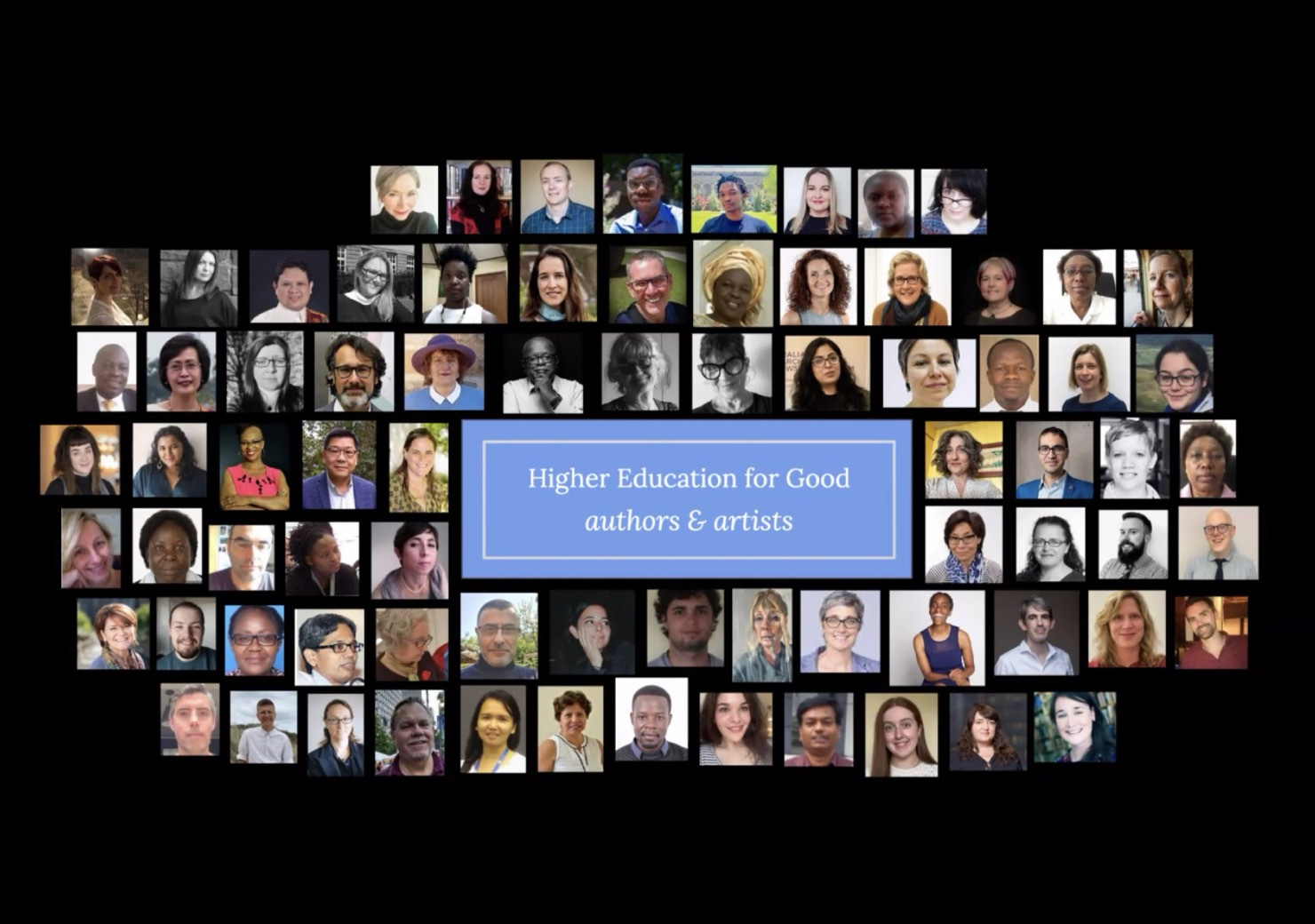
    November 20, 2023, I attended an online launch celebration event for a magnificent project. The book Higher Education for Good: Teaching and Learning Futures brought together 71 authors around the globe to create 27 chapters, as well as multiple pieces of artwork and poetry. Editors Laura Czerniewicz and Catherine Cronin shared their reflections of writing the book and invited chapter authors, and Larry Onokpite, the book’s editor, to celebrate the release and opportunities for collaboration. In total, the work represents contributions from 29 countries from six continents. Laura Czerniewicz was invited to talk about the book by the Academy of Science of South Africa (ASSAf), where she describes the values of inclusion woven throughout this project.

    Higher Ed for Good Aims

    At Monday’s book launch, Laura shared how the authors aimed to write about the tenants that were directed toward the greater aims of the book. Catherine described the call for authors to engage in this project, such that the resulting collection would help people:

    • Acknowledge despair
    • Engage in resistance
    • Imagine alternative futures and…
    • Foster hope and courage

    Laura stressed the way articulating what we stand for and not simply what we are against is essential in facilitating systemic change. Quoting Ruha Benjamin, Laura described ways to courageously imagine the future:

    Only by shifting our imagination, can we begin to think of a world that is more egalitarian, less extractive, and more habitable for everyone not just a small elite.

    It was wonderful to see the community who showed up to help celebrate this magnificent accomplishment. Toward the end of the conversations, someone asked about what might be next for this movement. Frances Bell responded by joking that she wasn’t sure she was necessarily going to answer the question, as she is prone to do. Instead, she described her use of ‘a slow ontology,’ a phrase which quickly resonated with me, even thought I didn’t know exactly what it meant.

    In some brief searching, I discovered a bit more about slow ontology. My novice understanding is that slow ontology asks the question of what lives might look like, were we to live them slowly and resist the socialization of speed as productivity and self-worth. Ulmer offers a look at a slow ontology for writing, while Mol uses slowness to analyze archeological artifacts. One piece I absolutely want to revisit is Mark Carrigan’s Beyond fast and slow: temporal ontology in critical higher education scholarship

    Next Steps

    I’ll have the honor, soon, of interviewing Laura and Catherine for the Teaching in Higher Ed podcast. I’m ~30% through Higher Education for Good and am glad I don’t have to rush through the reading too quickly. I mentioned as a few of us remained online together after the book release celebration that reading Higher Education for Good and Dave Cormier’s forthcoming Learning in a Time of Abundance has been an interesting juxtaposition. Rissa Sorensen-Unruh described a similar serendipity of reading Belonging, by Geoffrey Cohen at the same time as Rebecca Pope-Ruark’s Unraveling Faculty Burnout. After skimming the book description of Belonging, I instantly bought it… adding it to the quite-long digital to-read stack. I suppose that while I struggle with slowing down, that challenge doesn’t apply when it comes to my reading practice.

    Resources:

    Source link