A few weeks ago, I had the pleasure of presenting for an Undergraduate Research Group at my university. When they initially asked me about presenting about visual presentations, I had to think back to the numerous presentations that I have been fortunate to facilitate all over America.
Then, I thought about the items that I wish I would have had on site when I saw the place where I needed to place my poster. So, I decided to make a “Poster Presentation Survival Kit”. This kit contains: masking tape, t-pins, white out, sharpie markers, and cuticle clippers (to serve as scissors for your poster (just in case)).
The presentation was well received and they asked for a copy. I was very impressed with this group and their questions focused on research and the presentation process. We also had a great conversation about presenting information that has not yet been published.
Here’s the presentation:
Here are some additional resources. Thanks UNC, UC Davis, and Bucknell!
Enjoy! Please let me know if you have any questions.
When it comes to representation and pay equity for women and people of color in the higher education workforce, colleges and universities have frequently struggled to make meaningful progress. Through several new interactive graphics representing years of research, CUPA-HR shines a light on the progress that has been made and the disparities that persist. These graphics represent data from CUPA-HR’s four signature higher ed workforce surveys — Administrators, Faculty, Professionals, and Staff — through 2022.
Administrators
While the proportion of people of color in higher ed administrator positions has grown steadily over the last 10 years, these increases have not kept pace with the rate at which minorities are obtaining graduate degrees. In 2022, people of color made up 18.2 percent of administrators, up from 12.9 percent in 2012.
The data also show that pay gaps for women administrators of all races/ethnicities are consistent across the past 10 years and notably wide. Pay inequity is particularly egregious for women administrators of color (with the exception of Asian women). Men of color, on the other hand, have been paid salaries equitable to or greater than those of White men in recent years.
The Administrators in Higher Education Survey collects data on administrator positions that manage a higher ed institution or a division within it.
There are two notable findings in faculty composition. First, more women are represented in non-tenure-track than in tenure-track faculty. Second, for each tenure status and with each increase in rank, the proportions of women and faculty of color decrease. This means that women are over-represented in the lowest-paying and lowest-ranking positions. This remains the case despite the fact that the proportion of women and faculty of color have increased slightly at each rank over the past five years.
Pay gaps for women faculty, regardless of tenure status or rank, continue to persist, particularly at the rank of professor. These gaps are most notable for women of color. Pay gaps at other ranks have narrowed over time, particularly for tenure-track faculty. Importantly, the factor that most impacts faculty pay is promotion to a higher rank. Often, the only significant increases in salary happen with these promotions. These data show that the only group that has greater representation with each increase in rank is that of White male faculty, and this pattern has persisted over time.
The Faculty in Higher Education Survey collects data on tenure-track faculty positions and non-tenure-track teaching faculty positions.
Women’s representation has increased across all professionals’ positions since 2017, and in 2022, women represented more than 60 percent of higher ed professionals. This change is due to slight increases in representation of women of color since 2017. In 2022, representation of people of color was 24 percent overall, with the highest percentage among human resources professionals (34 percent) and diversity and equal opportunity professionals (33 percent).
In 2022, women were consistently paid less than White men, a pattern that has worsened since 2017. However, men of color were paid more equitably in 2022 compared to previous years.
The Professionals in Higher Education Survey collects data on positions in specific functional areas in higher ed institutions, such as academic or student services, that usually require a baccalaureate degree.
Staff employees have a higher representation of people of color than any other higher ed employee group. This is notable in that these are the lowest-paying positions in higher ed. In 2022, women of color represented about 19 percent of all higher ed staff, and men of color represented about 13 percent of all higher ed staff. These numbers have increased since 2017, though modestly. Skilled craft employees were the least racially diverse group, as 80 percent were White men, a finding that has persisted across the past six years. Notably, skilled craft staff are among the highest-paid staff positions.
Since 2017, women in staff positions have been paid consistently and considerably less than White men in staff positions, a pattern that has worsened over time, particularly for women in office and clerical positions. Men of color were paid more equitably in 2022 when compared to 2017.
The Staff in Higher Education Survey collects data on positions that are generally non-exempt and do not require a college degree.
CUPA-HR is the recognized authority on compensation surveys for higher education, with its workforce surveys designed by higher ed HR professionals for higher ed HR professionals and other campus leaders. CUPA-HR has been collecting data on the higher ed workforce for more than 50 years, and we maintain one of the largest workforce databases in existence. CUPA-HR also publishes numerous research publications and interactive graphics highlighting trends and issues around higher ed workforce planning, pay equity, representation of women and racial/ethnic minorities and more. Learn more about CUPA-HR research.
After a month in session, the U.S. House of Representatives and Senate are finalizing their committee and subcommittee membership rosters. Of particular significance are the House Education and the Workforce Committee and Senate Health, Education, Labor and Pensions (HELP) Committee, which have jurisdiction over higher education and many labor and employment issues, including overtime, paid leave, occupational safety and health and employment-based discrimination.
House Education and the Workforce Committee and Subcommittees
The House Education and the Workforce Committee will be comprised of 25 Republicans and 20 Democrats with Rep. Virginia Foxx (R-NC) serving as chairwoman and Rep. Bobby Scott (D-VA) serving as ranking member of the full committee. Both Foxx and Scott served as their party’s committee leader in the previous Congress when Democrats held the majority, but Foxx was notably able to secure a waiver granting her exemption from House Republican-imposed committee leadership term limits that would have prohibited her from serving a fourth consecutive term as Republican leader on the committee.
Foxx has publicly stated her priorities for the committee, citing oversight of the Biden administration, Department of Labor and Department of Education as a top concern for the committee. Having previously taught at two institutions of higher education and served as president at Mayland Community College, Foxx also has a particular interest in higher education. With divided control of Congress and Democrat control of the Senate, however, it is unlikely that Foxx will be able to pass any meaningful legislation that would garner support from the Senate and the president.
In addition to the full committee roster, the Education and the Workforce Committee has also finalized their subcommittee rosters.
Subcommittee on Workforce Protections
The Subcommittee on Workforce Protections has jurisdiction over issues relating to wages, hours of workers and overtime, including the Fair Labor Standards Act (FLSA); workers’ compensation, including the Family and Medical Leave Act (FMLA); issues relating to immigration and employment; and occupational safety and health, including the Occupational Safety and Health Administration (OSHA).
Freshman Rep. Kevin Kiley (R-CA) will serve as chairman of the subcommittee and Rep. Alma Adams (D-NC) will serve as ranking member after serving as chair of the subcommittee last Congress. The subcommittee will made be up of six Republicans, including Glenn Grothman (R-WI), James Comer (R-KY), Mary Miller (R-IL) and Eric Burlison (R-MO), all who did not serve on the subcommittee in the previous Congress; and four Democrats, all who served on the subcommittee in the last Congress.
Subcommittee on Higher Education and Workforce Development
The Subcommittee on Higher Education and Workforce Development has jurisdiction over the following areas: postsecondary student assistance and employment services, and the Higher Education Act; postsecondary career and technical education, apprenticeship programs, and workforce development; and science and technology programs.
Rep. Owen Burgess (R-UT) will serve as chairman of the Subcommittee on Higher Education and Workforce Development, while Rep. Frederica S. Wilson (D-FL) will serve as ranking member of the subcommittee after serving as chair of the subcommittee in the 117th Congress. The makeup of the subcommittee will include 13 Republicans, including Reps. Glenn Thompson (R-PA), Lloyd Smucker (R-PA), Nathaniel Moran (R-TX), John James (R-MI), Lori Chavez-DeRemer (R-OR), Erin Houchin (R-IN) and Brandon Williams (R-NY) as new members; and 11 Democrats, including Reps. Lucy McBath (D-GA), Gregorio Kilili Camacho Sablan (D-Northern Marina Islands) and Alma Adams (D-NC) as new members.
Subcommittee on Health, Employment, Labor and Pensions
The Subcommittee on Health, Employment, Labor and Pensions’ jurisdiction involves “matters dealing with relations between employers and employees,” including to the National Labor Relations Act (NLRA) and employment-related health and retirement security, such as pension, health and other employee benefits and the Employee Retirement Income Security Act (ERISA).
The subcommittee will see Rep. Bob Good (R-VA) serve as chairman and Rep. Mark DeSaulnier (D-CA) serve as ranking member after previously serving as chair in the 117th Congress. The subcommittee will be composed of 12 Republicans, including Reps. James Comer (R-KY), Lloyd Smucker (R-PA), Michelle Steele (R-C), Aaron Bean (R-FL), Eric Burlison (R-MO), Lori Chavez-DeRemer (R-OR) and Erin Houchin (R-IN) serving as new members; and 10 Democrats, including Reps. Pramila Jayapal (D-WA), Jahana Hayes (D-CT), Ilhan Omar (D-MN) and Kathy Manning (D-NC) serving as new members.
Senate Health, Education, Labor and Pensions Committee
The Senate HELP Committee is the Senate counterpart to the House Education and the Workforce Committee. Chair Bernie Sanders (I-VT) will be replacing former Chair Patty Murray (D-WA), who is now the chair of the Senate Appropriations Committee, and Ranking Member Bill Cassidy (R-LA) will be replacing former Ranking Member Richard Burr (R-NC), who retired at the end of the 117th Congress. Democrats will have 11 members and Republicans will have 10 members on the committee. Subcommittees have not yet been finalized, though we expect to see membership lists soon.
Sanders staffers have stated that, as chair, he will “focus on universal healthcare, lowering the cost of prescription drugs, increasing access to higher education and protecting workers’ rights on the job.” As previously mentioned, however, the divided Congress and Republican control of the House will likely prevent meaningful legislation from moving to President Biden’s desk for his signature.
CUPA-HR will be monitoring committee activity and will keep members apprised of any major hearings or updates that come out of the committees.
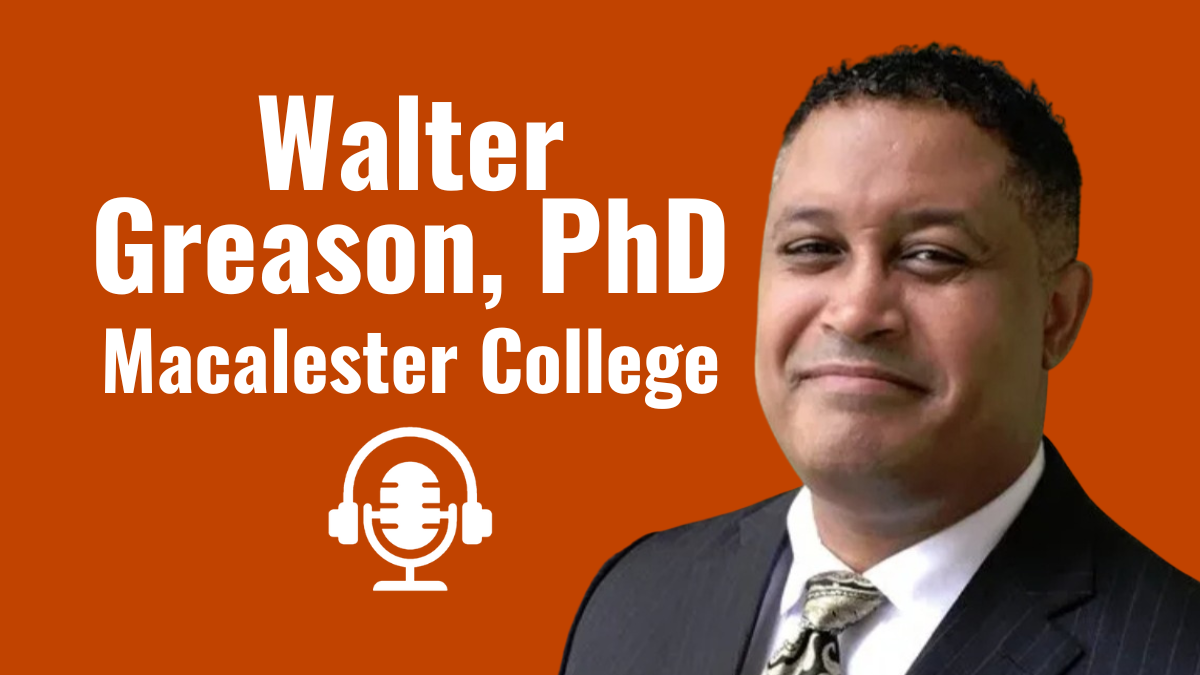
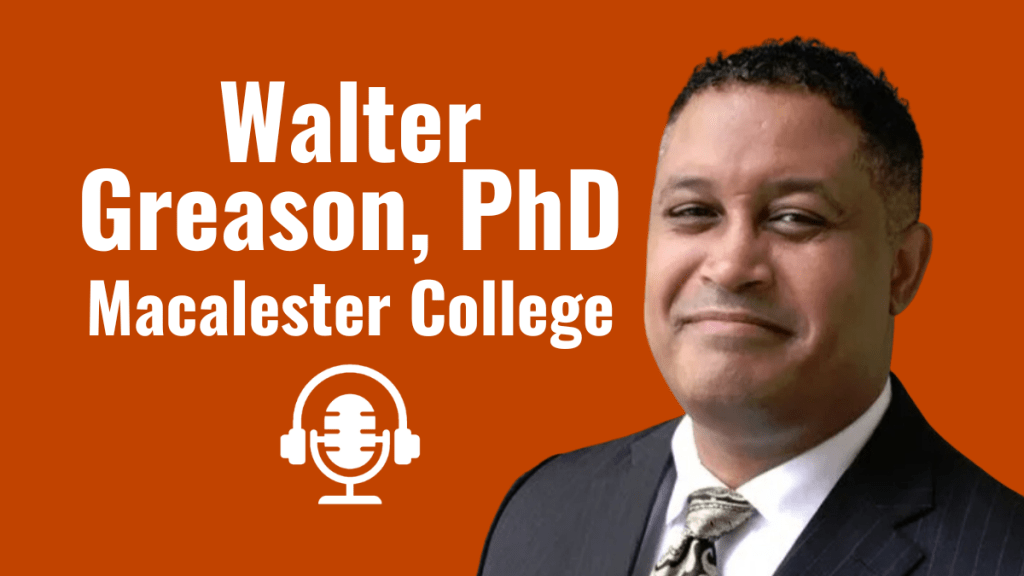
Professor Walter Greason is back with a new in-depth interview
We’re talking about racism in education. This conversation dives into the history of racism in New Jersey. Topics that come up include the January 6th insurrection, the Supreme Court, and how things are affected today.
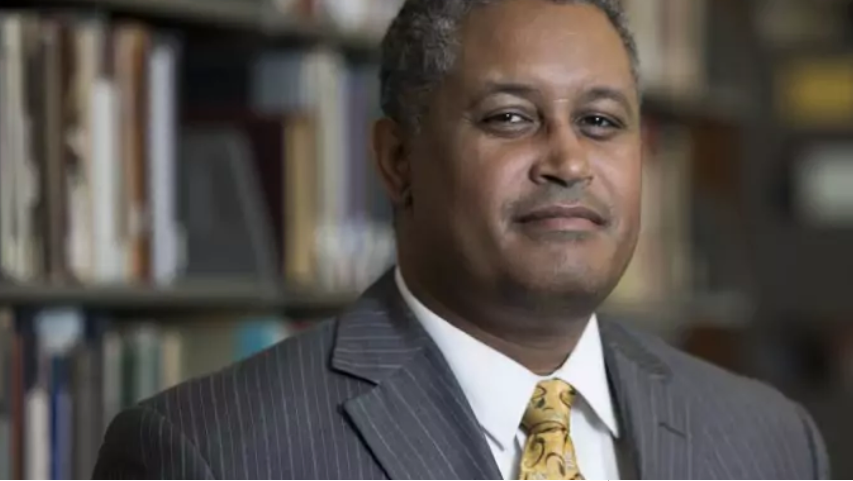
Walter D. Greason, PhD is Professor and Chair of the History Department at Macalester College in Saint Paul, Minnesota. He is author of 6 books including Industrial Segregation (2018) and Cities Imagined: The African Diaspora in Media and History (2018). His digital humanities projects, The Wakanda Syllabus and The Racial Violence Syllabus reached millions of people, and was translated into 7 languages.
P.S. Black Panther fans, this interview has some exciting tidbits about the upcoming Wakanda Forever movie! Don’t miss it.
Jennifer: Hi, everyone. This is Jennifer Van Alstyne on The Social Academic.
Today, I’m talking with Dr. Walter Greason, who has joined us before. He’s back to talk about racism and education in New Jersey. Professor Greason, would you please introduce yourself?
Walter: Thank you so much, Jennifer. It’s an honor to be here.
Again, Walter Greason. I am a former Dean, Department Chair, 1st African American serving those roles at Monmouth University in New Jersey where we met. And so this is just a tremendous joy for me. [Jennifer graduated from Monmouth U with a BA in English in 2013.]
I’m currently a full Professor and Chair of the History Department at Macalester College in Minnesota. Which is kind of like being in charge of the Honor School [at Monmouth], but the entire campus is the honor school. So it’s been really amazing so far.
Jennifer: Oh, I love that.
It’s a reflection of the change in national politics
Jennifer: Now, today you reached out because you specifically wanted to talk about racism in education in New Jersey. And I know you’re in a new place right now, but this is a topic that you spent your career researching. That you’ve written about in Suburban Erasure: How the Suburbs Ended the Civil Rights Movement in New Jersey (2012).
I’m curious, why is this topic so important to you?
Walter: Right now it’s a reflection of the change in the national politics. That New Jersey is extraordinary place. A brilliant governor, outstanding state legislature, many of my friends currently doing amazing work to make New Jersey an even better place to live.
However in parts and pockets of the state, there are people who are extraordinarily dangerous. And I’ve seen reports in multiple news outlets about the funders in New Jersey who made things like the January 6th insurrection possible. Who throughout the last five or six years have done everything they could to sabotage the society from being an inclusive and free place.
And so now after this January 6th hearings, people are becoming more aware that there is a dangerous white nationalist threat in the United States.
But I still find that folks are underestimating it. And they’re missing the danger, particularly within our school systems.
Jennifer: Ooh. Okay. So people are already missing some of the danger that is out there and that’s because they’re not aware of it, it sounds like.
So, why is this conversation going to help them? Right? Most of the people who are listening to this are going to be professors, people who are doing research. People who are in the process of deciding what their research subject is if they’re in graduate school.
So what kind of message can we share with them that will help them understand why this is important to them?
Walter: So for folks who are going into Higher Education or really Education at any phase of their career, to understand the way the institutions operate. To understand the ways that bias still prevails in hiring, promotion, retention decisions. This is tremendously significant.
And that piece of the institutional, the governance of the school systems, of our institutions of Higher Ed. The barrier that I’ve seen most commonly, not just at Monmouth, but at many institutions is that there are committed leaders at the top of the institution. There are committed leaders at the grassroots, at the teacher’s levels, where they’re doing face to face work with students and families.
But often in the intermediate tiers: assistant principals, principals, assistant and associate superintendents, people who operationalize a lot of strategic vision…There’s enormous hostility against commitments to equity. And so it’s this middle level of administrative leadership that slows down and derails so much of the work. And frankly, underwrites and expands the ways that people can come and attack school boards.
Or, the ways that they can go out on social media and build white nationalist networks where they’re attacking parents, where they’re attacking families, where they’re attacking teachers who are attempting to make schools more equitable for everyone.
And so that’s the danger I live with every day. That’s the danger I see hour-by-hour creeping in multiple contexts. And, again, not even just in New Jersey, I mean, places like Ohio. I was just down in Alabama. There are so many places where the organized institutional commitment to injustice is winning.
And until we actually take stands together as faculty and really organize just as rigorously, we will lose these battles to try and make better school systems, better institutions for young people and for families everywhere.
Can you tell me more about the history of racism in New Jersey?
Walter: Absolutely. And, I mean, this is something that has a lot of data behind it [laugh]. But New Jersey history as a field really tended to focus on either the American Revolution or the Civil War, or to a lesser extent, World War II. There is very little attention to the social history of New Jersey. And so I’m very proud that the work I’ve done for the last 15, 20 years has changed that.
There’s a lot of attention now to history of immigrants, histories of black people, histories of lesbian, gay, transgender populations. That the openness to learn about different perspectives in our past has really grown. So that’s one of the pieces of my career I’m most proud of.
And you mentioned something that at Monmouth University there’s so many good things that I was lucky to be a part of. But the founding of the Social Justice Academy over the last two years…writing the proposal, winning the grant, getting the funding to be able to bring people like Nikole Hannah-Jones, hiring Nicole Pulliam as the Program Director for the Academy. These are things that are at the absolute top shelf of my life. I’m so proud of everything that goes on with the Academy.
That is pointing to the kinds of barriers that continue to exist.
And I think #1, people don’t understand how segregation persisted in the North after the Civil War. That they tend to even see slavery as a Southern phenomenon. They see Jim Crow segregation as a Southern phenomenon. And that’s not the case at all.
That segregation dominated the North through the 1800s while slavery was thriving. And it ultimately became the template by which the South said, ‘Oh, we can do what the North does and just keep everyone separate from each other.’ And so that in entrenched segregation, particularly with the Plessy v. Ferguson decision in 1896.
And even when you saw Brown challenge that and say, no, “with all deliberate speed,” we must desegregate [Brown v. Board of Education].
The movement was called [Massive Resistance], basically a white nationalist movement led by the White Citizens’ Council to resist nonviolently and politically any attempt to integrate schools or public institutions. And so this effort goes on for 60 Years. Like you go into the Obama administration and there are still people fighting to keep segregation and expand segregation.
It reshapes the Supreme Court.
It basically makes it possible in places like New Jersey that the worst feature that could be possible: all of the organizations that were dedicated to civil rights, and integration, and equal opportunity were dismantled after Brown [v. Board of Education].
So places that we look at old ironsides is the Bordentown Manual Training Institute, was serving African American and immigrant communities to get people trained to succeed in a modern economy–We closed it in 1956 and said, ‘No, this is no longer going to be a part of what we do in our state.’
We fired thousands of black and immigrant professionals and said, “No, they will have to learn to comply within white institutions that had created all the problems to begin with.’
So when we talk about desegregation and integration, we have a really poor grasp of how we dismantle the institutions that made the chance for integration possible.
And then we preserved all the institutions that had maintained segregation.
And then we’re surprised 50, 60 years later that so little has changed. It’s that we didn’t embrace the kinds of organizations and institutions that would have led to more equity and more inclusion.
And that meant firing lots of really qualified even overqualified people within the educational system, especially, that could have made a much stronger society overall.
Jennifer: Wow. That is very new to me. All of this information is something I may have heard you talk about before, but hearing it all together…hearing it all at once makes me see how important this was. And how lacking my own education in history in America was.
And so we had these parallel tracks within the state where municipalities essentially partnered with the real estate industry to decide where there would be high quality education. And where there would be an education that really did not prepare students to be competitive for college and for future careers.
And so that track, when that report comes out, it shocks everyone. But for anyone who had studied the way that these institutions evolved over the previous 40 years, the only inevitable outcome was that you were gonna have disparate educational gaps
Jennifer: Right.
Walter: And as a result, lifelong employment gaps, lifelong healthcare gaps, lifelong wealth gaps, and we’re not providing fair and equal opportunity to achieve and succeed in life to people of different backgrounds based on their race.
And then, when it’s not based on their race, it’s based on their zip code. Which is even more pernicious because we allow that within the market system to say that some people should get less opportunities than others based on their income, based on their education. But it’s all deeply tied to these structures about race and ethnicity.
Jennifer: Tell me more about that in terms of zip code, and real estate, and education. That seems much more closely tied together than people often expect. How does real estate and where people live affect education?
Walter: So a state like New Jersey, and many Northern and Midwestern states, education is tied to human municipality.
This is very different than places in the far West or in the South where it’s often state funded. Here in Minnesota, all counties received the same funding for education. And so, there’s remarkably high quality. And there’s still disparities, but nowhere near as extreme as what we see in a place like New Jersey, or Connecticut, or Delaware, or Virginia. These places really struggle trying to actually serve the people who have the greatest need.
And there’s a reward structure for that. There are businesses that make more money because they target very affluent particular towns, or sections of counties.
Yeah, just in Monmouth [County], around where we met, you can look at Rumson, and Deal, and Fairhaven and you see these extraordinary school systems. How do you even say a place like Middletown, doing really well
But if you go down the street to Asbury Park, if you go into parts of Red Bank, if you certainly go into the Freehold Regional System and look at what happens to Freehold borough…There are just places where people turn against majority Black and Latino populations and are angry when they get quality opportunities.
And so my students did a lot of research on this, going back into the early 2000s, where they were interviewing folks who were going out to find homes, to find apartments and talking to real estate professionals. And they’re steering folks to different communities based on their appearance. And this is a common practice.
The National Association of Realtors had to apologize just two or three years ago for ongoing systemic discriminatory practices.
And so opening the door for people to understand–And thankfully I am working with Governor Murphy on this problem–how do we actually commit to open up doors of opportunity for all people and then break down the systems of financial incentives for skilled professionals to kind of maintain segregation and inequality. Those are the things that I’m looking forward to the 2nd half of this year and into next year. We have the ability to open the door for everyone to have a fair chance to find success in economic stability.
Google ‘Massive resistance’ and ways to take action
Jennifer: So what can people do if this is all of a sudden an issue that they’re hearing about learning about and wanting to learn more about…And to take action…
What’s something that they can do in their local communities? Let’s say maybe a teacher in New Jersey.
Walter: So first and foremost, I would say Google the term Massive Resistance. This is the phrase that I was trying to put my finger on a few minutes ago. But this is where the state of Virginia decided after the Brown decision is they were gonna commit every resource to making sure that desegregation didn’t happen.
And we tend to look at it and be like, oh, they lost in court. And eventually they decided to comply. Absolutely not. That through the early 1980s into the mid 1990s, town-by-town, county-by-county, state-by-state, people continued to push back. To deny equal opportunity to all people.
And ultimately they win that fight. By the time we get to 2014 and you’re seeing the reversal of the Voting Rights Act. And you’re seeing the increasing waves over the last decade of abandoning the idea of equal justice for all people…That’s exactly what we’re seeing play out in the 2016, the 2020 election, now in the 22 congressional election.
It’s what sparked the riot in on January 6th was this idea that this is a white Christian nation and that any anyone that doesn’t fit that parameter, especially those who challenge patriarchy, and want to kind of guarantee women’s equal rights, that they are equal citizens, and deserve something like abortion protections and equal healthcare access.
That’s the battle where some people’s like, ‘No, we are going to dictate that that’s not going to happen. And then we’re gonna cut off the legal basis for it.”
And Clarence Thomas’s recent decision concurrence, he spells out all the rights that he wants the Supreme Court to repeal. And it’s largely all of these principles that are reinforced by the January 6th insurrection. Not surprisingly, his wife is having to testify before the January 6th committee because of her organizing in funding for those events.
But no one on the opposite side of these issues, no one pressing for civil rights, and women’s rights, and immigrant’s rights, for recognition of equal treatment of the LGBTQ community…there is not the same level of organization. Things are fractured. People undercut each other. People feel defensive about giving up space so that they can give voice to other people who share their same agenda.
Until folks who are pressing for equal justice come together and get on the same page, these issues will never gain traction. You’ll never be able to defend the rights of all people and guarantee equity for every person to find their American dream.
Jennifer: You talked about the importance of organizing before. And I think you just talked about it again, the importance of coming together when you have similar interests.
Now, what can that look like? What kind of organizational structure is that? How can people connect with each other? Where can people go to find that community?
Walter: So, there’s extraordinary model. I’m fortunate because I do the work, I know a few.
In Princeton, [New Jersey] there is an organization called Not In Our Town that meets every week and they discuss books. They discuss movies. They listen to music together. They share great food and they actually talk about how do they stand up for justice in that community? And Princeton is an elite place. That Route 1 corridor between New Brunswick and Princeton, that is a place where there is a ton of resources. And they have a long history of cutting people out and not getting access to them.
We need something like that along the Route 36 corridor [laughs]. You know, going out from Middletown down to Point Pleasant, like that’s another area where there’s not that same type of engagement.
I know there are folks who are doing work in the arts community in Belmar. There is an Asbury Park book collective that actually does a lot of great work across the state.
I mean, up in Newark, there’s just long tradition of battling against discrimination. That’s very important. We need more of that in Camden. We need more of that in Atlantic city.
But most of all, I’ve been really pleased to see in places like Union County and Morristown, places that are really affluent, more and more people trying to raise these questions and engage these topics.
And it’s not just about doing just a book club, or doing just a cooking society, cooking circle. You can do all of these good things, but raise the difficult issues. And look at the policies.
Attend the school board meetings, not to shout at the people who serve, but to talk with them about the solutions that they may not be aware of.
Work that I was just doing in Freehold was about participatory budgeting as a model that comes out of Brazil, where local people get to choose the budget priorities on an annual basis. They don’t just leave it to the town council to decide how tax money is spent.
Jennifer: Wow.
Walter: And so there are all number of ways. You know, I work on things like universal basic income here in Saint Paul, [Minnesota] where folks who are really struggling, who are facing disabilities, or are out of work can get additional supplemental income just so they don’t fall behind and get further into debt.
Big ones are ideas that go into like a job guarantee at the state or the federal level so that everybody who can work can find the work they want and go out there. We desperately need this right now.
There’s a lot of fights I have with central bankers about inflationary pressures. And should we go into recession? What will that do to the country in the next 6 to 10 months?
So doing things differently than we’ve done them in the last 40 to 50 years is uniform in my commitment. I’m big on the side of economics and teaching folks how to read business news and actually engage in new business creation.
For young people, especially for folks who are 15 to 25, folks following the example of what you’re doing with this show. There is so much to do, and we need people to do it differently than was done in the past.
Those are the kinds of things, if anyone’s interested, they can hit my website where I give out ideas every day in business models and funding so that folks can get underway.
How Walter responds to negative reactions to his tweets on Twitter
Jennifer: Now Walter, you have almost 33,000 Twitter followers [@WalterDGreason]. That’s a lot of people who are potentially listening when you tweet about racism in education.
What kinds of responses do you typically get to your tweets?
Walter: Wow. So it’s varied a lot.
Jennifer: Yeah!
Walter: So that account has been up now for 10 years. I can’t believe that account is 10 years old now. Early on, you know, there’s just not a lot of acceptance of academic content on social media.
And so that’s another area where I feel tremendously proud that the kinds of models of providing quality graphics to advertise academic content. To emphasize doing things like podcasts and online shows…That these things were just not part of the social media community 2012, 2013, 2014.
Jennifer: Right.
Walter: And then we started to gain traction. Like we started to really change things. And so for me, it was the Racial Violence Syllabus in 2017.
I think I was already in the tens of thousands of followers. But since then, the engagement is just off the chart.
And so by 2017, now you saw a turning point. You know, my profession as a historian embraced social media really aggressively and thousands of well known scholars joined social media and began to promote their books, began to talk about speaking tours.
But Ibram X. Kendi’s (@DrIbram) up there too in How to Be an Antiracist (2019).
These are all folks that kind of were little pups [laughs] and so I had them come up and believe in the vision. And come on board, and it’s been extraordinary to see the success across so many different platforms. And the revolution in publishing in media that came from it.
So yeah, it’s nice. You know, 30,000 followers for an academic is no joke.
Everywhere I’ve taught, whether it is Monmouth, or Drexel, any of these places, Macalester. You know, there’s just an impact where I’m guaranteed to reach 40 to 70 million people with viral impact. And again, for academic content, that’s kind of unheard of.
Most academics in my field, you know, there’s, they’re satisfied if they get 20-25 people to know anything about what they’re talking about.
Jennifer: Right.
Walter: And so I also have to mention the Wakanda stuff was tremendous. And so being able to bring a spotlight to other colleagues. And then to expand the kinds of audiences who engage in these discussions.
You know, there’s a lot of folks who like to attack the idea of being woke. But being aware and having a good vocabulary to communicate effectively about difficult topics. That’s something everybody should have. And then really should not avoid acquiring those skills.
I don’t care if you call it woke, or informed, or discerning. There’s any number of phrases and adjectives we can use to describe it. But the skill set to communicate clearly and find new solutions together, that’s essential. That’s the core of what freedom is. And so, you know, I’m just very proud that we can turn social media into a platform that does that. And not just a platform for disinformation and manipulation for people to just fuel hate and anger.
Jennifer: Now, when it comes to the tweets that you have about your research, there are always going to be people who hate. Or, who very much dislike what you have to say.
When you get those negative reactions, what’s that like for you?
Walter: So I came up in the internet before there were like pictures [laughs]. And so, you know, I was building webpages, and joining list serves, and being on discussion boards when it was so much worse.
[Laughs.] It was so much worse.
I don’t even know if people use this phrase anymore, but there were these things called flame wars where, you know, you would just get into it and try to burn up whoever was disagreeing with you. And shame, them cow them, dox them into submission and drive them from the platform.
I remember being in a lot of those fights in the mid to late 90s and learning that it’s a waste of time going after and trying to destroy people who disagree with you.
And so I typically have a rule, you know, when someone says something snarky, off color, or aggressive…I’ll indulge it, you know, for a message or two. But inevitably I turn to it as an educator and say, well, you clearly haven’t seen X, Y, and Z. Here are some places to continue to kind of learn about what you’re asking about. And then if you take a look at these things, we can kind of continue the discussion.
But I do find, I get bombarded with bot accounts. And that was something I wasn’t prepared for when it really started to happen a lot. And so these are bot accounts that have 0 to 200 followers that are also all bot accounts. And they’re automated. And they repeat their content. And they just spam the communication channel hoping to waste your time and energy. And eventually I just came to the places once I’m able to determine that it’s a bot account. If it’s a network of bots. I just block them and keep moving [laughs].
Cause there are too many people who are sincere and honest about trying to participate in discourse and, and have good conversations that deserve my time.
Not, not these [bot accounts]. And it’s not just from one country or another it’s there are any number of bad actors out there that have learned how to build bots that are designed to disrupt really productive work.
Jennifer: Okay. So that’s really interesting. You have experienced a lot of flame wars, is that what you called it?
Walter: Mm-hmm [affirmative].
Jennifer: So you’ve experienced a lot more direct and kind of like ongoing conversations about that in the past. So you don’t really engage in those conversations now.
But you do respond, it sounds like, if someone does leave a comment or a question. You don’t just ignore it if it’s a negative comment or question.
Walter: No, if it’s an actual person. Yeah. If its an actual person, and one just disagrees, I want there to be a constructive way that they can move forward.
I do put a limit on it. That’s like it can go back and forth three or four times, but you’re not gonna take me away from doing the work that brought me to this place.
Jennifer: Right. Oh, well, thank you for sharing that with me.
A lot of the professors that I work with, you know, they’re really anxious about posting anything at all. They’re scared that someone will report them to their university, or that they’ll get death threats, or that they’ll get doxed and actually have cops or SWAT come into their home.
Because of that fear, it really stops them from speaking out. But you’ve been speaking out and you’ve been talking on Twitter for a long time. And it sounds like even though you do get negative comments, you do respond to those and you do engage in those conversations because occasionally they can be helpful or learning experiences. Is that right?
Walter: Oh, yes. Oh yes, no. It’s funny. I just saw a cartoonist, very conservative cartoonist, that I met years ago on Facebook. And he’s become radicalized. He says, and then writes, and draws a lot of really poisonous kinds of stuff.
Jennifer: Mm-hmm [affirmative].
Walter: But I still stay in touch. I still tell him, you know, like try to moderate this. You’re not accomplishing the thing that you might think you are.
But ultimately, I find with these folks, particularly in that kind of, you know, Trump MAGA circle is, they’re in a lot of pain. They’re very deeply hurt and sad. And they try to then inflict that sadness and injury on other people around them.
And when I can mostly face-to-face honest, honestly, kind of giving them a way to look at their own humanity–could be through their family members, it could be through friends of theirs–but it gets them to kind of be more introspective.
And that slows down the vitriol. I’m not gonna say it wipes it away or completely reverses the issues that they raise. But shutting them down and casting ’em aside, that’s not always the best way.
There are folks, yeah, you can’t. They are dangerous. And then you need to report them to the police and the FBI. And protect yourself from them.
But it’s even with that mob on January 6th that, you know, you had several hundred out of 10,000 that were really dangerous that needed to be arrested, needed to be convicted, needed to be sent to jail for some time. But there were a lot of folks who were there that looked at what was going on, didn’t like what they saw and backed away and had to kind of reevaluate like, ‘How did this happen?’
And those are the folks that will confront me. And they’re doing it in a way where they’re trying to kind of reconcile, ‘Okay. How do I get back into a conversation that is civil? I don’t want to be a part of something that’s about attacking police and destroying government buildings.’
It’s also hard from the left. There are a lot of folks on the left who feel like I’m way too conservative. That I’m not really ready to burn everything down to make freedom happen for people.
And so, you know, like trying to bring people together in a broad middle where they can see a way to make progress together. That’s a really tough position. That’s a time where lots of folks don’t want to be in the middle because you can get attacked from both sides. But again, I’ve been doing it for 30, 40 years now.
I’m committed to Dr. King’s vision, but I am open to Malcolm X’s methods. [Laughs.]
I pull in a lot of different tools to go after what I think will make all of us better people tomorrow.
Collaboration across sectors helps bridge connections
Jennifer: Now you’ve collaborated with people in kind of every sector in government, in local government, in the media. You collaborated with people on what Wakanda, and all of these things.
What do you get out of collaborating with so many different people? Not just people in Higher Education.
Walter: Yeah. I’ve had a long time to think about that and coming to Macalester helped me get a little bit more perspective on that experience.
I’m not just historian. I’ve PhD in history. I’ve studied history for decades. But I also have a lot of literary analysis skills. I have a strong background as a philosopher. I’ve worked in Africana studies, worked in diplomacy, in peace and justice work. Having that kind of multidisciplinary background working–working in a prosecutor’s office as a high school student. Even growing up on a farm and being a carpenter as like my first real job. Those things challenge me to bridge connections.
And I say almost on a daily basis now, I hear from people who think whatever their approach is the only approach, and it’s the best answer. And I never believe that any of the tools that I bring to the table are the only way, or the best way. I always come in with what I hope is great humility to learn from people what tools they have. And then try to see and understand from their perspective how we can move forward while also providing them with resources that maybe they had never encountered before.
And so I used to do a freshman seminar at Monmouth University on ‘why do we have so many different departments at the college?’ And you know, you have 70 majors at a regional university, you know, to serve everybody and help them choose the thing that they feel like they can be good at and succeed in. But that’s 70 different sets of solutions to any kind of social problems that we’re trying to solve out in the real world. And that’s just the big umbrella. Like you break each of those departments, they have 15 or 20 different methodologies within each department. So you’ve got 1,500 different ways of going after solutions at a school like Monmouth.
Imagine when you go to Rutgers, and that system. And how much they’re offering on a daily basis about different ways to go about building a better world. And then you go to Penn State or Michigan and, you know, it’s ridiculous, the amount of solutions we have.
And we need to have more respect and deference for each other so that we find good answers together.
That you know, we’re not just assuming our way is the only way to go about it.
Jennifer: Wow. Oh, I have just loved this conversation. And I’m so glad that you came back to talk with me again. For anyone who’s listening, be sure to check out that first featured interview with Walter. We talk more about his tweets going viral, the Wakanda Syllabus, all sorts of things that you don’t wanna miss.
Black Panther: Wakanda Forever comes out November 11, 2022
Jennifer: Now, Walter, the Black Panther: Wakanda Forever trailer just came out yesterday, I believe. And I remember we talked about Black Panther and your Wakanda Syllabus during our last interview. Are you excited for the new movie?
Walter: Oh, of course. Of course. You know, so I spent a long time working on just the idea that a movie could possibly be made. So it’s a dream. I was teaching Black Panther comics in my classes back in 2002, 2003. Working on drafts of content for the movie.
When I saw the ancestral plane in the first film, I literally cried in the theater. Like it is still one of the great moments of my life to see that something that was so important to me made it onto a Hollywood screen.
And now I’m seeing this sequel and knowing, you know, I knew before the movie came out, there would be a sequel. I was like, this is gonna be too intense. People are gonna wanna see more.
Jennifer: Yes.
Walter: But it’s not just the sequel of the Black Panther. It’s so many other shows. It’s the HBO Lovecraft Country. It’s the way that the Westworld series has evolved. There’s so much good Afrofuturistic content that is out and available now. And so much more to come that’s still in production.
I just saw the Jordan Peel movie, [Nope] just this past weekend. These are things that just couldn’t exist when I was younger, that I was so happy to see emerge.
But yeah, the trailer to come out at San Diego ComicCon. And to see the audience, they had an African dance performance on stage to introduce the section of the program where they brought it out.
Yeah, the change in the sequel because of Chadwick Boseman’s passing is that it’s titled Black Panther, but the more prominent subtitle is Wakanda Forever.
And I said this in the first movie, it’s like, you come for the Black Panther, but you’re gonna stay for the Dora Milaje. Like this entire cast of people who just transformed the way we tell stories. And we imagine what a superhero narrative is about. And there’s so much more layered into the way this sequel’s gonna be done.
So a character named Namor, who was one of Marvel’s earliest characters has been kind of redesigned as a Chicano superhero using Incan and Mayan kinds of expressions in the way it’s costume is designed and the society that he represents.
And I don’t wanna give away too much in the movie, but this movie is really about sadness and loss. And so it’s a way to kind of process the grief of the loyalty of Chadwick Boseman, but it’s gonna be much larger than that.
There’s a devastation to the way that this conflict plays out that is gonna set up a 3rd movie. And the 3rd movie is then gonna lead into the final two Avengers movies over the next 3 years and it’ll make the Thanos conflict, the infinity stone saga, look very, very small in comparison.
And so if anybody has seen the Loki series on Disney+, or the What If series. Those two things are tremendously important.
And I know there’s a lot of folks who are very disappointed that the T’Challa character was not recast for this movie to kind of bring in more audience and honor Bozeman by just not letting the character disappear.
I do think there’s gonna be a surprise at the end of this sequel about the nature of T’Challa character. And so knowing the way the story works, knowing the way the writers work, and then the designers…I definitely think it’s gonna be a different vibe completely from the 1st movie. But it will be something that will be unforgettable. And people will be talking about it for the next 2 years.
Jennifer: Oh, that’s great. Wow. Black Panther: Wakanda Forever comes out November 11, 2022. I’m really excited for it.
And I’m also gonna include the link to that trailer below.
Walter: Yes, please.
Jennifer: Because you should definitely check it out.
Jennifer: Walter, thank you so much for joining me for this interview. Is there anything you’d like to add before we wrap up?
Walter: Oh, this is tremendous. Your work is spectacular. You don’t know. I am so happy to see it every day.
I would say to you specifically tag me every time you have something [Laughter]. So I make sure I am letting everybody know about it.
Your work is so good.
Jennifer: Well, thank you so much for that!
And just on the topic of grief and loss, I do wanna let everyone listening know that my last interview with Dr. Chinasa Elue was focused on grief and loss, especially in these last couple of years during the pandemic. So I want to encourage you to check that out if it’s something that you’ve been experiencing. Your students I’m sure have been experiencing this as well.
Alright, thank you, Walter! I really appreciate it.
Walter: Jennifer, you’re the best. Thank you again.
Dr. Walter Greason is the leading academic expert on Black and Indigenous historic preservation as well as Afrofuturism and the Black Speculative Arts Movement. He is a professor of history and chairs the Department of History at Macalester College, one of the best liberal arts colleges in the world.
Throughout the past few years we have definitely been part of a Zoom and Microsoft Team centric world. As we meet with teams and individuals, we have to account for the life that is happening on the other side of the screen. Through Zoom we have a unique opportunity to gain a glimpse into another person’s life to which we would normally not have access.
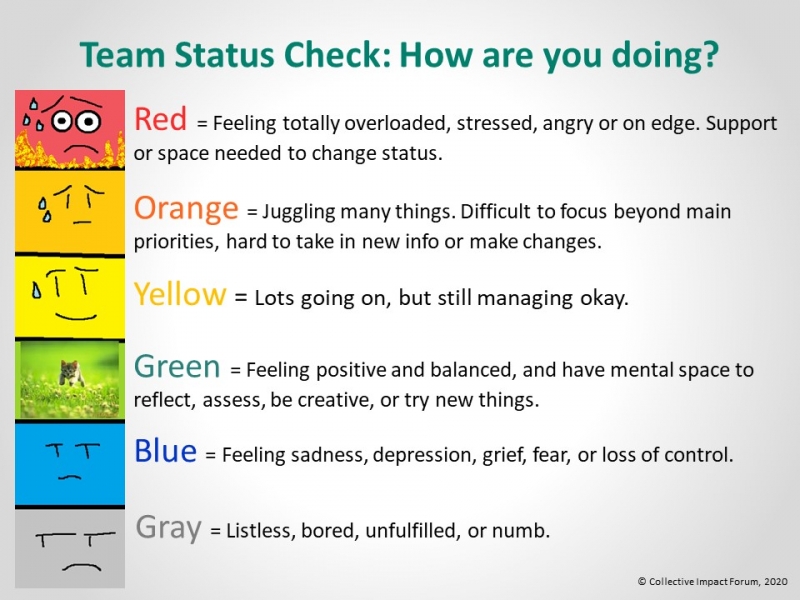
This means that we have a moral and ethnical responsibility as peers and as leaders to genuinely care about the people to which we are communicate with on Zoom. Here’s a great resource from the Collective Impact Forum (http://www.collectiveimpactforum.org).
The Team Color Check-In Tool is a communication tool to help people in virtual and face-to-face conversations have a check-in. The colors range from:
Red
Orange
Yellow
Green
Blue
Gray
If you are wondering how to apply this for your teams or classrooms, I would definitely recommend the following:
#1 – Utilize it when you meet with individuals one-on-one (BEFORE) the meeting.
#2 – Utilize it in Zoom via an anonymous poll to gauge how their audience is feeling BEFORE the meeting and providing resources at the end of the meeting (or in a follow-up email).
#3 – Send the check-in tool to your team/organization at the beginning of the week and provide workshops and support throughout the week for the team.
Respond Below – How would you use the resource? Do you think teams would benefit from this resource? How would you modify it?
Thanks for reading!
Sincerely, Dr. Jennifer T. Edwards Professor of Communication
Executive Director of the Texas Social Media Research Institute & Rural Communication Institute
July 5, 2022 by Dr. Candace Goodwin – Although every industry has undergone significant changes over the past several years, higher education has been impacted more profoundly. When the pandemic hit, traditional colleges and universities were abruptly forced to adapt their mindset and move toward thinking differently, scrambling to transform standard brick-and-mortar programs into online or hybrid delivery modalities. Colleges and universities that already had successful online programs could pivot quickly and sustain student enrollment. Universities unable to make these changes rapidly faced many challenges.
High education leadership teams were confronted with workforce challenges they had not faced before. The changes in the economy, staffing shortages, healthcare concerns, loss of international students, diversity, equity, and inclusion were all simultaneously impacting higher education. College leadership focused on enrollment as their highest priority and lost sight of how the pandemic influenced staff and shaped their expectations and preferences. Employees were seeking out empathy, remote work, and flexible work hours and wanted to feel more connected than ever.
As the environment of higher education leadership becomes more complicated by outside events and shifting employee motivations, the benefits of executive coaching only increase. High- quality executive coaching balances organizational priorities like enrollment with the leadership development and insight required to move those priorities forward. Executive coaching is an essential problem-solving tool for higher education executives seeking support balancing leadership challenges and understanding the higher education landscape from both the 30,000 ft elevation and the 100 ft elevation.
1. Executive coaching activates and animates wisdom.
Many executives and aspiring higher education leaders lean most heavily on their level of intelligence. Clayton (1982) defined intelligence as the ability to think logically, conceptualize, and abstract from reality. Intelligence focuses on how to do. It helps leaders accomplish and achieve.
By contrast, Clayton defines wisdom as the ability to grasp human nature, which is paradoxical, contradictory, and subject to continual change. Wisdom provokes a person to consider the consequences of their actions on themselves and the effects on others.
Wisdom helps people decide whether to pursue a course of action. Higher education executives work in concert with many others. It is incumbent on all higher education leaders to work with their wisdom.
The difference between intelligence and wisdom can be described as knowing what vs. knowing how. According to Stenberg (2005), knowing how adds creativity and experience to our knowledge. While an executive has proven intelligence, the wisdom gained by learning from various experiences provides multiple points of view at their disposal to solve problems creatively.
It is no longer sufficient to only have intelligence and management skills to make high- level and far-reaching leadership decisions. Wisdom is a crucial component of good leadership. Staudinger, Lopez, and Baltes (1997) found that individuals who discussed life problems with another person and reflected on the conversation before responding out-performed others. Executive coaching can make the difference in that kind of wisdom and more.
An executive coach for higher education helps college and university executives activate and animate their wisdom. Executive coaches guide leaders to go beyond reporting metrics and learn ways to increase their wisdom through natural reciprocity, investing in their team, and developing new leadership traits. The result is a higher education leader able to make more creative and cultured decisions that are the best for university and college leadership, staff, and students.
2. Executive coaching galvanizes conscious and intentional conversations.
There are two conversations we have every day. One is with other people—and one is in our heads. Having conversations with other people can feel fraught in this increasingly complicated world. Higher education executives need to ensure their conversations are conscious and intentional. Executive coaching can help!
Conscious conversations encourage connection and overcoming differences. The basis is hearing and understanding instead of judging as right or wrong. Participants in a conversation of this nature must be fully present, listen fully and respectfully, keep an open mind, and be patient. It is important to understand that conversations of this kind are a skill to be learned and built upon. There is always room to improve communication as a leader.
Intentional conversations are purposeful and planned. Being intentional means being strategic in how to communicate, what to communicate, and to whom. Intentional conversations can make staff members feel valued and ensure that conversations are productive.
With an executive coach, higher education executives can build confidence in their ability to have conscious and intentional conversations.
3. Executive coaching stimulates creativity.
With the landscape for higher education rapidly changing, a successful higher education executive needs to move beyond the same old, same old. It is time for creativity in all aspects of leadership. Nothing helps creativity like the collaboration that comes from partnering with an executive coach.
Most executives could benefit from switching things up and taking their leadership off auto pilot. A significant outcome could be developing a flexible mindset and considering new ways to get things done. A lack of creativity could result in missing opportunities for innovation and growth. Working with an executive coach helps open the door to explore innovative ideas and getting excited by new, creative possibilities.
4.Executive coaching creates “emotional safety.”
Having emotional safety means feeling secure enough to be your most authentic self, and isn’t that the ideal for all employee-leader scenarios? Who wouldn’t want to bring their real selves to work? Well, that takes work. Emotional safety is an important aspect of having a satisfying connection. Connection is increasingly vital to today’s workforce. It is worth the investment.
Higher education executive coaching cultivates emotional safety so executives can get the most out of their experience. Our brains constantly detect whether a situation is safe or dangerous. When people experience safety, they are better listeners, able to collaborate more, innovative, creative, and able to connect with others. Emotional safety has positive effects that flow to others.
Emotional safety encourages freedom of expression and increased compassion. A skilled executive coach can help guide you to understanding and increasing emotional safety.
Executives and leaders in higher education benefit from the investment in high-quality executive coaching. Coaching is transformative—helping leaders leverage their best selves. An executive coach empowers creativity, impact, connection, and influence. Great leaders have great coaches—everyone can use that kind of support! Especially leaders working in higher education.
Levine, Arthur and Pelt, S. “The Future of Higher Education is Occurring at the Margins.” Inside Higher Education, 4, Oct. 2021, https://www.insidehighered.com/views/2021/10/04/higher-education- should-prepare-five-new-realities-opinion
Staudinger, U.M., Lopez, D. F., and Baltes, P. B. (1997). The psychometric location of wisdom-related performance: Intelligence, personality and more. Personality and Social Psychology Bulletin, 23(11). 1200-1214,
Sternberg, R. J. (2005). WICS: A model of leadership. The Psychologist- Manager Journal, 8(1), 20-43.
Sternberg, R. J. (2005a). WICS: A model of leadership. The Psychologist-Manager Journal, 8(1), 20–43
Dr. Candace Goodwin a member of the Edu Alliance Group Advisory Council is a culture strategist and the CEO of Organizational Leadership Partners, an organization that helps leaders achieve exceptional results through the alignment of organizational priorities and culture. Candace’s expertise in culture, employee engagement, emotional intelligence, and leadership development provides guidance to leaders who desire to create an environment where people can do their best work.
Dr. Goodwin has a Doctorate in Organizational Leadership, an MBA in Human Resources, and a Bachelor’s degree in Finance.
Edu Alliance Group, Inc. (EAG) is an education consulting firm located in Abu Dhabi, the United Arab Emirates, and Bloomington, Indiana, USA. We assist higher education institutions worldwide on a variety of mission-critical projects. Our consultants have accomplished university/college leaders who share the benefit of their experience to diagnose and solve challenges.
EAG has provided consulting and successful solutions for higher education institutions in Australia, Egypt, Georgia, India, Kazakhstan, Morocco, Nigeria, Uganda, United Arab Emirates, and the United States.
Edu Alliance offers higher education institutions consulting services worldwide. If you like to know more about how Edu Alliance can best serve you, please contact Dean Hoke at [email protected]
I love gardening. Whether my gardening takes place in a container, in an urban area, or in a rural area, I am all about it! This year, my daughter decided that she wanted to become a mini-gardener as well.
As a result, we are growing…tomatoes, peppers, eggplant, watermelon, and lettuce. I teach her to watch the prices as they continue to increase. My daughter and I talk about innovative ways to counteract the increasing prices. Our strategy is gardening!
I am part of a wealth of gardening groups. My favorites are “Black Girls Garden” and Black girl container gardening groups on Facebook. These groups give me inspiration and ideas to garden for my family and for the community. One thing that I like the most is the emphasis on sharing seeds and supporting one another. I also work with our community garden group as well.
This summer, I have been very fortunate to learn even more gardening skills from the local Agrilife Extension agent in Panola County, Clarissa Moon. She is an excellent teacher and she provides so much educational outreach for the community.
Another resource that I absolutely love is the USDA, which has great resources for gardening as well. I subscribe to their blog, “Farmers.gov Blog” and it has some incredible tips for gardening. It also features several other sections on their website that feature articles. These categories are:
Of course, my favorite is Farm Life! I love the “Friday’s on the Farm” series.
Check them out! What is your favorite part?
Thanks for visiting! Sincerely, Dr. Jennifer T. Edwards Professor of Communication
Executive Director of the Texas Social Media Research Institute & Rural Communication Institute
On June 23, the Department of Education released the highly anticipated Notice of Proposed Rulemaking (NPRM) to amend Title IX. The NPRM proposes to replace the Trump administration’s 2020 Title IX rule and establishes safeguards for transgender students by proposing a ban on “all forms of sex discrimination, including discrimination based on sex stereotypes, sex characteristics, pregnancy or related conditions, sexual orientation and gender identity.” The proposal will be open for public comment for 60 days following publication in the Federal Register.
In March 2021, President Biden issued an Executive Order (EO) titled, “Guaranteeing an Educational Environment Free from Discrimination on the Basis of Sex, Including Sexual Orientation and Gender Identity.” The EO directed the secretary of education to evaluate the Trump administration’s Title IX regulations and to “issue new guidance as needed on the implementation of the rule.”
Of significance, the NPRM proposes to repeal the Trump administration’s requirement for live hearings for Title IX investigations. It also proposes to change the definition of sexual harassment back to “unwelcome sex-based conduct” that creates a hostile environment sufficiently severe or pervasive that it denies or limits a person’s ability to participate in a school’s education program or activity.
CUPA-HR will be conducting a deeper analysis of the 700-page proposal in the days and weeks to come and will be partnering with other higher education associations to ensure the department receives meaningful feedback on its proposal.