This audio is auto-generated. Please let us know if you have feedback.
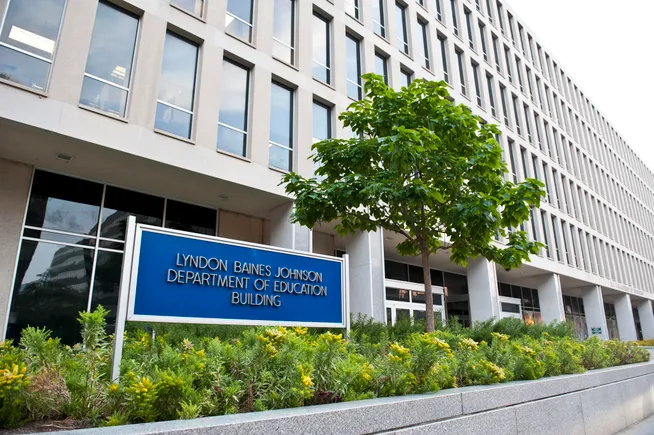
The U.S. Department of Education announced Thursday that it iseliminating its diversity, equity and inclusion initiatives, a move tied to President Donald Trump’s directives to purge DEI from the federal government.
The agency said it has “removed or archived” hundreds of outward-facing documents — including guidance, reports and training materials — that mention DEI. That includes links to resources encouraging educators to incorporate DEI in their classrooms, a department spokesperson said.
The department also put agency employees tasked withleading DEI initiatives on paid leave. A spokesperson declined to comment Friday on how many staff members were placed on leave, citing privacy concerns.
The move comes after Trump signed several executive orders on the first day of his presidency designed to dismantle the Biden administration’s DEI efforts. That includes an order directing all federal agencies to end their DEI programs and positions “under whatever name they appear.”
Additionally, the Education Department dissolved its Diversity & Inclusion Council. The agency has also canceled DEI training and service contracts for staff, totaling more than $2.6 million.
Department officials said they will continue reviewing the agency’s programs to identify other initiatives and groups “that may be advancing a divisive DEI agenda, including programs using coded or imprecise language to disguise their activity.”
This audio is auto-generated. Please let us know if you have feedback.
The U.S. Department of Education announced Thursday that it iseliminating its diversity, equity and inclusion initiatives, a move tied to President Donald Trump’s directives to purge DEI from the federal government.
The agency said it has “removed or archived” hundreds of outward-facing documents — including guidance, reports and training materials — that mention DEI. That includes links to resources encouraging educators to incorporate DEI in their classrooms, a department spokesperson said.
The department also put agency employees tasked withleading DEI initiatives on paid leave. A spokesperson declined to comment Friday on how many staff members were placed on leave, citing privacy concerns.
The move comes after Trump signed several executive orders on the first day of his presidency designed to dismantle the Biden administration’s DEI efforts. That includes an order directing all federal agencies to end their DEI programs and positions “under whatever name they appear.”
Additionally, the Education Department dissolved its Diversity & Inclusion Council. The agency has also canceled DEI training and service contracts for staff, totaling more than $2.6 million.
Department officials said they will continue reviewing the agency’s programs to identify other initiatives and groups “that may be advancing a divisive DEI agenda, including programs using coded or imprecise language to disguise their activity.”
Individualized Education Plans (IEP) have been the foundation of special education for decades, and the process in which these documents are written has evolved over the years.
As technology has evolved, writing documents has also evolved. Before programs existed to streamline the IEP writing process, creating IEPs was once a daunting task of paper and pencil. Not only has the process of writing the IEP evolved, but IEPs are becoming technology-driven.
Enhancing IEP goal progress with data-driven insights using technology: There are a variety of learning platforms that can monitor a student’s performance in real-time, tailoring to their individual needs and intervening areas for improvement. Data from these programs can be used to create students’ annual IEP goals. This study mentions that the ReadWorks program, used for progress monitoring IEP goals, has 1.2 million teachers and 17 million students using its resources, which provide content, curricular support, and digital tools. ReadWorks is free and provides all its resources free of charge and has both printed and digital versions of the material available to teachers and students (Education Technology Nonprofit, 2021).
Student engagement and involvement with technology-driven IEPs: Technology-driven IEPs can also empower students to take an active role in their education plan. According to this study, research shows that special education students benefit from educational technology, especially in concept teaching and in practice-feedback type instructional activities (Carter & Center, 2005; Hall, Hughes & Filbert, 2000; Hasselbring & Glaser, 2000). It is vital for students to take ownership in their learning. When students on an IEP reach a certain age, it is important for them to be the active lead in their plan. Digital tools that are used for technology-driven IEPs can provide students with visual representations of their progress, such as dashboards or graphs. When students are given a visual representation of their progress, their engagement and motivation increases.
Technology-driven IEPs make learning fun:This study discusses technology-enhanced and game based learning for children with special needs. Gamified programs, virtual reality (VR), and augmented reality (AR) change the learning experience from traditional to transformative. Gamified programs are intended to motivate students with rewards, personalized feedback, and competition with leaderboards and challenges to make learning feel like play. Virtual reality gives students an immersive experience that they would otherwise only be able to experience outside of the classroom. It allows for deep engagement and experiential learning via virtual field trips and simulations, without the risk of visiting dangerous places or costly field trip fees that not all districts or students can afford. Augmented reality allows students to visualize abstract concepts such as anatomy or 3D shapes in context. All these technologies align with technology-driven IEPs by providing personalized, accessible, and measurable learning experiences that address diverse needs. These technologies can adapt to a student’s individual skill level, pace, and goals, supporting their IEP.
Challenges with technology-driven IEPs: Although there are many benefits to technology-driven IEPs, it is important to address the potential challenges to ensure equity across school districts. Access to technology in underfunded school districts can be challenging without proper investment in infrastructures, devices, and network connection. Student privacy and data must also be properly addressed. With the use of technologies for technology-driven IEPs, school districts must take into consideration laws such as the Family Educational Rights and Privacy Act (FERPA).
The integration of technology into the IEP process to create technology-driven IEPs represents a shift from a traditional process to a transformative process. Technology-driven IEPs create more student-centered learning experiences by implementing digital tools, enhancing collaboration, and personalized learning experiences. These learning experiences will enhance student engagement and motivation and allow students to take control of their own learning, making them leaders in their IEP process. However, as technology continues to evolve, it is important to address the equity gap that may arise in underfunded school districts.
Shannon Keenan, Special Education Teacher
Shannon Keenan is a special education teacher in Columbia Heights, MN. She is also a graduate student at Concordia University in St. Paul, MN studying Educational Technology.
Latest posts by eSchool Media Contributors (see all)
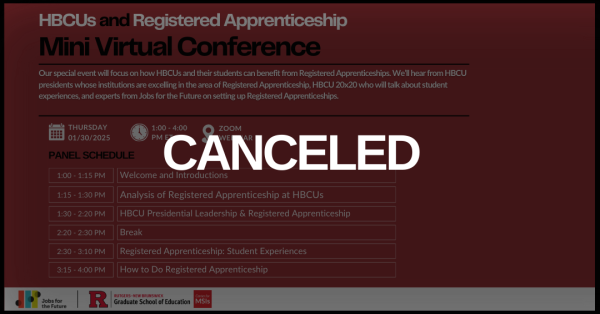
The virtual mini-conference sponsored by Jobs for the Future was scheduled for Jan. 30.
The Rutgers University Center for Minority Serving Institutions announced Thursday that it has canceled an upcoming virtual conference about registered apprenticeship programs as a result of President Trump’s executive orders targeting diversity, equity and inclusion initiatives.
“We were very excited to bring the HBCUs and Registered Apprenticeship Mini-Conference to you next week,” said the email sent to registered attendees. “Unfortunately, due to President Trump’s Executive Orders … we have been asked to cease all work under the auspices of the Diversity, Equity, Inclusion, and Accessibility HUB at Jobs for the Future, which the U.S. Department of Labor funds.”
Jobs for the Future, an organization focused on helping college and workforce leaders create equitable economic outcomes for students, runs a national innovation hub focused on improving access to registered apprenticeships for women, people of color and other underrepresented groups.
Located in New Jersey, a blue state for more the 30 years, Rutgers has not faced pressure from state legislators to dismantle DEI. But the cancellation demonstrates the leverage and power the federal government can hold over colleges and universities by threatening to pull funding from programs that don’t comply with the president’s demands.
“That wariness and sort of pre-emptive compliance, even absent direct threats from the federal or state government, might be somewhat universal,” Brendan Cantwell, a professor of education at Michigan State University, told Inside Higher Ed.
“These leaders will be worried about losing their federal funding, which is exactly what DEI opponents want,” added Shaun Harper, a professor of education, business and public policy; the founder of the University of Southern California’s Race and Equity Center; and an Inside Higher Ed opinion contributor.
More cancellations are anticipated in the weeks and months to come as the Trump administration continues to issue executive orders. For instance, Trump’s growing team at the Department of Education announced a series of actions Thursday related to eliminating DEI.
“The Department removed or archived hundreds of guidance documents, reports, and training materials that include mentions of DEI from its outward facing communication channels [and] put employees charged with leading DEI initiatives on paid administrative leave,” agency officials said in a news release. “These actions are in line with President Trump’s ongoing commitment to end illegal discrimination and wasteful spending across the federal government. They are the first step in reorienting the agency toward prioritizing meaningful learning ahead of divisive ideology in our schools.”
Other actions the department has taken include:
Dissolving the department’s Diversity and Inclusion Council.
Terminating the Employee Engagement Diversity Equity Inclusion Accessibility Council within the Office for Civil Rights.
Canceling ongoing DEI training and service contracts that total over $2.6 million.
Withdrawing the department’s Equity Action Plan, which was released in 2023 to align with former president Joe Biden’s executive order to advance racial equity and support for underserved communities.
Orders to freeze travel, meetings, communications and hiring at the National Institutes of Health—and all other agencies within the Department of Health and Human Services—has some federally funded researchers on edge just days into President Donald Trump’s second term.
Scholars say they’ve received emails canceling key meetings that determine which research projects to fund and they’re worried about how those and other disruptions could stall the billions of dollars in NIH-funded projects universities oversee.
“I suspect that folks outside the sciences don’t understand just how disruptive even a short delay in funding decisions can be,” Adam Forte, an associate professor of geology at Louisiana State University who runs his own lab, posted on BlueSky Thursday alongside numerous other concerned scholars. “This is how we lose huge amounts of scientific capacity, scientific capacity we as a collective have already invested huge amounts of time and money in, just lighting it on fire to watch the flames.”
If they leave, it’s not like there is much chance they’re coming back to that, or a similar position. That expertise is just gone as they are forced to move onto something else to pay the bills. A spectacular waste from a “short” delay in the machinery that funds science. 5/6
Some research policy experts say a pause is typical for the initial days of a new administration and that it’s too soon to tell whether this week’s order is a cause for concern. Others, however, are interpreting it as part of a larger message from Trump, who has repeatedly undermined scientific findings about COVID-19 and climate change and nominated Robert F. Kennedy Jr., who falsely claims there are no safe or effective vaccines, to lead the HHS.
While Kennedy, who previously vowed to enact mass layoffs at the NIH, and Trump’s other cabinet nominees await Senate confirmation, Trump has already issued a blitz of executive orders—including some that roll back diversity and environmental justice initiatives, as well as protections for federal workers and immigrants—since retaking the White House Monday. (In addition to those in HHS, all federal agencies are also under a hiring freeze.)
“It’s not unheard-of to see some things paused when a new administration takes over, but when we look at the whole package of language and executive orders that have come out this week, they’re all tied up together,” said Jennifer Jones, director of the Center for Science and Democracy at the Union of Concerned Scientists. “The goal is to intimidate, chill and create this exact sort of fear.”
A Communications Freeze
That fear for NIH-affiliated researchers came after Dorothy Fink, acting secretary of HHS, sent a memo Tuesday to all HHS division heads, including the directors of the NIH, the Centers for Disease Control and Prevention, and the Food and Drug Administration.
“As the new administration considers its plan for managing the federal policy and public communications processes, it is important that the President’s appointees and designees have the opportunity to review and approve any regulations, guidance, documents, and other public documents and communications (including social media),” explained the memo, which instructed agency employees to refrain from numerous forms of communications, including issuing grant award announcements and public speaking, until a presidential appointee can review them. The memo is in effect until Feb. 1.
An NIH spokesperson clarified to Inside Higher Ed via email that the restrictions apply to communication “not directly related to emergencies or critical to preserving health,” and that any “exceptions for announcements that HHS divisions believe are mission critical” will be made “on a case-by-case basis.”
On Wednesday, Glenda Conroy, a senior travel official for NIH, emailed NIH employees notifying them that all sponsored travel for HHS employees is also suspended until further notice.
Disruptions to Research
As of right now, all these restrictions mean that scheduled meetings have been canceled or postponed, including NIH study sections, which convene scientific experts to decide which projects to fund.
And university-affiliated researchers make up a sizable portion of the grant application pool. The $44 billion NIH is the largest federal research funding source for colleges and universities, which receive billions in NIH grants each year to support medical and other scientific research projects, including those that have advanced treatments for common diseases such as cancer and Alzheimer’s.
Chrystal Starbird, an assistant professor of biology and a cancer researcher at the University of North Carolina at Chapel Hill’s School of Medicine, had been planning for months to attend a study section next week where nearly 60 grants were set to be reviewed, but she got word a couple of days ago that it was canceled.
“Ultimately, the NIH will continue to function, so maybe it’s not a huge issue, but for the people being reviewed now it is,” she said. “None of those grants will be reviewed on time. The question is: How are they going to get all of us together again to review the grant?”
And rescheduling the study sections for weeks or months after the communication restrictions lift may disrupt certain ongoing projects.
“Some people may be using this funding to do research that may have more time pressure,” Starbird said, noting that clinical research typically adheres to strict patient-monitoring timelines. “We have to acknowledge that there’s already a significant impact from this pause.”
‘Too Soon to Assume’ Worst-Case Scenario?
Carrie Wolinetz, a science and health policy consultant who worked for the NIH between 2015 and 2023, said in an email that the communications freeze is similar to memos from previous transitions. Although she acknowledged that pausing study section meetings seems broader than previous transitions, it doesn’t strike her “as tremendously outside the norm of activities that might be paused while a new team is transitioning.”
And though it’s understandable that all of these restrictions are “causing anxiety,” she said it’s “too soon to assume that worst case scenario.”
“It becomes a concern if there is a long cessation of activity, of the sort you might experience if there was an extended government shutdown,” she said. “There is likely to be minimal impact in the short term—other than for folks who hopped on flights only to discover their meeting was cancelled, which I imagine was pretty irritating.”
But others caution that having such restrictions in place for even a short time could force people out of their jobs, create a talent void and potentially stall innovation.
“Even if this is short-lived bumpiness, the uncertainty in funding can have career-altering implications, especially for young scientists,” Erica Goldman, a former academic and director of policy entrepreneurship for the Federation of American Scientists, said in an email.
“If conferences or travel are canceled, for example, the inability to present new ideas and network with senior colleagues can have cascading effects,” she continued. “I’m reminded of the experiments, data, and professionals who left the field during COVID-19. Even temporary pauses can have lasting consequences.”
In 2023, Korean video game company WeMade pledged to donate the equivalent of one billion Korean won ($695,988) in Wemix tokens—a cryptocurrency linked to the blockchain platform of the same name—to Seoul National University.
What seemed like a moment for celebration quickly descended into controversy, with the university eventually ceasing to accept cryptocurrency donations altogether.
So, what happened? Shortly after the donation was made, WeMade reportedly liquidated a large share of its coins, causing a significant currency devaluation and meaning SNU’s donation was no longer worth so much—a problem given that the funds had been earmarked for a specific project.
That wasn’t the only barrier. Under South Korean financial regulations, the university was also unable to open a corporate account for virtual asset exchange. With calls to change the law unanswered, the university was left holding a volatile currency it was unable to convert to cash.
Now Korean regulators are reportedly considering allowing the country’s universities to convert cryptocurrency for the first time—potentially opening a significant new fundraising stream for the country’s financially ailing sector.
Elsewhere, universities are already cashing in on the crypto craze, most notably in the U.S. In 2021, the University of Pennsylvania received $5 million in Bitcoin from an unnamed donor. A year later, Vitalik Buterin, co-founder of Ethereum, a leading blockchain, donated the equivalent of $9.4 million in USDC coin to the University of Maryland to fund public health research in the wake of the pandemic.
The Giving Block, a U.S.-based platform that facilitates cryptocurrency donations to nonprofit organizations, said that the higher education sector has been one of its “biggest growth areas” over the past two years, with Washington State University and Northeastern University among the company’s clients.
“There are several things driving this, like the booming crypto market and broader mainstream adoption, but the biggest driver for schools is simply following the money,” said Pat Duffy, its co-founder.
With analysts suggesting popular currencies like Bitcoin will continue to grow in value this year, spurred on by newly inaugurated Donald Trump’s crypto-friendly rhetoric, universities could be set to benefit—if they are prepared to manage the risks that come with the volatile landscape.
“For donors in the U.S., the biggest driver is the tax incentive,” said Duffy. “You can skip capital gains taxes on appreciated assets and still get a deduction for the full market value.
“The donor pays no taxes on their appreciated crypto, and neither does the school. Donors across the country are eliminating tens of millions of dollars in tax liability by choosing to give with crypto, and giving larger gifts … as a result.”
For universities, accepting cryptocurrency may also allow them to target their fundraising at a younger, tech-savvy market. “They can attract more people if they accept crypto payments,” said Nir Kshetri, professor of management at the University of North Carolina at Greensboro.
It’s not just donations where universities are capitalizing. Some, like Bentley University, have begun accepting tuition fees in cryptocurrency, with significant implications for international students.
In Nigeria, for example, converting the naira to the U.S. dollar to make fee payments can be a complicated process. For some, paying in decentralized cryptocurrency is simpler and faster, according to Kshetri.
However, a key risk for universities is the unpredictability of cryptocurrency markets, with fears compounded by the volatility of Bitcoin in recent years. While the market is recovering, crashes such as the one experienced in 2022 have left a lasting impact and made some universities wary.
“Right now it’s at a peak, but who’s to say we won’t see a return to what we saw two years ago when the bottom fell out?” cautioned Bill Stanczykiewicz, director of the Fund Raising School at Indiana University Indianapolis’s Lilly Family School of Philanthropy.
According to Stanczykiewicz, best practice is to avoid holding on to cryptocurrency, even if it is predicted to increase in value. “What we say to fundraisers is if you get crypto, turn it into your national currency as quickly as you can,” he said, or use a platform like the Giving Block, which does this for you.
However, this approach isn’t universal. In Paraguay, Universidad Americana is less risk-averse than some, evaluating the market before converting any cryptocurrency payments.
Universities considering going down this avenue also need to consider the ethical aspects, said Stanczykiewicz, and whether such donations adhere to their institution’s values.
Specifically, the environmental impact of currencies like Bitcoin is a concern for some. However, Kshetri argued, the coin has already been mined prior to the donation—that is, the damage has already been done. “Just to transfer that Bitcoin from you to me consumes very little … electricity,” he said.
Whatever your ethical view, those interviewed for this article agreed on this: Cryptocurrency is here to stay and, for universities, it’s simply a question of how quickly they embrace it.
“Historically, it was regulatory uncertainty that made universities nervous about crypto acceptance and investing,” said Duffy. Today, he continued, in the U.S., “regulatory clarity and the political support we see on both sides of the aisle have cleared up those concerns.”
With countries like South Korea set to provide a regulatory green light, too, it may not be long before institutions around the globe follow in the footsteps of their U.S. counterparts.
Some students may need to take a leave of absence for their mental health before returning to an institution. Here’s how the institution can help.
Brothers91/E+/Getty Images
In the past few years, more students have shared the toll their mental health can take on their academic pursuits. Recent surveys of students who left higher education prior to completing a credential or degree reveal that mental health challenges or stress are primary reasons why they discontinue their education.
Some learners opt to take a pause, withdrawing from the university for a semester or longer to prioritize their health and wellness.
To promote student completion and success, institutions can consider formal procedures and initiatives targeted toward easing the transition of re-enrollment after a voluntary mental health leave of absence.
The background: Colleges have historically offered students the opportunity to temporarily unenroll to address health conditions, but only more recently has that definition expanded to include students’ mental health.
“Such policies and practices actually discourage students—not just the student with a mental health condition, but all others—from seeking help,” according to a 2021 report from Boston University and the Ruderman Family Foundation.
A recent survey from the Princeton Review found 43 percent of colleges and universities now have an official support program in place for students returning from mental health leave of absence.
However, there is little consistency in policies and practices regarding medical or psychiatric leaves of absence, according to the BU report: “Students are often left to confusing, conflicting information and sometimes, discriminatory policies and practices that make a return to higher education difficult.”
State policymakers have worked to expand the conditions included in leave-of-absence policies at institutions to recognize mental health difficulties.
In May 2024, Maryland passed legislation that expanded formal health withdrawal policies at public institutions to include mental health. The legislation also requires institutions to provide partial refunds for students who withdraw for physical or mental health reasons in the middle of the term.
A 2022 bill introduced to the New York State Legislature would require university systems to review enrollment and re-enrollment policies for students who take extended mental health leaves.
Students Taking Action
Active Minds, a youth-led mental health advocacy group, developed a guide for students who are advocating for improved leave-of-absence policies at their institution.
How to help: Some of the ways institutions assist learners are through:
Outlining the return process. The University of Southern California offers a step-by-step outline of the different offices a student must contact to re-enroll. Stanford University also created a Returning to Stanford booklet to answer frequently asked questions.
Providing coaching services for returners. Institutions, themselves or in partnership with outside organizations, can deliver intentional coaching for skill development and resource coordination to re-enroll learners.
Connecting students with peers. Supportive communities can help reconnect students to the institution and affirm their commitments to healthy habits, like engaging in social activities or demonstrating good study behaviors. Georgetown University offers a special support group, Back on the Hilltop, for learners who are returning from a leave of absence or who have recently transferred.
Do you know of a wellness intervention that might help others encourage student success? Tell us about it.
The Trump administration named 10 new Education Department appointees Thursday, four of whom have previously worked with the America First Policy Institute, a pro-Trump think tank formed in 2021 as the president ended his first term in office.
Education secretary nominee Linda McMahon was a co-founder of AFPI and served as the group’s president and CEO until she was selected to head the department.
Rachel Oglesby, a former AFPI chief state action officer, as chief of staff.
Jonathan Pidluzny, AFPI’s former director of higher education reform, as deputy chief of staff for policy and programs.
Virginia “Chase” Forrester, former AFPI chief events officer, as deputy chief of staff for operations.
Craig Trainor, a former congressional senior special counsel and AFPI senior litigation counsel, as deputy assistant secretary for policy in the Office for Civil Rights. (During his time at AFPI, Trainor worked under Pam Bondi, whom Trump has nominated as his attorney general.)
Steve Warzoha as White House liaison.
Tom Wheeler as principal deputy general counsel.
Madi Biedermann as deputy assistant secretary for the Office of Communications and Outreach.
Candice Jackson, who served in the first Trump administration, as deputy general counsel.
Joshua Kleinfeld as deputy general counsel.
Hannah Ruth Earl as director of the Center for Faith-Based and Neighborhood Partnerships.
The American Association of University Professors released a statement Thursday urging universities not to engage in “anticipatory obedience,” which it defined as “acting to comply in advance of any pressure to do so.”
“As Donald Trump assumes the presidency for a second time, the outlook for higher education is dire,” begins the statement, which the AAUP said its elected national council approved this month.
“The Trump administration and many Republican-led state governments appear poised to accelerate attacks on academic freedom, shared governance and higher education as a public good,” the statement says. “They will attack the curricular authority of the faculty on a number of fronts … It is the higher education community’s responsibility not to surrender to such attacks—and not to surrender in anticipation of them. Instead, we must vigorously and loudly oppose them.”
The White House did not respond to Inside Higher Ed’s request for comment. Before JD Vance was elected vice president, AAUP president Todd Wolfson called him a “fascist.”
In the fall, media reported that the University of North Texas removed words such as “race” from course titles, despite Texas’s anti–diversity, equity and inclusion law specifically exempting “course instruction.” The AAUP statement says that was part of a trend.
“Under no circumstances should an institution go further than the law demands,” the AAUP wrote. “Yet, the examples above depict an eagerness to obey on the part of administrative officers, portending a bleak future.”
The association recommended that faculty act by reviewing “handbooks and contracts to strengthen and reinforce faculty rights” in employment decisions and curricular changes. It also suggested reforming “policies to strengthen faculty oversight in areas currently being used to exercise excessive and undue discipline against faculty, staff and students,” including policies on Title IX, Title VI, acceptable use of institutional resources, outside speakers and campus protests.