Tag: Education

  • 2025 higher education in twelve charts

    2025 higher education in twelve charts

    Not every big higher education story has an accompanying chart – but many of them do have an accompanying data release that allows us to dig into problems and hopefully help us identify solutions.

    I’m lucky enough to have the chance to visualise some of these things for you all, and these are twelve (well, thirteen…) things that I have found interesting, informative, and useful over the past twelve months.

    As always, if there are data-related questions please do get in touch – quite a few of the ideas for these charts came from my email inbox!

    Money matters

    This doesn’t even feel like a 2025 thing – it feels like an eternal complaint, but over the last couple of years things have intensified. We’ve (by “we” I mean all four devolved administrations) systematically and deliberately underfunded higher education for years, and acting surprised when universities have to stop doing valuable things – or doing them less well – is the inevitable result.

    Financial issues have also led to the late publication of audited financial statements, as institutions have had to rework budgets to pass the “going concern” test. In December 2025 we finally got a near-complete set of financial data for 2023-24 (obviously not including the University of Dundee or Dartington Hall) and even a cursory look at the key financial indicators suggests that things are gradually (and then suddenly) getting worse. Striking for me is the growing number of very well known providers running a large deficit as a proportion of total income. You can do this for a few years (judiciously liquidising assets and drawing on reserves) but you cannot do it for much longer.

    [Full screen]

    Saying goodbye

    One of the ways in which these financial woes have manifested themselves is in difficult and painful provider-level decisions to stop employing many of our friends, colleagues, and inspirations across every area of university activity. Staff costs are, and remain, the biggest proportional cost in nearly every university and college – and years of austerity mean that every other cost has been cut to the bone).

    Your campus unions have been working hard to blunt the impact of these cuts and negotiate alternative approaches that can keep the whole show on the road. If you have a good branch it is a fantastic thing, and even if the machinations of national union politics have turned you off please do continue to support the people performing this often thankless and often essential work. Everyone knows that nearly all universities are struggling – and it is only through working together (unions and managers) that we get through this while still being a university.

    Here’s the change in academic staff numbers (we still don’t have a mandatory data collection in England for all of the other amazing staff that make universities work!), by cost centre, at your university (or anywhere else you want to look) between 2022-23 and 2023-24. Next year’s data – given the scope and scale of cuts announced – will look even worse.

    [Full screen]

    The end of “high tariff providers”

    Changes in recruitment strategies mean that all kinds of universities are making often surprising low tariff UCAS offers, with providers who traditionally cater for applicants with less evidence of academic prowess (or being middle-class) both struggling and wondering if the increasingly busy posh kids place up the road is actually set up to provide the support students need.

    As is often the case with recruitment data we can’t really look at the issue directly – there’s some kind of an omerta about discussing this – but by looking at where providers are growing recruitment while getting less applications we can see some instances where a prime diagnosis may be a lowering of entry requirements.

    [Full screen]

    To be clear, the elite end of the sector becoming less elite is not a bad thing in and of itself – but we need to be clear that providers more used to stellar A levels are able to provide the support that less advantaged students need, and we need also be a little more open about what the future is for the other providers who have historically done this work very well.

    Mind you, posh kids who do really well at A level are less likely to go to university if they apply. What’s that about?

    Subcontractual obligations

    The last few years have been busy with attempts to spot and root out “low quality courses” – who remembers the PROCEED metric? – but these attempts seem to have landed on sub-contractual provision… particularly when this happens at high volumes at unregistered independent providers. There’s been steps taken to compel registration, and to reinforce the responsibility that lead partners have over the quality of the provision carried out in their name.

    But to do all that took the release of previously unseen data on the size and shape of the subcontractual universe. It’s not perfect (in fact it is rather old data) but for the first time we have some understanding of who is (or was) working with who – and what the outcomes (B3) metrics look like.

    [Full screen] (and there’s also a version allowing you search by lead provider)

    Didn’t get the memo

    Alas, nobody told shadow minister for policy renewal (the current opposition’s Temu David Willetts) Neil O’Brien who spent the spring playing with SLC data to determine which institutions had graduates who were not paying back loans. He did not do very well – in that he didn’t bother controlling for any of the things (including, mystifyingly, subject area) that we know affect earnings and thus graduate repayment.

    Using LEO data and some assumptions (so in indicative terms only) I had a go at doing something similar – and it turns out that the biggest determining factor for low levels of repayment is the likelihood that someone attending a given provider has a disadvantaged background.

    [Full screen] (and here’s a look by subject area which makes the point that that is very obviously a determinant of earnings too, so perhaps the lads at whichever think tank is helping Neil will spot that different providers teach different subjects in different proportions.)

    Commuter line

    Who is teaching the students who – for financial, work, caring obligations, or other reasons – want to study locally? There’s various data driven ways to answer that question, but all of them require that you accept someone else’s definition of living “locally” and none of them let you do things the other way around (which providers recruit in a given locality).

    I had a go at this with one of my favourite HESA Student tables and a little bit of Tableau magic. It’s not entirely satisfying (I’m using the central point of each local authority area which… isn’t ideal) but it is fun.

    [Full screen]

    Levy or not

    A new tax is just the thing for a cash-strapped sector, and one on the one area of income where universities can actually meet the associated costs and run a profit was the Christmas gift all of us wanted. The money will stay – broadly – in the sector (with some of it going to grants for less well off students doing government priority subjects) but the big surprise was a shift from a proportional model (where the providers that charge the highest fees pay a bigger levy) to a flat rate, disproportionately hitting those who can’t or won’t charge a premium.

    You can model the impact yourself here – and ponder the implications of a single sector tax that directly affects the ability to cross-subsidise public funded work.

    [Full screen]

    It’s maybe my second favourite new data release. The favourite has to be the Standard Skills Classification from Skills England – because who doesn’t love a vocabulary that links together other vocabularies?

    Spinning around

    And who doesn’t love yet another new new data set? – this one is another belter. Universities often prove to be the launching pad for companies who are able to commercialise products, processes, or services developed from academic practice (research, teaching, capacity building). It’s still in experimental mode – we had two versions this year and this is a plot of the second one (which saved me the bother of manually linking it to Companies House data – thanks HESA friends!)

    [Full screen]

    Premium content

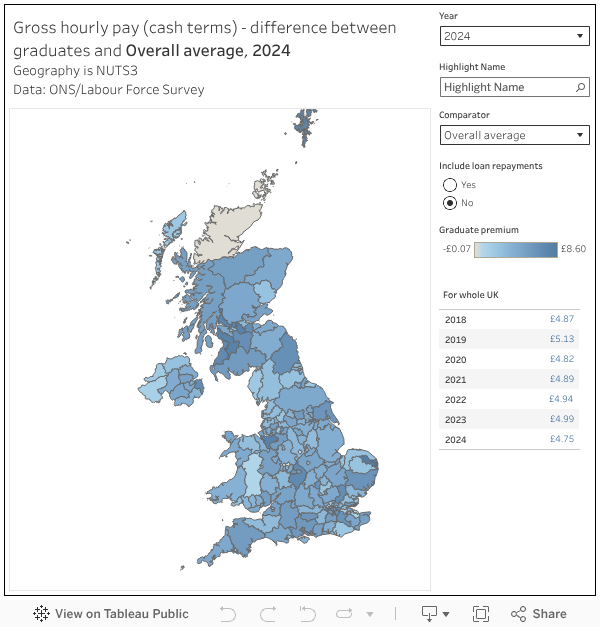
    The idea of a graduate premium – that your newly minted degree holder will earn enough extra over their lifetime to cover the increasingly expensive loan repayments that are required from them – was everywhere this year, and those interested in getting an accurate rather than politically useful answer spent a lot of time hitting up on the limits of what available data can tell us. This is an area the Department for Education is actively working on – so expect some improvements in the future.

    For me, the most compelling answer came from a data source that DfE has pledged to abandon – the venerable Graduate Labour Market Statistics (GLMS). Under cover of historic problems with the underlying Labour Force Statistics (LFS) this will be axed in favour of improvements to a data source that can’t even handle the concept of part time work – LEO.

    I stumbled across a dataset showing hourly wages by highest qualification held within localities (NUTS3, UK deprecated international geographic identifier fans!), and the beleaguered Office for National Statistics were happy to fill in the gaps for me. In every area of the UK, graduates earn more for an hour’s work than people who haven’t attended higher education. And that has to count for something.
    [Full screen]

    New information, supposed to fry your imagination

    There were (thankfully) no changes to the National Student Survey this year – so just another data point in a timeseries that demonstrates that people leaving an undergraduate qualification do so with satisfaction rates that would turn any other service industry green with envy.

    [Full screen]

    No plans

    However, who gets to study is still very much a problematic question. If you read the wider education news you’ll know that the number of pupils with Education Health and Care Plans (EHCPs) has been steadily growing year on year – in 2024-25 it was above 600,000. But despite this growth, access to higher tariff (or prestigious I guess?) higher education providers for pupils with an EHCP is abysmal. In the 2023-24 recruitment cycle just 327 (that’s 1.5 per cent) of young people with an EHCP managed it – you could literally fit all of them in a lecture theatre.

    [Full screen]

    Bonus: You’ll never believe this one weird chart

    Yes, it’s the providers where more students get an undergraduate maintenance loan than an undergraduate fee loan. There are a few edge cases where this can happen, for an individual student what I’m looking for (call it a Christmas quiz) is an explanation that explains why these providers and why these volumes.


    [Full screen]

    Source link

  • Brown University Reels After Deadly Shooting

    Brown University Reels After Deadly Shooting

    Two students were killed and nine were injured in a mass shooting at Brown University on Saturday. The university’s president Christina H. Paxson described the incident as “a tragedy that no university community is ever ready for.”

    “The past 24 hours really have been unimaginable,” she said in a letter to the Ivy League university’s greater community Sunday morning, adding that most of the injured students remain hospitalized in stable condition.

    The shooting began just after 4 p.m. at the Barus and Holley engineering and physics building. The Providence, Rhode Island, campus was locked down until Sunday morning when local law enforcement officials ended the order, sharing that they had identified and detained a male in his 20s as a person of interest. That person was later released. State police and agents from the Federal Bureau of Investigation remain on campus.

    Brown University President Christina Paxson leaving a press conference Sunday.

    Jessica Rinaldi/The Boston Globe/Getty Images

    According to The Brown Daily Herald, the student newspaper, many of the students affected were in a review session for a Principles of Economics exam. One freshman, Spencer Yang, told The Herald that he was shot in the leg but others near him were “seriously injured.” He said he tried to help them and keep them conscious.

    “While we always prepare for major crises, we also pray such a day never comes,” Paxson said in her letter. “We know there is a long road ahead as students and families deal with the after effects of the events of the past day and the emergency that is still unfolding.”

    Joseph Oduro, a senior from New Jersey and teaching assistant for the economics class, told The Boston Globe that the review session had just wrapped up when the shooter entered carrying “the longest gun I’ve ever seen in my life.” Oduro crouched behind the podium at the front of the auditorium and huddled with a first-year student who had been shot twice in the leg. He stayed with her until she reached the hospital, The Globe reported.

    Oduro didn’t want to describe what he saw as first responders evacuated the classroom, but said it hurt to see his students “all in a state of panic and desperate pain.”

    University Provost Francis J. Doyle III announced Sunday morning, that “out of profound concern for all students, faculty and staff,” all undergraduate, graduate and medical classes, exams and final projects for the semester would not take place as scheduled. Students are free to leave campus if they are able, but if not, access to on-campus services will remain available, Doyle said. More guidance about the status of unfinished courses will be released in the days ahead, he added.

    Saturday’s events sparked anger and frustration among gun control advocates and affected students as the number of mass school shootings on record continues to climb. One student, Zoe Weissman, a college sophomore, survived the Brown shooting Saturday nearly eight years after she had been affected by a similar event in her hometown—Parkland, Florida.

    Weissman, now 20, was a student at Parkland Middle School when 17 people were killed and 18 injured at the nearby Marjory Stoneman Douglas High School.

    “Mentally, I feel like I’m 12 again. This just feels exactly how I felt in 2018. But honestly, I’m really angry,” Weissman said in an interview with MS NOW, formerly MSNBC. “This isn’t a new phenomenon, and we’re going to get to a point where there’s [more] people like myself who survived two of these.”

    Another Brown student, Mia Tretta, was shot in a 2019 school shooting in Santa Clarita that left two people dead, the New York Times reported.

    “People always think, well, it’ll never be me,” Tretta told the Times. “And until I was shot in my school, I also thought the same thing.”

    President Donald Trump addressed the shooting during a holiday reception at the White House Sunday, but did not speak directly to public concerns about gun control or the number of incidents on college or K-12 campuses.

    “Things can happen,” he said. “So to the nine injured, get well fast and the families of those two who are no longer with us, I pay my deepest regards and respects.”

    The campus shooting also gained attention from fans of the reality TV show Survivor. Season 48 runner-up, Eva Erickson, is a Brown doctoral candidate, and she shared on social media how she had left the engineering building minutes before the shooting began.

    “I am so, so extremely lucky that I was very unproductive at work today,” she said in a video eight hours after the lockdown began. “I was in my office in Barus and Holley in that area until 4 p.m. and I was like, man I’m just not getting nothing done on my code and randomly decided I would go to the gym … I left and about 20 minutes later, we get the warning.”

    Erickson added that while she appreciated all the thoughts and prayers she had received, it wasn’t enough.

    “We need more than thoughts and prayers,” she said. “This is ridiculous that as college students in America we have to worry about someone shooting up our classrooms.”


    Source link

  • How AI in Public Education Is Evolving: Inside El Salvador’s Partnership with Elon Musk’s xAI

    How AI in Public Education Is Evolving: Inside El Salvador’s Partnership with Elon Musk’s xAI

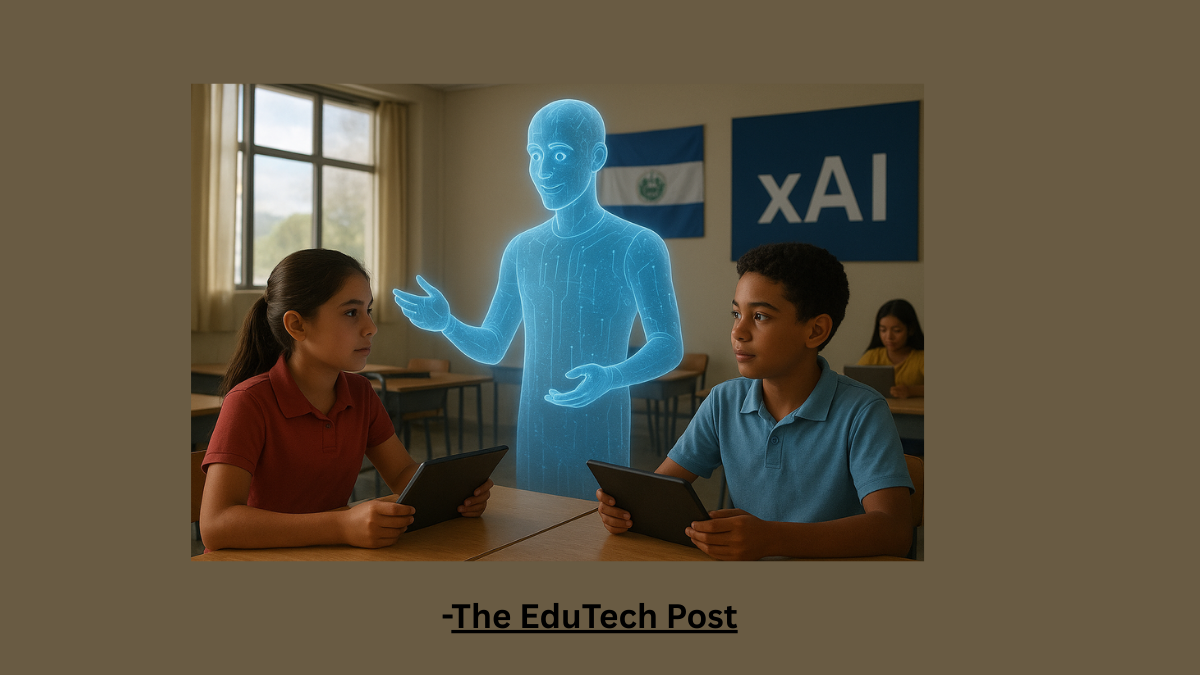
    In a world where classrooms are racing to keep up with rapidly evolving technology, El Salvador has taken a bold leap that is capturing global attention. In partnership with Elon Musk’s xAI, the country has launched what is being celebrated as the world’s first nationwide AI-powered education program—a move that could redefine how children learn, teachers teach, and nations prepare their next generation.

    The initiative aims to introduce personalized AI tutoring to more than one million students across public schools, creating a blueprint for what the future of AI in public education could look like.

    🎥 Elon Musk’s xAI Enters Classrooms: AI Education in Action

    🌎 A Historic Education Partnership

    On December 11, 2025, the Government of El Salvador announced a landmark two-year collaboration with xAI to integrate advanced artificial intelligence across more than 5,000 public schools, from bustling cities to remote rural regions.

    At the heart of this transformation is Grok, xAI’s powerful language model—now entering classrooms as an intelligent tutor designed to adapt to each student’s unique learning journey.

    For the first time, an entire national education system is embracing AI tutoring at full scale. This isn’t a pilot. This isn’t an experiment in a few select schools. This is a nationwide rollout, positioning El Salvador as a global pioneer in educational innovation.

    🤖 What Grok Will Bring to Classrooms

    According to the joint announcement from the government and xAI, Grok’s role goes far beyond simply answering questions. It has been designed as a full-spectrum learning companion.

    Here’s what Grok will do:

    • Deliver personalized, curriculum-aligned tutoring, adjusting explanations based on each child’s pace and learning style.
    • Break down complex concepts in simpler, more relatable ways—reducing classroom confusion.
    • Generate custom practice exercises for students who need extra support or want additional challenge.
    • Support teachers, not replace them, by taking over repetitive tasks so educators can focus on creativity, critical thinking, and emotional development.

    This initiative is expected to uplift over one million students and thousands of teachers, offering differentiated learning opportunities on a scale never seen before in the developing world.

    🗣️ Vision, Leadership & Global Ambition

    President Nayib Bukele has positioned this initiative as a cornerstone of the nation’s educational transformation. His vision is clear and bold.

    “El Salvador doesn’t just wait for the future of education — we build it with xAI.”

    This statement captures the spirit behind the project: a desire not just to follow global trends but to lead them.

    On the other side of the partnership, Elon Musk emphasized the historic nature of the program:

    “By partnering with President Bukele to bring Grok to every student in El Salvador, we’re putting the most advanced AI directly in the hands of an entire generation.”

    Together, these viewpoints underscore a shared conviction: AI can facilitate more equitable access to high-quality education, providing every child—regardless of their background—a genuine opportunity to succeed.

    📊 Why This Matters for the Future of Education

    1️ Personalized Learning at Scale

    Traditional classrooms frequently face challenges in addressing the diverse needs of dozens of students simultaneously. While some students grasp concepts quickly, others require more time and support, leading to disparities in learning progress and the risk of some quietly falling behind.

    With Grok:

    • Lessons can be personalized in real time
    • Students can learn at their own speed
    • Remedial support becomes instant and accessible
    • Advanced learners can progress further without being held back

    For the first time, every child can receive individual attention.

    2️ A Powerful Tool for Teachers

    Instead of competing with educators, Grok is designed to empower them.

    AI can:

    • Generate worksheets, quizzes, and differentiated materials
    • Help explain tough topics when students need extra support
    • Allow teachers to focus on emotional, social, and creative growth

    With AI as an assistant, teachers gain more time for meaningful teaching.

    3️ Global Implications

    If the program succeeds, El Salvador could become a case study for the world—a proof of concept showing that AI in public education isn’t just possible, but game-changing.

    This model could influence:

    • National education reforms
    • Digital transformation policies
    • How countries approach AI equity in schools
    • Long-term strategies for bridging learning gaps

    Many education systems are watching closely—and some are already considering similar programs.

    📍 Challenges & Concerns

    Despite the excitement, experts agree that the approach must remain thoughtful and responsible.

    Key concerns include:

    • Curriculum alignment: Ensuring AI does not stray from national learning goals.
    • Data privacy: Preventing the exploitation of private student information.
    • Algorithmic bias: Making sure AI treats all students fairly.
    • Human connection: Preserving the teacher-student bond that shapes emotional intelligence and values.

    These conversations are not unique to El Salvador—they mirror global debates about AI’s role in the classroom. The country’s experience will provide critical insights for the world.

    El Salvador’s partnership with xAI represents a pivotal milestone in the advancement of AI in public education. By implementing AI tutoring nationwide, the country is not only enhancing academic achievement but also fundamentally transforming the educational experience for the 21st century.

    Whether this model becomes a global standard will depend on careful implementation, measurable improvements, and thoughtful oversight. But one thing is undeniable:

    El Salvador has taken a bold step toward the future—and the world is watching.

    Find more edutech articles and news on this website

    Source link

  • Elite Influence and For‑Profit Exploitation in Higher Education

    Elite Influence and For‑Profit Exploitation in Higher Education

    As the 2028 presidential race accelerates, J.B. Pritzker has emerged as a favored candidate among Democratic power brokers. His public image—competent, pragmatic, socially liberal, and reliably anti-Trump—has been carefully shaped to appeal to voters exhausted by polarization and chaos. But beneath this polished surface lies a deep and troubling contradiction that the public, and especially those affected by the student-debt crisis, cannot afford to ignore. This contradiction, the Pritzker Paradox, stems from the profound dissonance between Pritzker’s public rhetoric about educational opportunity and the private capital networks that have fueled both his family’s wealth and his political ascent.

    The Pritzker family has long been intertwined with for-profit higher education and its surrounding ecosystem of lenders, service providers, and private-equity investors. These sectors have collectively played a major role in producing the contemporary student-debt crisis. While J.B. Pritzker often presents himself as a champion of equity, public investment, and educational access, his family’s financial history reveals an alignment with institutions that have extracted billions from low-income students, veterans, and Black and Latino communities through high-cost, low-value educational programs.

    This is not simply a matter of past investments. It is part of an ongoing and highly influential political economy in which wealthy Democratic donors, private-equity executives, and education “reformers” operate as a unified class. Central to that class formation is The Vistria Group, a Chicago-based private-equity firm founded by Marty Nesbitt, a close friend of Barack Obama. Vistria stands at the intersection of Democratic power and education profiteering. After the collapse of scandal-ridden chains like Corinthian Colleges and ITT Tech, Vistria did not step in to dismantle the exploitative for-profit model. Instead, it strategically acquired distressed educational assets and reconstructed them into a new generation of institutions that presented themselves as “nonprofits” while maintaining tuition-driven, debt-laden business models. Former Obama administration officials moved seamlessly into Vistria and related firms, raising serious questions about regulatory capture and revolving-door governance.

    Pritzker moves within this same Chicago-centered network. His political donors, associates, and advisers overlap significantly with the circles that built Vistria’s ascent. The structural relationships matter more than any single investment. A Pritzker administration would not exist outside this ecosystem; it would be shaped by it. The question, therefore, is not whether Pritzker personally signed a for-profit acquisition deal but whether the political world that produced him can be trusted to regulate higher education fairly and aggressively. The answer, based on the last twenty years of policy and practice, is no.

    This is especially troubling because presidents play a decisive role in higher-education oversight. Through the Department of Education, a president can strengthen or weaken borrower protections, set standards for nonprofit conversions, determine enforcement priorities, and decide whether private-equity extraction will be challenged or quietly accommodated. Millions of borrowers harmed by predatory institutions are currently awaiting relief through borrower defense, income-driven repayment audits, and Gainful Employment rules. The integrity of these processes depends on political leadership that is independent from the private-equity interests that helped create the crisis.

    Pritzker’s political style—managerial, technocratic, deeply rooted in elite networks—suggests continuity rather than challenge. The neoliberal framework he embodies does not confront structural inequalities; it manages them. It does not dismantle extractive systems; it attempts to regulate their excesses while leaving their core intact. In higher education, this approach has already failed. It is the reason the for-profit sector was allowed to expand dramatically under both Republican and Democratic administrations. It is why private-equity firms continue to control large segments of the educational marketplace through complex ownership structures and shadow nonprofits. And it is why millions of borrowers remain trapped in debts for degrees that offered little or no economic return.

    The Pritzker Paradox is therefore not a story about one wealthy governor. It is a story about the consolidation of political and economic power within a narrow elite that has profited handsomely from the financialization of education while promising, cycle after cycle, to reform the very problems it helped create. Vistria exemplifies this dynamic. The Pritzker family’s history echoes it. And a Pritzker presidency would likely entrench it further.

    America needs leadership willing to challenge private-equity influence in higher education, not leadership bound to it. The country needs a president who understands education as a public good, not a marketplace. For borrowers, students, and communities harmed by decades of predatory practices, the stakes could not be higher. The choice before the nation is not simply whether Pritzker is preferable to Trump. It is whether the country will continue to entrust its public institutions to elites who speak the language of equity while advancing the interests of the very networks that undermined educational opportunity in the first place.

    Sources
    Public reporting on Pritzker family investments in for-profit and education-related sectors; investigations by the Senate HELP Committee, GAO, and CFPB; reporting on The Vistria Group’s acquisitions and nonprofit conversions; analyses of private-equity influence in U.S. higher education; academic literature on neoliberalism and elite capture.

    Source link

  • Harvard Health and Human Rights Director Stepping Down

    Harvard Health and Human Rights Director Stepping Down

    John Tlumacki/The Boston Globe/Getty Images

    The director of Harvard University’s François-Xavier Bagnoud Center for Health and Human Rights will step down in January after seven years at the helm, dean of the Harvard T. H. Chan School of Public Health Andrea Baccarelli announced Tuesday. News of her departure follows months of criticism of the center’s Palestine Program for Health and Human Rights.

    Mary Bassett’s last day as director will be Jan. 9, 2026, after which she will remain a professor of practice in the Social and Behavioral Sciences Department. Kari Nadeau, a professor of climate and population studies at Harvard, will serve as interim director. Bassett did not respond to a request for an interview Thursday. A Harvard spokesperson did not answer Inside Higher Ed’s questions about Bassett’s departure, including whether she was asked to step down, and instead pointed to Baccarelli’s message. 

    Baccarelli also announced that the center will shift its primary focus to children’s health.

    “Over the past years, FXB has worked on a wide range of programs within the context of human rights, extending across varied projects, including those related to oppression, poverty, and stigma around the world,” he wrote. “We believe we can accomplish more, and have greater impact, if we go deeper in a primary area of focus.”

    The center’s Palestine Program for Health and Human Rights drew increased scrutiny after Hamas’s Oct. 7, 2023, attack in Israel, including from former Harvard president Larry Summers and New York congresswoman Elise Stefanik. In previous years, the program partnered with Birzeit University in the West Bank, but Harvard declined to renew that partnership in the spring. In their April report on antisemitism on campus, Harvard officials detailed complaints from students about the program’s webinars, in which speakers allegedly “presented a demonizing view of Israel and Israelis.”

    “One student told us that the FXB programming created the impression that ‘Israel exists solely to oppress Palestinians, and nothing else,’” the report stated.

    Source link

  • College Aid Previews Aim to Improve Early Decision

    College Aid Previews Aim to Improve Early Decision

    With the imminent arrival of early-decision results comes a new round of hand-wringing about the admissions practice, which affords students a better chance of getting accepted to their top institution but requires them to commit if admitted.

    Critics argue that the practice disadvantages low- and middle-income students, who fear being locked into attending a college before they know if they can afford it—although many colleges with an early-decision option allow students to back out over financial constraints. It also prevents applicants from comparing financial aid offers across multiple institutions.

    “Because there is so much uncertainty, families with high incomes are more likely to choose early decision and therefore benefit from its more favorable odds. It’s the perfect tool for maximizing revenues at schools positioned as luxury products, with price tags to match,” wrote Daniel Currell, a former deputy under secretary and senior adviser at the Department of Education from 2018 to 2021, in a New York Times op-ed published Wednesday that argued for the end of early decision. Indeed, Common App data about the fall 2021 freshman class showed that students from the wealthiest ZIP codes were twice as likely to apply early decision.

    But despite the criticisms, some institutions are aiming to make the practice more equitable. A handful of small liberal arts colleges have introduced initiatives in recent years to allow students to preview their financial aid offers before they decide whether or not to apply early, which admissions leaders say they hope will make lower-income students feel more comfortable taking the leap.

    Reed College, a selective liberal arts college in Oregon, began offering early-decision aid reviews this year, which allow early-decision applicants to request and view their full financial aid packages before they receive an actual decision from the university. Just like an official aid offer, the preview is calculated by financial aid staff using the College Scholarship Service profile.

    If they aren’t entirely comfortable with the amount of aid they’re set to receive—or they’d rather compare offers from other institutions—they can drop their application down into the early-action pool.

    “I just think that this anxiety that people have over not getting the best financial deal for their family has been a barrier for people saying, ‘This is my first-choice school and I want to do everything I can to increase my chances for admission,’” said Milyon Trulove, vice president and dean of admission and financial aid at Reed.

    Early financial aid offers are among the various steps institutions have taken in recent years to improve cost transparency and, in many cases, show students that their institutions are affordable. Others include improved cost estimators and campaigns offering free tuition for families under a particular income limit. Institutions hope that such innovations will help prevent students from writing off their institutions—particularly selective institutions that offer significant aid—due to their sticker prices.

    So far, Reed’s reviews appear to be doing a good job of enticing applicants who otherwise might not have applied early; the number of early-decision applicants this year increased 60 percent compared to last admissions cycle. Only one student has opted to switch to early action, which is nonbinding, after receiving their estimated offer.

    Similar programs at other institutions have also proven successful. Whitman College in Washington began offering early financial aid guarantees in 2020 to any prospective student who had filled out the Free Application for Federal Student Aid. The initiative wasn’t created specifically to promote early decision, said Adam Miller, vice president for admission and financial aid. But he said he hoped that making it clear to families that Whitman is affordable would also open doors for students interested in applying early decision but nervous about costs.

    Early-decision applications haven’t increased at Whitman like they did this year at Reed. But Miller noted that the college’s early-decision applicants are as socioeconomically diverse as the institution’s overall applicant pool, rather than skewing wealthier.

    “As we think about these nationwide conversations and the very valid criticism of early decision, we think that our approach allows us to have kind of a win-win,” he said. “We still get the benefit of students who are applying early, [so] that we can start to build our incoming class with some confidence,” while also eliminating financial uncertainty for families.

    Last year, the university’s four-person financial aid staff handled 546 requests for early aid guarantees. It’s an extra lift for the tiny office, but, Miller said, 410 of those students ended up applying—“so it’s not like we were doing a lot of extra work for students that we weren’t going to be doing it for anyway.”

    Macalester College also launched such a program in 2021. The institution, which typically admits between 35 and 40 percent of its incoming class from early decision, implemented aid previews in conjunction with a number of other steps aimed at improving access, including going test-optional and eliminating its application fee.

    “If we have an opportunity to do something that we think might be helpful to an individual student or family, I guess I feel as responsibility as an enrollment manager to try to initiate a new practice or new policy,” said Jeff Allen, vice president for admissions and financial aid at Macalester.

    Boosting Cost Transparency

    Financial aid experts said they see early financial aid calculations as a good option for institutions hoping to make the early-decision process—and college costs over all—more transparent.

    Students should be able to “apply early decision to a school where they know it’s the place for them and they don’t need to be saying, ‘But I need the financial aid so maybe this isn’t a good choice,’” said Jill Desjean, director of policy analysis at the National Association of Student Financial Aid Administrators. “That option should be available to anyone that finds the school where they really feel like they belong via early decision without having to factor in their finances, so any kind of early estimates, accurate early estimates—anything like that is a positive thing.”

    She noted that such programs might be too heavy of a lift for institutions receiving massive numbers of applications every year, but also that larger institutions have more resources and staffing to accommodate such requests.

    James Murphy, a senior fellow at Class Action, an advocacy organization focused on “reimagining elite higher education,” said that while he sees early aid previews as a positive step toward transparency, they don’t address some of his key concerns about early decision. At many expensive private high schools, he said, nearly every student applies early decision, whereas public high school students often aren’t even aware of the option.

    “There’s kind of a culture thing. If you go to Georgetown Prep … everybody’s applying early decision, or most students are applying early decision, unless they’re applying to Harvard or Stanford that don’t have it … When you look at public schools, that’s not nearly as common,” he said. “I think raising awareness of early decision as a viable option for more students is one step that higher education could take to make it a little bit more equitable.”

    He also noted that some institutions admit over half of their incoming classes from early-decision applicants, which dramatically lowers the chances for regular-admission applicants to be admitted.

    The New York Times had that op-ed about banning it. That’s not going to happen. Colleges will fight so hard to make that not happen,” he said. But, he said, “what I would love to see is caps” on the percentage of students that can be admitted early decision.

    Source link

  • In Defense of Berkeley Instructor Peyrin Kao

    In Defense of Berkeley Instructor Peyrin Kao

    Peyrin Kao, a University of California, Berkeley, computer science lecturer, was suspended from teaching for a semester after UC Berkeley decreed that Kao’s criticism of Israel had violated campus bans on “political advocacy” in class. There are two significant problems with this action: Kao didn’t engage in advocacy in his class, and Berkeley’s rules don’t restrict political advocacy.

    The suspension of Kao reflects two alarming possibilities: Either Kao is being targeted for his criticism of Israel and there is selective persecution of faculty for leftist political beliefs, or Kao’s suspension shows a new, broader ban on all political speech in the classroom.

    The fact that this repression is happening at UC Berkeley—a top university in a blue state legendary for the Free Speech Movement and liberal politics—indicates how widespread censorship is across the country today.

    As Kao noted, “The university loves to talk about how they are ‘the free speech university,’ ‘the home of the free speech movement’ … but when it comes to Palestine: ‘Sorry, we’re drawing the line, your free speech does not apply.’”

    In October, UC Berkeley executive vice chancellor and provost Benjamin Hermalin wrote a letter determining that Kao was guilty of violating Regents Policy 2301 in two incidents.

    In 2023, Kao, after dismissing class, spoke for four minutes about ethics and technology, and expressed criticism of the Israeli government. In 2024, Kao informed students that he was on a hunger strike (without explaining why).

    It’s shocking that such trivial examples of advocacy could ever justify such a severe punishment. In the first case, Hermalin makes a ridiculous argument that what happens after a class is over is in fact part of the class.

    He writes, “Nothing in Regents Policy 2301 can be read to indicate it doesn’t apply when a course goes into ‘overtime.’” While it’s true that the rules about behavior during classes apply when instructors extend a class beyond the normal time (“overtime”), those limits end when the class is over. The Provost even quotes Kao’s words: “It is 2pm so class is officially over.” Once Kao says that, there is no overtime. There is only after-class time, and that time is not regulated by the Policy 2301 for course content. Of course, Kao’s brief comments on ethics in technology should be fully protected during a computer science class, but the fact that they happened outside of class means they cannot be regulated by these rules about classroom speech.

    The second alleged violation is even more ridiculous. Kao is accused of breaking the rules by uttering 20 words: “I’m currently undergoing a starvation diet for a cause that I believe in. If that sounds interesting, there’s a link.”

    The provost concluded, “I find Mr. Kao to have misused the classroom for the purpose of political advocacy, an action that constitutes a violation of Regents Policy 2301.”

    No, he didn’t, and no, it isn’t. Telling students that you’re on a starvation diet isn’t “political advocacy”; if Kao was ill or dieting for health reasons, he would be fully entitled to warn students of this fact in case it affected him, and nothing about these words is “political advocacy.” The same logic applies to a medical condition induced for political reasons.

    But the provost is also wrong on a much deeper level: There is no prohibition on “political advocacy” in Policy 2301. The word “advocacy” never appears in Policy 2301. Yet the provost proceeds to wonder “whether the instructor’s intent is to advocate” and frequently quotes his interviews rather than focusing on what he said in class and what Policy 2301 says. Political advocacy in the classroom is fundamentally protected by academic freedom.

    Astonishingly, the provost even asked, “To what extent is a hunger strike an in-class advocacy activity precluded by Regents Policy 2301?” In what bizarro world could a hunger strike ever be deemed “in-class advocacy”? Refusing to eat during class is not “advocacy” at all. The suggestion that Regents Policy 2301 could be interpreted to require teachers to eat outside the classroom is insane.

    The provost noted, “His actions are no different from those of an instructor who repeatedly wore a t-shirt when teaching that had on it a very visible political symbol or a picture of a political candidate.” Wait, does the provost actually think that professors are banned from wearing T-shirts with symbols on them? Will a professor with a peace symbol T-shirt be hauled before the provost for dress code violations? Wait until the provost finds out that some professors wear crosses while teaching—I’m sure that will be quickly prohibited by any fair-minded ban on advocacy.

    Perhaps UC Berkeley professors need to start wearing T-shirts with the First Amendment on them to remind the provost why we must not allow political commissars to dictate what teachers wear, say or think.

    Zach Greenberg of the Foundation for Individual Rights and Expression argued, “If you’re going on tangents during class or expressing a political advocacy to students during class as a professor, you’re on company time.” But the whole concept of academic freedom is a rejection of “company time.” Academic freedom in the classroom means that the instructor, not the company, decides what is taught. The classroom is “professional time” where instructors must meet professional standards. But professional standards allow for wide leeway to go on tangents, discuss broader issues and even chat with students about nonprofessional topics. If there is a professor who has never uttered any words in any class unrelated to the course topic, I would love to meet that weirdo.

    If a professor is wasting half of every class on a tangent unrelated to the course, then that professor should be disciplined. But the reason for the discipline must be politically neutral and disconnected from any viewpoint discrimination. A professor who expresses political views in class is no different from a professor who expresses views about the football team or a professor who discusses the weather (in a class unrelated to it). All of them are engaging in speech not germane to the class.

    But no one can seriously argue that a four-minute statement after class about ethics in technology or a 20-word comment about being on a hunger strike could possibly describe an instructor who is failing to teach the content of the class by going on constant tangents.

    The fact that Kao’s words were repeatedly described as “political” is not evidence of Kao’s guilt, but proof of the administration’s guilt. By targeting Kao purely for his political speech, and applying standards that would never be used for similar noncontroversial speech, the Berkeley administration is confessing to its violation of the First Amendment and standards of academic freedom that protect faculty from retaliation for their views.

    Policy 2301 is a terrible policy, enacted in 1970 by the regents to suppress free speech, and it violates standards of academic freedom and the First Amendment by targeting “political indoctrination” (rather than all “indoctrination”) and therefore engages in viewpoint discrimination against disfavored political views.

    But even Policy 2301 does not allow the kind of repression demanded by the provost, which is why he doesn’t quote any of its specific provisions in claiming Kao’s alleged violation of it.

    The provost repeatedly accuses Kao of being “at odds with the spirit of Regents Policy 2301” but fails to quote anything in the policy he actually violated. Suspensions cannot be justified by “spirits”; they can only be legitimate if there is a clear violation of the rule.

    The provost’s report is so grossly incompetent—fabricating clauses about “advocacy” that don’t exist in a policy he apparently hasn’t read—that it shows how arbitrary this act of political retaliation was.

    Writing that the punishment was “up to you,” the provost gave his subordinates an implicit order to suspend Kao with only one other option: “I would have no objection if you wished to impose a more severe disciplinary action than the one I proposed.” Obviously, he would object to anything less than a suspension, and the resulting suspension is not surprising to anyone. It is highly unprofessional for a top administrator to personally intervene in a discipline case in order to manipulate the outcome and decree what punishment must be given.

    The repressive administrative overreaction at Berkeley is precisely why we must give enormous freedom to instructors to do things that we think are wrong. Unless you protect the right of faculty to say dumb and inappropriate things in their classes, people driven mad by the possession of administrative power will seek to fire professors for what they say and do outside of class.

    We should want professors who feel free to express their values and their ideas openly, even when it offends some people. We should reject a world where every professor must fear saying a disapproved word in a classroom where every utterance is monitored for wrongthink.

    I don’t agree with Kao’s goals of campus divestment from Israel. I don’t agree with Kao’s tactics of engaging in a hunger strike. And I don’t agree with Kao’s methods of discussing his views in or after his classes.

    But Kao did not violate any university rules, and it is fundamentally unjust to suspend him for purely political reasons. People are free to criticize him for his ideas, but not to censor him or punish him for expressing them.

    UC Berkeley administrators have violated Kao’s academic freedom and the First Amendment in their shameful punishment of him for his free speech, and they deserve condemnation not only for this unjust act against Kao but also for the much larger chilling effect this repression will cause across the University of California.

    Source link

  • Purdue Allegedly Rejecting Chinese, Other Grad Students

    Purdue Allegedly Rejecting Chinese, Other Grad Students

    wanderluster/iStock/Getty Images

    Current and prospective Purdue University graduate students say the institution rejected a slew of Chinese applicants from its grad programs for this academic year. Also, one grad student says the university told grad admissions committees in the past couple of months that it’s highly unlikely to accept students from any “adversary nation” for next year.

    Faculty were told those countries are China, Cuba, Iran, North Korea, Russia and Venezuela, said Kieran Hilmer, a teaching assistant on the leadership committee of Graduate Rights and Our Wellbeing (GROW), a group trying to unionize Purdue grad workers. That list broadly matches the commerce secretary’s catalog of foreign adversaries.

    Hilmer said the university conveyed this prohibition verbally. “They didn’t write any of this down,” he said.

    Purdue isn’t commenting on the allegations. The university has faced scrutiny from members of Congress about its ties to China. In May, the Trump administration briefly said it would revoke Chinese students’ visas nationwide. The president has since changed his tune and said he would welcome more students from China.

    A Chinese student who wished to remain anonymous because he’s still trying to get into Purdue told Inside Higher Ed he received an offer to be a research assistant last February, meaning his funding was secure to become a Purdue grad student this academic year. But, in April or May, he said, the Office of Graduate Admissions told him that his application was denied.

    The redacted two-paragraph letter that he provided to Inside Higher Ed said admission “is competitive and many factors are carefully considered,” but “we are not able to provide specific feedback.”

    The student, who said he got his master’s degree in the U.S. and wishes to remain here, said he had already moved to West Lafayette, where Purdue’s flagship campus is, signed a lease and turned down other institutions’ offers. He said the rejection could impact his visa.

    “I may get deported,” he said.

    He said he learned through social media that at least 100 other Chinese students were similarly rejected.

    Purdue spokespeople also didn’t provide a response to the Lafayette Journal & Courier and the Exponent student newspaper when asked about this issue. The Journal & Courier, which first reported the story, cited four faculty members from “a wide range of departments” who wished to remain anonymous for fear of retribution from the university.

    Multiple heads of graduate admissions committees didn’t respond to Inside Higher Ed’s requests for comment Thursday; one who answered the phone referred a reporter to the press office, which didn’t respond. Emails sent to Office of Graduate Admissions employees went unanswered.

    While Purdue won’t explain what actions it’s taking or why, the U.S. House Select Committee on the Chinese Communist Party said in a September report that it’s been investigating Purdue and five other universities—Stanford and Carnegie Mellon Universities and the Universities of Maryland, Southern California and Illinois at Urbana-Champaign—all year “regarding the presence and research activities of Chinese national students on their campuses.”

    Hilmer said Purdue is rejecting Chinese applicants in “a specific attempt to comply with the U.S. Select Committee.” (The committee didn’t comment Thursday on whether it pressured Purdue to go as far as it allegedly has.) But Hilmer also said the “hostility and malice” the university is showing these students goes further than what the committee requested.

    “As Purdue said in its response to the House Select Committee, international students are fully vetted by the United States government when they apply for their visas,” Hilmer said. “And, on top of that, in order to work on projects related to national security, they need to get further security clearance. So there’s no reason for Purdue to make this unilateral extralegal decision to ban all of these students.”

    He said many of these students were already in the U.S.

    “This policy is obviously discriminatory and immoral, and, on top of that, it violates Purdue’s policy on nondiscrimination,” he said. The Chinese student told Inside Higher Ed that he doesn’t accept the committee pressure rationale, because Purdue wasn’t the only university under investigation.

    If Purdue is responding to the committee’s pressure, it’s another example of a selective American institution bending to the federal government’s efforts to reduce international enrollment and to particularly target Chinese students and scholars. During President Trump’s first term in office, the Justice Department launched the controversial China Initiative, which investigated faculty ties to China.

    Republicans said the initiative sought to counter espionage, but Democrats, education lobbyists and Asian American advocates argued it was ineffective and instead justified racial profiling and discrimination. A study suggested the initiative’s investigations may have caused valuable researchers of Chinese descent to leave the U.S. for China.

    Hilmer said Purdue’s rejection of Chinese students will harm its reputation and ability to recruit the best students and workers.

    “Even if they’re not international students, they’re going to say, ‘Why would I ever accept an offer from Purdue if there’s no guarantee that it’s actually an offer?’” he said. “Why would they ever feel comfortable accepting an offer from Purdue if they could go anywhere else?”

    Source link

  • Shouldn’t College Be for Learning?

    Shouldn’t College Be for Learning?

    In a long, passionate, well-reasoned, thoroughly evidenced cri de coeur published at Current Affairs, San Francisco State professor Ronald Purser declares, “AI Is Destroying the University and Learning Itself.”

    That attention-grabbing headline is a bit misleading, because as Purser makes clear in the article, it is not “AI” itself that is destroying these things. The source of the problem is human beings, primarily the human beings in charge of universities that have looked at the offerings from tech companies and, failing to recognize the vampire prepared to drain their institutions of their life force, not only invite them across the threshold but declare them their new bosom buddies.

    Dartmouth University recently announced a deal with Anthropic/Amazon Web Services that university president Sian Beilock declared “is more than a collaboration.” The promises are familiar, using AI “to augment—not replace—student learning,” as though this is something we know how to do, and that this is best explored en masse across all aspects of the university simultaneously, rather than through careful experimentation. I think I understand some of the motivation to these kinds of deals—to seize some sense of agency in uncertain times—but the idea that even an institution as august as Dartmouth with such a long history in the development of artificial intelligence will be “collaborators” with these two entities is wishful thinking, IMO.

    Purser’s piece details much of what I’ve heard in my travels from institution to institution to speak and consult on these issues. There is a lot of well-earned angst out there, particularly in places where administrations have made bets that look like a Texas Hold’em player pushing all in on a pair of eights. No consultation, no collaboration, no vision beyond vague promises of future abundance. A recent AAUP report stemming from a survey of 500 of its members shows that one of the chief fears of faculty is being sidelined entirely as administrations strike these deals.

    This uninvited guest has thrown much of what we would consider the core purpose of the university in doubt. As Purser says, “Students use AI to write papers, professors use AI to grade them, degrees become meaningless, and tech companies make fortunes. Welcome to the death of higher education.”

    While Purser’s account is accurate to a degree, I also want to say that it is not complete. As I wrote a couple of months ago, there are also great signs of progress in terms of addressing the challenges of the moment. The kind of administration and institutional carelessness that Purser documents is not universal, and even under those conditions, faculty and students are finding ways to do meaningful work. Many people are successfully addressing what I’ve long believed is the core problem, the “transactional model” of schooling that actively dissuades students from taking the required risks for learning and personal development.

    One of the most frequent observations I’ve made in doing this work is that many, perhaps even most, students have no real enthusiasm for an AI-mediated future where their thoughts and experiences are secondary to the outputs of an LLM model. The fact that they find the model outputs useful in school contexts is the problem.

    I was greatly cheered by this account from Matt Dinan, who details how he built the experiences of his course from root pedagogical values in a way that clearly signals to students the importance of doing the work for themselves, the importance of their thoughts and the sincere belief that taking a risk to learn is worth doing and well supported.

    What we see is that success comes from giving instructors the freedom to work the problem under conditions that allow the problem to be solved. Note that this does not de facto require a rejection of AI. There’s plenty of room for those more interested in AI to explore its integration, but it does mean doing more than signaling to faculty and students, “You’re going to use AI and you’re going to like it.”

    Much of what Purser describes is not only the imposition of AI, but the imposition of AI in a system that has been worn down through austerity measures over many decades, leaving it vulnerable to what is nothing more than an ideology promising increased efficiency and lower cost while still allowing the institutions to collect tuition revenue. This thinking reduces the “value proposition” of higher ed to its credentialing purpose.

    I know that the popular image of colleges and universities is that they are slow to change, but I have actually been surprised at the speed at which many institutions are making this AI future bet, particularly when we don’t know what future we’re betting on.

    Applying the tech ethos of “move fast and break things” to education has gained some traction because there is evidence to point toward and say, “This thing is already broken, so what do we have to lose?”

    We could lose a lot—and lose it forever.

    I remain open to the idea that generative AI and whatever comes after it can have positive effects on higher education, but I am increasingly convinced that when it comes to the experiences of learning, we know very little as to how this should be done. As Justin Reich wrote recently at The Chronicle, “stop pretending you know how to teach AI.”

    We shouldn’t abandon the things we do know how to teach (like writing) while we experiment with this new technology. We shouldn’t dodge the structural barriers that Ronald Purser outlines in his piece, hoping for an AI savior around the corner. This isn’t what students want, it’s not what students need and it is not a way to secure an ongoing value proposition for higher education.

    Source link

  • At UNC, Professors Must Soon Post Syllabi Publicly

    At UNC, Professors Must Soon Post Syllabi Publicly

    Photo illustration by Justin Morrison/Inside Higher Ed | DNY59 and golibo/iStock/Getty Images

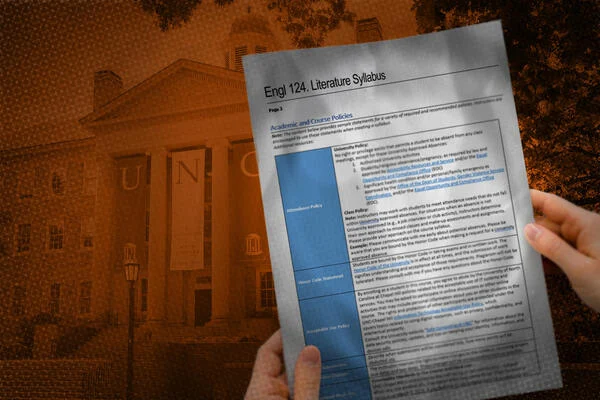
    Two months after legal teams at University of North Carolina system campuses split over whether syllabi are considered public documents, system president Peter Hans announced plans to adopt a new policy that will answer an unequivocal yes.

    Starting as early as next fall, faculty members at UNC institutions will be required to upload their syllabi to a searchable public database, according to a draft of the policy provided to Inside Higher Ed by student journalists at The Daily Tar Heel. These public syllabi must include the course name, prefix, description, course objectives and student learning outcomes, as well as “a breakdown of how student performance will be assessed, including the grading scale, percentage breakdown of major assignments, and how attendance or participation will affect a student’s final grade.” Faculty must also include any course materials that students are required to purchase.

    “Public university syllabi should be public records, and that will be the official policy of the UNC System,” Hans wrote in a Thursday op-ed in the News & Observer. “We are living through an age of dangerously low trust in some of society’s most important institutions. While support for North Carolina’s public universities remains strong and bipartisan, confidence in higher education generally has dropped in recent years, driven by concerns about value and a perception that some colleges and universities have drifted from their core mission.”

    The system is currently seeking feedback on the draft policy, a system spokesperson told Inside Higher Ed, and “after receiving input from elected faculty representatives and other stakeholders, the system office will revise the draft as needed.” Only Hans, and not the Board of Governors, will need to approve the policy.

    In October, system campuses disagreed over whether to give up syllabi in response to a broad public records request by the Heritage Foundation’s Oversight Project. Alongside other conservative groups, the Heritage Foundation has used open records laws to gather information on and expose public university faculty members who teach about race, gender, sexuality and the Israeli-Palestinian conflict. Syllabi that include classroom policies, required readings and instructor’s names are particularly valuable to conservative critics. The UNC system flagship in Chapel Hill determined that syllabi are not automatically subject to such requests. But officials at the University of North Carolina at Greensboro declared the opposite.

    “Having a consistent rule on syllabi transparency, instead of 16 campuses coming up with different rules, helps ensure that everyone is on the same page and similarly committed heading into each new semester,” Hans wrote in his op-ed.

    The Florida Board of Governors recently enacted a policy that makes syllabi, required or recommended textbooks, and instructional materials available online and searchable for students and the general public for five years. Indiana, Texas and the University System of Georgia also maintain similar rules.

    Belle Boggs, an English professor at North Carolina State University and president of the North Carolina American Association of University Professors chapter, is worried that many professors, busy with end-of-semester grading, are unaware of the forthcoming policy; administrators have yet to send out any formal announcement of the rule, Boggs said. But many of those that do know of it are pushing back. A petition started by the North Carolina AAUP chapter has garnered more than 2,100 signatures as of Thursday afternoon. The group plans to deliver it in person to Hans on Friday.

    The draft policy does not explicitly require instructors to list their names on their syllabi and states that “nothing within this regulation shall be construed to require a publicly available syllabus to include the location or time of day at which a course is being held.” This stipulation provides little comfort to faculty members, Boggs said.

    “As many of us have noted, there are many of us who are the only faculty who teach a particular class, and it is very easy to find out when our class is and where our classes are,” she said. “That does not make me feel safer.”

    Hans acknowledged critics’ weaponization of syllabi in his op-ed.

    “There is no question that making course syllabi publicly available will mean hearing feedback and criticism from people who may disagree with what’s being taught or how it’s being presented. That’s a normal fact of life at a public institution, and we should expect a vibrant and open society to have debates that extend beyond the walls of campus,” Hans wrote. “It’s awful that we live in a time when healthy discussion too often descends into outright harassment. We will do everything we can to safeguard faculty and staff who may be subject to threats or intimidation simply for doing their jobs.”

    The new policy would also classify syllabi as “work made for hire,” which makes the institution—not the syllabus’s creator—the copyright owner of the syllabus, according to U.S. copyright law.

    “As such, instructors do not retain personal copyright in these materials, and syllabi owned by a public agency generated in the course of public business, are not copyrightable in a manner that would exempt syllabi from public access to these records, consistent with state and federal public records laws,” the draft policy stated.

    The N.C. AAUP has focused its efforts on publicizing faculty safety concerns, but the work-made-for-hire provision is also worrisome, Boggs said.

    “That causes severe damage to academic freedom and how much control we have over our classes,” she said. “It may also make many faculty not want to work here, because the syllabi that they teach from or the syllabi that they’ve honed over decades in other places … [will belong to the university].”

    Source link