If approved, the merger between Willamette (above) and Pacific would create the largest private university in Oregon.
Pacific University and Willamette University have signed a letter of intent to merge, pending approval, which would create the largest private institution in Oregon if the deal is finalized.
Together the two institutions have a collective study body of about 6,000 students.
“If finalized and approved, this merger would be a defining moment for private higher education in the region. Pacific and Willamette are both deeply rooted in Oregon’s history and have educated thousands of leaders who have helped make the Pacific Northwest synonymous with innovation and excellence,” Willamette president Steve Thorsett said in a news release.
Pacific president Jenny Coyle emphasized a shared “commitment to addressing the region’s most pressing workforce needs while preserving the personalized, mission-driven education that defines both of our institutions” and the opportunity to leverage “our collective strengths.”
The combined entity would be known as the University of the Northwest.
The two institutions plan to operate under a shared administrative structure but maintain their respective campuses, admissions requirements, academic programs and athletic teams. Their main campuses are located roughly an hour apart; Willamette is in Salem and Pacific in Forest Grove. Willamette also has a campus in Portland that houses an art college.
The merger will require approval from regulatory bodies, including the Department of Education.
The vast majority of students surveyed reported feeling “moderately,” “very” or “extremely” fearful about their visa status.
Photo illustration by Justin Morrison/Inside Higher Ed | aapsky/iStock/Getty Images | Chip Somodevilla/Getty Images
A new national survey from Stop AAPI Hate, a coalition dedicated to fighting discrimination against Asian Americans and Pacific Islanders, found that international students are experiencing heightened fear and uncertainty under the Trump administration.
The survey, released Wednesday, drew on quantitative and qualitative data from 87 graduate and undergraduate international students from 36 U.S. colleges and universities.
It found that more than half of respondents, 53 percent, felt “not at all safe.” About 88 percent reported feeling a decreased sense of belonging and said they were holding back from political engagement, and 86 percent changed how they use social media out of fear. The majority, 90 percent, reported feeling “moderately,” “very” or “extremely” fearful about their visa status.
Students detailed their fears further in qualitative responses, including one that expressed fear of “being kidnapped by ICE without due process, being disappeared into the detention system, [and] being denied healthcare if detained.” Others described fears about family members being whisked away or about disrupted academic and career trajectories. Chinese students in particular raised concerns about being surveilled and targeted as a national security threat, invoking Japanese Americans’ incarceration during World War II, according to the report.
Respondents reported that campuses offered supports including mental health care, travel guidance and updates about student visa policies, but 48 percent said campuses didn’t provide guidance about how to complete their studies and 38 percent lacked legal aid resources.
Students also discouraged others from coming to the U.S. for their studies.
“Run, don’t come,” one student wrote.
“America is no longer the land for dreams,” said another.
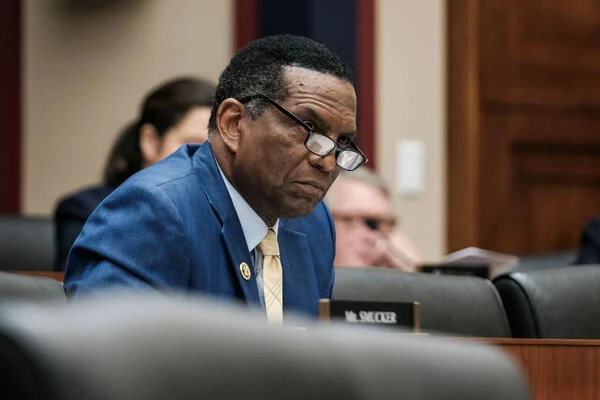
Republicans and Democrats showed rare agreement in a House committee meeting on Wednesday, putting their support behind digital skills transcripts that they say will make the economy more efficient and make education more skills-centered.
“This is a game changer,” said Rep. Burgess Owens, the Utah Republican who chairs the subcommittee.
The hearing shined a spotlight on the wonky world of learning and employment records, or LERs, and explored how to ensure they are available nationwide. It also progressed the conversation on workforce readiness, a bipartisan topic and an issue that has received heightened attention from House Republicans.
Students in the U.S. have access to more than 1.8 million credentials, but navigating those options can be challenging. At the same time, employers say they are struggling to find workers with the right skills for open jobs.
Although they are not a new idea, more associations, states and experts are turning to LERs as a way to better connect job seekers and employers. For instance, Western Governors University, which has had an LER platform since 2019, recently announced the WGU Achievement Wallet to help students track their skills and connect those to available jobs. A skills-based transcript is at the core of a new platform from the Educational Testing Service that Brandeis University and California State University campuses are piloting. To help boost adoption of LERs, the American Association of Collegiate Registrars and Admissions Officers last year launched the LER Accelerator Coalition.
These LERs “enable career mobility based on proven ability, not pedigree,” Western Governors president Scott Pulsipher told lawmakers at the hearing.
“When readiness is signaled through verified skills, opportunities expand to include those who might have been overlooked,” he said. “Few things are more profoundly human than enabling individuals to pursue a self-determined life. LERs, while seemingly abstract, exist for that purpose. They translate what individuals know and can do into real opportunity.”
Other witnesses said Congress can better help grow LERs by providing funding and encouraging states to create them. They also want lawmakers to require common open data standards, so the LERs are transparent and can be used across platforms.
“LERs only matter if people can use them,” said Scott Cheney, the CEO of Credential Engine. “If they’re trapped in proprietary systems, they do little for learners, workers or employers.”
Hearings like this offer some insight into lawmakers’ priorities and can lead to legislation. Since passing a landmark bill to overhaul student loans, the House education committee has delved into college pricing, alleged bias in the Truman scholarship, innovation in higher ed and campus antisemitism.
For Republicans, the LERs are a way to build on the One Big Beautiful Bill Act, which expanded the Pell Grant to short-term job training programs, and to support efforts to drop degree requirements.
Owens noted that short-term credentials, work-based learning and apprenticeships are increasing “as we shift away from the ‘college-for-all’ mentality and toward a skills-first approach.”
“LERs are the future,” said Owens, who played a video he narrated that explained how digital transcripts work.
Democrats pointed to the need to help workers advance their skills and navigate the labor market, citing rising unemployment numbers and slow job growth.
“LERs have the potential to make our economy more efficient, more equitable and more productive,” said Rep. Alma Adams, a North Carolina Democrat who serves as the subcommittee’s ranking member. “Employers are becoming overwhelmed with job applications containing limited information about the candidates’ skills, all of which can be hard to verify. Far too many employers have fallen into the habit of requiring college degrees for jobs that do not necessarily require them, effectively shutting out talented and qualified individuals who have the skills but not the diploma.”
But Adams and other Democrats worried about the data privacy in these online systems and said they want to see safeguards to protect workers. They also want to guarantee that workers have control over their data.
“We must ensure that a shift to learning and employment records does not enable an infringement on worker rights, increase discrimination or widen achievement and income gaps,” Adams said.
Some direct-admissions programs admit all students who fit certain criteria, while others seek out students based on particular traits.
Photo illustration by Justin Morrison/Inside Higher Ed | Prostock-Studio/iStock/Getty Images
Direct admissions, the practice by which colleges extend offers of admissions to students without them submitting an application, has become increasingly popular.
About 15 states now have their own programs, which typically involve extending admissions offers to qualifying high school seniors in the state—or, for some open-access institutions, to all graduating seniors. Meanwhile, a handful of private companies and nonprofits have launched platforms in recent years to allow institutions to send out offers to students around the country.
Such programs aim to help colleges boost enrollment and reach students who may otherwise not have applied to those institutions—and research shows that they’ve proven successful in those goals.
But what kinds of institutions utilize direct admissions and which students accept direct-admissions offers? Niche, a college rankings company whose direct admissions product launched as a pilot in 2022, shared data about its Class of 2029 direct-admissions enrollees with Inside Higher Ed, providing a glimpse into the demographics, majors and locations of those students.
“I think in this day and age of mobile, social media, AI—it’s just getting harder and harder to reach students and break through the noise,” said Luke Skurman, Niche’s CEO. “This is very in tune with [students’ expectations]. They’re used to pressing a button, having an Uber show up at their home, having food being delivered to their home. They like it being instantaneous. They like it being simple, transparent. I think there are institutions that really believe this is a natural evolution for this demographic.”
Over a million students received offers from the 145 participating institutions last year. That number is likely to grow this admissions cycle; over 160 partner institutions have already extended offers to over 770,000 students. (The Common App, which in 2021 launched its direct-admissions offering that focuses on first-generation and low- and middle-income students, reported that 119 participating universities extended offers last year to 733,000 students. This year, the number of institutions jumped to 213.)
But experts have noted that direct-admissions services run by private companies lack some of the benefits provided by state’s direct-admissions programs. Jennifer A. Delaney, an education professor at the University of California, Berkeley, who researches direct admissions, said in an interview that effective direct-admissions programs shouldn’t require students to take any steps to receive any admissions offers—including filling out a profile, as Niche requires.
Over all, enrollments through Niche’s platform this fall accounted for 11 percent of all enrollments at participating institutions, with each institution enrolling a median of 60 students through direct admissions. Inside Higher Ed broke it all down in five charts below.
Colleges admitted higher rates of nonwhite and first-gen students through direct admissions.
About 60 percent of students who enrolled through the Niche direct-admissions tool this year were students of color, while about 43 percent were first-generation. Among students at those same institutions who enrolled through other means, 48 percent were students of color and 34 percent were first-generation.
Colleges using direct admissions are mostly, but not exclusively, private.
Of the students who enrolled via Niche’s tool, a majority—69 percent—enrolled at private institutions.
Damien Snook, Niche’s director of product analytics, said that the types of institutions that use the service range significantly from flagship institutions, albeit generally in smaller states, down to tiny religious colleges. Most are not selective but aren’t open access, either.
“What we see from our direct-admissions partner more or less mirrors national trends. We do kind of meet that Goldilocks zone,” he said.
At public institutions, enrollments from direct admissions made up a slightly smaller share—8 percent—of new fall 2025 enrollments compared to 12 percent among private institutions.
Where is direct admissions most popular?
California, Pennsylvania and Texas are the most common states for direct-admissions enrollees to hail from. That statistic isn’t entirely surprising, considering they are among the most populous states. They’re also the three most popular destinations for direct-admissions students, though Pennsylvania ranks higher than California on that list.
Some of the areas where the product has been most successful, such as the Midwest, are where institutions that piloted and beta tested the tool found success, Snook said. They’re also areas that are projected to see decreased numbers of high school graduates in the coming years, meaning institutions may be looking to draw students from other areas of the country, which Niche’s tool allows them to do.
Health majors reign supreme, but direct admissions students span a variety of majors.
Unlike state direct-admissions programs, colleges on Niche’s platform can pick and choose students by attributes like intended major or location.
“Some lean into the territories that they’re already established in, so they’ll search for students in their state, or they’ll lean into ‘I’m a tech school and I’m looking for students that are interested in STEM majors.’ But we also have institutions that do the opposite, who say, ‘We’re good at recruiting in our backyard, but where we really want help is our secondary market,’” said Snook.
The trends in students’ majors mirror overall, national data trends, with the Niche data showing a slight decline in those studying computer science and an increase in those pursuing health degrees.
Employers prefer to hire graduates who have participated in applied, hands-on experiences.
Jason Ardan/The Citizens’ Voice/Getty Images
While fewer than half of Americans have confidence in higher education, new data shows that 85 percent of employers believe colleges and universities are adequately preparing students for the workforce. And they especially value degrees from institutions that emphasize constructive dialogue and disagreement.
Those are two of the big takeaways from “The Agility Imperative: How Employers View Preparation for an Uncertain Future,” a new report the American Association of Colleges and Universities published Thursday. In the ninth iteration of the report since 2006, the group commissioned Morning Consult to survey 1,030 executives and hiring managers in August about their attitudes toward higher education.
“This is our strongest case yet that the separation between workforce and civic skills is false,” said Ashley Finley, author of the report and vice president for research at AAC&U. “In the face of a public narrative that questions the value of college education, employers are higher education’s biggest fans. They value the ways in which colleges are preparing students to be nimble and agile for an uncertain future.”
‘Avoiding Groupthink’
According to the survey, 94 percent of employers said it’s equally important for colleges to prepare a skilled and educated workforce and to help students become informed citizens; 92 percent said it’s also important for colleges to create an environment where students of all backgrounds feel supported and to help them engage with and serve their communities. And 96 percent of employers said it’s useful for college graduates to be able to engage in constructive dialogue across disagreement; 80 percent are confident colleges and universities are helping students develop those skills.
“Employers want people who can grapple with differences of opinion because they know that strengthens the workplace,” Finley said. “Diverse teams are often the most effective because it’s through the process of disagreement that they arrive at better solutions by avoiding groupthink.”
Those results come at a time of intensified scrutiny and skepticism about the value of higher education from both the general public and policymakers. According to a survey the Pew Research Center published in October, 70 percent of Americans believe higher education is generally “going in the wrong direction,” citing high costs, poor preparation for the job market and lackluster development of students’ critical thinking and problem-solving skills.
In addition to focusing on career and technical education and using postgraduation earnings as the primary metric of a degree’s value, the Trump administration and its allies in Congress and state legislatures are also policing university curricula and faculty speech. Over the past year, political pressure has led numerous institutions—including Texas A&M University and the University of Oklahoma—to suspend or fire faculty and administrators who made comments that conflict with certain conservative viewpoints on race, gender and other topics.
But that’s not the type of learning environment most employers, regardless of political affiliation or age, want graduates to come from, according to the report.
Eighty-five percent of employers—including 90 percent of Democrats, 75 percent of Independents, 83 percent of Republicans, 87 percent of those under age 40 and 74 percent of those over age 50—said they would look more favorably upon a degree from an institution known for respecting diverse perspectives on political, economic and social issues in the curriculum. Additionally, 82 percent of respondents—including 83 percent of Democrats, 78 percent of Independents, 83 percent of Republicans, 85 percent of those under age 40 and 74 percent over age 50—said they would look more favorably upon a degree from an institution that’s not subject to government restrictions on what students learn and discuss.
The share of employers who strongly agreed with those statements has also increased by several percentage points since 2023, when the previous iteration of the survey asked the same questions.
“So much of workforce preparedness in the next few decades is going to involve durable skills amid the rapid proliferation of artificial intelligence,” Lynn Pasquerella, president of AAC&U, said. “We need to train individuals who can engage across differences and bring skills, competencies and dispositions computers can’t bring. That involves directly the capacity to engage with others who are different from oneself.”
In addition to valuing degrees that promote open inquiry, more than three-quarters of employers said they were more likely to hire graduates who participated in applied, hands-on experiences while in college, including internships, holding leadership roles or working on community-based projects. And 81 percent of employers said microcredentials are also valuable when they’re making hiring decisions.
“Employers are looking for more than just transcripts. They want portfolios and demonstrations of applied skills and competencies,” Pasquerella said. “The more colleges can do to provide a more comprehensive, complete picture of students’ abilities inside and outside the classroom, the more confidence they can create with employers.”
Governor-elect Spanberger will now get to select 22 board members.
Matt McClain/The Washington Post/Getty Images
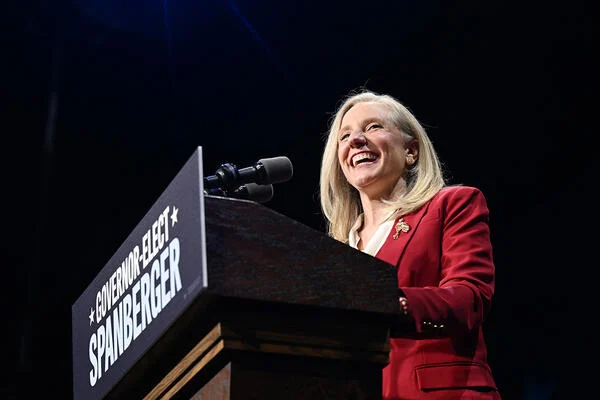
The legal battle over whether Virginia governor Glenn Youngkin’s university board appointees will take their seats is over after a judge set a trial for 2026, Virginia Business reported. Governor-elect Abigail Spanberger will assume office next month, rendering the lawsuit moot.
The case will be dismissed, shutting down an effort to install the Republican governor’s board picks, many of whom had previously worked for or donated to the GOP and were rejected by Virginia Democrats. Now Spanberger, a Democrat, will be able to name 22 board members that otherwise would have been appointed by Youngkin, giving her the opportunity to shift the political balance of boards away from the right.
Youngkin and Attorney General Jason Miyares had sought to expedite the legal fight by asking Virginia’s Supreme Court to review a lower court ruling that determined that blocked board picks could not take their seats. Youngkin has argued the board appointments must be rejected by the full Senate, not just the Democrat-led Privileges and Elections Committee, which voted down multiple picks.
Spanberger and state Democrats are expected to quickly fill multiple vacancies that have left boards hobbled, including at George Mason University, which does not have a quorum. GMU’s board met recently, despite the lack of a quorum and legal questions about their ability to do so.
Youngkin’s office did not immediately respond to a request for comment from Inside Higher Ed.
President Trump signed an executive order in April to reform accreditation.
Saul Loeb/AFP/Getty Images
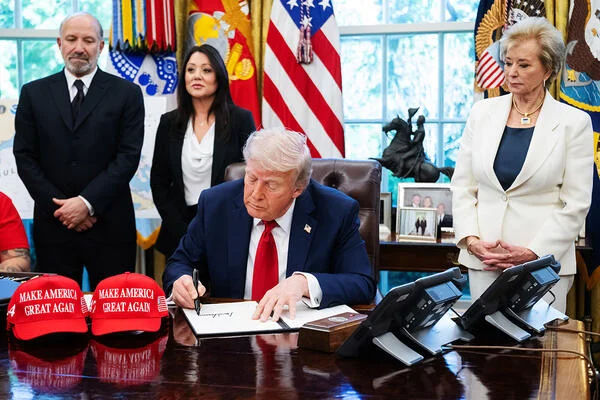
Reforming the accreditation process has been a key focus for the Trump administration. Officials from the Education Department reinforced that Wednesday when they announced a request for information to solicit public feedback on updating the accreditation handbook.
The aim, the department said in a news release, is to reduce “unduly burdensome and bureaucratic requirements” and increase “transparency and efficiency.”
“Instead of driving high-quality programs that better serve students, the antiquated accreditation system has led to inflated tuition costs and fees, administrative bloat, and ideology-driven initiatives at colleges across the country,” Assistant Secretary for Postsecondary Education David Barker said. “We are excited to receive feedback on how best to update the Handbook, streamline guidance, and eliminate bureaucratic headaches for accrediting agencies and associations.”
The request falls in line with an April executive order to “reform and strengthen” the accreditation system. It also comes less than a week before the next meeting of the National Advisory Committee on Institutional Quality and Integrity, the group that weighs in on accreditation issues and reviews accrediting agencies.
The department is planning to draft new rules and regulations for accreditors sometime next year.
Commenters will have 45 days to provide feedback on the following questions:
What policies or standards are encouraging innovation or reducing college costs within the postsecondary education sector and should be retained in or added to the new version of the handbook?
How can the handbook be designed to be less burdensome?
Is the handbook serving its intended purpose?
How can it better assist accrediting agencies and associations in evaluating the quality of educational institutions and programs or in applying for federal recognition?
How could accreditation standards be updated to incentivize intellectual diversity on campus?
What guidance or standards, if any, can the handbook provide to institutions and programs to help achieve this goal?
What methods should be incorporated into the handbook to determine appropriate assessment benchmarks, and what data sources or validation methods could be used to ensure those benchmarks reflect student competency?
AI isn’t the only reason new graduates can’t get a job, but it is changing the job market they’re entering. Economic uncertainty and a surplus of college graduates are contributing far more to high unemployment among young degree holders than job-thieving robots.
A recent Federal Reserve analysis showed that the unemployment gap between high school and college graduates has been narrowing since the 2008 recession and now sits at around 2.5 percentage points, down from an average of five percentage points from roughly the 1980s to early 2000s. The National Association of Colleges and Employers’ 2026 Job Outlook Survey found that employers expect hiring for the Class of 2026 to remain flat. Next year’s job market likely won’t improve for college graduates.
But even though huge corporations like Amazon, Target and Klarna say they are laying off tens of thousands of employees because of AI, they do not represent the majority of employers. Like the rest of us, most companies are still figuring out AI. In the NACE survey, nearly 59 percent of employers said they are not planning to or are unsure whether they’ll augment entry-level jobs with AI, and just 25 percent said they’re currently discussing it.
Meanwhile, in a recent Substack post, economist and CUNY Graduate Center professor Paul Krugman argued it’s too soon for AI to have such a drastic impact on unemployment for college-educated workers; instead, he blamed the crummy job market on tariffs, uncertainty in the economy and even DOGE cuts flooding the job market with laid-off, educated federal workers.
These market challenges coincide with intensifying pressure from the federal government and the general public for colleges to show that their degrees are valuable. Just this week, the Department of Education rolled out a new feature in the Free Application for Federal Student Aid alerting students if the institutions they’ve applied to produce graduates who earn less than people with just high school degrees.
While the state of the economy is out of higher education’s control, institutions should heed employer calls for graduates with real-world experience. Career-ready students will be able to adapt to the evolving world of work and see that their degrees are worth the investment. The most promising response is for colleges to embrace experiential learning.
A survey of employers released this week by the American Association of Colleges and Universities showed that college graduates who are proficient in applying knowledge to the real world and who understand teamwork are the most likely to be hired. Students agree: They cited paid internships and building stronger connections with employers as the top things colleges can do to help them get career-ready.
Focusing on work-based learning will achieve two things: get students the real-world experience employers demand and set them up for long-term economic success. The college premium may be eroding, but it persists. And while high school graduates might be getting jobs more quickly than recent college graduates, those with degrees stay employed longer once they do find jobs.
Regional economies will benefit from graduates with real-world experience, too. Students who participate in internships or apprenticeships are more likely to find local jobs after they graduate. Studies even show that underemployed graduates, those working jobs that don’t require a college degree, land in roles with higher intrinsic value—think less physical labor, more respectful treatment and better opportunities for skill development.
Some institutions are further along than others. A program at Harvey Mudd College pairs undergraduates early in their degrees with alumni around the country for summer job shadows. Others target career support to individual student groups, such as neurodiverse students and veterans. Virginia recently announced a partnership with Handshake to provide each student at a public institution at least one form of work-based learning in an effort to keep talent in the state. And the Delaware Workforce Development Board gave the University of Delaware’s Lerner College of Business and Economics a grant to create a yearlong co-op program with businesses across the state, partly to “keep homegrown talent here in Delaware,” the chair of the board said.
The economic forces impacting the job market aren’t going away, and neither is AI’s transformational influence on how work gets done. The solution for colleges is simple: Students need real-world experience and employers are explicit about wanting to hire graduates who have it. Colleges must start building employer relationships and embedding experiential learning into the curriculum now. The institutions that get it right will be the ones whose graduates never question the value of their degree.
Sara Custer is editor in chief at inside Higher Ed.
As food insecurity continues to rise across New York, the State University of New York’s public service program has stepped in to address the growing need.
The SUNY Empire State Service Corps, a paid, student-driven initiative with more than 500 members, has ramped up its on-the-ground efforts in recent months.
Launched in May 2024, the group was funded with $2.75 million from the state budget and is New York’s largest AmeriCorps program. SUNY Corps students assist New York residents in high-need communities with K–12 tutoring, Supplemental Nutrition Assistance Program and basic needs outreach, peer mental health support, sustainability projects, hate and bias prevention, nonpartisan civic engagement, and FAFSA completion.
SUNY chancellor John B. King Jr. said the program played an integral role during the federal government shutdown this fall as New York residents faced cutbacks to federal food-assistance benefits.
“The threats to the SNAP program presented a huge challenge for New York,” King said. “Many of our food pantries saw a significant uptick in usage before the shutdown, and then certainly during the shutdown as people anticipated not being able to access SNAP benefits.”
SUNY chancellor John B. King Jr. (center, in light blue shirt) joins students and staff as they pack backpacks with supplies for New York elementary students.
State University of New York at Binghamton
In response, New York governor Kathy Hochul provided $200,000 in additional funding to bring on more SUNY Corps students to help families at risk of losing aid. The funding will support the added students for the remainder of the academic year.
King said the additional paid hours were essential and allowed campuses to quickly mobilize students to support food pantries and community centers.
“Many of our students know what it’s like to be in a situation where your family finances feel incredibly fragile,” King said. “So when our students see classmates who are food insecure, who are skipping meals in order to make ends meet or who are distracted in class because they’re hungry, they worry a lot about them.”
Inside the Service Corps
SUNY Corps students dedicate at least 300 hours to paid community service and are eligible to receive an AmeriCorps Segal Education Award of up to $1,500.
“They’re from every part of the state, every socioeconomic background, every ethnic background, every faith background, and they are excited to work together to make the community better,” King said. “It’s exactly what we should be doing in higher ed, and it’s exactly what we need as a country.”
More than 500 students from 45 SUNY campuses participated in the program this year, and interest continues to outpace availability; applications exceeded campus placements by more than three to one over the last two years.
Sarah Hall, an Empire State Service Corps coordinator and senior assistant director at the State University of New York at Binghamton, said her campus received more than 200 applications for just 50 spots this year.
“Every time I talk to a student who is part of our Empire State Service Corps, you can really feel how meaningful this is to their own personal and professional growth,” Hall said. “I really think this is setting them on a path of service in their future.”
Sarah Hall, an Empire State Service Corps coordinator at SUNY Binghamton.
State University of New York at Binghamton
Following the federal government shutdown, Hall said, her students quickly mobilized a meal kit assembly effort after Hochul provided the additional funding.
“We purchased over $4,000 worth of food … so when families go to a pantry or food bank, they’re able to just pick up an entire meal that will feed a family of four,” Hall said, adding that her students put together more than 560 kits.
Beyond Binghamton, the first cohort of SUNY Corps students statewide, logged over 100,000 hours of service and served more than 70,000 New York residents during the 2024–25 program year.
“It’s a reflection that young people really want to serve and want to contribute to the community and are eager for these opportunities,” King said.
What’s Next
The chancellor said the government shutdown underscored how essential sustained investment in public service programs will be in the years ahead.
“I’d love to see federal investment in this space,” King said. “There continues to be bipartisan support for the AmeriCorps program, so my hope is that we can continue to grow national service efforts around the country.”
He noted that New York was recently selected as one of four states—along with California, Colorado and Kentucky—to join the Service Year Alliance, an inaugural cohort seeking to grow the number of paid service opportunities throughout the United States.
Looking ahead, King said the SUNY Empire State Service Corps could serve as a model for colleges and states seeking to build or expand their public service initiatives because it’s “highly replicable.”
“There’s a lot of reasons for people to feel discouraged about the health of our democracy,” King said. “But when you’re with these students who are committing 300 hours plus a year to service, it makes you quite hopeful.”
Get more content like this directly to your inbox. Subscribe here.
A recent study examining credit evaluation across five public community colleges and universities found pronounced pain points for both learners and the campus personnel supporting them in evaluating their coursework and other college-level learning. In their own words, learners described the process with frustration, resignation, and, at times, outright indignation:
A community college transfer student described the process of having their previous courses evaluated as a “six- to eight-month battle” that soured the joy of transfer admission and sent them on a wild goose hunt to track down prior course materials to prove their worth. “I had to fight with my department and contact all of my old professors from my community college and get syllabi and [approval] took so long … I had to send it back three times.”
A learner transferring from a private university expressed the heightened anxiety they experienced in the process and the high stakes at hand: “I think maybe three of my courses transferred over two years. I submitted like over 20 petitions just to get my credits to transfer over … it’s been a little bit difficult and really stressful because my program specifically kicks you out if you don’t graduate in two years.”
A student working full-time who sought a prior learning assessment, only to be met with silence and delays over the course of a year, spoke frankly: “My faith … dropped each semester and I got to the point of acceptance, like, ‘Oh, it’s OK. I’ll just take the classes again … It’s gonna be easy because I’ve already taken them before. I’ll be fine. I won’t have to study as much.’ But yeah, it’s just extra classes that I could have minimized.”
A community college student who learned after being accepted and deciding to enroll that they would have to go back and take additional general education courses: “I was upset because when I got here, they were like, ‘You need more GE requirements.’ And I was like, ‘What did I do all that work for? Why did you accept me, if I needed more GE requirements?’”
These firsthand accounts demonstrate a painful truth: Learning evaluation decisions shape learners’ trajectories. A decision to not award credit can add time and money to a learner’s educational path and ultimately impact whether they decide to continue. Indeed, a national poll of adult Americans by Public Agenda for Beyond Transfer found that negative credit transfer experiences can erode trust in higher education and even dissuade adults from pursuing a college credential altogether.
Such data should be a clarion call to higher education. Too often, though, it is treated like background noise. This is why we came together nearly 18 months ago to launch the Learning Evaluation and Recognition for the Next Generation Commission (co-convened by Sova and the American Association of Collegiate Registrars and Admissions Officers), and why this week we issued our final report outlining a robust set of actions for institutional, state and system leaders to dramatically transform learning evaluation policy and practice.
Taking up the commission’s charge was a pointed call to action for each of us, who in our varied roles as campus administrators, registrars, former faculty, student success professionals, researchers, accreditor leaders and advocates have dedicated our careers to expanding postsecondary opportunity and attainment. From our own firsthand knowledge and collective experience, we readily understood some of the challenges beleaguering learning evaluation. As discussed in this column last fall, learning evaluation at most institutions—including institutions of all levels and sizes—is a highly manual and decentralized process riddled with inefficiency, inconsistency and a lack of transparency.
Yet, we were still struck by what we uncovered. Drawing on AACRAO’s broad research base, the LEARN Commission reviewed national transfer student outcomes data, institutional survey insights and findings from qualitative studies to assemble a full picture of the many challenges, untapped potential and missed opportunities that abound. The public can access the full set of green papers that guided our work on the commission’s webpage.
Based on the evidence, we reached an important conclusion: Learning evaluation is working exactly as it was designed—to control and limit credential-applicable credit because of the assumption that some learning is inherently of lesser quality.
Thus, any effort to change learning evaluation requires a collective willingness to confront the unspoken norms that regularly devalue certain types of learning, including what community college students and adult learners bring to the table. Focusing on structural change (i.e., changing policies and resource flows) alone without considering relational and transformational change (i.e., changes in human relationships, power dynamics and mental modes) will not shift the conditions that hold the status quo in place.
The LEARN Commission calls on institutions and systems to start with a shift in mindsets: All involved should seek to maximize credential applicability and embrace the assumption that a learner is prepared for additional education unless proven otherwise. We outline specific recommendations to make this significant shift, including:
Base decisions to award and apply credit on learning outcomes alignment of at least 70 percent, without invoking additional criteria. Additional criteria do little to preserve academic quality and could introduce bias.
When learning outcomes do not overlap by at least 70 percent, prioritize evidence of whether learners are prepared enough for subsequent coursework and provide appropriate support to promote student success, as needed.
Collect and use student outcome data to continually refine evaluation processes, learning outcome goals, curricular pathways, classroom pedagogy and student support services.
Once an institution decides to award and apply credit, that decision should set a precedent for all future learners (unless substantive curricular changes occur).
An additional set of 10 recommendations that accompany these addresses the elements of strong institutional policy design and resource allocations needed to make this shift in practice. The report outlines ways that institutions, systems and states are advancing these ideas in the real world to provide further guidance on where we can start.
And, while we recognize the significant power and decision-making authority that institutional, state and system leaders already hold, we also recognize that for institutions to accelerate this work at scale, we must activate other stakeholders across the full ecosystem—including policymakers, higher education associations and technical assistance providers, private philanthropy, and institutional accreditors. The report discusses three specific levers to do so:
Enhancing student data and technology systems
Investing in human capital
Building supportive policy conditions
We invite all stakeholders to read the report and, in the months ahead, will ask how we can partner to support your efforts to make change.
The LEARN Commission is convened by AACRAO and Sova as part of the Beyond Transfer initiative. The LEARN Commission and Beyond Transfer are generously supported by Ascendium Education Group, ECMC Foundation and the Kresge Foundation.