American institutions occupy six of the top 10 slots on this year’s table. The Massachusetts Institute of Technology is first for the second year in a row, followed by Stanford University in second, also retaining its 2025 position. The California Institute of Technology rose one spot to third place, and the University of California, Berkeley, debuts on the list in fourth position.
Duke University dropped from fifth to sixth rank this year, and the Georgia Institute of Technology appears on the list for the first time, coming in seventh.
On a country level, nearly a quarter of the top 100 institutions in the ranking are from the US, more than any other nation.
Launched in 2024 in association with Schmidt Science Fellows, the rankings were created to improve scientific excellence and collaboration across disciplines and to help universities benchmark their interdisciplinary scientific work
THE broadened the interdisciplinary scope of research for this year’s list to cover any project that comprises multiple scientific disciplines or one or more scientific disciplines combined with the social sciences, education, psychology, law, economics or clinical and health.
The U.S.’s performance in the rankings is driven by high scores for outputs metrics, which include the number and share of interdisciplinary science research publications, the citations of interdisciplinary science research, and the reputation of support for interdisciplinary teams.
“For more than 80 years, research universities have advanced our understanding of the world, leading to dramatic improvements in health, economic prosperity, and national security. That work fundamentally is done best when people ideate and collaborate without regard for disciplinary boundaries within and between scientific areas,” Ian A. Waitz, vice president for research at MIT, said in a statement.
“Scientific research that breaks down academic silos and crosses traditional disciplines is increasingly understood to be essential for the next generation of big breakthroughs and the key to solving the world’s most pressing problems,” said Phil Baty, THE’s chief global affairs officer.
“The world’s biggest challenges are highly complex and require cutting-edge knowledge and fresh ideas from a wide range of specialisms.”
Are you searching for a learning designer, instructional designer or, as the University of Michigan calls the role, a learning experience designer? If so, your search is the perfect fit for Featured Gigs. Please reach out.
Q: What is the university’s mandate behind this role? How does it help align with and advance the university’s strategic priorities?
A: Imagine being the person who turns bold ideas into learning experiences that reach thousands of learners across the globe. The University of Michigan’s commitment to life-changing education, a key pillar of our Look to Michigan vision, drives this role’s focus on expanding access to high-quality, equitable learning experiences for a global audience.
The learning experience designer senior role advances the Center for Academic Innovation’s mission to collaborate across campus and around the world to create equitable, lifelong educational opportunities for learners everywhere. At CAI, we help translate Michigan’s academic excellence into scalable, learner-centered opportunities, both in our noncredit and for-credit portfolios. The learning experience designer senior role is at the forefront of our work.
Designers at CAI don’t just build courses; they co-create learning experiences that merge research-informed design and empathy with faculty expertise. We ensure every online or hybrid course reflects Michigan’s commitment to excellence while reimagining how learning reaches people across every stage of life, whether they are traditional students, working professionals or lifelong learners.
Q: Where does the role sit within the university structure? How will the person in this role engage with other units and leaders across campus?
A: Reporting to the learning experience design lead, the learning experience designer senior operates within a highly cross-functional team that brings together experts in design, technology, data and media. We have a highly collaborative environment, both within the center and with our faculty and academic partners.
As a learning experience designer senior, the ideal candidate will be collaborative and relationship-driven, working closely with faculty and academic unit leaders across the university’s schools and colleges to design meaningful online and hybrid learning experiences. We work in an environment that values experimentation, collaboration and continuous learning.
Q: What would success look like in one year? Three years? Beyond?
A: Our learning experience designers at CAI are connectors and translators. We turn teaching goals into actionable design strategies and align pedagogical vision with institutional priorities. In your first year, success looks like being a trusted connector who builds strong relationships across our team and with our academic partners. You’ll be shaping not only our courses but our culture, contributing your voice, curiosity and care to our thriving community.
In three years, this role may become a recognized mentor, leader and thought partner in learning experience design across U-M. A person in this role would be recognized for advancing best practices in digital pedagogy, mentoring colleagues and contributing to the university’s growing portfolio of online and hybrid programs.
Beyond that, success means lasting impact. The courses and programs you’ve helped build will keep reaching new learners, and the practices you’ve influenced will continue guiding our work long after any single project ends.
Q: What kinds of future roles would someone who took this position be prepared for?
A: This role offers the chance to develop strategic, creative and leadership skills that are highly transferable across higher education and beyond. Learning experience designers in this role gain experience with a diverse range of online and hybrid learning experiences, from degree programs, noncredit MOOCs and certificate-based stackable programs. This prepares our designers for roles that require both pedagogical expertise and operational agility.
People who grow in this role are well positioned to step into leadership positions, including leading design teams, shaping instructional design strategy within academic units or moving into broader academic innovation–focused roles within or outside of higher education.
Please get in touch if you are conducting a job search at the intersection of learning, technology and organizational change.
The state of Virginia promised all undergraduate students a meaningful internship experience and partnered with Handshake to elevate opportunities.
Internships can be a meaningful step in a college student’s career development. That’s why the commonwealth of Virginia is working to guarantee that undergraduates have a fair shot at paid experiential learning.
The Virginia Economic Development Partnership announced a new collaboration today with the job board Handshake as part of the state’s effort to train and retain local talent through internship opportunities.
Virginia has committed to giving all undergraduate students at least one form of meaningful work-based learning before graduation, said Megan Healy, senior vice president of talent and workforce strategy at VEDP. Overseen by the Virginia Talent and Opportunity Partnership, this work-based learning could include experiential learning or a paid internship.
The partnership with Handshake is one layer of a multifaceted approach to increasing opportunities for entry-level applicants to break into local job markets, helping to reduce brain drain and encourage economic development for evolving local markets.
State of play: Internships provide students with skills and experience for future careers, but for many of them paid internships remain out of reach. A 2024 report from the Business–Higher Education Forum found that nearly half of students who wanted an internship didn’t participate in one, and of those who did, only 70 percent said it was a “high-quality experience.”
A 2025 Student Voice survey by Inside Higher Ed and Generation Lab found that 38 percent of respondents believe their college should emphasize helping them find and access paid internships to enhance career services, and 30 percent want help making strong connections with potential employers.
Virginia has recently seen a dramatic drop in available internship listings; when President Trump took office in January, he slashed the federal workforce, reducing available roles in the D.C., Maryland and Northern Virginia region. Internship postings dropped 36 percent in June 2025 compared to June 2024, according to Lightcast data—a 20-percentage-point-greater decline compared to similar metropolitan job markets.
Brookings Institute
VEDP’s partnership with Handshake includes data sharing within the platform and additional visibility into existing or future internship opportunities for students.
Over 70 percent of colleges and universities in Virginia, representing 470,000 students, already connect to Handshake, said Christine Cruzvergara, the company’s chief education officer. In addition, 20,000 Virginia employers have posted more than 150,000 jobs and internships on the platform.
Building better internships: One of Virginia’s goals is to develop opportunities for students outside of metropolitan hubs.
“The state of Virginia is very diverse, and the majority of students that graduate from a lot of the Virginia schools end up going to Richmond or Northern Virginia—those are the two main hubs that most students go to,” said Cruzvergara, a former Virginia resident and college administrator herself. “But there are so many other regions of Virginia that also need amazing talent, and I think this particular initiative is going to help distribute more of that talent.”
The state is partnering with local business in more rural areas—including near Virginia Tech in Blacksburg and in Charlottesville, where the University of Virginia is located—to establish more high-impact and paid internships to attract students from these universities.
“We’re also looking at ways to connect students from those specific institutions,” Healy of VEDP said. “They also have the most out-of-state students because they’re very popular and very highly ranked.”
To increase internship offerings across the state, VEDP hosts regular training sessions to help employers build meaningful internship experiences for students and assists them in listing jobs on Handshake. The state hopes that connecting students with employers on an already-trusted platform will help expand access to opportunities as well as meet talent demands in the commonwealth.
Small businesses (employing 150 people or less) are also eligible for a grant program if they hire interns; the state will provide $7,500 in matched funds to compensate an intern for eight weeks and 120 hours making at least minimum wage.
“I think this particular initiative is going to help distribute more of that talent, because they’re going to tap into the local economy and the local employers to create the internships and opportunities that will be needed to attract students and also help them see this could be a great place to live In Virginia,” said Cruzvergara.
How is your college or university increasing opportunities for students to intern? Tell us more here.
Trustees at member institutions across the Big Ten are pushing back on a proposed $2.4 billion private equity deal that some argue has been too rushed, lacking transparency and proper vetting.
Now, with trustee criticism mounting, the conference appears to be prolonging talks amid a push to finalize a plan to establish a for-profit arm of the Big Ten, which would control its media and sponsorship rights and sell a 10 percent stake of that entity to the investor. The deal would give members an immediate cash infusion, with a minimum $100 million disbursement across the league, while more prominent athletic programs would receive an even higher revenue share. That money is needed, even at wealthy institutions, as universities adjust to a changing world of college athletics, which includes direct payments for players that began earlier this year.
The proposal would also maintain the current 18 universities as Big Ten members through 2046.
Dissent among the Big Ten ranks seems to have prompted the potential investor—the University of California pension fund, or UC Investments—to slow down the deal.
While UC Investments indicated in a Monday statement that it “remains very excited” about the offer, officials wrote they will work with members in the “coming months” to solidify the deal. (Prior reports indicated the conference hoped to put the deal to a league vote by mid-November.)
“As we have continued to evaluate this opportunity over the past five months, we remain convinced that the unity of the 18 Big Ten university members is key to the success of Big Ten Enterprises,” Chief Investment Officer Jagdeep Singh Bachher wrote in the statement. “We also recognize that some member universities need more time to assess the benefits of their participation. UC Investments likewise requires some additional time to complete our due diligence as recent developments unfold and we continue to engage with the conference.”
The CIO also lauded Big Ten commissioner Tony Petitti and his team.
“The process they have led has been rigorous, honest and fair—among the best we’ve seen. Recent misinformation has distorted some aspects of its effort,” Bachher wrote in the statement.
But several trustees at Big Ten member institutions have raised concerns about a lack of transparency into the deal, saying they have received little information about the arrangement and yet been asked to rubber-stamp it on a compressed timeline.
Trustee Dissent
UC Investments announced a commitment to a unified process for making a deal just a few days after the American Council of Trustees and Alumni held an online meeting with individual board members representing five Big Ten institutions. The meeting, held Friday, included trustees from the University of Michigan, the University of Minnesota, the University System of Maryland, Pennsylvania State University and the University of Southern California, all of whom had concerns about the deal.
Tom McMillen, a Maryland regent, said in the recorded meeting that “no trustee has been given a balanced view” of the pros and cons of the proposal, according to his conversations with other governing board members across the conference. He also called for third-party evaluations of the arrangement.
“It’s shocking to me that a decision of this magnitude, there are no opposing views presented,” McMillen said.
Michigan regent Sarah Hubbard echoed similar concerns on the ACTA call, arguing that there was a need for more oversight and for trustees to have a formal role in discussing the proposal. She also questioned the need to expedite the process with such limited information available.
“This lack of transparency and information for the fiduciaries at our universities is unacceptable,” Hubbard said.
Penn State trustee Jay Paterno questioned the need for secrecy around the potential investment. Given that the Big Ten is about to create “a for-profit company using what are essentially public dollars,” he argued, boards need to know more in order to be able to advise their institutions accordingly. Ultimately, Paterno said, he wanted to see the Big Ten put its cards on the table.
“If it’s such a great deal, show us the deal and let’s go,” Paterno said.
Outstanding Concerns
UC Investments signaled it would work on the deal over the “coming months”—likely signaling a slowdown in the process—but it has offered no information about where things stand.
A UC Investments spokesperson referred questions about trustee concerns to the Big Ten, which did not respond to a request for comment from Inside Higher Ed.
But outside analysts echo many of the concerns raised by trustees. Armand Alacbay, chief of staff and senior vice president of strategy at ACTA, said the organization has no position on the proposal itself but got involved because of concerns about trustees being shut out of the deal.
“Anyone we’ve heard from on this has said it’s not enough time, not enough information, not enough of anything to make this decision. Some have been told that it’s a nonvoting decision for them, that they don’t even have a right to make a decision because it’s the conference,” Alacbay said. “Well, I would say that the intellectual property and media rights of your athletic department are a significantly large asset of the institution and justify a level of board oversight.”
Karen Weaver, an adjunct assistant professor at the University of Pennsylvania Graduate School of Education, told Inside Higher Ed that while private equity has seeped into numerous areas of college athletics in recent years, the investment in a conference is a new approach. And what happens with the Big Ten will likely set the stage for other conferences.
She said if the Big Ten can successfully navigate a maze of thorny legal and political concerns, then other athletic conferences will be more likely to follow in their footsteps. “But if they constantly get land mines and roadblocks thrown in the way,” others will be more hesitant, she said.
Weaver also pointed to concerns lawmakers raised that could upend or complicate the deal.
Last week U.S. Senator Maria Cantwell, a Washington Democrat, issued warnings about the proposal in a statement and individual letters to both university and conference leadership. She argued that such a deal “may be counter to your university’s academic goals, may require the sale of university assets to a private investor, and may affect the tax-exempt purpose of those assets.”
Cantwell also emphasized the different priorities of universities and private equity investors.
“The primary goal of these companies is to make money for the firm, which is unlikely to align with the academic goals of your university or its obligations as a not-for-profit organization,” Cantwell wrote. “These investors will be focused on maximizing their investment, not on preserving and growing athletic and academic opportunities for student athletes.”
During National Transfer Student Week, I had the opportunity to present my dissertation findings. I was eager to share insights and connect with others doing similar work. Yet my excitement quickly gave way to disappointment: Multiple organizations were hosting overlapping events. Would anyone attend my session if there were other opportunities?
That moment clarified, for me, a larger truth about the transfer ecosystem. Despite our shared commitment to improving outcomes for transfer students, we often work in parallel rather than in partnership. True, sustained collaboration remains one of the missing links in creating a more coherent and equitable transfer experience.
Some Context
Collaboration should be the connective tissue of the transfer ecosystem. No single institution, system or organization can solve the challenges of transfer alone. When institutions, state agencies, employers and organizations work together, they have a better chance of building workable and successful pathways. The literature has increasingly suggested this point. Aspen et al.’s Tackling Transfer initiative implies that isolated campus reforms will not be entirely successful.
It emphasizes strengthening partnerships and using shared data and goals to make improvements. Similarly, both versions of the Transfer Playbook advocate success via intentional, ongoing partnerships.
Professional associations echo this message. For example, the American Association of Collegiate Registrars and Admissions Officers’ new conference, called The Assembly, is rooted in collaboration across sectors and institutions to solve transfer and mobility problems. This shift positions the association as a platform for collaboration, not just a publisher of best practices. Likewise, the National Association of Higher Education Systems is spearheading initiatives in the transfer and mobility space because it understands the need to have system-level collaboration.
These references send a clear message: Collaboration is an important strategy to improve the learner’s experience. This is a fundamental shift in our focus. When we center collaboration on the learner experience, rather than on the institution, it shifts the focus and the opportunities. Rather than designing projects around the interests of a single campus, foundation, or consulting contract, collaboration gives us the opportunity to ask, “What happens to the student through the educational journey that prevents successful transfer, and how do we solve that together?”
Challenges and Opportunities
As essential as it is, collaboration seems to be a challenge. To truly accomplish a collaborative network, institutions and agencies will need to look beyond their own boundaries. They need to be willing to pause their own goals to complement, support or provide an opportunity to another group. This has influential and financial implications, but it may end up being a better use of limited and shrinking dollars.
Changing the nature of how we collaborate could afford more opportunities and have a big impact. Collaboration can be complicated for organizations whose funding depends on producing value through exposure, engagement or consulting revenue. Partnerships may overshadow individual organizational accomplishments and lead to future financial growth.
For institutions, grant dollars for improving transfer are so highly competitive that they are sometimes impossible to obtain. More likely than not, funders are looking for the largest impact for their dollar, and that often translates into large-scale system- or statewide initiatives that will affect the most students or provide a large enough data set. That goal immediately eliminates small colleges from opportunities, further reducing the chance for improvement at the institutions that often need it the most.
On campuses, the need for collaboration is just as clear. Advocating for transfer is not the job of a single person with “transfer” in their title. It requires coordinated action across admissions, advising, faculty governance, financial aid, registrar, student life and employer partnerships. AACRAO’s task force on transfer and the award of credit, for instance, highlights the importance of cross-functional teams in redesigning policies and communication so students experience a coherent—not conflicting—set of messages about how their credits move.
Interestingly, the very reports we rely on for guidance point toward a different path. The Tackling Transfer work, for example, is grounded in multistate, cross-sector collaboration and explicitly calls for understanding the incentives and disincentives that shape institutional behavior around transfer. Lumina’s guidance on building local talent ecosystems emphasizes that durable change comes from coalitions willing to redesign systems together, not from one-off pilot projects.
What If We …
So, what might it look like to take collaboration seriously across the transfer ecosystem? Consider these collaborations:
Build shared agendas and calendars. National, regional and virtual events could be coordinated through a master calendar or hub so that transfer professionals aren’t forced to choose between overlapping webinars and conferences hosted by organizations that share the same goals.
Co-create tools and publications. Instead of each group producing its own tool kits and reports, organizations might collaborate on cross-branded resources that show how their frameworks align. Treat multiple opportunities as complements, not competitors.
Align state and regional efforts with institutional partnerships. The literature on national transfer reform emphasizes that systems and regions are critical units of change. State agencies, coordinating boards and foundations can use this insight to convene partnerships that bring institutions, employers and community organizations to the same table.
Elevate practitioners as collaborators, not just implementers. The most effective transfer-focused reports and research draw heavily on the expertise of people doing the day-to-day work of advising, curriculum design and transcript evaluation. Our collaborations should be built with, not just for, these practitioners.
Expand professional development and knowledge. Ideas could be to offer membership deals across organizations that support transfer students to engage more people in professional development opportunities amid decreasing budgets. Or, create a centralized repository or organization that can serve as a single source of information, rather than the plethora of sites, agencies, organizations and companies offering current professional development and resources.
These aren’t small shifts. They require seeing ourselves not as competitors in the transfer space, but as collaborators of its progress.
And So …
If we truly want to strengthen the ecosystem, we must build structures that make collaboration the default and not the exception. Many of the publications we rely on and reference already pointing us there. The question is whether we will follow their lead, not just in language but in practice. By working together, we can move beyond fragmented efforts toward a shared vision of mobility, equity and opportunity for every learner who dares to transfer.
UC may still implement some changes to the program, including a potential cap on the number of incentives supported.
Justin Sullivan/Getty Images
In a letter to system chancellors Tuesday, University of California system president James Milliken said he would not end financial support for hiring postdoctoral fellows out of the UC President’s Postdoctoral Fellowship Program.
“Given the myriad challenges currently facing UC—including disruptions in billions of dollars in annual federal support, as well as uncertainty around the state budget—reasonable questions were raised in recent months about whether the University could maintain the commitment to current levels of incentive funding,” Milliken wrote in the Tuesday letter.
He said he considered a proposal to sunset the incentive program but ultimately decided against it. Still, he said, there may be some future changes to the program, including a potential cap on the number of incentives supported and changes to how they are distributed across system campuses.
“After learning more about the history and success of the program and weighing the thoughtful perspectives that have been shared, I have concluded that barring extraordinary financial setbacks, the PPFP faculty hiring incentive program will continue while the University continues to assess the program’s structure as well as its long-term financial sustainability.”
This blog was kindly authored by Rose Stephenson, Director of Policy and Strategy atHEPI.
It is the ninth blog in HEPI’s series responding to the post-16 education and skills white paper. You can find the others in the series here, here, here, here, here, here, here and here.
There have been oodles of column inches already published about the Post-16 White Paper, and many have rightly focused on the headlines: increased tuition fees, a return of targeted maintenance grants funded by an international students levy and a move towards more specialist institutions.
In this blog, I want to dive beyond these headlines, as the paper contains a number of further bold policy proposals, some of which could be transformational for the sector.
Break points
The White Paper places a strong focus on flexible learning, including a greater number of Level 4 and 5 qualifications. There is a specific target of at least 10% of young people going into Level 4 or 5 study, including apprenticeships, by 2040. Clearly, the Government wants to see more movement in this direction from the sector, adding:
We need to build clear and well-understood pathways at these levels [4 and 5], underpinned by qualifications that are easier to study close to home, which are both modular and flexible.
In terms of higher education providers, the Government sets out:
We will expect providers to offer more flexible, modular provision and strengthen progression routes from further education into higher education, supported by transferable credits. We will consult on making student support for level 6 degrees conditional on the inclusion of break points in degree programmes. This marks a significant shift towards a more inclusive and adaptable model of learning, empowering individuals to tailor their educational journey.
There is little detail, but it reads to me that the Government will consult on a proposal that students will only be able to access student loan funding for institutions that offer ‘break points’ at Level 4 and 5 of a full three-year degree.
This was also a recommendation from the Augar report, which outlined:
… providers with degree-awarding powers will be required to offer them [level 4 and 5 qualifications] as ‘exit’ qualifications if learners choose to leave a course early.
In my experience, most institutions now do this. If a student wants or needs to finish their studies at the end of their first year, for example, (providing they have passed the required modules), the institution would offer to award them with the Level 4 qualification that recognises their learning to date – most likely a certificate of higher education. However, ‘CertHEs’ are only routinely awarded ‘mid-degree’ if a student withdraws, and many students don’t know that there is an option to take a qualification at the end of their first year. One might wonder if providers could maintain this ‘consolation prize’ status quo. However, the paper goes further, stating:
The introduction of break points will ensure that learners are acquiring vital, usable skills in every year of higher education. It will give them the option to break down their learning, achieving a qualification at level 4 after the first year and level 5 after their second year of studies, while also ensuring institutions are incentivised to support those who wish to continue their studies. This will enable young people to ‘stay local and go further’ by connecting local provision at level 4 and 5 with internationally recognised degree-level providers, unlocking opportunity and ambition across every region.
I am reading between the lines here, but it looks as though providers may be expected to award students at the end of each year of learning, increasing awareness of stackable, flexible learning, and potentially a knock-on increase in student mobility between institutions. As with much of this White Paper, we await the details.
Accommodation
The white paper outlines:
We will work with the sector and others so that the supply of student accommodation meets demand, including increasing the supply of affordable accommodation where that is needed. We will work with the sector, drafting a statement of expectations on accommodation which will call upon providers to work strategically with their local authorities to ensure there is adequate accommodation for the individuals they recruit.
Firstly, this statement is a little ironic given that the Renters Reform Act that has just passed through parliament is likely to reduce small (generally one to two bedroom) off-street student housing provision – as outlined by Martin Blakey in his blog.
This feels woolly to me. What levers does the Government have to pull to increase the supply of affordable accommodation for students? If it does have any, why have these not been pulled already? The main driver of expensive student accommodation is that there are not enough houses (for the general population as well as students), allowing rents to be driven ever higher. Providers working strategically with local authorities won’t deliver more housing stock. (Unless the magic house bush grows alongside the magic money tree?)
We’ve seen a ‘Statement of Expectations’ previously, delivered by the OfS in relation to sexual harassment prevention and response on campus. This was an evaluated stepping stone on the way to regulation. Could there be an increased expectation on institutions to provide affordable accommodation as part of future regulation? A sensible ideology, perhaps. After all, we know students want and need cheap places to live. But given the financial position of many institutions, the resulting pause in capital building projects, the increase in commuter students and the impending decline in 18-year-old population numbers, I can’t see many subsidised student flats being built anytime soon.
Apprenticeship ‘units’
We have known since before the 2024 General Election that Labour wanted to expand the Apprenticeship Levy to become the Growth and Skills Levy. We see some more detail about this in the paper:
We want employers to be able to use the levy on short, flexible training courses.
Currently, apprenticeships are funded by the apprenticeship levy. Businesses with a pay bill of over £3 million pay 0.5% of this into the levy ‘pot’. Businesses can then use the levy fund to cover the cost of training apprenticeships. Since the introduction of the levy, the number of apprenticeship starts has fallen, and the age profile of apprenticeships has changed. Since 2015, proportionately more apprenticeships have been started by those aged 25 or over.
Source: Department for Education, Apprenticeships and traineeships data
So – the apprenticeship levy was, unintentionally, a good policy for lifelong learning; businesses wanted to reinvest their levy costs into their business and found that an effective way to do this was to upskill colleagues already employed in their organisation, often on higher or degree apprenticeships. The flip side of this meant that the intended outcomes of the policy, supporting school and college-leavers into apprenticeships, were stymied.
To tackle this, most Level 7 Apprenticeships were defunded, with the aim of pushing funding back towards younger learners and lower-level apprenticeships. So the move to ‘apprenticeship units’ feels undermining of this aim. Again, this is likely to be great for lifelong learning. Employers will be able to upskill their workforce, initially in ‘priority areas’ such as artificial intelligence, digital and engineering.
There is a limited pot of growth and skills levy funding, which has been fully or overspent for the last two academic years. So if the Government wants to increase apprenticeships for younger learners, it will need to expand this pot, and potentially ring-fence some of this. The potential for a bigger pot is hinted at:
We will work with businesses and employers over the coming months to ensure that the growth in skills levy author is developed to help meet their needs and incentivise further employer investment in training.
However, ring-fencing is not mentioned. The Government will need to put some guardrails in place here if they want to meet their target of two-thirds of young people going to university, further education or a ‘gold standard apprenticeship’ by the age of 25.
Conclusion
So, while some of these statements are bold, remember that White Papers set out proposals for future legislation; there is a long way to go before legislation is in place. Further, there are several places in the white paper where the Government doesn’t specifically propose legislation; instead, there’s a sense of just asking the sector nicely. This is all well and good, but in times of severe financial constraint, asking institutions nicely to take steps that will cost them money is unlikely to yield results.
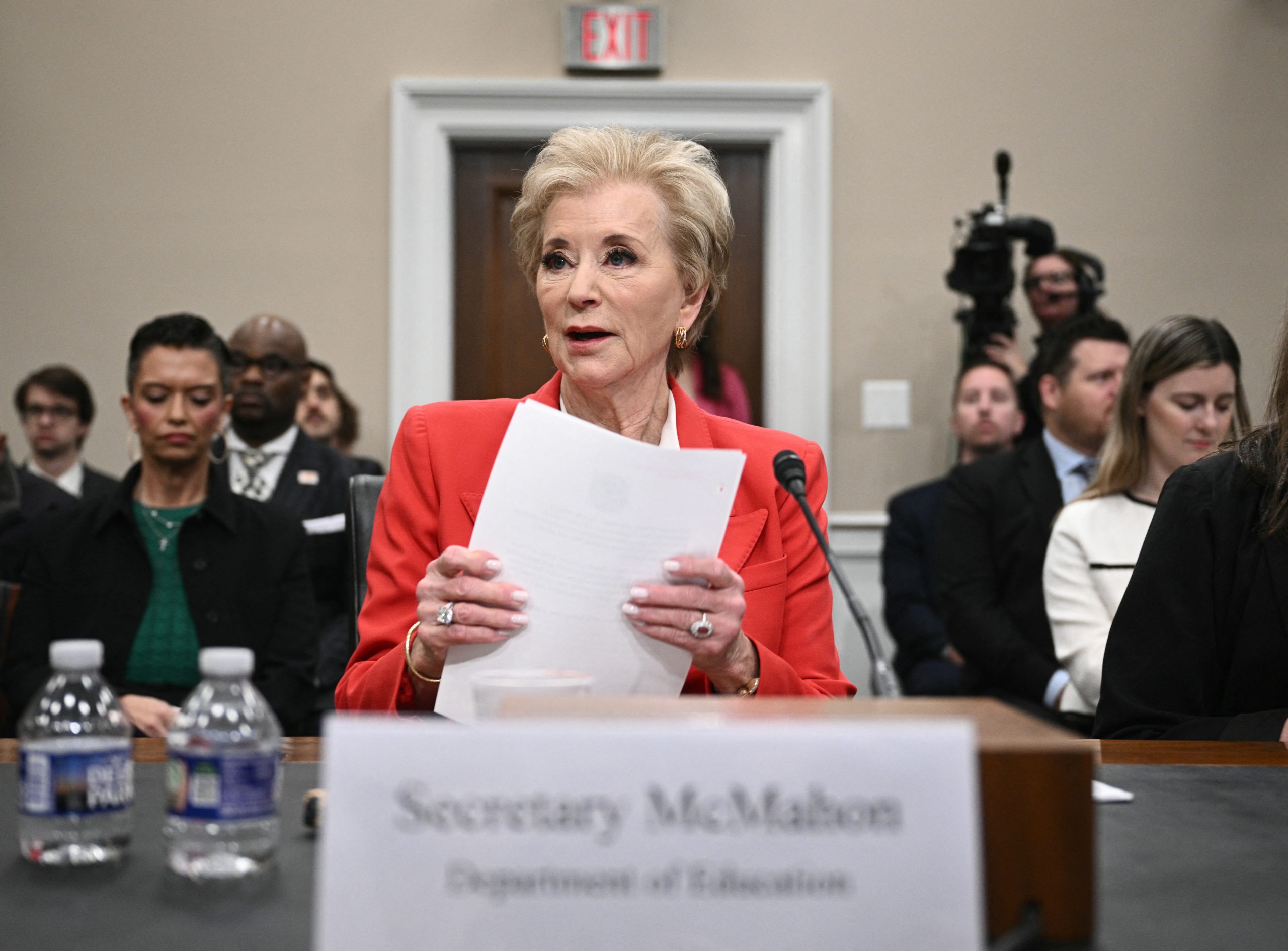
McMahon is committed to fulfilling the president’s campaign promise—shutting down the department and putting herself out of a job.
Jim Watson/AFP/Getty Images
To Education Secretary Linda McMahon, outsourcing education-related grant programs to other federal departments is just a “proof of concept” for her larger goal—closing the 45-year-old agency.
“Let’s move programs out on a temporary basis. Let’s see how the work is done. What is the result? What is the outcome?” she said in an all-staff meeting at the department Tuesday, shortly after publicly announcing six interagency agreements. “And if it has worked and we have proven that this is the best way to do it, then we’ll ask Congress to codify this and make it a permanent move.” (The meeting was closed to the public. All quotes are pulled from a recording obtained by Inside Higher Ed.)
In 20 minutes, the secretary explained her plan and the framework through which she hopes her employees and the nation will view it.
“We are not talking about shutting down the Department of Education. We are talking about returning education to states where it belongs,” she said. “That is the right messaging.”
McMahon cited polling that she said showed that while the public doesn’t support shutting down ED, respondents are more supportive when they hear the plan still preserves ED’s programs by sending them to other agencies.
A restructuring like the one in Tuesday’s announcement has been rumored for months, and the changes mirror recommendations outlined in Project 2025—a conservative blueprint that called for closing ED. (The education section of Project 2025 was spearheaded by Lindsey Burke, who is now the department’s deputy chief of staff for policy and programs.)
To advance President Trump’s goal of shuttering the agency, McMahon has previously shipped career and technical education programs to the Department of Labor and laid off nearly half of her staff.
But while the secretary said she understands the “unrest” and “uncertainty” the reductions in force have caused and stressed that they were hard decisions made with the “greatest of thought and care,” she stood firm on her belief that they were necessary.
“I applaud and appreciate everything that every one of you in this room is doing and has done over the years,” she said. “I’m not saying to any one of you that your efforts aren’t good enough—what I’m saying is the policies behind those efforts have not been good enough.”
By co-managing, “we can be more efficient and economical,” she said. “For instance, we’ve utilized Labor’s system now on grant drawdowns, and we’ve drawn down over 500 already, and they work very proficiently. It’s a better system than we had here.”
Although some conservatives praised the administration’s actions, others cast doubt on their magnitude or argued they were distracting attention from what really matters. For Margaret Spellings, former education secretary under President George W. Bush, that’s the “economic emergency” of improving student outcomes.
“Moving programs from one department to another does not actually eliminate the federal bureaucracy, and it may make the system harder for students, teachers and families to navigate and get the support they need,” she said. “We need to keep the main thing the main thing, and that is how to improve education and outcomes for all students.”
McMahon, on the other hand, told employees that this move is key to doing just that.
“We want to make sure that [students] understand there are many opportunities for them … that there are programs that will give them a great livelihood, whether they want to be electricians or doctors or Indian chiefs,” she said. “We are not closing education; we are lifting education up.”
Billionaires and the ultra-wealthy have no place in setting the future agenda for higher ed. We – the students, community members, workers that actually make the campus work – do.
In Michigan, the MI HELU coalition decided that we wanted to get ahead of the curve by providing candidates with a forum that focused exclusively on Higher Education and the challenges we are facing.
Together, we’re fighting back against the demonization of higher ed and we won’t cave to governmental bullying to water down our education system with the goal of elimination. Our students deserve better, and so do we.
Founded in 2020 during the initial phase of the COVID-19 pandemic, Scholars for a New Deal for Higher Education (SNDHE) is a group of teachers and researchers committed to rebuilding our colleges and universities so that they can be a true public resource for everyone.
And now [New York is] being punished by a federal government that sees organized labor, public education, and social investment as threats instead of strengths.
Public protest and influencing public opinion is keeping UCW (CWA Local 3821) busy. Members have been fighting fiercely to Defend Remote Work at their state institutions.
We invite you to support HELU’s work by making a direct financial contribution. While HELU’s main source of income is solidarity pledges from member organizations, these funds from individuals help us to grow capacity as we work to align the higher ed labor movement.
by John Katzman, The Hechinger Report November 19, 2025
The Trump administration’s dismantling of the U.S. Department of Education this week provides a rare opportunity to rethink our current top-down approach to school governance.
We should jump on it. It’s not sexy to talk about governance, but we can’t fix K-12 education until we do so, no matter how we feel about the latest changes.
Since the Department of Education opened in 1980, we’ve doubled per-pupil spending, and now spend about twice as much per student as does the average country in the European Union. Yet despite that funding — and the reforms, reports and technologies introduced over the past 45 years — U.S. students consistently underperform on international benchmarks. And people are opting out: 22 percent of U.S. district students are now chronically absent, while record numbers of families are opting out of those schools, choosing charters, private schools and homeschooling.
Most federal and state reform approaches have been focused on curricular standards and have accomplished little. The many billions spent on the Common Core standards coincided with — or triggered — a 13-year decline in academic performance. The underlying principles of the standards movement — that every student should learn the same things at the same time, that we know what those things are and that they don’t change over time — have made our schools even less compelling while narrowing instruction to what gets tested.
We need to address the real problem: how federal, state and district rules combine to create a dense fog of regulations and directives that often conflict or constrain one another. Educators are losing a rigged game: It’s not that they’re doing the wrong things, it’s that governance makes them unresponsive, bureaucratic, ineffective and paralyzed — can you name an industry that spends less on research and development?
Fixing governance won’t be simple, but it shouldn’t take more than 13 years to do it: three years to design a better system of state governance and 10 more to thoroughly test and debug it.
I would start by bringing together experts from a variety of disciplines, ideally at a new “Center for K-12 Governance” at a university’s school of education or school of public policy, and give them three years to think through a comprehensive set of state laws and regulations to manage schools.
The center would convene experts from inside and outside of education, in small groups focused on topics including labor, funding, data, evaluation, transportation, construction, athletics, counseling, technology, curricula and connections to higher education and the workforce. Its frameworks would address various educational and funding alternatives currently in use, including independent, charter and parochial schools, home schooling and Education Savings Accounts, all of which speak to the role of parents in making choices about their children’s education.
Each group would start with the questions and not the answers, and there are hundreds of really interesting questions to be considered: What are the various goals of our K-12 schools and how do we authentically measure schools against them? What choices do we give parents, and what information might help them make the right decisions for their kids? How do we allow for new approaches to attract, support and pay great teachers and administrators? How does money follow each student? What data do we collect and how do we use it?
After careful consideration, the center would hand its proposed statutes to a governor committed to running a long-term pilot to fully test the model. He or she would create a small alternative department of education, which would oversee a few hundred volunteer schools matched to a control group of similar schools running under the state’s legacy regime; both groups would include schools with a range of demographic and performance profiles. The two systems could run side by side for up to a decade.
Each year, the state would assess the two departments’ performance against metrics like graduation and college-completion rates, teacher retention, income trajectories, civic participation, student and parent satisfaction, and, yes, NAEP scores. Under intense scrutiny by interested parties, both groups would be free to tweak their playbooks and evaluate solutions against a range of real-world outcomes. Once definitive longitudinal data comes in, the state would shutter one department and move the governance of its schools over to the other, perhaps launching a new test with an even better system.
This all may seem like a lot of work, but it’s a patient approach to a root problem. Schools remain the nation’s most local public square; they determine income mobility, civic health and democratic resilience. If we fail to rewire the system now to support them properly, we guarantee their continued decline, to the detriment of students and society. Instead of celebrating students, teachers and principals who succeed despite the odds, we should address why we made those odds so steep.
That’s why we should use this moment to draft and test something audacious, and give the next Supreme Court a happier education case to decide: how to retire a legacy system that finally lost a fair fight.
John Katzman has founded and run three large ed tech companies: The Princeton Review, 2U and Noodle. He has worked closely with many large school districts and has served on the boards of NAPCS and NAIS.
This story about fixing K-12 education was produced by The Hechinger Report, a nonprofit, independent news organization focused on inequality and innovation in education. Sign up for Hechinger’sweekly newsletter.
This <a target=”_blank” href=”https://hechingerreport.org/opinion-it-will-take-patience-and-courage-to-fix-k-12-education-without-the-department-of-education/”>article</a> first appeared on <a target=”_blank” href=”https://hechingerreport.org”>The Hechinger Report</a> and is republished here under a <a target=”_blank” href=”https://creativecommons.org/licenses/by-nc-nd/4.0/”>Creative Commons Attribution-NonCommercial-NoDerivatives 4.0 International License</a>.<img src=”https://i0.wp.com/hechingerreport.org/wp-content/uploads/2018/06/cropped-favicon.jpg?fit=150%2C150&ssl=1″ style=”width:1em;height:1em;margin-left:10px;”>