Sterling College will close at the end of the spring semester, officials announced Wednesday.
The small college in Craftsbury Common, Vt., will cease operations in May due to “persistent financial and enrollment challenges,” according to a statement posted on its website.
“We understand that this news is difficult and deeply personal for every member of our community. Sterling College has always been more than a place of learning; it has been a home where curiosity, creativity, and compassion thrived,” officials wrote in the closure announcement.
Sterling, which offered “transdisciplinary, experiential, competency-assessed educational programs,” according to its website, historically capped enrollment at 125 students. Founded in 1958, Sterling is one of a few U.S. work colleges, a model that allows students to keep tuition down via campus labor. Residential students at Sterling work five hours per week in different roles.
Federal data shows that Sterling only had a head count of 78 students in fall 2023.
While the college managed to eke out modest surpluses in recent years, it had a meager endowment of just over $1.1 million, much of that restricted, according to financial documents.
Sterling is now the second institution to announce a closure this month, following Trinity Christian College in Illinois, which is shutting down next year due to similar challenges.
In August, the Trump administration issued an executive action ordering colleges and universities to submit disaggregated data about their applicants and prove they are following the letter of the law when it comes to race in admissions. But a new notice, published to the Federal Register Wednesday, clarifies that the mandate only applies to four-year institutions.
“We posed a directed question to the public to seek their feedback … [and] based both upon our initial thinking and public comment, we propose limit[ing] eligibility of [the new IPEDS Admissions and Consumer Transparency Supplement] to the four-year sector,” the notice stated.
Colleges that are obligated to comply must still submit six years’ worth of application and admissions data, disaggregated by student race and sex, during the next survey cycle, it said. But any college that admits 100 percent of its applicants and does not award merit or identity-based aid will be exempt.
Since the action was first published, institutions across the sector have warned the Trump administration that collecting and reporting such data would be a difficult task and place an undue burden on admissions offices. But with smaller staff sizes and limited resources, community colleges were particularly adamant about the challenge the requirement posed.
“It’s not just as easy as collecting data,” Paul Schroeder, the executive director of the Council of Professional Associations on Federal Statistics, toldInside Higher Ed in August. “It’s not just asking a couple questions about the race and ethnicity of those who were admitted versus those who applied. It’s a lot of work. It’s a lot of hours. It’s not going to be fast.”
When I first began teaching Islam, there was no road map. In 2001, I was a visiting assistant professor of Islamic and Middle Eastern studies at the University of Iowa—the first full-time professor of Islam in the history of the state. I was in my 20s, still finishing my dissertation, when the attacks of Sept. 11 unfolded. Suddenly, I found myself trying to explain a 1,400-year-old religion to students who had watched the Twin Towers fall on live television.
Teaching Islam in American universities has never been more widespread, more diverse or more embattled. That is the story of the past two decades: a field that has grown dramatically, transformed in terms of who teaches it, and now finds itself under intensifying political scrutiny.
That experience in Iowa shaped everything that came after. I discovered that my task was not only to introduce students to the theological, historical and cultural breadth of Islam but also to help them unlearn the simplistic caricatures they had absorbed from media and politics. Islam was not a monolith. It was not synonymous with terror. It was, like Christianity or Judaism, a faith defined by argument, diversity and adaptation.
Those class lectures eventually became the foundation for No god but God: The Origins, Evolution and Future of Islam, first published in 2005. I hoped the book would serve both general readers and university classrooms. To my surprise, it quickly became a popular text for teaching Islam in the United States and far beyond. It has been translated into dozens of languages, adopted in seminaries and world religion courses, and read in mosques, churches and synagogues.
Two decades later, the landscape of Islamic studies in American universities looks profoundly different. In 2001, very few institutions offered dedicated courses on Islam outside of theology departments. Today, there are hundreds of such courses, spanning history, political science, gender studies and literature. The proliferation has been remarkable—though uneven. Some courses are rigorous, rooted in language and text, while others are more ad hoc, responding to student demand and global events.
Another profound shift has been in who is teaching Islam. For most of the modern history of religious studies in America, Christian professors taught Christianity, Jewish professors taught Judaism—but it was rare to find Muslim professors teaching Islam. In nearly two decades of studying the subject, I had only one Muslim professor. That has changed dramatically. Today, Muslim scholars occupy faculty positions across the country, and new professional associations—such as the International Quranic Studies Association, of which I am a member—are fostering networks of Muslim academics who bring both scholarly expertise and lived experience into the classroom. This diversification has expanded the kinds of questions and perspectives that shape the field, though it has also forced universities to confront new debates over authority, representation and bias.
Meanwhile, the teaching of Islam—like so many fields in the humanities—is now buffeted by unprecedented political pressure. Across the country, state governments have moved to limit what can and cannot be taught in universities and ban diversity, equity and inclusion programs. More recently, elite universities such as Columbia and Harvard have faced political scrutiny from the Trump administration and Congress into their Middle East studies programs, accused by some lawmakers of being biased. In today’s climate, teaching Islam can feel like an act of defiance. Professors often self-censor, conscious that a stray lecture note could trigger outside campaigns or even threats. The irony is that in a moment when greater understanding of Islam is needed more than ever, the very institutions best equipped to provide that education are being undermined.
Yet this is precisely why teaching Islam in universities matters more than ever. At a time when Islam has faded from the headlines but remains entangled in the debates that define our era—from authoritarianism to surveillance to religious pluralism—the classroom is one of the few places where the faith can be encountered on its own terms. The role of professors is not to sanitize or defend Islam, but to present it in all its richness, contradictions and ongoing transformations.
The fully updated 20th-anniversary edition of No god but God is my attempt to support that task for another generation of teachers and students. The new preface reflects on what has changed since 2005—the Arab Spring, the rise of digital Islam, the ebb of the “war on terror”—and what has not: Islam’s enduring struggle to reconcile tradition and modernity, authority and pluralism.
More than two decades of teaching have convinced me that education about Islam cannot be episodic, tied only to moments of crisis or headlines of violence. It must be sustained, interdisciplinary and grounded in serious scholarship. It must expand beyond political science courses on terrorism and foreign policy, and beyond theology seminars comparing sacred texts, into the wider humanities and social sciences. And it must center the lived experiences of Muslims themselves.
The classroom is not a mosque. But it is one of the few spaces where young people can confront their assumptions, wrestle with complexity, and imagine new ways of understanding the role of religion in the world. That was my conviction in 2001, when I walked into a lecture hall in Iowa just days after Sept. 11. It remains my conviction today.
The classroom may not be a mosque, but it remains one of the few places where Islam can be encountered in all its richness, contradictions and humanity.
Reza Aslan is a writer and scholar of religion. His books includeZealot: The Life and Times of Jesus of Nazareth and No god but God: The Origins, Evolution, and Future of Islam, now available in an updated 20th-anniversary edition from Random House. He is a professor of creative writing at the University of California, Riverside.
There was a 9 percent increase in enrollments from the pilot county as compared to the previous CSU freshman class.
Photo illustration by Justin Morrison/Inside Higher Ed | gemenacom, ghoststone, Jose Gonzalez Buenaposada and vi73777/iStock/Getty Images
The California State University system launched a direct admissions pilot last year, offering qualifying high school seniors at school districts in Riverside County admission to 10 of its institutions. The program turned out to be an unqualified success: The number of graduates from the district who enrolled at a CSU campus this fall jumped 9 percent.
Now the system is expanding the program, thanks to legislation signed last month that will allow CSU to extend offers to students in every school district in the state starting in the 2026–27 admission cycle. The offers will grant admission to 16 of the 22 CSU campuses; the six most selective institutions will not participate.
The program ties in with the system’s goal of creating access to higher education for all Californians, said April Grommo, CSU’s assistant vice chancellor of strategic enrollment management.
“Being able to proactively inform students that they are eligible for the CSU has provided a lot of positive results,” she said. “We had a lot of students and families that did not realize they were eligible to go to a four-year university.”
With this program, California joins a cohort of about 15 states that offer students some form of direct, guaranteed or simplified admissions. The intent is to streamline the admissions process and make students aware of institutions they may not have otherwise considered, as well as to bolster institutions’ enrollment. Such programs have proven broadly successful, according to Taylor Odle, a professor of education policy studies at the University of Wisconsin.
“My work, in partnership with states and national nonprofit organizations, shows that direct admissions programs can not only increase students’ early-college going behaviors but also subsequently raise their college enrollment outcomes,” Odle wrote in an email to Inside Higher Ed. “These benefits are particularly large for students of color, those who will be the first in their family to attend college, and those from lower-income communities. States who have implemented direct admissions also consistently report higher enrollment levels following implementation.”
While different states use the term “direct admissions” slightly differently, Odle defined a true direct admissions program as “guaranteed (students are admitted to college; not an invitation to apply), universal (all students can participate), proactive (students don’t need to do anything to receive a direct admissions offer), simplified (students don’t need to apply; simply ‘claim their spot’ via a streamlined process), and free (no cost).”
In CSU’s case, qualified students—those who meet the system’s requirements regarding the courses they took in high school and who have a minimum 2.5 grade point average—receive mailers informing them that they have been admitted to all 16 participating campuses.
In the Riverside County pilot program, about 17,400 graduating seniors received admission offers. The system saw a 15 percent year-over-year increase in students from the county who completed an application for a CSU institution—direct admits don’t complete the full application, just a truncated version of it in order to accept the offer of admission—and led to the subsequent bump in enrollees. The majority ended up at Cal State San Bernardino, the closest campus to Riverside County—across the state, most CSU students attend an institution within 50 miles of their home—but others traveled farther, in some cases to study in specialized programs.
Along with the direct admissions offers, the system also launched a series of events to expose Riverside County students to CSU’s different campuses and programs. Called Discover CSU Days, the events featured panels of current students from Riverside County.
“A lot of Riverside County students are first-generation and low-income, so we talked to them about why the CSU is a good option for them,” said Grommo.
Students could enroll that same day, with some campuses waiving housing and tuition deposits for those who did.
Odle said that with so many institutions reporting positive outcomes from their direct admissions programs, such initiatives may soon become the “new norm.”
“More states and systems of higher education should be in the business of identifying challenges, designing and implementing pilot programs to address them, rigorously studying them, and then making expansion decisions (like this) based on evidence,” he wrote. “Given CSU’s access and service mission to the state, it makes sense that it joins a variety of other systems nationally at implementing this evidence-based practice to raise enrollments and reduce gaps in access.”
These institutions are the backbone of American higher education. They serve the largest share of students by far, and state-supported colleges and universities play an outsize role in providing economic mobility for Americans of all backgrounds. I’ve spent my entire career working on behalf of public universities, most recently as president of the Association of Public and Land-grant Universities. I know the enormous good they do for their students and for society at large. We have the best publicly supported system of higher education in the world. We can and must continue to improve it.
I also understand why our public institutions will benefit from an accreditor that aligns with their mission and their public obligations. They need an accreditor that offers true peer review and a disciplined focus on improving student outcomes. They need an accreditor familiar with the mechanics of state oversight, able to promote academic quality while also being more efficient by eliminating redundant bureaucracy in the accreditation process.
The Commission for Public Higher Education was formed earlier this year to answer those needs. Established by a consortium of six public university systems—the State University System of Florida, the University System of Georgia, the University of North Carolina System, the University of South Carolina System, the University of Tennessee System and the Texas A&M University System—the aim of CPHE is to offer public universities across the country an alternative to the regional accreditors that have long dominated higher education, each claiming a geographical monopoly that lumped together for-profit schools, bespoke private colleges and open-access public institutions under the same set of rules and regulations.
I agreed to serve as chair of the Board of Directors for CPHE because I believe there’s a need for innovation in accreditation. We are seizing the opportunity to improve institutional accreditation by focusing on outcomes, as well as streamlining the process by taking advantage of the considerable oversight that public institutions are subject to at the state level. An accreditor purpose-built by public institutions, for public institutions, can promote academic quality while driving innovation in student success and eliminating unnecessary costs in the legacy model of accreditation.
There is clearly enthusiasm for the vision behind CPHE. Ten diverse institutions have already signed on to join CPHE’s initial cohort (full list below), and the commission is fielding additional inquiries from across the country. We’ve just issued a call for public university faculty and administrators to join our first group of peer-review teams, and we look forward to pioneering a new model of more straightforward and more transparent accreditation review.
CPHE Initial Cohort
Appalachian State University
Chipola College
Columbus State University
Florida Atlantic University
Florida Polytechnic University
North Carolina Central University
Texas A&M–Kingsville
Texas A&M–Texarkana
University of North Carolina at Charlotte
University of South Georgia
University leaders and state policymakers nationwide see the value in a streamlined approach to accreditation that shifts the focus from inputs and operational minutiae to meaningful outcomes for students and taxpayers.
The legacy approach to accreditation is plagued by the need for each accreditor to serve the huge diversity of institutional missions and governing structures that underlie the American system of higher education. Trying to impose the same set of criteria and procedures on every institution, from small private colleges to huge public flagships, has led to decades of ineffective oversight and wasted effort. There is little or no evidence that institutional accreditation has driven quality improvements across the sector, while it is abundantly clear that it has imposed arbitrary and opaque regulatory demands on institutions that already are subjected to multiple layers of oversight as public agencies.
Institutions like Georgia State University, where I served more than a decade as president, are closely scrutinized by their governing boards, by state regulators and legislative bodies, by auditors and bond ratings agencies. They have public disclosure and consumer protection requirements above and beyond what is demanded of private and for-profit colleges. I have firsthand experience with how costly and cumbersome accreditation reviews divert institutional resources that would be better spent supporting student success, and I am confident a public-focused accreditor can streamline reporting and compliance costs without compromising oversight.
An accreditor attuned to the nuances of public oversight can add value by focusing on academic quality and student success, using a process of peer review to promote continuous improvement through the dissemination of best practices and innovations. That’s why CPHE’s accreditation standards are tailored toward public purpose and academic excellence, with provisions for measuring student learning, promoting academic freedom and intellectual diversity, and driving continuous improvement of student outcomes.
At core, the purpose of accreditation is to reassure students and taxpayers that universities are delivering on their promise to provide a quality education that leaves students better off. An accreditor tightly focused on that public mission can go a long way in shoring up the trust that higher education needs to thrive.
Mark Becker is the chair of the Board of Directors of the Commission for Public Higher Education. He formerly served as president of the Association of Public and Land-grant Universities from 2022 to 2025, and before that he was president of Georgia State University from 2009 to 2021.
Since 2022, there’s been a surge in the number and types of applications using generative AI, but not all tools are the same. So how can faculty, staff and students learn to identify the differences and determine when it’s appropriate to leverage these tools?
Colby College developed a platform, called Mule Chat, that allows users to explore several large language models, including ChatGPT, Gemini, Claude and LLaMA. The platform provides a safe on-ramp into generative AI usage and relies on student tutors to disseminate information to peers.
In the latest episode of Voices of Student Success, host Ashley Mowreader speaks with David Watts, the director of Colby College’s Davis Institute for Artificial Intelligence, and Michael Yankoski, Davis AI research and teaching scientist, to learn about the college’s AI institute and how Mule Chat works.
An edited version of the podcast appears below.
Inside Higher Ed: Can we start the conversation by talking a bit about what AI at Colby College looks like? What is the landscape you’re working with and how are you thinking about AI when it comes to teaching and learning?
David Watts: I am new to Davis AI, as we call it at Colby, but the [Davis AI] Institute has actually been around since before ChatGPT, so Colby kind of had a pioneering approach.
David Watts, director of the Davis Institute for AI at Colby College
Colby is a small liberal arts college, and they had the vision that this was going to be around for a while. And rather than, as most institutions were doing, sort of keep it at bay or ban it from campus, Colby dove in and wanted to engage with it and understand how it is going to impact education.
I spent most of my career in industry, mostly in research and development, and so I when I wanted to make the jump over to academia, I wasn’t expecting to find that small liberal arts colleges had done this, and when I saw what Colby had done, I was really drawn to it and came over. So I’ve really loved what has been going on and what continues to go on at Colby with the Davis Institute for Artificial Intelligence.
Inside Higher Ed: Michael, your role puts you directly in connection with faculty when it comes to integrating AI into their classrooms or into their programs. Can you talk about what that looks like and how maybe that looks different at a liberal arts institution?
Michael Yankoski, research and teaching scientist, Davis Institute for AI at Colby College
Michael Yankoski: One of the most amazing aspects of the Davis Institute for Artificial Intelligence here at a place like Colby is the liberal arts approach that the institution as a whole is able to engage with.
That means that we’re able to facilitate conversations from a multiplicity of different disciplines and bring faculty together from different approaches across the divisions in the college—from the STEM fields to the humanities to the social sciences. And have really productive, very generative conversations around ways to engage with artificial intelligence and the shared learning and shared knowledge of people who have been really pioneering in the area. To able to say, “How can I integrate generative artificial intelligence with my pedagogy? How can I help think with students about how to engage these technologies in a way that is beneficial for their education, help empower students in their education and then on the research side?”
Many faculty with whom we work at the Davis Institute are exploring ways to integrate artificial intelligence in their research program, and to say, “Is there a way that artificial intelligence can help me accelerate my research or take my research in new directions?” The opportunity to bring people together to discuss that and to facilitate those conversations across the disciplines is one of the best aspects of the liberal arts approach to artificial intelligence.
Inside Higher Ed: Does Colby have an institutional policy for AI use, or what appropriate AI use looks like?
Watts: It’s a moving target. Anyone who tells you they have it all figured out is probably embellishing. It is a moving target, but one of the things we did was make sure we engage faculty, and in fact, we started with faculty, then we engaged administrators, we engaged students and we engaged general counsel, and evaluated what the challenges are, what the downsides are. And we made sure that we built what we call guidelines rather than policy.
The guidelines talk through the dos and don’ts but also leave enough flexibility for our faculty to think through how they want to engage with AI, especially since AI is a moving target, too. As we grow and learn with our faculty, we adapt and adjust our guidelines and so they’re out there for everyone to see, and we will continue to evolve them as we move forward.
Inside Higher Ed: Can you introduce our listeners to Mule Chat? What is it and how does it work on campus?
Watts: Michael has been here and was one of the originators of creating Mule Chat on campus. And so he can tell you a lot of the details and how it’s been working.
But what I loved about what Michael and the team did, and it was a collaborative effort, was to create, I’ll call it an on-ramp. We were working towards moving the needle from banning AI, as one extreme, to engaging with AI and creating a tool that allowed faculty, students and staff to all easily engage with multiple tools through Mule Chat.
It lowered the activation barrier to entry to AI and allowed us to have an on-ramp for people to come in and start seeing what the possibilities are, and it has worked brilliantly.
Yankoski: The idea behind Mule Chat originally was to provide a place for students, faculty and staff to begin to get experience with and understanding around generative AI. To provide a space where folks could come and understand a bit more about, what are these tools? How do they work? What are they capable of? What are some of the areas we need to be aware of, the risks and the best practices, and how can we provide this on-ramp, as David described, for people to be able to engage with generative artificial intelligence?
This is about student success, empowering students to understand what these technologies are, what they’re good at, what they’re not good at. And then also, one of the key principles here was equity of access. We wanted to ensure that anybody on Colby’s campus, regardless of whether they could afford one of the premium subscription services, was able to get access to these frontier models and to understand how to then do the prompt engineering work, and to then compare the kinds of outputs and capabilities of some of the frontier models. And so really, the core sort of genesis and driving desire for the creation of Mule Chat was to provide this on-ramp that would empower student success, allow equity of access, and also would provide a safe and secure place for people to be able to engage these technologies and to learn.
Inside Higher Ed: Can you describe the functionality of Mule Chat? For someone who has never experimented with LLMs, what does it look like or feel like to engage with Mule Chat?
Watts: You touched on something really great there, because that was part of the idea. We introduced multiple models into Mule Chat so that people could compare and get an idea of what it’s capable of and what it’s not capable of.
I’ll give an example of a faculty member who we are working with right now who started with Mule Chat, engaged with it in their preparation—this is a professor of East Asian studies—how they prepare their classes, realized what the capabilities were, started doing more with it, with their students. The students then brought interesting ideas about what else we can do and pushed beyond even the limits of Mule Chat. And then Davis AI can go help them bring in, for example, they were looking at—not only just looking at old archives and using that in their teaching of East Asian studies, but also bringing in video capability, for example, and in fact, even creating new videos or some of the research that they’re doing now, bringing in more capabilities above and beyond Mule Chat. So it is exactly what Michael was saying, an on-ramp that then opens up the possibilities of what we can do with AI in higher education.
Yankoski: I think the real value of the Mule Chat interface is that it allows people to compare the different models.
Folks can use prompt engineering to compare the outputs of one model and then put that alongside the outputs of another model and be able to observe the way that different models might reason or might do their inference in different kinds of ways.
That side-by-side comparison is a really powerful opportunity for people to engage with the different models and to experience the different kinds of outputs that they create. To build on what David was saying, the ability to then put other tools [like videos] inside of the Mule Chat platform, that allows for deeper research into particular areas. For example, we have a tool that we built, which is called Echo Bot.
The Colby student newspaper is called the Colby Echo, so we’ve been able to bring all the archives of the Echo into a tool that allows students and faculty researchers to engage with those archives and chat with the entire archive of the Colby Echo. We’ve been working closely—and this goes back to the liberal arts approach—with different faculty across campus, as well as the college libraries, to bring this tool online and make it available within the Mule Chat system.
Inside Higher Ed: Let me know if you can build me an IHE bot, because I can never find anything in our archives. I could really benefit from something.
Watts: We can brainstorm on that.
Inside Higher Ed: Great, we’ll talk about licensing later.
I wanted to ask, it seems there’s a new AI tool that pops every other day. So when you’re talking about comparing different tools and thinking about what might be most relevant for students, how often are you scouting out the landscape to understand what’s out there and relevant?
Watts: That’s a great question, and actually extremely important that we do that.
Not only are we reaching out and finding, reading, learning, attending conferences, helping to create conferences ourselves that bring in people and experts who are different perspectives, but we also then have lots of people on campus who have their own ideas. People come to us regularly with, “Oh, look at this cool tool. We should use it for this thing on campus.”
And that’s when we use that for educating people about some of the potential pitfalls that we have to watch out for, talking about guardrails and when you’re bringing in new capability, just like you had to think about when you’re bringing in new software. But I think it’s even more imperative that we’re very careful about what AI tools we bring into campus. You’re absolutely right that there are tons of them that all have different capabilities. But one of the things we try to teach is that there’s a full spectrum: the great, the good, the bad and the ugly. You have to think about that entire spectrum. And that’s one of the beauties of what I loved about coming to a liberal arts college was that you have multiple perspectives, and coming from all forms of disciplines in the humanities, the arts, the natural sciences, the social sciences, and all are engaged and can be engaged across AI.
Yankoski: I think that’s what’s so unique and really powerful about the Davis Institute for Artificial Intelligence approach. When we work with faculty and students and really, if some faculty member or student has an idea that they want to explore, we have structures that allow for technology grants, for faculty to be able to come and to propose the use of a new tool, or to advance their teaching or to advance their research.
Then that’s a great opportunity to engage with that faculty member and perhaps their research assistants, and work with those students and that faculty member to explore the possibility of using that tool. Each faculty member knows their domain so much better than we do. As the core Davis AI team, we’re able to work with that faculty and those students to better understand the use case, better understand the tools that they want to engage, and then work with them to consult and to create a pathway forward. That’s an incredible opportunity as well for the students to understand, how do we think about the security of the data? How do we think about the processing pipeline? How do we think about the best practices with regards to utilizing artificial intelligence in this particular domain?
Really that’s about student empowerment and student success as they get ready to transition out of college into an economy where increasingly expectations around knowledge and the ability to utilize and to vet artificial intelligence are only going to increase.
Inside Higher Ed: How are students engaged in this work?
Yankoski: One the most intriguing aspects of Mule Chat has been that students have been really leading in teaching and empowering other students to utilize the tool and to understand the quantum engineering aspects and to understand the different models.
The student leaders have been working with Mule Chat and then actually teaching other students, teaching faculty and helping lead the sessions, as well as working on their own projects within Google Chat. So it’s been a really strong and quite incredible platform for student engagement and student empowerment as students learn from one another and then are able to learn how to teach about these tools to their peers.
Watts: That’s absolutely a huge part of what we did, and I mentioned that, even though students come first, we started working to move the needle with faculty first on purpose, with students in mind. And then we branched out into, now we can engage the students. Once you have enough buy-in from faculty, start engaging the students, and we’ve been doing a lot of that.
Then what’s beautiful, the magic happens when the students start coming up with thoughts and ideas that grow in ways that faculty haven’t thought of. Because remember that a lot of this is new to faculty as well.
So we actually then will identify key students that we have been working with and actually hire them on board as Davis AI research associates that then help us continue to move the needle, because there’s nothing better for students than to hear from other students about what’s possible. And the same goes for faculty, by the way. So, you know, Michael was mentioning a little bit about our strategy with faculty and how we engage them. But a part of what we do is faculty sessions. We give them creative names like “Bagels and bots,” and we include food and then we have those sessions where faculty talk to faculty. We do the same with the students, so students can talk to students. And it’s just wonderful to see the magic that happens when that begins to grow organically.
Inside Higher Ed: What has the reception been to Mule Chat?
Watts: Most people were skeptical [of AI] early on; most were in the mode of “push it away.” I think that drove some interesting behaviors in faculty and students.
So a big part of what we’ve been trying to do is essentially drive towards AI literacy for all. And when I say all, it’s an interdisciplinary approach. We’re looking across the entire campus, and so all students in all departments are what we’re driving towards. Now, you correctly point out that there will always be skeptics. I will strive for 100 percent, but if we asymptotically approach that into the future, I’ll live with that.
The goal is to prepare students, and that’s who we need to make sure that we’re preparing for the life they’re going to go into that’s been transformed by AI, that touches everybody. One of the cool things is we’re giving out grants to faculty to engage with AI and come up with ideas, and we’re doing that on multiple levels, and those faculty are now coming from all. We have art professors. We have writing professors. We have East Asian studies. We have professors from government, we have all of them engaging and so we’ve been able to, therefore, move the needle quite a bit so that a lot more people are a lot more receptive and open to it on campus, which is great.
Inside Higher Ed: You mentioned that Colby has a faculty-led approach, but sometimes that means that students from specific majors or disciplines might be less exposed to AI than others, depending on who their faculty are. It seems like you all are taking a balanced approach, not only encouraging enthusiastic AI entrepreneurs but also working with the skeptics.
Watts: It’s absolutely critical that we work on both ends of that spectrum, if that makes sense. We’re driving great innovation, and there’s great examples of research right here on campus that are doing wonderful things in an interdisciplinary way.
We just won an NSF grant for ARIA, an NSF institute looking at AI assistance in mental health, because that’s one of the most challenging spaces for how the models interact with people with mental and behavioral health challenges. It’s a perfect example of our interdisciplinary approach, with a professor from psychology working with a professor from computer science to go tackle these challenging areas. And I think that’s one of the things that Colby has done well, is to take that broader, interdisciplinary approach. Many people say that word now, but I think the liberal arts are primed for leading the charge on what that’s going to look like, because AI, by its nature, is interdisciplinary.
Inside Higher Ed: What’s next on campus? Is there any area that you’re all exploring or looking to do some more research in, or new tools and initiatives that our listeners should know about for the future?
Watts: We’re consistently evaluating that and bringing them in. What we’re trying to do is let it grow based on need as people explore and come up with ideas.
I mentioned the video; we’re now enabling video capability so we can do some of that research. It also opens up more multimodal approaches.
One of the approaches to the ARIA research, for example, is we want to be able to detect and therefore build context-aware assistance to have better results for everyone. So if we can solve the mental and behavioral health challenges, it’s probably one of the most difficult ones. It can also solve some of the other areas of underrepresented people who are left out or underrepresented groups who are left out of training, for example, which can lead to challenging behaviors.
I’m really excited about all of those possibilities and the areas that allow us to enable. We talked about access, we can also talk about accessibility.
We have on campus the Colby College Museum of Art; one of the faculty in computer science is exploring accessibility options using AI with a robotic seeing-eye dog. If someone wanted to visit the museum who was blind or visually impaired, they could interact with a seeing-eye dog that they’re used to, but this seeing-eye dog now might have more capability to communicate with people about what they’re seeing and in a museum setting, for example.
So really excited about that type of research: how do we really benefit humanity with these types of tools.
Inside Higher Ed: One thing I wanted to ask about is resources allocated from the university to be able to access all these tools. What investment is the college making to ensure that students are able to stay on the cutting edge of AI initiatives?
Watts: That’s absolutely critical. We want to make it no cost to our students and accessible to our students, but it still costs. So [it’s vital to] make sure that we have funding.
We were very lucky that we got a Davis endowment that enabled us to build the Davis Institute. That was huge because, and you can think about some of the challenges with federal funding and all of that stuff, but to have an endowment that allowed us to draw on that and really build strong capabilities at Colby College was critical. But you’re touching on the fact that we’re going to need to continue to do that. And that’s where, for example, the NSF grant and other grants that we will continue to explore will help us with how we continue to grow our impact and grow our value as we head into the future.
Rating colleges against each other is a tricky enterprise on a good day. For community colleges it’s particularly vexed, given how intensely local they are and the simple fact that most of them don’t compete with each other. If, say, a community college in Illinois or Arizona does something terrific, I don’t feel threatened by it; our students in Pennsylvania aren’t going to move there in large numbers based on ratings.
Still, the lure of lists is powerful. The new Carnegie classifications, as outlined by Inside Higher Ed, rate community colleges largely by the subsequent earnings of their students compared to local labor markets. The article outlines one key objection based on economic geography: In some parts of the country, the median wages and cost of living are so high that even students coming out of very successful vocational programs will struggle economically at first.
It’s similar to the objection I noted a few years ago to the “social mobility” ratings that Washington Monthly offered, in which colleges were graded based on how many quartiles of income their students jumped. To score really well on that metric, you’d better have most of your students start in the bottom quartile. A college located in an area with more students in the second quartile simply couldn’t compete, no matter how well it did its job.
The measurement error in this case is more well-meaning than in many others, but it’s still an error. And I’m still unconvinced that it adequately captures the value of students who transfer, whether with a degree or just with a bunch of classes.
Presumably, those objections could be incorporated into a more refined effort. But even the objections implicitly concede that the only relevant scale on which to measure education is income. Postcollege income matters, of course, but it’s not the only thing that matters. If it were, we would stop training early-childhood teachers and social workers immediately.
Part of the attraction of measuring income is that it’s quantifiable. Even I sometimes get twitchy when academics refer to the “ineffable” benefits of something; it can be hard to disentangle idealism from wishful thinking. But some noneconomic benefits of higher education are relatively easy to quantify in the short term.
What if we measured colleges on the voting rates of new graduates?
Voting is quantifiable, at least for now. It’s a basic form of adult civic engagement. It doesn’t rely on economic cycles that can wreak havoc with starting salaries. And we know from decades of political science that on average, people who vote are more knowledgeable about politics and social issues than people who don’t. (Contrary to popular myth, people who consistently vote a party line are more informed on average than ticket-splitters, but that’s another article.)
Voting rates also wouldn’t be distorted by the low earnings of students who transferred and are in their junior or senior years of college when surveyed. Yes, voting rates are higher in presidential years, but presidential years happen at the same time for every college in the country, so they wouldn’t affect comparisons between institutions.
If we took postgraduation voting rates seriously, colleges would be incentivized to improve the civic literacy and involvement of their students. That strikes me as an excellent outcome. That’s especially true for community colleges, given that their student bodies are much more representative of America than the elite selective universities.
Community colleges train, yes, but they also educate. Why not educate for democracy? And why not support—with funding and publicity—the colleges that do a particularly good job of that?
This blog was kindly authored by Joseph Morrison-Howe, former HEPI intern and recent graduate of the University of Nottingham. This blog is the seventh blog in HEPI’s series responding to the post-16 education and skills white paper. You can find the others in the series here, here, here, here, here and here.
Tuition fees rising with inflation serves as a reminder that going to university is a significant financial commitment for the student. In the recent Post-16 Education and Skillswhite paper, the Government commits to making higher education more skills focused because ‘there is a disconnect between what individuals choose to study and the needs of the economy, which limits people’s earning potential’. To achieve this, the Government seems to be leaning towards interventionalist policies. However, since the individuals themselves are involved in a financial decision, then presumably the Government’s desire for growth – that is, boosting average incomes – is largely not at odds with the individual. Therefore improving knowledge and access to information, which makes the individual’s decision more informed, is a viable alternative to interventionalist policy, and the Government’s commitment to providing graduate earning’s data on UCAS could lead the individual to choose courses with higher earnings should they want, which is in line with the Government’s aims whilst improving choice rather than curtailing it.
The Ministerial Foreword to the white paper states that the Government’s ‘defining mission’ of growth ‘relies on providing real opportunities through education and training that lead to real careers.’ In terms of policy, this aim seems to be taking the Government in an interventionalist direction, in an attempt to align what they see as the skills required in the economy with the skills being learnt in post-16 education. For example, by making the modular use of Lifelong Learning Entitlement conditional on the chosen course being aligned with the Government’s Industrial Strategy the Government hopes to create a workforce that is more productive in the jobs that the labour market demands. A more productive workforce is one associated with higher incomes, and so by pushing people towards the skills set out in their Industrial Strategy, the government hopes to achieve growth.
Interventionalist policies such as this, although moderate, can have adverse effects, however. Through the above policy, the Government might succeed in fixing the mismatch of skills learnt and skills demanded by the economy. However, the government cannot consider how happy an individual will be from entering a particular profession, and thus, by prioritising financial returns over choice, the welfare of individuals may be neglected.
It is worth remembering that for each individual, going to university is a financial commitment, but there are several reasons why it is difficult to make an informed decision about the financial aspect of going to university. The financial decision comprises the costs and gains of attending. The costs are difficult to determine because repayment is determined by future earnings, which at 18 is a distant and uncertain prospect. The financial gains are likewise uncertain because of the huge variety between courses as well as individuals, but this uncertainty can be limited. In England, there is a lot of data available on average graduate earnings by course and educational institution. This information is currently available on the Discover Uni website, but is very rarely accessed (see Imperfect Information in Higher Education). Perhaps the disconnect discussed in the recent white paper ‘between what individuals choose to study and the needs of the economy’ could be fixed to some extent by ensuring that when individuals choose what to study, they are in an informed position about earning differentials associated with different courses and institutions. This way, the prospective student has the capacity to make an informed financial decision, but still has complete freedom to study without it being a solely financial decision.
In the white paper, the Government has committed to integrating graduate earnings data into the UCAS website, ensuring the data will be seen and used by more prospective students, as proposed in Imperfect Information in Higher Education. This approach of helping individuals make an informed choice about what and where to study, rather than taking a more interventionalist approach, as a way of fixing the disconnect between study and the skills demanded by the economy, is valuable because it preserves individual choice. Someone who values high pay in return for their studies could use this graduate earnings data to ensure that the course they choose has the capacity to provide this. Someone who wishes to study for the sake of the subject, or someone who wants to study something that leads to a particular low-earning job because it will make them happy, has complete freedom to make this choice. This policy, by preserving choice and improving access to information, can promote government aims such as growth whilst letting people choose what they want.
This week’s blog come full of post-war scientific and technological optimism. We begin in 1944: Alan Butler, chairman of the de Havilland Aircraft Company, offered 90 acres to the Hertfordshire County Council for a technical college. De Havilland was based in Hatfield, and was one of the big names in aeronautical engineering and manufacture. (The world’s first commercial jet airliner – the de Havilland Comet – first flew in 1949. If you’d like to lament the apparent loss of Britain’s expertise and ambition, you may do so here.)
The county council accepted, and in 1949 Dr Chapman, erstwhile principal of Stafford Technical College, was appointed as the first principal of the Hatfield Technical College.
The image below and the snippet are both taken from The Sphere of 2 April 1949 and show that planning and construction were proceeding apace, and that modern, flexible, college accommodation was being built.
In 1952 the college opened. Formally, by the Duke of Edinburgh in December; practically, I imagine it was September for new students. And in that first year over 1,700 students enrolled. The vast majority were part-time or evening students; a small number – 55 – were full-time or on sandwich courses.
In 1956 the college offered a short course in computing – the first at the college – on “the application of computers to automation”. (The first transistorised computer had been developed at the University of Manchester only three years previously, so this was good advanced stuff.)
By the end of the decade students could not only gain technical qualifications but also degrees, via the University of London’s external system. The first such students graduated with BSc(Eng) degrees in 1958.
The 1960s saw much change and development. The college was renamed as the Hatfield College of Technology in 1960, following the government’s review of technical education. The colleges of technology were a counterpart to the colleges of advanced technology – like Aston, Bath and Brunel – which became universities in 1966. A digital computer was bought in 1962, costing more than £29,000 – almost £550k in today’s money.
By 1965 the Council for National Academic Awards (CNAA) had been established, and thirteen programmes at Hatfield College of Technology were recognised as honours degree courses. The college was well-placed to become Hatfield Polytechnic in 1969.
A campus was added in 1967, at Bayfordbury; in 1970 an observatory was built here. Also in 1070, a computer centre was opened, which was, apparently, the best equipped facility in public sector education in the country. It housed a DEC PDP-10, which is just the sort of mainframe that you see in 1970s futuristic sci-fi. And the polytechnic paid £256,500 for it, which is about £3.5 million today: this was a poly that knew how to invest.
Two local colleges of education were incorporated, in line with then policy to merge local authority provision – these were the Balls Park and Wall Hall teacher training colleges.
By 1988 the poly was one of those accredited by the CNAA, which gave it much more direct responsibility for the curriculum, quality and standards of its own degrees. This wasn’t universally done: only 21 polytechnics were so designated. It was also one of only eight polytechnics accredited for research degrees.
When polytechnics became universities in 1992, Hatfield Polytechnic became the University of Hertfordshire. The Hertfordshire College of Health Care and Nursing Studies and the Barnet College of Nursing and Midwifery were incorporated into the university in 1993.
Here are a couple of factoids about the university:
The university runs a bus company – UnoBus – which originally served to shuttle students between campuses but grew and now operates public bus services across Hertfordshire and some surrounding countries. This is a very different to the sort of companies which normally emerge from universities!
The university also hosted what is thought to be the longest exposure photograph ever. Artist Regina Valkenborgh was studying for a master’s degree at the university and installed a rudimentary pinhole camera – a beer can with photographic paper inside – on the observatory dome. Eight years later the can was retrieved. You can read more about the story here; and see the extraordinary image here.
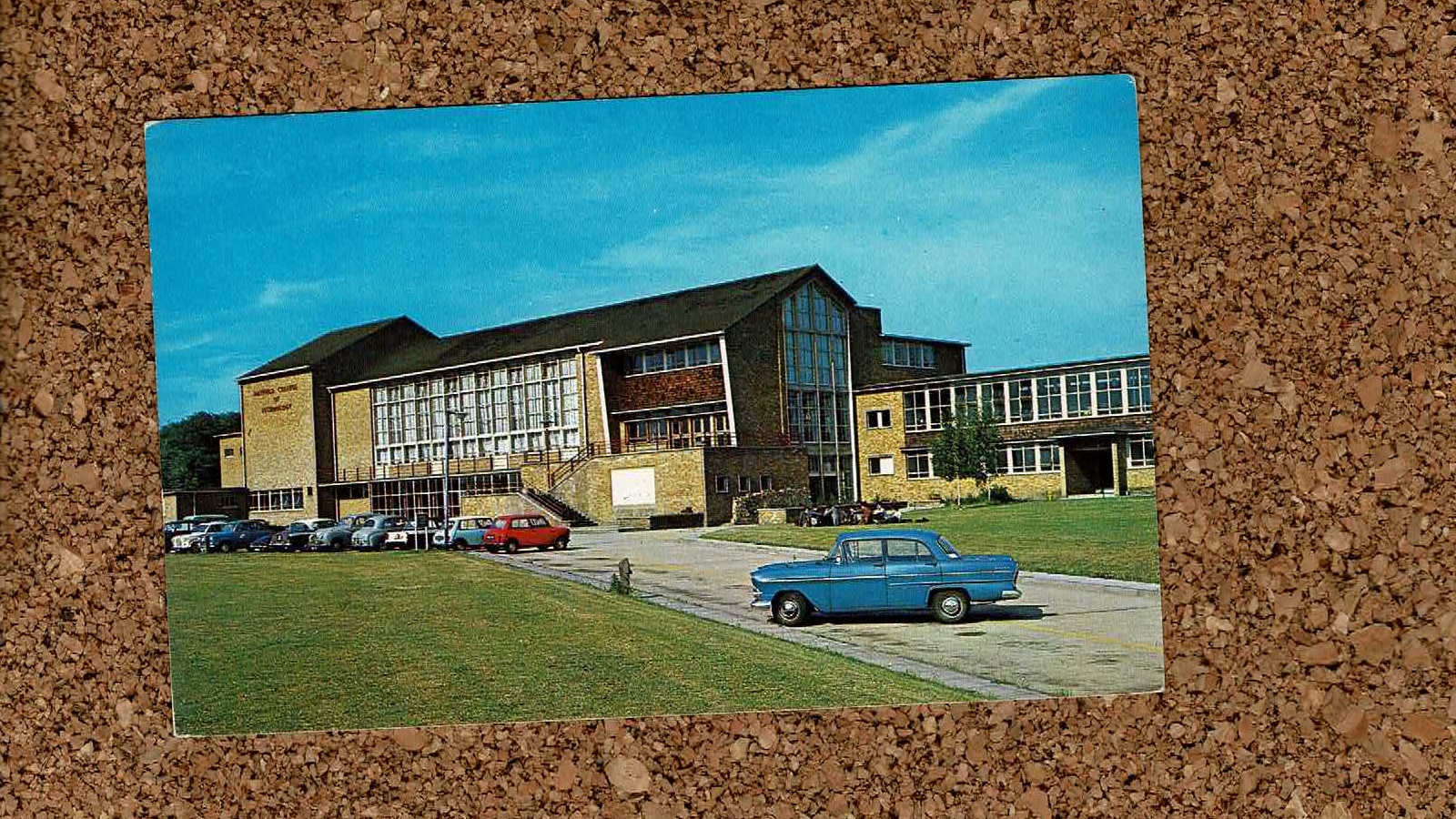
And finally, as is now customary, here’s a jigsaw of the card. This was posted on 7 August 1957 to an address in Salies-de-Béarn, near Biarritz, France. And, very exotically and excitingly, is written in French. I don’t speak much French at all, but it looks like the sender was an exchange student staying with a family in Hatfield.
Courses that “advocate race or gender ideology, sexual orientation, or gender identity” now require presidential approval at Texas A&M system campuses, the system Board of Regents decided Thursday.
Faculty members and external advocacy groups say the new rules violate academic freedom, and for many professors, questions remain about how the policies will be implemented and enforced. Approved in a unanimous vote after a lengthy public comment period, the policy changes fit a pattern of censorship at Texas A&M that escalated after a video of a student challenging an instructor about a lesson on gender identity went viral, leading to the instructor’s firing and the resignation of then-president Mark Welsh.
Dan Braaten, an associate professor of political science at Texas A&M San Antonio and president of the campus American Association of University Professors chapter, said he was shocked “at the egregiousness” of the policies, but not surprised by them.
“Faculty are extremely worried,” Braaten said. “They’re wondering, can they teach the classes they’re scheduled to teach in the spring? Who’s going to be looking at their syllabi? … Is the president of each A&M university going to have to approve every syllabus? Are there penalties for any of this? It’s just a complete … serious violation of academic freedom.”
The board approved the new rules as revisions to existing system policies. A policy on “Civil Rights Protections and Compliance” will be amended to state that “no system academic course will advocate race or gender ideology, sexual orientation, or gender identity unless the course is approved by the member CEO.” It will also define “gender ideology” as “a concept of self-assessed gender identity replacing, and disconnected from, the biological category of sex.”
Similarly, “race ideology” is defined as “a concept that attempts to shame a particular race or ethnicity, accuse them of being oppressors in a racial hierarchy or conspiracy, ascribe to them less value as contributors to society and public discourse because of their race or ethnicity, or assign them intrinsic guilt based on the actions of their presumed ancestors or relatives in other areas of the world. This also includes course content that promotes activism on issues related to race or ethnicity, rather than academic instruction.”
Teaching Versus Advocacy
A previous version of the revision proposed that no system academic course will “teach” race or gender ideology, but the verb was changed to “advocate” before the policies were presented formally to the full board. It’s unclear how the system will differentiate between advocacy and regular instruction on these topics. Representatives for the board on Wednesday declined to comment on the policies ahead of the board vote. They did not respond to Inside Higher Ed’s questions after the policies were approved.
A second policy on “Academic Freedom, Responsibility and Tenure” previously stated that “each faculty member is entitled to full freedom in the classroom in discussing the subject that the faculty member teaches, but a faculty member should not introduce a controversial matter that has no relation to the classroom subject.” The approved amendment adds that faculty members may not “teach material that is inconsistent with the approved syllabus for the course.”
In a partially redacted Nov. 10 email obtained by Inside Higher Ed, a Texas A&M faculty leader said that administrators at several universities were already discussing implementation plans ahead of the board vote. An administrator also told the faculty leader that the changes to the policy would not likely lead to a formal syllabus-approval process and instead are intended to keep course content aligned with learning outcomes.
The board received 142 written comments ahead of Thursday’s vote, and eight faculty members spoke out against the policy changes during the meeting’s public comment period. Several of them also called for Melissa McCoul, the professor fired in September, to be reinstated.
“This is not university-level education, it is cruelty and political indoctrination in wolf’s clothing,” said Leonard Bright, a professor of government and public service and president of the Texas A&M College Station AAUP chapter. “I would need to tell my students that ‘What you came here to learn, I’m unable to tell you, because I’m restricted to tell you that information, even though such knowledge is available at every major university in this world.’”
Sonia Hernandez, a liberal arts professor who teaches about Latin American history, shared a past example that highlighted the pitfalls of the new policies.
“I had a student once who took issue with my discussion of the importance of military history. He was against war and felt strongly about war’s damaging effects on society, yet it was full academic freedom—not cherry-picking of topics, not advocacy, not ideology—that allowed me to share research on the intersections of war and identity with my class,” Hernandez said.
Two faculty members—finance professor Adam Kolasinski and biomedical engineering professor John Criscione—spoke in favor of the policy changes.
“I don’t think somebody should be able to say that Germans born two generations after the Holocaust somehow bear guilt for the Holocaust, because that’s really what’s being prohibited here,” Kolasinski said. “My colleagues seem to think that the policy says something it doesn’t.” Kolasinski also suggested the board change the language back from “advocate” to “teach.”
“By considering these policy changes, the Texas A&M University System Board of Regents is telling faculty, ‘Shut up and teach—and we’ll tell you what to teach,’” Evans said in the statement. “This language and the censorship it imposes will cause irreparable harm to the reputation of the university, and impede faculty and students from their main mission on campus: to teach, learn, think critically, and create and share new knowledge.”
In a Monday statement, FIRE officials wrote, “Hiring professors with PhDs is meaningless if administrators are the ones deciding what gets taught … Faculty would need permission to teach students about not just modern controversies, but also civil rights, the Civil War, or even ancient Greek comedies. This is not just bad policy. It invites unlawful censorship, chills academic freedom, and undermines the core purpose of a university. Faculty will start asking not ‘Is this accurate?’ but ‘Will this get me in trouble?’ That’s not education, it’s risk management.”
AI-Driven Course Review
Also on Thursday, the board discussed a detailed, systemwide review of all courses using an artificial intelligence–driven process. The system has already piloted the review process at its Tarleton State University campus, where most of the courses that were flagged are housed in the College of Education, which includes the sociology and psychology departments, the Nov. 10 email from a faculty leader stated. Board members said they intend to complete the course review regularly, as often as once per semester.
“The Texas A&M system is stepping up first, setting the model that others will follow,” Regent Sam Torn said about the course review at Thursday’s meeting.
The system will also use EthicsPoint, an online system that will allow students to report inaccurate, misleading or inappropriate course content that diverges from the course descriptions. System staff will be alerted when a student submits an EthicsPoint complaint, and if the complaint is determined to be valid, it will be passed along to the relevant university.