Arizona State University police assisted in arranging the violent arrest of a staff member by Department of Homeland Security officials earlier this week, The Phoenix New Times reported.
The ASU chapter of the National Lawyers Guild alleged in an Instagram post that ASU police officer James Quigley arranged a meeting with a staff member, who was not named, “under the pretense of discussing a ‘concern’ about a social media post.” After a brief meeting, the employee was then arrested by multiple plainclothes Immigration and Customs Enforcement agents, according to the group.
A purported video of the encounter was later posted on X. The video shows several men with badges, one of whom identifies himself as “a special agent with Homeland Security” twisting an individual’s wrist before kneeing him in the back. In the video, the arrested individual, who is the employee in question, according to the post, asks, “What did I do?” as he is arrested.
The employee was later released, according to the newspaper.
In the aftermath of the arrest, the ASU chapter of the National Lawyers Guild called on the university and President Michael Crow to publicly denounce the incident, end all cooperation with ICE and enact policies “to prevent future targeting and harm” to community members.
“ASU must protest the safety and dignity of its staff and students—not partner with agencies that terrorize them,” the organization wrote online.
ASU spokesperson Jerry Gonzalez told Inside Higher Ed that the U.S. Secret Service and Department of Homeland Security had questioned an employee after receiving an anonymous tip.
“In order to remain informed about a matter involving an ASU employee, an ASU police officer accompanied a DHS investigator to a meeting with the employee at a coffee shop off campus,” Gonzalez wrote.
He confirmed that the employee was later released.
(This article has been updated with a comment from ASU.)
McMahon said the department’s plan to move career and technical education programs to the Labor Department is one way to show that other agencies can run Education Department programs more efficiently.
Connor McLaren for the Ronald Reagan Institute
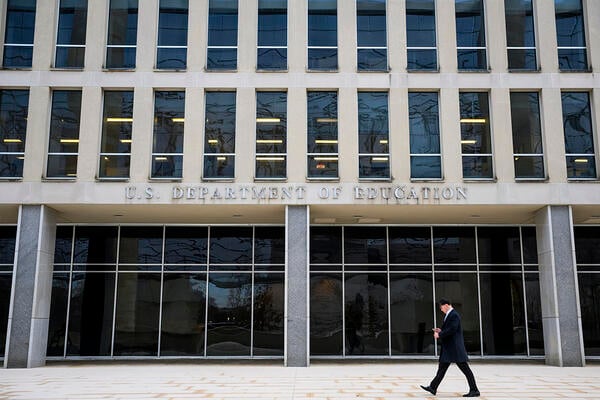
Washington, D.C.—Education Secretary Linda McMahon made clear at a series of policy summits this week that while she remains committed to one day shuttering her department, there’s still much work left to be done.
“You don’t just shut off the lights and walk out the door if you are trying to return education to the states,” McMahon said at one event Wednesday, adding that offices like Civil Rights and Federal Student Aid can’t simply be eliminated. “Really, what we’re trying to do is to show how we can move different parts of the Department of Education to show that they can be more efficient operating in other agencies.”
Throughout her remarks at both events—the Education Law and Policy Conference hosted by the Federalist Society and the Defense of Freedom Institute on Wednesday and the Reagan Institute Summit on Education on Thursday—the secretary stressed that a key way to test this concept is by moving workforce development programs to the Department of Labor.
“Let’s be sure that we are not moving hastily, but that we are taking the right steps at the right pace for success,” McMahon told the Federalist Society audience. “And if we show that this is an incredibly efficient and effective way to manage these programs, it is my hope that Congress will look at that and approve these moves.”
However, some advocates for students, institutional lobbyists, Democrats in Congress and left-leaning policy analysts have taken issue with the plan to move adult, career and technical education programs to the Labor Department, arguing that it’s illegal and will create more headaches for the providers who rely on the money.
Regardless, the Trump administration is moving forward with its plans. ED signed an interagency agreement with the Department of Labor earlier this spring and has more recently moved many of its staff members to the DOL office. (Funding for the salaries of these employees and the programs they lead, however, will still come from the Education Department budget.)
On Thursday at the Reagan Institute, McMahon noted that the combined staff is working on a new learning and employment report as well as a “skills wallet” that will help show employers what students have learned and students what employers are looking for.
“It’s an exciting time in labor development in that country, but it’s a challenge and a real responsibility for us to not get stuck,” she said.
Aside from career and technical education and some of her other priorities, such as cracking down on alleged campus antisemitism and racial preferencing, much of the conversation both days was centered around the recent shooting of conservative figurehead Charlie Kirk at Utah Valley University and how to prevent political violence on campus.
McMahon was quick to describe the Turning Point USA president’s death as a travesty and to charge colleges with the responsibility of promoting more healthy civic discourse. At both events, she cited Kirk himself as a prime example of what such debate looks like, saying that while his approach was at times “aggressive,” he was always “very polite” and “civil.”
“He wasn’t antagonistic, but he was challenging. And there’s a clever art to being able to do that,” she said. “I don’t think that we show our students how to do that enough.”
Thursday, she denounced the faculty, staff and students who appeared to have been apathetic toward or allegedly celebrated Kirk’s death, building upon comments she made in a social media video earlier this week. But just as she suggested condemning certain individuals for crossing an “ethical line,” she added that “if you shut down the speech of one side to allow the freedom of speech for another, you’d have actually compromised the entire principle, and that we cannot have.”
She closed on Thursday by urging educators to foster their students’ compassion.
“We’ve lost a little of our humanity,” she said. “Let’s make sure we grab that back in peace and show it through leadership.”
The full version of the Free Application for Federal Student Aid is scheduled to launch Oct. 1.
Photo illustration by Justin Morrison/Inside Higher Ed | SimoneN/iStock/Getty Images
All students can now access a beta version of the 2026–27 Free Application for Federal Student Aid, the Department of Education announced Wednesday.
The grant application platform won’t officially launch until Oct. 1, the congressionally mandated FAFSA launch deadline, but for the 12 days between now and then, students and families can start their application by participating in the test model.
“We’re using this time to monitor a limited number of FAFSA submissions to ensure our systems are performing as expected,” the department’s Federal Student Aid website explains. “This is a common practice in website and software development.”
The first round of beta testing was opened to a limited number of students in early August. Students who submit their form during the test will only have to submit it once, the department website states.
Creighton University has received a $100 million gift from the Heider Family Foundation to launch a nearly $300 million campaign for a sprawling recreational and athletic development on the east side of the Omaha campus.
Creighton’s Fly Together plan will establish or upgrade athletic facilities and outdoor spaces covering 12 blocks and roughly 700,000 square feet. It includes a new student fitness center, a pedestrian walkway connecting the private Jesuit campus to a downtown business district and a new sports performance center for Creighton’s student athletes.
“Fly Together will serve students and student-athletes, but importantly, it will serve the Omaha community itself,” said Scott Heider, a university trustee as well as a trustee of the Heider Family Foundation, which was established by his parents, Charles and Mary.
“We are incredibly grateful to the Heider family and the additional donors who are making this moment possible,” said Creighton president Daniel Hendrickson. “This gift … benefits everyone. It enhances student life, intramurals, premier club sports and intercollegiate athletics. It also strengthens Creighton’s connection to downtown and the broader Omaha community.”
On Wednesday ABC announced that it had taken Kimmel’s late-night show off the air “indefinitely.”
More professors in the United States have been fired for controversial views in the past week than any other week in all of American history. The violations of academic freedom, free speech and due process on campuses in the wake of Charlie Kirk’s assassination have been extraordinary and indefensible.
The campus firings are toonumerous to describe in full, but consider the case of Darren Michael, professor of theater at Austin Peay State University, who was fired because he reposted on social media a 2023 Newsweek headline: “Charlie Kirk Says Gun Deaths ‘Unfortunately’ Worth It to Keep 2nd Amendment.” Tennessee’s U.S. senator Marsha Blackburn reposted Michael’s view on X, asking the university to take action.
Austin Peay administrators declared, “A faculty member of Austin Peay State University reshared a post on social media that was insensitive, disrespectful and interpreted by many as propagating justification for unlawful death. Such actions do not align with Austin Peay’s commitment to mutual respect and human dignity. The university deems these actions unacceptable and has terminated the faculty member.”
This is an utterly appalling excuse to punish anyone, and certainly not an adequate reason for a university to terminate a professor without any due process. There is absolutely no rule at Austin Peay banning people from being insensitive or disrespectful, since any rule like that would clearly violate the First Amendment. And the idea that posting a headline quoting Kirk’s views would somehow justify his murder is insane. It’s perfectly legitimate to criticize anyone for favoring or opposing gun control. This critique of Kirk is anything but pro-murder.
The violations of due process involved in these arbitrary firings, with no opportunity for a hearing or a defense, are terrible in themselves. But the justifications for the firings are so insubstantial that they cannot merit any kind of penalty, let alone an immediate dismissal.
It is perfectly legitimate to criticize and even insult both the dead and the living. Any conservative who thinks Charlie Kirk hated free speech so much that he would want his critics purged from campuses is making a far worse insult against Kirk than what any offensive leftist has written or said.
Of course, the suppression of free speech goes far beyond academia.
The suspension of Jimmy Kimmel by ABC on Sept. 17 following FCC chair Brendan Carr’s demands for his removal and threats against broadcast licenses represent an alarming repression of free speech, with the combination of corporate censorship and government suppression.
On his Sept. 15 show, Kimmel said, “We had some new lows over the weekend, with the MAGA gang desperately trying to characterize this kid who murdered Charlie Kirk as anything other than one of them and with everything they can to score political points from it.” What Kimmel said was, in fact, technically true: Conservatives were doing everything they could to claim that Kirk’s murderer was not one of them. And the murderer was, in fact, a white male college dropout from a Republican family in Utah that taught him to shoot and provided him with guns.
Of course, conservatives are probably correct to call the murderer a leftist with political motives, and if Kimmel was trying to invoke theories that the killer was actually a right-winger, that seems unlikely now based on evidence released after Kimmel’s show aired. But even if Kimmel was trying to make a dubious claim that has now been discredited, that’s protected by the First Amendment and principles of free speech.
The second part of Kimmel’s claim—that conservatives were using Kirk’s murder to “score political points”—was never in doubt and has been proven yet again by his removal from the airwaves.
Kimmel didn’t celebrate any violence or say anything bad about Charlie Kirk. The glorification of Kirk is a cover for an authoritarian agenda to suppress political enemies. Donald Trump immediately celebrated Kimmel’s banishment and called for NBC hosts Jimmy Fallon and Seth Meyers to also be fired.
This is the slippery slope of censorship: First they come for those who celebrate murder, then they come for anyone who questions the hagiography of the victim, then they go after anyone who quotes the victim’s own words, then they silence anyone who objects to the repression itself. This is why even offensive and stupid comments about Charlie Kirk must not be punished.
But when Vice President JD Vance urges everyone to “call their employer” in response to offensive comments, that’s not critique or argument: That’s cancel culture, pure and simple. That’s government-mandated repression.
The right to free expression must include the right to say horrible and evil things. It protects all of the conservatives (including Donald Trump, his son and Charlie Kirk) who joked about the attempted murder of Paul Pelosi. It protects the Fox News host Brian Kilmeade, who urged mass executions of homeless people.
As David Letterman noted about Kimmel, “You can’t go around firing somebody because you’re fearful or trying to suck up to an authoritarian criminal administration in the Oval Office.”
Less than two years ago, before he began issuing government commands to silence the media, Carr posted on X, “Free speech is the counterweight—it is the check on government control. That is why censorship is the authoritarian’s dream.”
We are living in the authoritarian’s dream, and it’s a nightmare for free speech and democracy.
Over the past 10 days, dozens of faculty and staff members have had their personal contact information, photos and sometimes addresses broadcast online by anonymous right-wing social media accounts seeking to punish them for comments they allegedly made about the death of conservative firebrand Charlie Kirk. This public campaign of online harassment and intimidation, known as doxing, is “off the charts” right now, said Heather Steffen, an adjunct professor of humanities at Georgetown University.
Steffen is also the director of Faculty First Responders, a group created by the American Association of University Professors in 2020 to track and help faculty members targeted by right-wing media. Doxing has been on the rise since protests over the Israel-Hamas war fractured campuses in 2023, but educators are increasingly coming under attack in “ideologically motivated efforts” to silence dissent, according to an August report from the National Association of Attorneys General. “This shift signals the evolution of doxxing from isolated conduct to a more coordinated form of digital persecution,” the report said.
While the attacks are becoming more frequent and sophisticated, higher ed employees can take steps to minimize the risk of doxing, as well as the damage incurred if it does happen.
1. Keep your personal and work accounts separate.
Remove employers’ names from all of your personal social media accounts—if it’s in your bio, take it out, Steffen advised. “You can state in your bio on social media that your views do not represent your employer, and you don’t need to name the employer in order to do that,” she said.
In many cases, work may demand that you list some contact information publicly, but don’t use that information for personal business, said Rob Shavell, CEO and co-founder of DeleteMe, a service that will find and try to wipe members’ personal information from the web. “The data brokers are getting very good at correlating [work and personal] data and putting them into one dossier,” he said. These days, when DeleteMe’s privacy advisers scan the web for members’ information, they return an average of 750 pieces of personally identifying information per person, up from 225 pieces four years ago.
Also, be aware of what devices, accounts and Wi-Fi networks you’re using, and be sure not to use work-provided equipment or resources for anything other than work, Steffen added.
2. Scrub your information from data-broker websites.
Data brokers collect and sell personal information. Companies like DeleteMe and Incogni will remove your personal information from data-broker websites for a fee; DeleteMe charges $129 per member annually. But for anyone who wants to take a do-it-yourself approach, DeleteMe has published free opt-out guides that walk readers through removing their information from the sites, including Experian, TransUnion and CoreLogic. Steffen also suggests following the steps outlined in the Big Ass Data Broker Opt-Out List, a Github project that explains how to scrub your information from data brokers.
3. Use an email mask or alias when possible.
“Masked emails or phone numbers or even credit cards allow you to sign up for things or make calls or buy things without revealing to every counterparty your real personal information,” Shavell said. DeleteMe offers masking, as do companies like Apple and NordPass. These services create a faux address that will then forward emails to your real account. Google also offers free alias phone numbers through Google Voice that will forward calls to your personal phone. In addition to better security, masking also decreases spam and phishing risks.
4. Breathe before you post (and remember the risk of screenshots).
Even if you’re posting to a private account—say, a “close friends” story on your personal Instagram—anything you put online can still be screenshotted and shared widely, Steffen warned. “Anytime you’re posting or reposting something, a good tool can be to pause and think: Would I be comfortable with my employer, my students and my community knowing that I hold this view, and would I be comfortable with them seeing it expressed in this way?” she said.
5. Protect your accounts with complex passwords and two-factor authentication.
It’s boring, but it’s important, said Viktorya Vilk, director for digital safety and free expression at the nonprofit PEN America, which offers digital safety training to colleges and universities and has created a “what to do” resource for people who have been doxed. “If someone hacks into your Facebook or your email, it’s so hard to get that account back. And it’s also incredibly intrusive and unsettling,” she said. “Having a long, secure password and two-factor authentication makes it almost impossible for someone to be able to hack into your account.”
6. In the event you are doxed: Center yourself, and then secure your physical safety.
“People often have a fight, flight or freeze response. It can be incredibly traumatizing and so very difficult to take steps or use your judgment about what to do when you’re being doxed,” Vilk said. “And so, counterintuitively, the very first thing to do is to take a minute and try to center yourself. For some people that’s taking some deep breaths. For other people, it’s just, like, moving around, wiggling around.”
After that, make sure you’re physically safe, she advised. If your address has been shared, consider staying at a hotel or with friends or family until the storm passes. Consider contacting law enforcement to report the threats, file a police report and let them know you’re at increased risk for swatting—a harassment tactic that involves making a false emergency call in order to dispatch law enforcement to a specific location.
7. Once you are physically safe, document the harassment and lock down your accounts.
Set your social accounts to private mode if they’re not already, and take any steps to limit visibility of your posts, Vilk said. “That’s very easy to switch back after the storm dies down,” she added. Be careful communicating with unfamiliar accounts, emails or phone numbers, and document any threats or harassment you receive. Don’t download attachments or click on links from unknown senders, and do a quick search online to find out more about them before responding.
“Take screenshots when you receive them and then report them to the platform where they’re happening. That can be really stressful, so we really recommend that people recruit friends or family or trusted colleagues to help them do that so that they’re not doing it alone,” Vilk said.
Your cellphone number can also be stolen. “If it starts to circulate online, people will call your cellphone company and pretend to be you and try to reroute traffic,” she said. Protect your number by calling the company and placing a PIN on your account.
Texas A&M University president Mark Welsh stepped down abruptly Thursday under mounting pressure from state lawmakers over how he handled a recent incident in which a student clashed with a professor over a lesson on gender identity, prompting him to dismiss the instructor.
Earlier this month, Welsh fired Melissa McCoul, who taught English, after a student taking her children’s literature class objected to the professor’s statement that there are more than two genders. Welsh also removed two administrators from their duties because they “approved plans to continue teaching course content that was not consistent” with the course’s description, he said.
The incident prompted fury from state lawmakers, some of whom called on the Texas A&M Board of Regents to terminate Welsh. But on Thursday, system officials announced he had resigned.
The case also raised serious questions about academic freedom at Texas A&M and prompted pushback from faculty members who argued that McCoul’s termination was unnecessary and unjust. The American Association of University Professors also released a statement arguing that the “firings set a dangerous new precedent for partisan interference in Texas higher education.”
Welsh’s resignation is effective Friday at 5 p.m., system officials noted in a statement.
“President Welsh is a man of honor who has led Texas A&M with selfless dedication. We are grateful for his service and contributions,” Texas A&M system chancellor Glenn Hegar, a former GOP lawmaker, said in a statement Thursday. “At the same time, we agree that now is the right moment to make a change and to position Texas A&M for continued excellence in the years ahead.”
Others took a victory lap, including Brian Harrison, a Republican lawmaker and Texas A&M alum who has accused the university of funding “leftist [diversity, equity and inclusion] and transgender indoctrination.”
Last week Harrison posted a video that the student had taken of her confrontation with McCoul, in which the student claims that teaching material related to gender identity and transgender people is illegal and violates one of President Trump’s executive orders, which are not laws. Harrison called for the board to fire Welsh and other senior officials.
“WE DID IT! TEXAS A&M PRESIDENT IS OUT!!” Harrison wrote on social media Thursday, adding that “as the first elected official to call for him to be fired, this news is welcome, although overdue.”
Welsh’s resignation comes despite the backing of notable faculty members, such as Texas A&M’s Executive Committee of the University Distinguished Professors, who wrote a letter of support for the president to the Board of Regents ahead of Thursday’s meeting.
Welsh, a four-star general who served as chief of staff of the U.S. Air Force, was previously dean of the Bush School of Government and Public Service before he was initially tapped as interim president in July 2023 when his predecessor, Kathy Banks, resigned following a hiring scandal. Welsh was named to the job on a permanent basis in December 2023.
Welsh’s exit now means the last two Texas A&M presidents have been felled by scandal and neither lasted more than two years in the job.
Texas A&M did not immediately name an interim upon announcing Welsh’s resignation, but system officials noted in a statement that it will appoint someone to the position “in the coming days” and “initiate a national search for a permanent president” following Welsh’s resignation.
During this reign the memorable preacher Wyclif collected together a curious set of men known as the Lollards or Dullards, because they insisted on walking about with their tongues hanging out and because they were so stupid that they could not do the Bible in Latin and demanded that everyone should be allowed to use an English translation. They were thus heretics and were accordingly unpopular with the top men in the Church who were very good at Latin and who liked to see some Dullards burnt before every meal.
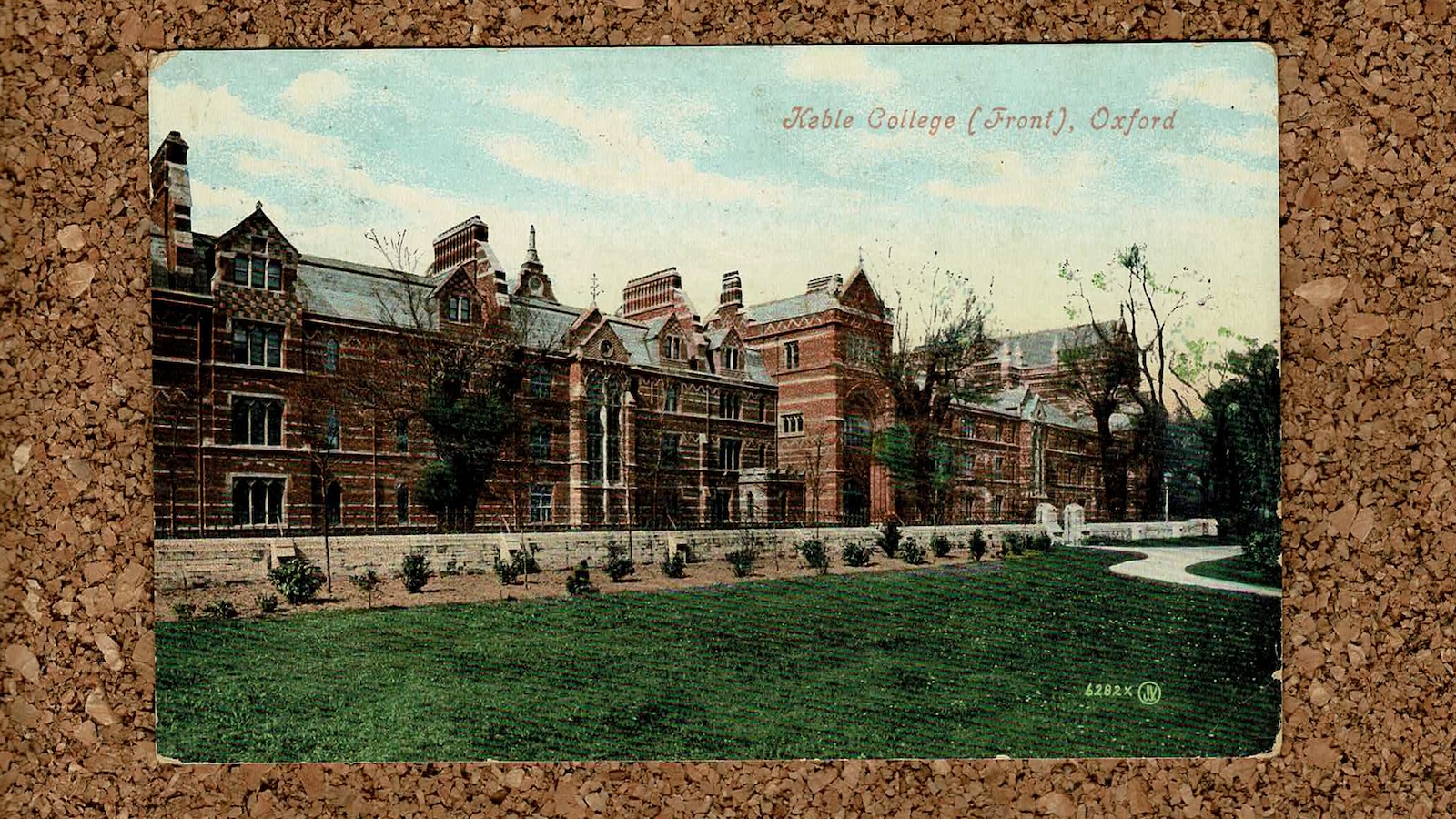
Anyway, Lollardy was considered a problem by the church, and in 1427 Richard Fleming, Bishop of Lincoln, founded a college in Oxford as, apparently, “a little college of true students of theology who would defend the mysteries of Scripture against those ignorant laymen who profaned with swinish snouts its most holy pearls.”
Benefactions in 1436 and 1437 enabled the nascent college to establish a physical base in Oxford, with a chapel, a library, a hall, a kitchen, rooms and, in 1465, rooms for the college’s master. In 1478, a second Royal Charter was granted, at the prompting of Thomas Rotherham, Bishop of Lincoln and later Lord Chancellor and Archbishop of York, who was the college’s visitor. (We’ll cover the role of the visitor another time, when I have the right postcard!)
By this stage we’ve got in place the necessities of a college, and a few more elements – leasing the Mitre Inn, gaining a coat of arms – followed in the next hundred years. And the college continued to add buildings and the like, in the way that medieval Oxford colleges did. The interesting parts of our story now are people.
Let’s fast forward to 1726, when John Wesley was elected a fellow of Lincoln. Discussions within the college set the scene for the establishment of Methodism. Having started as a college to counter heretical beliefs, the college had now enabled a significant branch of non-conformist Christianity to be born.
In 1882 the first Jewish fellow of an Oxford college was elected at Lincoln. This followed the Universities Tests Act, passed in 1871, which removed religious barriers to participation in university life at Oxford, Cambridge and Durham. The fellow in question was Samuel Alexander, who later became a professor at Owens College, Manchester, and whose work focused, as best as I can tell, on questions of the nature of space and time. He’d have answered Zeno’s paradox, I suspect, by denying the reality of incrementally smaller units of time. But I may be wrong!
In 1925 Theodor Seuss Geisel enrolled as a graduate student at Lincoln, having completed undergraduate studies at Dartmouth College, USA. We know him better as Dr Seuss. He didn’t, it seems, complete his postgraduate work. Maybe he’d have been a better writer if he had, maybe not – who knows?
In 1952 another notable writer began his studies at Lincoln. This was David Cornwall, who is similarly better known by his pen-name: John le Carré. Cornwall graduated in 1956; it is thought that he was working for MI5 while at the college, and he certainly became an intelligence agent afterwards, continuing until 1964, when the fall-out from Kim Philby’s spectacular betrayal of many British agents means that he left the secret service. Fortunately for him, his writing enabled him to make an alternative living.
Other notable Lincoln names include Rishi Sunak, former PM; Edward Thomas, WW1 poet; and physician John Radcliffe, after whom many Oxford buildings, including the hospital, the camera and the observatory, were named.
Women were admitted to Lincoln for the first time in 1979.
Lincoln College’s full name – reserved for Sunday best – is the College of the Blessed Mary and All Saints, Lincoln. It’s only called that by the monarch and by the university when it has been naughty, I imagine. The college has a very good page on its history – including some shot films – here. There’s more than I could reference in this piece.
The card itself was unposted but has a message written on the back.
Dear Mr Smithies, Great pleasure to talk to you – thanks for your kind offer of support.
Back in late 2023, a little known libertarian by the name of Javier Milei was elected President of Argentina with a strong mandate to conquer that country’s hyperinflation. His strategy for doing so was pretty straightforward — freeze public spending, which would mean a big loss in real terms until inflation came down, and then let the free market do the rest.
That was easier said than done. Milei lacked a majority in Congress and all of the legacy parties had some reason to try and preserve the status quo, but more or less, Milei got his way and the public sector, including public universities, have had to shrink enormously as a result. Falling budgets, cratering salaries, the lot.
But now the opposition is starting to gain strength. Over the northern summer, Congress passed a bill meant to roughly double state spending on public higher education. Last week, predictably Milei vetoed the law. We can probably expect a season of protests and strikes to ensue.
Returning to the show today to discuss all this is Marcelo Rabossi of the Universidad Torcuato Di Tella in Buenos Aires. He joined the podcast 18 months ago at the outset of Milei’s term to discuss what the President’s agenda was likely to have in store for the higher education sector. Today he’s with us to talk about how the system is surviving what amounts to a massive cut in real pesos, and what the next few months look like as tensions mount between the President and the opposition.
Of particular interest, I think, is where we talk about how, despite Milei’s affinity to the US hard right, he’s avoided Trumpian tactics, like targeted cutbacks through research rescissions and outright institutional extortion.
The World of Higher Education Podcast Episode 4.3 | Crisis or Reform? Higher Education in Milei’s Argentina with Marcelo Rabossi
Transcript
Alex Usher (AU): Marcelo, when we last spoke in January 2024, Javier Milei was newly elected president at the head of La Libertad Avanza. He didn’t have a majority in Congress—still doesn’t. He was elected on a mandate to stop hyperinflation, but his appeal wasn’t just about tighter money. He was a libertarian who wanted to shrink the size of government enormously, which is, in some ways, quite a revolutionary idea in Argentina. Generally speaking, how has his first year and a half in office gone? Is inflation down? Has the size of the government shrunk?
Marcelo Rabossi (MR): From the very beginning, even during his campaign, Milei promised radical changes to literally crash hyperinflation. He aimed to do this by reducing government spending and opening the economy. Inflation has dropped substantially. For example, in December 2023, monthly inflation peaked at 25% and now it’s around 2% for three consecutive months. This is largely due to Milei’s aggressive austerity measures and a very tight monetary policy. He significantly cut federal spending and restored market dynamics.
It’s also true that poverty has declined, from 54% in early 2024 to about 32% in early 2025. On the other hand, economic activity has stagnated, and retirees have lost much of the purchasing power of their pensions. That’s the dark side of Milei’s economic plan.
AU: How has he been able to achieve his agenda without a majority in Congress? What’s the dynamic there? Does he strike deals with conservative parties, or does the presidency give him some ability to rule by decree? How do you get things done when you’re a minority president?
MR: That’s a great question, because I think this is the first party in power with a minority in both chambers of Congress. Milei has relied on emergency executive decrees to bypass legislative opposition or blockages and to implement deep reforms.
Early on, he also struck strategic deals with conservative parties, particularly PRO—the party of former President Macri—and the Radical Civic Union. These strategies helped him pass the “Ley de Bases” in 2024, which was a foundational reform to deregulate the economy.
However, this approach had its limits. He’s now facing growing resistance, even from former allies. Internal divisions and shifting loyalties have made these alliances fragile.
By mid-2025, even some conservative legislators began distancing themselves from Milei’s more extreme measures and aggressive behavior. So I’d say he has governed through a mix of executive power, tactical alliances, and public pressure—but he’s losing that advantage.
AU: My understanding is that Milei’s approach to reducing expenditure and inflation has been simply to freeze spending on government departments. Inflation is lower now than it was two years ago, but it’s still reasonably high, so inflation just erodes the value of that spending.
How has this affected higher education? How big has the cut been to higher education in real terms—that is, after inflation? And is higher education different from other social sectors? Presumably you’d see the same dynamics with hospitals and other services. Is higher education being targeted for bigger reductions, or no?
MR: You’re absolutely right. Spending freezes across all public areas—education, health, infrastructure—have been his primary tool to fight inflation. But as you noted, when inflation remains high, even if it’s slowing, frozen budgets imply reductions in real terms.
Regarding higher education, let me give you some numbers. In 2024, funding for Argentina’s public universities fell by around 30% in real terms and by 2025, the projected university budget is about 35–36% lower than in 2023. According to my analysis, around 80% of higher education spending in Argentina goes to salaries, and those dropped by about 30–35%. Capital expenditures for infrastructure have also collapsed.
But it’s not only university funding. Overall, education has suffered a real decrease of more than 30% between 2023 and 2025. For example, teacher training and technology programs are down 40%, and early childhood education infrastructure is down 60%. Scholarships for low-income students have also decreased by about 40%. I should add that schools are funded at the provincial level, so national cuts didn’t have as large an impact there. But universities, which are funded nationally, were hit hard. Overall, higher education has been one of the hardest-hit sectors.
So, this “freeze strategy,” as I call it, has helped Milei achieve fiscal surpluses and reduce inflation—but it has come at the cost of shrinking real investment in the country’s future.
AU: The president is sometimes seen as Argentina’s Trump—that’s sort of his international reputation. He certainly has admirers on the U.S. far right. Elon Musk even copied him with the chainsaw routine, attacking public finances.
I don’t get the sense that Milei is a friend of higher education. He rants about “woke intellectuals” and that kind of thing, which lines up with the American right. But I don’t get the sense he’s copied Trump in terms of silencing particular lines of research or picking fights with individual universities.
So apart from the financial cuts, which can maybe be defended purely on anti-inflationary grounds, what has the relationship been between Milei and the higher education sector?
MR: Unlike Trump, Milei hasn’t gone after specific research areas or individual institutions. He hasn’t interfered with academic freedom—there have been no restrictions on curricula, no attacks on gender studies or climate research, and no attempt to control university governance.
His approach has been more structural than targeted at specific institutions. That said, the University of Buenos Aires—the largest and most important in the system—has been his main target, simply because it’s the most visible.
I should add that some of his early ideas, like replacing direct public funding of universities with vouchers, have remained more like theoretical provocations than serious proposals. They have no real support and no chance of being implemented.
So while Milei’s stance toward higher education is hostile, it’s not close to institutional repression. His obsession is with the economy and controlling inflation.
AU: A moment ago, you talked about roughly a 30% decline in real terms for university support—maybe a bit higher if you compare the end of 2025 to the end of 2023. How does a university deal with a cut of 33%? What kinds of decisions do they have to make to keep the doors open in conditions of austerity like that? And what have been the consequences of those decisions?
MR: First, universities reacted in order to survive. I would say they are operating in survival mode. In this scenario, universities have had to freeze salaries, delay infrastructure repairs, and cut back on research funding. They’ve also shortened semesters, reduced course offerings, and postponed new programs. Some campuses, like the University of Buenos Aires, have even merged departments or cut non-essential services.
To give you an idea of why these fiscal restrictions have hit so hard: between 80% and 90% of universities’ total income comes from national government funds. Remember, undergraduate education in Argentina is tuition-free, and undergraduates represent more than 90% of a total student body of over 2 million enrolled in national institutions. On the other hand, historically Argentina’s public universities haven’t had a strong tradition of fundraising. Some institutions are beginning to move in that direction, collecting money from private donors, but it’s still very limited.
AU: Surely those kinds of cutbacks would make private universities in Argentina more attractive, right? Argentina doesn’t have a huge private sector—it’s not like Chile or Brazil. I think about 80% of students are in the public system. But have private universities seen an opportunity here? Are they taking advantage of these cuts to tout the benefits of paying tuition and offering something more complete than the public sector?
MR: As I always say, in Argentina the private sector is more tolerated than stimulated, unlike in Brazil or Chile. There are about 60 private universities in the country with around 400,000 undergraduates. Historically, they’ve largely avoided political confrontations and remained neutral. Politics tends to play out in the public sector, so unlike national institutions, private universities haven’t been cast as ideological enemies or targets. This has allowed them to operate with less social and political confrontation.
On the financial side, the private sector largely depends on tuition fees—on average, 90% of their income comes from that source. So decreases in public funding haven’t been an issue for them, since they don’t rely on public subsidies or loans. Recently, however, there have been rumors about public scholarships for students at private universities.
Financially speaking, they’re in reasonably good shape. They’ve been able to maintain operations, salaries, and infrastructure. In a way, they look relatively resilient. And you’re right—while public universities are cutting programs, freezing salaries, and facing potential strikes, private universities now appear more stable and predictable for students and families. For those who can afford tuition, private institutions may seem like a real option.
AU: The public universities have obviously been fighting back over the past year and a half. I’ve lost count of the number of strikes, protests, and demonstrations of public opposition.
What’s interesting is that just in the past few months—during the Northern Hemisphere summer, your winter—Congress considered a bill to stabilize university finances. If I understand correctly, they mandated a funding floor tied to a certain percentage of GDP. That law passed about a month ago. What was this bill, and how did it pass? Because it seems to get back to the question of the president losing allies, since some of his conservative partners voted for it.
MR: Right. The goal of this law was to increase Argentina’s university budget from around 0.4% of GDP to 1.5% in the next five years. That’s a big jump. Beginning in 2026, funding will rise to 1% of GDP.
Historically, public spending on universities has been around 0.6% of GDP, peaking at 1% but usually closer to 0.8%. So this proposal represents a significant increase. It’s intended to replace the funding law passed by the government in 2024.
The bill was introduced in Congress by the rectors of Argentina’s 56 national universities, with support from unions and student organizations. It also proposes updating budget allocations for accumulated inflation in 2023–2024 and reinforcing faculty salaries starting in December 2023, with monthly updates tied to the consumer price index.
AU: Let’s talk about what happens politically here. Both houses of Congress passed the law, and Milei vetoed it on September 10th, I think. How does this get resolved at this point? What happens politically to the bill from here on in?
MR: You’re right about the veto—it’s his main political tool, given that he has no majority in either chamber. University unions, students, and education advocates have already staged protests and strikes, and more demonstrations are expected, especially around Congress.
The veto will escalate tensions between Milei and the education sector, and it’s becoming a rallying point for the opposition. In my view, the next few weeks will be critical. If Congress can’t override the veto, universities will remain under severe financial strain, and political pressure on Milei will intensify.
Either way, this is more than a budget fight. The opposition says it’s a battle over the future of public education in Argentina.
AU: President Milei has another two years and three months left in his mandate. What’s your best guess about higher education? How is it going to fare between now and then? What does the Argentinian system look like at the end of 2027?
MR: Yes, you’re right—we have two years ahead. It’s difficult to predict the future in Argentina, although some would say: expect a new crisis and you’ll probably be right.
As we’ve said, despite lacking a congressional majority, Milei has pushed through major reforms via executive decrees. That’s been his political tool. His confrontational style has kept him in the spotlight but also sparked resistance from traditional parties, the far left, conservatives, and even moderate liberals.
Whether this initial economic stabilization translates into long-term growth—and consequently, political support—remains the big question. If he wins in the next legislative elections this October, he will likely maintain his firm stance, continue vetoing, and I don’t see major changes. If the economy grows, there may be some money to calm the situation, but not enough to achieve what the vetoed law proposed: doubling university funding in relative terms in the short or medium term. That’s a kind of utopia, even if the country emerges from its depression.
But if Milei loses by a wide margin, the pressure will be enormous, creating a vicious circle that prevents Argentina from escaping economic stagnation. Keep in mind: the only way for universities to receive more funding is for the country to grow. If conflict increases, investors will postpone decisions, and in such a scenario, there are no winners.
Again, public universities in Argentina are more than just educational institutions—they are symbols of social mobility and national pride. Milei’s veto of the bill to increase university funding and staff salaries will likely trigger widespread outrage, uniting students, faculty, unions, and the political opposition. In fact, new public demonstrations are already underway and may continue for weeks, months, or even the next two years until his mandate ends.
AU: Lots to keep an eye on. Marcelo Rabossi, thank you so much for being with us today.
MR: It’s my pleasure. Thank you so much.
AU: And it just remains for me to thank our excellent producers, Sam Pufek and Tiffany MacLennan, and you—our listeners and readers—for joining us once again. If you have any questions or comments about today’s episode, or suggestions for future ones, please don’t hesitate to write to us at [email protected].
Join us next week when our guest will be Yale University’s Zach Bleemer, professor of economics, who has just co-written a fascinating new paper, Changes in the College Mobility Pipeline since 1900. We’ll be talking about some of that report’s surprising findings. Bye for now.
*This podcast transcript was generated using an AI transcription service with limited editing. Please forgive any errors made through this service.Please note, the views and opinions expressed in each episode are those of the individual contributors, and do not necessarily reflect those of the podcast host and team, or our sponsors.
With national attention already focused on campus free speech, the assassination of Charlie Kirk at Utah Valley University has intensified a fractious moment for higher education. Voices on the right have blamed colleges for Kirk’s death, calling them “indoctrination camps” and comparing them to “madrassas that radicalize jihadis.”
Though the suspect is not a student, Kirk’s killing has intersected with concerns that students are increasingly unable or unwilling to engage with dissenting views. Critics have cited the most recent FIRE College Free Speech Rankings survey, which shows that one in three students thinks it’s acceptable to use violence to stop a speaker.
Colleges did not cause Kirk’s death, but leaders cannot ignore the finding that a third of students support using violence against a speaker. Though most students will never resort to violence, the possibility forces colleges to reassess campus security. UVU’s police chief admitted more than half his force of 15 officers wasn’t able to secure the crowd of 3,000 people at the Kirk event. Security experts noted that stopping a shooting from the top of a building hundreds of feet away requires Secret Service–style sweeps. The incident raises questions about bringing outside speakers to campuses. With so many budget problems in higher ed, who will cover the costs of keeping them safe?
Yet on the ground at UVU, life on campus looked far different from critics’ portrayals. In the hours after the shooting, the student newspaper, The UVU Review, reported that professors reached out to students to offer resources and reprieves from coursework. Students called everyone in their phone to tell them they were safe. Strangers hugged each other and students offered a ride home to anyone who needed it. They put aside their differences to grieve together. “It feels like life stopped for us,” said one student. “But it kept going for everyone else. I’m ready for life to start again, no matter how changed it’ll be.”
Given Kirk’s prominence, students across the country will feel like this incident has changed their lives, too. With more than 850 campus chapters, Turning Point USA is an organization where conservative students have found community. And even for students who disagreed with Kirk he inspired them to engage with political issues and debate their ideas.
But the reactions to Kirk’s death reveal that the ideological fissures on campus have only deepened. At least 15 faculty and staff members have been fired for appearing to condone the shooting on social media, many after online campaigns called for their dismissal. Meanwhile, at a candlelit vigil at the University of North Carolina at Chapel Hill—a campus that has faced its own tragedy—student Walt Wilson told The Daily Tarheel he was mourning Kirk even though he disagreed with him. “Getting killed over debate and fostering free speech, especially in a place like a university where that is supposed to prosper, is a real tragedy and shows an issue of communication and reconciliation,” he said.
Free speech survives only if protected in practice. This moment will test higher education’s resolve: Will political pressure drive colleges to retreat, or will they recommit to free expression as a path through turmoil?