A UIC official said the system made the decision after “considering the increased risk to our faculty and to the University that these criteria present in the current climate.”
Just_Super/iStock/Getty Images Plus
The University of Illinois system is telling its institutions they can’t consider race, color, national origin or sex in hiring, tenure, promotion and student financial aid decisions—a move that’s drawn opposition from a faculty union at the University of Illinois at Chicago.
Aaron Krall, president of UIC United Faculty, an affiliate of the American Federation of Teachers and the American Association of University Professors, said the UI system circumvented shared governance.
“This was a directive that came down and surprised everyone,” Krall said.
The system implemented a policy saying it and its universities don’t consider race or the other factors in determining eligibility for need- or merit-based financial aid. In a statement, the system further said it “issued guidance to its universities to ensure that hiring, promotion, and tenure processes follow the same standards.”
The statement said, “There may be some variation in how and when changes are fully operationalized” across its three universities: UIC, Springfield and Urbana-Champaign. The system didn’t provide Inside Higher Ed an interview Tuesday about why it’s making this change now.
Krall shared communications that he said UIC officials sent out last week. One, from Chancellor Marie Lynn Miranda and others, suggested the student aid change would apply to “donor-funded, college-determined and institutionally funded scholarships” and said “UIC will replace its Affirmative Action Plan with a Nondiscrimination and Merit-Based Hiring Plan.”
In another message Krall provided, a UIC official wrote that “faculty may no longer submit a Statement on Efforts to Promote Diversity, Equity, and Inclusion in the dossier, nor may faculty members be evaluated on norms related to” DEI. The official wrote that the system “made this decision after carefully considering the increased risk to our faculty and to the University that these criteria present in the current climate.”
Krall said. “The most shocking thing to me, really, is they want to change the policy and make it retroactive—so we have [affected] faculty members going up for promotion right now who have already submitted their promotion materials.” He said the union has demanded the right to bargain over these changes.
This blog was kindly authored by Dr. Ismini Vasileiou, Associate Professor at De Montfort University.
The government’s new Post-16 Education and Skills White Paper reframes how the UK prepares people for work, learning, and life. It promises a simpler, more coherent system built around quality, parity of esteem, and progression – introducing new V-Levels, reforming Level 3 and below qualifications, and setting out clearer routes into higher education and skilled employment.
Within it there is an unmistakable message for universities: higher education is no longer a separate tier but a partner in a joined-up skills ecosystem.
This direction of travel strongly echoes the recommendations of the Cyber Workforce of the Future white paper, which called for a unified national skills taxonomy, stronger coordination between education and employers, and consistent frameworks for developing technical talent. The government’s post-16 reforms, though broader in scope, now seeks to achieve at system level what the cyber sector has already begun to pilot.
Reimagining pathways: from fragmentation to flow
At the heart of the White Paper lies the ambition to create “a seamless system where every learner can progress, without duplication or dead ends.” The proposed V-Levels for 16-19-year-olds aim to sit alongside A-Levels, replacing hundreds of overlapping technical qualifications and creating a nationally recognised route into both higher technical and academic study.
Reforms to Level 2 and entry-level qualifications will introduce new “Foundation Programmes” that build essential skills and prepare learners for work or further study. Alongside these, stepping-stone qualifications in English and Mathematics will replace automatic GCSE resits, acknowledging that linear repetition has failed to deliver progress for many young people.
The emphasis on simplified, stackable routes reflects the very principles behind the Cyber Workforce of the Future model, which proposed interoperable learning pathways connecting schools, further education, higher education, and industry within a single skills continuum. What began as a sector-specific call for alignment in cyber is now being written into national policy.
Higher education’s new context
The White Paper links post-16 reform directly to the Industrial Strategy and to Skills England’s mission to align learning with labour-market demand. For universities, several themes stand out:
Progression and parity: Higher education is expected to work together with further education and employers to ensure that learners completing V-Levels and higher technical qualifications can progress seamlessly into Level 4, 5, and 6 provision.
Higher Technical Qualifications (HTQs): The expansion of HTQs in growth areas such as AI, cyber security, and green technology positions universities as key co-developers and deliverers of technical education.
Quality and accountability: The Office for Students will have powers to limit recruitment to poor-quality courses and tie tuition-fee flexibility to demonstrable outcomes, reinforcing the need for robust progression and employability data.
Lifelong learning and modularity: The commitment to the Lifelong Learning Entitlement demands interoperability of credits across further education and higher education – another concept long championed in the cyber-skills ecosystem.
Taken together, these reforms require universities to move beyond disciplinary silos and become brokers of opportunity – enabling flexible, lifelong learning rather than simply delivering three-year degrees.
From strategy to delivery: lessons from cyber that can scale
The Cyber Workforce of the Future paper provides a live example of how the government’s post-16 vision can be delivered in practice. Its framework rests on three transferable pillars:
Unified skills taxonomy – mapping qualifications and competencies against occupational standards to create a common language for education and industry.
Education – industry bridge – aligning curriculum design and placements to real-world demand through structured partnerships between universities, FE colleges, and employers.
Inclusive pipeline development – embedding equity and access by designing pathways that work for diverse learners and career changers, not just traditional entrants.
These principles are not unique to cyber; they represent a template for how any technical or digital field can align with the White Paper’s objectives. The challenge now is scaling this joined-up approach nationally across disciplines – from advanced manufacturing to health tech and green energy.
Six priorities for universities
Redefine admissions and progression routes Recognise new qualifications such as V-Levels and HTQs as rigorous, valued entry points to higher education.
Co-design regional skills ecosystems Partner with futher education colleges, local authorities, and industry to map regional growth sectors and align provision accordingly.
Develop flexible, modular curricula Build stackable learning blocks that learners can access and re-enter throughout their careers under the Lifelong Learning Entitlement.
Co-create with employers Move from consultation to collaboration, embedding placements, apprenticeships, and micro-credentials that reflect labour-market demand.
Support learner transition Provide structured academic and digital-skills support for students from vocational or stepping-stone routes.
Measure outcomes transparently Track progression, attainment, and employability by qualification route to evidence value and inform continuous improvement.
Opportunities and risks
The White Paper’s success will depend on genuine partnership between universities, further education providers, and employers. Without coordination, the new structure could replicate old hierarchies – leaving V-Levels or technical routes seen as second-tier options. Similarly, tighter regulation must not deter universities from widening participation or admitting learners who require additional support.
The cyber-skills sector demonstrates what can work when these risks are managed: clear frameworks, shared standards, and collaborative delivery that bridges academic and technical domains. Replicating this across disciplines will require sustained investment and policy stability, not short-term pilots.
A new social contract for tertiary education
The Post-16 Education and Skills White Paper represents a genuine reset for tertiary education – one that values technical excellence, lifelong learning, and regional growth alongside academic achievement.
Its goals mirror those already embedded within the Cyber Workforce of the Future initiative: building a national system where education and employment are continuous, mutually reinforcing stages of one journey. The cyber model shows that when universities act as integrators – connecting further education, employers, and government – policy ambitions translate into measurable workforce outcomes.
What began as a sector-specific experiment can now serve as a blueprint for system-wide reform. If universities across all disciplines embrace this pivot, they can help turn the White Paper’s vision into reality – a cohesive, agile, and inclusive skills ecosystem ready for the future economy.
This audio is auto-generated. Please let us know if you have feedback.
The number of education degrees awarded in the U.S. steadily decreased in the nearly two decades between 2003-04 and 2022-23, according to a new analysis of federal data by the American Association of Colleges for Teacher Education.
Bachelor’s degrees in education dipped from 109,622 annually to 90,710 while master’s degrees declined from 162,632 to 143,669 in that time span, AACTE said in its report on data from the U.S. Department of Education.
On Thursday, AACTE released a data dashboard based on these findings as well as two related reports. One covers the degrees and certificates conferred in education and the other highlights teacher preparation program trends.
As the Trump administration seeks to dismantle the Education Department and limit funding for federal education research, Jacqueline King, a co-author of the reports and an AACTE consultant, called for the agency to continue publishing research on teacher preparation programs.
“These reports provide a valuable check-up on the supply of new educators, and it is exciting that this year we can offer readers the opportunity to customize how they view the data through our new data dashboards,” King said in a Thursday statement. “It is essential that the federal government continue to provide the field — and the broader public — with this important information.”
Here are some standout figures on AACTE’s findings on the state of teacher preparation programs nationwide.
By the numbers
-3%
The one-year decline in bachelor’s degrees awarded in education from 2021-22 to 2022-23, the most recent year with available data.
-5%
The one-year decline in master’s degrees awarded in education from 2021-22 to 2022-23.
407,556.
The number of students enrolled in a teacher preparation program at a comprehensive higher education institution during the 2022-23 academic year.
611,296
The number of students enrolled in a teacher preparation program at a comprehensive higher education institution during the 2012-13 academic year.
124,428
The number of students enrolled in a teacher preparation program at an alternative teacher preparation program — ones not based at colleges — during the 2022-23 academic year. In the 2012-13 academic year, that number was just 43,099
112,913
The number of students who completed a teacher preparation program at a comprehensive college or university in the 2022-23 academic year. During the 2012-13 academic year, that number stood at 163,851.
16,899
The number of students who completed an alternative teacher preparation program not based at a college during the 2022-23 academic year. In 2012-13, that number was 15,550.
+9%
The growth in students completing alternative teacher preparation programs not based at higher education institutions between 2012-13 and 2022-23.
+44%
The growth in students who completed alternative teacher preparation programs based at colleges between 2012-13 and 2022-23.
29%
The share of education bachelor’s degrees awarded to non-White graduates in 2022-23, up from 23% in 2016-17.
33%
The percentage of education master’s degrees that went to non-Whites in 2022-23, up from 28% in 2016-17.
42%
The portion of education doctoral degrees earned by non-Whites in 2022-23, up from 37% in 2016-17.
Correction: A previous version of this article stated the wrong number of students enrolled in a teacher preparation program at a comprehensive higher education institution during the 2022-23 academic year. The correct enrollment figure is 407,556 students.
In SRHE News and Blog a series of posts is chronicling, decade by decade, the progress of SRHE since its foundation 60 years ago in 1965. As always, our memories are supported by some music of the times.
So here we are, with many people taking stock of where HE had got to in 2005 – suddenly I see. Evan Schofer (Minnesota) and John W Meyer (Stanford) looked at the worldwide expansion of HE in the twentieth century in the American Sociological Review, noting that: “An older vision of education as contributing to a more closed society and occupational system—with associated fears of “over-education”—was replaced by an open-system picture of education as useful “human capital” for unlimited progress. … currently about one-fifth of the world cohort is now enrolled in higher education.”
Mark Olssen (Surrey) and Michael A Peters (Surrey) wrote about “a fundamental shift in the way universities and other institutions of higher education have defined and justified their institutional existence” as different governments sought to apply some pressure. Their 2005 article in the Journal of Educational Policy traced“… the links between neoliberalism and globalization on the one hand, and neoliberalism and the knowledge economy on the other. … Universities are seen as a key driver in the knowledge economy and as a consequence higher education institutions have been encouraged to develop links with industry and business in a series of new venture partnerships.”
Åse Gornitzka (Oslo), Maurice Kogan (Brunel) and Alberto Amaral (Porto) edited Reform and Change in Higher Education: Analysing Policy Implementation, also taking a long view of events since the publication 40 years earlier of Great Expectations and Mixed Performance: The Implementation of Higher Education Reforms in Europe by Ladislav Cerych and Paul Sabatier. The 2005 book provided a review and critical appraisal of current empirical policy research in higher education with Kogan on his home territory writing the first chapter, ‘The Implementation Game’. At the same time another giant of HE research, SRHE Fellow Michael Shattock, was equally at home editing a special issue of Higher Education Management and Policyon the theme of ‘Entrepreneurialism and the Knowledge Society’. That journal had first seen the light of day in 1977, being a creation of the OECD programme on Institutional Management in Higher Education, a major supporter of and outlet for research into HE in those earlier decades. The special issue included articles by SRHE Fellows Ron Barnett and Gareth Williams, and by Steve Fuller (Warwick), who would be a keynote speaker at the SRHE Research Conference in 2006. The journal’s Editorial Advisory Group was a beautiful parade of leading researchers into HE, including among others Elaine El-Khawas, (George Washington University, Chair), Philip Altbach (Boston College, US), Chris Duke (RMIT University, Australia), Leo Goedegebuure (Twente), Ellen Hazelkorn (Dublin Institute of Technology), Lynn Meek (University of New England, Australia), Robin Middlehurst (Surrey), Christine Musselin (Centre de Sociologie des Organisations (CNRS), France), Sheila Slaughter (Arizona) and Ulrich Teichler (Gesamthochschule Kassel, Germany).
I’ve got another confession to make – Shattock had been writing about entrepreneurialism as ‘an idea for its time’ for more than 15 years, paying due homage to Burton Clark. The ‘entrepreneurial university’ was indeed a term “susceptible to processes of semantic appropriation to suit particular agendas”, as Gerlinde Mautner (Vienna) wrote in Critical Discourse Studies. It was a concept that seemed to break through to the mainstream in 2005 – witness, a survey by The Economist, ‘The Brains Business’ which said: “America’s system of higher education is the best in the world. That is because there is no system … Europe hopes to become the world’s pre-eminent knowledge-based economy. Not likely … For students, higher education is becoming a borderless world … Universities have become much more businesslike, but they are still doing the same old things … A more market-oriented system of higher education can do much better than the state-dominated model”. You could have it so much better, said The Economist.
An article by Simon Marginson (then Melbourne, now Oxford via UCL), ‘Higher Education in the Global Economy’, noted that “… a new wave of Asian science powers is emerging in China (including Hong Kong and Taiwan), Singapore and Korea. In China, between 1995 and 2005 the number of scientific papers produced each year multiplied by 4.6 times. In South Korea … 3.6 times, in Singapore 3.2. … Between 1998 and 2005 the total number of graduates from tertiary education in China increased from 830,000 to 3,068,000 ….” (and Coldplay sang China all lit up). Ka Ho Mok (then Hang Seng University, Hong Kong) wrote about how Hong Kong institutional strategies aimed to foster entrepreneurship. Private education was booming, as Philip Altbach (Boston College) and Daniel C Levy (New York, Albany) showed in their edited collection, Private Higher Education: a Global Revolution. Diane Reay (Cambridge), Miriam E David and Stephen J Ball (both IoE/UCL) reminded us that disadvantage was always with us, as we now had different sorts of higher educations, offering Degrees of choice: class, race, gender and higher education.
The 2005 Oxford Review of Educationarticle by SRHE Fellow Rosemary Deem (Royal Holloway) and Kevin J Brehony (Surrey) ‘Management as ideology: the case of ‘new managerialism’ in higher education’ was cited by almost every subsequent writer on managerialism in HE. 2005 was not quite the year in which journal articles appeared first online; like many others in 2005 that article appeared online only two years later in 2007, as publishers digitised their back catalogues. However by 2005 IT had become a dominant force in institutional management. Libraries were reimagined as library and information services, student administration was done in virtual learning environments, teaching was under the influence of learning management systems.
The 2005 book edited by Paul Ashwin (Lancaster), Changing higher education: the development of learning and teaching, reviewed changes in higher education and ways of thinking about teaching and learning over the previous 30 years. Doyenne of e-learning Diana Laurillard (UCL) said: “Those of us working to improve student learning, and seeking to exploit elearning to do so, have to ride each new wave of technological innovation in an attempt to divert it from its more natural course of techno-hype, and drive it towards the quality agenda.” Singh, O’Donoghue and Worton (all Wolverhampton) provided an overview of the effects of eLearning on HE andin an article in the Journal of University Teaching Learning Practice.
UK HE in 2005
Higher education in the UK kept on growing. HESA recorded 2,287,540 students in the UK in 2004-2005, of whom 60% were full-time or sandwich students. Universities UK reported a 43% increase in student numbers in the previous ten years, with the fastest rise being in postgraduate numbers, and there were more than 150,000 academic staff in universities.
Government oversight of HE went from the Department for Education (DfE) to the Department for Education and Employment (DfEE), then in 2001 the Department for Education and Skills (DfES), which itself would only last until 2007. Gillian Shepherd was the last Conservative Secretary of State for Education before the new Labour government in 1997 installed David Blunkett until 2001, when Estelle Morris, Charles Clarke and Ruth Kelly served in more rapid succession. No party would dare to tangle with HE funding in 1997, so a cross-party pact set up the Dearing Review, which reported after the election. Dearing pleaded for its proposals to be treated as a package but government picked the bits it liked, notably the introduction of an undergraduate fee of £1000, introduced in 1998. Perhaps Kelly Clarkson got it right: You had your chance, you blew it.
The decade after 1995 featured 12 separate pieces of legislation. The Conservative government’s 1996 Education (Student Loans) Act empowered the Secretary of State to subsidise private sector student loans. Under the 1996 Education (Scotland) Act the Scottish Qualifications Authority replaced the Scottish Examination Board and the Scottish Vocational Education Council. There was a major consolidation of previous legislation from the 1944 Education Act onwards in the 1996 Education Act, and the 1997 Education Act replaced the National Council for Vocational Qualifications and the School Curriculum and Assessment Authority with the Qualifications and Curriculum Authority.
The new Labour government started by abolishing assisted places in private schools with the 1997 Education (Schools) Act (an immediate reward for party stalwarts, echoed 20 years later when the new Labour government started by abolishing VAT relief for private schools). The 1998 Education (Student Loans) Act allowed public sector student loans to be transferred to the private sector, which would prompt much subsequent comment and criticism when tranches of student debt were sold, causing unnecessary trouble. The 1998 Teaching and Higher Education Act established General Teaching Councils for England and Wales, made new arrangements for the registration and training of teachers, changed HE student financial support arrangements and allowed fees to rise to £3000, passing narrowly after much Parliamentary debate. The 1998 School Standards and Framework Act followed, before the 2000 Learning and Skills Act abolished the Further Education Funding Councils and set up the Learning and Skills Council for England, the National Council for Education and Training for Wales, and the Adult Learning Inspectorate. The 2001 Special Educational Needs and Disability Act extended provision against discrimination on grounds of disability in schools, further and higher education.
The 2004 Higher Education Act established the Arts and Humanities Research Council, created a Director of Fair Access to Higher Education, made arrangements for dealing with students’ complaints and made provisions relating to grants and loans to students in higher and further education. In 2005 in the Journal of Education PolicyRobert Jones (Edinburgh) and Liz Thomas (HE Academy) identified three strands – academic, utilitarian and transformative – in policy on access and widening participation in the 2003 White Paper which preceded the 2004 Act. They concluded that “… within a more differentiated higher education sector different aspects of the access discourse will become dominant in different types of institutions.” Which it did, but perhaps not quite in the way they might have anticipated.
John Taylor (then Southampton) looked much further back, at the long-term implications of the devastating 1981 funding cuts, citing Maurice Kogan and Stephen Hanney (both Brunel) “Before then, there was very little government policy for higher education. After 1981, the Government took a policy decision to take policy decisions, and other points such as access and efficiency moves then followed.”.
SRHE and research into higher education in 2005
With long experience of engaging with HE finance policy, Nick Barr and Iain Crawford (both LSE) boldly titled their 2005 book Financing Higher Education: Answers From the UK. But policies were not necessarily joined up, and often pointed in different directions, as SRHE Fellow Paul Trowler (Lancaster), Joelle Fanghanel (City University, London) and Terry Wareham (Lancaster) noted in their analysis, in Studies in Higher Education, of initiatives to enhance teaching and learning: “… these interventions have been based on contrasting underlying theories of change and development. One hegemonic theory relates to the notion of the reflective practitioner, which addresses itself to the micro (individual) level of analysis. It sees reflective practitioners as potential change agents. Another relates to the theory of the learning organization, which addresses the macro level … and sees change as stemming from alterations in organizational routines, values and practices. A third is based on a theory of epistemological determinism … sees the discipline as the salient level of analysis for change. … other higher education policies exist … not overtly connected to the enhancement of teaching and learning but impinging upon it in very significant ways in a bundle of disjointed strategies and tacit theories.”
SRHE Fellow Ulrich Teichler (Kassel) might have been channelling The Killers as he looked on the bright side about the growth of research on higher education in Europe in the European Journal of Education: “Research on higher education often does not have a solid institutional base and it both benefits and suffers from the fact that it is a theme-base area of research, drawing from different disciplines, and that the borderline is fuzzy between researchers and other experts on higher education. But a growth and quality improvement of research on higher education can be observed in recent years …”
European research into HE had reached the point where Katrien Struyven, Filip Dochy and Steven Janssens (all Leuven) could review evaluation and assessment from the student’s point of view in Evaluation and Assessment in Higher Education:“… students’ perceptions about assessment significantly influence their approaches to learning and studying. Conversely, students’ approaches to study influence the ways in which they perceive evaluation and assessment.” Lin Norton (Liverpool Hope) and four co-authors surveyed teachers’ beliefs and intentions about teaching in a much-cited article in Higher Education: “… teachers’ intentions were more orientated towards knowledge transmission than were their beliefs, and problem solving was associated with beliefs based on learning facilitation but with intentions based on knowledge transmission.” Time for both students and teachers to realise it was not all about you.
SRHE had more than its share of dislocations and financial difficulties in the decade to 2005. After its office move to Devonshire Street in London in 1995 the Society’s financial position declined steadily, to the point where survival was seriously in doubt. Little more than a decade later we would have no worries, but until then the Society’s chairs having more than one bad day were Leslie Wagner (1994-1995), Oliver Fulton (1996-1997), Diana Green (1998-1999), Jennifer Bone (2000-2001), Rob Cuthbert (2002-2003) and Ron Barnett (2004-2005). The crisis was worst in 2002, when SRHE’s tenancy in Devonshire Street ended. At the same time the chairs of SRHE’s three committees stepped down and SRHE’s funds and prospective income reached their lowest point, sending a shiver down the spine of the governing Council. The international committee was disbanded but the two new incoming committee chairs for Research (Maria Slowey, Dublin City University) and Publications (Rosemary Deem, Royal Holloway) began immediately to restore the Society’s academic and financial health. SRHE Director Heather Eggins arranged a tenancy at the Institute of Physics in 76 Portland Place, conveniently near the previous office. From 2005 the new Director, Helen Perkins, would build on the income stream created by Rosemary Deem’s skilful negotiations with publishers to transform the Society’s finances and raise SRHE up. The annual Research Conference would go from strength to strength, find a long-term home in Celtic Manor, and see SRHE’s resident impresario François Smit persuade everyone that they looked good on the dancefloor. But that will have to wait until we get to SRHE in 2015.
Rob Cuthbert is editor of SRHE News and the SRHE Blog, Emeritus Professor of Higher Education Management, University of the West of England and Joint Managing Partner, Practical Academics. Email [email protected]. Twitter/X @RobCuthbert. Bluesky @robcuthbert22.bsky.social.
By now, the 2025-2026 school year is well underway. The glow of new beginnings has faded, and the process of learning has begun in earnest. No doubt there is plenty to do, but I recommend that educators take a moment and check in on their teaching toolkit.
The tools of our trade are always evolving, and if our students are going to get the most out of their time in class, it’s important for us to familiarize ourselves with the newest resources for sparking curiosity, creativity, and critical thinking. This includes the latest AI programs that are making their way into the classroom.
Here are five AI tech tools that I believe are essential for back-to-school success:
ChatGPT: ChatGPT has quickly become the all-in-one tool for generating anything and everything. Many educators are (rightly) concerned about ChatGPT’s potential for student cheating, but this AI can also serve as a built-in assistant for creating welcome letters, student-friendly syllabi, and other common documents for the classroom. If it’s used responsibly, ChatGPT can assist teachers by cutting out the busy work involved when planning and implementing lessons.
ClassroomScreen: ClassroomScreen functions as a modern-day chalkboard. This useful tool lets teachers project a variety of information on screen while simultaneously performing classroom tasks. Teachers can take straw polls, share inspiring quotes, detail the morning schedule, and even monitor volume without opening a single tab. It’s a simple, multipurpose tool for classroom coordination.
SchoolAI: SchoolAI is a resource generator that provides safe, teacher-guided interactions between students and AI. With AI becoming increasingly common, it’s vital that students are taught how to use it safely, effectively, and responsibly. SchoolAI can help with this task by cultivating student curiosity and critical thinking without doing the work for them. Best of all, teachers remain at the helm the entire time, ensuring an additional layer of instruction and protection.
Snorkl: Snorkl is a feedback tool, providing students with instant feedback on their responses. This AI program allows students to record their thinking process on a digital whiteboard using a variety of customizable tools. With Snorkl, a teacher could send students a question with an attached image, then have them respond using audio, visual tools such as highlighting, and much more. It’s the perfect way to inject a little creativity into a lesson while making it memorable, meaningful, and fun!
Suno: Suno is unique in that it specializes in creative song generation. Looking for an engaging way to teach fractions? Upload your lesson to Suno and it can generate a catchy, educational song in the style of your favorite artist. Suno even allows users to customize lyrics so that the songs stay relevant to the lesson at hand. If you need a resource that can get students excited about learning, then Suno will be the perfect addition to your teaching toolkit!
The world of education is always changing, and today’s technology may be outdated within a matter of years. Still, the mission of educators remains the same: to equip students with the skills, determination, and growth mindset they need to thrive in an uncertain future. By integrating effective tools into the classroom, we can guide them toward a brighter tomorrow–one where inquiry and critical thinking continue to flourish, both within the classroom and beyond.
Jamie MacPherson, Van Andel Institute for Education
Jamie MacPherson is a Learning Specialist at Van Andel Institute for Education, a Michigan-based education nonprofit dedicated to creating classrooms where curiosity, creativity, and critical thinking thrive.
Latest posts by eSchool Media Contributors (see all)
As part of National Transfer Student Week, hundreds of college campuses are hosting public celebrations to uplift their transfer student communities, including many in our home state of California. While these celebrations are important to increase visibility and a sense of belonging, transfer students warrant our attention and support year-round. The data demonstrate why: While 80 percent of community college students nationally aspire to earn a bachelor’s degree, just 17 percent of community college students in California reach that finish line within six years. Moreover, sizable inequities by race and ethnicity, income, and age point to the need for drastic change.
As former transfer students from the California Community Colleges who have worked in various capacities to improve transfer, including working directly with students through admissions, partnering with higher education system leaders to implement statewide legislation like Assembly Bill 928 and educating lawmakers and system leaders on the gaps that persist as policy fellows with the Campaign for College Opportunity, we know these challenges firsthand. Reflecting on our own transfer journeys and professional experience, we have identified three priorities that must be addressed to improve transfer student outcomes.
Align and streamline transfer pathways to create flexibility for learners.
When we began our community college journeys, we had no idea where the road might lead us: to a California State University, a University of California or a private nonprofit institution. Like many first-time students, we explored our options and built contingency plans. Yet California’s transfer pathways are not designed to provide such flexibility. Eligibility requirements vary across systems, with CSU and UC maintaining their own preferred pathways.
Adding complexity, individual campuses and academic programs also impose local requirements, as documented in a recent study of five public institutions in California. This means that the same community college class can be treated differently by every campus, even in the same system, and may not end up applying to the intended major. As Just Equations further documented, the campus- and major-specific requirements are especially complicated for math.
To avoid wasting time and credits, transfer students must commit early to a specific path. Making sense of these requirements, however, falls largely on students. One resource that helped us navigate course transfer in California is ASSIST.org. Nancy was able to use this tool to decide that the flexibility afforded by the general education transfer curriculum recognized by all CSU and UC campuses would be the best path for her. Meanwhile, both Brianna and Carlos relied on the tool to understand which math classes to take for their intended majors. Brianna discovered that the business calculus class she planned to take at American River College would work at her target CSU campus but would disqualify her from every UC campus.
Unfortunately, while tools exist, students must independently seek them out and interpret complex rules. This adds unnecessary stress and risk of error. While we each ultimately succeeded in transferring and graduating, too many students are thrown off course. California should cut through this confusion by better aligning curricular requirements across the CSU and UC, and across campuses in the same system, so students have breathing room.
Expand access to accurate and timely advising.
While students in specialized programs often receive consistent advising, all community college students would benefit from personalized, ongoing support. Advising was pivotal for each of us, but only after we made the effort to seek it out and build relationships.
For Nancy, proactively meeting with a transfer counselor every semester at El Camino College ensured that her general education plan and major requirements stayed on track. Brianna initially struggled to connect with advisers, but after joining her college’s track team, she began working with a consistent counselor who understood her long-term goals and helped her recognize that her coursework qualified her for several associate degrees.
Through EOPS and athletics, Carlos met with his counselors multiple times each semester to monitor his progress on his plan to transfer to UCLA for economics. Despite his persistence, he was not informed of the calculus prerequisites until a year into his studies, which delayed his graduation from Porterville College. This gap was not the result of inaction on his part but of advising structures that are too underresourced to keep up with the ever-changing terrain of major requirements and hidden prerequisites.
Together, our experiences highlight both the promise and pitfalls of advising. Consistent guidance turned potential setbacks into opportunities, but these outcomes depended on resources and relationships that are not universally accessible. California can and must do better by guaranteeing timely, accurate advising from the start. That means staffing campuses with sufficient transfer counselors, ensuring continuity with the same adviser, embedding transfer-specific advising across programs, as well as transfer receiving institutions investing more into their future students before the application process begins.
Invest in transfer success and building transfer-receptive cultures.
Admission to a four-year institution is only the beginning of the transfer journey. Just like first-year students, transfer students need resources and communities to thrive at an entirely new school and system. For Nancy and Carlos, UCLA’s Transfer Summer Program provided an early introduction to key campus resources and a strong peer community. That foundation smoothed their transition and reinforced their sense of belonging. With one in three UC undergraduates entering as transfer students, investing systemwide in transfer-specific programming is essential. Summer bridge programs, structured mentorship and visible campus traditions can ensure transfer students feel valued from the first day they enter campus.
By contrast, Brianna entered Pomona College as one of just 20 transfer students. While living with fellow transfer students helped build community, formal support was limited. She stepped up as a student leader, serving as the first transfer community residential adviser and partnering with university leaders to design and implement transfer-specific programming.
These stories illustrate both the power of institutionalizing support services and of recognizing the inherent assets that transfer students bring to the table, because building a transfer-receptive culture must begin with valuing transfer students and treating them as integral contributors to the intellectual and social life of their campuses.
Looking Ahead
Our transfer success stories were possible because of our persistence in seeking tools like ASSIST.org, the guidance of dedicated advisers and the support of peer communities that helped us navigate through an unduly complex and high-stakes process. But no student’s success should depend on luck—our higher education systems need to make sure they are student-ready. California has made important progress through reforms like common course numbering, the Associate Degree for Transfer and Cal-GETC. Now it is time to build on that momentum by aligning and streamlining pathways, expanding access to accurate advising and degree planning tools, and investing in transfer-receptive campuses.
Brianna Huynh is a former policy fellow at the Campaign for College Opportunity. She is completing her M.S. in mathematics at California State Polytechnic University Pomona, and holds an A.S.T. in mathematics from American River College and a B.S. in mathematics from Pomona College.
Nancy Ohia is a current policy fellow at the Campaign for College Opportunity. After graduating from UCLA as a transfer student, Nancy earned her M.P.P. from USC.
Carlos Rodriguez is a current policy fellow at the Campaign for College Opportunity. He earned his A.S. in business management from Porterville College and is a current transfer student at UCLA majoring in economics.
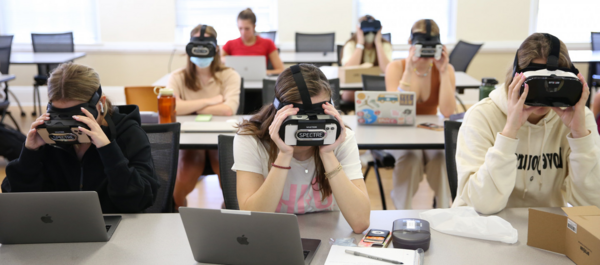
Virtual reality courses have become more common, thanks to the development of new classroom applications for the software and the increased affordability of VR and augmented reality technology for institutions. A 2025 survey of chief technology officers by Inside Higher Ed and Hanover Research found that 14 percent of respondents said their institution has made meaningful investments in virtual reality and immersive learning.
Past research shows that VR activities benefit student learning by making the classroom more engaging and encouraging creative and entrepreneurial thinking.
A group of faculty at Pepperdine University in California adapted virtual reality content to teach undergraduates about ethical systems in a practical and applied setting.
Their research study, published in the Journal of Business and Technical Communication, showed that students who used VR in a case study had a heightened emotional response to the material, which clouded their ability to provide a measured analysis. By comparison, students who watched a straight video about the same case not only expressed empathy for the subjects but also maintained a clear view of their situation.
How it works: The research study evaluated student learning over the course of two semesters in 2023. Students were presented with three variations of a case study related to the Malibu Community Labor Exchange, a nonprofit organization that helps day laborers and individuals without housing secure work. Students read a news article and watched a VR video or watched a standard video about the lives of workers at the MCLE, which provides a variety of opportunities for individuals in the Los Angeles region. Some watched both VR and a standard video.
Course content focused primarily on the workers, their personal lives, their role in addressing wildfires in Malibu and the risks they face in fighting fires.
After watching the materials, students had to connect the ethical questions presented about MCLE’s mission and workers’ conditions with a previously taught lesson about ethicists and their ethical systems, as well as write a recommendation for the organization.
Faculty reviewed students’ responses to identify whether they exhibited appropriate reasoning about ethical systems and whether their recommendations reflected their ability to interpret the content.
The takeaways: In their reflections, students underscored the way videos exposed them to someone else’s circumstances and realities, saying the content felt very authentic. But those who used VRwere more likely to say the format was distracting than those who saw only videos.
Students who watched the standard video said it helped them expand their understanding of the organization, its members and the context of the work in an emotional and logical way. They wrote that they felt empathetic and had a richer sense of the work being done.
“The video was very raw. It didn’t glamorize or have fantastic editing. It showed us exactly what it is like for these workers,” one student wrote.
For some students, the VR video was more powerful because it was more “shocking and realistic than seeing the video in normal format,” one course participant wrote. Instructors noted students were almost too personally affected by the first-person vantage point to talk about the organization and the ethical systems from an objective or factual perspective.
Students who watched only the VR were also more likely to conflate the experience with reality, calling it a “true view” instead of a representation or interpretation of events; students who watched a standard video as well as the VR version had a more balanced perspective.
Based on their findings, researchers suggest that using both standard and VR videos that require students to reflect, analyze and recommend solutions can increase students’ “practical wisdom,” or balancing cognition and emotion for ethical action, as researchers defined it.
“Rather than assuming that students know how to critically evaluate visual messages and their emotions, we need to intentionally teach students how to develop visual literacy and practical wisdom, especially by using VR video,” researchers wrote in the article.
The Graduate Student Assembly had planned to consider resolutions against two Texas laws.
Officials at the University of Texas at Austin blocked the Graduate Student Assembly from considering two resolutions against Texas state laws last week, arguing that the student-run body must follow institutional neutrality policies.
Mateo Vallejo, a first-year master’s student and representative in the GSA for the School of Social Work, drafted two resolutions for the assembly to consider: one condemning Texas SB 17, which bans diversity, equity and inclusion initiatives at Texas public institutions, and another against Texas SB 37, a state law that, among other changes, put faculty senates at public institutions under the control of university presidents and boards.
On Oct. 10, GSA president David Spicer submitted the two resolutions to Associate Dean for Graduate Studies Christopher J. McCarthy for approval. According to the assembly bylaws, the dean of students’ office must approve all proposed GSA legislation before it can be considered by the full assembly, effectively giving the office an opportunity to veto, Vallejo explained. Once a bill is submitted to the dean’s office, the assembly cannot make any changes to the text. Vallejo, Spicer and the GSA vice president were careful to follow the bylaws during the drafting process to give administrators as little reason as possible to shut the resolutions down.
Five days later, McCarthy nixed them.
“[Vice President for Legal Affairs] considers the legislation to be political speech that is not permitted to be issued by a sponsored student organization in their official capacity,” McCarthy wrote in an email to Spicer, which Inside Higher Ed obtained. “This legislation should not be permitted to go forward.”
Spicer followed up, asking why the GSA was prohibited from engaging inpolitical speech when others have done so in their official capacity at UT Austin. He pointed to an op-ed by Provost William Inboden in the conservative magazine National Affairs and a statement from University of Texas System Board of Regents chairman Kevin P. Eltife, who said the university was “honored” to be among the institutions “selected by the Trump Administration for potential funding advantages” under Trump’s “Compact for Academic Excellence in Higher Education.”
“Their speech was on ‘political and social’ matters, so I do not know how they escape the neutrality requirement whereas GSA cannot,” Spicer wrote in his response to McCarthy. In addition, UT Austin’s undergraduate student government recently put out a statement of support for the university’s new president, Jim Davis, which Spicer argued is also political speech.
“Like attacks on the Faculty Council, silencing GSA through institutional neutrality is an attack on the notion of shared governance,” Spicer said in a statement to Inside Higher Ed. “GSA appoints students to university-wide committees and, previously, Faculty Council committees. GSA is the one space at UT Austin where students can voice issues impacting their graduate education.”
When asked about the double standard, UT Austin spokesperson Mike Rosen told Inside Higher Ed that the resolution in support of Davis is not political speech because he was appointed by a nonpartisan board and not by an elected official. Members of the University of Texas System Board of Regents are appointed by the Texas governor.
“UT Austin exercises institutional neutrality consistent with a policy approved by the UT System Board of Regents, which prohibits System institutions from expressing positions on political matters or issues of the day. As a sponsored student organization, GSA acts as an extension of the University and cannot act to cause the University to violate the UT System policy,” Rosen wrote in an email.
Vallejo’s resolutions against SB 17 and SB 37 would not be the firstattempt by the GSA to address Texas politics. In 2022, the Assembly passed a resolution in response to Texas attorney general Ken Paxton’s opinion and Gov. Greg Abbott’s directive to the Department of Family and Protective Services that gender-affirming medical care for minors could be treated as child abuse. In its resolution, the Assembly urged campus officials not to adopt that definition for campus reporting purposes.
It can be tempting for department chairs to think about their role as a series of tasks on a to-do list: managing faculty and staff reviews, running department meetings, implementing a new university policy, dealing with unexpected emergencies. After all, it’s an ever-changing list that demands attention.
But focusing only on tasks misses the ways that chairs shape how department members interact with one another and the quality of relationships that result. Meetings are a common example. Chairs have choices about how to organize meetings, help staff feel included or excluded, coach new assistant professors about participation norms, and assign people to committees. How chairs do these routine tasks can have powerful effects on how department members relate to one another and the quality of relationships that develop. Cumulatively, small moments of interaction have a profound influence on a department and its culture and can be an important ingredient in helping to make departments healthier places to work.
However, many chairs aren’t used to noticing all the ways their everyday chair work impacts work relationships. To take advantage of the opportunity to positively impact relationships in departments, chairs need to develop their relational attention, or ability to notice opportunities to impact how people connect. Two years ago, I developed a six-part workshop series, Healthy Relationships at Work Fellowship, for chairs at University of Massachusetts Amherst, for a small cohort to work on just this issue. By engaging with research-based practices, they were able to develop competence and confidence as leaders while improving the quality of relationships in their departments.
Below, I describe four ways chairs can develop their relational attention and increase the occurrence of positive, inclusive relationships in their department. In describing these four suggestions, I share examples from two cohorts of chairs I’ve had the pleasure to work with.
Invest in one-on-one relationships with department members.
It is easy for department chairs to take for granted that they know the faculty and staff in their departments—and that they know you. After all, as a faculty member you have likely had many casual conversations and sat in many meetings with them. But relying on your past knowledge can leave chairs with an incomplete view. We all inevitably have some faculty or staff we favor and those we avoid, leaving us with uneven relationships and information about their work, motivations and lives. Similarly, faculty and staff may have a hard time viewing you as an impartial department chair unless you take the time to demonstrate it. After all, making visible efforts to cultivate relationships is a cornerstone of inclusive leadership.
One important way to create the foundations for positive inclusive relationships with your department members is to re-establish your relationships with them. You can do this by holding 30-minute one-on-one meetings with every member of your department. Given that chairs often have very little idea about what staff do and how they contribute to the department, it is important to meet with staff as well as faculty. In some departments, it may be important to meet with students as well.
Before beginning these one-on-one conversations, try to get in a mindset of openness, humility and genuine curiosity, no matter your relationship history. Ideally these meetings can occur in their workspace (versus your own office) so you convey that you are interested in them and are willing to come to their space. Ask open-ended questions about their interests, their motivations and their jobs. In smaller departments, these meetings can happen over the course of a month, while in larger departments it may require a whole semester. In larger departments, where one-on-one meetings seem impractical, you can hold meetings with small groups of people in similar roles or ranks. These meetings demonstrate that you want to hear from everyone, no matter your past relationships.
You may also learn new things that you can use to make your department a healthier place. For example, you may learn that two faculty unknowingly have a shared research or teaching interest. By connecting them, you can help to strengthen the connections within the department and potentially spark new collaborations.
What you learn in these meetings can also help to address unhealthy relationships. For example, one chair learned new information about a curmudgeonly faculty member who frustrated his colleagues (including the new chair!) because he had a reputation for not pulling his weight on committees. When the new chair asked him, “How do you want to contribute to the department?” she learned that the one thing he cared about was graduate education. With this new information, she placed him on a committee that matched his interests, and he contributed to the committee fully. By crafting his job to his interests, the faculty member was more intrinsically motivated to participate, and his colleagues were no longer annoyed by his behavior on committees.
Learn about the diversity of your faculty, staff and students and demonstrate your interest in learning from them.
Departments, like all organizations, are diverse in visible (race and gender) and invisible (political, neurodiversity) ways. While there is lots of debate about DEI these days, learning about the diversity of your faculty and staff helps you become a better leader because you can understand how to help everyone succeed. To develop positive inclusive relationships, chairs have to make visible effort to demonstrate respect and express genuine interest in people different from themselves.
To build chairs’ foundational knowledge, you can learn about the experiences of diverse groups in your department, school or university by reading institutional resources, such as climate surveys, or by having a conversation with college or university-level experts. For example, a conversation with a school DEI leader can speak to the experiences of your faculty, staff and students. A university’s international office can provide insight into immigration-related issues, which may be useful for understanding the complexity of managing immigration for international faculty, staff and students.
Bolstering your own knowledge can help contextualize issues that come across your desk. For example, if a student comes to you to complain about a faculty member’s teaching, and you have learned that members of that group have to fight for respect in your university’s classrooms, your knowledge about the broader climate can help you think of this complaint in light of the larger context as you consider what an appropriate response might be.
If you have more confidence in your knowledge, skills and abilities to manage DEI, you can connect more publicly. For example, if there are on-campus employee resource groups or off-campus community organizations, reach out and tell them you would like to learn from them; ask if there are any events that would be appropriate for you to attend. Given your stronger foundation in terms of the local DEI landscape, you can offer to connect marginalized faculty and staff with on-campus mentors and communities.
The ability of chairs to engage publicly with DEI issues will depend both on their own expertise and their institutional and local contexts, as DEI work grows more fraught in many parts of the country. Some chairs who have expertise in DEI or related topics may be comfortable hosting activities in their departments. For example, one chair hosts a monthly social justice lunch and learn, a voluntary reading group for faculty and staff. Given her expertise, she chooses the article and is comfortable facilitating the discussion herself.
Chairs can also create opportunities for critical feedback for the department. For example, if there is tension between groups within the department, instead of ignoring it, create a game plan for how to receive critical feedback about what’s causing the tension and how it might be addressed. Faculty and staff exert a lot of energy withstanding such tension; finding ways to address it can be a huge relief and release of energy.
Remember, faculty and staff evaluate a leader’s inclusivity based not just on one-time events, but instead search for patterns in terms of the leader’s efforts around inclusion. You don’t have to have all the answers about how to serve the diversity of members in your department, but you can strengthen your networks to include those with knowledge and expertise.
View committees as connection opportunities.
Chairs can use committees, meetings and other routine ways that faculty and staff gather as opportunities to build higher-quality connections. By focusing your relational attention on these routine interactions, you can improve relationship quality. For example, people often don’t know why they’ve been placed on a committee or task force, nor do they know what other people bring to the table. As a chair, you can use introductions strategically. Publicly communicating your view of faculty and staff strengths and potential contributions to committees, task forces and meetings helps them feel respected and makes it more likely others will view them that way. This can increase the chances that these routine ways of interacting will result in positive connections.
Committees and meetings are also opportunities to create greater inclusion of staff and to spread knowledge about their work. University staff too often feel like second-class citizens and that faculty don’t know or care about their expertise. To counter this tension, one chair introduces staff members as experts in their respective areas and provides them with opportunities to present in their areas of expertise in meetings. This chair reported that these innovations created new positive connections between faculty and staff; faculty had a new appreciation for staff work, and the staff felt seen and valued.
Design social events as connection opportunities.
We are in a moment in which many people want, and some have, the ability to work remotely. At the same time, faculty and staff desire more connection from work. As an architect of social relationships, chairs have the opportunity to hold meaningful social events that will bring people together. There is no one-size-fits all for designing such events: The goal should be to make events magnets, not mandates.
To start, think creatively about what will bring people together in your specific department. For example, one department chair knew all faculty would come together to support their students. In his department, faculty wanted their undergraduates to have a good experience in the major because they genuinely valued undergraduate education. Accordingly, the chair organized an open house event for faculty and students. In the process of connecting with students, faculty also deepened their connections to each other.
Another chair created a social event around the dreaded faculty annual reviews. The day before the reviews were due, she reserved a conference room and brought snacks so that faculty could trade tips about how to complete the cumbersome form. Still others hosted department parties at their homes, used departmental funds to host monthly lunches or upgraded the department’s shared space to make it more conducive to shared interactions.
Improving the quality of relationships through social events in a department doesn’t have to rely on the chair alone; it can also be the work of a culture committee that can brainstorm social events that will resonate. Ideally, these events will become part of the rhythm of the department. One caveat: It is not advisable to use workplace socializing to try to repair relationships between warring internal factions. In fact, it can make things worse.
Each of these four approaches can help chairs invest in and improve the health of relationships in their departments. It is, of course, also important to contain and manage negative relationships in them (that is another topic I address in the Healthy Relationships at Work program). But taking advantage of these everyday opportunities through strategically investing in your relationships, your knowledge and the ways people connect provides important sustenance to support departmental relationships and ultimately a positive departmental culture.
Emily Heaphy is a professor of management, a John F. Kennedy Faculty Fellow and an Office of Faculty Development Fellow at the University of Massachusetts Amherst. She developed the Healthy Relationships at Work Fellowship for department chairs when she was a Chancellor’s Leadership Fellow affiliated with OFD in 2023–24.
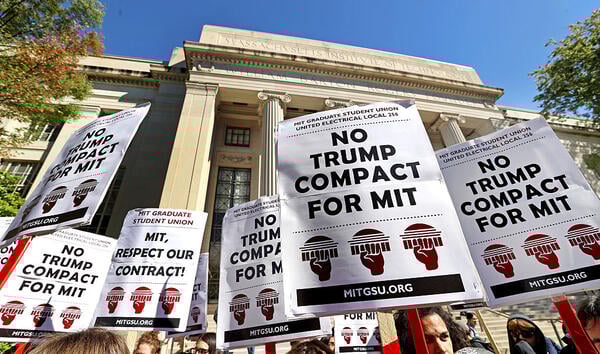
The Trump administration’s initial effort to convince universities to join its “Compact for Academic Excellence” did not go well. Of the original nine colleges and universities, so far none has signed it, and seven—Brown University, Dartmouth College, the Massachusetts Institute of Technology and the Universities of Arizona, Pennsylvania, Southern California and Virginia—have loudly and forcefully rejected it, citing “our core belief that scientific funding should be based on scientific merit alone” (MIT) and “the government’s lack of authority to dictate our curriculum or the content of academic speech” (Brown).
The Trump administration made more headway with its earlier efforts to force a “deal” on one university at a time. But that was never going to be enough. An authoritarian needs to establish control over the entire higher education sector, not just a handful of institutions. But the truth is, this government does not have the legal leverage or even the staff to negotiate bespoke agreements with the thousands of colleges and universities in the United States.
The compact is an effort to overcome that problem. But it is also a gift. It has flipped the default: Now collective action does not necessarily require affirmative acts like banding together to file a lawsuit (although several are warranted). Collective action can simply take the form of nonacquiescence. All university leaders need to do is … nothing.
Last week, the Trump administration—apparently unafraid to look desperate—decided to open the compact to any American college or university that will accept its terms. Suddenly, literally anyone affiliated with any college or university—faculty, staff, students, parents, alumni, trustees, donors—has the opportunity to use their voice to help persuade their institution not to sign, as their counterparts at the original nine invitees have been doing rather vociferously and, in six cases so far, successfully. By opening the compact so broadly, the government is risking, or inviting, an equally broad response: a recognition throughout the vast American higher education sector that the integrity and value of our whole enterprise depend on independence from government control.
Regardless of their politics, every university leader should reject this compact. University leaders have a fiduciary responsibility to plan ahead on a time scale longer than three years. As Sally Kornbluth, the president of MIT, explained, “America’s leadership in science and innovation depends on independent thinking and open competition,” not special “preferences” for institutions that submit to government control. Future federal governments are much more likely to embrace Kornbluth’s view than Trump’s. It does not put a university in a strong position to compete for future faculty and students if the university enthusiastically agrees to toe one administration’s political line.
To sign the compact is to invite a breathtaking degree of federal government control. Colleges signing it agree that in the future, if the Department of Justice—perhaps acting on orders from the president—“finds” that the university is disobeying any one of the compact’s many ambiguous commands, the department can take away all the university’s federal funding for a year or more. That includes not only scientific research grants but also student loans or Pell Grants, potentially even the university’s 501(c)(3) status—and not only future funds but also, incredibly, funds already spent that must somehow be returned.
The ambiguous rules that signing institutions must avoid transgressing are numerous. Signing universities must “abolish” or “transform” academic departments that “belittle” “conservative ideas.” They must screen out foreign students with “anti-American values” and those with “hostility” toward any of America’s “allies.” They must punish students or faculty whose speech, in the DOJ’s opinion, “support[s]” any group the government deems a terrorist group, which would include “antifa” as well as Hamas (and the government has a long recent record of defining “support for Hamas” extremely broadly, so that it encompasses much pro-Palestinian speech).
They must commit to “defining” and “interpreting” gender in the government’s preferred way, which denies that transgender people exist. Signing institutions must obtain, to the DOJ’s satisfaction, “a broad spectrum of viewpoints” not only in the university as a whole, but “within every field, department, school, and teaching unit.” They must admit students on the basis of sufficiently “objective” criteria. Leaders of signing universities must avoid speaking out about “societal and political events” beyond those that directly affect the university.
Not a single one of those terms is self-defining. The arbiter of whether a university is fulfilling these vague promises is a Department of Justice that has a record of acting in bad faith and takes orders from a notoriously mercurial president. No university leader or trustee can truthfully say that it fulfills their fiduciary responsibility to sign their school up for this.
The compact is also blatantly illegal. The Trump administration has cited no statutes that give it the authority to boss universities around in this way, because there aren’t any. Many of the compact’s provisions listed above—and others—violate the First Amendment. Clear black-letter law holds that what the government cannot impose by law, it also cannot impose as a condition of receiving government funds.
It is crucial to keep in mind the larger context here: the rise of an authoritarian regime that seeks to undermine the independence of many types of civil society institutions, not just universities. The national governments in both Turkey and Hungary have increased political control over their universities as part of their consolidation of power, but neither has gone as far as this compact would go in putting universities under the government’s thumb. To sign the compact is to participate in an authoritarian project.
Any university leaders still inclined to join the compact should consider a final argument: The dollars and cents simply don’t add up. The compact requires, among many other things, a five-year tuition freeze. In the high-inflation environment of the second Trump administration, this is very costly. (At today’s 3 percent inflation rate, it amounts to a 16 percent cut in real terms over five years; if inflation continues to rise, that could easily become a 20 to 25 percent cut.)
The government offers a vague, nonbinding promise that it will give signing institutions extra research grants, but such grants do not easily make up for lost tuition in an environment of rising costs. The grants require doing the research; that eats up most of the money. Any college that becomes dependent on extra grants, beyond those they would have been qualified to receive without the compact, is going to be in big fiscal trouble down the line.
This compact has vast implications, which deserve careful study. For faculty, staff, students, parents, donors and alumni hoping for a no but willing to settle for silence, time is your friend; inaction is your goal. A faculty committee would certainly be in order. If you do nothing, and most other universities do nothing, the government will have no more leverage over your institution than over any other, and academic freedom and the pursuit of knowledge and truth will continue for another day.