Tag: Education

  • Michael Stedelin | Diverse: Issues In Higher Education

    Michael Stedelin | Diverse: Issues In Higher Education

    Michael StedelinMichael Stedelin has been named assistant vice president for research strategic planning and solution development at Penn State University. In this role, Stedelin will provide senior leadership in integrating mission planning, systems and solutions within the research domain so that organizational capabilities are prioritized, adopted and scaled effectively to meet the University’s research goals. 

    Stedelin holds a bachelor’s degree in computer management information systems and an MBA from Southern Illinois University Edwardsville.

    Source link

  • Black Women’s Leadership in Higher Education: The Remaking of Academic Power

    Black Women’s Leadership in Higher Education: The Remaking of Academic Power

    I
    Dr. Tina M. King 
    n the storied halls of higher education, Black women who ascend to the presidency do so while carrying the weight of history, community, and the unspoken expectation that we will be both miracle workers and scapegoats. Black women in higher education leadership navigate a complex matrix of anti-Blackness and misogynoir —a reality where their expertise is simultaneously appropriated and undermined. Research reveals that more than most Black women executives in predominantly white institutions (PWIs) experience racelighting (racialized gaslighting), characterized by dehumanizing scrutiny. We endure identity taxation, where we are expected to carry the unsustainable burden of single-handedly solving institutional race problems, often where we are the target of the attack while comforting white fragility. Simultaneously, we experience racelighting where people of color receive racialized messages and question their thoughts and experiences. This racelighting is perpetuated by the institution’s willingness to tokenize Black women’s identities for diversity optics while suppressing our agenda for transformative anti-racist praxis. The narrative of Black women’s leadership in PWIs is not simply a tale of individual achievement but also reflects the deep, persistent anti-Blackness embedded in the academy’s very structure.

    The attacks, swift and severe, are often cloaked in the familiar rhetoric of “governance, academic integrity, or collegial concern,” but the subtext is unmistakably racial. They are orchestrated not as a response to policy but as a rebuke of Black authority daring to reshape the institution’s priorities. In such attacks, we are called incompetent, corrupt, and unwilling to do the hard work (lazy), echoing tropes that have long been used to undermine Black people in general and Black women in leadership specifically. The most insidious move, however, is often the elevation of a single Black or Brown person to be the messenger or carrier of the attack, serving as a shield to deflect accusations of racism and to lend legitimacy to the movement or campaign t o disparage and discredit Black women’s leadership.Dr. Regina Stanback StroudDr. Regina Stanback Stroud

    This dynamic is not new. Dr. Patricia Hill Collins (2000), in her foundational work on Black Feminist Thought, describes how Black women in leadership are subjected to controlling images— stereotypes that are deployed to police the boundaries of acceptable Blackness. In the academy, these images manifest as relentless questioning of competence, insinuations of aggression, and the expectation that Black women will perform emotional labor to maintain white comfort. The token messenger, perhaps unwittingly, becomes complicit in this system, their proximity to whiteness granting her temporary power even as it reinforces the very structures that marginalize leaders of color—in other words, they become complicit in using the academic tools of white supremacy to join in the assault on Black women’s leadership.

    What begins to emerge is a spectator sport where people at all levels of influence remain silent in the face of orchestrated attacks. Please make no mistake: silence does not represent neutrality; it represents complicity. By refusing to address the racialized nature of the attacks, the institution is signaling that Black women leaders are ultimately expendable, their contributions contingent upon their willingness to placate white interests and prioritize white comfort. This is the reality of what Breonna Collins (2022) calls “epistemic violence” –the systematic invalidation of Black knowledge and leadership under the guise of procedural fairness.

    Yet Black women leaders have always found ways to resist and reimagine the academy. Drawing on the tradition of Black feminist resistance, we create counterspaces within hostile institutions, mentoring the next generation and insisting on the legitimacy of their vision. We redefine “institutional fit” not as assimilation into white norms but as the capacity to transform the institution in service of justice.

    Despite these acts of resistance and reimagination, the very presence and leadership of Black women in academic spaces often disrupts entrenched power structures and exposes the discomfort many have with authentic Black excellence. A threat to many, Black excellence in leadership prioritizes the needs of marginalized students and communities over the preservation of the status quo.

    While some may wish to uphold privilege and power for themselves, others may be well-intentioned but unable to recognize Black excellence. They may interpret Black leadership as arrogance or see Black Leaders simply as flaunting their positions or being opinionated. Still others may believe they are doing good but fail to recognize their own deep biases. Those who consider themselves allies may suffer fatigue along with Black leaders, but that mutual suffering does not, an ally make. It must be accompanied by one’s willingness to use their white privilege and capital to actively combat anti-Blackness and misogynoir at play.

    Studies of HBCU leadership reveal how Black women executives subvert PWI pathologies through radical self-definition, where we reject white-normed leadership frameworks to implement culturally grounded approaches and ethical care (prioritizing community needs over respectability politics). We create counter-spaces that center Black epistemologies, such as mentorship programs that affirm Black women’s intellectual sovereignty. Black women leaders engage in institutional truth-telling where we document systemic racelighting through critical race methodology.

    True transformation requires more than performative allyship. It demands redistribution of resources, independent accountability structures, and a commitment to centering Black epistemologies in institutional decision-making. There is a growing recognition that Black leadership is not incidental— it is essential to the future of higher education. The time has come for institutions to choose: will they cling to the master’s tools, or will they finally make room for the radical imagination and power of Black women’s leadership?

    Until higher education is willing to confront its foundational anti-Blackness, it will continue to sacrifice its most visionary leaders on the altar of white comfort. The question is not whether another attack will come but who will have the courage to stand in solidarity and say, “Enough.” The future of academia depends on this shift. Ultimately, we must move beyond the white gaze and demand for our pain, and instead, embrace the Black radical imagination and the remaking of power in the academy.

    Dr. Tina M. King is president of San Diego College of Continuing Education 

    Dr. Regina Stanback Stroud is the chief executive officer of RSSC Consulting

    Dr. Jennifer Taylor Mendoza serves as the 13th president of West Valley College.


    Source link

  • Proposal would remove federal data collection for special education racial disparities

    Proposal would remove federal data collection for special education racial disparities

    This audio is auto-generated. Please let us know if you have feedback.

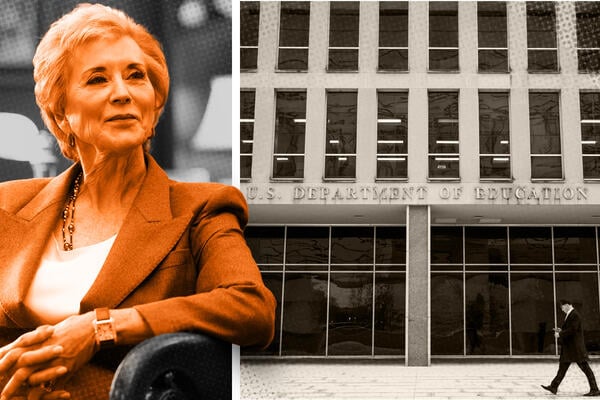
    The U.S. Department of Education is proposing to remove a requirement for states to collect and report on racial disparities in special education, according to a notice being published in the Federal Register on Friday.  

    The data collection is part of the annual state application under Part B of the Individuals with Disabilities Education Act. The application provides assurances that the state and its districts will comply with IDEA rules as a condition for receiving federal IDEA funding. 

    The data collection for racial overrepresentation or underrepresentation in special education — known as significant disproportionality — helps identify states and districts that have racial disparities among student special education identifications, placements and discipline. About 5% of school districts nationwide were identified with significant disproportionality in the 2020-21 school year, according to federal data.

    The Education Department said it wants to remove the data collection because the agency anticipates it will reduce paperwork burdens for the states. According to several state Part B applications filed earlier this year, the significant disproportionality data collection adds more hours in paperwork duties. 

    For example, Florida’s application said it records an average of 25 additional hours for responses reporting data related to significant disproportionality in any given year, including the time for reviewing instructions, searching existing data sources, gathering and maintaining the data needed, and completing and reviewing the collection of information. Alabama’s and Oregon’s applications also cite an additional 25 hours each for the collections. 

    The department has not said it wants to rescind or pause the significant disproportionality regulation, a rule known as Equity in IDEA, which was last updated in 2016. 

    However, under the first Trump administration, the rule became a hot button issue when then-U.S. Education Secretary Betsy DeVos said its implementation would be delayed. 

    The Council of Parent Attorneys and Advocates, a nonprofit supportive of education rights for students with disabilities, sued the Education Department and won, and by April 2019, the rule was back in full effect. 

    Denise Marshall, CEO of COPAA said in a Thursday email to K-12 Dive that the proposal to remove the Equity in IDEA federal data collection was “yet another unlawful attempt by the Administration to shirk its obligations under the law to students of color.”

    Marshall added that the data collection fulfills a critical role in enforcing the significant disproportionality requirement in IDEA. The collection allows states and districts to examine the data, determine if there is racial disproportionality, and develop measures to address the problem. Marshall points out that IDEA does not declare significant disproportionality unlawful. Rather, the law and regulations provide a method for states and districts to address systemic racial disproportionality in special education.  

    Robyn Linscott, director of education and family policy at The Arc, an organization that advocates for people with intellectual and developmental disabilities, said that even if in the future there is no longer a data collection for significant disproportionality at the federal level, the information would still need to be collected by states and districts as required by IDEA.

    But the loss of the central repository of information on significant disproportionality in schools will make it more difficult for advocacy groups and technical assistance centers to support school and district efforts to reduce racial disparities in special education.

    In the absence of the data being available at the federal level, it will be “much more difficult” for people not within a state education agency to be able to access the data, Linscott said.

    Correction: A previous version of this article erred in spelling out the IDEA acronym. It stands for the Individuals with Disabilities Education Act. We have updated our story.

    Source link

  • Egypt and Czech Republic to deepen higher education ties

    Egypt and Czech Republic to deepen higher education ties

    Conversations between Egypt and Czech Republic are focused on expanding opportunities for student and faculty mobility, launching joint research initiatives, and creating frameworks for institutional partnerships between universities in both countries.

    Senior officials including Ayman Ashour, Egypt’s minister of higher education and Czech Ambassador to Cairo, Ivan Jukl, gathered at the New Cairo Education Building to discuss deepening educational ties.

    Ashour emphasised the importance of deepening academic and research collaboration between Egyptian and Czech institutions, noting that closer ties would help build human capacity and advance the priorities of both countries.

    “We agreed on the importance of strengthening academic and research collaboration between Egyptian and Czech institutions, fostering knowledge exchange, and creating new opportunities for joint projects in priority fields that serve both nations’ development goals,” commented Ayman Ashour.

    “Together, we will work towards building impactful partnerships that advance innovation, research, scholarships, and sustainable development.”

    Together, we will work towards building impactful partnerships that advance innovation, research, scholarships, and sustainable development.

    Ayman Ashour, minister of higher education,

    In recent years, Egypt has launched new universities, welcomed international branch campuses, and developed dual-degree programs with globally ranked institutions, aiming to attract more students.

    Egyptian universities are increasingly offering programs taught in multiple languages, designed to draw a more diverse pool of international students. This part of the expansion strategy and national development agenda, the minister explained, is Egypt’s ambition to establish itself as a regional hub for higher education, attracting students from across the Arab world, Africa, and the Middle East.

    Jukl, meanwhile, welcomed the developments, stressing the Czech Republic’s commitment to extending its cooperation with Egypt.

    He praised Egypt’s young, dynamic population and its position as a gateway to the African continent, calling these factors a strong foundation for building long-term academic and scientific partnerships.

    For students, the enhanced cooperation could mean greater access to scholarships, exchange placements, and dual-degree opportunities in the coming years. Egyptian students may also see more Czech institutions participating in academic fairs and mobility schemes across the region, opening new pathways to Europe for postgraduate study and research.

    Source link

  • A Strategic Blueprint for University Administrators

    A Strategic Blueprint for University Administrators

    The higher education sector is navigating an era of rapid change. Shifting demographics, declining traditional enrollment and evolving workforce needs are redefining the value proposition for universities. Coupled with budget and staffing pressures, it can seem daunting to university leaders to understand how to begin the transformation that universities are being asked to undertake.

    Workforce-relevant credentials, such as microcredentials, certificates and industry-aligned badges, are emerging as strategic tools to expand institutional reach, respond to employer demand and deliver measurable career impact for learners. These can be delivered separately from your degree curriculum, embedded within the degree pathway or both.

    Universities face stagnant enrollments, skepticism about ROI and mounting pressure to innovate. Traditional degree pathways alone are no longer enough to address these headwinds. This blueprint provides university leaders with a road map to implement credentialing initiatives that align with market demand, institutional mission and long-term sustainability.

    The Why: Building the Case Internally

    Building the internal case to expend the time and energy to realign curricular offerings can be daunting at times of resource scarcity. But the reality is that from an enrollment perspective, it’s simply good planning to be looking ahead and identifying new markets for your institution. And the population that holds the most promise of growth for higher education today is the adult learner—a segment that is growing fast.

    These students are often midcareer professionals, job changers or individuals seeking rapid upskilling. They may already have a bachelor’s degree or a workforce credential, or they may be a part of the 43.1 million learners with some credit but no degree. Of those, 37.6 million represent working-age adults under the age of 65. These learners will value short, targeted, career-aligned learning experiences that fit into busy lives. How are you identifying and connecting with these learners and who are the employer partners that you can engage with?

    By integrating stackable, workforce-relevant credentials into academic offerings, institutions can diversify revenue, attract new learners and showcase agility in meeting labor market needs. Graduates gain targeted skills, boosting employability and alumni engagement. Their success positions the university as a trusted partner for every career stage.

    How to Start

    Exploring innovative credentialing is a great tool in your strategic enrollment management planning toolbox. Such initiatives can be supportive of your enrollment goals and also provide some answers to the public questions around the ROI for their tuition dollars. You might be well on your way on the journey to strengthening the connection between learning and the workforce, or you might be just beginning. The reality is that educational institutions may already have some of the building blocks in place, and a slight shift in how you package and document your educational programs could put you on the right path.

    While any credential could be industry-aligned, it might be easiest to begin with smaller, incremental credentials, either independently or aligned to current degree programs. For adult learners, short, skill-based and industry-aligned programs offer an immediate career payoff while potentially stacking toward degrees.

    A well-designed workforce offering needs to be aligned with industry-trusted credentials and certifications and should ultimately layer with your traditional academic programs and offer a clear connection to employment-relevant skills. Investing in this work today will create short-term enrollment gains and help you to build long-term relationships with learners and employers who will turn to you again and again to meet their upskilling needs. These will also speak to your undergraduate degree learners (and their parents) by creating a direct link to return on investment.

    Defining Workforce-Relevant Credentials

    • Degree: Academic credential or qualifications awarded to a learner who has successfully completed a specified course of study in a particular field or discipline.
    • Certificate: Official documentation indicating completion of purposefully collected coursework to signify understanding of a narrow subject or topic. May also confirm acquisition of specific skills.
    • Microcredential: Competency or skills-based recognition that allows a learner to demonstrate mastery and learning in a particular area. Less than a full degree or certificate; it is a segment of learning achievement or outcome. Should be certified by a recognized authority.
    • Badge: Digital visual representation that recognizes skills, achievements, membership affiliation and participation.

    Build a Cross-Campus Team

    To successfully build new innovative credentials requires a collaborative approach, the creation of a planning team that aligns academic, enrollment, tech, marketing and employer-engagement strategies holistically. At a minimum, this includes faculty, the registrar’s office, enrollment management, your continuing-education division, education technology and your finance officer.

    A second layer to support learner success should also include advising, student services and career services. Chosen well, this team will be key to help ensure that you maintain compliance with accreditation or governance requirements in addition to designing an attractive and relevant program. Building the internal case across the campus with these leaders will help you to create the buy-in required to balance innovation and agility with compliance.

    Aligning Credentials With Institutional Mission

    Any workforce credentials offered by an institution should support and complement, not compete with, existing degree pathways. To ensure this alignment, consider embedding programs within academic departments and continuing education units. Be sure to involve faculty early to ensure rigor, buy-in and shared governance.

    And don’t forget to map credentials to degree pathways for seamless learner progression. Make it easy for an adult learner to become a lifelong learner. Innovative credentials can serve as entry ramps to degree programs, be embedded into degrees or stand alone. Start with pilots and focus on high-demand, high-return fields.

    Consider Technology

    Ultimately, when making learning and credential platform decisions, you should seek to prioritize interoperable, learner-centered technologies that enhance the portability of records and improve coordination across institutions. Digital solutions that prioritize transparency, accuracy and accessibility help to create a more connected and responsive learning ecosystem, ensuring that learners can move seamlessly through their educational and career pathways, with their achievements recognized and understood wherever they go.

    Building the Adult Learner Pipeline

    As in any new program, you must do your research. Review your institution’s most recent environmental scan to support prioritization of your best opportunities. If that scan is not current or doesn’t include market intelligence that leverages labor market analytics and employer feedback, you will need to collect that information to ensure offerings are demand-driven.

    • Outreach and messaging. Frequently, the effectiveness of the institution’s communications with prospective and current students comes under scrutiny: the quality of technology, the delivery modes, timing, the content and the coordination. Prepare for these concerns by outlining what the college is currently doing and who the stakeholders are. Messaging for innovative credentials will be inherently different than messaging for a degree. Promote credentials as high-value, low-barrier entry points for upskilling or career change.
    • Leveraging partnerships. Consider your service area and inventory your partnerships. Collaborate with employers, workforce boards and government agencies to co-design, fund or endorse programs. Convene regional advisory councils to keep offerings aligned with workforce trends. It is important that these relationships are current and agile so that credentials can respond to shifting workforce needs in real time. Explore grants, workforce investment funds and employer cost-sharing opportunities that may help defray your costs and those of your learners.
    • Developing support structures. All learners need support, which might need to look somewhat different for adult learners than your traditional degree support. Offer advising, prior learning assessment and flexible credit pathways to maximize learner success.
    • Considering assessment and data collection. Nationally, there is a call for more transparency and more data that proves ROI. This means that more data collection from learners up front and better tracking of outcomes will be required. Data collection in the workforce credential space will give you valuable experience that you can apply to your degree programs as federal student aid requirements shift toward proving workforce outcomes.

    A Call to Action for Institutional Leaders

    Universities that strategically embrace workforce-relevant credentials will not only meet the needs of today’s learners but also strengthen employer partnerships and stand out in a crowded market. It’s more than launching new programs. It’s about reimagining the university as a future-facing institution that delivers lifelong value. The time to act is now: Start small, scale smart and lead with vision.

    Source link

  • Rise of the Incompetents (opinion)

    Rise of the Incompetents (opinion)

    As an English composition instructor, I’m prone to doomscrolling articles (written primarily by other English composition instructors) about the uses, advantages and dangers of large language models in college classrooms. I think my colleagues, focused on concerns about plagiarism, policing and the tenability of our own employment (all pressing issues in their own rights), may be ignoring the greater threat that text-generation technology poses to our democratic institutions, the judgment of our electorate and the competence of our workforce.

    In one of the articles I found myself scrolling, John Villasenor, writing for the Brookings Institution, suggested that LLMs would lead to “the democratization of good writing.” I was surprised to see that description. The ChatGPT-produced assignments I see on a weekly basis are rarely mistakable for “good.”

    More to the point, research suggests that uniform style and content will not produce a level playing field of competent writers but, more likely, a ceiling of barely capable thinkers. In a study published by Nature Human Behaviour, researchers discovered that “reliance on ChatGPT … reduces the diversity of ideas in a pool of ideas,” to the degree that “94 percent of ideas from those who used ChatGPT ‘shared overlapping concepts.’”

    Academics like Vered Shwartz at the University of British Columbia have also raised concerns that if North American models “assume the set of values and norms associated with western or North American culture, their information for and about people from other cultures might be inaccurate and discriminatory.”

    A diversity of perspective, experience, talent and know-how are required to run and maintain a healthy democratic society. That civic diversity cannot be replicated by machines, and it would be severely damaged by voter rolls consisting of former students educated in the art of outsourcing their mental faculties to chat bots.

    AI proponents are quick to point out historical instances of educators running about like headless chickens at the inventions of keyboards, calculators, pen and ink. I would go further: Socrates opposed the act of writing itself, which he believed would “introduce forgetfulness into the soul of those who learn it.”

    We remember this quote because Plato wrote it down. It is a fallacy to conflate those examples with the full replacement (sometimes called “assistance”) of human thought by LLMs. Pens, keyboards and even Gutenberg’s printing press democratized writing in that they made it simpler for a greater number of human beings to convey themselves. In contrast, “AI” technology does not make writing easier for writers: At best it makes them readers—at worst, copy-pasters. LLMs pull words from data centers filled with the ideas of other writers, whose work is to a large degree not credited or paid for (even children will tell you that’s called theft). The result is akin to regurgitated vomit.

    To create this essay, I applied Microsoft Word’s red squiggly lines to spot my misspellings. I’ve always been a poor speller (ask my middle school teachers), but the words I produce, the mistakes I make, are still my own, and the reason I make them is tied to my human experience as a communicator. Whether I learn from those mistakes or simply press “fix” and doom myself to repeat them is a conscious choice I make every time I write.

    Of course, the choices don’t end there. I also decided how to approach the topic; what references to pull; how to order my paragraphs (both before and after I wrote them); what idioms, metaphors and introductory language to use; where to place hooks and callbacks; what to title the piece; and how to utilize grammar and punctuation to express my sassy indignation. These are vital skills for students to practice, not because they’re required in every profession, but because they emphasize executive function and cognitive reasoning. Writers are responsible for what they write, speakers for what they say, leaders for what they decide and voters for whom they elect. This in and of itself is reason enough to teach actual writing.

    Another common argument of writers who unironically propose supplanting their own perspectives with generative AI summaries is that the traditional method of teaching writing caters to what Villasenor calls an “inherently elitist” system. To their credit, this is true. In his guide Writing With Power (Oxford, 1998), the esteemed rhetoric and composition professor Peter Elbow, who passed away earlier this year, explained,

    Grammar is glamour … the two words just started out as two pronunciations of the same word … If you knew grammar you were special … But now, with respect to grammar, you are only special if you lack it. Writing without errors doesn’t make you anything, but writing with errors …makes you a hick, a boob, a bumpkin.”

    The fact that we have raised the bar for ourselves is a sign of intellectual progress. Yes, gaps continue to exist (I taught ESL for several years), but I wouldn’t be so quick to concede the higher ground of achievement. Besides, while knowing one’s split infinitives and dangling modifiers is not a prerequisite for civic engagement, an innate, perhaps unconscious understanding of collective grammar norms is still required for reading, and this is true for every written language, in all of its forms (including memes and text messages).

    We should be wary of the faux-populist sentiment behind arguments like this. A willful naïveté is required, I think, to suggest that the products of LLM parent companies (Google, Meta, OpenAI, Microsoft) foster equitable principles.

    Even more dangerous is the tactic of deriding the abilities and wisdom of specialists and academics who seek rare and valuable knowledge. This has been and remains a frequent trick of authoritarians, which is why educators should be concerned by the visibly cozy relationship many of these tech companies have fostered with the Trump administration.

    Both thematically and practically, this partnership, forged in campaign contributions, public appearances and the elimination of internal dissent (see: Jeff Bezos and The Washington Post), represents a threat to the university system. The Trump White House, intent on canceling research grants, deporting students and revoking accreditation, has very clearly demonstrated its opposition to “the elites” of academia. Ignorant consumers, like ignorant voters, are easier to manipulate, and ignorance thrives when education falters. Trump stated his preference clearly in a Nevada campaign event back in 2016:

    We won with young. We won with old. We won with highly educated. We won with poorly educated. I love the poorly educated!”

    According to a Pew Research Center analysis, Trump won the non-college-educated population by a 14-point margin (56 to 42 percent) in the 2024 presidential election, double his margin from 2016. The bad-actor alliance between Trump and big tech companies is no coincidence. They do not want you to write because they do not want you to think.

    The falseness of LLM-generated content is a perfect fit for the reality-rejecting ethos of the Trump administration. Back in April, the White House was accused of outsourcing its world-altering tariff calculations to ChatGPT. In May, the Health and Human Services secretary, Robert F. Kennedy Jr., published a report that experts discovered was filled with what appeared to be AI-generated false citations.

    These people have access to the greatest resources known to mankind. Why are they operating like bumfuzzled freshmen, submitting sloppy work at the 11th hour? Check the roster. The head of the Environmental Protection Agency has no experience working with the environment. The secretary of education is not an educator. The head of the Department of Housing and Urban Development is a former football player. The secretary of homeland security has never served in either an intelligence or defense capacity. RFK Jr. is a lawyer, not a doctor. Donald Trump is a reality TV star and convicted felon with six bankruptcies and numerous failed businesses to his name. If there is a better example of the Peter Principle in action on Planet Earth today, I don’t know it.

    Jason Stanley, an expert on fascism previously at Yale University and now at the University of Toronto (he was spurred by the Trump administration’s actions to leave the country), identified “anti-intellectualism” as a signature feature in fascist movements.

    As he writes, “Fascist politics seeks to undermine public discourse by attacking and devaluing education, expertise and language. Intelligent debate is impossible without an education with access to different perspectives, a respect for expertise when one’s own knowledge gives out, and a rich enough language to precisely describe reality.”

    As Americans, we are in real danger of voluntarily submitting our cognitive faculties to LLMs for the sake of convenience, thereby weakening our ability to express truth and sort it from falsehood, a dilemma we already face with the advent of social media, extremist “news” networks and both foreign- and domestic-born disinformation. It is easier to give up than to resist. It is easier to delegate than to work hard. Aldous Huxley, author of Brave New World, knew this well. In a 1949 letter to George Orwell, he predicted,

    Within the next generation, I believe that the world’s rulers will discover that infant conditioning and narco-hypnosis are more efficient, as instruments of government, than clubs and prisons, and that the lust for power can be just as completely satisfied by suggesting people into loving their servitude.”

    Our mothers gave us sage advice when we were children; they said, “Don’t take candy from strangers.” Like a creep in a white van, LLMs represent nebulous actors with nefarious purposes. In addition to stealing from countless unattributed human writers, companies like Meta and Google have demonstrated a careless—if not outright vampiric—interest in our personal data.

    The availability of this technology is equally pervasive. There’s a van on every street corner and the driver says that I can save 30 minutes of work by outsourcing it to Gemini. Why shouldn’t I? Isn’t this a benefit to me as an employee? Game theory suggests otherwise—if all competitors offload their work in the same manner, none of them get ahead. In a recent working paper published by the National Bureau of Economic Research, economists Anders Humlum and Emilie Vestergaard found that “AI chatbots have had no significant impact on earnings or recorded hours in any occupation.”

    Perhaps a more important question is this: Where do we imagine that 30 minutes goes? The rise of “AI” has yet to instigate a four-day workweek, and it is unlikely to do so. Since the Industrial Revolution—from black lung to Black Friday—American workers have learned that innovations in productivity rarely manifest as increased pay or shorter work hours.

    In the United States, labor conditions have improved only when collective action demanded it from lawmakers. Such was the case with Roosevelt’s New Deal in the 1930s. On their own, the steam engine, spinning jenny, desktop computer and mobile phone failed to reduce the need for workers to be productive. Rather, they set new production standards, profiting company shareholders. Line graphs of U.S. worker salaries and CEO earnings versus inflation over time bear this out quite strikingly.

    Big tech corporations are currently installing LLM apps in every corner of our daily lives, degrading the accuracy of search engines, making it harder to reach human customer service representatives and filling the internet with identical templates and “slop.” This may be profitable for wealthy investors, but it is not progress for average Americans. Moreover, as has been reported by Business Insider and Time, among many others, this rapid incursion represents a serious threat to the livelihood of employees across multiple sectors. Micha Kaufman, founder and CEO of Fiverr, a multinational company offering an “AI-enhanced” platform connecting freelancers and businesses, said back in April that “AI is coming for your jobs. Heck, it’s coming for my job too.”

    I imagine Kaufman can afford to lose his job. Can you? In the short term, corporate bosses may favor compliant employees who hastily enter prompts into LLMs, a skill that might take as much as a few hours of guesswork to develop. But leadership requires competence. Leaders make decisions, carry responsibility and know what to do when systems go down. If a 50-foot wave comes careening over your boat, whom do you want at the helm—a captain with years of sailing experience or one who is very good at asking AI what to do?

    Every time I enter a new classroom on the first day of the semester, I look across the desks and wonder which of my pupils will be a part of the next big thing. Which of them will enter government service? Which of them will teach in my place when I’m gone?

    Educators should not relent in pushing their students beyond the bounds of incompetence. Our collective goal should remain as it always has been—to inspire students to struggle and learn from that struggle, thereby forging new, more capable identities. I want my students to make something of themselves. What a disservice I’d do if, instead, I taught them how to delegate their potential to a machine.

    Noah B. Goldsher is a first-year seminar and first-year writing instructor at Quinnipiac University.

    Source link

  • The American Historical Association Comes Close, but Misses

    The American Historical Association Comes Close, but Misses

    I believe it to be very important for disciplinary bodies to issue statements/guidance on the use of generative AI when it comes to the production of scholarship and the work of teaching and learning.

    For that reason, I was glad to see the American Historical Association issue its Guiding Principles for Artificial Intelligence in Education. One of the chief recommendations in the concluding chapters of More Than Words: How to Think About Education in the Age of AI is that we need many more community-based conversations about the intersection of our labor and this technology, and a great way to have a conversation is to release documents like this one.

    So, let’s talk.

    First, we should acknowledge the limits of these kinds of documents, something the AHA committee that prepared the principles acknowledges up front at the closing of the preamble:

    Given the speed at which technologies are changing, and the many local considerations to be taken into account, the AHA will not attempt to provide comprehensive or concrete directives for all instances of AI use in the classroom. Instead, we offer a set of guiding principles that have emerged from ongoing conversations within the committee, and input from AHA members via a survey and conference sessions.”

    —AHA Guiding Principles for Artificial Intelligence in Education

    I think this is obviously correct because teaching and learning are inherently, inevitably context-dependent, sometimes down to the smallest variables. I’ve used this example many times, but as someone who frequently taught the same course three or even four times a day, I could detect variances based on what seems like the smallest differences, including the time of day a particular section met. There is a weird (but also wonderful) human chemistry at play when we treat learning as a communal act—as I believe we should—but this means it is incredibly difficult to systematize teaching, as we have seen from generations of failed attempts to do so.

    Caution over offering prescriptions is more than warranted. As someone who now spends a lot of time trying to help others think through the challenges in their particular teaching contexts, I’m up front about the fact that I have very few if any universal answers and instead offer some ways of thinking about and breaking down a problem that may pave the road to progress.

    I cringe at some folks who seem to be positioning themselves as AI gurus, eager to tell us the future and, in so doing, know what we should be doing in the present. This is going to be a problem that must be continually worked.

    The AHA principles start with a declaration that seeks to unify the group around a shared principle, declaring, “Historical thinking matters.”

    My field is writing and English, not history, but here I think this is a misstep, one that I think is common and one that must be addressed if we’re going to have the most productive conversations possible about where generative AI has a place (or not) in our disciplines.

    What is meant by “historical thinking”? From what I can tell, the document makes no specific claims as to what this entails, though it has many implied activities that presumably are component parts of historical thinking: research, analysis, synthesis, etc. …

    To my mind, what is missing is the underlying values that historical thinking is meant to embody. Perhaps these are agreed upon and go without saying, but my experience in the field of writing suggests that this is unlikely. What one values about historical thinking and, perhaps most importantly, the evidence they privilege in detecting and measuring historical thinking is likely complicated and contested.

    This is definitely true when it comes to writing.

    One of my core beliefs about how we’ve been teaching writing is that the artifacts we ask students to produce and the way we assess them often actually prevents students from engaging in the kinds of experiences that help them learn to write.

    Because of this, I put more stock in evidence of a developing writing practice than I do in judging the written artifact at the end of a writing experience. Even my use of the word “experience” signals what I think is most valuable when it comes to writing: the process over the product.

    Others who put more stock in the artifacts themselves see great potential for LLM use to help students produce “better” versions of those artifacts by offering assistance in various parts of the process. This is an obviously reasonable point of view. If we have a world that judges students on outputs and these tools help them produce better outputs (and more quickly), why would we wall them off from these tools?

    In contrast, I say that there is something essentially human—as I argue at book length in More Than Words—about reading and writing, so I am much more cautious about embracing this technology. I’m concerned that we may lose experiences that are actually essential not for getting through school, but for getting through life.

    But this is a debate! And the answers to what the “right” approach is depend on those root values.

    The AHA principles are all fair enough and generally agreeable, arguing for AI literacy, policy transparency and a valuing of historical expertise over LLM outputs. But without unpacking what we mean by “historical thinking,” and how we determine when this thinking is present, we’re stuck in cul-de-sac of uncertainty.

    This is apparent in an appendix that attempts to show what an AI policy might look like, listing a task, whether AI use could be acceptable and then the conditions of acceptance. But again, the devil is in the details.

    For example, “Ask generative AI to identify or summarize key points in an article before you read it” is potentially acceptable, without explicit citation.

    But when? Why? What if the most important thing about a reading, as an aspect of developing their historical thinking practice, is for students to experience the disorientation of tackling a difficult text, and we desire maximum friction in the process?

    Context is everything, and we can’t talk context if we don’t know what we truly value, not just at the level of a discipline, or even a course, but at the level of the experience itself. For every course-related activities, we have to ask:

    What do we want students to know?

    and

    What do we want students to be able to do?

    My answers to these questions, particularly as they pertain to writing courses, involve very little large language model use until a solid foundation in a writing practice is established. Essentially, we want students to be able to use these tools in the way we likely perceive our own abilities to use them productively without compromising our values or the quality of our work.

    I’m guessing most faculty reading this trust themselves to make these judgments about when use is acceptable and under what conditions. That’s the big-picture target. What do we need to know and what do we need to be able to do to arrive at that state?

    Without getting at the deepest values, we don’t really even know where to aim.

    Source link

  • A Look at WashU’s Continuing Education Program

    A Look at WashU’s Continuing Education Program

    Continuing-education programs are one way for colleges and universities to provide targeted offerings and credentialing opportunities for alumni, adults in the region lacking postsecondary education and the local workforce. They also provide flexible support offerings, recognizing the competing identities and responsibilities adult learners hold.

    The School of Continuing and Professional Studies at Washington University in St. Louis houses certificate programs, undergraduate and graduate degrees, prison education initiatives, and lifelong learning courses for adults in retirement.

    In the most recent episode of Voices of Student Success, host Ashley Mowreader speaks with Sean Armstrong, dean of the School of Continuing and Professional Studies, to talk about the program’s goals and ways the school uplifts adult learners of all types.

    An edited version of the podcast appears below.

    Q: Most people know WashU; it’s a pretty well-known institution in the U.S. But what is CAPS and what is the mission, and [who are] some of the students that you’re serving?

    Sean Armstrong, dean of the school of continuing and professional education at Washington University in St. Louis

    Washington University in St. Louis

    A: Let me start with definitions. First, Washington University in St. Louis, we’ll call WashU. Continuing and Professional Studies, we’ll call CAPS. Nontraditional or adult learners, we call modern learners here—those for whom school is not their only priority. And then noncredit, we call professional credit because we don’t like “nons.” I think calling anything a “non” is just a negative, and it seems to say it doesn’t matter. So those are the terms that we use.

    The program itself is an opportunity for modern learners to access Washington University in a way that they may not have been able to before. This university started out close to 100 years ago, and it was kind of a niche type of school, accessible to certain individuals but not broadly accessible. So our goal is to make this school broadly accessible. Many of our programs are based on regional workforce needs and, of course, [are for] those who find themselves in the category of some college, no degree, and they would like to return and complete their degree.

    Q: Can you talk a little bit more about the students who enroll? When it comes to demographics or general trends that you see among the people who enroll in CAPS, what are those?

    A: Over 80 percent of our students are employed full-time; I think over 50 percent have multiple jobs. Over 90 percent have families, whether that means they have children or they’re caring for an adult, a parent or older age demographic. I would say 80 percent of our students fall in the 25 to 49 age range. We do have some that are younger, and of course, we have some that are older, but [most] fall squarely in that range. Many of them are looking to find a way back because they want to advance or shift gears and enter another career. The bedrocks [of industry] here in St. Louis are health care, emerging technologies like data, and leadership and management.

    Q: I like the focus that you placed on career. One, these students are already working—they know what it’s like to be in the workforce and be employed—compared to maybe some of our traditional undergraduate students. But two, they have a very clear career goal, and they’re looking to do something different with their lives.

    I wonder if you can talk about that paradigm where it’s not that they need a job, it’s that they want a different job, or that they’re looking to do something maybe tangential or in a higher-paid role.

    A: I think being aspirational doesn’t stop when you’re 22 years old. That’s why we have lifelong learning, and our role is to meet people where they are and to create pathways that lead them to their goals.

    We call ourselves partners in student success. We don’t see ourselves as necessarily the educator or the school; we want to be a partner. We want to talk about what your goals are, what your motivations are, and then try to use the resources within the university and within the community to build that pathway to where you want to go.

    Q: I just want to say it’s been great listening to the word choice that you all are using, like a “partner,” a “modern learner” and not using “noncredit.” Is that an institutional initiative or is that something you’re passionate about, the idea of using asset-based language?

    A: I am super passionate about it. I think the institution has adopted it as well. I can’t say what the language was before I arrived, but I’ve been using a lot of it here.

    A lot of it has been to change the perception of the students who enroll within CAPS and the perception of the individuals in our community who are coming to us. I don’t want anybody to be viewed in a negative light, one, and I don’t think there needs to be a comparison between learners, right? They’re all learners, they all have aspirations and we’re all here to support them. I think of all of this as “We are all in this.”

    Q: Let’s talk about some of the programs. What’s the most popular degree offering that you all have, or nondegree offering?

    A: The bachelor of science in integrated studies is a degree program that has many different areas of study and certificate options. That is a popular program because this is really dedicated as a some college, no degree type of program. We accept up to 85 transfer credit hours in this program, which is super generous. It’s not something I want to change, and hope I don’t have to, for various reasons, but it allows us to really be open to students.

    WashU is a writing school. It is a school that wants you to be able to communicate clearly, either through writing or speaking. And so our writing and communication courses, there is an assessment that we do to see where individuals are, and then to help them build the skill to be able to be successful in our courses. So that’s a really popular one.

    Our certificates, you know, I try to put my finger on which ones [are popular], because I think our certificate enrollments have doubled in the last year, and we’re trying to understand why.

    Our certificates serve two purposes. One, they’re skill-based, so they’re an opportunity for someone to learn a skill within a year and then have that credential and move on. But they’re also stackable to a bachelor’s degree, so if somebody has some college, no degree, or maybe they have an A.A. [associate of arts] degree, they want to earn their certificate because they’re not feeling too confident about entering into a bachelor’s degree program, this is a really good way for them to be able to do that. We’ll begin to uncover this year as to why that’s so popular, but it’s been going gangbusters.

    And then I have to tell you about our “heart” programs. We market them as our community programs, but they’re programs that are central to our heart. They’re our prison education program, our English language program, our master of arts in teaching and learning, and our OSHA Lifelong Learning Institute program.

    The four of those are really community-based. Prison education, we offer face-to-face degree programs in two prisons in Missouri and re-entry support for individuals who are returning home. In our English language program, we offer opportunities for individuals who are international students to communicate clearly, present clearly. But we also had an opportunity to turn that program towards the community, for individuals who lack the English skills to be a good fit for a job—you have to communicate clearly on any job. So we had individuals who were here that had medical degrees and wanted to work in the medical field, and so we’re helping them to be able to bridge that gap.

    I mentioned our master of arts in teaching and learning; teaching is just necessary. So we’re trying to do all that we can to be helpful, especially here in the St. Louis region. And then our OSHA Lifelong Learning Program offers opportunities for individuals who are over 50 to continue learning for the rest of their lives.

    Q: That’s awesome. I have a personal passion for lifelong learner classes because they’re so niche and there are so many different ways to engage the community there.

    You talked a little about the community engagement piece of CAPS, but I wonder if we can dig into that a bit more. You know, WashU has historically been very selective in who it admits and how it relates to the St. Louis community as a whole. How does this further that town-and-gown relationship and encourage St. Louisans to see themselves as part of WashU?

    A: Our focus is on the region and on individuals who really don’t have the option of being a residential student. They have to be either part-time, some of them are three-quarter time, but they cannot live on campus. That’s not an option, because they just have other things going on. And so that’s our niche. That’s kind of the gap that we’ve been able to fill.

    I am happy to say that WashU has been very supportive, very enthusiastic about that population of students. Again, we don’t compare. I think the WashU residential students are probably some of the brightest students I’ve met in my career, probably top 1 or 2 percent from around the world. And I’m not trying to say our students are not, but you know that they’re not 18, either.

    They’re 30 years old with two children and other obligations. Household operations is a real thing, trying to figure out what needs to get paid and what doesn’t. That’s not to say our residential students don’t have those types of concerns, but for our [CAPS] students, it is something that can sometimes challenge how they appear in our setting.

    Q: There was a study by Trellis Strategies that found a majority of community college students or those enrolled part-time were more likely to consider themselves workers who are students and not necessarily students who are workers. It sounds like that’s the population you’re talking about, where their education is important to them, but there are other things that are ranking towards the top first.

    You serve a variety of adults in a variety of different contexts. What is that like for you, as the dean of a school like this, to wear all these hats and engage with all these different types of programs and support mechanisms to encourage student success?

    A: I’ve always liked the full-spectrum model of adult education. We’ve seen bits and pieces—the community college, of course, has a piece. Typically, school districts will have a piece, universities will have a piece. I’ve always liked, “OK, there’s really no job too small if there’s a need in the region. So let’s attack all of it.”

    I think that vision starts with me, and of course, I’m kind of the mad scientist sometimes, but the support and the passion for the individuals that I work with are really what makes this happen. It’s interesting because we were talking the other day in a leadership team meeting, and I said, “I think one of the questions I am going to ask in interviews from now on is, ‘How does it make you feel to help somebody? Does it make you feel good, or is it just you’ve checked the box?’” And I think, for the most part, in our organization, it makes people feel good to do this type of work.

    Q: Absolutely. What are some of the challenges in the work that you do?

    A: Time is our biggest challenge. There are things that people needed yesterday, and we’re just unable to create a program as quickly as the need arises or has arisen. There are people who are finding out about us and wish they had known about us a year ago, and so we’re behind the gun on that. But really, it’s time for us. I think we are ready to do, as I think my daughter would say, we’re ready to do the most in any given circumstance.

    Q: One initiative that we didn’t talk too much about that I want to highlight is Extend(Ed) and this idea of equipping professionals to advance in their career. Can you talk a little bit about that initiative and how it works?

    A: Sure. Extend(Ed) is the professional credits—the noncredit space is what it’s typically called, but we call it professional credits. I call it creative solutions for workforce needs. It’s a model that I see us offering 100-plus short-term courses or programs in within the next, I’d say, 18 months.

    We’re looking at synchronous opportunities, asynchronous opportunities, and they’ll be online mostly. I think there’ll be some that’ll be based on an employer’s needs. We’re working with a few employers on creating programs that they asked for. And they’ll be co-created, which is key, because I never want somebody to leave and say, “We didn’t really get what we wanted.” It was like, “Oh, we discussed this.”

    So we’ll be on-site delivering that particular program. Extend(Ed) allows us to be really creative and really responsive to the needs of industry or even community organizations. And they’re affordable. We’re trying to make them as affordable as possible.

    Q: Who are the faculty in this work?

    A: They’re subject-matter experts, so they are working in the field. They’re doing the work on a day-to-day basis, so they’re able to link what students are learning in the text with real life and what they’re doing at work, and I think our students really appreciate that.

    We’ve had students who have enrolled with us, who were our residential students, who also appreciate the perspective of the faculty that teach for us, and also the students and their real-world experiences also. It creates a different dimension of diversity, I think, within the classroom, and maybe an elevated level of conversation when you’re talking about, “I do this on a daily basis.”

    One question I like to ask students—our students in particular—is “Is there anything that you learned in the classroom last week that you were able to apply recently?” And they all say yes, and they’ll say, “this thing,” so it’s pretty cool.

    Q: What’s next for CAPS? What are some of your goals for this upcoming academic year?

    A: I mentioned one with Extend(Ed). I think we want to deepen partnerships. Partnerships are central to what I do. It’s in my background; a really deep knowledge of how to create partnerships has been what my career has been all about for the past 25 years, and so I want to continue to do that in St. Louis. And then we always strive to improve student success and student service. So that’s another area that we’d like to ensure that we keep top of mind.

    Q: Are your student support services similar to those for residential students or how do they look different?

    A: It’s slightly different. Our model is based on the coaching model, and so there is more of the directive “Here are the courses that you will need to take in order to graduate.” But where the traditional student affairs or student support for a residential student would be based on a living and learning community, ours is more based on the how-to.

    Our students are more confronted with, “I don’t know if this is the right time to go back, but I need to.” And then there might be some impostor syndrome also. So we’re focused on how to be successful—What was your motivation for doing all of this?—and then reminding students of that motivation as we guide them along that path.

    Q: I wonder if you have any advice or insight for others who work in this space, either in higher education broadly or in continuing education spaces, encouragement on how to do this work well or a lesson you’ve learned doing this work.

    A: One lesson that I’ve learned is to talk to all of your surrounding organizations to understand what their role is in the space. When we talk about some college, no degree [students], the first thing I say is “There’s no competition among us, because that population is so large that if we ran at double our capacity, we wouldn’t be able to meet the need.” So it might be better for us to look at what we all are doing. If we want to establish swim lanes, we can. If there are ways that we can collaborate, we should. And that would be the one advice that I’d give people who are, depending on the population, some college, no degree is definitely one of those, but really to partner with one another, collaborate on student success.

    Get more content like this directly to your inbox.

    Source link

  • Most Students Affected by OBBBA Student Loan Changes

    Most Students Affected by OBBBA Student Loan Changes

    Photo illustration by Justin Morrison/Inside Higher Ed | Feverpitched/iStock/Getty Images

    The majority of current college students—61 percent—surveyed recently say that several changes to the federal student loan system that became law earlier this summer will directly impact them, according to a new poll from U.S. News & World Report.

    The key changes that students expect to affect them include caps on how much students can borrow, the elimination of some income-based repayment plans and the end of Grad PLUS loans.

    The poll, which surveyed 1,190 graduate and undergraduate students earlier this month, asked students about what various provisions in the One Big Beautiful Bill Act would mean for them. Many respondents (38 percent) said they would have to take out private loans to balance the effects of the law, while others (35 percent) said they may not be able to finish college at all. About a quarter said they were even considering joining the military to help pay for college.

    “I wanted to go to medical school, but now I won’t,” one student wrote, according to U.S. News.

    At the same time, one in five students said they were unaware of the changes to students loans, while another 39 percent said they were “fuzzy on the details” of the OBBBA. Twenty-two percent said they understood the law but not how they will personally be affected.

    Some students also reported supporting the bill’s provisions; about one in five students said they approved, respectively, of loan caps for graduate students, caps for medical and law students, and the elimination of certain income-based repayment plans. Slightly fewer, 17 percent, approve of eliminating Grad PLUS loans.

    About 63 percent of students said they reached out to their financial aid offices for help navigating the bill’s effects, and three-quarters of those students found their financial aid offices helpful. About half of students (51 percent) also reported that their universities had been transparent about the effects of the OBBBA.

    Source link

  • Survey Shows High Graduation and Employment Rates

    Survey Shows High Graduation and Employment Rates

    College Possible’s latest alumni survey shows strong outcomes for participants in its coaching program, including a 93 percent five-year graduation rate for those who attended a four-year college and high rates of employment and job satisfaction.

    According to the report, which is based on a survey of 1,300 of the college access nonprofit’s more than 100,000 graduates, 95 percent are employed, 83 percent are employed full-time and more than four in five respondents said they felt fulfilled by their jobs.

    The salaries of College Possible graduates are also high, with half reporting salaries over $60,000. The median salary for those working in STEM fields is $101,650, while those in non-STEM careers made a median income of $46,680. Sixty-eight percent of respondents indicated they feel at least somewhat financially secure.

    The report also highlights that most of College Possible’s graduates say they benefited significantly from the coaching program, with nine in 10 saying they would recommend College Possible to others and 17 percent returning to coach other students or work for the organization in another capacity.

    Source link