Tag: Education

  • Why Universities Must Not Capitulate to the Trump Regime

    Why Universities Must Not Capitulate to the Trump Regime

    The $221 million settlement with the Trump administration by Columbia University (and a similar $50 million deal by Brown University) represent a terrible capitulation by these campus leaders. AAUP president Todd Wolfson called the settlement “a disaster for Columbia students, faculty, and staff, as well as for academic freedom, freedom of speech, and the independence of colleges and universities nationwide. Never in the history of our nation has an educational institution so thoroughly bent to the will of an autocrat.”

    Columbia and Brown had slam-dunk legal cases against the Trump administration, which clearly violated the processes required under Title VI when they suspended funding. (Brown was never notified of any reasons for the funding to be cut off, and there wasn’t even the pretense of a finding of antisemitic discrimination.) By making a settlement, universities give up their legal rights to challenge this repression, agree to impose massive censorship and pay a huge sum for the privilege of sacrificing their values.

    It’s possible that the leaders of Columbia and Brown made this agreement because they concluded that Trump is a pathological liar, a petty dictator, a petulant lawbreaker intent on taking revenge against any perceived enemy and a president who will simply ignore any adverse judicial rulings. That analysis is accurate. But if you think Trump will ignore the law and violate any rules, then trusting his regime to obey a legal settlement is just as crazy.

    The settlements include a bizarre amount of federal micromanagement of private universities, requiring Brown to provide single-sex floors in student housing, ban admissions decisions using personal statements that mention race and conduct a survey about antisemitism by the end of the year and take “appropriate action” in response. Even the smallest violation of the numerous requirements could be used to justify a future cutoff in federal funds.

    The same officials who made ludicrous accusations of antisemitic discrimination to punish these universities will get to decide if the colleges are violating the agreement and deserve to be punished. While the agreements settle the old baseless charges, nothing prevents new baseless charges from being filed and leading to the same illegal funding cuts. Colleges that settle with the Trump administration have no guarantee of safety from further retaliation, and Trump officials will actually use these settlements to demand a tighter reign of censorship.

    The New York Times reported about those praising the Columbia agreement, “Many have focused on a provision that said no part of the settlement ‘shall be construed as giving the United States authority to dictate faculty hiring, university hiring, admissions decisions or the content of academic speech.’” Far from being a positive protection for intellectual liberty, this language is actually a terrible threat to free expression on campus.

    By only protecting academic speech, this provision leaves the door wide open for government-imposed repression. Most expression on college campuses is not academic speech. The extramural utterances of faculty, along with virtually all student speech, is not academic speech and therefore is open to any suppression by the government under this agreement. But protecting extramural utterances is an essential part of academic freedom and has been a fundamental aspect of its definition since the AAUP’s 1915 Declaration of Principles.

    While the provision says that the government can’t “dictate faculty hiring,” there’s nothing about dictating faculty firings. By solely protecting hiring decisions, Columbia leaves the door wide-open for purging faculty, staff and students who are deemed undesirable by the Trump administration.

    In an email to the campus, Brown president Christina H. Paxson wrote that the first key aspect of the settlement was that “no provision of this Agreement, individually or taken together, shall be construed as giving the United States authority to dictate Brown’s curriculum or the content of academic speech.” (Brown apparently didn’t bother to follow Columbia and get a ban on federal control over its hiring decisions, which is an alarming omission.)

    Some people might think that paying $221 million to get $400 million in research grants is a good bargain. Federal grants aren’t free money for colleges. All of the funding goes to research expenses. Now that the Trump administration has arbitrarily lowered the indirect cost rate to 15 percent, government-sponsored research is much less profitable for colleges—and possibly an expense they must subsidize. Certainly, Columbia will be losing money by paying $221 million to get access to $400 million in grants.

    Paramount bribed Donald Trump a mere $16 million (and purged a few critics) in order to get approved an $8 billion merger that can’t be undone. As terrible as Paramount’s submission to Trump was, Columbia purged far more students and spent 13 times as much to get a deal worth 1/20th the value that increases ongoing federal control over Columbia. Paramount and Columbia executives may share a moral gutter, but at least Paramount’s bribe made financial sense.

    Worse yet, by making a settlement, Columbia loses that $221 million forever, with no opportunity to prevail in court and receive the full funding their researchers are entitled to. By agreeing to obey the government, Columbia hurts its legal options to challenge future funding cutoffs, because the government can claim that Columbia failed to live up to the terms of the settlement. If the courts rule against the Trump administration’s illegal actions, Columbia and Brown will still be forced to pay these millions, impose repressive censorship and face retaliation without legal recourse.

    The Columbia capitulation sets a precedent for Harvard to pay an even bigger settlement, estimated at up to $500 million. Unfortunately, hapless apologists for repression such as former Harvard president Larry Summers are urging Harvard to follow Columbia’s model, and Summers praised the Columbia capitulation as “the best day higher education has had in the last year.” Summers claimed, “The prestige of the university is not to be arrogated by faculty members in support of any set of political convictions, particularly those in leadership positions of academic units.”

    Let me translate this: Professors should not be allowed to express political views. For believers in censorship such as Summers, the desire to suppress academic freedom finds a convenient partner in the Trump administration.

    Universities are making these deals with the Trump regime not in spite of the requirements for censorship, but because of those restrictions. The provisions in these settlements enhance administrative power to suppress dissent, and that’s precisely what makes them so appealing to some campus administrators.

    Columbia and other colleges are trapped in a no-win situation, but even difficult moral dilemmas have wrong answers, and that’s what Columbia’s leadership has chosen. Let’s hope Harvard is not the next lemming to throw itself over the cliff and sacrifice its core values, its donor money and its common sense in the vain hope that fawning obedience and bribery can satisfy the vengeance of a mad leader.

    Source link

  • National Science Foundation Suspends Grants at UCLA

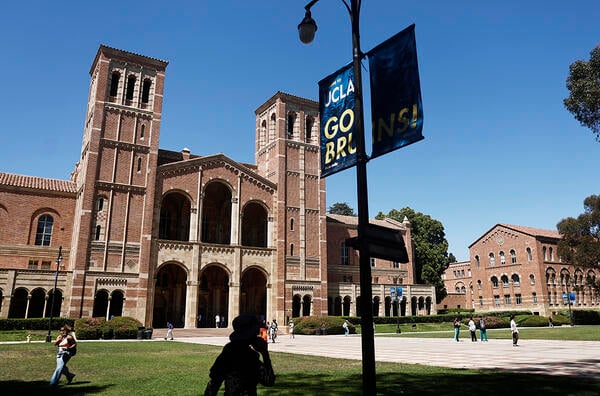
    National Science Foundation Suspends Grants at UCLA

    Frederic J. Brown/AFP via Getty Images

    (This article has been updated with comment from UCLA.)

    The National Science Foundation said Thursday that it’s suspending grant awards at the University of California, Los Angeles. 

    An NSF spokesperson said that the university’s awards “are not in alignment with current NSF priorities and/or programmatic goals,” though they didn’t offer more specifics. NSF changed its priorities in April and, as a result, cut off funding to programs related to diversity, equity and inclusion and those aimed at combating misinformation

    Freelance journalist Dan Garisto wrote on BlueSky that nearly 300 grants at UCLA are now suspended. That includes a $25 million grant that supports the university’s Institute for Pure and Applied Mathematics. (In 2022, UCLA had about 450 grants from the NSF, totaling more than $350 million.)

    UCLA chancellor Julio Frenk wrote in a letter to the campus community that the freeze extended beyond NSF to include grants from the National Institutes of Health and other federal agencies.

    “This is not only a loss to the researchers who rely on critical grants,” Frenk wrote. “It is a loss for Americans across the nation whose work, health, and future depend on the groundbreaking work we do.”

    Frenk noted that UCLA was prepared for a grant freeze and has developed contingency plans. “We will do everything we can to protect the interests of faculty, students and staff—and to defend our values and principles,” he pledged.

    The Associated Press reported that the freeze affected $339 million in federal grants.

    The grant suspension comes as UCLA finds itself the Trump administration’s latest target in its growing war with higher education. Earlier this week, the university settled a lawsuit in which a group of Jewish students alleged that UCLA enabled pro-Palestinian activists to cut off Jewish students’ access to parts of campus. On the same day the settlement was announced, the Justice Department accused UCLA of violating the federal civil rights law that bars antisemitism and race-based discrimination.

    Frenk said the government claimed “antisemitism and bias as the reasons” for the freeze. But he argued that Trump’s “far-reaching penalty of defunding life-saving research does nothing to address any alleged discrimination.” 

    He added that UCLA shares the goal of eradicating antisemitism, detailing the steps the university has taken in the last year to address the issue, including establishing new policies for campus protests.

    UCLA has until Aug. 5 to respond to the DOJ’s notice of violation; DOJ officials threatened that the university would “pay a heavy price for putting Jewish Americans at risk.” The Justice Department is also investigating the admissions practices at UCLA, but that inquiry hasn’t wrapped up yet.

    Source link

  • Senate Appropriators Reject Trump’s Education Dept. Cuts

    Senate Appropriators Reject Trump’s Education Dept. Cuts

    Senate Republicans are planning to protect the Pell Grant program, keeping the maximum grant award at $7,395 for the coming academic year, despite the Trump administration’s proposal to lower it to $5,710.

    The rejection of Pell Grant cuts at a key committee markup Thursday is just the latest rebuke from congressional appropriators as lawmakers in both chambers have appeared wary of President Trump’s plans to shutter offices, gut programs and generally reshape the federal government.

    In addition to protecting $22.5 billion for Pell, the GOP also spared TRIO, campus childcare subsidies and numerous other programs that Trump had proposed zeroing out. It also set new staffing standards for the recently gutted Department of Education, increased funding for medical research by $400 million and rejected the National Institutes of Health’s attempt to cap indirect research cost reimbursements at 15 percent. The legislation also restricts other efforts at NIH to change how grants are awarded, though Democrats say “more needs to be done to protect NIH research programs.”

    Over all, the Department of Education is going to receive $79 billion and the NIH will get $48.7 billion. In comparison, Trump had requested $66.7 billion for ED and $27.5 billion for NIH.

    Committee chair Sen. Susan Collins, a Maine Republican, said she was proud of the legislation that advanced Thursday, calling it a bipartisan effort to fund the health and education of American families. She noted that “the appropriations process is the key way that Congress carries out its constitutional responsibility for the power of the purse.”

    But Democrats, while overall supportive, noted that they’ve had to make a number of compromises already and warned that Trump could still attempt to make unilateral changes moving forward.

    “These are not the bills I would have written on my own, but nonetheless they represent serious bipartisan work to make some truly critical investments in our country and families’ future,” said Sen. Patty Murray, a Washington Democrat and ranking member of the committee. Still, she added, this is only half the battle. “The fact of the matter is we have an administration right now that is intent on ignoring Congress, breaking the law and doing everything it can without transparency to dismantle programs and agencies.”

    The Trump administration has repeatedly frozen or cut grant funding, largely declining to spend money that Congress appropriated—moves that Murray and others have decried as illegal. More recently, the administration waited weeks before sending critical funding to states that supports after-school programs, migrant education and adult education. About $7 billion was affected, and colleges had to scramble to find a way to fill the funding gaps before Trump’s Office of Management and Budget finally released the money last week. Meanwhile, colleges are still waiting for the Education Department to open up grant applications for millions in funds.

    At NIH, grant cancellations and other changes have slowed the flow of research funding to colleges. Earlier this week the administration briefly paused all new grant awards, infuriating congressional Democrats. Over all, since Trump took office, the biomedical research agency has cut more than 4,000 grants at 600 institutions totaling somewhere between $6.9 billion and $8.2 billion.

    Beyond the grant cuts, the Trump administration recently clawed back money that had been allocated to public broadcasting, using a legislative process called rescission. The president is expected to propose a second rescission package in the months to come, this time targeting education dollars. Democrats have warned that using rescissions to change the budget could endanger talks on fiscal year 2026 spending.

    So while higher ed lobbyists typically look to the Senate’s spending plan as the framework for what to expect in the final bill, Trump’s willingness to test the limits of executive power complicates the picture.

    Still, the Senate’s proposals for the NIH as well as the Education Department, which funds a number of programs at the previous year’s level, is a victory for advocates who spent months warning that Trump’s budget cuts would be devastating for students and research.

    “We are not surprised by what we’ve seen. The Senate often works more bipartisanly together, and that was reflected in the markup today,” said Emmanual Guillory, senior director of government relations at the American Council on Education. “In this political environment, flat funding is a win. It’s not ideal, but it is us being mindful of the current realities that we’re in and the financial constraints that we’re in, especially with the upcoming rescissions package that’s supposed to include education.”

    That said, Guillory noted that he’s bracing for deeper cuts from the House, which has yet to release its education and health spending proposals.

    “I could see the House having a bit more influence [than most years past], as they have had more influence so far this Congress,” he said.

    Seeking Guardrails

    Democrats did try to amend the bill in order to establish guardrails that would retroactively address Trump’s funding cuts and protect the fiscal year 2026 appropriations from a similar ambush.

    Sen. Dick Durbin, an Illinois Democrat, proposed reinstating all college grants frozen or retracted since Jan. 28, with the exception of those pulled due to financial malfeasance. He highlighted how, in Chicago, the cuts have halted infant heart defect research and then ran through a lengthy list of other medical projects affected in other senators’ districts.

    “This could happen to any of your states’ research centers. It could hurt any of your families,” he argued.

    Later, Sen. Chris Murphy of Connecticut, one of the few Democrats who did not support the bill, sought an inspector general report into whether the Department of Education’s civil rights office is properly following statutes when investigating discrimination complaints and issuing discipline.

    The Department of Education’s OCR, along with other agencies, has launched dozens of investigations into alleged civil rights violations at colleges and universities. Those inquiries haven’t followed the required statutory procedures, but colleges have lost funding and faced other consequences.

    Murphy proposed withholding OCR funding until the appropriations committee received the IG’s report.

    “My worry is simply that the president is going to ignore the will of Congress that is present in this legislation,” he said. “If this does become normalized—if the president of the United States gets to deny funds to universities because they don’t like political viewpoints of the student body or of the faculty—that is a Pandora’s box that is hard to ever again close.”

    Sen. Shelley Moore Capito, the West Virginia Republican who leads the education and health subcommittee, shot down both proposals, calling Murphy’s amendment “contrary to the point of the [OCR] office” and Durbin’s “too broad.”

    “I think every administration has the prerogative to implement new goals and priorities,” she said.

    Source link

  • Penny Schwinn Drops Out of the Running for Ed Department’s Deputy Role – The 74

    Penny Schwinn Drops Out of the Running for Ed Department’s Deputy Role – The 74

    Updated

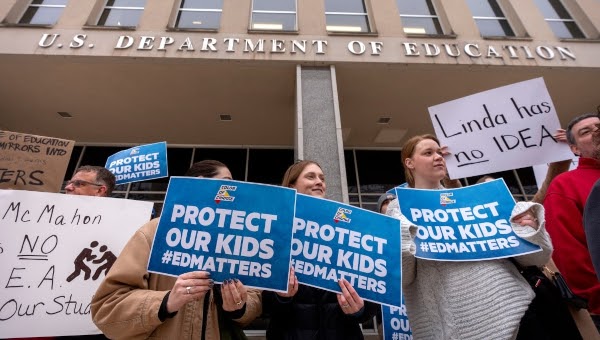
    Penny Schwinn, in line to serve as second in command of the U.S. Department of Education, has withdrawn from the nomination, Education Secretary Linda McMahon announced Thursday.

    Instead, the former Tennessee education commissioner will take on a different role for the department.

    “I am grateful to Dr. Schwinn for her commitment to serving students, families, and educators across the nation,” McMahon said in a statement. “Penny is a brilliant education mind and I look forward to continuing working with her as my chief strategist to make education great again.”

    Schwinn, in a statement, said she gave the decision “thoughtful consideration” and said she will  “remain committed to protecting kids, raising achievement and expanding opportunity  —  my lifelong mission and north star.”

    Considered a champion for improving reading outcomes and high-dosage tutoring, Schwinn was among President Donald Trump’s early picks for department posts. Many perceived her as a more bipartisan choice than others joining the administration, but among Tennessee conservatives, many who felt she was too liberal, opposition to her nomination was strong.

    The timing of Schwinn’s withdrawal couldn’t be worse, according to some conservatives. 

    “Her decision to remove herself from consideration to become deputy secretary hurts students, educators, and the Trump administration,” said Jim Blew, co-founder of the Defense of Freedom Institute, a think tank. “Secretary McMahon has been charged by Congress and the president with huge tasks under the One Big Beautiful Bill and several urgent executive orders.”

    As head of the Education Department, McMahon is striving to turn more authority over education to the states. It’s now unclear who will step into the deputy position and take the lead on the state’s requests for more flexibility over education funding. At least two states, Iowa and Oklahoma, have already submitted requests for block grants, and Indiana is currently gathering comments from the public in preparation for a similar proposal. Kirsten Baesler, North Dakota’s long-time education chief, is currently awaiting confirmation to be assistant secretary for elementary and secondary education at the department. In February, she joined 11 other GOP chiefs in asking McMahon for greater freedom to direct education funds toward state-level needs.

    Controversies and questions over Schwinn’s conservative qualifications have followed her for years. Far-right groups, including Moms for Liberty, said her past support for equity initiatives, like hiring more teachers of color, was evidence that she was not a good fit for an administration determined to eliminate such programs. Others remained angry over Schwinn’s pandemic-era plan to conduct “well-being” home visits. Even though she scrapped the plan, parents and members of the legislature considered it an example of government overreach.

    More recently, Steve Gill, a conservative commentator in Tennessee, reported that while she was deputy superintendent of the Texas Education Agency, Schwinn recommended individuals who advocate for comprehensive sex education, including abortion rights, to advise the state on health curriculum. 

    Gill told The 74 he shared his TriStar Daily article about her stance on these issues with Tennessee Sens. Marsha Blackburn and Bill Hagerty, as well as the state’s congressional delegation. Blackburn, who is expected to run for governor next year, was considered a possible no vote for Schwinn.

    According to Gill, Blackburn’s office “has been working tirelessly behind the scenes with the White House, Secretary Linda McMahon and Majority Leader [John] Thune to block the confirmation.”

    But Madi Biedermann, spokeswoman for the department, said the agency “strongly disagrees with that characterization.”

    Republican Sen. Marsha Blackburn from Tennessee was expected to vote no on Penny Schwinn’s confirmation. (Anna Moneymaker/Getty Images)

    Blew said it’s unfortunate that politics got in the way, noting that Schwinn’s experience in both blue and red states would have brought valuable expertise to the Ed Department role. In addition to her jobs in Tennessee and Texas, Schwinn founded a charter school in Sacramento and also served in the Delaware Department of Education.

    “It’s sad that a handful of demagogues are standing in the way of giving Secretary McMahon the team she needs to succeed,” he said.

    Others praised Schwinn’s record of prioritizing the science of reading in Tennessee schools and directing COVID relief funds toward tutoring.

    “This is a setback for all who want to see Washington slashing red tape, advancing literacy and fighting for common sense values,” said Rick Hess, director of education policy studies at the conservative American Enterprise Institute.

    For some critics, Schwinn’s business ventures since leaving the top spot in Tennessee two years ago raised questions as she waited to appear before the Senate education committee. 

    In June, a day ahead of her joint hearing with three other nominees, The 74 reported that shortly after Trump tapped her for the job, she registered a new education consulting business in Florida, New Horizon BluePrint Group, with a longtime colleague. Before Schwinn filed ethics paperwork with the federal government, her sister replaced her as a manager on the business. 

    When a reporter from The 74 asked questions about the new project, Donald Fennoy, her colleague and a former superintendent of the Palm Beach County School District, dissolved the business.

    Ethics experts say candidates for an administration post often distance themselves from new business entanglements to avoid any appearance of a conflict, but Schwinn has faced accusations of poor judgment before.

    While she was in Texas, the state agency signed a $4.4 million no-bid contract in 2017 with a software company where she had a “professional relationship” with a subcontractor, according to a state audit. And in Tennessee, the education agency made an $8 million deal in 2021 with TNTP, a teacher training organization where her husband Paul Schwinn was employed at the time. Lawmakers considered the deal a “huge conflict.

    “Ethics was a crucial concern,” said J.C. Bowman, executive director and CEO of Professional Educators of Tennessee, a non-union organization. He was among those who sent letters to the Senate, asking them to remove her from consideration. “Her personal business interests and possible conflicts could potentially influence educational decisions in ways that many found difficult to overlook.”

    Clarification: An earlier version of this story mischaracterized the role Penny Schwinn will take on in lieu of serving as the deputy education secretary. Schwinn will be taking on an advisory role at the Education Department.


    Get stories like these delivered straight to your inbox. Sign up for The 74 Newsletter

    Source link

  • How will the India-UK Vision 2035 impact education?

    How will the India-UK Vision 2035 impact education?

    The India–United Kingdom Comprehensive Economic and Trade Agreement (CETA), negotiations for which began in January 2022, was finalised on July 24, with UK Prime Minister Keir Starmer and Indian Prime Minister Narendra Modi calling it a ‘step-change’ in bilateral relations. 

    While the trade deal covers a wide range of areas, including tariff reductions, market access, mobility, and investment protection, aimed at delivering a £4.8bn annual boost to the UK economy and an estimated USD $9-10bn in export growth, the two Prime Ministers also endorsed the India-UK Vision 2035, “reaffirming their shared commitment to unlocking the full potential of a revitalised partnership”.

    Although technology, innovation, defence, and climate action are key pillars of India-UK cooperation under the Vision 2035 framework, education remains central to the shared goal of developing a skilled, future-ready talent pool to tackle global challenges and drive a sustainable future, according to a policy statement released alongside the FTA signing.

    In a first, both countries are launching an annual ministerial India-UK Education Dialogue, which will include reviews of mutually recognised qualifications and knowledge-sharing through joint participation in platforms such as the UK’s Education World Forum and India’s National Education Policy initiatives. 

    The launch of the ministerial dialogue also comes as UK universities increasingly recognise the potential of establishing academic and research-focused branch campuses in India.

    Just this Tuesday, the University of Bristol joined a growing list of UK institutions that have received approval to open campuses in India under the University Grants Commission’s Foreign Higher Educational Institutions (FHEI) regulations.

    Bristol’s Mumbai campus, slated to launch in Summer 2026, will offer undergraduate and postgraduate programs in data science, economics, finance and investment, immersive arts, and financial technology.

    Once operational, Bristol, ranked 51st globally, will become the highest-ranked British university to establish a campus in India, surpassing the University of Southampton, which launched its Gurugram campus earlier this month with classes beginning this August.

    Though Modi has welcomed the establishment of British campuses in India, calling it a “new chapter in the education sector of both countries”, some UK universities are facing flak at home “for seeking fortunes in India” amid ongoing financial woes and domestic job cuts.

    However, with universities like Bristol positioning their India campus as a hub for students, researchers, and industry to shape a better future, the Vision 2035 framework also underscores the India-UK Green Skills Partnership, an initiative focused on equipping young people in both countries with future-ready skills.

    The partnership aims to bridge skill gaps and enable joint initiatives, such as centres of excellence, climate-focused ventures, and courses and certifications in areas such as sustainability. 

    Moreover, the Vision 2035 framework also “encourages exchange and understanding among youth and students” to strengthen the success of existing initiatives like the Young Professionals Scheme (YPS) and the Study India Programme.

    While the YPS, launched in February 2023, is designed as a reciprocal visa scheme enabling British and Indian citizens aged 18-30 to live, work, travel, and study in each other’s country for up to two years, it has so far been largely one-sided. 

    Over 2,100 visas were issued to Indian nationals in 2023, while no such data is available for UK nationals going to India – suggesting participation has been minimal.

    But on the educational front, with UK universities setting up campuses in India and more exchange opportunities emerging, British students may also be encouraged to study in the South Asian country, Alison Barrett, country director India at the British Council, said in a recent interview with Financial Express.

    Once the FTA is ratified, the responsibility will shift to business organisations, institutions, and industry leaders to bring it to life
    Amarjit Singh, India Business Group

    Furthermore, a recent article by Bhawna Kumar, Acumen’s director of TNE and institutional partnerships, and Nikunj Agarwal, the company’s consultant in research and TNE, highlighted the pivotal role of India’s National Education Policy in shaping the FTA and the Vision 2035. 

    “Chapter 8B of the FTA (UK Schedule of Commitments) places no restriction on UK providers offering higher education services (CPC 923) in India. This opens doors for UK universities to expand through various TNE models such as joint degrees, dual degrees, and campus partnerships,” they noted, citing the example of University of Birmingham’s joint master’s programs with IIT Madras in Data Science and Artificial Intelligence, and Sustainable Energy Systems, as a key example. 

    “Chapter 14 of the FTA aligns closely, promoting joint R&D, researcher exchanges, and institutional partnerships in areas like digital innovation, clean energy, agriculture, and healthcare mirroring NEP’s multidisciplinary agenda,” they added. 

    While the Vision 2035 framework appears robust on paper, the authors point out several implementation challenges that remain pressing, chief among them being regulatory alignment, visa bottlenecks, and the slow pace of progress on mutual recognition agreements. 

    “Establishing a Joint Education and Skills Council, co-chaired by senior officials from both countries, would institutionalise cooperation, monitor delivery, and resolve bottlenecks in real time,” they suggested. 

    While the trade deal does not explicitly mention international students, CETA is expected to broaden “high-quality employment pathways” for young Indians by easing access to the services market and facilitating short-term mobility for skilled talent across sectors such as IT, healthcare, finance, and the creative industries. 

    Each year, up to 1,800 Indian chefs, yoga instructors, and classical musicians would be able to work in the UK temporarily under CETA. 

    Additionally, Indian workers will benefit from the Double Contribution Convention (DCC), which will exempt them and their employers from UK National Insurance contributions for up to three years.

    Will CETA stand the test of time in delivering benefits to students and professionals? Amarjit Singh, CEO, India Business Group, believes it can but only with a collaborative approach to ensure its long-term success.

    “The UK-India partnership is respected across party lines. While the 2030 Roadmap was negotiated last year, the framework has been in the making for nearly a decade. There is broad consensus not to jeopardize this progress,” Singh told The PIE News. 

    Though CETA has been signed by both countries, it still requires ratification by their respective parliaments, a process expected to take another six to 12 months.

    “Once the FTA is ratified, the responsibility will shift to business organisations, institutions, and industry leaders to bring it to life. That’s where we need more awareness, active engagement, and a bit of hand-holding to realise its full potential.” 

    Source link

  • Sonia De La Torre | Diverse: Issues In Higher Education

    Sonia De La Torre | Diverse: Issues In Higher Education

    Dr. Sonia De La Torre Sonia De La Torre has been named Vice President of Student Services at Fullerton College.

    De La Torre most recently served as Dean of Student Equity at Long Beach City College. She previously served as the Associate Dean of Student Support Services and Director of Student Success and Support Services at Long Beach City College. Prior to her tenure in the California Community College system, she held leadership roles in student affairs at Scripps College and in academic support within the University of California system.

    De La Torre holds a Bachelors of Arts degree from University of California, Davis, a Master of Science degree in Educational Counseling and Guidance from California State University, San Bernardino and a Doctorate in Educational Leadership from California State University, Long Beach. 

    Source link

  • What really shapes the future of AI in education?

    What really shapes the future of AI in education?

    This post originally appeared on the Christensen Institute’s blog and is reposted here with permission.

    Key points:

    A few weeks ago, MIT’s Media Lab put out a study on how AI affects the brain. The study ignited a firestorm of posts and comments on social media, given its provocative finding that students who relied on ChatGPT for writing tasks showed lower brain engagement on EEG scans, hinting that offloading thinking to AI can literally dull our neural activity. For anyone who has used AI, it’s not hard to see how AI systems can become learning crutches that encourage mental laziness.

    But I don’t think a simple “AI harms learning” conclusion tells the whole story. In this blog post (adapted from a recent series of posts I shared on LinkedIn), I want to add to the conversation by tackling the potential impact of AI in education from four angles. I’ll explore how AI’s unique adaptability can reshape rigid systems, how it both fights and fuels misinformation, how AI can be both good and bad depending on how it is used, and why its funding model may ultimately determine whether AI serves learners or short-circuits their growth.

    What if the most transformative aspect of AI for schools isn’t its intelligence, but its adaptability?

    Most technologies make us adjust to them. We have to learn how they work and adapt our behavior. Industrial machines, enterprise software, even a basic thermostat—they all come with instructions and patterns we need to learn and follow.

    Education highlights this dynamic in a different way. How does education’s “factory model” work when students don’t come to school as standardized raw inputs? In many ways, schools expect students to conform to the requirements of the system—show up on time, sharpen your pencil before class, sit quietly while the teacher is talking, raise your hand if you want to speak. Those social norms are expectations we place on students so that standardized education can work. But as anyone who has tried to manage a group of six-year-olds knows, a class of students is full of complicated humans who never fully conform to what the system expects. So, teachers serve as the malleable middle layer. They adapt standardized systems to make them work for real students. Without that human adaptability, the system would collapse.

    Same thing in manufacturing. Edgar Schein notes that engineers aim to design systems that run themselves. But operators know systems never work perfectly. Their job—and often their sense of professional identity—is about having the expertise to adapt and adjust when things inevitably go off-script. Human adaptability in the face of rigid systems keeps everything running.

    So, how does this relate to AI? AI breaks the mold of most machines and systems humans have designed and dealt with throughout history. It doesn’t just follow its algorithm and expect us to learn how to use it. It adapts to us, like how teachers or factory operators adapt to the realities of the world to compensate for the rigidity of standardized systems.

    You don’t need a coding background or a manual. You just speak to it. (I literally hit the voice-to-text button and talk to it like I’m explaining something to a person.) Messy, natural human language—the age-old human-to-human interface that our brains are wired to pick up on as infants—has become the interface for large language models. In other words, what makes today’s AI models amazing is their ability to use our interface, rather than asking us to learn theirs.

    For me, the early hype about “prompt engineering” never really made sense. It assumed that success with AI required becoming an AI whisperer who knew how to speak AI’s language. But in my experience, working well with AI is less about learning special ways to talk to AI and more about just being a clear communicator, just like a good teacher or a good manager.

    Now imagine this: what if AI becomes the new malleable middle layer across all kinds of systems? Not just a tool, but an adaptive bridge that makes other rigid, standardized systems work well together. If AI can make interoperability nearly frictionless—adapting to each system and context, rather than forcing people to adapt to it—that could be transformative. It’s not hard to see how this shift might ripple far beyond technology into how we organize institutions, deliver services, and design learning experiences.

    Consider two concrete examples of how this might transform schools. First, our current system heavily relies on the written word as the medium for assessing students’ learning. To be clear, writing is an important skill that students need to develop to help them navigate the world beyond school. Yet at the same time, schools’ heavy reliance on writing as the medium for demonstrating learning creates barriers for students with learning disabilities, neurodivergent learners, or English language learners—all of whom may have a deep understanding but struggle to express it through writing in English. AI could serve as that adaptive layer, allowing students to demonstrate their knowledge and receive feedback through speech, visual representations, or even their native language, while still ensuring rigorous assessment of their actual understanding.

    Second, it’s obvious that students don’t all learn at the same pace—yet we’ve forced learning to happen at a uniform timeline because individualized pacing quickly becomes completely unmanageable when teachers are on their own to cover material and provide feedback to their students. So instead, everyone spends the same number of weeks on each unit of content and then moves to the next course or grade level together, regardless of individual readiness. Here again, AI could serve as that adaptive layer for keeping track of students’ individual learning progressions and then serving up customized feedback, explanations, and practice opportunities based on students’ individual needs.

    Third, success in school isn’t just about academics—it’s about knowing how to navigate the system itself. Students need to know how to approach teachers for help, track announcements for tryouts and auditions, fill out paperwork for course selections, and advocate for themselves to get into the classes they want. These navigation skills become even more critical for college applications and financial aid. But there are huge inequities here because much of this knowledge comes from social capital—having parents or peers who already understand how the system works. AI could help level the playing field by serving as that adaptive coaching layer, guiding any student through the bureaucratic maze rather than expecting them to figure it out on their own or rely on family connections to decode the system.

    Can AI help solve the problem of misinformation?

    Most people I talk to are skeptical of the idea in this subhead—and understandably so.

    We’ve all seen the headlines: deep fakes, hallucinated facts, bots that churn out clickbait. AI, many argue, will supercharge misinformation, not solve it. Others worry that overreliance on AI could make people less critical and more passive, outsourcing their thinking instead of sharpening it.

    But what if that’s not the whole story?

    Here’s what gives me hope: AI’s ability to spot falsehoods and surface truth at scale might be one of its most powerful—and underappreciated—capabilities.

    First, consider what makes misinformation so destructive. It’s not just that people believe wrong facts. It’s that people build vastly different mental models of what’s true and real. They lose any shared basis for reasoning through disagreements. Once that happens, dialogue breaks down. Facts don’t matter because facts aren’t shared.

    Traditionally, countering misinformation has required human judgment and painstaking research, both time-consuming and limited in scale. But AI changes the equation.

    Unlike any single person, a large language model (LLM) can draw from an enormous base of facts, concepts, and contextual knowledge. LLMs know far more facts from their training data than any person can learn in a lifetime. And when paired with tools like a web browser or citation database, they can investigate claims, check sources, and explain discrepancies.

    Imagine reading a social media post and getting a sidebar summary—courtesy of AI—that flags misleading statistics, offers missing context, and links to credible sources. Not months later, not buried in the comments—instantly, as the content appears. The technology to do this already exists.

    Of course, AI is not perfect as a fact-checker. When large language models generate text, they aren’t producing precise queries of facts; they’re making probabilistic guesses at what the right response should be based on their training, and sometimes those guesses are wrong. (Just like human experts, they also generate answers by drawing on their expertise, and they sometimes get things wrong.) AI also has its own blind spots and biases based on the biases it inherits from its training data. 

    But in many ways, both hallucinations and biases in AI are easier to detect and address than the false statements and biases that come from millions of human minds across the internet. AI’s decision rules can be audited. Its output can be tested. Its propensity to hallucinate can be curtailed. That makes it a promising foundation for improving trust, at least compared to the murky, decentralized mess of misinformation we’re living in now.

    This doesn’t mean AI will eliminate misinformation. But it could dramatically increase the accessibility of accurate information, and reduce the friction it takes to verify what’s true. Of course, most platforms don’t yet include built-in AI fact-checking, and even if they did, that approach would raise important concerns. Do we trust the sources that those companies prioritize? The rules their systems follow? The incentives that guide how their tools are designed? But beyond questions of trust, there’s a deeper concern: when AI passively flags errors or supplies corrections, it risks turning users into passive recipients of “answers” rather than active seekers of truth. Learning requires effort. It’s not just about having the right information—it’s about asking good questions, thinking critically, and grappling with ideas. That’s why I think one of the most important things to teach young people about how to use AI is to treat it as a tool for interrogating the information and ideas they encounter, both online and from AI itself. Just like we teach students to proofread their writing or double-check their math, we should help them develop habits of mind that use AI to spark their own inquiry—to question claims, explore perspectives, and dig deeper into the truth. 

    Still, this focuses on just one side of the story. As powerful as AI may be for fact-checking, it will inevitably be used to generate deepfakes and spin persuasive falsehoods.

    AI isn’t just good or bad—it’s both. The future of education depends on how we use it.

    Much of the commentary around AI takes a strong stance: either it’s an incredible force for progress or it’s a terrifying threat to humanity. These bold perspectives make for compelling headlines and persuasive arguments. But in reality, the world is messy. And most transformative innovations—AI included—cut both ways.

    History is full of examples of technologies that have advanced society in profound ways while also creating new risks and challenges. The Industrial Revolution made it possible to mass-produce goods that have dramatically improved the quality of life for billions. It has also fueled pollution and environmental degradation. The internet connects communities, opens access to knowledge, and accelerates scientific progress—but it also fuels misinformation, addiction, and division. Nuclear energy can power cities—or obliterate them.

    AI is no different. It will do amazing things. It will do terrible things. The question isn’t whether AI will be good or bad for humanity—it’s how the choices of its users and developers will determine the directions it takes. 

    Because I work in education, I’ve been especially focused on the impact of AI on learning. AI can make learning more engaging, more personalized, and more accessible. It can explain concepts in multiple ways, adapt to your level, provide feedback, generate practice exercises, or summarize key points. It’s like having a teaching assistant on demand to accelerate your learning.

    But it can also short-circuit the learning process. Why wrestle with a hard problem when AI will just give you the answer? Why wrestle with an idea when you can ask AI to write the essay for you? And even when students have every intention of learning, AI can create the illusion of learning while leaving understanding shallow.

    This double-edged dynamic isn’t limited to learning. It’s also apparent in the world of work. AI is already making it easier for individuals to take on entrepreneurial projects that would have previously required whole teams. A startup no longer needs to hire a designer to create its logo, a marketer to build its brand assets, or an editor to write its press releases. In the near future, you may not even need to know how to code to build a software product. AI can help individuals turn ideas into action with far fewer barriers. And for those who feel overwhelmed by the idea of starting something new, AI can coach them through it, step by step. We may be on the front end of a boom in entrepreneurship unlocked by AI.

    At the same time, however, AI is displacing many of the entry-level knowledge jobs that people have historically relied on to get their careers started. Tasks like drafting memos, doing basic research, or managing spreadsheets—once done by junior staff—can increasingly be handled by AI. That shift is making it harder for new graduates to break into the workforce and develop their skills on the job.

    One way to mitigate these challenges is to build AI tools that are designed to support learning, not circumvent it. For example, Khan Academy’s Khanmigo helps students think critically about the material they’re learning rather than just giving them answers. It encourages ideation, offers feedback, and prompts deeper understanding—serving as a thoughtful coach, not a shortcut. But the deeper issue AI brings into focus is that our education system often treats learning as a means to an end—a set of hoops to jump through on the way to a diploma. To truly prepare students for a world shaped by AI, we need to rethink that approach. First, we should focus less on teaching only the skills AI can already do well. And second, we should make learning more about pursuing goals students care about—goals that require curiosity, critical thinking, and perseverance. Rather than training students to follow a prescribed path, we should be helping them learn how to chart their own. That’s especially important in a world where career paths are becoming less predictable, and opportunities often require the kind of initiative and adaptability we associate with entrepreneurs.

    In short, AI is just the latest technological double-edged sword. It can support learning, or short-circuit it. Boost entrepreneurship—or displace entry-level jobs. The key isn’t to declare AI good or bad, but to recognize that it’s both, and then to be intentional about how we shape its trajectory. 

    That trajectory won’t be determined by technical capabilities alone. Who pays for AI, and what they pay it to do, will influence whether it evolves to support human learning, expertise, and connection, or to exploit our attention, take our jobs, and replace our relationships.

    What actually determines whether AI helps or harms?

    When people talk about the opportunities and risks of artificial intelligence, the conversation tends to focus on the technology’s capabilities—what it might be able to do, what it might replace, what breakthroughs lie ahead. But just focusing on what the technology does—both good and bad—doesn’t tell the whole story. The business model behind a technology influences how it evolves.

    For example, when advertisers are the paying customer, as they are for many social media platforms, products tend to evolve to maximize user engagement and time-on-platform. That’s how we ended up with doomscrolling—endless content feeds optimized to occupy our attention so companies can show us more ads, often at the expense of our well-being.

    That incentive could be particularly dangerous with AI. If you combine superhuman persuasion tools with an incentive to monopolize users’ attention, the results will be deeply manipulative. And this gets at a concern my colleague Julia Freeland Fisher has been raising: What happens if AI systems start to displace human connection? If AI becomes your go-to for friendship or emotional support, it risks crowding out the real relationships in your life.

    Whether or not AI ends up undermining human relationships depends a lot on how it’s paid for. An AI built to hold your attention and keep you coming back might try to be your best friend. But an AI built to help you solve problems in the real world will behave differently. That kind of AI might say, “Hey, we’ve been talking for a while—why not go try out some of the things we’ve discussed?” or “Sounds like it’s time to take a break and connect with someone you care about.”

    Some decisions made by the major AI companies seem encouraging. Sam Altman, OpenAI’s CEO, has said that adopting ads would be a last resort. “I’m not saying OpenAI would never consider ads, but I don’t like them in general, and I think that ads-plus-AI is sort of uniquely unsettling to me.” Instead, most AI developers like OpenAI and Anthropic have turned to user subscriptions, an incentive structure that doesn’t steer as hard toward addictiveness. OpenAI is also exploring AI-centric hardware as a business model—another experiment that seems more promising for user wellbeing.

    So far, we’ve been talking about the directions AI will take as companies develop their technologies for individual consumers, but there’s another angle worth considering: how AI gets adopted into the workplace. One of the big concerns is that AI will be used to replace people, not necessarily because it does the job better, but because it’s cheaper. That decision often comes down to incentives. Right now, businesses pay a lot in payroll taxes and benefits for every employee, but they get tax breaks when they invest in software and machines. So, from a purely financial standpoint, replacing people with technology can look like a smart move. In the book, The Once and Future Worker, Oren Cass discusses this problem and suggests flipping that script—taxing capital more and labor less—so companies aren’t nudged toward cutting jobs just to save money. That change wouldn’t stop companies from using AI, but it would encourage them to deploy it in ways that complement, rather than replace, human workers.

    Currently, while AI companies operate without sustainable business models, they’re buoyed by investor funding. Investors are willing to bankroll companies with little or no revenue today because they see the potential for massive profits in the future. But that investor model creates pressure to grow rapidly and acquire as many users as possible, since scale is often a key metric of success in venture-backed tech. That drive for rapid growth can push companies to prioritize user acquisition over thoughtful product development, potentially at the expense of safety, ethics, or long-term consequences. 

    Given these realities, what can parents and educators do? First, they can be discerning customers. There are many AI tools available, and the choices they make matter. Rather than simply opting for what’s most entertaining or immediately useful, they can support companies whose business models and design choices reflect a concern for users’ well-being and societal impact.

    Second, they can be vocal. Journalists, educators, and parents all have platforms—whether formal or informal—to raise questions, share concerns, and express what they hope to see from AI companies. Public dialogue helps shape media narratives, which in turn shape both market forces and policy decisions.

    Third, they can advocate for smart, balanced regulation. As I noted above, AI shouldn’t be regulated as if it’s either all good or all bad. But reasonable guardrails can ensure that AI is developed and used in ways that serve the public good. Just as the customers and investors in a company’s value network influence its priorities, so too can policymakers play a constructive role as value network actors by creating smart policies that promote general welfare when market incentives fall short.

    In sum, a company’s value network—who its investors are, who pays for its products, and what they hire those products to do—determines what companies optimize for. And in AI, that choice might shape not just how the technology evolves, but how it impacts our lives, our relationships, and our society.

    Latest posts by eSchool Media Contributors (see all)

    Source link

  • Grant Applications for Campus Childcare Put on Hold

    Grant Applications for Campus Childcare Put on Hold

    Eveline McPhee, a 39-year-old mother of two, has been a dental assistant in northern Massachusetts for nearly 15 years. And while she’s long aspired to upgrade that title to dental hygienist, for most of her career that goal seemed unattainable.

    With a full-time job, managing classes seemed arduous, and without a job she and her husband wouldn’t be able to afford day care and after-school programs.

    But that all changed last year when an admissions officer at Mount Wachusett Community College told McPhee about Child Care Access Means Parents in School, or CCAMPIS—a $75 million federal grant program designed to help low-income parents in college pay for childcare both on and off campus. McPhee enrolled last fall and is on track to graduate in 2026.

    “I have a 9-year-old son, and they paid for him to go to camp this summer so that I can take an intensive course in the dental hygiene program,” McPhee said. “I definitely would not have been able to go back to school without CCAMPIS.”

    Now the future of the program is cloudy.

    Applications for this year’s CCAMPIS grants—which typically open in May and close by the end of July—have yet to be announced, leaving thousands of student parents in limbo.

    Multiple think tank fellows and student advocacy representatives said they’ve been reaching out to the Trump Department of Education for more information since the spring, but the response is always “We’ll open it soon.” Similar circumstances have been reported for other basic needs programs included under FIPSE, the Fund for the Improvement of Postsecondary Education.

    Neither the Department of Education nor Republican committee chairs in the House and the Senate responded to Inside Higher Ed’s request for comment.

    With the new academic year quickly approaching, the lack of funds leaves many colleges and universities with major budget gaps.

    Until last month, Mount Wachusett’s childcare finances looked grim; CCAMPIS funding was set to run out on Sept. 30. But Ann Reynolds, the student support adviser who runs the program, had seen all the headlines about the Trump administration’s funding freezes and anticipated the delay. (Last year, the Biden administration chose not to open the grant to new applicants, but it sent out a clear notice in advance and allowed existing awardees to reapply.) She reached out to a local philanthropy and secured $94,000 to carry McPhee and about a dozen other student parents through graduation.

    “We could see the writing on the wall, so to speak,” Reynolds said. “And it’s lifted a great weight from my student parents’ shoulders.”

    Not all colleges were so forward-thinking. Many students, including future enrollees at Mount Wachusett, will have to take out additional loans—or drop out and try to repay the loans they already have without a college degree.

    “We’re seeing a lot of students raising children coming to school now, so our need is greater,” Reynolds said. “But we can’t take in new students.”

    Without the grants, which have had bipartisan support in Congress for years, historically underfunded institutions, including community colleges and minority-serving institutions, will be cash-strapped. Some may be forced to cut staffing or eliminate services entirely.

    “Given all the other funds from the U.S. Department of Education that have been frozen or subject to political games in the last few months, the community is right to worry,” said Bryce McKibben, senior director of policy and advocacy at Temple University’s Hope Center for Student Basic Needs. “This doesn’t serve anyone—certainly not taxpayers. The administration should announce a competition or award continuation grants immediately.”

    ‘A Vicious Cycle’

    Most experts speculate the delay is occurring for one of two reasons: Either the department lacks the capacity to meet this statutory requirement since it laid off half its staff in March, or it is intentionally withholding the dollars as part of a broader effort to claw back education funding through a process known as rescission.

    The latter option would require congressional approval. But the president already won enough votes to pass one rescission package earlier this month, and policy analysts say it’s likely he’ll try to do it again. (Trump’s proposed budget for fiscal year 2026 axes CCAMPIS and FIPSE completely.)

    Either way, Theresa Anderson, a senior education and labor fellow at the Urban Institute, a nonpartisan think tank, said the delay symbolizes a larger restriction on college access.

    This is a “well-documented agenda pattern and strategy” of the Trump administration, she explained. “It represents further disinvestment and disinterest in helping people access the necessary training, education and credentialing programs that states recognize are necessary to development of the workforce.”

    Tanya Ang, executive director of the Today’s Student Coalition, an adult learner advocacy group, described the situation as putting the leaders of critical student support services “up against a brick wall.”

    “If students are going to school, we want them to finish, because that’s going to ensure they can get a job and start a long-term career that will provide a strong return on investment,” Ang explained. Cutting off access to childcare “creates a vicious cycle that will hurt not just them and their children as individuals but, honestly, our economy.”

    Critics have long argued that CCAMPIS is a duplicate program, suggesting that the Child Care and Development Block Grant, which is run by the Department of Health and Human Services, fulfills a similar purpose. But higher education experts say that’s simply not the case.

    CCDBG, they say, supports broad, state-level childcare subsidies, predominantly allocated to parents who work full-time. CCAMPIS, on the other hand, is more targeted and serves student parents, many of whom can’t meet the work requirements attached to the block grant.

    “CCAMPIS was really important to not only be able to fill childcare needs in a way that was very flexible for colleges, but also to allow for additional wraparound supports that are incredibly important to support persistence,” Anderson said. It helps student parents “build meaningful community connections, not only with staff of the college, but also with each other.”

    At Mount Wachusett, Reynolds said student parents who participate in the CCAMPIS program have one of the highest completion rates among any demographic, at 73 percent. So she hopes that even a sliver of the current operation will survive past its current end date in 2027.

    When asked what she would tell the Trump administration if she had the chance, McPhee said she was worried people were losing the opportunity to get ahead.

    “I wanted to do better for my family, and this allowed me to do that,” she said. “To not be able to provide that for people moving forward, it’s just not what this country is about. It’s wrong, and I don’t really understand why they would do it.”

    Source link

  • Think of the Learner and Less About Modality

    Think of the Learner and Less About Modality

    Institutions should be thinking about how all kinds of learners fit into their learning environments and avoid viewing online and in-person courses as distinct environments, according to Stephanie Moore, an associate professor in organization, information and learning sciences at the University of New Mexico. 

    “Higher ed is not just simply face-to-face but rather additional modalities of online or blended,” she said. “If an institution is planning strategically around these, then you’re better able to meet a range of diverse learner needs—and oh, by the way, that gives your institutions some pretty tremendous resilience and flexibility that if you ever have to shift or pivot in emergencies, [you can].”

    The latest episode of The Key, Inside Higher Ed’s news and analysis podcast, features an interview between Moore and IHE’s senior editor for special content, Colleen Flaherty, recorded at the Digital Universities conference in Salt Lake City in June. 

    Moore discusses how to scale feedback and a foster a sense of connection in online learning ecosystems and why she thinks AI will not be more disruptive than any other communication technology that’s come before it. 

    Source link

  • Service Portfolios Make Service Visible (opinion)

    Service Portfolios Make Service Visible (opinion)

    Another academic year is fast approaching, and with it another promotion and tenure cycle in which faculty members will prepare dossiers for promotion. Some, but not all, universities have detailed instructions on what and what not to include in the dossier. At many research institutions, the service section consists of a list of committees on which the faculty member has served with little information about the nature of their participation. Having managed promotion and tenure at multiple institutions, I know that faculty members are often told to check the service boxes and move on.

    Yet, the pandemic and its aftermath threw into high relief what most faculty members already knew: Faculty service is a mission-critical portion of workloads and highly undervalued by our institutions. We also know that mission-critical workload is unevenly allocated to and carried out by some faculty members while others either refuse to participate, focus their service outside the institution for the profession or participate as free riders while others pull their load. This leads to conversations about “service slacking” and “service shaming.” Articles abound with useful suggestions on how to address the uneven distribution of service, including advice on how to say no. And the Faculty Workload Equity project, part of an NSF ADVANCE award to the University of Maryland, provides important tools to better understand the contours of differential workloads and ways to create transparency around them.

    This conversation is not new; Joya Misra and colleagues suggested in 2011 that changing the culture around service is essential in order to find ways to distribute the workload more evenly and to develop reward mechanisms for doing critical service in mission-central areas like curricular reform or student outcomes assessment. More than 10 years later, this conversation seems to have stalled. Properly recognizing the value of service would be a good way to restart it.

    Articulating the Value of Service

    Let me start with a story. About 15 years ago, I co-chaired my institution’s reaccreditation bid with the North Central Association of Colleges and Schools. We were tasked, among other things, with collecting information about how our faculty engaged in outreach to our community. Our campus survey about community engagement came back with pitifully little data. We realized that we needed to excavate the information. After visits to lots of faculty meetings, we had an amazingly rich list of ways our faculty were engaging with schools, nonprofits and local governments in our area. To my question about why these activities didn’t appear in any university document, faculty members universally replied that they didn’t think anyone cared.

    As Cullen C. Merrit recently argued, service and engagement activities are ways that the academy provides value to society at large. I agree. Yet we cannot value or demonstrate the impact of what we don’t document.

    To that end, colleges can launch a service portfolio that faculty can submit as part of promotion and performance-review processes. The service portfolio documents the range of service activities for each faculty member, as well as success metrics that demonstrate their impact on students, other faculty and the institutional mission. Identifying impact is a first step in increasing the value our institutions place on service activities and establishing fairer systems of allocation and rewards.

    The Service Portfolio

    Before you stop reading because no one wants to do more service work, a service portfolio can help bring attention to the value of work by demonstrating the impacts and outcomes. Indeed, some universities and colleges already have faculty members provide such information about service; others make suggestions about how to craft a promotion and tenure service and engagement dossier.

    As with a teaching portfolio, a service portfolio is a structured assemblage of contributions to mission-critical activities around student and faculty success (e.g., mentoring, curriculum development, professional development) and engagement with local and regional communities (e.g., support for K–12 education, support for local governmental and nongovernmental agencies).

    Service portfolio guidelines could begin by listing elements of the stated mission or the strategic planning goals at the department, college/school and institution levels. In consultation with department chairs or deans, faculty members would then select those elements to which they contribute through their service activities. In addition to describing their contributions, faculty could describe outcomes and impacts either in terms of future goals or what can already be measured.

    For example, a faculty member might want to prioritize curriculum development or faculty mentoring. In that case, we might expect them to serve locally or institutionally in those areas, to engage in professional development opportunities, or to develop community engagement activities related to their specializations. A focus on value requires that the service portfolio identify the impacts or expected outcomes of each activity. For example, participation in a curriculum revision might result in higher learning outcomes or lower DFW rates. Faculty mentoring can result in improved teaching outcomes, enhanced research productivity and an improved work environment.

    There are numerous advantages of a service portfolio over the current way of counting the number of committees on which we serve. First, faculty members can gain agency in the way that they shape and narrate their own contributions to the institutional mission through service. Agency is a motivating factor that might encourage yet more engagement. Faculty members will have a harder time free riding on a committee when they must articulate their contributions and when those contributions are then reviewed by departmental peers. Equity-minded faculty members and chairs/heads will be better able to track individual contributions and ensure that service is equitably allocated. And chairs and departmental colleagues who are impressed with a particular faculty member’s service contributions will be better positioned to suggest that recognition or reward for those contributions may be in order.

    To be sure, putting together a service portfolio will require extra time, something that faculty members do not have lots of. But the relatively small time commitment can result in significant benefits to faculty and to the institution. Intentional and agentic shaping of service and engagement workloads can ensure that mission-critical work is accomplished in a visible way and can be assessed for impact. Perhaps most importantly, a service portfolio gives information and tools to our colleagues to amplify impactful and valuable activities.

    Beth Mitchneck is professor emerita in the School of Geography, Development and Environment at the University of Arizona.

    Source link