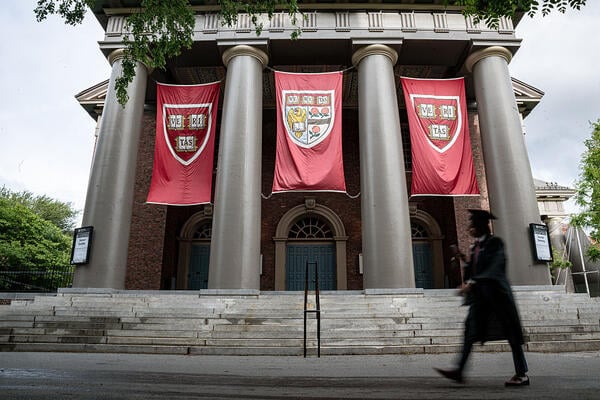
Harvard is one of nine universities the Trump administration has targeted with federal funding freezes. In April, the government froze $2.2 billion in federal grants after the university rejected its demands to overhaul its policies on admissions, governance, hiring and more. In July, Harvard, which also sued the Trump administration over the freeze, was reported as open to paying as much as $500 million to settle with the Trump administration, though leaders said they would be reluctant to pay the government directly.
While no deal with Harvard has materialized yet, Commerce Secretary Howard Lutnick told CNBC on Thursday that if one does, the $500 million could go toward vocational education.
“If Harvard settles with Donald Trump, you know what he’s going to do with the $500 million?” Lutnick said. “He’s going to have Harvard build vocational schools. The Harvard vocational school, because that’s what America needs.”
But deal or no deal, the frozen funds may start flowing back to Harvard soon.
Last week, a federal judge ruled that the Trump administration illegally froze Harvard’s federal money, but the government plans to appeal. Earlier this week, The New York Times reported that Harvard researchers were told some grants were being restored, though it’s not clear how widespread those restorations were.
The horrific assassination of Charlie Kirk at Utah Valley University is an unspeakable crime. But we must speak about its causes and how we can seek to reduce violence of this kind—and also how we must not seek to silence free speech in response.
Obviously, murder is an evil act in itself. But a political assassination of this kind is many magnitudes worse than the all-too-common murders we encounter every day in America.
Political violence undermines the sense of safety that’s essential to free and open debate. If controversial views inspire murder, then most of us will be reluctant to speak out honestly. Political violence and threats can be a powerful source of self-censorship. We need to end support for political violence of every kind on every side, from this terrible murder to the threats of violence against professors from all sides who express controversial views.
Political violence also breeds administrative censorship. Many of the campus bans on protests and suspensions and banishments of those accused of misconduct are done using the excuse of fear of violence. Safety becomes a simple defense for every act of repression, and Kirk’s murder may be used by campus officials to ban controversial speakers from all sides and to prohibit the kind of public discussion that Kirk was admirably engaged in when he was killed.
And political violence inspires political censorship, particularly when elected officials are looking for any excuse to suppress their ideological opponents. Donald Trump announced a campaign of retribution against leftists who harshly criticized Kirk: “For years those on the radical left have compared wonderful Americans like Charlie to Nazis. This kind of rhetoric is directly responsible for the terrorism that we’re seeing in our country and it must stop right now. My administration will find each and every one of those who contributed to this atrocity and to other political violence, including the organizations that fund it and support it …”
It’s appalling that Trump would call for unconstitutional repression of this kind to “find” and “stop” any leftist who ever used mean rhetoric—and the organizations that fund or support them. Even if you believe (as I do) that prominent political leaders such as Trump—one of the worst offenders at nasty political rhetoric—should tone down their hatred, that doesn’t mean that everyone should restrain their rhetoric, and it certainly does not allow the government to punish those who choose to say harsh words.
Since we do not yet know who murdered Kirk or what the motives were, it’s bizarre to assign ideological blame for this violence. But even if the murderer turns out to be a leftist inspired by hateful essays about Kirk, we must not punish (or even condemn) people who denounced Kirk.
We need to condemn horrible violence of this kind from any source, but we cannot blame those who engage in political critique for the crimes of lunatics. Words do not cause violence, and censorship does not stop it. It’s bizarre that the party of “guns don’t kill people, people kill people” is now suggesting that mean tweets kill people.
Other Republican politicians urged repression as the response. Rep. Clay Higgins (a Louisiana Republican) called for massive censorship of anyone who “belittled the assassination of Charlie Kirk,” calling for them to be “banned from ALL PLATFORMS FOREVER,” to have their business licenses and permits and driver’s licenses revoked, and be “kicked from every school.”
By far the most disturbing finding in the latest free speech survey of college students released this week by the Foundation for Individual Rights and Expression was that the proportion of students willing to support physical violence to stop an offensive speaker on campus grew from 20 percent in 2022 to 34 percent in 2025. FIRE chief research adviser Sean Stevens noted, “This finding cuts across partisan lines. It is not a liberal or conservative problem—it’s an American problem.”
In FIRE’s survey, the growth in willingness to use violence to stop an offensive speaker over the past few years tracks directly with the growth in willingness to shout down speakers (from 62 percent to 71 percent) and to physically block students from attending a speech (from 37 percent to 54 percent).
The willingness of people to silence speech is connected to their willingness to support violence as just one further step to achieve that repression. Stopping political violence can’t be seen in isolation from stopping political censorship of all kinds. We need to view a commitment to free speech as an essential tool to help reduce political violence.
Censorship can become the training wheels for political violence. Once you are willing to dehumanize someone by stripping away their rights and silencing their speech, the kind of dehumanization necessary to violently attack them becomes easier to imagine. And once you’re willing to use political violence, the reality will always become more likely.
Alice Dreger at Heterodox Academy noted that after the problems we’ve seen with the heckler’s veto, “The shooter’s veto is a whole new level of terrorism endangering political speech in America.” But what if the shooter’s veto is just the logical extension of the heckler’s veto?
It’s worth noting that in another of the rare cases of violence against a campus speaker—at Middlebury College in 2017, when Charles Murray was attacked and Professor Allison Stanger was injured—the violence followed in the wake of the students shouting down Murray. Censorship and violence are often linked together, and both are common weapons of totalitarian regimes.
That’s why we must reject political violence in all its forms and begin with the steps of censorship that often lead to it. That’s also why we must reject censorship as an answer to political violence. Because censorship is the foundation of political violence, we cannot cure it with more censorship.
I disagreed with many of Kirk’s political views, but I liked some of his methods—organizing students and publicly engaging in debates on campus with critics (as he was doing when he was murdered).
As I noted back in 2017 for why colleges must recognize TPUSA chapters, “Although Professor Watchlist is morally wrong and a threat to academic freedom, that is not a good reason for a university to de-recognize a student group associated with it. Free speech applies even to those who oppose free speech. And the right of students to form organizations is an essential part of student liberty, even if that means criticizing faculty.” I wrote about those leftists who supported repression, “If you think only your political enemies will be subject to censorship by administrators, I think you are very mistaken.”
We need colleges to be safe spaces in the sense of physical safety from political violence and physical threats. We also need safety from professional retaliation, to ensure that people are not fired or silenced or punished for their beliefs. We must reject the use of repression to protect people from hearing offensive ideas, whichever side is being censored. By rejecting censorship, and making the open exchange of ideas an essential part of campus life that no violent act can take away, we can reduce the culture of political violence that endangers all of our voices.
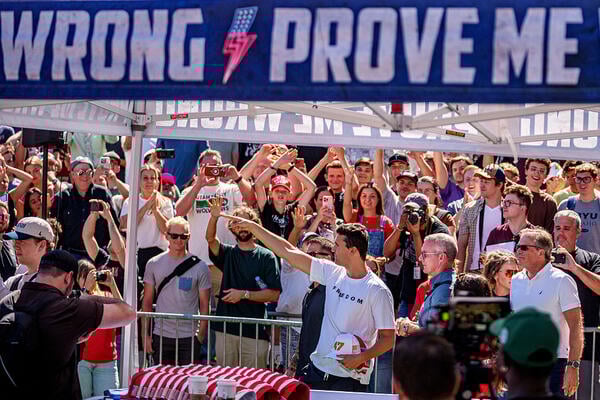
The best tribute to Kirk would be for colleges and politicians and advocates on all sides to imitate the best of what he did—to create and approve student organizations that express controversial views and debate those who disagree, asking them to “prove me wrong.”
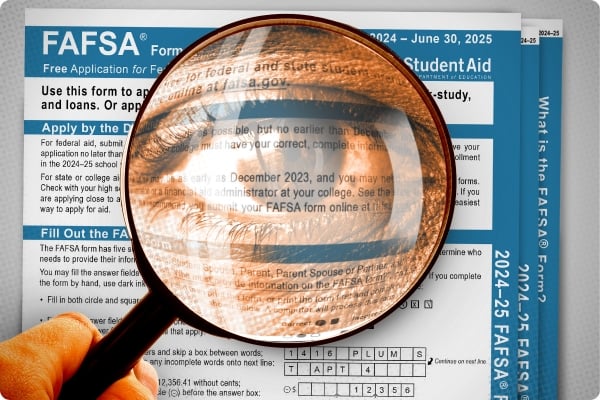
The government watchdog explored what went wrong with the 2024–25 FAFSA in a new report.
Photo illustration by Justin Morrison/Inside Higher Ed | sdominick/Getty Images | Ake/rawpixel
The Education Department is on track to release the 2026–27 Free Application for Federal Student Aid by Oct. 1, but a government watchdog warned this week that future forms are at risk of technical issues.
The Government Accountability Office, in its second report on the botchedlaunch of the 2024–25 FAFSA, found that the department has yet to implement a number of its recommendations from the first report released in September 2024. Additionally, the agency needs to improve its oversight of contractors. The GAO also noted that the department doesn’t have a plan for testing future FAFSAs and that staff overseeing the application lack key experience and training.
“Until [the Office of Federal Student Aid] makes progress in these important areas, [the FAFSA Processing System] is at risk of not functioning as intended in future releases, leading to students having trouble in obtaining timely aid,” the report states. “Further, the FPS contract is at risk of overexpenditure and potentially wasting taxpayer dollars. These risks are compounded by reductions in staff that likely impact the agency’s ability to carry out its mission to manage and oversee student financial assistance programs.”
FSA officials took issue with parts of the report and recommendations in a response to the agency.
“We believe that GAO’s analysis teaches the wrong lessons and, as an unintended consequence, reinforces the exact practices that led to the FAFSA’s initial challenges,” wrote Aaron Lemon-Strauss, executive director of the FAFSA program.
Lemon-Strauss said GAO is applying a “more traditional, and somewhat outdated, project-based model that does not support modern technology development for scaled systems like the FAFSA.” He went on to outline a number of changes that the department made to improve the system, as well as the key challenges they faced.
Among other things, he noted that FSA had no internal engineering expertise until last year and that contractors working on different pieces of the process used different tools that didn’t integrate with each other.
“The team is still working to unwind these parallel environments and the technical debt created by these decisions today,” he wrote.
GAO officials disagreed with some of the department’s statements and proposed changes to their recommendations, countering that the review was based on both federal and department guidelines and that ED needs a way to hold its contractors accountable.
“As our report notes, FSA was not appropriately overseeing the work of its contractor and did not adequately ensure rigorous testing of the system,” officials wrote. “By not doing so, FSA put the FAFSA modernization effort at risk of failure, which their letter points out.”
An estimated 59 percent of all college students have experienced some form of housing or food insecurity in the past year, according to 2024 data from the Hope Center at Temple University. Closer to three in four students have lacked access to other basic needs, such as mental health care, childcare, transportation or technology.
At Massachusetts College of Liberal Arts, it was students who first noticed their peers needed additional resources.
Spencer Moser, MCLA’s assistant dean for student growth and well-being, teaches a leadership capstone course in which students complete a community-based service project. “One group of students was aware that some of their peers were attending classes hungry,” he recalled.
As part of their assignment, students researched available resources to address basic needs insecurity and identified the need for a campus pantry.
“The program started as a drawer at my desk,” Moser said. “Then it grew to fill a shelving unit, a closet and eventually its own space on campus.”
Now, MCLA hosts an Essential Needs Center (ENC) on campus for any student who may face financial barriers to acquiring food, housing or other necessary items.
How it works: Located in the campus center, the Essential Needs Center is open 24 hours a day from Monday to Thursday, with more limited hours on Fridays. The center provides students with food, housing and transportation assistance, seasonal clothes, and more.
Students can utilize a variety of resources to address food insecurity, including grab-and-go or instant meals and free meal swipes for the dining hall, as well as help with their SNAP applications. The center’s website also provides links to recipes using MCLA food pantry staples to help students with minimal cooking experience prepare nutritious meals.
One of the unique offerings of MCLA’s center is a build-a-bundle initiative that allows students to request a variety of personal health, kitchen, bathroom, bedroom or cleaning items, as well as school supplies. Students can submit a form online requesting supplies ranging from a first-aid kit to baking supplies and a bath mat.
The pantry has a small budget from the college, which is supplemented by grants, a partnership with the Food Bank of Western Massachusetts and donor support. Interested donors can give nonperishable food items, toiletries or monetary contributions.
Student supported: The ENC first started with students looking to support their classmates, and student leadership continues to be at the heart of the center’s work.
“Students manage the inventory, make sure their peers know about this resource, staff the center,” Moser said. “The center is student-run and -managed, designed to be student-centric due to the belief that students know best what students’ needs are.”
The pantry sees 400 to 500 students use the pantry regularly, for a total of 1,313 visits between November 2023 and January 2025, Moser said.
In fall 2024 alone, ENC logged 729 visits—including from 96 first-time visitors—and distributed over 2,600 items.
Other Models of Success
Basic needs insecurity impacts college students across the country, hindering their academic progress and forcing them to choose between educational pursuits and personal needs. Here are some examples of how other colleges and universities are promoting student well-being.
Anne Arundel Community College students in Maryland created a cookbook featuring items exclusively from the campus pantry, many reflecting their traditions and cultures.
Pace University offers a monthly mobile market for students, faculty and staff to receive free food items that cannot be stored for longer in the permanent campus pantry.
The University of California, Davis, piloted a discounted food truck on campus at lunchtime, allowing students to receive a hot meal at a pay-what-you-can price.
Virginia Commonwealth University established mini pantries across campus with grab-and-go food items, modeled off the concept of a little free library.
As our fall semester begins, college students are filled with excitement and nervous anticipation. By my lights, they are getting ready to practice freedom in the service of learning. Back in the 18th century, the great German philosopher Immanuel Kant wrote that enlightenment was freedom from self-imposed immaturity, describing how the process of education was the practice of freedom. When people learn—embarking on the journey of thinking for themselves in the company of others—they are experimenting with choice, autonomy, relationship and discipline.
I (usually) find it thrilling to watch students experiment in these ways, and I occasionally get to join in. They are relinquishing—not completely, and certainly not all at once—their childish ways and trying on what it means to be an adult. They begin to experience that freedom from immaturity and figure out, provisionally, the kinds of lives they want to live. This normally includes, but is not limited to, the kind of work they are prepared to do. Facing this very practical issue is part of growing up, and colleges provide various opportunities for doing just that.
Still, many in America have doubts about whether today’s college student is, in fact, learning to be a free adult. Some have been persuaded that college campuses no longer value the open exchange of ideas but instead demand allegiance only to ideas deemed progressive. Others see colleges as failing to practice what they preach. Children of alumni or wealthy donors have a much better chance of getting admitted to highly selective colleges than ordinary Americans; the paths to colleges believed to offer the best educations are paved with gold.
The charge of unfair admissions—like the criticism of political groupthink or mindless grinding away to get grades and internships—attacks the integrity of learning as a path to freely thinking for oneself. If colleges are unfair or corrupt in choosing their students, then the value of the education offered is undermined. If one only learns to imitate the views of one’s professors in order to win their favor, then one is wallowing in immaturity and not practicing freedom.
Unquestionably, there has been a loss of trust in higher education, and— while less dramatic, perhaps, than the loss of trust in the judiciary, the media or Congress—it undermines the ability of colleges to teach their students. No matter how much teachers emphasize critical thinking, learning requires trust. It requires that we open ourselves to ideas and people that might have an impact on how we live. This can, of course, sometimes be disturbing, even offensive, but the deepest learning often involves reconsidering our assumptions and deeply held beliefs.
I see this regularly in the class I teach, Virtue and Vice. I see undergraduates willing to stress test their moral intuitions against thinkers as varied as Aristotle and Machiavelli, Friedrich Nietzsche and Danielle Allen. I see students considering how they want to live by thinking with some of the central texts of our traditions. Each week they practice one of the traditional virtues and discuss this with their fellow students. They read, think, practice, discuss. Reconsider and repeat.
Critics prone to exaggeration have claimed that this kind of traditional humanistic work is no longer possible because today’s colleges have been captured ideologically by the woke left. Of course, there have been pernicious examples of close-mindedness from progressive purists, but the current attempt at ideological capture by the Trump administration is far more dangerous, as well as dishonest. Since President Trump’s inauguration, scores of colleges are being investigated for deliberately ignoring the harassment and intimidation of their Jewish students. These investigations, I have argued, are just vehicles for the White House to put pressure on higher education.
As a Jewish teacher and university president, it pains me to see the fight against antisemitism used as a cudgel with which to attack centers of teaching and research. I’ve been very aware of antisemitism since I was a little boy, when a fellow fourth grader told me the only thing wrong with Hitler was that “he didn’t finish the job.” I reported this to my dad, and he told me to punch the kid at the next opportunity, which I did. I got in trouble at school, but my father was not displeased. I’ve never expected antisemitism to go away, and so its recent resurgence is concerning but not surprising.
I am genuinely startled, though, by the ways Christian nationalists in the American government use Jew hatred as a vehicle to advance their authoritarian agenda. That’s what we are witnessing today: the exploitation of anti-antisemitism by a White House determined to extort money and expressions of loyalty from higher education. Sensing opportunity, some universities see a marketing advantage in portraying themselves as “good for the Jews,” offering protest-free environments (all the while singing the praises of free speech).
As academic leaders, of course we must support students of faith generally, and we have a particular obligation to acknowledge religious minorities who have traditionally been targets of abuse. This, of course, includes but is not limited to Jews. Not a few of my students are interested in the topic “virtue and vice” because of their religious beliefs, and I find they are at least as capable of thinking critically about their faith as secular students are when asked to reconsider their own values. They join in the process of reading, thinking, practicing, discussing. Reconsider and repeat. As we practice a virtue each week, all my students learn how moral ideas might play a role in their daily lives. How much of a role, of course, is up to them.
When I write it’s “up to them,” I imagine their choices as part of the process of leaving behind self-imposed immaturity. Sometimes, unfortunately, parents contribute to a student remaining a child, especially when they try to run interference for cherished offspring whenever an obstacle arises. But most of the time I see undergraduates practicing freedom in a safe enough environment—not too safe that they aren’t pushed to reconsider their choices, but accommodating enough that they can explore possibilities without feeling in danger.
This environment is threatened by the enormous pressure the federal government is putting on higher education to “align its priorities” with those of the president. I am worried about the normalization of this authoritarian effort to reshape the ecosystem of higher education. Too many opportunists and collaborators have been responding by noisily preaching neutrality or just keeping their heads down.
Some faculty, student and alumni groups, however, have begun to stand up and make their voices heard. Whether refusing to apologize for diversity efforts or simply standing up for the freedom of scientific inquiry, there is growing resistance to the administration’s attempt to control civil society in general and higher education in particular.
The groups defending their campuses from governmental intrusion are not just shielding the status quo. They are resisting attempts to undermine education as the practice of freedom, safeguarding the various ways that learning can allow students and teachers to open their minds and their hearts to new ideas and ways of living.
We don’t want the government thinking for us, telling us what the president’s priorities are so that we can imitate them. We want to learn to think for ourselves in the company of others, leaving behind a dependence on authority. Authoritarians would see us impose immaturity upon ourselves. As the new school year begins, we in higher education must redouble our efforts to model and defend the enlightenment ideals of education and freedom—while we still can.
At least seven historically Black colleges and universities across the country went into lockdown on Thursday after institutions received threats, which they did not elaborate on.
Southern University and A&M College in Louisiana asked those on campus to shelter in place in response to a “potential threat to campus safety.”
The lockdown applied to the “entire Baton Rouge landmass,” including the Southern University Law Center, the Agricultural Research and Extension Center, and the university’s Laboratory School, according to a statement from the institution.
The lockdown lifted in the afternoon, but all classes and campus activities were canceled through the weekend.
Alabama State University also received a “terroristic threat,” university officials told local media outlets, and shut down campus as law enforcement officials checked buildings. The university sent an all-clear notice later in the day, noting that “the immediate threat has been resolved,” but told students to continue to shelter in place.
Two HBCUs in Virginia were also targeted.
Virginia State University went into lockdown while local, state and federal law enforcement agencies investigated the credibility of a threat received earlier that day, according to a message from the Virginia State University Office of Communications and University Relations. University officials assured students, “No injuries or incidents have been reported in connection with the threat” and said they would be provided with meals in university housing during the lockdown.
Hampton University canceled all activities and classes for both Thursday and Friday in response to a potential threat. Students were discouraged from moving across campus unless absolutely necessary, and all nonessential employees were told to “evacuate immediately” in a notice on the university’s website.
A threat at Bethune-Cookman University in Florida also forced the university to cancel classes and go into lockdown. A notice from the university told students to go to their dorms and faculty and staff members to leave campus.
Spelman College in Atlanta didn’t receive a threat but issued a shelter-in-place order because of its proximity to Clark-Atlanta University, which did. The order was lifted around 2 p.m.
Howard University, in Washington, D.C., assured students the institution hadn’t received any threats but would maintain “heightened security.”
“At Howard, we denounce all acts of hate designed to foster fear in our communities,” an update from the university read. “Howard stands in solidarity with our fellow HBCUs.”
A predominantly white institution, the University of Central Florida, also reported receiving a threat Thursday. The Orlando Sentinel, which obtained a copy via an anonymous tipster, reported that the expletive-laden message threatened Black students and referenced the killing of Iryna Zarutska, a Ukrainian refugee stabbed on a train in North Carolina.
A message from the UCF Police Department Thursday afternoon said, “Similar messages have been reported at other universities around the country.” The police department added it was working with the Federal Bureau of Investigation to assess the threat but does not consider it “to be credible.”
In what appears to be an unrelated incident, the U.S. Naval Academy in Annapolis, Md., went on lockdown Thursday evening after suspicious activity was reported on campus, The Baltimore Banner reported. One person was injured as Naval Security Forces cleared a building.
Florida A&M University, an HBCU, did not receive any threats but put out a statement of solidarity with institutions on lockdown.
Rep. Troy A. Carter, a Democrat from Louisiana, posted on X that he was “outraged and deeply disturbed” by the threats to HBCUs.
“These reprehensible acts are not only an attack on institutions of higher learning—they are an attack on our history, our culture, and the promise of opportunity that HBCUs represent for generations of students,” Carter wrote. In a statement, he called on the federal government “to utilize every available resource to identify, apprehend, and prosecute those responsible.”
The Congressional Black Caucus also put out a statement calling for action from the U.S. Department of Justice and FBI. Caucus members described the threats as a “chilling reminder of the relentless racism and extremism that continues to target and terrorize Black communities in this country.”
The rash of violent threats is reminiscent of a wave of bomb threats that targeted HBCUs in 2022 and prompted the FBI to get involved. The HBCU campus lockdowns also come on the heels of a series of false calls to colleges and universities about active shooters last month; an online extremist group claimed responsibility for the hoaxes.
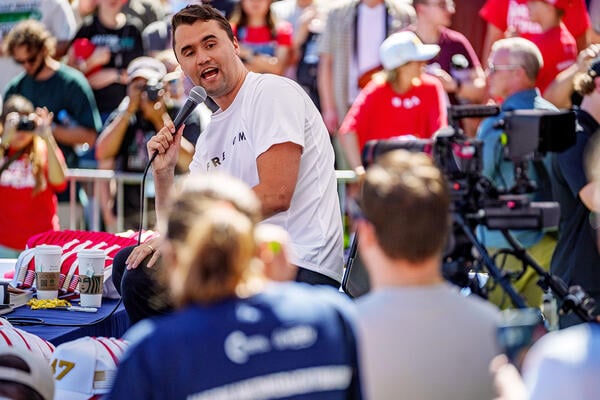
Wednesday saw a moment without precedent in recent history: A college speaker shot to death on a campus during an event. That fact alone would’ve escalated growing concerns about the future of free speech and civil discourse at colleges and universities.
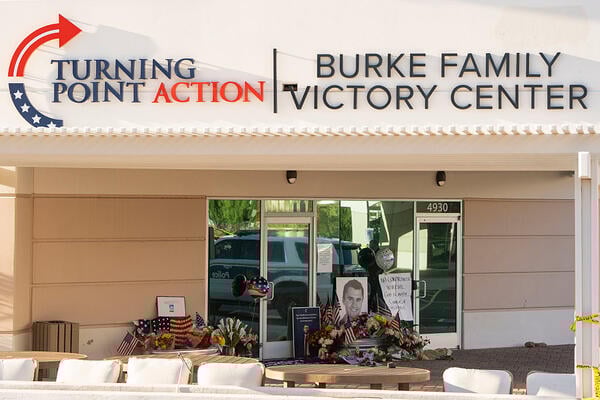
But this speaker was Charlie Kirk, a prominent ally of a U.S. president who was already crusading against higher ed. Kirk, a national political figure in his own right, was one of the foremost conservative critics of intolerance for right-wing views in higher ed and the founder and leader of Turning Point USA, a nationwide organization of conservative campus groups that aided the president’s re-election. Kirk even spoke at Trump’s January inauguration.
He was known for goading students on campuses to “prove me wrong,” posting the resulting clips online, appearing in conservative media to denounce higher ed, spreading his views further on his own podcast and using his organization’s online presence and on-the-ground staff to target left-leaning faculty.
“College is a scam,” Kirk, who dropped out of Harper College in Illinois, wrote in a 2022 Fox News op-ed, in which he urged most students not to go.
“Universities are indoctrination zones where free speech is crushed,” he wrote. “Radical students and faculty coerce and persecute their nonconforming peers through ‘cancel culture’ and threats … I firmly believe that most—if not all—the destructive ideas that are now eating away at the foundation of American society originated on college campuses.”
His death at Utah Valley University could put more pressure on higher ed at a time when colleges and universities have already been excoriated and targeted by the right. Faculty and those who criticize higher ed as being insufficiently open to civil debate between different viewpoints are worried that free expression will further erode.
“This is an epic moment for the future of higher ed,” said John Tomasi, president of Heterodox Academy. “For the issue of free speech, there’s been nothing quite like this ever before.”
Tomasi, whose organization promotes “viewpoint diversity” and “constructive disagreement” on campuses, noted both Kirk’s national stature and his association with campus free expression. He was the kind of person that conservatives had long argued wasn’t welcome on campuses.
“This is an attack on a magnitude that we have not previously seen,” he said. He said national attention on campus cultures intensified when Congress in late 2023 started calling university presidents into televised hearings regarding alleged campus antisemitism. Now, that “white-hot spotlight” is even hotter.
“This is a killing of a person who exemplifies the struggles of viewpoint diversity on college campuses … in the act of speaking on a college campus,” Tomasi said.
Multiple college presidents have issued statements condemning the shooting. Michael Roth of Wesleyan University, a vocal critic of Trump’s targeting of higher ed, wrote that “those who choose violence destroy the possibility of learning and meaning. Mr. Kirk’s murder on a college campus is an assault on all of us in education.” University of California system president James B. Milliken wrote, “This wasn’t just an attack on an individual; it was an attack on the very freedoms we as a nation hold dear.”
Some universities have also acted swiftly to punish employees who appeared to celebrate or make light of Kirk’s death in online comments.
I think it marks a breakdown of the culture of free speech.”
—Lindsie Rank, director of campus rights advocacy at FIRE
The killer has yet to be apprehended, their motive is unknown and the FBI is offering up to $100,000 for information. But in a video from the Oval Office Wednesday evening, President Trump called Kirk’s killing a “heinous assassination” of a “martyr for truth and freedom” and a “dark moment for America.” He said, “There’s never been anyone who was so respected by youth,” whom Kirk brought into the political process “better than anybody ever.”
“Charlie was a patriot, who devoted his life to the cause of open debate and the country that he loved so much,” Trump said, adding that Kirk “traveled the nation, joyfully engaging with everyone interested in good-faith debate.”
Kirk in the Oval Office
Andrew Harnik/Getty Images
But the president—who has demanded an undefined viewpoint diversity from universities while threatening them with sweeping federal funding cuts—didn’t go on to defend all free speech, which includes even hate speech. He denounced the “radical left,” saying that “violence and murder are the tragic consequence of demonizing those with whom you disagree day after day, year after year.”
“Those on the radical left have compared wonderful Americans like Charlie to Nazis and the world’s worst mass murderers and criminals,” Trump said. “This kind of rhetoric is directly responsible for the terrorism that we’re seeing in our country today, and it must stop right now.” (His speech didn’t mention the 2022 attack on former House speaker Nancy Pelosi’s husband, Paul, or the killings earlier this year of Democratic former Minnesota House speaker Melissa Hortman and her husband, Mark.)
Trump isn’t the only person calling it an assassination. Free speech advocates have called past shoutdowns of campus speakers the “heckler’s veto.” Lindsie Rank, director of campus rights advocacy at the Foundation for Individual Rights and Expression, called this an “assassin’s veto.”
“Regardless of how one feels about Charlie Kirk’s viewpoints, his tactics, his background, assassination cannot be a response to disagreement in a civilized society,” Rank said. “That’s the whole purpose of free speech: that we have a better way to engage in discourse across differences to settle disagreements.”
“I think there’s a lot of faculty thinking, ‘Is it going to be me, and maybe instead of a video, it’s a rifle?’”
—Isaac Kamola, director of the AAUP Center for the Defense of Academic Freedom
Rank said free speech allows people “to exchange words instead of bullets.” She said what happens on campus is never isolated to campus and raised concern about a feedback loop.
“Our society has started to accept violence as an appropriate response to viewpoints that folks disagree with,” Rank said. “I think it marks a breakdown of the culture of free speech.”
Isaac Kamola, director of the American Association of University Professors’ Center for the Defense of Academic Freedom and an associate political science professor at Trinity College in Connecticut, is among the fierce critics of Kirk’s tactics. While Trump called the “radical left’s” rhetoric dangerous, Kamola said Kirk’s was.
“He literally wrote the book titled Campus Battlefield,” Kamola noted. “He built a career out of treating higher education as a war zone … and treating professors and students that he disagreed with as enemies that posed an existential threat to America … That being said, when actual violence—physical violence and murder—come to college campuses, that ratchets things up to an even more dangerous degree.”
Kamola added that, “without knowing who the gunman is,” Trump is already saying “he’s going to use this as an opportunity to punish the left, and I think that’s really scary.” (Kirk’s final post on X to his over 5.4 million followers said it was “100% necessary to politicize the senseless murder” of a Ukrainian woman in Charlotte, N.C., last month.)
Kamola pointed to Turning Point USA’s own Professor Watchlist and Texas A&M University’s firing of a professor earlier this week after a student filmed herself challenging the legality of teaching about gender identity in a children’s literature class. He said the killing could now leave faculty to think, “Is there going to be retaliation for this assassination?”
“I think there’s a lot of faculty thinking, ‘Is it going to be me, and maybe instead of a video, it’s a rifle?’” he said.
Another Turning Point
Trump redefined conservatism, attracting new adherents. Kirk appeared to do the same for conservative students across the nation, adding them to the MAGA movement.
Amy Binder, SNF Agora Professor of Sociology at Johns Hopkins University, said she’s studied conservative campus activism for decades. She said Kirk “kind of burst on the scene right around the time” Trump won his first term in office.
Vigils to remember Kirk have popped up at college campuses and at the Turning Point USA headquarters in Arizona.
Rebecca Noble/Getty Images
Binder, co-author of Becoming Right: How Campuses Shape Young Conservatives and The Channels of Student Activism, said Kirk’s Turning Point group attracted students who initially weren’t sure they were Republicans and weren’t attracted to the College Republicans chapters that traditionally mobilized students.
“Their complaint about College Republicans was that it was too establishment, it was kind of fusty, stale, too focused on getting people elected,” Binder said of these students. She said Turning Point told them that “you are part of a liberal, left campus and you are mistreated here and you need to come out of the closet and declare that you’re conservative in a big, broad way—and we’ll help you do that with really splashy events and really splashy speakers.”
“All of the incentive structure there was to go big, go confrontational,” she said. Kirk exemplified that in his sparring matches with left-leaning students on campuses.
Binder said, “Kirk was really excellent at cross-branding,” frequently appearing on Fox News, recording videos for the conservative education video website PragerU and more.
“Over time, Kirk was really involved with the Trump family, and with MAGA under Trump,” Binder said. “And he really became an ambassador for that—not only to young people, but to others as well … He was really crossing over into other age brackets and he just kind of became a face—or the face—of energized, youthful conservatism.”
Turning Point sought to elect conservatives to student governments by providing funding. It broadcast online the names of faculty it considered too left-leaning or intolerant of conservative views and marshaled voters for Trump during his re-election campaigns.
“He became the face of young Republicans and probably helped Trump win Arizona, maybe Wisconsin, maybe Michigan, with his get-out-the-vote” in 2024, Binder said. She said he “might have been predicted to have a political career in the future. He’s charismatic, he’s good-looking, he has a perfect family, he’s obviously had success.”
Charlie Kirk was speaking at Utah Valley University on Sept. 10 to kick off his American Comeback Tour when he was shot and killed.
Trent Nelson/The Salt Lake Tribune/Getty Images
But now, Kirk is dead. While Binder said there will continue to be a “very robust right ecosystem of organizations that seek mobilized students on campus,” it’s unclear what Turning Point’s future will be.
“Is there a power vacuum, is there a succession plan, what does that look like? I certainly don’t know,” she said. Turning Point didn’t respond to Inside Higher Ed’s request for an interview Thursday.
As for how his death could impact campus free expression, Binder said, “It’s really, really horrible on just all of the fronts, and in the wrong hands, something like this could shut down speech.”
Rank, from FIRE, said that while the shooter’s motive is unknown, the effect that violence can have on free expression isn’t. She said it can not only create a chilling effect within people, but it also can cause higher ed institutions to clamp down on speech to prevent violence.
“If an administration comes in and prevents controversial speaking engagements, then you’re creating a situation where the violence wins and that just causes free speech to deteriorate even further,” Rank said. She said that would not only be wrong, but “it would be a strange way to honor his legacy.”
It’s that time of year again. A level results have been and gone, the initial buzz of clearing has passed, and new students are about to turn up. It can only mean enrolment. Or, at some universities, this strange thing called matriculation.
One internet definition of matriculation has it as “the process of matriculating”. Helpful.
To get to the bottom of it, we need to remember that universities were medieval European creations, and medieval Europe was all about the corporation. A universitas was a single body of people, chartered by a king or a pope, or sometimes by both, and you had to become a member of the universitas to benefit from its protection and patronage.
And the terminology stays with us – a degree refers to your class of membership of the universitas. A master had a license to teach at a universitas, and being a master at one would often (but not always) give you license to teach at another.
Matriculation was the process whereby you became a student member of the university. At some universities (here’s Oxford, for example) it is a formal ceremony, dressing up and parading, and the whole works. At other universities it can be more administrative – in my own case, I got a letter from the University of London University Entrance Requirements office telling me that I’d matriculated. But I still had to queue up a long winding staircase at LSE to enrol, get my student ID and a grant cheque.
Yes, I am that old.
Enrolment is really the same as matriculation, but without the razzamatazz. It’s the moment when the contract between the student and the university becomes made by both sides; calling it enrolment not matriculation is a badge of the ongoing transition by universities from being medieval to being modern. Which I guess we should probably support. Before we need to transition to being postmodern.
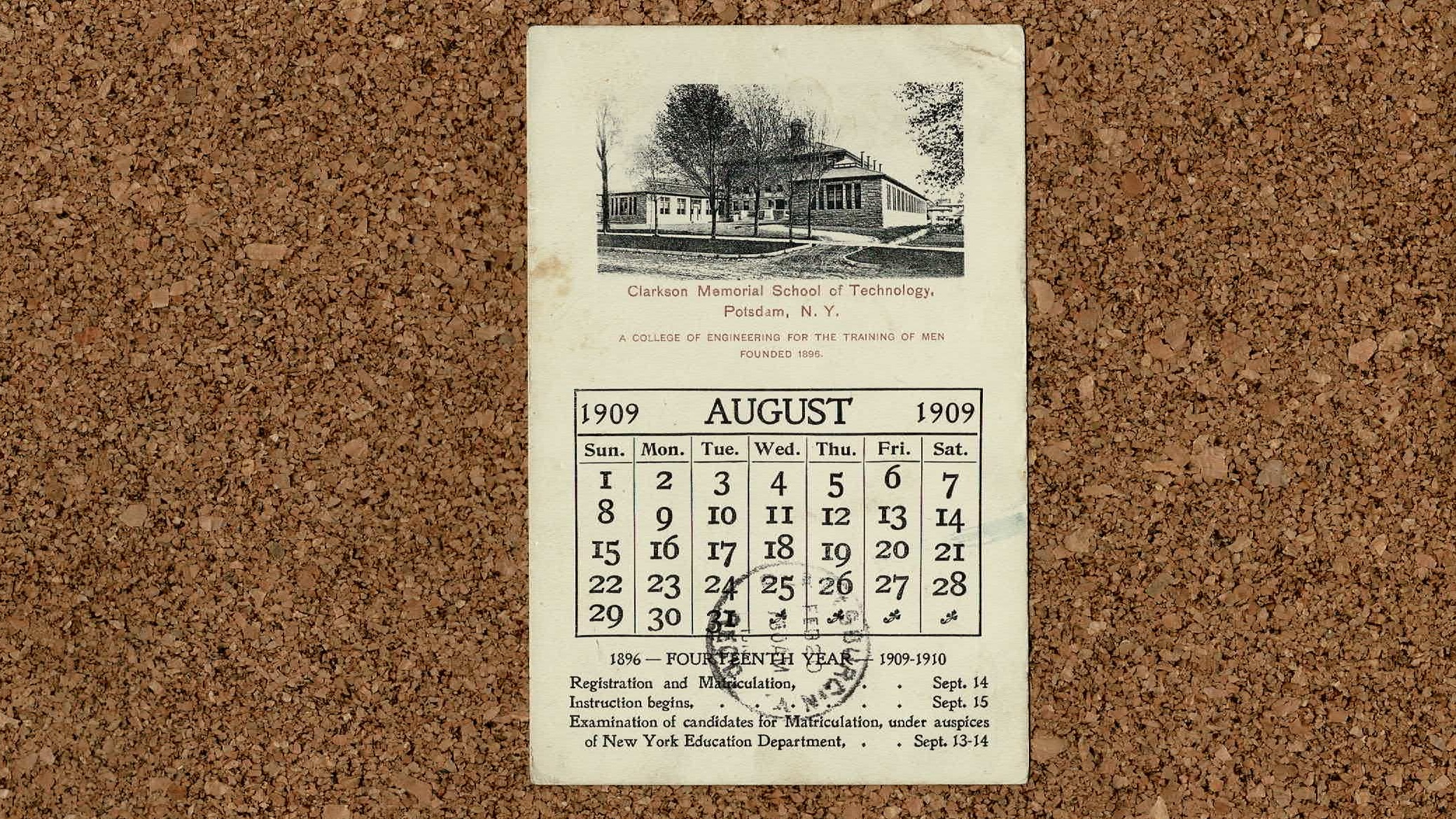
The card itself was issued by Clarkson School of Technology, in the USA. It’s actually a marketing card. Come to Clarkson, it says. There’s still time to matriculate and register, and start to learn. Note that the sequence is: exam for matriculation, matriculation, instruction begins. And note that the exam to matriculate isn’t the university’s, but is the New York Education Department’s. An external verification that standards had been met before enrolment could happen.
The Thomas S. Clarkson Memorial School of Technology was founded in 1896. Thomas S Clarkson was a businessman, with multiple interests including a quarry. In August 1894 we are told that a worker at the quarry was in danger of being crushed by a derrick pump. Clarkson pushed the worker out of the way, being crushed himself instead. He died five days later of his injuries. His three sisters and his niece established the technical school in his name.
In 1912 the State University of New York required the registration of all higher educational establishments, and it became the Thomas S. Clarkson Memorial College of Technology, commonly known as the Clarkson College of Technology. It became a university in 1984. The university has a more thorough account of its history on its webpages.
The card itself was sent on 19 February 1910.
Good morning, Leon:- Haven’t heard from you this week. Neither have we heard from Mayme. Had letter from Mabel R, her vacation began last Monday and lasts ‘til April 1st ….
Here’s the actual message if you can decipher more than I have, please share in the comments!
The U.S. Department of Educationis ending funding to several grant programs for minority-serving institutions, calling them racially discriminatorybecause colleges must enroll certain shares of underrepresented students to qualify for the awards.
In fiscal 2025, the department had been expected to award $350 million in grants to benefit institutions serving large shares of Alaska Native, Asian American,Black, Hispanic, Native American, Native Hawaiian and Pacific Islander students.The agency said on Wednesday it will redirect the funding to other programs “that advance Administration priorities.”
The announcement quickly drew criticism from college leaders, lawmakers and higher education organizations, who argued that cutting the grants would harm students and damage colleges that rely on the funding.
Dive Insight:
The cut grants have supported myriad initiatives at MSIs, such as purchasing laboratory equipment, improving buildings and classrooms, supporting student services like tutoring, and establishing endowment funds.
Eliminating the funding will irreparably harm students, Mildred García, chancellor of the California State University system, said in a Wednesday statement. She panned the move, noting that all but one of the CSU system’s 22 universities are Hispanic-serving institutions.
“Without this funding, students will lose the critical support they need to succeed in the classroom, complete their degrees on time, and achieve social mobility for themselves and their families,” García said.
Higher education leaders also said the funds benefit all students.
“The funds granted to HSIs have never supported only Latino students,” David Mendez, interim CEO of the Hispanic Association of Colleges and Universities, said in a statement on Wednesday. “These funds strengthen entire campuses, creating opportunities and resources that benefit all students, especially those pursuing STEM fields, as well as enhancing the communities where these colleges and universities are located.”
University of Hawaiʻi President Wendy Hensel voiced concernsspecifically about the impact the move would have across the public 10-campus system.
“It will affect all of our students, the programs that support them and the dedicated staff who carry out this work,” Hensel said in a Wednesday statement.
However, the Education Department took issue with the eligibility requirements for colleges to receive grants.
For instance, to be eligible for grants for the Developing Hispanic-Serving Institutions program, colleges must have student bodies where at least 25% of learners are Hispanic. For grants under the Minority Science and Engineering Improvement program, which is meant to encourage underrepresented students to enter STEM fields, colleges must have student bodies where 50% of learners belong to underrepresented racial or ethnic minority groups.
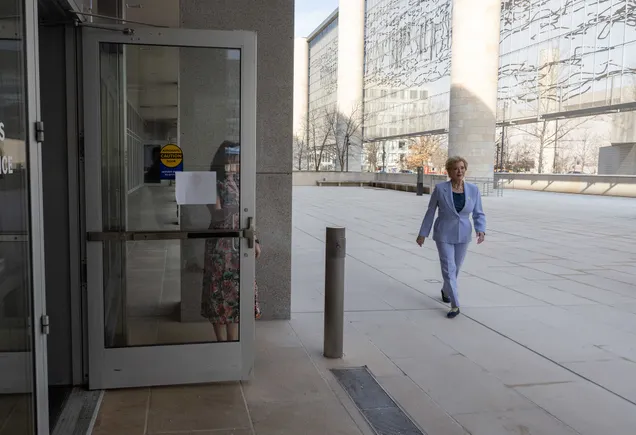
“To further our commitment to ending discrimination in all forms across federally supported programs, the Department will no longer award Minority-Serving Institution grants that discriminate by restricting eligibility to institutions that meet government-mandated racial quotas,” U.S. Education Secretary Linda McMahon said in a statement on Wednesday.
McMahon said the department wants to work with Congress to “reenvision these programs to support institutions that serve underprepared or under-resourced students without relying on race quotas.”
The Education Department’s decision Wednesday targets some of the very grants over which it is currently being sued by the state of Tennessee and Students for Fair Admissions, the anti-affirmative action group that successfully sued to end race-conscious admissions at colleges.In a lawsuit filed in June, the plaintiffs argued that grants for HSIs are discriminatory due to their eligibility requirements.
In a July memo, the U.S. Department of Justice said it would not defend the grant programs. Solicitor General D. John Sauer said the agency determined that they violated the constitutional right to equal protection under the law.
The Education Department said it will still disburse roughly $132 million in grant funding for fiscal year 2025 that Congress has mandated to be spent for MSIs. “The Department continues to consider the underlying legal issues associated with the mandatory funding mechanism in these programs,” the agency added.
The Education Department did not answer Higher Ed Dive’s questions Thursday but cited a Wednesday article from online news publication RealClearPolitics.
A senior administration official told RealClearPolitics that the changes would not impact historically Black colleges and universities.The federal designation of HBCU does not include any enrollment criteria. Instead, a college must have been established prior to 1964 and have a principal mission that “was, and is, the education of Black Americans,” according to federal statute.
In 2018, Military Times published a guide titled “8 Tips to Help Vets Pick the Right College.” While the intent was good, the higher education landscape has shifted dramatically since then — and not for the better. For-profit colleges have collapsed and rebranded, public universities are raising tuition while cutting services, and predatory practices continue to target veterans with GI Bill benefits.
Meanwhile, agencies like the Department of Defense (DOD) and the Department of Veterans Affairs (VA) — tasked with protecting veterans — have too often failed in their oversight. Investigations have revealed FOIA stonewalling, regulatory rollbacks, and a revolving door between government and industry. Veterans are left to navigate a minefield of deceptive recruiting, inflated job-placement claims, and programs that leave them indebted and underemployed.
Here’s what veterans need to know in 2025.
1. Don’t Trust the Branding
Colleges love to advertise themselves as “military friendly.” This phrase is meaningless. It’s often nothing more than a marketing slogan used to lure GI Bill dollars. The fact that a school has a veterans’ center or flags on campus tells you little about program quality, affordability, or long-term value.
If a school avoids publishing these numbers or makes them hard to find, that’s a red flag.
3. Understand the Limits of Oversight
The VA’s GI Bill Comparison Tool and DOD “oversight” portals may look official, but they are incomplete and sometimes misleading. The VA has even restored access to schools after proven misconduct under political pressure. DOD contracts with shady for-profit providers continue despite documented abuse.
Oversight agencies are not independent referees — too often, they are captured regulators.
4. Seek Independent Evidence
Avoid relying on large, national veteran nonprofits. Many of these organizations accept funding from schools, corporate partners, or government agencies with vested interests.
Instead, veterans should:
Check state attorney general enforcement actions and FTC press releases.
Read independent investigative journalism (such as the Higher Education Inquirer or Project on Predatory Student Lending).
Ask tough questions of alumni — especially those who dropped out or ended up in debt.
5. Watch Out for Job Placement Claims
Schools often boast of “high job placement rates” without clarifying what that means. Some count temporary or part-time work unrelated to your field. If a program promises guaranteed employment, demand written proof.
6. Don’t Chase Prestige
Big-name universities are not automatically better. Some elite schools partner with for-profit online program managers (OPMs) that deliver low-quality, high-cost programs to veterans and working adults. Prestige branding doesn’t guarantee fair treatment.
7. Weigh Community Colleges and Public Options
Community colleges can be a safer starting point, offering affordable tuition, transferable credits, and practical programs. Some state universities provide strong veteran support at the local level, even when national oversight is weak.
8. Build and Rely on Grassroots Networks
Large veteran organizations at the national level often fail to protect veterans from predatory colleges. Veterans are better served by:
Local veteran groups that are independent and community-based
Direct peer networks of fellow veterans who have attended the schools you’re considering
Public libraries, grassroots councils, and smaller veteran meetups not tied to corporate or political funding
Sharing experiences through independent media when official channels fail
Protect Yourself, Protect Others
Veterans have long been targeted by predatory colleges because their GI Bill benefits represent guaranteed federal money. DOD, VA, and large national veteran groups have too often enabled this exploitation.
The best defense is independent evidence, grassroots testimony, and investigative journalism. By asking hard questions, demanding transparency, and supporting one another at the local level, veterans can avoid the traps that continue to ensnare far too many.
For those who have been targeted and preyed upon, please consider joining the Facebook group, Restore GI Bill for Veterans.