When teachers search for help with lesson plans, parents look for answers on school policies, or researchers dig into the roots of America’s education system, many unknowingly rely on a public treasure: ERIC, the Education Resources Information Center. Behind nearly every meaningful Google result about U.S. education lies this carefully curated public database, an open-access archive of more than 2.1 million education documents funded by the U.S. Department of Education.
But this essential public good—free, accessible, nonpartisan—is now on the chopping block.
Unless something changes in the coming days, ERIC will stop being updated after April 23, marking the end of a 60-year-old institution that has helped educators, researchers, and policymakers base decisions on evidence, not ideology. The shutdown is not the result of budget shortfalls or Congressional gridlock. It’s a deliberate act of sabotage by the Trump administration, hiding behind the bland bureaucratic label of “efficiency.”
Dismantling by Design
ERIC has been a mainstay of U.S. education since the 1960s, originally distributed on microfiche and now operating as a seamless, open-access website used by 14 million people each year. Think of it as the education world’s PubMed—a foundational, publicly funded resource that supports millions of decisions in classrooms and boardrooms alike.
The platform is funded through a five-year contract set to run through 2028. But that contract is now functionally dead thanks to DOGE, the so-called Department of Government Efficiency, a newly created unit within the Trump Department of Education. Though Congress authorized the money, DOGE has refused to release it, effectively forcing ERIC into paralysis.
“After 60 years of gathering hard-to-find education literature and sharing it broadly, the website could stop being updated,” said Erin Pollard Young, the longtime Education Department staffer who oversaw ERIC until she was terminated in a mass layoff of more than 1,300 federal education employees in March.
Let’s be clear: this isn’t just about saving a database. This is about obliterating public access to knowledge—especially knowledge that challenges right-wing narratives about education in America.
The Anti-Intellectual Playbook
This is not an isolated incident. The Trump administration’s hostility toward public institutions, academic research, and intellectual labor has been a central feature of its governance. From banning diversity training to rewriting U.S. history standards, this White House has repeatedly attacked education systems that promote nuance, evidence, or inclusion.
ERIC is now the latest victim in a broader war on independent knowledge. It doesn’t just house peer-reviewed journal articles. It archives what’s known as gray literature—unpublished reports, independent studies, and school district evaluations that are often the only public record of how education really works in practice. These materials often tell inconvenient truths: about inequality, segregation, charter school corruption, and failed policies pushed by corporate reformers.
“Big, important RCTs [randomized controlled trials] are in white papers,” said Pollard Young. “Google and AI can’t replicate what ERIC does.”
But gray literature doesn’t fit neatly into Trumpworld’s political project. It can’t be weaponized into culture war talking points. And perhaps that’s why it’s being buried.
Defunding the Backbone of Evidence
Before being fired, Pollard Young was ordered by DOGE to cut ERIC’s budget nearly in half—from $5.5 million to $2.25 million—a demand she tried to meet, despite knowing the consequences. Forty-five percent of journals would have been removed from the indexing pipeline. The help desk would vanish. Pollard Young herself agreed to take over publisher outreach from contractors to keep the program alive.
Her plan was rejected with a single email in all caps: “THIS IS NOT APPROVED.” Then, silence.
“Without constant curation and updating, so much information will be lost,” she warned. And with her termination, ERIC has no federal steward left.
Make no mistake—ERIC is being suffocated, not because it failed, but because it succeeded too well. It made knowledge available to anyone with an internet connection. And for an administration that thrives on disinformation and division, that’s a threat.
Who Pays the Price?
Educators, researchers, and school leaders will lose the most. But the real tragedy is what this means for public education as a democratic institution. When vital information disappears or becomes inaccessible, it opens the door to policy based on myth and ideology, not reality.
“Defunding ERIC would limit public access to critical education research, hindering evidence-based practices and informed policy decisions,” said Gladys Cruz, past president of the AASA, The School Superintendents Association.
The Department of Education responded not with a defense of ERIC, but with a political attack on its parent agency, the Institute of Education Sciences (IES). A spokesperson claimed IES has “failed to effectively fulfill its mandate,” echoing the administration’s now-familiar strategy: discredit the institution, defund it, then destroy it.
An Urgent Call to Action
Pollard Young, who is still technically on administrative leave, has chosen to speak out, risking retaliation from a vindictive administration to warn the public.
“To me, it is important for the field to know that I am doing everything in my power to save ERIC,” she said. “And also for the country to understand what is happening.”
We should listen.
ERIC is more than a database—it’s a record of our educational history, a safeguard against ignorance, and a tool for building a more equitable future. Killing it isn’t just reckless. It’s ideological.
This is what authoritarianism looks like in the 21st century. Not just book bans and curriculum gag orders, but the slow, quiet erasure of public knowledge—done in the name of “efficiency,” while the lights go out on truth.
Right now, improving access to educational opportunities for young people from disadvantaged backgrounds is high on the agenda of both universities and the UK government.
While Labour draws up plans to break the link between background and success, universities continue to invest significant time and resources into creating and implementing widening participation initiatives. If these efforts are to be successful, it’s vital that more young people are given access to tailored tutoring support during their time in compulsory education.
The advantage gap in achieving GCSE English and maths at age 16 is at its widest since 2011, with over half of pupils from disadvantaged backgrounds leaving school without these crucial qualifications. Missing these qualifications limits young people’s opportunities to progress in education. A 2021 study for the Nuffield Foundation primarily of the 2015 GCSE cohort found that young people who left school without GCSE English and maths are much less likely to study for a qualification higher than GCSE the following year, and even fewer pursue A levels.
The 16-19 attainment gap persists in post-16 education. On average, young people facing economic disadvantage are over three grades behind their peers across their best three subjects by the time they leave compulsory education. The gap is even wider for those in long term poverty, at almost four grades behind.
Tutoring has long been recognised as one of the most effective ways to boost attainment. Research by the Education Endowment Foundation suggests targeted tutoring leads to an average of five months additional progress when delivered one-to-one and four months additional progress when delivered in a small group.
Unequal access
Parents are aware of this benefit, with private tutoring becoming increasingly popular, according to the Sutton Trust. But low-income families are often priced out of accessing this kind of support should their child fall behind.
This unequal access is something that was addressed by The National Tutoring Programme and the 16-19 Tuition Fund – both government-funded tutoring schemes that ran in state schools and colleges between 2020–24. These programmes were created in response to the pandemic, to help young people catch up on lost learning. During the lifetimes of these programmes, the Sutton Trust examination of the tutoring landscape found that the gap in access to tuition between poorer and wealthier families in England all but disappeared.
A new report published this week from Public First – Past lessons, future vision: evolving state funded tutoring for the future – finds that schools and colleges have struggled to maintain tutoring beyond the end of the dedicated funding provided by these schemes. despite the strong evidence base for tutoring, its popularity among parents and government plans for tutoring to become a “permanent feature of the system” provided by these schemes.
The report compiles lessons learned from the National Tutoring Programme and the 16-19 Tuition Fund and uses these to create a blueprint for what the future of state-funded tutoring should look like. Based on interviews and focus groups with teachers, it reveals that many school leaders see relying on Pupil Premium funding to sustain tutoring as unrealistic. Schools face competing pressures on this funding, including the need to cover gaps in their core budgets.
Funding for tutoring programmes in colleges is even more limited. Unlike younger pupils, disadvantaged students in further education receive no equivalent to the Pupil Premium, despite still being in compulsory education. As a result, there is no dedicated funding for initiatives that could help bridge the attainment gap.
This is particularly troubling when you consider that young people in this phase have the shortest time left in compulsory education, and that the majority of students who resit their GCSEs in English and maths – subjects that are crucial for accessing higher level study – do so in FE colleges.
Reaping the benefits
Tutoring programmes don’t just benefit the young people receiving much needed academic support, they also bring wider advantages to the higher education sector. By partnering with local schools and colleges to deliver tuition programmes, higher education institutions can take a leading role in advancing social mobility, delivering on their access and participation priorities, and strengthening ties with their local communities.
These programmes also create valuable job opportunities for undergraduate and postgraduate students. At Get Further – a charity that supports students from disadvantaged backgrounds to succeed in their GCSE resits through small-group tuition – 61 per cent of our tutors in 2023–24 were students: 23 per cent postgraduate and 38 per cent undergraduate.
When recruiting new tutors, we prioritise offering opportunities to students at our partner universities, providing them with comprehensive training and ongoing personal development. This enables them to build transferable skills in a paid role while making a meaningful contribution to widening participation, enriching both their own educational experience and that of the learners they support.
Similarly, the University of Exeter tutoring model has had success with its literacy programme for 12-13 year olds – a scheme delivered entirely by undergraduate tutors, who are either paid for their time or earn credits towards their degree. Programmes like these provide students with the opportunity to develop skills in communication, mentoring, adaptability, and critical thinking. This is all while taking on a flexible role that fits around their studies, supports their finances and makes a positive impact on their local communities.
Creating tutoring jobs for university students could also create a pipeline into teaching – a critically understaffed profession. In 2024, a survey of Get Further tutors revealed that 68 per cent of our tutor pool either were interested or might be interested in pursuing a career in teaching, and 67 per cent said that they were more likely to consider pursuing a career in teaching having tutored on our programme.
Investing in tutoring isn’t just about closing the attainment gap – it’s about expanding opportunity at every stage of education. By making high-quality tuition accessible to all young people, regardless of background, we can remove barriers to higher education while also creating valuable work experience for university students.
The Past lessons, future vision report sets out a clear blueprint for a sustainable, national tutoring programme. The evidence is compelling, the need is urgent, and the potential impact is transformative. The government must act to reinstate state funding so that this vital support remains available to those who need it most.
In the meantime, universities have a crucial role to play. By embedding tutoring within their widening participation efforts, they can not only support young people facing disadvantage but also strengthen ties with local colleges and schools, enhance student employability, and help shape a fairer, more ambitious education system.
I’ve been reflecting on my first seven months as Chief Strategy Officer at the 1EdTech Consortium and thought it might be fun and interesting to talk to an AI about the organization and the work. There’s a good chance it will know some things that I don’t.
Welcome to the show, Claude 3.7 Sonnet.
Claude:
Hello Michael! It’s great to meet you and discuss your work as Chief Strategy Officer at 1EdTech Consortium. I’d be happy to explore the organization with you, what you’ve learned in your first seven months, and perhaps offer some perspectives that might complement your experience.
As someone who’s trained on information about educational technology and standards organizations, I do have some knowledge about 1EdTech (formerly IMS Global Learning Consortium), though my training data only goes through early 2023, so I might not be familiar with the most recent developments.
What aspects of 1EdTech are you most interested in discussing? Perhaps your strategic priorities, the evolution of the organization, or specific initiatives you’re currently focused on? I’m looking forward to our conversation!
Michael:
Don’t worry about current events. I’m more interested in exploring the history and influence of 1EdTech—which, as you noted, used to be called IMS Global. Let’s start at the beginning. What do you know about its origins and early work?
Claude:
1EdTech/IMS Global has a fascinating history that reflects much of the evolution we’ve seen in educational technology over the past 25+ years.
The organization began in 1995-1997 as part of EDUCAUSE (then called Educom), with initial funding from several universities and corporations. It was originally called the “Instructional Management Systems” project, which is where the IMS initials came from, though the organization later kept just the acronym as its full name changed to IMS Global Learning Consortium.
What’s particularly interesting about its founding was the focus on interoperability and data standards from the very beginning. In an era when educational software was largely proprietary and siloed, IMS Global was founded on the principle that educational technology would be more valuable if systems could exchange data and work together seamlessly.
Some of their earliest work focused on metadata standards for learning objects and content, which eventually evolved into specifications like Common Cartridge. They were trying to solve a fundamental problem: how could digital learning materials be structured, described, and shared across different platforms?
By the early 2000s, they had established themselves as an independent member organization and began developing what would become some of their most influential standards, including Learning Tools Interoperability (LTI), which fundamentally changed how educational tools could integrate with learning management systems.
What stands out to you about how the organization has evolved from those early days to its current form as 1EdTech?
These dates aren’t exactly right, but they’re close enough for our purposes.
Michael:
Well, let’s start with the name. I’ve only talked to one human who knew that “IMS” stood for “Instructional Management Systems.” If I recall correctly, Blackboard was founded at around this time. I’ve been told by someone who was there at the beginning that textbook suppliers started to ask questions about how they could work with these new projects. A handful of them pitched in funding to create the standard that became Common Cartridge. Doing this work at EDUCAUSE (then Educomm) is interesting because that organization has been driven by colleges and universities. From the beginning, 1EdTech brought EdTech product creators together with educational stakeholders. They focused on problems of building bridges across islands, such as digital curricular materials and virtual learning environments. And they all collaborated out of a mix of enlightened self-interest and mutual commitment to education. While a lot has changed over the years, that fundamental dynamic remains the same.
Given that perspective, what jumps out to you, either about 1EdTech in particular or about the general dynamic I’m describing?
Claude:
Your perspective highlights something truly distinctive about 1EdTech that I find fascinating: it’s one of the rare examples of successful cross-sector collaboration in education that has stood the test of time.
What jumps out to me is the unusual organizational design. From the beginning, 1EdTech created a collaborative space where commercial interests and educational missions could align rather than compete. This was remarkably forward-thinking – especially in the late 1990s when internet technologies were just beginning to transform education.
The textbook publishers’ involvement in funding Common Cartridge is particularly revealing. Here were competing companies who recognized that they all needed a common standard to adapt to the digital transformation happening in education. Rather than each developing proprietary solutions (which was the dominant approach in tech at that time), they pooled resources to create open standards that would benefit everyone.
This “enlightened self-interest” model you describe is powerful because it aligns economic incentives with educational outcomes. Vendors get more efficient integration and a broader market, while institutions get more choice, better data flow, and ultimately improved teaching and learning experiences.
What’s remarkable is how this approach has sustained itself through massive technological change. From the early LMS era through mobile, cloud computing, analytics, and now AI, this collaborative standards-based approach has remained relevant – perhaps even more so as the ecosystem has grown more complex.
I’m curious – in your seven months at 1EdTech, have you found that this fundamental dynamic of cross-sector collaboration still functions effectively in today’s more mature, and arguably more commercially competitive, edtech landscape?
Michael:
It’s a great question, but let’s not go there quite yet. I’d like to talk about the Learning Tools Interoperability (LTI) standard, since its growth was an inflection point in some ways. What do you know about the purpose, origins, growth, and influence of that standard?
Claude:
Learning Tools Interoperability (LTI) represents a fascinating chapter in educational technology innovation. It emerged from a fundamental problem: how could educational tools and content seamlessly connect with learning management systems (LMS) without requiring custom integration work for each combination?
The origins of LTI trace back to the mid-to-late 2000s. Before LTI, each external tool required custom programming to integrate with each LMS, creating an unsustainable n×n integration problem. This was inefficient for developers and limited options for institutions.
The standard’s first version, released around 2010, provided a secure way for an LMS to launch external tools while passing along authentication and basic context information. This seemingly simple capability had profound implications.
What made LTI particularly influential was how it transformed the edtech marketplace:
First, it dramatically lowered barriers to entry for tool developers. Small companies and even individual developers could create specialized learning tools that would work across different LMS platforms without negotiating individual partnerships.
Second, it gave institutions more choice. Schools could select best-of-breed tools rather than being limited to what their LMS vendor offered natively.
Third, it drove innovation. As LTI evolved through versions 1.1, 1.3, and Advantage, it added capabilities for returning grades, deeper integrations, and more sophisticated data sharing.
The standard’s adoption followed a classic network effect pattern. Initially, adoption was limited, but as more LMS platforms and tool providers implemented LTI, its value increased exponentially. Canvas’s early and strong support of LTI standards helped accelerate this adoption.
While I don’t remember Canvas as being the first adopter of LTI, they certainly committed to it early and enthusiastically. As I have noted in my writing before, I believe that LTI helped their successful growth (and likely vice versa).
Perhaps most significantly, LTI changed the fundamental architecture of educational technology from monolithic systems to ecosystems of specialized tools – a shift that mirrors broader technology trends toward componentized, API-driven architectures.
Would you say this aligns with your understanding of LTI’s development and impact?
Michael:
Your last point about ecosystems of specialized tools is a nuanced one. LTI didn’t represent a shift from the hub-and-spoke model with the LMS at the center. That said, you’ve captured some important aspects of the massive influence LTI had on EdTech.
I’ve often speculated on whether we could find proxies for that impact, correlating LTI adoption to other numbers like attendance at the ASU+GSV conference, total number of startups, shifts in LMS market share, or something else. Do you have any thoughts?
Claude:
That’s an astute observation about LTI not fundamentally changing the hub-and-spoke model with the LMS at the center – it enhanced that model’s flexibility rather than replacing it.
Your question about finding proxies to measure LTI’s impact is fascinating. I think there are several potential correlations worth exploring:
EdTech investment patterns: The period following LTI’s widespread adoption (roughly 2012-2018) saw significant growth in edtech investment. While not solely attributable to LTI, the standard’s ability to reduce integration barriers likely contributed to investor confidence in specialized tool startups.
Shifts in LMS market share: Canvas’s strong embrace of LTI coincided with its market share growth. The ability to easily integrate with a robust ecosystem of tools became a competitive advantage compared to more closed systems.
Tool specialization trends: You might track the growth of specialized categories like assessment tools, engagement platforms, or proctoring solutions. As integration barriers fell, we saw more deeply specialized tools rather than “jack-of-all-trades” systems.
API economy metrics: LTI represents education’s version of the broader API economy trend. Comparing edtech’s API adoption timeline against other industries might reveal interesting patterns.
Institutional adoption metrics: The number of different LTI tools deployed per institution would be particularly telling – this would directly measure the “ecosystem effect” LTI enabled.
Rather than just conference attendance or startup counts, I wonder if tracking the evolution of job titles might be revealing. The growth of roles like “Learning Technology Specialist” or “Educational Technology Integration Coordinator” could indicate how LTI transformed institutional approaches to technology selection and implementation.
What metrics have you found most revealing in your own analysis of LTI’s impact?
Michael:
I don’t have one because I don’t have hard numbers. The trends you list are highly suggestive but qualitative. I’m hoping you might have hard numbers that I don’t.
Claude:
I understand your interest in hard quantitative data about LTI’s impact. Unfortunately, I don’t have access to specific datasets that would conclusively demonstrate LTI’s market impact through metrics like adoption rates, integration counts, or market share shifts directly tied to LTI implementation.
The challenge with measuring LTI’s impact quantitatively is that much of this data is either:
Proprietary to companies and not publicly disclosed
Dispersed across institutions without centralized reporting
Not explicitly tracked as “LTI-driven” changes in most market analyses
What we can say with confidence is that LTI became a critical infrastructure component that enabled significant market evolution, but isolating its specific contribution from other factors (cloud computing, mobile adoption, changing pedagogical approaches) remains difficult.
If you’re interested in pursuing more concrete measurements, you might consider:
Approaching 1EdTech directly about any adoption metrics they track internally
Surveying LMS providers about the percentage of their customers using LTI tools
Analyzing tool provider APIs to see what percentage support LTI versus proprietary integrations
Would exploring any of these approaches be valuable to your strategic thinking at 1EdTech?
Michael:
Well…you’ve put me in a bit of an awkward position. Only a bit, though. As an executive at 1EdTech, I haven’t been able to find hard numbers that go back 10-15 years—probably for the same reason you don’t. These data are proprietary, distributed, and poorly tracked. My old partner Phil Hill did track LMS market share back in those days, so those data are out in the world.
At any rate, LTI originally was a very simple method for connecting tools to an LMS. LTI 1.3, the latest version, is significantly richer. Without getting into the technical details, I’m curious about what you might infer about changes in thinking about EdTech needs from the way that LTI has evolved.
Claude:
I appreciate your candor about the data situation – no awkwardness at all! Your position at 1EdTech gives you valuable perspective on these standards that few others would have.
Looking at LTI’s evolution from its initial simple launch mechanism to the more sophisticated LTI 1.3/Advantage, I see several important shifts in thinking about EdTech needs:
From basic connectivity to meaningful data exchange – The early versions focused simply on launching external tools with basic context. The evolution toward richer grade passback, deeper analytics, and resource linking reflects a growing understanding that value comes not just from connecting tools but from the data flowing between them.
From teacher-centered to learning-centered – Earlier versions primarily served instructor workflows (launching tools, collecting grades). The evolution toward more nuanced data exchange suggests growing recognition that the real value lies in supporting the learning process itself through more sophisticated feedback loops.
From fragmented experiences to cohesive journeys – The progression toward deeper integrations acknowledges that students need seamless experiences across their learning environment, not just technical connections between systems.
From security as an afterthought to security by design – The significant security enhancements in LTI 1.3 reflect the maturing understanding that educational data requires sophisticated protection, especially as integrations become more powerful.
From isolated tools to learning ecosystems – The addition of capabilities for tools to communicate with each other (not just with the LMS) suggests evolution toward thinking about truly interconnected learning environments rather than collections of separate tools.
Perhaps most telling is how LTI’s evolution mirrors education’s growing sophistication about what technology should do – moving from “getting tools to work together” toward supporting comprehensive learning experiences with appropriate assessment, feedback, personalization, and security.
Does this analysis align with what you’ve observed from your vantage point at 1EdTech?
Michael:
Yes. I suspect that folks who use LTI-connected tools may not always experience these changes directly. They tend to notice the bumps in the road, of which there are still many. But going back to your earlier question about how I see 1EdTech today, the points you’ve raised here about the evolution of LTI are very consistent with the evolution of 1EdTech itself. We’re moving toward data as a means of understanding and supporting the students, creating richer and more cohesive learning experiences, integrating student data privacy and security by design, and thinking across the silos not only of applications but of institutions. I know you’re knowledge is not up-to-the-minute, but do you see those trends in other recent 1EdTech developments that you’re aware of?
Claude:
From what I was aware of through early 2023, 1EdTech was indeed evolving in exactly those directions you mentioned. Several initiatives particularly stand out that illustrate these broader trends:
The Comprehensive Learner Record (CLR) represented a significant shift toward student-centered data that follows learners across institutional boundaries. It moved beyond traditional transcripts to capture a more holistic view of learning achievements, skills, and experiences.
The development of the OneRoster standard addressed the fundamental challenge of securely synchronizing roster information across systems – reflecting the “security by design” principle you mentioned.
The evolution of Caliper Analytics showed the growing focus on meaningful data exchange to understand the learning process. Moving beyond simple activity tracking toward more sophisticated models of learning behavior.
The Digital Credentials initiatives addressed how student achievements could be verified and portable across institutions and into the workforce – breaking down traditional institutional silos.
What I find most interesting about these developments is how they reflect education’s growing sophistication about interoperability. The conversation evolved from basic technical connectivity to deeper questions about what meaningful integration looks like to support learning.
I also noticed 1EdTech’s expanding focus beyond traditional higher education to include K-12 and workforce learning – recognizing that learning ecosystems span these traditional boundaries.
Has your experience at 1EdTech shown these trends accelerating? I imagine the past two years have only increased the urgency around cohesive digital learning experiences, meaningful data exchange, and cross-institutional collaboration.
Michael:
Yes, though unevenly. The work is challenging in a few ways. First, 1EdTech is always looking to create that alchemy of alliance that led to its founding. The organization doesn’t really create standards. It creates specifications. They don’t become “standards” until they’re widely adopted. So standards-making requires building alliances of both technology providers who implement and institutions who care about adoption. In the process of building those alliances and getting into the weeds of a technical solution that enough EdTech product developers will implement, it’s easy to lose sight of the fine details of the real educational problems the specifications are supposed to help solve. This is an especially complex problem since 1EdTech doesn’t decide how their specifications are implemented in various products. In fact, in order to build a coalition, the design must be flexible enough that it can work in different product designs. That can create rough edges in the user experience. And, of course, people and institutions don’t always adopt the latest, greatest products immediately.
All that said, yes, the pace is picking up. Two trends are particularly noteworthy. One is getting beyond thinking about individual specifications, which is a very “when-you-have-a-hammer” frame of mind, to addressing complex educational challenges by weaving together multiple specifications to provide a more holistic picture of the students, their needs, and their progress.
The other trend, of course, is AI. Honestly, Claude, you and your peers have taken us all a bit by surprise. We’re still figuring out what to do with you.
Claude:
You’ve captured the complexity beautifully. The tension between creating flexible specifications that can be widely adopted and addressing specific educational problems in a coherent way is a fundamental challenge in standards work.
AIs tend to butter us up a lot. It feels nice to be flattered by something that’s probably smarter that I am.
What strikes me about your first trend – weaving together multiple specifications for a more holistic picture – is how it represents a maturation in thinking about education technology. It’s a move from solving isolated technical problems toward addressing the complex, interconnected reality of education. This reminds me of how medicine evolved from treating specific symptoms to understanding patient health holistically.
Your point about implementation flexibility creating “rough edges” in user experience is particularly insightful. Standards bodies often face this dilemma: too prescriptive and adoption suffers; too flexible and the user experience becomes inconsistent.
As for AI – yes, I imagine we’ve created quite the unexpected situation! The pace of development has certainly outrun most planning cycles. I’m curious about how 1EdTech is approaching AI standardization. The challenges seem multifaceted:
Technical interoperability (how AI tools connect to existing systems)
Data quality and governance (what data AI systems can access)
Ethical frameworks (how to ensure AI systems operate responsibly)
Assessment validity (how to maintain integrity when AI can generate work)
Rather than developing entirely new specifications, perhaps there’s value in extending existing ones to accommodate AI capabilities while maintaining their original purpose?
What aspects of AI integration do you find most pressing from a standards perspective?
Michael:
I should say it’s not just integration. 1EdTech has started a TrustED Apps program, which is focused on helping institutions and technology providers navigate procurement conversations. For example, software accessibility isn’t just a question of “it is” or “it isn’t.” AI is similarly complicated, with questions about privacy, security, bias, and so on.
At the next level, I am thinking about many different types of questions. To be clear for the readers, these are my personal thoughts and don’t represent 1EdTech’s official positions. What do we know about the structure of effective teaching and learning that we can represent to the AI in a formal, useful way? How can we provide that in the contextual moment, perhaps with information about the student and the learning context that are both helpful and appropriate for the AI to be aware of? What can the AI tell us about how each student is learning? How can we help it get better at that? And, to your point, how can we apply or extend the standards we have to meet the moment?
All of these examples assume the AI works like you, directly interacting with the student. But there are many other scenarios. It could be assisting a teacher or administrator. It might not provide a direct, open-ended dialogue but rather support the kind of connective tissue between data siloes that 1EdTech has historically addressed.
There are subtler questions, too. What would a more collaborative AI look like? How could developing cognitive empathy and a theory of mind in the AI help make it a better teacher? How could we know if a particular AI has such capacities? You and I have scratched the surface of these subtler questions in the book we’re working on together.
Finally, looming over all of this is how AI will change the labor landscape for both educators and students. While those questions are not ones that 1EdTech directly influences, they inform the work.
Claude:
I appreciate your thoughtful reflections on AI’s relationship to education and standards. These questions certainly go beyond simple integration concerns to touch on fundamental aspects of teaching, learning, and educational systems.
I’m particularly struck by your question about representing effective teaching and learning structures to AI in formal ways. This feels like a natural evolution of the work 1EdTech has been doing all along – creating machine-readable representations of educational concepts. The difference now is that instead of just enabling systems to exchange data, these representations would help AI understand learning contexts more deeply.
Your point about contextual information is crucial. Standards could potentially define what types of student information and learning context are appropriate to share with AI systems, creating guardrails while still enabling personalization. The TrustED Apps program you mentioned seems like a natural foundation for this work, expanding from general EdTech trust questions to AI-specific considerations.
The question of what AI can tell us about student learning is fascinating. Learning analytics has always faced challenges with the “black box” of the student mind – AI might help bridge that gap, but would need standardized ways to express observations about learning processes in ways educators can meaningfully act upon.
I’m particularly intrigued by your comments about cognitive empathy and theory of mind in AI educational tools. Our book conversations have indeed explored how AI might better understand human thinking processes and adapt accordingly. Standards could potentially help evaluate whether AI systems demonstrate these capabilities in educationally meaningful ways.
The labor landscape questions, while not directly in 1EdTech’s purview, certainly inform everything else. Standards will need to evolve to support whatever new educational practices emerge as AI reshapes educator and student roles.
Would you like to explore any of these dimensions more deeply? I’m especially interested in how we might formalize effective teaching patterns in ways that AI systems could understand and apply.
Michael:
I’m especially interested in that too. I think we’ll save it for a future conversation. Thank you for the collaboration, Claude.
Claude:
You’re welcome, Michael. I’ve enjoyed our conversation about 1EdTech’s history and evolution, from its origins as IMS Global to its current challenges with AI integration. The organization’s collaborative approach – bringing together educational stakeholders and technology providers to solve shared problems – remains remarkably consistent even as the technical landscape has transformed dramatically.
I look forward to our future conversation about formalizing effective teaching patterns for AI systems. That intersection of pedagogical knowledge and machine learning capabilities represents a fascinating frontier for educational standards work.
Thank you for sharing your insights from your position at 1EdTech. It’s been a pleasure collaborating with you today.
Are you wondering what sort of systems your school needs to streamline processes, enhance communication, and maximize student success? Two critical tools in this digital transformation are Customer Relationship Management (CRM) systems and Learning Management Systems (LMS). If you’re thinking about which kinds of systems to implement – CRM vs LMS?
While both play vital roles in educational institutions, their functions, benefits, and implementation strategies differ significantly. Understanding the difference between CRM and LMS and integrating them into your educational marketing strategy can provide a powerful edge. In this blog, we provide all of the guidance you’ll need to get started.
Simplify student management and boost recruitment efficiency!
Transform your student portal experience. Get a FREE HEM-SP demo today.
What Is a CRM System?
In an educational marketing context, a Customer Relationship Management (CRM) system is designed to manage interactions with prospective and current students. You can use CRM systems to track leads, nurture relationships, and streamline admissions workflows. These tools are indispensable if you’re looking to optimize your marketing and recruitment efforts by ensuring every prospective student receives personalized attention at the right time.
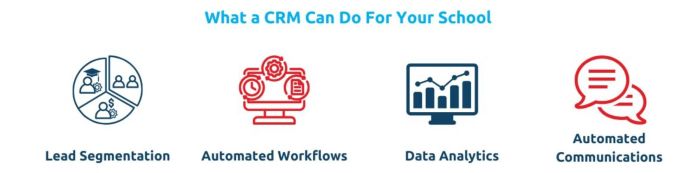
CRM systems often include features such as lead tracking, segmentation, automated workflows, communication tools, and analytics. By providing insights into the enrollment journey, CRMs help schools allocate resources more effectively and improve conversion rates. A robust CRM can also support long-term engagement by keeping alumni connected to the institution.
What is the best CRM for schools? Every school is different but generally, to choose the best CRM platform for your school, you should prioritize a system tailored to the education sector, like Mautic by HEM, which offers tools for lead management, personalized communication, and data-driven insights to streamline your admissions and marketing efforts.
Built on the Mautic open-source marketing automation platform, it offers a comprehensive solution for managing leads, automating communication, and gaining insights into recruitment performance. With features such as contact management, campaign workflows, and lead scoring, Mautic by HEM helps schools supercharge their marketing and admissions efforts.
Do you want to know how to use CRM and LMS to take your student experience to the next level? Contact us for a demo
What Is an LMS?
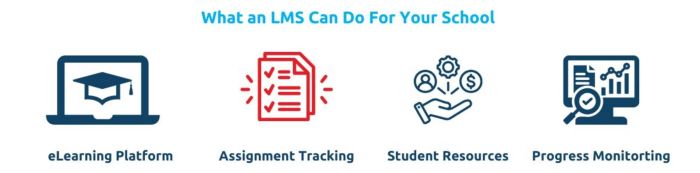
What is the purpose of LMS in education? A Learning Management System (LMS) is a platform designed to deliver, track, and manage educational content and student learning experiences. LMS platforms provide the infrastructure for online learning, offering tools for course creation, assignment tracking, progress monitoring, and student engagement. Schools use LMS platforms to enhance in-person and online education by providing a centralized hub for learning resources and communication.
In addition to managing educational delivery, an LMS can provide valuable data on student performance and engagement, allowing educators to tailor instruction and support to individual needs. HEM’s Student Portal System, which includes a Student Information System (SIS), is an example of how an LMS can be integrated into an institution’s broader ecosystem. It streamlines everything from course scheduling to attendance tracking, creating a seamless experience for educators and learners.
CRM vs LMS: Key Differences
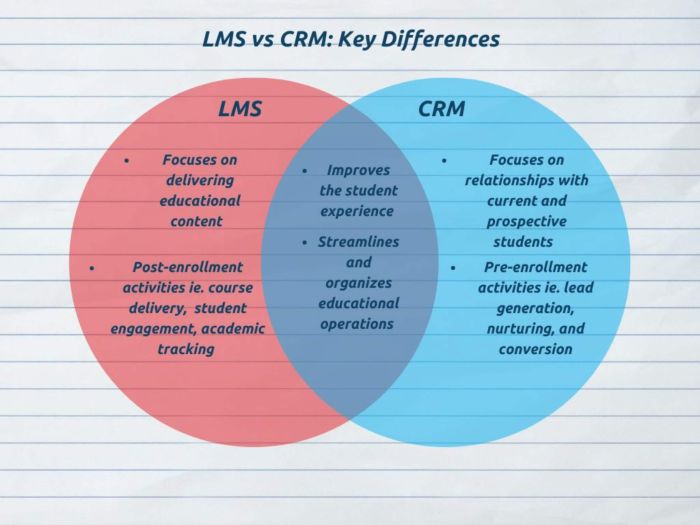
Although CRM and LMS systems serve different purposes, they often complement each other in educational marketing strategies. The primary distinction lies in their focus: CRM systems are designed to manage relationships with prospects and current students, while LMS platforms are dedicated to managing the delivery of educational content.
A CRM system focuses on pre-enrollment activities, such as lead generation, nurturing, and conversion. It ensures prospective students receive timely, relevant information encouraging them to apply and enroll. By contrast, an LMS supports post-enrollment activities, including course delivery, student engagement, and academic tracking.
Despite their distinct roles, both systems share a common goal: improving the student experience. By integrating CRM and LMS platforms, schools can create a cohesive journey from initial contact to graduation and beyond.
Source: HEM
Benefits of a CRM System in Educational Marketing
Implementing a CRM system in your school’s marketing strategy can yield several benefits. CRMs streamline lead management by organizing contacts, tracking interactions, and automating follow-ups. This allows your admissions team to focus on high-priority leads while ensuring no prospect falls through the cracks.
Mautic by HEM, for instance, empowers schools to create automated workflows for tasks such as email marketing, SMS campaigns, and event registrations. These tools help nurture leads effectively, moving them through the enrollment funnel. The platform’s robust reporting capabilities provide deep insights into the success of your marketing efforts, enabling data-driven decision-making.
CRMs also enhance personalization. By segmenting leads based on criteria such as program interest, location, or stage in the admissions process, schools can deliver tailored messages that resonate with each prospect. This level of customization increases engagement and improves conversion rates.
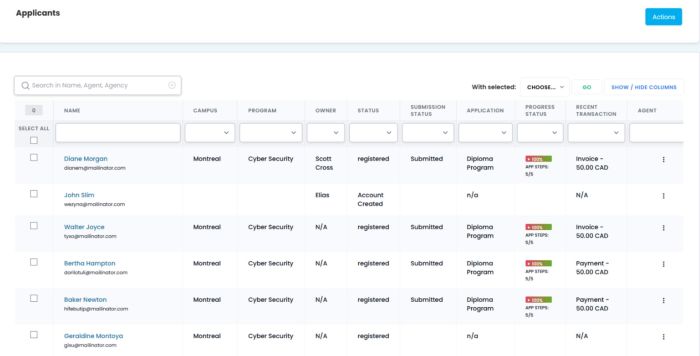
Example:One principal benefit of using a CRM for your school is access to detailed data that you can use to make your next move. The report below demonstrates how you can track registrations, what program the prospect has registered for, the prospects’ registration progress, and payment statuses. This is enough to craft and send a personalized follow-up message – a process that can be automated on CRMs like Mautic.
Source: Mautic | Higher Education Marketing
Benefits of an LMS for Educational Institutions
An LMS enhances the learning experience by providing a centralized platform for educational content and resources. Students can access course materials, submit assignments, and communicate with instructors from anywhere, fostering flexibility and accessibility.
LMS platforms also facilitate data collection, allowing educators to monitor student performance and identify areas for improvement. By tracking metrics such as course completion rates, assessment scores, and engagement levels, schools can make informed decisions to improve outcomes.
HEM’s Student Portal System exemplifies how an LMS can integrate seamlessly into an educational institution. With features such as course scheduling, attendance tracking, and performance reporting, it streamlines administrative tasks while enhancing the student experience. This dual functionality ensures that both educators and learners have the tools they need to succeed.
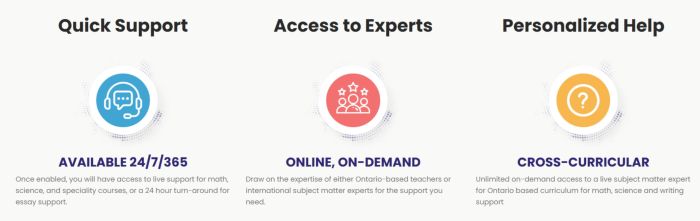
Example: Here, the learning benefits of Ontario eSecondary School are outlined plainly – they offer quick support, access to expert teachers, and personalized help. An LMS significantly improves the student experience by providing resources that enrich lessons and offer support from staff.
An LMS is particularly essential for online academies like Ontario eSecondary School in order to provide structure and necessary resources to students; however, with an increasingly tech savvy student population that tends to expect online options, an LMS can benefit any school.
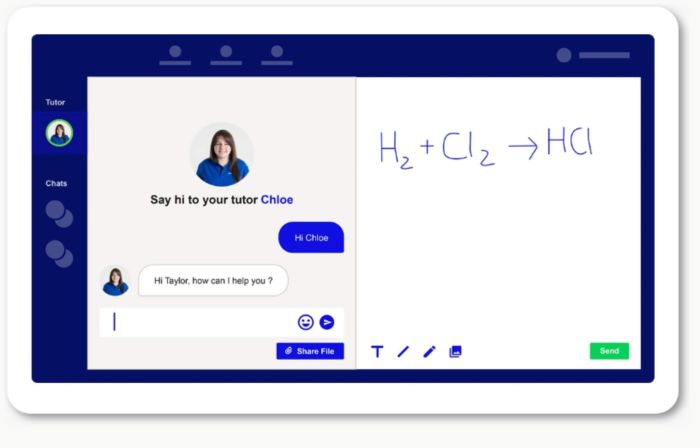
The second image demonstrates how courses can be delivered using LMS tools. Your aim should be to improve student experience by creating an interactive learning experience. This can be accomplished by integrating communications and multi-media tools with your LMS.
Source: Ontario eSecondary School
Implementing a CRM System: Actionable Advice
To implement a CRM system effectively, start by identifying your school’s specific needs and goals. Consider factors such as the size of your admissions team, the complexity of your enrollment process, and the channels you use to communicate with prospects.
Next, select a CRM system designed for the education sector. Mautic by HEM is an excellent choice, offering features such as automated workflows, lead scoring, and detailed reporting tailored to the unique challenges of student recruitment. Requesting a demo is a great way to explore the platform’s capabilities and determine how it aligns with your goals.
Once you’ve chosen a CRM, focus on integration and training. Ensure the system integrates with your existing tools, such as your website and email marketing platforms. Provide thorough training for your team to ensure they can use the CRM effectively. Finally, monitor performance and gather feedback to refine your processes over time.
Implementing an LMS: Actionable Advice
When implementing an LMS, start by defining your educational goals. Consider the types of courses you offer, the level of interactivity you want to provide, and the needs of your students and instructors.
Select an LMS that aligns with these goals. HEM’s Student Portal System, for example, offers a comprehensive solution for managing courses, tracking attendance, and monitoring student progress. By integrating these functions into a single platform, the system simplifies administration while enhancing the learning experience.
Ensure your LMS is user-friendly and accessible. Provide training for instructors and students to maximize adoption. Regularly review performance metrics to identify areas for improvement and ensure the platform continues to meet your institution’s needs.
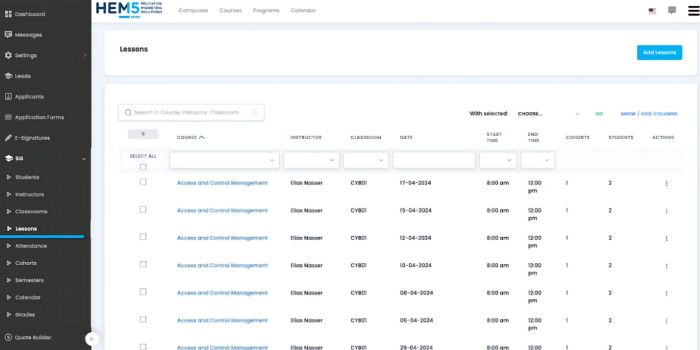
Example: Here, the SP Student Information System is being used for course planning. LMS systems like this help you centralize the information that students need to retain lessons and complete their assignments. Be detailed and clear when providing lesson information.
Source: Student Information System
Combining CRM and LMS for Maximum Impact
While CRM and LMS systems serve different purposes, integrating them can create a seamless experience for both prospective and current students. For example, data from your CRM can inform personalized communication with enrolled students through your LMS. Similarly, insights from your LMS can help you refine your marketing efforts by highlighting the types of content and courses that resonate most with learners.
HEM’s suite of solutions, including Mautic by HEM and the Student Portal System, offers an integrated approach to educational marketing and administration. By combining the strengths of CRM and LMS platforms, schools can create a unified strategy that supports students at every stage of their journey.
It’s Time to Get Started!
LMS vs CRM? Instead of choosing one over the other, try focussing on how each system contributes to your educational marketing strategy. A CRM system like Mautic by HEM helps schools attract and convert prospective students, while an LMS like HEM’s Student Portal System ensures those students have an exceptional learning experience. By leveraging both tools, schools can optimize their processes, enhance engagement, and achieve their goals more effectively.
If you’re ready to take your school’s marketing and administrative efforts to the next level, consider exploring HEM’s Mautic and Student Portal solutions. With the right tools and strategies in place, your institution can thrive in today’s competitive educational landscape.
Simplify student management and boost recruitment efficiency!
Transform your student portal experience. Get a FREE HEM-SP demo today.
Frequently Asked Questions
Question: What is the best CRM for schools?
Answer: Every school is different but generally, to choose the best CRM platform for your school, you should prioritize a system tailored to the education sector, like Mautic by HEM, which offers tools for lead management, personalized communication, and data-driven insights to streamline your admissions and marketing efforts.
Question: What is the purpose of LMS in education?
Answer: A Learning Management System (LMS) is a platform designed to deliver, track, and manage educational content and student learning experiences.
As we are marking three years since the start of the full-scale invasion of Ukraine and 11 years since the start of the Revolution of Dignity, it is impossible not to notice the scars and the suffering but also Ukraine’s resolve to continue rebuilding, innovating and even thriving among adversity.
Support from the UK remains unwavering. President Volodymyr Zelenskyy and Prime Minster Keir Starmer have signed a 100-year partnership agreement between Ukraine and the United Kingdom with historic significance to strengthen the ties between the two nations. It includes two “pillars” with items of particular significance to the education community: Pillar 8, focused on partnerships in science, technology, and innovation; and Pillar 9, focused on harnessing socio-cultural ties. These two pillars outline the development of new and the strengthening of existing links between higher education institutions and academic communities. It is this kind of constructive collaboration that creates hope against a background of the recent volte-face of the US towards Ukraine.
Twinning and British Council
Building on the success of the HE Twinning scheme, launched at the start of the full scale invasion, led by Cormack Consultancy with support from Universities UK International (UUKi), the 100 year agreement seeks to twin 100 schools in Ukraine and the United Kingdom to establish partnerships between learners and educators in secondary and primary education.
The British Council, a key funder and supporter of many educational initiatives, will continue to organise English language courses for Ukrainian civil servants and contribute to the professional development of English language teachers. In a more directed effort, the British Council has funded expertise exchange visits for senior leaders from Ukrainian universities to UK universities, and repeat-funded collaborations coming forth from such visits.
In our own case at Warwick, the visits from senior colleagues from V.N.Karazin Kharkiv National University have led to a flourishing research and expertise exchange on developing new forms of teacher training, educational leadership development, and trauma informed teaching and leadership practices. An international conference later this year will allow others in the HE sector to benefit from the insights the collaboration has brought forward.
Building leadership capacity for educational reforms
The UK has also made a commitment to “support education recovery and reform ambitions through policy exchanges, technical assistance, leadership training, education partnerships, and sharing best practice including on funding systems.” Warwick’s Leadership for Educational Transformation (LET) programme, founded in partnership with the Ukrainian Leadership Academy, has showed the significance and impact of such programmes on individual educational leaders as well as on building the cadre of educational leadership in Ukraine.
There is a commitment to “seek opportunities to collaborate in science, technology and innovation” including interest in developing AI and its related governance and regulation, building on Ukraine’s advancement in e-governance, transferring the experience into the gov.uk wallet (with, for example, an initial move to a digital driving licence).
Higher education in Ukraine is growing its stake in the rebuilding of the country and in innovation. There are many lessons that can be learnt from the UK experience, and indeed, thanks to the UK International Development and the Good Governance Fund, Kyiv Aviation Institute (KAI) will become one of the first universities in Ukraine to establish a science park, paving the way for the universities to become hubs for innovation where science, industry and education will join forces to develop Ukraine’s innovation potential. Having officially presented the concept of KAI Science Park at the end of January as part of the Win-Win 2030 strategy KAI will focus its research in deep tech, remotely piloted/unmanned aerial vehicles), cybersecurity, defence tech, AI, machine learning, materials, robotics and engineering.
There is also much to exchange in the entrepreneurship education space. Whilst the UK has some incredible success stories around knowledge transfer, student and regional entrepreneurship development, the European Startup National Alliance (ESNA), in 2024 ranked Ukraine fourth among 24 European countries (after Lithuanian, Spain and France) exceeding the average by 12 per cent for supporting start ups, enabled by its sophisticated digital ecosystem.
Other partnerships between the academic communities mentioned in the two pillars include space, increasing diversity in science, and particularly focusing on women in STEM, women’s rights more broadly, student mobility, sports and culture, youth programmes.
Of critical value is also medicine and healthcare innovation. As Ukraine faces unprecedented medical challenges due to the war, there is a pressing need to build expertise in hospital management, medical training, and rehabilitation – fields that remain underdeveloped. Collaboration between universities, research institutions, and healthcare professionals can lay the foundation for new academic programmes, joint research initiatives, and knowledge exchange in areas such as med tech, mental health, and especially trauma treatment.
A journey of 100 years
From our own experience working on the LET programme, we have seen the sense of purpose colleagues experience from collaborations between Ukrainian and UK institutions. Moreover, following Brexit and the current recasting of geopolitical alliances, the UK’s commitment to contributing positively to Europe may look different than before, but this is a prime opportunity to renew our commitment to prosperity and peace on the continent. With the financial squeeze on many UK institutions, we must also remain pragmatic as securing projects, funding and commitments is becoming harder. Seeking opportunities for win-win collaborations will be the way forward.
For instance:
Exchanging guest lecturing opportunities to offer different perspectives in the classroom and support each other with developing international ties, presence and impact.
Mentoring on all aspects of academic careers, building on the success of Science for Ukraine.
Exchanging data access opportunities to build mutually beneficial research dissemination partnerships.
Education has always been and will remain a catalyst for peace, and unity during tough times can help to nurture hope. Educational partnerships are making a tangible difference. And whilst there are many challenges ahead of our two education communities, the shared commitment to building resilience outlined in the 100-year partnership makes one thing clear: we must continue standing with Ukraine, as there is much to be done and to be gained from working together.
I’ve been fascinated for a while by the connection between political leanings and education: The correlation is so strong that I once suggested that perhaps Republicans were so anti-education because, in general, places with a higher percentage of bachelor’s degree recipients were more likely to vote for Democrats.
The 2024 presidential election puzzled a lot of us in higher education, and perhaps these charts will show you why: We work and probably hang around mostly people with college degrees (or higher). Our perception is limited.
With the 2024 election data just out, I thought I’d take a look at the last three elections and see if the pattern I noticed in 2016 and 2020 held. Spoiler: It did, mostly.
Before you dive into this, a couple of tips: Alaska’s data is always reported in a funky way, so just ignore it here. It’s a small state (in population, that is) and it’s very red. It doesn’t change the overall trends even if I could figure out how to connect the data to maps. Hawaii’s data is fine, but I don’t put it on the map because it takes a lot of work to get it to fit so that you can read the other states. It’s a blue state, but also small. So they balance out.
Some definitions: Bachelor’s degree attainment is the percentage of people in the county who have a Bachelor’s Degree or higher using 2020 data. If a county has 100,000 people and 27,500 have a BA, that’s an attainment rate of 27.5. Nationally, the rate is about 38%.
Median income is the Census Bureau statistic showing median earnings in the past twelve months for people who have earnings.
The statistic “Percent Democrat” is the percentage of voters who voted for Democrats, among those who voted Democrat or Republican. In other words, it excludes third-party voters. The Democrats and Republicans are the only parties with a candidate on every state’s ballot, so it’s the only fair comparison, I think. If you want to count people who throw away their vote, be my guest.
Simpson’s Diversity Index is a way to talk about diversity that’s a little different than you might think. It is not the percentage of people of color. Simpson’s Diversity essentially calculates the probability of selecting at random two different categories from a population. So, if 95% percent of a county is White, it’s not very diverse. Same as one that’s 80% Black or African-American, or 65% Hispanic. Higher numbers on Simpson’s means more diversity of the group. A group with one Hispanic person, one White person, one Black person, and one Asian person would be perfectly diverse, as you’d always pick two people from different groups in a random sample.
Final tips: It’s important to interact here by using the sliders and/or filters, and/or highlighters. You can’t break anything; you can always reset the view using the little arrow at lower right.
There are seven views here, accessible via the tabs across the top.
National View shows all the data from all the counties rolled up to a year. You can see Democrat and Republican votes on the bars. Use the sliders to only include counties with certain levels of income, diversity or educational attainment, nationally or in a single state. You’ll probably quickly see the great American divide.
Ed Attainment Splits is the same data, but divided. Each group of bars shows increasing attainment, from left to right. So at the far left is the aggregation of all counties with lower attainment, and as you move to the right within a year, you see higher levels of bachelor’s degree attainment. The three tallest blue bars tell the story of 2024 in a way no political scientist can.
The next three views show scatter plots, with Percent Voting Democrat on the y-axis (vertical). The three different views just swap out three different values: Bachelor’s degree attainment, Median Income, and Simpson’s Diversity. These three things largely covary, so the similar patterns should not surprise. The bubbles are sized by the number of voters, and you can hover over any bubble for details. Use the Highlight Tool at top to focus only on Blue, Purple, or Red counties.
The cleverly named view titled “Map” shows every county colored by its political lean. You can choose a year at top left, and only show certain counties using the various filters at top. Again, you can’t break anything by interacting, and a reset is a click away.
And finally, because there is one in every group who points to the preponderance of red on the map and thinks it’s meaningful, the final view shows Land Doesn’t Vote. Los Angeles County (in yellow) has more people by itself than all the blue states plus Hawaii combined. And it has more people than all the orange states combined, too.
Engaging students in learning outside the classroom can often be a challenge, but podcasts might be a simple yet versatile tool we’re overlooking.
As the number of commuting students rises across institutions, we recognise that students are time poor. There is, however, the potential of using travel time as an opportunity for students to work but also relax and many students use their commute time as an opportunity to prepare for teaching. Podcasting is one of the ways we can design our pedagogy to fit the busy lives of commuter students.
Think about how you listen to podcasts, most likely while you’re doing other things like driving, cooking or walking. There’s a versatility to it.
How many of the learning resources we offer allow students to learn on-the-go?
Education on-the-go
Most podcast listeners will tell you the convenience of audio-centric and on-the-go content is key to their success. BBC data suggests that about three in four podcast listeners do so while doing something else, so even podcasts that have a video option available need to be planned and created with an audio-only format in mind.
Offering that versatility also comes at a cost. It’s important to recognise the fact that students might be on a busy bus, or looking for the timetable for their next train connection. We probably won’t have a student’s full attention, and that means that we need to carefully consider the kind of educational content that’s going to work in this format.
Successful podcasts tend to be focused on experiential storytelling. They are usually fluid and conversational, so don’t be afraid to lean into that. Storytelling gives us emotional responses, helping students connect abstract ideas to real-world implications. A podcast will be much more successful if you give depth and meaning to something a student has already learned, rather than delivering the learning itself.
Let’s take data analysis as an example. Instead of focusing on the technical process of analysing data, you could discuss stories of the impact of data bias or ethical dilemmas in data usage. Give your students food for thought rather than core learning, use it to turn the numbers into narrative and give a deeper meaning to your classroom content.
It can also be a good idea to supplement your podcast with a short interactive activity, either online or at the start of your next learning session. Ask students to reflect on the podcast and their key takeaways from it. It can be a great starting point to encourage deeper learning.
A how to guide
Another core aspect of successful podcasts is authenticity. You don’t want your podcast to sound like a job interview. Natural conversations foster a sense of authenticity, which is key to keeping listeners engaged. A key part of this comes from the way you prepare for a podcast. Discussion points as opposed to questions allows both you and your guest to think more holistically about the topic and can make a huge difference when it comes to making the conversation flow authentically.
We’ve found it’s best to give more flexibility and aim for shorter episodes. Splitting a conversation up into bitesize chunks gives students the option to listen to all episodes in one go, or a bit at a time. Starting with a few episodes, around 12-20 minutes each, will offer your students a lot more flexibility than a single 1-hour long podcast.
Thankfully the technical and logistical aspects of recording podcasts have developed rapidly over the last few years and it’s very easy to get started. Advancements like text-to-speech editing and speech enhancement let you record fully online and get incredible results without any technical knowledge or high-end equipment. A lot of podcasting software now produces automatic text transcription supporting accessibility and allowing students to engage with the content in multiple formats.
And by framing these resources as useful for students to “listen to on-the-go,” gives students permission to use and access resources in ways which work for them during their busy lives. It recognises commuter students and acknowledges busy student lives and gives them a new innovative way to engage with their studies.
Getting started
If you’re interested in giving it a go, here are some ideas to get you started.
A conversation about a specific assessment: contact a student who did well on an assessment last year and ask if they would be happy to share their experiences. Students can get ideas and inspiration from how they have approached it, what worked well and what they would do differently.
Interviews with industry experts is another way to frame a podcast. Working professionals don’t always have the time to travel to campus and prepare a lecture for your students. That might be different if they just had to join an online call for a natural conversation. Recording it as a podcast also gives you a reusable resource for future cohorts.
Student Q&As where students can submit their own questions about a topic or assessment and discuss them in a podcast. This could be an idea to explore on your own, with another lecturer, or with professionals in the industry.
It’s clear that using podcasts as a form of education comes with a lot of challenges, but it also offers a vast world of opportunities and flexibility for students. Where students face further challenges to engage and attend classes, it is worth considering how educational podcasts may be a mechanism so that resources work around busy and complex student lives. For commuting students, a great deal of time is spent on public transport and in maximising their time, providing resources that are engaging, useful and timely is a step in the right direction. And in designing resources specifically with commuter students in mind it recognises their experiences and allows them to engage authentically.
And to make podcasts work for commuter students in an educational context we need to be realistic about the challenges students face and create content that works in a podcast format rather than shoehorning existing content into a new format. If we nail that, then podcasts could become a very useful tool for delivering educational content that fits around students and heightens engagement.
The inauguration ceremony for Donald Trump was interesting to watch for several reasons, but the Battle Hymn of the Republic caught my ear. Whilst the song has cultural connections for Americans, its explicit religiosity and commitment to truth seems at odds with modern sensibilities. Rather than truth, recent political history, eg Johnson, Trump, Brexit and Covid-19 (anti)vaccination, has shone a light on our post-truth society, where, as Illing (2018) notes, there is a disappearance of ‘shared standards of truth’. In such a society politics shifts from being the discussion of ideas or even ‘what works’ to a play for the emotions of the majority. A context within which Michael Gove, an early adopter, was able to label a raft of educational luminaries ‘the blob’ (see Garner, 2014).
Whilst this is/might be irritating and socially disabling, I want to argue that it is also both deleterious to educational research and that its roots lie some 250 years ago.
Pring (2015) argued that what makes educational research distinctly educational is its intention to improve educational practice. So, research about education is not sufficient to qualify as educational research; educational research intends to change educational practice for the good of learners (and often wider society). This requires several activities including shared dialogues between researchers, practitioners and other stakeholders with common ways of talking about education and common standards of truth (see Davies, 2016). An environment of post-truth undermines such possibilities, as I hope will become clearer as I explore the roots of the present malaise.
The roots lie around 1744 or just before, signalled by Vico’s New Science, or at least in the 18th century, where MacIntyre (1987) places the last foothold of the ‘educated public’ – and it is in MacIntyre that I ground the argument here. MacIntyre (1985) presents a historically informed account of the decline of ethical discourse and, on a more positive note, what is required for its restoration. Here I fillet that account for the resources I need for my purposes (see Davies, 2003, Davies, 2013 for more detailed reviews). He argues that ethical discourse has undergone a series of transformations, led by philosophers but now part of the public zeitgeist, causing a situation in which people believed there was no reasonable basis on which to resolve ethical disagreements.
Here, I identify just three key elements of the argument. Firstly, naïve relativism, the (false) view that because people disagree on a matter then, necessarily, there must be no rational means to resolve the disagreement. Secondly, MacIntyre identifies three, non-rational approaches to decision making: (i) personal taste, (ii) achieving the goals of the system of which one is a part, or (iii) through interpersonal agreement. These are embedded, MacIntyre claims, in our social activities and institutions. Thirdly, that these give rise to a distinctive form of political engagement, protest. In protest different sides shout their differing views at each other knowing both that their views will not change the views of their opponents nor that their opponents’ views will change their views.
When we see ‘toddler’ behaviour from politicians, it is a focus on personal taste and the tantrums that emerge when these are frustrated. What reasons, they might say, do others have to frustrate what I want, for no such reasons can exist. When we see claims that the democratic process must be followed, we are seeing a commitment to achieving the goals of the system; what else can be done? We regularly see examples of protest, often mistakenly seen as ‘facing down’ a critique of one’s behaviour. The views of others only count if they have some reasons for their views that might be better than mine. But for those embracing the obviousness of naïve relativism this cannot happen, rather protests (against Johnson, Trump, and others) are just attempts to make them feel bad. Such attempts must be resisted through and because of bravado.
How do the politician and policymaker operate in such an environment? Bauman (2000) offers a couple of practical conceptions consistent with MacIntyre’s critique. Firstly, Bauman draws attention to the effect of having no rational basis for decision making: it is increasingly difficult to aggregate individual desires into political coherent movements. Traditional political groupings on class, gender and race are dissolving (which is certainly a feature of the 2024 US election analysis). It matters less why you want to achieve something; it is just that we can have interpersonal agreement on what we claim we want to achieve. Secondly, Bauman talks of decision making as reflecting the ‘script of shopping’, we buy into things – friendship groups, lifestyles, etc – and as suddenly no longer do so when they do not satisfy our personal desires. Whilst this may seem overly pessimistic, Bauman and MacIntyre are identifying the unavoidable direction of human societies towards this already emergent conclusion.
Politicians and policymakers play, therefore, in this world of seeking sufficient co-operation to build a political base – to get elected and to get policies through. They do this by getting individuals to buy into the value of specific outcomes (or more often to stop other awful outcomes). They are not interested why individuals buy in, nor do they try to develop a broader consensus. There are no rational foundations, and any persuasive tactic will do, with different tactics deployed to influence different people. This scattergun approach is more likely to hit the personal desires of the maximum number of people.
Where does this leave the educational researcher seeking to influence educational policy and practice based on their research endeavours? At best, we might become the chosen instrument of a policymaker to persuade others – but only if our research agrees with their pre-existing desires. Truth is not the desired feature, just the ability to be persuasive.
But what if truth does matter, and we want to take seriously our moral responsibilities to support educational endeavours that are in the interests of students? There are four things we can do.
Understand the situation. It is not just that the political environment is hostile to research, it does not see facts as a feature of policy and practice development.
Decide if we want to be educational researchers or policymakers. The former means potentially less engagement, impact, and status, perhaps walking away from policymaking as more ethically defensible than staying to persuade using simulacra of evidence.
Get our own house in order. We have too many conferences which provide too little time to discuss fundamental differences between researchers, with so many papers that we are only speaking to people with whom we more or less agree. The debates are over minutiae rather than significant differences. Dissenting voices tend to go elsewhere and move on to different foci rather than try and get a foot in the door. Bluntly, our academic system is already shaped by the same post-truth structures that have given rise to Trump, Johnson, et al (and no doubt most of us could identify our equivalents of them). Although we will never speak with one voice and will, I hope, always embrace fallibility, getting the house in order will enable us to model what rational dialogue and truth seeking can achieve in identifying how educational policy and practice can be enhanced. Of course, we should value each other’s contributions, but not confuse value with valid (it is just another form of naïve relativism).
Find some allies who accept a similar account of the decline of reason from amongst politicians and policymakers and work out how we start to make educational research not only relevant but influential.
Richard Davies leads the MA Education Framework programmes at the University of Hertfordshire. His research interests include philosophical issues in higher education. He is a co-convenor of the Academic Practice Network at SRHE.
Ready for a conversation about educational technology, artificial intelligence, and personal academic websites? The 2024 season of The Social Academic is here.
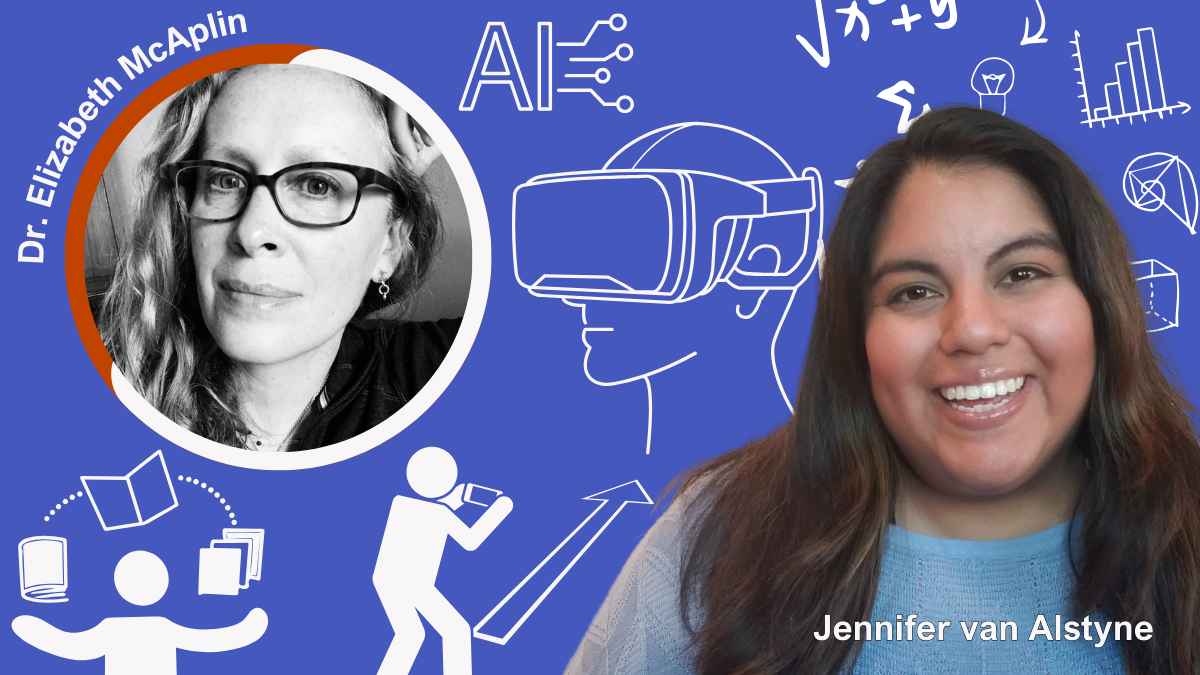
Meet my featured interview guest, Director of Educational Research Technology at New York University, Dr. Elizabeth McAplin. Read, watch, or listen to this episode of The Social Academic.
Jennifer: Hi everyone, my name is Jennifer van Alstyne. Welcome to the new season of The Social Academic. This blog, podcast, and YouTube channel is about managing your online presence in academia. Today we’re gonna be talking about teaching and educational resources.
I’m delighted to introduce my guest to you, Dr. Elizabeth McAplin, who is Director of Educational Research Technology at New York University. Elizabeth, thanks so much for joining me today. Would you please introduce yourself and tell us a little bit about your role at NYU?
Elizabeth: Sure. I’m Director of Educational Technology Research at NYU. I’ve been in this role a little over 7 years now, and at NYU for almost 10 years. I did my PhD at NYU and a MA in Educational Technology at NYU so I have a very long history with NYU.
When I was a student there and worked, I had multiple hats: student, alumni, faculty, and administrator.
Jennifer: Wow.
Elizabeth: Yup, all of them. I was the face of NYU. My role there specifically is to collaborate with faculty who are looking to make pedagogical changes to their courses usually involving some sort of media or technology.
We had a very large provostial push years ago to encourage faculty to start using technology, trying it out. And seeing how well that could enhance their courses and make things better and easier for themselves as well as their students.
I’ll work with them in part sometimes to develop a technology. Sometimes it might be a virtual reality project that they might want to use in their course or program. As well as conduct scholarly research to see how well that is impacting student learning in their classroom or program. We aim to publish those findings as well.
I’m a central resource. I work with all schools and departments at NYU.
Creating her university-hosted personal academic website
Jennifer: That is amazing. Because you’ve been at NYU for so long, you were a student there, you’ve worked there, and now you’re a director there. I’m curious. You have an internal personal academic website [hosted by NYU]. Is that something you created when you were a student? Or, in your newer role?
Elizabeth: No, I created it during a time when I was both a student and in my current role. I was finishing my PhD while I was still a Director.
I created it not for the purpose of my own portfolio site. I do have a presence at NYU that shows my service within the structure of Research, Instruction, and Technology which is my department, within the larger umbrella of NYU IT. [That presence] does get a little bit lost sometimes in that filter. But it is there. It doesn’t describe me personally, it describes my service to faculty and to the university. It’s not focused on me per se.
The portfolio site is to showcase some of the work I’ve done in the past, mainly at NYU. It does also list my CV, prior work experience as well as teaching experience and the like. In the event life changes, I like to have something available and ready to show.
Jennifer: I love that. When I was exploring your site it was fun for me to see the different types of videos you were posting about educational technology projects you were working on and collaborating with faculty. I like that even though this is a portfolio site, it sounds like maybe a ‘just in case’ site? That it was helping me prepare for this interview and get to know a little bit more about you. At what point did you create that website?
Elizabeth: That was many years ago. It’s hosted through NYU. NYU provides faculty a WordPress service just for that. Sometimes they use it to create a portfolio for grants they’ve received or want to receive. They can provide that to their grant funders. It’s another way to showcase the work that gets done.
It’s an internally managed WordPress hosting site. It’s not something I pay for externally. All faculty have that available to them [at NYU].
Jennifer: Did NYU encourage you to create a website? Or was it something you learned about and then decided to make yourself?
Elizabeth: I think when I knew the service was available, and I was teaching there as well, I decided it was a good idea and why not? I mean, if it’s free and I don’t have to pay for it, there’s no non-incentive not to do it, haha.
Videos for your personal academic website portfolio
Jennifer: Your portfolio had a nice list of videos where you’ve collaborated with faculty to create resources and technologies for their classrooms. Can you tell me about one of the videos that you were excited to share on your website?
Elizabeth: Before I was a Director of Research, I was a Director that oversaw a very large team of instructional designers and media producers. Our role was to create a lot of this content for faculty to be used in their courses. I learned a great deal about each faculty member I worked with and their particular expertise. It’s kind of a wonderful way to learn more, because I love learning. And to create and produce those videos.
Most of those [videos] were created with a team of people. They would be scripted, prepared, and imagery selected for them ahead of time. They were very well planned out videos that were used in their courses.
They’re just fascinating and visually engaging pieces of work. We did a lot of things! A lot of interactive pieces: videos, games, simulations, etc.
Jennifer: That is so cool! And I love that there’s support at NYU for faculty who are looking to introduce those newer technologies into their pedagogy, into their teaching.
Artificial intelligence in the university classroom
Jennifer: I’m curious. What technologies are faculty curious about exploring? I’m coming from literature as a field. There’s newer augmented reality [AR] or virtual reality [VR] technology that can be introduced into that. Most faculty just aren’t aware of it. So I’m curious, what are faculty at NYU curious about learning now?
Elizabeth: Artificial intelligence. It’s a really big topic right now because it has so many unknowns.
I think there’s still a lot of faculty that are hesitant to use a lot of technology. I think since COVID when faculty had to go online during that time period, that was a big change for them. It did kind of give them that opportunity to learn more about technologies they could use moving forward.
There’s giving a Zoom presentation, learning how to present, use technologies within Zoom for their classes, making hybrid courses or fully online versions of them. Learning how to create better videos for their courses.
Not relying so much on lecture as being used for the time in the classroom anymore. Pulling the lecture out, making that as a video or something, and using the classroom for more discussion or interactive uses of the time with their students.
Jennifer: That is so cool.
Elizabeth: It’s such a precious amount of time.
And then, there’s a handful of faculty very interested in virtual reality and augmented reality. Those are mainly in the sciences and medical fields.
And now, artificial intelligence is the biggest buzz at the university. How are faculty going to manage using artificial intelligence, ChatGPT, in a productive and constructive way as opposed to ways that students want to write their papers with.
Jennifer: It’s kind of like a shift in how we think about artificial intelligence in the classroom from fear-based to how can it be a part of it in a meaningful way?
What are your thoughts on it? How are you feeling about artificial intelligence and pedagogy?
Elizabeth: I think there can be a lot of great uses of it, as long as it’s well planned out. There are efficiencies to things like using ChatGPT that we didn’t have before. That can be wonderful.
Even doing literature reviews and such through ChatGPT can help speed up that process. We didn’t have to go to a library before to do a lot of research on articles because now they’re all digitized. We can do that through an online library system.
It just gets a little bit closer to making things more efficient. Maybe we’ll have more doctoral students coming out of it. I’m not sure.
There’s always going to be pros and cons for whatever technology comes before us. We have to acknowledge it. We have to understand what are the risks? What are the affordances? And work with that. That’s always going to be the case.
Just like with a calculator, one of those tools that came out and people said, “You won’t have to learn math anymore because you can just use a calculator.” Regardless of all that, yes, we will still turn to our calculators to make sure we’re right in our math.
It’s not a new problem, and it’s not a new risk. I think some of it comes down to making sure when we’re using these tools, we’re not also putting our students at risk like with identifiable information or grades, things like that. It’s a constant conversation to have with faculty on best uses and practices of these technologies and tools. And to keep monitoring those risks and the things that are gonna come up. They’re going to come up. They always will.
When students get very stressed out and are under pressure, they’re more apt to want to cheat. Or have something, or someone, help them get the work done. So reviewing how much work we’re imposing on our students, or understanding that their social lives are taking a precedence they need to dial back to focus on their academic careers. It’s always a balance: is it the student’s problem? Or, is it our problem? And how do we find a happy medium in between?
Jennifer: I really like that. It’s a beautiful point. When I was a student my parents had just passed away. I was working so hard. There were times I struggled to keep up. My teachers’ empathy for understanding what I was going through, even just a little bit made it feel like a safe place in the classroom, and made me excited to learn (even if I was a little bit behind in some areas). So I loved what you just said.
Which of the technologies you just share with me are you most excited about? You talked about AR, VR, artificial intelligence, games. Which of those kinds of forms of teaching excites you?
Elizabeth: I’ve been working so much in virtual reality recently in the past few years, so I guess that’s the most exciting.
I’ve been working with 1 faculty member for almost 10 years. We just keep evolving resources for her course, which is really large, almost 400 students in her course. The virtual reality project we had for her, we keep trying to find ways to improve the experience overall. We’ve just gotten into working with faculty in the School of Engineering on how to create custom haptics for that virtual reality simulation.
Jennifer: Would you explain haptics for us?
Elizabeth: A virtual reality out of the box headset comes with the headset and 2 hand controllers. When you’re trying to learn a procedure that involves medical instruments like a syringe or a scalpel if you’re doing surgery, you want to know and feel what that device is like as you are performing the procedure. It’s not just cognitive. It’s tactile. It’s procedural. It has multiple learning and practice components to it.
An out of the box hand controller is not particularly authentic to actually holding a syringe and actually practicing learning that procedure. Working with engineers, they developed a 3D printed syringe and connected that to a haptic device that now students can pick up and actually feel something that’s more authentic to that experience as they are in a virtual reality simulation in going through those procedural steps.
It’s never going to replace working on an actual patient. We’re trying to prepare them to get as close as possible to a real patient experience before they work with a patient because there are so many risks involved in working with a real patient. So that’s the impetus behind that. It’s an ongoing process. We keep learning and we keep trying to make things better. That’s for us, part of the learning process as well. And that’s what’s exciting.
Jennifer: That sounds so exciting. And I love it’s been an ongoing project and exploration over 10 years to improve the teaching and tools in that course.
Jennifer on sharing the resources you create online
Jennifer: One of the things I wanted to chat about for faculty who might be listening to this, is that when you do create educational resources or tools like this, it would be great to share on your personal academic website and on social media.
These tools don’t just help your students and other faculty at your university. They might help or inspire faculty across the world. I want you to know when you do take time to share those educational resources that you’ve made in a new way, in a way that’s accessible for people not directly in your classroom or talking with you at a conference 1-on-1. You can actually help more people with the hard work you’ve already done just by sharing it.
There’s so many things you can share on your personal website related to teaching. I thought I’d list a few for those listening: your syllabi, course descriptions, any videos, or tools like PDF resources or guides. That can go on your personal academic website. If you find that it’s helpful for you or your students, I’ve had professor clients who actually create lists of internal resources and external resources at their university that they regularly share with not just one class, but multiple. Putting that on their personal website creates a kind of home for it where your students can go to find those resources when it makes sense for them.
I want you to know that your website can be a portfolio. And that portfolio can be for the job market, it can be for grants like Dr. McAplin said. It can also be for your students. There’s so many ways to share the amazing teaching and educating you do online. I want you to not hide from that if you have resources to share.
Jennifer: Dr. McAplin, why did you actually choose to share the videos on your website? I think that’s the step a lot of people are missing. They create things, but they don’t always decide to share them. What prompted you to actually share the videos and the resources you helped create?
Elizabeth: We’re proud of the work that was done. We want to show what’s possible. We’re not creating things for National Geographic or some NOVA high-production value thing. It doesn’t have to be that. But we took as much time and care as we possibly could with very little budget at all to make these resources. So it’s just to show examples of what’s possible and change a little bit the narrative. We get comfortable lecturing, but when we don’t have a visual idea for our students for what we’re talking about as we’re talking about it…we don’t want to cause a cognitive dissonance with that information either. Thinking carefully about the words with the imagery or short clips of documentaries or films that go along with what we’re saying to describe as examples of what we’re talking about. As long as they’re relevant and not overdoing it, I think it’s a good way to connect what we say with our eyes. We process these two things simultaneously, so we have that cognitive ability to do so, and we should take advantage of that ability.
What we try to encourage with faculty and to try and make it a more enriching experience for our students.
Jennifer: That is beautiful. I’m so glad we got to talk about this today. Elizabeth, is there anything else you’d like to add about your website, or about the amazing work you do at NYU?
Elizabeth: I list [on my website] that I do workshops at the university. I get asked to do talks within the university. Those are important things to share, like this conversation. We have something at NYU called Teach Talks through the Provost department and there’s some other departments that do similar things, that connect with faculty to talk about things like their assessment practices, pedagogical practices. We haven’t really had one that talks about their research. That might be a missing link we could try to fill, which is more what my area is, on the research end.
These are great resources for faculty to connect with other faculty, to learn about more ways to do things, to inspire them to do things differently, and to take a leadership role forward in that department. That’s more or less what I provide on my website.
Jennifer: That’s amazing. I’m so glad you have your website. And, that I was able to explore it so we could have this conversation today.
It makes such a difference when people are open to sharing a little bit more about themselves. So I’m happy you were open to coming on The Social Academic to talk with me. Anything else you’d like to add?
Elizabeth: If anyone has any questions, I’m available to answer them.
Jennifer: Wonderful. Well thank you so much for listening to this new episode of The Social Academic. Be sure to share it with a friend if you think they’d find it helpful. And, be sure to subscribe so you don’t miss the next episode.
I’m Jennifer van Alstyne. I’ve been in conversation with Dr. Elizabeth McAplin. I’m so excited to share this episode with you.
Elizabeth: Thank you Jennifer for asking me to participate.
Dr. Elizabeth McAlpin is the Director of Educational Technology Research at NYU Information Technology. Her team assists faculty in scholarly research on teaching and learning strategies when enhanced with technology to improve student learning. She holds an undergraduate degree from Denison University, an Ed.M. in instructional technology and media from Teachers College, and an M.A. and Ph.D in educational communication and technology from New York University. In addition to her full-time position, she also teaches as an adjunct at NYU. Her interests include educational technology research, effective educational design, innovative pedagogy and assessment, and educational technology and media for all kinds of learning experiences.
IHEC Blog a project by David Comp: Lee Satterfield, Assistant Secretary of State for Educational and Cultural Affairs, International Education Week 2023 Message
Lee Satterfield, Assistant Secretary of State for Educational and Cultural Affairs, International Education Week 2023 Message