Tag: Educations

  • US Department of Education’s Failure to Address Food Insecurity Among College Students (Government Accountability Office)

    US Department of Education’s Failure to Address Food Insecurity Among College Students (Government Accountability Office)

    Nearly 25% of college students in 2020 reported
    limited or uncertain access to food. Despite being potentially eligible,
    most didn’t receive Supplemental Nutritional Assistance Program (SNAP)
    benefits—formerly known as “food stamps”—which could help them pay for
    food.

    A recent law gave the Department of Education
    authority to share students’ Free Application for Federal Student Aid
    data with federal and state SNAP agencies to identify and help students
    who may be eligible for benefits.

    But Education hasn’t made a plan to start sharing this data—nor have states received guidance about this opportunity.

    We recommended ways to address these issues.

    What GAO Found

    The U.S. Department of Agriculture (USDA) and the Department of
    Education have taken some steps to connect college students with
    Supplemental Nutrition Assistance Program (SNAP) benefits to help them
    pay for food, but gaps in planning and execution remain. Effective July
    2024, a new law gave Education authority to share students’ Free
    Application for Federal Student Aid (FAFSA) data with USDA and state
    SNAP agencies to conduct student outreach and streamline benefit
    administration. However, according to officials, Education had not yet
    developed a plan to implement these complex data-sharing arrangements.
    This risks delays in students getting important information that could
    help them access benefits they are eligible for. Following the passage
    of this new law, Education began providing a notification about federal
    benefit programs for students who may be eligible for them. However, it
    has not evaluated its method for identifying potentially eligible
    students. According to GAO analysis of 2020 Education data, Education’s
    method could miss an estimated 40 percent of potentially SNAP-eligible
    students.

    USDA encouraged state SNAP agencies to enhance student outreach and
    enrollment assistance. However, USDA has not included important
    information about the use of SNAP data and other student data in its
    guidance to state SNAP agencies. These gaps in guidance have left states
    with questions about how to permissibly use and share students’ data to
    help connect them with benefits.

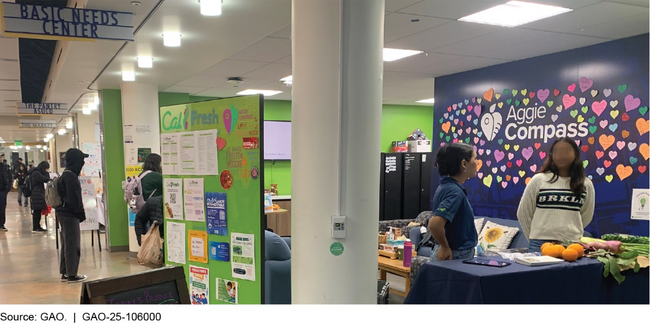
    Student Food Assistance at a College Basic Needs Center

    Officials from the three selected states and seven colleges GAO
    contacted described key strategies for communicating with students about
    their potential SNAP eligibility. These include using destigmatizing
    language, linking students directly to an application or support staff,
    and coordinating outreach efforts with SNAP agencies. Officials from the
    states and colleges GAO contacted said it is helpful to have staff
    available on campus to assist students with the SNAP application. Some
    colleges have found it helpful to partner with their respective SNAP
    agencies to obtain information on the status of students’ applications.

    Why GAO Did This Study

    According to a national survey, almost one-quarter of college
    students were food insecure in 2020, yet GAO found many who were
    potentially eligible for SNAP had not received benefits. The substantial
    federal investment in higher education is at risk of not serving its
    intended purpose if students drop out because of limited or uncertain
    access to food. Studies have found using data to direct outreach to
    those potentially eligible can increase benefit uptake.

    GAO was asked to review college student food insecurity. This report
    addresses (1) the extent to which Education and USDA have supported data
    use to help college students access SNAP benefits, and (2) how selected
    states and colleges have used student data to help connect students
    with SNAP benefits.

    GAO reviewed relevant federal laws and agency documents. GAO also
    interviewed officials from Education, USDA, and national higher
    education and SNAP associations. GAO selected three states and
    interviewed officials from state SNAP and higher education agencies and
    seven colleges in these states. GAO visited one selected state in person
    and interviewed two virtually. States were selected based on actions to
    support food insecure students and stakeholder recommendations.

    Recommendations

    GAO is making five recommendations, including that Education develop a
    plan to implement FAFSA data-sharing and assess its benefit
    notification approach; and that USDA improve its SNAP agency guidance.
    The agencies neither agreed nor disagreed with these recommendations.

    Recommendations for Executive Action

    Agency Affected Recommendation Status
    Department of Education The
    Secretary of Education should develop a written plan for implementing
    provisions in the FAFSA Simplification Act related to sharing FAFSA data
    with SNAP administrators, to aid in benefit outreach and enrollment
    assistance. (Recommendation 1)
    Department of Education The
    Secretary of Education should, in consultation with USDA, evaluate its
    approach to identifying and notifying FAFSA applicants who are
    potentially eligible for SNAP benefits and adjust its approach as
    needed. (Recommendation 2)
    Department of Education The
    Secretary of Education should inform colleges and state higher
    education agencies that FAFSA notifications are being sent to applicants
    who are potentially eligible for SNAP benefits. (Recommendation 3)
    Department of Agriculture The
    Administrator of USDA’s Food and Nutrition Service should, in
    consultation with Education, issue guidance to state SNAP agencies—such
    as in its SNAP outreach priority memo—to clarify permissible uses of
    student data, including FAFSA data, for SNAP outreach and enrollment
    assistance. (Recommendation 4)
    Department of Agriculture The
    Administrator of USDA’s Food and Nutrition Service should issue
    guidance to state SNAP agencies—such as in its SNAP outreach priority
    memo—to clarify the permissible uses and disclosure of SNAP data to
    support SNAP student outreach and enrollment assistance. (Recommendation
    5)

    Source link

  • How Being a Mother and Academic Helped Me Fix Higher Education’s Transfer Crisis

    How Being a Mother and Academic Helped Me Fix Higher Education’s Transfer Crisis

    Dr. Alicia M. AlveroWhen my daughter transferred to Queens College in Spring 2019, I could not have been more excited. As associate provost at the college, I’ll admit I was biased but even two decades of experience in higher education couldn’t fully prepare me for her struggle to transfer credits. 

    Queens College is one of The City University of New York’s 25 colleges. My daughter transferred from another school within the system yet despite mastering course material, she was told to take what was basically the same course all over again. 

    Fortunately, I understood the appeals process and was able to point her in the right direction. As a result, she obtained credit for the course, which counted toward her major. At the same time, reality struck: A student should not need to have an associate provost as a parent to transfer college credits. Frankly, they shouldn’t even need to appeal credits within the same system. 

    Nationally, the transfer system has been set up to let students fail for decades. On average, students lose a fifth of their credits when transferring to a four-year college, according to the U.S. Government Accountability Office. This leads to wasted tuition dollars and makes it more challenging to earn a bachelor’s degree. A 2023 report by the Community College Research Center found that only 16% of community college students earned a bachelor’s program within six years and just 10% of low-income students did

    As the largest public urban university system in the nation, CUNY had a real opportunity to make a change. In 2023, CUNY’s Board of Trustees charged the University’s leadership – including myself – to fix the transfer system. 

    CUNY has long been dedicated to eliminating the obstacles that result when a student transfers. In fact, the expectation that CUNY should provide a seamless ability to transfer between its constituent colleges dates to its formation as a centralized system in the 1960s. 

    Enshrined in New York state education law is the mandate for CUNY to “maintain its close articulation between senior and community college units.” Each year, up to 15,000 CUNY students – like my daughter – transfer between campuses, most commonly from a community college to a four-year college. 

    The purpose of an integrated university system is to offer an array of options for students which transfer seamlessly across all colleges. And over the years there have been efforts to achieve that at CUNY.  

    In 2013, the University implemented the Pathways initiative which established the seamless transfer of general education courses across its undergraduate colleges.  There are also many individual articulation agreements between colleges. But such agreements, between a singular CUNY community college’s program and a corresponding bachelor’s level program at another college, could only go so far in addressing a systemic problem and sometimes result in credits transferring as blanket elective, which does not help a student make progress in their major. Truly universal transferability would require faculty buy-in and better digital tools. 

    And so, one of the first things I knew I needed to do was engage our University Faculty Senate, both out of respect for their role in our decision-making process as part of shared governance and to leverage their expertise. This would come to be one of the most important steps in making this effort successful. 

    As we engaged faculty in discussions about transfer, we shifted the focus from simply identifying equivalent courses to defining the essential competencies students must master in the first half of their major. Faculty across institutions readily reached consensus on the core knowledge and skills students needed to succeed in the second half of their program.

    This competency-based approach then led to productive conversations about how specific courses developed these critical skills. Initially, the goal was to group courses into equivalent “blocks,” ensuring students could transfer seamlessly. In some cases, this process led faculty to align their individual courses more closely; others maintained course groupings but ensured consistency across institutions. Both approaches resulted in universal transfer pathways, guaranteeing students full credit toward their major at any receiving college. 

    At the same time, faculty helped us navigate practical roadblocks. For instance, we recognized that a universal approach could not always apply to programs leading to licensing exams— such as the CPA exam— where external accrediting bodies impose strict curricular requirements. While this nuance was clear to accounting faculty, it underscored for others the importance of discipline-specific constraints in shaping transfer policy. 

    Ultimately, this collaborative process ensured that transfer credit advances students’ progress toward degree completion rather than being lost as elective credit. Through collaboration, more than 300 courses, or blocks of courses, are now universally equivalent to each other across all colleges. 

    Starting in fall 2025, for over 75% of students transferring anywhere within the system, they will carry over most credits in their major. The University tackled the six most common transfer majors first – accounting, computer science, biology, math, psychology and sociology – ensuring credits transfer retroactively. We will work to align 100% of majors next. 

    The new system creates consistency on what students across CUNY campuses need to learn in the first half of their major and is expected to save students an average of $1,220 in wasted credits. 

    The CUNY Transfer Initiative extends beyond curricular alignment; it also involves evaluating the tools, policies, and practices that affect transfer student success. By reviewing policies, we identified gaps where new policies were needed and determined where existing policies required adjustments to better achieve their intended outcomes. We enhanced the CUNY Transfer Explorer (T-Rex), a tool that shows students how their credits transfer across the system, by adding leaderboards with key transfer metrics for each college and a feature that estimates how much of a degree would be completed at any CUNY school. 

    On January 21, the University automated a critical process in its student information system, known as CUNYfirst, ensuring admitted transfer students can immediately see how their credits apply at their new college. Previously, this was a manual, campus-specific process that required student advocacy and often caused delays. On its first day, the automation benefited 18,850 students, reducing stress and supporting informed academic decisions. 

    Fixing the transfer crisis will take continued effort. 

    To make sure that this system does not break again, we will be working with faculty to  adjust how we develop the curriculum for new courses. This means we will now proactively consider how a potential new course will transfer across the CUNY system before it even exists. As the initiative grows, we will have 100% of credits in the first half of a major count towards a degree when students transfer from one of CUNY’s associate programs to the same major in a CUNY bachelor’s degree program.

    The conversation is also continuing across the country. In 2023, the United States Department of Education hosted a summit of 200 higher education leaders on improving the transfer process. Then-U.S. Secretary of Education Dr. Miguel Cardona acknowledged that the current state of the college transfer system is broken, saying that it, “stacks the deck against community college students who aspire to earn four-year degrees.” 

    As part of my research when starting this effort, I reached out to my colleagues from colleges across the country to see what I could learn about what may work in improving outcomes for our transfer students. The collective response? “If you find a solution, please let us know.” 

    Everyone sees that the current state of our higher education system does a great disservice to students who transfer, presenting logistical and financial challenges that derail students who are otherwise dedicated to enhancing their education. While there is still work to be done, I am proud to say that we’ve truly begun to dismantle those barriers in an effort that I hope other public institutions of higher education will take inspiration from. 

    Dr. Alicia M. Alvero is the interim executive vice chancellor and university provost at The City University of New York. A professor of organizational behavior management for nearly two decades at CUNY’s Queens College, she also served as the college’s associate provost for academic and faculty affairs.   

    Source link

  • State Dashboards Help Students See Higher Education’s Long-Term Value

    State Dashboards Help Students See Higher Education’s Long-Term Value

    Title: Bridging Education and Opportunity: Exploring the ROI of Higher Education and Workforce Development

    Author: Paula Nazario

    Source: HCM Strategists

    New insights from HCM Strategists highlight how continued state investments in higher education are creating pathways to economic mobility, with the majority of degree programs delivering increased earnings and a solid return on investment (ROI). However, despite the continued success and quality of many degree programs, both students and the public have increased concerns about whether postsecondary credentials are worth the time and money.

    If consumers do not understand the ROI of their credentials, this can contribute to decreased enrollment, funding, and research, which would in turn produce broader economic and social consequences. While the data are clear that a majority of postsecondary programs do pay off, there are many degrees that fail to provide a measurable ROI. HCM Strategists’ recent analysis of College Scorecard data shows that the average student at over 1,000 institutions earns less 10 years after they first enrolled than the typical high school graduate. While nearly two-thirds of these institutions are certificate-focused, for-profit institutions, there are still many private nonprofit and public colleges that do not provide strong economic outcomes.

    To help students and the public understand the differences between institutions and degree programs that provide positive and negative value, the author of the brief urges states and policymakers to provide clear data on post-graduation outcomes. Some states have already advanced initiatives to help consumers see in real time the differences in earnings for those that enroll in higher education.

    The author highlights several states initiatives that help students see the value of their credentials including California Community Colleges’ Salary Surfer tool, the Texas Higher Education Coordinating Board’s student outcomes dashboards and reports, and the Virginia Office of Education Economics’ College and Career Outcomes Explorer. Ohio and Colorado are also highlighted for their investments in employer partnerships to expand graduates’ opportunities for well-paying and workforce relevant jobs.

    To read more on these new insights from HCM Strategists, click here.

    —Austin Freeman


    If you have any questions or comments about this blog post, please contact us.

    Source link

  • Supporting higher education’s emerging leaders

    Supporting higher education’s emerging leaders

    In the ever evolving world of higher education, effective leaders are required at all levels of our organisations.

    Emerging leaders lead in the middle of an organisation, with responsibility for delivering aspects of an institution’s mission, vision and strategy. Their roles are wide-ranging, they work with colleagues at all levels, striving to deliver an enhanced student experience, assuring academic quality and contributing (sometimes delivering) key aspects of their provider’s strategic plan.

    Emerging leaders find themselves sitting on committees, representing others, and championing particular topics, having listened to the views of their teams. For some these are new experiences, requiring support and encouragement from peers and senior leaders to embrace the opportunities and challenges.

    These colleagues are often leaders of a team or group, responsible for delivering not only their personal objectives, but that of the collective group. Emerging in their leadership journey they are often new to people management, navigating the concept of developing others. Their skillset requirement is vast, their teams need them to listen to many voices and views, and synthesise this into priority areas for campaign.

    Learning as leaders

    Attention must be paid to those embracing leadership roles, ensuring they are supported to develop. There will inevitably be contextualised opportunities and challenges, requiring understanding of the provider, location, and/or disciplinary focus. Leaders must swiftly understand the context in which they operate, previous developments in topical matters, and the drivers of various stakeholders. We must make space for leaders to learn, providing opportunity to develop.

    Emerging leaders learn through observation of senior or more established leaders, modelling behaviours and approaches, through peer networking, and crucially through experience. At different times, in different circumstances, the most beneficial learning opportunities will vary. Emerging leaders will be adaptable, recognising their own developmental need, seeking support and input based on their growing networks, and reflect on their own experiences as part of the learning journey.

    Space and encouragement are needed to explore and experience leadership qualities, styles and approaches. Important qualities for all leaders in HE are highlighted here by Shân Wareing: curiosity, confidence, team work, clarity in complexity, and fearlessness.

    Not as easy as it sounds

    While they are learning to lead, their university requires understanding, interpretation and application of activity to ensure delivery of strategic priorities – which, as we know, aren’t always aligned to the voices and views they are being asked to represent.

    Representing the views of others can be challenging, especially when a range of views need collating and presenting back to university management or the team from which they came. Colleague feedback provides leaders with the thoughts and opinions of those around them, through listening to what is being shared – and what isn’t.

    Emerging leaders have to synthesise great volumes of information, pulling out the very core of an issue, articulating this back to others, making strategy understandable. Collating and considering the voices of others is important, but critically, as we know from experiences with students, we must keep those who have contributed informed about what may happen next as a result of their engagement. This can empower communities to recognise input, and demonstrates an appreciation of the value of shared views.

    The views of colleagues do not always align to strategy or intended direction. In this space leaders develop heightened negotiation and articulation skills, an ability to represent strategic drivers as the mechanism for change, whilst recognising an interconnected web of views and opinions. Often responsible for the support and welfare of colleagues, they are mindful of the impact of decisions and actions on others.

    Developed with experience is the ability to identify where and when swift intervention is required, or when a longer-term more measured approach is needed. Uncertainties, questions and challenges surround daily life. There are times when action is required without full knowledge of a situation, confidence and the support of your surrounding team are critical when the occasion arises.

    Significant transformation

    It’s widely recognised that higher education has experienced significant transformation in recent years. Emerging leaders in our sector must recognise what has gone before and seek to make the most of the opportunities and challenges to come. Transformation can be invigorating, but it also brings uncertainty, and if poorly managed can cause greater uncertainty, leading to more challenges, and so the cycle continues.

    To avoid this, Catherine Moran summarises the skills required in three key principles for academic leadership. Leaders must be aware of what they are aiming for, and recognise it when achieved. Emerging leaders will develop the ability to be “present” in relationships with others, drawing on authentic skills of listening and inclusivity. And once a decision is reached, emerging leaders need to be accountable.

    Emerging leaders play a vital role in HE, and must be supported to develop appropriate skills, attributes and behaviours. They are delivering strategic impact, leading teams, and enhancing the student and staff experience – let’s take a moment to ensure all those in leadership roles have the opportunity to develop and grow.

    The author has written this piece as an emerging leader who has participated in Minerva’s Emerging Leadership Programme, and wishes to acknowledge the support and guidance received from Mary Stuart, Kerry Shepherd, Ben Tucker, and fellow programme participants, in shaping their emerging leadership journey.

    Source link

  • Higher education’s outlook for 2025

    Higher education’s outlook for 2025

     If January is any indication, major changes are likely coming to the higher education sector in the year ahead. President Donald Trump has taken executive actions during the first two weeks of his second term that could have big impacts on diversity and equity initiatives, immigration and Title IX, the federal law barring sex-based discrimination in federally funded colleges. 

    But those aren’t the only shifts that colleges are facing. Many institutions are grappling with financial strains, and the year ahead could bring challenges that are difficult to plan for, such as climate disasters, federal policy changes and cybersecurity attacks. 

    This year also marks the expected peak in high school graduate numbers, between 3.8 million and 3.9 million, according to projections from the Western Interstate Commission for Higher Education. Colleges will need to prepare their budgets for the expected decline in these students in the years ahead — a 10.3% drop by 2041, WICHE estimates. 

    The courts could also disrupt the higher ed landscape during the year. Lawsuits working their way through the legal system have targeted everything from Biden-era regulations to the academic publishing industry. 

    Below, we’re rounding up our outlooks for 2025 to help guide higher ed leaders through the year ahead. 

    Source link

  • U.S. Department of Education’s Trump Appointees and America First Agenda

    U.S. Department of Education’s Trump Appointees and America First Agenda

    Rachel
    Oglesby most recently served as America First Policy Institute’s Chief
    State Action Officer & Director, Center for the American Worker. In
    this role, she worked to advance policies that promote worker freedom,
    create opportunities outside of a four-year college degree, and provide
    workers with the necessary skills to succeed in the modern economy, as
    well as leading all of AFPI’s state policy development and advocacy
    work. She previously worked as Chief of Policy and Deputy Chief of Staff
    for Governor Kristi Noem in South Dakota, overseeing the implementation
    of the Governor’s pro-freedom agenda across all policy areas and state
    government agencies. Oglesby holds a master’s degree in public policy
    from George Mason University and earned her bachelor’s degree in
    philosophy from Wake Forest University. 

    Jonathan Pidluzny – Deputy Chief of Staff for Policy and Programs 

    Jonathan
    Pidluzny most recently served as Director of the Higher Education
    Reform Initiative at the America First Policy Institute. Prior to that,
    he was Vice President of Academic Affairs at the American Council of
    Trustees and Alumni, where his work focused on academic freedom and
    general education. Jonathan began his career in higher education
    teaching political science at Morehead State University, where he was an
    associate professor, program coordinator, and faculty regent from
    2017-2019. He received his Ph.D from Boston College and holds a
    bachelor’s degree and master’s degree from the University of Alberta. 

    Chase Forrester – Deputy Chief of Staff for Operations 

    Virginia
    “Chase” Forrester most recently served as the Chief Events Officer at
    America First Policy Institute, where she oversaw the planning and
    execution of 80+ high-profile events annually for AFPI’s 22 policy
    centers, featuring former Cabinet Officials and other distinguished
    speakers. Chase previously served as Operations Manager on the
    Trump-Pence 2020 presidential campaign
    , where she spearheaded all event
    operations for the Vice President of the United States and the Second
    Family. Chase worked for the National Republican Senatorial Committee
    during the Senate run-off races in Georgia and as a fundraiser for
    Members of Congress. Chase graduated from Clemson University with a
    bachelor’s degree in political science and a double-minor in Spanish and
    legal studies.

    Steve Warzoha – White House Liaison

    Steve
    Warzoha joins the U.S. Department of Education after most recently
    serving on the Trump-Vance Transition Team. A native of Greenwich, CT,
    he is a former local legislator who served on the Education Committee
    and as Vice Chairman of both the Budget Overview and Transportation
    Committees. He is also an elected leader of the Greenwich Republican
    Town Committee. Steve has run and served in senior positions on numerous
    local, state, and federal campaigns. Steve comes from a family of
    educators and public servants and is a proud product of Greenwich Public
    Schools and an Eagle Scout. 

    Tom Wheeler – Principal Deputy General Counsel 

    Tom
    Wheeler’s prior federal service includes as the Acting Assistant
    Attorney General for Civil Rights at the U.S. Department of Justice, a
    Senior Advisor to the White House Federal Commission on School Safety,
    and as a Senior Advisor/Counsel to the Secretary of Education
    . He has
    also been asked to serve on many Boards and Commissions, including as
    Chair of the Hate Crimes Sub-Committee for the Federal Violent Crime
    Reduction Task Force, a member of the Department of Justice’s Regulatory
    Reform Task Force
    , and as an advisor to the White House Coronavirus
    Task Force
    , where he worked with the CDC and HHS to develop guidelines
    for the safe reopening of schools and guidelines for law enforcement and
    jails/prisons. Prior to rejoining the U.S. Department of Education, Tom
    was a partner at an AM-100 law firm, where he represented federal,
    state, and local public entities including educational institutions and
    law enforcement agencies in regulatory, administrative, trial, and
    appellate matters in local, state and federal venues. He is a frequent
    author and speaker in the areas of civil rights, free speech, and
    Constitutional issues, improving law enforcement, and school safety. 

    Craig Trainor – Deputy Assistant Secretary for Policy, Office for Civil Rights 

    Craig
    Trainor most recently served as Senior Special Counsel with the U.S.
    House of Representatives Committee on the Judiciary under Chairman Jim
    Jordan (R-OH)
    , where Mr. Trainor investigated and conducted oversight of
    the U.S. Department of Justice, including its Civil Rights Division,
    the FBI, the Biden-Harris White House, and the Intelligence Community
    for civil rights and liberties abuses. He also worked as primary counsel
    on the House Judiciary’s Subcommittee on the Constitution and Limited
    Government’s investigation into the suppression of free speech and
    antisemitic harassment on college and university campuses
    , resulting in
    the House passing the Antisemitism Awareness Act of 2023. Previously, he
    served as Senior Litigation Counsel with the America First Policy
    Institute
    under former Florida Attorney General Pam Bondi, Of Counsel
    with the Fairness Center, and had his own civil rights and criminal
    defense law practice in New York City for over a decade. Upon graduating
    from the Catholic University of America, Columbus School of Law, he
    clerked for Chief Judge Frederick J. Scullin, Jr., U.S. District Court
    for the Northern District of New York. Mr. Trainor is admitted to
    practice law in the state of New York, the U.S. District Court for the
    Southern and Eastern Districts of New York, and the U.S. Supreme Court. 

    Madi Biedermann – Deputy Assistant Secretary, Office of Communications and Outreach 

    Madi
    Biedermann is an experienced education policy and communications
    professional with experience spanning both federal and state government
    and policy advocacy organizations. She most recently worked as the Chief
    Operating Officer at P2 Public Affairs. Prior to that, she served as an
    Assistant Secretary of Education for Governor Glenn Youngkin and worked
    as a Special Assistant and Presidential Management Fellow at the Office
    of Management and Budget in the first Trump Administration.
    Madi
    received her bachelor’s degree and master of public administration from
    the University of Southern California. 

    Candice Jackson – Deputy General Counsel 

    Candice
    Jackson returns to the U.S. Department of Education to serve as Deputy
    General Counsel. Candice served in the first Trump Administration as
    Acting Assistant Secretary for Civil Rights, and Deputy General Counsel,
    from 2017-2021. For the last few years, Candice has practiced law in
    Washington State and California and consulted with groups and
    individuals challenging the harmful effects of the concept of “gender
    identity” in laws and policies in schools, employment, and public
    accommodations.
    Candice is mom to girl-boy twins Madelyn and Zachary,
    age 11. 

    Joshua Kleinfeld – Deputy General Counsel 

    Joshua
    Kleinfeld is the Allison & Dorothy Rouse Professor of Law and
    Director of the Boyden Gray Center for the Study of the Administrative
    State at George Mason University’s Scalia School of Law. He writes and
    teaches about constitutional law, criminal law, and statutory
    interpretation, focusing in all fields on whether democratic ideals are
    realized in governmental practice. As a scholar and public intellectual,
    he has published work in the Harvard, Stanford, and University of
    Chicago Law Reviews, among other venues. As a practicing lawyer, he has
    clerked on the D.C. Circuit, Fourth Circuit, and Supreme Court of
    Israel, represented major corporations accused of billion-dollar
    wrongdoing, and, on a pro bono basis, represented children accused of
    homicide. As an academic, he was a tenured full professor at
    Northwestern Law School before lateraling to Scalia Law School. He holds
    a J.D. in law from Yale Law School, a Ph.D. in philosophy from the
    Goethe University of Frankfurt, and a B.A. in philosophy from Yale
    College. 

    Hannah Ruth Earl – Director, Center for Faith-Based and Neighborhood Partnerships

    Hannah
    Ruth Earl is the former executive director of America’s Future, where
    she cultivated communities of freedom-minded young professionals and
    local leaders. She previously co-produced award-winning feature films as
    director of talent and creative development at the Moving Picture
    Institute. A native of Tennessee, she holds a master of arts in religion
    from Yale Divinity School.

    AFPI Reform Priorities

    AFPI’s higher education priorities are to:

     Related links:

    America First Policy Institute Team

    America First Policy Initiatives

    Source link

  • Department of Education’s OCR Issues Resource Documents on Title IX Compliance for Athletic Programs – CUPA-HR

    Department of Education’s OCR Issues Resource Documents on Title IX Compliance for Athletic Programs – CUPA-HR

    by CUPA-HR | March 1, 2023

    On February 17, the Department of Education’s Office for Civil Rights (OCR) issued three resource documents on Title IX compliance for school athletic programs. The first resource document covers support for equal opportunity in school athletic programs generally, while the other two cover Title IX and athletic opportunities at K-12 schools and colleges and universities separately.

    According to the OCR, these documents were designed “to help students, parents, coaches, athletic directors and school officials evaluate whether a school is meeting its legal duty to provide equal athletic opportunity regardless of sex,” and they provide examples of situations that may mean a school is not complying with Title IX requirements. The guidance does not make any changes to existing enforcement procedures for the OCR, rather, it is intended to be used by institutions to ensure that their existing protocols and programs are compliant with Title IX.

    Supporting Equal Opportunity in School Athletic Programs

    The first resource document reiterates Title IX’s prohibition of discrimination on the basis of sex in education programs and activities, including athletic programs, that receive federal funds. It states that Title IX requires schools to effectively accommodate the athletic interests and abilities of their students regardless of sex, and provide equal opportunity in the benefits, opportunities and treatment provided for their athletic teams. It also clarifies that Title IX requires colleges and universities to not discriminate on the basis of sex in the provision of any athletic scholarships or financial assistance to students.

    The resource document included four examples of situations that may surface Title IX concerns at colleges and universities, which are listed below:

    • The men’s teams at a college receives new athletic apparel and gear each year, while the women’s teams must use old apparel and purchase some of their own equipment.
    • Across its entire athletic program, a college awards disproportionately more athletic financial assistance to men than women.
    • A university provides funds for its coaches to recruit athletes for its men’s football and basketball teams because it considers those teams to be “flagship sports.” It provides no funds for coaches to recruit women athletes. As a result, the school has difficulty attracting women to participate in its athletic program.
    • Women are underrepresented in a university’s athletic program compared to their representation in the student body. The university would have to offer 54 additional spots for its women students on existing or new teams for women to have substantially proportionate athletic participation opportunities. Women have expressed an interest in having more teams, and there are women students participating in club sports for which there are no varsity teams. Those club sports include lacrosse, water polo, ice hockey and bowling — all of which have intercollegiate competitions available and are sanctioned by the athletic governing body the university belongs to. Yet, the university has not added a women’s team for many years.

    Title IX and Athletic Opportunities in Colleges and Universities

    The resource document designed specifically for institutions of higher education dives deeper into background information on Title IX, as well as ways that students, coaches, athletic directors and school officials can evaluate a school’s athletic program and whether it’s meeting its legal requirements to provide equal athletic opportunity. With respect to the evaluation, the document guides readers with questions and examples of Title IX compliance with respect to the benefits, opportunities and treatment for men’s and women’s teams; athletic scholarships and financial assistance, and meeting students’ athletics interests and abilities.

    Benefits, Opportunities and Treatment for Men’s and Women’s Teams

    With respect to equivalent benefits, opportunities and treatment for men’s and women’s teams, the resource document lists several questions about an institution’s attempts to provide equal opportunities to both men and women student-athletes. These questions surround the following topics:

    • Equipment and supplies
    • Scheduling games and practice time
    • Travel and daily allowances
    • Coaching
    • Academic tutors
    • Locker rooms, fields, courts and other facilities for practice and competition
    • Medical and training facilities and services
    • Housing and dining services
    • Publicity
    • Recruitment

    The resource document explicitly states that if any of the questions listed under these topics is answered as a “no,” it may indicate a possible Title IX violation.

    Athletic Scholarships and Financial Assistance

    The document also creates questions that may be used to assess a school’s provision of scholarships and athletic financial assistance. The questions help guide users to measure the percentage of women and men participants at their institution and the percentage of scholarship awards provided to women and men, and it lists questions and examples to help compare these percentages. These questions may again point to disparities among programs that could be potential violations of Title IX, but the OCR states that it “will take into account all legitimate, non-discriminatory reasons for disparities provided by the school” if there are disparities present between percentages awarded to men’s and women’s programs.

    Meeting Students’ Athletic Interests and Capabilities

    The resource document refers to the “three-part test” that institutions may use to demonstrate that all Title IX legal requirements are being fulfilled. Schools are only required to use one of three options to show compliance with Title IX, which are detailed in the document and briefly listed below:

    • Option 1: Substantial Proportionality — This option looks to whether the percentage of women and men participants on athletic teams are about the same as, or “substantially proportionate” to, the percentage of women and men enrolled as full-time undergraduates at your school.
    • Option 2: History and Continuing Practice — This option looks to whether your school can show it has a history and continuing (i.e. present) practice of expanding its athletic program to respond to the interests and abilities of women, if women have been underrepresented, or if men have been underrepresented.
    • Option 3: Interests and Abilities of Students — This option asks whether your school can show that — despite the disproportionality — it is otherwise meeting the interests and abilities of the underrepresented sex.

    The resource document states that following longstanding practice for showing Title IX compliance — if an institution is unable to use any of the three options to show compliance with Title IX — may not be meeting legal requirements to provide equal opportunity to participate in athletics based on sex under Title IX.

    Options for Filing Complaints for Title IX Violations

    Both the general support and higher education-specific documents end their guidance with ways in which students, parents, employees and others in the school community may file Title IX complaints through their school’s grievance procedures if they believe their institution is not providing equal athletic opportunity based on sex. The documents first turn readers to their institution’s Title IX coordinator, but also provides the option to file a complaint online with the OCR. It also clarifies that anyone is able to file complaints with the OCR, which may include individuals outside of the school community.

    CUPA-HR will continue to monitor for any updates to Title IX compliance and will keep members apprised of any updates with respect to Title IX law and regulations.


    Source link

  • Federal Judge Blocks Department of Education’s Title IX Guidance – CUPA-HR

    Federal Judge Blocks Department of Education’s Title IX Guidance – CUPA-HR

    by CUPA-HR | July 27, 2022

    On July 15, a federal judge from the U.S. District Court of the Eastern District of Tennessee issued a preliminary injunction blocking enforcement of the Department of Education’s Title IX guidance that prohibits discrimination on the basis of gender identity and sexual orientation. Specifically, the ruling blocks enforcement of a June 2021 Notice of Interpretation issued by the department’s Office for Civil Rights (OCR) in light of the Supreme Court’s 2020 decision in Bostock v. Clayton County and President Biden’s Executive Order, “Guaranteeing an Educational Environment Free from Discrimination on the Basis of Sex, Including Sexual Orientation and Gender Identity.”

    Twenty Republican-controlled states, led by their attorneys general, were listed as plaintiffs on the case, arguing that the department’s guidance should not be enforced by the agency as it did not go through the notice-and-comment rulemaking process and is not codified law. They claimed that the department’s enforcement of the guidance also puts states at risk of losing significant federal funding if they do not comply with the guidance. The Eastern District of Tennessee judge ruled in favor of the plaintiffs, issuing the preliminary injunction while stating that the guidance interferes with states’ abilities to enforce their own laws that prohibit transgender students from participating on sports teams or using restrooms that align with their gender identity.

    As it currently stands, the injunction applies only to the 20 states listed as plaintiffs in the case, potentially impacting the policies of colleges and universities in those states. Notably, the injunction does not impact the recently issued Title IX proposed regulations that are currently undergoing a 60-day notice-and-comment period. If the Title IX regulations are codified into law, however, they may face similar legal challenges.

    CUPA-HR will continue to monitor this issue and keep members apprised of any developments related to Title IX.


    Source link