This audio is auto-generated. Please let us know if you have feedback.
ALEXANDRIA, Va. — To address chronic shortages of special educators and disability experts, leaders in the field are looking at best practices across early childhood, K-12 and postsecondary to focus on the similar challenges all three levels face in attracting, preparing and retaining special education professionals.
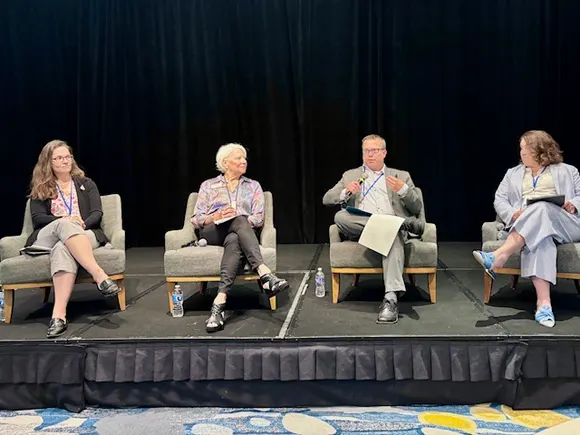
The cohesive approach to filling shortages of early interventionists, teachers, administrators, paraprofessionals and specialized instructional support personnel — as well as trying to reverse a decline in teacher education enrollment — reflects a shared mission to support students with disabilities at all age levels, speakers said July 14 at a legislative summit hosted by the Council for Exceptional Children and the Council of Administrators of Special Education.
“Schools are facing a significant shortage of qualified special education teachers — a challenge that directly affects the support and outcomes for students with disabilities,” said Kevin Rubenstein, president of CASE.
Rubenstein added that finding enough teachers to fill staff vacancies “feels like trying to spot a unicorn,” because it’s “rare but magical.”
At the start of the 2024-25 school year, 74% of both elementary and middle schools reported difficulty filling special education teacher vacancies with fully certified teachers, according to federal data. Early childhood education is also facing challenges in recruiting and retaining early interventionists.
At the higher education level, enrollment in teacher preparation programs has plummeted by 45% in one decade, according to CASE.
Supporting special educators
Developing a comprehensive special educator pipeline can better support teacher prep activities so future educators can eventually help boost outcomes for students at all levels, speakers said.
According to Amanda Schwartz, associate project director of the Maryland Early EdCorp Apprenticeship Program at the University of Maryland, some solutions to recruiting and retaining early interventionists include: boosting salaries, reducing teacher-student ratios, and training on high standards for early intervention services.
Recruiting and retaining qualified early interventionists is critical to children’s development, Schwartz said. “We want our teachers to have all this content in order to be able to deliver appropriate practice in classrooms,” she said.
David Krantz, executive director of special education at Michigan’s Saginaw Intermediate School District, said it’s helpful to have robust data that can pinpoint where there are staffing struggles.
Krantz then pointed to specific ways districts can attract and retain paraprofessionals who support special educators in the classroom. For starters, he said, paraprofessionals need to know their work matters.
“If people don’t feel valued in their service, they’re going to leave,” Krantz said.
The Michigan Association of Administrators of Special Education started a paraeducator learning series in January to provide professional development and other support to paraprofessionals. About 350 paraprofessionals have participated so far, Krantz said.
In the higher education field, Kyena Cornelius, an education professor at the University of Florida, put it bluntly: “Our supply pipeline is broken.”
While alternative pathways to the teaching profession have grown, those programs often don’t provide the depth of training into teaching pedagogy or disability-specific knowledge needed, she said. The alternative pathways, Cornelius added, were never meant to replace traditional teacher preparation programs
She highlighted CEC’s professional standards for special educators as a blueprint for the knowledge and skills teachers need so they are ready to serve students with disabilities and stay in the profession.
“We need to think about how we can not only attract and retain but how we can comprehensively prepare teachers in an affordable way, how we can make it attractable and get them the skills,” Cornelius said.
New elementary teachers who promote equity in science are proving highly effective at engaging students, no matter their background, a new University of Michigan study shows.
U-M researchers found that new educators are pioneering paths in science education by offering opportunities for scientific conversations, innovative learning strategies and encouraging children to become active participants in scientific exploration.
“When teachers are equipped to foster a more equitable and just learning environment in science, it not only enhances children’s understanding of scientific concepts but also empowers them to see themselves as scientists and to use science to address real-world issues that matter in their communities,” said Elizabeth Davis, a professor at U-M’s Marsal Family School of Education.
“Beginning teachers use a range of effective strategies to work toward more equitable science teaching. They vary in their emphasis on opportunity and access, representation and identification, expanding what counts as science and engaging children as change-makers using science to support a better world. This variation highlights the multiplicity of entry points into this challenging work and shows these teachers’ many strengths.”
The study, published in the General Proceedings of the 5th Annual Meeting of the International Society for the Learning Sciences 2025, also identified areas for growth: These teachers were less consistently likely to work to broaden what counts as science and to link science to social justice.
Davis and co-authors Jessica Bautista and Victoria Pérez Nifoussi said the study helps understand how different approaches to equity in science education can work together, potentially influencing future teacher training for improved K-12 science learning.
They emphasized the clear need for teacher educators and curriculum developers to provide more concrete examples and resources to help future teachers navigate complex, justice-oriented approaches to science.
“All children deserve to experience the joy and wonder of the natural world, yet science is taught far less often than language arts or math in elementary schools,” Davis said. “Furthermore, many students are marginalized in science, including girls, students of color, children with learning differences and queer or gender nonconforming children.”
Funding challenges impact long-term research
The study is part of the U-M ASSETS research, a four-year longitudinal project that began in September 2023. Although it was intended to run for four years, the project, funded by the National Science Foundation, was terminated in its 20th month, just shy of two years from its start.
“The termination of these NSF projects–focused on STEM education, and in particular equity in STEM education–is going to adversely affect science education and science for generations to come,” Davis said.
“We are seeking additional funds for this work. Regardless, we will continue to support the teachers who participate in this project and we’ll continue to collect and analyze data to the extent we’re able to do so.”
The team is now working on characterizing the participants’ first year of teaching to assess how their approaches to equitable and just elementary science teaching align with and differ from their approaches during teacher education.
Fernanda Pires, a Brazilian native, is a Lead Public Relations Representative at Michigan News, who covers the School of Education, student learning, coordinates media training and works with international communication. She holds a Master degree in Journalism/Broadcasting from Michigan State University and has more than 20 years of experience in communications. In Brazil, she worked for about 10 years as a broadcast reporter at Brazil’s national TV Globo and as a writer for the daily newspaper Correio Popular, in one of the largest cities in São Paulo State. She also worked as a public relations/corporate communications specialist for Brahma Brewing and Tilibra, the country’s leading manufacturer of school, office and time management stationery products.ᐧ
Latest posts by eSchool Media Contributors (see all)
America’s K-12 educators are more stressed than ever, with many considering leaving the profession altogether, according to new survey data from Prodigy Education.
The Teacher Stress Survey, which polled more than 800 K-12 educators across the U.S., found that nearly half of teachers (45 percent) view the 2024-25 school year as the most stressful of their careers. The surveyed educators were also three times more likely to say that the 2024-25 school year has been the hardest compared to 2020, when they had to teach during the height of the COVID-19 pandemic.
Student behavior challenges (58 percent), low compensation (44 percent), and administrative demands (28 percent) are driving teacher burnout and turnover at alarming rates. Public school teachers were more likely to report stress from unrealistic workloads, large class sizes, school safety concerns, and student behavior issues than their private school counterparts.
“The fact that stress levels for so many teachers have exceeded those of the pandemic era should be a wake-up call,” said Dr. Josh Prieur, director of education enablement at Prodigy Education and former assistant principal in the U.S. public school system. “Teachers need tangible, meaningful, and sustained support … every week of the year.”
Additional key findings include:
The vast majority of teachers (95 percent) are experiencing some level of stress, with more than two-thirds (68 percent) reporting moderate to very high stress. K-5 teachers were the most likely to feel extremely/very stressed (33 percent). Sixty-three percent of teachers report that their current stress levels are higher than when they first started teaching.
Nearly one in 10 teachers surveyed (9 percent) are planning to leave the profession this year, while nearly one in four (23 percent) are actively thinking about it. One-third of teachers do not expect to be teaching three years from now, likely because nearly half (48 percent) of teachers don’t feel appreciated for the work that they do.
Teachers are finding ways to prioritize their well-being, but time limits and job pressures often get in the way. Seventy-eight percent of teachers say they actively make time for self-care, but nearly half (43 percent) feel guilty for spending time on self-care and 78 percent have skipped self-care due to work demands. Implementing school-provided self-care perks and mandatory self-care breaks would appeal to teachers, with 85 percent and 76 percent taking advantage of each benefit, respectively.
Top solutions that would reduce teachers’ stress include a higher salary (59 percent), a four-day school week (33 percent), stronger classroom discipline policies (32 percent), and smaller class sizes (25 percent). Public school teachers were more likely to prefer a shorter week, while private school educators opted for higher pay.
“Teacher Appreciation Week should serve as the starting point for building systems that show we value teachers’ time, talent, and well-being,” said Dr. Prieur. “Districts can do this by investing in tools that reduce the burden on teachers, prioritizing time for self-care and implementing policies that reinforce teachers’ value as an ongoing commitment to bettering the profession.”
Laura Ascione is the Editorial Director at eSchool Media. She is a graduate of the University of Maryland’s prestigious Philip Merrill College of Journalism.
Krystal Emerson never imagined her son would spend his days at school being forcibly moved against his will by school staff and shut in an empty room.
But during the 2023-24 school year at Ellsworth Elementary-Middle School, that’s what happened — at least 18 times, according to Emerson and school district incident reports reviewed by the Maine Morning Star. Staff members put the 7-year-old boy in holds, forced him into empty rooms and did not let him out until he calmed down or his parents picked him up.
“It broke him, and it broke me,” Emerson said.
The trauma became so severe that her son, now a third grader, no longer attends school in person, she said.
What happened to Emerson’s son is not an isolated case. Across Maine, schools use restraint and seclusion on students more than 10,000 times each year, according to Maine Department of Education data — with some districts resorting to the emergency tactics regularly while others have changed policies and taken other steps so that such interventions are only used as a last resort.
In recent years, Maine as a whole has made an effort to reduce restraint and seclusion in schools, particularly for students with disabilities, with the U.S. Department of Education citing staff and student injuries and the resulting trauma for students as the reasons to curtail their use. The department has also condemned and discouraged these practices for years under multiple presidential administrations. Rare cases have resulted in serious injuries to students and even death.
A 2021 state law limits restraint and seclusion to emergencies. But as Maine educators report more challenging student behavior in the years since pandemic school closures, there have been calls to allow school staff to restrain and seclude children more often. A newly proposed bill would broaden the circumstances under which school staff could restrain or seclude students, igniting debate among educators, parents and lawmakers about how to manage student behavior without inflicting harm.
The Maine Education Association and the Maine School Management Association, representing teachers and administrators statewide, both support the proposal, citing increased reports of disruptive and violent student behavior — something educators nationwide have also reported in recent years.
The Gardiner-area school system, Maine School Administrative District (MSAD) 11, has led the push for that proposal. Victoria Duguay, principal of River View Community School in Gardiner, and MSAD 11 Superintendent Patricia Hopkins shared stories with lawmakers of students who hit and spit at adults, scream in hallways, throw chairs and destroy other students’ schoolwork.
Under the 2021 state law, school staff can only restrain students (immobilize them and move them against their will) or seclude them (isolate them in a room that they can’t leave) if their behavior “poses an imminent danger of serious physical injury” — requiring medical intervention beyond first aid, according to the Maine Department of Education regulations that govern restraint and seclusion.
“Staff are being hit, they’re being bit, but it doesn’t meet the threshold of serious imminent danger, because a 5-year-old isn’t going to [cause] an injury that requires medical care,” Hopkins said during an April 23 public hearing.
This extreme behavior, when it happens in a public place at school, traumatizes other students who witness it, Duguay said. The school sometimes has to close off access to common spaces — the gym or cafeteria — if a student acts out in a hallway through which students would need to pass.
Under the legislation MSAD 11 is supporting, staff would be able to move students against their will to a seclusion room or another quiet space without it counting as a restraint, which districts have to record, document, and report to the state.
But some educators who have pursued alternative training don’t agree that loosening restraint and seclusion requirements is the answer.
“The consequences of passing this bill will only inflict more trauma on students,” said Audrey Bartholomew, associate professor and coordinator of special education programs at the University of New England, who trains special education teachers. “Additionally, the behavior will keep happening, because restraint and seclusion is not an appropriate response to challenging behavior, and it will in no way help students remediate their behavior. These should not be referred to as strategies, treatments or solutions.”
Inside the three-hour restraint and seclusion of a 7-year-old
In October 2023, Emerson’s son started a behavior plan to help with concentration and self-regulation. The plan, which Emerson shared with the Maine Morning Star, highlighted the mother’s concerns about her son’s anger, dysregulation, anxiety and ADHD, and noted Emerson’s finding that occupational therapy had helped her son better regulate.
One week after the plan was put into place, the boy arrived at Ellsworth Elementary-Middle School already agitated, hit another student with a Pete the Cat stuffed animal and tried to leave the classroom, setting off a series of escalating interventions in which staff physically restrained him, relocated him against his will, and ultimately placed him in a small room where he stayed until his father arrived, according to incident reports shared with the Maine Morning Star.
The reports, which staff or administrators are required to write, offer an inside look at the behavior leading up to the restraint, how the situation escalated as staff restrained and secluded the boy, and how it continued for three hours, ending when Seth Emerson picked his son up from a seclusion room.
When the second grader initially tried to leave his classroom, two educators cornered the boy in a hallway nook, according to the report written by the school’s assistant principal. When he tried to push past them, they placed a mat between themselves and the child to block him from hitting them, and initiated the first of several physical holds. Each time he was released, he briefly calmed down but didn’t follow directions to sit still or stay in a designated spot, prompting a cycle: he would attempt to flee, staff would block him, the boy would resist, and staff would restrain him again, the report says.
About an hour in, while hiding in a locker, he asked to go home. A staff member moved him to a classroom, where he hid under a desk, retrieved rocks from his backpack, and threw them at staff, the report said. While the report described the projectiles as rocks, Emerson said her son had pebbles in his backpack.
Two hours in, staff called his parents. Even after he calmed down, they placed him in a seclusion room — referred to as a “quiet room” in the report — where they continued telling him to sit in a specific spot. When his father arrived, the boy walked out on his own, calm and cooperative.
Incidents like that continued for several more months for reasons that Emerson said did not warrant these measures: After he pulled books off shelves, punched a door, or refused to accompany staff to a quiet room, staff would put him in a physical hold or placed him in a room alone, according to a complaint Emerson filed with the district.
“I never condoned any of the behavior, whether he was throwing a book or whether he was yelling or running out of the classroom,” she said. “But he was not getting any education whatsoever last year. He was literally just going to school and being restrained and secluded.”
Frequent seclusions push an educator to quit
It’s not only students and their families who feel the trauma from restraints and seclusion. The educators who are told to put their hands on children feel it, too, several current and former teachers and education technicians told the Maine Morning Star.
Ashley Rose took a job as an ed tech at SeDoMoCha Elementary School in Dover-Foxcroft in August while working toward a degree in special education. But after months of witnessing staff placing students in empty rooms as they screamed and cried to be let out, she changed course.
In March, Rose switched her major, deciding she no longer wanted to become a teacher. On April 28, she resigned, writing to Superintendent Stacy Shorey that she had repeatedly raised concerns with supervisors about the school’s frequent use of seclusion, the lack of staff training on student behavior, and the absence of alternatives — without seeing meaningful change.
SeDoMoCha Elementary School has “quiet rooms” located within special education classrooms — which Rose described as 10-by-6-foot rooms with no windows. Some have benches and one light, while others are entirely empty, she said. All the doors have windows in them so staff can monitor students.
In her 10 years of working in special education, she has never seen such frequent use of quiet rooms, Rose said.
In December, Rose found herself participating in her first seclusion. The student she was working with wasn’t physically aggressive, just loud, and Rose’s plan had been to escort her into the special education classroom — not the quiet room — to help her calm down.
The student went with her voluntarily but was crying, she said. When they got to the classroom, another staff member who had worked at the school longer said it was part of that student’s behavior plan to go to the quiet room.
“That wasn’t my plan,” Rose said. “That room scares me just looking at it as an adult.”
As the student became more agitated, Rose said her own anxiety rose. If the student didn’t calm down, the other employee told Rose she had to shut the door. Rose complied, and then her colleague told her to hold the door shut with her foot to keep the student inside, she said.
Inside the room, the student began having what appeared to be an anxiety attack and threatened to break the window. She calmed down after about 20 minutes, and Rose let her out. Rose said she was not directed to file an incident report, nor was she told if someone else in the district did, despite the requirement in state law that districts document every seclusion.
Over the holiday break that followed, Rose said she had trouble sleeping. “All I can think about is the student I put in that room,” she said. “School should be their safe place, and these students were not feeling safe.”
Shorey, the superintendent, said staff members are required to report every incident, but she did not know about the particular incident Rose described. Special Education Director Sue Terrill said it’s possible that a staff member other than Rose wrote a report, but the district was unable to locate any documentation of that event.
The district trains employees in safety care — crisis management and prevention practices — Terrill said. It is open to other trainings, too, she said, including one that Rose brought to Terrill’s attention in February offered by the Maine nonprofit Lives in the Balance, which other districts have used to dramatically reduce their reliance on restraint and seclusion.
Quiet rooms present a gray area
Rose said she saw staff members keep students in seclusion rooms even when they were calm, using those same rooms for a variety of reasons beyond seclusion, which is banned or strictly regulated in at least seven states, according to the MOST Policy Initiative, a Missouri nonprofit. Maine came close to banning the rooms in 2021, but the final version of the law was amended to allow their use in emergencies.
Rose said she saw staff place students in quiet rooms to calm down after acting out, and then not allow them to exit for 20 minutes after they calmed down. If the seclusion happened at the end of the school day, sometimes the student would be expected to return to the quiet room the next day, she said.
Terrill recalled Rose raising this as an issue but denied keeping students in the rooms after they calmed down and no longer met the legal threshold for confinement.
But the district does use these rooms as timeout spaces, either by student choice or by staff direction, Terrill confirmed. Often, Terrill said, staff members are positioned outside the rooms, as they would be in a seclusion incident, but the student is typically free to leave the room, which is not the case in a seclusion.
Sometimes, the door is open, or a student can choose to shut the door with a staff member standing outside, she said.
“It can be the same room used if the student was in seclusion,” she said. “But if they’re taking a break because of something that happened, and that’s being used as a break space, the student might continue to work in there until they’re ready to go back to the classroom.”
Like RSU 68 in Dover-Foxcroft, districts across Maine also use seclusion rooms as quiet spaces, according to Ben Jones, a former Disability Rights Maine attorney who now works for Lives in the Balance.
“I think it’s actually more the rare case that the school is like, ‘We’re going to build this room and we’re going to call it the seclusion room, and it’s going to be used just for seclusion,’” he said.
If a student has voluntarily shut themselves in the seclusion room with a staff member outside and is free to go at any time, it would not count as seclusion under Maine law, he said. But if staff members ask students to stay in there to complete their work, as Rose described, whether it would count as a seclusion that districts are required to report to the state is “open to interpretation,” Jones said.
“The overall thing is, the kid is not learning, not in the classroom, in something that could easily turn into seclusion,” he said. “It’s inappropriate at best and potentially illegal if it’s an unrecorded seclusion.”
When are students and staff in “imminent danger”?
Education technicians like Rose — aides who often work with students one-on-one or in small groups — are often the ones handling student outbursts or potential violence, said Greg Kavanaugh, who spent 13 years working as an ed tech and special education teacher in Biddeford, Portland, and Yarmouth.
Ed techs are among the lowest-paid professionals in education, and often the least trained — including on behavior management techniques.
“They’re having to make good decisions about when to restrain, when to seclude, and their judgment is going to be really hard because they’re so stressed, overwhelmed, underpaid,” Kavanaugh said. “That just leads to more mistakes, more lapses in judgment.”
In his experience, Kavanaugh said, restraint and seclusion were consistently treated as last-resort measures — used only in extreme situations.
Staff received training on managing student behavior, they debriefed after restraints and seclusions, and they held regular conversations with parents, he said, which disability rights advocates recommend as best practices.
But working in a functional life skills program with students with moderate to severe disabilities, Kavanaugh said, deciding whether to restrain or seclude a child was never easy despite clear protocols in place. Even when a student threw a laptop across the room or hit him, he had to determine whether the behavior posed an imminent danger of serious injury that would require medical intervention beyond first aid — the standard in Maine law — and only intervene physically if it did. He also had to keep calm if students hit him, he said, because that still did not meet the legal standard.
Every time he did restrain or seclude a child, it stayed with him long after. He said he often questioned whether it had been the right call, thought about how families would respond, and considered the lasting effects the practice might have on the student — and on himself.
“Anytime there was a hold, a restraint or a seclusion, you’re taking that home, and you’re thinking about that kid when you’re at home, trying to move on with your day,” he said. “I’m a pretty strong-willed person, but there are plenty of times I would quietly be in tears, or going home and having an extra glass of wine, because I’m just not processing it well in the aftermath.”
Other students in the classroom witnessing these incidents are also traumatized, Kavanaugh said.
“You see the terror on their classmates’ faces, and you feel bad for the kid in a certain way because this is going to hurt their relationships,” he said.
But talking to parents afterward would always make him feel better, Kavanaugh said, because parents of students with disabilities are often dealing with similar behavior challenges at home.
District response to a parental complaint
Emerson, the parent in Ellsworth, complained to the school board, Superintendent Amy Boles, and the Maine Department of Education in August 2024, alleging that staff members had not met the legal threshold for using restraint and seclusion so often on her son.
Boles wrote back in October, saying in cases where Emerson’s son was hitting, scratching, and kicking staff, “it is my conclusion that active behavior like this toward another person does create an ‘imminent danger’ that the other person could be sufficiently injured that he or she may need more than ‘routine first aid.’”
“The incident may not in fact have caused an injury requiring that level of care, but a reasonable and prudent person could reasonably conclude that this could occur,” Boles wrote in her letter, reviewed by Maine Morning Star.
But the investigation the district launched in response to Emerson’s complaint found that staff had improperly restrained and secluded her son in at least five of the 18 incidents to which his mother objected. Some incident reports were also vaguely written, Boles wrote, which was the case for the three-hour incident in October 2023 — making it difficult to determine whether restraints and seclusion were warranted.
Nonetheless, Boles concluded in her letter to Emerson that all staff need training on the proper use of restraint and seclusion, and she agreed the district should rely on the practice less often.
Boles declined to comment on the investigation or specific incidents, but said district staff have undergone an initial training with Lives in the Balance, and followup trainings are planned.
“Behavior is an issue across the board. I mean, it’s skyrocketing everywhere. It’s not just Ellsworth,” she said. “But we’re working really hard to try to be preventative before it gets to that extreme state, trying to teach staff day-to-day strategies to prevent the behavior before it escalates.”
Emerson said her son is still visibly shaken every time he passes by the school, or even when someone mentions the word “school” around him.
“His world has become so small since these events, he rarely leaves our home,” she said. “Everyone continues about their day, and yet I’m left to pick up the pieces.”
Maine Morning Star is part of States Newsroom, a nonprofit news network supported by grants and a coalition of donors as a 501c(3) public charity. Maine Morning Star maintains editorial independence. Contact Editor Lauren McCauley for questions: [email protected].
Higher education faces a pivotal moment as Generative AI becomes increasingly embedded within academic practice. While AI technologies offer the potential to personalize learning, streamline processes, and expand access, they also risk exacerbating existing inequalities if not intentionally aligned with inclusive values. Building on our QAA-funded project outputs, this blog outlines a strategic framework for deploying AI to foster inclusion, equity, and ethical responsibility in higher education.
The digital divide and GenAI
Extensive research shows that students from marginalized backgrounds often face barriers in accessing digital tools, digital literacy training, and peer networks essential for technological confidence. GenAI exacerbates this divide, demanding not only infrastructure (devices, subscriptions, internet access) but also critical AI literacy. According to previous research, students with higher AI competence outperform peers academically, deepening outcome disparities.
However, the challenge is not merely technological; it is social and structural. WP (Widening Participation) students often remain outside informal digital learning communities where GenAI tools are introduced and shared. Without intervention, GenAI risks becoming a “hidden curriculum” advantage for already-privileged groups.
A framework for inclusive GenAI adoption
Our QAA-funded “Framework for Educators” proposes five interrelated principles to guide ethical, inclusive AI integration:
Understanding and Awareness Foundational AI literacy must be prioritized. Awareness campaigns showcasing real-world inclusive uses of AI (eg Otter.ai for students with hearing impairments) and tiered learning tracks from beginner to advanced levels ensure all students can access, understand, and critically engage with GenAI tools.
Inclusive Collaboration GenAI should be used to foster diverse collaboration, not reinforce existing hierarchies. Tools like Miro and DeepL can support multilingual and neurodiverse team interactions, while AI-powered task management (eg Notion AI) ensures equitable participation. Embedding AI-driven teamwork protocols into coursework can normalize inclusive digital collaboration.
Access to Resources Infrastructure equity is critical. Universities must provide free or subsidized access to key AI tools (eg Grammarly, ReadSpeaker), establish Digital Accessibility Centers, and proactively support economically disadvantaged students.
Ethical Responsibility Critical AI literacy must include an ethical dimension. Courses on AI ethics, student-led policy drafting workshops, and institutional AI Ethics Committees empower students to engage responsibly with AI technologies.
Implementation strategies
To operationalize the framework, a phased implementation plan is recommended:
Phase 1: Needs assessment and foundational AI workshops (0–3 months).
Phase 2: Pilot inclusive collaboration models and adaptive learning environments (3–9 months).
Key success metrics include increased AI literacy rates, participation from underrepresented groups, enhanced group project equity, and demonstrated critical thinking skill growth.
Discussion: opportunities and risks
Without inclusive design, GenAI could deepen educational inequalities, as recent research warns. Students without access to GenAI resources or social capital will be disadvantaged both academically and professionally. Furthermore, impersonal AI-driven learning environments may weaken students’ sense of belonging, exacerbating mental health challenges.
Conversely, intentional GenAI integration offers powerful opportunities. AI can personalize support for students with diverse learning needs, extend access to remote or rural learners, and reduce administrative burdens on staff – freeing them to focus on high-impact, relational work such as mentoring.
Conclusion
The future of inclusive higher education depends on whether GenAI is adopted with a clear commitment to equity and social justice. As our QAA project outputs demonstrate, the challenge is not merely technological but ethical and pedagogical. Institutions must move beyond access alone, embedding critical AI literacy, equitable resource distribution, community-building, and ethical responsibility into every stage of AI adoption.
Generative AI will not close the digital divide on its own. It is our pedagogical choices, strategic designs, and values-driven implementations that will determine whether the AI-driven university of the future is one of exclusion – or transformation.
This blog is based on the recent outputs from our QAA-funded project entitled: “Using AI to promote education for sustainable development and widen access to digital skills”
Dr Eleni Meletiadou is an Associate Professor (Teaching) at London Metropolitan University specialising in Equity, Diversity, and Inclusion (EDI), AI, inclusive digital pedagogy, and multilingual education. She leads the Education for Social Justice and Sustainable Learning and Development (RILEAS) and the Gender Equity, Diversity, and Inclusion (GEDI) Research Groups. Dr Meletiadou’s work, recognised with the British Academy of Management Education Practice Award (2023), focuses on transforming higher education curricula to promote equitable access, sustainability, and wellbeing. With over 15 years of international experience across 35 countries, she has led numerous projects in inclusive assessment and AI-enhanced learning. She is a Principal Fellow of the Higher Education Academy and serves on several editorial boards. Her research interests include organisational change, intercultural communication, gender equity, and Education for Sustainable Development (ESD). She actively contributes to global efforts in making education more inclusive and future-ready. LinkedIn: https://www.linkedin.com/in/dr-eleni-meletiadou/
LOS ANGELES — Scattered among the shrubs on the southern border lie belongings migrants left behind — toothbrushes, water bottles, baseball caps. Some of the owners forged north, crossing the boundary undetected. Others were apprehended or succumbed to dehydration, drowning or one of the unimaginable dangers in the harsh desert that straddles Mexico and the United States.
Angélica Reyes survived. At nine months old, she made the journey that could have claimed her life just as it started.
Since 1994, approximately 10,000 migrants have died in the borderlands. That year, the North American Free Trade Agreement (NAFTA) took effect. Designed to open trade between the United States, Canada and Mexico, the now-defunct policy has faced criticism for depressing Mexican wages. Their income flatlining, Reyes said, her parents left the city of Guadalajara, in the western part of Mexico, and headed with her to Los Angeles. They did not have authorization to live in the United States.
Reyes is now 32, though she remembers knowing she was undocumented as early as first grade.
“My mom was very cognizant of the discrimination and the obstacles that I would face throughout my life,” she said. “She made it clear, like, ‘You can’t mess up. You need to be twice as good to get half of the respect. You need to really prove that you earned your spot.’”
To do that, Reyes earned the good grades that set her up to become a history teacher for the Los Angeles Unified School District. She is one of about 15,000 teachers — and among the more than 835,000 undocumented people — who have received temporary permission to live, work and study in the United States through an Obama-era program known as Deferred Action for Childhood Arrivals (DACA). Women represent over half of DACA recipients, whose future in this country has been under threat by legal challenges to the program’s existence and the anti-immigration agenda of President Donald Trump.
https://datawrapper.dwcdn.net/nA5Cv/10/
If DACA ends, the goal of ongoing litigation, 700 education personnel, including teachers and teacher aides, would lose their jobs each month for two years as their work permits are revoked, according to FWD.us, an immigration reform organization. In California, the state with the most DACA recipients, 200 educators would lose their jobs monthly. In Texas, 100 would.
DACA-recipient teachers relate firsthand to the estimated 620,000 undocumented K-1 2 students, who confide in them about their experiences in immigrant families. They show youth that regardless of legal status, it’s possible to attain one’s professional goals. Many of these teachers are also activists, fighting for their students, themselves and other marginalized people. They see themselves as assets to schools.
“My immigration status inspires both my undocumented and documented students because they know all the obstacles that are faced by folks with my immigration status can be overcome,” Reyes said. “They know that if I could do it, that’s something that they could do as well.”
Without undocumented teachers, educator shortages across states could worsen. California has spent about $1.6 billion since the 2016-17 school year to tackle its teacher shortage. Still, the state issued 11 percent fewer teaching credentials between the 2021-22 and 2022-23 school years. Last year, it enacted legislation to eliminate barriers to entry, dropping a standardized test teaching candidates had to pass to demonstrate competence in math, reading and writing. But since undocumented immigrants aren’t widely perceived to be career professionals, the fact that schoolchildren nationwide depend on them has received scant attention in the broader immigration debate.
Maria Miranda, elementary vice president of the United Teachers Los Angeles (UTLA) labor union, said undocumented teachers “bring a different perspective to the table, a different skill set.”
Randi Weingarten, president of the American Federation of Teachers, the nation’s second largest teacher labor union, said DACA recipients in classrooms have strengthened the United States.
“They are role models, like all teachers, and should be treated as such, but instead, they are made to feel uncertain and fearful as their protections are challenged in court and as the Trump administration promotes mass deportations, even from sensitive locations like schools that were once considered off limits,” Weingarten said. “Immigration reform can’t be used as an excuse to rip teachers out of classrooms, where they are so desperately needed.”
Reyes at 1 year old with her father. (Angelica Reyes)
When Reyes was about to register for the SAT during her senior year in high school, one misinformed guidance counselor asked her why she planned to take the college entrance exam, insisting that higher education was off limits to undocumented students.
“I was devastated. It broke my heart,” Reyes said. “I remember crying and telling my mom, ‘I worked hard, for what?’”
Since 2001, however, California has extended access to in-state college tuition to undocumented students who have lived there long term. Unaware of this law and under the assumption that her counselor was correct, Reyes missed the deadline for the SAT and for the application to University of California schools, so she enrolled in a community college she could afford, a common path for many undocumented immigrants.
Then, in 2011, a state law was enacted that made her cry tears of gratitude: the California DREAM Act. The policy allows undocumented immigrants who entered the United States before they were 16 to obtain financial aid if they’ve earned qualifying credits at California schools. These young people have been nicknamed Dreamers after the Development, Relief, and Education for Alien Minors (DREAM) Act, a 2001 federal bill that would have given them legal status had it succeeded.
Reyes said that when she decided to apply to the University of California, Los Angeles (UCLA), a community college counselor took in her light brown skin and wavy black mane and without so much as seeing the 4.0 GPA in her transcript, told her to apply somewhere less competitive.
“I’m a competitive student!” Reyes recalled balking. “She opened my chart and she was, like, ‘Oh, you actually are.’ Her tune changed so quickly. It was really infuriating because if I had believed her, like many students believe counselors, I would have not gone to UCLA.”
In college, Reyes had to make a choice about her career path. Her research project on youth activism at Abraham Lincoln High School, where she graduated in 2010, had drawn her to education. “I realized that’s where I was needed,” she said.
It was at Lincoln High in March 1968 that students spearheaded the protests known as the Chicano Blowouts or East Los Angeles Walkouts. With signs stating “School Not Prison” and “We Are Not Dirty Mexicans,” almost 15,000 youth from Lincoln and other schools in historically Mexican-American East L.A. walked out of classes for a week to protest their substandard education.
Chicano student walkouts in front of Abraham Lincoln High School in East Los Angeles during the 1968 blowouts. (LAPL)
Back then, students could be paddled for speaking Spanish, and with few advanced courses at Eastside schools, they were routinely steered to vocational classes like auto shop. These inequities contributed to a 60 percent dropout rate in the area. Jailed for their activism against these circumstances, the teenagers garnered community support that ushered in sweeping policy changes — bilingual instruction, ethnic studies and more Latino teachers.
Today, the carnicerías, bungalow homes and palm trees along North Broadway Avenue, leading to 93 acres of green hills, offer no hint of the past tumult, but a mural at Lincoln commemorates the walkouts of nearly six decades ago.
Through her research, which also explored youth activism of the 2010s, Reyes learned that contemporary Lincoln High students continued to have unmet needs, such as support applying for college financial aid or accessing legal services as members of immigrant households. So when Lincoln High teachers asked if she wanted to develop a space to serve students, Reyes threw herself into the effort. The Paula Crisostomo Dream Center — named after a lead activist of the Chicano Blowouts and the inspiration for the 2006 film “Walkout” — opened at Lincoln in 2015.
“We established programming for immigrant students, for immigrant parents. We did immigrant and educational history,” Reyes said. “It’s still a resource for students at Lincoln, and we’ve expanded it to several other schools.”
Working at the Dream Center for three years convinced her that teaching was the best way to reach undocumented and marginalized youth. Rather than dismiss them, as she had been dismissed by school counselors, she would inspire students to excel academically regardless of legal status. In 2012, four years before she graduated from UCLA with a bachelor’s degree in sociology and six years before she earned her master’s in education from the university, DACA enabled undocumented students like herself to become career professionals.
Reyes surrounded by family at her high school graduation. (Angelica Reyes)
It’s complicated: Those two words capture Reyes’ feelings about DACA. Although the program allowed her to teach, she has long viewed it as flawed, exploitative and a “constant reminder” she isn’t “fully accepted.”
DACA stems from the activism of undocumented college students frustrated that the DREAM Act failed and that their immigration status would limit their potential, said Jennifer R. Nájera, author of “Learning to Lead: Undocumented Students Mobilizing Education.” Fighting for immigrant rights, they found a purpose.
Like the DREAM Act, DACA was reserved for young people who came to the United States as children and didn’t have criminal histories. “They had to graduate from high school or college or go to the military, show ‘good moral character,’” said Nájera, an associate professor in the Department of Ethnic Studies at the University of California, Riverside. Instead of citizenship, Obama’s executive order “provided temporary relief from deportation, a two-year relief specifically, that could be renewed, and a work permit, which was a big deal.”
While DACA recipients cherished their professional opportunities, some contended that the policy cast them as second-class citizens, Nájera said.
That includes Reyes.
“I knew it was a Band-Aid,” she said. “In fact, when I first started teaching, my DACA expired because of an issue with the application. They had asked me if I was in a gang, and apparently I didn’t check off the X hard enough, so I wasn’t hired at the beginning of the year. I remember feeling this immense frustration.”
Los Angeles Unified employs about 300 DACA-recipient school personnel, according to Miranda of the UTLA labor union. As Reyes’ teaching career started, DACA weathered the first of multiple legal challenges. Trump rescinded the program during his first term, a move the Supreme Court later blocked; at the time, Reyes told her students about possibly losing her job. Since then, she has endured several other threats to DACA , though she’s now pained to tell her students that the program isn’t accepting new applicants.
DACA, she said, must be replaced with a sustainable alternative.
In a December interview, Trump said, “We’re going to have to do something with” DACA recipients. “They were brought into this country many years ago” and “in many cases, they’ve become successful.”
But that sympathy has been absent from his immigration policies since he resumed office. He has issued an executive order prohibiting undocumented college students from receiving in-state tuition. He has also lifted restrictions on immigration enforcement in “sensitive locations” such as churches, hospitals and schools, prompting parents nationwide to keep kids out of class.
A protester waves the Mexican flag during a demonstration for immigration rights outside Los Angeles City Hall on February 5, 2025. (Qian Weizhong/Getty Images)
“A lot of times, the children are U.S. citizens and the parents are concerned,” Reyes said. “But I’ve had students who shared that their parents are U.S. citizens, and they’re still scared because they know that U.S. citizens are also caught up in these raids. So, this isn’t about criminality. It’s about the targeting of Brown folks.”
Immigration and Customs Enforcement (ICE) agents and other federal authorities reportedly detained or deported at least 10 U.S. citizens, including children, in the first 100 days of Trump’s second term.
Last month, the California state superintendent presented Senate Bill 48 to limit ICE appearances at schools as absences have spiked — and schools could lose millions of dollars since their funding is tied to average daily student attendance. About half of California children belong to families that include at least one immigrant parent, while one in five live in mixed-status families with at least one undocumented parent.
“It’s very taxing emotionally for our members and our students,” Miranda said of ICE enforcement. “We have students at the elementary level who are terrified of seeing anyone in uniform. Some of them are so young that they don’t know the difference between the police and immigration. It’s a very scary moment.”
When Trump targeted DACA during his first term, Reyes warned in a Los Angeles Times opinion piece that disbanding the program could upend public education. But now she says her students deserve more than DACA’s “breadcrumbs.”
“We need to fight for something new because my kids want to be chefs and doctors and lawyers, but they’re being held back by their immigration status,” she said. “It’s excruciating in two ways: One, I want my students to have the opportunities that they deserve to serve the community. And, two, I don’t know when I’m going to be taken from them because of my own uncertainty.”
For now, she knows that her presence makes a difference at her high school. Los Angeles Unified has an immigrant student body of about 30,000 students, according to UTLA. Of those, one in four is undocumented. After Reyes shared her immigration status with students during a recent lunchtime conversation, she said a ninth grader confessed that she planned to quit school because she, too, is undocumented. Learning Reyes managed to become a teacher made the girl reconsider.
“It was really beautiful to see that, like it reignited her hope to have a bright future,” Reyes said.
Although the risks of revealing her status frighten her, her conscience compels her to, Reyes said. She quoted Mexican Revolution leader Emiliano Zapata: “It’s better to die on your feet than to live on your knees.”
Staying silent as the president attacks immigrants would make it hard for Reyes to face the youth in her life — her son, especially.
Reyes after receiving her master’s degree in education from UCLA. (Angelica Reyes)
Whenever a state turned red on Election Night, Nathan Reyes felt his anxiety shoot up. Still, he held out hope Kamala Harris would win. Then the Electoral College math made it plain: Donald Trump would be president again.
Although he’s a U.S. citizen, Nathan wondered what lay ahead for his undocumented relatives under a president promising mass deportations.
“I feel worried for them because if they get deported, what am I going to do?” he asked. “Where am I going to stay?”
So, he began to plan. He and his family would “have to pick our poison” — stay in a country hostile to their presence or self-deport together to Mexico regardless of citizenship status.
That her son, with a pile of ringlets and a round cherubic face, was even considering these options stunned Reyes. Nathan is in seventh grade.
“I was like, ‘Oh, my God, this kid is 12,’” Angélica Reyes said. “Why is he talking about this?’”
Rummaging through a bin of childhood possessions in her mother’s bedroom last year, Reyes found a poem she wrote in fourth grade about her fear of police. Her parents were street food vendors, an occupation California criminalized until 2018, so Reyes realized growing up that one brush with the law could have seen them deported.
Just as she did not have a childhood free of deportation fears, neither has her son.
Nathan, now 13, is hardly the only youth pondering the possibility of a relative’s departure, according to Lisette Sanchez, a psychologist in Long Beach, California. She said children are leaving school with “Know Your Rights” cards advising them of their civil liberties during ICE encounters, but they may not understand the information.
“They’re just feeling fear,” she said. “They’re being told something’s gonna happen. So mental health wise, you’re looking at chronic anxiety. You’re looking at hypervigilance.”
Angélica Reyes and her son Nathan Reyes in front of Abraham Lincoln High School in East Los Angeles, California, on February 9, 2025. (Zaydee Sanchez/The 19th)
To gain some sense of control, they may overconsume social media, leading to racing thoughts, rapid heart rate and sleeping difficulties.
“It’s this chronic nonstop anxiety because the state of uncertainty feels never-ending, and in many ways, it is not ending, right?” Sanchez said. “There’s different news every day.”
By speaking openly with children, parents can help them better manage stress, she said. Teachers, if they’re permitted, can broach the topic of immigration. Nathan appreciated how his Spanish teacher led a class discussion after the election.
“Sharing your feelings and emotions and finding that a lot of other people are feeling very similar can bring comfort to you,” he said.
Reyes gave birth to her son while she was in college and briefly wed to his father. She applied for legal status as an immediate family member of a U.S. citizen, her spouse. But years passed before the federal government responded to her request, she said. By then, her marriage had ended.
“I don’t think people understand how long the path to citizenship can be, what it looks like, how costly and time-intensive it is,” Sanchez said.
Reyes, who has not remarried, said being undocumented seeps into every aspect of her life, including romantic relationships. She feels obligated to tell prospective partners about her status.
“I remember to always be upfront, like, ‘Hey, I’m undocumented. I don’t want you to think I’m going to use you for papers,’” she said.
Reyes lives in one of the country’s 4.7 million mixed-status households, which include undocumented individuals and people with legal status or U.S. citizenship. If she gets deported, she has arranged for others to care for her son.
Her sister, two years younger, is a U.S. citizen. Asked if she resents that twist of fate, Reyes said, “I’m happy that she gets to be safe. I think that there’s a lot of pain and guilt for her.”
Her sister realizes, Reyes said, that her entire family could be taken away.
Reyes and her son Nathan doing a science experiment when he was little. (Angelica Reyes)
Should she be forced out of the only country she considers home, Reyes wants her son to know this: “I would never willingly leave you. I am dedicated to you. I love you, and I will always be working as hard as possible to get back to you.”
For Nathan, it is mind-boggling that anyone would want his mother out. He doesn’t understand why politicians demonize immigrants. Trump launched his first presidential campaign calling them criminals and continues to malign them.
“My mom has done a lot of good for her community,” Nathan said. “She has organized a finders keepers closet where people who don’t have some resources they need, like canned food or clothes, can take what they need.”
Just as Nathan defends her honor, Reyes vouches for her parents. Her mother is now a nail technician and her father is a food vendor. Growing up, she said, she watched them visit the sick, volunteer at churches and fundraise for the poor.
“Whenever they saw a need, they stepped up, and they didn’t wait for someone else to help,” she said.
She’s hurt when people sympathize with Dreamers while disparaging their parents, that the immigration system paints family members as saints or sinners. The DACA recipients she’s researched feel similarly, Nájera said.
“Many of the students that I interviewed were always talking about their parents,” Nájera said. “They did not want their stories to be divorced from their parents and their family stories. These families, they’re units.”
But the Dream Act caused a migrant generational divide, insinuating that those who arrived in this country as children deserve citizenship, while their parents and others who arrived as adults do not, Nájera said.
Angélica Reyes helped paint the red and yellow skulls on the mural across the street from Abraham Lincoln High School in East Los Angeles, where she graduated. (Zaydee Sanchez/The 19th)
Migration often occurs out of necessity. For example, after NAFTA took effect in 1994, U.S. agricultural exports flooded Mexico, displacing workers, according to Edward Alden, a distinguished visiting professor in the College of Business and Economics at Western Washington University. Four years earlier, over 4 million Mexican migrants were in the United States, a figure that ballooned to nearly 13 million — around 9 percent of Mexico’s population — by 2008.
Reyes said NAFTA crushed the bakery business her father’s side of the family owned because it could not compete with the U.S. companies that swooped in. Her parents migrated north to earn higher wages.
Today, economic instability is but one of the reasons that motivate migrants.
“A lot of the Venezuelans are leaving Venezuela because it’s a violent, dangerous place, and the government has destroyed the economy in different ways,” Alden said. “Same thing out of Central America. These are people who aren’t necessarily leaving for economic reasons. They’re doing it for personal safety reasons.”
Reyes said she has Central American students who fled horrors. She wants them to feel safe in the United States, and the fact Los Angeles Unified has pledged not to cooperate with immigration officials voluntarily provides some comfort. Run by a formerly undocumented superintendent, the sanctuary districtblocked Homeland Security agents from entering two schools in April.
The fear of raids on campuses has traumatized her students, Reyes said. “It’s so difficult to convince my students that they are worthy of love and that they’re worthy of respect and that they deserve civil rights.”
It is equally difficult to keep advocating for herself, she said. But as the threat of deportation looms, she has no choice but to keep fighting.
“It’s hard to know that I can’t earn citizenship and that I can’t give my kid stability or safety,” she said. “I feel like if I could earn it, I would have three citizenships. I would have put in the work.”
When the developers of Canvas, the world’s leading web-based learning management system (LMS) software, invite you to a party—July 22-24 this year in Spokane, WA—you might consider the offer. Expected to draw 3,000 attendees across various roles from individual educators to IT leadership, the event promises product reveals, professional development, and collaborative opportunities like Hack Night, designed to help educators and administrators demonstrate tangible value when they return to their institutions. I was able to grab Ryan Lufkin, Vice President of Global Academic Strategy at Instructure, for some pre-show scuttle butt. Have a listen and scroll down for some highlights:
➜InstructureCon 2025 is evolving its AI strategy beyond basic features to an “agentic approach,” leveraging partnerships with Anthropic, Microsoft, and Google to create integrated AI experiences across campus environments. Says Ryan: “That’s because our open architecture is the most well-positioned learning platform in the world to really pull in, not just those AI-powered features that we’ve developed, but we also leverage those from our partners.”
➜Instructure is responding to educational institutions’ budget constraints by focusing on helping customers maximize their technology investments through better data usage, adoption metrics, and optimization strategies. Says Ryan: “We really want educators and administrators to walk away with just a toolkit of how to use these products better, how to use them more deeply and tangibly show that value because we know the budgets are tight.”
A few session highlights:
Transforming Student Success with Mastery Connect: A Proven Approach to Data-Driven Instruction in Richland One School District
Get ready to discover how Richland One (R1) School District in South Carolina has been transforming student success with Mastery Connect since 2015! This digital assessment platform has empowered R1 teachers to seamlessly administer standards-based formative and summative assessments, dive into score reports, and collaborate with colleagues. MC has unlocked deeper insights into student mastery, giving teachers and teams the tools they need to drive data-driven instruction. Join us for an exciting session where R1 will share its curriculum map structure and district approach to formative assessments. Discover how to save time on data collection and analysis—whether you’re a teacher or an admin. Learn how newer features like Quick Reassess and Assessment Compare can help you work smarter, not harder! You’ll also explore how to harness real-time data to fuel impactful discussions in your Professional Learning Communities (PLCs), driving focused, results-oriented collaboration.
Cracking the Code: Turning Data into Action with Mastery Connect
Drowning in data but struggling to make it meaningful? Join us on a journey to transform numbers into actionable insights using Mastery Connect! In this session, we’ll share how we built educator buy-in, shifted mindsets, and empowered teachers to use data in meaningful ways. Discover practical strategies for making data analysis approachable, actionable, and impactful—without overwhelming teachers. We’ll explore real-world examples, time-saving tips, and effective ways to connect assessment data to instructional decisions. Whether you’re just getting started or looking to refine your approach, this session will equip you with insights and strategies to turn data into a catalyst for student success.
Beyond the Classroom: Maximizing Canvas for Non-Academic Programs in Resource-Limited Environments.
As institutions face financial and regulatory challenges, maximizing existing technology investments is essential. While Canvas is primarily used for academic courses, its capabilities extend beyond the classroom. This session explores how a small liberal arts institution has successfully repurposed Canvas for faculty onboarding, professional development, syllabus archiving, student organizations, and institutional assessment—all without additional costs. A key focus will be the development of a syllabus submission portal designed to streamline syllabus collection, ensure compliance with learning outcomes, and create a structured faculty repository. Attendees will gain practical insights into overcoming adoption challenges, achieving measurable ROI, and applying these strategies to institutions of varying sizes.
Kevin is a forward-thinking media executive with more than 25 years of experience building brands and audiences online, in print, and face to face. He is an acclaimed writer, editor, and commentator covering the intersection of society and technology, especially education technology. You can reach Kevin at [email protected]
FREMONT, CA –Optoma, a world-leading provider of visual solutions, today announced its latest Creative Touch 3-Series Interactive Displays designed to empower educators and business professionals with new tools and features to enhance learning, make presentations more effective, and increase collaboration in classrooms, lecture halls, boardrooms, remote working and other business environments.
With Google’s Enterprise Device Licensing Agreement (EDLA) Certification and added functionality, the new 3-Series empowers professionals and educators to deliver dynamic and impactful content by providing cutting-edge tools that streamline management and elevate engagement. The advanced capabilities of the new 3-Series simplify planning and workflow through wireless collaboration, screen sharing, and innovative meeting solutions in both corporate and educational environments alike, all packed into a robust yet user-friendly platform.
The 3-Series: Purpose-Built for Corporate and Education Environments
New features and key highlights include:
Google EDLA Certification: Ensures compatibility and optimized performance with thousands of educational applications and services available directly from the pre-installed Google Play Store allowing users to experience the full Google Suite for real-time collaboration from practically anywhere in the world. Without compatibility issues or the hassle of connecting an external PC, users can easily access the entire suite of Google-based applications they are accustomed to – including Google Drive, Google Docs, YouTube, and more!
The Optoma Solution Suite (OSS®):User-friendly software featuring Artificial Intelligence (AI) enabled tools, such as Sticky Notes* and AI Handwriting Recognition, the OSS package also includes:
Whiteboard: Unleash creativity through a digital whiteboard packed with tools that make learning and sharing ideas engaging – facilitating collaboration in real-time from anywhere.
Smart Sketch tool is ideal for drawing diagrams as it recognizes shapes and drawings and converts them into clipart images.
Floating Toolbar and Infinity Canvas allow you to seamlessly switch between tools to suit your tasks with a virtually limitless writing space.
Innovative Annotation and Highlighter Tools make underlining key points or annotating complex diagrams a breeze.
File Manager: Easily save, organize, or move files from local storage to networkable storage or to popular cloud services in seconds.
Display Share: Connect any device to wirelessly broadcast, share, or stream your content to the big screen. Bringing your own device has never been easier.
Exceptional Performance: Seamless performance with an 8-core processor, Android 14 OS, and Zero Bonding screen for that natural writing experience.
“We are excited to announce our new 3-Series and partnership with Raptor Technologies which truly embodies our commitment to supporting education through cutting-edge visual solutions, enhanced software packages and safety and security,” said Maria Repole, Head of Marketing at Optoma.
A value-added solution, Optoma Management Suite (OMS®) is available out of the box on the 3-Series Interactive Displays, with a free trial available.** OMS offers IT administrators and technicians a real time remote platform to monitor, manage, diagnose, and update multiple or entire fleets of displays simultaneously that are either on the same network or connected through the cloud. OMS makes it easy to broadcast emergency messages, alerts, or announcements across displays worldwide.
Optoma is thrilled to partner with Raptor® Technologies, the leading innovator in school safety solutions, redefining the landscape of school security with its Raptor School Safety Software Suite. By integrating Raptor’s software with Optoma’s interactive displays, school administrators and students can receive real-time alerts and emergency notifications using CAP protocols to improve the overall safety of the school.
*Some AI features may require the use of an Optoma (OSS) account.
**Free trial licenses are available for a limited time. Please register your OMS® Cloud account at https://oms.optoma.com or speak with your local representative.
OMS and OSS are registered trademarks of Optoma Corporation
DLP is a registered trademark of Texas Instruments
About Optoma Technology, Inc.
Optoma combines cutting-edge technology and innovation to deliver remarkable visual display products designed to connect audiences with engaging video experiences. From the company’s ProScene projectors to its Creative Touch interactive, Professional LCD and LED displays, Optoma’s suite of products can meet the demands of nearly any professional environment, including conference rooms and classrooms, digital signage, corporate, houses of worship, retail, simulation environments and control rooms. Optoma Technology is the U.S. headquarters for The Optoma Group, with continental headquarters also in Europe and Asia. For more information, visit optomausa.com.
eSchool Media staff cover education technology in all its aspects–from legislation and litigation, to best practices, to lessons learned and new products. First published in March of 1998 as a monthly print and digital newspaper, eSchool Media provides the news and information necessary to help K-20 decision-makers successfully use technology and innovation to transform schools and colleges and achieve their educational goals.
CHICAGO, IL (GLOBE NEWSWIRE) —Otus, a leading provider of K-12 student data and assessment solutions, has been awarded a prestigious Gold Stevie® Award in the category of Customer Service Department of the Year at the 2025 American Business Awards®. This recognition celebrates the company’s unwavering commitment to supporting educators, students, and families through exceptional service and innovation.
In addition to the Gold award, Otus also earned two Silver Stevie® Awards: one for Company of the Year – Computer Software – Medium Size, and another honoring Co-founder and President Chris Hull as Technology Executive of the Year.
“It is an incredible honor to be recognized, but the real win is knowing our work is making a difference for educators and students,” said Hull. “As a former teacher, I know how difficult it can be to juggle everything that is asked of you. At Otus, we focus on building tools that save time, surface meaningful insights, and make student data easier to use—so teachers can focus on what matters most: helping kids grow.”
The American Business Awards®, now in their 23rd year, are the premier business awards program in the United States, honoring outstanding performances in the workplace across a wide range of industries. The competition receives more than 12,000 nominations every year. Judges selected Otus for its outstanding 98.7% customer satisfaction with chat interactions, and exceptional 89% gross retention in 2024. They also praised the company’s unique blend of technology and human touch, noting its strong focus on educator-led support, onboarding, data-driven product evolution, and professional development.
“We believe great support starts with understanding the realities educators face every day. Our Client Success team is largely made up of former teachers and school leaders, so we speak the same language. Whether it’s during onboarding, training, or day-to-day communication, we’re here to help districts feel confident and supported. This recognition is a reflection of how seriously we take that responsibility and energizes us to keep raising the bar,” said Phil Collins, Ed.D., Chief Customer Officer at Otus.
Otus continues to make significant strides in simplifying teaching and learning by offering a unified platform that integrates assessment, data, and instruction—all in one place. Otus has supported over 1 million students nationwide by helping educators make data-informed decisions, monitor progress, and personalize learning. These honors reflect the company’s growth, innovation, and steadfast commitment to helping school communities succeed.
About Otus
Otus, an award-winning edtech company, empowers educators to maximize student performance with a comprehensive K-12 assessment, data, and insights solution. Committed to student achievement and educational equity, Otus combines student data with powerful tools that provide educators, administrators, and families with the insights they need to make a difference. Built by teachers for teachers, Otus creates efficiencies in data management, assessment, and progress monitoring to help educators focus on what matters most—student success. Today, Otus partners with school districts nationwide to create informed, data-driven learning environments. Learn more at Otus.com.
eSchool Media staff cover education technology in all its aspects–from legislation and litigation, to best practices, to lessons learned and new products. First published in March of 1998 as a monthly print and digital newspaper, eSchool Media provides the news and information necessary to help K-20 decision-makers successfully use technology and innovation to transform schools and colleges and achieve their educational goals.
Bullying in nursing is a well-documented issue, but less attention has been given to the experiences of nurse educators who face hostility within academic institutions. While nursing education should promote professional growth, collaboration, and mentorship, many nurse educators—especially those in tenure-track positions—experience bullying from colleagues, senior faculty, or administrators. These hostile work environments have profound consequences, leading many talented educators to leave academia entirely or return to clinical practice. The prevalence of academic bullying, its impact on both individuals and institutions and strategies for addressing it must be explored to create healthier academic environments.
The Scope of Bullying in Nursing Academia
Bullying in higher education is a widespread and systemic issue. Keashly and Neuman (2010) found that faculty members in academia frequently experience bullying behaviors, including persistent criticism, professional exclusion, and attempts to damage their reputation. These behaviors often go unaddressed due to power imbalances, hierarchical structures, and institutional tolerance for incivility. Within nursing education, bullying often manifests in ways that undermine an educator’s credibility and professional standing, such as excessive scrutiny of work, withholding of resources, and exclusion from key academic opportunities.
The hierarchical structure of academia places tenure-track faculty at particular risk, as they are vulnerable to unfair evaluation practices, disproportionate workloads, and a lack of mentorship from senior faculty. Levecque et al. (2017) found that faculty in highly demanding positions—such as those pursuing tenure—are at greater risk for mental health challenges, including anxiety, depression, and burnout. When bullying is added to these pressures, the result is often faculty disengagement or attrition.
The Impact on Nurse Educators and Institutions
The consequences of academic bullying extend beyond the individuals directly affected. Nurse educators who experience bullying report increased stress, reduced job satisfaction, and emotional exhaustion (Clark, Olender, Cardoni, & Kenski, 2011). When educators feel unsupported, their ability to mentor students and contribute to nursing scholarship declines, diminishing the overall quality of nursing education.
This loss of faculty members is particularly concerning, given the ongoing nursing faculty shortage. The American Association of Colleges of Nursing (AACN) reports that thousands of qualified nursing applicants are turned away each year due to a lack of faculty. Bullying-induced faculty turnover exacerbates this crisis, forcing institutions to rely on fewer educators to meet growing educational demands. Furthermore, a toxic workplace culture may discourage younger nurse educators from entering academia, perpetuating the shortage and reducing the profession’s ability to educate future nurses.
Addressing Bullying in Nursing Academia
Given the significant impact of academic bullying, institutions must take proactive steps to identify, manage, and prevent these behaviors.
1. Recognizing and Reporting Bullying
Bullying in academia can be subtle, making it difficult to document and report. However, keeping a record of incidents, including dates, interactions, and effects, can provide necessary evidence when seeking support. Educators should familiarize themselves with their institution’s policies and report bullying through appropriate channels, such as human resources or faculty grievance committees.
2. Fostering a Culture of Civility
Clark et al. (2011) emphasize the importance of fostering a culture of civility within nursing education. Institutions should actively promote respect, professionalism, and mentorship while discouraging competitive or exclusionary behaviors. Faculty development programs that focus on conflict resolution, communication skills, and leadership training can help create a more supportive work environment.
3. Strengthening Institutional Policies
Many academic institutions have workplace violence and anti-bullying policies, but these often go unenforced. Keashly and Neuman (2010) highlight that stronger institutional accountability measures—such as anonymous reporting systems, independent faculty ombudsman offices, and clear disciplinary actions—are needed to address bullying effectively. Institutions must not only implement policies but also actively enforce them.
4. Providing Support and Advocacy
Support networks can be a powerful tool in mitigating the effects of bullying. Connecting with trusted colleagues, mentors, or professional organizations, such as the National League for Nursing (NLN) or AACN, can provide emotional and professional support. Faculty experiencing bullying should seek guidance from legal professionals or faculty unions if institutional responses are inadequate.
5. Prioritizing Self-Care and Career Flexibility
For nurse educators facing persistent bullying, self-care and professional reassessment are critical. Seeking therapy or counseling, practicing mindfulness, and engaging in professional development outside of a toxic work environment can help educators protect their mental well-being. If the workplace culture remains unsupportive, transitioning to a different institution or returning to clinical practice may be a viable option.
Conclusion
Bullying among nurse educators in higher education is a serious yet underrecognized issue that negatively impacts both faculty and students. The hierarchical nature of academia and institutional tolerance for incivility often allow bullying to persist unchecked, leading to faculty burnout, decreased student engagement, and an exacerbation of the nursing faculty shortage. Addressing this issue requires individual advocacy, institutional policy changes, and a cultural shift toward civility and mentorship. By recognizing and addressing bullying in nursing academia, institutions can retain skilled educators, improve faculty well-being, and ultimately strengthen the future of nursing education.
Dr. Robert Lucia is a three-time Bradley University graduate, receiving his undergraduate degree in 2008, his master’s in 2011, and his doctorate in 2019. All three of his degrees were from the College of Education and Health Sciences. Dr. Lucia started his career at the Children’s Hospital of Illinois in 2010 as a mental health provider in Pediatric Palliative Care. He worked closely with patients with devastating diagnoses, companioning them through their end-of-life journey. In 2015, he joined the Cystic Fibrosis Clinic at OSF Healthcare as inpatient clinical coordinator. This innovative role was created to help manage the inpatient consult service for cystic fibrosis patients in both the pediatric and adult setting. This unique RN role utilized the full nursing scope of practice, and the work Dr. Lucia did to reduce 30-day readmission rates was published nationally. In 2019, Dr. Lucia moved into clinical practice in OSF OnCall Urgent Care and eventually was the Lead Provider for the region. He has been teaching in higher education in some capacity since 2010. Dr. Lucia continues to maintain clinical practice in a federal qualified primary care clinic, in addition to a pediatric sleep medicine clinic. Dr. Lucia is passionate about health care leadership and has received training at Harvard University in both Foundational Leadership and Remote Leadership. Additionally, he received training from the University of South Florida in Inclusive and Ethical Leadership.
References
Clark, C. M., Olender, L., Cardoni, C., & Kenski, D. (2011). Fostering civility in nursing education and practice: Nurse leader perspectives. Journal of Nursing Administration, 41(7-8), 324-330. Retrieved from https://pubmed.ncbi.nlm.nih.gov/21799364/
Keashly, L., & Neuman, J. H. (2010). Faculty experiences with bullying in higher education: Causes, consequences, and management. Administrative Theory & Praxis, 32(1), 48–70.
Levecque, K., Anseel, F., De Beuckelaer, A., Van der Heyden, J., & Gisle, L. (2017). Work organization and mental health problems in PhD students. Research Policy, 46(4), 868-879.
Roberts, S. J., DeMarco, R., & Griffin, M. (2009). The effect of oppressed group behaviors on the culture of the nursing workplace: A review of the evidence and interventions for change. Journal of Nursing Management, 17(3), 288-293. Retrieved from https://onlinelibrary.wiley.com/doi/10.1111/j.1365-2834.2008.00959.x